User login
As family medicine was being formally recognized as a medical specialty in 1971, three young physicians were preparing to enter the field. Family Practice News, an Elsevier publication, sat down with the 2nd-year family practice residents at that time to find out what they thought of their training, their newly recognized specialty, and what their careers would hold.
Now, 40 years later, we invited them to look back on how their expectations stacked up to the reality of clinical practice.
Although the three physicians came into the specialty in much the same way, their subsequent career choices led them down different paths.
A Call to Geriatric Care: Dr. Alva S. Baker
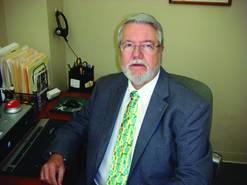
Dr. Alva S. "Buzz" Baker was a 2nd-year resident at the University of Maryland in 1971. He spent several years in general family practice before deciding that he wanted to concentrate on geriatric medicine. Today, Dr. Baker serves as director of the center for the study of aging at McDaniel College in Westminster, Md., and teaches in the gerontology program. "A major emphasis of my life in the last several years has been on education of physicians and health professionals," he said.
Question: In terms of your work in geriatrics, how do you feel your medicine training prepared you for that – or did it?
Dr. Baker: It absolutely did not. Forty years ago, medical schools had very little emphasis on geriatric medicine. I have been involved in the care of people in nursing homes since 1972. As it was structured then, the training for geriatrics was really not sufficient in many residency training programs. I know that residencies now have more emphasis on geriatric medicine and taking care of older patients. The doctors who are coming out of residency now are going to live their lives in large part taking care of older persons.
Question: When you look back to when you were a resident, are you surprised by the path your career has taken?
Dr. Baker: Absolutely. I grew up on a farm in a rural area. I went to college and to medical school with the goal of becoming a small-town physician, as my family physician had been when I was growing up. I was very comfortable with that into residency, because the folks who were faculty in the residency program and served as teaching mentors were basically physicians who were in small towns or had been in small towns.
When I went into practice in 1976, it was in what was then a relatively small town of 10,000 people. That town is now home to about 30,000 people, part of a bedroom community of Baltimore. So my goal to be the "country doctor" was never fully realized.
Even in that small-town environment, the writing was on the wall that family doctors as we had known them over the previous half century needed to evolve into a different kind of physician, one who was much more science based, one who was constantly interacting with other aspects of the medical community. Not that the country doctors over the previous half century didn’t do that – but it really became a necessity to do that.
Question: With that in mind and especially in light of some of the teaching activities that you still do, where do you see the specialty going as you talk to young physicians and as you look at how family medicine has changed over the past several decades?
Dr. Baker: Family medicine is still family medicine. So the physician who is going to practice broad-based family medicine still needs training in all the specialty disciplines in order to do that and to do that confidently. If somebody is going to take care of children and newborns and adolescents and young adults and middle-aged adults, as well as older persons, the different aspects of caring for certain age groups are constantly evolving and changing.
I think it is a lot harder, actually, than when I was in residency for somebody to be able to put together and achieve a sufficient level of education and skill level in the 3 years that the residency comprises.
Question: Do you have any advice for today’s residents – especially if they have an interest in geriatrics – about how to approach that and have a meaningful career?
Dr. Baker: If they are interested in geriatrics, they need to get a better understanding of what practicing geriatric medicine is all about. My advice to them would be to try to find a true geriatrician who is just doing geriatrics and try to spend time with that person and learn what his or her life as a geriatrician is all about. The second thing that they could do is to get involved with a nursing home.
Question: Looking back, what are some of the more rewarding things that have happened over the years in your career?
Dr. Baker: Overwhelmingly, No. 1 is the satisfaction of working with humans at whatever age, assisting them in their health care, and helping them to learn about themselves and their health issues and how to manage them. The second thing would be the period of practicing geriatrics for the frail elderly. I think the third significant concept of my practice life has been the joy of being a lifelong learner.
A Nonclinical Second Act: Dr. William D. Hakkarinen
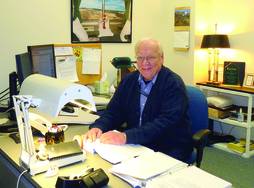
Dr. William D. Hakkarinen was a 2nd-year family practice resident at Hershey Medical Center of Pennsylvania State University in 1971. Over the years, he has worked in rural and urban practices and served as director of the family practice residency at the Franklin Hospital Center in Baltimore. He is also a past president of the Maryland Academy of Family Medicine.
Starting in 2001, he switched to a nonclinical role, and currently works as a medical consultant in the Maryland Disability Determination Services, where he helps to review applicants for Social Security Disability.
Question: Did your family medicine training prepare you well, and were there any gaps that you noticed?
Dr. Hakkarinen: I wish I had had more ambulatory surgical training. There were surgical rotations, but I could have used even more. But that was then, and I think they have changed family practice residencies a lot since I went through. I could not say anything negative about family practice training. For me, it continues to be a wonderful career, and it was a great way to start.
Question: What were some of the biggest surprises for you in your family medicine clinical career?
Dr. Hakkarinen: From the clinical practice standpoint, I had no idea that psychiatric issues and depression were as common as they turned out to be. I think that’s well recognized now in residency programs, more so than when I first went through.
A sad surprise over time was how much of medicine became a business. I have to be frank. I was very naive as a resident. I looked at medicine as a calling, a profession – not a job. I was a residency director for 18 years, and my last year of residency directorship was in 2000. By then, the residents were talking about the jobs they were going to get after residency, rather than how to start their careers.
Question: Did you see interest in family medicine residencies decline?
Dr. Hakkarinen: As a residency director, we went from being at the peak of interest and being able to fill our residency slots three times over, to having to struggle and fight. That’s so sad, because the need is great – and the need is even greater as we talk about health care reform. It’s business. If you’re a medical student with $40,000, $60,000, $80,000, or $100,000 in debt, family practice incomes do not help you reduce your debt.
Question: Do you think the emphasis that’s being placed now on primary care through health reform will turn this around? Do policy makers need to address the financial pressures as well?
Dr. Hakkarinen: Oh, I think they need to do both. Yes, there has to be interest from health reform, but there has to be some way of coping with the cost.
One of the things that’s happening with health reform is that less-expensive ways of training to do primary care are becoming more evident. There are more people going into physician assistant programs and going into family nurse practitioner programs. It doesn’t cost as much to do that. I have been part of physician assistant and nurse practitioner training ever since the military. More and more, they are becoming not just physician adjuncts and expanders – they are becoming physician substitutes. I don’t know where it’s going to go, but if I were a young person today wanting to do primary care, I’d look long and hard at whether I want to spend what it takes to go to medical school.
Question: About 10 years ago, you left clinical practice for a nonclinical career as a medical consultant for the Maryland Disability Determination Services. Do you enjoy the work?
Dr. Hakkarinen: I absolutely love what I do. I come to work whistling, and I go home whistling. It’s a challenge; it’s satisfying; it’s helping people; it’s using the skills I learned as a family physician. This is an outstanding encore career.
Question: Do you recommend nonclinical careers for family physicians?
Dr. Hakkarinen: In general, I’d say do what you want and do what you can. If you’re happy and enjoying clinical medicine, I don’t think a nonclinical career is in any way by itself better than a clinical career. I think that your circumstances can change. I just think people need to recognize that you can be happy and satisfied doing either.
Question: Do you have any advice for today’s family medicine residents?
Dr. Hakkarinen: I would encourage today’s family physicians to keep the faith and look to find where they fit. There are plenty of places in the country that are crying for family physicians and will be eager for them. I don’t think there’s any dearth of opportunity anywhere.
Family practice has in some sense lived up to our expectation in that it is now an integral part of medicine. We’ve had surgeons general who are family physicians. We have medical school deans who are family physicians. With the exception of a very few medical schools, there’s full acceptance. But that means you’ve got to have continued standards and continued excellence.
Embracing Change: Dr. Daniel R. McCready
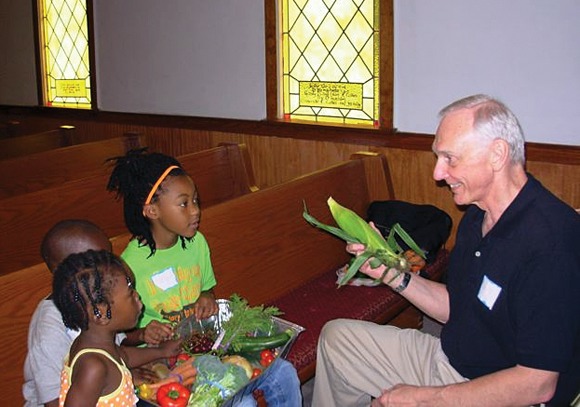
Dr. Daniel R. McCready was a 2nd-year family practice resident at Wilmington (Del.) Medical Center in 1971. He started out in solo practice in Virginia Beach in 1976, and over the years his practice grew to include several physicians and nurse practitioners.
In the early 1990s, the practice faced financial pressure. "The expenses were going up, and the reimbursements from the various third-party payers were going down," he said. "It was a bad situation." The solution came in the form of a partnership with the local hospital.
In 2009, Dr. McCready retired from clinical practice, at least for now. "On the very last day of work, I still enjoyed seeing patients the way I did when I was a family practice resident," he said. "It’s wonderful to be able to interact with people one on one."
Question: You were on the ground floor as family medicine got started as a specialty. Is it as relevant today?
Dr. McCready: I don’t see any real change. I think it’s good for people to have a primary doctor – the patient knows the doctor, and the doctor knows the patient and the patient’s family. There’s something very useful about that, because you then have this background of understanding that you can’t get when you just see a different doctor each time. The continuity is very useful in keeping things in context. I think maintaining that personal, quality, doctor-patient office visit is still as important now as it was then.
Question: When you look back, what were some of the biggest surprises for you?
Dr. McCready: I think a lot of things happened between 1971 and 2009 that I hadn’t expected. For example, when I first went into practice, it was the old idea that the doctor and the patient had this doctor-patient relationship. Also, for medical services rendered, the patient felt that it was between the patient and the doctor. As time went on, the third party became the one that started paying the bills, instead of the patient. Then we had the HMOs, then the managed care and gatekeeper idea.
With a lot of things that have happened, doctors initially have been surprised, shocked, concerned, and not sure what to do. But by our nature we have to be adaptable, because the landscape is constantly changing.
So urgent care centers came and went, and then we had diagnostic-related groups for hospitalized patients and that took awhile to get used to. Then you saw the advent of fewer and fewer doctors being in solo and small-group practices, and more and more doctors being affiliated with a hospital-based entity. I think that’s even truer now than ever. Then the electronic health record came in.
Question: What were the aspects of your career that you most enjoyed?
Dr. McCready: I always enjoy knocking on the door, going in, saying hello to the patient, and having that one-on-one interview. I was trained by my professor of medicine at the University of Maryland, Dr. Theodore Woodward, who said, "You just have to listen to the patient, and the patient will tell you what’s wrong most of the time." That ability to just go in and listen to people tell their story, I never got tired of that.
As family medicine was being formally recognized as a medical specialty in 1971, three young physicians were preparing to enter the field. Family Practice News, an Elsevier publication, sat down with the 2nd-year family practice residents at that time to find out what they thought of their training, their newly recognized specialty, and what their careers would hold.
Now, 40 years later, we invited them to look back on how their expectations stacked up to the reality of clinical practice.
Although the three physicians came into the specialty in much the same way, their subsequent career choices led them down different paths.
A Call to Geriatric Care: Dr. Alva S. Baker
Dr. Alva S. "Buzz" Baker was a 2nd-year resident at the University of Maryland in 1971. He spent several years in general family practice before deciding that he wanted to concentrate on geriatric medicine. Today, Dr. Baker serves as director of the center for the study of aging at McDaniel College in Westminster, Md., and teaches in the gerontology program. "A major emphasis of my life in the last several years has been on education of physicians and health professionals," he said.
Question: In terms of your work in geriatrics, how do you feel your medicine training prepared you for that – or did it?
Dr. Baker: It absolutely did not. Forty years ago, medical schools had very little emphasis on geriatric medicine. I have been involved in the care of people in nursing homes since 1972. As it was structured then, the training for geriatrics was really not sufficient in many residency training programs. I know that residencies now have more emphasis on geriatric medicine and taking care of older patients. The doctors who are coming out of residency now are going to live their lives in large part taking care of older persons.
Question: When you look back to when you were a resident, are you surprised by the path your career has taken?
Dr. Baker: Absolutely. I grew up on a farm in a rural area. I went to college and to medical school with the goal of becoming a small-town physician, as my family physician had been when I was growing up. I was very comfortable with that into residency, because the folks who were faculty in the residency program and served as teaching mentors were basically physicians who were in small towns or had been in small towns.
When I went into practice in 1976, it was in what was then a relatively small town of 10,000 people. That town is now home to about 30,000 people, part of a bedroom community of Baltimore. So my goal to be the "country doctor" was never fully realized.
Even in that small-town environment, the writing was on the wall that family doctors as we had known them over the previous half century needed to evolve into a different kind of physician, one who was much more science based, one who was constantly interacting with other aspects of the medical community. Not that the country doctors over the previous half century didn’t do that – but it really became a necessity to do that.
Question: With that in mind and especially in light of some of the teaching activities that you still do, where do you see the specialty going as you talk to young physicians and as you look at how family medicine has changed over the past several decades?
Dr. Baker: Family medicine is still family medicine. So the physician who is going to practice broad-based family medicine still needs training in all the specialty disciplines in order to do that and to do that confidently. If somebody is going to take care of children and newborns and adolescents and young adults and middle-aged adults, as well as older persons, the different aspects of caring for certain age groups are constantly evolving and changing.
I think it is a lot harder, actually, than when I was in residency for somebody to be able to put together and achieve a sufficient level of education and skill level in the 3 years that the residency comprises.
Question: Do you have any advice for today’s residents – especially if they have an interest in geriatrics – about how to approach that and have a meaningful career?
Dr. Baker: If they are interested in geriatrics, they need to get a better understanding of what practicing geriatric medicine is all about. My advice to them would be to try to find a true geriatrician who is just doing geriatrics and try to spend time with that person and learn what his or her life as a geriatrician is all about. The second thing that they could do is to get involved with a nursing home.
Question: Looking back, what are some of the more rewarding things that have happened over the years in your career?
Dr. Baker: Overwhelmingly, No. 1 is the satisfaction of working with humans at whatever age, assisting them in their health care, and helping them to learn about themselves and their health issues and how to manage them. The second thing would be the period of practicing geriatrics for the frail elderly. I think the third significant concept of my practice life has been the joy of being a lifelong learner.
A Nonclinical Second Act: Dr. William D. Hakkarinen
Dr. William D. Hakkarinen was a 2nd-year family practice resident at Hershey Medical Center of Pennsylvania State University in 1971. Over the years, he has worked in rural and urban practices and served as director of the family practice residency at the Franklin Hospital Center in Baltimore. He is also a past president of the Maryland Academy of Family Medicine.
Starting in 2001, he switched to a nonclinical role, and currently works as a medical consultant in the Maryland Disability Determination Services, where he helps to review applicants for Social Security Disability.
Question: Did your family medicine training prepare you well, and were there any gaps that you noticed?
Dr. Hakkarinen: I wish I had had more ambulatory surgical training. There were surgical rotations, but I could have used even more. But that was then, and I think they have changed family practice residencies a lot since I went through. I could not say anything negative about family practice training. For me, it continues to be a wonderful career, and it was a great way to start.
Question: What were some of the biggest surprises for you in your family medicine clinical career?
Dr. Hakkarinen: From the clinical practice standpoint, I had no idea that psychiatric issues and depression were as common as they turned out to be. I think that’s well recognized now in residency programs, more so than when I first went through.
A sad surprise over time was how much of medicine became a business. I have to be frank. I was very naive as a resident. I looked at medicine as a calling, a profession – not a job. I was a residency director for 18 years, and my last year of residency directorship was in 2000. By then, the residents were talking about the jobs they were going to get after residency, rather than how to start their careers.
Question: Did you see interest in family medicine residencies decline?
Dr. Hakkarinen: As a residency director, we went from being at the peak of interest and being able to fill our residency slots three times over, to having to struggle and fight. That’s so sad, because the need is great – and the need is even greater as we talk about health care reform. It’s business. If you’re a medical student with $40,000, $60,000, $80,000, or $100,000 in debt, family practice incomes do not help you reduce your debt.
Question: Do you think the emphasis that’s being placed now on primary care through health reform will turn this around? Do policy makers need to address the financial pressures as well?
Dr. Hakkarinen: Oh, I think they need to do both. Yes, there has to be interest from health reform, but there has to be some way of coping with the cost.
One of the things that’s happening with health reform is that less-expensive ways of training to do primary care are becoming more evident. There are more people going into physician assistant programs and going into family nurse practitioner programs. It doesn’t cost as much to do that. I have been part of physician assistant and nurse practitioner training ever since the military. More and more, they are becoming not just physician adjuncts and expanders – they are becoming physician substitutes. I don’t know where it’s going to go, but if I were a young person today wanting to do primary care, I’d look long and hard at whether I want to spend what it takes to go to medical school.
Question: About 10 years ago, you left clinical practice for a nonclinical career as a medical consultant for the Maryland Disability Determination Services. Do you enjoy the work?
Dr. Hakkarinen: I absolutely love what I do. I come to work whistling, and I go home whistling. It’s a challenge; it’s satisfying; it’s helping people; it’s using the skills I learned as a family physician. This is an outstanding encore career.
Question: Do you recommend nonclinical careers for family physicians?
Dr. Hakkarinen: In general, I’d say do what you want and do what you can. If you’re happy and enjoying clinical medicine, I don’t think a nonclinical career is in any way by itself better than a clinical career. I think that your circumstances can change. I just think people need to recognize that you can be happy and satisfied doing either.
Question: Do you have any advice for today’s family medicine residents?
Dr. Hakkarinen: I would encourage today’s family physicians to keep the faith and look to find where they fit. There are plenty of places in the country that are crying for family physicians and will be eager for them. I don’t think there’s any dearth of opportunity anywhere.
Family practice has in some sense lived up to our expectation in that it is now an integral part of medicine. We’ve had surgeons general who are family physicians. We have medical school deans who are family physicians. With the exception of a very few medical schools, there’s full acceptance. But that means you’ve got to have continued standards and continued excellence.
Embracing Change: Dr. Daniel R. McCready
Dr. Daniel R. McCready was a 2nd-year family practice resident at Wilmington (Del.) Medical Center in 1971. He started out in solo practice in Virginia Beach in 1976, and over the years his practice grew to include several physicians and nurse practitioners.
In the early 1990s, the practice faced financial pressure. "The expenses were going up, and the reimbursements from the various third-party payers were going down," he said. "It was a bad situation." The solution came in the form of a partnership with the local hospital.
In 2009, Dr. McCready retired from clinical practice, at least for now. "On the very last day of work, I still enjoyed seeing patients the way I did when I was a family practice resident," he said. "It’s wonderful to be able to interact with people one on one."
Question: You were on the ground floor as family medicine got started as a specialty. Is it as relevant today?
Dr. McCready: I don’t see any real change. I think it’s good for people to have a primary doctor – the patient knows the doctor, and the doctor knows the patient and the patient’s family. There’s something very useful about that, because you then have this background of understanding that you can’t get when you just see a different doctor each time. The continuity is very useful in keeping things in context. I think maintaining that personal, quality, doctor-patient office visit is still as important now as it was then.
Question: When you look back, what were some of the biggest surprises for you?
Dr. McCready: I think a lot of things happened between 1971 and 2009 that I hadn’t expected. For example, when I first went into practice, it was the old idea that the doctor and the patient had this doctor-patient relationship. Also, for medical services rendered, the patient felt that it was between the patient and the doctor. As time went on, the third party became the one that started paying the bills, instead of the patient. Then we had the HMOs, then the managed care and gatekeeper idea.
With a lot of things that have happened, doctors initially have been surprised, shocked, concerned, and not sure what to do. But by our nature we have to be adaptable, because the landscape is constantly changing.
So urgent care centers came and went, and then we had diagnostic-related groups for hospitalized patients and that took awhile to get used to. Then you saw the advent of fewer and fewer doctors being in solo and small-group practices, and more and more doctors being affiliated with a hospital-based entity. I think that’s even truer now than ever. Then the electronic health record came in.
Question: What were the aspects of your career that you most enjoyed?
Dr. McCready: I always enjoy knocking on the door, going in, saying hello to the patient, and having that one-on-one interview. I was trained by my professor of medicine at the University of Maryland, Dr. Theodore Woodward, who said, "You just have to listen to the patient, and the patient will tell you what’s wrong most of the time." That ability to just go in and listen to people tell their story, I never got tired of that.
As family medicine was being formally recognized as a medical specialty in 1971, three young physicians were preparing to enter the field. Family Practice News, an Elsevier publication, sat down with the 2nd-year family practice residents at that time to find out what they thought of their training, their newly recognized specialty, and what their careers would hold.
Now, 40 years later, we invited them to look back on how their expectations stacked up to the reality of clinical practice.
Although the three physicians came into the specialty in much the same way, their subsequent career choices led them down different paths.
A Call to Geriatric Care: Dr. Alva S. Baker
Dr. Alva S. "Buzz" Baker was a 2nd-year resident at the University of Maryland in 1971. He spent several years in general family practice before deciding that he wanted to concentrate on geriatric medicine. Today, Dr. Baker serves as director of the center for the study of aging at McDaniel College in Westminster, Md., and teaches in the gerontology program. "A major emphasis of my life in the last several years has been on education of physicians and health professionals," he said.
Question: In terms of your work in geriatrics, how do you feel your medicine training prepared you for that – or did it?
Dr. Baker: It absolutely did not. Forty years ago, medical schools had very little emphasis on geriatric medicine. I have been involved in the care of people in nursing homes since 1972. As it was structured then, the training for geriatrics was really not sufficient in many residency training programs. I know that residencies now have more emphasis on geriatric medicine and taking care of older patients. The doctors who are coming out of residency now are going to live their lives in large part taking care of older persons.
Question: When you look back to when you were a resident, are you surprised by the path your career has taken?
Dr. Baker: Absolutely. I grew up on a farm in a rural area. I went to college and to medical school with the goal of becoming a small-town physician, as my family physician had been when I was growing up. I was very comfortable with that into residency, because the folks who were faculty in the residency program and served as teaching mentors were basically physicians who were in small towns or had been in small towns.
When I went into practice in 1976, it was in what was then a relatively small town of 10,000 people. That town is now home to about 30,000 people, part of a bedroom community of Baltimore. So my goal to be the "country doctor" was never fully realized.
Even in that small-town environment, the writing was on the wall that family doctors as we had known them over the previous half century needed to evolve into a different kind of physician, one who was much more science based, one who was constantly interacting with other aspects of the medical community. Not that the country doctors over the previous half century didn’t do that – but it really became a necessity to do that.
Question: With that in mind and especially in light of some of the teaching activities that you still do, where do you see the specialty going as you talk to young physicians and as you look at how family medicine has changed over the past several decades?
Dr. Baker: Family medicine is still family medicine. So the physician who is going to practice broad-based family medicine still needs training in all the specialty disciplines in order to do that and to do that confidently. If somebody is going to take care of children and newborns and adolescents and young adults and middle-aged adults, as well as older persons, the different aspects of caring for certain age groups are constantly evolving and changing.
I think it is a lot harder, actually, than when I was in residency for somebody to be able to put together and achieve a sufficient level of education and skill level in the 3 years that the residency comprises.
Question: Do you have any advice for today’s residents – especially if they have an interest in geriatrics – about how to approach that and have a meaningful career?
Dr. Baker: If they are interested in geriatrics, they need to get a better understanding of what practicing geriatric medicine is all about. My advice to them would be to try to find a true geriatrician who is just doing geriatrics and try to spend time with that person and learn what his or her life as a geriatrician is all about. The second thing that they could do is to get involved with a nursing home.
Question: Looking back, what are some of the more rewarding things that have happened over the years in your career?
Dr. Baker: Overwhelmingly, No. 1 is the satisfaction of working with humans at whatever age, assisting them in their health care, and helping them to learn about themselves and their health issues and how to manage them. The second thing would be the period of practicing geriatrics for the frail elderly. I think the third significant concept of my practice life has been the joy of being a lifelong learner.
A Nonclinical Second Act: Dr. William D. Hakkarinen
Dr. William D. Hakkarinen was a 2nd-year family practice resident at Hershey Medical Center of Pennsylvania State University in 1971. Over the years, he has worked in rural and urban practices and served as director of the family practice residency at the Franklin Hospital Center in Baltimore. He is also a past president of the Maryland Academy of Family Medicine.
Starting in 2001, he switched to a nonclinical role, and currently works as a medical consultant in the Maryland Disability Determination Services, where he helps to review applicants for Social Security Disability.
Question: Did your family medicine training prepare you well, and were there any gaps that you noticed?
Dr. Hakkarinen: I wish I had had more ambulatory surgical training. There were surgical rotations, but I could have used even more. But that was then, and I think they have changed family practice residencies a lot since I went through. I could not say anything negative about family practice training. For me, it continues to be a wonderful career, and it was a great way to start.
Question: What were some of the biggest surprises for you in your family medicine clinical career?
Dr. Hakkarinen: From the clinical practice standpoint, I had no idea that psychiatric issues and depression were as common as they turned out to be. I think that’s well recognized now in residency programs, more so than when I first went through.
A sad surprise over time was how much of medicine became a business. I have to be frank. I was very naive as a resident. I looked at medicine as a calling, a profession – not a job. I was a residency director for 18 years, and my last year of residency directorship was in 2000. By then, the residents were talking about the jobs they were going to get after residency, rather than how to start their careers.
Question: Did you see interest in family medicine residencies decline?
Dr. Hakkarinen: As a residency director, we went from being at the peak of interest and being able to fill our residency slots three times over, to having to struggle and fight. That’s so sad, because the need is great – and the need is even greater as we talk about health care reform. It’s business. If you’re a medical student with $40,000, $60,000, $80,000, or $100,000 in debt, family practice incomes do not help you reduce your debt.
Question: Do you think the emphasis that’s being placed now on primary care through health reform will turn this around? Do policy makers need to address the financial pressures as well?
Dr. Hakkarinen: Oh, I think they need to do both. Yes, there has to be interest from health reform, but there has to be some way of coping with the cost.
One of the things that’s happening with health reform is that less-expensive ways of training to do primary care are becoming more evident. There are more people going into physician assistant programs and going into family nurse practitioner programs. It doesn’t cost as much to do that. I have been part of physician assistant and nurse practitioner training ever since the military. More and more, they are becoming not just physician adjuncts and expanders – they are becoming physician substitutes. I don’t know where it’s going to go, but if I were a young person today wanting to do primary care, I’d look long and hard at whether I want to spend what it takes to go to medical school.
Question: About 10 years ago, you left clinical practice for a nonclinical career as a medical consultant for the Maryland Disability Determination Services. Do you enjoy the work?
Dr. Hakkarinen: I absolutely love what I do. I come to work whistling, and I go home whistling. It’s a challenge; it’s satisfying; it’s helping people; it’s using the skills I learned as a family physician. This is an outstanding encore career.
Question: Do you recommend nonclinical careers for family physicians?
Dr. Hakkarinen: In general, I’d say do what you want and do what you can. If you’re happy and enjoying clinical medicine, I don’t think a nonclinical career is in any way by itself better than a clinical career. I think that your circumstances can change. I just think people need to recognize that you can be happy and satisfied doing either.
Question: Do you have any advice for today’s family medicine residents?
Dr. Hakkarinen: I would encourage today’s family physicians to keep the faith and look to find where they fit. There are plenty of places in the country that are crying for family physicians and will be eager for them. I don’t think there’s any dearth of opportunity anywhere.
Family practice has in some sense lived up to our expectation in that it is now an integral part of medicine. We’ve had surgeons general who are family physicians. We have medical school deans who are family physicians. With the exception of a very few medical schools, there’s full acceptance. But that means you’ve got to have continued standards and continued excellence.
Embracing Change: Dr. Daniel R. McCready
Dr. Daniel R. McCready was a 2nd-year family practice resident at Wilmington (Del.) Medical Center in 1971. He started out in solo practice in Virginia Beach in 1976, and over the years his practice grew to include several physicians and nurse practitioners.
In the early 1990s, the practice faced financial pressure. "The expenses were going up, and the reimbursements from the various third-party payers were going down," he said. "It was a bad situation." The solution came in the form of a partnership with the local hospital.
In 2009, Dr. McCready retired from clinical practice, at least for now. "On the very last day of work, I still enjoyed seeing patients the way I did when I was a family practice resident," he said. "It’s wonderful to be able to interact with people one on one."
Question: You were on the ground floor as family medicine got started as a specialty. Is it as relevant today?
Dr. McCready: I don’t see any real change. I think it’s good for people to have a primary doctor – the patient knows the doctor, and the doctor knows the patient and the patient’s family. There’s something very useful about that, because you then have this background of understanding that you can’t get when you just see a different doctor each time. The continuity is very useful in keeping things in context. I think maintaining that personal, quality, doctor-patient office visit is still as important now as it was then.
Question: When you look back, what were some of the biggest surprises for you?
Dr. McCready: I think a lot of things happened between 1971 and 2009 that I hadn’t expected. For example, when I first went into practice, it was the old idea that the doctor and the patient had this doctor-patient relationship. Also, for medical services rendered, the patient felt that it was between the patient and the doctor. As time went on, the third party became the one that started paying the bills, instead of the patient. Then we had the HMOs, then the managed care and gatekeeper idea.
With a lot of things that have happened, doctors initially have been surprised, shocked, concerned, and not sure what to do. But by our nature we have to be adaptable, because the landscape is constantly changing.
So urgent care centers came and went, and then we had diagnostic-related groups for hospitalized patients and that took awhile to get used to. Then you saw the advent of fewer and fewer doctors being in solo and small-group practices, and more and more doctors being affiliated with a hospital-based entity. I think that’s even truer now than ever. Then the electronic health record came in.
Question: What were the aspects of your career that you most enjoyed?
Dr. McCready: I always enjoy knocking on the door, going in, saying hello to the patient, and having that one-on-one interview. I was trained by my professor of medicine at the University of Maryland, Dr. Theodore Woodward, who said, "You just have to listen to the patient, and the patient will tell you what’s wrong most of the time." That ability to just go in and listen to people tell their story, I never got tired of that.