User login
Doug Brunk is a San Diego-based award-winning reporter who began covering health care in 1991. Before joining the company, he wrote for the health sciences division of Columbia University and was an associate editor at Contemporary Long Term Care magazine when it won a Jesse H. Neal Award. His work has been syndicated by the Los Angeles Times and he is the author of two books related to the University of Kentucky Wildcats men's basketball program. Doug has a master’s degree in magazine journalism from the S.I. Newhouse School of Public Communications at Syracuse University. Follow him on Twitter @dougbrunk.
Total Thyroidectomy More Likely With Younger Thyroid Cancer Patients
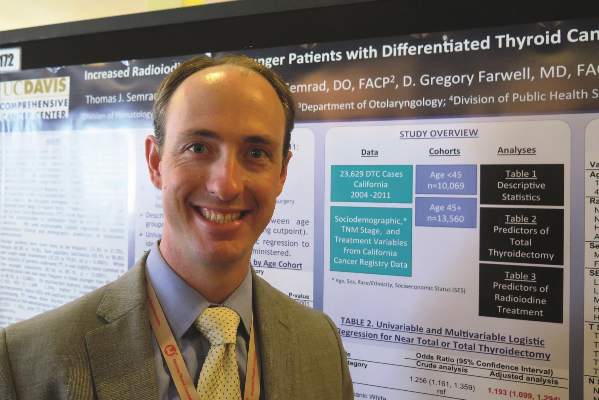
CORONADO, CALIF. – Patients with differentiated thyroid cancer who were younger than age 45 years were more likely to undergo total or near-total thyroidectomy and to receive radioactive iodine, compared with their older counterparts, a large registry analysis demonstrated.
In addition, younger patients were more likely to be Hispanic and female and to have papillary carcinoma, lead study author Dr. Thomas J. Semrad reported during the annual meeting of the American Thyroid Association.
“Not much is known about how treatment administration differs between younger and older patients with thyroid cancer,” Dr. Semrad of the division of hematology/oncology at the University of California, Davis, Comprehensive Cancer Center, Sacramento, said in an interview. “Some data suggest that perhaps patients younger than age 15 years may respond better to radioactive iodine and may present with more advanced disease. But not much is known about how they’re treated.”
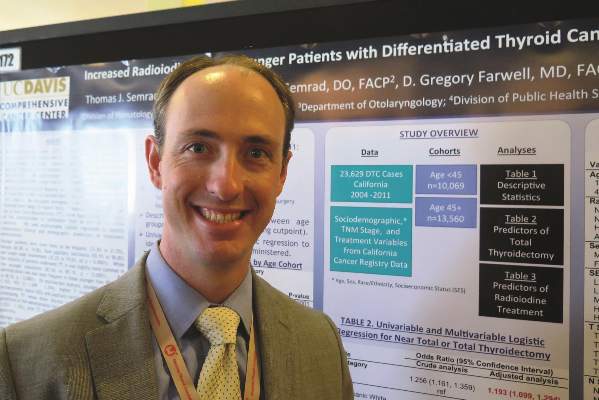
To find out, Dr. Semrad and his associates used the California Cancer Registry to identify 23,629 patients who were diagnosed with differentiated thyroid cancer between 2004 and 2011. They divided the patients into two cohorts: younger (defined as those younger than 45 years) and older (those 45 years or older). Treatment variables of interest included total or near-total thyroidectomy, other types of thyroid surgery, and the administration of radioactive iodine (RAI). The researchers compared the descriptive statistics between the two groups and used univariate and multivariate logistic regression to identify predictors of the treatment administered.
Compared with older patients, younger patients were significantly more likely to be Hispanic (33% vs. 22%), to be female (83% vs. 75%), to have papillary carcinoma (93% vs. 91%), and to have lymph node involvement (32% vs. 20%, all P < .0001).
Overall, the majority of patients (86%) underwent total or near-total thyroidectomy, but the surgery was slightly and significantly more common in younger patients, compared with their older counterparts (88% vs. 85%, P < .0001). Younger patients also were significantly more likely to receive RAI (55% vs. 49%, P < .0001).
On multivariate analysis, statistically significant predictors of total thyroidectomy, compared with other thyroid surgery, included younger age (odds ratio, 1.193); higher socioeconomic status (OR, 1.263, for higher-middle SES and OR, 1.325, for highest SES); higher T stage (OR, 1.848, for T2; OR, 2.473, for T3; and OR, 2.908, for T4); and papillary histology (OR, 0.349).
At the same time, statistically significant predictors of RAI administration included younger age (OR, 1.116); higher SES (OR, 1.410, for higher-middle SES and OR, 1.307, for highest SES); more advanced T stage (OR, 2.194 for T2; OR, 2.084, for T3; and OR, 1.527, for T4); node positivity (OR, 0.481), and total thyroidectomy (OR, 3.76).
“As we expected, the younger population was more likely to be female, but we did find that the younger population was also more likely to be Hispanic,” Dr. Semrad said. “We don’t know if they were native Hispanics or if it has something to do with immigration rates.”
Dr. Semrad acknowledged certain limitations of the study, including the risk of misclassification bias in registry data, the lack of details about surgical procedures performed, and the fact that the radioiodine dose was not captured.
“We have data regarding the T stage, the nodal stage, and the number of lymph nodes examined, but we don’t have some of the finer histology data,” he said.
Even so, he characterized the findings as “provocative in suggesting that perhaps our treatment patterns in younger patients are different. With more aggressive surgery and more use of radioactive iodine, that can have potential implications in terms of long-term side effects and follow-up.”
The researchers said they plan to use linked administrative data to analyze initial and subsequent thyroid surgical procedures in this patient population.
The study was supported by a grant from the National Institutes of Health. Dr. Semrad reported having no relevant financial disclosures.
CORONADO, CALIF. – Patients with differentiated thyroid cancer who were younger than age 45 years were more likely to undergo total or near-total thyroidectomy and to receive radioactive iodine, compared with their older counterparts, a large registry analysis demonstrated.
In addition, younger patients were more likely to be Hispanic and female and to have papillary carcinoma, lead study author Dr. Thomas J. Semrad reported during the annual meeting of the American Thyroid Association.
“Not much is known about how treatment administration differs between younger and older patients with thyroid cancer,” Dr. Semrad of the division of hematology/oncology at the University of California, Davis, Comprehensive Cancer Center, Sacramento, said in an interview. “Some data suggest that perhaps patients younger than age 15 years may respond better to radioactive iodine and may present with more advanced disease. But not much is known about how they’re treated.”
To find out, Dr. Semrad and his associates used the California Cancer Registry to identify 23,629 patients who were diagnosed with differentiated thyroid cancer between 2004 and 2011. They divided the patients into two cohorts: younger (defined as those younger than 45 years) and older (those 45 years or older). Treatment variables of interest included total or near-total thyroidectomy, other types of thyroid surgery, and the administration of radioactive iodine (RAI). The researchers compared the descriptive statistics between the two groups and used univariate and multivariate logistic regression to identify predictors of the treatment administered.
Compared with older patients, younger patients were significantly more likely to be Hispanic (33% vs. 22%), to be female (83% vs. 75%), to have papillary carcinoma (93% vs. 91%), and to have lymph node involvement (32% vs. 20%, all P < .0001).
Overall, the majority of patients (86%) underwent total or near-total thyroidectomy, but the surgery was slightly and significantly more common in younger patients, compared with their older counterparts (88% vs. 85%, P < .0001). Younger patients also were significantly more likely to receive RAI (55% vs. 49%, P < .0001).
On multivariate analysis, statistically significant predictors of total thyroidectomy, compared with other thyroid surgery, included younger age (odds ratio, 1.193); higher socioeconomic status (OR, 1.263, for higher-middle SES and OR, 1.325, for highest SES); higher T stage (OR, 1.848, for T2; OR, 2.473, for T3; and OR, 2.908, for T4); and papillary histology (OR, 0.349).
At the same time, statistically significant predictors of RAI administration included younger age (OR, 1.116); higher SES (OR, 1.410, for higher-middle SES and OR, 1.307, for highest SES); more advanced T stage (OR, 2.194 for T2; OR, 2.084, for T3; and OR, 1.527, for T4); node positivity (OR, 0.481), and total thyroidectomy (OR, 3.76).
“As we expected, the younger population was more likely to be female, but we did find that the younger population was also more likely to be Hispanic,” Dr. Semrad said. “We don’t know if they were native Hispanics or if it has something to do with immigration rates.”
Dr. Semrad acknowledged certain limitations of the study, including the risk of misclassification bias in registry data, the lack of details about surgical procedures performed, and the fact that the radioiodine dose was not captured.
“We have data regarding the T stage, the nodal stage, and the number of lymph nodes examined, but we don’t have some of the finer histology data,” he said.
Even so, he characterized the findings as “provocative in suggesting that perhaps our treatment patterns in younger patients are different. With more aggressive surgery and more use of radioactive iodine, that can have potential implications in terms of long-term side effects and follow-up.”
The researchers said they plan to use linked administrative data to analyze initial and subsequent thyroid surgical procedures in this patient population.
The study was supported by a grant from the National Institutes of Health. Dr. Semrad reported having no relevant financial disclosures.
CORONADO, CALIF. – Patients with differentiated thyroid cancer who were younger than age 45 years were more likely to undergo total or near-total thyroidectomy and to receive radioactive iodine, compared with their older counterparts, a large registry analysis demonstrated.
In addition, younger patients were more likely to be Hispanic and female and to have papillary carcinoma, lead study author Dr. Thomas J. Semrad reported during the annual meeting of the American Thyroid Association.
“Not much is known about how treatment administration differs between younger and older patients with thyroid cancer,” Dr. Semrad of the division of hematology/oncology at the University of California, Davis, Comprehensive Cancer Center, Sacramento, said in an interview. “Some data suggest that perhaps patients younger than age 15 years may respond better to radioactive iodine and may present with more advanced disease. But not much is known about how they’re treated.”
To find out, Dr. Semrad and his associates used the California Cancer Registry to identify 23,629 patients who were diagnosed with differentiated thyroid cancer between 2004 and 2011. They divided the patients into two cohorts: younger (defined as those younger than 45 years) and older (those 45 years or older). Treatment variables of interest included total or near-total thyroidectomy, other types of thyroid surgery, and the administration of radioactive iodine (RAI). The researchers compared the descriptive statistics between the two groups and used univariate and multivariate logistic regression to identify predictors of the treatment administered.
Compared with older patients, younger patients were significantly more likely to be Hispanic (33% vs. 22%), to be female (83% vs. 75%), to have papillary carcinoma (93% vs. 91%), and to have lymph node involvement (32% vs. 20%, all P < .0001).
Overall, the majority of patients (86%) underwent total or near-total thyroidectomy, but the surgery was slightly and significantly more common in younger patients, compared with their older counterparts (88% vs. 85%, P < .0001). Younger patients also were significantly more likely to receive RAI (55% vs. 49%, P < .0001).
On multivariate analysis, statistically significant predictors of total thyroidectomy, compared with other thyroid surgery, included younger age (odds ratio, 1.193); higher socioeconomic status (OR, 1.263, for higher-middle SES and OR, 1.325, for highest SES); higher T stage (OR, 1.848, for T2; OR, 2.473, for T3; and OR, 2.908, for T4); and papillary histology (OR, 0.349).
At the same time, statistically significant predictors of RAI administration included younger age (OR, 1.116); higher SES (OR, 1.410, for higher-middle SES and OR, 1.307, for highest SES); more advanced T stage (OR, 2.194 for T2; OR, 2.084, for T3; and OR, 1.527, for T4); node positivity (OR, 0.481), and total thyroidectomy (OR, 3.76).
“As we expected, the younger population was more likely to be female, but we did find that the younger population was also more likely to be Hispanic,” Dr. Semrad said. “We don’t know if they were native Hispanics or if it has something to do with immigration rates.”
Dr. Semrad acknowledged certain limitations of the study, including the risk of misclassification bias in registry data, the lack of details about surgical procedures performed, and the fact that the radioiodine dose was not captured.
“We have data regarding the T stage, the nodal stage, and the number of lymph nodes examined, but we don’t have some of the finer histology data,” he said.
Even so, he characterized the findings as “provocative in suggesting that perhaps our treatment patterns in younger patients are different. With more aggressive surgery and more use of radioactive iodine, that can have potential implications in terms of long-term side effects and follow-up.”
The researchers said they plan to use linked administrative data to analyze initial and subsequent thyroid surgical procedures in this patient population.
The study was supported by a grant from the National Institutes of Health. Dr. Semrad reported having no relevant financial disclosures.
AT THE ATA ANNUAL MEETING
Total thyroidectomy more likely with younger thyroid cancer patients
CORONADO, CALIF. – Patients with differentiated thyroid cancer who were younger than age 45 years were more likely to undergo total or near-total thyroidectomy and to receive radioactive iodine, compared with their older counterparts, a large registry analysis demonstrated.
In addition, younger patients were more likely to be Hispanic and female and to have papillary carcinoma, lead study author Dr. Thomas J. Semrad reported during the annual meeting of the American Thyroid Association.
“Not much is known about how treatment administration differs between younger and older patients with thyroid cancer,” Dr. Semrad of the division of hematology/oncology at the University of California, Davis, Comprehensive Cancer Center, Sacramento, said in an interview. “Some data suggest that perhaps patients younger than age 15 years may respond better to radioactive iodine and may present with more advanced disease. But not much is known about how they’re treated.”
To find out, Dr. Semrad and his associates used the California Cancer Registry to identify 23,629 patients who were diagnosed with differentiated thyroid cancer between 2004 and 2011. They divided the patients into two cohorts: younger (defined as those younger than 45 years) and older (those 45 years or older). Treatment variables of interest included total or near-total thyroidectomy, other types of thyroid surgery, and the administration of radioactive iodine (RAI). The researchers compared the descriptive statistics between the two groups and used univariate and multivariate logistic regression to identify predictors of the treatment administered.
Compared with older patients, younger patients were significantly more likely to be Hispanic (33% vs. 22%), to be female (83% vs. 75%), to have papillary carcinoma (93% vs. 91%), and to have lymph node involvement (32% vs. 20%, all P < .0001).
Overall, the majority of patients (86%) underwent total or near-total thyroidectomy, but the surgery was slightly and significantly more common in younger patients, compared with their older counterparts (88% vs. 85%, P < .0001). Younger patients also were significantly more likely to receive RAI (55% vs. 49%, P < .0001).
On multivariate analysis, statistically significant predictors of total thyroidectomy, compared with other thyroid surgery, included younger age (odds ratio, 1.193); higher socioeconomic status (OR, 1.263, for higher-middle SES and OR, 1.325, for highest SES); higher T stage (OR, 1.848, for T2; OR, 2.473, for T3; and OR, 2.908, for T4); and papillary histology (OR, 0.349).
At the same time, statistically significant predictors of RAI administration included younger age (OR, 1.116); higher SES (OR, 1.410, for higher-middle SES and OR, 1.307, for highest SES); more advanced T stage (OR, 2.194 for T2; OR, 2.084, for T3; and OR, 1.527, for T4); node positivity (OR, 0.481), and total thyroidectomy (OR, 3.76).
“As we expected, the younger population was more likely to be female, but we did find that the younger population was also more likely to be Hispanic,” Dr. Semrad said. “We don’t know if they were native Hispanics or if it has something to do with immigration rates.”
Dr. Semrad acknowledged certain limitations of the study, including the risk of misclassification bias in registry data, the lack of details about surgical procedures performed, and the fact that the radioiodine dose was not captured.
“We have data regarding the T stage, the nodal stage, and the number of lymph nodes examined, but we don’t have some of the finer histology data,” he said.
Even so, he characterized the findings as “provocative in suggesting that perhaps our treatment patterns in younger patients are different. With more aggressive surgery and more use of radioactive iodine, that can have potential implications in terms of long-term side effects and follow-up.”
The researchers said they plan to use linked administrative data to analyze initial and subsequent thyroid surgical procedures in this patient population.
The study was supported by a grant from the National Institutes of Health. Dr. Semrad reported having no relevant financial disclosures.
On Twitter @dougbrunk
CORONADO, CALIF. – Patients with differentiated thyroid cancer who were younger than age 45 years were more likely to undergo total or near-total thyroidectomy and to receive radioactive iodine, compared with their older counterparts, a large registry analysis demonstrated.
In addition, younger patients were more likely to be Hispanic and female and to have papillary carcinoma, lead study author Dr. Thomas J. Semrad reported during the annual meeting of the American Thyroid Association.
“Not much is known about how treatment administration differs between younger and older patients with thyroid cancer,” Dr. Semrad of the division of hematology/oncology at the University of California, Davis, Comprehensive Cancer Center, Sacramento, said in an interview. “Some data suggest that perhaps patients younger than age 15 years may respond better to radioactive iodine and may present with more advanced disease. But not much is known about how they’re treated.”
To find out, Dr. Semrad and his associates used the California Cancer Registry to identify 23,629 patients who were diagnosed with differentiated thyroid cancer between 2004 and 2011. They divided the patients into two cohorts: younger (defined as those younger than 45 years) and older (those 45 years or older). Treatment variables of interest included total or near-total thyroidectomy, other types of thyroid surgery, and the administration of radioactive iodine (RAI). The researchers compared the descriptive statistics between the two groups and used univariate and multivariate logistic regression to identify predictors of the treatment administered.
Compared with older patients, younger patients were significantly more likely to be Hispanic (33% vs. 22%), to be female (83% vs. 75%), to have papillary carcinoma (93% vs. 91%), and to have lymph node involvement (32% vs. 20%, all P < .0001).
Overall, the majority of patients (86%) underwent total or near-total thyroidectomy, but the surgery was slightly and significantly more common in younger patients, compared with their older counterparts (88% vs. 85%, P < .0001). Younger patients also were significantly more likely to receive RAI (55% vs. 49%, P < .0001).
On multivariate analysis, statistically significant predictors of total thyroidectomy, compared with other thyroid surgery, included younger age (odds ratio, 1.193); higher socioeconomic status (OR, 1.263, for higher-middle SES and OR, 1.325, for highest SES); higher T stage (OR, 1.848, for T2; OR, 2.473, for T3; and OR, 2.908, for T4); and papillary histology (OR, 0.349).
At the same time, statistically significant predictors of RAI administration included younger age (OR, 1.116); higher SES (OR, 1.410, for higher-middle SES and OR, 1.307, for highest SES); more advanced T stage (OR, 2.194 for T2; OR, 2.084, for T3; and OR, 1.527, for T4); node positivity (OR, 0.481), and total thyroidectomy (OR, 3.76).
“As we expected, the younger population was more likely to be female, but we did find that the younger population was also more likely to be Hispanic,” Dr. Semrad said. “We don’t know if they were native Hispanics or if it has something to do with immigration rates.”
Dr. Semrad acknowledged certain limitations of the study, including the risk of misclassification bias in registry data, the lack of details about surgical procedures performed, and the fact that the radioiodine dose was not captured.
“We have data regarding the T stage, the nodal stage, and the number of lymph nodes examined, but we don’t have some of the finer histology data,” he said.
Even so, he characterized the findings as “provocative in suggesting that perhaps our treatment patterns in younger patients are different. With more aggressive surgery and more use of radioactive iodine, that can have potential implications in terms of long-term side effects and follow-up.”
The researchers said they plan to use linked administrative data to analyze initial and subsequent thyroid surgical procedures in this patient population.
The study was supported by a grant from the National Institutes of Health. Dr. Semrad reported having no relevant financial disclosures.
On Twitter @dougbrunk
CORONADO, CALIF. – Patients with differentiated thyroid cancer who were younger than age 45 years were more likely to undergo total or near-total thyroidectomy and to receive radioactive iodine, compared with their older counterparts, a large registry analysis demonstrated.
In addition, younger patients were more likely to be Hispanic and female and to have papillary carcinoma, lead study author Dr. Thomas J. Semrad reported during the annual meeting of the American Thyroid Association.
“Not much is known about how treatment administration differs between younger and older patients with thyroid cancer,” Dr. Semrad of the division of hematology/oncology at the University of California, Davis, Comprehensive Cancer Center, Sacramento, said in an interview. “Some data suggest that perhaps patients younger than age 15 years may respond better to radioactive iodine and may present with more advanced disease. But not much is known about how they’re treated.”
To find out, Dr. Semrad and his associates used the California Cancer Registry to identify 23,629 patients who were diagnosed with differentiated thyroid cancer between 2004 and 2011. They divided the patients into two cohorts: younger (defined as those younger than 45 years) and older (those 45 years or older). Treatment variables of interest included total or near-total thyroidectomy, other types of thyroid surgery, and the administration of radioactive iodine (RAI). The researchers compared the descriptive statistics between the two groups and used univariate and multivariate logistic regression to identify predictors of the treatment administered.
Compared with older patients, younger patients were significantly more likely to be Hispanic (33% vs. 22%), to be female (83% vs. 75%), to have papillary carcinoma (93% vs. 91%), and to have lymph node involvement (32% vs. 20%, all P < .0001).
Overall, the majority of patients (86%) underwent total or near-total thyroidectomy, but the surgery was slightly and significantly more common in younger patients, compared with their older counterparts (88% vs. 85%, P < .0001). Younger patients also were significantly more likely to receive RAI (55% vs. 49%, P < .0001).
On multivariate analysis, statistically significant predictors of total thyroidectomy, compared with other thyroid surgery, included younger age (odds ratio, 1.193); higher socioeconomic status (OR, 1.263, for higher-middle SES and OR, 1.325, for highest SES); higher T stage (OR, 1.848, for T2; OR, 2.473, for T3; and OR, 2.908, for T4); and papillary histology (OR, 0.349).
At the same time, statistically significant predictors of RAI administration included younger age (OR, 1.116); higher SES (OR, 1.410, for higher-middle SES and OR, 1.307, for highest SES); more advanced T stage (OR, 2.194 for T2; OR, 2.084, for T3; and OR, 1.527, for T4); node positivity (OR, 0.481), and total thyroidectomy (OR, 3.76).
“As we expected, the younger population was more likely to be female, but we did find that the younger population was also more likely to be Hispanic,” Dr. Semrad said. “We don’t know if they were native Hispanics or if it has something to do with immigration rates.”
Dr. Semrad acknowledged certain limitations of the study, including the risk of misclassification bias in registry data, the lack of details about surgical procedures performed, and the fact that the radioiodine dose was not captured.
“We have data regarding the T stage, the nodal stage, and the number of lymph nodes examined, but we don’t have some of the finer histology data,” he said.
Even so, he characterized the findings as “provocative in suggesting that perhaps our treatment patterns in younger patients are different. With more aggressive surgery and more use of radioactive iodine, that can have potential implications in terms of long-term side effects and follow-up.”
The researchers said they plan to use linked administrative data to analyze initial and subsequent thyroid surgical procedures in this patient population.
The study was supported by a grant from the National Institutes of Health. Dr. Semrad reported having no relevant financial disclosures.
On Twitter @dougbrunk
AT THE ATA ANNUAL MEETING
Key clinical point: Younger patients with differentiated thyroid cancer were more likely to undergo total thyroidectomy and receive radioactive iodine.
Major finding: Total or near-total thyroidectomy was slightly more common in patients younger than age 45 years, compared with their older counterparts (88% vs. 85%, P < .0001). Younger patients were also more likely to receive RAI (55% vs. 49%, P < .0001).
Data source: A study of 23,629 patients from the California Cancer Registry who were diagnosed with differentiated thyroid cancer between 2004 and 2011.
Disclosures: The study was supported by a grant from the National Institutes of Health. Dr. Semrad reported having no relevant financial disclosures.
Enhanced thyroid cancer guidelines expected in 2015
CORONADO, CALIF. – Expect significant enhancements to the updated thyroid cancer management guidelines from the American Thyroid Association, due to be released in early 2015.
Last updated in 2009, the goal of the new guidelines is to “be evidence based and helpful,” guidelines task force chair Dr. Bryan R. Haugen said at the annual meeting of the American Thyroid Association. For example, the new guidelines will contain 101 recommendations, up from 80 in the 2009 version; 175 subrecommendations, up from 103; and 998 references, up from 437. “Still, 59 of the existing 80 recommendations are not substantially changed, showing a general stability in our field over the past 5 to 6 years,” he said.

One enhancement is a definition of risk of structural disease recurrence in patients without structurally identifiable disease after initial therapy for thyroid cancer. Low risk is defined as intrathyroidal differentiated thyroid cancer involving up to five metastases less than 0.2 cm in size. Intermediate risk is defined as the presence of aggressive histology, minor extrathyroidal extension, vascular invasion, or more than five involved lymph nodes with metastases 0.2-0.3 cm in size. High risk is defined as the presence of gross extrathyroidal extension, incomplete tumor resection, distant metastases, or lymph node metastases greater than 3 cm in size.
The guidelines also include a table that defines a patient’s response to therapy as a dynamic risk assessment. “This best applies to the low- to intermediate-risk patients, although it definitely applies to high risk as well,” said Dr. Haugen, who heads the division of endocrinology, metabolism, and diabetes at the University of Colorado Health Sciences Center, Denver. “It’s [a] strong recommendation based on low-quality evidence to use this risk-based response to therapy. A lot of this data is generated from patients who’ve had a thyroidectomy and have received radioiodine. So we’re on a bit more shaky ground right now in a patient who’s had a thyroidectomy but no radioiodine, or a patient who’s had a lobectomy.”
Other changes include the concept that it’s not necessary to biopsy every nodule more than 1 cm in size. “We’re going to be guided by the sonographic pattern in who we biopsy and how we monitor them,” Dr. Haugen explained. “A new recommendation adds follow-up guidance for nodules that do not meet FNA [fine-needle aspiration] criteria. We’re also recommending use of the Bethesda Cytology Classification System for cytology.”
Changes in the initial management of thyroid cancer include a recommendation for cross-sectional imaging with contrast for higher-risk disease and the consideration of lobectomy for some patients with tumors 1-4 cm in size. “This is a controversial recommendation,” Dr. Haugen said. “We got some feedback from members asking if you do it, what’s the TSH target? Should we give them synthetic levothyroxine? We are revising the guidelines based on this feedback to help guide clinicians.”
The new guidelines also call for more detailed/standardized pathology reports, with inclusion of lymph node size, extranodal invasion, and the number of invaded vessels. “I’ve talked to a number of pathologists and clinicians who are very happy about this guidance,” he said. “We also need to look at tumor stage, recurrence risk, and response to therapy in our patients, and the use of selective radioiodine. There is some more information on considering lower administered activities, especially in the lower-risk patients.”
For the first time, the guidelines include a section on radioiodine treatment for refractory differentiated thyroid cancer, including tips on directed therapy, clinical trials, systemic therapy, and bone-specific therapy.
Dr. Haugen disclosed that he has received grants and research support from Veracyte and Genzyme.
On Twitter @dougbrunk
CORONADO, CALIF. – Expect significant enhancements to the updated thyroid cancer management guidelines from the American Thyroid Association, due to be released in early 2015.
Last updated in 2009, the goal of the new guidelines is to “be evidence based and helpful,” guidelines task force chair Dr. Bryan R. Haugen said at the annual meeting of the American Thyroid Association. For example, the new guidelines will contain 101 recommendations, up from 80 in the 2009 version; 175 subrecommendations, up from 103; and 998 references, up from 437. “Still, 59 of the existing 80 recommendations are not substantially changed, showing a general stability in our field over the past 5 to 6 years,” he said.
One enhancement is a definition of risk of structural disease recurrence in patients without structurally identifiable disease after initial therapy for thyroid cancer. Low risk is defined as intrathyroidal differentiated thyroid cancer involving up to five metastases less than 0.2 cm in size. Intermediate risk is defined as the presence of aggressive histology, minor extrathyroidal extension, vascular invasion, or more than five involved lymph nodes with metastases 0.2-0.3 cm in size. High risk is defined as the presence of gross extrathyroidal extension, incomplete tumor resection, distant metastases, or lymph node metastases greater than 3 cm in size.
The guidelines also include a table that defines a patient’s response to therapy as a dynamic risk assessment. “This best applies to the low- to intermediate-risk patients, although it definitely applies to high risk as well,” said Dr. Haugen, who heads the division of endocrinology, metabolism, and diabetes at the University of Colorado Health Sciences Center, Denver. “It’s [a] strong recommendation based on low-quality evidence to use this risk-based response to therapy. A lot of this data is generated from patients who’ve had a thyroidectomy and have received radioiodine. So we’re on a bit more shaky ground right now in a patient who’s had a thyroidectomy but no radioiodine, or a patient who’s had a lobectomy.”
Other changes include the concept that it’s not necessary to biopsy every nodule more than 1 cm in size. “We’re going to be guided by the sonographic pattern in who we biopsy and how we monitor them,” Dr. Haugen explained. “A new recommendation adds follow-up guidance for nodules that do not meet FNA [fine-needle aspiration] criteria. We’re also recommending use of the Bethesda Cytology Classification System for cytology.”
Changes in the initial management of thyroid cancer include a recommendation for cross-sectional imaging with contrast for higher-risk disease and the consideration of lobectomy for some patients with tumors 1-4 cm in size. “This is a controversial recommendation,” Dr. Haugen said. “We got some feedback from members asking if you do it, what’s the TSH target? Should we give them synthetic levothyroxine? We are revising the guidelines based on this feedback to help guide clinicians.”
The new guidelines also call for more detailed/standardized pathology reports, with inclusion of lymph node size, extranodal invasion, and the number of invaded vessels. “I’ve talked to a number of pathologists and clinicians who are very happy about this guidance,” he said. “We also need to look at tumor stage, recurrence risk, and response to therapy in our patients, and the use of selective radioiodine. There is some more information on considering lower administered activities, especially in the lower-risk patients.”
For the first time, the guidelines include a section on radioiodine treatment for refractory differentiated thyroid cancer, including tips on directed therapy, clinical trials, systemic therapy, and bone-specific therapy.
Dr. Haugen disclosed that he has received grants and research support from Veracyte and Genzyme.
On Twitter @dougbrunk
CORONADO, CALIF. – Expect significant enhancements to the updated thyroid cancer management guidelines from the American Thyroid Association, due to be released in early 2015.
Last updated in 2009, the goal of the new guidelines is to “be evidence based and helpful,” guidelines task force chair Dr. Bryan R. Haugen said at the annual meeting of the American Thyroid Association. For example, the new guidelines will contain 101 recommendations, up from 80 in the 2009 version; 175 subrecommendations, up from 103; and 998 references, up from 437. “Still, 59 of the existing 80 recommendations are not substantially changed, showing a general stability in our field over the past 5 to 6 years,” he said.
One enhancement is a definition of risk of structural disease recurrence in patients without structurally identifiable disease after initial therapy for thyroid cancer. Low risk is defined as intrathyroidal differentiated thyroid cancer involving up to five metastases less than 0.2 cm in size. Intermediate risk is defined as the presence of aggressive histology, minor extrathyroidal extension, vascular invasion, or more than five involved lymph nodes with metastases 0.2-0.3 cm in size. High risk is defined as the presence of gross extrathyroidal extension, incomplete tumor resection, distant metastases, or lymph node metastases greater than 3 cm in size.
The guidelines also include a table that defines a patient’s response to therapy as a dynamic risk assessment. “This best applies to the low- to intermediate-risk patients, although it definitely applies to high risk as well,” said Dr. Haugen, who heads the division of endocrinology, metabolism, and diabetes at the University of Colorado Health Sciences Center, Denver. “It’s [a] strong recommendation based on low-quality evidence to use this risk-based response to therapy. A lot of this data is generated from patients who’ve had a thyroidectomy and have received radioiodine. So we’re on a bit more shaky ground right now in a patient who’s had a thyroidectomy but no radioiodine, or a patient who’s had a lobectomy.”
Other changes include the concept that it’s not necessary to biopsy every nodule more than 1 cm in size. “We’re going to be guided by the sonographic pattern in who we biopsy and how we monitor them,” Dr. Haugen explained. “A new recommendation adds follow-up guidance for nodules that do not meet FNA [fine-needle aspiration] criteria. We’re also recommending use of the Bethesda Cytology Classification System for cytology.”
Changes in the initial management of thyroid cancer include a recommendation for cross-sectional imaging with contrast for higher-risk disease and the consideration of lobectomy for some patients with tumors 1-4 cm in size. “This is a controversial recommendation,” Dr. Haugen said. “We got some feedback from members asking if you do it, what’s the TSH target? Should we give them synthetic levothyroxine? We are revising the guidelines based on this feedback to help guide clinicians.”
The new guidelines also call for more detailed/standardized pathology reports, with inclusion of lymph node size, extranodal invasion, and the number of invaded vessels. “I’ve talked to a number of pathologists and clinicians who are very happy about this guidance,” he said. “We also need to look at tumor stage, recurrence risk, and response to therapy in our patients, and the use of selective radioiodine. There is some more information on considering lower administered activities, especially in the lower-risk patients.”
For the first time, the guidelines include a section on radioiodine treatment for refractory differentiated thyroid cancer, including tips on directed therapy, clinical trials, systemic therapy, and bone-specific therapy.
Dr. Haugen disclosed that he has received grants and research support from Veracyte and Genzyme.
On Twitter @dougbrunk
EXPERT ANALYSIS FROM THE ATA ANNUAL MEETING
Moderate THST linked to improved survival in thyroid cancer
CORONADO, CALIF.– In an analysis of primary treatments for all stages of differentiated thyroid carcinoma, only thyroid hormone suppressive therapy was associated with both improved overall survival and disease-free survival.
Further, when examining the degree of thyroid hormone suppressive therapy (THST), aggressive THST conferred no additional survival benefit when compared with moderate THST, even when limiting the analysis to patients with distant metastatic disease, results from a long-term analysis of registry showed.

Those are key findings from an updated analysis of data from the National Thyroid Cancer Treatment Cooperative Study Group Registry, which were presented by lead study author Dr. Aubrey Carhill during the annual meeting of the American Thyroid Association.
“To date there are no prospective studies evaluating the longitudinal outcomes of initial long-term therapies in differentiated thyroid carcinoma,” said Dr. Carhill of MD Anderson Cancer Center, Houston. “In the absence of prospective trials, there has been significant reliance on retrospective studies with limited numbers of patients and low event rates as well as significant reliance on expert opinion to guide clinical practice.”
For example, current ATA guidelines for TSH suppression suggest that in long-term follow-up of patients with differentiated thyroid cancer, “those with persistent disease should have TSH levels suppressed to undetectable levels and maintained indefinitely,” Dr. Carhill said, while disease-free, higher-risk patients “should be suppressed to low-moderate levels continued between 5 and 10 years and low-risk patients should be maintained in the low-normal range. Similar levels of evidence exist to support the use of radioactive iodine and the degree of surgical extent.”
The challenge for clinicians, she continued, becomes balancing the potential risks of more aggressive therapies, such as aggressive thyroid hormone suppression, and the risks associated with long-term thyrotoxicosis with the potential benefits of treatment. “This is not always clear, especially in patients who are at very low risk for cancer-specific mortality,” she said. “There remains a need for accurate prognostication in order to identify which patients will benefit from different treatment modalities because current staging systems have limited ability to predict response to treatment.”
Formed in 1987, the National Thyroid Treatment Cooperative Study Group is a multi-institutional effort to assess long-term management of outcomes on patients with differentiated thyroid cancer. The purpose of the present study was to provide a more current analysis of the prospectively collected data, which was last analyzed in 2001. All staging is tracked according to the registry’s staging system, which is very similar to that of the American Joint Committee on Cancer’s TNM Staging System. Therapies analyzed included total/near total thyroidectomy (T/NTT) vs. a lesser extent of surgery; radioactive iodine (RAI) vs. no RAI; and increasing degrees of THST over time.
Dr. Carhill presented findings from an analysis of the effects of initial therapies in 4,941 patients treated at 11 centers in North America between 1987 and 2012. The median length of follow-up was 6 years, which translated to 34,631 person-years of documented follow-up time. The researchers used univariate and multivariate analyses to assess overall and disease-free survival. Moderate THST was defined as TSH maintained in subnormal or normal levels, while aggressive THST was defined as that maintained in undetectable or subnormal levels.
Improved overall survival was observed in stage III patients who received RAI (risk ratio, 0.66; P = .04) and in stage IV patients who received T/NTT and RAI (RR, 0.66 and 0.70, respectively; combined P = .049). Moderate but not aggressive THST was associated with significantly improved overall survival in all stages (RR, 0.13 in stage I, 0.09 in stage II, 0.13 in stage III, and 0.33 in stage IV), as well as with improved disease-free survival (RR, 0.52 in stage I, 0.40 in stage II, 0.18 in stage III, and no RR in stage IV).
In stage I patients, RAI conferred worse disease-free survival (RR, 1.79; P = .0005). “However, further propensity analysis demonstrated that there was no difference in disease-free survival when patients were stratified according to their propensity to receive radioactive iodine,” Dr. Carhill said.
To evaluate the optimal duration of THST, the researchers examined the effect of continuing degrees of suppression beyond 1, 3, and 5 years of follow-up. After 1 and 3 years of follow-up, both initial stage and moderate TSH suppression were independently predictive of improved overall survival (RR, 0.31 and 0.29, respectively). However, after 5 years of follow-up, “although initial stage remained independently predictive, there was no further benefit with any subsequent degree of TSH suppression,” Dr. Carhill said.
The study “confirms prior registry findings of a survival benefit in high-risk groups treated with T/NTT and RAI, and there is no disease-free survival benefit in low-risk groups receiving postoperative RAI,” she concluded. “We also report for the first time that in multivariate analysis of primary treatments for DTC [differentiated thyroid cancer], in all stages, only THST was associated with both improved overall survival and disease-free survival. When examining the degree of THST, aggressive THST confers no additional survival advantage as compared with moderate THST, even in patients with distant metastatic disease, which remains particularly relevant given the risks associated with long-term thyrotoxicosis.” She acknowledged certain limitations of the study, including the potential for institutional bias. “However, we feel that this is somewhat offset due to the size of the registry cohort and the number of sites involved” Dr. Carhill said.
The registry has received support from Genzyme and Pfizer. Dr. Carhill reported having no financial disclosures.
On Twitter @dougbrunk
CORONADO, CALIF.– In an analysis of primary treatments for all stages of differentiated thyroid carcinoma, only thyroid hormone suppressive therapy was associated with both improved overall survival and disease-free survival.
Further, when examining the degree of thyroid hormone suppressive therapy (THST), aggressive THST conferred no additional survival benefit when compared with moderate THST, even when limiting the analysis to patients with distant metastatic disease, results from a long-term analysis of registry showed.
Those are key findings from an updated analysis of data from the National Thyroid Cancer Treatment Cooperative Study Group Registry, which were presented by lead study author Dr. Aubrey Carhill during the annual meeting of the American Thyroid Association.
“To date there are no prospective studies evaluating the longitudinal outcomes of initial long-term therapies in differentiated thyroid carcinoma,” said Dr. Carhill of MD Anderson Cancer Center, Houston. “In the absence of prospective trials, there has been significant reliance on retrospective studies with limited numbers of patients and low event rates as well as significant reliance on expert opinion to guide clinical practice.”
For example, current ATA guidelines for TSH suppression suggest that in long-term follow-up of patients with differentiated thyroid cancer, “those with persistent disease should have TSH levels suppressed to undetectable levels and maintained indefinitely,” Dr. Carhill said, while disease-free, higher-risk patients “should be suppressed to low-moderate levels continued between 5 and 10 years and low-risk patients should be maintained in the low-normal range. Similar levels of evidence exist to support the use of radioactive iodine and the degree of surgical extent.”
The challenge for clinicians, she continued, becomes balancing the potential risks of more aggressive therapies, such as aggressive thyroid hormone suppression, and the risks associated with long-term thyrotoxicosis with the potential benefits of treatment. “This is not always clear, especially in patients who are at very low risk for cancer-specific mortality,” she said. “There remains a need for accurate prognostication in order to identify which patients will benefit from different treatment modalities because current staging systems have limited ability to predict response to treatment.”
Formed in 1987, the National Thyroid Treatment Cooperative Study Group is a multi-institutional effort to assess long-term management of outcomes on patients with differentiated thyroid cancer. The purpose of the present study was to provide a more current analysis of the prospectively collected data, which was last analyzed in 2001. All staging is tracked according to the registry’s staging system, which is very similar to that of the American Joint Committee on Cancer’s TNM Staging System. Therapies analyzed included total/near total thyroidectomy (T/NTT) vs. a lesser extent of surgery; radioactive iodine (RAI) vs. no RAI; and increasing degrees of THST over time.
Dr. Carhill presented findings from an analysis of the effects of initial therapies in 4,941 patients treated at 11 centers in North America between 1987 and 2012. The median length of follow-up was 6 years, which translated to 34,631 person-years of documented follow-up time. The researchers used univariate and multivariate analyses to assess overall and disease-free survival. Moderate THST was defined as TSH maintained in subnormal or normal levels, while aggressive THST was defined as that maintained in undetectable or subnormal levels.
Improved overall survival was observed in stage III patients who received RAI (risk ratio, 0.66; P = .04) and in stage IV patients who received T/NTT and RAI (RR, 0.66 and 0.70, respectively; combined P = .049). Moderate but not aggressive THST was associated with significantly improved overall survival in all stages (RR, 0.13 in stage I, 0.09 in stage II, 0.13 in stage III, and 0.33 in stage IV), as well as with improved disease-free survival (RR, 0.52 in stage I, 0.40 in stage II, 0.18 in stage III, and no RR in stage IV).
In stage I patients, RAI conferred worse disease-free survival (RR, 1.79; P = .0005). “However, further propensity analysis demonstrated that there was no difference in disease-free survival when patients were stratified according to their propensity to receive radioactive iodine,” Dr. Carhill said.
To evaluate the optimal duration of THST, the researchers examined the effect of continuing degrees of suppression beyond 1, 3, and 5 years of follow-up. After 1 and 3 years of follow-up, both initial stage and moderate TSH suppression were independently predictive of improved overall survival (RR, 0.31 and 0.29, respectively). However, after 5 years of follow-up, “although initial stage remained independently predictive, there was no further benefit with any subsequent degree of TSH suppression,” Dr. Carhill said.
The study “confirms prior registry findings of a survival benefit in high-risk groups treated with T/NTT and RAI, and there is no disease-free survival benefit in low-risk groups receiving postoperative RAI,” she concluded. “We also report for the first time that in multivariate analysis of primary treatments for DTC [differentiated thyroid cancer], in all stages, only THST was associated with both improved overall survival and disease-free survival. When examining the degree of THST, aggressive THST confers no additional survival advantage as compared with moderate THST, even in patients with distant metastatic disease, which remains particularly relevant given the risks associated with long-term thyrotoxicosis.” She acknowledged certain limitations of the study, including the potential for institutional bias. “However, we feel that this is somewhat offset due to the size of the registry cohort and the number of sites involved” Dr. Carhill said.
The registry has received support from Genzyme and Pfizer. Dr. Carhill reported having no financial disclosures.
On Twitter @dougbrunk
CORONADO, CALIF.– In an analysis of primary treatments for all stages of differentiated thyroid carcinoma, only thyroid hormone suppressive therapy was associated with both improved overall survival and disease-free survival.
Further, when examining the degree of thyroid hormone suppressive therapy (THST), aggressive THST conferred no additional survival benefit when compared with moderate THST, even when limiting the analysis to patients with distant metastatic disease, results from a long-term analysis of registry showed.
Those are key findings from an updated analysis of data from the National Thyroid Cancer Treatment Cooperative Study Group Registry, which were presented by lead study author Dr. Aubrey Carhill during the annual meeting of the American Thyroid Association.
“To date there are no prospective studies evaluating the longitudinal outcomes of initial long-term therapies in differentiated thyroid carcinoma,” said Dr. Carhill of MD Anderson Cancer Center, Houston. “In the absence of prospective trials, there has been significant reliance on retrospective studies with limited numbers of patients and low event rates as well as significant reliance on expert opinion to guide clinical practice.”
For example, current ATA guidelines for TSH suppression suggest that in long-term follow-up of patients with differentiated thyroid cancer, “those with persistent disease should have TSH levels suppressed to undetectable levels and maintained indefinitely,” Dr. Carhill said, while disease-free, higher-risk patients “should be suppressed to low-moderate levels continued between 5 and 10 years and low-risk patients should be maintained in the low-normal range. Similar levels of evidence exist to support the use of radioactive iodine and the degree of surgical extent.”
The challenge for clinicians, she continued, becomes balancing the potential risks of more aggressive therapies, such as aggressive thyroid hormone suppression, and the risks associated with long-term thyrotoxicosis with the potential benefits of treatment. “This is not always clear, especially in patients who are at very low risk for cancer-specific mortality,” she said. “There remains a need for accurate prognostication in order to identify which patients will benefit from different treatment modalities because current staging systems have limited ability to predict response to treatment.”
Formed in 1987, the National Thyroid Treatment Cooperative Study Group is a multi-institutional effort to assess long-term management of outcomes on patients with differentiated thyroid cancer. The purpose of the present study was to provide a more current analysis of the prospectively collected data, which was last analyzed in 2001. All staging is tracked according to the registry’s staging system, which is very similar to that of the American Joint Committee on Cancer’s TNM Staging System. Therapies analyzed included total/near total thyroidectomy (T/NTT) vs. a lesser extent of surgery; radioactive iodine (RAI) vs. no RAI; and increasing degrees of THST over time.
Dr. Carhill presented findings from an analysis of the effects of initial therapies in 4,941 patients treated at 11 centers in North America between 1987 and 2012. The median length of follow-up was 6 years, which translated to 34,631 person-years of documented follow-up time. The researchers used univariate and multivariate analyses to assess overall and disease-free survival. Moderate THST was defined as TSH maintained in subnormal or normal levels, while aggressive THST was defined as that maintained in undetectable or subnormal levels.
Improved overall survival was observed in stage III patients who received RAI (risk ratio, 0.66; P = .04) and in stage IV patients who received T/NTT and RAI (RR, 0.66 and 0.70, respectively; combined P = .049). Moderate but not aggressive THST was associated with significantly improved overall survival in all stages (RR, 0.13 in stage I, 0.09 in stage II, 0.13 in stage III, and 0.33 in stage IV), as well as with improved disease-free survival (RR, 0.52 in stage I, 0.40 in stage II, 0.18 in stage III, and no RR in stage IV).
In stage I patients, RAI conferred worse disease-free survival (RR, 1.79; P = .0005). “However, further propensity analysis demonstrated that there was no difference in disease-free survival when patients were stratified according to their propensity to receive radioactive iodine,” Dr. Carhill said.
To evaluate the optimal duration of THST, the researchers examined the effect of continuing degrees of suppression beyond 1, 3, and 5 years of follow-up. After 1 and 3 years of follow-up, both initial stage and moderate TSH suppression were independently predictive of improved overall survival (RR, 0.31 and 0.29, respectively). However, after 5 years of follow-up, “although initial stage remained independently predictive, there was no further benefit with any subsequent degree of TSH suppression,” Dr. Carhill said.
The study “confirms prior registry findings of a survival benefit in high-risk groups treated with T/NTT and RAI, and there is no disease-free survival benefit in low-risk groups receiving postoperative RAI,” she concluded. “We also report for the first time that in multivariate analysis of primary treatments for DTC [differentiated thyroid cancer], in all stages, only THST was associated with both improved overall survival and disease-free survival. When examining the degree of THST, aggressive THST confers no additional survival advantage as compared with moderate THST, even in patients with distant metastatic disease, which remains particularly relevant given the risks associated with long-term thyrotoxicosis.” She acknowledged certain limitations of the study, including the potential for institutional bias. “However, we feel that this is somewhat offset due to the size of the registry cohort and the number of sites involved” Dr. Carhill said.
The registry has received support from Genzyme and Pfizer. Dr. Carhill reported having no financial disclosures.
On Twitter @dougbrunk
AT THE ATA ANNUAL MEETING
Key clinical point: Only moderate thyroid hormone suppressive therapy is associated with better outcomes in all stages of differentiated thyroid cancer.
Major finding: Moderate, but not aggressive, THST was linked with significantly improved overall survival in all stages of differentiated thyroid cancer (RR, .13 in stage I, .09 in stage II, .13 in stage III, and .33 in stage IV).
Data source: An analysis of the effects of initial therapies in 4,941 patients from the National Thyroid Cancer Treatment Cooperative Study Group Registry who were treated at 11 centers in North America between 1987 and 2012.
Disclosures:The registry has received support from Genzyme and Pfizer. Dr. Carhill reported having no financial disclosures.

No survival benefit of RAI seen in early-stage thyroid cancer
CORONADO, CALIF. – In a large cohort of patients with differentiated thyroid cancer, the use of radioactive iodine was associated with improved disease-specific survival in those with advanced disease but not in those with papillary thyroid microcarcinoma.
“Everything in medicine is a risk-benefit balance,” lead author Dr. Ryan K. Orosco said in an interview in advance of the annual meeting of the American Thyroid Association, where the work was presented. “Any two patients that receive radioactive iodine (RAI) for differentiated thyroid cancer are likely to have different survival benefit from that therapy. This study provides a quantitative comparison of the impact of RAI in various patient subgroups.”

In one of the largest studies of its kind, Dr. Orosco of the division of head and neck surgery at the University of California, San Diego, and his associates identified 85,740 patients with differentiated thyroid carcinoma from the Surveillance, Epidemiology, and End Results database from 1973 through 2009. They used multivariate analyses to explore the association between RAI and cancer-specific survival in 149 population subgroups, controlling for age, decade of diagnosis, race, gender, tumor type, nodal involvement, metastasis stage, and RAI therapy.
More than three-quarters of the patients (78%) were female, 68% were white, their mean age at diagnosis was 46 years, and the median follow-up time was 85 months. The researchers found that nearly half of patients (43%) received RAI. By American Joint Committee on Cancer stage, RAI was used in 55% of stage I patients, 41% of stage II patients, 94% of stage III patients, and 85% of stage IV patients. In addition, 42% of patients with T1a disease and 88% of those with T4 disease received RAI.
Use of RAI was positively associated with survival in the overall cohort (hazard ratio 1.3; P = .002), while statistically significant HRs for RAI were observed in 49 population subgroups. In patients with metastatic disease, use of RAI was associated with a decreased risk for disease-specific mortality (HR range of 2.28-3.82). Protective effects of RAI were also observed in patients with regional metastases (HR 1.4-1.9), those with T3-positive tumors (HR 1.36-1.39), those with T4 tumors (HR 1.85), and in those with stage IV disease (HR 1.47-1.73).
Dr. Orosco and his associates observed a negative effect of RAI in patients with macropapillary carcinoma. Specifically, those with T1a disease had an increased likelihood of thyroid cancer–specific mortality (HR .13; P less than .001), while similar associations were seen in multiple subgroups of patients with T1a disease (HR 0.04-0.25). No statistically significant effects of RAI were observed in patients with T1b or T2 tumors.
“RAI appears to offer the best survival impact in patients with advanced differentiated thyroid carcinoma,” Dr. Orosco said. “Its use in early-stage patients should be carefully considered.”
In their abstract, the researchers noted that the findings “might help clinicians personalize RAI therapy to specific differentiated thyroid cancer populations – offering treatment in patients most likely to benefit, and sparing others unnecessary costs and potential side effects.”
Dr. Orosco acknowledged certain limitations of the study, including the fact that the SEER database does not contain details about each patient’s surgery, the dose of RAI used, other comorbidities, or data on cancer recurrence. “This study does not attempt to explore the reasons behind the apparent survival disadvantage seen in patients with T1a disease,” he said. “We don’t know exactly why early-stage patients have an increased risk of disease-specific mortality when RAI is used. Additional work is needed to explore this further.”
Dr. Orosco reported having no financial disclosures.
On Twitter @dougbrunk
CORONADO, CALIF. – In a large cohort of patients with differentiated thyroid cancer, the use of radioactive iodine was associated with improved disease-specific survival in those with advanced disease but not in those with papillary thyroid microcarcinoma.
“Everything in medicine is a risk-benefit balance,” lead author Dr. Ryan K. Orosco said in an interview in advance of the annual meeting of the American Thyroid Association, where the work was presented. “Any two patients that receive radioactive iodine (RAI) for differentiated thyroid cancer are likely to have different survival benefit from that therapy. This study provides a quantitative comparison of the impact of RAI in various patient subgroups.”
In one of the largest studies of its kind, Dr. Orosco of the division of head and neck surgery at the University of California, San Diego, and his associates identified 85,740 patients with differentiated thyroid carcinoma from the Surveillance, Epidemiology, and End Results database from 1973 through 2009. They used multivariate analyses to explore the association between RAI and cancer-specific survival in 149 population subgroups, controlling for age, decade of diagnosis, race, gender, tumor type, nodal involvement, metastasis stage, and RAI therapy.
More than three-quarters of the patients (78%) were female, 68% were white, their mean age at diagnosis was 46 years, and the median follow-up time was 85 months. The researchers found that nearly half of patients (43%) received RAI. By American Joint Committee on Cancer stage, RAI was used in 55% of stage I patients, 41% of stage II patients, 94% of stage III patients, and 85% of stage IV patients. In addition, 42% of patients with T1a disease and 88% of those with T4 disease received RAI.
Use of RAI was positively associated with survival in the overall cohort (hazard ratio 1.3; P = .002), while statistically significant HRs for RAI were observed in 49 population subgroups. In patients with metastatic disease, use of RAI was associated with a decreased risk for disease-specific mortality (HR range of 2.28-3.82). Protective effects of RAI were also observed in patients with regional metastases (HR 1.4-1.9), those with T3-positive tumors (HR 1.36-1.39), those with T4 tumors (HR 1.85), and in those with stage IV disease (HR 1.47-1.73).
Dr. Orosco and his associates observed a negative effect of RAI in patients with macropapillary carcinoma. Specifically, those with T1a disease had an increased likelihood of thyroid cancer–specific mortality (HR .13; P less than .001), while similar associations were seen in multiple subgroups of patients with T1a disease (HR 0.04-0.25). No statistically significant effects of RAI were observed in patients with T1b or T2 tumors.
“RAI appears to offer the best survival impact in patients with advanced differentiated thyroid carcinoma,” Dr. Orosco said. “Its use in early-stage patients should be carefully considered.”
In their abstract, the researchers noted that the findings “might help clinicians personalize RAI therapy to specific differentiated thyroid cancer populations – offering treatment in patients most likely to benefit, and sparing others unnecessary costs and potential side effects.”
Dr. Orosco acknowledged certain limitations of the study, including the fact that the SEER database does not contain details about each patient’s surgery, the dose of RAI used, other comorbidities, or data on cancer recurrence. “This study does not attempt to explore the reasons behind the apparent survival disadvantage seen in patients with T1a disease,” he said. “We don’t know exactly why early-stage patients have an increased risk of disease-specific mortality when RAI is used. Additional work is needed to explore this further.”
Dr. Orosco reported having no financial disclosures.
On Twitter @dougbrunk
CORONADO, CALIF. – In a large cohort of patients with differentiated thyroid cancer, the use of radioactive iodine was associated with improved disease-specific survival in those with advanced disease but not in those with papillary thyroid microcarcinoma.
“Everything in medicine is a risk-benefit balance,” lead author Dr. Ryan K. Orosco said in an interview in advance of the annual meeting of the American Thyroid Association, where the work was presented. “Any two patients that receive radioactive iodine (RAI) for differentiated thyroid cancer are likely to have different survival benefit from that therapy. This study provides a quantitative comparison of the impact of RAI in various patient subgroups.”
In one of the largest studies of its kind, Dr. Orosco of the division of head and neck surgery at the University of California, San Diego, and his associates identified 85,740 patients with differentiated thyroid carcinoma from the Surveillance, Epidemiology, and End Results database from 1973 through 2009. They used multivariate analyses to explore the association between RAI and cancer-specific survival in 149 population subgroups, controlling for age, decade of diagnosis, race, gender, tumor type, nodal involvement, metastasis stage, and RAI therapy.
More than three-quarters of the patients (78%) were female, 68% were white, their mean age at diagnosis was 46 years, and the median follow-up time was 85 months. The researchers found that nearly half of patients (43%) received RAI. By American Joint Committee on Cancer stage, RAI was used in 55% of stage I patients, 41% of stage II patients, 94% of stage III patients, and 85% of stage IV patients. In addition, 42% of patients with T1a disease and 88% of those with T4 disease received RAI.
Use of RAI was positively associated with survival in the overall cohort (hazard ratio 1.3; P = .002), while statistically significant HRs for RAI were observed in 49 population subgroups. In patients with metastatic disease, use of RAI was associated with a decreased risk for disease-specific mortality (HR range of 2.28-3.82). Protective effects of RAI were also observed in patients with regional metastases (HR 1.4-1.9), those with T3-positive tumors (HR 1.36-1.39), those with T4 tumors (HR 1.85), and in those with stage IV disease (HR 1.47-1.73).
Dr. Orosco and his associates observed a negative effect of RAI in patients with macropapillary carcinoma. Specifically, those with T1a disease had an increased likelihood of thyroid cancer–specific mortality (HR .13; P less than .001), while similar associations were seen in multiple subgroups of patients with T1a disease (HR 0.04-0.25). No statistically significant effects of RAI were observed in patients with T1b or T2 tumors.
“RAI appears to offer the best survival impact in patients with advanced differentiated thyroid carcinoma,” Dr. Orosco said. “Its use in early-stage patients should be carefully considered.”
In their abstract, the researchers noted that the findings “might help clinicians personalize RAI therapy to specific differentiated thyroid cancer populations – offering treatment in patients most likely to benefit, and sparing others unnecessary costs and potential side effects.”
Dr. Orosco acknowledged certain limitations of the study, including the fact that the SEER database does not contain details about each patient’s surgery, the dose of RAI used, other comorbidities, or data on cancer recurrence. “This study does not attempt to explore the reasons behind the apparent survival disadvantage seen in patients with T1a disease,” he said. “We don’t know exactly why early-stage patients have an increased risk of disease-specific mortality when RAI is used. Additional work is needed to explore this further.”
Dr. Orosco reported having no financial disclosures.
On Twitter @dougbrunk
AT THE ATA ANNUAL MEETING
Key clinical point: Radioactive iodine appears to offer the best survival impact in patients with advanced differentiated thyroid carcinoma.
Major finding: In patients with metastatic disease, use of RAI was associated with a decreased risk for disease-specific mortality (HR range of 2.28-3.82). However, those with T1a disease had an increased likelihood of thyroid cancer-specific mortality (HR .13; P less than .001), while similar associations were seen in multiple subgroups of patients with T1a disease (HR .04-.25).
Data source: An analysis of 85,740 patients with differentiated thyroid carcinoma from the Surveillance, Epidemiology, and End Results database from 1973 through 2009.
Disclosures: Dr. Orosco reported having no financial disclosures.

‘Shotgun’ skin prick testing for food allergy held flawed
VANCOUVER, B.C. – The “shotgun” style of skin prick testing in children and adolescents with suspected IgE-mediated food allergy shows sensitization, but not necessarily allergy, according to Dr. James Bergman.
A positive skin test measures the presence of a specific IgE antibody, which does not necessarily equate to an allergy. Consequently, children may have multiple positive skin prick tests yet clinically tolerate the tested food, he said. “Sensitization is just the presence of a specific IgE to a food. Allergy is sensitization plus signs or symptoms upon exposure to the food.”

Dr. Bergman, who also holds a faculty position in the department of dermatology and skin science at the University of British Columbia, said the practice of shotgun skin prick testing can lead to unnecessary avoidance of specific foods. One group of researchers conducted oral food challenge tests in 125 children aged 1-9 years with a diagnosis of food allergy based on IgE tests. Nearly all of them (93%) had no reactivity when challenged with the suspect food (J. Peds. 2011; 158[4]:578-83). “Ninety-three percent of the children would have been avoiding their ‘allergic foods’ perhaps indefinitely,” said Dr. Bergman, who was not involved with the study.
“The general rule is, if you’re not having clinical symptoms that suggest an IgE-mediated reaction, then don’t test,” Dr. Bergman, a dermatologist who practices in Vancouver, said at the annual meeting of the Pacific Dermatologic Association.
“I explain to parents that if they want to test for a food in the situation where there is no IgE-mediated reaction, then it can be done, but there is a significant risk of a false positive or ‘fake allergy,’ ” he said. “In this situation the only way of knowing for sure whether it is an allergy is to undertake a formal oral food challenge, which is the (highest) standard for diagnosing food allergy.”
Telltale symptoms of an IgE-mediated food allergy include hives, vomiting, diarrhea, breathing problems, and change in level of consciousness. “These symptoms typically occur within minutes of ingestion, sometimes within 30 minutes and rarely up to 2 hours,” Dr. Bergman said. “If it’s beyond 2 hours, it’s unlikely to be IgE mediated.”
“If someone has a true food allergy, advise them to avoid the culprit food, give them an epinephrine injector, and refer them to an allergist for testing, education, and follow-up,” he advised.
Food allergies affect 6%-8% of pediatric patients, yet 35%- 90% of families self-report food allergies depending on the population studied. Milk, egg, wheat, peanuts, nuts, soy, and seafood account for 90% of food allergens. Most children outgrow allergy to milk, egg, wheat, and soy, while few outgrow allergy to peanuts, nuts, fish, and shellfish.
Most patients and many physicians believe that eczema is caused by food allergies. In fact, only a small minority of patients have food allergies that directly cause eczema. “Eczema could occur secondary to scratching induced by an urticarial food reaction or by a primary irritant reaction, but food directly causing isolated eczema is rare,” Dr. Bergman said. “The belief that food allergies directly cause eczema is completely understandable given that eczema patients do have an increased rate of allergies, the cyclic pattern of eczema, and the parent’s desire to find a cause for the child’s rash. Eczema’s cyclic nature can easily lead to a specific food being implicated due to recall bias. The parent will remember the flares that occurred with exposure to the specific food, while not recalling the times when the food was tolerated or the flares that were not associated with the food.”
If a parent is worried about a food causing eczema and there are no IgE mediated symptoms, then instead of testing he will often recommend that the family keep a formal food symptom diary while they are intermittently ingesting the food of concern. “The vast majority of parents will see no consistent direct correlation with the food and they can feel comfortable with ongoing future ingestion,” he said.
Some clinicians are offering oral immune therapy to patients with IgE-mediated food allergy. Dr. Bergman characterized such practice as “risky” at this point in time. “It’s like the traditional allergy shots you’d get for your pollen allergy, except it’s done orally,” he explained. “Research is being done in this area by introducing small amounts [of the allergen], in an attempt to induce tolerance. The results are encouraging, but the problem is that patients can have bad reactions. We also don’t know how well or for how long it will work. At this point, while promising, the field is not yet ready for prime time.”
He also said there is no current evidence supporting IgG testing, Vega testing, or muscle strength testing in the investigation of suspected IgE-mediated food allergy. “What I tell patients is that if any of these tests identifies something, it probably identifies something that’s mild and very temporary, because in my experience patients with positive IgG tests are usually told to avoid the food for 1-4 months and then to reintroduce that food in a rotation basis. Avoidance of food allergens based on this type of testing is not necessary. However, for patients who still wish to practice short term avoidance of the food then this is fine provided the diet does not compromise nutrition.”
Dr. Bergman reported having no financial disclosures.
On Twitter @dougbrunk
VANCOUVER, B.C. – The “shotgun” style of skin prick testing in children and adolescents with suspected IgE-mediated food allergy shows sensitization, but not necessarily allergy, according to Dr. James Bergman.
A positive skin test measures the presence of a specific IgE antibody, which does not necessarily equate to an allergy. Consequently, children may have multiple positive skin prick tests yet clinically tolerate the tested food, he said. “Sensitization is just the presence of a specific IgE to a food. Allergy is sensitization plus signs or symptoms upon exposure to the food.”
Dr. Bergman, who also holds a faculty position in the department of dermatology and skin science at the University of British Columbia, said the practice of shotgun skin prick testing can lead to unnecessary avoidance of specific foods. One group of researchers conducted oral food challenge tests in 125 children aged 1-9 years with a diagnosis of food allergy based on IgE tests. Nearly all of them (93%) had no reactivity when challenged with the suspect food (J. Peds. 2011; 158[4]:578-83). “Ninety-three percent of the children would have been avoiding their ‘allergic foods’ perhaps indefinitely,” said Dr. Bergman, who was not involved with the study.
“The general rule is, if you’re not having clinical symptoms that suggest an IgE-mediated reaction, then don’t test,” Dr. Bergman, a dermatologist who practices in Vancouver, said at the annual meeting of the Pacific Dermatologic Association.
“I explain to parents that if they want to test for a food in the situation where there is no IgE-mediated reaction, then it can be done, but there is a significant risk of a false positive or ‘fake allergy,’ ” he said. “In this situation the only way of knowing for sure whether it is an allergy is to undertake a formal oral food challenge, which is the (highest) standard for diagnosing food allergy.”
Telltale symptoms of an IgE-mediated food allergy include hives, vomiting, diarrhea, breathing problems, and change in level of consciousness. “These symptoms typically occur within minutes of ingestion, sometimes within 30 minutes and rarely up to 2 hours,” Dr. Bergman said. “If it’s beyond 2 hours, it’s unlikely to be IgE mediated.”
“If someone has a true food allergy, advise them to avoid the culprit food, give them an epinephrine injector, and refer them to an allergist for testing, education, and follow-up,” he advised.
Food allergies affect 6%-8% of pediatric patients, yet 35%- 90% of families self-report food allergies depending on the population studied. Milk, egg, wheat, peanuts, nuts, soy, and seafood account for 90% of food allergens. Most children outgrow allergy to milk, egg, wheat, and soy, while few outgrow allergy to peanuts, nuts, fish, and shellfish.
Most patients and many physicians believe that eczema is caused by food allergies. In fact, only a small minority of patients have food allergies that directly cause eczema. “Eczema could occur secondary to scratching induced by an urticarial food reaction or by a primary irritant reaction, but food directly causing isolated eczema is rare,” Dr. Bergman said. “The belief that food allergies directly cause eczema is completely understandable given that eczema patients do have an increased rate of allergies, the cyclic pattern of eczema, and the parent’s desire to find a cause for the child’s rash. Eczema’s cyclic nature can easily lead to a specific food being implicated due to recall bias. The parent will remember the flares that occurred with exposure to the specific food, while not recalling the times when the food was tolerated or the flares that were not associated with the food.”
If a parent is worried about a food causing eczema and there are no IgE mediated symptoms, then instead of testing he will often recommend that the family keep a formal food symptom diary while they are intermittently ingesting the food of concern. “The vast majority of parents will see no consistent direct correlation with the food and they can feel comfortable with ongoing future ingestion,” he said.
Some clinicians are offering oral immune therapy to patients with IgE-mediated food allergy. Dr. Bergman characterized such practice as “risky” at this point in time. “It’s like the traditional allergy shots you’d get for your pollen allergy, except it’s done orally,” he explained. “Research is being done in this area by introducing small amounts [of the allergen], in an attempt to induce tolerance. The results are encouraging, but the problem is that patients can have bad reactions. We also don’t know how well or for how long it will work. At this point, while promising, the field is not yet ready for prime time.”
He also said there is no current evidence supporting IgG testing, Vega testing, or muscle strength testing in the investigation of suspected IgE-mediated food allergy. “What I tell patients is that if any of these tests identifies something, it probably identifies something that’s mild and very temporary, because in my experience patients with positive IgG tests are usually told to avoid the food for 1-4 months and then to reintroduce that food in a rotation basis. Avoidance of food allergens based on this type of testing is not necessary. However, for patients who still wish to practice short term avoidance of the food then this is fine provided the diet does not compromise nutrition.”
Dr. Bergman reported having no financial disclosures.
On Twitter @dougbrunk
VANCOUVER, B.C. – The “shotgun” style of skin prick testing in children and adolescents with suspected IgE-mediated food allergy shows sensitization, but not necessarily allergy, according to Dr. James Bergman.
A positive skin test measures the presence of a specific IgE antibody, which does not necessarily equate to an allergy. Consequently, children may have multiple positive skin prick tests yet clinically tolerate the tested food, he said. “Sensitization is just the presence of a specific IgE to a food. Allergy is sensitization plus signs or symptoms upon exposure to the food.”
Dr. Bergman, who also holds a faculty position in the department of dermatology and skin science at the University of British Columbia, said the practice of shotgun skin prick testing can lead to unnecessary avoidance of specific foods. One group of researchers conducted oral food challenge tests in 125 children aged 1-9 years with a diagnosis of food allergy based on IgE tests. Nearly all of them (93%) had no reactivity when challenged with the suspect food (J. Peds. 2011; 158[4]:578-83). “Ninety-three percent of the children would have been avoiding their ‘allergic foods’ perhaps indefinitely,” said Dr. Bergman, who was not involved with the study.
“The general rule is, if you’re not having clinical symptoms that suggest an IgE-mediated reaction, then don’t test,” Dr. Bergman, a dermatologist who practices in Vancouver, said at the annual meeting of the Pacific Dermatologic Association.
“I explain to parents that if they want to test for a food in the situation where there is no IgE-mediated reaction, then it can be done, but there is a significant risk of a false positive or ‘fake allergy,’ ” he said. “In this situation the only way of knowing for sure whether it is an allergy is to undertake a formal oral food challenge, which is the (highest) standard for diagnosing food allergy.”
Telltale symptoms of an IgE-mediated food allergy include hives, vomiting, diarrhea, breathing problems, and change in level of consciousness. “These symptoms typically occur within minutes of ingestion, sometimes within 30 minutes and rarely up to 2 hours,” Dr. Bergman said. “If it’s beyond 2 hours, it’s unlikely to be IgE mediated.”
“If someone has a true food allergy, advise them to avoid the culprit food, give them an epinephrine injector, and refer them to an allergist for testing, education, and follow-up,” he advised.
Food allergies affect 6%-8% of pediatric patients, yet 35%- 90% of families self-report food allergies depending on the population studied. Milk, egg, wheat, peanuts, nuts, soy, and seafood account for 90% of food allergens. Most children outgrow allergy to milk, egg, wheat, and soy, while few outgrow allergy to peanuts, nuts, fish, and shellfish.
Most patients and many physicians believe that eczema is caused by food allergies. In fact, only a small minority of patients have food allergies that directly cause eczema. “Eczema could occur secondary to scratching induced by an urticarial food reaction or by a primary irritant reaction, but food directly causing isolated eczema is rare,” Dr. Bergman said. “The belief that food allergies directly cause eczema is completely understandable given that eczema patients do have an increased rate of allergies, the cyclic pattern of eczema, and the parent’s desire to find a cause for the child’s rash. Eczema’s cyclic nature can easily lead to a specific food being implicated due to recall bias. The parent will remember the flares that occurred with exposure to the specific food, while not recalling the times when the food was tolerated or the flares that were not associated with the food.”
If a parent is worried about a food causing eczema and there are no IgE mediated symptoms, then instead of testing he will often recommend that the family keep a formal food symptom diary while they are intermittently ingesting the food of concern. “The vast majority of parents will see no consistent direct correlation with the food and they can feel comfortable with ongoing future ingestion,” he said.
Some clinicians are offering oral immune therapy to patients with IgE-mediated food allergy. Dr. Bergman characterized such practice as “risky” at this point in time. “It’s like the traditional allergy shots you’d get for your pollen allergy, except it’s done orally,” he explained. “Research is being done in this area by introducing small amounts [of the allergen], in an attempt to induce tolerance. The results are encouraging, but the problem is that patients can have bad reactions. We also don’t know how well or for how long it will work. At this point, while promising, the field is not yet ready for prime time.”
He also said there is no current evidence supporting IgG testing, Vega testing, or muscle strength testing in the investigation of suspected IgE-mediated food allergy. “What I tell patients is that if any of these tests identifies something, it probably identifies something that’s mild and very temporary, because in my experience patients with positive IgG tests are usually told to avoid the food for 1-4 months and then to reintroduce that food in a rotation basis. Avoidance of food allergens based on this type of testing is not necessary. However, for patients who still wish to practice short term avoidance of the food then this is fine provided the diet does not compromise nutrition.”
Dr. Bergman reported having no financial disclosures.
On Twitter @dougbrunk
EXPERT ANALYSIS FROM THE PDA ANNUAL MEETING

Survey: Pediatric hospitalists are treating more acutely ill children
SAN DIEGO – Pediatric hospitalists are treating a greater proportion of acutely ill children than ever before, results from the largest and most up-to-date national survey suggests.
“What we’re seeing is that our colleagues in ambulatory medicine are treating a large swath of patients that used to spend 1, 2, 3, or even more days in the hospital,” Dr. Erin Stucky Fisher said in an interview at the annual meeting of the American Academy of Pediatrics. “Given that those patients are no longer being hospitalized, and given that our emergency room colleagues stabilize and discharge yet another group of ill patients, patients who are admitted require a higher level of acute care thinking. More often the skill sets required for hospital medicine will require clinicians to be able to care for patients that require multiple visits daily and acute care decision making 24/7.”

In an effort to describe current pediatric hospitalist work trends, Dr. Fisher and her associates sent a survey to 1,260 members of the AAP’s Section of Hospital Medicine during the winter of 2012-2013. A total of 542 completed the survey for a response rate of 43%, making it the largest cohort of pediatric hospitalists surveyed to date. Of these, 64% were female and 85% were white.
Slightly more than half of respondents (51%) reported working 6-7 or 8-14 consecutive days when on service, with 57% spending 40-60 hours of on-site time per service week, and 28% spending more than 60 hours. Fewer than half (43%) provide 24/7 in-house coverage, 34% take call from home, and 23% use a hybrid model for after-hours coverage.
Nearly all respondents (97%) cover general pediatric units, and 49% consult in emergency medicine departments. Other common areas of coverage include the observation unit (36%), well baby nursery (34%), intermediate care/step-down unit (27%), and the pediatric intensive care unit (9%).
More than two-third of respondents (43%) routinely comanage surgery patients, 23% provide consultation to surgery patients, and nearly one-third (29%) participate in rapid response teams. In addition, 21% provide a sedation service and 11% provide a diagnostic referral service. While only 6% currently provide patient emergency transport, this is of interest as a partnership opportunity with critical care colleagues.
The most common procedure performed by respondents are lumbar puncture (88%), followed by arterial puncture (29%), intubation of children without teeth (29%), venipuncture (28%), peripheral IV placement (26%), and bladder catheterization (20%).
Findings “not surprising but notable – as the field has evolved – are that there is increasing provision of critical care and emergency level services,” said Dr. Fisher, a pediatric hospitalist at Rady Children’s Hospital–San Diego and professor of clinical pediatrics at the University of California, San Diego. “This reflects both the need for these services and a fact reported in other studies on hospitalized patients over the years: In all hospital settings, patients that are admitted – particularly children – are sicker. Many leaders and clinicians in hospital settings state that hospitals are or soon will be in essence a high-end critical care ICU, a step-down ICU, and an emergency department. Nowadays there are fewer patients admitted who are what would be considered standard ward patients. For community sites that’s particularly telling, because hospitalists in those settings are having to care for many sicker patients because there aren’t [enough] critical care physicians available in those environments.”
The study’s lead author is Dr. Daniel A. Rauch, a pediatrician based in Elmhurst, N.Y. Dr. Fisher reported having no financial disclosures.
On Twitter @dougbrunk
SAN DIEGO – Pediatric hospitalists are treating a greater proportion of acutely ill children than ever before, results from the largest and most up-to-date national survey suggests.
“What we’re seeing is that our colleagues in ambulatory medicine are treating a large swath of patients that used to spend 1, 2, 3, or even more days in the hospital,” Dr. Erin Stucky Fisher said in an interview at the annual meeting of the American Academy of Pediatrics. “Given that those patients are no longer being hospitalized, and given that our emergency room colleagues stabilize and discharge yet another group of ill patients, patients who are admitted require a higher level of acute care thinking. More often the skill sets required for hospital medicine will require clinicians to be able to care for patients that require multiple visits daily and acute care decision making 24/7.”
In an effort to describe current pediatric hospitalist work trends, Dr. Fisher and her associates sent a survey to 1,260 members of the AAP’s Section of Hospital Medicine during the winter of 2012-2013. A total of 542 completed the survey for a response rate of 43%, making it the largest cohort of pediatric hospitalists surveyed to date. Of these, 64% were female and 85% were white.
Slightly more than half of respondents (51%) reported working 6-7 or 8-14 consecutive days when on service, with 57% spending 40-60 hours of on-site time per service week, and 28% spending more than 60 hours. Fewer than half (43%) provide 24/7 in-house coverage, 34% take call from home, and 23% use a hybrid model for after-hours coverage.
Nearly all respondents (97%) cover general pediatric units, and 49% consult in emergency medicine departments. Other common areas of coverage include the observation unit (36%), well baby nursery (34%), intermediate care/step-down unit (27%), and the pediatric intensive care unit (9%).
More than two-third of respondents (43%) routinely comanage surgery patients, 23% provide consultation to surgery patients, and nearly one-third (29%) participate in rapid response teams. In addition, 21% provide a sedation service and 11% provide a diagnostic referral service. While only 6% currently provide patient emergency transport, this is of interest as a partnership opportunity with critical care colleagues.
The most common procedure performed by respondents are lumbar puncture (88%), followed by arterial puncture (29%), intubation of children without teeth (29%), venipuncture (28%), peripheral IV placement (26%), and bladder catheterization (20%).
Findings “not surprising but notable – as the field has evolved – are that there is increasing provision of critical care and emergency level services,” said Dr. Fisher, a pediatric hospitalist at Rady Children’s Hospital–San Diego and professor of clinical pediatrics at the University of California, San Diego. “This reflects both the need for these services and a fact reported in other studies on hospitalized patients over the years: In all hospital settings, patients that are admitted – particularly children – are sicker. Many leaders and clinicians in hospital settings state that hospitals are or soon will be in essence a high-end critical care ICU, a step-down ICU, and an emergency department. Nowadays there are fewer patients admitted who are what would be considered standard ward patients. For community sites that’s particularly telling, because hospitalists in those settings are having to care for many sicker patients because there aren’t [enough] critical care physicians available in those environments.”
The study’s lead author is Dr. Daniel A. Rauch, a pediatrician based in Elmhurst, N.Y. Dr. Fisher reported having no financial disclosures.
On Twitter @dougbrunk
SAN DIEGO – Pediatric hospitalists are treating a greater proportion of acutely ill children than ever before, results from the largest and most up-to-date national survey suggests.
“What we’re seeing is that our colleagues in ambulatory medicine are treating a large swath of patients that used to spend 1, 2, 3, or even more days in the hospital,” Dr. Erin Stucky Fisher said in an interview at the annual meeting of the American Academy of Pediatrics. “Given that those patients are no longer being hospitalized, and given that our emergency room colleagues stabilize and discharge yet another group of ill patients, patients who are admitted require a higher level of acute care thinking. More often the skill sets required for hospital medicine will require clinicians to be able to care for patients that require multiple visits daily and acute care decision making 24/7.”
In an effort to describe current pediatric hospitalist work trends, Dr. Fisher and her associates sent a survey to 1,260 members of the AAP’s Section of Hospital Medicine during the winter of 2012-2013. A total of 542 completed the survey for a response rate of 43%, making it the largest cohort of pediatric hospitalists surveyed to date. Of these, 64% were female and 85% were white.
Slightly more than half of respondents (51%) reported working 6-7 or 8-14 consecutive days when on service, with 57% spending 40-60 hours of on-site time per service week, and 28% spending more than 60 hours. Fewer than half (43%) provide 24/7 in-house coverage, 34% take call from home, and 23% use a hybrid model for after-hours coverage.
Nearly all respondents (97%) cover general pediatric units, and 49% consult in emergency medicine departments. Other common areas of coverage include the observation unit (36%), well baby nursery (34%), intermediate care/step-down unit (27%), and the pediatric intensive care unit (9%).
More than two-third of respondents (43%) routinely comanage surgery patients, 23% provide consultation to surgery patients, and nearly one-third (29%) participate in rapid response teams. In addition, 21% provide a sedation service and 11% provide a diagnostic referral service. While only 6% currently provide patient emergency transport, this is of interest as a partnership opportunity with critical care colleagues.
The most common procedure performed by respondents are lumbar puncture (88%), followed by arterial puncture (29%), intubation of children without teeth (29%), venipuncture (28%), peripheral IV placement (26%), and bladder catheterization (20%).
Findings “not surprising but notable – as the field has evolved – are that there is increasing provision of critical care and emergency level services,” said Dr. Fisher, a pediatric hospitalist at Rady Children’s Hospital–San Diego and professor of clinical pediatrics at the University of California, San Diego. “This reflects both the need for these services and a fact reported in other studies on hospitalized patients over the years: In all hospital settings, patients that are admitted – particularly children – are sicker. Many leaders and clinicians in hospital settings state that hospitals are or soon will be in essence a high-end critical care ICU, a step-down ICU, and an emergency department. Nowadays there are fewer patients admitted who are what would be considered standard ward patients. For community sites that’s particularly telling, because hospitalists in those settings are having to care for many sicker patients because there aren’t [enough] critical care physicians available in those environments.”
The study’s lead author is Dr. Daniel A. Rauch, a pediatrician based in Elmhurst, N.Y. Dr. Fisher reported having no financial disclosures.
On Twitter @dougbrunk
AT THE AAP NATIONAL CONFERENCE
Key clinical point: Pediatric hospitalists are treating more acutely ill children than ever before.
Major finding: Nearly half of pediatric hospitalists (49%) consult in emergency medicine departments, 43% routinely comanage surgery patients, 23% provide consultation to surgery patients, and nearly one-third (29%) participate in rapid response teams.
Data source: Responses from a survey sent to 1,260 members of the AAP’s Section of Hospital Medicine during the winter of 2012-2013.
Disclosures: Dr. Fisher reported having no financial disclosures.
Postdiagnosis Imaging Common in Thyroid Cancer
CORONADO, CALIF.– Today’s clinicians are ordering more postdiagnosis imaging tests in patients with thyroid cancer than they did in the early 1990s, results from the largest study of its kind showed.
“There is very little data on surveillance imaging for cancers in general, and especially for thyroid cancer,” lead author Dr. Jaime L. Wiebel said in an interview in advance of at the annual meeting of the American Thyroid Association, where the work was presented. “This study revealed that, over time, there has been an increase in all postdiagnosis imaging studies: ultrasound, I-131 [radioactive iodine] scans, and PET scans.”

Dr. Wiebel of the University of Michigan’s metabolism, endocrinology, and diabetes clinic, Ann Arbor, and her associates used records from the linked database to identify patients diagnosed with localized, regional, or distant well-differentiated thyroid cancer between 1991 and 2009. Next, they reviewed medical claims and determined the use of thyroid ultrasound, I-131 scan, or PET scan within 3 years post diagnosis. The researchers used linear regression analysis to evaluate imaging trends during the study period and multivariate logistic regression to estimate the likelihood of imaging use based on patient characteristics.
In all, 23,669 patients with well-differentiated thyroid cancer were included in the analysis. Most (79%) were younger than age 75 years, and 70% were female. Dr. Wiebel and her associates observed an increased use of both thyroid ultrasound and I-131 among patients with localized disease (P < .001 and P = .003, respectively). Use of the two modalities also increased among patients with regional disease (both P < .001) as well as among patients with distant disease (P = .001 and P = .015).
After controlling for patient characteristics, the researchers found that patients diagnosed during 2001-2009 were 2.15 times more likely to undergo a thyroid ultrasound, compared with those diagnosed during 1991-2000. In addition, PET scan use during 2005-2009, compared with 1996-2004, increased 32.4-fold among those with localized disease, 13.1-fold among those with regional disease, and 33.4-fold among those with distant disease (all significant at P < .001). Patients diagnosed with thyroid cancer after the year 2000 were more likely to have smaller, localized cancer.
“A few of our findings were unexpected,” Dr. Wiebel said. “We had anticipated that since more low-risk thyroid cancer is being diagnosed in the United States, that postdiagnosis surveillance imaging would decrease over time. We found the exact opposite. Despite the rise in low-risk thyroid cancer, there has been an increase in postdiagnosis imaging in the United States. Especially surprising was the very large increase in PET scan use.”
She acknowledged certain limitations of the analysis, including lack of data regarding indications for the imaging studies, “including iodine avidity of the tumor, disease recurrence, or patient preferences,” and the fact that most of the patients were over age 65 years. “However, we suspect that imaging practices in younger patients are similar,” she said.
Dr. Wiebel reported having no financial disclosures.
CORONADO, CALIF.– Today’s clinicians are ordering more postdiagnosis imaging tests in patients with thyroid cancer than they did in the early 1990s, results from the largest study of its kind showed.
“There is very little data on surveillance imaging for cancers in general, and especially for thyroid cancer,” lead author Dr. Jaime L. Wiebel said in an interview in advance of at the annual meeting of the American Thyroid Association, where the work was presented. “This study revealed that, over time, there has been an increase in all postdiagnosis imaging studies: ultrasound, I-131 [radioactive iodine] scans, and PET scans.”
Dr. Wiebel of the University of Michigan’s metabolism, endocrinology, and diabetes clinic, Ann Arbor, and her associates used records from the linked database to identify patients diagnosed with localized, regional, or distant well-differentiated thyroid cancer between 1991 and 2009. Next, they reviewed medical claims and determined the use of thyroid ultrasound, I-131 scan, or PET scan within 3 years post diagnosis. The researchers used linear regression analysis to evaluate imaging trends during the study period and multivariate logistic regression to estimate the likelihood of imaging use based on patient characteristics.
In all, 23,669 patients with well-differentiated thyroid cancer were included in the analysis. Most (79%) were younger than age 75 years, and 70% were female. Dr. Wiebel and her associates observed an increased use of both thyroid ultrasound and I-131 among patients with localized disease (P < .001 and P = .003, respectively). Use of the two modalities also increased among patients with regional disease (both P < .001) as well as among patients with distant disease (P = .001 and P = .015).
After controlling for patient characteristics, the researchers found that patients diagnosed during 2001-2009 were 2.15 times more likely to undergo a thyroid ultrasound, compared with those diagnosed during 1991-2000. In addition, PET scan use during 2005-2009, compared with 1996-2004, increased 32.4-fold among those with localized disease, 13.1-fold among those with regional disease, and 33.4-fold among those with distant disease (all significant at P < .001). Patients diagnosed with thyroid cancer after the year 2000 were more likely to have smaller, localized cancer.
“A few of our findings were unexpected,” Dr. Wiebel said. “We had anticipated that since more low-risk thyroid cancer is being diagnosed in the United States, that postdiagnosis surveillance imaging would decrease over time. We found the exact opposite. Despite the rise in low-risk thyroid cancer, there has been an increase in postdiagnosis imaging in the United States. Especially surprising was the very large increase in PET scan use.”
She acknowledged certain limitations of the analysis, including lack of data regarding indications for the imaging studies, “including iodine avidity of the tumor, disease recurrence, or patient preferences,” and the fact that most of the patients were over age 65 years. “However, we suspect that imaging practices in younger patients are similar,” she said.
Dr. Wiebel reported having no financial disclosures.
CORONADO, CALIF.– Today’s clinicians are ordering more postdiagnosis imaging tests in patients with thyroid cancer than they did in the early 1990s, results from the largest study of its kind showed.
“There is very little data on surveillance imaging for cancers in general, and especially for thyroid cancer,” lead author Dr. Jaime L. Wiebel said in an interview in advance of at the annual meeting of the American Thyroid Association, where the work was presented. “This study revealed that, over time, there has been an increase in all postdiagnosis imaging studies: ultrasound, I-131 [radioactive iodine] scans, and PET scans.”
Dr. Wiebel of the University of Michigan’s metabolism, endocrinology, and diabetes clinic, Ann Arbor, and her associates used records from the linked database to identify patients diagnosed with localized, regional, or distant well-differentiated thyroid cancer between 1991 and 2009. Next, they reviewed medical claims and determined the use of thyroid ultrasound, I-131 scan, or PET scan within 3 years post diagnosis. The researchers used linear regression analysis to evaluate imaging trends during the study period and multivariate logistic regression to estimate the likelihood of imaging use based on patient characteristics.
In all, 23,669 patients with well-differentiated thyroid cancer were included in the analysis. Most (79%) were younger than age 75 years, and 70% were female. Dr. Wiebel and her associates observed an increased use of both thyroid ultrasound and I-131 among patients with localized disease (P < .001 and P = .003, respectively). Use of the two modalities also increased among patients with regional disease (both P < .001) as well as among patients with distant disease (P = .001 and P = .015).
After controlling for patient characteristics, the researchers found that patients diagnosed during 2001-2009 were 2.15 times more likely to undergo a thyroid ultrasound, compared with those diagnosed during 1991-2000. In addition, PET scan use during 2005-2009, compared with 1996-2004, increased 32.4-fold among those with localized disease, 13.1-fold among those with regional disease, and 33.4-fold among those with distant disease (all significant at P < .001). Patients diagnosed with thyroid cancer after the year 2000 were more likely to have smaller, localized cancer.
“A few of our findings were unexpected,” Dr. Wiebel said. “We had anticipated that since more low-risk thyroid cancer is being diagnosed in the United States, that postdiagnosis surveillance imaging would decrease over time. We found the exact opposite. Despite the rise in low-risk thyroid cancer, there has been an increase in postdiagnosis imaging in the United States. Especially surprising was the very large increase in PET scan use.”
She acknowledged certain limitations of the analysis, including lack of data regarding indications for the imaging studies, “including iodine avidity of the tumor, disease recurrence, or patient preferences,” and the fact that most of the patients were over age 65 years. “However, we suspect that imaging practices in younger patients are similar,” she said.
Dr. Wiebel reported having no financial disclosures.
AT THE ATA ANNUAL MEETING

Postdiagnosis imaging common in thyroid cancer
CORONADO, CALIF.– Today’s clinicians are ordering more postdiagnosis imaging tests in patients with thyroid cancer than they did in the early 1990s, results from the largest study of its kind showed.
“There is very little data on surveillance imaging for cancers in general, and especially for thyroid cancer,” lead author Dr. Jaime L. Wiebel said in an interview in advance of at the annual meeting of the American Thyroid Association, where the work was presented. “This study revealed that, over time, there has been an increase in all postdiagnosis imaging studies: ultrasound, I-131 [radioactive iodine] scans, and PET scans.”

Dr. Wiebel of the University of Michigan’s metabolism, endocrinology, and diabetes clinic, Ann Arbor, and her associates used records from the linked database to identify patients diagnosed with localized, regional, or distant well-differentiated thyroid cancer between 1991 and 2009. Next, they reviewed medical claims and determined the use of thyroid ultrasound, I-131 scan, or PET scan within 3 years post diagnosis. The researchers used linear regression analysis to evaluate imaging trends during the study period and multivariate logistic regression to estimate the likelihood of imaging use based on patient characteristics.
In all, 23,669 patients with well-differentiated thyroid cancer were included in the analysis. Most (79%) were younger than age 75 years, and 70% were female. Dr. Wiebel and her associates observed an increased use of both thyroid ultrasound and I-131 among patients with localized disease (P < .001 and P = .003, respectively). Use of the two modalities also increased among patients with regional disease (both P < .001) as well as among patients with distant disease (P = .001 and P = .015).
After controlling for patient characteristics, the researchers found that patients diagnosed during 2001-2009 were 2.15 times more likely to undergo a thyroid ultrasound, compared with those diagnosed during 1991-2000. In addition, PET scan use during 2005-2009, compared with 1996-2004, increased 32.4-fold among those with localized disease, 13.1-fold among those with regional disease, and 33.4-fold among those with distant disease (all significant at P < .001). Patients diagnosed with thyroid cancer after the year 2000 were more likely to have smaller, localized cancer.
“A few of our findings were unexpected,” Dr. Wiebel said. “We had anticipated that since more low-risk thyroid cancer is being diagnosed in the United States, that postdiagnosis surveillance imaging would decrease over time. We found the exact opposite. Despite the rise in low-risk thyroid cancer, there has been an increase in postdiagnosis imaging in the United States. Especially surprising was the very large increase in PET scan use.”
She acknowledged certain limitations of the analysis, including lack of data regarding indications for the imaging studies, “including iodine avidity of the tumor, disease recurrence, or patient preferences,” and the fact that most of the patients were over age 65 years. “However, we suspect that imaging practices in younger patients are similar,” she said.
Dr. Wiebel reported having no financial disclosures.
On Twitter @dougbrunk
CORONADO, CALIF.– Today’s clinicians are ordering more postdiagnosis imaging tests in patients with thyroid cancer than they did in the early 1990s, results from the largest study of its kind showed.
“There is very little data on surveillance imaging for cancers in general, and especially for thyroid cancer,” lead author Dr. Jaime L. Wiebel said in an interview in advance of at the annual meeting of the American Thyroid Association, where the work was presented. “This study revealed that, over time, there has been an increase in all postdiagnosis imaging studies: ultrasound, I-131 [radioactive iodine] scans, and PET scans.”
Dr. Wiebel of the University of Michigan’s metabolism, endocrinology, and diabetes clinic, Ann Arbor, and her associates used records from the linked database to identify patients diagnosed with localized, regional, or distant well-differentiated thyroid cancer between 1991 and 2009. Next, they reviewed medical claims and determined the use of thyroid ultrasound, I-131 scan, or PET scan within 3 years post diagnosis. The researchers used linear regression analysis to evaluate imaging trends during the study period and multivariate logistic regression to estimate the likelihood of imaging use based on patient characteristics.
In all, 23,669 patients with well-differentiated thyroid cancer were included in the analysis. Most (79%) were younger than age 75 years, and 70% were female. Dr. Wiebel and her associates observed an increased use of both thyroid ultrasound and I-131 among patients with localized disease (P < .001 and P = .003, respectively). Use of the two modalities also increased among patients with regional disease (both P < .001) as well as among patients with distant disease (P = .001 and P = .015).
After controlling for patient characteristics, the researchers found that patients diagnosed during 2001-2009 were 2.15 times more likely to undergo a thyroid ultrasound, compared with those diagnosed during 1991-2000. In addition, PET scan use during 2005-2009, compared with 1996-2004, increased 32.4-fold among those with localized disease, 13.1-fold among those with regional disease, and 33.4-fold among those with distant disease (all significant at P < .001). Patients diagnosed with thyroid cancer after the year 2000 were more likely to have smaller, localized cancer.
“A few of our findings were unexpected,” Dr. Wiebel said. “We had anticipated that since more low-risk thyroid cancer is being diagnosed in the United States, that postdiagnosis surveillance imaging would decrease over time. We found the exact opposite. Despite the rise in low-risk thyroid cancer, there has been an increase in postdiagnosis imaging in the United States. Especially surprising was the very large increase in PET scan use.”
She acknowledged certain limitations of the analysis, including lack of data regarding indications for the imaging studies, “including iodine avidity of the tumor, disease recurrence, or patient preferences,” and the fact that most of the patients were over age 65 years. “However, we suspect that imaging practices in younger patients are similar,” she said.
Dr. Wiebel reported having no financial disclosures.
On Twitter @dougbrunk
CORONADO, CALIF.– Today’s clinicians are ordering more postdiagnosis imaging tests in patients with thyroid cancer than they did in the early 1990s, results from the largest study of its kind showed.
“There is very little data on surveillance imaging for cancers in general, and especially for thyroid cancer,” lead author Dr. Jaime L. Wiebel said in an interview in advance of at the annual meeting of the American Thyroid Association, where the work was presented. “This study revealed that, over time, there has been an increase in all postdiagnosis imaging studies: ultrasound, I-131 [radioactive iodine] scans, and PET scans.”
Dr. Wiebel of the University of Michigan’s metabolism, endocrinology, and diabetes clinic, Ann Arbor, and her associates used records from the linked database to identify patients diagnosed with localized, regional, or distant well-differentiated thyroid cancer between 1991 and 2009. Next, they reviewed medical claims and determined the use of thyroid ultrasound, I-131 scan, or PET scan within 3 years post diagnosis. The researchers used linear regression analysis to evaluate imaging trends during the study period and multivariate logistic regression to estimate the likelihood of imaging use based on patient characteristics.
In all, 23,669 patients with well-differentiated thyroid cancer were included in the analysis. Most (79%) were younger than age 75 years, and 70% were female. Dr. Wiebel and her associates observed an increased use of both thyroid ultrasound and I-131 among patients with localized disease (P < .001 and P = .003, respectively). Use of the two modalities also increased among patients with regional disease (both P < .001) as well as among patients with distant disease (P = .001 and P = .015).
After controlling for patient characteristics, the researchers found that patients diagnosed during 2001-2009 were 2.15 times more likely to undergo a thyroid ultrasound, compared with those diagnosed during 1991-2000. In addition, PET scan use during 2005-2009, compared with 1996-2004, increased 32.4-fold among those with localized disease, 13.1-fold among those with regional disease, and 33.4-fold among those with distant disease (all significant at P < .001). Patients diagnosed with thyroid cancer after the year 2000 were more likely to have smaller, localized cancer.
“A few of our findings were unexpected,” Dr. Wiebel said. “We had anticipated that since more low-risk thyroid cancer is being diagnosed in the United States, that postdiagnosis surveillance imaging would decrease over time. We found the exact opposite. Despite the rise in low-risk thyroid cancer, there has been an increase in postdiagnosis imaging in the United States. Especially surprising was the very large increase in PET scan use.”
She acknowledged certain limitations of the analysis, including lack of data regarding indications for the imaging studies, “including iodine avidity of the tumor, disease recurrence, or patient preferences,” and the fact that most of the patients were over age 65 years. “However, we suspect that imaging practices in younger patients are similar,” she said.
Dr. Wiebel reported having no financial disclosures.
On Twitter @dougbrunk
AT THE ATA ANNUAL MEETING
Key clinical point: Regardless of stage, clinicians are doing more postdiagnosis imaging of thyroid cancer patients than they were in the 1990s.
Major finding: Between 1991 and 2009, the use of both thyroid ultrasound and I-131 scans increased significantly among patients with localized thyroid disease. Imaging also increased among those with regional and distant disease.
Data source: An analysis of 23,669 patients diagnosed with localized, regional, or distant well-differentiated thyroid cancer between 1991 and 2009 who were identified from the linked SEER-Medicare database.
Disclosures: Dr. Wiebel reported having no financial disclosures.

Animal-related trauma: No small impact on kids
SAN DIEGO – Animal-related trauma is a significant cause of morbidity and occasional mortality, results from a 10-year, single-center study showed.
Nearly half of the injuries required operative intervention and injury patterns varied according to gender, race, and the type of animal involved, Dr. Jason W. Nielsen said at the annual meeting of the American Academy of Pediatrics.

In an effort to investigate pediatric animal-related trauma to compare injury patterns and guide prevention efforts, Dr. Nielsen and his associates performed a retrospective analysis of patients aged 18 years and younger who were admitted to Nationwide Children’s Hospital, Columbus, Ohio, with ICD-9 external cause of injury codes for animal trauma from 2004 to 2013. Of the 14,605 trauma admissions during that decade, 565 (3.9%) were animal related.
Children admitted with other forms of trauma (the baseline group) were similar in age to those admitted with animal-related trauma (a mean of 7.8 years vs. 7.2 years, respectively). However, males predominated in the baseline trauma group (62.8% vs. 37.2% female), while the genders were more balanced in the animal-related trauma group (48.7% male vs. 51.3% female). Racial differences appear to be amplified in the animal trauma group (80.9% white, 6.9% African American, and 12.2% other vs. 72.9% white, 16.3% African American, and 18.8% other in the baseline group). There were two deaths over the 10-year period (0.35%). One was dog-related involving an infant. The other involved an unhelmeted rider on a horse who suffered a devastating head injury.
The mean Injury Severity Score among patients in the animal-related trauma group was 3.6 and their mean hospital stay was 1.98 days, yet nearly half (48.5%) required operations. After presenting to the emergency department, two-thirds (66%) went to the floor, 28.5% went to the operating room, and just 5.5% went to the pediatric intensive care unit.
Most injuries involved dogs (340 cases or 60%) and horses (155 cases or 27%). Dog injuries were more common among boys, compared with girls (57.2% vs. 42.8%, respectively; P< .001), and the most common sites of injury were the face (52%) and the extremities (31%), with 59.7% of cases requiring an operative procedure. The dog breed was reported in 65.3% of cases, of which pit bulls were the majority (25.2%), followed by Labradors (10.8%), German shepherds (9.5%), and Rottweilers (6.3%). More than half of injuries (60%) came from nonfamily dogs, usually when the dog was in the care of a family member or a friend.
Trauma from horse-related injuries occurred in girls more often than in boys (69% vs. 31%; P< .001), and only 26% of those who sustained injuries were wearing a helmet. “Male patients with horse-related injuries tended to be younger, have higher injury severity scores, and also were more likely to be kicked,” added Dr. Nielsen, who is a surgical critical care resident at Nationwide Children’s Hospital. “Females were older (an average of 10.6 years), with falls being the most common injury [in about 60% of cases].” The most common sites of injury were the head and face (35%), the extremities (29%), and the abdomen (17%). “Horse injuries were also associated with fractures and had high rates of lacerations, abrasions, and a significant proportion of traumatic brain injuries,” he said.
Dr. Nielsen concluded his presentation by noting that patterns of injury from animal-related trauma “are based on patient gender and the animal species involved. In general, use of protective equipment such as helmets was low. We found that identification of high-risk situations and populations serve as valuable information for future prevention efforts, as well as for parent and patient education.”
Dr. Nielsen reported having no financial disclosures.
On Twitter @dougbrunk
SAN DIEGO – Animal-related trauma is a significant cause of morbidity and occasional mortality, results from a 10-year, single-center study showed.
Nearly half of the injuries required operative intervention and injury patterns varied according to gender, race, and the type of animal involved, Dr. Jason W. Nielsen said at the annual meeting of the American Academy of Pediatrics.
In an effort to investigate pediatric animal-related trauma to compare injury patterns and guide prevention efforts, Dr. Nielsen and his associates performed a retrospective analysis of patients aged 18 years and younger who were admitted to Nationwide Children’s Hospital, Columbus, Ohio, with ICD-9 external cause of injury codes for animal trauma from 2004 to 2013. Of the 14,605 trauma admissions during that decade, 565 (3.9%) were animal related.
Children admitted with other forms of trauma (the baseline group) were similar in age to those admitted with animal-related trauma (a mean of 7.8 years vs. 7.2 years, respectively). However, males predominated in the baseline trauma group (62.8% vs. 37.2% female), while the genders were more balanced in the animal-related trauma group (48.7% male vs. 51.3% female). Racial differences appear to be amplified in the animal trauma group (80.9% white, 6.9% African American, and 12.2% other vs. 72.9% white, 16.3% African American, and 18.8% other in the baseline group). There were two deaths over the 10-year period (0.35%). One was dog-related involving an infant. The other involved an unhelmeted rider on a horse who suffered a devastating head injury.
The mean Injury Severity Score among patients in the animal-related trauma group was 3.6 and their mean hospital stay was 1.98 days, yet nearly half (48.5%) required operations. After presenting to the emergency department, two-thirds (66%) went to the floor, 28.5% went to the operating room, and just 5.5% went to the pediatric intensive care unit.
Most injuries involved dogs (340 cases or 60%) and horses (155 cases or 27%). Dog injuries were more common among boys, compared with girls (57.2% vs. 42.8%, respectively; P< .001), and the most common sites of injury were the face (52%) and the extremities (31%), with 59.7% of cases requiring an operative procedure. The dog breed was reported in 65.3% of cases, of which pit bulls were the majority (25.2%), followed by Labradors (10.8%), German shepherds (9.5%), and Rottweilers (6.3%). More than half of injuries (60%) came from nonfamily dogs, usually when the dog was in the care of a family member or a friend.
Trauma from horse-related injuries occurred in girls more often than in boys (69% vs. 31%; P< .001), and only 26% of those who sustained injuries were wearing a helmet. “Male patients with horse-related injuries tended to be younger, have higher injury severity scores, and also were more likely to be kicked,” added Dr. Nielsen, who is a surgical critical care resident at Nationwide Children’s Hospital. “Females were older (an average of 10.6 years), with falls being the most common injury [in about 60% of cases].” The most common sites of injury were the head and face (35%), the extremities (29%), and the abdomen (17%). “Horse injuries were also associated with fractures and had high rates of lacerations, abrasions, and a significant proportion of traumatic brain injuries,” he said.
Dr. Nielsen concluded his presentation by noting that patterns of injury from animal-related trauma “are based on patient gender and the animal species involved. In general, use of protective equipment such as helmets was low. We found that identification of high-risk situations and populations serve as valuable information for future prevention efforts, as well as for parent and patient education.”
Dr. Nielsen reported having no financial disclosures.
On Twitter @dougbrunk
SAN DIEGO – Animal-related trauma is a significant cause of morbidity and occasional mortality, results from a 10-year, single-center study showed.
Nearly half of the injuries required operative intervention and injury patterns varied according to gender, race, and the type of animal involved, Dr. Jason W. Nielsen said at the annual meeting of the American Academy of Pediatrics.
In an effort to investigate pediatric animal-related trauma to compare injury patterns and guide prevention efforts, Dr. Nielsen and his associates performed a retrospective analysis of patients aged 18 years and younger who were admitted to Nationwide Children’s Hospital, Columbus, Ohio, with ICD-9 external cause of injury codes for animal trauma from 2004 to 2013. Of the 14,605 trauma admissions during that decade, 565 (3.9%) were animal related.
Children admitted with other forms of trauma (the baseline group) were similar in age to those admitted with animal-related trauma (a mean of 7.8 years vs. 7.2 years, respectively). However, males predominated in the baseline trauma group (62.8% vs. 37.2% female), while the genders were more balanced in the animal-related trauma group (48.7% male vs. 51.3% female). Racial differences appear to be amplified in the animal trauma group (80.9% white, 6.9% African American, and 12.2% other vs. 72.9% white, 16.3% African American, and 18.8% other in the baseline group). There were two deaths over the 10-year period (0.35%). One was dog-related involving an infant. The other involved an unhelmeted rider on a horse who suffered a devastating head injury.
The mean Injury Severity Score among patients in the animal-related trauma group was 3.6 and their mean hospital stay was 1.98 days, yet nearly half (48.5%) required operations. After presenting to the emergency department, two-thirds (66%) went to the floor, 28.5% went to the operating room, and just 5.5% went to the pediatric intensive care unit.
Most injuries involved dogs (340 cases or 60%) and horses (155 cases or 27%). Dog injuries were more common among boys, compared with girls (57.2% vs. 42.8%, respectively; P< .001), and the most common sites of injury were the face (52%) and the extremities (31%), with 59.7% of cases requiring an operative procedure. The dog breed was reported in 65.3% of cases, of which pit bulls were the majority (25.2%), followed by Labradors (10.8%), German shepherds (9.5%), and Rottweilers (6.3%). More than half of injuries (60%) came from nonfamily dogs, usually when the dog was in the care of a family member or a friend.
Trauma from horse-related injuries occurred in girls more often than in boys (69% vs. 31%; P< .001), and only 26% of those who sustained injuries were wearing a helmet. “Male patients with horse-related injuries tended to be younger, have higher injury severity scores, and also were more likely to be kicked,” added Dr. Nielsen, who is a surgical critical care resident at Nationwide Children’s Hospital. “Females were older (an average of 10.6 years), with falls being the most common injury [in about 60% of cases].” The most common sites of injury were the head and face (35%), the extremities (29%), and the abdomen (17%). “Horse injuries were also associated with fractures and had high rates of lacerations, abrasions, and a significant proportion of traumatic brain injuries,” he said.
Dr. Nielsen concluded his presentation by noting that patterns of injury from animal-related trauma “are based on patient gender and the animal species involved. In general, use of protective equipment such as helmets was low. We found that identification of high-risk situations and populations serve as valuable information for future prevention efforts, as well as for parent and patient education.”
Dr. Nielsen reported having no financial disclosures.
On Twitter @dougbrunk
AT THE AAP NATIONAL CONFERENCE
Key clinical point: Animal-related trauma is a significant cause of morbidity in children.
Major finding: Nearly half of children admitted to the hospital with an injury caused by animal-related trauma (48.5%) required an operative procedure.
Data source: A review of 565 cases of animal-related trauma in patients aged 18 years and younger who presented to a single hospital between 2004 and 2013.
Disclosures: Dr. Nielsen reported having no financial disclosures.