User login
Team identifies potential target for T-ALL therapy

New research suggests T-cell acute lymphoblastic leukemia (T-ALL) cells use the tricarboxylic acid (TCA) cycle to support their growth and survival.
Investigators say the findings could aid the development of therapeutics that can kill T-ALL cells by targeting an enzyme that exists in the TCA cycle—dihydrolipoamide S-succinyltransferase (DLST).
The team described this research in the journal Leukemia.
“Researchers have wrongly assumed that cancer cells do not use the TCA cycle to support their growth,” said study author Hui Feng, MD, PhD, of Boston University Medical Center in Massachusetts.
“Our new findings provide solid evidence that these cancer cells depend on the TCA cycle for their survival. Additionally, we demonstrated the importance of DLST in T-cell leukemia development and have identified a targetable enzyme for T-cell leukemia treatment.”
For this study, the investigators set out to examine the mechanisms underlying MYC-mediated tumorigenesis in T-ALL.
They used a zebrafish model of MYC-induced T-ALL to screen for genes that contribute to disease onset. The results suggested the TCA-cycle enzyme DLST is an important contributor to T-ALL development.
And experiments showed that heterozygous inactivation of DLST significantly delayed disease onset in the zebrafish, apparently without affecting the development of the fish.
Further analysis revealed that inhibiting the activity of DLST could effectively kill human T-ALL cells. Specifically, RNAi knockdown of DLST decreased cell viability and induced apoptosis in human T-ALL cell
lines.
The investigators found that knockdown of DLST disrupted the TCA cycle in the human T-ALL cells. But adding succinate, the downstream TCA-cycle intermediate, to the cells rescued defects in cell viability caused by DLST knockdown.
The investigators said the therapeutic benefit of DLST inhibition may extend to cancers other than T-ALL as well. 
New research suggests T-cell acute lymphoblastic leukemia (T-ALL) cells use the tricarboxylic acid (TCA) cycle to support their growth and survival.
Investigators say the findings could aid the development of therapeutics that can kill T-ALL cells by targeting an enzyme that exists in the TCA cycle—dihydrolipoamide S-succinyltransferase (DLST).
The team described this research in the journal Leukemia.
“Researchers have wrongly assumed that cancer cells do not use the TCA cycle to support their growth,” said study author Hui Feng, MD, PhD, of Boston University Medical Center in Massachusetts.
“Our new findings provide solid evidence that these cancer cells depend on the TCA cycle for their survival. Additionally, we demonstrated the importance of DLST in T-cell leukemia development and have identified a targetable enzyme for T-cell leukemia treatment.”
For this study, the investigators set out to examine the mechanisms underlying MYC-mediated tumorigenesis in T-ALL.
They used a zebrafish model of MYC-induced T-ALL to screen for genes that contribute to disease onset. The results suggested the TCA-cycle enzyme DLST is an important contributor to T-ALL development.
And experiments showed that heterozygous inactivation of DLST significantly delayed disease onset in the zebrafish, apparently without affecting the development of the fish.
Further analysis revealed that inhibiting the activity of DLST could effectively kill human T-ALL cells. Specifically, RNAi knockdown of DLST decreased cell viability and induced apoptosis in human T-ALL cell
lines.
The investigators found that knockdown of DLST disrupted the TCA cycle in the human T-ALL cells. But adding succinate, the downstream TCA-cycle intermediate, to the cells rescued defects in cell viability caused by DLST knockdown.
The investigators said the therapeutic benefit of DLST inhibition may extend to cancers other than T-ALL as well.
New research suggests T-cell acute lymphoblastic leukemia (T-ALL) cells use the tricarboxylic acid (TCA) cycle to support their growth and survival.
Investigators say the findings could aid the development of therapeutics that can kill T-ALL cells by targeting an enzyme that exists in the TCA cycle—dihydrolipoamide S-succinyltransferase (DLST).
The team described this research in the journal Leukemia.
“Researchers have wrongly assumed that cancer cells do not use the TCA cycle to support their growth,” said study author Hui Feng, MD, PhD, of Boston University Medical Center in Massachusetts.
“Our new findings provide solid evidence that these cancer cells depend on the TCA cycle for their survival. Additionally, we demonstrated the importance of DLST in T-cell leukemia development and have identified a targetable enzyme for T-cell leukemia treatment.”
For this study, the investigators set out to examine the mechanisms underlying MYC-mediated tumorigenesis in T-ALL.
They used a zebrafish model of MYC-induced T-ALL to screen for genes that contribute to disease onset. The results suggested the TCA-cycle enzyme DLST is an important contributor to T-ALL development.
And experiments showed that heterozygous inactivation of DLST significantly delayed disease onset in the zebrafish, apparently without affecting the development of the fish.
Further analysis revealed that inhibiting the activity of DLST could effectively kill human T-ALL cells. Specifically, RNAi knockdown of DLST decreased cell viability and induced apoptosis in human T-ALL cell
lines.
The investigators found that knockdown of DLST disrupted the TCA cycle in the human T-ALL cells. But adding succinate, the downstream TCA-cycle intermediate, to the cells rescued defects in cell viability caused by DLST knockdown.
The investigators said the therapeutic benefit of DLST inhibition may extend to cancers other than T-ALL as well.
Orphan designation recommended for BTK inhibitor

The European Medicines Agency’s Committee for Orphan Medicinal Products (COMP) is recommending orphan designation for the second-generation BTK inhibitor acalabrutinib (ACP-196) for 3 indications.
The COMP is recommending the drug receive orphan designation as a treatment for chronic lymphocytic leukemia (CLL)/small lymphocytic lymphoma (SLL), mantle cell lymphoma, and Waldenström’s macroglobulinemia.
The COMP adopts an opinion on orphan drug designation, and that opinion is submitted to the European Commission (EC) for endorsement.
To be granted orphan designation by the EC, a medicine must be intended for the treatment, prevention, or diagnosis of a disease that is life-threatening and has a prevalence of up to 5 in 10,000 in the European Union. Additionally, the medicine must aim to provide significant benefit to those affected by the condition.
Orphan designation provides companies with development and market exclusivity incentives for designated compounds and medicines.
About acalabrutinib
Acalabrutinib is under development by AstraZeneca and Acerta Pharma BV. The drug is currently being evaluated in trials of patients with CLL/SLL, mantle cell lymphoma, Waldentröm’s macroglobulinemia, and a range of other hematologic malignancies and solid tumor cancers.
Data from a phase 1/2 trial of acalabrutinib in CLL were presented at the 2015 ASH Annual Meeting and simultaneously published in NEJM.
The researchers reported on 61 patients with relapsed CLL who had a median age of 62 (range, 44-84) and a median of 3 prior therapies (range, 1-13).
Patients enrolled in the phase 1 portion of the study received escalating doses of acalabrutinib, with a maximum dose of 400 mg once daily. Patients involved in the phase 2 portion of the study were treated with a 100 mg dose twice daily.
At a median follow-up of 14.3 months (range, 0.5 to 20), 53 patients were still receiving treatment.
The most common adverse events of all grades (occurring in at least 20% of patients) were headache (43%), diarrhea (39%), increased weight (26%), pyrexia (23%), upper respiratory tract infection (23%), fatigue (21%), peripheral edema (21%), hypertension (20%), and nausea (20%).
Grade 3/4 adverse events included diarrhea (2%), increased weight (2%), pyrexia (3%), fatigue (3%), hypertension (7%), and arthralgia (2%).
The overall response rate among the 60 evaluable patients was 95%. This included partial responses in 85% of patients and partial responses with lymphocytosis in 10%. The rate of stable disease was 5%.
The researchers noted that responses occurred in all dosing cohorts, and the response rate increased over time.
The European Medicines Agency’s Committee for Orphan Medicinal Products (COMP) is recommending orphan designation for the second-generation BTK inhibitor acalabrutinib (ACP-196) for 3 indications.
The COMP is recommending the drug receive orphan designation as a treatment for chronic lymphocytic leukemia (CLL)/small lymphocytic lymphoma (SLL), mantle cell lymphoma, and Waldenström’s macroglobulinemia.
The COMP adopts an opinion on orphan drug designation, and that opinion is submitted to the European Commission (EC) for endorsement.
To be granted orphan designation by the EC, a medicine must be intended for the treatment, prevention, or diagnosis of a disease that is life-threatening and has a prevalence of up to 5 in 10,000 in the European Union. Additionally, the medicine must aim to provide significant benefit to those affected by the condition.
Orphan designation provides companies with development and market exclusivity incentives for designated compounds and medicines.
About acalabrutinib
Acalabrutinib is under development by AstraZeneca and Acerta Pharma BV. The drug is currently being evaluated in trials of patients with CLL/SLL, mantle cell lymphoma, Waldentröm’s macroglobulinemia, and a range of other hematologic malignancies and solid tumor cancers.
Data from a phase 1/2 trial of acalabrutinib in CLL were presented at the 2015 ASH Annual Meeting and simultaneously published in NEJM.
The researchers reported on 61 patients with relapsed CLL who had a median age of 62 (range, 44-84) and a median of 3 prior therapies (range, 1-13).
Patients enrolled in the phase 1 portion of the study received escalating doses of acalabrutinib, with a maximum dose of 400 mg once daily. Patients involved in the phase 2 portion of the study were treated with a 100 mg dose twice daily.
At a median follow-up of 14.3 months (range, 0.5 to 20), 53 patients were still receiving treatment.
The most common adverse events of all grades (occurring in at least 20% of patients) were headache (43%), diarrhea (39%), increased weight (26%), pyrexia (23%), upper respiratory tract infection (23%), fatigue (21%), peripheral edema (21%), hypertension (20%), and nausea (20%).
Grade 3/4 adverse events included diarrhea (2%), increased weight (2%), pyrexia (3%), fatigue (3%), hypertension (7%), and arthralgia (2%).
The overall response rate among the 60 evaluable patients was 95%. This included partial responses in 85% of patients and partial responses with lymphocytosis in 10%. The rate of stable disease was 5%.
The researchers noted that responses occurred in all dosing cohorts, and the response rate increased over time.
The European Medicines Agency’s Committee for Orphan Medicinal Products (COMP) is recommending orphan designation for the second-generation BTK inhibitor acalabrutinib (ACP-196) for 3 indications.
The COMP is recommending the drug receive orphan designation as a treatment for chronic lymphocytic leukemia (CLL)/small lymphocytic lymphoma (SLL), mantle cell lymphoma, and Waldenström’s macroglobulinemia.
The COMP adopts an opinion on orphan drug designation, and that opinion is submitted to the European Commission (EC) for endorsement.
To be granted orphan designation by the EC, a medicine must be intended for the treatment, prevention, or diagnosis of a disease that is life-threatening and has a prevalence of up to 5 in 10,000 in the European Union. Additionally, the medicine must aim to provide significant benefit to those affected by the condition.
Orphan designation provides companies with development and market exclusivity incentives for designated compounds and medicines.
About acalabrutinib
Acalabrutinib is under development by AstraZeneca and Acerta Pharma BV. The drug is currently being evaluated in trials of patients with CLL/SLL, mantle cell lymphoma, Waldentröm’s macroglobulinemia, and a range of other hematologic malignancies and solid tumor cancers.
Data from a phase 1/2 trial of acalabrutinib in CLL were presented at the 2015 ASH Annual Meeting and simultaneously published in NEJM.
The researchers reported on 61 patients with relapsed CLL who had a median age of 62 (range, 44-84) and a median of 3 prior therapies (range, 1-13).
Patients enrolled in the phase 1 portion of the study received escalating doses of acalabrutinib, with a maximum dose of 400 mg once daily. Patients involved in the phase 2 portion of the study were treated with a 100 mg dose twice daily.
At a median follow-up of 14.3 months (range, 0.5 to 20), 53 patients were still receiving treatment.
The most common adverse events of all grades (occurring in at least 20% of patients) were headache (43%), diarrhea (39%), increased weight (26%), pyrexia (23%), upper respiratory tract infection (23%), fatigue (21%), peripheral edema (21%), hypertension (20%), and nausea (20%).
Grade 3/4 adverse events included diarrhea (2%), increased weight (2%), pyrexia (3%), fatigue (3%), hypertension (7%), and arthralgia (2%).
The overall response rate among the 60 evaluable patients was 95%. This included partial responses in 85% of patients and partial responses with lymphocytosis in 10%. The rate of stable disease was 5%.
The researchers noted that responses occurred in all dosing cohorts, and the response rate increased over time.
FDA investigates issues with rivaroxaban trial

The US Food and Drug Administration (FDA) is investigating issues surrounding a defect in the device that was used to test international normalized ratios (INRs) in the ROCKET AF trial.
ROCKET AF was used to support approval for the direct oral anticoagulant rivaroxaban (Xarelto) in the US and European Union.
According to a legal brief filed in federal court earlier this week, the FDA has asked rivaroxaban’s manufacturer, Johnson & Johnson, if there was evidence of the defect in the INR-measuring device while ROCKET AF was underway.
The trial was a comparison of rivaroxaban and warfarin in patients with nonvalvular atrial fibrillation.
Results suggested rivaroxaban was noninferior to warfarin for preventing stroke or systemic embolism. And there was no significant difference between the treatment arms with regard to major or nonmajor clinically relevant bleeding.
However, an article recently published in The BMJ questioned these results because the Alere INRatio Monitor System (INRatio Monitor or INRatio2 Monitor and INRatio Test Strips), which was used to measure patients’ INRs during the trial, was recalled in December 2014 after giving falsely low test results.
The article suggested the system could have provided falsely low INR values in some patients in the warfarin arm. The lower values could have led investigators to give incorrect doses of warfarin, increasing the risk of bleeding for those patients and therefore giving a false impression of the comparative safety of rivaroxaban.
Two days after The BMJ article was published, the European Medicines Agency released a statement saying the defect with the INRatio system does not change the overall conclusions of ROCKET AF.
Researchers at the Duke Clinical Research Institute, which oversaw ROCKET AF, also assessed the impact of the INRatio defect. Their findings, published in NEJM, suggested the defect did not affect the trial’s outcome.
However, it appears the FDA still has some concerns. The agency has asked Johnson & Johnson whether there was evidence of the INRatio defect during ROCKET AF, according to a legal brief filed by lawyers representing individuals claiming injuries resulting from rivaroxaban.
The brief also cited internal emails that, according to the lawyers, showed some ROCKET AF investigators questioned the accuracy of the INRatio system during the trial. In fact, the lawyers said a special program was set up to investigate the malfunctions, but Johnson & Johnson never disclosed this information to the FDA.
The US Food and Drug Administration (FDA) is investigating issues surrounding a defect in the device that was used to test international normalized ratios (INRs) in the ROCKET AF trial.
ROCKET AF was used to support approval for the direct oral anticoagulant rivaroxaban (Xarelto) in the US and European Union.
According to a legal brief filed in federal court earlier this week, the FDA has asked rivaroxaban’s manufacturer, Johnson & Johnson, if there was evidence of the defect in the INR-measuring device while ROCKET AF was underway.
The trial was a comparison of rivaroxaban and warfarin in patients with nonvalvular atrial fibrillation.
Results suggested rivaroxaban was noninferior to warfarin for preventing stroke or systemic embolism. And there was no significant difference between the treatment arms with regard to major or nonmajor clinically relevant bleeding.
However, an article recently published in The BMJ questioned these results because the Alere INRatio Monitor System (INRatio Monitor or INRatio2 Monitor and INRatio Test Strips), which was used to measure patients’ INRs during the trial, was recalled in December 2014 after giving falsely low test results.
The article suggested the system could have provided falsely low INR values in some patients in the warfarin arm. The lower values could have led investigators to give incorrect doses of warfarin, increasing the risk of bleeding for those patients and therefore giving a false impression of the comparative safety of rivaroxaban.
Two days after The BMJ article was published, the European Medicines Agency released a statement saying the defect with the INRatio system does not change the overall conclusions of ROCKET AF.
Researchers at the Duke Clinical Research Institute, which oversaw ROCKET AF, also assessed the impact of the INRatio defect. Their findings, published in NEJM, suggested the defect did not affect the trial’s outcome.
However, it appears the FDA still has some concerns. The agency has asked Johnson & Johnson whether there was evidence of the INRatio defect during ROCKET AF, according to a legal brief filed by lawyers representing individuals claiming injuries resulting from rivaroxaban.
The brief also cited internal emails that, according to the lawyers, showed some ROCKET AF investigators questioned the accuracy of the INRatio system during the trial. In fact, the lawyers said a special program was set up to investigate the malfunctions, but Johnson & Johnson never disclosed this information to the FDA.
The US Food and Drug Administration (FDA) is investigating issues surrounding a defect in the device that was used to test international normalized ratios (INRs) in the ROCKET AF trial.
ROCKET AF was used to support approval for the direct oral anticoagulant rivaroxaban (Xarelto) in the US and European Union.
According to a legal brief filed in federal court earlier this week, the FDA has asked rivaroxaban’s manufacturer, Johnson & Johnson, if there was evidence of the defect in the INR-measuring device while ROCKET AF was underway.
The trial was a comparison of rivaroxaban and warfarin in patients with nonvalvular atrial fibrillation.
Results suggested rivaroxaban was noninferior to warfarin for preventing stroke or systemic embolism. And there was no significant difference between the treatment arms with regard to major or nonmajor clinically relevant bleeding.
However, an article recently published in The BMJ questioned these results because the Alere INRatio Monitor System (INRatio Monitor or INRatio2 Monitor and INRatio Test Strips), which was used to measure patients’ INRs during the trial, was recalled in December 2014 after giving falsely low test results.
The article suggested the system could have provided falsely low INR values in some patients in the warfarin arm. The lower values could have led investigators to give incorrect doses of warfarin, increasing the risk of bleeding for those patients and therefore giving a false impression of the comparative safety of rivaroxaban.
Two days after The BMJ article was published, the European Medicines Agency released a statement saying the defect with the INRatio system does not change the overall conclusions of ROCKET AF.
Researchers at the Duke Clinical Research Institute, which oversaw ROCKET AF, also assessed the impact of the INRatio defect. Their findings, published in NEJM, suggested the defect did not affect the trial’s outcome.
However, it appears the FDA still has some concerns. The agency has asked Johnson & Johnson whether there was evidence of the INRatio defect during ROCKET AF, according to a legal brief filed by lawyers representing individuals claiming injuries resulting from rivaroxaban.
The brief also cited internal emails that, according to the lawyers, showed some ROCKET AF investigators questioned the accuracy of the INRatio system during the trial. In fact, the lawyers said a special program was set up to investigate the malfunctions, but Johnson & Johnson never disclosed this information to the FDA.
Gene therapy could treat aplastic anemia
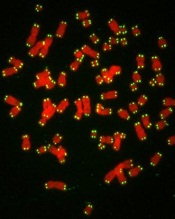
with telomeres in green
Image by Claus Azzalin
Researchers say they have found a new way to fight aplastic anemia—using a therapy designed to delay aging.
Four years ago, the group created telomerase gene therapy, an antiaging treatment based on repairing telomeres.
Now, they have found evidence to suggest this therapy can be effective against both acquired and inherited aplastic anemia.
The team reported preclinical results with the treatment in Blood.
In 2012, Maria A. Blasco, PhD, of Centro Nacional de Investigaciones Oncologicas in Madrid, Spain, and her colleagues described a strategy to repair telomeres.
They used adeno-associated virus (AAV9) vectors to deliver telomerase (Tert) gene therapy, which attenuated or reverted aging-associated telomere erosion in peripheral blood mononuclear cells.
For the current study, the researchers tested the therapy in a mouse model of acquired aplastic anemia and one of inherited aplastic anemia.
Acquired aplastic anemia
For the model of acquired aplastic anemia, the researchers depleted the TRF1 shelterin protein in the bone marrow. The team said this causes severe telomere uncapping and provokes a persistent DNA damage response at telomeres, which leads to fast clearance of hematopoietic stem and progenitor cells (HSPCs) deficient for Trf1.
The remaining HSPCs then undergo additional rounds of compensatory proliferation to regenerate the bone marrow, which leads to rapid telomere attrition. So this model recapitulates the compensatory hyperproliferation and short-telomere phenotype observed in acquired aplastic anemia.
The researchers induced Trf1 deletion with polyinosinic-polycytidylic acid injections given 3 times a week for 5 weeks. At that point, the mice began to show signs of aplastic anemia. A week after the last injection, the mice received either AAV9-Tert or AAV9-empty vectors.
Eighty-seven percent of the AAV9-Tert mice were still alive at 100 days, compared to 55% of mice in the empty vector group (P=0.0025).
In addition, 13% (4/31) of the mice treated with AAV9-Tert actually developed aplastic anemia, while 44% (16/36) of the control mice died showing “clear signs” of aplastic anemia (P=0.0006).
Finally, the researchers found that AAV9-Tert reversed telomere shortening in peripheral blood and bone marrow cells.
Inherited aplastic anemia
For the model of inherited aplastic anemia, the researchers transplanted irradiated wild-type mice with bone marrow from third-generation telomerase-deficient Tert knockout mice. These mice have short telomeres resulting from telomerase deficiency over 3 generations.
As with the previous model, these mice received AAV9-Tert or AAV9-empty vectors. The AAV9-Tert mice had a superior survival rate that nearly reached statistical significance (P=0.058).
The researchers also found that, compared to controls, AAV9-Tert-treated mice had significant increases in hemoglobin levels (P=0.003), erythrocyte counts (P=0.006), and platelet counts (P=0.035), as well as a trend toward an increase in leukocyte counts (P=0.09).
In addition, AAV9-Tert treatment led to a net increase in average telomere length of 5.18Kb, while control mice had a slight telomere shortening of 1.76Kb.
The researchers noted that there are types of aplastic anemia not associated with short telomeres. However, they believe these results provide proof of concept that gene therapy is a valid strategy for treating aplastic anemia.
with telomeres in green
Image by Claus Azzalin
Researchers say they have found a new way to fight aplastic anemia—using a therapy designed to delay aging.
Four years ago, the group created telomerase gene therapy, an antiaging treatment based on repairing telomeres.
Now, they have found evidence to suggest this therapy can be effective against both acquired and inherited aplastic anemia.
The team reported preclinical results with the treatment in Blood.
In 2012, Maria A. Blasco, PhD, of Centro Nacional de Investigaciones Oncologicas in Madrid, Spain, and her colleagues described a strategy to repair telomeres.
They used adeno-associated virus (AAV9) vectors to deliver telomerase (Tert) gene therapy, which attenuated or reverted aging-associated telomere erosion in peripheral blood mononuclear cells.
For the current study, the researchers tested the therapy in a mouse model of acquired aplastic anemia and one of inherited aplastic anemia.
Acquired aplastic anemia
For the model of acquired aplastic anemia, the researchers depleted the TRF1 shelterin protein in the bone marrow. The team said this causes severe telomere uncapping and provokes a persistent DNA damage response at telomeres, which leads to fast clearance of hematopoietic stem and progenitor cells (HSPCs) deficient for Trf1.
The remaining HSPCs then undergo additional rounds of compensatory proliferation to regenerate the bone marrow, which leads to rapid telomere attrition. So this model recapitulates the compensatory hyperproliferation and short-telomere phenotype observed in acquired aplastic anemia.
The researchers induced Trf1 deletion with polyinosinic-polycytidylic acid injections given 3 times a week for 5 weeks. At that point, the mice began to show signs of aplastic anemia. A week after the last injection, the mice received either AAV9-Tert or AAV9-empty vectors.
Eighty-seven percent of the AAV9-Tert mice were still alive at 100 days, compared to 55% of mice in the empty vector group (P=0.0025).
In addition, 13% (4/31) of the mice treated with AAV9-Tert actually developed aplastic anemia, while 44% (16/36) of the control mice died showing “clear signs” of aplastic anemia (P=0.0006).
Finally, the researchers found that AAV9-Tert reversed telomere shortening in peripheral blood and bone marrow cells.
Inherited aplastic anemia
For the model of inherited aplastic anemia, the researchers transplanted irradiated wild-type mice with bone marrow from third-generation telomerase-deficient Tert knockout mice. These mice have short telomeres resulting from telomerase deficiency over 3 generations.
As with the previous model, these mice received AAV9-Tert or AAV9-empty vectors. The AAV9-Tert mice had a superior survival rate that nearly reached statistical significance (P=0.058).
The researchers also found that, compared to controls, AAV9-Tert-treated mice had significant increases in hemoglobin levels (P=0.003), erythrocyte counts (P=0.006), and platelet counts (P=0.035), as well as a trend toward an increase in leukocyte counts (P=0.09).
In addition, AAV9-Tert treatment led to a net increase in average telomere length of 5.18Kb, while control mice had a slight telomere shortening of 1.76Kb.
The researchers noted that there are types of aplastic anemia not associated with short telomeres. However, they believe these results provide proof of concept that gene therapy is a valid strategy for treating aplastic anemia.
with telomeres in green
Image by Claus Azzalin
Researchers say they have found a new way to fight aplastic anemia—using a therapy designed to delay aging.
Four years ago, the group created telomerase gene therapy, an antiaging treatment based on repairing telomeres.
Now, they have found evidence to suggest this therapy can be effective against both acquired and inherited aplastic anemia.
The team reported preclinical results with the treatment in Blood.
In 2012, Maria A. Blasco, PhD, of Centro Nacional de Investigaciones Oncologicas in Madrid, Spain, and her colleagues described a strategy to repair telomeres.
They used adeno-associated virus (AAV9) vectors to deliver telomerase (Tert) gene therapy, which attenuated or reverted aging-associated telomere erosion in peripheral blood mononuclear cells.
For the current study, the researchers tested the therapy in a mouse model of acquired aplastic anemia and one of inherited aplastic anemia.
Acquired aplastic anemia
For the model of acquired aplastic anemia, the researchers depleted the TRF1 shelterin protein in the bone marrow. The team said this causes severe telomere uncapping and provokes a persistent DNA damage response at telomeres, which leads to fast clearance of hematopoietic stem and progenitor cells (HSPCs) deficient for Trf1.
The remaining HSPCs then undergo additional rounds of compensatory proliferation to regenerate the bone marrow, which leads to rapid telomere attrition. So this model recapitulates the compensatory hyperproliferation and short-telomere phenotype observed in acquired aplastic anemia.
The researchers induced Trf1 deletion with polyinosinic-polycytidylic acid injections given 3 times a week for 5 weeks. At that point, the mice began to show signs of aplastic anemia. A week after the last injection, the mice received either AAV9-Tert or AAV9-empty vectors.
Eighty-seven percent of the AAV9-Tert mice were still alive at 100 days, compared to 55% of mice in the empty vector group (P=0.0025).
In addition, 13% (4/31) of the mice treated with AAV9-Tert actually developed aplastic anemia, while 44% (16/36) of the control mice died showing “clear signs” of aplastic anemia (P=0.0006).
Finally, the researchers found that AAV9-Tert reversed telomere shortening in peripheral blood and bone marrow cells.
Inherited aplastic anemia
For the model of inherited aplastic anemia, the researchers transplanted irradiated wild-type mice with bone marrow from third-generation telomerase-deficient Tert knockout mice. These mice have short telomeres resulting from telomerase deficiency over 3 generations.
As with the previous model, these mice received AAV9-Tert or AAV9-empty vectors. The AAV9-Tert mice had a superior survival rate that nearly reached statistical significance (P=0.058).
The researchers also found that, compared to controls, AAV9-Tert-treated mice had significant increases in hemoglobin levels (P=0.003), erythrocyte counts (P=0.006), and platelet counts (P=0.035), as well as a trend toward an increase in leukocyte counts (P=0.09).
In addition, AAV9-Tert treatment led to a net increase in average telomere length of 5.18Kb, while control mice had a slight telomere shortening of 1.76Kb.
The researchers noted that there are types of aplastic anemia not associated with short telomeres. However, they believe these results provide proof of concept that gene therapy is a valid strategy for treating aplastic anemia.
Agent can mobilize HSCs for transplant, study suggests

in the bone marrow
HONOLULU—Early results from a pilot study suggest an investigational agent can effectively mobilize hematopoietic stem cells (HSCs) in healthy transplant donors.
The agent, CDX-301 (recombinant human Flt3 ligand), is a hematopoietic cytokine designed to expand dendritic cells and HSCs.
For the study, researchers tested CDX-301 in sibling-matched donors for hematopoietic stem cell transplant (HSCT) recipients with hematologic malignancies.
The team reported early results with 4 donor/recipient pairs at the 2016 BMT Tandem Meetings (abstract 479). The research was sponsored by Celldex Therapeutics, Inc., the company developing CDX-301.
Donor results
The donors received CDX-301 at 75 μg/kg/day for 5 days. Leukapheresis began on day 6 if the peripheral blood CD34+ count was 7/μL or greater. The goal CD34+ yield was at least 2x10⁶ per kilogram of recipient weight collected in 2 days of leukapheresis or less.
The donors could receive rescue plerixafor if the peripheral blood CD34+ count was less than 7/μL by day 8 or if the total CD34+ yield was less than 1x10⁶/kg after the second day of leukapheresis.
The researchers analyzed CDX-301-mobilized cells by flow cytometry and compared them to historical data for peripheral blood grafts mobilized by granulocyte colony-stimulating factor (G-CSF).
Compared to the G-CSF-mobilized grafts, CDX-301-mobilized grafts had an increase in CD127+ (IL-7R) naïve T cells, γδ T cells, natural killer cells, and B cells.
The CDX-301-mobilized grafts were more enriched with plasmacytoid dendritic cells. And dendritic cells from the CDX-301 grafts had a more mature phenotype, expressing CD80 and CD86.
“From these data and preclinical studies, CDX-301 appears to be an effective, targeted approach to mobilization comparable to G-CSF,” said Steven Devine, MD, of The Ohio State Comprehensive Cancer Center in Columbus.
“With a relatively short course of treatment, we are observing specificity for mobilized stem cells and a lack of toxicity, instead of broad cellular mobilization and side effects.”
CDX-301 related adverse events included dizziness (grade 2), back pain (grade 1), arthralgia (grade 1), injection site reaction (2 grade 1), dyspepsia (1 grade 1, 1 grade 2), and decreased platelet count (2 grade 1). There were no grade 3/4 adverse events.
Recipient results
Thus far, 4 recipients have undergone HSCT with CDX-301-mobilized grafts. Recipient 1 had acute myeloid leukemia, recipients 2 and 3 had mantle cell lymphoma, and recipient 4 had chronic myeloid leukemia.
Recipients 1 through 3 received myeloablative conditioning, while recipient 4 received reduced-intensity conditioning. All patients received standard graft-vs-host disease (GVHD) prophylaxis (tacrolimus and methotrexate).
Recipient 4 has not yet engrafted. The other 3 had both neutrophil engraftment (day 17, 18, and 19) and platelet engraftment (day 14, 25, and 40).
There have been no infectious complications, and recipients 1 and 3 have not developed GVHD.
Recipient 2 developed steroid-responsive, grade 2, upper gastrointestinal GVHD on day 18, followed by grade 1 skin GVHD on day 50 that progressed to stage 3. Overall, the patient had grade 2 GVHD on day 64. The patient’s lymphoma has also progressed.
The researchers said these results suggest CDX-301 is well tolerated and can mobilize CD34+ cells when given as a single agent. They said recipients experienced successful engraftment in an expected time frame.
And the additional naïve T cells and plasmacytoid dendritic cells in CDX-301-mobilized grafts (compared to G-CSF-mobilized grafts) may provide better outcomes in HSCT recipients.
Now, the researchers plan to explore CDX-301 in combination with plerixafor. Additional donor/patient pairs are being accrued to a second study cohort.
in the bone marrow
HONOLULU—Early results from a pilot study suggest an investigational agent can effectively mobilize hematopoietic stem cells (HSCs) in healthy transplant donors.
The agent, CDX-301 (recombinant human Flt3 ligand), is a hematopoietic cytokine designed to expand dendritic cells and HSCs.
For the study, researchers tested CDX-301 in sibling-matched donors for hematopoietic stem cell transplant (HSCT) recipients with hematologic malignancies.
The team reported early results with 4 donor/recipient pairs at the 2016 BMT Tandem Meetings (abstract 479). The research was sponsored by Celldex Therapeutics, Inc., the company developing CDX-301.
Donor results
The donors received CDX-301 at 75 μg/kg/day for 5 days. Leukapheresis began on day 6 if the peripheral blood CD34+ count was 7/μL or greater. The goal CD34+ yield was at least 2x10⁶ per kilogram of recipient weight collected in 2 days of leukapheresis or less.
The donors could receive rescue plerixafor if the peripheral blood CD34+ count was less than 7/μL by day 8 or if the total CD34+ yield was less than 1x10⁶/kg after the second day of leukapheresis.
The researchers analyzed CDX-301-mobilized cells by flow cytometry and compared them to historical data for peripheral blood grafts mobilized by granulocyte colony-stimulating factor (G-CSF).
Compared to the G-CSF-mobilized grafts, CDX-301-mobilized grafts had an increase in CD127+ (IL-7R) naïve T cells, γδ T cells, natural killer cells, and B cells.
The CDX-301-mobilized grafts were more enriched with plasmacytoid dendritic cells. And dendritic cells from the CDX-301 grafts had a more mature phenotype, expressing CD80 and CD86.
“From these data and preclinical studies, CDX-301 appears to be an effective, targeted approach to mobilization comparable to G-CSF,” said Steven Devine, MD, of The Ohio State Comprehensive Cancer Center in Columbus.
“With a relatively short course of treatment, we are observing specificity for mobilized stem cells and a lack of toxicity, instead of broad cellular mobilization and side effects.”
CDX-301 related adverse events included dizziness (grade 2), back pain (grade 1), arthralgia (grade 1), injection site reaction (2 grade 1), dyspepsia (1 grade 1, 1 grade 2), and decreased platelet count (2 grade 1). There were no grade 3/4 adverse events.
Recipient results
Thus far, 4 recipients have undergone HSCT with CDX-301-mobilized grafts. Recipient 1 had acute myeloid leukemia, recipients 2 and 3 had mantle cell lymphoma, and recipient 4 had chronic myeloid leukemia.
Recipients 1 through 3 received myeloablative conditioning, while recipient 4 received reduced-intensity conditioning. All patients received standard graft-vs-host disease (GVHD) prophylaxis (tacrolimus and methotrexate).
Recipient 4 has not yet engrafted. The other 3 had both neutrophil engraftment (day 17, 18, and 19) and platelet engraftment (day 14, 25, and 40).
There have been no infectious complications, and recipients 1 and 3 have not developed GVHD.
Recipient 2 developed steroid-responsive, grade 2, upper gastrointestinal GVHD on day 18, followed by grade 1 skin GVHD on day 50 that progressed to stage 3. Overall, the patient had grade 2 GVHD on day 64. The patient’s lymphoma has also progressed.
The researchers said these results suggest CDX-301 is well tolerated and can mobilize CD34+ cells when given as a single agent. They said recipients experienced successful engraftment in an expected time frame.
And the additional naïve T cells and plasmacytoid dendritic cells in CDX-301-mobilized grafts (compared to G-CSF-mobilized grafts) may provide better outcomes in HSCT recipients.
Now, the researchers plan to explore CDX-301 in combination with plerixafor. Additional donor/patient pairs are being accrued to a second study cohort.
in the bone marrow
HONOLULU—Early results from a pilot study suggest an investigational agent can effectively mobilize hematopoietic stem cells (HSCs) in healthy transplant donors.
The agent, CDX-301 (recombinant human Flt3 ligand), is a hematopoietic cytokine designed to expand dendritic cells and HSCs.
For the study, researchers tested CDX-301 in sibling-matched donors for hematopoietic stem cell transplant (HSCT) recipients with hematologic malignancies.
The team reported early results with 4 donor/recipient pairs at the 2016 BMT Tandem Meetings (abstract 479). The research was sponsored by Celldex Therapeutics, Inc., the company developing CDX-301.
Donor results
The donors received CDX-301 at 75 μg/kg/day for 5 days. Leukapheresis began on day 6 if the peripheral blood CD34+ count was 7/μL or greater. The goal CD34+ yield was at least 2x10⁶ per kilogram of recipient weight collected in 2 days of leukapheresis or less.
The donors could receive rescue plerixafor if the peripheral blood CD34+ count was less than 7/μL by day 8 or if the total CD34+ yield was less than 1x10⁶/kg after the second day of leukapheresis.
The researchers analyzed CDX-301-mobilized cells by flow cytometry and compared them to historical data for peripheral blood grafts mobilized by granulocyte colony-stimulating factor (G-CSF).
Compared to the G-CSF-mobilized grafts, CDX-301-mobilized grafts had an increase in CD127+ (IL-7R) naïve T cells, γδ T cells, natural killer cells, and B cells.
The CDX-301-mobilized grafts were more enriched with plasmacytoid dendritic cells. And dendritic cells from the CDX-301 grafts had a more mature phenotype, expressing CD80 and CD86.
“From these data and preclinical studies, CDX-301 appears to be an effective, targeted approach to mobilization comparable to G-CSF,” said Steven Devine, MD, of The Ohio State Comprehensive Cancer Center in Columbus.
“With a relatively short course of treatment, we are observing specificity for mobilized stem cells and a lack of toxicity, instead of broad cellular mobilization and side effects.”
CDX-301 related adverse events included dizziness (grade 2), back pain (grade 1), arthralgia (grade 1), injection site reaction (2 grade 1), dyspepsia (1 grade 1, 1 grade 2), and decreased platelet count (2 grade 1). There were no grade 3/4 adverse events.
Recipient results
Thus far, 4 recipients have undergone HSCT with CDX-301-mobilized grafts. Recipient 1 had acute myeloid leukemia, recipients 2 and 3 had mantle cell lymphoma, and recipient 4 had chronic myeloid leukemia.
Recipients 1 through 3 received myeloablative conditioning, while recipient 4 received reduced-intensity conditioning. All patients received standard graft-vs-host disease (GVHD) prophylaxis (tacrolimus and methotrexate).
Recipient 4 has not yet engrafted. The other 3 had both neutrophil engraftment (day 17, 18, and 19) and platelet engraftment (day 14, 25, and 40).
There have been no infectious complications, and recipients 1 and 3 have not developed GVHD.
Recipient 2 developed steroid-responsive, grade 2, upper gastrointestinal GVHD on day 18, followed by grade 1 skin GVHD on day 50 that progressed to stage 3. Overall, the patient had grade 2 GVHD on day 64. The patient’s lymphoma has also progressed.
The researchers said these results suggest CDX-301 is well tolerated and can mobilize CD34+ cells when given as a single agent. They said recipients experienced successful engraftment in an expected time frame.
And the additional naïve T cells and plasmacytoid dendritic cells in CDX-301-mobilized grafts (compared to G-CSF-mobilized grafts) may provide better outcomes in HSCT recipients.
Now, the researchers plan to explore CDX-301 in combination with plerixafor. Additional donor/patient pairs are being accrued to a second study cohort.
Team develops hospital-based Zika test
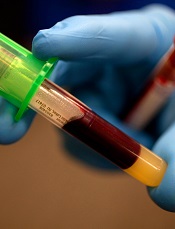
Photo by Juan D. Alfonso
Two institutions in Houston, Texas, have developed the US’s first hospital-based, rapid diagnostic test for the Zika virus.
Pathologists and clinical laboratory scientists at Texas Children’s Hospital and Houston Methodist Hospital developed the test, which is customized to each hospital’s diagnostic laboratory and can provide results within several hours.
The test can be performed on blood, amniotic fluid, urine, or spinal fluid.
The test identifies virus-specific RNA sequences to detect Zika virus. It can distinguish Zika infection from dengue, West Nile, or chikungunya infections.
Right now, only registered patients at Texas Children’s or Houston Methodist Hospital can receive the test, but the labs will consider referral testing from other hospitals and clinics in the future.
Initially, the test will be offered to patients with a positive travel history and symptoms consistent with acute Zika virus infection (eg, rash, arthralgia, or fever) or asymptomatic pregnant women with a positive travel history to any of the Zika-affected countries.
The goal of hospital-based testing for Zika virus is to prevent the delays that may occur with testing conducted in local and state public health laboratories and the Centers for Disease Control and Prevention.
“Hospital-based testing that is state-of-the-art enables our physicians and patients to get very rapid diagnostic answers,” said James M. Musser, MD, PhD, of Houston Methodist Hospital.
“If tests need to be repeated or if our treating doctors need to talk with our pathologists, we have the resources near patient care settings.”
The collaboration between Texas Children’s and Houston Methodist Hospital was sponsored by the L.E. and Virginia Simmons Collaborative in Virus Detection and Surveillance. This program was designed to facilitate rapid development of tests for virus detection in a large metropolitan area.
Photo by Juan D. Alfonso
Two institutions in Houston, Texas, have developed the US’s first hospital-based, rapid diagnostic test for the Zika virus.
Pathologists and clinical laboratory scientists at Texas Children’s Hospital and Houston Methodist Hospital developed the test, which is customized to each hospital’s diagnostic laboratory and can provide results within several hours.
The test can be performed on blood, amniotic fluid, urine, or spinal fluid.
The test identifies virus-specific RNA sequences to detect Zika virus. It can distinguish Zika infection from dengue, West Nile, or chikungunya infections.
Right now, only registered patients at Texas Children’s or Houston Methodist Hospital can receive the test, but the labs will consider referral testing from other hospitals and clinics in the future.
Initially, the test will be offered to patients with a positive travel history and symptoms consistent with acute Zika virus infection (eg, rash, arthralgia, or fever) or asymptomatic pregnant women with a positive travel history to any of the Zika-affected countries.
The goal of hospital-based testing for Zika virus is to prevent the delays that may occur with testing conducted in local and state public health laboratories and the Centers for Disease Control and Prevention.
“Hospital-based testing that is state-of-the-art enables our physicians and patients to get very rapid diagnostic answers,” said James M. Musser, MD, PhD, of Houston Methodist Hospital.
“If tests need to be repeated or if our treating doctors need to talk with our pathologists, we have the resources near patient care settings.”
The collaboration between Texas Children’s and Houston Methodist Hospital was sponsored by the L.E. and Virginia Simmons Collaborative in Virus Detection and Surveillance. This program was designed to facilitate rapid development of tests for virus detection in a large metropolitan area.
Photo by Juan D. Alfonso
Two institutions in Houston, Texas, have developed the US’s first hospital-based, rapid diagnostic test for the Zika virus.
Pathologists and clinical laboratory scientists at Texas Children’s Hospital and Houston Methodist Hospital developed the test, which is customized to each hospital’s diagnostic laboratory and can provide results within several hours.
The test can be performed on blood, amniotic fluid, urine, or spinal fluid.
The test identifies virus-specific RNA sequences to detect Zika virus. It can distinguish Zika infection from dengue, West Nile, or chikungunya infections.
Right now, only registered patients at Texas Children’s or Houston Methodist Hospital can receive the test, but the labs will consider referral testing from other hospitals and clinics in the future.
Initially, the test will be offered to patients with a positive travel history and symptoms consistent with acute Zika virus infection (eg, rash, arthralgia, or fever) or asymptomatic pregnant women with a positive travel history to any of the Zika-affected countries.
The goal of hospital-based testing for Zika virus is to prevent the delays that may occur with testing conducted in local and state public health laboratories and the Centers for Disease Control and Prevention.
“Hospital-based testing that is state-of-the-art enables our physicians and patients to get very rapid diagnostic answers,” said James M. Musser, MD, PhD, of Houston Methodist Hospital.
“If tests need to be repeated or if our treating doctors need to talk with our pathologists, we have the resources near patient care settings.”
The collaboration between Texas Children’s and Houston Methodist Hospital was sponsored by the L.E. and Virginia Simmons Collaborative in Virus Detection and Surveillance. This program was designed to facilitate rapid development of tests for virus detection in a large metropolitan area.
Histone levels may predict thrombocytopenia

Image by Eric Smith
Measuring circulating histones may help physicians predict the onset of thrombocytopenia or allow them to monitor the condition in patients who are critically ill, according to researchers.
They noted that histones induce profound thrombocytopenia in mice and are associated with organ injury when released after extensive cell damage in patients who are critically ill.
So the team decided to examine the association between circulating histones and thrombocytopenia in patients in the intensive care unit (ICU).
Cheng-Hock Toh, MD, of the University of Liverpool in the UK, and his colleagues conducted this research and reported the results in a letter to JAMA.
The researchers analyzed 56 patients with thrombocytopenia and 56 controls with normal platelet counts who were admitted to the ICU at Royal Liverpool University Hospital between June 2013 and January 2014.
Thrombocytopenia was defined as a platelet count less than 150 × 103/µL, a 25% or greater decrease in platelet count, or both within the first 96 hours of ICU admission.
The researchers noted that, at approximately 30 µg/mL, histones bind platelets and cause platelet aggregation, which results in profound thrombocytopenia in mice.
So the team used this as a cutoff to stratify thrombocytopenic patients. A “high” level of histones was 30 µg/mL or greater, and a “low” level was below 30 µg/mL.
The researchers detected circulating histones in 51 of the thrombocytopenic patients and 31 controls—91% and 55%, respectively (P<0.001). Histone levels were 2.5- to 5.5-fold higher in thrombocytopenic patients than in controls.
Thrombocytopenic patients with high histone levels at ICU admission had significantly lower platelet counts and a significantly higher percentage of decrease in platelet counts at 24 hours (P=0.02 and P=0.04, respectively) and 48 hours (P=0.003 and P=0.005, respectively) after admission.
High admission histone levels were associated with moderate to severe thrombocytopenia and the development of clinically important thrombocytopenia (P<0.001).
A 30 µg/mL histone concentration was able to predict thrombocytopenia with 76% sensitivity and 91% specificity. The positive predictive value was 79.4%, and the negative predictive value was 89.2%.
Image by Eric Smith
Measuring circulating histones may help physicians predict the onset of thrombocytopenia or allow them to monitor the condition in patients who are critically ill, according to researchers.
They noted that histones induce profound thrombocytopenia in mice and are associated with organ injury when released after extensive cell damage in patients who are critically ill.
So the team decided to examine the association between circulating histones and thrombocytopenia in patients in the intensive care unit (ICU).
Cheng-Hock Toh, MD, of the University of Liverpool in the UK, and his colleagues conducted this research and reported the results in a letter to JAMA.
The researchers analyzed 56 patients with thrombocytopenia and 56 controls with normal platelet counts who were admitted to the ICU at Royal Liverpool University Hospital between June 2013 and January 2014.
Thrombocytopenia was defined as a platelet count less than 150 × 103/µL, a 25% or greater decrease in platelet count, or both within the first 96 hours of ICU admission.
The researchers noted that, at approximately 30 µg/mL, histones bind platelets and cause platelet aggregation, which results in profound thrombocytopenia in mice.
So the team used this as a cutoff to stratify thrombocytopenic patients. A “high” level of histones was 30 µg/mL or greater, and a “low” level was below 30 µg/mL.
The researchers detected circulating histones in 51 of the thrombocytopenic patients and 31 controls—91% and 55%, respectively (P<0.001). Histone levels were 2.5- to 5.5-fold higher in thrombocytopenic patients than in controls.
Thrombocytopenic patients with high histone levels at ICU admission had significantly lower platelet counts and a significantly higher percentage of decrease in platelet counts at 24 hours (P=0.02 and P=0.04, respectively) and 48 hours (P=0.003 and P=0.005, respectively) after admission.
High admission histone levels were associated with moderate to severe thrombocytopenia and the development of clinically important thrombocytopenia (P<0.001).
A 30 µg/mL histone concentration was able to predict thrombocytopenia with 76% sensitivity and 91% specificity. The positive predictive value was 79.4%, and the negative predictive value was 89.2%.
Image by Eric Smith
Measuring circulating histones may help physicians predict the onset of thrombocytopenia or allow them to monitor the condition in patients who are critically ill, according to researchers.
They noted that histones induce profound thrombocytopenia in mice and are associated with organ injury when released after extensive cell damage in patients who are critically ill.
So the team decided to examine the association between circulating histones and thrombocytopenia in patients in the intensive care unit (ICU).
Cheng-Hock Toh, MD, of the University of Liverpool in the UK, and his colleagues conducted this research and reported the results in a letter to JAMA.
The researchers analyzed 56 patients with thrombocytopenia and 56 controls with normal platelet counts who were admitted to the ICU at Royal Liverpool University Hospital between June 2013 and January 2014.
Thrombocytopenia was defined as a platelet count less than 150 × 103/µL, a 25% or greater decrease in platelet count, or both within the first 96 hours of ICU admission.
The researchers noted that, at approximately 30 µg/mL, histones bind platelets and cause platelet aggregation, which results in profound thrombocytopenia in mice.
So the team used this as a cutoff to stratify thrombocytopenic patients. A “high” level of histones was 30 µg/mL or greater, and a “low” level was below 30 µg/mL.
The researchers detected circulating histones in 51 of the thrombocytopenic patients and 31 controls—91% and 55%, respectively (P<0.001). Histone levels were 2.5- to 5.5-fold higher in thrombocytopenic patients than in controls.
Thrombocytopenic patients with high histone levels at ICU admission had significantly lower platelet counts and a significantly higher percentage of decrease in platelet counts at 24 hours (P=0.02 and P=0.04, respectively) and 48 hours (P=0.003 and P=0.005, respectively) after admission.
High admission histone levels were associated with moderate to severe thrombocytopenia and the development of clinically important thrombocytopenia (P<0.001).
A 30 µg/mL histone concentration was able to predict thrombocytopenia with 76% sensitivity and 91% specificity. The positive predictive value was 79.4%, and the negative predictive value was 89.2%.
Adjunct T-cell therapy granted orphan designation
The US Food and Drug Administration (FDA) has granted orphan drug designation for BPX-501, an adjunct T-cell therapy.
The designation is for the combination of BPX-501 genetically modified T cells and the activator agent rimiducid as replacement T-cell therapy for the treatment of immunodeficiency and graft-versus-host disease (GVHD) after allogeneic hematopoietic stem cell transplant (HSCT).
BPX-501 consists of genetically modified donor T cells incorporating the CaspaCIDe safety switch, which is designed to eliminate cells in the event of toxicity.
The CaspaCIDe switch consists of the CID-binding domain coupled to the signaling domain of caspase-9, an enzyme that is part of the apoptotic pathway. Infusion of rimiducid is designed to trigger activation of this domain of caspase-9 (iCasp9), which leads to selective apoptosis of the CaspaCIDe-containing cells.
This technology is intended to provide a safety net to eliminate BPX-501 alloreactive T cells if severe GVHD occurs, ostensibly enabling physicians to more safely perform haploidentical HSCTs by adding back the BPX-501 genetically engineered T cells to speed immune reconstitution and provide control over viral infections.
Following an allogeneic HSCT, a lack of sufficient mature T cells constitutes immune deficiency that can contribute to infections, viral reactivation, and relapse.
The ability to correct this immune deficiency by adding back mature donor T cells, without raising the risk of uncontrollable GVHD, has the potential to change the risk profile of allogeneic transplant, according to Bellicum Pharmaceuticals, the company developing BPX-501.
BPX-501 is being evaluated in multiple phase 1/2 trials in adults and pediatric patients with leukemias, lymphomas, and genetic blood diseases in the US and Europe.
About orphan designation
The FDA’s Office of Orphan Products Development grants orphan designation to drugs and biologics intended to treat, diagnose, or prevent rare diseases and disorders that affect fewer than 200,000 people in the US.
Orphan designation qualifies a company for various development incentives, including tax credits for qualified clinical testing and marketing exclusivity for a period of 7 years.
The US Food and Drug Administration (FDA) has granted orphan drug designation for BPX-501, an adjunct T-cell therapy.
The designation is for the combination of BPX-501 genetically modified T cells and the activator agent rimiducid as replacement T-cell therapy for the treatment of immunodeficiency and graft-versus-host disease (GVHD) after allogeneic hematopoietic stem cell transplant (HSCT).
BPX-501 consists of genetically modified donor T cells incorporating the CaspaCIDe safety switch, which is designed to eliminate cells in the event of toxicity.
The CaspaCIDe switch consists of the CID-binding domain coupled to the signaling domain of caspase-9, an enzyme that is part of the apoptotic pathway. Infusion of rimiducid is designed to trigger activation of this domain of caspase-9 (iCasp9), which leads to selective apoptosis of the CaspaCIDe-containing cells.
This technology is intended to provide a safety net to eliminate BPX-501 alloreactive T cells if severe GVHD occurs, ostensibly enabling physicians to more safely perform haploidentical HSCTs by adding back the BPX-501 genetically engineered T cells to speed immune reconstitution and provide control over viral infections.
Following an allogeneic HSCT, a lack of sufficient mature T cells constitutes immune deficiency that can contribute to infections, viral reactivation, and relapse.
The ability to correct this immune deficiency by adding back mature donor T cells, without raising the risk of uncontrollable GVHD, has the potential to change the risk profile of allogeneic transplant, according to Bellicum Pharmaceuticals, the company developing BPX-501.
BPX-501 is being evaluated in multiple phase 1/2 trials in adults and pediatric patients with leukemias, lymphomas, and genetic blood diseases in the US and Europe.
About orphan designation
The FDA’s Office of Orphan Products Development grants orphan designation to drugs and biologics intended to treat, diagnose, or prevent rare diseases and disorders that affect fewer than 200,000 people in the US.
Orphan designation qualifies a company for various development incentives, including tax credits for qualified clinical testing and marketing exclusivity for a period of 7 years.
The US Food and Drug Administration (FDA) has granted orphan drug designation for BPX-501, an adjunct T-cell therapy.
The designation is for the combination of BPX-501 genetically modified T cells and the activator agent rimiducid as replacement T-cell therapy for the treatment of immunodeficiency and graft-versus-host disease (GVHD) after allogeneic hematopoietic stem cell transplant (HSCT).
BPX-501 consists of genetically modified donor T cells incorporating the CaspaCIDe safety switch, which is designed to eliminate cells in the event of toxicity.
The CaspaCIDe switch consists of the CID-binding domain coupled to the signaling domain of caspase-9, an enzyme that is part of the apoptotic pathway. Infusion of rimiducid is designed to trigger activation of this domain of caspase-9 (iCasp9), which leads to selective apoptosis of the CaspaCIDe-containing cells.
This technology is intended to provide a safety net to eliminate BPX-501 alloreactive T cells if severe GVHD occurs, ostensibly enabling physicians to more safely perform haploidentical HSCTs by adding back the BPX-501 genetically engineered T cells to speed immune reconstitution and provide control over viral infections.
Following an allogeneic HSCT, a lack of sufficient mature T cells constitutes immune deficiency that can contribute to infections, viral reactivation, and relapse.
The ability to correct this immune deficiency by adding back mature donor T cells, without raising the risk of uncontrollable GVHD, has the potential to change the risk profile of allogeneic transplant, according to Bellicum Pharmaceuticals, the company developing BPX-501.
BPX-501 is being evaluated in multiple phase 1/2 trials in adults and pediatric patients with leukemias, lymphomas, and genetic blood diseases in the US and Europe.
About orphan designation
The FDA’s Office of Orphan Products Development grants orphan designation to drugs and biologics intended to treat, diagnose, or prevent rare diseases and disorders that affect fewer than 200,000 people in the US.
Orphan designation qualifies a company for various development incentives, including tax credits for qualified clinical testing and marketing exclusivity for a period of 7 years.
MSC product may treat refractory aGVHD
HONOLULU—A mesenchymal stem cell (MSC) product has shown promise for treating children with steroid-refractory acute graft-versus-host disease (aGVHD), according to researchers.
The product, remestemcel-L (MSC-100-IV, formerly Prochymal), produced an overall response rate of 65% by 28 days after treatment.
And patients who responded to remestemcel-L had significantly better survival at day 100 than patients who did not respond.
Joanne Kurtzberg, MD, of Duke University Medical Center in Durham, North Carolina, presented these data at the 2016 BMT Tandem Meetings (abstract 54). The study was sponsored by Mesoblast, the company developing remestemcel-L.
“There is a critical and urgent need for an effective and well-tolerated treatment for the very ill children who develop [GVHD] after a bone marrow transplant,” Dr Kurtzberg said. “While, historically, there is a high mortality rate associated with this complication, we are now seeing the majority of children who receive Mesoblast’s cell therapy respond and survive.”
For this study, Dr Kurtzberg and her colleagues assessed 241 children treated in Mesoblast’s Expanded Access Program, which was conducted at 50 sites in North American and Europe from 2007 to 2014.
Forty-five percent of the children received a bone marrow transplant, 31% received cord blood, and 45% had a mismatched transplant. Their median age was 9.6 (range, 2 months-18 years), 61% were male, and 60% were Caucasian.
All of the patients had steroid-refractory aGVHD. Thirty percent had grade C GVHD, 50% had grade D, 50% had multi-organ disease, and 79% were classified as “high-risk” disease.
Treatment
All 241 children received remestemcel-L, which consists of bone-marrow derived and culture-expanded human MSCs. The initial treatment was 2 million MSCs/kg twice a week for 4 weeks, at least 3 days apart.
Continued treatment consisted of 2 million MSCs/kg once a week for 4 weeks if patients achieved a partial or mixed response (improvement in one organ with deterioration in another organ) at the day-28 assessment.
The patients received a total of 2434 infusions. The median number of infusions was 11 (range, 1-24), and the median duration of treatment was 46 days (range, 1-186). Eighty-one percent (123/152) of eligible patients with a partial or mixed response at day 28 received continued therapy of 1 infusion a week for 4 weeks.
Results
Fifty-seven percent of patients (n=138) had at least 1 serious adverse event. About 5% (n=11) were considered treatment-related, and 1.7% (n=4) led to study discontinuation. There was 1 infusion reaction.
Thirty-four percent of patients (n=81) died through day 100, and 2.5% (n=6) experienced a relapse of their underlying disease.
At day 28 after treatment, the overall response rate was 65%, with a complete response rate of 14% and partial response rate of 51%. Responses were observed for all aGVHD grades and did not differ by baseline organ involvement.
When remestemcel-L was used as front-line therapy following steroid failure, the response rate was 81%. In patients with gastrointestinal and liver disease, the overall response rates were 65% and 62%, respectively.
Children who achieved a response at day 28 had significantly improved survival, compared to those who did not—82% and 39%, respectively (P<0.0001).
Extending therapy beyond day 28 in children who had a mixed response at day 28 resulted in significantly improved survival as well. Survival was 72% for these patients, compared to 18% for patients with a mixed response who did not receive additional therapy (P=0.003).
Mesoblast is now conducting a 60-patient, open label, phase 3 trial using remestemcel-L as front-line therapy in children with steroid-refractory aGVHD.
HONOLULU—A mesenchymal stem cell (MSC) product has shown promise for treating children with steroid-refractory acute graft-versus-host disease (aGVHD), according to researchers.
The product, remestemcel-L (MSC-100-IV, formerly Prochymal), produced an overall response rate of 65% by 28 days after treatment.
And patients who responded to remestemcel-L had significantly better survival at day 100 than patients who did not respond.
Joanne Kurtzberg, MD, of Duke University Medical Center in Durham, North Carolina, presented these data at the 2016 BMT Tandem Meetings (abstract 54). The study was sponsored by Mesoblast, the company developing remestemcel-L.
“There is a critical and urgent need for an effective and well-tolerated treatment for the very ill children who develop [GVHD] after a bone marrow transplant,” Dr Kurtzberg said. “While, historically, there is a high mortality rate associated with this complication, we are now seeing the majority of children who receive Mesoblast’s cell therapy respond and survive.”
For this study, Dr Kurtzberg and her colleagues assessed 241 children treated in Mesoblast’s Expanded Access Program, which was conducted at 50 sites in North American and Europe from 2007 to 2014.
Forty-five percent of the children received a bone marrow transplant, 31% received cord blood, and 45% had a mismatched transplant. Their median age was 9.6 (range, 2 months-18 years), 61% were male, and 60% were Caucasian.
All of the patients had steroid-refractory aGVHD. Thirty percent had grade C GVHD, 50% had grade D, 50% had multi-organ disease, and 79% were classified as “high-risk” disease.
Treatment
All 241 children received remestemcel-L, which consists of bone-marrow derived and culture-expanded human MSCs. The initial treatment was 2 million MSCs/kg twice a week for 4 weeks, at least 3 days apart.
Continued treatment consisted of 2 million MSCs/kg once a week for 4 weeks if patients achieved a partial or mixed response (improvement in one organ with deterioration in another organ) at the day-28 assessment.
The patients received a total of 2434 infusions. The median number of infusions was 11 (range, 1-24), and the median duration of treatment was 46 days (range, 1-186). Eighty-one percent (123/152) of eligible patients with a partial or mixed response at day 28 received continued therapy of 1 infusion a week for 4 weeks.
Results
Fifty-seven percent of patients (n=138) had at least 1 serious adverse event. About 5% (n=11) were considered treatment-related, and 1.7% (n=4) led to study discontinuation. There was 1 infusion reaction.
Thirty-four percent of patients (n=81) died through day 100, and 2.5% (n=6) experienced a relapse of their underlying disease.
At day 28 after treatment, the overall response rate was 65%, with a complete response rate of 14% and partial response rate of 51%. Responses were observed for all aGVHD grades and did not differ by baseline organ involvement.
When remestemcel-L was used as front-line therapy following steroid failure, the response rate was 81%. In patients with gastrointestinal and liver disease, the overall response rates were 65% and 62%, respectively.
Children who achieved a response at day 28 had significantly improved survival, compared to those who did not—82% and 39%, respectively (P<0.0001).
Extending therapy beyond day 28 in children who had a mixed response at day 28 resulted in significantly improved survival as well. Survival was 72% for these patients, compared to 18% for patients with a mixed response who did not receive additional therapy (P=0.003).
Mesoblast is now conducting a 60-patient, open label, phase 3 trial using remestemcel-L as front-line therapy in children with steroid-refractory aGVHD.
HONOLULU—A mesenchymal stem cell (MSC) product has shown promise for treating children with steroid-refractory acute graft-versus-host disease (aGVHD), according to researchers.
The product, remestemcel-L (MSC-100-IV, formerly Prochymal), produced an overall response rate of 65% by 28 days after treatment.
And patients who responded to remestemcel-L had significantly better survival at day 100 than patients who did not respond.
Joanne Kurtzberg, MD, of Duke University Medical Center in Durham, North Carolina, presented these data at the 2016 BMT Tandem Meetings (abstract 54). The study was sponsored by Mesoblast, the company developing remestemcel-L.
“There is a critical and urgent need for an effective and well-tolerated treatment for the very ill children who develop [GVHD] after a bone marrow transplant,” Dr Kurtzberg said. “While, historically, there is a high mortality rate associated with this complication, we are now seeing the majority of children who receive Mesoblast’s cell therapy respond and survive.”
For this study, Dr Kurtzberg and her colleagues assessed 241 children treated in Mesoblast’s Expanded Access Program, which was conducted at 50 sites in North American and Europe from 2007 to 2014.
Forty-five percent of the children received a bone marrow transplant, 31% received cord blood, and 45% had a mismatched transplant. Their median age was 9.6 (range, 2 months-18 years), 61% were male, and 60% were Caucasian.
All of the patients had steroid-refractory aGVHD. Thirty percent had grade C GVHD, 50% had grade D, 50% had multi-organ disease, and 79% were classified as “high-risk” disease.
Treatment
All 241 children received remestemcel-L, which consists of bone-marrow derived and culture-expanded human MSCs. The initial treatment was 2 million MSCs/kg twice a week for 4 weeks, at least 3 days apart.
Continued treatment consisted of 2 million MSCs/kg once a week for 4 weeks if patients achieved a partial or mixed response (improvement in one organ with deterioration in another organ) at the day-28 assessment.
The patients received a total of 2434 infusions. The median number of infusions was 11 (range, 1-24), and the median duration of treatment was 46 days (range, 1-186). Eighty-one percent (123/152) of eligible patients with a partial or mixed response at day 28 received continued therapy of 1 infusion a week for 4 weeks.
Results
Fifty-seven percent of patients (n=138) had at least 1 serious adverse event. About 5% (n=11) were considered treatment-related, and 1.7% (n=4) led to study discontinuation. There was 1 infusion reaction.
Thirty-four percent of patients (n=81) died through day 100, and 2.5% (n=6) experienced a relapse of their underlying disease.
At day 28 after treatment, the overall response rate was 65%, with a complete response rate of 14% and partial response rate of 51%. Responses were observed for all aGVHD grades and did not differ by baseline organ involvement.
When remestemcel-L was used as front-line therapy following steroid failure, the response rate was 81%. In patients with gastrointestinal and liver disease, the overall response rates were 65% and 62%, respectively.
Children who achieved a response at day 28 had significantly improved survival, compared to those who did not—82% and 39%, respectively (P<0.0001).
Extending therapy beyond day 28 in children who had a mixed response at day 28 resulted in significantly improved survival as well. Survival was 72% for these patients, compared to 18% for patients with a mixed response who did not receive additional therapy (P=0.003).
Mesoblast is now conducting a 60-patient, open label, phase 3 trial using remestemcel-L as front-line therapy in children with steroid-refractory aGVHD.
Poverty tied to early relapse in kids with ALL

Photo by Logan Tuttle
A new study suggests children with acute lymphoblastic leukemia (ALL) are more likely to suffer early relapse if they live in high-poverty areas.
All of the children studied received the same treatment, and the rates of relapse were similar regardless of poverty level.
But early relapse was more common among children from poorer areas. These children also had a lower rate of 5-year overall survival, but the difference was not significant.
Kira Bona, MD, of Dana-Farber Cancer Institute in Boston, Massachusetts, and her colleagues reported these results in Pediatric Blood & Cancer.
The team examined outcomes for 575 children, ages 1 to 18, with newly diagnosed ALL who were treated on Dana-Farber Cancer Institute ALL Consortium Protocols at 7 major academic medical centers in the US between 2000 and 2010.
Using US Census Bureau criteria, the investigators defined high-poverty areas as zip codes where 20% or more of residents have incomes below the federal poverty level. For a family of 4, this translates to an annual income of $24,250 or less.
Dr Bona and her colleagues found the overall rates of relapse were similar between children from low-poverty areas and those from high-poverty areas.
However, the timing of relapse differed significantly. Ninety-two percent of children from high-poverty areas who relapsed suffered early relapse (less than 36 months after first achieving complete remission), while 48% of the other children who relapsed did so early (P=0.008).
The 5-year overall survival was 85% for children from high-poverty areas and 92% for children from low-poverty areas. This difference is statistically significant when considered on its own (P=0.02) but not when the analysis is adjusted for other factors (P=0.07).
Still, the investigators said this suggests a possible disparity in survival.
“These children are getting the same best possible care at well-resourced institutions from highly trained clinicians, and we’re still seeing disparities,” Dr Bona said. “In trying to improve cure rates, we, as a field, have focused almost exclusively on biology. If we want to move forward, we also have to look at social determinants.”
Next steps
Dr Bona and her colleagues are undertaking further research designed to delve deeper into the relationship between socioeconomic status and outcomes and to allow for the development of poverty-targeted interventions.
As part of a prospective trial for children with ALL, the researchers will investigate associations between disease outcomes and the socioeconomic status of patients’ families, using a targetable measure of socioeconomic status called material hardship (food, housing, and/or energy insecurity).
The researchers will also investigate possible mechanisms underlying the relationship between socioeconomic status and early relapse, including adherence to oral chemotherapy and delays or dose reductions in chemotherapy due to a child’s underlying health.
In another study, investigators will conduct in-depth interviews with patients’ families, probing their knowledge and experience to pinpoint factors that might explain the disparity in outcomes and identify factors that can be targeted with interventions.
“Doing these next 2 studies is incredibly important,” Dr Bona said. “This study told us that simply providing the current best treatment regimen is not good enough if our goal is to cure every child with cancer.”
“At the same time that we develop new drugs and new treatment protocols, we need to address social determinants of health. Findings from these next studies will help us develop specific interventions to address disparities in outcomes. That’s an amazing opportunity.”
Photo by Logan Tuttle
A new study suggests children with acute lymphoblastic leukemia (ALL) are more likely to suffer early relapse if they live in high-poverty areas.
All of the children studied received the same treatment, and the rates of relapse were similar regardless of poverty level.
But early relapse was more common among children from poorer areas. These children also had a lower rate of 5-year overall survival, but the difference was not significant.
Kira Bona, MD, of Dana-Farber Cancer Institute in Boston, Massachusetts, and her colleagues reported these results in Pediatric Blood & Cancer.
The team examined outcomes for 575 children, ages 1 to 18, with newly diagnosed ALL who were treated on Dana-Farber Cancer Institute ALL Consortium Protocols at 7 major academic medical centers in the US between 2000 and 2010.
Using US Census Bureau criteria, the investigators defined high-poverty areas as zip codes where 20% or more of residents have incomes below the federal poverty level. For a family of 4, this translates to an annual income of $24,250 or less.
Dr Bona and her colleagues found the overall rates of relapse were similar between children from low-poverty areas and those from high-poverty areas.
However, the timing of relapse differed significantly. Ninety-two percent of children from high-poverty areas who relapsed suffered early relapse (less than 36 months after first achieving complete remission), while 48% of the other children who relapsed did so early (P=0.008).
The 5-year overall survival was 85% for children from high-poverty areas and 92% for children from low-poverty areas. This difference is statistically significant when considered on its own (P=0.02) but not when the analysis is adjusted for other factors (P=0.07).
Still, the investigators said this suggests a possible disparity in survival.
“These children are getting the same best possible care at well-resourced institutions from highly trained clinicians, and we’re still seeing disparities,” Dr Bona said. “In trying to improve cure rates, we, as a field, have focused almost exclusively on biology. If we want to move forward, we also have to look at social determinants.”
Next steps
Dr Bona and her colleagues are undertaking further research designed to delve deeper into the relationship between socioeconomic status and outcomes and to allow for the development of poverty-targeted interventions.
As part of a prospective trial for children with ALL, the researchers will investigate associations between disease outcomes and the socioeconomic status of patients’ families, using a targetable measure of socioeconomic status called material hardship (food, housing, and/or energy insecurity).
The researchers will also investigate possible mechanisms underlying the relationship between socioeconomic status and early relapse, including adherence to oral chemotherapy and delays or dose reductions in chemotherapy due to a child’s underlying health.
In another study, investigators will conduct in-depth interviews with patients’ families, probing their knowledge and experience to pinpoint factors that might explain the disparity in outcomes and identify factors that can be targeted with interventions.
“Doing these next 2 studies is incredibly important,” Dr Bona said. “This study told us that simply providing the current best treatment regimen is not good enough if our goal is to cure every child with cancer.”
“At the same time that we develop new drugs and new treatment protocols, we need to address social determinants of health. Findings from these next studies will help us develop specific interventions to address disparities in outcomes. That’s an amazing opportunity.”
Photo by Logan Tuttle
A new study suggests children with acute lymphoblastic leukemia (ALL) are more likely to suffer early relapse if they live in high-poverty areas.
All of the children studied received the same treatment, and the rates of relapse were similar regardless of poverty level.
But early relapse was more common among children from poorer areas. These children also had a lower rate of 5-year overall survival, but the difference was not significant.
Kira Bona, MD, of Dana-Farber Cancer Institute in Boston, Massachusetts, and her colleagues reported these results in Pediatric Blood & Cancer.
The team examined outcomes for 575 children, ages 1 to 18, with newly diagnosed ALL who were treated on Dana-Farber Cancer Institute ALL Consortium Protocols at 7 major academic medical centers in the US between 2000 and 2010.
Using US Census Bureau criteria, the investigators defined high-poverty areas as zip codes where 20% or more of residents have incomes below the federal poverty level. For a family of 4, this translates to an annual income of $24,250 or less.
Dr Bona and her colleagues found the overall rates of relapse were similar between children from low-poverty areas and those from high-poverty areas.
However, the timing of relapse differed significantly. Ninety-two percent of children from high-poverty areas who relapsed suffered early relapse (less than 36 months after first achieving complete remission), while 48% of the other children who relapsed did so early (P=0.008).
The 5-year overall survival was 85% for children from high-poverty areas and 92% for children from low-poverty areas. This difference is statistically significant when considered on its own (P=0.02) but not when the analysis is adjusted for other factors (P=0.07).
Still, the investigators said this suggests a possible disparity in survival.
“These children are getting the same best possible care at well-resourced institutions from highly trained clinicians, and we’re still seeing disparities,” Dr Bona said. “In trying to improve cure rates, we, as a field, have focused almost exclusively on biology. If we want to move forward, we also have to look at social determinants.”
Next steps
Dr Bona and her colleagues are undertaking further research designed to delve deeper into the relationship between socioeconomic status and outcomes and to allow for the development of poverty-targeted interventions.
As part of a prospective trial for children with ALL, the researchers will investigate associations between disease outcomes and the socioeconomic status of patients’ families, using a targetable measure of socioeconomic status called material hardship (food, housing, and/or energy insecurity).
The researchers will also investigate possible mechanisms underlying the relationship between socioeconomic status and early relapse, including adherence to oral chemotherapy and delays or dose reductions in chemotherapy due to a child’s underlying health.
In another study, investigators will conduct in-depth interviews with patients’ families, probing their knowledge and experience to pinpoint factors that might explain the disparity in outcomes and identify factors that can be targeted with interventions.
“Doing these next 2 studies is incredibly important,” Dr Bona said. “This study told us that simply providing the current best treatment regimen is not good enough if our goal is to cure every child with cancer.”
“At the same time that we develop new drugs and new treatment protocols, we need to address social determinants of health. Findings from these next studies will help us develop specific interventions to address disparities in outcomes. That’s an amazing opportunity.”