User login
AVAHO
div[contains(@class, 'header__large-screen')]
div[contains(@class, 'read-next-article')]
div[contains(@class, 'nav-primary')]
nav[contains(@class, 'nav-primary')]
section[contains(@class, 'footer-nav-section-wrapper')]
footer[@id='footer']
div[contains(@class, 'main-prefix')]
section[contains(@class, 'nav-hidden')]
div[contains(@class, 'ce-card-content')]
nav[contains(@class, 'nav-ce-stack')]

Worse survival seen among black patients with MCL
Black non-Hispanic patients with mantle cell lymphoma (MCL) have a lower rate of 5-year overall survival, compared with white non-Hispanic and Hispanic patients, according to a retrospective analysis of more than 18,000 cases.

However, black patients were also most likely to receive treatment at an academic center, which was an independent predictor of better survival, reported Nikesh N. Shah, MD, of Emory University, Atlanta, and his colleagues. This finding suggests that even academic centers still need to focus on overcoming demographic disparities.
“Racial and socioeconomic differences have been reported in many malignancies and certain lymphomas; however, few studies report on disparities in MCL,” the investigators wrote in Clinical Lymphoma, Myeloma & Leukemia. “To our knowledge this is the first such study to assess racial and socioeconomic disparities in this disease.”
The investigators reviewed 18,120 patients with MCL diagnosed between 2004 and 2013; data were drawn from the National Cancer Database. The primary endpoint was overall survival from the time of diagnosis, with analyses conducted to assess various associations with race/ethnicity, facility type, clinical/tumor characteristics, cancer stage, insurance type, and other factors.
Results showed that Hispanic patients had the highest rate of overall survival, at 55.8%, followed by white patients, at 50.1%. Trailing behind these groups were black patients (46.8%) and patients of other races/ethnicities (46.0%).
Along with survival disparities, race/ethnicity was tied to certain clinical and treatment characteristics. Compared with white patients, black patients were more likely to experience B symptoms (28% vs. 25%) and have Medicaid or lack insurance (15% vs. 5%). Black and Hispanic patients were also less likely than white non-Hispanic patients to receive stem cell transplant (13% vs. 10% vs. 10%).
Although black patients were more likely than white patients to receive treatment at an academic center (51% vs. 38%), a factor independently associated with best survival among center types, whatever advantage provided apparently did not exceed disadvantages associated with race.
“We report inferior overall survival in black patients after accounting for socioeconomic status, as seen in other malignancies,” the investigators wrote. “Surprisingly, these patients were more likely to be treated at academic centers, which independently showed improved overall survival in multivariable analysis that controlled for age, disease stage, insurance status, and other socioeconomic factors.”
The researchers cited a number of steps that could help close the survival gap, including providing more comprehensive supportive care between physician visits and enrollment of patients from diverse racial background on clinical trials.
The study was funded by the National Institutes of Health. The researchers reported having no conflicts of interest.
SOURCE: Shah NN et al. Clin Lymphoma Myeloma Leuk. 2019 Mar 11. doi: 10.1016/j.clml.2019.03.006.
Black non-Hispanic patients with mantle cell lymphoma (MCL) have a lower rate of 5-year overall survival, compared with white non-Hispanic and Hispanic patients, according to a retrospective analysis of more than 18,000 cases.
However, black patients were also most likely to receive treatment at an academic center, which was an independent predictor of better survival, reported Nikesh N. Shah, MD, of Emory University, Atlanta, and his colleagues. This finding suggests that even academic centers still need to focus on overcoming demographic disparities.
“Racial and socioeconomic differences have been reported in many malignancies and certain lymphomas; however, few studies report on disparities in MCL,” the investigators wrote in Clinical Lymphoma, Myeloma & Leukemia. “To our knowledge this is the first such study to assess racial and socioeconomic disparities in this disease.”
The investigators reviewed 18,120 patients with MCL diagnosed between 2004 and 2013; data were drawn from the National Cancer Database. The primary endpoint was overall survival from the time of diagnosis, with analyses conducted to assess various associations with race/ethnicity, facility type, clinical/tumor characteristics, cancer stage, insurance type, and other factors.
Results showed that Hispanic patients had the highest rate of overall survival, at 55.8%, followed by white patients, at 50.1%. Trailing behind these groups were black patients (46.8%) and patients of other races/ethnicities (46.0%).
Along with survival disparities, race/ethnicity was tied to certain clinical and treatment characteristics. Compared with white patients, black patients were more likely to experience B symptoms (28% vs. 25%) and have Medicaid or lack insurance (15% vs. 5%). Black and Hispanic patients were also less likely than white non-Hispanic patients to receive stem cell transplant (13% vs. 10% vs. 10%).
Although black patients were more likely than white patients to receive treatment at an academic center (51% vs. 38%), a factor independently associated with best survival among center types, whatever advantage provided apparently did not exceed disadvantages associated with race.
“We report inferior overall survival in black patients after accounting for socioeconomic status, as seen in other malignancies,” the investigators wrote. “Surprisingly, these patients were more likely to be treated at academic centers, which independently showed improved overall survival in multivariable analysis that controlled for age, disease stage, insurance status, and other socioeconomic factors.”
The researchers cited a number of steps that could help close the survival gap, including providing more comprehensive supportive care between physician visits and enrollment of patients from diverse racial background on clinical trials.
The study was funded by the National Institutes of Health. The researchers reported having no conflicts of interest.
SOURCE: Shah NN et al. Clin Lymphoma Myeloma Leuk. 2019 Mar 11. doi: 10.1016/j.clml.2019.03.006.
Black non-Hispanic patients with mantle cell lymphoma (MCL) have a lower rate of 5-year overall survival, compared with white non-Hispanic and Hispanic patients, according to a retrospective analysis of more than 18,000 cases.
However, black patients were also most likely to receive treatment at an academic center, which was an independent predictor of better survival, reported Nikesh N. Shah, MD, of Emory University, Atlanta, and his colleagues. This finding suggests that even academic centers still need to focus on overcoming demographic disparities.
“Racial and socioeconomic differences have been reported in many malignancies and certain lymphomas; however, few studies report on disparities in MCL,” the investigators wrote in Clinical Lymphoma, Myeloma & Leukemia. “To our knowledge this is the first such study to assess racial and socioeconomic disparities in this disease.”
The investigators reviewed 18,120 patients with MCL diagnosed between 2004 and 2013; data were drawn from the National Cancer Database. The primary endpoint was overall survival from the time of diagnosis, with analyses conducted to assess various associations with race/ethnicity, facility type, clinical/tumor characteristics, cancer stage, insurance type, and other factors.
Results showed that Hispanic patients had the highest rate of overall survival, at 55.8%, followed by white patients, at 50.1%. Trailing behind these groups were black patients (46.8%) and patients of other races/ethnicities (46.0%).
Along with survival disparities, race/ethnicity was tied to certain clinical and treatment characteristics. Compared with white patients, black patients were more likely to experience B symptoms (28% vs. 25%) and have Medicaid or lack insurance (15% vs. 5%). Black and Hispanic patients were also less likely than white non-Hispanic patients to receive stem cell transplant (13% vs. 10% vs. 10%).
Although black patients were more likely than white patients to receive treatment at an academic center (51% vs. 38%), a factor independently associated with best survival among center types, whatever advantage provided apparently did not exceed disadvantages associated with race.
“We report inferior overall survival in black patients after accounting for socioeconomic status, as seen in other malignancies,” the investigators wrote. “Surprisingly, these patients were more likely to be treated at academic centers, which independently showed improved overall survival in multivariable analysis that controlled for age, disease stage, insurance status, and other socioeconomic factors.”
The researchers cited a number of steps that could help close the survival gap, including providing more comprehensive supportive care between physician visits and enrollment of patients from diverse racial background on clinical trials.
The study was funded by the National Institutes of Health. The researchers reported having no conflicts of interest.
SOURCE: Shah NN et al. Clin Lymphoma Myeloma Leuk. 2019 Mar 11. doi: 10.1016/j.clml.2019.03.006.
FROM CLINICAL LYMPHOMA, MYELOMA & LEUKEMIA
Perceived cancer risk may improve access to HPV vaccine
HONOLULU – The perceived risk of HPV-related cancer appears to overcome variables that typically impede access to HPV vaccination, according to a speaker at the Society of Gynecologic Oncology’s Annual Meeting on Women’s Cancer.
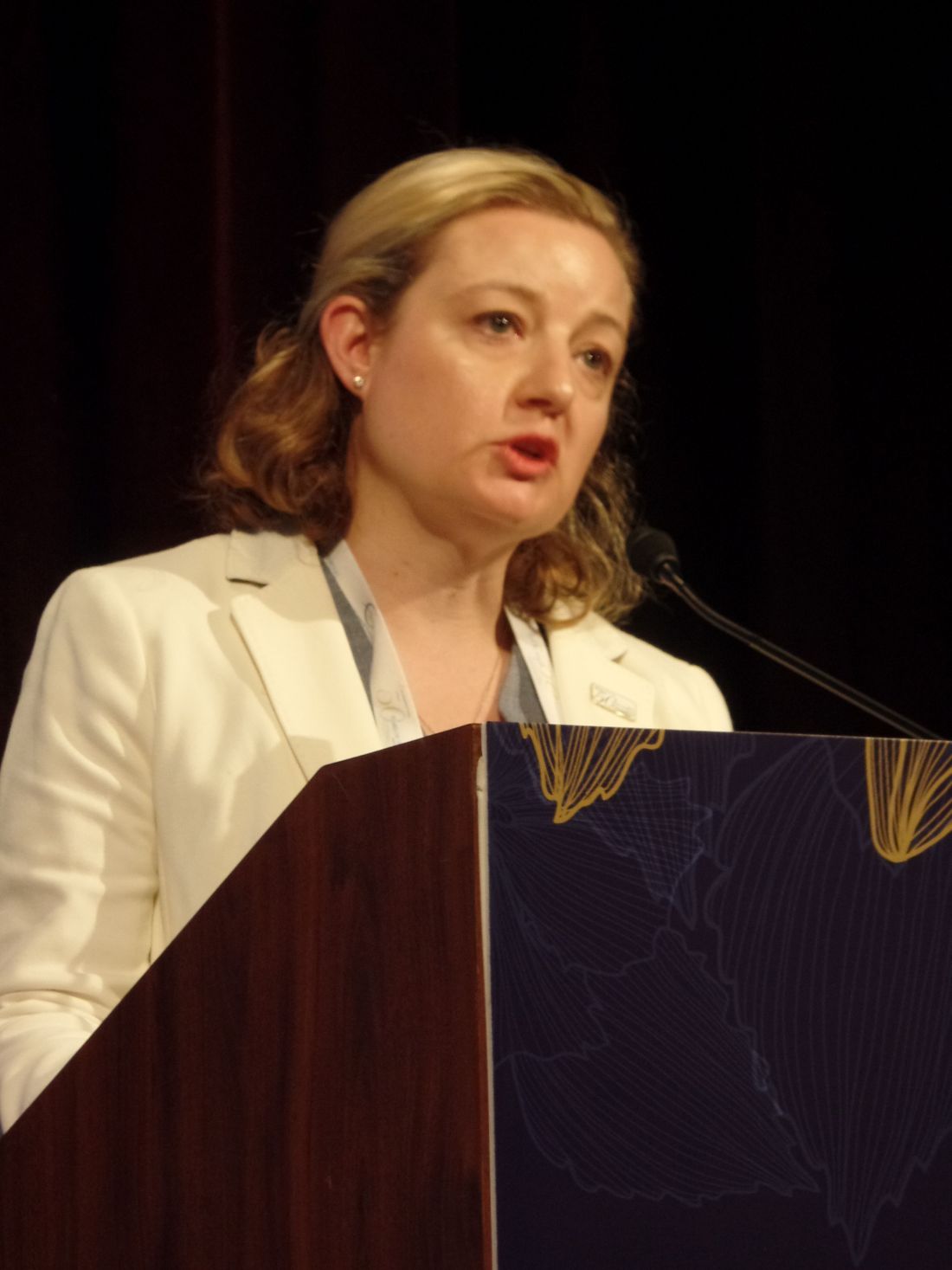
An analysis showed that adolescents in Alabama are more likely to receive the HPV vaccine if they live below the poverty line and reside in rural areas. The study also revealed a positive association between vaccine uptake and the incidence of HPV-related cancer by county.
These results suggest the perceived risk of HPV-related cancer may outweigh rurality and poverty—factors that might otherwise hinder access to health care, according to Jennifer Y. Pierce, MD, of Mitchell Cancer Institute in Mobile, Ala.
She discussed this idea when presenting the study results at the meeting.
“There are 39,000 preventable cases of HPV-related cancer in the United States,” Dr. Pierce said. “In Alabama, we are [ranked] third for cervical cancer incidence and first for cervical cancer mortality. When we look at vaccination rates in Alabama, unfortunately, we have the opposite problem. We are 45th for HPV vaccination.”
Dr. Pierce also noted that, nationally, adolescents in rural areas are 11% less likely to be vaccinated than their peers in urban areas.
“When we looked in Alabama, that did not exist,” Dr. Pierce said. “So we wanted to know, ‘What are the factors associated with HPV vaccination rate, by county, in the state of Alabama?’ because we had widely disparate rates by county.”
Dr. Pierce and her colleagues looked at data from the U.S. census, county health rankings for Alabama, the Alabama state cancer registry, and other sources. The researchers wanted to determine rates of HPV vaccination in 13- to 17-year-olds as well as rates of HPV-related cancers and variables associated with HPV vaccination by county.
Dr. Pierce said that, of the 67 counties in Alabama, 50%-70% of them are rural. Forty of them have a higher percent poverty level than the state mean. Twenty-three counties have no pediatrician, and four counties have no vaccine provider other than the health department.
By county, cancer rates were positively associated with HPV vaccination in both sexes. Higher cervical cancer rates correlated with higher HPV vaccination rates in females (r = .49; P = .011) and males (r = .46; P = .017). Higher HPV-related cancer rates in males correlated with higher HPV vaccination rates in females (r = .49; P = .001) and males (r = .46; P = .001).
The researchers found no significant association between vaccine uptake and the primary care provider ratio or the number of pediatricians per county. However, private insurance (r = –.40; P = .001) and higher median household income (r = –.40; P = .0007) were associated with lower HPV vaccine uptake. Rurality (r = .27; P = .025) and having a higher percentage of people below the poverty line (r = .39; P = .0011) were associated with higher vaccine uptake.
“How do we explain this paradox?” Dr. Pierce asked. “I think, really, it speaks to the strong commitment of our county public health departments who have, for a long time, been pushing the HPV vaccine and are doing a fairly good job of vaccinating. But I think, even more so, we need to focus on this question of perceived risk.”
“Our poor, rural adolescents in Alabama are being vaccinated at a higher rate than their more affluent peers, and those HPV vaccination rates appear to be directly linked to the cancer incidence rates in those counties.”
Dr. Pierce had no disclosures.
SOURCE: Pierce JY et al. SGO 2019, Abstract 13.
HONOLULU – The perceived risk of HPV-related cancer appears to overcome variables that typically impede access to HPV vaccination, according to a speaker at the Society of Gynecologic Oncology’s Annual Meeting on Women’s Cancer.
An analysis showed that adolescents in Alabama are more likely to receive the HPV vaccine if they live below the poverty line and reside in rural areas. The study also revealed a positive association between vaccine uptake and the incidence of HPV-related cancer by county.
These results suggest the perceived risk of HPV-related cancer may outweigh rurality and poverty—factors that might otherwise hinder access to health care, according to Jennifer Y. Pierce, MD, of Mitchell Cancer Institute in Mobile, Ala.
She discussed this idea when presenting the study results at the meeting.
“There are 39,000 preventable cases of HPV-related cancer in the United States,” Dr. Pierce said. “In Alabama, we are [ranked] third for cervical cancer incidence and first for cervical cancer mortality. When we look at vaccination rates in Alabama, unfortunately, we have the opposite problem. We are 45th for HPV vaccination.”
Dr. Pierce also noted that, nationally, adolescents in rural areas are 11% less likely to be vaccinated than their peers in urban areas.
“When we looked in Alabama, that did not exist,” Dr. Pierce said. “So we wanted to know, ‘What are the factors associated with HPV vaccination rate, by county, in the state of Alabama?’ because we had widely disparate rates by county.”
Dr. Pierce and her colleagues looked at data from the U.S. census, county health rankings for Alabama, the Alabama state cancer registry, and other sources. The researchers wanted to determine rates of HPV vaccination in 13- to 17-year-olds as well as rates of HPV-related cancers and variables associated with HPV vaccination by county.
Dr. Pierce said that, of the 67 counties in Alabama, 50%-70% of them are rural. Forty of them have a higher percent poverty level than the state mean. Twenty-three counties have no pediatrician, and four counties have no vaccine provider other than the health department.
By county, cancer rates were positively associated with HPV vaccination in both sexes. Higher cervical cancer rates correlated with higher HPV vaccination rates in females (r = .49; P = .011) and males (r = .46; P = .017). Higher HPV-related cancer rates in males correlated with higher HPV vaccination rates in females (r = .49; P = .001) and males (r = .46; P = .001).
The researchers found no significant association between vaccine uptake and the primary care provider ratio or the number of pediatricians per county. However, private insurance (r = –.40; P = .001) and higher median household income (r = –.40; P = .0007) were associated with lower HPV vaccine uptake. Rurality (r = .27; P = .025) and having a higher percentage of people below the poverty line (r = .39; P = .0011) were associated with higher vaccine uptake.
“How do we explain this paradox?” Dr. Pierce asked. “I think, really, it speaks to the strong commitment of our county public health departments who have, for a long time, been pushing the HPV vaccine and are doing a fairly good job of vaccinating. But I think, even more so, we need to focus on this question of perceived risk.”
“Our poor, rural adolescents in Alabama are being vaccinated at a higher rate than their more affluent peers, and those HPV vaccination rates appear to be directly linked to the cancer incidence rates in those counties.”
Dr. Pierce had no disclosures.
SOURCE: Pierce JY et al. SGO 2019, Abstract 13.
HONOLULU – The perceived risk of HPV-related cancer appears to overcome variables that typically impede access to HPV vaccination, according to a speaker at the Society of Gynecologic Oncology’s Annual Meeting on Women’s Cancer.
An analysis showed that adolescents in Alabama are more likely to receive the HPV vaccine if they live below the poverty line and reside in rural areas. The study also revealed a positive association between vaccine uptake and the incidence of HPV-related cancer by county.
These results suggest the perceived risk of HPV-related cancer may outweigh rurality and poverty—factors that might otherwise hinder access to health care, according to Jennifer Y. Pierce, MD, of Mitchell Cancer Institute in Mobile, Ala.
She discussed this idea when presenting the study results at the meeting.
“There are 39,000 preventable cases of HPV-related cancer in the United States,” Dr. Pierce said. “In Alabama, we are [ranked] third for cervical cancer incidence and first for cervical cancer mortality. When we look at vaccination rates in Alabama, unfortunately, we have the opposite problem. We are 45th for HPV vaccination.”
Dr. Pierce also noted that, nationally, adolescents in rural areas are 11% less likely to be vaccinated than their peers in urban areas.
“When we looked in Alabama, that did not exist,” Dr. Pierce said. “So we wanted to know, ‘What are the factors associated with HPV vaccination rate, by county, in the state of Alabama?’ because we had widely disparate rates by county.”
Dr. Pierce and her colleagues looked at data from the U.S. census, county health rankings for Alabama, the Alabama state cancer registry, and other sources. The researchers wanted to determine rates of HPV vaccination in 13- to 17-year-olds as well as rates of HPV-related cancers and variables associated with HPV vaccination by county.
Dr. Pierce said that, of the 67 counties in Alabama, 50%-70% of them are rural. Forty of them have a higher percent poverty level than the state mean. Twenty-three counties have no pediatrician, and four counties have no vaccine provider other than the health department.
By county, cancer rates were positively associated with HPV vaccination in both sexes. Higher cervical cancer rates correlated with higher HPV vaccination rates in females (r = .49; P = .011) and males (r = .46; P = .017). Higher HPV-related cancer rates in males correlated with higher HPV vaccination rates in females (r = .49; P = .001) and males (r = .46; P = .001).
The researchers found no significant association between vaccine uptake and the primary care provider ratio or the number of pediatricians per county. However, private insurance (r = –.40; P = .001) and higher median household income (r = –.40; P = .0007) were associated with lower HPV vaccine uptake. Rurality (r = .27; P = .025) and having a higher percentage of people below the poverty line (r = .39; P = .0011) were associated with higher vaccine uptake.
“How do we explain this paradox?” Dr. Pierce asked. “I think, really, it speaks to the strong commitment of our county public health departments who have, for a long time, been pushing the HPV vaccine and are doing a fairly good job of vaccinating. But I think, even more so, we need to focus on this question of perceived risk.”
“Our poor, rural adolescents in Alabama are being vaccinated at a higher rate than their more affluent peers, and those HPV vaccination rates appear to be directly linked to the cancer incidence rates in those counties.”
Dr. Pierce had no disclosures.
SOURCE: Pierce JY et al. SGO 2019, Abstract 13.
REPORTING FROM SGO 2019
Death by a thousand clicks
Where electronic health records went wrong.
The pain radiated from the top of Annette Monachelli’s head, and it got worse when she changed positions. It didn’t feel like her usual migraine. The 47-year-old Vermont attorney turned innkeeper visited her local doctor at the Stowe Family Practice twice about the problem in late November 2012, but got little relief.

Two months later, Monachelli was dead of an aneurysm, a condition that, despite the symptoms and the appointments, had never been tested for or diagnosed until she turned up in the emergency room days before her death.
Monachelli’s husband sued Stowe, the federally qualified health center the physician worked for. Owen Foster, a newly hired assistant U.S. attorney with the District of Vermont, was assigned to defend the government. Though it looked to be a standard medical malpractice case, Foster was on the cusp of discovering something much bigger – what his boss, U.S. Attorney Christina Nolan, calls the “frontier of health care fraud” – and prosecuting a first-of-its-kind case that landed the largest-ever financial recovery in Vermont’s history.
Foster began with Monachelli’s medical records, which offered a puzzle. Her doctor had considered the possibility of an aneurysm and, to rule it out, had ordered a head scan through the clinic’s software system, the government alleged in court filings. The test, in theory, would have caught the bleeding in Monachelli’s brain. But the order never made it to the lab; it had never been transmitted.
The software in question was an electronic health records system, or EHR, made by eClinicalWorks (eCW), one of the leading sellers of record-keeping software for physicians in America, currently used by 850,000 health professionals in the U.S. It didn’t take long for Foster to assemble a dossier of troubling reports – Better Business Bureau complaints, issues flagged on an eCW user board, and legal cases filed around the country – suggesting the company’s technology didn’t work quite the way it said it did.
Until this point, Foster, like most Americans, knew next to nothing about electronic medical records, but he was quickly amassing clues that eCW’s software had major problems – some of which put patients, like Annette Monachelli, at risk.
Damning evidence came from a whistleblower claim filed in 2011 against the company. Brendan Delaney, a British cop turned EHR expert, was hired in 2010 by New York City to work on the eCW implementation at Rikers Island, a jail complex that then had more than 100,000 inmates. But soon after he was hired, Delaney noticed scores of troubling problems with the system, which became the basis for his lawsuit. The patient medication lists weren’t reliable; prescribed drugs would not show up, while discontinued drugs would appear as current, according to the complaint. The EHR would sometimes display one patient’s medication profile accompanied by the physician’s note for a different patient, making it easy to misdiagnose or prescribe a drug to the wrong individual. Prescriptions, some 30,000 of them in 2010, lacked proper start and stop dates, introducing the opportunity for under- or overmedication. The eCW system did not reliably track lab results, concluded Delaney, who tallied 1,884 tests for which they had never gotten outcomes.
The District of Vermont launched an official federal investigation in 2015.
The eCW spaghetti code was so buggy that when one glitch got fixed, another would develop, the government found. The user interface offered a few ways to order a lab test or diagnostic image, for example, but not all of them seemed to function. The software would detect and warn users of dangerous drug interactions, but unbeknownst to physicians, the alerts stopped if the drug order was customized. “It would be like if I was driving with the radio on and the windshield wipers going and when I hit the turn signal, the brakes suddenly didn’t work,” said Foster.
The eCW system also failed to use the standard drug codes and, in some instances, lab and diagnosis codes as well, the government alleged.
The case never got to a jury. In May 2017, eCW paid a $155 million settlement to the government over alleged “false claims” and kickbacks – one physician made tens of thousands of dollars – to clients who promoted its product. Despite the record settlement, the company denied wrongdoing; eCW did not respond to numerous requests for comment.
If there is a kicker to this tale, it is this: The U.S. government bankrolled the adoption of this software – and continues to pay for it. Or we should say: You do.
Which brings us to the strange, sad, and aggravating story that unfolds below. It is not about one lawsuit or a piece of sloppy technology. Rather, it’s about a trouble-prone industry that intersects, in the most personal way, with every one of our lives. It’s about a $3.7 trillion health care system idling at the crossroads of progress. And it’s about a slew of unintended consequences – the surprising casualties of a big idea whose time had seemingly come.
The virtual magic bullet
Electronic health records were supposed to do a lot: make medicine safer, bring higher-quality care, empower patients, and yes, even save money. Boosters heralded an age when researchers could harness the big data within to reveal the most effective treatments for disease and sharply reduce medical errors. Patients, in turn, would have truly portable health records, being able to share their medical histories in a flash with doctors and hospitals anywhere in the country – essential when life-and-death decisions are being made in the ER.

But 10 years after President Barack Obama signed a law to accelerate the digitization of medical records – with the federal government, so far, sinking $36 billion into the effort – America has little to show for its investment. KHN and Fortune spoke with more than 100 physicians, patients, IT experts and administrators, health policy leaders, attorneys, top government officials and representatives at more than a half-dozen EHR vendors, including the CEOs of two of the companies. The interviews reveal a tragic missed opportunity: Rather than an electronic ecosystem of information, the nation’s thousands of EHRs largely remain a sprawling, disconnected patchwork. Moreover, the effort has handcuffed health providers to technology they mostly can’t stand and has enriched and empowered the $13-billion-a-year industry that sells it.
By one measure, certainly, the effort has achieved what it set out to do: Today, 96% of hospitals have adopted EHRs, up from just 9% in 2008. But on most other counts, the newly installed technology has fallen well short. Physicians complain about clumsy, unintuitive systems and the number of hours spent clicking, typing and trying to navigate them – which is more than the hours they spend with patients. Unlike, say, with the global network of ATMs, the proprietary EHR systems made by more than 700 vendors routinely don’t talk to one another, meaning that doctors still resort to transferring medical data via fax and CD-ROM. Patients, meanwhile, still struggle to access their own records – and, sometimes, just plain can’t.
Instead of reducing costs, many say, EHRs, which were originally optimized for billing rather than for patient care, have instead made it easier to engage in “upcoding” or bill inflation (though some say the systems also make such fraud easier to catch).
More gravely still, a months-long joint investigation by KHN and Fortune has found that instead of streamlining medicine, the government’s EHR initiative has created a host of largely unacknowledged patient safety risks. Our investigation found that alarming reports of patient deaths, serious injuries and near misses – thousands of them – tied to software glitches, user errors or other flaws have piled up, largely unseen, in various government-funded and private repositories.
Compounding the problem are entrenched secrecy policies that continue to keep software failures out of public view. EHR vendors often impose contractual “gag clauses” that discourage buyers from speaking out about safety issues and disastrous software installations – though some customers have taken to the courts to air their grievances. Plaintiffs, moreover, say hospitals often fight to withhold records from injured patients or their families. Indeed, two doctors who spoke candidly about the problems they faced with EHRs later asked that their names not be used, adding that they were forbidden by their health care organizations to talk. Says Assistant U.S. Attorney Foster, the EHR vendors “are protected by a shield of silence.”
Though the software has reduced some types of clinical mistakes common in the era of handwritten notes, Raj Ratwani, a researcher at MedStar Health in Washington, D.C., has documented new patterns of medical errors tied to EHRs that he believes are both perilous and preventable. “The fact that we’re not able to broadcast that nationally and solve these issues immediately, and that another patient somewhere else may be harmed by the very same issue – that just can’t happen,” he said.
David Blumenthal, who, as Obama’s national coordinator for health information technology, was one of the architects of the EHR initiative, acknowledged to KHN and Fortune that electronic health records “have not fulfilled their potential. I think few would argue they have.”
The former president has likewise singled out the effort as one of his most disappointing, bemoaning in a January 2017 interview with Vox “the fact that there are still just mountains of paperwork ... and the doctors still have to input stuff, and the nurses are spending all their time on all this administrative work. We put a big slug of money into trying to encourage everyone to digitalize, to catch up with the rest of the world ... that’s been harder than we expected.”
Seema Verma, the current chief of the Centers for Medicare & Medicaid Services (CMS), which oversees the EHR effort today, shudders at the billions of dollars spent building software that doesn’t share data – an electronic bridge to nowhere. “Providers developed their own systems that may or may not even have worked well for them,” she told KHN and Fortune in an interview last month, “but we didn’t think about how all these systems connect with one another. That was the real missing piece.”
Perhaps none of the initiative’s former boosters is quite as frustrated as former Vice President Joe Biden. At a 2017 meeting with health care leaders in Washington, he railed against the infuriating challenge of getting his son Beau’s medical records from one hospital to another. “I was stunned when my son for a year was battling stage 4 glioblastoma,” said Biden. “I couldn’t get his records. I’m the vice president of the United States of America. ... It was an absolute nightmare. It was ridiculous, absolutely ridiculous, that we’re in that circumstance.”
A bridge to nowhere
As Biden would tell you, the original concept was a smart one. The wave of digitization had swept up virtually every industry, bringing both disruption and, in most cases, greater efficiency. And perhaps none of these industries was more deserving of digital liberation than medicine, where life-measuring and potentially lifesaving data was locked away in paper crypts – stack upon stack of file folders at doctors’ offices across the country.
Stowed in steel cabinets, the records were next to useless. Nobody – particularly at the dawn of the age of the iPhone – thought it was a good idea to leave them that way. The problem, say critics, was in the way that policymakers set about to transform them.
“Every single idea was well-meaning and potentially of societal benefit, but the combined burden of all of them hitting clinicians simultaneously made office practice basically impossible,” said John Halamka, chief information officer at Beth Israel Deaconess Medical Center, who served on the EHR standards committees under both President George W. Bush and President Obama. “In America, we have 11 minutes to see a patient, and, you know, you’re going to be empathetic, make eye contact, enter about 100 pieces of data, and never commit malpractice. It’s not possible!”
KHN and Fortune examined more than two dozen medical negligence cases that have alleged that EHRs either contributed to injuries, had been improperly altered, or were withheld from patients to conceal substandard care. In such cases, the suits typically settle prior to trial with strict confidentiality pledges, so it’s often not possible to determine the merits of the allegations. EHR vendors also frequently have contract stipulations, known as “hold harmless clauses,” that protect them from liability if hospitals are later sued for medical errors – even if they relate to an issue with the technology.
But lawsuits, like that filed by Fabian Ronisky, which do emerge from this veil, are quite telling.
Ronisky, according to his complaint, arrived by ambulance at Providence Saint John’s Health Center in Santa Monica on the afternoon of March 2, 2015. For two days, the young lawyer had been suffering from severe headaches while a disorienting fever left him struggling to tell the 911 operator his address.
Suspecting meningitis, a doctor at the hospital performed a spinal tap, and the next day an infectious disease specialist typed in an order for a critical lab test – a check of the spinal fluid for viruses, including herpes simplex – into the hospital’s EHR.
The multimillion-dollar system, manufactured by Epic Systems Corp. and considered by some to be the Cadillac of medical software, had been installed at the hospital about four months earlier. Although the order appeared on Epic’s screen, it was not sent to the lab. It turned out, Epic’s software didn’t fully “interface” with the lab’s software, according to a lawsuit Ronisky filed in February 2017 in Los Angeles County Superior Court. His results and diagnosis were delayed – by days, he claimed – during which time he suffered irreversible brain damage from herpes encephalitis. The suit alleged the mishap delayed doctors from giving Ronisky a drug called acyclovir that might have minimized damage to his brain.
Epic denied any liability or defects in its software; the company said the doctor failed to push the right button to send the order and that the hospital, not Epic, had configured the interface with the lab. Epic, among the nation’s largest manufacturers of computerized health records and the leading provider to most of America’s most elite medical centers, quietly paid $1 million to settle the suit in July 2018, according to court records. The hospital and two doctors paid a total of $7.5 million, and a case against a third doctor is pending trial. Ronisky, 34, who is fighting to rebuild his life, declined to comment.
Incidents like that which happened to Ronisky – or to Annette Monachelli, for that matter – are surprisingly common, data show. And the back-and-forth about where the fault lies in such cases is actually part of the problem: The systems are often so confusing (and training on them seldom sufficient) that errors frequently fall into a nether zone of responsibility. It can be hard to tell where human error begins and the technological shortcomings end.
EHRs promised to put all of a patient’s records in one place, but often that’s the problem. Critical or time-sensitive information routinely gets buried in an endless scroll of data, where in the rush of medical decision-making – and amid the maze of pulldown menus – it can be missed.
Thirteen-year-old Brooke Dilliplaine, who was severely allergic to dairy, was given a probiotic containing milk. The two doses sent her into “complete respiratory distress” and resulted in a collapsed lung, according to a lawsuit filed by her mother. Rory Staunton, 12, scraped his arm in gym class and then died of sepsis after ER doctors discharged the boy on the basis of lab results in the EHR that weren’t complete. And then there’s the case of Thomas Eric Duncan. The 42-year-old man was sent home in 2014 from a Dallas hospital infected with Ebola virus. Though a nurse had entered in the EHR his recent travel to Liberia, where an Ebola epidemic was then in full swing, the doctor never saw it. Duncan died a week later.
Many such cases end up in court. Typically, doctors and nurses blame faulty technology in the medical-records systems. The EHR vendors blame human error. And meanwhile, the cases mount.
Quantros, a private health care analytics firm, said it has logged 18,000 EHR-related safety events from 2007 through 2018, 3 percent of which resulted in patient harm, including seven deaths – a figure that a Quantros director said is “drastically underreported.”
A 2016 study by The Leapfrog Group, a patient-safety watchdog based in Washington, D.C., found that the medication-ordering function of hospital EHRs – a feature required by the government for certification but often configured differently in each system – failed to flag potentially harmful drug orders in 39 percent of cases in a test simulation. In 13 percent of those cases, the mistake could have been fatal
The Pew Charitable Trusts has, for the past few years, run an EHR safety project, taking aim at issues like usability and patient matching – the process of linking the correct medical record to the correct patient – a seemingly basic task at which the systems, even when made by the same EHR vendor, often fail. At some institutions, according to Pew, such matching was accurate only 50 percent of the time. Patients have discovered mistakes as well: A January survey by the Kaiser Family Foundation found that 1 in 5 patients spotted an error in their electronic medical records. (Kaiser Health News is an editorially independent program of the foundation.)
The Joint Commission, which certifies hospitals, has sounded alarms about a number of issues, including false alarms – which account for between 85 and 99 percent of EHR and medical device alerts. (One study by researchers at Oregon Health & Science University estimated that the average clinician working in the intensive care unit may be exposed to up to 7,000 passive alerts per day.) Such over-warning can be dangerous. From 2014 to 2018, the commission tallied 170 mostly voluntary reports of patient harm related to alarm management and alert fatigue – the phenomenon in which health workers, so overloaded with unnecessary warnings, ignore the occasional meaningful one. Of those 170 incidents, 101 resulted in patient deaths.
The Pennsylvania Patient Safety Authority, an independent state agency that collects information about adverse events and incidents, counted 775 “laboratory-test problems” related to health IT from January 2016 to December 2017.
To be sure, medical errors happened en masse in the age of paper medicine, when hospital staffers misinterpreted a physician’s scrawl or read the wrong chart to deadly consequence, for instance. But what is perhaps telling is how many doctors today opt for manual workarounds to their EHRs. Aaron Zachary Hettinger, an emergency medicine physician with MedStar Health in Washington, D.C., said that when he and fellow clinicians need to share critical patient information, they write it on a whiteboard or on a paper towel and leave it on their colleagues’ computer keyboards.
While the Food and Drug Administration doesn’t mandate reporting of EHR safety events – as it does for regulated medical devices – concerned posts have nonetheless proliferated in the FDA MAUDE database of adverse events, which now serves as an ad hoc bulletin board of warnings about the various systems.
Further complicating the picture is that health providers nearly always tailor their one-size-fits-all EHR systems to their own specifications. Such customization makes every one unique and often hard to compare with others – which, in turn, makes the source of mistakes difficult to determine.
Dr. Martin Makary, a surgical oncologist at Johns Hopkins and the co-author of a much-cited 2016 study that identified medical errors as the third-leading cause of death in America, credits EHRs for some safety improvements – including recent changes that have helped put electronic brakes on the opioid epidemic. But, he said, “we’ve swapped one set of problems for another. We used to struggle with handwriting and missing information. We now struggle with a lack of visual cues to know we’re writing and ordering on the correct patient.”
Dr. Joseph Schneider, a pediatrician at UT Southwestern Medical Center, compares the transition we’ve made, from paper records to electronic ones, to moving from horses to automobiles. But in this analogy, he added, “our cars have advanced to about the 1960s. They still don’t have seat belts or air bags.”
Schneider recalled one episode when his colleagues couldn’t understand why chunks of their notes would inexplicably disappear. They figured out the problem weeks later after intense study: Physicians had been inputting squiggly brackets – {} – the use of which, unbeknownst to even vendor representatives, deleted the text between them. (The EHR maker initially blamed the doctors, said Schneider.)
A broad coalition of actors, from National Nurses United to the Texas Medical Association to leaders within the FDA, has long called for oversight on electronic-record safety issues. Among the most outspoken is Ratwani, who directs MedStar Health’s National Center on Human Factors in Healthcare, a 30-person institute focused on optimizing the safety and usability of medical technology. Ratwani spent his early career in the defense industry, studying things like the intuitiveness of information displays. When he got to MedStar in 2012, he was stunned by “the types of [digital] interfaces being used” in health care, he said.
In a study published last year in the journal Health Affairs, Ratwani and colleagues studied medication errors at three pediatric hospitals from 2012 to 2017. They discovered that 3,243 of them were owing in part to EHR “usability issues.” Roughly 1 in 5 of these could have resulted in patient harm, the researchers found. “Poor interface design and poor implementations can lead to errors and sometimes death, and that is just unbelievably bad as well as completely fixable,” he said. “We should not have patients harmed this way.”
Using eye-tracking technology, Ratwani has demonstrated on video just how easy it is to make mistakes when performing basic tasks on the nation’s two leading EHR systems. When emergency room doctors went to order Tylenol, for example, they saw a drop-down menu listing 86 options, many of which were irrelevant for the specified patient. They had to read the list carefully, so as not to click the wrong dosage or form – though many do that too: In roughly 1 out of 1,000 orders, physicians accidentally select the suppository (designated “PR”) rather than the tablet dose (“OR”), according to one estimate. That’s not an error that will harm a patient – though other medication mix-ups can and do.
Earlier this year, MedStar’s human-factors center launched a website and public awareness campaign with the American Medical Association to draw attention to such rampant mistakes – they use the letters “EHR” as an initialism for “Errors Happen Regularly” – and to petition Congress for action. Ratwani is pushing for a central database to track such errors and adverse events.
Others have turned to social media to vent. Dr. Mark Friedberg, a health-policy researcher with the Rand Corp. who is also a practicing primary care physician, champions the Twitter hashtag #EHRbuglist to encourage fellow health care workers to air their pain points. And last month, a scathing Epic parody account cropped up on Twitter, earning more than 8,000 followers in its first five days. Its maiden tweet, written in the mock voice of an Epic overlord, read: “I once saw a doctor make eye contact with a patient. This horror must stop.”
As much as EHR systems are blamed for sins of commission, it is often the sins of omission that trip up users even more.
Consider the case of Lynne Chauvin, who worked as a medical assistant at Ochsner Health System, in Louisiana. In a still-pending 2015 lawsuit, Chauvin alleges that Epic’s software failed to fire a critical medication warning; Chauvin suffered from conditions that heightened her risk for blood clots, and though that history was documented in her records, she was treated with drugs that restricted blood flow after a heart procedure at the hospital. She developed gangrene, which led to the amputation of her lower legs and forearm. (Ochsner Health System said that while it cannot comment on ongoing litigation, it “remains committed to patient safety which we strongly believe is optimized through the use of electronic health record technology.” Epic declined to comment.)
Echoing the complaints of many doctors, the suit argues that Epic software “is extremely complicated to view and understand,” owing to “significant repetition of data.” Chauvin said that her medical bills have topped $1 million and that she is permanently disabled. Her husband, Richard, has become her primary caregiver and had to retire early from his job with the city of Kenner to care for his wife, according to the suit. Each party declined to comment.
An epidemic of burnout
The numbing repetition, the box-ticking and the endless searching on pulldown menus are all part of what Ratwani called the “cognitive burden” that’s wearing out today’s physicians and driving increasing numbers into early retirement.
In recent years, “physician burnout” has skyrocketed to the top of the agenda in medicine. A 2018 Merritt Hawkins survey found a staggering 78 percent of doctors suffered symptoms of burnout, and in January the Harvard School of Public Health and other institutions deemed it a “public health crisis.”
One of the co-authors of the Harvard study, Ashish Jha, pinned much of the blame on “the growth in poorly designed digital health records ... that [have] required that physicians spend more and more time on tasks that don’t directly benefit patients.”
Few would deny that the swift digitization of America’s medical system has been transformative. With EHRs now nearly universal, the face and feel of medicine has changed. The doctor is now typing away, making more eye contact with the computer screen, perhaps, than with the patient. Patients don’t like that dynamic; for doctors, whose days increasingly begin and end with such fleeting encounters, the effect can be downright deadening.
“You’re sitting in front of a patient, and there are so many things you have to do, and you only have so much time to do it in – seven to 11 minutes, probably – so when do you really listen?” asked John-Henry Pfifferling, a medical anthropologist who counsels physicians suffering from burnout. “If you go into medicine because you care about interacting, and then you’re just a tool, it’s dehumanizing,” said Pfifferling, who has seen many physicians leave medicine over the shift to electronic records. “It’s a disaster,” he said.
Beyond complicating the physician-patient relationship, EHRs have in some ways made practicing medicine harder, said Dr. Hal Baker, a physician and the chief information officer at WellSpan, a Pennsylvania hospital system. “Physicians have to cognitively switch between focusing on the record and focusing on the patient,” he said. He points out how unusual – and potentially dangerous – this is: “Texting while you’re driving is not a good idea. And I have yet to see the CEO who, while running a board meeting, takes minutes, and certainly I’ve never heard of a judge who, during the trial, would also be the court stenographer. But in medicine ... we’ve asked the physician to move from writing in pen to [entering a computer] record, and it’s a pretty complicated interface.”
Even if docs may be at the keyboard during visits, they report having to spend hours more outside that time – at lunch, late at night – in order to finish notes and keep up with electronic paperwork (sending referrals, corresponding with patients, resolving coding issues). That’s right. EHRs didn’t take away paperwork; the systems just moved it online. And there’s a lot of it: 44 percent of the roughly six hours a physician spends on the EHR each day is focused on clerical and administrative tasks, like billing and coding, according to a 2017 Annals of Family Medicine study.
For all that so-called pajama time – the average physician logs 1.4 hours per day on the EHR after work – they don’t get a cent.
Many doctors do recognize the value in the technology: 60 percent of participants in Stanford Medicine’s 2018 National Physician Poll said EHRs had led to improved patient care. At the same time, about as many (59 percent) said EHRs needed a “complete overhaul” and that the systems had detracted from their professional satisfaction (54 percent) as well as from their clinical effectiveness (49 percent).
In preliminary studies, Ratwani has found that doctors have a typical physiological reaction to using an EHR: stress. When he and his team shadow clinicians on the job, they use a range of sensors to monitor the doctors’ heart rate and other vital signs over the course of their shift. The physicians’ heart rates will spike – as high as 160 beats per minute – on two sorts of occasions: when they are interacting with patients and when they’re using the EHR.
4,000
Approximate number of computer clicks an ER doctor makes over the course of a single shift, according to an American Journal of Emergency Medicine study
“Everything is so cumbersome,” said Dr. Karla Dick, a family medicine physician in Arlington, Texas. “It’s slow compared to a paper chart. You’re having to click and zoom in and zoom out to look for stuff.” With all the zooming in and out, she explained, it’s easy to end up in the wrong record. “I can’t tell you how many times I’ve had to cancel an order because I was in the wrong chart.”
Among the daily frustrations for one emergency room physician in Rhode Island is ordering ibuprofen, a seemingly simple task that now requires many rounds of mouse clicking. Every time she prescribes the basic painkiller for a female patient, whether that patient is 9 or 68 years old, the prescription is blocked by a pop-up alert warning her that it may be dangerous to give the drug to a pregnant woman. The physician, whose institution does not allow her to comment on the systems, must then override the warning with yet more clicks. “That’s just the tiniest tip of the iceberg,” she said.
What worries the doctor most is the ease with which diligent, well-meaning physicians can make serious medical errors. She noted that the average ER doc will make 4,000 mouse clicks over the course of a shift, and that the odds of doing anything 4,000 times without an error is small. “The interfaces are just so confusing and clunky,” she added. “They invite error ... it’s not a negligence issue. This is a poor tool issue.”
Many of the EHR makers acknowledge physician burnout is real and say they’re doing what they can to lessen the burden and enhance user experience. Dr. Sam Butler, a pulmonary critical care specialist who started working at Epic in 2001, leads those efforts at the Wisconsin-based company. When doctors get more than 100 messages per week in their in-basket (akin to an email inbox), there’s a higher likelihood of burnout. Butler’s team has also analyzed doctors’ electronic notes – they’re twice as long as they were nine years ago, and three to four times as long as notes in the rest of the world. He said Epic uses such insights to improve the client experience. But coming up with fixes is difficult because doctors “have different viewpoints on everything,” he said. (KHN and Fortune made multiple requests to interview Epic CEO Judy Faulkner, but the company declined to make her available. In a trade interview in February, however, Faulkner said that EHRs were unfairly blamed for physician burnout and cited a study suggesting that there’s little correlation between burnout and EHR satisfaction. Executives at other vendors noted that they’re aware of usability issues and that they’re working on addressing them.)
“It’s not that we’re a bunch of Luddites who don’t know how to use technology,” said the Rhode Island ER doctor. “I have an iPhone and a computer and they work the way they’re supposed to work, and then we’re given these incredibly cumbersome and error-prone tools. This is something the government mandated. There really wasn’t the time to let the cream rise to the top; everyone had to jump in and pick something that worked and spend tens of millions of dollars on a system that is slowly killing us.”
$36 billion and change
The effort to digitize America’s health records got its biggest push in a very low moment: the financial crisis of 2008. In early December of that year, Obama, barely four weeks after his election, pitched an ambitious economic recovery plan. “We will make sure that every doctor’s office and hospital in this country is using cutting-edge technology and electronic medical records so that we can cut red tape, prevent medical mistakes and help save billions of dollars each year,” he said in a radio address.
The idea had already been a fashionable one in Washington. Former House Speaker Newt Gingrich was fond of saying it was easier to track a FedEx package than one’s medical records. Obama’s predecessor, President George W. Bush, had also pursued the idea of wiring up the country’s health system. He didn’t commit much money, but Bush did create an agency to do the job: the Office of the National Coordinator (ONC).
In the depths of recession, the EHR conceit looked like a shovel-ready project that only the paper lobby could hate. In February 2009, legislators passed the HITECH Act, which carved out a hefty chunk of the massive stimulus package for health information technology. The goal was not just to get hospitals and doctors to buy EHRs, but rather to get them using them in a way that would drive better care. So lawmakers devised a carrot-and-stick approach: Physicians would qualify for federal subsidies (a sum of up to nearly $64,000 over a period of years) only if they were “meaningful users” of a government-certified system. Vendors, for their part, had to develop systems that met the government’s requirements.
They didn’t have much time, though. The need to stimulate the economy, which meant getting providers to adopt EHRs quickly, “presented a tremendous conundrum,” said Farzad Mostashari, who joined the ONC as deputy director in 2009 and became its leader in 2011: The ideal – creating a useful, interoperable, nationwide records system – was “utterly infeasible to get to in a short time frame.”
That didn’t stop the federal planners from pursuing their grand ambitions. Everyone had big ideas for the EHRs. The FDA wanted the systems to track unique device identifiers for medical implants, the Centers for Disease Control and Prevention wanted them to support disease surveillance, CMS wanted them to include quality metrics and so on. “We had all the right ideas that were discussed and hashed out by the committee,” said Mostashari, “but they were all of the right ideas.”
Not everyone agreed, though, that they were the right ideas. Before long, “meaningful use” became pejorative shorthand to many for a burdensome government program – making doctors do things like check a box indicating a patient’s smoking status each and every visit.
The EHR vendor community, then a scrappy $2 billion industry, griped at the litany of requirements but stood to gain so much from the government’s $36 billion injection that it jumped in line. As Rusty Frantz, CEO of EHR vendor NextGen Healthcare, put it: “The industry was like, ‘I’ve got this check dangling in front of me, and I have to check these boxes to get there, and so I’m going to do that.’”
Halamka, who was an enthusiastic backer of the initiative in both the Bush and Obama administrations, blames the pressure for a speedy launch as much as the excessive wish list. “To go from a regulation to a highly usable product that is in the hands of doctors in 18 months, that’s too fast,” he said. “It’s like asking nine women to have a baby in a month.”
Several of those who worked on the project admit the rollout was not as easy or seamless as they’d anticipated, but they contend that was never the point. Aneesh Chopra, appointed by Obama in 2009 as the nation’s first chief technology officer, called the spending a “down payment” on a vision to fundamentally change American medicine – creating a digital infrastructure to support new ways to pay for health services based on their quality and outcomes.
Dr. Bob Kocher, a physician and star investor with venture capital firm Venrock, who served in the Obama administration from 2009 to 2011 as a health and economic policy adviser, not only defends the rollout then but also disputes the notion that the government initiative has been a failure at all. “EHRs have totally lived up to the hype and expectations,” he said, emphasizing that they also serve as a technology foundation to support innovation on everything from patients accessing their medical records on a smartphone to AI-driven medical sleuthing. Others note the systems’ value in aggregating medical data in ways that were never possible with paper – helping, for example, to figure out that contaminated water was poisoning children in Flint, Mich.
But Rusty Frantz heard a far different message about EHRs – and, more important, it was coming from his own customers.
The Stanford-trained engineer, who in 2015 became CEO of NextGen, a $500-million-a-year EHR heavyweight in the physician-office market, learned the hard way about how his product was being viewed. As he stood at the podium at his first meeting with thousands of NextGen customers at Las Vegas’ Mandalay Bay Resort, just four months after getting the job, he told KHN and Fortune, “People were lining up at the microphones to yell at us: ‘We weren’t delivering stable software! The executive team was inaccessible! The service experience was terrible!’ ” (He now refers to the event as “Festivus: the airing of the grievances.”)
Frantz had bounced around the health care industry for much of his career, and from the nearby perch of a medical device company, he watched the EHR incentive bonanza with a mix of envy and slack-jawed awe. “The industry was moving along in a natural Darwinist way, and then along came the stimulus,” said Frantz, who blames the government’s ham-handed approach to regulation. “The software got slammed in, and the software wasn’t implemented in a way that supported care,” he said. “It was installed in a way that supported stimulus. This company, we were complicit in it, too.”
Even that may be a generous description. KHN and Fortune found a trail of lawsuits against the company, stretching from White Sulphur Springs, Mont., to Neillsville, Wis. Mary Rutan Hospital in Bellefontaine, Ohio, sued NextGen (formerly called Quality Systems) in federal court in 2013, arguing that it experienced hundreds of problems with the “materially defective” software the company had installed in 2011.
A consultant hired by the hospital to evaluate the NextGen system, whose 60-page report was submitted to the court, identified “many functional defects” that he said rendered the software “unfit for its intended purpose.” Some patient information was not accurately recorded, which had the potential, the consultant wrote, “to create major patient care risk which could lead to, at a minimum, inconvenience, and at worst, malpractice or even death.” Glitches at Mary Rutan included incidents in which the software would apparently change a patient’s gender at random or lose a doctor’s observations after an exam, the consultant reported. The company, he found, sometimes took months to address issues: One IT ticket, which related to a physician’s notes inexplicably deleting themselves, reportedly took 10 months to resolve. (The consultant also noted that similar problems appeared to be occurring at as many as a dozen other hospitals that had installed NextGen software.)
The Ohio hospital, which paid more than $1.5 million for its EHR system, claimed breach of contract. NextGen responded that it disputed the claims made in the lawsuit and that the matter was resolved in 2015 “with no findings of fact by a court related to the allegations.” The hospital declined to comment.
At the time, as it has been since then, NextGen’s software was certified by the government as meeting the requirements of the stimulus program. By 2016, NextGen had more than 19,000 customers who had received federal subsidies.
NextGen was subpoenaed by the Department of Justice in December 2017, months after becoming the subject of a federal investigation led by the District of Vermont. Frantz tells KHN and Fortune that NextGen is cooperating with the investigation. “This company was not dishonest, but it was not effective four years ago,” he said. Frantz also emphasized that NextGen has “rapidly evolved” during his tenure, earning five industry awards since 2017, and that customers have “responded very positively.”
Glen Tullman, who until 2012 led Allscripts, another leading EHR vendor that benefited royally from the stimulus and that has been sued by numerous unhappy customers, admitted that the industry’s race to market took priority over all else.
“It was a big distraction. That was an unintended consequence of that,” Tullman said. “All the companies were saying, This is a one-time opportunity to expand our share, focus everything there, and then we’ll go back and fix it.” The Justice Department has opened a civil investigation into the company, Securities and Exchange Commission filings show. Allscripts said in an email that it cannot comment on an ongoing investigation, but that the civil investigations by the Department of Justice relate to businesses it acquired after the investigations were opened.
Much of the marketing mayhem occurred because federal officials imposed few controls over firms scrambling to cash in on the stimulus. It was a gold rush – and any system, it seemed, could be marketed as “federally approved.” Doctors could shop for bargain-price software packages at Costco and Walmart’s Sam’s Club – where eClinicalWorks sold a “turnkey” system for $11,925 – and cash in on the government’s adoption incentives.
The top-shelf vendors in 2009 crisscrossed the country on a “stimulus tour” like rock groups, gigging at some 30 cities, where they offered doctors who showed up to hear the pitch “a customized analysis” of how much money they could earn off the government incentives. Following the same playbook used by pharmaceutical companies, EHR sellers courted doctors at fancy dinners in ritzy hotels. One enterprising software firm advertised a “cash for clunkers” deal that paid $3,000 to doctors willing to trade in their current records system for a new one. Athenahealth held “invitation only” dinners at luxury hotels to advise doctors, among other things, how to use the stimulus to get paid more and capture available incentives. Allscripts offered a no-money-down purchase plan to help doctors “maximize the return on your EHR investment.” (An Athenahealth spokesperson said the company’s “dinners were educational in nature and aimed at helping physicians navigate the government program.” Allscripts did not respond directly to questions about its marketing practices, but said it “is proud of the software and services [it provides] to hundreds of thousands of caregivers across the globe.”)
EHRs were supposed to reduce health care costs, at least in part by preventing duplicative tests. But as the federal government opened the stimulus tap, many raised doubts about the promised savings. Advocates bandied about a figure of $80 billion in cost savings even as congressional auditors were debunking it. While the jury’s still out, there’s growing suspicion the digital revolution may potentially raise health care costs by encouraging overbilling and new strains of fraud and abuse.
In September 2012, following press reports suggesting that some doctors and hospitals were using the new technology to improperly boost their fees, a practice known as “upcoding,” then-Health and Human Services chief Kathleen Sebelius and Attorney General Eric Holder warned the industry not to try to “game the system.”
There’s also growing evidence that some doctors and health systems may have overstated their use of the new technology to secure stimulus funds, a potentially enormous fraud against Medicare and Medicaid that likely will take many years to unravel. In June 2017, the HHS inspector general estimated that Medicare officials made more than $729 million in subsidy payments to hospitals and doctors that didn’t deserve them.
Individual states, which administer the Medicaid portion of the program, haven’t fared much better. Audits have uncovered overpayments in 14 of 17 state programs reviewed, totaling more than $66 million, according to inspector general reports.
Last month, Sen. Chuck Grassley, an Iowa Republican who chairs the Senate Finance Committee, sharply criticized CMS for recovering only a tiny fraction of these bogus payments, or what he termed a “spit in the ocean.”
EHR vendors have also been accused of egregious and patient-endangering acts of fraud as they raced to cash in on the stimulus money grab. In addition to the U.S. government’s $155 million False Claims Act settlement with eClinicalWorks noted above, the federal government has reached a second settlement over similar charges against another large vendor, Tampa-based Greenway Health. In February, that company settled with the government for just over $57 million without denying or admitting wrongdoing. “These are cases of corporate greed, companies that prioritized profits over everything else,” said Christina Nolan, the U.S. attorney for the District of Vermont, whose office led the cases. (In a response, Greenway Health did not address the charges or the settlement but said it was “committing itself to being the standard-bearer for quality, compliance, and transparency.”)
Tower of Babel
In early 2017, Seema Verma, then the country’s newly appointed CMS administrator, went on a listening tour. She visited doctors around the country, at big urban practices and tiny rural clinics, and from those front-line physicians she consistently heard one thing: They hated their electronic health records. “Physician burnout is real,” she told KHN and Fortune. The doctors spoke of the difficulty in getting information from other systems and providers, and they complained about the government’s reporting requirements, which they perceived as burdensome and not meaningful.
What she heard then became suddenly personal one summer day in 2017, when her husband, himself a physician, collapsed in the airport on his way home to Indianapolis after a family vacation. For a frantic few hours, the CMS administrator fielded phone calls from first responders and physicians – Did she know his medical history? Did she have information that could save his life? – and made calls to his doctors in Indiana, scrambling to piece together his record, which should have been there in one piece. Her husband survived the episode, but it laid bare the dysfunction and danger inherent in the existing health information ecosystem.
The notion that one EHR should talk to another was a key part of the original vision for the HITECH Act, with the government calling for systems to be eventually interoperable.
What the framers of that vision didn’t count on were the business incentives working against it. A free exchange of information means that patients can be treated anywhere. And though they may not admit it, many health providers are loath to lose their patients to a competing doctor’s office or hospital. There’s a term for that lost revenue: “leakage.” And keeping a tight hold on patients’ medical records is one way to prevent it.
There’s a ton of proprietary value in that data, said Blumenthal, who now heads the Commonwealth Fund, a philanthropy that does health research. Asking hospitals to give it up is “like asking Amazon to share their data with Walmart,” he said.
Blumenthal acknowledged that he failed to grasp these perverse business dynamics and foresee what a challenge getting the systems to talk to one another would be. He added that forcing interoperability goals early on, when 90 percent of the nation’s providers still didn’t have systems or data to exchange, seemed unrealistic. “We had an expression: They had to operate before they could interoperate,” he said.
In the absence of true incentives for systems to communicate, the industry limped along; some providers wired up directly to other select providers or through regional exchanges, but the efforts were spotty. A Cerner-backed interoperability network called CommonWell formed in 2013, but some companies, including dominant Epic, didn’t join. (“Initially, Epic was neither invited nor allowed to join,” said Sumit Rana, senior vice president of R&D at Epic. Jitin Asnaani, executive director of CommonWell countered, “We made repeated invitations to every major EHR ... and numerous public and private invitations to Epic.”)
Epic then supported a separate effort to do much the same.
Last spring, Verma attempted to kick-start the sharing effort and later pledged a war on “information blocking,” threatening penalties for bad actors. She has promised to reduce the documentation burden on physicians and end the gag clauses that protect the EHR industry. Regarding the first effort at least, “there was consensus that this needed to happen and that it would take the government to push this forward,” she said. In one sign of progress last summer, the dueling sharing initiatives of Epic and Cerner, the two largest players in the industry, began to share with each other – though the effort is fledgling.
When it comes to patients, though, the real sharing too often stops. Despite federal requirements that providers give patients their medical records in a timely fashion, in their chosen format and at low cost (the government recommends a flat fee of $6.50 or less), patients struggle mightily to get them. A 2017 study by researchers at Yale found that of America’s 83 top-rated hospitals, only 53 percent offer forms that provide patients with the option to receive their entire medical record. Fewer than half would share records via email. One hospital charged more than $500 to release them.
Sometimes the mere effort to access records leads to court. Jennifer De Angelis, a Tulsa attorney, has frequently sparred with hospitals over releasing her clients’ records. She said they either attempt to charge huge sums for them or force her to obtain a court order before releasing them. De Angelis added that she sometimes suspects the records have been overwritten to cover up medical mistakes.
Consider the case of 5-year-old Uriah R. Roach, who fractured and cut his finger on Oct. 2, 2014, when it was accidentally slammed in a door at school. Five days later, an operation to repair the damage went awry, and he suffered permanent brain damage, apparently owing to an anesthesia problem. The Epic electronic medical file had been accessed more than 76,000 times during the 22 days the boy was in the hospital, and a lawsuit brought by his parents contended that numerous entries had been “corrected, altered, modified and possibly deleted after an unexpected outcome during the induction of anesthesia.” The hospital denied wrongdoing. The case settled in November 2016, and the terms are confidential.
More than a dozen other attorneys interviewed cited similar problems, especially with gaining access to computerized “audit trails.” In several cases, court records show, government lawyers resisted turning over electronic files from federally run hospitals. That happened to Russell Uselton, an Oklahoma lawyer who represented a pregnant teen admitted to the Choctaw Nation Health Care Center in Talihina, Okla. Shelby Carshall, 18, was more than 40 weeks pregnant at the time. Doctors failed to perform a cesarean section, and her baby was born brain-damaged as a result, she alleged in a lawsuit filed in 2017 against the U.S. government. The baby began having seizures at 10 hours old and will “likely never walk, talk, eat, or otherwise live normally,” according to pleadings in the suit. Though the federal government requires hospitals to produce electronic health records to patients and their families, Uselton had to obtain a court order to get the baby’s complete medical files. Government lawyers denied any negligence in the case, which is pending.
“They try to hide anything from you that they can hide from you,” said Uselton. “They make it extremely difficult to get records, so expensive and hard that most lawyers can’t take it on,” he said.
Nor, it seems, can high-ranking federal officials. When Seema Verma’s husband was discharged from the hospital after his summer health scare, he was handed a few papers and a CD-ROM containing some medical images – but missing key tests and monitoring data. Said Verma, “We left that hospital and we still don’t have his information today.” That was nearly two years ago
Kaiser Health News is a nonprofit national health policy news service. It is an editorially independent program of the Henry J. Kaiser Family Foundation that is not affiliated with Kaiser Permanente.
Where electronic health records went wrong.
Where electronic health records went wrong.
The pain radiated from the top of Annette Monachelli’s head, and it got worse when she changed positions. It didn’t feel like her usual migraine. The 47-year-old Vermont attorney turned innkeeper visited her local doctor at the Stowe Family Practice twice about the problem in late November 2012, but got little relief.
Two months later, Monachelli was dead of an aneurysm, a condition that, despite the symptoms and the appointments, had never been tested for or diagnosed until she turned up in the emergency room days before her death.
Monachelli’s husband sued Stowe, the federally qualified health center the physician worked for. Owen Foster, a newly hired assistant U.S. attorney with the District of Vermont, was assigned to defend the government. Though it looked to be a standard medical malpractice case, Foster was on the cusp of discovering something much bigger – what his boss, U.S. Attorney Christina Nolan, calls the “frontier of health care fraud” – and prosecuting a first-of-its-kind case that landed the largest-ever financial recovery in Vermont’s history.
Foster began with Monachelli’s medical records, which offered a puzzle. Her doctor had considered the possibility of an aneurysm and, to rule it out, had ordered a head scan through the clinic’s software system, the government alleged in court filings. The test, in theory, would have caught the bleeding in Monachelli’s brain. But the order never made it to the lab; it had never been transmitted.
The software in question was an electronic health records system, or EHR, made by eClinicalWorks (eCW), one of the leading sellers of record-keeping software for physicians in America, currently used by 850,000 health professionals in the U.S. It didn’t take long for Foster to assemble a dossier of troubling reports – Better Business Bureau complaints, issues flagged on an eCW user board, and legal cases filed around the country – suggesting the company’s technology didn’t work quite the way it said it did.
Until this point, Foster, like most Americans, knew next to nothing about electronic medical records, but he was quickly amassing clues that eCW’s software had major problems – some of which put patients, like Annette Monachelli, at risk.
Damning evidence came from a whistleblower claim filed in 2011 against the company. Brendan Delaney, a British cop turned EHR expert, was hired in 2010 by New York City to work on the eCW implementation at Rikers Island, a jail complex that then had more than 100,000 inmates. But soon after he was hired, Delaney noticed scores of troubling problems with the system, which became the basis for his lawsuit. The patient medication lists weren’t reliable; prescribed drugs would not show up, while discontinued drugs would appear as current, according to the complaint. The EHR would sometimes display one patient’s medication profile accompanied by the physician’s note for a different patient, making it easy to misdiagnose or prescribe a drug to the wrong individual. Prescriptions, some 30,000 of them in 2010, lacked proper start and stop dates, introducing the opportunity for under- or overmedication. The eCW system did not reliably track lab results, concluded Delaney, who tallied 1,884 tests for which they had never gotten outcomes.
The District of Vermont launched an official federal investigation in 2015.
The eCW spaghetti code was so buggy that when one glitch got fixed, another would develop, the government found. The user interface offered a few ways to order a lab test or diagnostic image, for example, but not all of them seemed to function. The software would detect and warn users of dangerous drug interactions, but unbeknownst to physicians, the alerts stopped if the drug order was customized. “It would be like if I was driving with the radio on and the windshield wipers going and when I hit the turn signal, the brakes suddenly didn’t work,” said Foster.
The eCW system also failed to use the standard drug codes and, in some instances, lab and diagnosis codes as well, the government alleged.
The case never got to a jury. In May 2017, eCW paid a $155 million settlement to the government over alleged “false claims” and kickbacks – one physician made tens of thousands of dollars – to clients who promoted its product. Despite the record settlement, the company denied wrongdoing; eCW did not respond to numerous requests for comment.
If there is a kicker to this tale, it is this: The U.S. government bankrolled the adoption of this software – and continues to pay for it. Or we should say: You do.
Which brings us to the strange, sad, and aggravating story that unfolds below. It is not about one lawsuit or a piece of sloppy technology. Rather, it’s about a trouble-prone industry that intersects, in the most personal way, with every one of our lives. It’s about a $3.7 trillion health care system idling at the crossroads of progress. And it’s about a slew of unintended consequences – the surprising casualties of a big idea whose time had seemingly come.
The virtual magic bullet
Electronic health records were supposed to do a lot: make medicine safer, bring higher-quality care, empower patients, and yes, even save money. Boosters heralded an age when researchers could harness the big data within to reveal the most effective treatments for disease and sharply reduce medical errors. Patients, in turn, would have truly portable health records, being able to share their medical histories in a flash with doctors and hospitals anywhere in the country – essential when life-and-death decisions are being made in the ER.
But 10 years after President Barack Obama signed a law to accelerate the digitization of medical records – with the federal government, so far, sinking $36 billion into the effort – America has little to show for its investment. KHN and Fortune spoke with more than 100 physicians, patients, IT experts and administrators, health policy leaders, attorneys, top government officials and representatives at more than a half-dozen EHR vendors, including the CEOs of two of the companies. The interviews reveal a tragic missed opportunity: Rather than an electronic ecosystem of information, the nation’s thousands of EHRs largely remain a sprawling, disconnected patchwork. Moreover, the effort has handcuffed health providers to technology they mostly can’t stand and has enriched and empowered the $13-billion-a-year industry that sells it.
By one measure, certainly, the effort has achieved what it set out to do: Today, 96% of hospitals have adopted EHRs, up from just 9% in 2008. But on most other counts, the newly installed technology has fallen well short. Physicians complain about clumsy, unintuitive systems and the number of hours spent clicking, typing and trying to navigate them – which is more than the hours they spend with patients. Unlike, say, with the global network of ATMs, the proprietary EHR systems made by more than 700 vendors routinely don’t talk to one another, meaning that doctors still resort to transferring medical data via fax and CD-ROM. Patients, meanwhile, still struggle to access their own records – and, sometimes, just plain can’t.
Instead of reducing costs, many say, EHRs, which were originally optimized for billing rather than for patient care, have instead made it easier to engage in “upcoding” or bill inflation (though some say the systems also make such fraud easier to catch).
More gravely still, a months-long joint investigation by KHN and Fortune has found that instead of streamlining medicine, the government’s EHR initiative has created a host of largely unacknowledged patient safety risks. Our investigation found that alarming reports of patient deaths, serious injuries and near misses – thousands of them – tied to software glitches, user errors or other flaws have piled up, largely unseen, in various government-funded and private repositories.
Compounding the problem are entrenched secrecy policies that continue to keep software failures out of public view. EHR vendors often impose contractual “gag clauses” that discourage buyers from speaking out about safety issues and disastrous software installations – though some customers have taken to the courts to air their grievances. Plaintiffs, moreover, say hospitals often fight to withhold records from injured patients or their families. Indeed, two doctors who spoke candidly about the problems they faced with EHRs later asked that their names not be used, adding that they were forbidden by their health care organizations to talk. Says Assistant U.S. Attorney Foster, the EHR vendors “are protected by a shield of silence.”
Though the software has reduced some types of clinical mistakes common in the era of handwritten notes, Raj Ratwani, a researcher at MedStar Health in Washington, D.C., has documented new patterns of medical errors tied to EHRs that he believes are both perilous and preventable. “The fact that we’re not able to broadcast that nationally and solve these issues immediately, and that another patient somewhere else may be harmed by the very same issue – that just can’t happen,” he said.
David Blumenthal, who, as Obama’s national coordinator for health information technology, was one of the architects of the EHR initiative, acknowledged to KHN and Fortune that electronic health records “have not fulfilled their potential. I think few would argue they have.”
The former president has likewise singled out the effort as one of his most disappointing, bemoaning in a January 2017 interview with Vox “the fact that there are still just mountains of paperwork ... and the doctors still have to input stuff, and the nurses are spending all their time on all this administrative work. We put a big slug of money into trying to encourage everyone to digitalize, to catch up with the rest of the world ... that’s been harder than we expected.”
Seema Verma, the current chief of the Centers for Medicare & Medicaid Services (CMS), which oversees the EHR effort today, shudders at the billions of dollars spent building software that doesn’t share data – an electronic bridge to nowhere. “Providers developed their own systems that may or may not even have worked well for them,” she told KHN and Fortune in an interview last month, “but we didn’t think about how all these systems connect with one another. That was the real missing piece.”
Perhaps none of the initiative’s former boosters is quite as frustrated as former Vice President Joe Biden. At a 2017 meeting with health care leaders in Washington, he railed against the infuriating challenge of getting his son Beau’s medical records from one hospital to another. “I was stunned when my son for a year was battling stage 4 glioblastoma,” said Biden. “I couldn’t get his records. I’m the vice president of the United States of America. ... It was an absolute nightmare. It was ridiculous, absolutely ridiculous, that we’re in that circumstance.”
A bridge to nowhere
As Biden would tell you, the original concept was a smart one. The wave of digitization had swept up virtually every industry, bringing both disruption and, in most cases, greater efficiency. And perhaps none of these industries was more deserving of digital liberation than medicine, where life-measuring and potentially lifesaving data was locked away in paper crypts – stack upon stack of file folders at doctors’ offices across the country.
Stowed in steel cabinets, the records were next to useless. Nobody – particularly at the dawn of the age of the iPhone – thought it was a good idea to leave them that way. The problem, say critics, was in the way that policymakers set about to transform them.
“Every single idea was well-meaning and potentially of societal benefit, but the combined burden of all of them hitting clinicians simultaneously made office practice basically impossible,” said John Halamka, chief information officer at Beth Israel Deaconess Medical Center, who served on the EHR standards committees under both President George W. Bush and President Obama. “In America, we have 11 minutes to see a patient, and, you know, you’re going to be empathetic, make eye contact, enter about 100 pieces of data, and never commit malpractice. It’s not possible!”
KHN and Fortune examined more than two dozen medical negligence cases that have alleged that EHRs either contributed to injuries, had been improperly altered, or were withheld from patients to conceal substandard care. In such cases, the suits typically settle prior to trial with strict confidentiality pledges, so it’s often not possible to determine the merits of the allegations. EHR vendors also frequently have contract stipulations, known as “hold harmless clauses,” that protect them from liability if hospitals are later sued for medical errors – even if they relate to an issue with the technology.
But lawsuits, like that filed by Fabian Ronisky, which do emerge from this veil, are quite telling.
Ronisky, according to his complaint, arrived by ambulance at Providence Saint John’s Health Center in Santa Monica on the afternoon of March 2, 2015. For two days, the young lawyer had been suffering from severe headaches while a disorienting fever left him struggling to tell the 911 operator his address.
Suspecting meningitis, a doctor at the hospital performed a spinal tap, and the next day an infectious disease specialist typed in an order for a critical lab test – a check of the spinal fluid for viruses, including herpes simplex – into the hospital’s EHR.
The multimillion-dollar system, manufactured by Epic Systems Corp. and considered by some to be the Cadillac of medical software, had been installed at the hospital about four months earlier. Although the order appeared on Epic’s screen, it was not sent to the lab. It turned out, Epic’s software didn’t fully “interface” with the lab’s software, according to a lawsuit Ronisky filed in February 2017 in Los Angeles County Superior Court. His results and diagnosis were delayed – by days, he claimed – during which time he suffered irreversible brain damage from herpes encephalitis. The suit alleged the mishap delayed doctors from giving Ronisky a drug called acyclovir that might have minimized damage to his brain.
Epic denied any liability or defects in its software; the company said the doctor failed to push the right button to send the order and that the hospital, not Epic, had configured the interface with the lab. Epic, among the nation’s largest manufacturers of computerized health records and the leading provider to most of America’s most elite medical centers, quietly paid $1 million to settle the suit in July 2018, according to court records. The hospital and two doctors paid a total of $7.5 million, and a case against a third doctor is pending trial. Ronisky, 34, who is fighting to rebuild his life, declined to comment.
Incidents like that which happened to Ronisky – or to Annette Monachelli, for that matter – are surprisingly common, data show. And the back-and-forth about where the fault lies in such cases is actually part of the problem: The systems are often so confusing (and training on them seldom sufficient) that errors frequently fall into a nether zone of responsibility. It can be hard to tell where human error begins and the technological shortcomings end.
EHRs promised to put all of a patient’s records in one place, but often that’s the problem. Critical or time-sensitive information routinely gets buried in an endless scroll of data, where in the rush of medical decision-making – and amid the maze of pulldown menus – it can be missed.
Thirteen-year-old Brooke Dilliplaine, who was severely allergic to dairy, was given a probiotic containing milk. The two doses sent her into “complete respiratory distress” and resulted in a collapsed lung, according to a lawsuit filed by her mother. Rory Staunton, 12, scraped his arm in gym class and then died of sepsis after ER doctors discharged the boy on the basis of lab results in the EHR that weren’t complete. And then there’s the case of Thomas Eric Duncan. The 42-year-old man was sent home in 2014 from a Dallas hospital infected with Ebola virus. Though a nurse had entered in the EHR his recent travel to Liberia, where an Ebola epidemic was then in full swing, the doctor never saw it. Duncan died a week later.
Many such cases end up in court. Typically, doctors and nurses blame faulty technology in the medical-records systems. The EHR vendors blame human error. And meanwhile, the cases mount.
Quantros, a private health care analytics firm, said it has logged 18,000 EHR-related safety events from 2007 through 2018, 3 percent of which resulted in patient harm, including seven deaths – a figure that a Quantros director said is “drastically underreported.”
A 2016 study by The Leapfrog Group, a patient-safety watchdog based in Washington, D.C., found that the medication-ordering function of hospital EHRs – a feature required by the government for certification but often configured differently in each system – failed to flag potentially harmful drug orders in 39 percent of cases in a test simulation. In 13 percent of those cases, the mistake could have been fatal
The Pew Charitable Trusts has, for the past few years, run an EHR safety project, taking aim at issues like usability and patient matching – the process of linking the correct medical record to the correct patient – a seemingly basic task at which the systems, even when made by the same EHR vendor, often fail. At some institutions, according to Pew, such matching was accurate only 50 percent of the time. Patients have discovered mistakes as well: A January survey by the Kaiser Family Foundation found that 1 in 5 patients spotted an error in their electronic medical records. (Kaiser Health News is an editorially independent program of the foundation.)
The Joint Commission, which certifies hospitals, has sounded alarms about a number of issues, including false alarms – which account for between 85 and 99 percent of EHR and medical device alerts. (One study by researchers at Oregon Health & Science University estimated that the average clinician working in the intensive care unit may be exposed to up to 7,000 passive alerts per day.) Such over-warning can be dangerous. From 2014 to 2018, the commission tallied 170 mostly voluntary reports of patient harm related to alarm management and alert fatigue – the phenomenon in which health workers, so overloaded with unnecessary warnings, ignore the occasional meaningful one. Of those 170 incidents, 101 resulted in patient deaths.
The Pennsylvania Patient Safety Authority, an independent state agency that collects information about adverse events and incidents, counted 775 “laboratory-test problems” related to health IT from January 2016 to December 2017.
To be sure, medical errors happened en masse in the age of paper medicine, when hospital staffers misinterpreted a physician’s scrawl or read the wrong chart to deadly consequence, for instance. But what is perhaps telling is how many doctors today opt for manual workarounds to their EHRs. Aaron Zachary Hettinger, an emergency medicine physician with MedStar Health in Washington, D.C., said that when he and fellow clinicians need to share critical patient information, they write it on a whiteboard or on a paper towel and leave it on their colleagues’ computer keyboards.
While the Food and Drug Administration doesn’t mandate reporting of EHR safety events – as it does for regulated medical devices – concerned posts have nonetheless proliferated in the FDA MAUDE database of adverse events, which now serves as an ad hoc bulletin board of warnings about the various systems.
Further complicating the picture is that health providers nearly always tailor their one-size-fits-all EHR systems to their own specifications. Such customization makes every one unique and often hard to compare with others – which, in turn, makes the source of mistakes difficult to determine.
Dr. Martin Makary, a surgical oncologist at Johns Hopkins and the co-author of a much-cited 2016 study that identified medical errors as the third-leading cause of death in America, credits EHRs for some safety improvements – including recent changes that have helped put electronic brakes on the opioid epidemic. But, he said, “we’ve swapped one set of problems for another. We used to struggle with handwriting and missing information. We now struggle with a lack of visual cues to know we’re writing and ordering on the correct patient.”
Dr. Joseph Schneider, a pediatrician at UT Southwestern Medical Center, compares the transition we’ve made, from paper records to electronic ones, to moving from horses to automobiles. But in this analogy, he added, “our cars have advanced to about the 1960s. They still don’t have seat belts or air bags.”
Schneider recalled one episode when his colleagues couldn’t understand why chunks of their notes would inexplicably disappear. They figured out the problem weeks later after intense study: Physicians had been inputting squiggly brackets – {} – the use of which, unbeknownst to even vendor representatives, deleted the text between them. (The EHR maker initially blamed the doctors, said Schneider.)
A broad coalition of actors, from National Nurses United to the Texas Medical Association to leaders within the FDA, has long called for oversight on electronic-record safety issues. Among the most outspoken is Ratwani, who directs MedStar Health’s National Center on Human Factors in Healthcare, a 30-person institute focused on optimizing the safety and usability of medical technology. Ratwani spent his early career in the defense industry, studying things like the intuitiveness of information displays. When he got to MedStar in 2012, he was stunned by “the types of [digital] interfaces being used” in health care, he said.
In a study published last year in the journal Health Affairs, Ratwani and colleagues studied medication errors at three pediatric hospitals from 2012 to 2017. They discovered that 3,243 of them were owing in part to EHR “usability issues.” Roughly 1 in 5 of these could have resulted in patient harm, the researchers found. “Poor interface design and poor implementations can lead to errors and sometimes death, and that is just unbelievably bad as well as completely fixable,” he said. “We should not have patients harmed this way.”
Using eye-tracking technology, Ratwani has demonstrated on video just how easy it is to make mistakes when performing basic tasks on the nation’s two leading EHR systems. When emergency room doctors went to order Tylenol, for example, they saw a drop-down menu listing 86 options, many of which were irrelevant for the specified patient. They had to read the list carefully, so as not to click the wrong dosage or form – though many do that too: In roughly 1 out of 1,000 orders, physicians accidentally select the suppository (designated “PR”) rather than the tablet dose (“OR”), according to one estimate. That’s not an error that will harm a patient – though other medication mix-ups can and do.
Earlier this year, MedStar’s human-factors center launched a website and public awareness campaign with the American Medical Association to draw attention to such rampant mistakes – they use the letters “EHR” as an initialism for “Errors Happen Regularly” – and to petition Congress for action. Ratwani is pushing for a central database to track such errors and adverse events.
Others have turned to social media to vent. Dr. Mark Friedberg, a health-policy researcher with the Rand Corp. who is also a practicing primary care physician, champions the Twitter hashtag #EHRbuglist to encourage fellow health care workers to air their pain points. And last month, a scathing Epic parody account cropped up on Twitter, earning more than 8,000 followers in its first five days. Its maiden tweet, written in the mock voice of an Epic overlord, read: “I once saw a doctor make eye contact with a patient. This horror must stop.”
As much as EHR systems are blamed for sins of commission, it is often the sins of omission that trip up users even more.
Consider the case of Lynne Chauvin, who worked as a medical assistant at Ochsner Health System, in Louisiana. In a still-pending 2015 lawsuit, Chauvin alleges that Epic’s software failed to fire a critical medication warning; Chauvin suffered from conditions that heightened her risk for blood clots, and though that history was documented in her records, she was treated with drugs that restricted blood flow after a heart procedure at the hospital. She developed gangrene, which led to the amputation of her lower legs and forearm. (Ochsner Health System said that while it cannot comment on ongoing litigation, it “remains committed to patient safety which we strongly believe is optimized through the use of electronic health record technology.” Epic declined to comment.)
Echoing the complaints of many doctors, the suit argues that Epic software “is extremely complicated to view and understand,” owing to “significant repetition of data.” Chauvin said that her medical bills have topped $1 million and that she is permanently disabled. Her husband, Richard, has become her primary caregiver and had to retire early from his job with the city of Kenner to care for his wife, according to the suit. Each party declined to comment.
An epidemic of burnout
The numbing repetition, the box-ticking and the endless searching on pulldown menus are all part of what Ratwani called the “cognitive burden” that’s wearing out today’s physicians and driving increasing numbers into early retirement.
In recent years, “physician burnout” has skyrocketed to the top of the agenda in medicine. A 2018 Merritt Hawkins survey found a staggering 78 percent of doctors suffered symptoms of burnout, and in January the Harvard School of Public Health and other institutions deemed it a “public health crisis.”
One of the co-authors of the Harvard study, Ashish Jha, pinned much of the blame on “the growth in poorly designed digital health records ... that [have] required that physicians spend more and more time on tasks that don’t directly benefit patients.”
Few would deny that the swift digitization of America’s medical system has been transformative. With EHRs now nearly universal, the face and feel of medicine has changed. The doctor is now typing away, making more eye contact with the computer screen, perhaps, than with the patient. Patients don’t like that dynamic; for doctors, whose days increasingly begin and end with such fleeting encounters, the effect can be downright deadening.
“You’re sitting in front of a patient, and there are so many things you have to do, and you only have so much time to do it in – seven to 11 minutes, probably – so when do you really listen?” asked John-Henry Pfifferling, a medical anthropologist who counsels physicians suffering from burnout. “If you go into medicine because you care about interacting, and then you’re just a tool, it’s dehumanizing,” said Pfifferling, who has seen many physicians leave medicine over the shift to electronic records. “It’s a disaster,” he said.
Beyond complicating the physician-patient relationship, EHRs have in some ways made practicing medicine harder, said Dr. Hal Baker, a physician and the chief information officer at WellSpan, a Pennsylvania hospital system. “Physicians have to cognitively switch between focusing on the record and focusing on the patient,” he said. He points out how unusual – and potentially dangerous – this is: “Texting while you’re driving is not a good idea. And I have yet to see the CEO who, while running a board meeting, takes minutes, and certainly I’ve never heard of a judge who, during the trial, would also be the court stenographer. But in medicine ... we’ve asked the physician to move from writing in pen to [entering a computer] record, and it’s a pretty complicated interface.”
Even if docs may be at the keyboard during visits, they report having to spend hours more outside that time – at lunch, late at night – in order to finish notes and keep up with electronic paperwork (sending referrals, corresponding with patients, resolving coding issues). That’s right. EHRs didn’t take away paperwork; the systems just moved it online. And there’s a lot of it: 44 percent of the roughly six hours a physician spends on the EHR each day is focused on clerical and administrative tasks, like billing and coding, according to a 2017 Annals of Family Medicine study.
For all that so-called pajama time – the average physician logs 1.4 hours per day on the EHR after work – they don’t get a cent.
Many doctors do recognize the value in the technology: 60 percent of participants in Stanford Medicine’s 2018 National Physician Poll said EHRs had led to improved patient care. At the same time, about as many (59 percent) said EHRs needed a “complete overhaul” and that the systems had detracted from their professional satisfaction (54 percent) as well as from their clinical effectiveness (49 percent).
In preliminary studies, Ratwani has found that doctors have a typical physiological reaction to using an EHR: stress. When he and his team shadow clinicians on the job, they use a range of sensors to monitor the doctors’ heart rate and other vital signs over the course of their shift. The physicians’ heart rates will spike – as high as 160 beats per minute – on two sorts of occasions: when they are interacting with patients and when they’re using the EHR.
4,000
Approximate number of computer clicks an ER doctor makes over the course of a single shift, according to an American Journal of Emergency Medicine study
“Everything is so cumbersome,” said Dr. Karla Dick, a family medicine physician in Arlington, Texas. “It’s slow compared to a paper chart. You’re having to click and zoom in and zoom out to look for stuff.” With all the zooming in and out, she explained, it’s easy to end up in the wrong record. “I can’t tell you how many times I’ve had to cancel an order because I was in the wrong chart.”
Among the daily frustrations for one emergency room physician in Rhode Island is ordering ibuprofen, a seemingly simple task that now requires many rounds of mouse clicking. Every time she prescribes the basic painkiller for a female patient, whether that patient is 9 or 68 years old, the prescription is blocked by a pop-up alert warning her that it may be dangerous to give the drug to a pregnant woman. The physician, whose institution does not allow her to comment on the systems, must then override the warning with yet more clicks. “That’s just the tiniest tip of the iceberg,” she said.
What worries the doctor most is the ease with which diligent, well-meaning physicians can make serious medical errors. She noted that the average ER doc will make 4,000 mouse clicks over the course of a shift, and that the odds of doing anything 4,000 times without an error is small. “The interfaces are just so confusing and clunky,” she added. “They invite error ... it’s not a negligence issue. This is a poor tool issue.”
Many of the EHR makers acknowledge physician burnout is real and say they’re doing what they can to lessen the burden and enhance user experience. Dr. Sam Butler, a pulmonary critical care specialist who started working at Epic in 2001, leads those efforts at the Wisconsin-based company. When doctors get more than 100 messages per week in their in-basket (akin to an email inbox), there’s a higher likelihood of burnout. Butler’s team has also analyzed doctors’ electronic notes – they’re twice as long as they were nine years ago, and three to four times as long as notes in the rest of the world. He said Epic uses such insights to improve the client experience. But coming up with fixes is difficult because doctors “have different viewpoints on everything,” he said. (KHN and Fortune made multiple requests to interview Epic CEO Judy Faulkner, but the company declined to make her available. In a trade interview in February, however, Faulkner said that EHRs were unfairly blamed for physician burnout and cited a study suggesting that there’s little correlation between burnout and EHR satisfaction. Executives at other vendors noted that they’re aware of usability issues and that they’re working on addressing them.)
“It’s not that we’re a bunch of Luddites who don’t know how to use technology,” said the Rhode Island ER doctor. “I have an iPhone and a computer and they work the way they’re supposed to work, and then we’re given these incredibly cumbersome and error-prone tools. This is something the government mandated. There really wasn’t the time to let the cream rise to the top; everyone had to jump in and pick something that worked and spend tens of millions of dollars on a system that is slowly killing us.”
$36 billion and change
The effort to digitize America’s health records got its biggest push in a very low moment: the financial crisis of 2008. In early December of that year, Obama, barely four weeks after his election, pitched an ambitious economic recovery plan. “We will make sure that every doctor’s office and hospital in this country is using cutting-edge technology and electronic medical records so that we can cut red tape, prevent medical mistakes and help save billions of dollars each year,” he said in a radio address.
The idea had already been a fashionable one in Washington. Former House Speaker Newt Gingrich was fond of saying it was easier to track a FedEx package than one’s medical records. Obama’s predecessor, President George W. Bush, had also pursued the idea of wiring up the country’s health system. He didn’t commit much money, but Bush did create an agency to do the job: the Office of the National Coordinator (ONC).
In the depths of recession, the EHR conceit looked like a shovel-ready project that only the paper lobby could hate. In February 2009, legislators passed the HITECH Act, which carved out a hefty chunk of the massive stimulus package for health information technology. The goal was not just to get hospitals and doctors to buy EHRs, but rather to get them using them in a way that would drive better care. So lawmakers devised a carrot-and-stick approach: Physicians would qualify for federal subsidies (a sum of up to nearly $64,000 over a period of years) only if they were “meaningful users” of a government-certified system. Vendors, for their part, had to develop systems that met the government’s requirements.
They didn’t have much time, though. The need to stimulate the economy, which meant getting providers to adopt EHRs quickly, “presented a tremendous conundrum,” said Farzad Mostashari, who joined the ONC as deputy director in 2009 and became its leader in 2011: The ideal – creating a useful, interoperable, nationwide records system – was “utterly infeasible to get to in a short time frame.”
That didn’t stop the federal planners from pursuing their grand ambitions. Everyone had big ideas for the EHRs. The FDA wanted the systems to track unique device identifiers for medical implants, the Centers for Disease Control and Prevention wanted them to support disease surveillance, CMS wanted them to include quality metrics and so on. “We had all the right ideas that were discussed and hashed out by the committee,” said Mostashari, “but they were all of the right ideas.”
Not everyone agreed, though, that they were the right ideas. Before long, “meaningful use” became pejorative shorthand to many for a burdensome government program – making doctors do things like check a box indicating a patient’s smoking status each and every visit.
The EHR vendor community, then a scrappy $2 billion industry, griped at the litany of requirements but stood to gain so much from the government’s $36 billion injection that it jumped in line. As Rusty Frantz, CEO of EHR vendor NextGen Healthcare, put it: “The industry was like, ‘I’ve got this check dangling in front of me, and I have to check these boxes to get there, and so I’m going to do that.’”
Halamka, who was an enthusiastic backer of the initiative in both the Bush and Obama administrations, blames the pressure for a speedy launch as much as the excessive wish list. “To go from a regulation to a highly usable product that is in the hands of doctors in 18 months, that’s too fast,” he said. “It’s like asking nine women to have a baby in a month.”
Several of those who worked on the project admit the rollout was not as easy or seamless as they’d anticipated, but they contend that was never the point. Aneesh Chopra, appointed by Obama in 2009 as the nation’s first chief technology officer, called the spending a “down payment” on a vision to fundamentally change American medicine – creating a digital infrastructure to support new ways to pay for health services based on their quality and outcomes.
Dr. Bob Kocher, a physician and star investor with venture capital firm Venrock, who served in the Obama administration from 2009 to 2011 as a health and economic policy adviser, not only defends the rollout then but also disputes the notion that the government initiative has been a failure at all. “EHRs have totally lived up to the hype and expectations,” he said, emphasizing that they also serve as a technology foundation to support innovation on everything from patients accessing their medical records on a smartphone to AI-driven medical sleuthing. Others note the systems’ value in aggregating medical data in ways that were never possible with paper – helping, for example, to figure out that contaminated water was poisoning children in Flint, Mich.
But Rusty Frantz heard a far different message about EHRs – and, more important, it was coming from his own customers.
The Stanford-trained engineer, who in 2015 became CEO of NextGen, a $500-million-a-year EHR heavyweight in the physician-office market, learned the hard way about how his product was being viewed. As he stood at the podium at his first meeting with thousands of NextGen customers at Las Vegas’ Mandalay Bay Resort, just four months after getting the job, he told KHN and Fortune, “People were lining up at the microphones to yell at us: ‘We weren’t delivering stable software! The executive team was inaccessible! The service experience was terrible!’ ” (He now refers to the event as “Festivus: the airing of the grievances.”)
Frantz had bounced around the health care industry for much of his career, and from the nearby perch of a medical device company, he watched the EHR incentive bonanza with a mix of envy and slack-jawed awe. “The industry was moving along in a natural Darwinist way, and then along came the stimulus,” said Frantz, who blames the government’s ham-handed approach to regulation. “The software got slammed in, and the software wasn’t implemented in a way that supported care,” he said. “It was installed in a way that supported stimulus. This company, we were complicit in it, too.”
Even that may be a generous description. KHN and Fortune found a trail of lawsuits against the company, stretching from White Sulphur Springs, Mont., to Neillsville, Wis. Mary Rutan Hospital in Bellefontaine, Ohio, sued NextGen (formerly called Quality Systems) in federal court in 2013, arguing that it experienced hundreds of problems with the “materially defective” software the company had installed in 2011.
A consultant hired by the hospital to evaluate the NextGen system, whose 60-page report was submitted to the court, identified “many functional defects” that he said rendered the software “unfit for its intended purpose.” Some patient information was not accurately recorded, which had the potential, the consultant wrote, “to create major patient care risk which could lead to, at a minimum, inconvenience, and at worst, malpractice or even death.” Glitches at Mary Rutan included incidents in which the software would apparently change a patient’s gender at random or lose a doctor’s observations after an exam, the consultant reported. The company, he found, sometimes took months to address issues: One IT ticket, which related to a physician’s notes inexplicably deleting themselves, reportedly took 10 months to resolve. (The consultant also noted that similar problems appeared to be occurring at as many as a dozen other hospitals that had installed NextGen software.)
The Ohio hospital, which paid more than $1.5 million for its EHR system, claimed breach of contract. NextGen responded that it disputed the claims made in the lawsuit and that the matter was resolved in 2015 “with no findings of fact by a court related to the allegations.” The hospital declined to comment.
At the time, as it has been since then, NextGen’s software was certified by the government as meeting the requirements of the stimulus program. By 2016, NextGen had more than 19,000 customers who had received federal subsidies.
NextGen was subpoenaed by the Department of Justice in December 2017, months after becoming the subject of a federal investigation led by the District of Vermont. Frantz tells KHN and Fortune that NextGen is cooperating with the investigation. “This company was not dishonest, but it was not effective four years ago,” he said. Frantz also emphasized that NextGen has “rapidly evolved” during his tenure, earning five industry awards since 2017, and that customers have “responded very positively.”
Glen Tullman, who until 2012 led Allscripts, another leading EHR vendor that benefited royally from the stimulus and that has been sued by numerous unhappy customers, admitted that the industry’s race to market took priority over all else.
“It was a big distraction. That was an unintended consequence of that,” Tullman said. “All the companies were saying, This is a one-time opportunity to expand our share, focus everything there, and then we’ll go back and fix it.” The Justice Department has opened a civil investigation into the company, Securities and Exchange Commission filings show. Allscripts said in an email that it cannot comment on an ongoing investigation, but that the civil investigations by the Department of Justice relate to businesses it acquired after the investigations were opened.
Much of the marketing mayhem occurred because federal officials imposed few controls over firms scrambling to cash in on the stimulus. It was a gold rush – and any system, it seemed, could be marketed as “federally approved.” Doctors could shop for bargain-price software packages at Costco and Walmart’s Sam’s Club – where eClinicalWorks sold a “turnkey” system for $11,925 – and cash in on the government’s adoption incentives.
The top-shelf vendors in 2009 crisscrossed the country on a “stimulus tour” like rock groups, gigging at some 30 cities, where they offered doctors who showed up to hear the pitch “a customized analysis” of how much money they could earn off the government incentives. Following the same playbook used by pharmaceutical companies, EHR sellers courted doctors at fancy dinners in ritzy hotels. One enterprising software firm advertised a “cash for clunkers” deal that paid $3,000 to doctors willing to trade in their current records system for a new one. Athenahealth held “invitation only” dinners at luxury hotels to advise doctors, among other things, how to use the stimulus to get paid more and capture available incentives. Allscripts offered a no-money-down purchase plan to help doctors “maximize the return on your EHR investment.” (An Athenahealth spokesperson said the company’s “dinners were educational in nature and aimed at helping physicians navigate the government program.” Allscripts did not respond directly to questions about its marketing practices, but said it “is proud of the software and services [it provides] to hundreds of thousands of caregivers across the globe.”)
EHRs were supposed to reduce health care costs, at least in part by preventing duplicative tests. But as the federal government opened the stimulus tap, many raised doubts about the promised savings. Advocates bandied about a figure of $80 billion in cost savings even as congressional auditors were debunking it. While the jury’s still out, there’s growing suspicion the digital revolution may potentially raise health care costs by encouraging overbilling and new strains of fraud and abuse.
In September 2012, following press reports suggesting that some doctors and hospitals were using the new technology to improperly boost their fees, a practice known as “upcoding,” then-Health and Human Services chief Kathleen Sebelius and Attorney General Eric Holder warned the industry not to try to “game the system.”
There’s also growing evidence that some doctors and health systems may have overstated their use of the new technology to secure stimulus funds, a potentially enormous fraud against Medicare and Medicaid that likely will take many years to unravel. In June 2017, the HHS inspector general estimated that Medicare officials made more than $729 million in subsidy payments to hospitals and doctors that didn’t deserve them.
Individual states, which administer the Medicaid portion of the program, haven’t fared much better. Audits have uncovered overpayments in 14 of 17 state programs reviewed, totaling more than $66 million, according to inspector general reports.
Last month, Sen. Chuck Grassley, an Iowa Republican who chairs the Senate Finance Committee, sharply criticized CMS for recovering only a tiny fraction of these bogus payments, or what he termed a “spit in the ocean.”
EHR vendors have also been accused of egregious and patient-endangering acts of fraud as they raced to cash in on the stimulus money grab. In addition to the U.S. government’s $155 million False Claims Act settlement with eClinicalWorks noted above, the federal government has reached a second settlement over similar charges against another large vendor, Tampa-based Greenway Health. In February, that company settled with the government for just over $57 million without denying or admitting wrongdoing. “These are cases of corporate greed, companies that prioritized profits over everything else,” said Christina Nolan, the U.S. attorney for the District of Vermont, whose office led the cases. (In a response, Greenway Health did not address the charges or the settlement but said it was “committing itself to being the standard-bearer for quality, compliance, and transparency.”)
Tower of Babel
In early 2017, Seema Verma, then the country’s newly appointed CMS administrator, went on a listening tour. She visited doctors around the country, at big urban practices and tiny rural clinics, and from those front-line physicians she consistently heard one thing: They hated their electronic health records. “Physician burnout is real,” she told KHN and Fortune. The doctors spoke of the difficulty in getting information from other systems and providers, and they complained about the government’s reporting requirements, which they perceived as burdensome and not meaningful.
What she heard then became suddenly personal one summer day in 2017, when her husband, himself a physician, collapsed in the airport on his way home to Indianapolis after a family vacation. For a frantic few hours, the CMS administrator fielded phone calls from first responders and physicians – Did she know his medical history? Did she have information that could save his life? – and made calls to his doctors in Indiana, scrambling to piece together his record, which should have been there in one piece. Her husband survived the episode, but it laid bare the dysfunction and danger inherent in the existing health information ecosystem.
The notion that one EHR should talk to another was a key part of the original vision for the HITECH Act, with the government calling for systems to be eventually interoperable.
What the framers of that vision didn’t count on were the business incentives working against it. A free exchange of information means that patients can be treated anywhere. And though they may not admit it, many health providers are loath to lose their patients to a competing doctor’s office or hospital. There’s a term for that lost revenue: “leakage.” And keeping a tight hold on patients’ medical records is one way to prevent it.
There’s a ton of proprietary value in that data, said Blumenthal, who now heads the Commonwealth Fund, a philanthropy that does health research. Asking hospitals to give it up is “like asking Amazon to share their data with Walmart,” he said.
Blumenthal acknowledged that he failed to grasp these perverse business dynamics and foresee what a challenge getting the systems to talk to one another would be. He added that forcing interoperability goals early on, when 90 percent of the nation’s providers still didn’t have systems or data to exchange, seemed unrealistic. “We had an expression: They had to operate before they could interoperate,” he said.
In the absence of true incentives for systems to communicate, the industry limped along; some providers wired up directly to other select providers or through regional exchanges, but the efforts were spotty. A Cerner-backed interoperability network called CommonWell formed in 2013, but some companies, including dominant Epic, didn’t join. (“Initially, Epic was neither invited nor allowed to join,” said Sumit Rana, senior vice president of R&D at Epic. Jitin Asnaani, executive director of CommonWell countered, “We made repeated invitations to every major EHR ... and numerous public and private invitations to Epic.”)
Epic then supported a separate effort to do much the same.
Last spring, Verma attempted to kick-start the sharing effort and later pledged a war on “information blocking,” threatening penalties for bad actors. She has promised to reduce the documentation burden on physicians and end the gag clauses that protect the EHR industry. Regarding the first effort at least, “there was consensus that this needed to happen and that it would take the government to push this forward,” she said. In one sign of progress last summer, the dueling sharing initiatives of Epic and Cerner, the two largest players in the industry, began to share with each other – though the effort is fledgling.
When it comes to patients, though, the real sharing too often stops. Despite federal requirements that providers give patients their medical records in a timely fashion, in their chosen format and at low cost (the government recommends a flat fee of $6.50 or less), patients struggle mightily to get them. A 2017 study by researchers at Yale found that of America’s 83 top-rated hospitals, only 53 percent offer forms that provide patients with the option to receive their entire medical record. Fewer than half would share records via email. One hospital charged more than $500 to release them.
Sometimes the mere effort to access records leads to court. Jennifer De Angelis, a Tulsa attorney, has frequently sparred with hospitals over releasing her clients’ records. She said they either attempt to charge huge sums for them or force her to obtain a court order before releasing them. De Angelis added that she sometimes suspects the records have been overwritten to cover up medical mistakes.
Consider the case of 5-year-old Uriah R. Roach, who fractured and cut his finger on Oct. 2, 2014, when it was accidentally slammed in a door at school. Five days later, an operation to repair the damage went awry, and he suffered permanent brain damage, apparently owing to an anesthesia problem. The Epic electronic medical file had been accessed more than 76,000 times during the 22 days the boy was in the hospital, and a lawsuit brought by his parents contended that numerous entries had been “corrected, altered, modified and possibly deleted after an unexpected outcome during the induction of anesthesia.” The hospital denied wrongdoing. The case settled in November 2016, and the terms are confidential.
More than a dozen other attorneys interviewed cited similar problems, especially with gaining access to computerized “audit trails.” In several cases, court records show, government lawyers resisted turning over electronic files from federally run hospitals. That happened to Russell Uselton, an Oklahoma lawyer who represented a pregnant teen admitted to the Choctaw Nation Health Care Center in Talihina, Okla. Shelby Carshall, 18, was more than 40 weeks pregnant at the time. Doctors failed to perform a cesarean section, and her baby was born brain-damaged as a result, she alleged in a lawsuit filed in 2017 against the U.S. government. The baby began having seizures at 10 hours old and will “likely never walk, talk, eat, or otherwise live normally,” according to pleadings in the suit. Though the federal government requires hospitals to produce electronic health records to patients and their families, Uselton had to obtain a court order to get the baby’s complete medical files. Government lawyers denied any negligence in the case, which is pending.
“They try to hide anything from you that they can hide from you,” said Uselton. “They make it extremely difficult to get records, so expensive and hard that most lawyers can’t take it on,” he said.
Nor, it seems, can high-ranking federal officials. When Seema Verma’s husband was discharged from the hospital after his summer health scare, he was handed a few papers and a CD-ROM containing some medical images – but missing key tests and monitoring data. Said Verma, “We left that hospital and we still don’t have his information today.” That was nearly two years ago
Kaiser Health News is a nonprofit national health policy news service. It is an editorially independent program of the Henry J. Kaiser Family Foundation that is not affiliated with Kaiser Permanente.
The pain radiated from the top of Annette Monachelli’s head, and it got worse when she changed positions. It didn’t feel like her usual migraine. The 47-year-old Vermont attorney turned innkeeper visited her local doctor at the Stowe Family Practice twice about the problem in late November 2012, but got little relief.
Two months later, Monachelli was dead of an aneurysm, a condition that, despite the symptoms and the appointments, had never been tested for or diagnosed until she turned up in the emergency room days before her death.
Monachelli’s husband sued Stowe, the federally qualified health center the physician worked for. Owen Foster, a newly hired assistant U.S. attorney with the District of Vermont, was assigned to defend the government. Though it looked to be a standard medical malpractice case, Foster was on the cusp of discovering something much bigger – what his boss, U.S. Attorney Christina Nolan, calls the “frontier of health care fraud” – and prosecuting a first-of-its-kind case that landed the largest-ever financial recovery in Vermont’s history.
Foster began with Monachelli’s medical records, which offered a puzzle. Her doctor had considered the possibility of an aneurysm and, to rule it out, had ordered a head scan through the clinic’s software system, the government alleged in court filings. The test, in theory, would have caught the bleeding in Monachelli’s brain. But the order never made it to the lab; it had never been transmitted.
The software in question was an electronic health records system, or EHR, made by eClinicalWorks (eCW), one of the leading sellers of record-keeping software for physicians in America, currently used by 850,000 health professionals in the U.S. It didn’t take long for Foster to assemble a dossier of troubling reports – Better Business Bureau complaints, issues flagged on an eCW user board, and legal cases filed around the country – suggesting the company’s technology didn’t work quite the way it said it did.
Until this point, Foster, like most Americans, knew next to nothing about electronic medical records, but he was quickly amassing clues that eCW’s software had major problems – some of which put patients, like Annette Monachelli, at risk.
Damning evidence came from a whistleblower claim filed in 2011 against the company. Brendan Delaney, a British cop turned EHR expert, was hired in 2010 by New York City to work on the eCW implementation at Rikers Island, a jail complex that then had more than 100,000 inmates. But soon after he was hired, Delaney noticed scores of troubling problems with the system, which became the basis for his lawsuit. The patient medication lists weren’t reliable; prescribed drugs would not show up, while discontinued drugs would appear as current, according to the complaint. The EHR would sometimes display one patient’s medication profile accompanied by the physician’s note for a different patient, making it easy to misdiagnose or prescribe a drug to the wrong individual. Prescriptions, some 30,000 of them in 2010, lacked proper start and stop dates, introducing the opportunity for under- or overmedication. The eCW system did not reliably track lab results, concluded Delaney, who tallied 1,884 tests for which they had never gotten outcomes.
The District of Vermont launched an official federal investigation in 2015.
The eCW spaghetti code was so buggy that when one glitch got fixed, another would develop, the government found. The user interface offered a few ways to order a lab test or diagnostic image, for example, but not all of them seemed to function. The software would detect and warn users of dangerous drug interactions, but unbeknownst to physicians, the alerts stopped if the drug order was customized. “It would be like if I was driving with the radio on and the windshield wipers going and when I hit the turn signal, the brakes suddenly didn’t work,” said Foster.
The eCW system also failed to use the standard drug codes and, in some instances, lab and diagnosis codes as well, the government alleged.
The case never got to a jury. In May 2017, eCW paid a $155 million settlement to the government over alleged “false claims” and kickbacks – one physician made tens of thousands of dollars – to clients who promoted its product. Despite the record settlement, the company denied wrongdoing; eCW did not respond to numerous requests for comment.
If there is a kicker to this tale, it is this: The U.S. government bankrolled the adoption of this software – and continues to pay for it. Or we should say: You do.
Which brings us to the strange, sad, and aggravating story that unfolds below. It is not about one lawsuit or a piece of sloppy technology. Rather, it’s about a trouble-prone industry that intersects, in the most personal way, with every one of our lives. It’s about a $3.7 trillion health care system idling at the crossroads of progress. And it’s about a slew of unintended consequences – the surprising casualties of a big idea whose time had seemingly come.
The virtual magic bullet
Electronic health records were supposed to do a lot: make medicine safer, bring higher-quality care, empower patients, and yes, even save money. Boosters heralded an age when researchers could harness the big data within to reveal the most effective treatments for disease and sharply reduce medical errors. Patients, in turn, would have truly portable health records, being able to share their medical histories in a flash with doctors and hospitals anywhere in the country – essential when life-and-death decisions are being made in the ER.
But 10 years after President Barack Obama signed a law to accelerate the digitization of medical records – with the federal government, so far, sinking $36 billion into the effort – America has little to show for its investment. KHN and Fortune spoke with more than 100 physicians, patients, IT experts and administrators, health policy leaders, attorneys, top government officials and representatives at more than a half-dozen EHR vendors, including the CEOs of two of the companies. The interviews reveal a tragic missed opportunity: Rather than an electronic ecosystem of information, the nation’s thousands of EHRs largely remain a sprawling, disconnected patchwork. Moreover, the effort has handcuffed health providers to technology they mostly can’t stand and has enriched and empowered the $13-billion-a-year industry that sells it.
By one measure, certainly, the effort has achieved what it set out to do: Today, 96% of hospitals have adopted EHRs, up from just 9% in 2008. But on most other counts, the newly installed technology has fallen well short. Physicians complain about clumsy, unintuitive systems and the number of hours spent clicking, typing and trying to navigate them – which is more than the hours they spend with patients. Unlike, say, with the global network of ATMs, the proprietary EHR systems made by more than 700 vendors routinely don’t talk to one another, meaning that doctors still resort to transferring medical data via fax and CD-ROM. Patients, meanwhile, still struggle to access their own records – and, sometimes, just plain can’t.
Instead of reducing costs, many say, EHRs, which were originally optimized for billing rather than for patient care, have instead made it easier to engage in “upcoding” or bill inflation (though some say the systems also make such fraud easier to catch).
More gravely still, a months-long joint investigation by KHN and Fortune has found that instead of streamlining medicine, the government’s EHR initiative has created a host of largely unacknowledged patient safety risks. Our investigation found that alarming reports of patient deaths, serious injuries and near misses – thousands of them – tied to software glitches, user errors or other flaws have piled up, largely unseen, in various government-funded and private repositories.
Compounding the problem are entrenched secrecy policies that continue to keep software failures out of public view. EHR vendors often impose contractual “gag clauses” that discourage buyers from speaking out about safety issues and disastrous software installations – though some customers have taken to the courts to air their grievances. Plaintiffs, moreover, say hospitals often fight to withhold records from injured patients or their families. Indeed, two doctors who spoke candidly about the problems they faced with EHRs later asked that their names not be used, adding that they were forbidden by their health care organizations to talk. Says Assistant U.S. Attorney Foster, the EHR vendors “are protected by a shield of silence.”
Though the software has reduced some types of clinical mistakes common in the era of handwritten notes, Raj Ratwani, a researcher at MedStar Health in Washington, D.C., has documented new patterns of medical errors tied to EHRs that he believes are both perilous and preventable. “The fact that we’re not able to broadcast that nationally and solve these issues immediately, and that another patient somewhere else may be harmed by the very same issue – that just can’t happen,” he said.
David Blumenthal, who, as Obama’s national coordinator for health information technology, was one of the architects of the EHR initiative, acknowledged to KHN and Fortune that electronic health records “have not fulfilled their potential. I think few would argue they have.”
The former president has likewise singled out the effort as one of his most disappointing, bemoaning in a January 2017 interview with Vox “the fact that there are still just mountains of paperwork ... and the doctors still have to input stuff, and the nurses are spending all their time on all this administrative work. We put a big slug of money into trying to encourage everyone to digitalize, to catch up with the rest of the world ... that’s been harder than we expected.”
Seema Verma, the current chief of the Centers for Medicare & Medicaid Services (CMS), which oversees the EHR effort today, shudders at the billions of dollars spent building software that doesn’t share data – an electronic bridge to nowhere. “Providers developed their own systems that may or may not even have worked well for them,” she told KHN and Fortune in an interview last month, “but we didn’t think about how all these systems connect with one another. That was the real missing piece.”
Perhaps none of the initiative’s former boosters is quite as frustrated as former Vice President Joe Biden. At a 2017 meeting with health care leaders in Washington, he railed against the infuriating challenge of getting his son Beau’s medical records from one hospital to another. “I was stunned when my son for a year was battling stage 4 glioblastoma,” said Biden. “I couldn’t get his records. I’m the vice president of the United States of America. ... It was an absolute nightmare. It was ridiculous, absolutely ridiculous, that we’re in that circumstance.”
A bridge to nowhere
As Biden would tell you, the original concept was a smart one. The wave of digitization had swept up virtually every industry, bringing both disruption and, in most cases, greater efficiency. And perhaps none of these industries was more deserving of digital liberation than medicine, where life-measuring and potentially lifesaving data was locked away in paper crypts – stack upon stack of file folders at doctors’ offices across the country.
Stowed in steel cabinets, the records were next to useless. Nobody – particularly at the dawn of the age of the iPhone – thought it was a good idea to leave them that way. The problem, say critics, was in the way that policymakers set about to transform them.
“Every single idea was well-meaning and potentially of societal benefit, but the combined burden of all of them hitting clinicians simultaneously made office practice basically impossible,” said John Halamka, chief information officer at Beth Israel Deaconess Medical Center, who served on the EHR standards committees under both President George W. Bush and President Obama. “In America, we have 11 minutes to see a patient, and, you know, you’re going to be empathetic, make eye contact, enter about 100 pieces of data, and never commit malpractice. It’s not possible!”
KHN and Fortune examined more than two dozen medical negligence cases that have alleged that EHRs either contributed to injuries, had been improperly altered, or were withheld from patients to conceal substandard care. In such cases, the suits typically settle prior to trial with strict confidentiality pledges, so it’s often not possible to determine the merits of the allegations. EHR vendors also frequently have contract stipulations, known as “hold harmless clauses,” that protect them from liability if hospitals are later sued for medical errors – even if they relate to an issue with the technology.
But lawsuits, like that filed by Fabian Ronisky, which do emerge from this veil, are quite telling.
Ronisky, according to his complaint, arrived by ambulance at Providence Saint John’s Health Center in Santa Monica on the afternoon of March 2, 2015. For two days, the young lawyer had been suffering from severe headaches while a disorienting fever left him struggling to tell the 911 operator his address.
Suspecting meningitis, a doctor at the hospital performed a spinal tap, and the next day an infectious disease specialist typed in an order for a critical lab test – a check of the spinal fluid for viruses, including herpes simplex – into the hospital’s EHR.
The multimillion-dollar system, manufactured by Epic Systems Corp. and considered by some to be the Cadillac of medical software, had been installed at the hospital about four months earlier. Although the order appeared on Epic’s screen, it was not sent to the lab. It turned out, Epic’s software didn’t fully “interface” with the lab’s software, according to a lawsuit Ronisky filed in February 2017 in Los Angeles County Superior Court. His results and diagnosis were delayed – by days, he claimed – during which time he suffered irreversible brain damage from herpes encephalitis. The suit alleged the mishap delayed doctors from giving Ronisky a drug called acyclovir that might have minimized damage to his brain.
Epic denied any liability or defects in its software; the company said the doctor failed to push the right button to send the order and that the hospital, not Epic, had configured the interface with the lab. Epic, among the nation’s largest manufacturers of computerized health records and the leading provider to most of America’s most elite medical centers, quietly paid $1 million to settle the suit in July 2018, according to court records. The hospital and two doctors paid a total of $7.5 million, and a case against a third doctor is pending trial. Ronisky, 34, who is fighting to rebuild his life, declined to comment.
Incidents like that which happened to Ronisky – or to Annette Monachelli, for that matter – are surprisingly common, data show. And the back-and-forth about where the fault lies in such cases is actually part of the problem: The systems are often so confusing (and training on them seldom sufficient) that errors frequently fall into a nether zone of responsibility. It can be hard to tell where human error begins and the technological shortcomings end.
EHRs promised to put all of a patient’s records in one place, but often that’s the problem. Critical or time-sensitive information routinely gets buried in an endless scroll of data, where in the rush of medical decision-making – and amid the maze of pulldown menus – it can be missed.
Thirteen-year-old Brooke Dilliplaine, who was severely allergic to dairy, was given a probiotic containing milk. The two doses sent her into “complete respiratory distress” and resulted in a collapsed lung, according to a lawsuit filed by her mother. Rory Staunton, 12, scraped his arm in gym class and then died of sepsis after ER doctors discharged the boy on the basis of lab results in the EHR that weren’t complete. And then there’s the case of Thomas Eric Duncan. The 42-year-old man was sent home in 2014 from a Dallas hospital infected with Ebola virus. Though a nurse had entered in the EHR his recent travel to Liberia, where an Ebola epidemic was then in full swing, the doctor never saw it. Duncan died a week later.
Many such cases end up in court. Typically, doctors and nurses blame faulty technology in the medical-records systems. The EHR vendors blame human error. And meanwhile, the cases mount.
Quantros, a private health care analytics firm, said it has logged 18,000 EHR-related safety events from 2007 through 2018, 3 percent of which resulted in patient harm, including seven deaths – a figure that a Quantros director said is “drastically underreported.”
A 2016 study by The Leapfrog Group, a patient-safety watchdog based in Washington, D.C., found that the medication-ordering function of hospital EHRs – a feature required by the government for certification but often configured differently in each system – failed to flag potentially harmful drug orders in 39 percent of cases in a test simulation. In 13 percent of those cases, the mistake could have been fatal
The Pew Charitable Trusts has, for the past few years, run an EHR safety project, taking aim at issues like usability and patient matching – the process of linking the correct medical record to the correct patient – a seemingly basic task at which the systems, even when made by the same EHR vendor, often fail. At some institutions, according to Pew, such matching was accurate only 50 percent of the time. Patients have discovered mistakes as well: A January survey by the Kaiser Family Foundation found that 1 in 5 patients spotted an error in their electronic medical records. (Kaiser Health News is an editorially independent program of the foundation.)
The Joint Commission, which certifies hospitals, has sounded alarms about a number of issues, including false alarms – which account for between 85 and 99 percent of EHR and medical device alerts. (One study by researchers at Oregon Health & Science University estimated that the average clinician working in the intensive care unit may be exposed to up to 7,000 passive alerts per day.) Such over-warning can be dangerous. From 2014 to 2018, the commission tallied 170 mostly voluntary reports of patient harm related to alarm management and alert fatigue – the phenomenon in which health workers, so overloaded with unnecessary warnings, ignore the occasional meaningful one. Of those 170 incidents, 101 resulted in patient deaths.
The Pennsylvania Patient Safety Authority, an independent state agency that collects information about adverse events and incidents, counted 775 “laboratory-test problems” related to health IT from January 2016 to December 2017.
To be sure, medical errors happened en masse in the age of paper medicine, when hospital staffers misinterpreted a physician’s scrawl or read the wrong chart to deadly consequence, for instance. But what is perhaps telling is how many doctors today opt for manual workarounds to their EHRs. Aaron Zachary Hettinger, an emergency medicine physician with MedStar Health in Washington, D.C., said that when he and fellow clinicians need to share critical patient information, they write it on a whiteboard or on a paper towel and leave it on their colleagues’ computer keyboards.
While the Food and Drug Administration doesn’t mandate reporting of EHR safety events – as it does for regulated medical devices – concerned posts have nonetheless proliferated in the FDA MAUDE database of adverse events, which now serves as an ad hoc bulletin board of warnings about the various systems.
Further complicating the picture is that health providers nearly always tailor their one-size-fits-all EHR systems to their own specifications. Such customization makes every one unique and often hard to compare with others – which, in turn, makes the source of mistakes difficult to determine.
Dr. Martin Makary, a surgical oncologist at Johns Hopkins and the co-author of a much-cited 2016 study that identified medical errors as the third-leading cause of death in America, credits EHRs for some safety improvements – including recent changes that have helped put electronic brakes on the opioid epidemic. But, he said, “we’ve swapped one set of problems for another. We used to struggle with handwriting and missing information. We now struggle with a lack of visual cues to know we’re writing and ordering on the correct patient.”
Dr. Joseph Schneider, a pediatrician at UT Southwestern Medical Center, compares the transition we’ve made, from paper records to electronic ones, to moving from horses to automobiles. But in this analogy, he added, “our cars have advanced to about the 1960s. They still don’t have seat belts or air bags.”
Schneider recalled one episode when his colleagues couldn’t understand why chunks of their notes would inexplicably disappear. They figured out the problem weeks later after intense study: Physicians had been inputting squiggly brackets – {} – the use of which, unbeknownst to even vendor representatives, deleted the text between them. (The EHR maker initially blamed the doctors, said Schneider.)
A broad coalition of actors, from National Nurses United to the Texas Medical Association to leaders within the FDA, has long called for oversight on electronic-record safety issues. Among the most outspoken is Ratwani, who directs MedStar Health’s National Center on Human Factors in Healthcare, a 30-person institute focused on optimizing the safety and usability of medical technology. Ratwani spent his early career in the defense industry, studying things like the intuitiveness of information displays. When he got to MedStar in 2012, he was stunned by “the types of [digital] interfaces being used” in health care, he said.
In a study published last year in the journal Health Affairs, Ratwani and colleagues studied medication errors at three pediatric hospitals from 2012 to 2017. They discovered that 3,243 of them were owing in part to EHR “usability issues.” Roughly 1 in 5 of these could have resulted in patient harm, the researchers found. “Poor interface design and poor implementations can lead to errors and sometimes death, and that is just unbelievably bad as well as completely fixable,” he said. “We should not have patients harmed this way.”
Using eye-tracking technology, Ratwani has demonstrated on video just how easy it is to make mistakes when performing basic tasks on the nation’s two leading EHR systems. When emergency room doctors went to order Tylenol, for example, they saw a drop-down menu listing 86 options, many of which were irrelevant for the specified patient. They had to read the list carefully, so as not to click the wrong dosage or form – though many do that too: In roughly 1 out of 1,000 orders, physicians accidentally select the suppository (designated “PR”) rather than the tablet dose (“OR”), according to one estimate. That’s not an error that will harm a patient – though other medication mix-ups can and do.
Earlier this year, MedStar’s human-factors center launched a website and public awareness campaign with the American Medical Association to draw attention to such rampant mistakes – they use the letters “EHR” as an initialism for “Errors Happen Regularly” – and to petition Congress for action. Ratwani is pushing for a central database to track such errors and adverse events.
Others have turned to social media to vent. Dr. Mark Friedberg, a health-policy researcher with the Rand Corp. who is also a practicing primary care physician, champions the Twitter hashtag #EHRbuglist to encourage fellow health care workers to air their pain points. And last month, a scathing Epic parody account cropped up on Twitter, earning more than 8,000 followers in its first five days. Its maiden tweet, written in the mock voice of an Epic overlord, read: “I once saw a doctor make eye contact with a patient. This horror must stop.”
As much as EHR systems are blamed for sins of commission, it is often the sins of omission that trip up users even more.
Consider the case of Lynne Chauvin, who worked as a medical assistant at Ochsner Health System, in Louisiana. In a still-pending 2015 lawsuit, Chauvin alleges that Epic’s software failed to fire a critical medication warning; Chauvin suffered from conditions that heightened her risk for blood clots, and though that history was documented in her records, she was treated with drugs that restricted blood flow after a heart procedure at the hospital. She developed gangrene, which led to the amputation of her lower legs and forearm. (Ochsner Health System said that while it cannot comment on ongoing litigation, it “remains committed to patient safety which we strongly believe is optimized through the use of electronic health record technology.” Epic declined to comment.)
Echoing the complaints of many doctors, the suit argues that Epic software “is extremely complicated to view and understand,” owing to “significant repetition of data.” Chauvin said that her medical bills have topped $1 million and that she is permanently disabled. Her husband, Richard, has become her primary caregiver and had to retire early from his job with the city of Kenner to care for his wife, according to the suit. Each party declined to comment.
An epidemic of burnout
The numbing repetition, the box-ticking and the endless searching on pulldown menus are all part of what Ratwani called the “cognitive burden” that’s wearing out today’s physicians and driving increasing numbers into early retirement.
In recent years, “physician burnout” has skyrocketed to the top of the agenda in medicine. A 2018 Merritt Hawkins survey found a staggering 78 percent of doctors suffered symptoms of burnout, and in January the Harvard School of Public Health and other institutions deemed it a “public health crisis.”
One of the co-authors of the Harvard study, Ashish Jha, pinned much of the blame on “the growth in poorly designed digital health records ... that [have] required that physicians spend more and more time on tasks that don’t directly benefit patients.”
Few would deny that the swift digitization of America’s medical system has been transformative. With EHRs now nearly universal, the face and feel of medicine has changed. The doctor is now typing away, making more eye contact with the computer screen, perhaps, than with the patient. Patients don’t like that dynamic; for doctors, whose days increasingly begin and end with such fleeting encounters, the effect can be downright deadening.
“You’re sitting in front of a patient, and there are so many things you have to do, and you only have so much time to do it in – seven to 11 minutes, probably – so when do you really listen?” asked John-Henry Pfifferling, a medical anthropologist who counsels physicians suffering from burnout. “If you go into medicine because you care about interacting, and then you’re just a tool, it’s dehumanizing,” said Pfifferling, who has seen many physicians leave medicine over the shift to electronic records. “It’s a disaster,” he said.
Beyond complicating the physician-patient relationship, EHRs have in some ways made practicing medicine harder, said Dr. Hal Baker, a physician and the chief information officer at WellSpan, a Pennsylvania hospital system. “Physicians have to cognitively switch between focusing on the record and focusing on the patient,” he said. He points out how unusual – and potentially dangerous – this is: “Texting while you’re driving is not a good idea. And I have yet to see the CEO who, while running a board meeting, takes minutes, and certainly I’ve never heard of a judge who, during the trial, would also be the court stenographer. But in medicine ... we’ve asked the physician to move from writing in pen to [entering a computer] record, and it’s a pretty complicated interface.”
Even if docs may be at the keyboard during visits, they report having to spend hours more outside that time – at lunch, late at night – in order to finish notes and keep up with electronic paperwork (sending referrals, corresponding with patients, resolving coding issues). That’s right. EHRs didn’t take away paperwork; the systems just moved it online. And there’s a lot of it: 44 percent of the roughly six hours a physician spends on the EHR each day is focused on clerical and administrative tasks, like billing and coding, according to a 2017 Annals of Family Medicine study.
For all that so-called pajama time – the average physician logs 1.4 hours per day on the EHR after work – they don’t get a cent.
Many doctors do recognize the value in the technology: 60 percent of participants in Stanford Medicine’s 2018 National Physician Poll said EHRs had led to improved patient care. At the same time, about as many (59 percent) said EHRs needed a “complete overhaul” and that the systems had detracted from their professional satisfaction (54 percent) as well as from their clinical effectiveness (49 percent).
In preliminary studies, Ratwani has found that doctors have a typical physiological reaction to using an EHR: stress. When he and his team shadow clinicians on the job, they use a range of sensors to monitor the doctors’ heart rate and other vital signs over the course of their shift. The physicians’ heart rates will spike – as high as 160 beats per minute – on two sorts of occasions: when they are interacting with patients and when they’re using the EHR.
4,000
Approximate number of computer clicks an ER doctor makes over the course of a single shift, according to an American Journal of Emergency Medicine study
“Everything is so cumbersome,” said Dr. Karla Dick, a family medicine physician in Arlington, Texas. “It’s slow compared to a paper chart. You’re having to click and zoom in and zoom out to look for stuff.” With all the zooming in and out, she explained, it’s easy to end up in the wrong record. “I can’t tell you how many times I’ve had to cancel an order because I was in the wrong chart.”
Among the daily frustrations for one emergency room physician in Rhode Island is ordering ibuprofen, a seemingly simple task that now requires many rounds of mouse clicking. Every time she prescribes the basic painkiller for a female patient, whether that patient is 9 or 68 years old, the prescription is blocked by a pop-up alert warning her that it may be dangerous to give the drug to a pregnant woman. The physician, whose institution does not allow her to comment on the systems, must then override the warning with yet more clicks. “That’s just the tiniest tip of the iceberg,” she said.
What worries the doctor most is the ease with which diligent, well-meaning physicians can make serious medical errors. She noted that the average ER doc will make 4,000 mouse clicks over the course of a shift, and that the odds of doing anything 4,000 times without an error is small. “The interfaces are just so confusing and clunky,” she added. “They invite error ... it’s not a negligence issue. This is a poor tool issue.”
Many of the EHR makers acknowledge physician burnout is real and say they’re doing what they can to lessen the burden and enhance user experience. Dr. Sam Butler, a pulmonary critical care specialist who started working at Epic in 2001, leads those efforts at the Wisconsin-based company. When doctors get more than 100 messages per week in their in-basket (akin to an email inbox), there’s a higher likelihood of burnout. Butler’s team has also analyzed doctors’ electronic notes – they’re twice as long as they were nine years ago, and three to four times as long as notes in the rest of the world. He said Epic uses such insights to improve the client experience. But coming up with fixes is difficult because doctors “have different viewpoints on everything,” he said. (KHN and Fortune made multiple requests to interview Epic CEO Judy Faulkner, but the company declined to make her available. In a trade interview in February, however, Faulkner said that EHRs were unfairly blamed for physician burnout and cited a study suggesting that there’s little correlation between burnout and EHR satisfaction. Executives at other vendors noted that they’re aware of usability issues and that they’re working on addressing them.)
“It’s not that we’re a bunch of Luddites who don’t know how to use technology,” said the Rhode Island ER doctor. “I have an iPhone and a computer and they work the way they’re supposed to work, and then we’re given these incredibly cumbersome and error-prone tools. This is something the government mandated. There really wasn’t the time to let the cream rise to the top; everyone had to jump in and pick something that worked and spend tens of millions of dollars on a system that is slowly killing us.”
$36 billion and change
The effort to digitize America’s health records got its biggest push in a very low moment: the financial crisis of 2008. In early December of that year, Obama, barely four weeks after his election, pitched an ambitious economic recovery plan. “We will make sure that every doctor’s office and hospital in this country is using cutting-edge technology and electronic medical records so that we can cut red tape, prevent medical mistakes and help save billions of dollars each year,” he said in a radio address.
The idea had already been a fashionable one in Washington. Former House Speaker Newt Gingrich was fond of saying it was easier to track a FedEx package than one’s medical records. Obama’s predecessor, President George W. Bush, had also pursued the idea of wiring up the country’s health system. He didn’t commit much money, but Bush did create an agency to do the job: the Office of the National Coordinator (ONC).
In the depths of recession, the EHR conceit looked like a shovel-ready project that only the paper lobby could hate. In February 2009, legislators passed the HITECH Act, which carved out a hefty chunk of the massive stimulus package for health information technology. The goal was not just to get hospitals and doctors to buy EHRs, but rather to get them using them in a way that would drive better care. So lawmakers devised a carrot-and-stick approach: Physicians would qualify for federal subsidies (a sum of up to nearly $64,000 over a period of years) only if they were “meaningful users” of a government-certified system. Vendors, for their part, had to develop systems that met the government’s requirements.
They didn’t have much time, though. The need to stimulate the economy, which meant getting providers to adopt EHRs quickly, “presented a tremendous conundrum,” said Farzad Mostashari, who joined the ONC as deputy director in 2009 and became its leader in 2011: The ideal – creating a useful, interoperable, nationwide records system – was “utterly infeasible to get to in a short time frame.”
That didn’t stop the federal planners from pursuing their grand ambitions. Everyone had big ideas for the EHRs. The FDA wanted the systems to track unique device identifiers for medical implants, the Centers for Disease Control and Prevention wanted them to support disease surveillance, CMS wanted them to include quality metrics and so on. “We had all the right ideas that were discussed and hashed out by the committee,” said Mostashari, “but they were all of the right ideas.”
Not everyone agreed, though, that they were the right ideas. Before long, “meaningful use” became pejorative shorthand to many for a burdensome government program – making doctors do things like check a box indicating a patient’s smoking status each and every visit.
The EHR vendor community, then a scrappy $2 billion industry, griped at the litany of requirements but stood to gain so much from the government’s $36 billion injection that it jumped in line. As Rusty Frantz, CEO of EHR vendor NextGen Healthcare, put it: “The industry was like, ‘I’ve got this check dangling in front of me, and I have to check these boxes to get there, and so I’m going to do that.’”
Halamka, who was an enthusiastic backer of the initiative in both the Bush and Obama administrations, blames the pressure for a speedy launch as much as the excessive wish list. “To go from a regulation to a highly usable product that is in the hands of doctors in 18 months, that’s too fast,” he said. “It’s like asking nine women to have a baby in a month.”
Several of those who worked on the project admit the rollout was not as easy or seamless as they’d anticipated, but they contend that was never the point. Aneesh Chopra, appointed by Obama in 2009 as the nation’s first chief technology officer, called the spending a “down payment” on a vision to fundamentally change American medicine – creating a digital infrastructure to support new ways to pay for health services based on their quality and outcomes.
Dr. Bob Kocher, a physician and star investor with venture capital firm Venrock, who served in the Obama administration from 2009 to 2011 as a health and economic policy adviser, not only defends the rollout then but also disputes the notion that the government initiative has been a failure at all. “EHRs have totally lived up to the hype and expectations,” he said, emphasizing that they also serve as a technology foundation to support innovation on everything from patients accessing their medical records on a smartphone to AI-driven medical sleuthing. Others note the systems’ value in aggregating medical data in ways that were never possible with paper – helping, for example, to figure out that contaminated water was poisoning children in Flint, Mich.
But Rusty Frantz heard a far different message about EHRs – and, more important, it was coming from his own customers.
The Stanford-trained engineer, who in 2015 became CEO of NextGen, a $500-million-a-year EHR heavyweight in the physician-office market, learned the hard way about how his product was being viewed. As he stood at the podium at his first meeting with thousands of NextGen customers at Las Vegas’ Mandalay Bay Resort, just four months after getting the job, he told KHN and Fortune, “People were lining up at the microphones to yell at us: ‘We weren’t delivering stable software! The executive team was inaccessible! The service experience was terrible!’ ” (He now refers to the event as “Festivus: the airing of the grievances.”)
Frantz had bounced around the health care industry for much of his career, and from the nearby perch of a medical device company, he watched the EHR incentive bonanza with a mix of envy and slack-jawed awe. “The industry was moving along in a natural Darwinist way, and then along came the stimulus,” said Frantz, who blames the government’s ham-handed approach to regulation. “The software got slammed in, and the software wasn’t implemented in a way that supported care,” he said. “It was installed in a way that supported stimulus. This company, we were complicit in it, too.”
Even that may be a generous description. KHN and Fortune found a trail of lawsuits against the company, stretching from White Sulphur Springs, Mont., to Neillsville, Wis. Mary Rutan Hospital in Bellefontaine, Ohio, sued NextGen (formerly called Quality Systems) in federal court in 2013, arguing that it experienced hundreds of problems with the “materially defective” software the company had installed in 2011.
A consultant hired by the hospital to evaluate the NextGen system, whose 60-page report was submitted to the court, identified “many functional defects” that he said rendered the software “unfit for its intended purpose.” Some patient information was not accurately recorded, which had the potential, the consultant wrote, “to create major patient care risk which could lead to, at a minimum, inconvenience, and at worst, malpractice or even death.” Glitches at Mary Rutan included incidents in which the software would apparently change a patient’s gender at random or lose a doctor’s observations after an exam, the consultant reported. The company, he found, sometimes took months to address issues: One IT ticket, which related to a physician’s notes inexplicably deleting themselves, reportedly took 10 months to resolve. (The consultant also noted that similar problems appeared to be occurring at as many as a dozen other hospitals that had installed NextGen software.)
The Ohio hospital, which paid more than $1.5 million for its EHR system, claimed breach of contract. NextGen responded that it disputed the claims made in the lawsuit and that the matter was resolved in 2015 “with no findings of fact by a court related to the allegations.” The hospital declined to comment.
At the time, as it has been since then, NextGen’s software was certified by the government as meeting the requirements of the stimulus program. By 2016, NextGen had more than 19,000 customers who had received federal subsidies.
NextGen was subpoenaed by the Department of Justice in December 2017, months after becoming the subject of a federal investigation led by the District of Vermont. Frantz tells KHN and Fortune that NextGen is cooperating with the investigation. “This company was not dishonest, but it was not effective four years ago,” he said. Frantz also emphasized that NextGen has “rapidly evolved” during his tenure, earning five industry awards since 2017, and that customers have “responded very positively.”
Glen Tullman, who until 2012 led Allscripts, another leading EHR vendor that benefited royally from the stimulus and that has been sued by numerous unhappy customers, admitted that the industry’s race to market took priority over all else.
“It was a big distraction. That was an unintended consequence of that,” Tullman said. “All the companies were saying, This is a one-time opportunity to expand our share, focus everything there, and then we’ll go back and fix it.” The Justice Department has opened a civil investigation into the company, Securities and Exchange Commission filings show. Allscripts said in an email that it cannot comment on an ongoing investigation, but that the civil investigations by the Department of Justice relate to businesses it acquired after the investigations were opened.
Much of the marketing mayhem occurred because federal officials imposed few controls over firms scrambling to cash in on the stimulus. It was a gold rush – and any system, it seemed, could be marketed as “federally approved.” Doctors could shop for bargain-price software packages at Costco and Walmart’s Sam’s Club – where eClinicalWorks sold a “turnkey” system for $11,925 – and cash in on the government’s adoption incentives.
The top-shelf vendors in 2009 crisscrossed the country on a “stimulus tour” like rock groups, gigging at some 30 cities, where they offered doctors who showed up to hear the pitch “a customized analysis” of how much money they could earn off the government incentives. Following the same playbook used by pharmaceutical companies, EHR sellers courted doctors at fancy dinners in ritzy hotels. One enterprising software firm advertised a “cash for clunkers” deal that paid $3,000 to doctors willing to trade in their current records system for a new one. Athenahealth held “invitation only” dinners at luxury hotels to advise doctors, among other things, how to use the stimulus to get paid more and capture available incentives. Allscripts offered a no-money-down purchase plan to help doctors “maximize the return on your EHR investment.” (An Athenahealth spokesperson said the company’s “dinners were educational in nature and aimed at helping physicians navigate the government program.” Allscripts did not respond directly to questions about its marketing practices, but said it “is proud of the software and services [it provides] to hundreds of thousands of caregivers across the globe.”)
EHRs were supposed to reduce health care costs, at least in part by preventing duplicative tests. But as the federal government opened the stimulus tap, many raised doubts about the promised savings. Advocates bandied about a figure of $80 billion in cost savings even as congressional auditors were debunking it. While the jury’s still out, there’s growing suspicion the digital revolution may potentially raise health care costs by encouraging overbilling and new strains of fraud and abuse.
In September 2012, following press reports suggesting that some doctors and hospitals were using the new technology to improperly boost their fees, a practice known as “upcoding,” then-Health and Human Services chief Kathleen Sebelius and Attorney General Eric Holder warned the industry not to try to “game the system.”
There’s also growing evidence that some doctors and health systems may have overstated their use of the new technology to secure stimulus funds, a potentially enormous fraud against Medicare and Medicaid that likely will take many years to unravel. In June 2017, the HHS inspector general estimated that Medicare officials made more than $729 million in subsidy payments to hospitals and doctors that didn’t deserve them.
Individual states, which administer the Medicaid portion of the program, haven’t fared much better. Audits have uncovered overpayments in 14 of 17 state programs reviewed, totaling more than $66 million, according to inspector general reports.
Last month, Sen. Chuck Grassley, an Iowa Republican who chairs the Senate Finance Committee, sharply criticized CMS for recovering only a tiny fraction of these bogus payments, or what he termed a “spit in the ocean.”
EHR vendors have also been accused of egregious and patient-endangering acts of fraud as they raced to cash in on the stimulus money grab. In addition to the U.S. government’s $155 million False Claims Act settlement with eClinicalWorks noted above, the federal government has reached a second settlement over similar charges against another large vendor, Tampa-based Greenway Health. In February, that company settled with the government for just over $57 million without denying or admitting wrongdoing. “These are cases of corporate greed, companies that prioritized profits over everything else,” said Christina Nolan, the U.S. attorney for the District of Vermont, whose office led the cases. (In a response, Greenway Health did not address the charges or the settlement but said it was “committing itself to being the standard-bearer for quality, compliance, and transparency.”)
Tower of Babel
In early 2017, Seema Verma, then the country’s newly appointed CMS administrator, went on a listening tour. She visited doctors around the country, at big urban practices and tiny rural clinics, and from those front-line physicians she consistently heard one thing: They hated their electronic health records. “Physician burnout is real,” she told KHN and Fortune. The doctors spoke of the difficulty in getting information from other systems and providers, and they complained about the government’s reporting requirements, which they perceived as burdensome and not meaningful.
What she heard then became suddenly personal one summer day in 2017, when her husband, himself a physician, collapsed in the airport on his way home to Indianapolis after a family vacation. For a frantic few hours, the CMS administrator fielded phone calls from first responders and physicians – Did she know his medical history? Did she have information that could save his life? – and made calls to his doctors in Indiana, scrambling to piece together his record, which should have been there in one piece. Her husband survived the episode, but it laid bare the dysfunction and danger inherent in the existing health information ecosystem.
The notion that one EHR should talk to another was a key part of the original vision for the HITECH Act, with the government calling for systems to be eventually interoperable.
What the framers of that vision didn’t count on were the business incentives working against it. A free exchange of information means that patients can be treated anywhere. And though they may not admit it, many health providers are loath to lose their patients to a competing doctor’s office or hospital. There’s a term for that lost revenue: “leakage.” And keeping a tight hold on patients’ medical records is one way to prevent it.
There’s a ton of proprietary value in that data, said Blumenthal, who now heads the Commonwealth Fund, a philanthropy that does health research. Asking hospitals to give it up is “like asking Amazon to share their data with Walmart,” he said.
Blumenthal acknowledged that he failed to grasp these perverse business dynamics and foresee what a challenge getting the systems to talk to one another would be. He added that forcing interoperability goals early on, when 90 percent of the nation’s providers still didn’t have systems or data to exchange, seemed unrealistic. “We had an expression: They had to operate before they could interoperate,” he said.
In the absence of true incentives for systems to communicate, the industry limped along; some providers wired up directly to other select providers or through regional exchanges, but the efforts were spotty. A Cerner-backed interoperability network called CommonWell formed in 2013, but some companies, including dominant Epic, didn’t join. (“Initially, Epic was neither invited nor allowed to join,” said Sumit Rana, senior vice president of R&D at Epic. Jitin Asnaani, executive director of CommonWell countered, “We made repeated invitations to every major EHR ... and numerous public and private invitations to Epic.”)
Epic then supported a separate effort to do much the same.
Last spring, Verma attempted to kick-start the sharing effort and later pledged a war on “information blocking,” threatening penalties for bad actors. She has promised to reduce the documentation burden on physicians and end the gag clauses that protect the EHR industry. Regarding the first effort at least, “there was consensus that this needed to happen and that it would take the government to push this forward,” she said. In one sign of progress last summer, the dueling sharing initiatives of Epic and Cerner, the two largest players in the industry, began to share with each other – though the effort is fledgling.
When it comes to patients, though, the real sharing too often stops. Despite federal requirements that providers give patients their medical records in a timely fashion, in their chosen format and at low cost (the government recommends a flat fee of $6.50 or less), patients struggle mightily to get them. A 2017 study by researchers at Yale found that of America’s 83 top-rated hospitals, only 53 percent offer forms that provide patients with the option to receive their entire medical record. Fewer than half would share records via email. One hospital charged more than $500 to release them.
Sometimes the mere effort to access records leads to court. Jennifer De Angelis, a Tulsa attorney, has frequently sparred with hospitals over releasing her clients’ records. She said they either attempt to charge huge sums for them or force her to obtain a court order before releasing them. De Angelis added that she sometimes suspects the records have been overwritten to cover up medical mistakes.
Consider the case of 5-year-old Uriah R. Roach, who fractured and cut his finger on Oct. 2, 2014, when it was accidentally slammed in a door at school. Five days later, an operation to repair the damage went awry, and he suffered permanent brain damage, apparently owing to an anesthesia problem. The Epic electronic medical file had been accessed more than 76,000 times during the 22 days the boy was in the hospital, and a lawsuit brought by his parents contended that numerous entries had been “corrected, altered, modified and possibly deleted after an unexpected outcome during the induction of anesthesia.” The hospital denied wrongdoing. The case settled in November 2016, and the terms are confidential.
More than a dozen other attorneys interviewed cited similar problems, especially with gaining access to computerized “audit trails.” In several cases, court records show, government lawyers resisted turning over electronic files from federally run hospitals. That happened to Russell Uselton, an Oklahoma lawyer who represented a pregnant teen admitted to the Choctaw Nation Health Care Center in Talihina, Okla. Shelby Carshall, 18, was more than 40 weeks pregnant at the time. Doctors failed to perform a cesarean section, and her baby was born brain-damaged as a result, she alleged in a lawsuit filed in 2017 against the U.S. government. The baby began having seizures at 10 hours old and will “likely never walk, talk, eat, or otherwise live normally,” according to pleadings in the suit. Though the federal government requires hospitals to produce electronic health records to patients and their families, Uselton had to obtain a court order to get the baby’s complete medical files. Government lawyers denied any negligence in the case, which is pending.
“They try to hide anything from you that they can hide from you,” said Uselton. “They make it extremely difficult to get records, so expensive and hard that most lawyers can’t take it on,” he said.
Nor, it seems, can high-ranking federal officials. When Seema Verma’s husband was discharged from the hospital after his summer health scare, he was handed a few papers and a CD-ROM containing some medical images – but missing key tests and monitoring data. Said Verma, “We left that hospital and we still don’t have his information today.” That was nearly two years ago
Kaiser Health News is a nonprofit national health policy news service. It is an editorially independent program of the Henry J. Kaiser Family Foundation that is not affiliated with Kaiser Permanente.
Tumor testing cost-effective for triage to germline testing in HGSOC patients
HONOLULU – Tumor testing for the triage of women with high-grade serous ovarian cancer to confirmatory genetic testing for BRCA mutations appears feasible, according to a cost-effectiveness analysis.
In fact, based on a Markov Monte Carlo simulation model developed to compare a tumor-testing approach with a universal germline testing approach, tumor testing yields an incremental cost-effectiveness ratio (ICER) of $127,000 per year of life gained, Janice S. Kwon, MD, reported at the Society of Gynecologic Oncology’s Annual Meeting on Women’s Cancer.

“This is well in excess of [the $50,000 to $100,000 that] would be considered an acceptable threshold in the United States,” said Dr. Kwon of the University of British Columbia, Vancouver, Canada.
“We predict that tumor testing will be a cost-effective method of triage in women with high-grade serous ovarian cancer for confirmatory genetic testing to identify BRCA mutation carriers, assuming high sensitivity and acceptable cost of tumor testing,” she said.
In many areas around the world, germline testing is recommended for all women with high-grade serous ovarian cancer (HGSOC) because they have a 20% chance of carrying a BRCA 1 or 2 mutation.
“However, we all know that the referral rate for genetic testing is far from optimal, and furthermore, there are costs incurred to the healthcare system for resources utilized for genetic counseling and testing,” she said.
Tumor testing for triage is an alternative approach.
“If you consider 100 women with high-grade serous ovarian cancer and follow them through the conventional pathway in which all of them are referred for germline testing, you would expect to find 20 mutation carriers. If you take those same 100 women and apply tumor testing first, then 25 are expected to have a mutation in the tumor, Dr. Kwon said.
“If [all 25] are referred for germline testing, you would expect to find the same number of BRCA mutation carriers but with far less resource utilization.”
The remaining 75 are not expected to have a mutation in the tumor, and they may not need to be referred for confirmatory genetic testing unless there is a compelling family history or panel testing reveals a concerning mutation, she explained.
Since a randomized trial to compare these two strategies is not feasible, Dr. Kwon and her colleagues performed the current cost-effectiveness analysis.
The Markov simulation model was used to estimate the number of BRCA mutation carriers from index cases and their first degree relatives, and the number of cancer cases averted among first degree relatives, assuming they would undergo risk-reducing surgery.
“We conducted extensive sensitivity analyses to account for uncertainly around various parameters and we modeled a time horizon of 50 years,” Dr. Kwon noted. “We know that there are approximately 10,000 new [HGSOC] cases diagnosed in the United States every year, and we assumed that for every woman with [HGSOC], there was at least 1 female first-degree relative who would benefit from genetic testing.”
The model showed that applying tumor testing first would lead to a substantial reduction in the number of women undergoing germline mutation testing, but the number of BRCA mutation carriers identified would be comparable with the two strategies – assuming that the sensitivity of tumor testing is less than 100%, she said.
“As expected, the average lifetime costs associated with germline testing would be less than that for tumor testing, and even though you would expect that more first-degree relatives would be identified as BRCA mutation carriers after universal germline testing for index cases, the life expectancy gain for those first-degree relatives is averaged over the entire cohort at risk, and therefore the average incremental gain or benefit was actually quite small,” she said, noting that this yielded the ICER of $127,000 per year of life gained.
Based on this finding, tumor testing would be the preferred strategy, she added.
Sensitivity analysis around the sensitivity and specificity of tumor testing showed that tumor testing would be cost effective if its sensitivity is above 97%, and that tumor testing is cost-effective as long as it costs less than a third of the cost of germline testing – including genetic counseling.
Dr. Kwon has received research funding from AstraZeneca.
sworcester@mdedge.com
SOURCE: Kwon J et al., SGO 2019: Abstract 5.
HONOLULU – Tumor testing for the triage of women with high-grade serous ovarian cancer to confirmatory genetic testing for BRCA mutations appears feasible, according to a cost-effectiveness analysis.
In fact, based on a Markov Monte Carlo simulation model developed to compare a tumor-testing approach with a universal germline testing approach, tumor testing yields an incremental cost-effectiveness ratio (ICER) of $127,000 per year of life gained, Janice S. Kwon, MD, reported at the Society of Gynecologic Oncology’s Annual Meeting on Women’s Cancer.
“This is well in excess of [the $50,000 to $100,000 that] would be considered an acceptable threshold in the United States,” said Dr. Kwon of the University of British Columbia, Vancouver, Canada.
“We predict that tumor testing will be a cost-effective method of triage in women with high-grade serous ovarian cancer for confirmatory genetic testing to identify BRCA mutation carriers, assuming high sensitivity and acceptable cost of tumor testing,” she said.
In many areas around the world, germline testing is recommended for all women with high-grade serous ovarian cancer (HGSOC) because they have a 20% chance of carrying a BRCA 1 or 2 mutation.
“However, we all know that the referral rate for genetic testing is far from optimal, and furthermore, there are costs incurred to the healthcare system for resources utilized for genetic counseling and testing,” she said.
Tumor testing for triage is an alternative approach.
“If you consider 100 women with high-grade serous ovarian cancer and follow them through the conventional pathway in which all of them are referred for germline testing, you would expect to find 20 mutation carriers. If you take those same 100 women and apply tumor testing first, then 25 are expected to have a mutation in the tumor, Dr. Kwon said.
“If [all 25] are referred for germline testing, you would expect to find the same number of BRCA mutation carriers but with far less resource utilization.”
The remaining 75 are not expected to have a mutation in the tumor, and they may not need to be referred for confirmatory genetic testing unless there is a compelling family history or panel testing reveals a concerning mutation, she explained.
Since a randomized trial to compare these two strategies is not feasible, Dr. Kwon and her colleagues performed the current cost-effectiveness analysis.
The Markov simulation model was used to estimate the number of BRCA mutation carriers from index cases and their first degree relatives, and the number of cancer cases averted among first degree relatives, assuming they would undergo risk-reducing surgery.
“We conducted extensive sensitivity analyses to account for uncertainly around various parameters and we modeled a time horizon of 50 years,” Dr. Kwon noted. “We know that there are approximately 10,000 new [HGSOC] cases diagnosed in the United States every year, and we assumed that for every woman with [HGSOC], there was at least 1 female first-degree relative who would benefit from genetic testing.”
The model showed that applying tumor testing first would lead to a substantial reduction in the number of women undergoing germline mutation testing, but the number of BRCA mutation carriers identified would be comparable with the two strategies – assuming that the sensitivity of tumor testing is less than 100%, she said.
“As expected, the average lifetime costs associated with germline testing would be less than that for tumor testing, and even though you would expect that more first-degree relatives would be identified as BRCA mutation carriers after universal germline testing for index cases, the life expectancy gain for those first-degree relatives is averaged over the entire cohort at risk, and therefore the average incremental gain or benefit was actually quite small,” she said, noting that this yielded the ICER of $127,000 per year of life gained.
Based on this finding, tumor testing would be the preferred strategy, she added.
Sensitivity analysis around the sensitivity and specificity of tumor testing showed that tumor testing would be cost effective if its sensitivity is above 97%, and that tumor testing is cost-effective as long as it costs less than a third of the cost of germline testing – including genetic counseling.
Dr. Kwon has received research funding from AstraZeneca.
sworcester@mdedge.com
SOURCE: Kwon J et al., SGO 2019: Abstract 5.
HONOLULU – Tumor testing for the triage of women with high-grade serous ovarian cancer to confirmatory genetic testing for BRCA mutations appears feasible, according to a cost-effectiveness analysis.
In fact, based on a Markov Monte Carlo simulation model developed to compare a tumor-testing approach with a universal germline testing approach, tumor testing yields an incremental cost-effectiveness ratio (ICER) of $127,000 per year of life gained, Janice S. Kwon, MD, reported at the Society of Gynecologic Oncology’s Annual Meeting on Women’s Cancer.
“This is well in excess of [the $50,000 to $100,000 that] would be considered an acceptable threshold in the United States,” said Dr. Kwon of the University of British Columbia, Vancouver, Canada.
“We predict that tumor testing will be a cost-effective method of triage in women with high-grade serous ovarian cancer for confirmatory genetic testing to identify BRCA mutation carriers, assuming high sensitivity and acceptable cost of tumor testing,” she said.
In many areas around the world, germline testing is recommended for all women with high-grade serous ovarian cancer (HGSOC) because they have a 20% chance of carrying a BRCA 1 or 2 mutation.
“However, we all know that the referral rate for genetic testing is far from optimal, and furthermore, there are costs incurred to the healthcare system for resources utilized for genetic counseling and testing,” she said.
Tumor testing for triage is an alternative approach.
“If you consider 100 women with high-grade serous ovarian cancer and follow them through the conventional pathway in which all of them are referred for germline testing, you would expect to find 20 mutation carriers. If you take those same 100 women and apply tumor testing first, then 25 are expected to have a mutation in the tumor, Dr. Kwon said.
“If [all 25] are referred for germline testing, you would expect to find the same number of BRCA mutation carriers but with far less resource utilization.”
The remaining 75 are not expected to have a mutation in the tumor, and they may not need to be referred for confirmatory genetic testing unless there is a compelling family history or panel testing reveals a concerning mutation, she explained.
Since a randomized trial to compare these two strategies is not feasible, Dr. Kwon and her colleagues performed the current cost-effectiveness analysis.
The Markov simulation model was used to estimate the number of BRCA mutation carriers from index cases and their first degree relatives, and the number of cancer cases averted among first degree relatives, assuming they would undergo risk-reducing surgery.
“We conducted extensive sensitivity analyses to account for uncertainly around various parameters and we modeled a time horizon of 50 years,” Dr. Kwon noted. “We know that there are approximately 10,000 new [HGSOC] cases diagnosed in the United States every year, and we assumed that for every woman with [HGSOC], there was at least 1 female first-degree relative who would benefit from genetic testing.”
The model showed that applying tumor testing first would lead to a substantial reduction in the number of women undergoing germline mutation testing, but the number of BRCA mutation carriers identified would be comparable with the two strategies – assuming that the sensitivity of tumor testing is less than 100%, she said.
“As expected, the average lifetime costs associated with germline testing would be less than that for tumor testing, and even though you would expect that more first-degree relatives would be identified as BRCA mutation carriers after universal germline testing for index cases, the life expectancy gain for those first-degree relatives is averaged over the entire cohort at risk, and therefore the average incremental gain or benefit was actually quite small,” she said, noting that this yielded the ICER of $127,000 per year of life gained.
Based on this finding, tumor testing would be the preferred strategy, she added.
Sensitivity analysis around the sensitivity and specificity of tumor testing showed that tumor testing would be cost effective if its sensitivity is above 97%, and that tumor testing is cost-effective as long as it costs less than a third of the cost of germline testing – including genetic counseling.
Dr. Kwon has received research funding from AstraZeneca.
sworcester@mdedge.com
SOURCE: Kwon J et al., SGO 2019: Abstract 5.
REPORTING FROM SGO 2019
HCC with no cirrhosis is more common in HIV patients
SEATTLE – Hepatocellular carcinoma (HCC) is on the rise in HIV-positive individuals, its incidence having quadrupled since 1996, and HIV-positive individuals have about a 300% increase risk of HCC, compared with the general population. However, more than 40% of patients with HIV who develop HCC have a Fibrosis-4 score (FIB-4) suggesting a lack of cirrhosis, according to a new retrospective analysis. By contrast, only about 13% of typical HCC patients have no cirrhosis.

The study also revealed some of the risk factors associated with HCC in this population, including longer duration of HIV viremia and lower CD4 cell counts, as well as markers of metabolic syndrome. “There was some signal that perhaps other markers of metabolic syndrome, obesity and diabetes, were more prevalent in those [who developed HCC] without advanced fibrosis or cirrhosis, suggesting that there may be other underlying etiologies of liver disease that we should be wary of when evaluating somebody for their risk of HCC,” Jessie Torgersen, MD, said in an interview.
Dr. Torgersen is an instructor of medicine at the University of Pennsylvania, Philadelphia. She presented the study at the Conference on Retroviruses & Opportunistic Infections.
The results of the study are tantalizing, but not yet practice changing. “I don’t think we have enough information from this study to recommend a dramatic overhaul of the current HCC screening guidelines, but with the anticipated elimination of hepatitis C, I think the emergence of [metabolic factors and their] contributions to our HIV-positive population’s risk of HCC needs to be better understood. Hopefully this will serve as a first step in further understanding those risks,” Dr. Torgersen said.
She also hopes to get a better handle on the biological mechanisms that might drive HCC in the absence of cirrhosis. “While the mechanisms are unclear as to why HCC would develop in HIV-positive patients without cirrhosis, there are a lot of biologically plausible mechanisms that seem to make [sense],” said Dr. Torgersen. The team hopes to get a better understanding of those mechanisms in order to information evaluation and screening for HCC.
The researchers analyzed data from the Veterans Affairs Cancer Registry as well as EMRs for HIV-positive veterans across the United States. The study included 2,497 participants with a FIB-4 score greater than 3.25, and 29,836 with an FIB-4 score less than or equal to 3.25. At baseline, subjects with FIB-4 greater than 3.25 were more likely to have an alcohol-related diagnosis (47% vs. 29%), be positive for hepatitis C virus RNA (59% vs. 30%), be positive for the hepatitis B surface antigen (10% versus 5%), have HIV RNA greater than or equal to 500 copies/mL (63% vs. 56%), and to have a CD4+ cell count less than 200 cells/m3 (39% vs. 26%).
A total of 278 subjects were diagnosed with HCC; 43% had an FIB-4 less than or equal to 3.25. Among those 43%, more patients had a body mass index of 30 or higher (16% vs. 12%), had diabetes (31% vs. 25%), and tested positive for the hepatitis B surface antigen (26% vs. 17%).
Among subjects with FIB-4 less than or equal to 3.25, factors associated with greater HCC risk included higher HIV RNA level (hazard ratio, 1.24 per 1.0 log10 copies/mL), CD4+ cell count less than 200 cells/m3 (HR, 1.78), hepatitis C virus infection (HR, 6.32), and positive hepatitis B surface antigen (HR, 4.93).
Among subjects with FIB-4 greater than 3.25, increased HCC risk was associated with HCV infection (HR, 6.18) and positive hepatitis B surface antigen (HR, 2.12).
The study was funded by the National Institutes of Health. Dr. Torgersen reported no financial disclosures.
SOURCE: Torgersen J et al. CROI 2019, Abstract 90.
SEATTLE – Hepatocellular carcinoma (HCC) is on the rise in HIV-positive individuals, its incidence having quadrupled since 1996, and HIV-positive individuals have about a 300% increase risk of HCC, compared with the general population. However, more than 40% of patients with HIV who develop HCC have a Fibrosis-4 score (FIB-4) suggesting a lack of cirrhosis, according to a new retrospective analysis. By contrast, only about 13% of typical HCC patients have no cirrhosis.
The study also revealed some of the risk factors associated with HCC in this population, including longer duration of HIV viremia and lower CD4 cell counts, as well as markers of metabolic syndrome. “There was some signal that perhaps other markers of metabolic syndrome, obesity and diabetes, were more prevalent in those [who developed HCC] without advanced fibrosis or cirrhosis, suggesting that there may be other underlying etiologies of liver disease that we should be wary of when evaluating somebody for their risk of HCC,” Jessie Torgersen, MD, said in an interview.
Dr. Torgersen is an instructor of medicine at the University of Pennsylvania, Philadelphia. She presented the study at the Conference on Retroviruses & Opportunistic Infections.
The results of the study are tantalizing, but not yet practice changing. “I don’t think we have enough information from this study to recommend a dramatic overhaul of the current HCC screening guidelines, but with the anticipated elimination of hepatitis C, I think the emergence of [metabolic factors and their] contributions to our HIV-positive population’s risk of HCC needs to be better understood. Hopefully this will serve as a first step in further understanding those risks,” Dr. Torgersen said.
She also hopes to get a better handle on the biological mechanisms that might drive HCC in the absence of cirrhosis. “While the mechanisms are unclear as to why HCC would develop in HIV-positive patients without cirrhosis, there are a lot of biologically plausible mechanisms that seem to make [sense],” said Dr. Torgersen. The team hopes to get a better understanding of those mechanisms in order to information evaluation and screening for HCC.
The researchers analyzed data from the Veterans Affairs Cancer Registry as well as EMRs for HIV-positive veterans across the United States. The study included 2,497 participants with a FIB-4 score greater than 3.25, and 29,836 with an FIB-4 score less than or equal to 3.25. At baseline, subjects with FIB-4 greater than 3.25 were more likely to have an alcohol-related diagnosis (47% vs. 29%), be positive for hepatitis C virus RNA (59% vs. 30%), be positive for the hepatitis B surface antigen (10% versus 5%), have HIV RNA greater than or equal to 500 copies/mL (63% vs. 56%), and to have a CD4+ cell count less than 200 cells/m3 (39% vs. 26%).
A total of 278 subjects were diagnosed with HCC; 43% had an FIB-4 less than or equal to 3.25. Among those 43%, more patients had a body mass index of 30 or higher (16% vs. 12%), had diabetes (31% vs. 25%), and tested positive for the hepatitis B surface antigen (26% vs. 17%).
Among subjects with FIB-4 less than or equal to 3.25, factors associated with greater HCC risk included higher HIV RNA level (hazard ratio, 1.24 per 1.0 log10 copies/mL), CD4+ cell count less than 200 cells/m3 (HR, 1.78), hepatitis C virus infection (HR, 6.32), and positive hepatitis B surface antigen (HR, 4.93).
Among subjects with FIB-4 greater than 3.25, increased HCC risk was associated with HCV infection (HR, 6.18) and positive hepatitis B surface antigen (HR, 2.12).
The study was funded by the National Institutes of Health. Dr. Torgersen reported no financial disclosures.
SOURCE: Torgersen J et al. CROI 2019, Abstract 90.
SEATTLE – Hepatocellular carcinoma (HCC) is on the rise in HIV-positive individuals, its incidence having quadrupled since 1996, and HIV-positive individuals have about a 300% increase risk of HCC, compared with the general population. However, more than 40% of patients with HIV who develop HCC have a Fibrosis-4 score (FIB-4) suggesting a lack of cirrhosis, according to a new retrospective analysis. By contrast, only about 13% of typical HCC patients have no cirrhosis.
The study also revealed some of the risk factors associated with HCC in this population, including longer duration of HIV viremia and lower CD4 cell counts, as well as markers of metabolic syndrome. “There was some signal that perhaps other markers of metabolic syndrome, obesity and diabetes, were more prevalent in those [who developed HCC] without advanced fibrosis or cirrhosis, suggesting that there may be other underlying etiologies of liver disease that we should be wary of when evaluating somebody for their risk of HCC,” Jessie Torgersen, MD, said in an interview.
Dr. Torgersen is an instructor of medicine at the University of Pennsylvania, Philadelphia. She presented the study at the Conference on Retroviruses & Opportunistic Infections.
The results of the study are tantalizing, but not yet practice changing. “I don’t think we have enough information from this study to recommend a dramatic overhaul of the current HCC screening guidelines, but with the anticipated elimination of hepatitis C, I think the emergence of [metabolic factors and their] contributions to our HIV-positive population’s risk of HCC needs to be better understood. Hopefully this will serve as a first step in further understanding those risks,” Dr. Torgersen said.
She also hopes to get a better handle on the biological mechanisms that might drive HCC in the absence of cirrhosis. “While the mechanisms are unclear as to why HCC would develop in HIV-positive patients without cirrhosis, there are a lot of biologically plausible mechanisms that seem to make [sense],” said Dr. Torgersen. The team hopes to get a better understanding of those mechanisms in order to information evaluation and screening for HCC.
The researchers analyzed data from the Veterans Affairs Cancer Registry as well as EMRs for HIV-positive veterans across the United States. The study included 2,497 participants with a FIB-4 score greater than 3.25, and 29,836 with an FIB-4 score less than or equal to 3.25. At baseline, subjects with FIB-4 greater than 3.25 were more likely to have an alcohol-related diagnosis (47% vs. 29%), be positive for hepatitis C virus RNA (59% vs. 30%), be positive for the hepatitis B surface antigen (10% versus 5%), have HIV RNA greater than or equal to 500 copies/mL (63% vs. 56%), and to have a CD4+ cell count less than 200 cells/m3 (39% vs. 26%).
A total of 278 subjects were diagnosed with HCC; 43% had an FIB-4 less than or equal to 3.25. Among those 43%, more patients had a body mass index of 30 or higher (16% vs. 12%), had diabetes (31% vs. 25%), and tested positive for the hepatitis B surface antigen (26% vs. 17%).
Among subjects with FIB-4 less than or equal to 3.25, factors associated with greater HCC risk included higher HIV RNA level (hazard ratio, 1.24 per 1.0 log10 copies/mL), CD4+ cell count less than 200 cells/m3 (HR, 1.78), hepatitis C virus infection (HR, 6.32), and positive hepatitis B surface antigen (HR, 4.93).
Among subjects with FIB-4 greater than 3.25, increased HCC risk was associated with HCV infection (HR, 6.18) and positive hepatitis B surface antigen (HR, 2.12).
The study was funded by the National Institutes of Health. Dr. Torgersen reported no financial disclosures.
SOURCE: Torgersen J et al. CROI 2019, Abstract 90.
REPORTING FROM CROI 2019
Advance care planning codes not being used
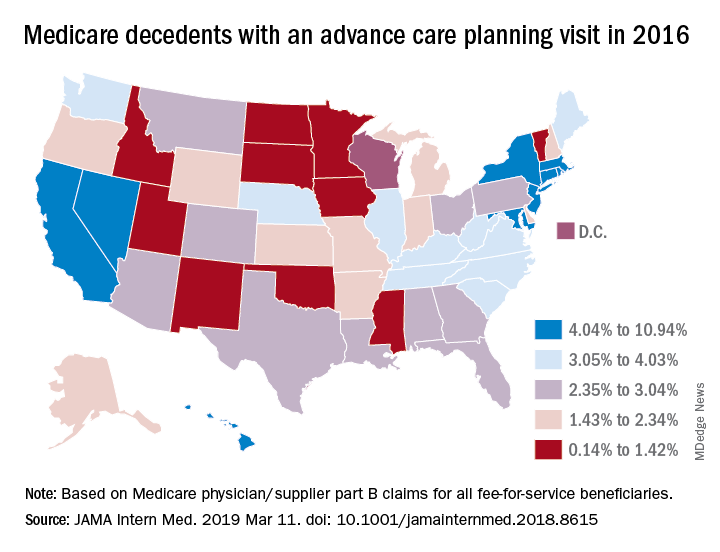
Starting in 2016, the Centers for Medicare & Medicaid Services began paying physicians for advance care planning discussions with the approval of two new codes: 99497 and 99498. The codes pay about $86 for the first 30 minutes of a face-to-face conversation with a patient, family member, and/or surrogate and about $75 for additional sessions. Services can be furnished in both inpatient and ambulatory settings, and payment is not limited to particular physician specialties.
In 2016, health care professionals in New England (Connecticut, Maine, Massachusetts, New Hampshire, Rhode Island, and Vermont) billed Medicare 26,522 times for the advance care planning (ACP) codes for a total of 24,536 patients, which represented less than 1% of Medicare beneficiaries in New England at the time, according to Kimberly Pelland, MPH, of Healthcentric Advisors, Providence, R.I., and her colleagues. Most claims were billed in the office, followed by in nursing homes, and in hospitals; 40% of conversations occurred during an annual wellness visit (JAMA Intern Med. 2019 March 11. doi:10.1001/jamainternmed.2018.8107).
Internists billed Medicare the most for ACP claims (65%), followed by family physicians (22%) gerontologists (5%), and oncologist/hematologists (0.3%), according to the analysis based on 2016 Medicare claims data and Census Bureau data. A greater proportion of patients with ACP claims were female, aged 85 years or older, enrolled in hospice, and died in the study year. Patients had higher odds of having an ACP claim if they were older and had lower income, and if they had cancer, heart failure, stroke, chronic kidney disease, or dementia. Male patients who were Asian, black, and Hispanic had lower chances of having an ACP claim.
In a related study, Emmanuelle Belanger, PhD, of Brown University, Providence, R.I., and her colleagues examined national Medicare data from 2016 to the third quarter of 2017. Across the United States, 2% of Medicare patients aged 65 years and older received advance care planning services that were billed under the ACP codes (JAMA Intern Med. 2019 March 11. doi: 10.1001/jamainternmed.2018.8615). Visits billed under the ACP codes increased from 538,275 to 633,214 during the same time period. Claim rates were higher among patients who died within the study period, reaching 3% in 2016 and 6% in 2017. The percentage of decedents with an ACP billed visit varied strongly across states, with states such as North Dakota, South Dakota, and Wyoming having the fewest ACP visits billed and states such as California and Nevada having the most. ACP billed visits increased in all settings in 2017, but primarily in hospitals and nursing homes. Nationally, internists billed the codes most (48%), followed by family physicians (28%).
While the two studies indicate low usage of the ACP codes, many physicians are discussing advance care planning with their patients, said Mary M. Newman, MD, an internist based in Lutherville, Md., and former American College of Physicians adviser to the American Medical Association Relative Scale Value Update Committee (RUC).
“What cannot be captured by tracking under Medicare claims data are those shorter conversations that we have frequently,” Dr. Newman said in an interview. “If we have a short conversation about advance care planning, it gets folded into our evaluation and management visit. It’s not going to be separately billed.”
At the same time, some patients are not ready to discuss end-of-life options and decline the discussions when asked, Dr. Newman said. Particularly for healthier patients, end of life care is not a primary focus, she noted.
“Not everybody’s ready to have an advance care planning [discussion] that lasts 16-45 minutes,” she said. “Many people over age 65 are not ready to deal with advance care planning in their day-to-day lives, and it may not be what they wish to discuss. I offer the option to patients and some say, ‘Yes, I’d love to,’ and others decline or postpone.”
Low usage of the ACP codes may be associated with lack of awareness, uncertainty about appropriate code use, or associated billing that is not part of the standard workflow, Ankita Mehta, MD, of Mount Sinai in New York wrote an editorial accompanying the studies (JAMA Intern Med. 2019 March 11. doi:10.1001/jamainternmed.2018.8105).
“Regardless, the low rates of utilization of ACP codes is alarming and highlights the need to create strategies to integrate ACP discussions into standard practice and build ACP documentation and billing in clinical workflow,” Dr. Mehta said.
Dr. Newman agreed that more education among physicians is needed.
“The amount of education clinicians have received varies tremendously across the geography of the country,” she said. “I think the codes are going to be slowly adopted. The challenge to us is to make sure we’re all better educated on palliative care as people age and get sick and that we are sensitive to our patients explicit and implicit needs for these discussions.”
Starting in 2016, the Centers for Medicare & Medicaid Services began paying physicians for advance care planning discussions with the approval of two new codes: 99497 and 99498. The codes pay about $86 for the first 30 minutes of a face-to-face conversation with a patient, family member, and/or surrogate and about $75 for additional sessions. Services can be furnished in both inpatient and ambulatory settings, and payment is not limited to particular physician specialties.
In 2016, health care professionals in New England (Connecticut, Maine, Massachusetts, New Hampshire, Rhode Island, and Vermont) billed Medicare 26,522 times for the advance care planning (ACP) codes for a total of 24,536 patients, which represented less than 1% of Medicare beneficiaries in New England at the time, according to Kimberly Pelland, MPH, of Healthcentric Advisors, Providence, R.I., and her colleagues. Most claims were billed in the office, followed by in nursing homes, and in hospitals; 40% of conversations occurred during an annual wellness visit (JAMA Intern Med. 2019 March 11. doi:10.1001/jamainternmed.2018.8107).
Internists billed Medicare the most for ACP claims (65%), followed by family physicians (22%) gerontologists (5%), and oncologist/hematologists (0.3%), according to the analysis based on 2016 Medicare claims data and Census Bureau data. A greater proportion of patients with ACP claims were female, aged 85 years or older, enrolled in hospice, and died in the study year. Patients had higher odds of having an ACP claim if they were older and had lower income, and if they had cancer, heart failure, stroke, chronic kidney disease, or dementia. Male patients who were Asian, black, and Hispanic had lower chances of having an ACP claim.
In a related study, Emmanuelle Belanger, PhD, of Brown University, Providence, R.I., and her colleagues examined national Medicare data from 2016 to the third quarter of 2017. Across the United States, 2% of Medicare patients aged 65 years and older received advance care planning services that were billed under the ACP codes (JAMA Intern Med. 2019 March 11. doi: 10.1001/jamainternmed.2018.8615). Visits billed under the ACP codes increased from 538,275 to 633,214 during the same time period. Claim rates were higher among patients who died within the study period, reaching 3% in 2016 and 6% in 2017. The percentage of decedents with an ACP billed visit varied strongly across states, with states such as North Dakota, South Dakota, and Wyoming having the fewest ACP visits billed and states such as California and Nevada having the most. ACP billed visits increased in all settings in 2017, but primarily in hospitals and nursing homes. Nationally, internists billed the codes most (48%), followed by family physicians (28%).
While the two studies indicate low usage of the ACP codes, many physicians are discussing advance care planning with their patients, said Mary M. Newman, MD, an internist based in Lutherville, Md., and former American College of Physicians adviser to the American Medical Association Relative Scale Value Update Committee (RUC).
“What cannot be captured by tracking under Medicare claims data are those shorter conversations that we have frequently,” Dr. Newman said in an interview. “If we have a short conversation about advance care planning, it gets folded into our evaluation and management visit. It’s not going to be separately billed.”
At the same time, some patients are not ready to discuss end-of-life options and decline the discussions when asked, Dr. Newman said. Particularly for healthier patients, end of life care is not a primary focus, she noted.
“Not everybody’s ready to have an advance care planning [discussion] that lasts 16-45 minutes,” she said. “Many people over age 65 are not ready to deal with advance care planning in their day-to-day lives, and it may not be what they wish to discuss. I offer the option to patients and some say, ‘Yes, I’d love to,’ and others decline or postpone.”
Low usage of the ACP codes may be associated with lack of awareness, uncertainty about appropriate code use, or associated billing that is not part of the standard workflow, Ankita Mehta, MD, of Mount Sinai in New York wrote an editorial accompanying the studies (JAMA Intern Med. 2019 March 11. doi:10.1001/jamainternmed.2018.8105).
“Regardless, the low rates of utilization of ACP codes is alarming and highlights the need to create strategies to integrate ACP discussions into standard practice and build ACP documentation and billing in clinical workflow,” Dr. Mehta said.
Dr. Newman agreed that more education among physicians is needed.
“The amount of education clinicians have received varies tremendously across the geography of the country,” she said. “I think the codes are going to be slowly adopted. The challenge to us is to make sure we’re all better educated on palliative care as people age and get sick and that we are sensitive to our patients explicit and implicit needs for these discussions.”
Starting in 2016, the Centers for Medicare & Medicaid Services began paying physicians for advance care planning discussions with the approval of two new codes: 99497 and 99498. The codes pay about $86 for the first 30 minutes of a face-to-face conversation with a patient, family member, and/or surrogate and about $75 for additional sessions. Services can be furnished in both inpatient and ambulatory settings, and payment is not limited to particular physician specialties.
In 2016, health care professionals in New England (Connecticut, Maine, Massachusetts, New Hampshire, Rhode Island, and Vermont) billed Medicare 26,522 times for the advance care planning (ACP) codes for a total of 24,536 patients, which represented less than 1% of Medicare beneficiaries in New England at the time, according to Kimberly Pelland, MPH, of Healthcentric Advisors, Providence, R.I., and her colleagues. Most claims were billed in the office, followed by in nursing homes, and in hospitals; 40% of conversations occurred during an annual wellness visit (JAMA Intern Med. 2019 March 11. doi:10.1001/jamainternmed.2018.8107).
Internists billed Medicare the most for ACP claims (65%), followed by family physicians (22%) gerontologists (5%), and oncologist/hematologists (0.3%), according to the analysis based on 2016 Medicare claims data and Census Bureau data. A greater proportion of patients with ACP claims were female, aged 85 years or older, enrolled in hospice, and died in the study year. Patients had higher odds of having an ACP claim if they were older and had lower income, and if they had cancer, heart failure, stroke, chronic kidney disease, or dementia. Male patients who were Asian, black, and Hispanic had lower chances of having an ACP claim.
In a related study, Emmanuelle Belanger, PhD, of Brown University, Providence, R.I., and her colleagues examined national Medicare data from 2016 to the third quarter of 2017. Across the United States, 2% of Medicare patients aged 65 years and older received advance care planning services that were billed under the ACP codes (JAMA Intern Med. 2019 March 11. doi: 10.1001/jamainternmed.2018.8615). Visits billed under the ACP codes increased from 538,275 to 633,214 during the same time period. Claim rates were higher among patients who died within the study period, reaching 3% in 2016 and 6% in 2017. The percentage of decedents with an ACP billed visit varied strongly across states, with states such as North Dakota, South Dakota, and Wyoming having the fewest ACP visits billed and states such as California and Nevada having the most. ACP billed visits increased in all settings in 2017, but primarily in hospitals and nursing homes. Nationally, internists billed the codes most (48%), followed by family physicians (28%).
While the two studies indicate low usage of the ACP codes, many physicians are discussing advance care planning with their patients, said Mary M. Newman, MD, an internist based in Lutherville, Md., and former American College of Physicians adviser to the American Medical Association Relative Scale Value Update Committee (RUC).
“What cannot be captured by tracking under Medicare claims data are those shorter conversations that we have frequently,” Dr. Newman said in an interview. “If we have a short conversation about advance care planning, it gets folded into our evaluation and management visit. It’s not going to be separately billed.”
At the same time, some patients are not ready to discuss end-of-life options and decline the discussions when asked, Dr. Newman said. Particularly for healthier patients, end of life care is not a primary focus, she noted.
“Not everybody’s ready to have an advance care planning [discussion] that lasts 16-45 minutes,” she said. “Many people over age 65 are not ready to deal with advance care planning in their day-to-day lives, and it may not be what they wish to discuss. I offer the option to patients and some say, ‘Yes, I’d love to,’ and others decline or postpone.”
Low usage of the ACP codes may be associated with lack of awareness, uncertainty about appropriate code use, or associated billing that is not part of the standard workflow, Ankita Mehta, MD, of Mount Sinai in New York wrote an editorial accompanying the studies (JAMA Intern Med. 2019 March 11. doi:10.1001/jamainternmed.2018.8105).
“Regardless, the low rates of utilization of ACP codes is alarming and highlights the need to create strategies to integrate ACP discussions into standard practice and build ACP documentation and billing in clinical workflow,” Dr. Mehta said.
Dr. Newman agreed that more education among physicians is needed.
“The amount of education clinicians have received varies tremendously across the geography of the country,” she said. “I think the codes are going to be slowly adopted. The challenge to us is to make sure we’re all better educated on palliative care as people age and get sick and that we are sensitive to our patients explicit and implicit needs for these discussions.”
‘Difficult’ discussions reduced anxiety, depression in life-limiting cancer patients
A program to encourage difficult discussions between seriously ill patients and their oncologists reduced anxiety and depression in a recent randomized trial, but its impact on patient-centered outcomes were uncertain.
Goal-concordant care and peacefulness at the end of life, the coprimary study outcomes, were not significantly different between patients who received the quality improvement intervention and controls in the study, which included 91 clinicians providing care for 278 patients with advanced cancer.
However, it’s not clear whether the intervention, known as the Serious Illness Care Program (SICP), failed to improve those outcomes, or if there simply weren’t enough patients in the trial to detect a meaningful difference, according to investigators led by Rachelle Bernacki, MD, of Brigham and Women’s Hospital and the Harvard School of Public Health, Boston.
“Our challenges reflect the need in our field for patient-centered measures of communication that are agreed upon, validated, and demonstrably sensitive to communication interventions,” wrote Dr. Bernacki and her coinvestigators in a report on the study published in JAMA Internal Medicine.
However, the SICP intervention did clearly result in a larger number of serious-illness conversations that occurred earlier and were of higher quality, the investigators wrote in a separate report published in JAMA Oncology. In medical records reviewed after the patients’ deaths, 96% of those who received the intervention had a documented serious-illness conversation with their oncology clinician, compared with 79% of controls (P = .005), according to that report.
The conversations among SICP recipients occurred a median of 2.4 months earlier than controls, and had a greater focus on values and goals, prognosis and understanding of illness, and treatment preferences.
These outcomes are reassuring, since patients “want, require, and deserve” conversations about serious illness, regardless of their impact on measurable outcomes, the authors of an editorial published in JAMA Oncology wrote.
The SICP intervention included a communication guide for clinicians, who also participated in a 2.5-hour training session designed to improve their serious-illness conversation skills. Other aspects of the program for clinicians included email reminders before outpatient visits, a specialized EMR template, and personal coaching. The program also included patient tools, including a letter introducing the intervention and a guide for continuing the conversation with their family.
The study did not demonstrate a significant difference in peacefulness, as measured by the validated Peace, Equanimity, and Acceptance in the Cancer Experience questionnaire, or in goal-concordant care, which was measured by asking patients to select goals of importance, and then asking caregivers to rate whether those goals had been met at the end of life.
However, patients in the SICP group reported less anxiety and depression 14 weeks into the trial, according to the investigators. The proportion of patients reporting moderate to severe anxiety at that time point was 10.2% for the intervention group versus 5.0% for controls (P = .05), while the proportion reporting depression symptoms was 20.8% for the intervention versus 10.6% for controls (P = .04).
The anxiety reduction was maintained at 24 weeks, though the depression reduction was not, the investigators wrote, adding that there were no differences in survival between arms.
Taken together, these results suggest that oncology clinicians can discuss difficult topics without causing harm, and with potential benefit, the investigators wrote in a discussion of their results.
“Further development of serious illness communication interventions will require more reliable and well-accepted patient-centered outcome measures and additional testing of the effect on patients throughout their illness trajectory,” they concluded.
Dr. Bernacki reported no disclosures. Coauthor Susan D. Block, MD, reported compensation from Up to Date and Atul A. Gawande, MD, MPH, reported receiving compensation from health care writing and media and is employed by a health care venture formed by Amazon, Berkshire Hathaway, and JPMorgan Chase.
SOURCE: Bernacki R et al. JAMA Intern Med. 2018 Mar 14. doi: 10.1001/jamainternmed.2019.0077.
While results of this rigorous and innovative clinical trial are disappointing because of an apparent lack of impact on the primary outcomes of care, oncologists still must initiate serious illness conversations with advanced cancer patients at risk of dying in the foreseeable future, according to the authors of an editorial.
Doing so is important “not because this will necessarily improve outcomes, but because patients want, require, and deserve to know what is coming,” wrote Belinda E. Kiely, MBBS, PhD, FRACP, and Martin R. Stockler, MBBS, MSc, FRACP.
Those difficult conversations should not stop at discussing the limits of care, but should include a discussion of the patient’s preferences, priorities, and values, Dr. Kiely and Dr. Stockler wrote, adding that they should be documented in the EMR to ensure they are accessible to other health care providers.
“If nothing else, oncologists should be reassured that having these conversations is unlikely to increase anxiety or depression in their patients,” wrote the editorial authors, referencing the significantly reduced incidence of those secondary endpoints in the study.
However, conversations alone may not be enough to improve other patient-centered outcomes, based on the inability of this trial to demonstrate significant improvements in goal-centered care or peacefulness at the end of life.
Moreover, building this Serious Illness Care Program intervention into a health system could be complicated and may require significant resources.
“Simple, pragmatic, and effective tactics are needed to ensure greater generalizability and widespread applicability of such programs,” the authors concluded.
Dr. Kiely and Dr. Stockler are with the National Health and Medical Research Council Clinical Trials Centre at the University of Sydney. Their editorial appears in JAMA Oncology. Dr. Stockler reported grants outside the submitted work from Astellas, Amgen, AstraZeneca, Cancer Australia, Celgene, Bionomics, Bayer, Medivation, Merck, National Health and Medical Research Council Australia, Pfizer, Roche, Sanofi, and Tilray.
While results of this rigorous and innovative clinical trial are disappointing because of an apparent lack of impact on the primary outcomes of care, oncologists still must initiate serious illness conversations with advanced cancer patients at risk of dying in the foreseeable future, according to the authors of an editorial.
Doing so is important “not because this will necessarily improve outcomes, but because patients want, require, and deserve to know what is coming,” wrote Belinda E. Kiely, MBBS, PhD, FRACP, and Martin R. Stockler, MBBS, MSc, FRACP.
Those difficult conversations should not stop at discussing the limits of care, but should include a discussion of the patient’s preferences, priorities, and values, Dr. Kiely and Dr. Stockler wrote, adding that they should be documented in the EMR to ensure they are accessible to other health care providers.
“If nothing else, oncologists should be reassured that having these conversations is unlikely to increase anxiety or depression in their patients,” wrote the editorial authors, referencing the significantly reduced incidence of those secondary endpoints in the study.
However, conversations alone may not be enough to improve other patient-centered outcomes, based on the inability of this trial to demonstrate significant improvements in goal-centered care or peacefulness at the end of life.
Moreover, building this Serious Illness Care Program intervention into a health system could be complicated and may require significant resources.
“Simple, pragmatic, and effective tactics are needed to ensure greater generalizability and widespread applicability of such programs,” the authors concluded.
Dr. Kiely and Dr. Stockler are with the National Health and Medical Research Council Clinical Trials Centre at the University of Sydney. Their editorial appears in JAMA Oncology. Dr. Stockler reported grants outside the submitted work from Astellas, Amgen, AstraZeneca, Cancer Australia, Celgene, Bionomics, Bayer, Medivation, Merck, National Health and Medical Research Council Australia, Pfizer, Roche, Sanofi, and Tilray.
While results of this rigorous and innovative clinical trial are disappointing because of an apparent lack of impact on the primary outcomes of care, oncologists still must initiate serious illness conversations with advanced cancer patients at risk of dying in the foreseeable future, according to the authors of an editorial.
Doing so is important “not because this will necessarily improve outcomes, but because patients want, require, and deserve to know what is coming,” wrote Belinda E. Kiely, MBBS, PhD, FRACP, and Martin R. Stockler, MBBS, MSc, FRACP.
Those difficult conversations should not stop at discussing the limits of care, but should include a discussion of the patient’s preferences, priorities, and values, Dr. Kiely and Dr. Stockler wrote, adding that they should be documented in the EMR to ensure they are accessible to other health care providers.
“If nothing else, oncologists should be reassured that having these conversations is unlikely to increase anxiety or depression in their patients,” wrote the editorial authors, referencing the significantly reduced incidence of those secondary endpoints in the study.
However, conversations alone may not be enough to improve other patient-centered outcomes, based on the inability of this trial to demonstrate significant improvements in goal-centered care or peacefulness at the end of life.
Moreover, building this Serious Illness Care Program intervention into a health system could be complicated and may require significant resources.
“Simple, pragmatic, and effective tactics are needed to ensure greater generalizability and widespread applicability of such programs,” the authors concluded.
Dr. Kiely and Dr. Stockler are with the National Health and Medical Research Council Clinical Trials Centre at the University of Sydney. Their editorial appears in JAMA Oncology. Dr. Stockler reported grants outside the submitted work from Astellas, Amgen, AstraZeneca, Cancer Australia, Celgene, Bionomics, Bayer, Medivation, Merck, National Health and Medical Research Council Australia, Pfizer, Roche, Sanofi, and Tilray.
A program to encourage difficult discussions between seriously ill patients and their oncologists reduced anxiety and depression in a recent randomized trial, but its impact on patient-centered outcomes were uncertain.
Goal-concordant care and peacefulness at the end of life, the coprimary study outcomes, were not significantly different between patients who received the quality improvement intervention and controls in the study, which included 91 clinicians providing care for 278 patients with advanced cancer.
However, it’s not clear whether the intervention, known as the Serious Illness Care Program (SICP), failed to improve those outcomes, or if there simply weren’t enough patients in the trial to detect a meaningful difference, according to investigators led by Rachelle Bernacki, MD, of Brigham and Women’s Hospital and the Harvard School of Public Health, Boston.
“Our challenges reflect the need in our field for patient-centered measures of communication that are agreed upon, validated, and demonstrably sensitive to communication interventions,” wrote Dr. Bernacki and her coinvestigators in a report on the study published in JAMA Internal Medicine.
However, the SICP intervention did clearly result in a larger number of serious-illness conversations that occurred earlier and were of higher quality, the investigators wrote in a separate report published in JAMA Oncology. In medical records reviewed after the patients’ deaths, 96% of those who received the intervention had a documented serious-illness conversation with their oncology clinician, compared with 79% of controls (P = .005), according to that report.
The conversations among SICP recipients occurred a median of 2.4 months earlier than controls, and had a greater focus on values and goals, prognosis and understanding of illness, and treatment preferences.
These outcomes are reassuring, since patients “want, require, and deserve” conversations about serious illness, regardless of their impact on measurable outcomes, the authors of an editorial published in JAMA Oncology wrote.
The SICP intervention included a communication guide for clinicians, who also participated in a 2.5-hour training session designed to improve their serious-illness conversation skills. Other aspects of the program for clinicians included email reminders before outpatient visits, a specialized EMR template, and personal coaching. The program also included patient tools, including a letter introducing the intervention and a guide for continuing the conversation with their family.
The study did not demonstrate a significant difference in peacefulness, as measured by the validated Peace, Equanimity, and Acceptance in the Cancer Experience questionnaire, or in goal-concordant care, which was measured by asking patients to select goals of importance, and then asking caregivers to rate whether those goals had been met at the end of life.
However, patients in the SICP group reported less anxiety and depression 14 weeks into the trial, according to the investigators. The proportion of patients reporting moderate to severe anxiety at that time point was 10.2% for the intervention group versus 5.0% for controls (P = .05), while the proportion reporting depression symptoms was 20.8% for the intervention versus 10.6% for controls (P = .04).
The anxiety reduction was maintained at 24 weeks, though the depression reduction was not, the investigators wrote, adding that there were no differences in survival between arms.
Taken together, these results suggest that oncology clinicians can discuss difficult topics without causing harm, and with potential benefit, the investigators wrote in a discussion of their results.
“Further development of serious illness communication interventions will require more reliable and well-accepted patient-centered outcome measures and additional testing of the effect on patients throughout their illness trajectory,” they concluded.
Dr. Bernacki reported no disclosures. Coauthor Susan D. Block, MD, reported compensation from Up to Date and Atul A. Gawande, MD, MPH, reported receiving compensation from health care writing and media and is employed by a health care venture formed by Amazon, Berkshire Hathaway, and JPMorgan Chase.
SOURCE: Bernacki R et al. JAMA Intern Med. 2018 Mar 14. doi: 10.1001/jamainternmed.2019.0077.
A program to encourage difficult discussions between seriously ill patients and their oncologists reduced anxiety and depression in a recent randomized trial, but its impact on patient-centered outcomes were uncertain.
Goal-concordant care and peacefulness at the end of life, the coprimary study outcomes, were not significantly different between patients who received the quality improvement intervention and controls in the study, which included 91 clinicians providing care for 278 patients with advanced cancer.
However, it’s not clear whether the intervention, known as the Serious Illness Care Program (SICP), failed to improve those outcomes, or if there simply weren’t enough patients in the trial to detect a meaningful difference, according to investigators led by Rachelle Bernacki, MD, of Brigham and Women’s Hospital and the Harvard School of Public Health, Boston.
“Our challenges reflect the need in our field for patient-centered measures of communication that are agreed upon, validated, and demonstrably sensitive to communication interventions,” wrote Dr. Bernacki and her coinvestigators in a report on the study published in JAMA Internal Medicine.
However, the SICP intervention did clearly result in a larger number of serious-illness conversations that occurred earlier and were of higher quality, the investigators wrote in a separate report published in JAMA Oncology. In medical records reviewed after the patients’ deaths, 96% of those who received the intervention had a documented serious-illness conversation with their oncology clinician, compared with 79% of controls (P = .005), according to that report.
The conversations among SICP recipients occurred a median of 2.4 months earlier than controls, and had a greater focus on values and goals, prognosis and understanding of illness, and treatment preferences.
These outcomes are reassuring, since patients “want, require, and deserve” conversations about serious illness, regardless of their impact on measurable outcomes, the authors of an editorial published in JAMA Oncology wrote.
The SICP intervention included a communication guide for clinicians, who also participated in a 2.5-hour training session designed to improve their serious-illness conversation skills. Other aspects of the program for clinicians included email reminders before outpatient visits, a specialized EMR template, and personal coaching. The program also included patient tools, including a letter introducing the intervention and a guide for continuing the conversation with their family.
The study did not demonstrate a significant difference in peacefulness, as measured by the validated Peace, Equanimity, and Acceptance in the Cancer Experience questionnaire, or in goal-concordant care, which was measured by asking patients to select goals of importance, and then asking caregivers to rate whether those goals had been met at the end of life.
However, patients in the SICP group reported less anxiety and depression 14 weeks into the trial, according to the investigators. The proportion of patients reporting moderate to severe anxiety at that time point was 10.2% for the intervention group versus 5.0% for controls (P = .05), while the proportion reporting depression symptoms was 20.8% for the intervention versus 10.6% for controls (P = .04).
The anxiety reduction was maintained at 24 weeks, though the depression reduction was not, the investigators wrote, adding that there were no differences in survival between arms.
Taken together, these results suggest that oncology clinicians can discuss difficult topics without causing harm, and with potential benefit, the investigators wrote in a discussion of their results.
“Further development of serious illness communication interventions will require more reliable and well-accepted patient-centered outcome measures and additional testing of the effect on patients throughout their illness trajectory,” they concluded.
Dr. Bernacki reported no disclosures. Coauthor Susan D. Block, MD, reported compensation from Up to Date and Atul A. Gawande, MD, MPH, reported receiving compensation from health care writing and media and is employed by a health care venture formed by Amazon, Berkshire Hathaway, and JPMorgan Chase.
SOURCE: Bernacki R et al. JAMA Intern Med. 2018 Mar 14. doi: 10.1001/jamainternmed.2019.0077.
FROM JAMA INTERNAL MEDICINE
Clinical trials unavailable for more than half of all cancer patients
More than half of all cancer patients do not participate in clinical trials because none are available for their cancer type or stage at their institution, according to a meta-analysis of cancer clinical trials that examined the trial decision-making pathway.
“This is the first effort to systematically both define and quantify domains of clinical trial barriers using a meta-analytic approach,” wrote lead author Joseph M. Unger, PhD, of the Fred Hutchinson Cancer Research Center in Seattle and his coauthors in the Journal of the National Cancer Institute.
To identify trials that addressed barriers to enrollment, Dr. Unger and his colleagues conducted a literature search using the PubMed, Google Scholar, Web of Science, and Ovid Medline databases. The search returned 7,576 unique results, of which they reviewed 38 full articles and eventually decided on 13 studies comprising 8,883 patients. Nine of the studies were focused on academic care settings, and four were focused on community care settings; seven examined patient decision-making patterns in all types of cancers, while the others focused on breast cancer only (n = 2), lung cancer only (n = 2), prostate cancer only (n = 1), and cervix/uterine cancers (n = 1).
Their analysis found that, for 55.6% of patients, no trial was available for their cancer type and stage (95% confidence interval, 43.7%-67.3%). In addition, 21.5% (95% CI, 10.9%-34.6%) were not eligible for an available trial, and 14.8% (95% CI, 9.0%-21.7%) did not enroll; only 8.1% (95% CI, 6.3%-10.0%) enrolled in a trial. Academic sites (15.9%, 95% CI, 13.8%-18.2%) saw much higher rates of participation than community sites (7.0%, 95% CI, 5.1%-9.1%; P less than .001).
The authors acknowledged their study’s limitations, including details on trial availability not being available for all analyzed studies. In addition, several of the studies relied on selected cancer types instead of sampling a representative set of cancers. Finally, these studies may have oversampled research-oriented sites, which would mean “the actual overall trial participation rate may be lower than we estimated.”
The study was supported by the National Cancer Institute. The authors reported no conflicts of interest.
SOURCE: Unger JM et al. J Natl Cancer Inst. 2019 Feb 19. doi: 10.1093/jnci/djy221.
More than half of all cancer patients do not participate in clinical trials because none are available for their cancer type or stage at their institution, according to a meta-analysis of cancer clinical trials that examined the trial decision-making pathway.
“This is the first effort to systematically both define and quantify domains of clinical trial barriers using a meta-analytic approach,” wrote lead author Joseph M. Unger, PhD, of the Fred Hutchinson Cancer Research Center in Seattle and his coauthors in the Journal of the National Cancer Institute.
To identify trials that addressed barriers to enrollment, Dr. Unger and his colleagues conducted a literature search using the PubMed, Google Scholar, Web of Science, and Ovid Medline databases. The search returned 7,576 unique results, of which they reviewed 38 full articles and eventually decided on 13 studies comprising 8,883 patients. Nine of the studies were focused on academic care settings, and four were focused on community care settings; seven examined patient decision-making patterns in all types of cancers, while the others focused on breast cancer only (n = 2), lung cancer only (n = 2), prostate cancer only (n = 1), and cervix/uterine cancers (n = 1).
Their analysis found that, for 55.6% of patients, no trial was available for their cancer type and stage (95% confidence interval, 43.7%-67.3%). In addition, 21.5% (95% CI, 10.9%-34.6%) were not eligible for an available trial, and 14.8% (95% CI, 9.0%-21.7%) did not enroll; only 8.1% (95% CI, 6.3%-10.0%) enrolled in a trial. Academic sites (15.9%, 95% CI, 13.8%-18.2%) saw much higher rates of participation than community sites (7.0%, 95% CI, 5.1%-9.1%; P less than .001).
The authors acknowledged their study’s limitations, including details on trial availability not being available for all analyzed studies. In addition, several of the studies relied on selected cancer types instead of sampling a representative set of cancers. Finally, these studies may have oversampled research-oriented sites, which would mean “the actual overall trial participation rate may be lower than we estimated.”
The study was supported by the National Cancer Institute. The authors reported no conflicts of interest.
SOURCE: Unger JM et al. J Natl Cancer Inst. 2019 Feb 19. doi: 10.1093/jnci/djy221.
More than half of all cancer patients do not participate in clinical trials because none are available for their cancer type or stage at their institution, according to a meta-analysis of cancer clinical trials that examined the trial decision-making pathway.
“This is the first effort to systematically both define and quantify domains of clinical trial barriers using a meta-analytic approach,” wrote lead author Joseph M. Unger, PhD, of the Fred Hutchinson Cancer Research Center in Seattle and his coauthors in the Journal of the National Cancer Institute.
To identify trials that addressed barriers to enrollment, Dr. Unger and his colleagues conducted a literature search using the PubMed, Google Scholar, Web of Science, and Ovid Medline databases. The search returned 7,576 unique results, of which they reviewed 38 full articles and eventually decided on 13 studies comprising 8,883 patients. Nine of the studies were focused on academic care settings, and four were focused on community care settings; seven examined patient decision-making patterns in all types of cancers, while the others focused on breast cancer only (n = 2), lung cancer only (n = 2), prostate cancer only (n = 1), and cervix/uterine cancers (n = 1).
Their analysis found that, for 55.6% of patients, no trial was available for their cancer type and stage (95% confidence interval, 43.7%-67.3%). In addition, 21.5% (95% CI, 10.9%-34.6%) were not eligible for an available trial, and 14.8% (95% CI, 9.0%-21.7%) did not enroll; only 8.1% (95% CI, 6.3%-10.0%) enrolled in a trial. Academic sites (15.9%, 95% CI, 13.8%-18.2%) saw much higher rates of participation than community sites (7.0%, 95% CI, 5.1%-9.1%; P less than .001).
The authors acknowledged their study’s limitations, including details on trial availability not being available for all analyzed studies. In addition, several of the studies relied on selected cancer types instead of sampling a representative set of cancers. Finally, these studies may have oversampled research-oriented sites, which would mean “the actual overall trial participation rate may be lower than we estimated.”
The study was supported by the National Cancer Institute. The authors reported no conflicts of interest.
SOURCE: Unger JM et al. J Natl Cancer Inst. 2019 Feb 19. doi: 10.1093/jnci/djy221.
FROM THE JOURNAL OF THE NATIONAL CANCER INSTITUTE
Treating lymphoma in patients with HIV
In this episode, Stefan Barta, MD, of the University of Pennsylvania, joins David Henry, MD, to discuss the treatment and diagnosis of lymphoma in patients with HIV.
And in this week’s Clinical Correlation, Ilana Yurkiewicz, MD, has Part 2 of her discussion on informed consent in cancer. Dr. Yurkiewicz is a fellow in hematology and oncology at Stanford (Calif.) University and is also a columnist for Hematology News. More from Dr. Yurkiewicz here.
Subscribe to Blood & Cancer here:
Apple Podcasts
Google Podcasts
Show notes
By Emily Bryer, DO
Resident in the department of internal medicine, University of Pennsylvania Health System
Immunosuppression in patients with HIV, especially with low CD4 counts, is associated with the development of lymphomas.
Diffuse large B-cell lymphoma is the most common lymphoma in patients with HIV followed by Burkitt lymphoma and Hodgkin lymphoma.
Extra-nodal manifestations of lymphoma are more common in patients with HIV, especially with lower CD4 counts.
Following pathologic diagnosis, staging of lymphoma should include:
- CT scan, PET scan, evaluation of CNS (MRI brain and LP), bone marrow biopsy, and evaluation for hepatitis B and C co-infection.
- Fluorescence in situ hybridization (FISH) is a molecular technique that identifies portions of DNA and helps to identify translocations and rearrangements.
- cMYC, BCL2, and BCL6 are all pro-proliferative genes and commonly implicated in lymphoma.
- cMYC rearrangement poses higher risk of CNS involvement and CNS relapse.
- cMYC rearrangement (as opposed to cMYC translocation) requires therapy that is more aggressive therapy than R-CHOP.
Treatment of high grade diffuse large B-cell lymphoma:
- R-EPOCH
- Ibrutinib plus R-EPOCH
Resources:AIDS Malignancy ConsortiumBlood. 2004;103:275-82.
Blood. 2010 Apr 15; 115(15): 3008–16.
NCT03220022: Ibrutinib, Rituximab, Etoposide, Prednisone, Vincristine Sulfate, Cyclophosphamide, and Doxorubicin Hydrochloride in Treating Patients With HIV-Positive Stage II-IV Diffuse Large B-Cell Lymphomas
In this episode, Stefan Barta, MD, of the University of Pennsylvania, joins David Henry, MD, to discuss the treatment and diagnosis of lymphoma in patients with HIV.
And in this week’s Clinical Correlation, Ilana Yurkiewicz, MD, has Part 2 of her discussion on informed consent in cancer. Dr. Yurkiewicz is a fellow in hematology and oncology at Stanford (Calif.) University and is also a columnist for Hematology News. More from Dr. Yurkiewicz here.
Subscribe to Blood & Cancer here:
Apple Podcasts
Google Podcasts
Show notes
By Emily Bryer, DO
Resident in the department of internal medicine, University of Pennsylvania Health System
Immunosuppression in patients with HIV, especially with low CD4 counts, is associated with the development of lymphomas.
Diffuse large B-cell lymphoma is the most common lymphoma in patients with HIV followed by Burkitt lymphoma and Hodgkin lymphoma.
Extra-nodal manifestations of lymphoma are more common in patients with HIV, especially with lower CD4 counts.
Following pathologic diagnosis, staging of lymphoma should include:
- CT scan, PET scan, evaluation of CNS (MRI brain and LP), bone marrow biopsy, and evaluation for hepatitis B and C co-infection.
- Fluorescence in situ hybridization (FISH) is a molecular technique that identifies portions of DNA and helps to identify translocations and rearrangements.
- cMYC, BCL2, and BCL6 are all pro-proliferative genes and commonly implicated in lymphoma.
- cMYC rearrangement poses higher risk of CNS involvement and CNS relapse.
- cMYC rearrangement (as opposed to cMYC translocation) requires therapy that is more aggressive therapy than R-CHOP.
Treatment of high grade diffuse large B-cell lymphoma:
- R-EPOCH
- Ibrutinib plus R-EPOCH
Resources:AIDS Malignancy ConsortiumBlood. 2004;103:275-82.
Blood. 2010 Apr 15; 115(15): 3008–16.
NCT03220022: Ibrutinib, Rituximab, Etoposide, Prednisone, Vincristine Sulfate, Cyclophosphamide, and Doxorubicin Hydrochloride in Treating Patients With HIV-Positive Stage II-IV Diffuse Large B-Cell Lymphomas
In this episode, Stefan Barta, MD, of the University of Pennsylvania, joins David Henry, MD, to discuss the treatment and diagnosis of lymphoma in patients with HIV.
And in this week’s Clinical Correlation, Ilana Yurkiewicz, MD, has Part 2 of her discussion on informed consent in cancer. Dr. Yurkiewicz is a fellow in hematology and oncology at Stanford (Calif.) University and is also a columnist for Hematology News. More from Dr. Yurkiewicz here.
Subscribe to Blood & Cancer here:
Apple Podcasts
Google Podcasts
Show notes
By Emily Bryer, DO
Resident in the department of internal medicine, University of Pennsylvania Health System
Immunosuppression in patients with HIV, especially with low CD4 counts, is associated with the development of lymphomas.
Diffuse large B-cell lymphoma is the most common lymphoma in patients with HIV followed by Burkitt lymphoma and Hodgkin lymphoma.
Extra-nodal manifestations of lymphoma are more common in patients with HIV, especially with lower CD4 counts.
Following pathologic diagnosis, staging of lymphoma should include:
- CT scan, PET scan, evaluation of CNS (MRI brain and LP), bone marrow biopsy, and evaluation for hepatitis B and C co-infection.
- Fluorescence in situ hybridization (FISH) is a molecular technique that identifies portions of DNA and helps to identify translocations and rearrangements.
- cMYC, BCL2, and BCL6 are all pro-proliferative genes and commonly implicated in lymphoma.
- cMYC rearrangement poses higher risk of CNS involvement and CNS relapse.
- cMYC rearrangement (as opposed to cMYC translocation) requires therapy that is more aggressive therapy than R-CHOP.
Treatment of high grade diffuse large B-cell lymphoma:
- R-EPOCH
- Ibrutinib plus R-EPOCH
Resources:AIDS Malignancy ConsortiumBlood. 2004;103:275-82.
Blood. 2010 Apr 15; 115(15): 3008–16.
NCT03220022: Ibrutinib, Rituximab, Etoposide, Prednisone, Vincristine Sulfate, Cyclophosphamide, and Doxorubicin Hydrochloride in Treating Patients With HIV-Positive Stage II-IV Diffuse Large B-Cell Lymphomas

Oral triplet deemed effective in relapsed/refractory myeloma
An all-oral, three-drug regimen may be a treatment option for relapsed or refractory multiple myeloma, according to researchers.

The regimen – clarithromycin, pomalidomide, and dexamethasone (ClaPd) – produced an overall response rate (ORR) of 60% in a phase 2 trial of patients with relapsed/refractory multiple myeloma (RRMM). Response rates were similar whether patients were refractory to lenalidomide, bortezomib, or both drugs.
The most common adverse events (AEs) in this trial were hematologic toxicities.
Tomer M. Mark, MD, of the University of Colorado at Denver, Aurora, and his colleagues, reported these results in Blood Advances.
The trial (NCT01159574) included 120 patients with RRMM. They had a median age of 63 years (range, 42-87 years) and were a median of 4.6 years (range, 0.8-21.2 years) from diagnosis at baseline.
The patients had received a median of 5 (range, 3-15) prior lines of therapy. Most patients were refractory to lenalidomide (n = 101), bortezomib (n = 94), or both (n = 81).
The ClaPd regimen consisted of clarithromycin given at 500 mg twice daily, pomalidomide at 4 mg on days 1-21, and dexamethasone at 40 mg on days 1, 8, 15, and 22 of a 28-day cycle. The patients received ClaPd until intolerance or disease progression. In addition to ClaPd, patients received thromboprophylaxis (aspirin at 81 mg daily) and Pneumocystis jiroveci prophylaxis (trimethoprim-sulfamethoxazole or an alternative).
The toxicities were manageable, with low rates of nonhematologic and high-grade events, according to the researchers. The most common grade 3 or higher AEs were lymphopenia (60%), neutropenia (58%), leukopenia (34%), thrombocytopenia (31%), and anemia (28%).
Among all evaluable patients, the ORR was 60% (70/117). One patient had a complete response, 6 had a stringent complete response, 20 had a very good partial response, and 43 had a partial response.
ORRs were similar whether patients were refractory to bortezomib, lenalidomide, or both. The ORR was 58% (n = 59) among lenalidomide-refractory patients, 55% (n = 52) among bortezomib-refractory patients, and 54% (n = 44) among double-refractory patients.
For the entire cohort, the median progression-free survival was 7.7 months and the median overall survival was 19.2 months.
In a multivariate analysis, there were two factors significantly associated with inferior overall survival – having a revised International Staging System score greater than 1 (hazard ratio, 2.75; P = .044) and having at least 5% of CD138 cells positive for Ki67 on immunohistochemistry (hazard ratio, 1.84, P = .030).
“The ClaPd regimen demonstrated high rates of overall response and significant duration of disease control in a heavily pretreated RRMM population while maintaining a toxicity profile similar to Pom-dex [pomalidone-dexamethasone] alone,” Dr. Mark and his colleagues wrote. “The clinical efficacy advantage of adding clarithromycin to Pom-dex should be explored further in a phase 3 clinical trial.”
This research was supported by Celgene; the Myeloma Center at Weill Cornell Medicine, New York; and a grant from the National Institutes of Health. Dr. Mark reported relationships with Amgen, Takeda, Celgene, and Janssen. Other study authors reported relationships with Celgene, Takeda, and Onyx Pharmaceuticals.
SOURCE: Mark TM et al. Blood Adv. 2019 Feb 26;3(4):603-11.
An all-oral, three-drug regimen may be a treatment option for relapsed or refractory multiple myeloma, according to researchers.
The regimen – clarithromycin, pomalidomide, and dexamethasone (ClaPd) – produced an overall response rate (ORR) of 60% in a phase 2 trial of patients with relapsed/refractory multiple myeloma (RRMM). Response rates were similar whether patients were refractory to lenalidomide, bortezomib, or both drugs.
The most common adverse events (AEs) in this trial were hematologic toxicities.
Tomer M. Mark, MD, of the University of Colorado at Denver, Aurora, and his colleagues, reported these results in Blood Advances.
The trial (NCT01159574) included 120 patients with RRMM. They had a median age of 63 years (range, 42-87 years) and were a median of 4.6 years (range, 0.8-21.2 years) from diagnosis at baseline.
The patients had received a median of 5 (range, 3-15) prior lines of therapy. Most patients were refractory to lenalidomide (n = 101), bortezomib (n = 94), or both (n = 81).
The ClaPd regimen consisted of clarithromycin given at 500 mg twice daily, pomalidomide at 4 mg on days 1-21, and dexamethasone at 40 mg on days 1, 8, 15, and 22 of a 28-day cycle. The patients received ClaPd until intolerance or disease progression. In addition to ClaPd, patients received thromboprophylaxis (aspirin at 81 mg daily) and Pneumocystis jiroveci prophylaxis (trimethoprim-sulfamethoxazole or an alternative).
The toxicities were manageable, with low rates of nonhematologic and high-grade events, according to the researchers. The most common grade 3 or higher AEs were lymphopenia (60%), neutropenia (58%), leukopenia (34%), thrombocytopenia (31%), and anemia (28%).
Among all evaluable patients, the ORR was 60% (70/117). One patient had a complete response, 6 had a stringent complete response, 20 had a very good partial response, and 43 had a partial response.
ORRs were similar whether patients were refractory to bortezomib, lenalidomide, or both. The ORR was 58% (n = 59) among lenalidomide-refractory patients, 55% (n = 52) among bortezomib-refractory patients, and 54% (n = 44) among double-refractory patients.
For the entire cohort, the median progression-free survival was 7.7 months and the median overall survival was 19.2 months.
In a multivariate analysis, there were two factors significantly associated with inferior overall survival – having a revised International Staging System score greater than 1 (hazard ratio, 2.75; P = .044) and having at least 5% of CD138 cells positive for Ki67 on immunohistochemistry (hazard ratio, 1.84, P = .030).
“The ClaPd regimen demonstrated high rates of overall response and significant duration of disease control in a heavily pretreated RRMM population while maintaining a toxicity profile similar to Pom-dex [pomalidone-dexamethasone] alone,” Dr. Mark and his colleagues wrote. “The clinical efficacy advantage of adding clarithromycin to Pom-dex should be explored further in a phase 3 clinical trial.”
This research was supported by Celgene; the Myeloma Center at Weill Cornell Medicine, New York; and a grant from the National Institutes of Health. Dr. Mark reported relationships with Amgen, Takeda, Celgene, and Janssen. Other study authors reported relationships with Celgene, Takeda, and Onyx Pharmaceuticals.
SOURCE: Mark TM et al. Blood Adv. 2019 Feb 26;3(4):603-11.
An all-oral, three-drug regimen may be a treatment option for relapsed or refractory multiple myeloma, according to researchers.
The regimen – clarithromycin, pomalidomide, and dexamethasone (ClaPd) – produced an overall response rate (ORR) of 60% in a phase 2 trial of patients with relapsed/refractory multiple myeloma (RRMM). Response rates were similar whether patients were refractory to lenalidomide, bortezomib, or both drugs.
The most common adverse events (AEs) in this trial were hematologic toxicities.
Tomer M. Mark, MD, of the University of Colorado at Denver, Aurora, and his colleagues, reported these results in Blood Advances.
The trial (NCT01159574) included 120 patients with RRMM. They had a median age of 63 years (range, 42-87 years) and were a median of 4.6 years (range, 0.8-21.2 years) from diagnosis at baseline.
The patients had received a median of 5 (range, 3-15) prior lines of therapy. Most patients were refractory to lenalidomide (n = 101), bortezomib (n = 94), or both (n = 81).
The ClaPd regimen consisted of clarithromycin given at 500 mg twice daily, pomalidomide at 4 mg on days 1-21, and dexamethasone at 40 mg on days 1, 8, 15, and 22 of a 28-day cycle. The patients received ClaPd until intolerance or disease progression. In addition to ClaPd, patients received thromboprophylaxis (aspirin at 81 mg daily) and Pneumocystis jiroveci prophylaxis (trimethoprim-sulfamethoxazole or an alternative).
The toxicities were manageable, with low rates of nonhematologic and high-grade events, according to the researchers. The most common grade 3 or higher AEs were lymphopenia (60%), neutropenia (58%), leukopenia (34%), thrombocytopenia (31%), and anemia (28%).
Among all evaluable patients, the ORR was 60% (70/117). One patient had a complete response, 6 had a stringent complete response, 20 had a very good partial response, and 43 had a partial response.
ORRs were similar whether patients were refractory to bortezomib, lenalidomide, or both. The ORR was 58% (n = 59) among lenalidomide-refractory patients, 55% (n = 52) among bortezomib-refractory patients, and 54% (n = 44) among double-refractory patients.
For the entire cohort, the median progression-free survival was 7.7 months and the median overall survival was 19.2 months.
In a multivariate analysis, there were two factors significantly associated with inferior overall survival – having a revised International Staging System score greater than 1 (hazard ratio, 2.75; P = .044) and having at least 5% of CD138 cells positive for Ki67 on immunohistochemistry (hazard ratio, 1.84, P = .030).
“The ClaPd regimen demonstrated high rates of overall response and significant duration of disease control in a heavily pretreated RRMM population while maintaining a toxicity profile similar to Pom-dex [pomalidone-dexamethasone] alone,” Dr. Mark and his colleagues wrote. “The clinical efficacy advantage of adding clarithromycin to Pom-dex should be explored further in a phase 3 clinical trial.”
This research was supported by Celgene; the Myeloma Center at Weill Cornell Medicine, New York; and a grant from the National Institutes of Health. Dr. Mark reported relationships with Amgen, Takeda, Celgene, and Janssen. Other study authors reported relationships with Celgene, Takeda, and Onyx Pharmaceuticals.
SOURCE: Mark TM et al. Blood Adv. 2019 Feb 26;3(4):603-11.
FROM BLOOD ADVANCES