User login
Laparoscopic procedure safer for SBO in elderly patients
JACKSONVILLE, FLA. – Octogenarians with small-bowel obstruction are about seven times more likely to have open than laparoscopic surgery, but the minimally invasive approach in these patients has been found to reduce their hospital stays and risk of pneumonia afterward, according to results of an observational study of data from the American College of Surgeons National Surgical Quality Improvement Program database.

Dr. Chang said, “Our study was able to show that age and the presence of preoperative sepsis are associated with mortality rather than procedure type, and that there are procedure-type risks associated with open procedures.”
The observational study analyzed 103 laparoscopic and 692 open operations for small-bowel obstruction (SBO) in patients 80 and older from 2006 to 2014. Characteristics of the open and laparoscopic group – age, gender, body mass index, and race – were similar, although the open group had higher American Society of Anesthesiologists classification and incidence of preoperative sepsis, Dr. Chang said.
“Unadjusted outcomes showed longer length of stay [and] higher postoperative mortality and rates of postoperative pneumonia in the open cases vs. laparoscopic,” she said. “But after we made adjustments for preoperative risk variables, age and the presence of preoperative sepsis were associated with mortality, not the operative approach.” Length of stay was 4 days for the laparoscopic patients vs. 8 days for open (P less than .0001).
The researchers performed logistical regression analysis and found that mortality risk rose slightly with age (odds ratio, 1.11; P = .0311) but almost quadrupled with preoperative sepsis (OR, 3.77; P = .0287) regardless of open or laparoscopic approach. For postoperative pneumonia, risk factors were male gender (OR, 2.68; P = .0003) and open procedure (OR, 5.03; P = .0282).
“Our study elucidates that the octogenarian with small-bowel obstruction due to adhesive disease may benefit from an initial laparoscopic approach,” Dr. Change said. “Further prospective studies are warranted.”
Dr. Chang and coauthors reported having no financial disclosures.
acssurgerynews@frontlinemedcom.com
SOURCE: Chang E et al. Academic Surgical Congress.
JACKSONVILLE, FLA. – Octogenarians with small-bowel obstruction are about seven times more likely to have open than laparoscopic surgery, but the minimally invasive approach in these patients has been found to reduce their hospital stays and risk of pneumonia afterward, according to results of an observational study of data from the American College of Surgeons National Surgical Quality Improvement Program database.
Dr. Chang said, “Our study was able to show that age and the presence of preoperative sepsis are associated with mortality rather than procedure type, and that there are procedure-type risks associated with open procedures.”
The observational study analyzed 103 laparoscopic and 692 open operations for small-bowel obstruction (SBO) in patients 80 and older from 2006 to 2014. Characteristics of the open and laparoscopic group – age, gender, body mass index, and race – were similar, although the open group had higher American Society of Anesthesiologists classification and incidence of preoperative sepsis, Dr. Chang said.
“Unadjusted outcomes showed longer length of stay [and] higher postoperative mortality and rates of postoperative pneumonia in the open cases vs. laparoscopic,” she said. “But after we made adjustments for preoperative risk variables, age and the presence of preoperative sepsis were associated with mortality, not the operative approach.” Length of stay was 4 days for the laparoscopic patients vs. 8 days for open (P less than .0001).
The researchers performed logistical regression analysis and found that mortality risk rose slightly with age (odds ratio, 1.11; P = .0311) but almost quadrupled with preoperative sepsis (OR, 3.77; P = .0287) regardless of open or laparoscopic approach. For postoperative pneumonia, risk factors were male gender (OR, 2.68; P = .0003) and open procedure (OR, 5.03; P = .0282).
“Our study elucidates that the octogenarian with small-bowel obstruction due to adhesive disease may benefit from an initial laparoscopic approach,” Dr. Change said. “Further prospective studies are warranted.”
Dr. Chang and coauthors reported having no financial disclosures.
acssurgerynews@frontlinemedcom.com
SOURCE: Chang E et al. Academic Surgical Congress.
JACKSONVILLE, FLA. – Octogenarians with small-bowel obstruction are about seven times more likely to have open than laparoscopic surgery, but the minimally invasive approach in these patients has been found to reduce their hospital stays and risk of pneumonia afterward, according to results of an observational study of data from the American College of Surgeons National Surgical Quality Improvement Program database.
Dr. Chang said, “Our study was able to show that age and the presence of preoperative sepsis are associated with mortality rather than procedure type, and that there are procedure-type risks associated with open procedures.”
The observational study analyzed 103 laparoscopic and 692 open operations for small-bowel obstruction (SBO) in patients 80 and older from 2006 to 2014. Characteristics of the open and laparoscopic group – age, gender, body mass index, and race – were similar, although the open group had higher American Society of Anesthesiologists classification and incidence of preoperative sepsis, Dr. Chang said.
“Unadjusted outcomes showed longer length of stay [and] higher postoperative mortality and rates of postoperative pneumonia in the open cases vs. laparoscopic,” she said. “But after we made adjustments for preoperative risk variables, age and the presence of preoperative sepsis were associated with mortality, not the operative approach.” Length of stay was 4 days for the laparoscopic patients vs. 8 days for open (P less than .0001).
The researchers performed logistical regression analysis and found that mortality risk rose slightly with age (odds ratio, 1.11; P = .0311) but almost quadrupled with preoperative sepsis (OR, 3.77; P = .0287) regardless of open or laparoscopic approach. For postoperative pneumonia, risk factors were male gender (OR, 2.68; P = .0003) and open procedure (OR, 5.03; P = .0282).
“Our study elucidates that the octogenarian with small-bowel obstruction due to adhesive disease may benefit from an initial laparoscopic approach,” Dr. Change said. “Further prospective studies are warranted.”
Dr. Chang and coauthors reported having no financial disclosures.
acssurgerynews@frontlinemedcom.com
SOURCE: Chang E et al. Academic Surgical Congress.
REPORTING FROM THE ACADEMIC SURGICAL CONGRESS
Key clinical point: and older.
Major finding: The open procedure had an odds ratio five times greater than laparoscopic surgery for risk of pneumonia after the operation in this age group (OR, 5.03; P =.0282).
Data source: Observational study of 103 laparoscopic and 692 open cases of surgery for SBO in the ACS NSQIP database from 2006 to 2014.
Disclosures: Dr. Chang and coauthors reported having no financial disclosures.
Source: Chang E et al. Academic Surgical Congress.

Major depression identified in almost 21% of U.S. adults
Major depressive disorder (MDD) was identified in 21% of adults in the United States during their lifetimes and 10% over 12 months, according to data published Feb. 14 from the 2012-2013 National Epidemiologic Survey on Alcohol and Related Conditions III (NESARC-III).
Research shows that the prevalence of depression in adolescents and adults in the United States has increased over the last 25 years. However, epidemiologic data on MDD prevalence since the 2013 publication of the DSM-5 have been limited, wrote Deborah S. Hasin, PhD, of Columbia University, New York, and her colleagues.
In a study published in JAMA Psychiatry, Dr. Hasin and her colleagues reviewed data from 36,309 adult participants in the NESARC-III who reflected DSM-5 criteria. Major depressive disorder was defined as at least 2 weeks of persistent depressed mood, anhedonia, or hopelessness reported by the individual or others observing the individual.
Overall, the 12-month and lifetime prevalences of MDD were 10.4% and 20.6%, respectively. Factors associated with a more likely 12-month diagnosis of MDD included younger age (18-29 years) and lower income (less than $19,999 per year). In addition, MDD was significantly less likely in men than it was in women (odds ratio, 0.5). Compared with the likelihood among white adults, MDD was less likely among adults who were African American (OR, 0.6), Asian/Pacific Islander (OR, 0.6), and Hispanic (OR, 0.7).
Generalized anxiety disorder was the most common comorbidity associated with MDD (adjusted OR, 5.7). Any drug disorder was three times more likely in MDD patients (aOR, 3.0), and alcohol use disorder was nearly twice as likely (aOR, 1.8). Approximately 70% of patients with lifetime MDD received some treatment. But patients with substance use disorders and depression are less likely to receive treatment for major depression disorder. “Therefore, clinician education and training in dual-disorder screening and treatment should be prioritized,” Dr. Hasin and her colleagues wrote.
The study is the first to include data on two new major depression specifiers from the DSM-5, the researchers noted. “That almost three-quarters of those with MDD had the anxious/distressed specifier confirms clinical observation and research,” they said. “In patient samples, the anxious/distressed specifier predicts a poor course of MDD.”
The study was limited by several factors, including its cross-sectional design and the potentially inconsistent differentiation of MDD from normal bereavement in patients who had been diagnosed with MDD shortly after the death of a loved one, the researchers said. However, the findings provide the first nationally representative information on MDD since the advent of the DSM-5 and highlight the high prevalence of MDD in the U.S. population and the need for further intervention, they said.
The researchers had no financial conflicts to disclose. The NESARC-III was supported by several entities, including the National Institute on Alcohol Abuse and Alcoholism, the National Institute on Drug Abuse, and the New York State Psychiatric Institute.
SOURCE: Hasin D et al. JAMA Psychiatry. 2018 Feb 14. doi: 10.1001/jamapsychiatry.2017.4602.
Major depressive disorder (MDD) was identified in 21% of adults in the United States during their lifetimes and 10% over 12 months, according to data published Feb. 14 from the 2012-2013 National Epidemiologic Survey on Alcohol and Related Conditions III (NESARC-III).
Research shows that the prevalence of depression in adolescents and adults in the United States has increased over the last 25 years. However, epidemiologic data on MDD prevalence since the 2013 publication of the DSM-5 have been limited, wrote Deborah S. Hasin, PhD, of Columbia University, New York, and her colleagues.
In a study published in JAMA Psychiatry, Dr. Hasin and her colleagues reviewed data from 36,309 adult participants in the NESARC-III who reflected DSM-5 criteria. Major depressive disorder was defined as at least 2 weeks of persistent depressed mood, anhedonia, or hopelessness reported by the individual or others observing the individual.
Overall, the 12-month and lifetime prevalences of MDD were 10.4% and 20.6%, respectively. Factors associated with a more likely 12-month diagnosis of MDD included younger age (18-29 years) and lower income (less than $19,999 per year). In addition, MDD was significantly less likely in men than it was in women (odds ratio, 0.5). Compared with the likelihood among white adults, MDD was less likely among adults who were African American (OR, 0.6), Asian/Pacific Islander (OR, 0.6), and Hispanic (OR, 0.7).
Generalized anxiety disorder was the most common comorbidity associated with MDD (adjusted OR, 5.7). Any drug disorder was three times more likely in MDD patients (aOR, 3.0), and alcohol use disorder was nearly twice as likely (aOR, 1.8). Approximately 70% of patients with lifetime MDD received some treatment. But patients with substance use disorders and depression are less likely to receive treatment for major depression disorder. “Therefore, clinician education and training in dual-disorder screening and treatment should be prioritized,” Dr. Hasin and her colleagues wrote.
The study is the first to include data on two new major depression specifiers from the DSM-5, the researchers noted. “That almost three-quarters of those with MDD had the anxious/distressed specifier confirms clinical observation and research,” they said. “In patient samples, the anxious/distressed specifier predicts a poor course of MDD.”
The study was limited by several factors, including its cross-sectional design and the potentially inconsistent differentiation of MDD from normal bereavement in patients who had been diagnosed with MDD shortly after the death of a loved one, the researchers said. However, the findings provide the first nationally representative information on MDD since the advent of the DSM-5 and highlight the high prevalence of MDD in the U.S. population and the need for further intervention, they said.
The researchers had no financial conflicts to disclose. The NESARC-III was supported by several entities, including the National Institute on Alcohol Abuse and Alcoholism, the National Institute on Drug Abuse, and the New York State Psychiatric Institute.
SOURCE: Hasin D et al. JAMA Psychiatry. 2018 Feb 14. doi: 10.1001/jamapsychiatry.2017.4602.
Major depressive disorder (MDD) was identified in 21% of adults in the United States during their lifetimes and 10% over 12 months, according to data published Feb. 14 from the 2012-2013 National Epidemiologic Survey on Alcohol and Related Conditions III (NESARC-III).
Research shows that the prevalence of depression in adolescents and adults in the United States has increased over the last 25 years. However, epidemiologic data on MDD prevalence since the 2013 publication of the DSM-5 have been limited, wrote Deborah S. Hasin, PhD, of Columbia University, New York, and her colleagues.
In a study published in JAMA Psychiatry, Dr. Hasin and her colleagues reviewed data from 36,309 adult participants in the NESARC-III who reflected DSM-5 criteria. Major depressive disorder was defined as at least 2 weeks of persistent depressed mood, anhedonia, or hopelessness reported by the individual or others observing the individual.
Overall, the 12-month and lifetime prevalences of MDD were 10.4% and 20.6%, respectively. Factors associated with a more likely 12-month diagnosis of MDD included younger age (18-29 years) and lower income (less than $19,999 per year). In addition, MDD was significantly less likely in men than it was in women (odds ratio, 0.5). Compared with the likelihood among white adults, MDD was less likely among adults who were African American (OR, 0.6), Asian/Pacific Islander (OR, 0.6), and Hispanic (OR, 0.7).
Generalized anxiety disorder was the most common comorbidity associated with MDD (adjusted OR, 5.7). Any drug disorder was three times more likely in MDD patients (aOR, 3.0), and alcohol use disorder was nearly twice as likely (aOR, 1.8). Approximately 70% of patients with lifetime MDD received some treatment. But patients with substance use disorders and depression are less likely to receive treatment for major depression disorder. “Therefore, clinician education and training in dual-disorder screening and treatment should be prioritized,” Dr. Hasin and her colleagues wrote.
The study is the first to include data on two new major depression specifiers from the DSM-5, the researchers noted. “That almost three-quarters of those with MDD had the anxious/distressed specifier confirms clinical observation and research,” they said. “In patient samples, the anxious/distressed specifier predicts a poor course of MDD.”
The study was limited by several factors, including its cross-sectional design and the potentially inconsistent differentiation of MDD from normal bereavement in patients who had been diagnosed with MDD shortly after the death of a loved one, the researchers said. However, the findings provide the first nationally representative information on MDD since the advent of the DSM-5 and highlight the high prevalence of MDD in the U.S. population and the need for further intervention, they said.
The researchers had no financial conflicts to disclose. The NESARC-III was supported by several entities, including the National Institute on Alcohol Abuse and Alcoholism, the National Institute on Drug Abuse, and the New York State Psychiatric Institute.
SOURCE: Hasin D et al. JAMA Psychiatry. 2018 Feb 14. doi: 10.1001/jamapsychiatry.2017.4602.
FROM JAMA PSYCHIATRY
Key clinical point: Clinicians should prioritize education and training in treating patients with comorbid MDD and substance use disorders.
Major finding: Among adults in the United States, the 12-month and lifetime prevalences of MDD were 10.4% and 20.6%, respectively.
Data source: The data come from the National Epidemiologic Survey on Alcohol and Related Conditions III (NESARC-III) for 2012-2013 and includes 36,309 adults.
Disclosures: The researchers had no financial conflicts to disclose. The National Epidemiologic Survey on Alcohol and Related Conditions III (NESARC-III) was supported by several entities, including the National Institute on Alcohol Abuse and Alcoholism, the National Institute on Drug Abuse, and the New York State Psychiatric Institute.
Source: Hasin D et al. JAMA Psychiatry. doi: 10.1001/jamapsychiatry.2017.4602.
‘Real-world’ study finds treat-to-target benefits out to 5 years
A treat-to-target (T2T) strategy in daily clinical practice for patients with early rheumatoid arthritis proved successful in maintaining good disease- and patient-related outcomes over a 5-year period at two rheumatology clinics in the Netherlands.
The observational study builds on previous research on the long-term results of continuous application of T2T strategies in rheumatoid arthritis, for which there have been few published studies. “Long-term data from more recent randomized controlled clinical trials, using a T2T approach and biologicals, have shown good clinical outcomes. However, the generalizability of these results is hampered by the selection of specific patient groups in clinical trials and strict exclusion criteria. Patients seen in real-life practice may differ substantially from those in randomized clinical trials,” first author Letty G.A. Versteeg of Medisch Spectrum Twente, Enschede, the Netherlands, and her colleagues wrote in Clinical Rheumatology.
The investigators examined outcomes for 229 patients with very early RA who enrolled in the Dutch Rheumatoid Arthritis Monitoring (DREAM) remission induction cohort during 2006-2009, which included 5 years of follow-up for 171 of the patients. These patients underwent a protocoled T2T strategy aimed at remission, defined as a 28-joint Disease Activity Score (DAS28) of less than 2.6.
“In previous publications on the [DREAM] remission induction cohort, successful implementation of T2T in daily clinical practice was demonstrated. Achieving remission within the first year of treatment was shown to be a realistic goal for an important proportion of patients,” the authors wrote.
All patients started methotrexate monotherapy at an initial dosage of 15 mg/week that could be increased to a maximum dosage of 25 mg/week in week 8. Patients took folic acid on the second day after methotrexate. By week 12, those with persistent disease activity added sulfasalazine, starting at 2,000 mg/day and increasing if necessary to a maximum of 3,000 mg/day at week 20. Patients whose DAS28 remained at 3.2 or greater at week 24 received a tumor necrosis factor inhibitor. Those who reached remission had no change in medication, and when remission lasted for at least 6 months, medication was gradually tapered and eventually discontinued. Patients who had flares in which disease activity increased to a DAS28 of 2.6 and higher restarted their last effective medication or dosage, which could subsequently be intensified if necessary. Patients with comorbidities and contraindications for medication were not excluded because deviations from the protocol were allowed. The protocol also allowed concomitant treatment with NSAIDs, prednisolone at a dosage of less than 10 mg/day, and intra-articular corticosteroid injections.
The rate of DAS28-defined remission rose to 63% (126 of 199 patients) by the end of the first year, and only 5% had high disease activity at 24 weeks. The rate of remission remained stable over the next 4 years. This rate of remission was reflected as a drop from an overall mean DAS28 of 4.93 at baseline to 2.49 at 5 years. The majority of the drop in DAS28 occurred during the first 3 months (–1.63 points), and by the end of the first year of treatment, mean disease activity stayed below 2.6 on the DAS28.
The investigators saw a sustained remission at least once in 144 of the 171 patients with 5-year outcome data available, including sustained remission for 1 year or longer in 115. Median time to the first sustained remission proved to be 50 weeks, and half had this last less than 97 weeks and half more than 97 weeks.
During the 5-year follow-up, 17% of patients received treatment with biologics, with a median start of their first biologic at about 54 weeks after baseline. This first biologic was used continuously for a median of 29 weeks, and close to one-third of patients who started a biologic switched to a second biologic after a median duration of 41 weeks on the first. About two-thirds did not need a second biologic. A total of 66% of patients who took a biologic had at least one period of sustained remission.
Functional disability improved overall at 5 years as determined by Health Assessment Questionnaire (HAQ) scores that were available for 107 patients. HAQ scores decreased from a median of 1.125 at baseline to 0.375 after 24 weeks (P less than .001), where they remained stable throughout the rest of follow-up. Overall, nearly 70% of the patients with available 5-year data had a change in their individual HAQ score that was clinically meaningful from baseline to 24 weeks.
“Our study describes long-term outcome of implementation and continuous application of T2T to RA patients in daily clinical practice. The outcomes are similar to or even better than the results of T2T randomized clinical trials, in which strict selection of patients and controlled conditions were followed. These ‘real-life data’ are of important additional value in the evidence for the effectiveness of a T2T approach in RA patients,” the investigators concluded.
They had no disclosures to report.
SOURCE: Versteeg G et al. Clin Rheumatol. 2018 Feb 1. doi: 10.1007/s10067-017-3962-5.
A treat-to-target (T2T) strategy in daily clinical practice for patients with early rheumatoid arthritis proved successful in maintaining good disease- and patient-related outcomes over a 5-year period at two rheumatology clinics in the Netherlands.
The observational study builds on previous research on the long-term results of continuous application of T2T strategies in rheumatoid arthritis, for which there have been few published studies. “Long-term data from more recent randomized controlled clinical trials, using a T2T approach and biologicals, have shown good clinical outcomes. However, the generalizability of these results is hampered by the selection of specific patient groups in clinical trials and strict exclusion criteria. Patients seen in real-life practice may differ substantially from those in randomized clinical trials,” first author Letty G.A. Versteeg of Medisch Spectrum Twente, Enschede, the Netherlands, and her colleagues wrote in Clinical Rheumatology.
The investigators examined outcomes for 229 patients with very early RA who enrolled in the Dutch Rheumatoid Arthritis Monitoring (DREAM) remission induction cohort during 2006-2009, which included 5 years of follow-up for 171 of the patients. These patients underwent a protocoled T2T strategy aimed at remission, defined as a 28-joint Disease Activity Score (DAS28) of less than 2.6.
“In previous publications on the [DREAM] remission induction cohort, successful implementation of T2T in daily clinical practice was demonstrated. Achieving remission within the first year of treatment was shown to be a realistic goal for an important proportion of patients,” the authors wrote.
All patients started methotrexate monotherapy at an initial dosage of 15 mg/week that could be increased to a maximum dosage of 25 mg/week in week 8. Patients took folic acid on the second day after methotrexate. By week 12, those with persistent disease activity added sulfasalazine, starting at 2,000 mg/day and increasing if necessary to a maximum of 3,000 mg/day at week 20. Patients whose DAS28 remained at 3.2 or greater at week 24 received a tumor necrosis factor inhibitor. Those who reached remission had no change in medication, and when remission lasted for at least 6 months, medication was gradually tapered and eventually discontinued. Patients who had flares in which disease activity increased to a DAS28 of 2.6 and higher restarted their last effective medication or dosage, which could subsequently be intensified if necessary. Patients with comorbidities and contraindications for medication were not excluded because deviations from the protocol were allowed. The protocol also allowed concomitant treatment with NSAIDs, prednisolone at a dosage of less than 10 mg/day, and intra-articular corticosteroid injections.
The rate of DAS28-defined remission rose to 63% (126 of 199 patients) by the end of the first year, and only 5% had high disease activity at 24 weeks. The rate of remission remained stable over the next 4 years. This rate of remission was reflected as a drop from an overall mean DAS28 of 4.93 at baseline to 2.49 at 5 years. The majority of the drop in DAS28 occurred during the first 3 months (–1.63 points), and by the end of the first year of treatment, mean disease activity stayed below 2.6 on the DAS28.
The investigators saw a sustained remission at least once in 144 of the 171 patients with 5-year outcome data available, including sustained remission for 1 year or longer in 115. Median time to the first sustained remission proved to be 50 weeks, and half had this last less than 97 weeks and half more than 97 weeks.
During the 5-year follow-up, 17% of patients received treatment with biologics, with a median start of their first biologic at about 54 weeks after baseline. This first biologic was used continuously for a median of 29 weeks, and close to one-third of patients who started a biologic switched to a second biologic after a median duration of 41 weeks on the first. About two-thirds did not need a second biologic. A total of 66% of patients who took a biologic had at least one period of sustained remission.
Functional disability improved overall at 5 years as determined by Health Assessment Questionnaire (HAQ) scores that were available for 107 patients. HAQ scores decreased from a median of 1.125 at baseline to 0.375 after 24 weeks (P less than .001), where they remained stable throughout the rest of follow-up. Overall, nearly 70% of the patients with available 5-year data had a change in their individual HAQ score that was clinically meaningful from baseline to 24 weeks.
“Our study describes long-term outcome of implementation and continuous application of T2T to RA patients in daily clinical practice. The outcomes are similar to or even better than the results of T2T randomized clinical trials, in which strict selection of patients and controlled conditions were followed. These ‘real-life data’ are of important additional value in the evidence for the effectiveness of a T2T approach in RA patients,” the investigators concluded.
They had no disclosures to report.
SOURCE: Versteeg G et al. Clin Rheumatol. 2018 Feb 1. doi: 10.1007/s10067-017-3962-5.
A treat-to-target (T2T) strategy in daily clinical practice for patients with early rheumatoid arthritis proved successful in maintaining good disease- and patient-related outcomes over a 5-year period at two rheumatology clinics in the Netherlands.
The observational study builds on previous research on the long-term results of continuous application of T2T strategies in rheumatoid arthritis, for which there have been few published studies. “Long-term data from more recent randomized controlled clinical trials, using a T2T approach and biologicals, have shown good clinical outcomes. However, the generalizability of these results is hampered by the selection of specific patient groups in clinical trials and strict exclusion criteria. Patients seen in real-life practice may differ substantially from those in randomized clinical trials,” first author Letty G.A. Versteeg of Medisch Spectrum Twente, Enschede, the Netherlands, and her colleagues wrote in Clinical Rheumatology.
The investigators examined outcomes for 229 patients with very early RA who enrolled in the Dutch Rheumatoid Arthritis Monitoring (DREAM) remission induction cohort during 2006-2009, which included 5 years of follow-up for 171 of the patients. These patients underwent a protocoled T2T strategy aimed at remission, defined as a 28-joint Disease Activity Score (DAS28) of less than 2.6.
“In previous publications on the [DREAM] remission induction cohort, successful implementation of T2T in daily clinical practice was demonstrated. Achieving remission within the first year of treatment was shown to be a realistic goal for an important proportion of patients,” the authors wrote.
All patients started methotrexate monotherapy at an initial dosage of 15 mg/week that could be increased to a maximum dosage of 25 mg/week in week 8. Patients took folic acid on the second day after methotrexate. By week 12, those with persistent disease activity added sulfasalazine, starting at 2,000 mg/day and increasing if necessary to a maximum of 3,000 mg/day at week 20. Patients whose DAS28 remained at 3.2 or greater at week 24 received a tumor necrosis factor inhibitor. Those who reached remission had no change in medication, and when remission lasted for at least 6 months, medication was gradually tapered and eventually discontinued. Patients who had flares in which disease activity increased to a DAS28 of 2.6 and higher restarted their last effective medication or dosage, which could subsequently be intensified if necessary. Patients with comorbidities and contraindications for medication were not excluded because deviations from the protocol were allowed. The protocol also allowed concomitant treatment with NSAIDs, prednisolone at a dosage of less than 10 mg/day, and intra-articular corticosteroid injections.
The rate of DAS28-defined remission rose to 63% (126 of 199 patients) by the end of the first year, and only 5% had high disease activity at 24 weeks. The rate of remission remained stable over the next 4 years. This rate of remission was reflected as a drop from an overall mean DAS28 of 4.93 at baseline to 2.49 at 5 years. The majority of the drop in DAS28 occurred during the first 3 months (–1.63 points), and by the end of the first year of treatment, mean disease activity stayed below 2.6 on the DAS28.
The investigators saw a sustained remission at least once in 144 of the 171 patients with 5-year outcome data available, including sustained remission for 1 year or longer in 115. Median time to the first sustained remission proved to be 50 weeks, and half had this last less than 97 weeks and half more than 97 weeks.
During the 5-year follow-up, 17% of patients received treatment with biologics, with a median start of their first biologic at about 54 weeks after baseline. This first biologic was used continuously for a median of 29 weeks, and close to one-third of patients who started a biologic switched to a second biologic after a median duration of 41 weeks on the first. About two-thirds did not need a second biologic. A total of 66% of patients who took a biologic had at least one period of sustained remission.
Functional disability improved overall at 5 years as determined by Health Assessment Questionnaire (HAQ) scores that were available for 107 patients. HAQ scores decreased from a median of 1.125 at baseline to 0.375 after 24 weeks (P less than .001), where they remained stable throughout the rest of follow-up. Overall, nearly 70% of the patients with available 5-year data had a change in their individual HAQ score that was clinically meaningful from baseline to 24 weeks.
“Our study describes long-term outcome of implementation and continuous application of T2T to RA patients in daily clinical practice. The outcomes are similar to or even better than the results of T2T randomized clinical trials, in which strict selection of patients and controlled conditions were followed. These ‘real-life data’ are of important additional value in the evidence for the effectiveness of a T2T approach in RA patients,” the investigators concluded.
They had no disclosures to report.
SOURCE: Versteeg G et al. Clin Rheumatol. 2018 Feb 1. doi: 10.1007/s10067-017-3962-5.
FROM CLINICAL RHEUMATOLOGY
Key clinical point:
Major finding: The rate of DAS28 remission rose to 63% by the end of the first year and remained stable over the next 4 years.
Study details: An observational cohort study of 171 patients with 5 years of follow-up data.
Disclosures: The investigators had no disclosures to report.
Source: Versteeg G et al. Clin Rheumatol. 2018 Feb 1. doi: 10.1007/s10067-017-3962-5.
Colorectal cancer deaths projected for 2018
Approximately 50,630 deaths from colorectal cancer are predicted for the year in the United States by the American Cancer Society (ACS) in its Cancer Facts & Figures 2018, based on analysis of 2001-2015 data from the National Center for Health Statistics.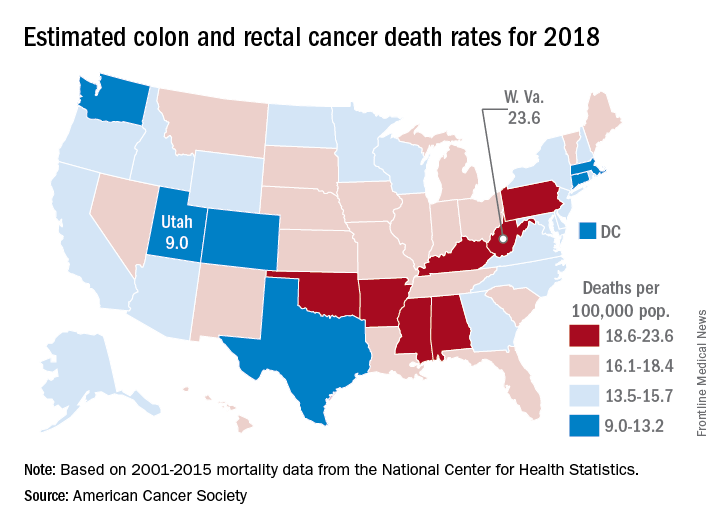
March is Colorectal Cancer Awareness Month. Visit www.gastro.org/CRC for tools you can use to help educate your patients about the importance of colorectal cancer screening.
Approximately 50,630 deaths from colorectal cancer are predicted for the year in the United States by the American Cancer Society (ACS) in its Cancer Facts & Figures 2018, based on analysis of 2001-2015 data from the National Center for Health Statistics.
March is Colorectal Cancer Awareness Month. Visit www.gastro.org/CRC for tools you can use to help educate your patients about the importance of colorectal cancer screening.
Approximately 50,630 deaths from colorectal cancer are predicted for the year in the United States by the American Cancer Society (ACS) in its Cancer Facts & Figures 2018, based on analysis of 2001-2015 data from the National Center for Health Statistics.
March is Colorectal Cancer Awareness Month. Visit www.gastro.org/CRC for tools you can use to help educate your patients about the importance of colorectal cancer screening.
Man's Condition Gets Out of Hand
This 46-year-old man’s skin disease has gotten so serious that he is essentially disabled. The problem started about six months ago, with joint pain that particularly affected his left ankle. Now, his hands are fissured and swollen to the point that he is unable to button his shirt or hold a fork. He is referred to dermatology by his attorney, who is helping him pursue possible disability benefits, for evaluation and treatment.
He has been seen by a variety of primary care providers, who have collectively prescribed topical triamcinolone 0.1% and several antifungal medications, including a two-month course of oral terbinafine. When those failed, he was treated with prednisone; at the start of the three-week course, there were signs of improvement but by the end, his hands were worse than ever.
EXAMINATION
The dorsal and palmar surfaces of the patient’s hands are covered with thick, white scales atop salmon-colored erythematous bases. Multiple fissures and marked edema can be seen. Seven of 10 fingernails are dystrophic, yellowed, and thickened.

The patient’s elbows, knees, and upper intergluteal area show less impressive involvement.
There is marked tenderness on palpation of the left Achilles insertion, made worse by dorsiflexion.
What is the diagnosis?
DISCUSSION
Psoriasis can affect one or more areas, typically the hands, scalp, genitals, or feet. When it’s focused in one area, as in this case, it can be baffling to diagnose; sometimes it’s hard to see the forest for the trees. But because the condition affects almost 3% of white Americans, you’ll see it regularly—if you’re looking for it.
Nearly 25% of patients with psoriasis eventually develop psoriatic arthritis (PsA), which not only affects the joints but also can cause complications such as enthesitis, or inflammation of the entheses (the sites of insertion of the tendon into bone; eg, the Achilles). This can be confused with plantar fasciitis, which this patient had been previously diagnosed with.
This diagnosis could have been proved or disproved by a KOH prep (which would have shown evidence of fungal disease) or a biopsy (which would have shown fused rete ridges, microabscesses at the papillary tips, hyperkeratosis, and parakeratosis). Providers should first establish a firm diagnosis to dictate effective treatment. In this case, a visual diagnosis was possible.
Given the severity of the problem, the patient was started on a biologic; he showed vast improvement within a week. He was referred to rheumatology for evaluation and management of PsA, and the severity of his disease was communicated to his attorney.
TAKE-HOME LEARNING POINTS
- In some cases, psoriasis can be isolated to the hands, feet, genitals, or scalp, complicating detection of the condition.
- Almost 25% of patients with psoriasis develop psoriatic arthritis (PsA), which can manifest with dactylitis, arthritis, or enthesitis.
- Left untreated, PsA is potentially debilitating.
- Establishing a firm diagnosis with KOH prep or biopsy will dictate effective treatment.
This 46-year-old man’s skin disease has gotten so serious that he is essentially disabled. The problem started about six months ago, with joint pain that particularly affected his left ankle. Now, his hands are fissured and swollen to the point that he is unable to button his shirt or hold a fork. He is referred to dermatology by his attorney, who is helping him pursue possible disability benefits, for evaluation and treatment.
He has been seen by a variety of primary care providers, who have collectively prescribed topical triamcinolone 0.1% and several antifungal medications, including a two-month course of oral terbinafine. When those failed, he was treated with prednisone; at the start of the three-week course, there were signs of improvement but by the end, his hands were worse than ever.
EXAMINATION
The dorsal and palmar surfaces of the patient’s hands are covered with thick, white scales atop salmon-colored erythematous bases. Multiple fissures and marked edema can be seen. Seven of 10 fingernails are dystrophic, yellowed, and thickened.
The patient’s elbows, knees, and upper intergluteal area show less impressive involvement.
There is marked tenderness on palpation of the left Achilles insertion, made worse by dorsiflexion.
What is the diagnosis?
DISCUSSION
Psoriasis can affect one or more areas, typically the hands, scalp, genitals, or feet. When it’s focused in one area, as in this case, it can be baffling to diagnose; sometimes it’s hard to see the forest for the trees. But because the condition affects almost 3% of white Americans, you’ll see it regularly—if you’re looking for it.
Nearly 25% of patients with psoriasis eventually develop psoriatic arthritis (PsA), which not only affects the joints but also can cause complications such as enthesitis, or inflammation of the entheses (the sites of insertion of the tendon into bone; eg, the Achilles). This can be confused with plantar fasciitis, which this patient had been previously diagnosed with.
This diagnosis could have been proved or disproved by a KOH prep (which would have shown evidence of fungal disease) or a biopsy (which would have shown fused rete ridges, microabscesses at the papillary tips, hyperkeratosis, and parakeratosis). Providers should first establish a firm diagnosis to dictate effective treatment. In this case, a visual diagnosis was possible.
Given the severity of the problem, the patient was started on a biologic; he showed vast improvement within a week. He was referred to rheumatology for evaluation and management of PsA, and the severity of his disease was communicated to his attorney.
TAKE-HOME LEARNING POINTS
- In some cases, psoriasis can be isolated to the hands, feet, genitals, or scalp, complicating detection of the condition.
- Almost 25% of patients with psoriasis develop psoriatic arthritis (PsA), which can manifest with dactylitis, arthritis, or enthesitis.
- Left untreated, PsA is potentially debilitating.
- Establishing a firm diagnosis with KOH prep or biopsy will dictate effective treatment.
This 46-year-old man’s skin disease has gotten so serious that he is essentially disabled. The problem started about six months ago, with joint pain that particularly affected his left ankle. Now, his hands are fissured and swollen to the point that he is unable to button his shirt or hold a fork. He is referred to dermatology by his attorney, who is helping him pursue possible disability benefits, for evaluation and treatment.
He has been seen by a variety of primary care providers, who have collectively prescribed topical triamcinolone 0.1% and several antifungal medications, including a two-month course of oral terbinafine. When those failed, he was treated with prednisone; at the start of the three-week course, there were signs of improvement but by the end, his hands were worse than ever.
EXAMINATION
The dorsal and palmar surfaces of the patient’s hands are covered with thick, white scales atop salmon-colored erythematous bases. Multiple fissures and marked edema can be seen. Seven of 10 fingernails are dystrophic, yellowed, and thickened.
The patient’s elbows, knees, and upper intergluteal area show less impressive involvement.
There is marked tenderness on palpation of the left Achilles insertion, made worse by dorsiflexion.
What is the diagnosis?
DISCUSSION
Psoriasis can affect one or more areas, typically the hands, scalp, genitals, or feet. When it’s focused in one area, as in this case, it can be baffling to diagnose; sometimes it’s hard to see the forest for the trees. But because the condition affects almost 3% of white Americans, you’ll see it regularly—if you’re looking for it.
Nearly 25% of patients with psoriasis eventually develop psoriatic arthritis (PsA), which not only affects the joints but also can cause complications such as enthesitis, or inflammation of the entheses (the sites of insertion of the tendon into bone; eg, the Achilles). This can be confused with plantar fasciitis, which this patient had been previously diagnosed with.
This diagnosis could have been proved or disproved by a KOH prep (which would have shown evidence of fungal disease) or a biopsy (which would have shown fused rete ridges, microabscesses at the papillary tips, hyperkeratosis, and parakeratosis). Providers should first establish a firm diagnosis to dictate effective treatment. In this case, a visual diagnosis was possible.
Given the severity of the problem, the patient was started on a biologic; he showed vast improvement within a week. He was referred to rheumatology for evaluation and management of PsA, and the severity of his disease was communicated to his attorney.
TAKE-HOME LEARNING POINTS
- In some cases, psoriasis can be isolated to the hands, feet, genitals, or scalp, complicating detection of the condition.
- Almost 25% of patients with psoriasis develop psoriatic arthritis (PsA), which can manifest with dactylitis, arthritis, or enthesitis.
- Left untreated, PsA is potentially debilitating.
- Establishing a firm diagnosis with KOH prep or biopsy will dictate effective treatment.

The case for closing robotic surgery port sites
JACKSONVILLE, FLA. – Findings from a retrospective chart review of robotic operations performed over 6 years has identified situations in which surgeons may consider closing 8-mm port sites after robotic surgery, according to a presentation at the Association for Academic Surgery/Society of University Surgeons Academic Surgical Congress.

“Although the incidence of hernia through the 8-mm port sites was low, it’s still important because it’s a significant cause of morbidity in these patients,” Dr. Diez-Barroso said. Two of the three 8-mm port-site hernias required emergency surgery for small bowel incarceration.
“Both of the hernias occurred in the left lower quadrant in the lateral most port, near the anterior superior iliac spine,” he said. “The nearest site of muscle insertions was where the abdominal wall muscle layers have a limited ability to slide over one another during insufflation and desufflation and therefore have a lack of ability to seal off the port site correctly.”
These results have caused surgeons in his group to take a closer look at their own practices, Dr. Diez-Barroso said. “In our practice, now we’re considering closure of the ports in that location in the presence of known risk factors for hernia formation,” he said.
Dr. Diez-Barroso noted other scenarios when surgeons might consider closing 8-mm port sites, for example, after a prolonged operation, when significant torque has been placed on the port site, and in obese patients. The two cases of emergency surgery for port-site hernias involved obese patients: a female with a body mass index of 33 kg/m2 who had an abdominoperineal resection and a male with a BMI of 34 kg/m2 who had a right-sided ventral hernia repair.
The study had a number of limitations, Dr. Diez-Barroso said: its small sample size, retrospective nature, and short follow-up. “Moving forward, to understand better the true incidence of port-site hernias, we want further investigation with longer follow-up times and a larger sample size,” he said.
During questions, moderator Lesly Ann Dossett, MD, FACS, of the University of Michigan, Ann Arbor, asked whether there were other steps surgeons could take, such as where to place the ports or how much torque they apply, besides closing the ports.
“We’ve always placed ports with the standard approach: inserting them perpendicular to the abdominal wall,” Dr. Diez-Barroso said. “Others have theorized that the lateral sites undergo more torque, but I think that also needs further investigation.”
Dr. Diez-Barroso and coauthors reported having no financial disclosures.
Source: Diez-Barroso R. Academic Surgical Congress 2018.
JACKSONVILLE, FLA. – Findings from a retrospective chart review of robotic operations performed over 6 years has identified situations in which surgeons may consider closing 8-mm port sites after robotic surgery, according to a presentation at the Association for Academic Surgery/Society of University Surgeons Academic Surgical Congress.
“Although the incidence of hernia through the 8-mm port sites was low, it’s still important because it’s a significant cause of morbidity in these patients,” Dr. Diez-Barroso said. Two of the three 8-mm port-site hernias required emergency surgery for small bowel incarceration.
“Both of the hernias occurred in the left lower quadrant in the lateral most port, near the anterior superior iliac spine,” he said. “The nearest site of muscle insertions was where the abdominal wall muscle layers have a limited ability to slide over one another during insufflation and desufflation and therefore have a lack of ability to seal off the port site correctly.”
These results have caused surgeons in his group to take a closer look at their own practices, Dr. Diez-Barroso said. “In our practice, now we’re considering closure of the ports in that location in the presence of known risk factors for hernia formation,” he said.
Dr. Diez-Barroso noted other scenarios when surgeons might consider closing 8-mm port sites, for example, after a prolonged operation, when significant torque has been placed on the port site, and in obese patients. The two cases of emergency surgery for port-site hernias involved obese patients: a female with a body mass index of 33 kg/m2 who had an abdominoperineal resection and a male with a BMI of 34 kg/m2 who had a right-sided ventral hernia repair.
The study had a number of limitations, Dr. Diez-Barroso said: its small sample size, retrospective nature, and short follow-up. “Moving forward, to understand better the true incidence of port-site hernias, we want further investigation with longer follow-up times and a larger sample size,” he said.
During questions, moderator Lesly Ann Dossett, MD, FACS, of the University of Michigan, Ann Arbor, asked whether there were other steps surgeons could take, such as where to place the ports or how much torque they apply, besides closing the ports.
“We’ve always placed ports with the standard approach: inserting them perpendicular to the abdominal wall,” Dr. Diez-Barroso said. “Others have theorized that the lateral sites undergo more torque, but I think that also needs further investigation.”
Dr. Diez-Barroso and coauthors reported having no financial disclosures.
Source: Diez-Barroso R. Academic Surgical Congress 2018.
JACKSONVILLE, FLA. – Findings from a retrospective chart review of robotic operations performed over 6 years has identified situations in which surgeons may consider closing 8-mm port sites after robotic surgery, according to a presentation at the Association for Academic Surgery/Society of University Surgeons Academic Surgical Congress.
“Although the incidence of hernia through the 8-mm port sites was low, it’s still important because it’s a significant cause of morbidity in these patients,” Dr. Diez-Barroso said. Two of the three 8-mm port-site hernias required emergency surgery for small bowel incarceration.
“Both of the hernias occurred in the left lower quadrant in the lateral most port, near the anterior superior iliac spine,” he said. “The nearest site of muscle insertions was where the abdominal wall muscle layers have a limited ability to slide over one another during insufflation and desufflation and therefore have a lack of ability to seal off the port site correctly.”
These results have caused surgeons in his group to take a closer look at their own practices, Dr. Diez-Barroso said. “In our practice, now we’re considering closure of the ports in that location in the presence of known risk factors for hernia formation,” he said.
Dr. Diez-Barroso noted other scenarios when surgeons might consider closing 8-mm port sites, for example, after a prolonged operation, when significant torque has been placed on the port site, and in obese patients. The two cases of emergency surgery for port-site hernias involved obese patients: a female with a body mass index of 33 kg/m2 who had an abdominoperineal resection and a male with a BMI of 34 kg/m2 who had a right-sided ventral hernia repair.
The study had a number of limitations, Dr. Diez-Barroso said: its small sample size, retrospective nature, and short follow-up. “Moving forward, to understand better the true incidence of port-site hernias, we want further investigation with longer follow-up times and a larger sample size,” he said.
During questions, moderator Lesly Ann Dossett, MD, FACS, of the University of Michigan, Ann Arbor, asked whether there were other steps surgeons could take, such as where to place the ports or how much torque they apply, besides closing the ports.
“We’ve always placed ports with the standard approach: inserting them perpendicular to the abdominal wall,” Dr. Diez-Barroso said. “Others have theorized that the lateral sites undergo more torque, but I think that also needs further investigation.”
Dr. Diez-Barroso and coauthors reported having no financial disclosures.
Source: Diez-Barroso R. Academic Surgical Congress 2018.
AT THE ACADEMIC SURGICAL CONGRESS
Key clinical point: Some 8-mm robotic port sites may warrant closure under certain circumstances.
Major finding: Of 178 patients, 3 had complications caused by 8-mm robotic port sites that were not closed, 2 of which required emergency reoperation for small bowel incarceration.
Data source: Retrospective chart review of 178 patients who had robotic general and oncologic surgical procedures between July 2010 and December 2016.
Disclosures: Dr. Diez-Barroso and coauthors reported having no financial disclosures.
Source: Diez-Barroso R. Academic Surgical Congress 2018.

Women, Apply for Leadership Training Grant
Through the Leadership Development and Diversity Committee, the SVS continues its strong commitment to leadership development in women. The Women's Leadership Training Grant seeks to identify female surgeons who want to sharpen their leadership skills. A $5,000 award will defray costs for travel, hotel accommodations and registration expenses to attend relevant courses and/or other leadership training opportunities and activities. Application deadline is March 14.
Through the Leadership Development and Diversity Committee, the SVS continues its strong commitment to leadership development in women. The Women's Leadership Training Grant seeks to identify female surgeons who want to sharpen their leadership skills. A $5,000 award will defray costs for travel, hotel accommodations and registration expenses to attend relevant courses and/or other leadership training opportunities and activities. Application deadline is March 14.
Through the Leadership Development and Diversity Committee, the SVS continues its strong commitment to leadership development in women. The Women's Leadership Training Grant seeks to identify female surgeons who want to sharpen their leadership skills. A $5,000 award will defray costs for travel, hotel accommodations and registration expenses to attend relevant courses and/or other leadership training opportunities and activities. Application deadline is March 14.
Call from SVS and American Venous Forum
The SVS and American Venous Forum seek to update their joint clinical practice guidelines on the care of patients with varicose veins and associated chronic venous diseases (pdf of full text here). This update will address new research and advances in care since the original guidelines were published in 2011.
The SVS Document Oversight Committee seeks current SVS members with significant relevant practice and research experience to participate. All interested members must complete a conflict of interest disclosure for 2018-2019 to be considered. The SVS requires each volunteer to disclose all relevant financial relationships with commercial interests within the past 12 months. Please indicate your interest here by March 1.
The SVS and American Venous Forum seek to update their joint clinical practice guidelines on the care of patients with varicose veins and associated chronic venous diseases (pdf of full text here). This update will address new research and advances in care since the original guidelines were published in 2011.
The SVS Document Oversight Committee seeks current SVS members with significant relevant practice and research experience to participate. All interested members must complete a conflict of interest disclosure for 2018-2019 to be considered. The SVS requires each volunteer to disclose all relevant financial relationships with commercial interests within the past 12 months. Please indicate your interest here by March 1.
The SVS and American Venous Forum seek to update their joint clinical practice guidelines on the care of patients with varicose veins and associated chronic venous diseases (pdf of full text here). This update will address new research and advances in care since the original guidelines were published in 2011.
The SVS Document Oversight Committee seeks current SVS members with significant relevant practice and research experience to participate. All interested members must complete a conflict of interest disclosure for 2018-2019 to be considered. The SVS requires each volunteer to disclose all relevant financial relationships with commercial interests within the past 12 months. Please indicate your interest here by March 1.
At Some Veterans Homes, Aid-In-Dying Is Not An Option
California voters passed a law two years ago that allows terminally ill people to take lethal drugs to end their lives, but controversy is growing over a newer rule that effectively bans that option in the state’s eight veterans homes.
Proponents of medical aid-in-dying and residents of the Veterans Home of California-Yountville — the largest in the nation — are protesting a regulation passed last year by the California Department of Veterans Affairs, or CalVet, that requires that anyone living in the facilities must be discharged if they intend to use the law.
That’s a position shared by most — but not all — states where aid-in-dying is allowed. As more U.S. jurisdictions consider whether to legalize the practice, the status of terminally ill veterans living in state-run homes will loom large.
“It would be a terrible hardship, because I have no place to go,” said Bob Sloan, 73, who suffers from congestive heart failure and other serious cardiac problems. He said he intends to seek medical aid-in-dying if doctors certify he has six months or less to live.
“I’m not going to be a vegetable,” said Sloan, a Vietnam War-era veteran who moved into the Yountville center five years ago. “I’m not going to end up living in so much pain it’s unbearable.”
A CalVet official said the agency adopted the rule to avoid violating a federal statute that prohibits using U.S. government resources for physician-assisted death. Otherwise, the agency would jeopardize nearly $68 million in federal funds that helps run the facilities, said June Iljana, CalVet’s deputy secretary of communications.
California is not alone. Three other states where aid-in-dying is legal — Oregon, Colorado and Vermont — all prohibit use of lethal medications in state-run veterans homes.
In Montana, where aid-in-dying is allowed under a state Supreme Court ruling, officials didn’t respond to multiple requests about whether veterans would be able to use the law in the residences. However, Dr. Eric Kress, a Missoula physician who prescribes the lethal medication, says he has transferred patients to hospice, to relatives’ homes, even to extended-stay hotels to avoid conflict.
In Washington, D.C., where an aid-in-dying law took effect last summer, the Armed Forces Retirement Home won’t assist patients in any way. Those who wish to use the law would be referred to an ethics committee for individual consideration, spokesman Christopher Kelly said in an email.
Only Washington state has a policy that allows veterans to remain in government-run residences if they intend to ingest lethal medications.. At least one veteran has died in a state-run home using that law, said Heidi Audette, a spokeswoman for the state’s Department of Veterans Affairs.
Paul Sherbo, a spokesman for the U.S. Department of Veterans Affairs, said the choice is up to the states.
“VA does not mandate how states comply with federal law,” Sherbo said in an email. “There are a number of ways individual states can choose to handle such situations and still be in compliance.”
To date, none of the 2,400 residents of California’s veterans homes has formally requested medical aid-in-dying, said Iljana. That includes the more than 900 residents of the Yountville center, located about 60 miles north of San Francisco.
“We would respectfully and compassionately assist them in transferring to a hospice, family home or other location,” Iljana said in an email. “We will readmit them immediately if they change their minds.”
But Kathryn Tucker, executive director of the End of Life Liberty Project, an advocacy group that supports aid-in-dying, said that CalVet is interpreting the federal regulations too broadly and denying terminally ill veterans the right to choose a “peaceful death” through medical assistance.
“Nothing exists in the federal statute’s language that would prohibit a resident from receiving aid-in-dying services at state homes, so long as they are not provided using federal funds or employees,” she said.
Ed Warren, head of the Allied Council, a group representing veterans at the Yountville site, co-signed a letter to CalVet officials protesting the ruling.
“My point of view is that it is inhumane to expect people in the last stages of dying to go through the hullabaloo of leaving their homes,” he said.
In Washington state, a 60-year-old man diagnosed with terminal chronic obstructive pulmonary disease, or COPD, died in June 2015 after ingesting lethal drugs at the Washington Soldiers Home in Orting, where he lived.
“It was all done very much in the open,” said Chris Fruitrich, a volunteer with the group End of Life Washington, which assisted the man.
There has been no indication that the policy jeopardizes the nearly $47 million the agency receives each year in federal funds, said Audette, the state VA spokeswoman.
In California, additional protests have centered on allegations that CalVet suppressed information about the aid-in-dying law.
Critics at the Yountville home contend that CalVet passed the discharge rule quietly, with little public input. Then the agency refused to broadcast a public meeting about medical aid-in-dying on KVET, the center’s state-run, closed-circuit television station.
Iljana said the Aug. 21 meeting, led by Tucker and Dr. Robert Brody, also a supporter of aid-in-dying, violated state rules that prohibit using public resources to promote political causes.
“Free speech is great and criticizing the government is great, but not using the government’s own resources and paid staff to advocate for a change in the law,” Iljana wrote in an email to prohibit the broadcast.
That decision, however, prompted Jac Warren, 81, who has been KVET’s station manager for eight years, to resign last month in protest, citing censorship.
“What is at issue is whether a state may completely suppress the dissemination of concededly truthful information about entirely lawful activity,” Warren wrote in an email to CalVet.
The hour-long meeting, attended by about 50 people, was not propaganda, Tucker said, but “an educational event with information provided by an attorney and a physician who both specialize in their respective fields in end-of-life care.”
Bob Sloan, who works as an engineer at KVET for a $400 monthly stipend, disagreed with the decision not to broadcast the meeting on the system that serves residents of the Yountville home.
Sloan said he knows other residents who would like to be able to use California’s aid-in-dying law if their illnesses progress.
“The only other option that people have in this state is committing suicide,” he said. “If I can’t find some way of doing it legally, I’ll do it illegally.”
Kaiser Health News (KHN) is a national health policy news service. It is an editorially independent program of the Henry J. Kaiser Family Foundation which is not affiliated with Kaiser Permanente.
California voters passed a law two years ago that allows terminally ill people to take lethal drugs to end their lives, but controversy is growing over a newer rule that effectively bans that option in the state’s eight veterans homes.
Proponents of medical aid-in-dying and residents of the Veterans Home of California-Yountville — the largest in the nation — are protesting a regulation passed last year by the California Department of Veterans Affairs, or CalVet, that requires that anyone living in the facilities must be discharged if they intend to use the law.
That’s a position shared by most — but not all — states where aid-in-dying is allowed. As more U.S. jurisdictions consider whether to legalize the practice, the status of terminally ill veterans living in state-run homes will loom large.
“It would be a terrible hardship, because I have no place to go,” said Bob Sloan, 73, who suffers from congestive heart failure and other serious cardiac problems. He said he intends to seek medical aid-in-dying if doctors certify he has six months or less to live.
“I’m not going to be a vegetable,” said Sloan, a Vietnam War-era veteran who moved into the Yountville center five years ago. “I’m not going to end up living in so much pain it’s unbearable.”
A CalVet official said the agency adopted the rule to avoid violating a federal statute that prohibits using U.S. government resources for physician-assisted death. Otherwise, the agency would jeopardize nearly $68 million in federal funds that helps run the facilities, said June Iljana, CalVet’s deputy secretary of communications.
California is not alone. Three other states where aid-in-dying is legal — Oregon, Colorado and Vermont — all prohibit use of lethal medications in state-run veterans homes.
In Montana, where aid-in-dying is allowed under a state Supreme Court ruling, officials didn’t respond to multiple requests about whether veterans would be able to use the law in the residences. However, Dr. Eric Kress, a Missoula physician who prescribes the lethal medication, says he has transferred patients to hospice, to relatives’ homes, even to extended-stay hotels to avoid conflict.
In Washington, D.C., where an aid-in-dying law took effect last summer, the Armed Forces Retirement Home won’t assist patients in any way. Those who wish to use the law would be referred to an ethics committee for individual consideration, spokesman Christopher Kelly said in an email.
Only Washington state has a policy that allows veterans to remain in government-run residences if they intend to ingest lethal medications.. At least one veteran has died in a state-run home using that law, said Heidi Audette, a spokeswoman for the state’s Department of Veterans Affairs.
Paul Sherbo, a spokesman for the U.S. Department of Veterans Affairs, said the choice is up to the states.
“VA does not mandate how states comply with federal law,” Sherbo said in an email. “There are a number of ways individual states can choose to handle such situations and still be in compliance.”
To date, none of the 2,400 residents of California’s veterans homes has formally requested medical aid-in-dying, said Iljana. That includes the more than 900 residents of the Yountville center, located about 60 miles north of San Francisco.
“We would respectfully and compassionately assist them in transferring to a hospice, family home or other location,” Iljana said in an email. “We will readmit them immediately if they change their minds.”
But Kathryn Tucker, executive director of the End of Life Liberty Project, an advocacy group that supports aid-in-dying, said that CalVet is interpreting the federal regulations too broadly and denying terminally ill veterans the right to choose a “peaceful death” through medical assistance.
“Nothing exists in the federal statute’s language that would prohibit a resident from receiving aid-in-dying services at state homes, so long as they are not provided using federal funds or employees,” she said.
Ed Warren, head of the Allied Council, a group representing veterans at the Yountville site, co-signed a letter to CalVet officials protesting the ruling.
“My point of view is that it is inhumane to expect people in the last stages of dying to go through the hullabaloo of leaving their homes,” he said.
In Washington state, a 60-year-old man diagnosed with terminal chronic obstructive pulmonary disease, or COPD, died in June 2015 after ingesting lethal drugs at the Washington Soldiers Home in Orting, where he lived.
“It was all done very much in the open,” said Chris Fruitrich, a volunteer with the group End of Life Washington, which assisted the man.
There has been no indication that the policy jeopardizes the nearly $47 million the agency receives each year in federal funds, said Audette, the state VA spokeswoman.
In California, additional protests have centered on allegations that CalVet suppressed information about the aid-in-dying law.
Critics at the Yountville home contend that CalVet passed the discharge rule quietly, with little public input. Then the agency refused to broadcast a public meeting about medical aid-in-dying on KVET, the center’s state-run, closed-circuit television station.
Iljana said the Aug. 21 meeting, led by Tucker and Dr. Robert Brody, also a supporter of aid-in-dying, violated state rules that prohibit using public resources to promote political causes.
“Free speech is great and criticizing the government is great, but not using the government’s own resources and paid staff to advocate for a change in the law,” Iljana wrote in an email to prohibit the broadcast.
That decision, however, prompted Jac Warren, 81, who has been KVET’s station manager for eight years, to resign last month in protest, citing censorship.
“What is at issue is whether a state may completely suppress the dissemination of concededly truthful information about entirely lawful activity,” Warren wrote in an email to CalVet.
The hour-long meeting, attended by about 50 people, was not propaganda, Tucker said, but “an educational event with information provided by an attorney and a physician who both specialize in their respective fields in end-of-life care.”
Bob Sloan, who works as an engineer at KVET for a $400 monthly stipend, disagreed with the decision not to broadcast the meeting on the system that serves residents of the Yountville home.
Sloan said he knows other residents who would like to be able to use California’s aid-in-dying law if their illnesses progress.
“The only other option that people have in this state is committing suicide,” he said. “If I can’t find some way of doing it legally, I’ll do it illegally.”
Kaiser Health News (KHN) is a national health policy news service. It is an editorially independent program of the Henry J. Kaiser Family Foundation which is not affiliated with Kaiser Permanente.
California voters passed a law two years ago that allows terminally ill people to take lethal drugs to end their lives, but controversy is growing over a newer rule that effectively bans that option in the state’s eight veterans homes.
Proponents of medical aid-in-dying and residents of the Veterans Home of California-Yountville — the largest in the nation — are protesting a regulation passed last year by the California Department of Veterans Affairs, or CalVet, that requires that anyone living in the facilities must be discharged if they intend to use the law.
That’s a position shared by most — but not all — states where aid-in-dying is allowed. As more U.S. jurisdictions consider whether to legalize the practice, the status of terminally ill veterans living in state-run homes will loom large.
“It would be a terrible hardship, because I have no place to go,” said Bob Sloan, 73, who suffers from congestive heart failure and other serious cardiac problems. He said he intends to seek medical aid-in-dying if doctors certify he has six months or less to live.
“I’m not going to be a vegetable,” said Sloan, a Vietnam War-era veteran who moved into the Yountville center five years ago. “I’m not going to end up living in so much pain it’s unbearable.”
A CalVet official said the agency adopted the rule to avoid violating a federal statute that prohibits using U.S. government resources for physician-assisted death. Otherwise, the agency would jeopardize nearly $68 million in federal funds that helps run the facilities, said June Iljana, CalVet’s deputy secretary of communications.
California is not alone. Three other states where aid-in-dying is legal — Oregon, Colorado and Vermont — all prohibit use of lethal medications in state-run veterans homes.
In Montana, where aid-in-dying is allowed under a state Supreme Court ruling, officials didn’t respond to multiple requests about whether veterans would be able to use the law in the residences. However, Dr. Eric Kress, a Missoula physician who prescribes the lethal medication, says he has transferred patients to hospice, to relatives’ homes, even to extended-stay hotels to avoid conflict.
In Washington, D.C., where an aid-in-dying law took effect last summer, the Armed Forces Retirement Home won’t assist patients in any way. Those who wish to use the law would be referred to an ethics committee for individual consideration, spokesman Christopher Kelly said in an email.
Only Washington state has a policy that allows veterans to remain in government-run residences if they intend to ingest lethal medications.. At least one veteran has died in a state-run home using that law, said Heidi Audette, a spokeswoman for the state’s Department of Veterans Affairs.
Paul Sherbo, a spokesman for the U.S. Department of Veterans Affairs, said the choice is up to the states.
“VA does not mandate how states comply with federal law,” Sherbo said in an email. “There are a number of ways individual states can choose to handle such situations and still be in compliance.”
To date, none of the 2,400 residents of California’s veterans homes has formally requested medical aid-in-dying, said Iljana. That includes the more than 900 residents of the Yountville center, located about 60 miles north of San Francisco.
“We would respectfully and compassionately assist them in transferring to a hospice, family home or other location,” Iljana said in an email. “We will readmit them immediately if they change their minds.”
But Kathryn Tucker, executive director of the End of Life Liberty Project, an advocacy group that supports aid-in-dying, said that CalVet is interpreting the federal regulations too broadly and denying terminally ill veterans the right to choose a “peaceful death” through medical assistance.
“Nothing exists in the federal statute’s language that would prohibit a resident from receiving aid-in-dying services at state homes, so long as they are not provided using federal funds or employees,” she said.
Ed Warren, head of the Allied Council, a group representing veterans at the Yountville site, co-signed a letter to CalVet officials protesting the ruling.
“My point of view is that it is inhumane to expect people in the last stages of dying to go through the hullabaloo of leaving their homes,” he said.
In Washington state, a 60-year-old man diagnosed with terminal chronic obstructive pulmonary disease, or COPD, died in June 2015 after ingesting lethal drugs at the Washington Soldiers Home in Orting, where he lived.
“It was all done very much in the open,” said Chris Fruitrich, a volunteer with the group End of Life Washington, which assisted the man.
There has been no indication that the policy jeopardizes the nearly $47 million the agency receives each year in federal funds, said Audette, the state VA spokeswoman.
In California, additional protests have centered on allegations that CalVet suppressed information about the aid-in-dying law.
Critics at the Yountville home contend that CalVet passed the discharge rule quietly, with little public input. Then the agency refused to broadcast a public meeting about medical aid-in-dying on KVET, the center’s state-run, closed-circuit television station.
Iljana said the Aug. 21 meeting, led by Tucker and Dr. Robert Brody, also a supporter of aid-in-dying, violated state rules that prohibit using public resources to promote political causes.
“Free speech is great and criticizing the government is great, but not using the government’s own resources and paid staff to advocate for a change in the law,” Iljana wrote in an email to prohibit the broadcast.
That decision, however, prompted Jac Warren, 81, who has been KVET’s station manager for eight years, to resign last month in protest, citing censorship.
“What is at issue is whether a state may completely suppress the dissemination of concededly truthful information about entirely lawful activity,” Warren wrote in an email to CalVet.
The hour-long meeting, attended by about 50 people, was not propaganda, Tucker said, but “an educational event with information provided by an attorney and a physician who both specialize in their respective fields in end-of-life care.”
Bob Sloan, who works as an engineer at KVET for a $400 monthly stipend, disagreed with the decision not to broadcast the meeting on the system that serves residents of the Yountville home.
Sloan said he knows other residents who would like to be able to use California’s aid-in-dying law if their illnesses progress.
“The only other option that people have in this state is committing suicide,” he said. “If I can’t find some way of doing it legally, I’ll do it illegally.”
Kaiser Health News (KHN) is a national health policy news service. It is an editorially independent program of the Henry J. Kaiser Family Foundation which is not affiliated with Kaiser Permanente.
New AEDs Have Not Increased Seizure Control
The development of new antiepileptic drugs (AEDs) with novel mechanisms of action has not improved overall outcomes for patients with epilepsy, according to an analysis published online ahead of print December 26, 2017, in JAMA Neurology.
“A paradigm shift in treatment and research strategies is needed to improve the long-term outcomes of newly diagnosed epilepsy. Patients with drug-resistant epilepsy should be considered early for nonpharmacologic therapies, such as resective surgery and brain stimulation techniques,” said Patrick Kwan, MD, PhD, Chair of Neurology at the University of Melbourne and Head of Epilepsy at the Royal Melbourne Hospital, and colleagues.

The analysis suggests that contemporary AEDs suppress seizures, but do not affect the underlying disease. “Future research should focus on novel treatments that can modify the development or progression of epilepsy, ideally guided by biomarkers,” said the authors.
Investigators Examined an Expanded Cohort
In an oft-cited study published in 2000, Dr. Kwan and Martin J. Brodie, MD, followed 470 patients with newly diagnosed epilepsy who presented to the Epilepsy Unit at the Western Infirmary in Glasgow from 1982 to 1998. They observed that seizures persisted despite AED treatment for more than one-third of patients. Participants with an inadequate response to their first or second treatment regimens were likely to develop refractory epilepsy.
To study whether newer AEDs have changed treatment outcomes, Dr. Kwan and colleagues followed 1,795 patients with newly diagnosed epilepsy who presented to the Western Infirmary between July 1, 1982, and October 31, 2012. The investigators followed patients until October 31, 2014, or until their deaths. Patients with poor adherence for reasons unrelated to drug efficacy or tolerability, those whose seizures resulted from drug use, and those with nonepileptic seizures were excluded from the analysis.
Patients visited the clinic every two to six weeks for the first six months after treatment initiation. After month six, participants had follow-up visits at least every four months. Physicians collected data routinely during standard clinical care. Patients recorded seizure descriptions and the number of seizures that occurred between visits.
Nearly Two-Thirds Became Seizure-Free
Of the 1,795 study participants, 969 (53.7%) were male. Patients’ median age at referral was 33. In all, 386 patients (21.5%) had generalized epilepsy, and 1,409 patients (78.5%) had focal epilepsy. Follow-up lasted for a median of 11 years.
As of the final follow-up visit, 1,440 patients (80.2%) were receiving AED monotherapy, and 355 (19.8%) were receiving two or more AEDs. In all, 1,144 participants (63.7%) had been seizure-free for the previous 12 months or longer, of whom 993 (55.3%) had attained this outcome by taking a single AED. The remaining 151 seizure-free patients had achieved this outcome by taking two or more AEDs.
In all, 816 participants (45.4%) achieved at least one year of seizure freedom while taking their first AED, and 212 patients (28.6%) achieved this outcome while taking the second regimen, which was either monotherapy or polytherapy. The first and second regimens together accounted for 1,028 of the 1,144 patients (89.9%) who achieved at least one year of seizure freedom. At the last follow-up, seizure freedom was more common among patients with generalized epilepsy (68.1%) than among those with focal epilepsy (62.5%).
Although the use of newer AEDs increased significantly during the study, the proportion of patients who were seizure-free at the last follow-up was similar in the three time-period subgroups that the investigators examined. The cumulative probability of one year of seizure freedom also was similar in these periods. Adjustment for patient characteristics did not alter these findings.
Number of AEDs Affected Likelihood of Seizure Freedom
For patients who did not achieve one year of seizure freedom with their first AED, the likelihood of uncontrolled epilepsy increased with each subsequent AED tried (odds ratio [OR], 1.73). Dr. Kwan and colleagues found a significant difference in the probability of seizure freedom between patients treated with the first and second AED regimens (hazard ratio [HR], 0.52). The difference in this outcome between participants treated with their second and third AED regimen was also significant (HR, 0.71). Whether epilepsy was focal or generalized did not affect these findings.
When the investigators adjusted their data for sex and epilepsy classification, they found that a high number of seizures in the year before treatment initiation, a history of smoking, a history of recreational drug use, a family history of epilepsy in first-degree relatives, previous brain injury, and psychiatric comorbidity were significantly associated with an adverse prognosis. Each increase in the number of seizures in the year before treatment was associated with a 6% decrease in the chance of seizure freedom at the last follow-up.
Is Better Seizure Control Possible?
“The observation that newer drugs have not increased the percentage of people who are rendered seizure-free is not new and should not be surprising,” said W. Allen Hauser, MD, Special Lecturer in the Gertrude H. Sergievsky Center at Columbia University in New York, in an accompanying editorial. “Even though mechanisms of action of specific drugs may differ, the same animal models have been used to predict successful suppression of seizures in preclinical studies for the last 80 years, and successful response has been the basis for clinical drug development for both old and new therapeutic agents.”
Nevertheless, the data “are sobering and somewhat disconcerting,” Dr. Hauser added. “In 1881, pioneering neurologist Sir William Gowers reported that he could not control seizures in 36% of the patients to whom he prescribed bromide compounds. It seems that we might not have improved our initial management results for a much longer period than the 30 years covered in the current study. While biologically unlikely, it is possible that a two-thirds proportion represents a ceiling for the initial control of epilepsy.”
—Erik Greb
Suggested Reading
Chen Z, Brodie MJ, Liew D, Kwan P. Treatment outcomes in patients with newly diagnosed epilepsy treated with established and new antiepileptic drugs: a 30-year longitudinal cohort study. JAMA Neurol. 2017 Dec 26 [Epub ahead of print].
Hauser WA. Questioning the effectiveness of newer antiseizure medications. JAMA Neurol. 2017 Dec 26 [Epub ahead of print].
The development of new antiepileptic drugs (AEDs) with novel mechanisms of action has not improved overall outcomes for patients with epilepsy, according to an analysis published online ahead of print December 26, 2017, in JAMA Neurology.
“A paradigm shift in treatment and research strategies is needed to improve the long-term outcomes of newly diagnosed epilepsy. Patients with drug-resistant epilepsy should be considered early for nonpharmacologic therapies, such as resective surgery and brain stimulation techniques,” said Patrick Kwan, MD, PhD, Chair of Neurology at the University of Melbourne and Head of Epilepsy at the Royal Melbourne Hospital, and colleagues.
The analysis suggests that contemporary AEDs suppress seizures, but do not affect the underlying disease. “Future research should focus on novel treatments that can modify the development or progression of epilepsy, ideally guided by biomarkers,” said the authors.
Investigators Examined an Expanded Cohort
In an oft-cited study published in 2000, Dr. Kwan and Martin J. Brodie, MD, followed 470 patients with newly diagnosed epilepsy who presented to the Epilepsy Unit at the Western Infirmary in Glasgow from 1982 to 1998. They observed that seizures persisted despite AED treatment for more than one-third of patients. Participants with an inadequate response to their first or second treatment regimens were likely to develop refractory epilepsy.
To study whether newer AEDs have changed treatment outcomes, Dr. Kwan and colleagues followed 1,795 patients with newly diagnosed epilepsy who presented to the Western Infirmary between July 1, 1982, and October 31, 2012. The investigators followed patients until October 31, 2014, or until their deaths. Patients with poor adherence for reasons unrelated to drug efficacy or tolerability, those whose seizures resulted from drug use, and those with nonepileptic seizures were excluded from the analysis.
Patients visited the clinic every two to six weeks for the first six months after treatment initiation. After month six, participants had follow-up visits at least every four months. Physicians collected data routinely during standard clinical care. Patients recorded seizure descriptions and the number of seizures that occurred between visits.
Nearly Two-Thirds Became Seizure-Free
Of the 1,795 study participants, 969 (53.7%) were male. Patients’ median age at referral was 33. In all, 386 patients (21.5%) had generalized epilepsy, and 1,409 patients (78.5%) had focal epilepsy. Follow-up lasted for a median of 11 years.
As of the final follow-up visit, 1,440 patients (80.2%) were receiving AED monotherapy, and 355 (19.8%) were receiving two or more AEDs. In all, 1,144 participants (63.7%) had been seizure-free for the previous 12 months or longer, of whom 993 (55.3%) had attained this outcome by taking a single AED. The remaining 151 seizure-free patients had achieved this outcome by taking two or more AEDs.
In all, 816 participants (45.4%) achieved at least one year of seizure freedom while taking their first AED, and 212 patients (28.6%) achieved this outcome while taking the second regimen, which was either monotherapy or polytherapy. The first and second regimens together accounted for 1,028 of the 1,144 patients (89.9%) who achieved at least one year of seizure freedom. At the last follow-up, seizure freedom was more common among patients with generalized epilepsy (68.1%) than among those with focal epilepsy (62.5%).
Although the use of newer AEDs increased significantly during the study, the proportion of patients who were seizure-free at the last follow-up was similar in the three time-period subgroups that the investigators examined. The cumulative probability of one year of seizure freedom also was similar in these periods. Adjustment for patient characteristics did not alter these findings.
Number of AEDs Affected Likelihood of Seizure Freedom
For patients who did not achieve one year of seizure freedom with their first AED, the likelihood of uncontrolled epilepsy increased with each subsequent AED tried (odds ratio [OR], 1.73). Dr. Kwan and colleagues found a significant difference in the probability of seizure freedom between patients treated with the first and second AED regimens (hazard ratio [HR], 0.52). The difference in this outcome between participants treated with their second and third AED regimen was also significant (HR, 0.71). Whether epilepsy was focal or generalized did not affect these findings.
When the investigators adjusted their data for sex and epilepsy classification, they found that a high number of seizures in the year before treatment initiation, a history of smoking, a history of recreational drug use, a family history of epilepsy in first-degree relatives, previous brain injury, and psychiatric comorbidity were significantly associated with an adverse prognosis. Each increase in the number of seizures in the year before treatment was associated with a 6% decrease in the chance of seizure freedom at the last follow-up.
Is Better Seizure Control Possible?
“The observation that newer drugs have not increased the percentage of people who are rendered seizure-free is not new and should not be surprising,” said W. Allen Hauser, MD, Special Lecturer in the Gertrude H. Sergievsky Center at Columbia University in New York, in an accompanying editorial. “Even though mechanisms of action of specific drugs may differ, the same animal models have been used to predict successful suppression of seizures in preclinical studies for the last 80 years, and successful response has been the basis for clinical drug development for both old and new therapeutic agents.”
Nevertheless, the data “are sobering and somewhat disconcerting,” Dr. Hauser added. “In 1881, pioneering neurologist Sir William Gowers reported that he could not control seizures in 36% of the patients to whom he prescribed bromide compounds. It seems that we might not have improved our initial management results for a much longer period than the 30 years covered in the current study. While biologically unlikely, it is possible that a two-thirds proportion represents a ceiling for the initial control of epilepsy.”
—Erik Greb
Suggested Reading
Chen Z, Brodie MJ, Liew D, Kwan P. Treatment outcomes in patients with newly diagnosed epilepsy treated with established and new antiepileptic drugs: a 30-year longitudinal cohort study. JAMA Neurol. 2017 Dec 26 [Epub ahead of print].
Hauser WA. Questioning the effectiveness of newer antiseizure medications. JAMA Neurol. 2017 Dec 26 [Epub ahead of print].
The development of new antiepileptic drugs (AEDs) with novel mechanisms of action has not improved overall outcomes for patients with epilepsy, according to an analysis published online ahead of print December 26, 2017, in JAMA Neurology.
“A paradigm shift in treatment and research strategies is needed to improve the long-term outcomes of newly diagnosed epilepsy. Patients with drug-resistant epilepsy should be considered early for nonpharmacologic therapies, such as resective surgery and brain stimulation techniques,” said Patrick Kwan, MD, PhD, Chair of Neurology at the University of Melbourne and Head of Epilepsy at the Royal Melbourne Hospital, and colleagues.
The analysis suggests that contemporary AEDs suppress seizures, but do not affect the underlying disease. “Future research should focus on novel treatments that can modify the development or progression of epilepsy, ideally guided by biomarkers,” said the authors.
Investigators Examined an Expanded Cohort
In an oft-cited study published in 2000, Dr. Kwan and Martin J. Brodie, MD, followed 470 patients with newly diagnosed epilepsy who presented to the Epilepsy Unit at the Western Infirmary in Glasgow from 1982 to 1998. They observed that seizures persisted despite AED treatment for more than one-third of patients. Participants with an inadequate response to their first or second treatment regimens were likely to develop refractory epilepsy.
To study whether newer AEDs have changed treatment outcomes, Dr. Kwan and colleagues followed 1,795 patients with newly diagnosed epilepsy who presented to the Western Infirmary between July 1, 1982, and October 31, 2012. The investigators followed patients until October 31, 2014, or until their deaths. Patients with poor adherence for reasons unrelated to drug efficacy or tolerability, those whose seizures resulted from drug use, and those with nonepileptic seizures were excluded from the analysis.
Patients visited the clinic every two to six weeks for the first six months after treatment initiation. After month six, participants had follow-up visits at least every four months. Physicians collected data routinely during standard clinical care. Patients recorded seizure descriptions and the number of seizures that occurred between visits.
Nearly Two-Thirds Became Seizure-Free
Of the 1,795 study participants, 969 (53.7%) were male. Patients’ median age at referral was 33. In all, 386 patients (21.5%) had generalized epilepsy, and 1,409 patients (78.5%) had focal epilepsy. Follow-up lasted for a median of 11 years.
As of the final follow-up visit, 1,440 patients (80.2%) were receiving AED monotherapy, and 355 (19.8%) were receiving two or more AEDs. In all, 1,144 participants (63.7%) had been seizure-free for the previous 12 months or longer, of whom 993 (55.3%) had attained this outcome by taking a single AED. The remaining 151 seizure-free patients had achieved this outcome by taking two or more AEDs.
In all, 816 participants (45.4%) achieved at least one year of seizure freedom while taking their first AED, and 212 patients (28.6%) achieved this outcome while taking the second regimen, which was either monotherapy or polytherapy. The first and second regimens together accounted for 1,028 of the 1,144 patients (89.9%) who achieved at least one year of seizure freedom. At the last follow-up, seizure freedom was more common among patients with generalized epilepsy (68.1%) than among those with focal epilepsy (62.5%).
Although the use of newer AEDs increased significantly during the study, the proportion of patients who were seizure-free at the last follow-up was similar in the three time-period subgroups that the investigators examined. The cumulative probability of one year of seizure freedom also was similar in these periods. Adjustment for patient characteristics did not alter these findings.
Number of AEDs Affected Likelihood of Seizure Freedom
For patients who did not achieve one year of seizure freedom with their first AED, the likelihood of uncontrolled epilepsy increased with each subsequent AED tried (odds ratio [OR], 1.73). Dr. Kwan and colleagues found a significant difference in the probability of seizure freedom between patients treated with the first and second AED regimens (hazard ratio [HR], 0.52). The difference in this outcome between participants treated with their second and third AED regimen was also significant (HR, 0.71). Whether epilepsy was focal or generalized did not affect these findings.
When the investigators adjusted their data for sex and epilepsy classification, they found that a high number of seizures in the year before treatment initiation, a history of smoking, a history of recreational drug use, a family history of epilepsy in first-degree relatives, previous brain injury, and psychiatric comorbidity were significantly associated with an adverse prognosis. Each increase in the number of seizures in the year before treatment was associated with a 6% decrease in the chance of seizure freedom at the last follow-up.
Is Better Seizure Control Possible?
“The observation that newer drugs have not increased the percentage of people who are rendered seizure-free is not new and should not be surprising,” said W. Allen Hauser, MD, Special Lecturer in the Gertrude H. Sergievsky Center at Columbia University in New York, in an accompanying editorial. “Even though mechanisms of action of specific drugs may differ, the same animal models have been used to predict successful suppression of seizures in preclinical studies for the last 80 years, and successful response has been the basis for clinical drug development for both old and new therapeutic agents.”
Nevertheless, the data “are sobering and somewhat disconcerting,” Dr. Hauser added. “In 1881, pioneering neurologist Sir William Gowers reported that he could not control seizures in 36% of the patients to whom he prescribed bromide compounds. It seems that we might not have improved our initial management results for a much longer period than the 30 years covered in the current study. While biologically unlikely, it is possible that a two-thirds proportion represents a ceiling for the initial control of epilepsy.”
—Erik Greb
Suggested Reading
Chen Z, Brodie MJ, Liew D, Kwan P. Treatment outcomes in patients with newly diagnosed epilepsy treated with established and new antiepileptic drugs: a 30-year longitudinal cohort study. JAMA Neurol. 2017 Dec 26 [Epub ahead of print].
Hauser WA. Questioning the effectiveness of newer antiseizure medications. JAMA Neurol. 2017 Dec 26 [Epub ahead of print].