User login
One in four children with ALL misses maintenance doses

Credit: Bill Branson
Forgetting to take medication is the number one reason for non-adherence to maintenance therapy in children with acute lymphoblastic leukemia (ALL), according to a new study by the Children’s Oncology Group.
And neglecting to take maintenance medication 10% of the time increases the patient’s risk of relapse threefold.
In a study of 298 children receiving 6-mercaptopurine (6MP) as part of maintenance therapy, African Americans and Asians had significantly lower adherence rates than non-Hispanic whites, at 46%, 28%, and 14%, respectively.
Researchers discovered a number of other race-specific characteristics to explain the disparity, including low maternal education, households with a single parent and multiple children, low-income households, and households in which mothers were not the full-time caregivers.
The investigators had studied adherence in Hispanic children in an earlier study and they were not included here.
“While we don’t yet know why children of different races have significantly different survival rates for ALL,” said senior study author Smita Bhatia, MD, MPH, of City of Hope in Duarte, California, “we know that their adherence to their maintenance medication is a critical factor in their survival.”
And so the researchers explored potential sociodemographic differences that impact adherence to 6MP and reported their findings in Blood.
They enrolled 298 children, with a median age of 6 years at study entry (range, 2-20 years). All were in first continuous remission and receiving maintenance therapy that included 6MP.
One-hundred fifty-nine patients were non-Hispanic whites (the referent group), 71 were Asians, and 68 African Americans.
The researchers recorded adherence for up to 5 months per patient using an electronic monitoring device (MEMS®TrackCapTM) that recorded the date and time the pill bottle was opened. These data were downloaded at the end of the adherence-monitoring period.
They also measured erythrocyte TGN levels of the patients on a monthly basis to determine the association between bottle opening and taking the 6MP. Erythrocyte TGN levels reflect 6MP exposure.
Demographics
The researchers found that disease characteristics were comparable across the racial groups, but sociodemographic characteristics varied significantly.
African American families (64%) reported annual household incomes of less than $50,000 compared with 44% of non-Hispanic white and 33% of Asian families.
African American parents had significantly less formal education than non-Hispanic white and Asian parents. Sixty-six percent of African American fathers and 61% of African American mothers reported having less than a college degree.
This compared with 48% and 31% of non-Hispanic white and Asian fathers, respectively, and 46% and 32% of non-Hispanic white and Asian mothers, respectively.
More African American households (37%) were headed by single parents, compared with non-Hispanic white (9%) and Asian (4%) households.
And only 27% of African American children had their mothers as full-time caregivers, compared with 38% of non-Hispanic white children and 52% of Asian children.
Overall adherence
The investigators found that adherence for the entire population declined over the course of the 5 months, from 94.8% to 91.3% (P<0.0001).
Adherence rates were significantly lower in Asians and African Americans than in non-Hispanic whites, and in patients from low-income households.
Adherence rates were significantly higher in patients from single-parent/single-child households (96.9%) and in households where the mothers were full-time caregivers (94.8%).
Adherence by race
In Asian households, adherence was significantly higher with mothers as full-time caregivers (95.6%) compared with all other configurations of caregivers. And adherence rates in households with income of $50,000 or more were also higher (93.9%) than in households with income under $50,000 (84.2%).
In African American households, those with low maternal education had significantly lower adherence rates, 74.6%, than in those households in which mothers held a college degree, 94.6%. And adherence rates were higher in households with single parents and a single child (94.2%) compared with those households with a single parent and multiple children (80.5%) or even from nuclear families (85.5%).
In non-Hispanic white households, paternal education higher than a postgraduate degree resulted in adherence of 97.2%, compared with households in which the father did not have a postgraduate degree, (95.3%). Again, adherence rates were higher in households with single parents and a single child (97.8%) compared with those from single parents with multiple children (94.0%) or from nuclear families (95.6%).
For all racial groups, forgetfulness was the most common reason for missing doses—non-Hispanic whites, 79%; Asians, 90%; and African Americans, 75%.
“Our data demonstrate that one in four children in remission from ALL does not take the medicine needed to remain cancer free,” said Dr Bhatia, “and in an overwhelming majority, the primary reason why is that they forget to take their pills each day,” said Dr. Bhatia.
“These results are the basis for further studies that will examine how physicians can successfully intervene, using technology, for example, to ensure that children do not experience an increased risk of relapse because they did not take their oral chemotherapy.” 
Credit: Bill Branson
Forgetting to take medication is the number one reason for non-adherence to maintenance therapy in children with acute lymphoblastic leukemia (ALL), according to a new study by the Children’s Oncology Group.
And neglecting to take maintenance medication 10% of the time increases the patient’s risk of relapse threefold.
In a study of 298 children receiving 6-mercaptopurine (6MP) as part of maintenance therapy, African Americans and Asians had significantly lower adherence rates than non-Hispanic whites, at 46%, 28%, and 14%, respectively.
Researchers discovered a number of other race-specific characteristics to explain the disparity, including low maternal education, households with a single parent and multiple children, low-income households, and households in which mothers were not the full-time caregivers.
The investigators had studied adherence in Hispanic children in an earlier study and they were not included here.
“While we don’t yet know why children of different races have significantly different survival rates for ALL,” said senior study author Smita Bhatia, MD, MPH, of City of Hope in Duarte, California, “we know that their adherence to their maintenance medication is a critical factor in their survival.”
And so the researchers explored potential sociodemographic differences that impact adherence to 6MP and reported their findings in Blood.
They enrolled 298 children, with a median age of 6 years at study entry (range, 2-20 years). All were in first continuous remission and receiving maintenance therapy that included 6MP.
One-hundred fifty-nine patients were non-Hispanic whites (the referent group), 71 were Asians, and 68 African Americans.
The researchers recorded adherence for up to 5 months per patient using an electronic monitoring device (MEMS®TrackCapTM) that recorded the date and time the pill bottle was opened. These data were downloaded at the end of the adherence-monitoring period.
They also measured erythrocyte TGN levels of the patients on a monthly basis to determine the association between bottle opening and taking the 6MP. Erythrocyte TGN levels reflect 6MP exposure.
Demographics
The researchers found that disease characteristics were comparable across the racial groups, but sociodemographic characteristics varied significantly.
African American families (64%) reported annual household incomes of less than $50,000 compared with 44% of non-Hispanic white and 33% of Asian families.
African American parents had significantly less formal education than non-Hispanic white and Asian parents. Sixty-six percent of African American fathers and 61% of African American mothers reported having less than a college degree.
This compared with 48% and 31% of non-Hispanic white and Asian fathers, respectively, and 46% and 32% of non-Hispanic white and Asian mothers, respectively.
More African American households (37%) were headed by single parents, compared with non-Hispanic white (9%) and Asian (4%) households.
And only 27% of African American children had their mothers as full-time caregivers, compared with 38% of non-Hispanic white children and 52% of Asian children.
Overall adherence
The investigators found that adherence for the entire population declined over the course of the 5 months, from 94.8% to 91.3% (P<0.0001).
Adherence rates were significantly lower in Asians and African Americans than in non-Hispanic whites, and in patients from low-income households.
Adherence rates were significantly higher in patients from single-parent/single-child households (96.9%) and in households where the mothers were full-time caregivers (94.8%).
Adherence by race
In Asian households, adherence was significantly higher with mothers as full-time caregivers (95.6%) compared with all other configurations of caregivers. And adherence rates in households with income of $50,000 or more were also higher (93.9%) than in households with income under $50,000 (84.2%).
In African American households, those with low maternal education had significantly lower adherence rates, 74.6%, than in those households in which mothers held a college degree, 94.6%. And adherence rates were higher in households with single parents and a single child (94.2%) compared with those households with a single parent and multiple children (80.5%) or even from nuclear families (85.5%).
In non-Hispanic white households, paternal education higher than a postgraduate degree resulted in adherence of 97.2%, compared with households in which the father did not have a postgraduate degree, (95.3%). Again, adherence rates were higher in households with single parents and a single child (97.8%) compared with those from single parents with multiple children (94.0%) or from nuclear families (95.6%).
For all racial groups, forgetfulness was the most common reason for missing doses—non-Hispanic whites, 79%; Asians, 90%; and African Americans, 75%.
“Our data demonstrate that one in four children in remission from ALL does not take the medicine needed to remain cancer free,” said Dr Bhatia, “and in an overwhelming majority, the primary reason why is that they forget to take their pills each day,” said Dr. Bhatia.
“These results are the basis for further studies that will examine how physicians can successfully intervene, using technology, for example, to ensure that children do not experience an increased risk of relapse because they did not take their oral chemotherapy.”
Credit: Bill Branson
Forgetting to take medication is the number one reason for non-adherence to maintenance therapy in children with acute lymphoblastic leukemia (ALL), according to a new study by the Children’s Oncology Group.
And neglecting to take maintenance medication 10% of the time increases the patient’s risk of relapse threefold.
In a study of 298 children receiving 6-mercaptopurine (6MP) as part of maintenance therapy, African Americans and Asians had significantly lower adherence rates than non-Hispanic whites, at 46%, 28%, and 14%, respectively.
Researchers discovered a number of other race-specific characteristics to explain the disparity, including low maternal education, households with a single parent and multiple children, low-income households, and households in which mothers were not the full-time caregivers.
The investigators had studied adherence in Hispanic children in an earlier study and they were not included here.
“While we don’t yet know why children of different races have significantly different survival rates for ALL,” said senior study author Smita Bhatia, MD, MPH, of City of Hope in Duarte, California, “we know that their adherence to their maintenance medication is a critical factor in their survival.”
And so the researchers explored potential sociodemographic differences that impact adherence to 6MP and reported their findings in Blood.
They enrolled 298 children, with a median age of 6 years at study entry (range, 2-20 years). All were in first continuous remission and receiving maintenance therapy that included 6MP.
One-hundred fifty-nine patients were non-Hispanic whites (the referent group), 71 were Asians, and 68 African Americans.
The researchers recorded adherence for up to 5 months per patient using an electronic monitoring device (MEMS®TrackCapTM) that recorded the date and time the pill bottle was opened. These data were downloaded at the end of the adherence-monitoring period.
They also measured erythrocyte TGN levels of the patients on a monthly basis to determine the association between bottle opening and taking the 6MP. Erythrocyte TGN levels reflect 6MP exposure.
Demographics
The researchers found that disease characteristics were comparable across the racial groups, but sociodemographic characteristics varied significantly.
African American families (64%) reported annual household incomes of less than $50,000 compared with 44% of non-Hispanic white and 33% of Asian families.
African American parents had significantly less formal education than non-Hispanic white and Asian parents. Sixty-six percent of African American fathers and 61% of African American mothers reported having less than a college degree.
This compared with 48% and 31% of non-Hispanic white and Asian fathers, respectively, and 46% and 32% of non-Hispanic white and Asian mothers, respectively.
More African American households (37%) were headed by single parents, compared with non-Hispanic white (9%) and Asian (4%) households.
And only 27% of African American children had their mothers as full-time caregivers, compared with 38% of non-Hispanic white children and 52% of Asian children.
Overall adherence
The investigators found that adherence for the entire population declined over the course of the 5 months, from 94.8% to 91.3% (P<0.0001).
Adherence rates were significantly lower in Asians and African Americans than in non-Hispanic whites, and in patients from low-income households.
Adherence rates were significantly higher in patients from single-parent/single-child households (96.9%) and in households where the mothers were full-time caregivers (94.8%).
Adherence by race
In Asian households, adherence was significantly higher with mothers as full-time caregivers (95.6%) compared with all other configurations of caregivers. And adherence rates in households with income of $50,000 or more were also higher (93.9%) than in households with income under $50,000 (84.2%).
In African American households, those with low maternal education had significantly lower adherence rates, 74.6%, than in those households in which mothers held a college degree, 94.6%. And adherence rates were higher in households with single parents and a single child (94.2%) compared with those households with a single parent and multiple children (80.5%) or even from nuclear families (85.5%).
In non-Hispanic white households, paternal education higher than a postgraduate degree resulted in adherence of 97.2%, compared with households in which the father did not have a postgraduate degree, (95.3%). Again, adherence rates were higher in households with single parents and a single child (97.8%) compared with those from single parents with multiple children (94.0%) or from nuclear families (95.6%).
For all racial groups, forgetfulness was the most common reason for missing doses—non-Hispanic whites, 79%; Asians, 90%; and African Americans, 75%.
“Our data demonstrate that one in four children in remission from ALL does not take the medicine needed to remain cancer free,” said Dr Bhatia, “and in an overwhelming majority, the primary reason why is that they forget to take their pills each day,” said Dr. Bhatia.
“These results are the basis for further studies that will examine how physicians can successfully intervene, using technology, for example, to ensure that children do not experience an increased risk of relapse because they did not take their oral chemotherapy.”
CAR T-cell therapy successfully used frontline as consolidation in CLL

©ASCO/Todd Buchanan
CHICAGO—Infusion of autologous CD19-targeted chimeric antigen receptor (CAR)-modified T cells appears to have promising anti-tumor activity and be well-tolerated as a consolidation to frontline chemotherapy in patients with high-risk chronic lymphocytic leukemia (CLL), researchers report.
In a phase 1 trial, the modified T cells benefitted 43% of patients, including 1 who achieved a complete response and 2 who achieved marrow responses only.
Jae Park, MD, of Memorial Sloan-Kettering Cancer Center in New York, reported the findings at the 2014 ASCO Annual Meeting as abstract 7020.
Dr Park and colleagues enrolled 7 CLL patients who had detectable minimal residual disease after achieving either a partial or complete response following 6 cycles of pentostatin, cyclophosphamide, and rituximab.
Patients then received cyclophosphamide conditioning therapy, followed by 3 escalating doses of CAR T cells in 3 dose cohorts.
Six patients had unmutated IgHV, and 2 patients had del 11q. Four patients had palpable lymphadenopathy, including 1 patient with bulky lymph nodes, prior to T-cell infusion.
After a median follow-up of 11 months, 1 patient achieved a complete response, and 2 patients achieved complete responses in the bone marrow but had progressive disease in the lymph nodes.
Three patients achieved a partial response, and 1 patient had progressive disease, but this patient had rapidly rising absolute lymphocyte count at the time of T-cell infusion, Dr Park noted.
The investigators observed no dose-limiting toxicity. Mild and self-limiting cytokine release syndrome occurred in 3 patients.
“There was a positive correlation between the development of cytokine release syndrome and the CAR T-cell persistence,” Dr Park said.
“Our findings suggest that the CD19-targeted CAR T cells are more effective in eradicating disease in the marrow versus lymph nodes,” he added. “And further studies are being conducted to better understand the mechanism of resistance.”
ASCO discussant Veronika Bachanova, MD, of the University of Minnesota, noted that all previous studies of CAR T-cell therapy in CLL were conducted with relapsed/refractory patients.
“The novelty of this study,” she commented, “is the use of CAR T cells upfront.”
She noted that it can take as long as 8 months to develop the CAR T cells for therapy, adding that “the vector design is of critical importance, since inhibitory signals influence therapy.”
©ASCO/Todd Buchanan
CHICAGO—Infusion of autologous CD19-targeted chimeric antigen receptor (CAR)-modified T cells appears to have promising anti-tumor activity and be well-tolerated as a consolidation to frontline chemotherapy in patients with high-risk chronic lymphocytic leukemia (CLL), researchers report.
In a phase 1 trial, the modified T cells benefitted 43% of patients, including 1 who achieved a complete response and 2 who achieved marrow responses only.
Jae Park, MD, of Memorial Sloan-Kettering Cancer Center in New York, reported the findings at the 2014 ASCO Annual Meeting as abstract 7020.
Dr Park and colleagues enrolled 7 CLL patients who had detectable minimal residual disease after achieving either a partial or complete response following 6 cycles of pentostatin, cyclophosphamide, and rituximab.
Patients then received cyclophosphamide conditioning therapy, followed by 3 escalating doses of CAR T cells in 3 dose cohorts.
Six patients had unmutated IgHV, and 2 patients had del 11q. Four patients had palpable lymphadenopathy, including 1 patient with bulky lymph nodes, prior to T-cell infusion.
After a median follow-up of 11 months, 1 patient achieved a complete response, and 2 patients achieved complete responses in the bone marrow but had progressive disease in the lymph nodes.
Three patients achieved a partial response, and 1 patient had progressive disease, but this patient had rapidly rising absolute lymphocyte count at the time of T-cell infusion, Dr Park noted.
The investigators observed no dose-limiting toxicity. Mild and self-limiting cytokine release syndrome occurred in 3 patients.
“There was a positive correlation between the development of cytokine release syndrome and the CAR T-cell persistence,” Dr Park said.
“Our findings suggest that the CD19-targeted CAR T cells are more effective in eradicating disease in the marrow versus lymph nodes,” he added. “And further studies are being conducted to better understand the mechanism of resistance.”
ASCO discussant Veronika Bachanova, MD, of the University of Minnesota, noted that all previous studies of CAR T-cell therapy in CLL were conducted with relapsed/refractory patients.
“The novelty of this study,” she commented, “is the use of CAR T cells upfront.”
She noted that it can take as long as 8 months to develop the CAR T cells for therapy, adding that “the vector design is of critical importance, since inhibitory signals influence therapy.”
©ASCO/Todd Buchanan
CHICAGO—Infusion of autologous CD19-targeted chimeric antigen receptor (CAR)-modified T cells appears to have promising anti-tumor activity and be well-tolerated as a consolidation to frontline chemotherapy in patients with high-risk chronic lymphocytic leukemia (CLL), researchers report.
In a phase 1 trial, the modified T cells benefitted 43% of patients, including 1 who achieved a complete response and 2 who achieved marrow responses only.
Jae Park, MD, of Memorial Sloan-Kettering Cancer Center in New York, reported the findings at the 2014 ASCO Annual Meeting as abstract 7020.
Dr Park and colleagues enrolled 7 CLL patients who had detectable minimal residual disease after achieving either a partial or complete response following 6 cycles of pentostatin, cyclophosphamide, and rituximab.
Patients then received cyclophosphamide conditioning therapy, followed by 3 escalating doses of CAR T cells in 3 dose cohorts.
Six patients had unmutated IgHV, and 2 patients had del 11q. Four patients had palpable lymphadenopathy, including 1 patient with bulky lymph nodes, prior to T-cell infusion.
After a median follow-up of 11 months, 1 patient achieved a complete response, and 2 patients achieved complete responses in the bone marrow but had progressive disease in the lymph nodes.
Three patients achieved a partial response, and 1 patient had progressive disease, but this patient had rapidly rising absolute lymphocyte count at the time of T-cell infusion, Dr Park noted.
The investigators observed no dose-limiting toxicity. Mild and self-limiting cytokine release syndrome occurred in 3 patients.
“There was a positive correlation between the development of cytokine release syndrome and the CAR T-cell persistence,” Dr Park said.
“Our findings suggest that the CD19-targeted CAR T cells are more effective in eradicating disease in the marrow versus lymph nodes,” he added. “And further studies are being conducted to better understand the mechanism of resistance.”
ASCO discussant Veronika Bachanova, MD, of the University of Minnesota, noted that all previous studies of CAR T-cell therapy in CLL were conducted with relapsed/refractory patients.
“The novelty of this study,” she commented, “is the use of CAR T cells upfront.”
She noted that it can take as long as 8 months to develop the CAR T cells for therapy, adding that “the vector design is of critical importance, since inhibitory signals influence therapy.”
‘Nanodaisies’ deliver drug cocktail to leukemia cells
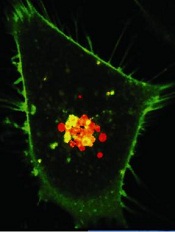
Credit: PNAS
Biomedical engineers have reported that daisy-shaped, nanoscale structures can deliver a cocktail of drugs directly to cancer cells.
The “nanodaisies” effectively delivered a 2-drug combination in a range of cell lines, including the leukemia cell line HL-60.
The drug-delivery vehicles also proved effective in a mouse model of lung cancer.
Zhen Gu, PhD, of North Carolina State University and the University of North Carolina at Chapel Hill, and his colleagues detailed these results in Biomaterials.
“We found that this technique was much better than conventional drug-delivery techniques at inhibiting the growth of lung cancer tumors in mice,” Dr Gu said.
“And based on in vitro tests in 9 different cell lines, the technique is also promising for use against leukemia, breast, prostate, liver, ovarian, and brain cancers.”
To make the “nanodaisies,” the researchers begin with a solution that contains a polymer called polyethylene glycol (PEG). The PEG forms long strands that have much shorter strands branching off to either side.
The researchers directly link the anticancer drug camptothecin (CPT) onto the shorter strands and introduce the anticancer drug doxorubicin (Dox) into the solution.
PEG is hydrophilic, but CPT and Dox are hydrophobic. As a result, the CPT and Dox cluster together in the solution, wrapping the PEG around themselves. This results in a daisy-shaped drug cocktail, only 50 nanometers in diameter, that can (in theory) be injected into a cancer patient.
Once injected, the nanodaisies float through the bloodstream until they are absorbed by cancer cells. In fact, one of the reasons the researchers chose to use PEG is because it has chemical properties that prolong the life of the drugs in the bloodstream. Once in a cancer cell, the drugs are released.
“Both drugs attack the cell’s nucleus but via different mechanisms,” said study author Wanyi Tai, PhD, who was previously a researcher in Dr Gu’s lab but is now at the University of Washington in Seattle.
“Combined, the drugs are more effective than either drug is by itself,” Dr Gu added. “We are very optimistic about this technique and are hoping to begin preclinical testing in the near future.”
Credit: PNAS
Biomedical engineers have reported that daisy-shaped, nanoscale structures can deliver a cocktail of drugs directly to cancer cells.
The “nanodaisies” effectively delivered a 2-drug combination in a range of cell lines, including the leukemia cell line HL-60.
The drug-delivery vehicles also proved effective in a mouse model of lung cancer.
Zhen Gu, PhD, of North Carolina State University and the University of North Carolina at Chapel Hill, and his colleagues detailed these results in Biomaterials.
“We found that this technique was much better than conventional drug-delivery techniques at inhibiting the growth of lung cancer tumors in mice,” Dr Gu said.
“And based on in vitro tests in 9 different cell lines, the technique is also promising for use against leukemia, breast, prostate, liver, ovarian, and brain cancers.”
To make the “nanodaisies,” the researchers begin with a solution that contains a polymer called polyethylene glycol (PEG). The PEG forms long strands that have much shorter strands branching off to either side.
The researchers directly link the anticancer drug camptothecin (CPT) onto the shorter strands and introduce the anticancer drug doxorubicin (Dox) into the solution.
PEG is hydrophilic, but CPT and Dox are hydrophobic. As a result, the CPT and Dox cluster together in the solution, wrapping the PEG around themselves. This results in a daisy-shaped drug cocktail, only 50 nanometers in diameter, that can (in theory) be injected into a cancer patient.
Once injected, the nanodaisies float through the bloodstream until they are absorbed by cancer cells. In fact, one of the reasons the researchers chose to use PEG is because it has chemical properties that prolong the life of the drugs in the bloodstream. Once in a cancer cell, the drugs are released.
“Both drugs attack the cell’s nucleus but via different mechanisms,” said study author Wanyi Tai, PhD, who was previously a researcher in Dr Gu’s lab but is now at the University of Washington in Seattle.
“Combined, the drugs are more effective than either drug is by itself,” Dr Gu added. “We are very optimistic about this technique and are hoping to begin preclinical testing in the near future.”
Credit: PNAS
Biomedical engineers have reported that daisy-shaped, nanoscale structures can deliver a cocktail of drugs directly to cancer cells.
The “nanodaisies” effectively delivered a 2-drug combination in a range of cell lines, including the leukemia cell line HL-60.
The drug-delivery vehicles also proved effective in a mouse model of lung cancer.
Zhen Gu, PhD, of North Carolina State University and the University of North Carolina at Chapel Hill, and his colleagues detailed these results in Biomaterials.
“We found that this technique was much better than conventional drug-delivery techniques at inhibiting the growth of lung cancer tumors in mice,” Dr Gu said.
“And based on in vitro tests in 9 different cell lines, the technique is also promising for use against leukemia, breast, prostate, liver, ovarian, and brain cancers.”
To make the “nanodaisies,” the researchers begin with a solution that contains a polymer called polyethylene glycol (PEG). The PEG forms long strands that have much shorter strands branching off to either side.
The researchers directly link the anticancer drug camptothecin (CPT) onto the shorter strands and introduce the anticancer drug doxorubicin (Dox) into the solution.
PEG is hydrophilic, but CPT and Dox are hydrophobic. As a result, the CPT and Dox cluster together in the solution, wrapping the PEG around themselves. This results in a daisy-shaped drug cocktail, only 50 nanometers in diameter, that can (in theory) be injected into a cancer patient.
Once injected, the nanodaisies float through the bloodstream until they are absorbed by cancer cells. In fact, one of the reasons the researchers chose to use PEG is because it has chemical properties that prolong the life of the drugs in the bloodstream. Once in a cancer cell, the drugs are released.
“Both drugs attack the cell’s nucleus but via different mechanisms,” said study author Wanyi Tai, PhD, who was previously a researcher in Dr Gu’s lab but is now at the University of Washington in Seattle.
“Combined, the drugs are more effective than either drug is by itself,” Dr Gu added. “We are very optimistic about this technique and are hoping to begin preclinical testing in the near future.”
Method reveals new targets of p53

Credit: A.T. Tikhonenko
A novel sequencing technique has allowed researchers to identify direct targets of p53, providing new insight into this gene’s anticancer activity.
The research, published in eLife, revealed nearly 200 genes that were directly regulated by p53, and many of these had never been identified before.
The study’s authors said this work lays the foundation for investigations into which of these genes are necessary for p53’s cancer-killing effects and how cancer cells evade these genes.
The researchers noted that all cancers must deal with p53’s antitumor effects. Generally, there are 2 ways they do this: by mutating p53 directly or by producing the protein MDM2, which inhibits p53 function. With the current study, the team explored the second strategy.
“MDM2 inhibitors, which are through phase 1 human trials, effectively activate p53 but manage to kill only about 1 in 20 tumors,” said study author Joaquín Espinosa, PhD, of the University of Colorado in Boulder.
“The question is why. What else is happening in these cancer cells that allow them to evade p53?”
According to the researchers, the answer is in the downstream effects of p53. The gene sets in motion a cascade of events that lead to cancer cell destruction. But it has been unclear exactly which other genes are directly activated by p53.
To identify genetic targets of p53, Dr Espinosa and his colleagues used a technique called Global Run-On Sequencing (GRO-Seq). Unlike other methods, GRO-Seq measures new RNA being created, not overall RNA levels.
“Many teams around the world have been getting cancer cells, treating them with MDM2 inhibitors, and waiting hours and hours to see what genes turn on, and then, only imprecisely,” Dr Espinosa said. “GRO-Seq lets us do it in minutes, and the discoveries are massive.”
The technique generates a large quantity of data because it requires counting tens of thousands of RNA molecules before and after p53 activation. So this research required designing algorithms to sort through the data, as well as a computational biologist driving a supercomputer.
But the researchers were able to pinpoint new genes directly regulated by p53. And they believe this could aid the future development of cancer-fighting strategies.
Credit: A.T. Tikhonenko
A novel sequencing technique has allowed researchers to identify direct targets of p53, providing new insight into this gene’s anticancer activity.
The research, published in eLife, revealed nearly 200 genes that were directly regulated by p53, and many of these had never been identified before.
The study’s authors said this work lays the foundation for investigations into which of these genes are necessary for p53’s cancer-killing effects and how cancer cells evade these genes.
The researchers noted that all cancers must deal with p53’s antitumor effects. Generally, there are 2 ways they do this: by mutating p53 directly or by producing the protein MDM2, which inhibits p53 function. With the current study, the team explored the second strategy.
“MDM2 inhibitors, which are through phase 1 human trials, effectively activate p53 but manage to kill only about 1 in 20 tumors,” said study author Joaquín Espinosa, PhD, of the University of Colorado in Boulder.
“The question is why. What else is happening in these cancer cells that allow them to evade p53?”
According to the researchers, the answer is in the downstream effects of p53. The gene sets in motion a cascade of events that lead to cancer cell destruction. But it has been unclear exactly which other genes are directly activated by p53.
To identify genetic targets of p53, Dr Espinosa and his colleagues used a technique called Global Run-On Sequencing (GRO-Seq). Unlike other methods, GRO-Seq measures new RNA being created, not overall RNA levels.
“Many teams around the world have been getting cancer cells, treating them with MDM2 inhibitors, and waiting hours and hours to see what genes turn on, and then, only imprecisely,” Dr Espinosa said. “GRO-Seq lets us do it in minutes, and the discoveries are massive.”
The technique generates a large quantity of data because it requires counting tens of thousands of RNA molecules before and after p53 activation. So this research required designing algorithms to sort through the data, as well as a computational biologist driving a supercomputer.
But the researchers were able to pinpoint new genes directly regulated by p53. And they believe this could aid the future development of cancer-fighting strategies.
Credit: A.T. Tikhonenko
A novel sequencing technique has allowed researchers to identify direct targets of p53, providing new insight into this gene’s anticancer activity.
The research, published in eLife, revealed nearly 200 genes that were directly regulated by p53, and many of these had never been identified before.
The study’s authors said this work lays the foundation for investigations into which of these genes are necessary for p53’s cancer-killing effects and how cancer cells evade these genes.
The researchers noted that all cancers must deal with p53’s antitumor effects. Generally, there are 2 ways they do this: by mutating p53 directly or by producing the protein MDM2, which inhibits p53 function. With the current study, the team explored the second strategy.
“MDM2 inhibitors, which are through phase 1 human trials, effectively activate p53 but manage to kill only about 1 in 20 tumors,” said study author Joaquín Espinosa, PhD, of the University of Colorado in Boulder.
“The question is why. What else is happening in these cancer cells that allow them to evade p53?”
According to the researchers, the answer is in the downstream effects of p53. The gene sets in motion a cascade of events that lead to cancer cell destruction. But it has been unclear exactly which other genes are directly activated by p53.
To identify genetic targets of p53, Dr Espinosa and his colleagues used a technique called Global Run-On Sequencing (GRO-Seq). Unlike other methods, GRO-Seq measures new RNA being created, not overall RNA levels.
“Many teams around the world have been getting cancer cells, treating them with MDM2 inhibitors, and waiting hours and hours to see what genes turn on, and then, only imprecisely,” Dr Espinosa said. “GRO-Seq lets us do it in minutes, and the discoveries are massive.”
The technique generates a large quantity of data because it requires counting tens of thousands of RNA molecules before and after p53 activation. So this research required designing algorithms to sort through the data, as well as a computational biologist driving a supercomputer.
But the researchers were able to pinpoint new genes directly regulated by p53. And they believe this could aid the future development of cancer-fighting strategies.
Team identifies mechanism of resistance in AML
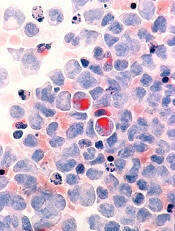
Credit: Lance Liotta
New research has revealed a mechanism of drug resistance in acute myeloid leukemia (AML) that may also occur in other cancers.
Investigators found evidence suggesting that glioma-associated protein 1 (GLI1) and the UDP glucuronosyltransferase (UGT1A) family of enzymes drive resistance to 2 drugs—ribavirin and cytarabine—in AML.
But the researchers were able to overcome this resistance by genetic or pharmacologic inhibition of GLI1.
They described this research in a letter to Nature.
“By studying drug-resistant cancer cells from AML patients and head and neck tumors, we found that a gene called GLI1 is dramatically overactive in these cells,” said study author Hiba Zahreddine, a doctoral student at the University of Montreal in Canada.
“[W[e were then able to show that this results in a specific chemical change to the drugs that prevents their toxicity toward the cancer cells,” said author Kathy Borden, PhD, of the University of Montreal’s Institute for Research in Immunology and Cancer.
Specifically, the investigators found that UGT1A enzymes add glucuronic acid to the drugs, thereby modifying their activity. And GLI1 alone is sufficient to drive UGT1A-dependent glucuronidation of ribavirin and cytarabine, which fuels drug resistance.
Fortunately, the researchers found that inhibiting GLI1, either genetically or with pharmacologic inhibitors, could force cancer cells to revert to a treatment-sensitive state.
The team therefore hopes that using GLI1 inhibitors in combination with ribavirin, cytarabine, or other therapies can overcome treatment resistance in patients with AML. The investigators have received approval from Health Canada to conduct a new clinical trial to test this theory.
“If this new approach is successful, it could have very broad applications, since the mode of action of ribavirin suggests that it could be effective against up to 30% of all cancers, including some types of breast, prostate, colon, stomach, and head and neck cancers, in addition to AML,” said Morris Goodman, co-founder and Chairman of the Board of Pharmascience Inc., the company that manufactured the ribavirin for this research.
Credit: Lance Liotta
New research has revealed a mechanism of drug resistance in acute myeloid leukemia (AML) that may also occur in other cancers.
Investigators found evidence suggesting that glioma-associated protein 1 (GLI1) and the UDP glucuronosyltransferase (UGT1A) family of enzymes drive resistance to 2 drugs—ribavirin and cytarabine—in AML.
But the researchers were able to overcome this resistance by genetic or pharmacologic inhibition of GLI1.
They described this research in a letter to Nature.
“By studying drug-resistant cancer cells from AML patients and head and neck tumors, we found that a gene called GLI1 is dramatically overactive in these cells,” said study author Hiba Zahreddine, a doctoral student at the University of Montreal in Canada.
“[W[e were then able to show that this results in a specific chemical change to the drugs that prevents their toxicity toward the cancer cells,” said author Kathy Borden, PhD, of the University of Montreal’s Institute for Research in Immunology and Cancer.
Specifically, the investigators found that UGT1A enzymes add glucuronic acid to the drugs, thereby modifying their activity. And GLI1 alone is sufficient to drive UGT1A-dependent glucuronidation of ribavirin and cytarabine, which fuels drug resistance.
Fortunately, the researchers found that inhibiting GLI1, either genetically or with pharmacologic inhibitors, could force cancer cells to revert to a treatment-sensitive state.
The team therefore hopes that using GLI1 inhibitors in combination with ribavirin, cytarabine, or other therapies can overcome treatment resistance in patients with AML. The investigators have received approval from Health Canada to conduct a new clinical trial to test this theory.
“If this new approach is successful, it could have very broad applications, since the mode of action of ribavirin suggests that it could be effective against up to 30% of all cancers, including some types of breast, prostate, colon, stomach, and head and neck cancers, in addition to AML,” said Morris Goodman, co-founder and Chairman of the Board of Pharmascience Inc., the company that manufactured the ribavirin for this research.
Credit: Lance Liotta
New research has revealed a mechanism of drug resistance in acute myeloid leukemia (AML) that may also occur in other cancers.
Investigators found evidence suggesting that glioma-associated protein 1 (GLI1) and the UDP glucuronosyltransferase (UGT1A) family of enzymes drive resistance to 2 drugs—ribavirin and cytarabine—in AML.
But the researchers were able to overcome this resistance by genetic or pharmacologic inhibition of GLI1.
They described this research in a letter to Nature.
“By studying drug-resistant cancer cells from AML patients and head and neck tumors, we found that a gene called GLI1 is dramatically overactive in these cells,” said study author Hiba Zahreddine, a doctoral student at the University of Montreal in Canada.
“[W[e were then able to show that this results in a specific chemical change to the drugs that prevents their toxicity toward the cancer cells,” said author Kathy Borden, PhD, of the University of Montreal’s Institute for Research in Immunology and Cancer.
Specifically, the investigators found that UGT1A enzymes add glucuronic acid to the drugs, thereby modifying their activity. And GLI1 alone is sufficient to drive UGT1A-dependent glucuronidation of ribavirin and cytarabine, which fuels drug resistance.
Fortunately, the researchers found that inhibiting GLI1, either genetically or with pharmacologic inhibitors, could force cancer cells to revert to a treatment-sensitive state.
The team therefore hopes that using GLI1 inhibitors in combination with ribavirin, cytarabine, or other therapies can overcome treatment resistance in patients with AML. The investigators have received approval from Health Canada to conduct a new clinical trial to test this theory.
“If this new approach is successful, it could have very broad applications, since the mode of action of ribavirin suggests that it could be effective against up to 30% of all cancers, including some types of breast, prostate, colon, stomach, and head and neck cancers, in addition to AML,” said Morris Goodman, co-founder and Chairman of the Board of Pharmascience Inc., the company that manufactured the ribavirin for this research.
ASCO 2014: Dr. David H. Henry’s top picks in leukemia research
1. A phase III, randomized, double-blind, placebo-controlled study evaluating the efficacy and safety of idelalisib (GS-1101) in combination with bendamustine and rituximab for previously treated chronic lymphocytic leukemia.
Herbert Aaron Eradat, et al., Abstract TPS7127

2. Independent evaluation of ibrutinib efficacy 3 years postinitiation of monotherapy in patients with chronic lymphocytic leukemia/small lymphocytic leukemia including deletion 17p disease.
Susan Mary O’Brien, et al., Abstract 7014
3. Randomized comparison of ibrutinib vs. ofatumumab in relapsed or refractory chronic lymphocytic leukemia/small lymphocytic lymphoma: Results from the phase III RESONATE trial.
John C. Byrd, Abstract LBA7008
4. Efficacy and safety of imatinib in chronic myeloid leukemia over 10 years.
Rüdiger Hehlmann, Abstract 7021
5. Chronic myelomonocytic leukemia: Next-generation sequencing in 30 treatment-naive cases.
Priyanka Priyanka, et al., Abstract 7051
Dr. Henry is with the department of medicine at the University of Pennsylvania, Philadelphia. He is a member of the medical staff at Pennsylvania Hospital in the division of hematology/oncology and is vice chairman of its department of medicine, and editor in chief of the Journal of Community and Supportive Oncology.
1. A phase III, randomized, double-blind, placebo-controlled study evaluating the efficacy and safety of idelalisib (GS-1101) in combination with bendamustine and rituximab for previously treated chronic lymphocytic leukemia.
Herbert Aaron Eradat, et al., Abstract TPS7127
2. Independent evaluation of ibrutinib efficacy 3 years postinitiation of monotherapy in patients with chronic lymphocytic leukemia/small lymphocytic leukemia including deletion 17p disease.
Susan Mary O’Brien, et al., Abstract 7014
3. Randomized comparison of ibrutinib vs. ofatumumab in relapsed or refractory chronic lymphocytic leukemia/small lymphocytic lymphoma: Results from the phase III RESONATE trial.
John C. Byrd, Abstract LBA7008
4. Efficacy and safety of imatinib in chronic myeloid leukemia over 10 years.
Rüdiger Hehlmann, Abstract 7021
5. Chronic myelomonocytic leukemia: Next-generation sequencing in 30 treatment-naive cases.
Priyanka Priyanka, et al., Abstract 7051
Dr. Henry is with the department of medicine at the University of Pennsylvania, Philadelphia. He is a member of the medical staff at Pennsylvania Hospital in the division of hematology/oncology and is vice chairman of its department of medicine, and editor in chief of the Journal of Community and Supportive Oncology.
1. A phase III, randomized, double-blind, placebo-controlled study evaluating the efficacy and safety of idelalisib (GS-1101) in combination with bendamustine and rituximab for previously treated chronic lymphocytic leukemia.
Herbert Aaron Eradat, et al., Abstract TPS7127
2. Independent evaluation of ibrutinib efficacy 3 years postinitiation of monotherapy in patients with chronic lymphocytic leukemia/small lymphocytic leukemia including deletion 17p disease.
Susan Mary O’Brien, et al., Abstract 7014
3. Randomized comparison of ibrutinib vs. ofatumumab in relapsed or refractory chronic lymphocytic leukemia/small lymphocytic lymphoma: Results from the phase III RESONATE trial.
John C. Byrd, Abstract LBA7008
4. Efficacy and safety of imatinib in chronic myeloid leukemia over 10 years.
Rüdiger Hehlmann, Abstract 7021
5. Chronic myelomonocytic leukemia: Next-generation sequencing in 30 treatment-naive cases.
Priyanka Priyanka, et al., Abstract 7051
Dr. Henry is with the department of medicine at the University of Pennsylvania, Philadelphia. He is a member of the medical staff at Pennsylvania Hospital in the division of hematology/oncology and is vice chairman of its department of medicine, and editor in chief of the Journal of Community and Supportive Oncology.
AT THE ASCO ANNUAL MEETING 2014

Ibrutinib boosts survival of relapsed/refractory CLL
CHICAGO – For the first time an oral drug, ibrutinib, has been shown to significantly improve both progression-free and overall survival of patients with relapsed or refractory chronic lymphocytic leukemia, compared with a systemic agent.
The first interim analysis of a phase III randomized trial showed that 1-year overall survival for patients with previously treated chronic lymphocytic leukemia (CLL) or small lymphocytic lymphoma (SLL) assigned to receive ibrutinib (Imbruvica) was 90%, compared with 81% for patients assigned to ofatumumab (Arzerra).

The hazard ratio (HR) for death for patients assigned to ibrutinib was 0.43 (P = .005), reported lead author Dr. John Byrd, professor of medicine at the Ohio State University Comprehensive Cancer Center, Columbus, at a media briefing at the annual meeting of the American Society of Clinical Oncology.
The median time to progression for patients on ibrutinib had not been reached, compared with 8.08 months for those on ofatumumab. At 15 months follow-up, the median progression-free survival (PFS) was 8.4 months in the ofatumumab group vs. not reached for patients on ibrutinib.
Ibrutinib reduced by 78% the risk of disease progression or death, compared with ofatumumab, Dr. Byrd noted.
The overall survival advantage shown with ibrutinib persisted even after 57 patients who had disease progression while on ofatumumab were crossed over to ibrutinib, Dr. Byrd said.
"These patients who have a short response to first-line therapy, or who are elderly, have very few treatment options that induce durable remissions. Identifying new therapies in this patient population, particularly those that extend survival, is very important," he said.
"The issue now is how to best use the drug and how to most effectively move this into the front-line setting. This is a transformative drug," commented Dr. Olatoyosi Odenike, a leukemia specialist from the University of Chicago, who was not involved in the study.
Dr. Gregory A. Masters of Jefferson Medical College, Philadelphia, and the Helen F. Graham Cancer Center in Newark, Del., who moderated the briefing, but was not involved in the study, echoed those sentiments.
"I think this drug’s efficacy may in fact transform the treatment of CLL, potentially replacing more toxic chemotherapy," he said.
B-cell signaling inhibitor
Ibrutinib is an oral inhibitor of Bruton’s tyrosine kinase, an enzyme essential for B-cell receptor signaling and adhesion that is present in many types of B-cell malignancies. Based on the results of phase II studies, ibrutinib received Food and Drug Administration approval for relapsed mantle cell lymphoma in November 2013 and for CLL in February 2014.
Ofatumumab, a CD20 inhibitor, was approved for the treatment of CLL based on a single group study in which patients whose disease was resistant to fludarabine and alemtuzumab had an overall response rate of 58%.
In the RESONATE trial, Dr. Byrd and his colleagues enrolled 391 patients with relapsed or refractory CLL or SLL and randomly assigned them to receive either oral ibrutinib 420 mg once daily until disease progression or unacceptable toxicity (195 patients) or to IV ofatumumab at an initial dose of 300 mg followed by 11 doses at 2,000 mg (196 patients).
At a median follow-up of 9.4 months, the median duration of PFS, the primary endpoint, had not been reached in ibrutinib-treated patients (88% of whom had PFS at 6 months), compared with 8.1 months for patients treated with ofatumumab.
In all, 42.6% of patients on ibrutinib had a partial response rate, compared with 4.1% of those on ofatumumab. In addition, 20% of patients on ibrutinib had a partial response with lymphocytosis. Lymphocytosis occurred in 69% of all patients treated with ibrutinib. The investigators did not consider lymphocytosis to be disease progression, and the condition resolved in 77% of these patients during follow-up.
Nonhematologic adverse events occurring in at least 20% of patients included diarrhea, fatigue, pyrexia, and nausea in patients on ibrutinib, and fatigue, infusion-related reactions, and cough in those on ofatumumab.
In all, 4% of patients on ibrutinib and 5% on ofatumumab discontinued the assigned drug because of adverse events.
Richter’s transformation – CLL evolving into an aggressive, rapidly growing large-cell lymphoma – occurred in two patients in each treatment arm. One patient on ibrutinib developed prolymphocytic leukemia.
Dr. Byrd noted that the improved PFS, overall survival, and response rates with ibrutinib were seem across all patient subgroups, including patients who were resistant to chemoimmunotherapy and those with the notorious chromosome 17p13.1 deletion.
Ibrutinib is currently being explored in patients with previously untreated CLL or SLL. The study was supported by Pharmacyclics. Dr. Byrd disclosed receiving research funding and serving as an unpaid advisor to the company. Dr. Odenike and Dr. Masters reported having no relevant disclosures.
CHICAGO – For the first time an oral drug, ibrutinib, has been shown to significantly improve both progression-free and overall survival of patients with relapsed or refractory chronic lymphocytic leukemia, compared with a systemic agent.
The first interim analysis of a phase III randomized trial showed that 1-year overall survival for patients with previously treated chronic lymphocytic leukemia (CLL) or small lymphocytic lymphoma (SLL) assigned to receive ibrutinib (Imbruvica) was 90%, compared with 81% for patients assigned to ofatumumab (Arzerra).
The hazard ratio (HR) for death for patients assigned to ibrutinib was 0.43 (P = .005), reported lead author Dr. John Byrd, professor of medicine at the Ohio State University Comprehensive Cancer Center, Columbus, at a media briefing at the annual meeting of the American Society of Clinical Oncology.
The median time to progression for patients on ibrutinib had not been reached, compared with 8.08 months for those on ofatumumab. At 15 months follow-up, the median progression-free survival (PFS) was 8.4 months in the ofatumumab group vs. not reached for patients on ibrutinib.
Ibrutinib reduced by 78% the risk of disease progression or death, compared with ofatumumab, Dr. Byrd noted.
The overall survival advantage shown with ibrutinib persisted even after 57 patients who had disease progression while on ofatumumab were crossed over to ibrutinib, Dr. Byrd said.
"These patients who have a short response to first-line therapy, or who are elderly, have very few treatment options that induce durable remissions. Identifying new therapies in this patient population, particularly those that extend survival, is very important," he said.
"The issue now is how to best use the drug and how to most effectively move this into the front-line setting. This is a transformative drug," commented Dr. Olatoyosi Odenike, a leukemia specialist from the University of Chicago, who was not involved in the study.
Dr. Gregory A. Masters of Jefferson Medical College, Philadelphia, and the Helen F. Graham Cancer Center in Newark, Del., who moderated the briefing, but was not involved in the study, echoed those sentiments.
"I think this drug’s efficacy may in fact transform the treatment of CLL, potentially replacing more toxic chemotherapy," he said.
B-cell signaling inhibitor
Ibrutinib is an oral inhibitor of Bruton’s tyrosine kinase, an enzyme essential for B-cell receptor signaling and adhesion that is present in many types of B-cell malignancies. Based on the results of phase II studies, ibrutinib received Food and Drug Administration approval for relapsed mantle cell lymphoma in November 2013 and for CLL in February 2014.
Ofatumumab, a CD20 inhibitor, was approved for the treatment of CLL based on a single group study in which patients whose disease was resistant to fludarabine and alemtuzumab had an overall response rate of 58%.
In the RESONATE trial, Dr. Byrd and his colleagues enrolled 391 patients with relapsed or refractory CLL or SLL and randomly assigned them to receive either oral ibrutinib 420 mg once daily until disease progression or unacceptable toxicity (195 patients) or to IV ofatumumab at an initial dose of 300 mg followed by 11 doses at 2,000 mg (196 patients).
At a median follow-up of 9.4 months, the median duration of PFS, the primary endpoint, had not been reached in ibrutinib-treated patients (88% of whom had PFS at 6 months), compared with 8.1 months for patients treated with ofatumumab.
In all, 42.6% of patients on ibrutinib had a partial response rate, compared with 4.1% of those on ofatumumab. In addition, 20% of patients on ibrutinib had a partial response with lymphocytosis. Lymphocytosis occurred in 69% of all patients treated with ibrutinib. The investigators did not consider lymphocytosis to be disease progression, and the condition resolved in 77% of these patients during follow-up.
Nonhematologic adverse events occurring in at least 20% of patients included diarrhea, fatigue, pyrexia, and nausea in patients on ibrutinib, and fatigue, infusion-related reactions, and cough in those on ofatumumab.
In all, 4% of patients on ibrutinib and 5% on ofatumumab discontinued the assigned drug because of adverse events.
Richter’s transformation – CLL evolving into an aggressive, rapidly growing large-cell lymphoma – occurred in two patients in each treatment arm. One patient on ibrutinib developed prolymphocytic leukemia.
Dr. Byrd noted that the improved PFS, overall survival, and response rates with ibrutinib were seem across all patient subgroups, including patients who were resistant to chemoimmunotherapy and those with the notorious chromosome 17p13.1 deletion.
Ibrutinib is currently being explored in patients with previously untreated CLL or SLL. The study was supported by Pharmacyclics. Dr. Byrd disclosed receiving research funding and serving as an unpaid advisor to the company. Dr. Odenike and Dr. Masters reported having no relevant disclosures.
CHICAGO – For the first time an oral drug, ibrutinib, has been shown to significantly improve both progression-free and overall survival of patients with relapsed or refractory chronic lymphocytic leukemia, compared with a systemic agent.
The first interim analysis of a phase III randomized trial showed that 1-year overall survival for patients with previously treated chronic lymphocytic leukemia (CLL) or small lymphocytic lymphoma (SLL) assigned to receive ibrutinib (Imbruvica) was 90%, compared with 81% for patients assigned to ofatumumab (Arzerra).
The hazard ratio (HR) for death for patients assigned to ibrutinib was 0.43 (P = .005), reported lead author Dr. John Byrd, professor of medicine at the Ohio State University Comprehensive Cancer Center, Columbus, at a media briefing at the annual meeting of the American Society of Clinical Oncology.
The median time to progression for patients on ibrutinib had not been reached, compared with 8.08 months for those on ofatumumab. At 15 months follow-up, the median progression-free survival (PFS) was 8.4 months in the ofatumumab group vs. not reached for patients on ibrutinib.
Ibrutinib reduced by 78% the risk of disease progression or death, compared with ofatumumab, Dr. Byrd noted.
The overall survival advantage shown with ibrutinib persisted even after 57 patients who had disease progression while on ofatumumab were crossed over to ibrutinib, Dr. Byrd said.
"These patients who have a short response to first-line therapy, or who are elderly, have very few treatment options that induce durable remissions. Identifying new therapies in this patient population, particularly those that extend survival, is very important," he said.
"The issue now is how to best use the drug and how to most effectively move this into the front-line setting. This is a transformative drug," commented Dr. Olatoyosi Odenike, a leukemia specialist from the University of Chicago, who was not involved in the study.
Dr. Gregory A. Masters of Jefferson Medical College, Philadelphia, and the Helen F. Graham Cancer Center in Newark, Del., who moderated the briefing, but was not involved in the study, echoed those sentiments.
"I think this drug’s efficacy may in fact transform the treatment of CLL, potentially replacing more toxic chemotherapy," he said.
B-cell signaling inhibitor
Ibrutinib is an oral inhibitor of Bruton’s tyrosine kinase, an enzyme essential for B-cell receptor signaling and adhesion that is present in many types of B-cell malignancies. Based on the results of phase II studies, ibrutinib received Food and Drug Administration approval for relapsed mantle cell lymphoma in November 2013 and for CLL in February 2014.
Ofatumumab, a CD20 inhibitor, was approved for the treatment of CLL based on a single group study in which patients whose disease was resistant to fludarabine and alemtuzumab had an overall response rate of 58%.
In the RESONATE trial, Dr. Byrd and his colleagues enrolled 391 patients with relapsed or refractory CLL or SLL and randomly assigned them to receive either oral ibrutinib 420 mg once daily until disease progression or unacceptable toxicity (195 patients) or to IV ofatumumab at an initial dose of 300 mg followed by 11 doses at 2,000 mg (196 patients).
At a median follow-up of 9.4 months, the median duration of PFS, the primary endpoint, had not been reached in ibrutinib-treated patients (88% of whom had PFS at 6 months), compared with 8.1 months for patients treated with ofatumumab.
In all, 42.6% of patients on ibrutinib had a partial response rate, compared with 4.1% of those on ofatumumab. In addition, 20% of patients on ibrutinib had a partial response with lymphocytosis. Lymphocytosis occurred in 69% of all patients treated with ibrutinib. The investigators did not consider lymphocytosis to be disease progression, and the condition resolved in 77% of these patients during follow-up.
Nonhematologic adverse events occurring in at least 20% of patients included diarrhea, fatigue, pyrexia, and nausea in patients on ibrutinib, and fatigue, infusion-related reactions, and cough in those on ofatumumab.
In all, 4% of patients on ibrutinib and 5% on ofatumumab discontinued the assigned drug because of adverse events.
Richter’s transformation – CLL evolving into an aggressive, rapidly growing large-cell lymphoma – occurred in two patients in each treatment arm. One patient on ibrutinib developed prolymphocytic leukemia.
Dr. Byrd noted that the improved PFS, overall survival, and response rates with ibrutinib were seem across all patient subgroups, including patients who were resistant to chemoimmunotherapy and those with the notorious chromosome 17p13.1 deletion.
Ibrutinib is currently being explored in patients with previously untreated CLL or SLL. The study was supported by Pharmacyclics. Dr. Byrd disclosed receiving research funding and serving as an unpaid advisor to the company. Dr. Odenike and Dr. Masters reported having no relevant disclosures.
AT THE ASCO ANNUAL MEETING 2014
Major finding: One-year overall survival for patients with previously treated chronic lymphocytic leukemia (CLL) or small lymphocytic lymphoma (SLL) treated with ibrutinib was 90%, compared with 81% for patients treated with ofatumumab.
Data source: First interim analysis of a randomized phase III study in 391 patients with relapsed or refractory chronic lymphocytic leukemia or small lymphocytic lymphoma.
Disclosures: The study was supported by Pharmacyclics. Dr. Byrd disclosed receiving research funding and serving as an unpaid advisor to the company. Dr. Odenike and Dr. Masters reported having no relevant disclosures.

Mutation causes ibrutinib resistance in CLL

Credit: Rhoda Baer
Researchers say they have identified a source of drug resistance in chronic lymphocytic leukemia (CLL).
In a letter to The New England Journal of Medicine, the team described how a mutation in Bruton’s tyrosine kinase (BTK) triggers resistance to ibrutinib, a drug that treats CLL by inhibiting BTK.
The researchers discovered this point mutation in a CLL patient enrolled in a clinical trial. The patient initially responded well to ibrutinib but stopped responding after almost 20 months.
“In a way, we are repeating, at a faster pace, the story of Gleevec [imatinib],” said study author Y. Lynn Wang, MD, PhD, of the University of Chicago in Illinois.
“That story began with development of an effective drug with few side effects, but, in many patients, the leukemia eventually found a way around it after long-term use. So researchers developed second-line drugs to overcome resistance.”
The ibrutinib study began in 2010 at Weill Cornell Medical College in New York, one of several sites for a phase 1 trial of ibrutinib. The researchers recruited 16 patients with CLL whose disease had progressed or relapsed despite multiple treatments.
Dr Wang arranged to track the progress of each patient’s leukemic cells before and during treatment and to correlate any cellular or molecular changes with each patient’s disease activity.
One of the 16 patients in the trial seemed to be unusual. This 61-year-old woman was diagnosed in 2000 at age 49. She had unsuccessfully received several different treatments before entering the study.
Within 18 months of starting ibrutinib, she showed significant improvement. At about 20 months, however, she started to decline, developing a respiratory infection that did not improve with treatment. By 21 months, it was clear she was having a relapse. The clinical team increased her dose, with no discernable effect.
Dr Wang’s team quickly began analyzing her blood samples, looking for changes that occurred between the period when she was responding well to ibrutinib and after she began to relapse.
Because complete gene sequencing would be time consuming, Dr Wang asked a graduate student working on the project, Menu Setty from Memorial Sloan-Kettering in New York, to first focus on 3 proteins that were likely candidates. One of the candidates was BTK.
And sure enough, Setty discovered a tiny but consistent change in BTK in about 90% of post-relapse cells. It was a thymidine-to-adenine mutation at nucleotide 1634 of the BTK complementary DNA, leading to a substitution of serine for cysteine at residue 481 (C481S).
When the researchers later analyzed the entire set of the patient’s genes, they found no other genetic changes that correlated with the patient’s clinical course. BTK made perfect sense as the cause for drug resistance, the researchers noted, as it’s the primary target of ibrutinib binding, and it plays a central role in rapid cell proliferation.
Dr Wang and her colleagues used structural and biochemical measures to confirm that the C481S mutation made CLL cells resistant to ibrutinib. The studies indicated that ibrutinib was 500 times less likely to bind to mutant BTK.
In an attempt to save the patient, the researchers tested alternative kinase inhibitors against the patient’s leukemic cells in the lab.
They found some kinase inhibitors remained effective against ibrutinib-resistant cells. (These studies are described in a separate manuscript that has been submitted for publication.) Unfortunately, despite this effort, the patient passed away a few weeks later, due to sepsis.
The researchers noted that the C481S mutation is one of several mechanisms that underlie resistance to ibrutinib, but this research highlights the mutation’s role in disease development and drug resistance.
Understanding the molecular and cellular mechanisms of resistance is the first step toward monitoring, early detection, and development of novel strategies to overcome drug resistance.
Credit: Rhoda Baer
Researchers say they have identified a source of drug resistance in chronic lymphocytic leukemia (CLL).
In a letter to The New England Journal of Medicine, the team described how a mutation in Bruton’s tyrosine kinase (BTK) triggers resistance to ibrutinib, a drug that treats CLL by inhibiting BTK.
The researchers discovered this point mutation in a CLL patient enrolled in a clinical trial. The patient initially responded well to ibrutinib but stopped responding after almost 20 months.
“In a way, we are repeating, at a faster pace, the story of Gleevec [imatinib],” said study author Y. Lynn Wang, MD, PhD, of the University of Chicago in Illinois.
“That story began with development of an effective drug with few side effects, but, in many patients, the leukemia eventually found a way around it after long-term use. So researchers developed second-line drugs to overcome resistance.”
The ibrutinib study began in 2010 at Weill Cornell Medical College in New York, one of several sites for a phase 1 trial of ibrutinib. The researchers recruited 16 patients with CLL whose disease had progressed or relapsed despite multiple treatments.
Dr Wang arranged to track the progress of each patient’s leukemic cells before and during treatment and to correlate any cellular or molecular changes with each patient’s disease activity.
One of the 16 patients in the trial seemed to be unusual. This 61-year-old woman was diagnosed in 2000 at age 49. She had unsuccessfully received several different treatments before entering the study.
Within 18 months of starting ibrutinib, she showed significant improvement. At about 20 months, however, she started to decline, developing a respiratory infection that did not improve with treatment. By 21 months, it was clear she was having a relapse. The clinical team increased her dose, with no discernable effect.
Dr Wang’s team quickly began analyzing her blood samples, looking for changes that occurred between the period when she was responding well to ibrutinib and after she began to relapse.
Because complete gene sequencing would be time consuming, Dr Wang asked a graduate student working on the project, Menu Setty from Memorial Sloan-Kettering in New York, to first focus on 3 proteins that were likely candidates. One of the candidates was BTK.
And sure enough, Setty discovered a tiny but consistent change in BTK in about 90% of post-relapse cells. It was a thymidine-to-adenine mutation at nucleotide 1634 of the BTK complementary DNA, leading to a substitution of serine for cysteine at residue 481 (C481S).
When the researchers later analyzed the entire set of the patient’s genes, they found no other genetic changes that correlated with the patient’s clinical course. BTK made perfect sense as the cause for drug resistance, the researchers noted, as it’s the primary target of ibrutinib binding, and it plays a central role in rapid cell proliferation.
Dr Wang and her colleagues used structural and biochemical measures to confirm that the C481S mutation made CLL cells resistant to ibrutinib. The studies indicated that ibrutinib was 500 times less likely to bind to mutant BTK.
In an attempt to save the patient, the researchers tested alternative kinase inhibitors against the patient’s leukemic cells in the lab.
They found some kinase inhibitors remained effective against ibrutinib-resistant cells. (These studies are described in a separate manuscript that has been submitted for publication.) Unfortunately, despite this effort, the patient passed away a few weeks later, due to sepsis.
The researchers noted that the C481S mutation is one of several mechanisms that underlie resistance to ibrutinib, but this research highlights the mutation’s role in disease development and drug resistance.
Understanding the molecular and cellular mechanisms of resistance is the first step toward monitoring, early detection, and development of novel strategies to overcome drug resistance.
Credit: Rhoda Baer
Researchers say they have identified a source of drug resistance in chronic lymphocytic leukemia (CLL).
In a letter to The New England Journal of Medicine, the team described how a mutation in Bruton’s tyrosine kinase (BTK) triggers resistance to ibrutinib, a drug that treats CLL by inhibiting BTK.
The researchers discovered this point mutation in a CLL patient enrolled in a clinical trial. The patient initially responded well to ibrutinib but stopped responding after almost 20 months.
“In a way, we are repeating, at a faster pace, the story of Gleevec [imatinib],” said study author Y. Lynn Wang, MD, PhD, of the University of Chicago in Illinois.
“That story began with development of an effective drug with few side effects, but, in many patients, the leukemia eventually found a way around it after long-term use. So researchers developed second-line drugs to overcome resistance.”
The ibrutinib study began in 2010 at Weill Cornell Medical College in New York, one of several sites for a phase 1 trial of ibrutinib. The researchers recruited 16 patients with CLL whose disease had progressed or relapsed despite multiple treatments.
Dr Wang arranged to track the progress of each patient’s leukemic cells before and during treatment and to correlate any cellular or molecular changes with each patient’s disease activity.
One of the 16 patients in the trial seemed to be unusual. This 61-year-old woman was diagnosed in 2000 at age 49. She had unsuccessfully received several different treatments before entering the study.
Within 18 months of starting ibrutinib, she showed significant improvement. At about 20 months, however, she started to decline, developing a respiratory infection that did not improve with treatment. By 21 months, it was clear she was having a relapse. The clinical team increased her dose, with no discernable effect.
Dr Wang’s team quickly began analyzing her blood samples, looking for changes that occurred between the period when she was responding well to ibrutinib and after she began to relapse.
Because complete gene sequencing would be time consuming, Dr Wang asked a graduate student working on the project, Menu Setty from Memorial Sloan-Kettering in New York, to first focus on 3 proteins that were likely candidates. One of the candidates was BTK.
And sure enough, Setty discovered a tiny but consistent change in BTK in about 90% of post-relapse cells. It was a thymidine-to-adenine mutation at nucleotide 1634 of the BTK complementary DNA, leading to a substitution of serine for cysteine at residue 481 (C481S).
When the researchers later analyzed the entire set of the patient’s genes, they found no other genetic changes that correlated with the patient’s clinical course. BTK made perfect sense as the cause for drug resistance, the researchers noted, as it’s the primary target of ibrutinib binding, and it plays a central role in rapid cell proliferation.
Dr Wang and her colleagues used structural and biochemical measures to confirm that the C481S mutation made CLL cells resistant to ibrutinib. The studies indicated that ibrutinib was 500 times less likely to bind to mutant BTK.
In an attempt to save the patient, the researchers tested alternative kinase inhibitors against the patient’s leukemic cells in the lab.
They found some kinase inhibitors remained effective against ibrutinib-resistant cells. (These studies are described in a separate manuscript that has been submitted for publication.) Unfortunately, despite this effort, the patient passed away a few weeks later, due to sepsis.
The researchers noted that the C481S mutation is one of several mechanisms that underlie resistance to ibrutinib, but this research highlights the mutation’s role in disease development and drug resistance.
Understanding the molecular and cellular mechanisms of resistance is the first step toward monitoring, early detection, and development of novel strategies to overcome drug resistance.
CHMP recommends ofatumumab for CLL

Credit: Linda Bartlett
The European Medicine Agency’s Committee for Medicinal Products for Human Use (CHMP) has issued a positive opinion for ofatumumab (Arzerra), a monoclonal antibody targeting CD20.
The CHMP is recommending that ofatumumab receive conditional approval for use in combination with chlorambucil or bendamustine to treat patients with chronic lymphocytic leukemia (CLL) who have not received prior therapy and are not eligible for fludarabine-based therapy.
The European Commission (EC) will take the CHMP’s opinion into account when deciding whether to approve ofatumumab for this indication.
Ofatumumab already has conditional approval in the Europe Union to treat CLL patients who are refractory to fludarabine and alemtuzumab.
Ofatumumab received conditional approval because the drug’s benefits appear to outweigh the risks it poses. The drug will not receive full
approval until the companies developing ofatumumab, GlaxoSmithKline and Genmab, submit results of additional research to the EC.
The CHMP’s recommendation for expanded approval is based on results from 2 trials in patients with CLL who were ineligible for fludarabine-based treatment.
The first is a phase 2 study (OMB115991) in which researchers evaluated the efficacy of ofatumumab in combination with bendamustine. The second is the phase 3 COMPLEMENT 1 study (OMB110911), a randomized trial in which researchers compared ofatumumab and chlorambucil in combination to chlorambucil alone.
Phase 2 study
Results from this single-arm study were presented at the 2013 International Workshop on CLL. Researchers enrolled 97 patients with CLL, 44 of whom were previously untreated and 53 who had relapsed. The median ages were 62.5 and 68 years, respectively.
Treatment began with acetaminophen, an antihistamine, and a glucocorticoid. Patients then received ofatumumab at 300 mg on day 1 and 1000 mg on day 8 of cycle 1. For cycles 2 through 6, they received 1000 mg on day 1 every 28 days.
Patients received bendamustine on days 1 and 2, every 28 days for up to 6 cycles. The initial dose was 90 mg/m2 for the untreated patients and 70 mg/m2 for relapsed patients.
However, patients required a dose reduction due to toxicity. The previously untreated patients were reduced to 60 mg/m2, and the relapsed patients were reduced to 50 mg/m2.
The overall response rate was 95% in the previously untreated group and 74% in the relapsed group. Complete responses occurred in 43% and 11%, respectively.
CT results showed the overall response rate was 82% in the previously untreated group and 70% in the relapsed group. Complete responses occurred in 27% and 9%, respectively. The median time to response was 0.95 months for both groups.
Grade 3 or higher adverse events occurred in 25% of patients in the previously untreated group and 38% of those in the relapsed group.
This included infusion reactions (11% and 8%, respectively), neutropenia (16% and 29%, respectively), infections (11% and 15%, respectively), rash (2% of previously untreated patients), febrile neutropenia (4% of relapsed patients), and thrombocytopenia (4% of relapsed patients).
There were no deaths in the previously untreated group, but 4 patients died in the relapsed group. Two of these deaths may have been related to study treatment. One patient died of pneumonia and hemolytic anemia 15 days after the last dose of treatment, and 1 patient died of sepsis 4 days after the last dose of treatment.
Phase 3 study
Data from the COMPLEMENT 1 study were presented at ASH 2013. Researchers compared ofatumumab plus chlorambucil to chlorambucil alone in 447 previously untreated patients with CLL who were ineligible for fludarabine-based therapy.
Patients had a median age of 69 years (range, 35 to 92). Seventy-two percent had 2 or more comorbidities, and 48% had a creatinine clearance of less than 70 mL/min.
Patients in the ofatumumab arm received the drug at 300 mg in cycle 1 on day 1, 1000 mg in cycle 1 on day 8, and 1000 mg administered on day 1 of all subsequent 28-day cycles.
In both arms, patients received chlorambucil at a dose of 10 mg/m2 orally on days 1 to 7, every 28 days. Prior to each infusion of ofatumumab, patients received acetaminophen, an antihistamine, and a glucocorticoid.
The overall response rate was 82% in the ofatumumab-chlorambucil group and 69% in the chlorambucil-alone group (P=0.001). Complete response rates were 12% and 1%, respectively.
At a median follow-up of 29 months, the median overall survival was not reached for either treatment arm. However, ofatumumab-treated patients had longer progression-free survival than patients who received chlorambucil alone—22.4 months and 13.1 months, respectively (P<0.001).
Grade 3 or higher adverse events occurred in 50% of ofatumumab-treated patients and 43% of patients who received chlorambucil alone. The most common event was neutropenia, which occurred in 26% and 14% of patients, respectively.
Grade 3 or higher infections occurred in 15% of ofatumumab-treated patients and 14% of patients who received chlorambucil alone. The most common was pneumonia, which occurred in 4% and 3%, respectively.
In the entire cohort, grade 3 or higher infusion-related events occurred in 10% of patients, but there were no fatal infusion reactions. Two percent of subjects in both arms died during treatment.
Credit: Linda Bartlett
The European Medicine Agency’s Committee for Medicinal Products for Human Use (CHMP) has issued a positive opinion for ofatumumab (Arzerra), a monoclonal antibody targeting CD20.
The CHMP is recommending that ofatumumab receive conditional approval for use in combination with chlorambucil or bendamustine to treat patients with chronic lymphocytic leukemia (CLL) who have not received prior therapy and are not eligible for fludarabine-based therapy.
The European Commission (EC) will take the CHMP’s opinion into account when deciding whether to approve ofatumumab for this indication.
Ofatumumab already has conditional approval in the Europe Union to treat CLL patients who are refractory to fludarabine and alemtuzumab.
Ofatumumab received conditional approval because the drug’s benefits appear to outweigh the risks it poses. The drug will not receive full
approval until the companies developing ofatumumab, GlaxoSmithKline and Genmab, submit results of additional research to the EC.
The CHMP’s recommendation for expanded approval is based on results from 2 trials in patients with CLL who were ineligible for fludarabine-based treatment.
The first is a phase 2 study (OMB115991) in which researchers evaluated the efficacy of ofatumumab in combination with bendamustine. The second is the phase 3 COMPLEMENT 1 study (OMB110911), a randomized trial in which researchers compared ofatumumab and chlorambucil in combination to chlorambucil alone.
Phase 2 study
Results from this single-arm study were presented at the 2013 International Workshop on CLL. Researchers enrolled 97 patients with CLL, 44 of whom were previously untreated and 53 who had relapsed. The median ages were 62.5 and 68 years, respectively.
Treatment began with acetaminophen, an antihistamine, and a glucocorticoid. Patients then received ofatumumab at 300 mg on day 1 and 1000 mg on day 8 of cycle 1. For cycles 2 through 6, they received 1000 mg on day 1 every 28 days.
Patients received bendamustine on days 1 and 2, every 28 days for up to 6 cycles. The initial dose was 90 mg/m2 for the untreated patients and 70 mg/m2 for relapsed patients.
However, patients required a dose reduction due to toxicity. The previously untreated patients were reduced to 60 mg/m2, and the relapsed patients were reduced to 50 mg/m2.
The overall response rate was 95% in the previously untreated group and 74% in the relapsed group. Complete responses occurred in 43% and 11%, respectively.
CT results showed the overall response rate was 82% in the previously untreated group and 70% in the relapsed group. Complete responses occurred in 27% and 9%, respectively. The median time to response was 0.95 months for both groups.
Grade 3 or higher adverse events occurred in 25% of patients in the previously untreated group and 38% of those in the relapsed group.
This included infusion reactions (11% and 8%, respectively), neutropenia (16% and 29%, respectively), infections (11% and 15%, respectively), rash (2% of previously untreated patients), febrile neutropenia (4% of relapsed patients), and thrombocytopenia (4% of relapsed patients).
There were no deaths in the previously untreated group, but 4 patients died in the relapsed group. Two of these deaths may have been related to study treatment. One patient died of pneumonia and hemolytic anemia 15 days after the last dose of treatment, and 1 patient died of sepsis 4 days after the last dose of treatment.
Phase 3 study
Data from the COMPLEMENT 1 study were presented at ASH 2013. Researchers compared ofatumumab plus chlorambucil to chlorambucil alone in 447 previously untreated patients with CLL who were ineligible for fludarabine-based therapy.
Patients had a median age of 69 years (range, 35 to 92). Seventy-two percent had 2 or more comorbidities, and 48% had a creatinine clearance of less than 70 mL/min.
Patients in the ofatumumab arm received the drug at 300 mg in cycle 1 on day 1, 1000 mg in cycle 1 on day 8, and 1000 mg administered on day 1 of all subsequent 28-day cycles.
In both arms, patients received chlorambucil at a dose of 10 mg/m2 orally on days 1 to 7, every 28 days. Prior to each infusion of ofatumumab, patients received acetaminophen, an antihistamine, and a glucocorticoid.
The overall response rate was 82% in the ofatumumab-chlorambucil group and 69% in the chlorambucil-alone group (P=0.001). Complete response rates were 12% and 1%, respectively.
At a median follow-up of 29 months, the median overall survival was not reached for either treatment arm. However, ofatumumab-treated patients had longer progression-free survival than patients who received chlorambucil alone—22.4 months and 13.1 months, respectively (P<0.001).
Grade 3 or higher adverse events occurred in 50% of ofatumumab-treated patients and 43% of patients who received chlorambucil alone. The most common event was neutropenia, which occurred in 26% and 14% of patients, respectively.
Grade 3 or higher infections occurred in 15% of ofatumumab-treated patients and 14% of patients who received chlorambucil alone. The most common was pneumonia, which occurred in 4% and 3%, respectively.
In the entire cohort, grade 3 or higher infusion-related events occurred in 10% of patients, but there were no fatal infusion reactions. Two percent of subjects in both arms died during treatment.
Credit: Linda Bartlett
The European Medicine Agency’s Committee for Medicinal Products for Human Use (CHMP) has issued a positive opinion for ofatumumab (Arzerra), a monoclonal antibody targeting CD20.
The CHMP is recommending that ofatumumab receive conditional approval for use in combination with chlorambucil or bendamustine to treat patients with chronic lymphocytic leukemia (CLL) who have not received prior therapy and are not eligible for fludarabine-based therapy.
The European Commission (EC) will take the CHMP’s opinion into account when deciding whether to approve ofatumumab for this indication.
Ofatumumab already has conditional approval in the Europe Union to treat CLL patients who are refractory to fludarabine and alemtuzumab.
Ofatumumab received conditional approval because the drug’s benefits appear to outweigh the risks it poses. The drug will not receive full
approval until the companies developing ofatumumab, GlaxoSmithKline and Genmab, submit results of additional research to the EC.
The CHMP’s recommendation for expanded approval is based on results from 2 trials in patients with CLL who were ineligible for fludarabine-based treatment.
The first is a phase 2 study (OMB115991) in which researchers evaluated the efficacy of ofatumumab in combination with bendamustine. The second is the phase 3 COMPLEMENT 1 study (OMB110911), a randomized trial in which researchers compared ofatumumab and chlorambucil in combination to chlorambucil alone.
Phase 2 study
Results from this single-arm study were presented at the 2013 International Workshop on CLL. Researchers enrolled 97 patients with CLL, 44 of whom were previously untreated and 53 who had relapsed. The median ages were 62.5 and 68 years, respectively.
Treatment began with acetaminophen, an antihistamine, and a glucocorticoid. Patients then received ofatumumab at 300 mg on day 1 and 1000 mg on day 8 of cycle 1. For cycles 2 through 6, they received 1000 mg on day 1 every 28 days.
Patients received bendamustine on days 1 and 2, every 28 days for up to 6 cycles. The initial dose was 90 mg/m2 for the untreated patients and 70 mg/m2 for relapsed patients.
However, patients required a dose reduction due to toxicity. The previously untreated patients were reduced to 60 mg/m2, and the relapsed patients were reduced to 50 mg/m2.
The overall response rate was 95% in the previously untreated group and 74% in the relapsed group. Complete responses occurred in 43% and 11%, respectively.
CT results showed the overall response rate was 82% in the previously untreated group and 70% in the relapsed group. Complete responses occurred in 27% and 9%, respectively. The median time to response was 0.95 months for both groups.
Grade 3 or higher adverse events occurred in 25% of patients in the previously untreated group and 38% of those in the relapsed group.
This included infusion reactions (11% and 8%, respectively), neutropenia (16% and 29%, respectively), infections (11% and 15%, respectively), rash (2% of previously untreated patients), febrile neutropenia (4% of relapsed patients), and thrombocytopenia (4% of relapsed patients).
There were no deaths in the previously untreated group, but 4 patients died in the relapsed group. Two of these deaths may have been related to study treatment. One patient died of pneumonia and hemolytic anemia 15 days after the last dose of treatment, and 1 patient died of sepsis 4 days after the last dose of treatment.
Phase 3 study
Data from the COMPLEMENT 1 study were presented at ASH 2013. Researchers compared ofatumumab plus chlorambucil to chlorambucil alone in 447 previously untreated patients with CLL who were ineligible for fludarabine-based therapy.
Patients had a median age of 69 years (range, 35 to 92). Seventy-two percent had 2 or more comorbidities, and 48% had a creatinine clearance of less than 70 mL/min.
Patients in the ofatumumab arm received the drug at 300 mg in cycle 1 on day 1, 1000 mg in cycle 1 on day 8, and 1000 mg administered on day 1 of all subsequent 28-day cycles.
In both arms, patients received chlorambucil at a dose of 10 mg/m2 orally on days 1 to 7, every 28 days. Prior to each infusion of ofatumumab, patients received acetaminophen, an antihistamine, and a glucocorticoid.
The overall response rate was 82% in the ofatumumab-chlorambucil group and 69% in the chlorambucil-alone group (P=0.001). Complete response rates were 12% and 1%, respectively.
At a median follow-up of 29 months, the median overall survival was not reached for either treatment arm. However, ofatumumab-treated patients had longer progression-free survival than patients who received chlorambucil alone—22.4 months and 13.1 months, respectively (P<0.001).
Grade 3 or higher adverse events occurred in 50% of ofatumumab-treated patients and 43% of patients who received chlorambucil alone. The most common event was neutropenia, which occurred in 26% and 14% of patients, respectively.
Grade 3 or higher infections occurred in 15% of ofatumumab-treated patients and 14% of patients who received chlorambucil alone. The most common was pneumonia, which occurred in 4% and 3%, respectively.
In the entire cohort, grade 3 or higher infusion-related events occurred in 10% of patients, but there were no fatal infusion reactions. Two percent of subjects in both arms died during treatment.
The importance of hematologic, cytogenetic, and molecular testing and mutational analysis in chronic myeloid leukemia
The introduction of BCR-ABL1 tyrosine kinase inhibitors (TKIs) for treatment of chronic myeloid leukemia (CML) has made it possible for this cancer to be controlled in many patients for long periods with chronic medication and regular monitoring of disease status. Hematologic and cytogenetic testing, molecular monitoring, and BCR-ABL1 mutational analysis have become integral to the routine management of CML. The information that each type of test provides is essential to confirm a diagnosis, determine the disease stage, assess response to treatment, and monitor for signals of disease progression – all of which can be used to identify patients who might require further evaluation, closer follow-up, and additional intervention, and to guide clinical decisions.
Click on the PDF icon at the top of this introduction to read the full article.
The introduction of BCR-ABL1 tyrosine kinase inhibitors (TKIs) for treatment of chronic myeloid leukemia (CML) has made it possible for this cancer to be controlled in many patients for long periods with chronic medication and regular monitoring of disease status. Hematologic and cytogenetic testing, molecular monitoring, and BCR-ABL1 mutational analysis have become integral to the routine management of CML. The information that each type of test provides is essential to confirm a diagnosis, determine the disease stage, assess response to treatment, and monitor for signals of disease progression – all of which can be used to identify patients who might require further evaluation, closer follow-up, and additional intervention, and to guide clinical decisions.
Click on the PDF icon at the top of this introduction to read the full article.
The introduction of BCR-ABL1 tyrosine kinase inhibitors (TKIs) for treatment of chronic myeloid leukemia (CML) has made it possible for this cancer to be controlled in many patients for long periods with chronic medication and regular monitoring of disease status. Hematologic and cytogenetic testing, molecular monitoring, and BCR-ABL1 mutational analysis have become integral to the routine management of CML. The information that each type of test provides is essential to confirm a diagnosis, determine the disease stage, assess response to treatment, and monitor for signals of disease progression – all of which can be used to identify patients who might require further evaluation, closer follow-up, and additional intervention, and to guide clinical decisions.
Click on the PDF icon at the top of this introduction to read the full article.