User login
The Hospitalist only
The Colonial Formulary
Pharmacies have plotted a dynamic course through history, arriving late to North America in relation to other nations. Before the origin of the first true hospital pharmacy, medicinal therapies were often distributed by public officials, heads of households, and religious leaders or sold in drug stores and other free-standing apothecaries. Colonists followed books on self-treatment and methods of cultivating herbs. With the introduction of hospitals came the hospital pharmacy.
Great Britain had long been a glowing example of how pharmacists could prepare, compound, and administer prescriptions ordered by physicians in an organized manner. In contrast, the role of physicians, surgeons, and apothecaries in the British colonies were blurred, each with overlapping responsibilities of caring for patients and treating ailments.
It was not until 1751 after Benjamin Franklin and Dr. Thomas Bond founded the first hospital in the British Colonies—Pennsylvania Hospital in Philadelphia—that the idea for a hospital pharmacy was cultivated in North America. Because the first hospital’s mission was to provide charity for the poor, there initially was resistance to Dr. Bond’s idea of creating an apothecary in the same institution. Colonists feared that it would become costly to those in Philadelphia being served by the hospital. However, with Franklin’s persuading, enough funds were eventually solicited to purchase more than 112 pounds worth of drugs from London. In 1752, these drugs filled shelves in the hospital president’s office in the Pine Building of Pennsylvania Hospital instituting the first “Apothecary’s Shop in the Hospital” in the British colonies.
The first salaried hospital pharmacist, making 15 pounds per year, was Jonathon Roberts who worked until 1755 fulfilling the role of preparing medications requested by physicians. Medical and surgical students were often hired for short tenures in the apothecary to obtain experience in pharmacy or to simply cover their room and board expenses. John Morgan replaced Roberts in May 1755, and he worked for only one year before using that experience as a springboard for stirring up great influence in the future direction of American pharmacy. Morgan went on to become a physician and a vocal advocate for a more distinct separation of professions among physicians, surgeons, and pharmacists in America.
Most of the drugs available in the first American hospital pharmacy could be found in the London Pharmacopoeia of 1650, whereas very few drugs were of North American origin. Contributions from the colonies came primarily from the American Indian traditions that involved the extraction of botanical drugs such as cascara, bloodroot, and jalap. Nearly 170 of these particular preparations used by Indians north of the Rio Grande or their derivatives are still used today.
Other drugs used at the time of the first hospital pharmacy included emetic ipecac, an expectorant made of benzoin known as “Jesuit’s Drops,” antimony in “Plummer’s Pills,” and tincture of lavender (originally referred to as “Palsy Drops” and used to treat muscle spasms and headaches).
The advent of the American Revolution made importing drugs nearly impossible, requiring an increase in the number of patented drugs from North America. The first colonial hospital pharmacy, thanks to the ingenuity and persistence of Benjamin Franklin and Dr. Bond, set the stage for the development and transformation of pharmacies as we know them to today. TH
Nordman is a senior medical student at Penn State University.
Resources
- Bender GA. The First Hospital Pharmacy in Colonial America. In: Great Moments in Pharmacy. Detroit: Northwood Institute Press; 1966:84-87.
- Franklin B. Some Account of the Pennsylvania Hospital. Baltimore: The Johns Hopkins Press; 1954.
- Harris MR, Paracandola J. Images of Hospital Pharmacy in America. Am J Hosp Pharm. Reprint. June 1992.
- Lawall CH. Four Thousand Years of Pharmacy: An Outline History of Pharmacy and the Allied Sciences. Philadelphia: Lippincott; 1927.
- Massengill SE. American Pharmacy. In: A Sketch of Medicine and Pharmacy. Bristol, Tenn.: The S.E. Massengill Company. Chapter XV.
- Osborne GE. Pharmacy in British Colonial America. In: Bender GA, Parascandolam J, eds. American Pharmacy in the Colonial and Revolutionary Periods: A Bicentential Symposium held April 5, 1976. Madison, Wis.: American Institute of Pharmacy; 1977.
- Williams WH. Pharmacists at America’s First Hospital, 1752–1841 [abstract]. Am J Health Sys Pharm. 1976;33:804-804.
Pharmacies have plotted a dynamic course through history, arriving late to North America in relation to other nations. Before the origin of the first true hospital pharmacy, medicinal therapies were often distributed by public officials, heads of households, and religious leaders or sold in drug stores and other free-standing apothecaries. Colonists followed books on self-treatment and methods of cultivating herbs. With the introduction of hospitals came the hospital pharmacy.
Great Britain had long been a glowing example of how pharmacists could prepare, compound, and administer prescriptions ordered by physicians in an organized manner. In contrast, the role of physicians, surgeons, and apothecaries in the British colonies were blurred, each with overlapping responsibilities of caring for patients and treating ailments.
It was not until 1751 after Benjamin Franklin and Dr. Thomas Bond founded the first hospital in the British Colonies—Pennsylvania Hospital in Philadelphia—that the idea for a hospital pharmacy was cultivated in North America. Because the first hospital’s mission was to provide charity for the poor, there initially was resistance to Dr. Bond’s idea of creating an apothecary in the same institution. Colonists feared that it would become costly to those in Philadelphia being served by the hospital. However, with Franklin’s persuading, enough funds were eventually solicited to purchase more than 112 pounds worth of drugs from London. In 1752, these drugs filled shelves in the hospital president’s office in the Pine Building of Pennsylvania Hospital instituting the first “Apothecary’s Shop in the Hospital” in the British colonies.
The first salaried hospital pharmacist, making 15 pounds per year, was Jonathon Roberts who worked until 1755 fulfilling the role of preparing medications requested by physicians. Medical and surgical students were often hired for short tenures in the apothecary to obtain experience in pharmacy or to simply cover their room and board expenses. John Morgan replaced Roberts in May 1755, and he worked for only one year before using that experience as a springboard for stirring up great influence in the future direction of American pharmacy. Morgan went on to become a physician and a vocal advocate for a more distinct separation of professions among physicians, surgeons, and pharmacists in America.
Most of the drugs available in the first American hospital pharmacy could be found in the London Pharmacopoeia of 1650, whereas very few drugs were of North American origin. Contributions from the colonies came primarily from the American Indian traditions that involved the extraction of botanical drugs such as cascara, bloodroot, and jalap. Nearly 170 of these particular preparations used by Indians north of the Rio Grande or their derivatives are still used today.
Other drugs used at the time of the first hospital pharmacy included emetic ipecac, an expectorant made of benzoin known as “Jesuit’s Drops,” antimony in “Plummer’s Pills,” and tincture of lavender (originally referred to as “Palsy Drops” and used to treat muscle spasms and headaches).
The advent of the American Revolution made importing drugs nearly impossible, requiring an increase in the number of patented drugs from North America. The first colonial hospital pharmacy, thanks to the ingenuity and persistence of Benjamin Franklin and Dr. Bond, set the stage for the development and transformation of pharmacies as we know them to today. TH
Nordman is a senior medical student at Penn State University.
Resources
- Bender GA. The First Hospital Pharmacy in Colonial America. In: Great Moments in Pharmacy. Detroit: Northwood Institute Press; 1966:84-87.
- Franklin B. Some Account of the Pennsylvania Hospital. Baltimore: The Johns Hopkins Press; 1954.
- Harris MR, Paracandola J. Images of Hospital Pharmacy in America. Am J Hosp Pharm. Reprint. June 1992.
- Lawall CH. Four Thousand Years of Pharmacy: An Outline History of Pharmacy and the Allied Sciences. Philadelphia: Lippincott; 1927.
- Massengill SE. American Pharmacy. In: A Sketch of Medicine and Pharmacy. Bristol, Tenn.: The S.E. Massengill Company. Chapter XV.
- Osborne GE. Pharmacy in British Colonial America. In: Bender GA, Parascandolam J, eds. American Pharmacy in the Colonial and Revolutionary Periods: A Bicentential Symposium held April 5, 1976. Madison, Wis.: American Institute of Pharmacy; 1977.
- Williams WH. Pharmacists at America’s First Hospital, 1752–1841 [abstract]. Am J Health Sys Pharm. 1976;33:804-804.
Pharmacies have plotted a dynamic course through history, arriving late to North America in relation to other nations. Before the origin of the first true hospital pharmacy, medicinal therapies were often distributed by public officials, heads of households, and religious leaders or sold in drug stores and other free-standing apothecaries. Colonists followed books on self-treatment and methods of cultivating herbs. With the introduction of hospitals came the hospital pharmacy.
Great Britain had long been a glowing example of how pharmacists could prepare, compound, and administer prescriptions ordered by physicians in an organized manner. In contrast, the role of physicians, surgeons, and apothecaries in the British colonies were blurred, each with overlapping responsibilities of caring for patients and treating ailments.
It was not until 1751 after Benjamin Franklin and Dr. Thomas Bond founded the first hospital in the British Colonies—Pennsylvania Hospital in Philadelphia—that the idea for a hospital pharmacy was cultivated in North America. Because the first hospital’s mission was to provide charity for the poor, there initially was resistance to Dr. Bond’s idea of creating an apothecary in the same institution. Colonists feared that it would become costly to those in Philadelphia being served by the hospital. However, with Franklin’s persuading, enough funds were eventually solicited to purchase more than 112 pounds worth of drugs from London. In 1752, these drugs filled shelves in the hospital president’s office in the Pine Building of Pennsylvania Hospital instituting the first “Apothecary’s Shop in the Hospital” in the British colonies.
The first salaried hospital pharmacist, making 15 pounds per year, was Jonathon Roberts who worked until 1755 fulfilling the role of preparing medications requested by physicians. Medical and surgical students were often hired for short tenures in the apothecary to obtain experience in pharmacy or to simply cover their room and board expenses. John Morgan replaced Roberts in May 1755, and he worked for only one year before using that experience as a springboard for stirring up great influence in the future direction of American pharmacy. Morgan went on to become a physician and a vocal advocate for a more distinct separation of professions among physicians, surgeons, and pharmacists in America.
Most of the drugs available in the first American hospital pharmacy could be found in the London Pharmacopoeia of 1650, whereas very few drugs were of North American origin. Contributions from the colonies came primarily from the American Indian traditions that involved the extraction of botanical drugs such as cascara, bloodroot, and jalap. Nearly 170 of these particular preparations used by Indians north of the Rio Grande or their derivatives are still used today.
Other drugs used at the time of the first hospital pharmacy included emetic ipecac, an expectorant made of benzoin known as “Jesuit’s Drops,” antimony in “Plummer’s Pills,” and tincture of lavender (originally referred to as “Palsy Drops” and used to treat muscle spasms and headaches).
The advent of the American Revolution made importing drugs nearly impossible, requiring an increase in the number of patented drugs from North America. The first colonial hospital pharmacy, thanks to the ingenuity and persistence of Benjamin Franklin and Dr. Bond, set the stage for the development and transformation of pharmacies as we know them to today. TH
Nordman is a senior medical student at Penn State University.
Resources
- Bender GA. The First Hospital Pharmacy in Colonial America. In: Great Moments in Pharmacy. Detroit: Northwood Institute Press; 1966:84-87.
- Franklin B. Some Account of the Pennsylvania Hospital. Baltimore: The Johns Hopkins Press; 1954.
- Harris MR, Paracandola J. Images of Hospital Pharmacy in America. Am J Hosp Pharm. Reprint. June 1992.
- Lawall CH. Four Thousand Years of Pharmacy: An Outline History of Pharmacy and the Allied Sciences. Philadelphia: Lippincott; 1927.
- Massengill SE. American Pharmacy. In: A Sketch of Medicine and Pharmacy. Bristol, Tenn.: The S.E. Massengill Company. Chapter XV.
- Osborne GE. Pharmacy in British Colonial America. In: Bender GA, Parascandolam J, eds. American Pharmacy in the Colonial and Revolutionary Periods: A Bicentential Symposium held April 5, 1976. Madison, Wis.: American Institute of Pharmacy; 1977.
- Williams WH. Pharmacists at America’s First Hospital, 1752–1841 [abstract]. Am J Health Sys Pharm. 1976;33:804-804.
Medication Compliance, the New C. Diff
The Tricky Nature of Medication Compliance
Review by Osterberg L, Blaschke T. Adherence to Medication. N Engl J Med. 2005;353:487-497.
Adherence to (or compliance with) a medication regimen is generally defined as the extent to which patients take medications as prescribed by their healthcare providers. Adherence rates are typically higher among patients with acute conditions, as compared with those with chronic conditions; persistence among patients with chronic conditions is disappointingly low, dropping most drastically after the first six months of therapy. Of all medication-related hospital admissions in the United States, 33% to 69% are because of poor medication adherence, with a resultant cost of approximately $100 billion a year.
Electronic medication-monitoring devices have provided very detailed information about the patterns of medication-taking behavior. Studies using these monitors have shown six general patterns of taking medication among patients treated for chronic illnesses who continue to take their medications. Approximately one-sixth come close to perfect adherence to a regimen; one-sixth take nearly all doses, but with some timing irregularity; one-sixth miss an occasional single day’s dose and have some timing inconsistency; one-sixth take drug holidays three to four times a year, with occasional omissions of doses; one-sixth have a drug holiday monthly or more often, with frequent omissions of doses; and one-sixth take few or no doses while giving the impression of good adherence.
Poor adherence to medication regimens is common, contributing to substantial worsening of disease, death, and increased healthcare costs. Practitioners should always look for poor adherence and can enhance adherence by emphasizing the value of a patient’s regimen, making the regimen simple, and customizing the regimen to the patient’s lifestyle. Asking patients nonjudgmentally about medication-taking behavior is a practical strategy for identifying poor adherence. A collaborative approach to care augments adherence. Patients who have difficulty maintaining adequate adherence need more intensive strategies than do patients who have less difficulty with adherence, a more forgiving medication regimen, or both. Innovative methods of managing chronic diseases have had some success in improving adherence when a regimen has been difficult to follow.
The New Clostridium Difficile—What Does It Mean?
McDonald LC, Killgore GE, Thompson A, et al. An epidemic, toxic gene-variant of Clostridium difficile. N Eng J Med. 2005;353;2433-2441.
Clostridium difficile is the only anaerobe that causes nosocomial infections. It colonizes the colon in 3% of the healthy population and about 20% to 40% of hospitalized patients.
This study was done in response to reports of increasing rate and severity of this infection. This study looked at healthcare facilities in Pennsylvania, Maine, Georgia, Oregon, Illinois, and New Jersey and did indeed find a new strain of Clostridium difficile isolate which showed 100% resistance to gatifloxacin and moxifloxacin, compared with no resistance in the historic strain.
Resistance to clindamycin was similar in both the groups, which was measured at 79%. This particular strain secretes 16 to 23 times more toxins A and B in vitro than other strains. And in this study the new strain accounted for 51% of the infections compared with 17% in the historic control isolates. Fluoroquinolones were implicated alone or in combination with other antibiotics in 52% of the cases. Those infected with the new strain were more likely to have higher rates of toxic megacolon, need for colectomy, leukemoid reaction, shock, and death. Like any disease, the interaction between host and pathogen is key to severity, thereby making patients who are chronically ill and elderly more susceptible.
For hospitalists the implications for this study are certainly important. We need to be aware of whether this strain is prevalent in our work environment. Close collaboration with our colleagues from infectious disease services along with monitoring clinical outcomes of patients with Clostridium difficile infection is the need of the hour. Also recommended is investigation of any increases in caseload of this infection. Simple measures such as judicious use of antibiotics, early diagnosis, and appropriate treatment of Clostridium difficile infection and strict isolation of the patients infected or colonized with Clostridium difficile would go a long way in controlling the spread of the new more virulent strain. It must be pointed out that alcohol-based waterless hand-sanitizing agents do not kill the Clostridium difficile spores; washing hands with soap and water is a prudent option after coming in contact with a patient with Clostridium difficile. TH
Nasal MRSA Carriage: A Study of Current Prevalence with Commentary
Creech CB, Kernodle DS, Alsectzer M, et al. Increasing rates of nasal carriage of methicillin-resistant Staphylococcus aureus in healthy children. Pediatr Infect Dis J. 2005;24:617-621.
Review by Laura Ortman, MD
The incidence of methicillin-resistant Staphylococcus aureus (MRSA) infections seen in outpatient clinics and emergency rooms appears to be on the rise. In 2001 a study done at Vanderbilt University Medical Center found the prevalence of MRSA in its pediatric community to be 0.8%1. Creech, et al., devised a study to describe the current prevalence of MRSA colonization in the same population.
The study population was children between the ages of two weeks and 21 years of age presenting for a health maintenance visit at two outpatient clinics. Nasal swabs were obtained and cultures preformed on plates with and without oxacillin containing media. Possible MRSA isolates were confirmed with PCR for the mecA gene, which codes for the protein responsible for beta-lactam resistance.
Of the 500 children enrolled 182 (36.4%) were found to be colonized with S. aureus. 46 (9.2%) isolates were positive for the mecA gene and considered MRSA. The only risk factor found to increase risk for MRSA colonization was having a family member who works in a hospital (odds ratio, 2.0; 95% confidence interval, 1.03-4.1). Fifty-four percent of MRSA isolates were resistant to erythromycin, and 32% of these had inducible clindamycin resistance.
Commentary: This study shows a greater than tenfold increase in MRSA colonization in a three-year time period in a healthy outpatient population. This finding is consistent with other studies that have shown increasing rates of colonization.2-3 This increase has led some institutions to attempt decolonization of MRSA, most often using nasal mupirocin. To determine if current evidence supports attempts to eradicate MRSA nasal colonization, the following literature search was performed: Cochrane DSR, ACP Journal Club, PubMed, and PubMed Clinical Queries were searched using the search terms “MRSA,” “colonization,” and “staphylococcus.”
One Cochrane review summarizes the evidence for use of antimicrobial agents on MRSA colonized patients4. Of six randomized controlled trials, only one compares rates of infection during follow-up between the study and control groups. The difference in infections was not statistically significant. Five other studies of inconsistent quality followed eradication rates of MRSA and varied widely in their results. The Cochrane review concluded that there was insufficient evidence to recommend nasal decolonization of MRSA.
One article reviewed the evidence for intranasal mupirocin for S. aureus.5 This review did not differentiate between MRSA and MSSA. The authors appraised clinical trials that evaluated the effect of mupirocin on MRSA colonization and infection. In a trial of patients undergoing dialysis there was no overall difference in the rate of infection between groups. In trials using mupirocin for preoperative prophylaxis there was no difference in number of surgical site infections. The authors concluded that mupirocin did not result in long-term clearance of S. aureus and that the available evidence does not support its use for prevention of infection. With the current evidence routine decolonization of patients colonized with MRSA cannot be recommended.
References
- Nakamura MM, Rohling KL, Shashaty M, et al. Prevalence of methicillin-resistant Staphylococcus aureus nasal carriage in the community pediatric population. Pediatr Infect Dis J. 2002;21:917-922.
- Herold BC, Immergluck LC, Maranan MC, et al. Community-acquired methicillin-resistant Staphylococcus aureus in children with no identified predisposing risk. JAMA. 1998;279:593-598.
- Fergie JE, Purcell K. Community-acquired methicillin-resistant Staphylococcus aureus infections in south Texas children. Pediatr Infect Dis J. 2001;20:860-863.
- Loeb M, Main C, Walker-Dilks C. Antimicrobial drugs for treating methicillin-resistant Staphylococcus aureus colonization. Cochrane Database Syst Rev. 2003;(4):CD003340.
- Laupland KB, Conly JM. Treatment of Staphylococcus aureus colonization and prophylaxis for infection with topical intranasal mupirocin: an evidence-based review. Clin Infect Dis. 2003;37:933-938.
Is Ultrasound Sufficient for Diagnosing Urolithiasis in the Pediatric Patient?
Palmer JS, Donaher ER, O’Riordan MA, et al. Diagnosis of Pediatric Urolithiasis: Role of ultrasound and computerized tomography. J Urol. 2005;174:1413-1416.
Review by Ann Mattison, RN, CPNP
Pediatric urolithiasis is uncommon and may present without the classic symptoms of renal colic, making diagnosis of pediatric urolithiasis problematic. Previously published data has revealed that unenhanced spiral CT is the gold standard in diagnosing urinary tract calculi in adults. However, CT carries the risk of exposure to ionizing radiation, which can be a significant issue in children.
Due to the low prevalence of urolithiasis in addition to concerns about radiation exposure, many primary care providers choose ultrasound as the initial radiographic study for children with symptoms that can be associated with urolithiasis, such as flank pain, abdominal pain, and gross hematuria. But the accuracy of ultrasound in detecting pediatric urolithiasis has not been well studied.
A retrospective chart review was performed in all patients 0-18 evaluated as outpatients and inpatients at the study institution. Subjects were identified by ICD-9 codes and billing records. The study showed the accuracy of ultrasounds performed was variable and dependent on the location of the calculi. In contrast, CT was highly accurate regardless of calculi location.
The study concluded that ultrasound may still be the appropriate initial study for the majority of children presenting with symptoms suggestive of urolithiasis; however, a negative ultrasound should not be considered sufficient to rule out the diagnosis of urolithiasis in pediatric patients. The authors recommended the patient with persistent symptoms and negative ultrasound undergo unenhanced CT. The retrospective design of this study limits application of these results; however, the study does highlight the need for a heightened index of suspicion for the diagnosis as well as the need for further prospective studies describing the most safe and efficient method for confirming the diagnosis. TH
The Tricky Nature of Medication Compliance
Review by Osterberg L, Blaschke T. Adherence to Medication. N Engl J Med. 2005;353:487-497.
Adherence to (or compliance with) a medication regimen is generally defined as the extent to which patients take medications as prescribed by their healthcare providers. Adherence rates are typically higher among patients with acute conditions, as compared with those with chronic conditions; persistence among patients with chronic conditions is disappointingly low, dropping most drastically after the first six months of therapy. Of all medication-related hospital admissions in the United States, 33% to 69% are because of poor medication adherence, with a resultant cost of approximately $100 billion a year.
Electronic medication-monitoring devices have provided very detailed information about the patterns of medication-taking behavior. Studies using these monitors have shown six general patterns of taking medication among patients treated for chronic illnesses who continue to take their medications. Approximately one-sixth come close to perfect adherence to a regimen; one-sixth take nearly all doses, but with some timing irregularity; one-sixth miss an occasional single day’s dose and have some timing inconsistency; one-sixth take drug holidays three to four times a year, with occasional omissions of doses; one-sixth have a drug holiday monthly or more often, with frequent omissions of doses; and one-sixth take few or no doses while giving the impression of good adherence.
Poor adherence to medication regimens is common, contributing to substantial worsening of disease, death, and increased healthcare costs. Practitioners should always look for poor adherence and can enhance adherence by emphasizing the value of a patient’s regimen, making the regimen simple, and customizing the regimen to the patient’s lifestyle. Asking patients nonjudgmentally about medication-taking behavior is a practical strategy for identifying poor adherence. A collaborative approach to care augments adherence. Patients who have difficulty maintaining adequate adherence need more intensive strategies than do patients who have less difficulty with adherence, a more forgiving medication regimen, or both. Innovative methods of managing chronic diseases have had some success in improving adherence when a regimen has been difficult to follow.
The New Clostridium Difficile—What Does It Mean?
McDonald LC, Killgore GE, Thompson A, et al. An epidemic, toxic gene-variant of Clostridium difficile. N Eng J Med. 2005;353;2433-2441.
Clostridium difficile is the only anaerobe that causes nosocomial infections. It colonizes the colon in 3% of the healthy population and about 20% to 40% of hospitalized patients.
This study was done in response to reports of increasing rate and severity of this infection. This study looked at healthcare facilities in Pennsylvania, Maine, Georgia, Oregon, Illinois, and New Jersey and did indeed find a new strain of Clostridium difficile isolate which showed 100% resistance to gatifloxacin and moxifloxacin, compared with no resistance in the historic strain.
Resistance to clindamycin was similar in both the groups, which was measured at 79%. This particular strain secretes 16 to 23 times more toxins A and B in vitro than other strains. And in this study the new strain accounted for 51% of the infections compared with 17% in the historic control isolates. Fluoroquinolones were implicated alone or in combination with other antibiotics in 52% of the cases. Those infected with the new strain were more likely to have higher rates of toxic megacolon, need for colectomy, leukemoid reaction, shock, and death. Like any disease, the interaction between host and pathogen is key to severity, thereby making patients who are chronically ill and elderly more susceptible.
For hospitalists the implications for this study are certainly important. We need to be aware of whether this strain is prevalent in our work environment. Close collaboration with our colleagues from infectious disease services along with monitoring clinical outcomes of patients with Clostridium difficile infection is the need of the hour. Also recommended is investigation of any increases in caseload of this infection. Simple measures such as judicious use of antibiotics, early diagnosis, and appropriate treatment of Clostridium difficile infection and strict isolation of the patients infected or colonized with Clostridium difficile would go a long way in controlling the spread of the new more virulent strain. It must be pointed out that alcohol-based waterless hand-sanitizing agents do not kill the Clostridium difficile spores; washing hands with soap and water is a prudent option after coming in contact with a patient with Clostridium difficile. TH
Nasal MRSA Carriage: A Study of Current Prevalence with Commentary
Creech CB, Kernodle DS, Alsectzer M, et al. Increasing rates of nasal carriage of methicillin-resistant Staphylococcus aureus in healthy children. Pediatr Infect Dis J. 2005;24:617-621.
Review by Laura Ortman, MD
The incidence of methicillin-resistant Staphylococcus aureus (MRSA) infections seen in outpatient clinics and emergency rooms appears to be on the rise. In 2001 a study done at Vanderbilt University Medical Center found the prevalence of MRSA in its pediatric community to be 0.8%1. Creech, et al., devised a study to describe the current prevalence of MRSA colonization in the same population.
The study population was children between the ages of two weeks and 21 years of age presenting for a health maintenance visit at two outpatient clinics. Nasal swabs were obtained and cultures preformed on plates with and without oxacillin containing media. Possible MRSA isolates were confirmed with PCR for the mecA gene, which codes for the protein responsible for beta-lactam resistance.
Of the 500 children enrolled 182 (36.4%) were found to be colonized with S. aureus. 46 (9.2%) isolates were positive for the mecA gene and considered MRSA. The only risk factor found to increase risk for MRSA colonization was having a family member who works in a hospital (odds ratio, 2.0; 95% confidence interval, 1.03-4.1). Fifty-four percent of MRSA isolates were resistant to erythromycin, and 32% of these had inducible clindamycin resistance.
Commentary: This study shows a greater than tenfold increase in MRSA colonization in a three-year time period in a healthy outpatient population. This finding is consistent with other studies that have shown increasing rates of colonization.2-3 This increase has led some institutions to attempt decolonization of MRSA, most often using nasal mupirocin. To determine if current evidence supports attempts to eradicate MRSA nasal colonization, the following literature search was performed: Cochrane DSR, ACP Journal Club, PubMed, and PubMed Clinical Queries were searched using the search terms “MRSA,” “colonization,” and “staphylococcus.”
One Cochrane review summarizes the evidence for use of antimicrobial agents on MRSA colonized patients4. Of six randomized controlled trials, only one compares rates of infection during follow-up between the study and control groups. The difference in infections was not statistically significant. Five other studies of inconsistent quality followed eradication rates of MRSA and varied widely in their results. The Cochrane review concluded that there was insufficient evidence to recommend nasal decolonization of MRSA.
One article reviewed the evidence for intranasal mupirocin for S. aureus.5 This review did not differentiate between MRSA and MSSA. The authors appraised clinical trials that evaluated the effect of mupirocin on MRSA colonization and infection. In a trial of patients undergoing dialysis there was no overall difference in the rate of infection between groups. In trials using mupirocin for preoperative prophylaxis there was no difference in number of surgical site infections. The authors concluded that mupirocin did not result in long-term clearance of S. aureus and that the available evidence does not support its use for prevention of infection. With the current evidence routine decolonization of patients colonized with MRSA cannot be recommended.
References
- Nakamura MM, Rohling KL, Shashaty M, et al. Prevalence of methicillin-resistant Staphylococcus aureus nasal carriage in the community pediatric population. Pediatr Infect Dis J. 2002;21:917-922.
- Herold BC, Immergluck LC, Maranan MC, et al. Community-acquired methicillin-resistant Staphylococcus aureus in children with no identified predisposing risk. JAMA. 1998;279:593-598.
- Fergie JE, Purcell K. Community-acquired methicillin-resistant Staphylococcus aureus infections in south Texas children. Pediatr Infect Dis J. 2001;20:860-863.
- Loeb M, Main C, Walker-Dilks C. Antimicrobial drugs for treating methicillin-resistant Staphylococcus aureus colonization. Cochrane Database Syst Rev. 2003;(4):CD003340.
- Laupland KB, Conly JM. Treatment of Staphylococcus aureus colonization and prophylaxis for infection with topical intranasal mupirocin: an evidence-based review. Clin Infect Dis. 2003;37:933-938.
Is Ultrasound Sufficient for Diagnosing Urolithiasis in the Pediatric Patient?
Palmer JS, Donaher ER, O’Riordan MA, et al. Diagnosis of Pediatric Urolithiasis: Role of ultrasound and computerized tomography. J Urol. 2005;174:1413-1416.
Review by Ann Mattison, RN, CPNP
Pediatric urolithiasis is uncommon and may present without the classic symptoms of renal colic, making diagnosis of pediatric urolithiasis problematic. Previously published data has revealed that unenhanced spiral CT is the gold standard in diagnosing urinary tract calculi in adults. However, CT carries the risk of exposure to ionizing radiation, which can be a significant issue in children.
Due to the low prevalence of urolithiasis in addition to concerns about radiation exposure, many primary care providers choose ultrasound as the initial radiographic study for children with symptoms that can be associated with urolithiasis, such as flank pain, abdominal pain, and gross hematuria. But the accuracy of ultrasound in detecting pediatric urolithiasis has not been well studied.
A retrospective chart review was performed in all patients 0-18 evaluated as outpatients and inpatients at the study institution. Subjects were identified by ICD-9 codes and billing records. The study showed the accuracy of ultrasounds performed was variable and dependent on the location of the calculi. In contrast, CT was highly accurate regardless of calculi location.
The study concluded that ultrasound may still be the appropriate initial study for the majority of children presenting with symptoms suggestive of urolithiasis; however, a negative ultrasound should not be considered sufficient to rule out the diagnosis of urolithiasis in pediatric patients. The authors recommended the patient with persistent symptoms and negative ultrasound undergo unenhanced CT. The retrospective design of this study limits application of these results; however, the study does highlight the need for a heightened index of suspicion for the diagnosis as well as the need for further prospective studies describing the most safe and efficient method for confirming the diagnosis. TH
The Tricky Nature of Medication Compliance
Review by Osterberg L, Blaschke T. Adherence to Medication. N Engl J Med. 2005;353:487-497.
Adherence to (or compliance with) a medication regimen is generally defined as the extent to which patients take medications as prescribed by their healthcare providers. Adherence rates are typically higher among patients with acute conditions, as compared with those with chronic conditions; persistence among patients with chronic conditions is disappointingly low, dropping most drastically after the first six months of therapy. Of all medication-related hospital admissions in the United States, 33% to 69% are because of poor medication adherence, with a resultant cost of approximately $100 billion a year.
Electronic medication-monitoring devices have provided very detailed information about the patterns of medication-taking behavior. Studies using these monitors have shown six general patterns of taking medication among patients treated for chronic illnesses who continue to take their medications. Approximately one-sixth come close to perfect adherence to a regimen; one-sixth take nearly all doses, but with some timing irregularity; one-sixth miss an occasional single day’s dose and have some timing inconsistency; one-sixth take drug holidays three to four times a year, with occasional omissions of doses; one-sixth have a drug holiday monthly or more often, with frequent omissions of doses; and one-sixth take few or no doses while giving the impression of good adherence.
Poor adherence to medication regimens is common, contributing to substantial worsening of disease, death, and increased healthcare costs. Practitioners should always look for poor adherence and can enhance adherence by emphasizing the value of a patient’s regimen, making the regimen simple, and customizing the regimen to the patient’s lifestyle. Asking patients nonjudgmentally about medication-taking behavior is a practical strategy for identifying poor adherence. A collaborative approach to care augments adherence. Patients who have difficulty maintaining adequate adherence need more intensive strategies than do patients who have less difficulty with adherence, a more forgiving medication regimen, or both. Innovative methods of managing chronic diseases have had some success in improving adherence when a regimen has been difficult to follow.
The New Clostridium Difficile—What Does It Mean?
McDonald LC, Killgore GE, Thompson A, et al. An epidemic, toxic gene-variant of Clostridium difficile. N Eng J Med. 2005;353;2433-2441.
Clostridium difficile is the only anaerobe that causes nosocomial infections. It colonizes the colon in 3% of the healthy population and about 20% to 40% of hospitalized patients.
This study was done in response to reports of increasing rate and severity of this infection. This study looked at healthcare facilities in Pennsylvania, Maine, Georgia, Oregon, Illinois, and New Jersey and did indeed find a new strain of Clostridium difficile isolate which showed 100% resistance to gatifloxacin and moxifloxacin, compared with no resistance in the historic strain.
Resistance to clindamycin was similar in both the groups, which was measured at 79%. This particular strain secretes 16 to 23 times more toxins A and B in vitro than other strains. And in this study the new strain accounted for 51% of the infections compared with 17% in the historic control isolates. Fluoroquinolones were implicated alone or in combination with other antibiotics in 52% of the cases. Those infected with the new strain were more likely to have higher rates of toxic megacolon, need for colectomy, leukemoid reaction, shock, and death. Like any disease, the interaction between host and pathogen is key to severity, thereby making patients who are chronically ill and elderly more susceptible.
For hospitalists the implications for this study are certainly important. We need to be aware of whether this strain is prevalent in our work environment. Close collaboration with our colleagues from infectious disease services along with monitoring clinical outcomes of patients with Clostridium difficile infection is the need of the hour. Also recommended is investigation of any increases in caseload of this infection. Simple measures such as judicious use of antibiotics, early diagnosis, and appropriate treatment of Clostridium difficile infection and strict isolation of the patients infected or colonized with Clostridium difficile would go a long way in controlling the spread of the new more virulent strain. It must be pointed out that alcohol-based waterless hand-sanitizing agents do not kill the Clostridium difficile spores; washing hands with soap and water is a prudent option after coming in contact with a patient with Clostridium difficile. TH
Nasal MRSA Carriage: A Study of Current Prevalence with Commentary
Creech CB, Kernodle DS, Alsectzer M, et al. Increasing rates of nasal carriage of methicillin-resistant Staphylococcus aureus in healthy children. Pediatr Infect Dis J. 2005;24:617-621.
Review by Laura Ortman, MD
The incidence of methicillin-resistant Staphylococcus aureus (MRSA) infections seen in outpatient clinics and emergency rooms appears to be on the rise. In 2001 a study done at Vanderbilt University Medical Center found the prevalence of MRSA in its pediatric community to be 0.8%1. Creech, et al., devised a study to describe the current prevalence of MRSA colonization in the same population.
The study population was children between the ages of two weeks and 21 years of age presenting for a health maintenance visit at two outpatient clinics. Nasal swabs were obtained and cultures preformed on plates with and without oxacillin containing media. Possible MRSA isolates were confirmed with PCR for the mecA gene, which codes for the protein responsible for beta-lactam resistance.
Of the 500 children enrolled 182 (36.4%) were found to be colonized with S. aureus. 46 (9.2%) isolates were positive for the mecA gene and considered MRSA. The only risk factor found to increase risk for MRSA colonization was having a family member who works in a hospital (odds ratio, 2.0; 95% confidence interval, 1.03-4.1). Fifty-four percent of MRSA isolates were resistant to erythromycin, and 32% of these had inducible clindamycin resistance.
Commentary: This study shows a greater than tenfold increase in MRSA colonization in a three-year time period in a healthy outpatient population. This finding is consistent with other studies that have shown increasing rates of colonization.2-3 This increase has led some institutions to attempt decolonization of MRSA, most often using nasal mupirocin. To determine if current evidence supports attempts to eradicate MRSA nasal colonization, the following literature search was performed: Cochrane DSR, ACP Journal Club, PubMed, and PubMed Clinical Queries were searched using the search terms “MRSA,” “colonization,” and “staphylococcus.”
One Cochrane review summarizes the evidence for use of antimicrobial agents on MRSA colonized patients4. Of six randomized controlled trials, only one compares rates of infection during follow-up between the study and control groups. The difference in infections was not statistically significant. Five other studies of inconsistent quality followed eradication rates of MRSA and varied widely in their results. The Cochrane review concluded that there was insufficient evidence to recommend nasal decolonization of MRSA.
One article reviewed the evidence for intranasal mupirocin for S. aureus.5 This review did not differentiate between MRSA and MSSA. The authors appraised clinical trials that evaluated the effect of mupirocin on MRSA colonization and infection. In a trial of patients undergoing dialysis there was no overall difference in the rate of infection between groups. In trials using mupirocin for preoperative prophylaxis there was no difference in number of surgical site infections. The authors concluded that mupirocin did not result in long-term clearance of S. aureus and that the available evidence does not support its use for prevention of infection. With the current evidence routine decolonization of patients colonized with MRSA cannot be recommended.
References
- Nakamura MM, Rohling KL, Shashaty M, et al. Prevalence of methicillin-resistant Staphylococcus aureus nasal carriage in the community pediatric population. Pediatr Infect Dis J. 2002;21:917-922.
- Herold BC, Immergluck LC, Maranan MC, et al. Community-acquired methicillin-resistant Staphylococcus aureus in children with no identified predisposing risk. JAMA. 1998;279:593-598.
- Fergie JE, Purcell K. Community-acquired methicillin-resistant Staphylococcus aureus infections in south Texas children. Pediatr Infect Dis J. 2001;20:860-863.
- Loeb M, Main C, Walker-Dilks C. Antimicrobial drugs for treating methicillin-resistant Staphylococcus aureus colonization. Cochrane Database Syst Rev. 2003;(4):CD003340.
- Laupland KB, Conly JM. Treatment of Staphylococcus aureus colonization and prophylaxis for infection with topical intranasal mupirocin: an evidence-based review. Clin Infect Dis. 2003;37:933-938.
Is Ultrasound Sufficient for Diagnosing Urolithiasis in the Pediatric Patient?
Palmer JS, Donaher ER, O’Riordan MA, et al. Diagnosis of Pediatric Urolithiasis: Role of ultrasound and computerized tomography. J Urol. 2005;174:1413-1416.
Review by Ann Mattison, RN, CPNP
Pediatric urolithiasis is uncommon and may present without the classic symptoms of renal colic, making diagnosis of pediatric urolithiasis problematic. Previously published data has revealed that unenhanced spiral CT is the gold standard in diagnosing urinary tract calculi in adults. However, CT carries the risk of exposure to ionizing radiation, which can be a significant issue in children.
Due to the low prevalence of urolithiasis in addition to concerns about radiation exposure, many primary care providers choose ultrasound as the initial radiographic study for children with symptoms that can be associated with urolithiasis, such as flank pain, abdominal pain, and gross hematuria. But the accuracy of ultrasound in detecting pediatric urolithiasis has not been well studied.
A retrospective chart review was performed in all patients 0-18 evaluated as outpatients and inpatients at the study institution. Subjects were identified by ICD-9 codes and billing records. The study showed the accuracy of ultrasounds performed was variable and dependent on the location of the calculi. In contrast, CT was highly accurate regardless of calculi location.
The study concluded that ultrasound may still be the appropriate initial study for the majority of children presenting with symptoms suggestive of urolithiasis; however, a negative ultrasound should not be considered sufficient to rule out the diagnosis of urolithiasis in pediatric patients. The authors recommended the patient with persistent symptoms and negative ultrasound undergo unenhanced CT. The retrospective design of this study limits application of these results; however, the study does highlight the need for a heightened index of suspicion for the diagnosis as well as the need for further prospective studies describing the most safe and efficient method for confirming the diagnosis. TH
There Was a Farmer Had a Rash ...
A61-year-old farmer from Iowa with a medical history significant for non-Hodgkin’s lymphoma in remission presented for evaluation and treatment of two ulcerating lesions, located on his left forearm and left thigh of two months’ duration. He denied a history of pulmonary symptoms, fever, or unintentional weight loss. Physical examination was negative for lymphadenopathy or splenomegaly. Two large, beefy hyperkeratotic plaques with an underlying border with pustules were noted. The lesion shown is on the left lateral leg and is 5.3 x 4.0 cm.
What is your diagnosis:
- Cutaneous sarcoidosis;
- Recurrent lymphoma with skin metastasis;
- Blastomycosis;
- Pyoderma gangrenosum; or
- Anthrax.
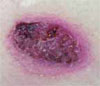
Discussion
The answer is C: blastomycosis. A pathology specimen from a left arm skin punch biopsy was read as pseudoepitheliomatous hyperplasia, dermal abscess, and broad-based yeast organisms suggestive of blastomycosis. Fungal cultures grew a white-like colony of hyphae suggestive of blastomycosis. DNA probe was positive for blastomycosis dermatitidis. Interestingly, his fungal serologies were negative. The patient was started on itraconazole 200 mg twice daily.
Blastomycosis typically presents in one of two ways:
- Pulmonary infection and/or
- Cutaneous infection.
Typically, the spores of Blastomyces dermatitidis are inhaled from the soil, decomposed vegetation, or rotting wood, and the respiratory system is the first site of infection. Occupations with frequent outdoor exposure in highly endemic areas (including the southeastern states of the United States) connote increased risk. Case series have documented inoculation arising after outdoor activities in the woods near water sources.
Although pulmonary infection is subclinical in 50% of inhalational cases, one study found that pulmonary manifestations were present in 154 of 170 cases (91%) with cough (90%), fever (75%), night sweats (68%), weight loss (66%), chest pain (63%), dyspnea (54%), and aches (50%). Therefore, respiratory symptoms may signal the disease.
According to another review of 100 cases in an endemic area, pulmonary blastomycosis should be considered for any pulmonary infiltrate, especially in the upper lobes. For this patient, because there were no pulmonary symptoms or cutaneous trauma, the most likely etiology is via hematogenous spread. However, whereas the chest radiograph did not show classic signs of blastomycosis (one or more densely consolidated areas of pneumonia or nodular infiltrates), it did show slight fibrosis and pleural thickenings in the apices that is occasionally associated with blastomycosis infection.
As in this case, a presenting cutaneous lesion may be the first sign of disease. The cutaneous findings are usually the result of hematogenous spread; however, uncommon primary cutaneous blastomycosis can occur after direct inoculation from trauma to the skin. Classically, they are described as well-demarcated papulopustules and verrucous plaques with central scarring and black crusting. But the skin lesions can present in many forms and often confound the differential diagnosis. Other cutaneous infectious etiologies include verrucae, nocardiosis, cutaneous tuberculosis, and other dimorphic fungi. However, other dimorphic fungi are less likely to infect the skin. Inflammatory conditions, such as pyoderma gangrenosum and sarcoidosis, must be considered. Ulcerating squamous cell carcinoma is also a consideration.
Blastomycosis is recognized histologically by its broad-based budding and thick, double-contoured walls of the yeast forms found at body temperature (37º C) while it grows as tan or white mold at room temperature. Cultures can be drawn from sputum, pus, or urine. Severe disease often requires systemic antifungal treatment, whereas more moderate to mild disease can be treated topically. TH
References
- Baumgardner DJ, Halsmer SE, Eagan G. Symptoms of pulmonary blastomycosis: northern Wisconsin, United States. Wilderness Environ Med. 2004;15:250-256.
- Patel RG, Patel B, Petrini MF, et al. Clinical presentation, radiographic findings, and diagnostic methods of pulmonary blastomycosis: a review of 100 consecutive cases. South Med J. 1999;92:289-295.
- Bolognia J, ed. Dermatology. Barcelona, Spain: Mosby; 2003.
- Kasper DL, ed. Harrison’s Online Principles of Internal Medicine. 16th ed. New York: McGraw-Hill; 2005.
A61-year-old farmer from Iowa with a medical history significant for non-Hodgkin’s lymphoma in remission presented for evaluation and treatment of two ulcerating lesions, located on his left forearm and left thigh of two months’ duration. He denied a history of pulmonary symptoms, fever, or unintentional weight loss. Physical examination was negative for lymphadenopathy or splenomegaly. Two large, beefy hyperkeratotic plaques with an underlying border with pustules were noted. The lesion shown is on the left lateral leg and is 5.3 x 4.0 cm.
What is your diagnosis:
- Cutaneous sarcoidosis;
- Recurrent lymphoma with skin metastasis;
- Blastomycosis;
- Pyoderma gangrenosum; or
- Anthrax.
Discussion
The answer is C: blastomycosis. A pathology specimen from a left arm skin punch biopsy was read as pseudoepitheliomatous hyperplasia, dermal abscess, and broad-based yeast organisms suggestive of blastomycosis. Fungal cultures grew a white-like colony of hyphae suggestive of blastomycosis. DNA probe was positive for blastomycosis dermatitidis. Interestingly, his fungal serologies were negative. The patient was started on itraconazole 200 mg twice daily.
Blastomycosis typically presents in one of two ways:
- Pulmonary infection and/or
- Cutaneous infection.
Typically, the spores of Blastomyces dermatitidis are inhaled from the soil, decomposed vegetation, or rotting wood, and the respiratory system is the first site of infection. Occupations with frequent outdoor exposure in highly endemic areas (including the southeastern states of the United States) connote increased risk. Case series have documented inoculation arising after outdoor activities in the woods near water sources.
Although pulmonary infection is subclinical in 50% of inhalational cases, one study found that pulmonary manifestations were present in 154 of 170 cases (91%) with cough (90%), fever (75%), night sweats (68%), weight loss (66%), chest pain (63%), dyspnea (54%), and aches (50%). Therefore, respiratory symptoms may signal the disease.
According to another review of 100 cases in an endemic area, pulmonary blastomycosis should be considered for any pulmonary infiltrate, especially in the upper lobes. For this patient, because there were no pulmonary symptoms or cutaneous trauma, the most likely etiology is via hematogenous spread. However, whereas the chest radiograph did not show classic signs of blastomycosis (one or more densely consolidated areas of pneumonia or nodular infiltrates), it did show slight fibrosis and pleural thickenings in the apices that is occasionally associated with blastomycosis infection.
As in this case, a presenting cutaneous lesion may be the first sign of disease. The cutaneous findings are usually the result of hematogenous spread; however, uncommon primary cutaneous blastomycosis can occur after direct inoculation from trauma to the skin. Classically, they are described as well-demarcated papulopustules and verrucous plaques with central scarring and black crusting. But the skin lesions can present in many forms and often confound the differential diagnosis. Other cutaneous infectious etiologies include verrucae, nocardiosis, cutaneous tuberculosis, and other dimorphic fungi. However, other dimorphic fungi are less likely to infect the skin. Inflammatory conditions, such as pyoderma gangrenosum and sarcoidosis, must be considered. Ulcerating squamous cell carcinoma is also a consideration.
Blastomycosis is recognized histologically by its broad-based budding and thick, double-contoured walls of the yeast forms found at body temperature (37º C) while it grows as tan or white mold at room temperature. Cultures can be drawn from sputum, pus, or urine. Severe disease often requires systemic antifungal treatment, whereas more moderate to mild disease can be treated topically. TH
References
- Baumgardner DJ, Halsmer SE, Eagan G. Symptoms of pulmonary blastomycosis: northern Wisconsin, United States. Wilderness Environ Med. 2004;15:250-256.
- Patel RG, Patel B, Petrini MF, et al. Clinical presentation, radiographic findings, and diagnostic methods of pulmonary blastomycosis: a review of 100 consecutive cases. South Med J. 1999;92:289-295.
- Bolognia J, ed. Dermatology. Barcelona, Spain: Mosby; 2003.
- Kasper DL, ed. Harrison’s Online Principles of Internal Medicine. 16th ed. New York: McGraw-Hill; 2005.
A61-year-old farmer from Iowa with a medical history significant for non-Hodgkin’s lymphoma in remission presented for evaluation and treatment of two ulcerating lesions, located on his left forearm and left thigh of two months’ duration. He denied a history of pulmonary symptoms, fever, or unintentional weight loss. Physical examination was negative for lymphadenopathy or splenomegaly. Two large, beefy hyperkeratotic plaques with an underlying border with pustules were noted. The lesion shown is on the left lateral leg and is 5.3 x 4.0 cm.
What is your diagnosis:
- Cutaneous sarcoidosis;
- Recurrent lymphoma with skin metastasis;
- Blastomycosis;
- Pyoderma gangrenosum; or
- Anthrax.
Discussion
The answer is C: blastomycosis. A pathology specimen from a left arm skin punch biopsy was read as pseudoepitheliomatous hyperplasia, dermal abscess, and broad-based yeast organisms suggestive of blastomycosis. Fungal cultures grew a white-like colony of hyphae suggestive of blastomycosis. DNA probe was positive for blastomycosis dermatitidis. Interestingly, his fungal serologies were negative. The patient was started on itraconazole 200 mg twice daily.
Blastomycosis typically presents in one of two ways:
- Pulmonary infection and/or
- Cutaneous infection.
Typically, the spores of Blastomyces dermatitidis are inhaled from the soil, decomposed vegetation, or rotting wood, and the respiratory system is the first site of infection. Occupations with frequent outdoor exposure in highly endemic areas (including the southeastern states of the United States) connote increased risk. Case series have documented inoculation arising after outdoor activities in the woods near water sources.
Although pulmonary infection is subclinical in 50% of inhalational cases, one study found that pulmonary manifestations were present in 154 of 170 cases (91%) with cough (90%), fever (75%), night sweats (68%), weight loss (66%), chest pain (63%), dyspnea (54%), and aches (50%). Therefore, respiratory symptoms may signal the disease.
According to another review of 100 cases in an endemic area, pulmonary blastomycosis should be considered for any pulmonary infiltrate, especially in the upper lobes. For this patient, because there were no pulmonary symptoms or cutaneous trauma, the most likely etiology is via hematogenous spread. However, whereas the chest radiograph did not show classic signs of blastomycosis (one or more densely consolidated areas of pneumonia or nodular infiltrates), it did show slight fibrosis and pleural thickenings in the apices that is occasionally associated with blastomycosis infection.
As in this case, a presenting cutaneous lesion may be the first sign of disease. The cutaneous findings are usually the result of hematogenous spread; however, uncommon primary cutaneous blastomycosis can occur after direct inoculation from trauma to the skin. Classically, they are described as well-demarcated papulopustules and verrucous plaques with central scarring and black crusting. But the skin lesions can present in many forms and often confound the differential diagnosis. Other cutaneous infectious etiologies include verrucae, nocardiosis, cutaneous tuberculosis, and other dimorphic fungi. However, other dimorphic fungi are less likely to infect the skin. Inflammatory conditions, such as pyoderma gangrenosum and sarcoidosis, must be considered. Ulcerating squamous cell carcinoma is also a consideration.
Blastomycosis is recognized histologically by its broad-based budding and thick, double-contoured walls of the yeast forms found at body temperature (37º C) while it grows as tan or white mold at room temperature. Cultures can be drawn from sputum, pus, or urine. Severe disease often requires systemic antifungal treatment, whereas more moderate to mild disease can be treated topically. TH
References
- Baumgardner DJ, Halsmer SE, Eagan G. Symptoms of pulmonary blastomycosis: northern Wisconsin, United States. Wilderness Environ Med. 2004;15:250-256.
- Patel RG, Patel B, Petrini MF, et al. Clinical presentation, radiographic findings, and diagnostic methods of pulmonary blastomycosis: a review of 100 consecutive cases. South Med J. 1999;92:289-295.
- Bolognia J, ed. Dermatology. Barcelona, Spain: Mosby; 2003.
- Kasper DL, ed. Harrison’s Online Principles of Internal Medicine. 16th ed. New York: McGraw-Hill; 2005.
Improve Glycemic Control in Inpatients
For most of recent history, it has been standard practice to tolerate hyperglycemia and expect some hypoglycemia when caring for diabetic patients in the hospital. This attitude stems from the many barriers to controlling glucose levels in hospitalized patients (e.g., the stress of acute illness and the changes in diet and medications that occur on admission to the hospital). In addition, most diabetic patients are hospitalized for illness other than their diabetes. In these situations, glycemic control may not be a priority, and fear of hypoglycemia may be prominent.
However, in recent years, there has been a change in attitude regarding glycemic control in the hospitalized patient. Recently, clinical studies have shown that hyperglycemia leads to poor outcomes in some hospitalized patients, prompting the American College of Endocrinology and the American Association of Clinical Endocrinologists to publish a position statement on inpatient diabetes and metabolic control.1 In addition, best practice strategies for controlling glucose levels in hospitalized patients have been recently reviewed.2
At the same time, hospitalists have emerged on the scene, bringing with them a new awareness of the gaps between the best practice and real practice. In real practice, both hyperglycemia and hypoglycemia are common, and insulin use in the hospital is often guided by strategies that are based on simplicity, instead of strategies that are based on established principles of diabetes management. There has been remarkably little attention given to the management of diabetes and hyperglycemia in noncritically ill hospitalized patients, and glucose levels are often far outside of the recommended range in this group.
SHM’s Glycemic Control Task Force
The Glycemic Control Task Force was assembled with the intent of improving glycemic control in hospitals nationally by providing hospitalists with an understanding of the best practice of glycemic control in the hospital, and by providing them with the tools and skills to make real changes in their own systems. With the assistance of a grant from Sanofi-Aventis, the Glycemic Control Summit was held on Oct. 20, 2005, in Chicago. A distinguished panel of experts attended, including hospitalists, endocrinologists, nurses, case managers, diabetes educators, and pharmacists. The goals of the meeting were as follows:
- To identify the currently available resources pertinent to glycemic control in the hospital (e.g., resources related to best practice, education, quality improvement, awareness, clinical tools, research, metrics/quality parameters);
- To identify the gaps in those resources; and
- To assemble several focused work groups to address the major gaps in the existing resources, and to determine specific interventions or products that could fill those gaps.
The meeting spawned several smaller work groups that will address the major barriers to improving glycemic control in hospitalized patients. These groups were formed in direct response to the gaps that were identified during the meeting. A description of each of the work groups is provided below, highlighting the major gaps that were identified and the strategies being considered to overcome them.
Education: This group will focus on creating case-based, educational materials that will provide physicians, nurses, and other providers with pragmatic examples illustrating the best practice of glycemic control and insulin management in the hospital and at the transition of care. In addition, this group will address patient education issues, educational metrics, and other issues.
Potential deliverables from this group include Web-based, case-based educational modules applicable to CME or to support quality improvement efforts at individual institutions and patient education materials.
Quality improvement process: This group will focus on formulating a how-to resource for performing quality improvement projects related to glycemic control. This group will attempt to provide hospitalists with a practical guideline to help them successfully implement changes in their own institutions. Topics will include forming and leading a multidisciplinary team, setting goals, defining metrics, and identifying process analysis and evaluation methods.
Deliverables from this group will likely include a glycemic control quality improvement workbook that will guide individuals through the complex process of performing robust quality improvement projects in their own hospitals. This workbook will be similar in format to one that is currently available in the “VTE Quality Improvement Resource Room” on the SHM Web site.
Clinical tools: This group will focus on compiling and appraising already existing clinical tools (e.g., standardized order sets, protocols) and identifying the key features of these tools and the differences among them. The emphasis will be on either compiling or creating ready-to-use clinical tools.
Potential deliverables from this group include a collection of tools that will have substantial built-in decision support and will be useful in a range of settings. These might include standardized order sets, protocols, and charting tools.
Metrics: This group will focus on defining useful metrics for performing glycemic control research and quality improvement projects. This group intends to define the best ways to measure glycemic control, balancing measures, process measures, and other specific outcomes. These metrics will allow hospitals to examine their current performance and to develop quality standards for inpatient glycemic control.
Care transitions: This group is charged with beginning to identify and address the many challenges that are faced when diabetic and/or hyperglycemic patients move from one care setting to another (e.g., ICU to general ward, hospital to outpatient setting). The work done by this group is likely to have an impact on all of the other groups.
Potential deliverables from this group include a set of standards that can be applied to care transitions. There may also be specific clinical tools developed to improve the process of these care transitions, such as checklists, order sets, and protocols.
Promotional: This group will focus on creating national awareness of the importance of glycemic control in hospitals, particularly at the administrative level. This may include efforts to partner with relevant medical societies, regulatory agencies, and other professional organizations focused on improving glycemic control.
Goals and Timelines
The three-month goal is for each of the focus groups is to further delineate the gaps in the existing resources, and to further refine the specific deliverables that they will produce. Each group will need to determine specific goals and timelines.
An intermediate-term goal is the formation of a white paper that will describe, in detail, the existing glycemic control resources, the gaps in these resources, and the need for additional work in these areas.
In addition, work on the glycemic control quality improvement workbook is under way, and this resource will be used in the “Quality Improvement Precourse” that will take place May 3, 2006, at the SHM Annual Meeting.
The work being done by this task force will lead to a collection of high-quality, user-friendly resources that will enhance awareness of the issue of inpatient glycemic control and facilitate the implementation of effective inpatient diabetes quality improvement across the nation. The longer term goal will be to bring about demonstration projects in the area of inpatient glycemic control and advance the science of diabetes care in the hospital.
References
- American College of Endocrinology Task Force on Inpatient Diabetes and Metabolic Control. American College of Endocrinology position statement on inpatient diabetes and metabolic control. Endocr Prac. 2004;10:77-82.
- Clement S, Braithwaite SS, Magee MF, et al. Management of diabetes and hyperglycemia in hospitals. Diabetes Care. 2004;27:553-591.
Non-Physician Provider Task Force Progress
Annual meeting workshop plans, plus continued Web development
Shm’s Non-Physician Provider Task Force has continued to meet via conference calls on a regular basis. The task force now has representation from the ranks of nurse practitioners, physician assistants, hospitalist clinical care coordinators, health systems pharmacists, and hospitalist physicians. We realize that there are many other professionals vital to hospital medicine and plan to recruit more representatives from the SHM member ranks as qualified individuals are brought to our attention.
Task force members will provide important contributions to the annual meeting. The special interest forum on non-physician providers in hospital medicine has been growing each year. This forum is an important venue for exchanging ideas and meeting fellow professionals. It also gives the task force members a chance to make contact with individuals who want to get involved in Non-Physician Provider Task Force activities.
This year task force members Scarlett Blue, RNC, MSN, CNA, and Ryan Genzink, PAC, will lead the forum. Mitchell Wilson, MD, will lead a workshop, “Integrating Non-Physician Providers into Hospital Medicine Services.” National trends that include decreasing availability of generalist physicians, decreasing workloads for resident physicians, and the rapid growth in hospital medicine as a specialty will make this workshop vital to SHM members faced with these pressures.
The task force remains interested in developing a network for communication within the community of professionals in hospital medicine who have an interest in non-physician provider issues and practice. The Hub-and-Spoke initiative is intended to provide a network to allow more individuals to provide input to the task force. The forum at the annual meeting will be an opportunity to meet task force members, exchange e-mail addresses, and discuss how to become involved.
SHM’s Web site has a link for “Non-Physician Provider Resources,” and the task force has continued to work on the content of this site. The priorities for expansion include adding staffing models, billing and documentation resources, value added by non-physician providers, and FAQs. The task force welcomes SHM members to submit documents for posting to the resource center.
For most of recent history, it has been standard practice to tolerate hyperglycemia and expect some hypoglycemia when caring for diabetic patients in the hospital. This attitude stems from the many barriers to controlling glucose levels in hospitalized patients (e.g., the stress of acute illness and the changes in diet and medications that occur on admission to the hospital). In addition, most diabetic patients are hospitalized for illness other than their diabetes. In these situations, glycemic control may not be a priority, and fear of hypoglycemia may be prominent.
However, in recent years, there has been a change in attitude regarding glycemic control in the hospitalized patient. Recently, clinical studies have shown that hyperglycemia leads to poor outcomes in some hospitalized patients, prompting the American College of Endocrinology and the American Association of Clinical Endocrinologists to publish a position statement on inpatient diabetes and metabolic control.1 In addition, best practice strategies for controlling glucose levels in hospitalized patients have been recently reviewed.2
At the same time, hospitalists have emerged on the scene, bringing with them a new awareness of the gaps between the best practice and real practice. In real practice, both hyperglycemia and hypoglycemia are common, and insulin use in the hospital is often guided by strategies that are based on simplicity, instead of strategies that are based on established principles of diabetes management. There has been remarkably little attention given to the management of diabetes and hyperglycemia in noncritically ill hospitalized patients, and glucose levels are often far outside of the recommended range in this group.
SHM’s Glycemic Control Task Force
The Glycemic Control Task Force was assembled with the intent of improving glycemic control in hospitals nationally by providing hospitalists with an understanding of the best practice of glycemic control in the hospital, and by providing them with the tools and skills to make real changes in their own systems. With the assistance of a grant from Sanofi-Aventis, the Glycemic Control Summit was held on Oct. 20, 2005, in Chicago. A distinguished panel of experts attended, including hospitalists, endocrinologists, nurses, case managers, diabetes educators, and pharmacists. The goals of the meeting were as follows:
- To identify the currently available resources pertinent to glycemic control in the hospital (e.g., resources related to best practice, education, quality improvement, awareness, clinical tools, research, metrics/quality parameters);
- To identify the gaps in those resources; and
- To assemble several focused work groups to address the major gaps in the existing resources, and to determine specific interventions or products that could fill those gaps.
The meeting spawned several smaller work groups that will address the major barriers to improving glycemic control in hospitalized patients. These groups were formed in direct response to the gaps that were identified during the meeting. A description of each of the work groups is provided below, highlighting the major gaps that were identified and the strategies being considered to overcome them.
Education: This group will focus on creating case-based, educational materials that will provide physicians, nurses, and other providers with pragmatic examples illustrating the best practice of glycemic control and insulin management in the hospital and at the transition of care. In addition, this group will address patient education issues, educational metrics, and other issues.
Potential deliverables from this group include Web-based, case-based educational modules applicable to CME or to support quality improvement efforts at individual institutions and patient education materials.
Quality improvement process: This group will focus on formulating a how-to resource for performing quality improvement projects related to glycemic control. This group will attempt to provide hospitalists with a practical guideline to help them successfully implement changes in their own institutions. Topics will include forming and leading a multidisciplinary team, setting goals, defining metrics, and identifying process analysis and evaluation methods.
Deliverables from this group will likely include a glycemic control quality improvement workbook that will guide individuals through the complex process of performing robust quality improvement projects in their own hospitals. This workbook will be similar in format to one that is currently available in the “VTE Quality Improvement Resource Room” on the SHM Web site.
Clinical tools: This group will focus on compiling and appraising already existing clinical tools (e.g., standardized order sets, protocols) and identifying the key features of these tools and the differences among them. The emphasis will be on either compiling or creating ready-to-use clinical tools.
Potential deliverables from this group include a collection of tools that will have substantial built-in decision support and will be useful in a range of settings. These might include standardized order sets, protocols, and charting tools.
Metrics: This group will focus on defining useful metrics for performing glycemic control research and quality improvement projects. This group intends to define the best ways to measure glycemic control, balancing measures, process measures, and other specific outcomes. These metrics will allow hospitals to examine their current performance and to develop quality standards for inpatient glycemic control.
Care transitions: This group is charged with beginning to identify and address the many challenges that are faced when diabetic and/or hyperglycemic patients move from one care setting to another (e.g., ICU to general ward, hospital to outpatient setting). The work done by this group is likely to have an impact on all of the other groups.
Potential deliverables from this group include a set of standards that can be applied to care transitions. There may also be specific clinical tools developed to improve the process of these care transitions, such as checklists, order sets, and protocols.
Promotional: This group will focus on creating national awareness of the importance of glycemic control in hospitals, particularly at the administrative level. This may include efforts to partner with relevant medical societies, regulatory agencies, and other professional organizations focused on improving glycemic control.
Goals and Timelines
The three-month goal is for each of the focus groups is to further delineate the gaps in the existing resources, and to further refine the specific deliverables that they will produce. Each group will need to determine specific goals and timelines.
An intermediate-term goal is the formation of a white paper that will describe, in detail, the existing glycemic control resources, the gaps in these resources, and the need for additional work in these areas.
In addition, work on the glycemic control quality improvement workbook is under way, and this resource will be used in the “Quality Improvement Precourse” that will take place May 3, 2006, at the SHM Annual Meeting.
The work being done by this task force will lead to a collection of high-quality, user-friendly resources that will enhance awareness of the issue of inpatient glycemic control and facilitate the implementation of effective inpatient diabetes quality improvement across the nation. The longer term goal will be to bring about demonstration projects in the area of inpatient glycemic control and advance the science of diabetes care in the hospital.
References
- American College of Endocrinology Task Force on Inpatient Diabetes and Metabolic Control. American College of Endocrinology position statement on inpatient diabetes and metabolic control. Endocr Prac. 2004;10:77-82.
- Clement S, Braithwaite SS, Magee MF, et al. Management of diabetes and hyperglycemia in hospitals. Diabetes Care. 2004;27:553-591.
Non-Physician Provider Task Force Progress
Annual meeting workshop plans, plus continued Web development
Shm’s Non-Physician Provider Task Force has continued to meet via conference calls on a regular basis. The task force now has representation from the ranks of nurse practitioners, physician assistants, hospitalist clinical care coordinators, health systems pharmacists, and hospitalist physicians. We realize that there are many other professionals vital to hospital medicine and plan to recruit more representatives from the SHM member ranks as qualified individuals are brought to our attention.
Task force members will provide important contributions to the annual meeting. The special interest forum on non-physician providers in hospital medicine has been growing each year. This forum is an important venue for exchanging ideas and meeting fellow professionals. It also gives the task force members a chance to make contact with individuals who want to get involved in Non-Physician Provider Task Force activities.
This year task force members Scarlett Blue, RNC, MSN, CNA, and Ryan Genzink, PAC, will lead the forum. Mitchell Wilson, MD, will lead a workshop, “Integrating Non-Physician Providers into Hospital Medicine Services.” National trends that include decreasing availability of generalist physicians, decreasing workloads for resident physicians, and the rapid growth in hospital medicine as a specialty will make this workshop vital to SHM members faced with these pressures.
The task force remains interested in developing a network for communication within the community of professionals in hospital medicine who have an interest in non-physician provider issues and practice. The Hub-and-Spoke initiative is intended to provide a network to allow more individuals to provide input to the task force. The forum at the annual meeting will be an opportunity to meet task force members, exchange e-mail addresses, and discuss how to become involved.
SHM’s Web site has a link for “Non-Physician Provider Resources,” and the task force has continued to work on the content of this site. The priorities for expansion include adding staffing models, billing and documentation resources, value added by non-physician providers, and FAQs. The task force welcomes SHM members to submit documents for posting to the resource center.
For most of recent history, it has been standard practice to tolerate hyperglycemia and expect some hypoglycemia when caring for diabetic patients in the hospital. This attitude stems from the many barriers to controlling glucose levels in hospitalized patients (e.g., the stress of acute illness and the changes in diet and medications that occur on admission to the hospital). In addition, most diabetic patients are hospitalized for illness other than their diabetes. In these situations, glycemic control may not be a priority, and fear of hypoglycemia may be prominent.
However, in recent years, there has been a change in attitude regarding glycemic control in the hospitalized patient. Recently, clinical studies have shown that hyperglycemia leads to poor outcomes in some hospitalized patients, prompting the American College of Endocrinology and the American Association of Clinical Endocrinologists to publish a position statement on inpatient diabetes and metabolic control.1 In addition, best practice strategies for controlling glucose levels in hospitalized patients have been recently reviewed.2
At the same time, hospitalists have emerged on the scene, bringing with them a new awareness of the gaps between the best practice and real practice. In real practice, both hyperglycemia and hypoglycemia are common, and insulin use in the hospital is often guided by strategies that are based on simplicity, instead of strategies that are based on established principles of diabetes management. There has been remarkably little attention given to the management of diabetes and hyperglycemia in noncritically ill hospitalized patients, and glucose levels are often far outside of the recommended range in this group.
SHM’s Glycemic Control Task Force
The Glycemic Control Task Force was assembled with the intent of improving glycemic control in hospitals nationally by providing hospitalists with an understanding of the best practice of glycemic control in the hospital, and by providing them with the tools and skills to make real changes in their own systems. With the assistance of a grant from Sanofi-Aventis, the Glycemic Control Summit was held on Oct. 20, 2005, in Chicago. A distinguished panel of experts attended, including hospitalists, endocrinologists, nurses, case managers, diabetes educators, and pharmacists. The goals of the meeting were as follows:
- To identify the currently available resources pertinent to glycemic control in the hospital (e.g., resources related to best practice, education, quality improvement, awareness, clinical tools, research, metrics/quality parameters);
- To identify the gaps in those resources; and
- To assemble several focused work groups to address the major gaps in the existing resources, and to determine specific interventions or products that could fill those gaps.
The meeting spawned several smaller work groups that will address the major barriers to improving glycemic control in hospitalized patients. These groups were formed in direct response to the gaps that were identified during the meeting. A description of each of the work groups is provided below, highlighting the major gaps that were identified and the strategies being considered to overcome them.
Education: This group will focus on creating case-based, educational materials that will provide physicians, nurses, and other providers with pragmatic examples illustrating the best practice of glycemic control and insulin management in the hospital and at the transition of care. In addition, this group will address patient education issues, educational metrics, and other issues.
Potential deliverables from this group include Web-based, case-based educational modules applicable to CME or to support quality improvement efforts at individual institutions and patient education materials.
Quality improvement process: This group will focus on formulating a how-to resource for performing quality improvement projects related to glycemic control. This group will attempt to provide hospitalists with a practical guideline to help them successfully implement changes in their own institutions. Topics will include forming and leading a multidisciplinary team, setting goals, defining metrics, and identifying process analysis and evaluation methods.
Deliverables from this group will likely include a glycemic control quality improvement workbook that will guide individuals through the complex process of performing robust quality improvement projects in their own hospitals. This workbook will be similar in format to one that is currently available in the “VTE Quality Improvement Resource Room” on the SHM Web site.
Clinical tools: This group will focus on compiling and appraising already existing clinical tools (e.g., standardized order sets, protocols) and identifying the key features of these tools and the differences among them. The emphasis will be on either compiling or creating ready-to-use clinical tools.
Potential deliverables from this group include a collection of tools that will have substantial built-in decision support and will be useful in a range of settings. These might include standardized order sets, protocols, and charting tools.
Metrics: This group will focus on defining useful metrics for performing glycemic control research and quality improvement projects. This group intends to define the best ways to measure glycemic control, balancing measures, process measures, and other specific outcomes. These metrics will allow hospitals to examine their current performance and to develop quality standards for inpatient glycemic control.
Care transitions: This group is charged with beginning to identify and address the many challenges that are faced when diabetic and/or hyperglycemic patients move from one care setting to another (e.g., ICU to general ward, hospital to outpatient setting). The work done by this group is likely to have an impact on all of the other groups.
Potential deliverables from this group include a set of standards that can be applied to care transitions. There may also be specific clinical tools developed to improve the process of these care transitions, such as checklists, order sets, and protocols.
Promotional: This group will focus on creating national awareness of the importance of glycemic control in hospitals, particularly at the administrative level. This may include efforts to partner with relevant medical societies, regulatory agencies, and other professional organizations focused on improving glycemic control.
Goals and Timelines
The three-month goal is for each of the focus groups is to further delineate the gaps in the existing resources, and to further refine the specific deliverables that they will produce. Each group will need to determine specific goals and timelines.
An intermediate-term goal is the formation of a white paper that will describe, in detail, the existing glycemic control resources, the gaps in these resources, and the need for additional work in these areas.
In addition, work on the glycemic control quality improvement workbook is under way, and this resource will be used in the “Quality Improvement Precourse” that will take place May 3, 2006, at the SHM Annual Meeting.
The work being done by this task force will lead to a collection of high-quality, user-friendly resources that will enhance awareness of the issue of inpatient glycemic control and facilitate the implementation of effective inpatient diabetes quality improvement across the nation. The longer term goal will be to bring about demonstration projects in the area of inpatient glycemic control and advance the science of diabetes care in the hospital.
References
- American College of Endocrinology Task Force on Inpatient Diabetes and Metabolic Control. American College of Endocrinology position statement on inpatient diabetes and metabolic control. Endocr Prac. 2004;10:77-82.
- Clement S, Braithwaite SS, Magee MF, et al. Management of diabetes and hyperglycemia in hospitals. Diabetes Care. 2004;27:553-591.
Non-Physician Provider Task Force Progress
Annual meeting workshop plans, plus continued Web development
Shm’s Non-Physician Provider Task Force has continued to meet via conference calls on a regular basis. The task force now has representation from the ranks of nurse practitioners, physician assistants, hospitalist clinical care coordinators, health systems pharmacists, and hospitalist physicians. We realize that there are many other professionals vital to hospital medicine and plan to recruit more representatives from the SHM member ranks as qualified individuals are brought to our attention.
Task force members will provide important contributions to the annual meeting. The special interest forum on non-physician providers in hospital medicine has been growing each year. This forum is an important venue for exchanging ideas and meeting fellow professionals. It also gives the task force members a chance to make contact with individuals who want to get involved in Non-Physician Provider Task Force activities.
This year task force members Scarlett Blue, RNC, MSN, CNA, and Ryan Genzink, PAC, will lead the forum. Mitchell Wilson, MD, will lead a workshop, “Integrating Non-Physician Providers into Hospital Medicine Services.” National trends that include decreasing availability of generalist physicians, decreasing workloads for resident physicians, and the rapid growth in hospital medicine as a specialty will make this workshop vital to SHM members faced with these pressures.
The task force remains interested in developing a network for communication within the community of professionals in hospital medicine who have an interest in non-physician provider issues and practice. The Hub-and-Spoke initiative is intended to provide a network to allow more individuals to provide input to the task force. The forum at the annual meeting will be an opportunity to meet task force members, exchange e-mail addresses, and discuss how to become involved.
SHM’s Web site has a link for “Non-Physician Provider Resources,” and the task force has continued to work on the content of this site. The priorities for expansion include adding staffing models, billing and documentation resources, value added by non-physician providers, and FAQs. The task force welcomes SHM members to submit documents for posting to the resource center.
Top PICS
Busy community physicians planted the seeds of Charlotte, N.C., Presbyterian Hospital’s hospitalist program in the late 1990s. The hospital, which anchors Novant Health’s presence in North Carolina’s Southern Piedmont region, is a 460-bed tertiary care hospital offering emergency, medical, surgical, and behavioral services.
Novant, the parent company, is a nonprofit healthcare system headquartered in Winston-Salem. Adjacent to Presbyterian Hospital and joined by skywalks is the Presbyterian Orthopedic Hospital. Two community hospitals, Presbyterian Hospital Matthews (10 miles south in suburban Charlotte) and Presbyterian Hospital Huntersville (16 miles north and close to an interstate) complete the Charlotte Presbyterian Hospital system.
By 1997 Charlotte’s population was growing so quickly its office-based physicians struggled to cover night calls or leave their office practices during the day to admit patients to the hospital. Presbyterian Hospital answered by forming an Inpatient Management Team (IMT) of five hospitalist internists to handle admissions for community internists from 5 p.m. to 7 a.m. Monday through Friday and on weekends.
While the internists delegated admissions to the IMT, they subsequently managed their own patients. Family practitioners, on the other hand, usually delegated the care of their inpatients to the IMT from admission to discharge. Steven Wallenhaupt, MD, and Presbyterian’s executive vice president of medical affairs says that the evening hours overwhelmed local physicians—particularly those who had moved to the Charlotte area for a decent lifestyle.
“It’s really not all about the money—either for the hospitalists or community doctors,” he explains. “It’s about wanting to have a good life and to practice good medicine.”
Mary Le-Bliss, MD, a Presbyterian Hospital clinical director, was one of the original IMT hospitalists. She explains what happened next, in 1999. “Three of the IMT physicians weren’t happy. They felt we were just running an admitting service,” she says. “They wanted something bigger—to manage patients throughout their stay—so they resigned.”
That was a wake-up call. While some community physicians still resisted turning over their patients completely to the hospitalists, a large majority decided to work with the hospitalists. The two groups of physicians (community-based and inpatient) found ways to coexist, hammering out a written agreement that community doctors sign to empower Presbyterian’s hospitalists to follow their hospitalized patients.
“It was nothing out of their pockets, they had an affiliation and the hospitalists got what they wanted,” notes Dr. Wallenhaupt.
So in1999 a new hospitalist program was born—the Presbyterian Inpatient Care Services (PICS) team, replacing its predecessor, IMT. PICS started with eight internists providing 24/7 coverage at Presbyterian Hospital and the adjacent Presbyterian Orthopedic Hospital. In April 1999 PICS expanded to the Matthews campus, where, for the first six months, the Matthews hospitalists worked 6 a.m. to 6 p.m. shifts, with the community physicians covering after hours.
By fall 1999 the PICS team at Matthews had grown to four physicians, enabling its own 24/7 coverage. In November 2004 when Presbyterian opened a community hospital in Huntersville, its PICS team provided 24/7 coverage of from the beginning.
Since early 1999 PICS has grown to 43 staff providers plus moonlighters, offering 24/7 coverage at the four hospitals. PICS maintains coverage agreements with approximately 330 primary care physicians, and provides consulting services for specialists throughout the South Piedmont region
To enhance communication, PICS providers leave voice messages summarizing the patients’ hospital stay with the primary at the time of patient admission and discharge. Additionally, most of the primary care practices have access to the hospital information system, including all notes dictated at the hospital as soon as they are transcribed.
Room to Roam
One of the hospitalist movement’s greatest contributions to the practice of medicine is its ability to spur innovation. Because hospitalists spend their work lives in hospitals, they can diagnose what has to be done to make things work better and implement new programs and processes to do that.
John Gardella, MD, MBA, of the Presbyterian Hospital Matthews PICS team, a transplant from New York to Charlotte in 1979, and the self-described “old man of the hospitalist team,” has done just that at Presbyterian. Dr. Gardella and other leaders stimulated development of orthopedic hospitalists, stroke center hospitalists, the nocturnist program (the 11 p.m. to 7 a.m. shift), and many best practices and order sets.
Dr. Gardella cites the work of hospitalist Jeanne Huddleston, MD, at the Mayo Clinic as the inspiration for Presbyterian’s orthopedic hospitalist program.
“The way she was managing comorbidities encouraged us to try to clone the program here and address the many needs of our elderly orthopedic patients,” says Dr. Gardella.
In August 2003, Presbyterian Orthopedic Hospital opened a preoperative service directed by Sarah Reynolds, MD. Now, with support from the referring orthopedic surgeons, the PICS team handles perioperative situations such as diabetes, hypertension, sleep medication, urinary incontinence and antibiotic prescriptions.
Also in 2003 the hospital added a PICS neurology team. (See “Hospitalist Specialist—the PICS Neurology Team,” left.)
A Balanced Life
Presbyterian Hospital’s administrators realized that providing a decent lifestyle for hospitalists, one that allowed doctors to have adequate free time and to provide quality care, was essential to avoiding stress and burnout. Dr. Wallenhaupt says that compensation is based on Medical Group Management Association salary recommendations plus incentives for productivity (relative value units). Shortened hours such as the nocturnist shift, which is an eight-hour rather than the usual 12-hour shift for the same pay, compensates for the inconveniences of night duty.
Vital to the PICS team’s success is a manageable caseload for each physician. While it may seem obvious that a reasonable average daily census would result in better patient care and reduced length of stay, Dr. Gardella has documented the correlation between the two (see chart below):
In pursuit of a balanced life, all hospitalist-internists work one week on followed by one week off (generally in 12-hour shifts) and can voluntarily moonlight during their week off. To help ease the workload during the emergency department’s busiest time, another physician works from 2 p.m. to midnight, handling admissions and consultations from the emergency department and the medical-surgical units, as well as phone consultations with community physicians. During the day nurses, nurse practitioners, and physicians assistants help with admissions, rounds, discharge planning, patient education, and follow-up with primary care physicians.
Solving one of medicine’s biggest headaches—night coverage—Presbyterian recruited Floyd Hale, MD, and Peter Le, MD, as nocturnists. In addition, moonlighters are recruited to work a short night shift from 6 p.m. to midnight, assisting with emergency department admissions when things get hectic.
At the community hospitals in Matthews and Huntersville, the PICS teams admit and manage the majority of the medical cases and provide consultation for the emergency department and the specialists on staff. The Matthews and Huntersville PICS teams also provide code blue and ICU coverage. Because the PICS MDs in the community hospitals are responsible for patient management and consultation in the ICU, all the physicians are expected to receive certification in the fundamentals of critical care and life support.
Financial Performance, Quality
Financially, the PICS team has been a boon to the hospital system. Gross patient revenue generated by the team grew from $2.2 million in 1999 to nearly $8 million in 2004, representing 28% compound annual growth. Over the same time period, operating expenses grew from $1.8 million to $4.5 million, representing 20% compound annual growth. Administrative support of the PICS team has actually dropped from $1.8 million or 32% of gross revenue in 1999 to $971,000 in 2004.
The PICS team has boosted revenues by reducing average length of stay, from .83 days for all patients and 1.36 days for Medicare diagnosis-related groups. Dr. Gardella calculated that reducing length of stay allows the hospitals to handle 1,300 more cases a year, which brought in an additional $10.4 million last year.
Although the PICS cadre is more than 40 strong, team members are well connected to improve efficiency and reduce wasted time. E-mails, an intranet, team leaders disseminating order sets and guidelines, and lunch-and-learn educational programs sponsored by vendors keep everyone informed. Small teams meet over lunch once a week, while the entire PICS team meets monthly to discuss business over pizza.
Presbyterian Hospital has long tracked clinical as well as financial metrics, and it compares favorably with other national and regional hospitals.

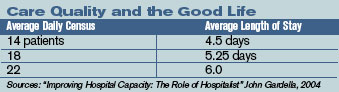
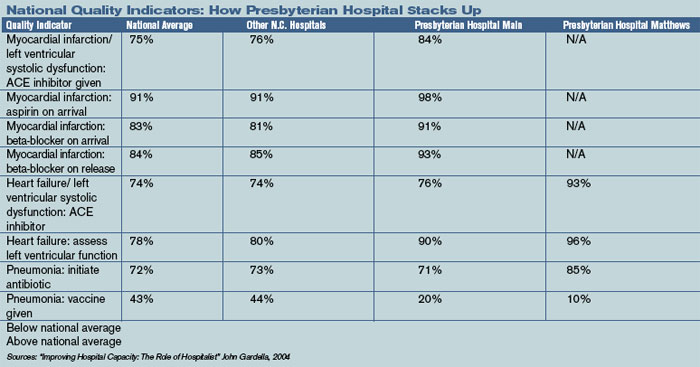
Publicly available data from CMS show that comparison. (See “National Quality Indicators: How Presbyterian Hospital Stacks Up,” p. 24.)
With care quality now reported so openly, Presbyterian Hospital’s administration, in conjunction with PICS leaders, is revising the PICS compensation package, which is now a combination of fixed salary plus productivity relative value units. The leaders are attempting to create financial incentives for order set usage and compliance with core measures.
At present, the PICS team manages about 70% of the internal medicine admissions at Presbyterian Hospital, and nearly all the medical cases at the Matthews and Huntersville sites. It is anticipated that the trend toward using hospitalists for inpatient management will continue. Further, it is likely that all orthopedic patients, or at least those with comorbidities, will be comanaged by the PICS team and their referring physicians.
Checklist for Change
The PICS team is instrumental in leading patient safety and quality improvement initiatives throughout the Charlotte, N.C., Presbyterian system. Among the operational improvement initiatives:
- Developing order sets in anticipation of computerized physician order entry;
- Working with the Institute of Healthcare Improvement’s 100,000 Lives Campaign. In particular assisting with the development of a medical response team and with medication reconciliation (www.ihi.org, click on “100,000 lives campaign”);
- Improving the care of hospitalized diabetics via participation in VHA’s Project Diabetes (VHA is a national alliance of nonprofit healthcare providers based in Irving, Texas);
- Helping develop a direct admission unit to reduce emergency department workload while providing better service for patients;
- Working with nursing to create a more team-oriented approach to inpatient management; and
- Working with the Operation Improvement group on initiatives to improve throughput.
Conclusion
Charlotte’s Presbyterian Hospital hospitalist program has grown rapidly. From its inception as an admitting service for busy community physicians, through an inpatient management team at the main hospital, to a group that now covers three hospitals and has specialists in orthopedics and neurology, the PICS team has learned to manage change and to grow successfully. More than 40 strong, they’re well equipped to keep pursuing the quest for quality, both at the hospital and as part of a national effort. TH
Writer Marlene Piturro is based in New York.
Busy community physicians planted the seeds of Charlotte, N.C., Presbyterian Hospital’s hospitalist program in the late 1990s. The hospital, which anchors Novant Health’s presence in North Carolina’s Southern Piedmont region, is a 460-bed tertiary care hospital offering emergency, medical, surgical, and behavioral services.
Novant, the parent company, is a nonprofit healthcare system headquartered in Winston-Salem. Adjacent to Presbyterian Hospital and joined by skywalks is the Presbyterian Orthopedic Hospital. Two community hospitals, Presbyterian Hospital Matthews (10 miles south in suburban Charlotte) and Presbyterian Hospital Huntersville (16 miles north and close to an interstate) complete the Charlotte Presbyterian Hospital system.
By 1997 Charlotte’s population was growing so quickly its office-based physicians struggled to cover night calls or leave their office practices during the day to admit patients to the hospital. Presbyterian Hospital answered by forming an Inpatient Management Team (IMT) of five hospitalist internists to handle admissions for community internists from 5 p.m. to 7 a.m. Monday through Friday and on weekends.
While the internists delegated admissions to the IMT, they subsequently managed their own patients. Family practitioners, on the other hand, usually delegated the care of their inpatients to the IMT from admission to discharge. Steven Wallenhaupt, MD, and Presbyterian’s executive vice president of medical affairs says that the evening hours overwhelmed local physicians—particularly those who had moved to the Charlotte area for a decent lifestyle.
“It’s really not all about the money—either for the hospitalists or community doctors,” he explains. “It’s about wanting to have a good life and to practice good medicine.”
Mary Le-Bliss, MD, a Presbyterian Hospital clinical director, was one of the original IMT hospitalists. She explains what happened next, in 1999. “Three of the IMT physicians weren’t happy. They felt we were just running an admitting service,” she says. “They wanted something bigger—to manage patients throughout their stay—so they resigned.”
That was a wake-up call. While some community physicians still resisted turning over their patients completely to the hospitalists, a large majority decided to work with the hospitalists. The two groups of physicians (community-based and inpatient) found ways to coexist, hammering out a written agreement that community doctors sign to empower Presbyterian’s hospitalists to follow their hospitalized patients.
“It was nothing out of their pockets, they had an affiliation and the hospitalists got what they wanted,” notes Dr. Wallenhaupt.
So in1999 a new hospitalist program was born—the Presbyterian Inpatient Care Services (PICS) team, replacing its predecessor, IMT. PICS started with eight internists providing 24/7 coverage at Presbyterian Hospital and the adjacent Presbyterian Orthopedic Hospital. In April 1999 PICS expanded to the Matthews campus, where, for the first six months, the Matthews hospitalists worked 6 a.m. to 6 p.m. shifts, with the community physicians covering after hours.
By fall 1999 the PICS team at Matthews had grown to four physicians, enabling its own 24/7 coverage. In November 2004 when Presbyterian opened a community hospital in Huntersville, its PICS team provided 24/7 coverage of from the beginning.
Since early 1999 PICS has grown to 43 staff providers plus moonlighters, offering 24/7 coverage at the four hospitals. PICS maintains coverage agreements with approximately 330 primary care physicians, and provides consulting services for specialists throughout the South Piedmont region
To enhance communication, PICS providers leave voice messages summarizing the patients’ hospital stay with the primary at the time of patient admission and discharge. Additionally, most of the primary care practices have access to the hospital information system, including all notes dictated at the hospital as soon as they are transcribed.
Room to Roam
One of the hospitalist movement’s greatest contributions to the practice of medicine is its ability to spur innovation. Because hospitalists spend their work lives in hospitals, they can diagnose what has to be done to make things work better and implement new programs and processes to do that.
John Gardella, MD, MBA, of the Presbyterian Hospital Matthews PICS team, a transplant from New York to Charlotte in 1979, and the self-described “old man of the hospitalist team,” has done just that at Presbyterian. Dr. Gardella and other leaders stimulated development of orthopedic hospitalists, stroke center hospitalists, the nocturnist program (the 11 p.m. to 7 a.m. shift), and many best practices and order sets.
Dr. Gardella cites the work of hospitalist Jeanne Huddleston, MD, at the Mayo Clinic as the inspiration for Presbyterian’s orthopedic hospitalist program.
“The way she was managing comorbidities encouraged us to try to clone the program here and address the many needs of our elderly orthopedic patients,” says Dr. Gardella.
In August 2003, Presbyterian Orthopedic Hospital opened a preoperative service directed by Sarah Reynolds, MD. Now, with support from the referring orthopedic surgeons, the PICS team handles perioperative situations such as diabetes, hypertension, sleep medication, urinary incontinence and antibiotic prescriptions.
Also in 2003 the hospital added a PICS neurology team. (See “Hospitalist Specialist—the PICS Neurology Team,” left.)
A Balanced Life
Presbyterian Hospital’s administrators realized that providing a decent lifestyle for hospitalists, one that allowed doctors to have adequate free time and to provide quality care, was essential to avoiding stress and burnout. Dr. Wallenhaupt says that compensation is based on Medical Group Management Association salary recommendations plus incentives for productivity (relative value units). Shortened hours such as the nocturnist shift, which is an eight-hour rather than the usual 12-hour shift for the same pay, compensates for the inconveniences of night duty.
Vital to the PICS team’s success is a manageable caseload for each physician. While it may seem obvious that a reasonable average daily census would result in better patient care and reduced length of stay, Dr. Gardella has documented the correlation between the two (see chart below):
In pursuit of a balanced life, all hospitalist-internists work one week on followed by one week off (generally in 12-hour shifts) and can voluntarily moonlight during their week off. To help ease the workload during the emergency department’s busiest time, another physician works from 2 p.m. to midnight, handling admissions and consultations from the emergency department and the medical-surgical units, as well as phone consultations with community physicians. During the day nurses, nurse practitioners, and physicians assistants help with admissions, rounds, discharge planning, patient education, and follow-up with primary care physicians.
Solving one of medicine’s biggest headaches—night coverage—Presbyterian recruited Floyd Hale, MD, and Peter Le, MD, as nocturnists. In addition, moonlighters are recruited to work a short night shift from 6 p.m. to midnight, assisting with emergency department admissions when things get hectic.
At the community hospitals in Matthews and Huntersville, the PICS teams admit and manage the majority of the medical cases and provide consultation for the emergency department and the specialists on staff. The Matthews and Huntersville PICS teams also provide code blue and ICU coverage. Because the PICS MDs in the community hospitals are responsible for patient management and consultation in the ICU, all the physicians are expected to receive certification in the fundamentals of critical care and life support.
Financial Performance, Quality
Financially, the PICS team has been a boon to the hospital system. Gross patient revenue generated by the team grew from $2.2 million in 1999 to nearly $8 million in 2004, representing 28% compound annual growth. Over the same time period, operating expenses grew from $1.8 million to $4.5 million, representing 20% compound annual growth. Administrative support of the PICS team has actually dropped from $1.8 million or 32% of gross revenue in 1999 to $971,000 in 2004.
The PICS team has boosted revenues by reducing average length of stay, from .83 days for all patients and 1.36 days for Medicare diagnosis-related groups. Dr. Gardella calculated that reducing length of stay allows the hospitals to handle 1,300 more cases a year, which brought in an additional $10.4 million last year.
Although the PICS cadre is more than 40 strong, team members are well connected to improve efficiency and reduce wasted time. E-mails, an intranet, team leaders disseminating order sets and guidelines, and lunch-and-learn educational programs sponsored by vendors keep everyone informed. Small teams meet over lunch once a week, while the entire PICS team meets monthly to discuss business over pizza.
Presbyterian Hospital has long tracked clinical as well as financial metrics, and it compares favorably with other national and regional hospitals.
Publicly available data from CMS show that comparison. (See “National Quality Indicators: How Presbyterian Hospital Stacks Up,” p. 24.)
With care quality now reported so openly, Presbyterian Hospital’s administration, in conjunction with PICS leaders, is revising the PICS compensation package, which is now a combination of fixed salary plus productivity relative value units. The leaders are attempting to create financial incentives for order set usage and compliance with core measures.
At present, the PICS team manages about 70% of the internal medicine admissions at Presbyterian Hospital, and nearly all the medical cases at the Matthews and Huntersville sites. It is anticipated that the trend toward using hospitalists for inpatient management will continue. Further, it is likely that all orthopedic patients, or at least those with comorbidities, will be comanaged by the PICS team and their referring physicians.
Checklist for Change
The PICS team is instrumental in leading patient safety and quality improvement initiatives throughout the Charlotte, N.C., Presbyterian system. Among the operational improvement initiatives:
- Developing order sets in anticipation of computerized physician order entry;
- Working with the Institute of Healthcare Improvement’s 100,000 Lives Campaign. In particular assisting with the development of a medical response team and with medication reconciliation (www.ihi.org, click on “100,000 lives campaign”);
- Improving the care of hospitalized diabetics via participation in VHA’s Project Diabetes (VHA is a national alliance of nonprofit healthcare providers based in Irving, Texas);
- Helping develop a direct admission unit to reduce emergency department workload while providing better service for patients;
- Working with nursing to create a more team-oriented approach to inpatient management; and
- Working with the Operation Improvement group on initiatives to improve throughput.
Conclusion
Charlotte’s Presbyterian Hospital hospitalist program has grown rapidly. From its inception as an admitting service for busy community physicians, through an inpatient management team at the main hospital, to a group that now covers three hospitals and has specialists in orthopedics and neurology, the PICS team has learned to manage change and to grow successfully. More than 40 strong, they’re well equipped to keep pursuing the quest for quality, both at the hospital and as part of a national effort. TH
Writer Marlene Piturro is based in New York.
Busy community physicians planted the seeds of Charlotte, N.C., Presbyterian Hospital’s hospitalist program in the late 1990s. The hospital, which anchors Novant Health’s presence in North Carolina’s Southern Piedmont region, is a 460-bed tertiary care hospital offering emergency, medical, surgical, and behavioral services.
Novant, the parent company, is a nonprofit healthcare system headquartered in Winston-Salem. Adjacent to Presbyterian Hospital and joined by skywalks is the Presbyterian Orthopedic Hospital. Two community hospitals, Presbyterian Hospital Matthews (10 miles south in suburban Charlotte) and Presbyterian Hospital Huntersville (16 miles north and close to an interstate) complete the Charlotte Presbyterian Hospital system.
By 1997 Charlotte’s population was growing so quickly its office-based physicians struggled to cover night calls or leave their office practices during the day to admit patients to the hospital. Presbyterian Hospital answered by forming an Inpatient Management Team (IMT) of five hospitalist internists to handle admissions for community internists from 5 p.m. to 7 a.m. Monday through Friday and on weekends.
While the internists delegated admissions to the IMT, they subsequently managed their own patients. Family practitioners, on the other hand, usually delegated the care of their inpatients to the IMT from admission to discharge. Steven Wallenhaupt, MD, and Presbyterian’s executive vice president of medical affairs says that the evening hours overwhelmed local physicians—particularly those who had moved to the Charlotte area for a decent lifestyle.
“It’s really not all about the money—either for the hospitalists or community doctors,” he explains. “It’s about wanting to have a good life and to practice good medicine.”
Mary Le-Bliss, MD, a Presbyterian Hospital clinical director, was one of the original IMT hospitalists. She explains what happened next, in 1999. “Three of the IMT physicians weren’t happy. They felt we were just running an admitting service,” she says. “They wanted something bigger—to manage patients throughout their stay—so they resigned.”
That was a wake-up call. While some community physicians still resisted turning over their patients completely to the hospitalists, a large majority decided to work with the hospitalists. The two groups of physicians (community-based and inpatient) found ways to coexist, hammering out a written agreement that community doctors sign to empower Presbyterian’s hospitalists to follow their hospitalized patients.
“It was nothing out of their pockets, they had an affiliation and the hospitalists got what they wanted,” notes Dr. Wallenhaupt.
So in1999 a new hospitalist program was born—the Presbyterian Inpatient Care Services (PICS) team, replacing its predecessor, IMT. PICS started with eight internists providing 24/7 coverage at Presbyterian Hospital and the adjacent Presbyterian Orthopedic Hospital. In April 1999 PICS expanded to the Matthews campus, where, for the first six months, the Matthews hospitalists worked 6 a.m. to 6 p.m. shifts, with the community physicians covering after hours.
By fall 1999 the PICS team at Matthews had grown to four physicians, enabling its own 24/7 coverage. In November 2004 when Presbyterian opened a community hospital in Huntersville, its PICS team provided 24/7 coverage of from the beginning.
Since early 1999 PICS has grown to 43 staff providers plus moonlighters, offering 24/7 coverage at the four hospitals. PICS maintains coverage agreements with approximately 330 primary care physicians, and provides consulting services for specialists throughout the South Piedmont region
To enhance communication, PICS providers leave voice messages summarizing the patients’ hospital stay with the primary at the time of patient admission and discharge. Additionally, most of the primary care practices have access to the hospital information system, including all notes dictated at the hospital as soon as they are transcribed.
Room to Roam
One of the hospitalist movement’s greatest contributions to the practice of medicine is its ability to spur innovation. Because hospitalists spend their work lives in hospitals, they can diagnose what has to be done to make things work better and implement new programs and processes to do that.
John Gardella, MD, MBA, of the Presbyterian Hospital Matthews PICS team, a transplant from New York to Charlotte in 1979, and the self-described “old man of the hospitalist team,” has done just that at Presbyterian. Dr. Gardella and other leaders stimulated development of orthopedic hospitalists, stroke center hospitalists, the nocturnist program (the 11 p.m. to 7 a.m. shift), and many best practices and order sets.
Dr. Gardella cites the work of hospitalist Jeanne Huddleston, MD, at the Mayo Clinic as the inspiration for Presbyterian’s orthopedic hospitalist program.
“The way she was managing comorbidities encouraged us to try to clone the program here and address the many needs of our elderly orthopedic patients,” says Dr. Gardella.
In August 2003, Presbyterian Orthopedic Hospital opened a preoperative service directed by Sarah Reynolds, MD. Now, with support from the referring orthopedic surgeons, the PICS team handles perioperative situations such as diabetes, hypertension, sleep medication, urinary incontinence and antibiotic prescriptions.
Also in 2003 the hospital added a PICS neurology team. (See “Hospitalist Specialist—the PICS Neurology Team,” left.)
A Balanced Life
Presbyterian Hospital’s administrators realized that providing a decent lifestyle for hospitalists, one that allowed doctors to have adequate free time and to provide quality care, was essential to avoiding stress and burnout. Dr. Wallenhaupt says that compensation is based on Medical Group Management Association salary recommendations plus incentives for productivity (relative value units). Shortened hours such as the nocturnist shift, which is an eight-hour rather than the usual 12-hour shift for the same pay, compensates for the inconveniences of night duty.
Vital to the PICS team’s success is a manageable caseload for each physician. While it may seem obvious that a reasonable average daily census would result in better patient care and reduced length of stay, Dr. Gardella has documented the correlation between the two (see chart below):
In pursuit of a balanced life, all hospitalist-internists work one week on followed by one week off (generally in 12-hour shifts) and can voluntarily moonlight during their week off. To help ease the workload during the emergency department’s busiest time, another physician works from 2 p.m. to midnight, handling admissions and consultations from the emergency department and the medical-surgical units, as well as phone consultations with community physicians. During the day nurses, nurse practitioners, and physicians assistants help with admissions, rounds, discharge planning, patient education, and follow-up with primary care physicians.
Solving one of medicine’s biggest headaches—night coverage—Presbyterian recruited Floyd Hale, MD, and Peter Le, MD, as nocturnists. In addition, moonlighters are recruited to work a short night shift from 6 p.m. to midnight, assisting with emergency department admissions when things get hectic.
At the community hospitals in Matthews and Huntersville, the PICS teams admit and manage the majority of the medical cases and provide consultation for the emergency department and the specialists on staff. The Matthews and Huntersville PICS teams also provide code blue and ICU coverage. Because the PICS MDs in the community hospitals are responsible for patient management and consultation in the ICU, all the physicians are expected to receive certification in the fundamentals of critical care and life support.
Financial Performance, Quality
Financially, the PICS team has been a boon to the hospital system. Gross patient revenue generated by the team grew from $2.2 million in 1999 to nearly $8 million in 2004, representing 28% compound annual growth. Over the same time period, operating expenses grew from $1.8 million to $4.5 million, representing 20% compound annual growth. Administrative support of the PICS team has actually dropped from $1.8 million or 32% of gross revenue in 1999 to $971,000 in 2004.
The PICS team has boosted revenues by reducing average length of stay, from .83 days for all patients and 1.36 days for Medicare diagnosis-related groups. Dr. Gardella calculated that reducing length of stay allows the hospitals to handle 1,300 more cases a year, which brought in an additional $10.4 million last year.
Although the PICS cadre is more than 40 strong, team members are well connected to improve efficiency and reduce wasted time. E-mails, an intranet, team leaders disseminating order sets and guidelines, and lunch-and-learn educational programs sponsored by vendors keep everyone informed. Small teams meet over lunch once a week, while the entire PICS team meets monthly to discuss business over pizza.
Presbyterian Hospital has long tracked clinical as well as financial metrics, and it compares favorably with other national and regional hospitals.
Publicly available data from CMS show that comparison. (See “National Quality Indicators: How Presbyterian Hospital Stacks Up,” p. 24.)
With care quality now reported so openly, Presbyterian Hospital’s administration, in conjunction with PICS leaders, is revising the PICS compensation package, which is now a combination of fixed salary plus productivity relative value units. The leaders are attempting to create financial incentives for order set usage and compliance with core measures.
At present, the PICS team manages about 70% of the internal medicine admissions at Presbyterian Hospital, and nearly all the medical cases at the Matthews and Huntersville sites. It is anticipated that the trend toward using hospitalists for inpatient management will continue. Further, it is likely that all orthopedic patients, or at least those with comorbidities, will be comanaged by the PICS team and their referring physicians.
Checklist for Change
The PICS team is instrumental in leading patient safety and quality improvement initiatives throughout the Charlotte, N.C., Presbyterian system. Among the operational improvement initiatives:
- Developing order sets in anticipation of computerized physician order entry;
- Working with the Institute of Healthcare Improvement’s 100,000 Lives Campaign. In particular assisting with the development of a medical response team and with medication reconciliation (www.ihi.org, click on “100,000 lives campaign”);
- Improving the care of hospitalized diabetics via participation in VHA’s Project Diabetes (VHA is a national alliance of nonprofit healthcare providers based in Irving, Texas);
- Helping develop a direct admission unit to reduce emergency department workload while providing better service for patients;
- Working with nursing to create a more team-oriented approach to inpatient management; and
- Working with the Operation Improvement group on initiatives to improve throughput.
Conclusion
Charlotte’s Presbyterian Hospital hospitalist program has grown rapidly. From its inception as an admitting service for busy community physicians, through an inpatient management team at the main hospital, to a group that now covers three hospitals and has specialists in orthopedics and neurology, the PICS team has learned to manage change and to grow successfully. More than 40 strong, they’re well equipped to keep pursuing the quest for quality, both at the hospital and as part of a national effort. TH
Writer Marlene Piturro is based in New York.
A Granary Becomes a Hospital
California gained statehood in 1850. Two months later Navy Secretary William Graham wrote to President Fillmore that “a new empire has, as by magic, sprung into existence. San Francisco promises, at no distant time, to become another New York.” He went on to say that “a Navy yard is very much needed in California, and no time will be lost in accomplishing the work.”
A three-officer commission was soon dispatched to choose a suitable site, and they decided on one protected inside San Francisco Bay at Mare Island. Commander David G. Farragut (of “Damn the torpedoes! Full speed ahead!” fame, a Civil War hero and the first admiral of the U.S. Navy) arrived at the remote place in 1854.
Within two days of his arrival at the California site, Farragut ordered the sloop-of-war over from Sausalito. This ship, soon to be replaced by the much larger USS Independence, served as the first naval medical facility on the West Coast. Ambulatory care was given in the ship’s sick bay, and the “hospitalized” were cared for from wooden bed frames suspended from the sick bay overhead or from their own hammocks. The average inpatient load was 10 sailors or civilian Navy yard workers.
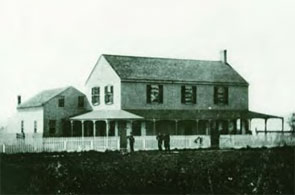
The limitations of care aboard ship are made clear in a note from the yard surgeon in 1863; he wrote, “The frigate Independence, particularly in the winter season, is a very unsuitable place to treat the sick. It is cold, wet, and open to every wind that blows.”
Navy officials, while sympathetic to the plight of men serving in the tiny Pacific squadron, did little to correct the situation—likely because their attentions were focused on prosecuting the Civil War and not on a little Navy yard in far away California. Taking the situation into their own hands, surgeon Bishop and the commandant of the Navy yard submitted plans for a temporary facility—to be fashioned from an unused granary. The plans provided for a 25' x 25' ward on the first floor and a 24' x 40'9" ward space above, and called for a large cistern for year-round water supply, an attached bath approached from outside, and a nearby outdoor privy.
Still, Washington resisted, recommending that sick sailors be sent to the Marine (Public Health) Hospital in San Francisco, 25 miles away. This suggestion was met by stiff resistance both by local Naval authorities who feared desertion by sailors not under their direct observation and by the sailors themselves, who didn’t cotton to being hospitalized with merchant mariners.
Permission from Washington finally came through in July 1863. Work completed, the “Temporary Hospital” at Mare Island Navy Yard opened on Feb. 23, 1864.
The hospital carried an average inpatient load of 30, cared for by a surgeon and a surgeon’s steward, until the first permanent hospital—palatial by comparison—opened in 1871. TH
Dr. Snyder is a retired captain of the U.S. Naval Reserves’ Medical Corps. He writes regularly about naval medicine.
California gained statehood in 1850. Two months later Navy Secretary William Graham wrote to President Fillmore that “a new empire has, as by magic, sprung into existence. San Francisco promises, at no distant time, to become another New York.” He went on to say that “a Navy yard is very much needed in California, and no time will be lost in accomplishing the work.”
A three-officer commission was soon dispatched to choose a suitable site, and they decided on one protected inside San Francisco Bay at Mare Island. Commander David G. Farragut (of “Damn the torpedoes! Full speed ahead!” fame, a Civil War hero and the first admiral of the U.S. Navy) arrived at the remote place in 1854.
Within two days of his arrival at the California site, Farragut ordered the sloop-of-war over from Sausalito. This ship, soon to be replaced by the much larger USS Independence, served as the first naval medical facility on the West Coast. Ambulatory care was given in the ship’s sick bay, and the “hospitalized” were cared for from wooden bed frames suspended from the sick bay overhead or from their own hammocks. The average inpatient load was 10 sailors or civilian Navy yard workers.
The limitations of care aboard ship are made clear in a note from the yard surgeon in 1863; he wrote, “The frigate Independence, particularly in the winter season, is a very unsuitable place to treat the sick. It is cold, wet, and open to every wind that blows.”
Navy officials, while sympathetic to the plight of men serving in the tiny Pacific squadron, did little to correct the situation—likely because their attentions were focused on prosecuting the Civil War and not on a little Navy yard in far away California. Taking the situation into their own hands, surgeon Bishop and the commandant of the Navy yard submitted plans for a temporary facility—to be fashioned from an unused granary. The plans provided for a 25' x 25' ward on the first floor and a 24' x 40'9" ward space above, and called for a large cistern for year-round water supply, an attached bath approached from outside, and a nearby outdoor privy.
Still, Washington resisted, recommending that sick sailors be sent to the Marine (Public Health) Hospital in San Francisco, 25 miles away. This suggestion was met by stiff resistance both by local Naval authorities who feared desertion by sailors not under their direct observation and by the sailors themselves, who didn’t cotton to being hospitalized with merchant mariners.
Permission from Washington finally came through in July 1863. Work completed, the “Temporary Hospital” at Mare Island Navy Yard opened on Feb. 23, 1864.
The hospital carried an average inpatient load of 30, cared for by a surgeon and a surgeon’s steward, until the first permanent hospital—palatial by comparison—opened in 1871. TH
Dr. Snyder is a retired captain of the U.S. Naval Reserves’ Medical Corps. He writes regularly about naval medicine.
California gained statehood in 1850. Two months later Navy Secretary William Graham wrote to President Fillmore that “a new empire has, as by magic, sprung into existence. San Francisco promises, at no distant time, to become another New York.” He went on to say that “a Navy yard is very much needed in California, and no time will be lost in accomplishing the work.”
A three-officer commission was soon dispatched to choose a suitable site, and they decided on one protected inside San Francisco Bay at Mare Island. Commander David G. Farragut (of “Damn the torpedoes! Full speed ahead!” fame, a Civil War hero and the first admiral of the U.S. Navy) arrived at the remote place in 1854.
Within two days of his arrival at the California site, Farragut ordered the sloop-of-war over from Sausalito. This ship, soon to be replaced by the much larger USS Independence, served as the first naval medical facility on the West Coast. Ambulatory care was given in the ship’s sick bay, and the “hospitalized” were cared for from wooden bed frames suspended from the sick bay overhead or from their own hammocks. The average inpatient load was 10 sailors or civilian Navy yard workers.
The limitations of care aboard ship are made clear in a note from the yard surgeon in 1863; he wrote, “The frigate Independence, particularly in the winter season, is a very unsuitable place to treat the sick. It is cold, wet, and open to every wind that blows.”
Navy officials, while sympathetic to the plight of men serving in the tiny Pacific squadron, did little to correct the situation—likely because their attentions were focused on prosecuting the Civil War and not on a little Navy yard in far away California. Taking the situation into their own hands, surgeon Bishop and the commandant of the Navy yard submitted plans for a temporary facility—to be fashioned from an unused granary. The plans provided for a 25' x 25' ward on the first floor and a 24' x 40'9" ward space above, and called for a large cistern for year-round water supply, an attached bath approached from outside, and a nearby outdoor privy.
Still, Washington resisted, recommending that sick sailors be sent to the Marine (Public Health) Hospital in San Francisco, 25 miles away. This suggestion was met by stiff resistance both by local Naval authorities who feared desertion by sailors not under their direct observation and by the sailors themselves, who didn’t cotton to being hospitalized with merchant mariners.
Permission from Washington finally came through in July 1863. Work completed, the “Temporary Hospital” at Mare Island Navy Yard opened on Feb. 23, 1864.
The hospital carried an average inpatient load of 30, cared for by a surgeon and a surgeon’s steward, until the first permanent hospital—palatial by comparison—opened in 1871. TH
Dr. Snyder is a retired captain of the U.S. Naval Reserves’ Medical Corps. He writes regularly about naval medicine.
Limits for Disaster Responders
Most healthcare providers are inexperienced in caring for people in disasters. However, in a national disaster that hinders mobility both into and out of an affected area, available skilled personnel are limited. A disaster response asks more of the scarce manpower: Providers must work longer hours and extend their customary scope of expertise to aid the largest number of victims. While these mandates are designed to maximize the care provided, the emotional and physical burdens on providers and victims in these circumstances are significant, and it is important that we remember the fundamental duty to prevent unnecessary harm in the provision of healthcare.
Should healthcare providers be held to different standards in times of disaster? If so, what are acceptable limits to disaster care, and what ethical dilemmas result during such exceptional times?
Unique Circumstances Call for Unique Standards of Care
Standards in a variety of areas differ in the face of a large-scale disaster, but the fact that standards must change to accommodate the circumstances does not mean that they cease to exist entirely. In the event of a large-scale disaster where populations become isolated and no new resources will arrive in the immediate future, the risks of inaction are magnified and we accept a higher risk resulting from relief action. When only one doctor is available, that doctor is obligated to provide whatever care he or she can to whoever is in need.
When the alternative is that no help will be given, any able doctor should provide whatever help they can. However, there are limits to this responsibility. Greater risks may be justified, and standards may be different, but physicians’ fundamental duties to patients are unchanged and avoidable mistakes causing injuries still need to be prevented. The basic duties of beneficence and non-malfeasance must still guide physician behavior, and the reality of the circumstances in disaster response favors pre-emptive determination on the safety limits that physicians should observe in providing disaster assistance.
Disasters inherently influence doctors to both continue to provide care when they are impaired by sleep or grief and to provide care that under other circumstances they would consider their experience inadequate to undertake. These are realities of disaster response, and all skilled personnel can and should exceed the limits that normally exist in a fully functional system with adequate resources. However, at some point a doctor becomes too impaired or too inexperienced to provide care to patients—even if no one else is available. Doctors are neither trained nor encouraged to weigh the global risks and benefits in this manner; in fact, we are trained to push ourselves beyond our reasonable limits even when absolute scarcity of resources isn’t an issue. People are quite willing to compromise their own comfort and safety in the event of a disaster, but there comes a point at which they may do more harm than good.
There is extensive evidence that sleep deprivation impairs judgment and performance in the medical setting.1-2 Despite the fact that standards change in emergencies and greater risk must be undertaken by both providers and victims, there must still be safety limits. At some point a doctor becomes so sleep deprived that he or she is more dangerous providing care than leaving people entirely without a provider, and further may have impaired judgment on the severity of the various conditions they are facing and the reasonable limits on their expertise. This problem is inherent to the setting. How much risk should doctors subject patients to? In the face of a life-threatening condition should a completely inexperienced physician undertake care? What if the doctor is mistaken as to the severity of the illness or the proper response to it?
In response to Hurricane Katrina, state and national regulatory agencies had to create emergency exceptions to licensing regulations and to HIPAA and EMTALA requirements in order to facilitate patient care.3 Both the Model State Emergency Health Powers Act (legislation designed to serve as template for states to use to create emergency health response mechanisms) and the Louisiana legislation that governed provision of medical care in a state of emergency limit liability of any provider assisting in an emergency.4-5 Providers assisting in an emergency will not be held liable for any injury resulting from action or inaction except for intentional or grossly negligent acts or omissions. Such limitation of liability is essential to ensure that all available resources are utilized in an emergency. However, given that patients will have limited remedies for injuries caused, it is increasingly important to proactively define limitations on provider activity during emergencies. Because other remedies and regulatory structures are relaxed, ethical self-regulation becomes increasingly important.
The first priority in emergency disaster response must be ensuring that providers are available and do not encounter unnecessary barriers to providing care to ill or injured patients. However, a secondary goal must be ensuring that the safest and most effective care is provided under the circumstances. As with many things in disaster response, once the disaster has occurred there is little time for contemplation. Therefore, disaster response plans should include guidelines for providers on how to ensure safety in the care they provide.
Disaster response issues must be dealt with proactively because resources cannot be diverted to these issues in the thick of emergency response. Some organizations and providers have experience with disaster response and can provide guidance. A major goal of medical relief organizations is to provide relief for fatigued providers. When relief is not available and not likely to arrive soon, providers should be encouraged to self-impose sleep periods despite the apparent urgency of the situations they face. Urging providers to ensure that they eat at least twice and sleep for two to four hours in any 24-hour period is a reasonable limit on the physical activity of providers.
Providers and patients need to understand that this is essential to ensure that providers are capable of giving safe care in a sustained fashion. Emergency responders must maintain adequate perspective on their own abilities and patients’ needs to ensure that unnecessary risks are not undertaken nor avoidable injures inflicted. Importantly, these limitations should not be legislated or imposed externally, but should be defined by the profession and self-enforced by providers.
There have been significant discussion of what aspects of the U.S. system of response to large-scale disasters need to be improved. The Katrina disaster has given us the opportunity to enhance essential response mechanisms, whether the cause of the disaster is natural, infectious, or terrorist. A good disaster plan takes steps to ensure availability of care, but also to ensure that the care is as ethical, safe and effective as possible.
References
- Arnedt JT, Owens J, Crouch M, Stahl J, Carskadon MA. Neurobehavioral performance of residents after heavy night call vs after alcohol ingestion. JAMA. 2005;294(9):1025-1033.
- Landrigan CP, Rothschild JM, Cronin JW, et al. Effect of reducing interns' work hours on serious medical errors in intensive care units. N Eng J Med. 2004;351(18):1838-1848.
- Hyland, et al. Federal, State Regulations Relaxed for Providers Affected by Hurricane. BNA Health Law Reporter. 2005;15(36):1190-1191.
- Gostin, LO, Model State Emergency Health Powers Act, §608 Licensing and Appointment of Health Care Personnel, December 21, 2001. Available at www.publichealthlaw.net/MSEHPA/MSEHPA2.pdf. Last accessed Dec. 1, 2005.
- La. R.S. 29:656 (2005).
FROM THE PUBLIC POLICY COMMITTEE
Make a Positive Difference in the Politics of Healthcare
SHM to sponsor Legislative Advocacy Day on May 3
By Eric Siegal, MD, committee chair
“The stakes are too high for government to be a spectator sport.”
—Barbara Jordan, former U.S. Congresswoman
SHM is taking advantage of its 2006 annual meeting location in Washington, D.C., and sponsoring its first Legislative Advocacy Day on May 3. The Public Policy Committee is excited about the opportunity this initiative presents for hospitalists to learn more about how government really works and to speak with members of Congress about issues that are vital to patient care and clinical practice.
Are you concerned about continued Medicare cuts? Worried about how pending pay-for-performance legislation will affect hospitalists? SHM members registering for Advocacy Day will meet with their members of Congress and staff to discuss these and other important issues affecting hospital medicine.
I encourage you to register for Advocacy Day. There is no better way to influence how health policy is made in Washington than by meeting directly with your elected officials and their staffs. Lawmakers need constituent input to be effective legislators. Whether your legislator is a newly elected representative or a veteran senator with years of experience, he or she wants—and needs—to hear what you have to say about issues under consideration by the U.S. Congress, particularly in an election year. Input from their constituents always receives attention and consideration and can frequently make the difference in the way a lawmaker votes. Who better to educate members of Congress on changes to Medicare than the physicians directly involved in caring for the program’s beneficiaries?
We will give you the tools and information you need to make the most of your meetings on Capitol Hill. Legislative appointments will be scheduled by SHM as part of the registration process. SHM members will be grouped together by congressional district for House meetings and by state for Senate meetings and each registrant will have a minimum of three Hill appointments. To familiarize you with SHM’s legislative objectives for the second session of the 109th Congress, Laura Allendorf, SHM’s Washington representative, and I will conduct a pre-visit breakfast briefing from 7 a.m. to 8:30 a.m. on May 3. This briefing will cover procedural tips on how to have a successful meeting and update you on the status of the key health issues you will be discussing while on Capitol Hill. These meetings will take place from 9 a.m. to 5 p.m. that day.
Join us on May 3 and help educate members of Congress about the unique role hospitalists play in the delivery of medical care in our nation’s hospitals. We hope Advocacy Day will be the start of regular contact by hospitalists with their elected representatives in Washington.
FROM THE PEDIATRICS COMMITTEE
CME, Pediatric Core Curriculum on the Horizon
Multiple initiatives keep committee active
The Pediatric Committee at SHM is both the center of pediatric activity within SHM and a clearinghouse for SHM committee and task force activity as it relates to pediatrics.
The major pediatric activity in SHM continues to be CME activities and the Pediatric Core Curriculum. The dramatic success of the Pediatric Hospital Medicine Meeting was documented in the October issue of The Hospitalist (p. 33.)
Evaluations of the meeting overwhelmingly favored staging a three- to four-day Pediatric Hospital Medicine meeting on an annual basis during the late summer as a stand-alone meeting, with sponsorship rotating among SHM, the AAP, and the APA. There was insufficient lead time to offer a comprehensive meeting in 2006, but a meeting is scheduled for 2007 sponsored by AAP, with SHM taking the lead in 2008. More information to follow both in the SHM online discussion communities and through these committee reports.
The Pediatric Core Curriculum is nearly complete and should be at the review stage by early 2006. This curriculum is modeled after the adult core curriculum. It will serve as a framework for residency and fellowship directors, as well as a basis for the topics addressed at the Pediatric Hospital Medicine Meetings. Thanks to Tim Cornell, MD, Dan Rauch, MD, and all the authors and editors who have contributed to this work.
We will offer a full pediatric track in May at the SHM Annual Meeting in Washington, D.C., as we have in prior years. Registration is available online. Meetings of both the Pediatric Committee and the Pediatric Forum will be held during the meeting. This year’s meeting immediately precedes the PAS Meetings in San Francisco, and we encourage you to plan early so that at least one member of your program is able to attend the SHM Meeting. Once the Pediatric Hospital Medicine Meetings are held on an annual basis, we will need to decide how to balance SHM meeting offerings between the summer stand-alone Denver meeting and the SHM Annual Meeting.
The second function of Pediatric Committee involves having pediatric representatives on the various SHM committees and task forces report on their individual group’s activities, particularly as it relates to pediatrics. This keeps the broader group of pediatric leadership within SHM informed about the society’s global picture. SHM is committed to having a pediatric representative on each committee. You never know when or where an important issue for pediatricians may arise. Even geriatrics overlaps with pediatrics with regard to both family-centered care and proxy decision-makers.
Major endeavors at this point include the activities of the Benchmark and Career Satisfaction groups. SHM continues to make a strong effort to collect and generate data for workload and compensation, and to provide specific “pediatric only” subsets. Efforts regarding credentialing, sub-specialty designation/certification, and board re-certification are an active focus of SHM for adult hospitalists with ongoing discussions with the Board of Internal Medicine. We pediatricians stand on the sidelines of this battle, with the expectation that once the adults figure out how to do it, we can modify their approach with lower casualties on both sides.
The clinical Resource Rooms on the SHM Web site are clearly targeted toward adult topics. We intend to develop similar resources for pediatrics and are exploring possibilities of doing this collaboratively with the AAP and the APA. Sub-committees on pediatric hospital medicine topics are developing under a loose and shared structure with the AAP’s Section on Hospital Medicine. For example, SHM has taken the lead on a palliative care task force. Maggie Hood is the pediatric representative to this task force and wants to involve other interested pediatric hospitalists in a sub-committee on this topic. The AAP’s Karen Kingry has taken the lead on developing a sub-committee for community (pediatric) hospitalists; membership on her committee is open to SHM members. Expect other topics to develop as well.
If you have any comments, feedback or suggestions for the SHM Pediatric Committee, please contact co-chairs, David Zipes (dgzipes@indy.rr.com) or Jack Percelay (JPercelayMD@yahoo.com). TH
Most healthcare providers are inexperienced in caring for people in disasters. However, in a national disaster that hinders mobility both into and out of an affected area, available skilled personnel are limited. A disaster response asks more of the scarce manpower: Providers must work longer hours and extend their customary scope of expertise to aid the largest number of victims. While these mandates are designed to maximize the care provided, the emotional and physical burdens on providers and victims in these circumstances are significant, and it is important that we remember the fundamental duty to prevent unnecessary harm in the provision of healthcare.
Should healthcare providers be held to different standards in times of disaster? If so, what are acceptable limits to disaster care, and what ethical dilemmas result during such exceptional times?
Unique Circumstances Call for Unique Standards of Care
Standards in a variety of areas differ in the face of a large-scale disaster, but the fact that standards must change to accommodate the circumstances does not mean that they cease to exist entirely. In the event of a large-scale disaster where populations become isolated and no new resources will arrive in the immediate future, the risks of inaction are magnified and we accept a higher risk resulting from relief action. When only one doctor is available, that doctor is obligated to provide whatever care he or she can to whoever is in need.
When the alternative is that no help will be given, any able doctor should provide whatever help they can. However, there are limits to this responsibility. Greater risks may be justified, and standards may be different, but physicians’ fundamental duties to patients are unchanged and avoidable mistakes causing injuries still need to be prevented. The basic duties of beneficence and non-malfeasance must still guide physician behavior, and the reality of the circumstances in disaster response favors pre-emptive determination on the safety limits that physicians should observe in providing disaster assistance.
Disasters inherently influence doctors to both continue to provide care when they are impaired by sleep or grief and to provide care that under other circumstances they would consider their experience inadequate to undertake. These are realities of disaster response, and all skilled personnel can and should exceed the limits that normally exist in a fully functional system with adequate resources. However, at some point a doctor becomes too impaired or too inexperienced to provide care to patients—even if no one else is available. Doctors are neither trained nor encouraged to weigh the global risks and benefits in this manner; in fact, we are trained to push ourselves beyond our reasonable limits even when absolute scarcity of resources isn’t an issue. People are quite willing to compromise their own comfort and safety in the event of a disaster, but there comes a point at which they may do more harm than good.
There is extensive evidence that sleep deprivation impairs judgment and performance in the medical setting.1-2 Despite the fact that standards change in emergencies and greater risk must be undertaken by both providers and victims, there must still be safety limits. At some point a doctor becomes so sleep deprived that he or she is more dangerous providing care than leaving people entirely without a provider, and further may have impaired judgment on the severity of the various conditions they are facing and the reasonable limits on their expertise. This problem is inherent to the setting. How much risk should doctors subject patients to? In the face of a life-threatening condition should a completely inexperienced physician undertake care? What if the doctor is mistaken as to the severity of the illness or the proper response to it?
In response to Hurricane Katrina, state and national regulatory agencies had to create emergency exceptions to licensing regulations and to HIPAA and EMTALA requirements in order to facilitate patient care.3 Both the Model State Emergency Health Powers Act (legislation designed to serve as template for states to use to create emergency health response mechanisms) and the Louisiana legislation that governed provision of medical care in a state of emergency limit liability of any provider assisting in an emergency.4-5 Providers assisting in an emergency will not be held liable for any injury resulting from action or inaction except for intentional or grossly negligent acts or omissions. Such limitation of liability is essential to ensure that all available resources are utilized in an emergency. However, given that patients will have limited remedies for injuries caused, it is increasingly important to proactively define limitations on provider activity during emergencies. Because other remedies and regulatory structures are relaxed, ethical self-regulation becomes increasingly important.
The first priority in emergency disaster response must be ensuring that providers are available and do not encounter unnecessary barriers to providing care to ill or injured patients. However, a secondary goal must be ensuring that the safest and most effective care is provided under the circumstances. As with many things in disaster response, once the disaster has occurred there is little time for contemplation. Therefore, disaster response plans should include guidelines for providers on how to ensure safety in the care they provide.
Disaster response issues must be dealt with proactively because resources cannot be diverted to these issues in the thick of emergency response. Some organizations and providers have experience with disaster response and can provide guidance. A major goal of medical relief organizations is to provide relief for fatigued providers. When relief is not available and not likely to arrive soon, providers should be encouraged to self-impose sleep periods despite the apparent urgency of the situations they face. Urging providers to ensure that they eat at least twice and sleep for two to four hours in any 24-hour period is a reasonable limit on the physical activity of providers.
Providers and patients need to understand that this is essential to ensure that providers are capable of giving safe care in a sustained fashion. Emergency responders must maintain adequate perspective on their own abilities and patients’ needs to ensure that unnecessary risks are not undertaken nor avoidable injures inflicted. Importantly, these limitations should not be legislated or imposed externally, but should be defined by the profession and self-enforced by providers.
There have been significant discussion of what aspects of the U.S. system of response to large-scale disasters need to be improved. The Katrina disaster has given us the opportunity to enhance essential response mechanisms, whether the cause of the disaster is natural, infectious, or terrorist. A good disaster plan takes steps to ensure availability of care, but also to ensure that the care is as ethical, safe and effective as possible.
References
- Arnedt JT, Owens J, Crouch M, Stahl J, Carskadon MA. Neurobehavioral performance of residents after heavy night call vs after alcohol ingestion. JAMA. 2005;294(9):1025-1033.
- Landrigan CP, Rothschild JM, Cronin JW, et al. Effect of reducing interns' work hours on serious medical errors in intensive care units. N Eng J Med. 2004;351(18):1838-1848.
- Hyland, et al. Federal, State Regulations Relaxed for Providers Affected by Hurricane. BNA Health Law Reporter. 2005;15(36):1190-1191.
- Gostin, LO, Model State Emergency Health Powers Act, §608 Licensing and Appointment of Health Care Personnel, December 21, 2001. Available at www.publichealthlaw.net/MSEHPA/MSEHPA2.pdf. Last accessed Dec. 1, 2005.
- La. R.S. 29:656 (2005).
FROM THE PUBLIC POLICY COMMITTEE
Make a Positive Difference in the Politics of Healthcare
SHM to sponsor Legislative Advocacy Day on May 3
By Eric Siegal, MD, committee chair
“The stakes are too high for government to be a spectator sport.”
—Barbara Jordan, former U.S. Congresswoman
SHM is taking advantage of its 2006 annual meeting location in Washington, D.C., and sponsoring its first Legislative Advocacy Day on May 3. The Public Policy Committee is excited about the opportunity this initiative presents for hospitalists to learn more about how government really works and to speak with members of Congress about issues that are vital to patient care and clinical practice.
Are you concerned about continued Medicare cuts? Worried about how pending pay-for-performance legislation will affect hospitalists? SHM members registering for Advocacy Day will meet with their members of Congress and staff to discuss these and other important issues affecting hospital medicine.
I encourage you to register for Advocacy Day. There is no better way to influence how health policy is made in Washington than by meeting directly with your elected officials and their staffs. Lawmakers need constituent input to be effective legislators. Whether your legislator is a newly elected representative or a veteran senator with years of experience, he or she wants—and needs—to hear what you have to say about issues under consideration by the U.S. Congress, particularly in an election year. Input from their constituents always receives attention and consideration and can frequently make the difference in the way a lawmaker votes. Who better to educate members of Congress on changes to Medicare than the physicians directly involved in caring for the program’s beneficiaries?
We will give you the tools and information you need to make the most of your meetings on Capitol Hill. Legislative appointments will be scheduled by SHM as part of the registration process. SHM members will be grouped together by congressional district for House meetings and by state for Senate meetings and each registrant will have a minimum of three Hill appointments. To familiarize you with SHM’s legislative objectives for the second session of the 109th Congress, Laura Allendorf, SHM’s Washington representative, and I will conduct a pre-visit breakfast briefing from 7 a.m. to 8:30 a.m. on May 3. This briefing will cover procedural tips on how to have a successful meeting and update you on the status of the key health issues you will be discussing while on Capitol Hill. These meetings will take place from 9 a.m. to 5 p.m. that day.
Join us on May 3 and help educate members of Congress about the unique role hospitalists play in the delivery of medical care in our nation’s hospitals. We hope Advocacy Day will be the start of regular contact by hospitalists with their elected representatives in Washington.
FROM THE PEDIATRICS COMMITTEE
CME, Pediatric Core Curriculum on the Horizon
Multiple initiatives keep committee active
The Pediatric Committee at SHM is both the center of pediatric activity within SHM and a clearinghouse for SHM committee and task force activity as it relates to pediatrics.
The major pediatric activity in SHM continues to be CME activities and the Pediatric Core Curriculum. The dramatic success of the Pediatric Hospital Medicine Meeting was documented in the October issue of The Hospitalist (p. 33.)
Evaluations of the meeting overwhelmingly favored staging a three- to four-day Pediatric Hospital Medicine meeting on an annual basis during the late summer as a stand-alone meeting, with sponsorship rotating among SHM, the AAP, and the APA. There was insufficient lead time to offer a comprehensive meeting in 2006, but a meeting is scheduled for 2007 sponsored by AAP, with SHM taking the lead in 2008. More information to follow both in the SHM online discussion communities and through these committee reports.
The Pediatric Core Curriculum is nearly complete and should be at the review stage by early 2006. This curriculum is modeled after the adult core curriculum. It will serve as a framework for residency and fellowship directors, as well as a basis for the topics addressed at the Pediatric Hospital Medicine Meetings. Thanks to Tim Cornell, MD, Dan Rauch, MD, and all the authors and editors who have contributed to this work.
We will offer a full pediatric track in May at the SHM Annual Meeting in Washington, D.C., as we have in prior years. Registration is available online. Meetings of both the Pediatric Committee and the Pediatric Forum will be held during the meeting. This year’s meeting immediately precedes the PAS Meetings in San Francisco, and we encourage you to plan early so that at least one member of your program is able to attend the SHM Meeting. Once the Pediatric Hospital Medicine Meetings are held on an annual basis, we will need to decide how to balance SHM meeting offerings between the summer stand-alone Denver meeting and the SHM Annual Meeting.
The second function of Pediatric Committee involves having pediatric representatives on the various SHM committees and task forces report on their individual group’s activities, particularly as it relates to pediatrics. This keeps the broader group of pediatric leadership within SHM informed about the society’s global picture. SHM is committed to having a pediatric representative on each committee. You never know when or where an important issue for pediatricians may arise. Even geriatrics overlaps with pediatrics with regard to both family-centered care and proxy decision-makers.
Major endeavors at this point include the activities of the Benchmark and Career Satisfaction groups. SHM continues to make a strong effort to collect and generate data for workload and compensation, and to provide specific “pediatric only” subsets. Efforts regarding credentialing, sub-specialty designation/certification, and board re-certification are an active focus of SHM for adult hospitalists with ongoing discussions with the Board of Internal Medicine. We pediatricians stand on the sidelines of this battle, with the expectation that once the adults figure out how to do it, we can modify their approach with lower casualties on both sides.
The clinical Resource Rooms on the SHM Web site are clearly targeted toward adult topics. We intend to develop similar resources for pediatrics and are exploring possibilities of doing this collaboratively with the AAP and the APA. Sub-committees on pediatric hospital medicine topics are developing under a loose and shared structure with the AAP’s Section on Hospital Medicine. For example, SHM has taken the lead on a palliative care task force. Maggie Hood is the pediatric representative to this task force and wants to involve other interested pediatric hospitalists in a sub-committee on this topic. The AAP’s Karen Kingry has taken the lead on developing a sub-committee for community (pediatric) hospitalists; membership on her committee is open to SHM members. Expect other topics to develop as well.
If you have any comments, feedback or suggestions for the SHM Pediatric Committee, please contact co-chairs, David Zipes (dgzipes@indy.rr.com) or Jack Percelay (JPercelayMD@yahoo.com). TH
Most healthcare providers are inexperienced in caring for people in disasters. However, in a national disaster that hinders mobility both into and out of an affected area, available skilled personnel are limited. A disaster response asks more of the scarce manpower: Providers must work longer hours and extend their customary scope of expertise to aid the largest number of victims. While these mandates are designed to maximize the care provided, the emotional and physical burdens on providers and victims in these circumstances are significant, and it is important that we remember the fundamental duty to prevent unnecessary harm in the provision of healthcare.
Should healthcare providers be held to different standards in times of disaster? If so, what are acceptable limits to disaster care, and what ethical dilemmas result during such exceptional times?
Unique Circumstances Call for Unique Standards of Care
Standards in a variety of areas differ in the face of a large-scale disaster, but the fact that standards must change to accommodate the circumstances does not mean that they cease to exist entirely. In the event of a large-scale disaster where populations become isolated and no new resources will arrive in the immediate future, the risks of inaction are magnified and we accept a higher risk resulting from relief action. When only one doctor is available, that doctor is obligated to provide whatever care he or she can to whoever is in need.
When the alternative is that no help will be given, any able doctor should provide whatever help they can. However, there are limits to this responsibility. Greater risks may be justified, and standards may be different, but physicians’ fundamental duties to patients are unchanged and avoidable mistakes causing injuries still need to be prevented. The basic duties of beneficence and non-malfeasance must still guide physician behavior, and the reality of the circumstances in disaster response favors pre-emptive determination on the safety limits that physicians should observe in providing disaster assistance.
Disasters inherently influence doctors to both continue to provide care when they are impaired by sleep or grief and to provide care that under other circumstances they would consider their experience inadequate to undertake. These are realities of disaster response, and all skilled personnel can and should exceed the limits that normally exist in a fully functional system with adequate resources. However, at some point a doctor becomes too impaired or too inexperienced to provide care to patients—even if no one else is available. Doctors are neither trained nor encouraged to weigh the global risks and benefits in this manner; in fact, we are trained to push ourselves beyond our reasonable limits even when absolute scarcity of resources isn’t an issue. People are quite willing to compromise their own comfort and safety in the event of a disaster, but there comes a point at which they may do more harm than good.
There is extensive evidence that sleep deprivation impairs judgment and performance in the medical setting.1-2 Despite the fact that standards change in emergencies and greater risk must be undertaken by both providers and victims, there must still be safety limits. At some point a doctor becomes so sleep deprived that he or she is more dangerous providing care than leaving people entirely without a provider, and further may have impaired judgment on the severity of the various conditions they are facing and the reasonable limits on their expertise. This problem is inherent to the setting. How much risk should doctors subject patients to? In the face of a life-threatening condition should a completely inexperienced physician undertake care? What if the doctor is mistaken as to the severity of the illness or the proper response to it?
In response to Hurricane Katrina, state and national regulatory agencies had to create emergency exceptions to licensing regulations and to HIPAA and EMTALA requirements in order to facilitate patient care.3 Both the Model State Emergency Health Powers Act (legislation designed to serve as template for states to use to create emergency health response mechanisms) and the Louisiana legislation that governed provision of medical care in a state of emergency limit liability of any provider assisting in an emergency.4-5 Providers assisting in an emergency will not be held liable for any injury resulting from action or inaction except for intentional or grossly negligent acts or omissions. Such limitation of liability is essential to ensure that all available resources are utilized in an emergency. However, given that patients will have limited remedies for injuries caused, it is increasingly important to proactively define limitations on provider activity during emergencies. Because other remedies and regulatory structures are relaxed, ethical self-regulation becomes increasingly important.
The first priority in emergency disaster response must be ensuring that providers are available and do not encounter unnecessary barriers to providing care to ill or injured patients. However, a secondary goal must be ensuring that the safest and most effective care is provided under the circumstances. As with many things in disaster response, once the disaster has occurred there is little time for contemplation. Therefore, disaster response plans should include guidelines for providers on how to ensure safety in the care they provide.
Disaster response issues must be dealt with proactively because resources cannot be diverted to these issues in the thick of emergency response. Some organizations and providers have experience with disaster response and can provide guidance. A major goal of medical relief organizations is to provide relief for fatigued providers. When relief is not available and not likely to arrive soon, providers should be encouraged to self-impose sleep periods despite the apparent urgency of the situations they face. Urging providers to ensure that they eat at least twice and sleep for two to four hours in any 24-hour period is a reasonable limit on the physical activity of providers.
Providers and patients need to understand that this is essential to ensure that providers are capable of giving safe care in a sustained fashion. Emergency responders must maintain adequate perspective on their own abilities and patients’ needs to ensure that unnecessary risks are not undertaken nor avoidable injures inflicted. Importantly, these limitations should not be legislated or imposed externally, but should be defined by the profession and self-enforced by providers.
There have been significant discussion of what aspects of the U.S. system of response to large-scale disasters need to be improved. The Katrina disaster has given us the opportunity to enhance essential response mechanisms, whether the cause of the disaster is natural, infectious, or terrorist. A good disaster plan takes steps to ensure availability of care, but also to ensure that the care is as ethical, safe and effective as possible.
References
- Arnedt JT, Owens J, Crouch M, Stahl J, Carskadon MA. Neurobehavioral performance of residents after heavy night call vs after alcohol ingestion. JAMA. 2005;294(9):1025-1033.
- Landrigan CP, Rothschild JM, Cronin JW, et al. Effect of reducing interns' work hours on serious medical errors in intensive care units. N Eng J Med. 2004;351(18):1838-1848.
- Hyland, et al. Federal, State Regulations Relaxed for Providers Affected by Hurricane. BNA Health Law Reporter. 2005;15(36):1190-1191.
- Gostin, LO, Model State Emergency Health Powers Act, §608 Licensing and Appointment of Health Care Personnel, December 21, 2001. Available at www.publichealthlaw.net/MSEHPA/MSEHPA2.pdf. Last accessed Dec. 1, 2005.
- La. R.S. 29:656 (2005).
FROM THE PUBLIC POLICY COMMITTEE
Make a Positive Difference in the Politics of Healthcare
SHM to sponsor Legislative Advocacy Day on May 3
By Eric Siegal, MD, committee chair
“The stakes are too high for government to be a spectator sport.”
—Barbara Jordan, former U.S. Congresswoman
SHM is taking advantage of its 2006 annual meeting location in Washington, D.C., and sponsoring its first Legislative Advocacy Day on May 3. The Public Policy Committee is excited about the opportunity this initiative presents for hospitalists to learn more about how government really works and to speak with members of Congress about issues that are vital to patient care and clinical practice.
Are you concerned about continued Medicare cuts? Worried about how pending pay-for-performance legislation will affect hospitalists? SHM members registering for Advocacy Day will meet with their members of Congress and staff to discuss these and other important issues affecting hospital medicine.
I encourage you to register for Advocacy Day. There is no better way to influence how health policy is made in Washington than by meeting directly with your elected officials and their staffs. Lawmakers need constituent input to be effective legislators. Whether your legislator is a newly elected representative or a veteran senator with years of experience, he or she wants—and needs—to hear what you have to say about issues under consideration by the U.S. Congress, particularly in an election year. Input from their constituents always receives attention and consideration and can frequently make the difference in the way a lawmaker votes. Who better to educate members of Congress on changes to Medicare than the physicians directly involved in caring for the program’s beneficiaries?
We will give you the tools and information you need to make the most of your meetings on Capitol Hill. Legislative appointments will be scheduled by SHM as part of the registration process. SHM members will be grouped together by congressional district for House meetings and by state for Senate meetings and each registrant will have a minimum of three Hill appointments. To familiarize you with SHM’s legislative objectives for the second session of the 109th Congress, Laura Allendorf, SHM’s Washington representative, and I will conduct a pre-visit breakfast briefing from 7 a.m. to 8:30 a.m. on May 3. This briefing will cover procedural tips on how to have a successful meeting and update you on the status of the key health issues you will be discussing while on Capitol Hill. These meetings will take place from 9 a.m. to 5 p.m. that day.
Join us on May 3 and help educate members of Congress about the unique role hospitalists play in the delivery of medical care in our nation’s hospitals. We hope Advocacy Day will be the start of regular contact by hospitalists with their elected representatives in Washington.
FROM THE PEDIATRICS COMMITTEE
CME, Pediatric Core Curriculum on the Horizon
Multiple initiatives keep committee active
The Pediatric Committee at SHM is both the center of pediatric activity within SHM and a clearinghouse for SHM committee and task force activity as it relates to pediatrics.
The major pediatric activity in SHM continues to be CME activities and the Pediatric Core Curriculum. The dramatic success of the Pediatric Hospital Medicine Meeting was documented in the October issue of The Hospitalist (p. 33.)
Evaluations of the meeting overwhelmingly favored staging a three- to four-day Pediatric Hospital Medicine meeting on an annual basis during the late summer as a stand-alone meeting, with sponsorship rotating among SHM, the AAP, and the APA. There was insufficient lead time to offer a comprehensive meeting in 2006, but a meeting is scheduled for 2007 sponsored by AAP, with SHM taking the lead in 2008. More information to follow both in the SHM online discussion communities and through these committee reports.
The Pediatric Core Curriculum is nearly complete and should be at the review stage by early 2006. This curriculum is modeled after the adult core curriculum. It will serve as a framework for residency and fellowship directors, as well as a basis for the topics addressed at the Pediatric Hospital Medicine Meetings. Thanks to Tim Cornell, MD, Dan Rauch, MD, and all the authors and editors who have contributed to this work.
We will offer a full pediatric track in May at the SHM Annual Meeting in Washington, D.C., as we have in prior years. Registration is available online. Meetings of both the Pediatric Committee and the Pediatric Forum will be held during the meeting. This year’s meeting immediately precedes the PAS Meetings in San Francisco, and we encourage you to plan early so that at least one member of your program is able to attend the SHM Meeting. Once the Pediatric Hospital Medicine Meetings are held on an annual basis, we will need to decide how to balance SHM meeting offerings between the summer stand-alone Denver meeting and the SHM Annual Meeting.
The second function of Pediatric Committee involves having pediatric representatives on the various SHM committees and task forces report on their individual group’s activities, particularly as it relates to pediatrics. This keeps the broader group of pediatric leadership within SHM informed about the society’s global picture. SHM is committed to having a pediatric representative on each committee. You never know when or where an important issue for pediatricians may arise. Even geriatrics overlaps with pediatrics with regard to both family-centered care and proxy decision-makers.
Major endeavors at this point include the activities of the Benchmark and Career Satisfaction groups. SHM continues to make a strong effort to collect and generate data for workload and compensation, and to provide specific “pediatric only” subsets. Efforts regarding credentialing, sub-specialty designation/certification, and board re-certification are an active focus of SHM for adult hospitalists with ongoing discussions with the Board of Internal Medicine. We pediatricians stand on the sidelines of this battle, with the expectation that once the adults figure out how to do it, we can modify their approach with lower casualties on both sides.
The clinical Resource Rooms on the SHM Web site are clearly targeted toward adult topics. We intend to develop similar resources for pediatrics and are exploring possibilities of doing this collaboratively with the AAP and the APA. Sub-committees on pediatric hospital medicine topics are developing under a loose and shared structure with the AAP’s Section on Hospital Medicine. For example, SHM has taken the lead on a palliative care task force. Maggie Hood is the pediatric representative to this task force and wants to involve other interested pediatric hospitalists in a sub-committee on this topic. The AAP’s Karen Kingry has taken the lead on developing a sub-committee for community (pediatric) hospitalists; membership on her committee is open to SHM members. Expect other topics to develop as well.
If you have any comments, feedback or suggestions for the SHM Pediatric Committee, please contact co-chairs, David Zipes (dgzipes@indy.rr.com) or Jack Percelay (JPercelayMD@yahoo.com). TH
Make a Difference
Welcome to 2006 and another coming-out party for SHM and hospitalists. In just a few short months more than a thousand hospitalists will come together in our nation’s capitol for the SHM Annual Meeting May 3-5, 2006. In addition to the largest convention of hospitalists, hundreds of other stakeholders in hospital medicine will gather for what has become the centerpiece of their year.
In addition to the opportunity to hear our nation’s experts talk about the up-to-date, state-of-the art medical knowledge for hospitalists, the SHM Annual Meeting is the place to find your next job, reconnect with colleagues from around the country, express your own opinions and vision for hospital medicine at the Special Interest Forums, and so much more.
SHM will be literally in the center of our nation’s capitol. It will be an opportunity for hospitalists to not only see the power center for our country, but with SHM’s help, a time for hospitalists to engage our legislators about issues important to hospitalists and our patients.
Taking advantage of the location of this year’s Annual Meeting, SHM’s Public Policy Committee has organized the first SHM Legislative Day on May 3, 2006. SHM meeting attendees can voluntarily sign up to meet with their congressmen and senators and their staffs.
SHM will make all the appointments for these Congressional visits. In addition, May 3 will kick off with a Washington overview and practical sessions on how best to approach your legislators to get your message across.
In addition, SHM has been working with HPA, a nationally recognized information resource in D.C. to put together a “Hospital Medicine White Paper” to concisely describe the emerging specialty of hospital medicine and how our perspectives and ideas are important to the healthcare debate.
The white paper will be a useful document to leave with your legislator and to use as a reference for your discussions. It will also contain some suggested policy recommendations supported by the SHM Board that can form the basis of what we would like to see move forward in Congress and on the Hill.
I have participated in many of these Legislative Days in my time on the ASIM and ACP Boards. I have found the legislators and their staffs interested in hearing from a passionate, informed part of their constituencies. Often these conversations were informal and personal and led to an ongoing relationship that continued when we were back home. I looked forward to coming back to Washington to renew our discussions.
And there can be real tangible changes as a result of these Congressional visits. I have seen changes in Medicare scope of benefits and reimbursement and methodologies based on messages I carried with the support of my professional medical societies.
Hospitalists are in a unique position to influence the current and future medical debates in Washington. We are young (average age 37) with a long professional career ahead of us. Hospitalists are at the center of many issues and initiatives that affect hospitals and the acutely ill patients they treat. Hospitalists measure and improve inpatient healthcare in an era of decreasing resources and increasing expectations.
Right now there is significant activity in pay for performance and in developing quality performance measures. There is also debate on gain-sharing and discussions of reducing and reshaping reimbursement for physicians. There are discussions on how to fund medical education and how to make sure all Americans get healthcare—even the 45 million without any insurance coverage. There are issues of access and limitations of crowded emergency departments and hospitals running at capacity.
There is no shortage of ideas and proposals, and most of these will affect hospitalists and the patients we treat and the hospitals we work in. In many ways these issues will shape our professional futures and determine how satisfying a career as a physician and specifically as a hospitalist will be.
Hospitalists and SHM must be part of the dialogue. We must clearly state where we stand and be prepared to back this up with data and to propose realistic solutions we are prepared to implement.
So clear your schedules May 3-5, 2006, and come to Washington, D.C., to join more than a thousand of your hospitalist colleagues as we take our first determined steps at the power center of our country. SHM will provide the support and materials for your success. But you must supply the voice and the presence. We owe no less to our profession and our patients now and in the future. TH
Dr. Wellikson has been CEO of SHM since 2000.
Welcome to 2006 and another coming-out party for SHM and hospitalists. In just a few short months more than a thousand hospitalists will come together in our nation’s capitol for the SHM Annual Meeting May 3-5, 2006. In addition to the largest convention of hospitalists, hundreds of other stakeholders in hospital medicine will gather for what has become the centerpiece of their year.
In addition to the opportunity to hear our nation’s experts talk about the up-to-date, state-of-the art medical knowledge for hospitalists, the SHM Annual Meeting is the place to find your next job, reconnect with colleagues from around the country, express your own opinions and vision for hospital medicine at the Special Interest Forums, and so much more.
SHM will be literally in the center of our nation’s capitol. It will be an opportunity for hospitalists to not only see the power center for our country, but with SHM’s help, a time for hospitalists to engage our legislators about issues important to hospitalists and our patients.
Taking advantage of the location of this year’s Annual Meeting, SHM’s Public Policy Committee has organized the first SHM Legislative Day on May 3, 2006. SHM meeting attendees can voluntarily sign up to meet with their congressmen and senators and their staffs.
SHM will make all the appointments for these Congressional visits. In addition, May 3 will kick off with a Washington overview and practical sessions on how best to approach your legislators to get your message across.
In addition, SHM has been working with HPA, a nationally recognized information resource in D.C. to put together a “Hospital Medicine White Paper” to concisely describe the emerging specialty of hospital medicine and how our perspectives and ideas are important to the healthcare debate.
The white paper will be a useful document to leave with your legislator and to use as a reference for your discussions. It will also contain some suggested policy recommendations supported by the SHM Board that can form the basis of what we would like to see move forward in Congress and on the Hill.
I have participated in many of these Legislative Days in my time on the ASIM and ACP Boards. I have found the legislators and their staffs interested in hearing from a passionate, informed part of their constituencies. Often these conversations were informal and personal and led to an ongoing relationship that continued when we were back home. I looked forward to coming back to Washington to renew our discussions.
And there can be real tangible changes as a result of these Congressional visits. I have seen changes in Medicare scope of benefits and reimbursement and methodologies based on messages I carried with the support of my professional medical societies.
Hospitalists are in a unique position to influence the current and future medical debates in Washington. We are young (average age 37) with a long professional career ahead of us. Hospitalists are at the center of many issues and initiatives that affect hospitals and the acutely ill patients they treat. Hospitalists measure and improve inpatient healthcare in an era of decreasing resources and increasing expectations.
Right now there is significant activity in pay for performance and in developing quality performance measures. There is also debate on gain-sharing and discussions of reducing and reshaping reimbursement for physicians. There are discussions on how to fund medical education and how to make sure all Americans get healthcare—even the 45 million without any insurance coverage. There are issues of access and limitations of crowded emergency departments and hospitals running at capacity.
There is no shortage of ideas and proposals, and most of these will affect hospitalists and the patients we treat and the hospitals we work in. In many ways these issues will shape our professional futures and determine how satisfying a career as a physician and specifically as a hospitalist will be.
Hospitalists and SHM must be part of the dialogue. We must clearly state where we stand and be prepared to back this up with data and to propose realistic solutions we are prepared to implement.
So clear your schedules May 3-5, 2006, and come to Washington, D.C., to join more than a thousand of your hospitalist colleagues as we take our first determined steps at the power center of our country. SHM will provide the support and materials for your success. But you must supply the voice and the presence. We owe no less to our profession and our patients now and in the future. TH
Dr. Wellikson has been CEO of SHM since 2000.
Welcome to 2006 and another coming-out party for SHM and hospitalists. In just a few short months more than a thousand hospitalists will come together in our nation’s capitol for the SHM Annual Meeting May 3-5, 2006. In addition to the largest convention of hospitalists, hundreds of other stakeholders in hospital medicine will gather for what has become the centerpiece of their year.
In addition to the opportunity to hear our nation’s experts talk about the up-to-date, state-of-the art medical knowledge for hospitalists, the SHM Annual Meeting is the place to find your next job, reconnect with colleagues from around the country, express your own opinions and vision for hospital medicine at the Special Interest Forums, and so much more.
SHM will be literally in the center of our nation’s capitol. It will be an opportunity for hospitalists to not only see the power center for our country, but with SHM’s help, a time for hospitalists to engage our legislators about issues important to hospitalists and our patients.
Taking advantage of the location of this year’s Annual Meeting, SHM’s Public Policy Committee has organized the first SHM Legislative Day on May 3, 2006. SHM meeting attendees can voluntarily sign up to meet with their congressmen and senators and their staffs.
SHM will make all the appointments for these Congressional visits. In addition, May 3 will kick off with a Washington overview and practical sessions on how best to approach your legislators to get your message across.
In addition, SHM has been working with HPA, a nationally recognized information resource in D.C. to put together a “Hospital Medicine White Paper” to concisely describe the emerging specialty of hospital medicine and how our perspectives and ideas are important to the healthcare debate.
The white paper will be a useful document to leave with your legislator and to use as a reference for your discussions. It will also contain some suggested policy recommendations supported by the SHM Board that can form the basis of what we would like to see move forward in Congress and on the Hill.
I have participated in many of these Legislative Days in my time on the ASIM and ACP Boards. I have found the legislators and their staffs interested in hearing from a passionate, informed part of their constituencies. Often these conversations were informal and personal and led to an ongoing relationship that continued when we were back home. I looked forward to coming back to Washington to renew our discussions.
And there can be real tangible changes as a result of these Congressional visits. I have seen changes in Medicare scope of benefits and reimbursement and methodologies based on messages I carried with the support of my professional medical societies.
Hospitalists are in a unique position to influence the current and future medical debates in Washington. We are young (average age 37) with a long professional career ahead of us. Hospitalists are at the center of many issues and initiatives that affect hospitals and the acutely ill patients they treat. Hospitalists measure and improve inpatient healthcare in an era of decreasing resources and increasing expectations.
Right now there is significant activity in pay for performance and in developing quality performance measures. There is also debate on gain-sharing and discussions of reducing and reshaping reimbursement for physicians. There are discussions on how to fund medical education and how to make sure all Americans get healthcare—even the 45 million without any insurance coverage. There are issues of access and limitations of crowded emergency departments and hospitals running at capacity.
There is no shortage of ideas and proposals, and most of these will affect hospitalists and the patients we treat and the hospitals we work in. In many ways these issues will shape our professional futures and determine how satisfying a career as a physician and specifically as a hospitalist will be.
Hospitalists and SHM must be part of the dialogue. We must clearly state where we stand and be prepared to back this up with data and to propose realistic solutions we are prepared to implement.
So clear your schedules May 3-5, 2006, and come to Washington, D.C., to join more than a thousand of your hospitalist colleagues as we take our first determined steps at the power center of our country. SHM will provide the support and materials for your success. But you must supply the voice and the presence. We owe no less to our profession and our patients now and in the future. TH
Dr. Wellikson has been CEO of SHM since 2000.
I, Intern
Internship is a stressful and life-altering experience. Demands from patients, consulting staff, and paperwork can dehumanize the new physician and make him or her feel like an automaton. The constant exigency of being an intern is further compounded by the increasing use of algorithms and computers. Guidelines for care have existed since the Hermetic books of Thoth in ancient Egypt, but strict “cookbook” medicine limits the intern’s decision-making and individuality. Pressure for electronic record-keeping and redundant documentation further reduce the new physician into not much more than a data entry-and-retrieval terminal. With the intern spending more time with patient records than actual patients, the physician-patient relationship invariably suffers as the intern becomes a small part of the machinery. Consequently, house-staff are constantly searching for a conceptual framework to better understand and cope with their unusual existence.
Isaac Asimov, the visionary science fiction writer and one-time biochemistry professor at Boston University School of Medicine, wrote an entire corpus of work around robots and the three “Laws of Robotics” starting in the 1940s.1 It seems the laws of robotics might also apply to interns as the Three Laws of “Internotics” (original text in parenthesis):
- First Law: An intern (robot) may not injure a patient (human being), or, through inaction, allow a patient (human being) to come to harm.
- Second Law: An intern (robot) must obey orders given it by attendings (human beings) except when such orders would conflict with the First Law.*
- Third Law: An intern (robot) must protect its own existence as long as such protection does not conflict with the First or Second Law.
Ten years after the creation of these laws, Asimov developed a “Zeroth” Law: An intern (robot) may not injure humanity, or through inaction, allow humanity to come to harm.
The First Law
Isolated interpretation of the First Law is the modus operandi of robots and interns. This law is a re-wording of the basic tenet of medicine: First do no harm, or primum non nocere as quoted from Hippocrates in Epidemics. On its surface, the First Law may seem easy for the intern to interpret and follow. However, when the patient’s own perception of benefit and harm deviates from the established norms in medicine, the intern is faced with dilemma of patient autonomy versus beneficence. This may not be a novel phenomenon in the modern consumer-based healthcare system, as Will Mayo, MD, from our own institution once said during a speech at Rush Medical College in 1910: “The best interest of the patient is the only interest to be considered.”
The Second Law
The Second Law explicitly states that the intern must follow the orders of the attending physician, but much rests in the intern’s additional obligation to reconcile obligatory recommendations with their own knowledge and patients’ idiosyncrasy. This may quickly become problematic for the intern, as few orders in modern medicine are considered absolutely risk-free.
The intern must undertake two levels of risk-benefit analysis: They must first determine what type of harm the patient faces in the setting of inaction—as spelled out by the First Law—if the attending’s orders were not carried out; he then must balance such hypothetical harm with the risks associated with the attendings orders of action. If such analysis were to favor inaction, to question the attending’s order is to challenge the attending’s own interpretation of the First Law and to risk the intern’s own existence (Third Law).
Therefore, the best solution for the intern is often to not question whether such order is necessary, but to do whatever possible to protect the patient. An example might be a consultant’s request for a CAT scan in a patient at high risk for contrast-induced nephropathy. In such a case, N-acetylcystein, adequate hydration or urine alkalinization may provide optimal protection against nephropathy. As such, the intern fulfills his or her obligations to the First and Second Laws without testing the limits imposed by the Third.
The Third Law
Much of the practice of—if not the principle of—internship is a violation of the Third Law. Excessive sleepiness and stressors may lead to medical errors, substance abuse, and traffic accidents.2 Work-hour restrictions may alleviate this condition, but can also erode the already limited patient-physician relationship. Further, certain attending physicians may denigrate the performance of the intern, leading to self doubt, lower self esteem, and mental anguish.
Similarly, interaction with certain patients may challenge the intern’s physical or mental well-being. As a result, the intern juxtaposes the new physician’s self-image of competency against the hierarchical stereotype of the rookie. The Third Law allows an opportunity for the intern to be associated with the proud heritage of the caduceus. However, as most interns soon learn, an intern can possibly best ensure his or her well-being and ascent to the next level when the Third Law is not cited as regularly as the first two laws.
The Zeroth Law
The Zeroth Law may be the most challenging law for both robots and interns. While robots and interns are both proficiently trained in serving individual humans, neither positronic programming nor medical education clearly establishes how this leads to the service of humanity.
If humanity is to be defined as the collection of individuals, principles in doctoring of the individual cannot be easily duplicated onto a population. This can be demonstrated through the continuously escalating medical expenditures in the setting of limited resources. For example, if a patient presents with “atypical” chest pain, a diligent medical graduate might order a set of laboratory studies and an electrocardiogram to rule out on-going myocardial infarction despite a low likelihood of abnormality. The slightest normal variation may then involve, by the First or Second Law, observation, stress testing, or cardiac catheterization.
Even though the current economic and legal systems allow for such shotgun approach of affordable technology, such application of the First Law onto humans as a collective will exhaust the population of its limited resources and utterly defy the Zeroth Law.
Alternatively, if humanity is to mean what constitutes each person’s individuality, argument involving maleficence and beneficence must give way to autonomy in the presentation, diagnosis, and treatment of disease, despite what the intern or attending physician perceive as benefits and harm. This obviously violates the First Law in the most fundamental level. However, different from the other laws, the Zeroth Law is not prefaced with the need to comply with the other Three Laws.
Interns can and often do feel dehumanized, whether from loss of decision-making role, from lack of sleep, or as a psychological tool of survival against the rigors of life and death in the hospital. Sometimes even a perfectly beneficent act violates the First Law at a later time and haunts the practitioners. Asimov himself received surgery-related transfusion with the best intention of his treating physicians and surgeons, yet he contracted transfusion-related HIV and died years later of AIDS complications.3
While the Three Laws create a framework of the intern’s existence, it can never create the ideal intern with both the competency of the attending and frailty of the patients. The Laws of Robotics—and Internotics—remind us that just as Asimov’s “Bicentennial man” wanted to transform from robot to human, we want our interns to finish their training more human, not less so.4,** TH
*This makes the assumption that most attendings are humans in the context of this discussion—a hypothesis only. **Dr. Hu was recently a medical intern for Dr. Newman. None of the original Three Laws were violated during the course of their relationship.
Jamie Newman, MD, FACP, is the physician editor of The Hospitalist, senior associate consultant, Hospital Internal Medicine, and assistant professor of internal medicine and medical history, Mayo Clinic College of Medicine at the Mayo Clinic College of Medicine, Rochester, Minn. Dr. Hu works in the Departments of Internal Medicine and Neurology, Mayo Clinic College of Medicine, Rochester, Minn.
References
- Asimov, I. I, Robot. London: Grafton Books; 1968.
- Barger LK, Cade BE, Ayas NT, et al. Extended work shifts and the risk of motor vehicle crashes among interns. N Engl J Med. 2005;352:125-134.
- Asimov I, Asimov, JJ. Isaac Asimov: It’s Been a Good Life. New York: Prometheus; 2002.
- Asimov, I. The Bicentennial Man and Other Stories. New York:Doubleday and Co; 1976.
Internship is a stressful and life-altering experience. Demands from patients, consulting staff, and paperwork can dehumanize the new physician and make him or her feel like an automaton. The constant exigency of being an intern is further compounded by the increasing use of algorithms and computers. Guidelines for care have existed since the Hermetic books of Thoth in ancient Egypt, but strict “cookbook” medicine limits the intern’s decision-making and individuality. Pressure for electronic record-keeping and redundant documentation further reduce the new physician into not much more than a data entry-and-retrieval terminal. With the intern spending more time with patient records than actual patients, the physician-patient relationship invariably suffers as the intern becomes a small part of the machinery. Consequently, house-staff are constantly searching for a conceptual framework to better understand and cope with their unusual existence.
Isaac Asimov, the visionary science fiction writer and one-time biochemistry professor at Boston University School of Medicine, wrote an entire corpus of work around robots and the three “Laws of Robotics” starting in the 1940s.1 It seems the laws of robotics might also apply to interns as the Three Laws of “Internotics” (original text in parenthesis):
- First Law: An intern (robot) may not injure a patient (human being), or, through inaction, allow a patient (human being) to come to harm.
- Second Law: An intern (robot) must obey orders given it by attendings (human beings) except when such orders would conflict with the First Law.*
- Third Law: An intern (robot) must protect its own existence as long as such protection does not conflict with the First or Second Law.
Ten years after the creation of these laws, Asimov developed a “Zeroth” Law: An intern (robot) may not injure humanity, or through inaction, allow humanity to come to harm.
The First Law
Isolated interpretation of the First Law is the modus operandi of robots and interns. This law is a re-wording of the basic tenet of medicine: First do no harm, or primum non nocere as quoted from Hippocrates in Epidemics. On its surface, the First Law may seem easy for the intern to interpret and follow. However, when the patient’s own perception of benefit and harm deviates from the established norms in medicine, the intern is faced with dilemma of patient autonomy versus beneficence. This may not be a novel phenomenon in the modern consumer-based healthcare system, as Will Mayo, MD, from our own institution once said during a speech at Rush Medical College in 1910: “The best interest of the patient is the only interest to be considered.”
The Second Law
The Second Law explicitly states that the intern must follow the orders of the attending physician, but much rests in the intern’s additional obligation to reconcile obligatory recommendations with their own knowledge and patients’ idiosyncrasy. This may quickly become problematic for the intern, as few orders in modern medicine are considered absolutely risk-free.
The intern must undertake two levels of risk-benefit analysis: They must first determine what type of harm the patient faces in the setting of inaction—as spelled out by the First Law—if the attending’s orders were not carried out; he then must balance such hypothetical harm with the risks associated with the attendings orders of action. If such analysis were to favor inaction, to question the attending’s order is to challenge the attending’s own interpretation of the First Law and to risk the intern’s own existence (Third Law).
Therefore, the best solution for the intern is often to not question whether such order is necessary, but to do whatever possible to protect the patient. An example might be a consultant’s request for a CAT scan in a patient at high risk for contrast-induced nephropathy. In such a case, N-acetylcystein, adequate hydration or urine alkalinization may provide optimal protection against nephropathy. As such, the intern fulfills his or her obligations to the First and Second Laws without testing the limits imposed by the Third.
The Third Law
Much of the practice of—if not the principle of—internship is a violation of the Third Law. Excessive sleepiness and stressors may lead to medical errors, substance abuse, and traffic accidents.2 Work-hour restrictions may alleviate this condition, but can also erode the already limited patient-physician relationship. Further, certain attending physicians may denigrate the performance of the intern, leading to self doubt, lower self esteem, and mental anguish.
Similarly, interaction with certain patients may challenge the intern’s physical or mental well-being. As a result, the intern juxtaposes the new physician’s self-image of competency against the hierarchical stereotype of the rookie. The Third Law allows an opportunity for the intern to be associated with the proud heritage of the caduceus. However, as most interns soon learn, an intern can possibly best ensure his or her well-being and ascent to the next level when the Third Law is not cited as regularly as the first two laws.
The Zeroth Law
The Zeroth Law may be the most challenging law for both robots and interns. While robots and interns are both proficiently trained in serving individual humans, neither positronic programming nor medical education clearly establishes how this leads to the service of humanity.
If humanity is to be defined as the collection of individuals, principles in doctoring of the individual cannot be easily duplicated onto a population. This can be demonstrated through the continuously escalating medical expenditures in the setting of limited resources. For example, if a patient presents with “atypical” chest pain, a diligent medical graduate might order a set of laboratory studies and an electrocardiogram to rule out on-going myocardial infarction despite a low likelihood of abnormality. The slightest normal variation may then involve, by the First or Second Law, observation, stress testing, or cardiac catheterization.
Even though the current economic and legal systems allow for such shotgun approach of affordable technology, such application of the First Law onto humans as a collective will exhaust the population of its limited resources and utterly defy the Zeroth Law.
Alternatively, if humanity is to mean what constitutes each person’s individuality, argument involving maleficence and beneficence must give way to autonomy in the presentation, diagnosis, and treatment of disease, despite what the intern or attending physician perceive as benefits and harm. This obviously violates the First Law in the most fundamental level. However, different from the other laws, the Zeroth Law is not prefaced with the need to comply with the other Three Laws.
Interns can and often do feel dehumanized, whether from loss of decision-making role, from lack of sleep, or as a psychological tool of survival against the rigors of life and death in the hospital. Sometimes even a perfectly beneficent act violates the First Law at a later time and haunts the practitioners. Asimov himself received surgery-related transfusion with the best intention of his treating physicians and surgeons, yet he contracted transfusion-related HIV and died years later of AIDS complications.3
While the Three Laws create a framework of the intern’s existence, it can never create the ideal intern with both the competency of the attending and frailty of the patients. The Laws of Robotics—and Internotics—remind us that just as Asimov’s “Bicentennial man” wanted to transform from robot to human, we want our interns to finish their training more human, not less so.4,** TH
*This makes the assumption that most attendings are humans in the context of this discussion—a hypothesis only. **Dr. Hu was recently a medical intern for Dr. Newman. None of the original Three Laws were violated during the course of their relationship.
Jamie Newman, MD, FACP, is the physician editor of The Hospitalist, senior associate consultant, Hospital Internal Medicine, and assistant professor of internal medicine and medical history, Mayo Clinic College of Medicine at the Mayo Clinic College of Medicine, Rochester, Minn. Dr. Hu works in the Departments of Internal Medicine and Neurology, Mayo Clinic College of Medicine, Rochester, Minn.
References
- Asimov, I. I, Robot. London: Grafton Books; 1968.
- Barger LK, Cade BE, Ayas NT, et al. Extended work shifts and the risk of motor vehicle crashes among interns. N Engl J Med. 2005;352:125-134.
- Asimov I, Asimov, JJ. Isaac Asimov: It’s Been a Good Life. New York: Prometheus; 2002.
- Asimov, I. The Bicentennial Man and Other Stories. New York:Doubleday and Co; 1976.
Internship is a stressful and life-altering experience. Demands from patients, consulting staff, and paperwork can dehumanize the new physician and make him or her feel like an automaton. The constant exigency of being an intern is further compounded by the increasing use of algorithms and computers. Guidelines for care have existed since the Hermetic books of Thoth in ancient Egypt, but strict “cookbook” medicine limits the intern’s decision-making and individuality. Pressure for electronic record-keeping and redundant documentation further reduce the new physician into not much more than a data entry-and-retrieval terminal. With the intern spending more time with patient records than actual patients, the physician-patient relationship invariably suffers as the intern becomes a small part of the machinery. Consequently, house-staff are constantly searching for a conceptual framework to better understand and cope with their unusual existence.
Isaac Asimov, the visionary science fiction writer and one-time biochemistry professor at Boston University School of Medicine, wrote an entire corpus of work around robots and the three “Laws of Robotics” starting in the 1940s.1 It seems the laws of robotics might also apply to interns as the Three Laws of “Internotics” (original text in parenthesis):
- First Law: An intern (robot) may not injure a patient (human being), or, through inaction, allow a patient (human being) to come to harm.
- Second Law: An intern (robot) must obey orders given it by attendings (human beings) except when such orders would conflict with the First Law.*
- Third Law: An intern (robot) must protect its own existence as long as such protection does not conflict with the First or Second Law.
Ten years after the creation of these laws, Asimov developed a “Zeroth” Law: An intern (robot) may not injure humanity, or through inaction, allow humanity to come to harm.
The First Law
Isolated interpretation of the First Law is the modus operandi of robots and interns. This law is a re-wording of the basic tenet of medicine: First do no harm, or primum non nocere as quoted from Hippocrates in Epidemics. On its surface, the First Law may seem easy for the intern to interpret and follow. However, when the patient’s own perception of benefit and harm deviates from the established norms in medicine, the intern is faced with dilemma of patient autonomy versus beneficence. This may not be a novel phenomenon in the modern consumer-based healthcare system, as Will Mayo, MD, from our own institution once said during a speech at Rush Medical College in 1910: “The best interest of the patient is the only interest to be considered.”
The Second Law
The Second Law explicitly states that the intern must follow the orders of the attending physician, but much rests in the intern’s additional obligation to reconcile obligatory recommendations with their own knowledge and patients’ idiosyncrasy. This may quickly become problematic for the intern, as few orders in modern medicine are considered absolutely risk-free.
The intern must undertake two levels of risk-benefit analysis: They must first determine what type of harm the patient faces in the setting of inaction—as spelled out by the First Law—if the attending’s orders were not carried out; he then must balance such hypothetical harm with the risks associated with the attendings orders of action. If such analysis were to favor inaction, to question the attending’s order is to challenge the attending’s own interpretation of the First Law and to risk the intern’s own existence (Third Law).
Therefore, the best solution for the intern is often to not question whether such order is necessary, but to do whatever possible to protect the patient. An example might be a consultant’s request for a CAT scan in a patient at high risk for contrast-induced nephropathy. In such a case, N-acetylcystein, adequate hydration or urine alkalinization may provide optimal protection against nephropathy. As such, the intern fulfills his or her obligations to the First and Second Laws without testing the limits imposed by the Third.
The Third Law
Much of the practice of—if not the principle of—internship is a violation of the Third Law. Excessive sleepiness and stressors may lead to medical errors, substance abuse, and traffic accidents.2 Work-hour restrictions may alleviate this condition, but can also erode the already limited patient-physician relationship. Further, certain attending physicians may denigrate the performance of the intern, leading to self doubt, lower self esteem, and mental anguish.
Similarly, interaction with certain patients may challenge the intern’s physical or mental well-being. As a result, the intern juxtaposes the new physician’s self-image of competency against the hierarchical stereotype of the rookie. The Third Law allows an opportunity for the intern to be associated with the proud heritage of the caduceus. However, as most interns soon learn, an intern can possibly best ensure his or her well-being and ascent to the next level when the Third Law is not cited as regularly as the first two laws.
The Zeroth Law
The Zeroth Law may be the most challenging law for both robots and interns. While robots and interns are both proficiently trained in serving individual humans, neither positronic programming nor medical education clearly establishes how this leads to the service of humanity.
If humanity is to be defined as the collection of individuals, principles in doctoring of the individual cannot be easily duplicated onto a population. This can be demonstrated through the continuously escalating medical expenditures in the setting of limited resources. For example, if a patient presents with “atypical” chest pain, a diligent medical graduate might order a set of laboratory studies and an electrocardiogram to rule out on-going myocardial infarction despite a low likelihood of abnormality. The slightest normal variation may then involve, by the First or Second Law, observation, stress testing, or cardiac catheterization.
Even though the current economic and legal systems allow for such shotgun approach of affordable technology, such application of the First Law onto humans as a collective will exhaust the population of its limited resources and utterly defy the Zeroth Law.
Alternatively, if humanity is to mean what constitutes each person’s individuality, argument involving maleficence and beneficence must give way to autonomy in the presentation, diagnosis, and treatment of disease, despite what the intern or attending physician perceive as benefits and harm. This obviously violates the First Law in the most fundamental level. However, different from the other laws, the Zeroth Law is not prefaced with the need to comply with the other Three Laws.
Interns can and often do feel dehumanized, whether from loss of decision-making role, from lack of sleep, or as a psychological tool of survival against the rigors of life and death in the hospital. Sometimes even a perfectly beneficent act violates the First Law at a later time and haunts the practitioners. Asimov himself received surgery-related transfusion with the best intention of his treating physicians and surgeons, yet he contracted transfusion-related HIV and died years later of AIDS complications.3
While the Three Laws create a framework of the intern’s existence, it can never create the ideal intern with both the competency of the attending and frailty of the patients. The Laws of Robotics—and Internotics—remind us that just as Asimov’s “Bicentennial man” wanted to transform from robot to human, we want our interns to finish their training more human, not less so.4,** TH
*This makes the assumption that most attendings are humans in the context of this discussion—a hypothesis only. **Dr. Hu was recently a medical intern for Dr. Newman. None of the original Three Laws were violated during the course of their relationship.
Jamie Newman, MD, FACP, is the physician editor of The Hospitalist, senior associate consultant, Hospital Internal Medicine, and assistant professor of internal medicine and medical history, Mayo Clinic College of Medicine at the Mayo Clinic College of Medicine, Rochester, Minn. Dr. Hu works in the Departments of Internal Medicine and Neurology, Mayo Clinic College of Medicine, Rochester, Minn.
References
- Asimov, I. I, Robot. London: Grafton Books; 1968.
- Barger LK, Cade BE, Ayas NT, et al. Extended work shifts and the risk of motor vehicle crashes among interns. N Engl J Med. 2005;352:125-134.
- Asimov I, Asimov, JJ. Isaac Asimov: It’s Been a Good Life. New York: Prometheus; 2002.
- Asimov, I. The Bicentennial Man and Other Stories. New York:Doubleday and Co; 1976.
Hospitalists Effects on Outcomes, Costs, Point-of-Care HIV Testing, and More
Community Teaching
Halasyamani L, Valenstein P, Friedlander M. et al. A comparison of two hospitalist models with traditional care in a community teaching hospital. Am J Med. 2005;118:536-543.
Background: A growing body of literature has demonstrated the effects of hospitalists on reducing inpatient length of stay and cost of care, with some literature showing a decreased in-hospital and 30-day mortality. However, most prior studies were conducted in academic medical centers or health maintenance organizations where one group of hospitalists, employed by the institution within which they worked, was compared with traditional primary care physicians. Direct comparisons between different hospitalist models practicing within a single institution have not been published. As a result, the impact of different hospitalist characteristics, including employment status and reimbursement incentives, on inpatient resource utilization and patient care outcomes is unknown.
Methods: Halasyamani and colleagues conducted a retrospective cohort study of 10,595 patients in a tertiary care community-based teaching hospital in which private hospitalists, academic hospitalists, and community physicians all practice. They measured risk-adjusted length of stay, variable costs, 30-day readmission rates, and in-hospital and 30-day mortality for patients treated by each of these three groups, controlling for potentially confounding variables. Community physicians belonged to 21 rounding groups, most of which were private or solo. Two of the community physicians groups were hospital-owned practices reimbursed by a relative value unit system. The private hospitalist group was self-employed with no financial relationship to the hospital and worked an average of 40 weeks per year. Community physicians and private hospitalists worked Monday-Friday and covered weekends or holidays about 25% of the time. Academic hospitalists worked with internal medicine residents and students on a teaching service. They were employed by the hospital using a relative value unit system. They worked an average of 14 weeks per year as an inpatient attending in half-month rotations, which included weekend coverage.
Results: There was a 20% reduction (-0.72 days absolute difference) in length of stay on the academic hospitalist service (P<0.0001) and 8% (-0.28 days absolute difference) on the private hospitalist service (P=0.049) compared with community physicians. Case-mix adjusted relative total costs were 10% less ($173 absolute difference) on the academic (P<0.0001) and 6% less ($109 absolute difference) on the private hospitalist services (P=0.02) compared with community physicians. There were no differences in 30-day readmission, in-hospital and 30-day mortality between the three groups.
Discussion: This study is the first to look at the effects of two separate hospitalist models on resource utilization and patient outcomes within the same institution. Although both the academic and private hospitalist groups demonstrated improved resource utilization as compared with the community physicians, the magnitude of benefit was much greater for the academic hospitalist group.
As the authors point out, one major difference between the two groups was employment status, with the academic hospitalists employed directly by the hospital and the private hospitalists receiving all payment directly from payers. Previous studies have also focused on hospitalists, which were employed by the institution at which they worked, raising the question of whether alignment of employee and employer incentives is an important factor affecting resource utilization outcomes.
Results of this study highlight the need for more studies which seek to clarify specific physician-level, group-level, and organization-level characteristics of hospitalists that result in improved resource utilization and patient care outcomes.
The Last Few Hours
Bailey FA, Burgio KL, Woodby LL, et al. Improving the processes of hospital care during the last hours of life. Arch Int Med. 2005;165(15):1722-1727.
Background: End-of-life care in the acute care inpatient setting is often not initiated until very late in the dying process and may be related to inadequate early recognition of dying patients as well as difficulty transitioning from disease-modifying treatments to palliative measures. Additional barriers exist, including lack of familiarity of hospital staff with initiation and implementation of hospice care. Education about end-of-life care and introduction of a physician-led palliative care team available for consultation within acute care hospitals may help promote better recognition of the dying patient by staff and allow for a “good death.”
Methods: A single hospital within the Veterans Affairs (VA) medical system (Birmingham, Ala., VA Medical Center) was chosen as a pilot center for initiation of a physician-led Inpatient Comfort Care Program (ICCP). The study was framed as a “before-after intervention trial” and analyzed all inpatient deaths identified by the Computerized Patient Recognition System during a six-month period before and substantially after the introduction of the ICCP. A structured chart abstraction tool was used and data was obtained from the last seven days of hospitalization analyzing variables associated with recognition of the dying patient and initiation of palliative care. Education of hospital staff on both hospice care and case identification was initiated during the intervention phase of the study. Additionally, a flexible comfort care order set was introduced.
Results: Two hundred and three veterans were identified (98% men, average age 68) and no significant differences in clinical characteristics were noted between the two groups, pre-intervention and post-intervention. Post-intervention, 59.3% of patients had formal palliative care consultation. Significant findings (P<0.01) following implementation of ICCP were increased documentation of end-of-life symptoms, increased documentation of care plans, increased utilization of opioids (57.1% to 87.2%), increased initiation of do-not-resuscitate orders (61.9% to 85.1%) with a concurrent decrease in cardiopulmonary resuscitation at death (34.4% to 15.4%), and a surprising increase in restraint use (6.0% to 22.6%).
Discussion: Data on hospice care patients indicate that 10% to 30% die in an acute care hospital, identifying a need for increased education and training in palliative medicine. This study demonstrates the positive outcomes of implementation of an inpatient palliative care service both for heightened awareness of identifying the dying patient as well as initiation of end-of-life care. The increased use of opioid medications is an important marker given that many patients experience pain and dyspnea at the end of life. This study is limited by its single site and further validation at other centers implementing similar protocols and assessing similar outcomes is needed. While this intervention had important clinical benefits, additional studies examining the cost implications of this system would be helpful.
Education alone has not been shown to be entirely effective in creating change. This single-site implementation of a palliative care consultation service successfully integrated an education program with on-site consultants. Distributing pocket cards with clinical findings identifying the dying patient aided in recognition of those patients and pre-printed order sets facilitated initiation of end-of-life care. The intervention initiated is possible for many medical centers and promotes an environment allowing for a “good death” for dying patients.
Computers, Doctors, and Errors
Koppel R, Metlay JP, Cohen A, et al. Role of computerized physician order entry systems in facilitating medication errors. JAMA. 2005;293(10):1197-1203
For physicians, computerized physician order entry (CPOE) has become an important topic of discussion as many hospitals and health systems embark on the complex and lengthy process of implementing new enterprise clinical systems. Though there are undoubtedly benefits to such systems, practicing clinicians are apt to remain skeptical of the grandiose pictures the more vocal advocates of CPOE may paint. This is not to say that the promises of CPOE are empty; to the contrary, there have been substantial successes, notably in the realm of medication error prevention.
At the same time, CPOE is a mixture of complex technologies that interface in complicated ways with the culture of clinical medicine. The view that medical informatics is a technical problem that has been solved long ago is simplistic and naïve. The article by Koppel, et al, has two important implications: 1) It is critical to look at clinical information systems in the social milieu in which it functions, and 2) there are often unintended consequences that may not beneficial.
This article examines a widely used, commercial CPOE system in use at the University of Pennsylvania (Philadelphia) using both quantitative and qualitative methods. The researchers conducted focus groups and expert interviews in addition to field observations of physicians (house officers and attendings), nurses, and pharmacists in order to identify themes relating to work with the order entry system. This work helped to guide the creation of a survey instrument subsequently used to survey house staff about working conditions and sources of error and stress. There was an 85%-90% response rate that primarily included house staff who ordered more than nine medication orders per month.
Researchers found two broad categories of errors that were fostered in this environment. The first category, which they termed “information errors” were generated by fragmentation of data and the failure to integrate the hospitals various systems both electronic and paper. Examples of this type of error include antibiotic renewal failures. A common way this failure would occur is that renewal reminder stickers would be placed in the patients’ charts, but the house staff would overlook these because medication orders occurred electronically. Another example is assumed dose errors, where house staff would assume that the default dose displayed was the recommended starting dose, when in fact this was the smallest dose unit available. Physicians were assuming decision support was available when it was not.
The second type of error, human-machine interface flaws, occurred when machine rules did not correspond to work behaviors. An example of this is when patients were listed alphabetically rather than by service, making it easy to select the wrong patient. In another instance, many screens (up to 20) were required to view all of a patient’s medications, making it difficult to choose a correct medication for editing.
This study has been criticized by industry advocates for focusing on an older set of technologies or because a number of these issues related to training or “user factors.” At the other extreme, this study has been cited as a cautionary tale about the risks of CPOE. Both types of criticism miss the point. This study demonstrates that CPOE and the social environment in which it sits is a complex entity and that careful design, proper support, and maintenance are critical ingredients to the success of an incredibly complex but vital new component of hospital medicine.
Point-of-Care HIV Testing in Inpatients
Lubelchek R, Kroc K, Hota B, et al. The role of rapid vs conventional human immunodeficiency virus testing for inpatients: effects on quality of care. Arch Intern Med. 2005;165:1956-1960.
Despite advances in treatment, infection with HIV and AIDS remains a public health problem in the United States. According to the CDC the rate of new diagnosis of HIV infection has remained steady from 2000 to 2003 at about 20 per 100,000 people. (Centers for Disease Control and Prevention. Diagnosis of HIV/AIDS–32 states, 2009-2003. MMWR Morb Mortal Wkly Rep. 2004;53:1106-1110). Currently, about 850,000 to 950,000 people are believed to be living with HIV infection, and it is estimated that 180,000 to 280,000 are unaware of their diagnosis. (Fleming P, Byers RH, Sweeney PA, et al., HIV prevalence in the United States, 2000 [Abstract 11]. Presented at the Ninth Conference on Retroviruses and Opportunistic Infections, Seattle; February 24–28, 2002). These patients are not only at risk for disease progression, but can undermine efforts at disease prevention if they continue to engage in unsafe activities. Thus, increasing awareness of HIV status is an important aspect of disease prevention.
HIV testing remains a challenge. Conventional testing with enzyme immunoassay (EIA) and confirmatory Western blot requires patient follow-up for results, which approximately 25% of patients in various outpatient testing sites fail to do. (Centers for Disease Control and Prevention. Update: HIV counseling and testing using rapid tests, United States, 1995. MMWR Morb Mortal Wkly Rep. 1998;47:211-215). Given the difficulties inherent in the transition of care from the inpatient to outpatient setting, conventional testing in the inpatient setting presents additional barriers to appropriate notification. As various point-of-care HIV tests have been developed for commercial use, the possibility of rapid HIV testing presents an opportunity to reduce notification failure and improve patient care. While not replacing traditional testing, the CDC has endorsed rapid HIV testing as a means to initiate therapy and provide counseling with a particular focus on preventing further disease transmission. In this retrospective study, Lubelchek and colleagues present the effects of a rapid HIV test utilized in the emergency department on various inpatient quality of care measures for those patients who received a positive rapid HIV test later confirmed by Western blot as compared with those patients who were diagnosed after admission by traditional diagnostic methods. This study took place in the context of CDC-funded study of the use of OraQuick (OraSure Technologies, Bethlehem, Pa.) rapid HIV testing in the emergency department at Cook County Hospital in Chicago.
The manufacturer claims the product has a sensitivity of 99.6% and a specificity of 100% as compared with conventional testing. (OraQuick rapid HIV-1 antibody test summary of safety and effectiveness. November 7, 2002. Accessed October 1, 2005, at www.fda.gov/cber/pma/P010047.htm). In the initial study, two of the three emergency department’s treatment pods were equipped to provide HIV screening utilizing the point-of-care technology to consenting patients. Patients in the third pod could be referred to rapid testing based on symptoms or risk factors. All patients who received the rapid test also submitted specimens for conventional EIA and confirmatory Western blot testing. All positive rapid HIV tests were confirmed by Western blot.
In this study, patients who were not known to be infected and were subsequently admitted on non-obstetric or surgical services over 17 months from 2003 to 2004 and confirmed to be HIV positive by Western blot were identified utilizing administrative records. Where possible, charts were reviewed to confirm no prior diagnosis of HIV. Patients who received rapid HIV testing were compared with those who only received conventional testing. Endpoints included time to primary inpatient care service awareness of HIV diagnosis, time to admission or transfer to the inpatient HIV service, time to empiric treatment of diagnosis of opportunistic infection, length of stay, discharge with appropriate prophylactic medications, discharge with patient knowledge of HIV diagnosis, and initial engagement in outpatient care. Length of stay was adjusted by multivariate regression on co-morbid diagnoses (congestive heart failure, end-stage renal disease, cirrhosis, chronic obstructive pulmonary disease, and diabetes), opportunistic infections, ICU admission, need for mechanical ventilation, and CD4 count.
A total of 103 patients were identified with complete chart review completed on 86 of them. All patients except one were admitted through the emergency department. Forty-eight patients were diagnosed initially with the rapid HIV test with 58% of these specifically referred for testing by the emergency department physician, and 55 were diagnosed with conventional testing. Overall, 78% were male, 62% African American, and 20% Hispanic. The two groups were comparable in terms of age, sex, ethnicity, history of substance abuse, HIV risk factors, psychiatric diagnoses, homelessness, CD4 count, presence of opportunistic infections, mechanical ventilation, and co-morbidities. However, conventionally tested patients were more likely to require an ICU stay (31% vs. 10%, P=.01).
Patients in the rapid test group were more quickly documented in the chart as having HIV (.8 vs. 6.4 days, p<.001), placed on an HIV service sooner (1.4 versus 6.9 days, P<.001), initiated outpatient follow-up sooner (21.5 versus 49.5 days, p=.05), and had less unawareness of their HIV status (0 vs. 16%, P=.002). There was no significant difference between the two groups in time from admission to empiric treatment or diagnosis of an opportunistic infection. Patients who received the rapid test did have a lower length of stay (6.4 versus 13.2 days, P<.001). Although much of this difference was due to higher number of ICU stays in the conventional group, in multivariate analysis conventional testing still increased length of stay significantly, OR 5.4 days (2.5, 8.3).
This study suggests that patients who are tested with rapid HIV testing can lead to more efficient inpatient treatment of the complications of HIV, improved patient awareness of HIV status, and quicker outpatient follow-up. These findings have ramifications not just to the inpatient management of patients with HIV but to general public health efforts to reduce the spread of HIV infection.
Nevertheless, these results must be interpreted with caution. They reflect the experience of one institution situated in an area with a high prevalence of HIV. Some degree of selection bias is suggested by the higher presence of ICU admissions in the conventional testing group. The multivariate analysis attempted to control for confounding factors, but the possibility remains that other unrecognized factors may have influenced results. The authors do note that an analysis of patients in the rapid test group stratified by whether the test was performed for screening or by referral of the physician did not demonstrate a statistically significant difference in length of stay. This finding provides further support that the sicker patients which triggered the rapid test had shorter lengths of stay on account of the rapid test and not simply because they were sicker.
As recognized by the authors, physicians in routine practice rely on surrogate markers of HIV infection, most notably a patient’s CD4 count, and thus it is not surprising that the rapid test did not affect time to empiric treatment or diagnosis of opportunistic infection. If treatment did not differ, then explaining the longer length of stay remains an unexplained puzzle. The fact that the two groups were equally matched socially and psychiatrically leaves open the possibility that it was actual knowledge of the HIV test result—and not its effect on treatment—that drove the longer length of stay.
One possibility not suggested by the authors is that definitive knowledge of HIV status helped to mobilize patient discharge. If there were legitimate concerns of follow-up, physicians may have delayed discharge in order to receive HIV test results. Alternatively, some patients may have resisted discharge until receiving test results and the development of a more concrete plan. It would be interesting to know if the time to follow-up for the two groups would be the same if the 16% who did not know their HIV status at discharge were excluded. This suggests that knowledge of HIV status drives follow-up time and would lend some support to the notion that patient discharge was delayed for test results and clarification of the follow-up treatment plan.
Even putting aside the difference in length of stay, the difference of rapid testing on improved knowledge of HIV status and quicker follow-up is likely real and meaningful. Although this study was not designed to assess the impact of this knowledge on patient behavior, immediate knowledge of HIV status during hospitalization may translate to decreased transmission as patients alter their behavior and lends further credibility to the utility of rapid HIV testing in conjunction with conventional methods in the management of inpatients. TH
Community Teaching
Halasyamani L, Valenstein P, Friedlander M. et al. A comparison of two hospitalist models with traditional care in a community teaching hospital. Am J Med. 2005;118:536-543.
Background: A growing body of literature has demonstrated the effects of hospitalists on reducing inpatient length of stay and cost of care, with some literature showing a decreased in-hospital and 30-day mortality. However, most prior studies were conducted in academic medical centers or health maintenance organizations where one group of hospitalists, employed by the institution within which they worked, was compared with traditional primary care physicians. Direct comparisons between different hospitalist models practicing within a single institution have not been published. As a result, the impact of different hospitalist characteristics, including employment status and reimbursement incentives, on inpatient resource utilization and patient care outcomes is unknown.
Methods: Halasyamani and colleagues conducted a retrospective cohort study of 10,595 patients in a tertiary care community-based teaching hospital in which private hospitalists, academic hospitalists, and community physicians all practice. They measured risk-adjusted length of stay, variable costs, 30-day readmission rates, and in-hospital and 30-day mortality for patients treated by each of these three groups, controlling for potentially confounding variables. Community physicians belonged to 21 rounding groups, most of which were private or solo. Two of the community physicians groups were hospital-owned practices reimbursed by a relative value unit system. The private hospitalist group was self-employed with no financial relationship to the hospital and worked an average of 40 weeks per year. Community physicians and private hospitalists worked Monday-Friday and covered weekends or holidays about 25% of the time. Academic hospitalists worked with internal medicine residents and students on a teaching service. They were employed by the hospital using a relative value unit system. They worked an average of 14 weeks per year as an inpatient attending in half-month rotations, which included weekend coverage.
Results: There was a 20% reduction (-0.72 days absolute difference) in length of stay on the academic hospitalist service (P<0.0001) and 8% (-0.28 days absolute difference) on the private hospitalist service (P=0.049) compared with community physicians. Case-mix adjusted relative total costs were 10% less ($173 absolute difference) on the academic (P<0.0001) and 6% less ($109 absolute difference) on the private hospitalist services (P=0.02) compared with community physicians. There were no differences in 30-day readmission, in-hospital and 30-day mortality between the three groups.
Discussion: This study is the first to look at the effects of two separate hospitalist models on resource utilization and patient outcomes within the same institution. Although both the academic and private hospitalist groups demonstrated improved resource utilization as compared with the community physicians, the magnitude of benefit was much greater for the academic hospitalist group.
As the authors point out, one major difference between the two groups was employment status, with the academic hospitalists employed directly by the hospital and the private hospitalists receiving all payment directly from payers. Previous studies have also focused on hospitalists, which were employed by the institution at which they worked, raising the question of whether alignment of employee and employer incentives is an important factor affecting resource utilization outcomes.
Results of this study highlight the need for more studies which seek to clarify specific physician-level, group-level, and organization-level characteristics of hospitalists that result in improved resource utilization and patient care outcomes.
The Last Few Hours
Bailey FA, Burgio KL, Woodby LL, et al. Improving the processes of hospital care during the last hours of life. Arch Int Med. 2005;165(15):1722-1727.
Background: End-of-life care in the acute care inpatient setting is often not initiated until very late in the dying process and may be related to inadequate early recognition of dying patients as well as difficulty transitioning from disease-modifying treatments to palliative measures. Additional barriers exist, including lack of familiarity of hospital staff with initiation and implementation of hospice care. Education about end-of-life care and introduction of a physician-led palliative care team available for consultation within acute care hospitals may help promote better recognition of the dying patient by staff and allow for a “good death.”
Methods: A single hospital within the Veterans Affairs (VA) medical system (Birmingham, Ala., VA Medical Center) was chosen as a pilot center for initiation of a physician-led Inpatient Comfort Care Program (ICCP). The study was framed as a “before-after intervention trial” and analyzed all inpatient deaths identified by the Computerized Patient Recognition System during a six-month period before and substantially after the introduction of the ICCP. A structured chart abstraction tool was used and data was obtained from the last seven days of hospitalization analyzing variables associated with recognition of the dying patient and initiation of palliative care. Education of hospital staff on both hospice care and case identification was initiated during the intervention phase of the study. Additionally, a flexible comfort care order set was introduced.
Results: Two hundred and three veterans were identified (98% men, average age 68) and no significant differences in clinical characteristics were noted between the two groups, pre-intervention and post-intervention. Post-intervention, 59.3% of patients had formal palliative care consultation. Significant findings (P<0.01) following implementation of ICCP were increased documentation of end-of-life symptoms, increased documentation of care plans, increased utilization of opioids (57.1% to 87.2%), increased initiation of do-not-resuscitate orders (61.9% to 85.1%) with a concurrent decrease in cardiopulmonary resuscitation at death (34.4% to 15.4%), and a surprising increase in restraint use (6.0% to 22.6%).
Discussion: Data on hospice care patients indicate that 10% to 30% die in an acute care hospital, identifying a need for increased education and training in palliative medicine. This study demonstrates the positive outcomes of implementation of an inpatient palliative care service both for heightened awareness of identifying the dying patient as well as initiation of end-of-life care. The increased use of opioid medications is an important marker given that many patients experience pain and dyspnea at the end of life. This study is limited by its single site and further validation at other centers implementing similar protocols and assessing similar outcomes is needed. While this intervention had important clinical benefits, additional studies examining the cost implications of this system would be helpful.
Education alone has not been shown to be entirely effective in creating change. This single-site implementation of a palliative care consultation service successfully integrated an education program with on-site consultants. Distributing pocket cards with clinical findings identifying the dying patient aided in recognition of those patients and pre-printed order sets facilitated initiation of end-of-life care. The intervention initiated is possible for many medical centers and promotes an environment allowing for a “good death” for dying patients.
Computers, Doctors, and Errors
Koppel R, Metlay JP, Cohen A, et al. Role of computerized physician order entry systems in facilitating medication errors. JAMA. 2005;293(10):1197-1203
For physicians, computerized physician order entry (CPOE) has become an important topic of discussion as many hospitals and health systems embark on the complex and lengthy process of implementing new enterprise clinical systems. Though there are undoubtedly benefits to such systems, practicing clinicians are apt to remain skeptical of the grandiose pictures the more vocal advocates of CPOE may paint. This is not to say that the promises of CPOE are empty; to the contrary, there have been substantial successes, notably in the realm of medication error prevention.
At the same time, CPOE is a mixture of complex technologies that interface in complicated ways with the culture of clinical medicine. The view that medical informatics is a technical problem that has been solved long ago is simplistic and naïve. The article by Koppel, et al, has two important implications: 1) It is critical to look at clinical information systems in the social milieu in which it functions, and 2) there are often unintended consequences that may not beneficial.
This article examines a widely used, commercial CPOE system in use at the University of Pennsylvania (Philadelphia) using both quantitative and qualitative methods. The researchers conducted focus groups and expert interviews in addition to field observations of physicians (house officers and attendings), nurses, and pharmacists in order to identify themes relating to work with the order entry system. This work helped to guide the creation of a survey instrument subsequently used to survey house staff about working conditions and sources of error and stress. There was an 85%-90% response rate that primarily included house staff who ordered more than nine medication orders per month.
Researchers found two broad categories of errors that were fostered in this environment. The first category, which they termed “information errors” were generated by fragmentation of data and the failure to integrate the hospitals various systems both electronic and paper. Examples of this type of error include antibiotic renewal failures. A common way this failure would occur is that renewal reminder stickers would be placed in the patients’ charts, but the house staff would overlook these because medication orders occurred electronically. Another example is assumed dose errors, where house staff would assume that the default dose displayed was the recommended starting dose, when in fact this was the smallest dose unit available. Physicians were assuming decision support was available when it was not.
The second type of error, human-machine interface flaws, occurred when machine rules did not correspond to work behaviors. An example of this is when patients were listed alphabetically rather than by service, making it easy to select the wrong patient. In another instance, many screens (up to 20) were required to view all of a patient’s medications, making it difficult to choose a correct medication for editing.
This study has been criticized by industry advocates for focusing on an older set of technologies or because a number of these issues related to training or “user factors.” At the other extreme, this study has been cited as a cautionary tale about the risks of CPOE. Both types of criticism miss the point. This study demonstrates that CPOE and the social environment in which it sits is a complex entity and that careful design, proper support, and maintenance are critical ingredients to the success of an incredibly complex but vital new component of hospital medicine.
Point-of-Care HIV Testing in Inpatients
Lubelchek R, Kroc K, Hota B, et al. The role of rapid vs conventional human immunodeficiency virus testing for inpatients: effects on quality of care. Arch Intern Med. 2005;165:1956-1960.
Despite advances in treatment, infection with HIV and AIDS remains a public health problem in the United States. According to the CDC the rate of new diagnosis of HIV infection has remained steady from 2000 to 2003 at about 20 per 100,000 people. (Centers for Disease Control and Prevention. Diagnosis of HIV/AIDS–32 states, 2009-2003. MMWR Morb Mortal Wkly Rep. 2004;53:1106-1110). Currently, about 850,000 to 950,000 people are believed to be living with HIV infection, and it is estimated that 180,000 to 280,000 are unaware of their diagnosis. (Fleming P, Byers RH, Sweeney PA, et al., HIV prevalence in the United States, 2000 [Abstract 11]. Presented at the Ninth Conference on Retroviruses and Opportunistic Infections, Seattle; February 24–28, 2002). These patients are not only at risk for disease progression, but can undermine efforts at disease prevention if they continue to engage in unsafe activities. Thus, increasing awareness of HIV status is an important aspect of disease prevention.
HIV testing remains a challenge. Conventional testing with enzyme immunoassay (EIA) and confirmatory Western blot requires patient follow-up for results, which approximately 25% of patients in various outpatient testing sites fail to do. (Centers for Disease Control and Prevention. Update: HIV counseling and testing using rapid tests, United States, 1995. MMWR Morb Mortal Wkly Rep. 1998;47:211-215). Given the difficulties inherent in the transition of care from the inpatient to outpatient setting, conventional testing in the inpatient setting presents additional barriers to appropriate notification. As various point-of-care HIV tests have been developed for commercial use, the possibility of rapid HIV testing presents an opportunity to reduce notification failure and improve patient care. While not replacing traditional testing, the CDC has endorsed rapid HIV testing as a means to initiate therapy and provide counseling with a particular focus on preventing further disease transmission. In this retrospective study, Lubelchek and colleagues present the effects of a rapid HIV test utilized in the emergency department on various inpatient quality of care measures for those patients who received a positive rapid HIV test later confirmed by Western blot as compared with those patients who were diagnosed after admission by traditional diagnostic methods. This study took place in the context of CDC-funded study of the use of OraQuick (OraSure Technologies, Bethlehem, Pa.) rapid HIV testing in the emergency department at Cook County Hospital in Chicago.
The manufacturer claims the product has a sensitivity of 99.6% and a specificity of 100% as compared with conventional testing. (OraQuick rapid HIV-1 antibody test summary of safety and effectiveness. November 7, 2002. Accessed October 1, 2005, at www.fda.gov/cber/pma/P010047.htm). In the initial study, two of the three emergency department’s treatment pods were equipped to provide HIV screening utilizing the point-of-care technology to consenting patients. Patients in the third pod could be referred to rapid testing based on symptoms or risk factors. All patients who received the rapid test also submitted specimens for conventional EIA and confirmatory Western blot testing. All positive rapid HIV tests were confirmed by Western blot.
In this study, patients who were not known to be infected and were subsequently admitted on non-obstetric or surgical services over 17 months from 2003 to 2004 and confirmed to be HIV positive by Western blot were identified utilizing administrative records. Where possible, charts were reviewed to confirm no prior diagnosis of HIV. Patients who received rapid HIV testing were compared with those who only received conventional testing. Endpoints included time to primary inpatient care service awareness of HIV diagnosis, time to admission or transfer to the inpatient HIV service, time to empiric treatment of diagnosis of opportunistic infection, length of stay, discharge with appropriate prophylactic medications, discharge with patient knowledge of HIV diagnosis, and initial engagement in outpatient care. Length of stay was adjusted by multivariate regression on co-morbid diagnoses (congestive heart failure, end-stage renal disease, cirrhosis, chronic obstructive pulmonary disease, and diabetes), opportunistic infections, ICU admission, need for mechanical ventilation, and CD4 count.
A total of 103 patients were identified with complete chart review completed on 86 of them. All patients except one were admitted through the emergency department. Forty-eight patients were diagnosed initially with the rapid HIV test with 58% of these specifically referred for testing by the emergency department physician, and 55 were diagnosed with conventional testing. Overall, 78% were male, 62% African American, and 20% Hispanic. The two groups were comparable in terms of age, sex, ethnicity, history of substance abuse, HIV risk factors, psychiatric diagnoses, homelessness, CD4 count, presence of opportunistic infections, mechanical ventilation, and co-morbidities. However, conventionally tested patients were more likely to require an ICU stay (31% vs. 10%, P=.01).
Patients in the rapid test group were more quickly documented in the chart as having HIV (.8 vs. 6.4 days, p<.001), placed on an HIV service sooner (1.4 versus 6.9 days, P<.001), initiated outpatient follow-up sooner (21.5 versus 49.5 days, p=.05), and had less unawareness of their HIV status (0 vs. 16%, P=.002). There was no significant difference between the two groups in time from admission to empiric treatment or diagnosis of an opportunistic infection. Patients who received the rapid test did have a lower length of stay (6.4 versus 13.2 days, P<.001). Although much of this difference was due to higher number of ICU stays in the conventional group, in multivariate analysis conventional testing still increased length of stay significantly, OR 5.4 days (2.5, 8.3).
This study suggests that patients who are tested with rapid HIV testing can lead to more efficient inpatient treatment of the complications of HIV, improved patient awareness of HIV status, and quicker outpatient follow-up. These findings have ramifications not just to the inpatient management of patients with HIV but to general public health efforts to reduce the spread of HIV infection.
Nevertheless, these results must be interpreted with caution. They reflect the experience of one institution situated in an area with a high prevalence of HIV. Some degree of selection bias is suggested by the higher presence of ICU admissions in the conventional testing group. The multivariate analysis attempted to control for confounding factors, but the possibility remains that other unrecognized factors may have influenced results. The authors do note that an analysis of patients in the rapid test group stratified by whether the test was performed for screening or by referral of the physician did not demonstrate a statistically significant difference in length of stay. This finding provides further support that the sicker patients which triggered the rapid test had shorter lengths of stay on account of the rapid test and not simply because they were sicker.
As recognized by the authors, physicians in routine practice rely on surrogate markers of HIV infection, most notably a patient’s CD4 count, and thus it is not surprising that the rapid test did not affect time to empiric treatment or diagnosis of opportunistic infection. If treatment did not differ, then explaining the longer length of stay remains an unexplained puzzle. The fact that the two groups were equally matched socially and psychiatrically leaves open the possibility that it was actual knowledge of the HIV test result—and not its effect on treatment—that drove the longer length of stay.
One possibility not suggested by the authors is that definitive knowledge of HIV status helped to mobilize patient discharge. If there were legitimate concerns of follow-up, physicians may have delayed discharge in order to receive HIV test results. Alternatively, some patients may have resisted discharge until receiving test results and the development of a more concrete plan. It would be interesting to know if the time to follow-up for the two groups would be the same if the 16% who did not know their HIV status at discharge were excluded. This suggests that knowledge of HIV status drives follow-up time and would lend some support to the notion that patient discharge was delayed for test results and clarification of the follow-up treatment plan.
Even putting aside the difference in length of stay, the difference of rapid testing on improved knowledge of HIV status and quicker follow-up is likely real and meaningful. Although this study was not designed to assess the impact of this knowledge on patient behavior, immediate knowledge of HIV status during hospitalization may translate to decreased transmission as patients alter their behavior and lends further credibility to the utility of rapid HIV testing in conjunction with conventional methods in the management of inpatients. TH
Community Teaching
Halasyamani L, Valenstein P, Friedlander M. et al. A comparison of two hospitalist models with traditional care in a community teaching hospital. Am J Med. 2005;118:536-543.
Background: A growing body of literature has demonstrated the effects of hospitalists on reducing inpatient length of stay and cost of care, with some literature showing a decreased in-hospital and 30-day mortality. However, most prior studies were conducted in academic medical centers or health maintenance organizations where one group of hospitalists, employed by the institution within which they worked, was compared with traditional primary care physicians. Direct comparisons between different hospitalist models practicing within a single institution have not been published. As a result, the impact of different hospitalist characteristics, including employment status and reimbursement incentives, on inpatient resource utilization and patient care outcomes is unknown.
Methods: Halasyamani and colleagues conducted a retrospective cohort study of 10,595 patients in a tertiary care community-based teaching hospital in which private hospitalists, academic hospitalists, and community physicians all practice. They measured risk-adjusted length of stay, variable costs, 30-day readmission rates, and in-hospital and 30-day mortality for patients treated by each of these three groups, controlling for potentially confounding variables. Community physicians belonged to 21 rounding groups, most of which were private or solo. Two of the community physicians groups were hospital-owned practices reimbursed by a relative value unit system. The private hospitalist group was self-employed with no financial relationship to the hospital and worked an average of 40 weeks per year. Community physicians and private hospitalists worked Monday-Friday and covered weekends or holidays about 25% of the time. Academic hospitalists worked with internal medicine residents and students on a teaching service. They were employed by the hospital using a relative value unit system. They worked an average of 14 weeks per year as an inpatient attending in half-month rotations, which included weekend coverage.
Results: There was a 20% reduction (-0.72 days absolute difference) in length of stay on the academic hospitalist service (P<0.0001) and 8% (-0.28 days absolute difference) on the private hospitalist service (P=0.049) compared with community physicians. Case-mix adjusted relative total costs were 10% less ($173 absolute difference) on the academic (P<0.0001) and 6% less ($109 absolute difference) on the private hospitalist services (P=0.02) compared with community physicians. There were no differences in 30-day readmission, in-hospital and 30-day mortality between the three groups.
Discussion: This study is the first to look at the effects of two separate hospitalist models on resource utilization and patient outcomes within the same institution. Although both the academic and private hospitalist groups demonstrated improved resource utilization as compared with the community physicians, the magnitude of benefit was much greater for the academic hospitalist group.
As the authors point out, one major difference between the two groups was employment status, with the academic hospitalists employed directly by the hospital and the private hospitalists receiving all payment directly from payers. Previous studies have also focused on hospitalists, which were employed by the institution at which they worked, raising the question of whether alignment of employee and employer incentives is an important factor affecting resource utilization outcomes.
Results of this study highlight the need for more studies which seek to clarify specific physician-level, group-level, and organization-level characteristics of hospitalists that result in improved resource utilization and patient care outcomes.
The Last Few Hours
Bailey FA, Burgio KL, Woodby LL, et al. Improving the processes of hospital care during the last hours of life. Arch Int Med. 2005;165(15):1722-1727.
Background: End-of-life care in the acute care inpatient setting is often not initiated until very late in the dying process and may be related to inadequate early recognition of dying patients as well as difficulty transitioning from disease-modifying treatments to palliative measures. Additional barriers exist, including lack of familiarity of hospital staff with initiation and implementation of hospice care. Education about end-of-life care and introduction of a physician-led palliative care team available for consultation within acute care hospitals may help promote better recognition of the dying patient by staff and allow for a “good death.”
Methods: A single hospital within the Veterans Affairs (VA) medical system (Birmingham, Ala., VA Medical Center) was chosen as a pilot center for initiation of a physician-led Inpatient Comfort Care Program (ICCP). The study was framed as a “before-after intervention trial” and analyzed all inpatient deaths identified by the Computerized Patient Recognition System during a six-month period before and substantially after the introduction of the ICCP. A structured chart abstraction tool was used and data was obtained from the last seven days of hospitalization analyzing variables associated with recognition of the dying patient and initiation of palliative care. Education of hospital staff on both hospice care and case identification was initiated during the intervention phase of the study. Additionally, a flexible comfort care order set was introduced.
Results: Two hundred and three veterans were identified (98% men, average age 68) and no significant differences in clinical characteristics were noted between the two groups, pre-intervention and post-intervention. Post-intervention, 59.3% of patients had formal palliative care consultation. Significant findings (P<0.01) following implementation of ICCP were increased documentation of end-of-life symptoms, increased documentation of care plans, increased utilization of opioids (57.1% to 87.2%), increased initiation of do-not-resuscitate orders (61.9% to 85.1%) with a concurrent decrease in cardiopulmonary resuscitation at death (34.4% to 15.4%), and a surprising increase in restraint use (6.0% to 22.6%).
Discussion: Data on hospice care patients indicate that 10% to 30% die in an acute care hospital, identifying a need for increased education and training in palliative medicine. This study demonstrates the positive outcomes of implementation of an inpatient palliative care service both for heightened awareness of identifying the dying patient as well as initiation of end-of-life care. The increased use of opioid medications is an important marker given that many patients experience pain and dyspnea at the end of life. This study is limited by its single site and further validation at other centers implementing similar protocols and assessing similar outcomes is needed. While this intervention had important clinical benefits, additional studies examining the cost implications of this system would be helpful.
Education alone has not been shown to be entirely effective in creating change. This single-site implementation of a palliative care consultation service successfully integrated an education program with on-site consultants. Distributing pocket cards with clinical findings identifying the dying patient aided in recognition of those patients and pre-printed order sets facilitated initiation of end-of-life care. The intervention initiated is possible for many medical centers and promotes an environment allowing for a “good death” for dying patients.
Computers, Doctors, and Errors
Koppel R, Metlay JP, Cohen A, et al. Role of computerized physician order entry systems in facilitating medication errors. JAMA. 2005;293(10):1197-1203
For physicians, computerized physician order entry (CPOE) has become an important topic of discussion as many hospitals and health systems embark on the complex and lengthy process of implementing new enterprise clinical systems. Though there are undoubtedly benefits to such systems, practicing clinicians are apt to remain skeptical of the grandiose pictures the more vocal advocates of CPOE may paint. This is not to say that the promises of CPOE are empty; to the contrary, there have been substantial successes, notably in the realm of medication error prevention.
At the same time, CPOE is a mixture of complex technologies that interface in complicated ways with the culture of clinical medicine. The view that medical informatics is a technical problem that has been solved long ago is simplistic and naïve. The article by Koppel, et al, has two important implications: 1) It is critical to look at clinical information systems in the social milieu in which it functions, and 2) there are often unintended consequences that may not beneficial.
This article examines a widely used, commercial CPOE system in use at the University of Pennsylvania (Philadelphia) using both quantitative and qualitative methods. The researchers conducted focus groups and expert interviews in addition to field observations of physicians (house officers and attendings), nurses, and pharmacists in order to identify themes relating to work with the order entry system. This work helped to guide the creation of a survey instrument subsequently used to survey house staff about working conditions and sources of error and stress. There was an 85%-90% response rate that primarily included house staff who ordered more than nine medication orders per month.
Researchers found two broad categories of errors that were fostered in this environment. The first category, which they termed “information errors” were generated by fragmentation of data and the failure to integrate the hospitals various systems both electronic and paper. Examples of this type of error include antibiotic renewal failures. A common way this failure would occur is that renewal reminder stickers would be placed in the patients’ charts, but the house staff would overlook these because medication orders occurred electronically. Another example is assumed dose errors, where house staff would assume that the default dose displayed was the recommended starting dose, when in fact this was the smallest dose unit available. Physicians were assuming decision support was available when it was not.
The second type of error, human-machine interface flaws, occurred when machine rules did not correspond to work behaviors. An example of this is when patients were listed alphabetically rather than by service, making it easy to select the wrong patient. In another instance, many screens (up to 20) were required to view all of a patient’s medications, making it difficult to choose a correct medication for editing.
This study has been criticized by industry advocates for focusing on an older set of technologies or because a number of these issues related to training or “user factors.” At the other extreme, this study has been cited as a cautionary tale about the risks of CPOE. Both types of criticism miss the point. This study demonstrates that CPOE and the social environment in which it sits is a complex entity and that careful design, proper support, and maintenance are critical ingredients to the success of an incredibly complex but vital new component of hospital medicine.
Point-of-Care HIV Testing in Inpatients
Lubelchek R, Kroc K, Hota B, et al. The role of rapid vs conventional human immunodeficiency virus testing for inpatients: effects on quality of care. Arch Intern Med. 2005;165:1956-1960.
Despite advances in treatment, infection with HIV and AIDS remains a public health problem in the United States. According to the CDC the rate of new diagnosis of HIV infection has remained steady from 2000 to 2003 at about 20 per 100,000 people. (Centers for Disease Control and Prevention. Diagnosis of HIV/AIDS–32 states, 2009-2003. MMWR Morb Mortal Wkly Rep. 2004;53:1106-1110). Currently, about 850,000 to 950,000 people are believed to be living with HIV infection, and it is estimated that 180,000 to 280,000 are unaware of their diagnosis. (Fleming P, Byers RH, Sweeney PA, et al., HIV prevalence in the United States, 2000 [Abstract 11]. Presented at the Ninth Conference on Retroviruses and Opportunistic Infections, Seattle; February 24–28, 2002). These patients are not only at risk for disease progression, but can undermine efforts at disease prevention if they continue to engage in unsafe activities. Thus, increasing awareness of HIV status is an important aspect of disease prevention.
HIV testing remains a challenge. Conventional testing with enzyme immunoassay (EIA) and confirmatory Western blot requires patient follow-up for results, which approximately 25% of patients in various outpatient testing sites fail to do. (Centers for Disease Control and Prevention. Update: HIV counseling and testing using rapid tests, United States, 1995. MMWR Morb Mortal Wkly Rep. 1998;47:211-215). Given the difficulties inherent in the transition of care from the inpatient to outpatient setting, conventional testing in the inpatient setting presents additional barriers to appropriate notification. As various point-of-care HIV tests have been developed for commercial use, the possibility of rapid HIV testing presents an opportunity to reduce notification failure and improve patient care. While not replacing traditional testing, the CDC has endorsed rapid HIV testing as a means to initiate therapy and provide counseling with a particular focus on preventing further disease transmission. In this retrospective study, Lubelchek and colleagues present the effects of a rapid HIV test utilized in the emergency department on various inpatient quality of care measures for those patients who received a positive rapid HIV test later confirmed by Western blot as compared with those patients who were diagnosed after admission by traditional diagnostic methods. This study took place in the context of CDC-funded study of the use of OraQuick (OraSure Technologies, Bethlehem, Pa.) rapid HIV testing in the emergency department at Cook County Hospital in Chicago.
The manufacturer claims the product has a sensitivity of 99.6% and a specificity of 100% as compared with conventional testing. (OraQuick rapid HIV-1 antibody test summary of safety and effectiveness. November 7, 2002. Accessed October 1, 2005, at www.fda.gov/cber/pma/P010047.htm). In the initial study, two of the three emergency department’s treatment pods were equipped to provide HIV screening utilizing the point-of-care technology to consenting patients. Patients in the third pod could be referred to rapid testing based on symptoms or risk factors. All patients who received the rapid test also submitted specimens for conventional EIA and confirmatory Western blot testing. All positive rapid HIV tests were confirmed by Western blot.
In this study, patients who were not known to be infected and were subsequently admitted on non-obstetric or surgical services over 17 months from 2003 to 2004 and confirmed to be HIV positive by Western blot were identified utilizing administrative records. Where possible, charts were reviewed to confirm no prior diagnosis of HIV. Patients who received rapid HIV testing were compared with those who only received conventional testing. Endpoints included time to primary inpatient care service awareness of HIV diagnosis, time to admission or transfer to the inpatient HIV service, time to empiric treatment of diagnosis of opportunistic infection, length of stay, discharge with appropriate prophylactic medications, discharge with patient knowledge of HIV diagnosis, and initial engagement in outpatient care. Length of stay was adjusted by multivariate regression on co-morbid diagnoses (congestive heart failure, end-stage renal disease, cirrhosis, chronic obstructive pulmonary disease, and diabetes), opportunistic infections, ICU admission, need for mechanical ventilation, and CD4 count.
A total of 103 patients were identified with complete chart review completed on 86 of them. All patients except one were admitted through the emergency department. Forty-eight patients were diagnosed initially with the rapid HIV test with 58% of these specifically referred for testing by the emergency department physician, and 55 were diagnosed with conventional testing. Overall, 78% were male, 62% African American, and 20% Hispanic. The two groups were comparable in terms of age, sex, ethnicity, history of substance abuse, HIV risk factors, psychiatric diagnoses, homelessness, CD4 count, presence of opportunistic infections, mechanical ventilation, and co-morbidities. However, conventionally tested patients were more likely to require an ICU stay (31% vs. 10%, P=.01).
Patients in the rapid test group were more quickly documented in the chart as having HIV (.8 vs. 6.4 days, p<.001), placed on an HIV service sooner (1.4 versus 6.9 days, P<.001), initiated outpatient follow-up sooner (21.5 versus 49.5 days, p=.05), and had less unawareness of their HIV status (0 vs. 16%, P=.002). There was no significant difference between the two groups in time from admission to empiric treatment or diagnosis of an opportunistic infection. Patients who received the rapid test did have a lower length of stay (6.4 versus 13.2 days, P<.001). Although much of this difference was due to higher number of ICU stays in the conventional group, in multivariate analysis conventional testing still increased length of stay significantly, OR 5.4 days (2.5, 8.3).
This study suggests that patients who are tested with rapid HIV testing can lead to more efficient inpatient treatment of the complications of HIV, improved patient awareness of HIV status, and quicker outpatient follow-up. These findings have ramifications not just to the inpatient management of patients with HIV but to general public health efforts to reduce the spread of HIV infection.
Nevertheless, these results must be interpreted with caution. They reflect the experience of one institution situated in an area with a high prevalence of HIV. Some degree of selection bias is suggested by the higher presence of ICU admissions in the conventional testing group. The multivariate analysis attempted to control for confounding factors, but the possibility remains that other unrecognized factors may have influenced results. The authors do note that an analysis of patients in the rapid test group stratified by whether the test was performed for screening or by referral of the physician did not demonstrate a statistically significant difference in length of stay. This finding provides further support that the sicker patients which triggered the rapid test had shorter lengths of stay on account of the rapid test and not simply because they were sicker.
As recognized by the authors, physicians in routine practice rely on surrogate markers of HIV infection, most notably a patient’s CD4 count, and thus it is not surprising that the rapid test did not affect time to empiric treatment or diagnosis of opportunistic infection. If treatment did not differ, then explaining the longer length of stay remains an unexplained puzzle. The fact that the two groups were equally matched socially and psychiatrically leaves open the possibility that it was actual knowledge of the HIV test result—and not its effect on treatment—that drove the longer length of stay.
One possibility not suggested by the authors is that definitive knowledge of HIV status helped to mobilize patient discharge. If there were legitimate concerns of follow-up, physicians may have delayed discharge in order to receive HIV test results. Alternatively, some patients may have resisted discharge until receiving test results and the development of a more concrete plan. It would be interesting to know if the time to follow-up for the two groups would be the same if the 16% who did not know their HIV status at discharge were excluded. This suggests that knowledge of HIV status drives follow-up time and would lend some support to the notion that patient discharge was delayed for test results and clarification of the follow-up treatment plan.
Even putting aside the difference in length of stay, the difference of rapid testing on improved knowledge of HIV status and quicker follow-up is likely real and meaningful. Although this study was not designed to assess the impact of this knowledge on patient behavior, immediate knowledge of HIV status during hospitalization may translate to decreased transmission as patients alter their behavior and lends further credibility to the utility of rapid HIV testing in conjunction with conventional methods in the management of inpatients. TH