User login
Liability when patients die after treatment
Can a psychiatrist legally and safely prescribe medication to reduce pain and, if so, when? How can a psychiatrist avoid a negligence charge if the patient commits suicide after discharge?
This article offers answers to those questions.
Methadone prescription for pain blamed for overdose death
Richmond (VA) Circuit Court
The patient had been receiving psychiatric treatment for approximately 1 year and also sought care for chronic pain during that time. The psychiatrist prescribed a pain medication and advised the patient to find a physician specializing in pain management, which the patient did.
Later, the patient and her husband told the psychiatrist during an emergency visit that no other physician was willing to treat her pain and requested pain medication. The psychiatrist viewed this request as possible drug-seeking behavior but considered the incident a crisis. She gave the patient a 2-week prescription of methadone for both pain and withdrawal.
Five days later, the patient’s husband found her dead; her autopsy showed a high level of methadone and two other medications.
The plaintiff’s estate claimed that the psychiatrist was negligent and that the patient died from methadone intoxication. The defense argued that the prescription was appropriate, and that amitriptyline, which the patient also had been taking, caused the sudden cardiac arrest that led to her death.
- The jury found for the defense.
Dr. Grant’s observations
A physician can prescribe any medication for a legitimate purpose. When prescribing outside your psychiatric expertise—such as medication for this patient’s chronic pain—the following recommendations can help you prevent a negligence claim:
• Document your physical examination. Assess the physical and psychological aspects of a pain condition before treating it. Then document the condition and the rationale behind your treatment choice based on the medical assessment.
If you are uncomfortable examining and diagnosing a medical condition, avoid prescribing pain medication. Instead, refer the patient to a physician specializing in pain management.
• If prescribing pain medication, document the type, location, and severity of pain. Also document your discussion of pain management options with the patient, and ask about previous pain-reduction interventions.
• Assess type, quantity, and frequency of prescription drug use as well as illicit drug and alcohol use. Order urine and serum toxicology tests if you suspect or need to document substance abuse.
As in this case, refer patients with chronic pain to their primary care physicians or to another specialist for appropriate pain management. Pain reduction may require psychological and behavioral interventions (such as cognitivebehavioral therapy, relaxation therapy, hypnosis, biofeedback, stress management, educating patients and their families about pain management) as well as physical therapy, anesthetic treatments, or surgical evaluation.1
• Assessing pain in the ER. A different level of chronic pain assessment may be necessary in the emergency room, and the law recognizes that resources—such as information from other providers—are limited in the ER.2 In this case, the patient reported that no one was willing to treat her, and the psychiatrist feared she was seeking a prescription for illicit use. In such cases, consider contacting the patient’s previous pain specialist or hospitalizing the patient if you fear he or she will go into withdrawal.
Plaintiff: Premature discharge caused alcohol-related suicide by drowning
Lucas County (OH) Common Pleas Court
The patient, age 41, had a longstanding, treatment-refractory alcohol use disorder.
He was admitted to the hospital after he was dismissed from a halfway house; upon admission, his blood alcohol level was 0.41%.
When assessed by a psychiatrist several days later, the patient showed suicidal behavior. The psychiatrist evaluated him three additional times. After the final visit, the patient renounced suicide, and the psychiatrist decided that he had improved. The patient’s discharge was planned—with aftercare housing and outpatient program particiption arranged—and he left the hospital in a taxi.
Three days later, the patient was found dead in a creek. An autopsy showed that the patient died by drowning and that his blood alcohol level was 0.32%. The death was ruled a suicide secondary to excessive alcohol consumption.
The plaintiff—the patient’s estate —charged that the psychiatrist was negligent in discharging the patient from the hospital and claimed that lack of a post-discharge recovery plan made the suicide likely.
The defense argued that the patient’s history of suicide attempts was known and that a discharge plan—which included housing and participation in an outpatient program—was in place before he was discharged.
- The jury found for the defense.
Dr. Grant’s observations
Many factors associated with managed care—such as cost-containment policies that shorten hospital stays, shorter visits that limit opportunity to develop a therapeutic alliance with patients, and limited ability to communicate with patients—have increased the risk of malpractice suits alleging premature discharge of patients who later kill themselves.3
To avoid such a suit:4
• Document the patient’s risk factors for suicide as well as specific suicidal thoughts and methods expressed, extent of planning and action taken toward a suicide attempt, access to means, and response to prior therapeutic interventions.
• Explain in your notes why specific risk factors were ruled out. This supports the conclusion that you properly assessed the patient.
• Obtain a proper history of the patient’s current illness. Understanding how a patient’s substance use is affecting his mood may influence plans for care after discharge.
• Do not rely solely on a patient’s statements about suicidality. Document information from other sources (old records, previous providers, or family members) and note that you tried to contact collateral sources or get permission to talk with the patient’s family
• Arrange outpatient services that focus on substance addiction (for example, support groups such as Alcoholics Anonymous [see], and therapy with an addictions specialist). Schedule timely visits for therapy and medication management. A medical follow-up may be needed if health concerns are associated with a mental health issue. A patient may need to be placed in a sober house or residential facility if he cannot stay sober on his own.
1. Bronheim HE, Fulop G, Kunkel EJ, et al. The Academy of Psychosomatic Medicine practice guidelines for psychiatric consultation in the general medical setting. Psychosomatics 1998;39:S8-S30.
2. Gutheil TG, Appelbaum PS. Clinical Handbook of Psychiatry and the Law (3rd ed). Philadelphia: Lippincott Williams & Wilkins, 2000.
3. Simon RI. Psychiatrists’ duties in discharging sicker and potentially violent inpatients in the managed care era. Psychiatr Serv 1998;49:62-7.
4. Simpson S, Stacy M. Avoiding the malpractice snare: documenting suicide risk assessment. J Psychiatr Pract 2004;10:185-9.
Can a psychiatrist legally and safely prescribe medication to reduce pain and, if so, when? How can a psychiatrist avoid a negligence charge if the patient commits suicide after discharge?
This article offers answers to those questions.
Methadone prescription for pain blamed for overdose death
Richmond (VA) Circuit Court
The patient had been receiving psychiatric treatment for approximately 1 year and also sought care for chronic pain during that time. The psychiatrist prescribed a pain medication and advised the patient to find a physician specializing in pain management, which the patient did.
Later, the patient and her husband told the psychiatrist during an emergency visit that no other physician was willing to treat her pain and requested pain medication. The psychiatrist viewed this request as possible drug-seeking behavior but considered the incident a crisis. She gave the patient a 2-week prescription of methadone for both pain and withdrawal.
Five days later, the patient’s husband found her dead; her autopsy showed a high level of methadone and two other medications.
The plaintiff’s estate claimed that the psychiatrist was negligent and that the patient died from methadone intoxication. The defense argued that the prescription was appropriate, and that amitriptyline, which the patient also had been taking, caused the sudden cardiac arrest that led to her death.
- The jury found for the defense.
Dr. Grant’s observations
A physician can prescribe any medication for a legitimate purpose. When prescribing outside your psychiatric expertise—such as medication for this patient’s chronic pain—the following recommendations can help you prevent a negligence claim:
• Document your physical examination. Assess the physical and psychological aspects of a pain condition before treating it. Then document the condition and the rationale behind your treatment choice based on the medical assessment.
If you are uncomfortable examining and diagnosing a medical condition, avoid prescribing pain medication. Instead, refer the patient to a physician specializing in pain management.
• If prescribing pain medication, document the type, location, and severity of pain. Also document your discussion of pain management options with the patient, and ask about previous pain-reduction interventions.
• Assess type, quantity, and frequency of prescription drug use as well as illicit drug and alcohol use. Order urine and serum toxicology tests if you suspect or need to document substance abuse.
As in this case, refer patients with chronic pain to their primary care physicians or to another specialist for appropriate pain management. Pain reduction may require psychological and behavioral interventions (such as cognitivebehavioral therapy, relaxation therapy, hypnosis, biofeedback, stress management, educating patients and their families about pain management) as well as physical therapy, anesthetic treatments, or surgical evaluation.1
• Assessing pain in the ER. A different level of chronic pain assessment may be necessary in the emergency room, and the law recognizes that resources—such as information from other providers—are limited in the ER.2 In this case, the patient reported that no one was willing to treat her, and the psychiatrist feared she was seeking a prescription for illicit use. In such cases, consider contacting the patient’s previous pain specialist or hospitalizing the patient if you fear he or she will go into withdrawal.
Plaintiff: Premature discharge caused alcohol-related suicide by drowning
Lucas County (OH) Common Pleas Court
The patient, age 41, had a longstanding, treatment-refractory alcohol use disorder.
He was admitted to the hospital after he was dismissed from a halfway house; upon admission, his blood alcohol level was 0.41%.
When assessed by a psychiatrist several days later, the patient showed suicidal behavior. The psychiatrist evaluated him three additional times. After the final visit, the patient renounced suicide, and the psychiatrist decided that he had improved. The patient’s discharge was planned—with aftercare housing and outpatient program particiption arranged—and he left the hospital in a taxi.
Three days later, the patient was found dead in a creek. An autopsy showed that the patient died by drowning and that his blood alcohol level was 0.32%. The death was ruled a suicide secondary to excessive alcohol consumption.
The plaintiff—the patient’s estate —charged that the psychiatrist was negligent in discharging the patient from the hospital and claimed that lack of a post-discharge recovery plan made the suicide likely.
The defense argued that the patient’s history of suicide attempts was known and that a discharge plan—which included housing and participation in an outpatient program—was in place before he was discharged.
- The jury found for the defense.
Dr. Grant’s observations
Many factors associated with managed care—such as cost-containment policies that shorten hospital stays, shorter visits that limit opportunity to develop a therapeutic alliance with patients, and limited ability to communicate with patients—have increased the risk of malpractice suits alleging premature discharge of patients who later kill themselves.3
To avoid such a suit:4
• Document the patient’s risk factors for suicide as well as specific suicidal thoughts and methods expressed, extent of planning and action taken toward a suicide attempt, access to means, and response to prior therapeutic interventions.
• Explain in your notes why specific risk factors were ruled out. This supports the conclusion that you properly assessed the patient.
• Obtain a proper history of the patient’s current illness. Understanding how a patient’s substance use is affecting his mood may influence plans for care after discharge.
• Do not rely solely on a patient’s statements about suicidality. Document information from other sources (old records, previous providers, or family members) and note that you tried to contact collateral sources or get permission to talk with the patient’s family
• Arrange outpatient services that focus on substance addiction (for example, support groups such as Alcoholics Anonymous [see], and therapy with an addictions specialist). Schedule timely visits for therapy and medication management. A medical follow-up may be needed if health concerns are associated with a mental health issue. A patient may need to be placed in a sober house or residential facility if he cannot stay sober on his own.
Can a psychiatrist legally and safely prescribe medication to reduce pain and, if so, when? How can a psychiatrist avoid a negligence charge if the patient commits suicide after discharge?
This article offers answers to those questions.
Methadone prescription for pain blamed for overdose death
Richmond (VA) Circuit Court
The patient had been receiving psychiatric treatment for approximately 1 year and also sought care for chronic pain during that time. The psychiatrist prescribed a pain medication and advised the patient to find a physician specializing in pain management, which the patient did.
Later, the patient and her husband told the psychiatrist during an emergency visit that no other physician was willing to treat her pain and requested pain medication. The psychiatrist viewed this request as possible drug-seeking behavior but considered the incident a crisis. She gave the patient a 2-week prescription of methadone for both pain and withdrawal.
Five days later, the patient’s husband found her dead; her autopsy showed a high level of methadone and two other medications.
The plaintiff’s estate claimed that the psychiatrist was negligent and that the patient died from methadone intoxication. The defense argued that the prescription was appropriate, and that amitriptyline, which the patient also had been taking, caused the sudden cardiac arrest that led to her death.
- The jury found for the defense.
Dr. Grant’s observations
A physician can prescribe any medication for a legitimate purpose. When prescribing outside your psychiatric expertise—such as medication for this patient’s chronic pain—the following recommendations can help you prevent a negligence claim:
• Document your physical examination. Assess the physical and psychological aspects of a pain condition before treating it. Then document the condition and the rationale behind your treatment choice based on the medical assessment.
If you are uncomfortable examining and diagnosing a medical condition, avoid prescribing pain medication. Instead, refer the patient to a physician specializing in pain management.
• If prescribing pain medication, document the type, location, and severity of pain. Also document your discussion of pain management options with the patient, and ask about previous pain-reduction interventions.
• Assess type, quantity, and frequency of prescription drug use as well as illicit drug and alcohol use. Order urine and serum toxicology tests if you suspect or need to document substance abuse.
As in this case, refer patients with chronic pain to their primary care physicians or to another specialist for appropriate pain management. Pain reduction may require psychological and behavioral interventions (such as cognitivebehavioral therapy, relaxation therapy, hypnosis, biofeedback, stress management, educating patients and their families about pain management) as well as physical therapy, anesthetic treatments, or surgical evaluation.1
• Assessing pain in the ER. A different level of chronic pain assessment may be necessary in the emergency room, and the law recognizes that resources—such as information from other providers—are limited in the ER.2 In this case, the patient reported that no one was willing to treat her, and the psychiatrist feared she was seeking a prescription for illicit use. In such cases, consider contacting the patient’s previous pain specialist or hospitalizing the patient if you fear he or she will go into withdrawal.
Plaintiff: Premature discharge caused alcohol-related suicide by drowning
Lucas County (OH) Common Pleas Court
The patient, age 41, had a longstanding, treatment-refractory alcohol use disorder.
He was admitted to the hospital after he was dismissed from a halfway house; upon admission, his blood alcohol level was 0.41%.
When assessed by a psychiatrist several days later, the patient showed suicidal behavior. The psychiatrist evaluated him three additional times. After the final visit, the patient renounced suicide, and the psychiatrist decided that he had improved. The patient’s discharge was planned—with aftercare housing and outpatient program particiption arranged—and he left the hospital in a taxi.
Three days later, the patient was found dead in a creek. An autopsy showed that the patient died by drowning and that his blood alcohol level was 0.32%. The death was ruled a suicide secondary to excessive alcohol consumption.
The plaintiff—the patient’s estate —charged that the psychiatrist was negligent in discharging the patient from the hospital and claimed that lack of a post-discharge recovery plan made the suicide likely.
The defense argued that the patient’s history of suicide attempts was known and that a discharge plan—which included housing and participation in an outpatient program—was in place before he was discharged.
- The jury found for the defense.
Dr. Grant’s observations
Many factors associated with managed care—such as cost-containment policies that shorten hospital stays, shorter visits that limit opportunity to develop a therapeutic alliance with patients, and limited ability to communicate with patients—have increased the risk of malpractice suits alleging premature discharge of patients who later kill themselves.3
To avoid such a suit:4
• Document the patient’s risk factors for suicide as well as specific suicidal thoughts and methods expressed, extent of planning and action taken toward a suicide attempt, access to means, and response to prior therapeutic interventions.
• Explain in your notes why specific risk factors were ruled out. This supports the conclusion that you properly assessed the patient.
• Obtain a proper history of the patient’s current illness. Understanding how a patient’s substance use is affecting his mood may influence plans for care after discharge.
• Do not rely solely on a patient’s statements about suicidality. Document information from other sources (old records, previous providers, or family members) and note that you tried to contact collateral sources or get permission to talk with the patient’s family
• Arrange outpatient services that focus on substance addiction (for example, support groups such as Alcoholics Anonymous [see], and therapy with an addictions specialist). Schedule timely visits for therapy and medication management. A medical follow-up may be needed if health concerns are associated with a mental health issue. A patient may need to be placed in a sober house or residential facility if he cannot stay sober on his own.
1. Bronheim HE, Fulop G, Kunkel EJ, et al. The Academy of Psychosomatic Medicine practice guidelines for psychiatric consultation in the general medical setting. Psychosomatics 1998;39:S8-S30.
2. Gutheil TG, Appelbaum PS. Clinical Handbook of Psychiatry and the Law (3rd ed). Philadelphia: Lippincott Williams & Wilkins, 2000.
3. Simon RI. Psychiatrists’ duties in discharging sicker and potentially violent inpatients in the managed care era. Psychiatr Serv 1998;49:62-7.
4. Simpson S, Stacy M. Avoiding the malpractice snare: documenting suicide risk assessment. J Psychiatr Pract 2004;10:185-9.
1. Bronheim HE, Fulop G, Kunkel EJ, et al. The Academy of Psychosomatic Medicine practice guidelines for psychiatric consultation in the general medical setting. Psychosomatics 1998;39:S8-S30.
2. Gutheil TG, Appelbaum PS. Clinical Handbook of Psychiatry and the Law (3rd ed). Philadelphia: Lippincott Williams & Wilkins, 2000.
3. Simon RI. Psychiatrists’ duties in discharging sicker and potentially violent inpatients in the managed care era. Psychiatr Serv 1998;49:62-7.
4. Simpson S, Stacy M. Avoiding the malpractice snare: documenting suicide risk assessment. J Psychiatr Pract 2004;10:185-9.
Five-Year Review of Codes Begins
The Medicare Physician Fee Schedule indicates how much each physician service will be reimbursed by Medicare. Payment rates are a combination of three components: physician work, practice expense, and professional liability (malpractice). The Centers for Medicare and Medicaid Services (CMS) assigns relative value units (RVU) to each component, largely based on recommendations made by the Relative Value Update Committee (RUC).
Each billing code is to be reviewed at least once every 5 years to determine its RVU. The second Five-Year Review process has just begun and will review physician work RVU. By approximately March 15 this year, the American Medical Association (AMA) will have collected responses. Surveys will be sent to those specialty societies that expressed an interest in surveying the codes. Once the surveys are completed, specialty societies make their coding recommendations to the AMA. The Society of Hospitalist Medicine (SHM) will be making recommendations to the AMA in conjunction with our other colleagues who use similar codes.
In September, the recommendations are forwarded to the RUC for review. The RUC recommendations are then forwarded to CMS for consideration. Once CMS has completed their review, they typically publish a Notice of Proposed Rulemaking (NPRM) on Five-Year Review in March (in this case, March 2006). The Final Rule is expected to be released November 2006, and the new physician work RVU assignments will be implemented January 1, 2007.
Many cognitive specialty groups began to organize before the current Five-Year Review process started, in order to more efficiently coordinate efforts regarding codes of mutual interest. SHM has joined other such specialties in signing on to a unified letter to CMS regarding this Five-Year Review.
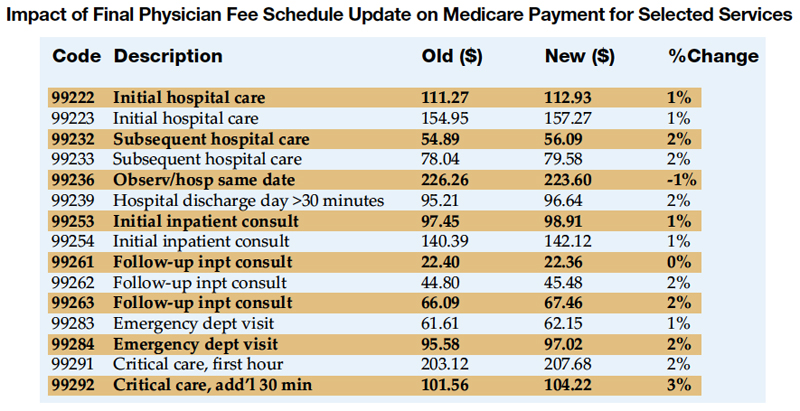
The 2005 Physician Fee Schedule was recently released. Below are the rates for selected services frequently rendered by hospitalists.
Dr. Gorman can be contacted at mjgorman@ipcm.com.
The Medicare Physician Fee Schedule indicates how much each physician service will be reimbursed by Medicare. Payment rates are a combination of three components: physician work, practice expense, and professional liability (malpractice). The Centers for Medicare and Medicaid Services (CMS) assigns relative value units (RVU) to each component, largely based on recommendations made by the Relative Value Update Committee (RUC).
Each billing code is to be reviewed at least once every 5 years to determine its RVU. The second Five-Year Review process has just begun and will review physician work RVU. By approximately March 15 this year, the American Medical Association (AMA) will have collected responses. Surveys will be sent to those specialty societies that expressed an interest in surveying the codes. Once the surveys are completed, specialty societies make their coding recommendations to the AMA. The Society of Hospitalist Medicine (SHM) will be making recommendations to the AMA in conjunction with our other colleagues who use similar codes.
In September, the recommendations are forwarded to the RUC for review. The RUC recommendations are then forwarded to CMS for consideration. Once CMS has completed their review, they typically publish a Notice of Proposed Rulemaking (NPRM) on Five-Year Review in March (in this case, March 2006). The Final Rule is expected to be released November 2006, and the new physician work RVU assignments will be implemented January 1, 2007.
Many cognitive specialty groups began to organize before the current Five-Year Review process started, in order to more efficiently coordinate efforts regarding codes of mutual interest. SHM has joined other such specialties in signing on to a unified letter to CMS regarding this Five-Year Review.
The 2005 Physician Fee Schedule was recently released. Below are the rates for selected services frequently rendered by hospitalists.
Dr. Gorman can be contacted at mjgorman@ipcm.com.
The Medicare Physician Fee Schedule indicates how much each physician service will be reimbursed by Medicare. Payment rates are a combination of three components: physician work, practice expense, and professional liability (malpractice). The Centers for Medicare and Medicaid Services (CMS) assigns relative value units (RVU) to each component, largely based on recommendations made by the Relative Value Update Committee (RUC).
Each billing code is to be reviewed at least once every 5 years to determine its RVU. The second Five-Year Review process has just begun and will review physician work RVU. By approximately March 15 this year, the American Medical Association (AMA) will have collected responses. Surveys will be sent to those specialty societies that expressed an interest in surveying the codes. Once the surveys are completed, specialty societies make their coding recommendations to the AMA. The Society of Hospitalist Medicine (SHM) will be making recommendations to the AMA in conjunction with our other colleagues who use similar codes.
In September, the recommendations are forwarded to the RUC for review. The RUC recommendations are then forwarded to CMS for consideration. Once CMS has completed their review, they typically publish a Notice of Proposed Rulemaking (NPRM) on Five-Year Review in March (in this case, March 2006). The Final Rule is expected to be released November 2006, and the new physician work RVU assignments will be implemented January 1, 2007.
Many cognitive specialty groups began to organize before the current Five-Year Review process started, in order to more efficiently coordinate efforts regarding codes of mutual interest. SHM has joined other such specialties in signing on to a unified letter to CMS regarding this Five-Year Review.
The 2005 Physician Fee Schedule was recently released. Below are the rates for selected services frequently rendered by hospitalists.
Dr. Gorman can be contacted at mjgorman@ipcm.com.
Other Literature of Interest
1. Dexter PR, Perkins SM, Mahany KS, Jones K, McDonald CJ. Inpatient computer-based standing orders vs. physician reminders to increase influenza and pneumococcal vaccination rates: a randomized trial. JAMA. 2004; 292: 2366-71.
Past studies have suggested that most patients admitted with severe pneumococcal infections have been hospitalized in the preceding 5 years, and simply being hospitalized is a potential risk factor for later pneumococcal infection. Likewise, hospitalization provides an opportunity to vaccinate high-risk patients against influenza, and raising pneumococcal and influenza immunization rates is a CMS quality improvement priority. Prior investigations have supported the use of labor-intensive manual standing orders as well as computerized reminders, but this prospective trial was conducted in 1998 and 1999 to assess the effectiveness of a computer-based system to screen for eligible patients and then generate orders to perform pneumonia and influenza vaccinations on inpatients at the time of discharge.
Over 13 months, a total of 3777 inpatients were entered into the study. The hospital computer identified patients eligible for vaccination based on common criteria and randomized them to one of two groups of physician teams. For one group of teams, the computer order-entry system would automatically generate vaccination orders at the time of discharge for vaccine-eligible patients; for the other group of teams, only computer reminders were provided to physicians. The outcome measure was administration of vaccine; long-term outcomes such as incidence of subsequent disease or mortality were not measured.
During the study period, 50% of all hospitalized patients were identified as eligible for influenza vaccination; 22% were eligible for pneumococcal vaccination. In each case, the “standing order” group received vaccine more often (influenza: 42% vs. 30%, p<.001; pneumococcal vaccine: 51% vs. 31%). The numbers were subsequently adjusted to allow for patients who had previously received vaccine, but the impressive differences persisted. Nurses reported reasons for non-administration in 98% of the eligible patients who were not vaccinated; the most common reason was patient refusal. It is not clear if the physicians knew that a study was being conducted. No adverse reactions were reported.
CMS has pushed for the development of institutional standing order sets as a tool to improve compliance with vaccination rate targets. Where the technology is available, computer systems that can screen eligible patients and generate automatic orders are an effective tool in implementing many quality-improvement initiatives, and hospitalists are in a crucial position to take an active role in their development and implementation.
2. Fang MC, Chang Y, Hylek EM, et al. Advanced age, anticoagulation intensity, and risk for intracranial hemorrhage among patients taking warfarin for a trial fibrillation. Ann Intern Med. 2004; 141: 745-52.
Warfarin has been shown to reduce risk of stroke in patients with chronic and paroxysmal atrial fibrillation. Intracranial hemorrhage remains one of the most feared complications of warfarin, especially among older patients, prompting suggestions to consider lower intensity anticoagulation among patients older than 75 years who have atrial fibrillation.
This study evaluated the relationship between the intensity of anticoagulation, risk of intracranial hemorrhage, and age of patients with atrial fibrillation.
This was a retrospective case control study conducted at a tertiary care medical center. One-hundred and seventy patients on warfarin and admitted with intracranial hemorrhage from 1993 to 2002 were matched with 1020 patients who were on warfarin but without intracranial bleed. After controlling for comorbid conditions and aspirin use, authors conducted multivariable logistic regression analysis to determine the odds of intracranial hemorrhage with regard to age and INR. The risk of intracranial hemorrhage increased at 85 years of age and at INR values of 3.5 or greater. The risk of intracranial hemorrhage at INR less than 2.0 did not differ statistically from the risk at INR of 2.0–3.0.
This study shows the risk of intracranial hemorrhage is not decreased by choosing lower intensity anticoagulation, and target INR should still be kept at 2.5 among elderly patients. However, patients older than 85 years should be counseled about their higher risk of intracranial hemorrhage.
3. Heeschen C, Hamm CW, Mitrovic V, et al. N-terminal pro-B-type natriuretic peptide levels for dynamic risk stratification of patients with acute coronary syndromes. Circulation. 2004;110: 3206-12.
Recent data demonstrate the prognostic value of assessment of neurohormonal activation in patients with acute coronary syndromes (ACS). B-type natriuretic peptide levels (BNP) and levels of the N-terminal fragment of the BNP prohormone (NT-proBNP) predict adverse long-term outcomes in patients with ACS. Investigators reviewed plasma samples of Troponin T (TnT) and NT-proBNP obtained from patients with ACS enrolled in the Platelet Receptor Inhibition in Ischemic Syndrome Management (PRISM) trial, which randomized patients to tirofiban or heparin for 48 hours and assessed mortality and myocardial infarction at 30 day follow-up. TnT and NT-proBNP determinations were available at baseline for 1791 patients, and at 48 and 72 hours from 1401 patients. Baseline NT-proBNP levels >250 ng/L were associated with significantly higher rates of death and myocardial infarction at 7 and 30 day follow-up. After adjustment for TnT and C-reactive protein levels, elevated NTproBNP levels maintained its predictive value (OR 2.7; p<.001). In patients with normal TnT levels, NT-proBNP levels identified a subgroup of patients at increased risk (OR 3.0; p=.004). However, in patients with high TnT levels (>0.1 mcg/L), NT-proBNP lost its predictive value (p=.58). More importantly, patients with normal levels of both TnT and NT-proBNP were at very low risk (0.6% event rate at 30 day follow-up).
Serial determinations of NT-proBNP levels at 48 and 72 hours were reviewed in patients without major adverse cardiac events (death or myocardial infarction); these patients were subdivided into groups with and without refractory ischemia. Patients without refractory ischemia showed a significant decline in NT-proBNP levels, whereas patients with refractory ischemia had no significant change. Persistently elevated NT-proBNP levels at 72 hours were associated with a 17.2% risk of death or MI at 30 days, compared with 0.6% risk if NT-proBNP returned to normal at 72 hours (p<.001). Neither TnT nor C-reactive protein demonstrated similar predictive value.
The study is limited by its retrospective nature, by potential selection bias by including only patients with direct evidence of coronary artery disease, and by limitations of the generalizability of its findings (e.g., to emergency department patients with chest pain).
As BNP and NT-proBNP are counter-regulatory hormones that play an active role in the response to ischemic injury, the authors suggest that NT-proBNP is a promising tool for dynamic risk assessment in patients with ACS. The authors also do not differentiate between BNP and NT-proBNP with regard to use in risk stratification, which might lead one to believe that these tests share similar predictive value. (Of note, the study was entirely funded by a company that produces an assay for NT-proBNP). Prospective trials to validate this tool are warranted
4. Heuschmann PU, Kolominsky-Rabas PL, Roether J, et al. Predictors of in-hospital mortality in patients with acute ischemic stroke treated with thrombolytic therapy. JAMA. 2004;292:1831-38.
The objective of this study was to identify factors associated with in-hospital mortality in ischemic stroke patients treated with recombinant tissue plasminogen activator (tPA). It was a prospective observational cohort study of 1658 patients conducted at 225 community and academic hospitals throughout Germany with main outcome of in-hospital mortality.
In this study 10% of patients who were treated with tPA died during their hospital stay, with 2/3 of deaths occurring in the first 7 days. Relative probability of in-hospital mortality increased with increasing patient age, with an odds ratio (OR) of 1.6 for each 10-year increment in age. Age was an independent predictor of in hospital mortality irrespective of tPA administration, with patients older than 75 years age having 4 fold higher mortality than the youngest cohort of less than 55 years age.
Other factors predicting in hospital mortality were altered level of consciousness and relative lack of experience with tPA treatment in the center. Altered level of consciousness was a predictor of stroke severity and an independent predictor of in-hospital mortality (OR 3.4). The increase in mortality in centers with limited experience with tPA administration (OR 0.97) reflected learning curve issues with these patients. The study was not designed to separate out the confounders of operator experience curve from institutional experience curves, or to derive the exact relationship between experience and outcomes.
5. McAlister FA, Bertsch K, Man J, et al. Incidence of and risk factors for pulmonary complications after non-thoracic surgery. Am J Respir Crit Care Med. 2004; published ahead of print on November 24, 2004 as doi:10.1164/rccm.200408-1069OC. Accessed January 27, 2005.
Postoperative pulmonary complications after nonthoracic surgery are a cause of significant morbidity and increased length of hospital stay. Previous studies of preoperative pulmonary assessment were limited by non-representative patient samples, conflicting results, and lack of explicit definitions of these complications. The authors conducted a prospective cohort study of 1055 patients seen in a Pre-Admission Clinic of a tertiary care university hospital. Mean age was 55 years, 50% male, and the cohort consisted of patients scheduled for intermediate risk elective surgery (upper abdominal, lower abdominal, orthopedic). They evaluated physical exam maneuvers (cough test, wheeze test, maximal laryngeal height, and forced expiratory time, all of which are described in an online data supplement) and preoperative spirometry values, and collected information on clinically significant postoperative pulmonary complications, including pneumonia, respiratory failure requiring mechanical ventilation, atelectasis requiring bronchoscopy, or pneumothorax or pleural effusion requiring percutaneous intervention. Twenty-eight patients (2.7%) suffered a pulmonary complication within 7 days of surgery, one of whom died. Length of stay was significantly prolonged in this group (mean 27.9 days vs 4.5 days, p=.006). Multivariate regression analysis revealed four variables that were independently associated with increased risk for postoperative pulmonary complications: age > 65 years, positive cough test (repeated coughing after asking the patient to inhale deeply and cough once), perioperative nasogastric tube, and anesthesia duration 2.5 hours or greater. Number of pack years smoked, FEV1, FEV1/FVC ratio, and upper abdominal surgery were associated with postoperative pulmonary complications but were not found to be independently associated by multivariate analysis.
While it is not surprising that the above risk factors are predictive of postoperative complications, this is the first study to incorporate specific exam maneuvers and spirometry into a risk prediction analysis. Limitations of this model are lack of independent validation and lack of generalizability to other populations, e.g., inpatients awaiting urgent surgery. Of note, the study further provides further support for not routinely obtaining pulmonary function testing for risk stratification prior to noncardiac surgery.
6. Mortenson, EM, Restrepo M, Anzeuto A, Pugh J. Effects of guideline-concordant antimicrobial therapy on mortality among patients with community-acquired pneumonia. Am J Med. 2004;117:726-31.
The American Thoracic Society (ATS) and the Infectious Diseases Society of America (IDSA) have published guidelines for the management of community acquired pneumonia that include recommendations for antibiotic selection. This retrospective cohort study attempted to measure the association between adherence to such guidelines and 30-day mortality in patients admitted with pneumonia to two Texas hospitals.
The characteristics of the patients studied reflect a reasonable cross-section of typical pneumonia patients, with the exception that the patients were mostly (85%) men. Of the study population, 78% were admitted through the ER, 20% admitted to the ICU, and 9% were nursing home residents. Antibiotics were considered “concordant” if they were consistent with either the most recent IDSA or ATS recommendations. The “nonconcordant” group was slightly older (66 vs. 61), generally sicker (higher rate of comorbid COPD and CVD), had more cerebrovascular disease, was more likely to present with altered mental status, and less frequently received antibiotics within 8 hours of presentation. The study did not comment on patients’ vaccination status. Thirty-day mortality was 6.2% in the guideline-concordant group, versus 21.7% in the other group (p < .001). The most common “non-concordant” regimen described was use of a beta-lactam alone, although specific antibiotic regimens were not evaluated.
While the results of this study are not surprising, they provide us with both the validation to continue practice according to existing recommendations, particularly the avoidance of monotherapy with beta-lactam antibiotics. The study also provides us with the imperative to take the lead in developing evidence-based pneumonia pathways at our own hospitals.
7. Pham MX, Whooley MA, Evans GT Jr, et al. Prognostic value of low-level cardiac troponin-I elevations in patients without definite acute coronary syndromes. Am Heart J. 2004;148: 776-82.
With the availability of rapid and highly sensitive and specific troponin testing, many patients admitted to the hospital with non-cardiac diagnoses have been recognized as having abnormal serum troponin-I or troponin-T levels, often just slightly above the reference cutoff for “normal.” While the clinical assumption is often that the elevated enzyme level does not reflect an acute coronary syndrome per se, its significance regarding the patient’s underlying cardiac health is often unclear.
Pham et al. retrospectively reviewed the 1-year mortality of 366 patients who were admitted to the San Francisco VA without evidence of acute MI or ACS either clinically or by EKG, but who had low-level troponin-I elevations (up to 3.0 ng/mL—a level that the authors state was reached by institutional consensus, and which was measured by a “first-generation” assay). These patients were admitted for a broad spectrum of diagnoses ranging from CHF to COPD to sepsis. Ninety-six percent of the patients were men; their average age was 69.
Follow-up was accomplished after a mean of 288 days and included 97% of patients. The primary endpoint was MI or death due to cardiac disease at one year; secondary endpoints were revascularization or admission for unstable angina. The primary endpoint was reached by 11% of patients with cTn-I between 1.0 and 3.0 ng/mL, and 4% of the patients with cTn-I up to 1.0 ng/mL (adjusted HR 3.4, 95% CI, 1.3 to 9.4), and the higher the cTn-I, the higher the risk. However, the authors did not test for the level of risk by specific diagnosis, so they caution against overgeneralizing their findings.
The findings of this study add to the evidence that any evidence of myocardial injury implies an increased risk of underlying heart disease and accompanying long—term cardiac complications– even if such injury occurs in the absence of ACS or known heart disease. Hospitalists often see such injury in the setting of acute infection and pulmonary disease and may be the first to recognize the possibility of CHD in a given patient. To date, guidelines addressing optimal prospective risk stratification have not been developed. Until they are, hospitalists should be aware of the ramifications of “troponin leak” and be prepared to initiate necessary inpatient monitoring and treatments, and to coordinate appropriate follow-up for these patients.
8. Saposnik G, Young B, Silver B, et al. Lack of improvement in patients with acute stroke after treatment with thrombolytic therapy: predictors and association with outcome. JAMA. 2004; 292: 1839-44.
Recombinant tissue plasminogen activator (tPA) has been shown to be one of the most efficacious therapies for acute stroke treatment. This was a systematic evaluation of predictors for outcomes at 24 hours after tPA therapy and of the prognostic significance of lack of improvement at 24 hours for long-term outcomes at 3 months.
The trial was a prospective cohort study of 216 consecutive patients admitted with acute ischemic stroke to a university hospital. The decision to treat with tPA was based on the NINDS protocol with one difference: patients with involvement of more than one third of the middle cerebral artery on the baseline CT scan were excluded. A control CT scan was performed at 24 hours to determine the presence of new infarction, cortical involvement, and extension of the ischemic lesion.
Lack of improvement was defined as a difference between the NIHSS score at baseline and at 24 hours of 3 points or less. Poor outcome at 3 months was defined by a modified Rankin Scale score of 3 to 5 or death.
After adjusting for age, gender, and stroke severity, hyperglycemia at admission (glucose > 144 mg/dL), cortical involvement, and time to treatment were independent predictors of lack of improvement at 24 hours. After adjusting for age, gender, and stroke severity, lack of improvement at 24 hours was an independent predictor of poor outcome and death at 3 months. Patients with lack of improvement at 24 hours also had longer lengths of hospitalization.
9. Taylor AL, Ziesche S, Yancy C, et al. Combination of isosorbide dinitrate and hydralazine in blacks with heart failure. N Engl J Med. 2004;351:2049-57.
Neurohormonal changes, endothelial dysfunction, impaired nitric oxide availability, and oxidant stress all contribute to the structural remodeling of the left ventricle in congestive heart failure. The combination of isosorbide dinitrate, an organic nitrate that stimulates nitric oxide signaling, and the antioxidant and vasodilator hydralazine improves survival in heart failure. Based on more recent data that black patients have a clinically significant response to this combination therapy, the authors of the African-American Heart Failure Trial (A-HeFT) evaluated 1050 black patients with congestive heart failure in a randomized, double-blind, placebo controlled trial. Patients were randomized to fixed doses of isosorbide dinitrate and hydralazine plus background therapy (i.e., digoxin, ACE inhibitors, beta-blockers, diuretics, angiotensin receptor blockers) or to placebo plus background therapy. After 18 months, the trial was stopped due to a significantly higher mortality rate in the placebo group (10.2% in the placebo group vs. 6.2% with combination
therapy, p=.02); survival differences emerged at 180 days and increased progressively thereafter. The combination therapy group reported more headache and dizziness but suffered fewer exacerbations of congestive heart failure and reported improvement in subjective assessments of quality of life as measured by questionnaires. Accompanying editorials discuss the role of nitric oxide and prevention of oxidative stress in the treatment of heart failure, as well as the controversial issues surrounding race-based therapeutics.
1. Dexter PR, Perkins SM, Mahany KS, Jones K, McDonald CJ. Inpatient computer-based standing orders vs. physician reminders to increase influenza and pneumococcal vaccination rates: a randomized trial. JAMA. 2004; 292: 2366-71.
Past studies have suggested that most patients admitted with severe pneumococcal infections have been hospitalized in the preceding 5 years, and simply being hospitalized is a potential risk factor for later pneumococcal infection. Likewise, hospitalization provides an opportunity to vaccinate high-risk patients against influenza, and raising pneumococcal and influenza immunization rates is a CMS quality improvement priority. Prior investigations have supported the use of labor-intensive manual standing orders as well as computerized reminders, but this prospective trial was conducted in 1998 and 1999 to assess the effectiveness of a computer-based system to screen for eligible patients and then generate orders to perform pneumonia and influenza vaccinations on inpatients at the time of discharge.
Over 13 months, a total of 3777 inpatients were entered into the study. The hospital computer identified patients eligible for vaccination based on common criteria and randomized them to one of two groups of physician teams. For one group of teams, the computer order-entry system would automatically generate vaccination orders at the time of discharge for vaccine-eligible patients; for the other group of teams, only computer reminders were provided to physicians. The outcome measure was administration of vaccine; long-term outcomes such as incidence of subsequent disease or mortality were not measured.
During the study period, 50% of all hospitalized patients were identified as eligible for influenza vaccination; 22% were eligible for pneumococcal vaccination. In each case, the “standing order” group received vaccine more often (influenza: 42% vs. 30%, p<.001; pneumococcal vaccine: 51% vs. 31%). The numbers were subsequently adjusted to allow for patients who had previously received vaccine, but the impressive differences persisted. Nurses reported reasons for non-administration in 98% of the eligible patients who were not vaccinated; the most common reason was patient refusal. It is not clear if the physicians knew that a study was being conducted. No adverse reactions were reported.
CMS has pushed for the development of institutional standing order sets as a tool to improve compliance with vaccination rate targets. Where the technology is available, computer systems that can screen eligible patients and generate automatic orders are an effective tool in implementing many quality-improvement initiatives, and hospitalists are in a crucial position to take an active role in their development and implementation.
2. Fang MC, Chang Y, Hylek EM, et al. Advanced age, anticoagulation intensity, and risk for intracranial hemorrhage among patients taking warfarin for a trial fibrillation. Ann Intern Med. 2004; 141: 745-52.
Warfarin has been shown to reduce risk of stroke in patients with chronic and paroxysmal atrial fibrillation. Intracranial hemorrhage remains one of the most feared complications of warfarin, especially among older patients, prompting suggestions to consider lower intensity anticoagulation among patients older than 75 years who have atrial fibrillation.
This study evaluated the relationship between the intensity of anticoagulation, risk of intracranial hemorrhage, and age of patients with atrial fibrillation.
This was a retrospective case control study conducted at a tertiary care medical center. One-hundred and seventy patients on warfarin and admitted with intracranial hemorrhage from 1993 to 2002 were matched with 1020 patients who were on warfarin but without intracranial bleed. After controlling for comorbid conditions and aspirin use, authors conducted multivariable logistic regression analysis to determine the odds of intracranial hemorrhage with regard to age and INR. The risk of intracranial hemorrhage increased at 85 years of age and at INR values of 3.5 or greater. The risk of intracranial hemorrhage at INR less than 2.0 did not differ statistically from the risk at INR of 2.0–3.0.
This study shows the risk of intracranial hemorrhage is not decreased by choosing lower intensity anticoagulation, and target INR should still be kept at 2.5 among elderly patients. However, patients older than 85 years should be counseled about their higher risk of intracranial hemorrhage.
3. Heeschen C, Hamm CW, Mitrovic V, et al. N-terminal pro-B-type natriuretic peptide levels for dynamic risk stratification of patients with acute coronary syndromes. Circulation. 2004;110: 3206-12.
Recent data demonstrate the prognostic value of assessment of neurohormonal activation in patients with acute coronary syndromes (ACS). B-type natriuretic peptide levels (BNP) and levels of the N-terminal fragment of the BNP prohormone (NT-proBNP) predict adverse long-term outcomes in patients with ACS. Investigators reviewed plasma samples of Troponin T (TnT) and NT-proBNP obtained from patients with ACS enrolled in the Platelet Receptor Inhibition in Ischemic Syndrome Management (PRISM) trial, which randomized patients to tirofiban or heparin for 48 hours and assessed mortality and myocardial infarction at 30 day follow-up. TnT and NT-proBNP determinations were available at baseline for 1791 patients, and at 48 and 72 hours from 1401 patients. Baseline NT-proBNP levels >250 ng/L were associated with significantly higher rates of death and myocardial infarction at 7 and 30 day follow-up. After adjustment for TnT and C-reactive protein levels, elevated NTproBNP levels maintained its predictive value (OR 2.7; p<.001). In patients with normal TnT levels, NT-proBNP levels identified a subgroup of patients at increased risk (OR 3.0; p=.004). However, in patients with high TnT levels (>0.1 mcg/L), NT-proBNP lost its predictive value (p=.58). More importantly, patients with normal levels of both TnT and NT-proBNP were at very low risk (0.6% event rate at 30 day follow-up).
Serial determinations of NT-proBNP levels at 48 and 72 hours were reviewed in patients without major adverse cardiac events (death or myocardial infarction); these patients were subdivided into groups with and without refractory ischemia. Patients without refractory ischemia showed a significant decline in NT-proBNP levels, whereas patients with refractory ischemia had no significant change. Persistently elevated NT-proBNP levels at 72 hours were associated with a 17.2% risk of death or MI at 30 days, compared with 0.6% risk if NT-proBNP returned to normal at 72 hours (p<.001). Neither TnT nor C-reactive protein demonstrated similar predictive value.
The study is limited by its retrospective nature, by potential selection bias by including only patients with direct evidence of coronary artery disease, and by limitations of the generalizability of its findings (e.g., to emergency department patients with chest pain).
As BNP and NT-proBNP are counter-regulatory hormones that play an active role in the response to ischemic injury, the authors suggest that NT-proBNP is a promising tool for dynamic risk assessment in patients with ACS. The authors also do not differentiate between BNP and NT-proBNP with regard to use in risk stratification, which might lead one to believe that these tests share similar predictive value. (Of note, the study was entirely funded by a company that produces an assay for NT-proBNP). Prospective trials to validate this tool are warranted
4. Heuschmann PU, Kolominsky-Rabas PL, Roether J, et al. Predictors of in-hospital mortality in patients with acute ischemic stroke treated with thrombolytic therapy. JAMA. 2004;292:1831-38.
The objective of this study was to identify factors associated with in-hospital mortality in ischemic stroke patients treated with recombinant tissue plasminogen activator (tPA). It was a prospective observational cohort study of 1658 patients conducted at 225 community and academic hospitals throughout Germany with main outcome of in-hospital mortality.
In this study 10% of patients who were treated with tPA died during their hospital stay, with 2/3 of deaths occurring in the first 7 days. Relative probability of in-hospital mortality increased with increasing patient age, with an odds ratio (OR) of 1.6 for each 10-year increment in age. Age was an independent predictor of in hospital mortality irrespective of tPA administration, with patients older than 75 years age having 4 fold higher mortality than the youngest cohort of less than 55 years age.
Other factors predicting in hospital mortality were altered level of consciousness and relative lack of experience with tPA treatment in the center. Altered level of consciousness was a predictor of stroke severity and an independent predictor of in-hospital mortality (OR 3.4). The increase in mortality in centers with limited experience with tPA administration (OR 0.97) reflected learning curve issues with these patients. The study was not designed to separate out the confounders of operator experience curve from institutional experience curves, or to derive the exact relationship between experience and outcomes.
5. McAlister FA, Bertsch K, Man J, et al. Incidence of and risk factors for pulmonary complications after non-thoracic surgery. Am J Respir Crit Care Med. 2004; published ahead of print on November 24, 2004 as doi:10.1164/rccm.200408-1069OC. Accessed January 27, 2005.
Postoperative pulmonary complications after nonthoracic surgery are a cause of significant morbidity and increased length of hospital stay. Previous studies of preoperative pulmonary assessment were limited by non-representative patient samples, conflicting results, and lack of explicit definitions of these complications. The authors conducted a prospective cohort study of 1055 patients seen in a Pre-Admission Clinic of a tertiary care university hospital. Mean age was 55 years, 50% male, and the cohort consisted of patients scheduled for intermediate risk elective surgery (upper abdominal, lower abdominal, orthopedic). They evaluated physical exam maneuvers (cough test, wheeze test, maximal laryngeal height, and forced expiratory time, all of which are described in an online data supplement) and preoperative spirometry values, and collected information on clinically significant postoperative pulmonary complications, including pneumonia, respiratory failure requiring mechanical ventilation, atelectasis requiring bronchoscopy, or pneumothorax or pleural effusion requiring percutaneous intervention. Twenty-eight patients (2.7%) suffered a pulmonary complication within 7 days of surgery, one of whom died. Length of stay was significantly prolonged in this group (mean 27.9 days vs 4.5 days, p=.006). Multivariate regression analysis revealed four variables that were independently associated with increased risk for postoperative pulmonary complications: age > 65 years, positive cough test (repeated coughing after asking the patient to inhale deeply and cough once), perioperative nasogastric tube, and anesthesia duration 2.5 hours or greater. Number of pack years smoked, FEV1, FEV1/FVC ratio, and upper abdominal surgery were associated with postoperative pulmonary complications but were not found to be independently associated by multivariate analysis.
While it is not surprising that the above risk factors are predictive of postoperative complications, this is the first study to incorporate specific exam maneuvers and spirometry into a risk prediction analysis. Limitations of this model are lack of independent validation and lack of generalizability to other populations, e.g., inpatients awaiting urgent surgery. Of note, the study further provides further support for not routinely obtaining pulmonary function testing for risk stratification prior to noncardiac surgery.
6. Mortenson, EM, Restrepo M, Anzeuto A, Pugh J. Effects of guideline-concordant antimicrobial therapy on mortality among patients with community-acquired pneumonia. Am J Med. 2004;117:726-31.
The American Thoracic Society (ATS) and the Infectious Diseases Society of America (IDSA) have published guidelines for the management of community acquired pneumonia that include recommendations for antibiotic selection. This retrospective cohort study attempted to measure the association between adherence to such guidelines and 30-day mortality in patients admitted with pneumonia to two Texas hospitals.
The characteristics of the patients studied reflect a reasonable cross-section of typical pneumonia patients, with the exception that the patients were mostly (85%) men. Of the study population, 78% were admitted through the ER, 20% admitted to the ICU, and 9% were nursing home residents. Antibiotics were considered “concordant” if they were consistent with either the most recent IDSA or ATS recommendations. The “nonconcordant” group was slightly older (66 vs. 61), generally sicker (higher rate of comorbid COPD and CVD), had more cerebrovascular disease, was more likely to present with altered mental status, and less frequently received antibiotics within 8 hours of presentation. The study did not comment on patients’ vaccination status. Thirty-day mortality was 6.2% in the guideline-concordant group, versus 21.7% in the other group (p < .001). The most common “non-concordant” regimen described was use of a beta-lactam alone, although specific antibiotic regimens were not evaluated.
While the results of this study are not surprising, they provide us with both the validation to continue practice according to existing recommendations, particularly the avoidance of monotherapy with beta-lactam antibiotics. The study also provides us with the imperative to take the lead in developing evidence-based pneumonia pathways at our own hospitals.
7. Pham MX, Whooley MA, Evans GT Jr, et al. Prognostic value of low-level cardiac troponin-I elevations in patients without definite acute coronary syndromes. Am Heart J. 2004;148: 776-82.
With the availability of rapid and highly sensitive and specific troponin testing, many patients admitted to the hospital with non-cardiac diagnoses have been recognized as having abnormal serum troponin-I or troponin-T levels, often just slightly above the reference cutoff for “normal.” While the clinical assumption is often that the elevated enzyme level does not reflect an acute coronary syndrome per se, its significance regarding the patient’s underlying cardiac health is often unclear.
Pham et al. retrospectively reviewed the 1-year mortality of 366 patients who were admitted to the San Francisco VA without evidence of acute MI or ACS either clinically or by EKG, but who had low-level troponin-I elevations (up to 3.0 ng/mL—a level that the authors state was reached by institutional consensus, and which was measured by a “first-generation” assay). These patients were admitted for a broad spectrum of diagnoses ranging from CHF to COPD to sepsis. Ninety-six percent of the patients were men; their average age was 69.
Follow-up was accomplished after a mean of 288 days and included 97% of patients. The primary endpoint was MI or death due to cardiac disease at one year; secondary endpoints were revascularization or admission for unstable angina. The primary endpoint was reached by 11% of patients with cTn-I between 1.0 and 3.0 ng/mL, and 4% of the patients with cTn-I up to 1.0 ng/mL (adjusted HR 3.4, 95% CI, 1.3 to 9.4), and the higher the cTn-I, the higher the risk. However, the authors did not test for the level of risk by specific diagnosis, so they caution against overgeneralizing their findings.
The findings of this study add to the evidence that any evidence of myocardial injury implies an increased risk of underlying heart disease and accompanying long—term cardiac complications– even if such injury occurs in the absence of ACS or known heart disease. Hospitalists often see such injury in the setting of acute infection and pulmonary disease and may be the first to recognize the possibility of CHD in a given patient. To date, guidelines addressing optimal prospective risk stratification have not been developed. Until they are, hospitalists should be aware of the ramifications of “troponin leak” and be prepared to initiate necessary inpatient monitoring and treatments, and to coordinate appropriate follow-up for these patients.
8. Saposnik G, Young B, Silver B, et al. Lack of improvement in patients with acute stroke after treatment with thrombolytic therapy: predictors and association with outcome. JAMA. 2004; 292: 1839-44.
Recombinant tissue plasminogen activator (tPA) has been shown to be one of the most efficacious therapies for acute stroke treatment. This was a systematic evaluation of predictors for outcomes at 24 hours after tPA therapy and of the prognostic significance of lack of improvement at 24 hours for long-term outcomes at 3 months.
The trial was a prospective cohort study of 216 consecutive patients admitted with acute ischemic stroke to a university hospital. The decision to treat with tPA was based on the NINDS protocol with one difference: patients with involvement of more than one third of the middle cerebral artery on the baseline CT scan were excluded. A control CT scan was performed at 24 hours to determine the presence of new infarction, cortical involvement, and extension of the ischemic lesion.
Lack of improvement was defined as a difference between the NIHSS score at baseline and at 24 hours of 3 points or less. Poor outcome at 3 months was defined by a modified Rankin Scale score of 3 to 5 or death.
After adjusting for age, gender, and stroke severity, hyperglycemia at admission (glucose > 144 mg/dL), cortical involvement, and time to treatment were independent predictors of lack of improvement at 24 hours. After adjusting for age, gender, and stroke severity, lack of improvement at 24 hours was an independent predictor of poor outcome and death at 3 months. Patients with lack of improvement at 24 hours also had longer lengths of hospitalization.
9. Taylor AL, Ziesche S, Yancy C, et al. Combination of isosorbide dinitrate and hydralazine in blacks with heart failure. N Engl J Med. 2004;351:2049-57.
Neurohormonal changes, endothelial dysfunction, impaired nitric oxide availability, and oxidant stress all contribute to the structural remodeling of the left ventricle in congestive heart failure. The combination of isosorbide dinitrate, an organic nitrate that stimulates nitric oxide signaling, and the antioxidant and vasodilator hydralazine improves survival in heart failure. Based on more recent data that black patients have a clinically significant response to this combination therapy, the authors of the African-American Heart Failure Trial (A-HeFT) evaluated 1050 black patients with congestive heart failure in a randomized, double-blind, placebo controlled trial. Patients were randomized to fixed doses of isosorbide dinitrate and hydralazine plus background therapy (i.e., digoxin, ACE inhibitors, beta-blockers, diuretics, angiotensin receptor blockers) or to placebo plus background therapy. After 18 months, the trial was stopped due to a significantly higher mortality rate in the placebo group (10.2% in the placebo group vs. 6.2% with combination
therapy, p=.02); survival differences emerged at 180 days and increased progressively thereafter. The combination therapy group reported more headache and dizziness but suffered fewer exacerbations of congestive heart failure and reported improvement in subjective assessments of quality of life as measured by questionnaires. Accompanying editorials discuss the role of nitric oxide and prevention of oxidative stress in the treatment of heart failure, as well as the controversial issues surrounding race-based therapeutics.
1. Dexter PR, Perkins SM, Mahany KS, Jones K, McDonald CJ. Inpatient computer-based standing orders vs. physician reminders to increase influenza and pneumococcal vaccination rates: a randomized trial. JAMA. 2004; 292: 2366-71.
Past studies have suggested that most patients admitted with severe pneumococcal infections have been hospitalized in the preceding 5 years, and simply being hospitalized is a potential risk factor for later pneumococcal infection. Likewise, hospitalization provides an opportunity to vaccinate high-risk patients against influenza, and raising pneumococcal and influenza immunization rates is a CMS quality improvement priority. Prior investigations have supported the use of labor-intensive manual standing orders as well as computerized reminders, but this prospective trial was conducted in 1998 and 1999 to assess the effectiveness of a computer-based system to screen for eligible patients and then generate orders to perform pneumonia and influenza vaccinations on inpatients at the time of discharge.
Over 13 months, a total of 3777 inpatients were entered into the study. The hospital computer identified patients eligible for vaccination based on common criteria and randomized them to one of two groups of physician teams. For one group of teams, the computer order-entry system would automatically generate vaccination orders at the time of discharge for vaccine-eligible patients; for the other group of teams, only computer reminders were provided to physicians. The outcome measure was administration of vaccine; long-term outcomes such as incidence of subsequent disease or mortality were not measured.
During the study period, 50% of all hospitalized patients were identified as eligible for influenza vaccination; 22% were eligible for pneumococcal vaccination. In each case, the “standing order” group received vaccine more often (influenza: 42% vs. 30%, p<.001; pneumococcal vaccine: 51% vs. 31%). The numbers were subsequently adjusted to allow for patients who had previously received vaccine, but the impressive differences persisted. Nurses reported reasons for non-administration in 98% of the eligible patients who were not vaccinated; the most common reason was patient refusal. It is not clear if the physicians knew that a study was being conducted. No adverse reactions were reported.
CMS has pushed for the development of institutional standing order sets as a tool to improve compliance with vaccination rate targets. Where the technology is available, computer systems that can screen eligible patients and generate automatic orders are an effective tool in implementing many quality-improvement initiatives, and hospitalists are in a crucial position to take an active role in their development and implementation.
2. Fang MC, Chang Y, Hylek EM, et al. Advanced age, anticoagulation intensity, and risk for intracranial hemorrhage among patients taking warfarin for a trial fibrillation. Ann Intern Med. 2004; 141: 745-52.
Warfarin has been shown to reduce risk of stroke in patients with chronic and paroxysmal atrial fibrillation. Intracranial hemorrhage remains one of the most feared complications of warfarin, especially among older patients, prompting suggestions to consider lower intensity anticoagulation among patients older than 75 years who have atrial fibrillation.
This study evaluated the relationship between the intensity of anticoagulation, risk of intracranial hemorrhage, and age of patients with atrial fibrillation.
This was a retrospective case control study conducted at a tertiary care medical center. One-hundred and seventy patients on warfarin and admitted with intracranial hemorrhage from 1993 to 2002 were matched with 1020 patients who were on warfarin but without intracranial bleed. After controlling for comorbid conditions and aspirin use, authors conducted multivariable logistic regression analysis to determine the odds of intracranial hemorrhage with regard to age and INR. The risk of intracranial hemorrhage increased at 85 years of age and at INR values of 3.5 or greater. The risk of intracranial hemorrhage at INR less than 2.0 did not differ statistically from the risk at INR of 2.0–3.0.
This study shows the risk of intracranial hemorrhage is not decreased by choosing lower intensity anticoagulation, and target INR should still be kept at 2.5 among elderly patients. However, patients older than 85 years should be counseled about their higher risk of intracranial hemorrhage.
3. Heeschen C, Hamm CW, Mitrovic V, et al. N-terminal pro-B-type natriuretic peptide levels for dynamic risk stratification of patients with acute coronary syndromes. Circulation. 2004;110: 3206-12.
Recent data demonstrate the prognostic value of assessment of neurohormonal activation in patients with acute coronary syndromes (ACS). B-type natriuretic peptide levels (BNP) and levels of the N-terminal fragment of the BNP prohormone (NT-proBNP) predict adverse long-term outcomes in patients with ACS. Investigators reviewed plasma samples of Troponin T (TnT) and NT-proBNP obtained from patients with ACS enrolled in the Platelet Receptor Inhibition in Ischemic Syndrome Management (PRISM) trial, which randomized patients to tirofiban or heparin for 48 hours and assessed mortality and myocardial infarction at 30 day follow-up. TnT and NT-proBNP determinations were available at baseline for 1791 patients, and at 48 and 72 hours from 1401 patients. Baseline NT-proBNP levels >250 ng/L were associated with significantly higher rates of death and myocardial infarction at 7 and 30 day follow-up. After adjustment for TnT and C-reactive protein levels, elevated NTproBNP levels maintained its predictive value (OR 2.7; p<.001). In patients with normal TnT levels, NT-proBNP levels identified a subgroup of patients at increased risk (OR 3.0; p=.004). However, in patients with high TnT levels (>0.1 mcg/L), NT-proBNP lost its predictive value (p=.58). More importantly, patients with normal levels of both TnT and NT-proBNP were at very low risk (0.6% event rate at 30 day follow-up).
Serial determinations of NT-proBNP levels at 48 and 72 hours were reviewed in patients without major adverse cardiac events (death or myocardial infarction); these patients were subdivided into groups with and without refractory ischemia. Patients without refractory ischemia showed a significant decline in NT-proBNP levels, whereas patients with refractory ischemia had no significant change. Persistently elevated NT-proBNP levels at 72 hours were associated with a 17.2% risk of death or MI at 30 days, compared with 0.6% risk if NT-proBNP returned to normal at 72 hours (p<.001). Neither TnT nor C-reactive protein demonstrated similar predictive value.
The study is limited by its retrospective nature, by potential selection bias by including only patients with direct evidence of coronary artery disease, and by limitations of the generalizability of its findings (e.g., to emergency department patients with chest pain).
As BNP and NT-proBNP are counter-regulatory hormones that play an active role in the response to ischemic injury, the authors suggest that NT-proBNP is a promising tool for dynamic risk assessment in patients with ACS. The authors also do not differentiate between BNP and NT-proBNP with regard to use in risk stratification, which might lead one to believe that these tests share similar predictive value. (Of note, the study was entirely funded by a company that produces an assay for NT-proBNP). Prospective trials to validate this tool are warranted
4. Heuschmann PU, Kolominsky-Rabas PL, Roether J, et al. Predictors of in-hospital mortality in patients with acute ischemic stroke treated with thrombolytic therapy. JAMA. 2004;292:1831-38.
The objective of this study was to identify factors associated with in-hospital mortality in ischemic stroke patients treated with recombinant tissue plasminogen activator (tPA). It was a prospective observational cohort study of 1658 patients conducted at 225 community and academic hospitals throughout Germany with main outcome of in-hospital mortality.
In this study 10% of patients who were treated with tPA died during their hospital stay, with 2/3 of deaths occurring in the first 7 days. Relative probability of in-hospital mortality increased with increasing patient age, with an odds ratio (OR) of 1.6 for each 10-year increment in age. Age was an independent predictor of in hospital mortality irrespective of tPA administration, with patients older than 75 years age having 4 fold higher mortality than the youngest cohort of less than 55 years age.
Other factors predicting in hospital mortality were altered level of consciousness and relative lack of experience with tPA treatment in the center. Altered level of consciousness was a predictor of stroke severity and an independent predictor of in-hospital mortality (OR 3.4). The increase in mortality in centers with limited experience with tPA administration (OR 0.97) reflected learning curve issues with these patients. The study was not designed to separate out the confounders of operator experience curve from institutional experience curves, or to derive the exact relationship between experience and outcomes.
5. McAlister FA, Bertsch K, Man J, et al. Incidence of and risk factors for pulmonary complications after non-thoracic surgery. Am J Respir Crit Care Med. 2004; published ahead of print on November 24, 2004 as doi:10.1164/rccm.200408-1069OC. Accessed January 27, 2005.
Postoperative pulmonary complications after nonthoracic surgery are a cause of significant morbidity and increased length of hospital stay. Previous studies of preoperative pulmonary assessment were limited by non-representative patient samples, conflicting results, and lack of explicit definitions of these complications. The authors conducted a prospective cohort study of 1055 patients seen in a Pre-Admission Clinic of a tertiary care university hospital. Mean age was 55 years, 50% male, and the cohort consisted of patients scheduled for intermediate risk elective surgery (upper abdominal, lower abdominal, orthopedic). They evaluated physical exam maneuvers (cough test, wheeze test, maximal laryngeal height, and forced expiratory time, all of which are described in an online data supplement) and preoperative spirometry values, and collected information on clinically significant postoperative pulmonary complications, including pneumonia, respiratory failure requiring mechanical ventilation, atelectasis requiring bronchoscopy, or pneumothorax or pleural effusion requiring percutaneous intervention. Twenty-eight patients (2.7%) suffered a pulmonary complication within 7 days of surgery, one of whom died. Length of stay was significantly prolonged in this group (mean 27.9 days vs 4.5 days, p=.006). Multivariate regression analysis revealed four variables that were independently associated with increased risk for postoperative pulmonary complications: age > 65 years, positive cough test (repeated coughing after asking the patient to inhale deeply and cough once), perioperative nasogastric tube, and anesthesia duration 2.5 hours or greater. Number of pack years smoked, FEV1, FEV1/FVC ratio, and upper abdominal surgery were associated with postoperative pulmonary complications but were not found to be independently associated by multivariate analysis.
While it is not surprising that the above risk factors are predictive of postoperative complications, this is the first study to incorporate specific exam maneuvers and spirometry into a risk prediction analysis. Limitations of this model are lack of independent validation and lack of generalizability to other populations, e.g., inpatients awaiting urgent surgery. Of note, the study further provides further support for not routinely obtaining pulmonary function testing for risk stratification prior to noncardiac surgery.
6. Mortenson, EM, Restrepo M, Anzeuto A, Pugh J. Effects of guideline-concordant antimicrobial therapy on mortality among patients with community-acquired pneumonia. Am J Med. 2004;117:726-31.
The American Thoracic Society (ATS) and the Infectious Diseases Society of America (IDSA) have published guidelines for the management of community acquired pneumonia that include recommendations for antibiotic selection. This retrospective cohort study attempted to measure the association between adherence to such guidelines and 30-day mortality in patients admitted with pneumonia to two Texas hospitals.
The characteristics of the patients studied reflect a reasonable cross-section of typical pneumonia patients, with the exception that the patients were mostly (85%) men. Of the study population, 78% were admitted through the ER, 20% admitted to the ICU, and 9% were nursing home residents. Antibiotics were considered “concordant” if they were consistent with either the most recent IDSA or ATS recommendations. The “nonconcordant” group was slightly older (66 vs. 61), generally sicker (higher rate of comorbid COPD and CVD), had more cerebrovascular disease, was more likely to present with altered mental status, and less frequently received antibiotics within 8 hours of presentation. The study did not comment on patients’ vaccination status. Thirty-day mortality was 6.2% in the guideline-concordant group, versus 21.7% in the other group (p < .001). The most common “non-concordant” regimen described was use of a beta-lactam alone, although specific antibiotic regimens were not evaluated.
While the results of this study are not surprising, they provide us with both the validation to continue practice according to existing recommendations, particularly the avoidance of monotherapy with beta-lactam antibiotics. The study also provides us with the imperative to take the lead in developing evidence-based pneumonia pathways at our own hospitals.
7. Pham MX, Whooley MA, Evans GT Jr, et al. Prognostic value of low-level cardiac troponin-I elevations in patients without definite acute coronary syndromes. Am Heart J. 2004;148: 776-82.
With the availability of rapid and highly sensitive and specific troponin testing, many patients admitted to the hospital with non-cardiac diagnoses have been recognized as having abnormal serum troponin-I or troponin-T levels, often just slightly above the reference cutoff for “normal.” While the clinical assumption is often that the elevated enzyme level does not reflect an acute coronary syndrome per se, its significance regarding the patient’s underlying cardiac health is often unclear.
Pham et al. retrospectively reviewed the 1-year mortality of 366 patients who were admitted to the San Francisco VA without evidence of acute MI or ACS either clinically or by EKG, but who had low-level troponin-I elevations (up to 3.0 ng/mL—a level that the authors state was reached by institutional consensus, and which was measured by a “first-generation” assay). These patients were admitted for a broad spectrum of diagnoses ranging from CHF to COPD to sepsis. Ninety-six percent of the patients were men; their average age was 69.
Follow-up was accomplished after a mean of 288 days and included 97% of patients. The primary endpoint was MI or death due to cardiac disease at one year; secondary endpoints were revascularization or admission for unstable angina. The primary endpoint was reached by 11% of patients with cTn-I between 1.0 and 3.0 ng/mL, and 4% of the patients with cTn-I up to 1.0 ng/mL (adjusted HR 3.4, 95% CI, 1.3 to 9.4), and the higher the cTn-I, the higher the risk. However, the authors did not test for the level of risk by specific diagnosis, so they caution against overgeneralizing their findings.
The findings of this study add to the evidence that any evidence of myocardial injury implies an increased risk of underlying heart disease and accompanying long—term cardiac complications– even if such injury occurs in the absence of ACS or known heart disease. Hospitalists often see such injury in the setting of acute infection and pulmonary disease and may be the first to recognize the possibility of CHD in a given patient. To date, guidelines addressing optimal prospective risk stratification have not been developed. Until they are, hospitalists should be aware of the ramifications of “troponin leak” and be prepared to initiate necessary inpatient monitoring and treatments, and to coordinate appropriate follow-up for these patients.
8. Saposnik G, Young B, Silver B, et al. Lack of improvement in patients with acute stroke after treatment with thrombolytic therapy: predictors and association with outcome. JAMA. 2004; 292: 1839-44.
Recombinant tissue plasminogen activator (tPA) has been shown to be one of the most efficacious therapies for acute stroke treatment. This was a systematic evaluation of predictors for outcomes at 24 hours after tPA therapy and of the prognostic significance of lack of improvement at 24 hours for long-term outcomes at 3 months.
The trial was a prospective cohort study of 216 consecutive patients admitted with acute ischemic stroke to a university hospital. The decision to treat with tPA was based on the NINDS protocol with one difference: patients with involvement of more than one third of the middle cerebral artery on the baseline CT scan were excluded. A control CT scan was performed at 24 hours to determine the presence of new infarction, cortical involvement, and extension of the ischemic lesion.
Lack of improvement was defined as a difference between the NIHSS score at baseline and at 24 hours of 3 points or less. Poor outcome at 3 months was defined by a modified Rankin Scale score of 3 to 5 or death.
After adjusting for age, gender, and stroke severity, hyperglycemia at admission (glucose > 144 mg/dL), cortical involvement, and time to treatment were independent predictors of lack of improvement at 24 hours. After adjusting for age, gender, and stroke severity, lack of improvement at 24 hours was an independent predictor of poor outcome and death at 3 months. Patients with lack of improvement at 24 hours also had longer lengths of hospitalization.
9. Taylor AL, Ziesche S, Yancy C, et al. Combination of isosorbide dinitrate and hydralazine in blacks with heart failure. N Engl J Med. 2004;351:2049-57.
Neurohormonal changes, endothelial dysfunction, impaired nitric oxide availability, and oxidant stress all contribute to the structural remodeling of the left ventricle in congestive heart failure. The combination of isosorbide dinitrate, an organic nitrate that stimulates nitric oxide signaling, and the antioxidant and vasodilator hydralazine improves survival in heart failure. Based on more recent data that black patients have a clinically significant response to this combination therapy, the authors of the African-American Heart Failure Trial (A-HeFT) evaluated 1050 black patients with congestive heart failure in a randomized, double-blind, placebo controlled trial. Patients were randomized to fixed doses of isosorbide dinitrate and hydralazine plus background therapy (i.e., digoxin, ACE inhibitors, beta-blockers, diuretics, angiotensin receptor blockers) or to placebo plus background therapy. After 18 months, the trial was stopped due to a significantly higher mortality rate in the placebo group (10.2% in the placebo group vs. 6.2% with combination
therapy, p=.02); survival differences emerged at 180 days and increased progressively thereafter. The combination therapy group reported more headache and dizziness but suffered fewer exacerbations of congestive heart failure and reported improvement in subjective assessments of quality of life as measured by questionnaires. Accompanying editorials discuss the role of nitric oxide and prevention of oxidative stress in the treatment of heart failure, as well as the controversial issues surrounding race-based therapeutics.
In the Literature
CARP Trial Suggests No Benefit to Revascularization Before Vascular Surgery
McFalls, EO, Ward HB, Mortiz TE, et al. Coronary-artery revascularization before elective major vascular surgery. N Engl J Med. 2004;351:2795-2804.
Recent studies have presented evidence that treatment with beta-blockers for patients with CAD could reduce the risk of perioperative cardiac complications. Beta-blockers have since become a critical part of the management plan for the perioperative patient. Evidence-based practice guidelines for cardiac risk assessment have been published by both the American College of Physicians and the American College of Cardiology/American Heart Association. However, practice patterns continue to vary between physicians and cardiologists, particularly for patients clinically stratified into the intermediate-risk category. Some physicians feel comfortable with a conservative approach of medical optimization even in the setting of established CAD, while others favor more aggressive treatment, even though the prospective data supporting cardiac revascularization before major surgery has been lacking. The study investigators sought to clarify this uncertainty.
The prospective trial enrolled 510 patients at 18 VA centers. Patients scheduled for major vascular operations were eligible, and were preoperatively assessed via clinical criteria, stress imaging, and angiography when appropriate. Eligible patients had significant (at least 70%) stenosis of at least one coronary artery. High-risk patients (i.e., those with left main disease, severe aortic stenosis, and LVEF <20%) were excluded. Patients were then randomized to one
of two groups. The first group underwent revascularization with PTCA or CABG plus medical optimization; the second group received only medical optimization. Most patients in both groups received beta-blockers, and more than half in each received statins. The patient populations were appropriately randomized, although overwhelmingly male (98%). Most patients had one- or two-vessel CAD. The primary endpoint was long-term mortality. Secondary endpoints included MI, stroke, renal failure requiring dialysis, and limb loss. Follow-up rates were similar in both groups (86% and 85%).
The major finding of the study was the lack of difference in mortality between the two groups at an average follow-up of 2.7 years (22% vs. 23%, RR= 0.98, 95% CI 0.70 to 1.37, p = 0.92). Analyzing by “treatment-received” instead of “intention-to-treat” did not significantly change this result. Of note, ten patients in the revascularization arm died between the revascularization procedure and the vascular surgery. Not surprisingly, revascularization also delayed the time to surgery for patients in that arm of the study. In the authors’ analysis, the patients were also divided into subgroups based on high-risk variables (prior CABG, category of Revised Cardiac Risk Index, etc.), but the study was not powered to detect mortality differences between the two arms within these subgroups. The authors concluded that there was no benefit to revascularization in patients with stable coronary syndromes prior to elective vascular surgeries.
The results of this study validate the conservative practice recommended by the existing guidelines— that is, to perform revascularization procedures in the preoperative setting only when indicated by clinical criteria such as unstable ischemic symptoms, and if likely to improve long-term survival. Beta-blockers, and based on recent studies probably “statins,” should continue to be the mainstay of perioperative risk optimization for patients with stable coronary disease.
There were, however, several important considerations: first, the study group was exclusively male, although there is little reason to believe that women would have better outcomes from revascularization. And second, the highest-risk patients were excluded, and therefore the results should not be extrapolated to that population. Prospective identification of the group of patients who may benefit from aggressive intervention should remain a target of risk assessment and further research. (BH)
Blood Transfusion May Increase Mortality in Acute Coronary Syndrome
Rao SV, Jollis JG, Harrington RA, et al. Relationship of blood transfusion and clinical outcomes in patients with acute coronary syndromes. JAMA. 2004;292:1555-62.
The increased use of invasive procedures and anticoagulant and fibrinolytic drugs in patients with ischemic heart disease in recent years predictably increases the potential for bleeding and perceived need for transfusion. Studies evaluating the association between transfusion and mortality have produced mixed results. A more pertinent clinical question is whether transfusion is beneficial or harmful in patients with acute coronary syndromes who acutely develop anemia during their hospitalization.
The authors used clinical data from three large international trials of patients with acute coronary syndromes (GUSTO IIb, PURSUIT, and PARAGON B) to determine the association between blood transfusion and outcomes among patients who developed moderate to severe bleeding, anemia, or both during their hospitalization.
Assessment of clinically significant bleeding complications was based on the GUSTO definition of severe (intracranial hemorrhage or hemodynamic compromise and requiring intervention) or moderate (hemodynamically stable but requiring blood transfusion) bleeding. The GUSTO IIb and PURSUIT trials used the above definition; PARAGON B categorized bleeding as “major or life threatening” (intracranial hemorrhage or bleeding leading to hemodynamic compromise requiring intervention) or “intermediate” (requiring transfusion or a decrease in hemoglobin of 5 g/dL or more, or a decrease in hematocrit ( 15%). Major or life-threatening bleeding episodes and intermediate bleeding episodes in PARAGON B were deemed equivalent to severe and moderate bleeding episodes in GUSTO.
Data were collected on the date, time, severity, and location of each bleeding event, and on the date and number of units of packed red blood cells and whole blood transfused. The primary end-point was 30-day all-cause mortality. Secondary end-points were occurrence of the composite of 30-day death or MI.
The unadjusted rates of 30-day death, MI, and composite death/MI were significantly higher among patients who received a transfusion (30-day death, 8.00% vs. 3.08%; p<.001; 30-day MI, 25.16% vs. 8.16%; p<.001; 30-day composite death/MI, 29.24% vs. 10.02%; p<.001).
After adjustment for baseline characteristics, bleeding and transfusion propensity, and nadir hematocrit, blood transfusion was associated with a hazard ratio for death of 3.94 (95% confidence interval, 3.26–4.75).
No significant association was found between transfusion and 30-day mortality at a nadir hematocrit of 25% or less (adjusted OR 1.13; 95% CI 0.70-1.82). However, at a nadir hematocrit higher than 25%, transfusion was associated with significantly higher odds of 30-day death, even after excluding patients who underwent CABG or those who died within the first 5 days of follow-up.
These findings differ from the findings of Wu et al. (1) who noted that blood transfusion was associated with lower 30-day mortality among elderly patients with MI if the admission hematocrit was 30% or lower. The current authors propose that their data is more robust due to meticulous collection through clinical trial records, and that their analysis accounts for timing of transfusion and indications for transfusion.
Many clinicians logically believe that augmentation of oxygen carrying capacity via transfusion would be beneficial to patients with active ischemia. However, the authors note that red blood cells in stored blood may be depleted of both 2,3-diphosphoglyceric acid and nitric oxide, both of which are critical components to oxygen delivery and exchange. These cells then function as nitric oxide “sinks,” promoting vasoconstriction, platelet aggregation, and impaired oxygen delivery to tissues. In addition, inflammatory mediators associated with exacerbation of myocardial ischemia may remain in transfused blood, potentially contributing to adverse outcomes.
As this is a nonrandomized, post hoc observational study, further prescriptive conclusions regarding transfusion cannot be made. However, the authors, along with an accompanying editorial, call for prospective randomized trials of transfusion in anemic patients with acute coronary syndromes to better define the role of this commonly used therapy. (CW)
- Wu WC, Rathore SS, Wang Y, Radford MJ, Krumholz HM. Blood transfusion in elderly patients with acute myocardial infarction. N Engl J Med. 2001;345:1230-6.
Cost-effectiveness of Rhythm Versus Rate Control in Atrial Fibrillation
Marshall DA, Levy AR, Vidaillet H, et al. Cost-effectiveness of rhythm versus rate control in atrial fibrillation. Ann Intern Med. 2004;141:653-61.
Atrial fibrillation is the most common arrhythmia treated by physicians. It afflicts nearly 10% of patients age 80 years or older. There are two primary modalities of managing patients with atrial fibrillation; rate control versus cardioversion into sinus rhythm.
AFFIRM was a multicenter randomized controlled trial involving 213 centers in USA and Canada that compared rate versus rhythm control in 4060 patients. These patients had a mean age of 70 years. Sixty-one percent of the enrolled patients were men, and 66% had recurrent atrial fibrillation. Seventy-one percent of patients had hypertension, 39% had coronary artery disease, and 9% had congestive heart failure. Patients were block randomized by center to either rate control or rhythm control and followed for an average of 3.5 years. AFFIRM results showed no significant mortality difference between the two groups (hazard ratio for rate versus rhythm control, 0.87 with 95% CI, 0.75 to 1.01).
Primary data on survival and resource utilization were used to conduct the economic analysis from a third party payer perspective. Authors used intention to treat data for the economic analysis.
For resource utilization estimates, US healthcare cost figures for the year 2002 were used. All earlier costs were appropriately adjusted using Consumer Price Index, Medical Care component to estimate their nominal values in year 2002. Hospital costs were taken as the mean charges per day from Healthcare Cost and Utilization Project statistics for Diseases of the Circulatory System for patients older than 18 years age. Low and high end of these costs were assumed to be equivalent to 25th and 75th percentiles of the mean costs, respectively. Physician costs were assumed to be equivalent to be the average of all carriers’ payments for the relative value units of the services rendered based on a generic current procedural terminology code. Sensitivity analysis was conducted on these physician costs using minimum payment among these carriers as the low cost estimate and the standard charges for Marshfield Clinic for the high end. Costs of pacemaker and implantable cardioverter defibrillators were based on manufacturers’ list prices. For sensitivity analysis, hardware costs were excluded for low cost estimates and the maximum manufacturers’ list price for the high estimate was used.
At each follow-up visit during the AFFIRM trial, the number of cardioversion attempts since the prior visit was recorded. Costs of cardioversion were based on average payment to Marshfield Clinic for outpatient electrical cardioversion for the year 2002. Authors assigned no costs for low cost estimate and used billed charges for high costs for sensitivity analysis.
At each follow-up visit, the number of short stay and emergency department visits since the prior visit was recorded. Weighted average Medicare costs for level I and II facilities were used as the baseline estimate for these visits. Estimates for sensitivity analysis were the minimum and maximum Medicare payments for these visits. Physician fees were based on level III emergency department visit with low and high cost estimates assigned as described above.
Medication costs were based on the least average wholesale price (AWP) for a generic medication. Low and high cost estimates were taken from lowest quoted US Internet pharmacy price and highest AWP for the most expensive drug in the class respectively. Only medications used for atrial fibrillation and anticoagulation were considered for analysis.
The authors calculated the mean cost per patient In the Literature (continued) and the mean survival time between the two interventions. Future costs were discounted by 3%. For the base estimate, rhythm control was more expensive and less effective than rate control, i.e., dominated by the rate control. Rate control dominated rhythm control even for high and low estimates of the sensitivity analysis demonstrating stability of the results. Authors used 10,000 simulations to perform non-parametric bootstrapping analysis to find the 95% credible intervals around the base estimate. The bootstrap results showed that for 95% of the results rate control had higher survival time and was less costly than rhythm control. These simulation results clearly showed rate control is more cost-effective for patient population resembling that of AFFIRM trial.
The study has some limitations. These results are robust for patients similar to those in AFFIRM trial, i.e., older patients with cardiovascular defects that are at risk of cerebrovascular embolism. However these results may not be applicable to younger patients and those with “lone atrial fibrillation.” The study had a follow-up period of 3.5 years, and the cost-effectiveness analysis is confined to this period. It is difficult to determine mortality advantage of one treatment over another within the limited duration of the AFFIRM study. Most of the patients were on multiple pharmacologic agents for rhythm control and had a high incidence of cross-over from rhythm control to rate control reflecting modest benefits of the current agents. These results may not be applicable to patients whose atrial fibrillation is well controlled by a single agent or by non-pharmacological treatment. Patients on rhythm control agents had, as expected, more hospitalization days from the side effects and treatment protocols of the agents (especially pharmacologic) used to control the rhythm. With advances in both pharmacologic as well as nonpharmacologic methods for rhythm control generating safer and more efficacious technologies, the results of this analysis may become less valid in the future. The analysis was conducted from a third-party payer perspective, without accounting for the quality of life. Thus patients who have symptomatic atrial fibrillation and those with diastolic dysfunction may have improved quality of life from rhythm control over just rate control. The results may not be applicable to these patients. (SS)
CARP Trial Suggests No Benefit to Revascularization Before Vascular Surgery
McFalls, EO, Ward HB, Mortiz TE, et al. Coronary-artery revascularization before elective major vascular surgery. N Engl J Med. 2004;351:2795-2804.
Recent studies have presented evidence that treatment with beta-blockers for patients with CAD could reduce the risk of perioperative cardiac complications. Beta-blockers have since become a critical part of the management plan for the perioperative patient. Evidence-based practice guidelines for cardiac risk assessment have been published by both the American College of Physicians and the American College of Cardiology/American Heart Association. However, practice patterns continue to vary between physicians and cardiologists, particularly for patients clinically stratified into the intermediate-risk category. Some physicians feel comfortable with a conservative approach of medical optimization even in the setting of established CAD, while others favor more aggressive treatment, even though the prospective data supporting cardiac revascularization before major surgery has been lacking. The study investigators sought to clarify this uncertainty.
The prospective trial enrolled 510 patients at 18 VA centers. Patients scheduled for major vascular operations were eligible, and were preoperatively assessed via clinical criteria, stress imaging, and angiography when appropriate. Eligible patients had significant (at least 70%) stenosis of at least one coronary artery. High-risk patients (i.e., those with left main disease, severe aortic stenosis, and LVEF <20%) were excluded. Patients were then randomized to one
of two groups. The first group underwent revascularization with PTCA or CABG plus medical optimization; the second group received only medical optimization. Most patients in both groups received beta-blockers, and more than half in each received statins. The patient populations were appropriately randomized, although overwhelmingly male (98%). Most patients had one- or two-vessel CAD. The primary endpoint was long-term mortality. Secondary endpoints included MI, stroke, renal failure requiring dialysis, and limb loss. Follow-up rates were similar in both groups (86% and 85%).
The major finding of the study was the lack of difference in mortality between the two groups at an average follow-up of 2.7 years (22% vs. 23%, RR= 0.98, 95% CI 0.70 to 1.37, p = 0.92). Analyzing by “treatment-received” instead of “intention-to-treat” did not significantly change this result. Of note, ten patients in the revascularization arm died between the revascularization procedure and the vascular surgery. Not surprisingly, revascularization also delayed the time to surgery for patients in that arm of the study. In the authors’ analysis, the patients were also divided into subgroups based on high-risk variables (prior CABG, category of Revised Cardiac Risk Index, etc.), but the study was not powered to detect mortality differences between the two arms within these subgroups. The authors concluded that there was no benefit to revascularization in patients with stable coronary syndromes prior to elective vascular surgeries.
The results of this study validate the conservative practice recommended by the existing guidelines— that is, to perform revascularization procedures in the preoperative setting only when indicated by clinical criteria such as unstable ischemic symptoms, and if likely to improve long-term survival. Beta-blockers, and based on recent studies probably “statins,” should continue to be the mainstay of perioperative risk optimization for patients with stable coronary disease.
There were, however, several important considerations: first, the study group was exclusively male, although there is little reason to believe that women would have better outcomes from revascularization. And second, the highest-risk patients were excluded, and therefore the results should not be extrapolated to that population. Prospective identification of the group of patients who may benefit from aggressive intervention should remain a target of risk assessment and further research. (BH)
Blood Transfusion May Increase Mortality in Acute Coronary Syndrome
Rao SV, Jollis JG, Harrington RA, et al. Relationship of blood transfusion and clinical outcomes in patients with acute coronary syndromes. JAMA. 2004;292:1555-62.
The increased use of invasive procedures and anticoagulant and fibrinolytic drugs in patients with ischemic heart disease in recent years predictably increases the potential for bleeding and perceived need for transfusion. Studies evaluating the association between transfusion and mortality have produced mixed results. A more pertinent clinical question is whether transfusion is beneficial or harmful in patients with acute coronary syndromes who acutely develop anemia during their hospitalization.
The authors used clinical data from three large international trials of patients with acute coronary syndromes (GUSTO IIb, PURSUIT, and PARAGON B) to determine the association between blood transfusion and outcomes among patients who developed moderate to severe bleeding, anemia, or both during their hospitalization.
Assessment of clinically significant bleeding complications was based on the GUSTO definition of severe (intracranial hemorrhage or hemodynamic compromise and requiring intervention) or moderate (hemodynamically stable but requiring blood transfusion) bleeding. The GUSTO IIb and PURSUIT trials used the above definition; PARAGON B categorized bleeding as “major or life threatening” (intracranial hemorrhage or bleeding leading to hemodynamic compromise requiring intervention) or “intermediate” (requiring transfusion or a decrease in hemoglobin of 5 g/dL or more, or a decrease in hematocrit ( 15%). Major or life-threatening bleeding episodes and intermediate bleeding episodes in PARAGON B were deemed equivalent to severe and moderate bleeding episodes in GUSTO.
Data were collected on the date, time, severity, and location of each bleeding event, and on the date and number of units of packed red blood cells and whole blood transfused. The primary end-point was 30-day all-cause mortality. Secondary end-points were occurrence of the composite of 30-day death or MI.
The unadjusted rates of 30-day death, MI, and composite death/MI were significantly higher among patients who received a transfusion (30-day death, 8.00% vs. 3.08%; p<.001; 30-day MI, 25.16% vs. 8.16%; p<.001; 30-day composite death/MI, 29.24% vs. 10.02%; p<.001).
After adjustment for baseline characteristics, bleeding and transfusion propensity, and nadir hematocrit, blood transfusion was associated with a hazard ratio for death of 3.94 (95% confidence interval, 3.26–4.75).
No significant association was found between transfusion and 30-day mortality at a nadir hematocrit of 25% or less (adjusted OR 1.13; 95% CI 0.70-1.82). However, at a nadir hematocrit higher than 25%, transfusion was associated with significantly higher odds of 30-day death, even after excluding patients who underwent CABG or those who died within the first 5 days of follow-up.
These findings differ from the findings of Wu et al. (1) who noted that blood transfusion was associated with lower 30-day mortality among elderly patients with MI if the admission hematocrit was 30% or lower. The current authors propose that their data is more robust due to meticulous collection through clinical trial records, and that their analysis accounts for timing of transfusion and indications for transfusion.
Many clinicians logically believe that augmentation of oxygen carrying capacity via transfusion would be beneficial to patients with active ischemia. However, the authors note that red blood cells in stored blood may be depleted of both 2,3-diphosphoglyceric acid and nitric oxide, both of which are critical components to oxygen delivery and exchange. These cells then function as nitric oxide “sinks,” promoting vasoconstriction, platelet aggregation, and impaired oxygen delivery to tissues. In addition, inflammatory mediators associated with exacerbation of myocardial ischemia may remain in transfused blood, potentially contributing to adverse outcomes.
As this is a nonrandomized, post hoc observational study, further prescriptive conclusions regarding transfusion cannot be made. However, the authors, along with an accompanying editorial, call for prospective randomized trials of transfusion in anemic patients with acute coronary syndromes to better define the role of this commonly used therapy. (CW)
- Wu WC, Rathore SS, Wang Y, Radford MJ, Krumholz HM. Blood transfusion in elderly patients with acute myocardial infarction. N Engl J Med. 2001;345:1230-6.
Cost-effectiveness of Rhythm Versus Rate Control in Atrial Fibrillation
Marshall DA, Levy AR, Vidaillet H, et al. Cost-effectiveness of rhythm versus rate control in atrial fibrillation. Ann Intern Med. 2004;141:653-61.
Atrial fibrillation is the most common arrhythmia treated by physicians. It afflicts nearly 10% of patients age 80 years or older. There are two primary modalities of managing patients with atrial fibrillation; rate control versus cardioversion into sinus rhythm.
AFFIRM was a multicenter randomized controlled trial involving 213 centers in USA and Canada that compared rate versus rhythm control in 4060 patients. These patients had a mean age of 70 years. Sixty-one percent of the enrolled patients were men, and 66% had recurrent atrial fibrillation. Seventy-one percent of patients had hypertension, 39% had coronary artery disease, and 9% had congestive heart failure. Patients were block randomized by center to either rate control or rhythm control and followed for an average of 3.5 years. AFFIRM results showed no significant mortality difference between the two groups (hazard ratio for rate versus rhythm control, 0.87 with 95% CI, 0.75 to 1.01).
Primary data on survival and resource utilization were used to conduct the economic analysis from a third party payer perspective. Authors used intention to treat data for the economic analysis.
For resource utilization estimates, US healthcare cost figures for the year 2002 were used. All earlier costs were appropriately adjusted using Consumer Price Index, Medical Care component to estimate their nominal values in year 2002. Hospital costs were taken as the mean charges per day from Healthcare Cost and Utilization Project statistics for Diseases of the Circulatory System for patients older than 18 years age. Low and high end of these costs were assumed to be equivalent to 25th and 75th percentiles of the mean costs, respectively. Physician costs were assumed to be equivalent to be the average of all carriers’ payments for the relative value units of the services rendered based on a generic current procedural terminology code. Sensitivity analysis was conducted on these physician costs using minimum payment among these carriers as the low cost estimate and the standard charges for Marshfield Clinic for the high end. Costs of pacemaker and implantable cardioverter defibrillators were based on manufacturers’ list prices. For sensitivity analysis, hardware costs were excluded for low cost estimates and the maximum manufacturers’ list price for the high estimate was used.
At each follow-up visit during the AFFIRM trial, the number of cardioversion attempts since the prior visit was recorded. Costs of cardioversion were based on average payment to Marshfield Clinic for outpatient electrical cardioversion for the year 2002. Authors assigned no costs for low cost estimate and used billed charges for high costs for sensitivity analysis.
At each follow-up visit, the number of short stay and emergency department visits since the prior visit was recorded. Weighted average Medicare costs for level I and II facilities were used as the baseline estimate for these visits. Estimates for sensitivity analysis were the minimum and maximum Medicare payments for these visits. Physician fees were based on level III emergency department visit with low and high cost estimates assigned as described above.
Medication costs were based on the least average wholesale price (AWP) for a generic medication. Low and high cost estimates were taken from lowest quoted US Internet pharmacy price and highest AWP for the most expensive drug in the class respectively. Only medications used for atrial fibrillation and anticoagulation were considered for analysis.
The authors calculated the mean cost per patient In the Literature (continued) and the mean survival time between the two interventions. Future costs were discounted by 3%. For the base estimate, rhythm control was more expensive and less effective than rate control, i.e., dominated by the rate control. Rate control dominated rhythm control even for high and low estimates of the sensitivity analysis demonstrating stability of the results. Authors used 10,000 simulations to perform non-parametric bootstrapping analysis to find the 95% credible intervals around the base estimate. The bootstrap results showed that for 95% of the results rate control had higher survival time and was less costly than rhythm control. These simulation results clearly showed rate control is more cost-effective for patient population resembling that of AFFIRM trial.
The study has some limitations. These results are robust for patients similar to those in AFFIRM trial, i.e., older patients with cardiovascular defects that are at risk of cerebrovascular embolism. However these results may not be applicable to younger patients and those with “lone atrial fibrillation.” The study had a follow-up period of 3.5 years, and the cost-effectiveness analysis is confined to this period. It is difficult to determine mortality advantage of one treatment over another within the limited duration of the AFFIRM study. Most of the patients were on multiple pharmacologic agents for rhythm control and had a high incidence of cross-over from rhythm control to rate control reflecting modest benefits of the current agents. These results may not be applicable to patients whose atrial fibrillation is well controlled by a single agent or by non-pharmacological treatment. Patients on rhythm control agents had, as expected, more hospitalization days from the side effects and treatment protocols of the agents (especially pharmacologic) used to control the rhythm. With advances in both pharmacologic as well as nonpharmacologic methods for rhythm control generating safer and more efficacious technologies, the results of this analysis may become less valid in the future. The analysis was conducted from a third-party payer perspective, without accounting for the quality of life. Thus patients who have symptomatic atrial fibrillation and those with diastolic dysfunction may have improved quality of life from rhythm control over just rate control. The results may not be applicable to these patients. (SS)
CARP Trial Suggests No Benefit to Revascularization Before Vascular Surgery
McFalls, EO, Ward HB, Mortiz TE, et al. Coronary-artery revascularization before elective major vascular surgery. N Engl J Med. 2004;351:2795-2804.
Recent studies have presented evidence that treatment with beta-blockers for patients with CAD could reduce the risk of perioperative cardiac complications. Beta-blockers have since become a critical part of the management plan for the perioperative patient. Evidence-based practice guidelines for cardiac risk assessment have been published by both the American College of Physicians and the American College of Cardiology/American Heart Association. However, practice patterns continue to vary between physicians and cardiologists, particularly for patients clinically stratified into the intermediate-risk category. Some physicians feel comfortable with a conservative approach of medical optimization even in the setting of established CAD, while others favor more aggressive treatment, even though the prospective data supporting cardiac revascularization before major surgery has been lacking. The study investigators sought to clarify this uncertainty.
The prospective trial enrolled 510 patients at 18 VA centers. Patients scheduled for major vascular operations were eligible, and were preoperatively assessed via clinical criteria, stress imaging, and angiography when appropriate. Eligible patients had significant (at least 70%) stenosis of at least one coronary artery. High-risk patients (i.e., those with left main disease, severe aortic stenosis, and LVEF <20%) were excluded. Patients were then randomized to one
of two groups. The first group underwent revascularization with PTCA or CABG plus medical optimization; the second group received only medical optimization. Most patients in both groups received beta-blockers, and more than half in each received statins. The patient populations were appropriately randomized, although overwhelmingly male (98%). Most patients had one- or two-vessel CAD. The primary endpoint was long-term mortality. Secondary endpoints included MI, stroke, renal failure requiring dialysis, and limb loss. Follow-up rates were similar in both groups (86% and 85%).
The major finding of the study was the lack of difference in mortality between the two groups at an average follow-up of 2.7 years (22% vs. 23%, RR= 0.98, 95% CI 0.70 to 1.37, p = 0.92). Analyzing by “treatment-received” instead of “intention-to-treat” did not significantly change this result. Of note, ten patients in the revascularization arm died between the revascularization procedure and the vascular surgery. Not surprisingly, revascularization also delayed the time to surgery for patients in that arm of the study. In the authors’ analysis, the patients were also divided into subgroups based on high-risk variables (prior CABG, category of Revised Cardiac Risk Index, etc.), but the study was not powered to detect mortality differences between the two arms within these subgroups. The authors concluded that there was no benefit to revascularization in patients with stable coronary syndromes prior to elective vascular surgeries.
The results of this study validate the conservative practice recommended by the existing guidelines— that is, to perform revascularization procedures in the preoperative setting only when indicated by clinical criteria such as unstable ischemic symptoms, and if likely to improve long-term survival. Beta-blockers, and based on recent studies probably “statins,” should continue to be the mainstay of perioperative risk optimization for patients with stable coronary disease.
There were, however, several important considerations: first, the study group was exclusively male, although there is little reason to believe that women would have better outcomes from revascularization. And second, the highest-risk patients were excluded, and therefore the results should not be extrapolated to that population. Prospective identification of the group of patients who may benefit from aggressive intervention should remain a target of risk assessment and further research. (BH)
Blood Transfusion May Increase Mortality in Acute Coronary Syndrome
Rao SV, Jollis JG, Harrington RA, et al. Relationship of blood transfusion and clinical outcomes in patients with acute coronary syndromes. JAMA. 2004;292:1555-62.
The increased use of invasive procedures and anticoagulant and fibrinolytic drugs in patients with ischemic heart disease in recent years predictably increases the potential for bleeding and perceived need for transfusion. Studies evaluating the association between transfusion and mortality have produced mixed results. A more pertinent clinical question is whether transfusion is beneficial or harmful in patients with acute coronary syndromes who acutely develop anemia during their hospitalization.
The authors used clinical data from three large international trials of patients with acute coronary syndromes (GUSTO IIb, PURSUIT, and PARAGON B) to determine the association between blood transfusion and outcomes among patients who developed moderate to severe bleeding, anemia, or both during their hospitalization.
Assessment of clinically significant bleeding complications was based on the GUSTO definition of severe (intracranial hemorrhage or hemodynamic compromise and requiring intervention) or moderate (hemodynamically stable but requiring blood transfusion) bleeding. The GUSTO IIb and PURSUIT trials used the above definition; PARAGON B categorized bleeding as “major or life threatening” (intracranial hemorrhage or bleeding leading to hemodynamic compromise requiring intervention) or “intermediate” (requiring transfusion or a decrease in hemoglobin of 5 g/dL or more, or a decrease in hematocrit ( 15%). Major or life-threatening bleeding episodes and intermediate bleeding episodes in PARAGON B were deemed equivalent to severe and moderate bleeding episodes in GUSTO.
Data were collected on the date, time, severity, and location of each bleeding event, and on the date and number of units of packed red blood cells and whole blood transfused. The primary end-point was 30-day all-cause mortality. Secondary end-points were occurrence of the composite of 30-day death or MI.
The unadjusted rates of 30-day death, MI, and composite death/MI were significantly higher among patients who received a transfusion (30-day death, 8.00% vs. 3.08%; p<.001; 30-day MI, 25.16% vs. 8.16%; p<.001; 30-day composite death/MI, 29.24% vs. 10.02%; p<.001).
After adjustment for baseline characteristics, bleeding and transfusion propensity, and nadir hematocrit, blood transfusion was associated with a hazard ratio for death of 3.94 (95% confidence interval, 3.26–4.75).
No significant association was found between transfusion and 30-day mortality at a nadir hematocrit of 25% or less (adjusted OR 1.13; 95% CI 0.70-1.82). However, at a nadir hematocrit higher than 25%, transfusion was associated with significantly higher odds of 30-day death, even after excluding patients who underwent CABG or those who died within the first 5 days of follow-up.
These findings differ from the findings of Wu et al. (1) who noted that blood transfusion was associated with lower 30-day mortality among elderly patients with MI if the admission hematocrit was 30% or lower. The current authors propose that their data is more robust due to meticulous collection through clinical trial records, and that their analysis accounts for timing of transfusion and indications for transfusion.
Many clinicians logically believe that augmentation of oxygen carrying capacity via transfusion would be beneficial to patients with active ischemia. However, the authors note that red blood cells in stored blood may be depleted of both 2,3-diphosphoglyceric acid and nitric oxide, both of which are critical components to oxygen delivery and exchange. These cells then function as nitric oxide “sinks,” promoting vasoconstriction, platelet aggregation, and impaired oxygen delivery to tissues. In addition, inflammatory mediators associated with exacerbation of myocardial ischemia may remain in transfused blood, potentially contributing to adverse outcomes.
As this is a nonrandomized, post hoc observational study, further prescriptive conclusions regarding transfusion cannot be made. However, the authors, along with an accompanying editorial, call for prospective randomized trials of transfusion in anemic patients with acute coronary syndromes to better define the role of this commonly used therapy. (CW)
- Wu WC, Rathore SS, Wang Y, Radford MJ, Krumholz HM. Blood transfusion in elderly patients with acute myocardial infarction. N Engl J Med. 2001;345:1230-6.
Cost-effectiveness of Rhythm Versus Rate Control in Atrial Fibrillation
Marshall DA, Levy AR, Vidaillet H, et al. Cost-effectiveness of rhythm versus rate control in atrial fibrillation. Ann Intern Med. 2004;141:653-61.
Atrial fibrillation is the most common arrhythmia treated by physicians. It afflicts nearly 10% of patients age 80 years or older. There are two primary modalities of managing patients with atrial fibrillation; rate control versus cardioversion into sinus rhythm.
AFFIRM was a multicenter randomized controlled trial involving 213 centers in USA and Canada that compared rate versus rhythm control in 4060 patients. These patients had a mean age of 70 years. Sixty-one percent of the enrolled patients were men, and 66% had recurrent atrial fibrillation. Seventy-one percent of patients had hypertension, 39% had coronary artery disease, and 9% had congestive heart failure. Patients were block randomized by center to either rate control or rhythm control and followed for an average of 3.5 years. AFFIRM results showed no significant mortality difference between the two groups (hazard ratio for rate versus rhythm control, 0.87 with 95% CI, 0.75 to 1.01).
Primary data on survival and resource utilization were used to conduct the economic analysis from a third party payer perspective. Authors used intention to treat data for the economic analysis.
For resource utilization estimates, US healthcare cost figures for the year 2002 were used. All earlier costs were appropriately adjusted using Consumer Price Index, Medical Care component to estimate their nominal values in year 2002. Hospital costs were taken as the mean charges per day from Healthcare Cost and Utilization Project statistics for Diseases of the Circulatory System for patients older than 18 years age. Low and high end of these costs were assumed to be equivalent to 25th and 75th percentiles of the mean costs, respectively. Physician costs were assumed to be equivalent to be the average of all carriers’ payments for the relative value units of the services rendered based on a generic current procedural terminology code. Sensitivity analysis was conducted on these physician costs using minimum payment among these carriers as the low cost estimate and the standard charges for Marshfield Clinic for the high end. Costs of pacemaker and implantable cardioverter defibrillators were based on manufacturers’ list prices. For sensitivity analysis, hardware costs were excluded for low cost estimates and the maximum manufacturers’ list price for the high estimate was used.
At each follow-up visit during the AFFIRM trial, the number of cardioversion attempts since the prior visit was recorded. Costs of cardioversion were based on average payment to Marshfield Clinic for outpatient electrical cardioversion for the year 2002. Authors assigned no costs for low cost estimate and used billed charges for high costs for sensitivity analysis.
At each follow-up visit, the number of short stay and emergency department visits since the prior visit was recorded. Weighted average Medicare costs for level I and II facilities were used as the baseline estimate for these visits. Estimates for sensitivity analysis were the minimum and maximum Medicare payments for these visits. Physician fees were based on level III emergency department visit with low and high cost estimates assigned as described above.
Medication costs were based on the least average wholesale price (AWP) for a generic medication. Low and high cost estimates were taken from lowest quoted US Internet pharmacy price and highest AWP for the most expensive drug in the class respectively. Only medications used for atrial fibrillation and anticoagulation were considered for analysis.
The authors calculated the mean cost per patient In the Literature (continued) and the mean survival time between the two interventions. Future costs were discounted by 3%. For the base estimate, rhythm control was more expensive and less effective than rate control, i.e., dominated by the rate control. Rate control dominated rhythm control even for high and low estimates of the sensitivity analysis demonstrating stability of the results. Authors used 10,000 simulations to perform non-parametric bootstrapping analysis to find the 95% credible intervals around the base estimate. The bootstrap results showed that for 95% of the results rate control had higher survival time and was less costly than rhythm control. These simulation results clearly showed rate control is more cost-effective for patient population resembling that of AFFIRM trial.
The study has some limitations. These results are robust for patients similar to those in AFFIRM trial, i.e., older patients with cardiovascular defects that are at risk of cerebrovascular embolism. However these results may not be applicable to younger patients and those with “lone atrial fibrillation.” The study had a follow-up period of 3.5 years, and the cost-effectiveness analysis is confined to this period. It is difficult to determine mortality advantage of one treatment over another within the limited duration of the AFFIRM study. Most of the patients were on multiple pharmacologic agents for rhythm control and had a high incidence of cross-over from rhythm control to rate control reflecting modest benefits of the current agents. These results may not be applicable to patients whose atrial fibrillation is well controlled by a single agent or by non-pharmacological treatment. Patients on rhythm control agents had, as expected, more hospitalization days from the side effects and treatment protocols of the agents (especially pharmacologic) used to control the rhythm. With advances in both pharmacologic as well as nonpharmacologic methods for rhythm control generating safer and more efficacious technologies, the results of this analysis may become less valid in the future. The analysis was conducted from a third-party payer perspective, without accounting for the quality of life. Thus patients who have symptomatic atrial fibrillation and those with diastolic dysfunction may have improved quality of life from rhythm control over just rate control. The results may not be applicable to these patients. (SS)
Practice Profile
Contact
Michael J. Pistoria, DO
Medical Director, Lehigh Valley Hospitalist Services
Associate Program Director, Internal Medicine Residency
Assistant Professor of Medicine, Penn State College of Medicine
Kevin Flynn, MS, Administrative Director
Lehigh Valley Hospital
Cedar Crest Boulevard and I-78
Allentown, PA 18105
Phone: 610-402-8045
Fax: 610-402-1675
Website: www.lvhhn.org
E-mail: michael.pistoria@lvh.com
Start Up
July 2003
Practitioners
Lehigh Valley Hospital - Cedar Crest
Ardeth Copeland, MD
Shoban Dave, MD
John Davidyock, MD
William Ford, MD
Arvind Gupta, MD (site leader)
Kweku Hayford, MD
Lehigh Valley Hospital - Muhlenberg
Donna Dowlatshahi, Coordinator
Jeff rey Faidley, MD
Melissa Geitz, DO
Wayne Howard, DO (site leader)
Melissa Liu, MD
Dan Mulcahy, DO
Gonzalo Pimentel, MD
Deborah Sterner, Coordinator
Training
All ABIM certified
Employed By
Lehigh Valley Physician Group and Specialty Physicians of LVHHN, PC
Lehigh Valley Hospital and Health Network (LVHHN) is one of the largest teaching facilities in Pennsylvania. LVHHN consists of three clinical campuses, two of which focus on inpatient care: Lehigh Valley Hospital-Cedar Crest (LVHCC) and Lehigh Valley Hospital-Muhlenberg (LVH-M). The Network has more than 1,100 physicians and is a major clinical campus for Penn State’s College of Medicine. LVH-M opens a new patient care, tower in March 2005 and has approximately 200 inpatient beds on campus. The campus offers cardiac catheterization and open heart surgery capabilities, and its intensive care unit is augmented by a tele-intensivist system. A 24/7 hospitalist program was launched at LVH-M in July 2003 and is presently staffed by six full-time physicians.
The LVH-CC campus is preparing to undergo a major expansion that will bring its total beds to approximately 800 by 2007. This campus is a tertiary care center, featuring medical and surgical intensive care, a Level I trauma unit, a burn center, open heart surgery, perinatal care and renal transplantation services. LVHHN also boasts active teaching programs, with residencies in internal medicine, surgery, OB/GYN, family medicine, and emergency medicine. There are also fellowships in cardiology, pulmonary/critical care, and hematology/oncology. The LVHCC hospitalist program provides 24/7 service staffed by six physicians and was launched in July 2004.
Finances
All LVHS physicians are salaried employees. A bonus was paid to the physicians at LVH-M at the end of the first year of services. A bonus structure is being defined for both campuses, focusing on clinical, quality, and service measures. Each hospitalist receives 4 weeks vacation and 5 days of CME. A stipend is also provided for CME. Hospitalists receive malpractice coverage and reimbursement for licensure expenses. Physicians are also entitled to a benefits package that includes disability insurance, a supplemental retirement plan, and a 401(k)/403(b).
Chart abstraction and billing is done by the employer. At the end of each shift, the hospitalist submits a list of the patients seen and/or admitted. Each campus has a program coordinator certified in coding who reviews the charts for documentation and submits for the appropriate level of care. This system has worked well in ensuring proper billing and in allowing prompt feedback to the hospitalists regarding their documentation.
Referrals
LVH-M: The LVH-M hospitalist program was developed to provide a resource for primary care physicians in the community who wished to focus on outpatient care. Primary care physicians were identified and ranked in terms of their willingness to refer patients to the hospitalist program. Care was taken not to target groups who already had referral patterns to existing LVH-M groups to minimize the adverse impact of the hospitalist program on these groups. Hospitalists then made visits to these offices to explain the hospitalist program and answer questions from the PCPs. The program quickly became successful and now has a well-established referral base.
LVH-CC: The major driver of the hospitalist program at the Cedar Crest campus was assisting with the residency program. The existing faculty group staffed two of the five inpatient teaching services and was becoming increasingly busy as a result of new referrals. The hospitalist program helped decompress some of the volume from the existing faculty services by taking over one of the other inpatient teaching slots and establishing an overflow service. The program also seeks referrals from physicians outside the hospital’s traditional referral radius. The hospitalists have also worked with the medical and surgical subspecialists, developing standards for admission of subspecialty patients to the hospitalist service.
Teaching
LVH-CC: The LVH-CC hospitalists are intimately involved in the internal medicine residency program. They staff one of five inpatient teaching services during the morning. In the afternoon and overnight hours, the hospitalists cover their own service and the two pre-existing academic inpatient services. The hospitalists round either formally or informally with the residents of these three teams in the afternoon. They also review each new admission between noon and 8 a.m. to the three inpatient teams and provide bedside teaching on these patients.
A second daytime hospitalist also staff s an overflow service to ensure compliance with Residency Review Committee guidelines regarding service and admission caps. If the three teaching services hit their respective caps, any new patients are admitted by the hospitalists to this overflow service. In addition to rounding on the overflow patients, the second hospitalist staff s a consultative medicine service with a PGY-2 or PGY-3 resident.
The hospitalists participate in morning report and the resident lectures. The hospitalists are also involved in faculty development with the academic general internists as well as other residency initiatives.
LVH-M: Hospitalists at the LVH-M campus have no formal involvement in the teaching programs (osteopathic rotating internship and emergency medicine residency) at that campus. They are an available resource for housestaff, however, and have received many positive compliments from the housestaff for their assistance with difficult patients.
Schedule
LVH-M: The primary rounding hospitalist works Monday through Friday from 7 a.m. to 3 p.m. A second hospitalist works Monday through Friday from 10 a.m. to 7 p.m. and is available on Saturday if the census is high. This hospitalist also works the Sunday night shift beginning at 7 p.m. and ending 7 a.m. Monday. The overnight hospitalist works from 7 p.m. to 7 a.m. Monday through Saturday. There is always a back-up hospitalist available in case of emergency or significant influx of patients that overwhelms the system. The hospitalists work an average of 16 shifts per month.
LVH-CC: There are two hospitalists scheduled during the daytime hours. The hospitalist rounding with the resident team works 7 a.m. to 7 p.m. Monday through Sunday. The overflow/consult hospitalist works 8 a.m. to 8 p.m. Monday through Friday and 7 p.m. to 7 a.m. Saturday and Sunday. The overnight hospitalist works 7 p.m. to 7 a.m. Monday through Friday. The hospitalists work an average of 16 shifts per month.
Future Directions
LVH-M: As the campus continues to grow, the hospitalists aim to become more intricately involved in process improvement and quality-improvement measures. The program is exploring ways of becoming active in the teaching program, either with residents and medical students or with physician assistant students. Additionally, as the Network’s tele-intensivist initiative develops, the hospitalists are working closely with their critical care colleagues to provide top-quality ICU care for patients.
LVH-CC: The LVH-CC hospitalists are becoming increasingly involved in efforts to maximize institutional efficiency and throughput. This program is also seeking to establish itself as a premier research program, in both the educational and clinical realms.
Hospitalists at both campuses are becoming involved in various hospital committees such as Therapeutics and Quality Assurance. Their expertise has also been utilized in various throughput initiatives such as an automated discharge instruction process and electronic signout development.
Given the rapid growth of both programs, staffing needs are expected to increase considerably. One long-term goal is to make it possible for hospitalists to rotate between the two campuses to allow them a variety of experiences. A hospital medicine elective is being developed for PGY-3 residents interested in a career in hospital medicine. There has also been some preliminary discussion of a hospital medicine fellowship that would emphasize teaching, research, and palliative care.
Contact
Michael J. Pistoria, DO
Medical Director, Lehigh Valley Hospitalist Services
Associate Program Director, Internal Medicine Residency
Assistant Professor of Medicine, Penn State College of Medicine
Kevin Flynn, MS, Administrative Director
Lehigh Valley Hospital
Cedar Crest Boulevard and I-78
Allentown, PA 18105
Phone: 610-402-8045
Fax: 610-402-1675
Website: www.lvhhn.org
E-mail: michael.pistoria@lvh.com
Start Up
July 2003
Practitioners
Lehigh Valley Hospital - Cedar Crest
Ardeth Copeland, MD
Shoban Dave, MD
John Davidyock, MD
William Ford, MD
Arvind Gupta, MD (site leader)
Kweku Hayford, MD
Lehigh Valley Hospital - Muhlenberg
Donna Dowlatshahi, Coordinator
Jeff rey Faidley, MD
Melissa Geitz, DO
Wayne Howard, DO (site leader)
Melissa Liu, MD
Dan Mulcahy, DO
Gonzalo Pimentel, MD
Deborah Sterner, Coordinator
Training
All ABIM certified
Employed By
Lehigh Valley Physician Group and Specialty Physicians of LVHHN, PC
Lehigh Valley Hospital and Health Network (LVHHN) is one of the largest teaching facilities in Pennsylvania. LVHHN consists of three clinical campuses, two of which focus on inpatient care: Lehigh Valley Hospital-Cedar Crest (LVHCC) and Lehigh Valley Hospital-Muhlenberg (LVH-M). The Network has more than 1,100 physicians and is a major clinical campus for Penn State’s College of Medicine. LVH-M opens a new patient care, tower in March 2005 and has approximately 200 inpatient beds on campus. The campus offers cardiac catheterization and open heart surgery capabilities, and its intensive care unit is augmented by a tele-intensivist system. A 24/7 hospitalist program was launched at LVH-M in July 2003 and is presently staffed by six full-time physicians.
The LVH-CC campus is preparing to undergo a major expansion that will bring its total beds to approximately 800 by 2007. This campus is a tertiary care center, featuring medical and surgical intensive care, a Level I trauma unit, a burn center, open heart surgery, perinatal care and renal transplantation services. LVHHN also boasts active teaching programs, with residencies in internal medicine, surgery, OB/GYN, family medicine, and emergency medicine. There are also fellowships in cardiology, pulmonary/critical care, and hematology/oncology. The LVHCC hospitalist program provides 24/7 service staffed by six physicians and was launched in July 2004.
Finances
All LVHS physicians are salaried employees. A bonus was paid to the physicians at LVH-M at the end of the first year of services. A bonus structure is being defined for both campuses, focusing on clinical, quality, and service measures. Each hospitalist receives 4 weeks vacation and 5 days of CME. A stipend is also provided for CME. Hospitalists receive malpractice coverage and reimbursement for licensure expenses. Physicians are also entitled to a benefits package that includes disability insurance, a supplemental retirement plan, and a 401(k)/403(b).
Chart abstraction and billing is done by the employer. At the end of each shift, the hospitalist submits a list of the patients seen and/or admitted. Each campus has a program coordinator certified in coding who reviews the charts for documentation and submits for the appropriate level of care. This system has worked well in ensuring proper billing and in allowing prompt feedback to the hospitalists regarding their documentation.
Referrals
LVH-M: The LVH-M hospitalist program was developed to provide a resource for primary care physicians in the community who wished to focus on outpatient care. Primary care physicians were identified and ranked in terms of their willingness to refer patients to the hospitalist program. Care was taken not to target groups who already had referral patterns to existing LVH-M groups to minimize the adverse impact of the hospitalist program on these groups. Hospitalists then made visits to these offices to explain the hospitalist program and answer questions from the PCPs. The program quickly became successful and now has a well-established referral base.
LVH-CC: The major driver of the hospitalist program at the Cedar Crest campus was assisting with the residency program. The existing faculty group staffed two of the five inpatient teaching services and was becoming increasingly busy as a result of new referrals. The hospitalist program helped decompress some of the volume from the existing faculty services by taking over one of the other inpatient teaching slots and establishing an overflow service. The program also seeks referrals from physicians outside the hospital’s traditional referral radius. The hospitalists have also worked with the medical and surgical subspecialists, developing standards for admission of subspecialty patients to the hospitalist service.
Teaching
LVH-CC: The LVH-CC hospitalists are intimately involved in the internal medicine residency program. They staff one of five inpatient teaching services during the morning. In the afternoon and overnight hours, the hospitalists cover their own service and the two pre-existing academic inpatient services. The hospitalists round either formally or informally with the residents of these three teams in the afternoon. They also review each new admission between noon and 8 a.m. to the three inpatient teams and provide bedside teaching on these patients.
A second daytime hospitalist also staff s an overflow service to ensure compliance with Residency Review Committee guidelines regarding service and admission caps. If the three teaching services hit their respective caps, any new patients are admitted by the hospitalists to this overflow service. In addition to rounding on the overflow patients, the second hospitalist staff s a consultative medicine service with a PGY-2 or PGY-3 resident.
The hospitalists participate in morning report and the resident lectures. The hospitalists are also involved in faculty development with the academic general internists as well as other residency initiatives.
LVH-M: Hospitalists at the LVH-M campus have no formal involvement in the teaching programs (osteopathic rotating internship and emergency medicine residency) at that campus. They are an available resource for housestaff, however, and have received many positive compliments from the housestaff for their assistance with difficult patients.
Schedule
LVH-M: The primary rounding hospitalist works Monday through Friday from 7 a.m. to 3 p.m. A second hospitalist works Monday through Friday from 10 a.m. to 7 p.m. and is available on Saturday if the census is high. This hospitalist also works the Sunday night shift beginning at 7 p.m. and ending 7 a.m. Monday. The overnight hospitalist works from 7 p.m. to 7 a.m. Monday through Saturday. There is always a back-up hospitalist available in case of emergency or significant influx of patients that overwhelms the system. The hospitalists work an average of 16 shifts per month.
LVH-CC: There are two hospitalists scheduled during the daytime hours. The hospitalist rounding with the resident team works 7 a.m. to 7 p.m. Monday through Sunday. The overflow/consult hospitalist works 8 a.m. to 8 p.m. Monday through Friday and 7 p.m. to 7 a.m. Saturday and Sunday. The overnight hospitalist works 7 p.m. to 7 a.m. Monday through Friday. The hospitalists work an average of 16 shifts per month.
Future Directions
LVH-M: As the campus continues to grow, the hospitalists aim to become more intricately involved in process improvement and quality-improvement measures. The program is exploring ways of becoming active in the teaching program, either with residents and medical students or with physician assistant students. Additionally, as the Network’s tele-intensivist initiative develops, the hospitalists are working closely with their critical care colleagues to provide top-quality ICU care for patients.
LVH-CC: The LVH-CC hospitalists are becoming increasingly involved in efforts to maximize institutional efficiency and throughput. This program is also seeking to establish itself as a premier research program, in both the educational and clinical realms.
Hospitalists at both campuses are becoming involved in various hospital committees such as Therapeutics and Quality Assurance. Their expertise has also been utilized in various throughput initiatives such as an automated discharge instruction process and electronic signout development.
Given the rapid growth of both programs, staffing needs are expected to increase considerably. One long-term goal is to make it possible for hospitalists to rotate between the two campuses to allow them a variety of experiences. A hospital medicine elective is being developed for PGY-3 residents interested in a career in hospital medicine. There has also been some preliminary discussion of a hospital medicine fellowship that would emphasize teaching, research, and palliative care.
Contact
Michael J. Pistoria, DO
Medical Director, Lehigh Valley Hospitalist Services
Associate Program Director, Internal Medicine Residency
Assistant Professor of Medicine, Penn State College of Medicine
Kevin Flynn, MS, Administrative Director
Lehigh Valley Hospital
Cedar Crest Boulevard and I-78
Allentown, PA 18105
Phone: 610-402-8045
Fax: 610-402-1675
Website: www.lvhhn.org
E-mail: michael.pistoria@lvh.com
Start Up
July 2003
Practitioners
Lehigh Valley Hospital - Cedar Crest
Ardeth Copeland, MD
Shoban Dave, MD
John Davidyock, MD
William Ford, MD
Arvind Gupta, MD (site leader)
Kweku Hayford, MD
Lehigh Valley Hospital - Muhlenberg
Donna Dowlatshahi, Coordinator
Jeff rey Faidley, MD
Melissa Geitz, DO
Wayne Howard, DO (site leader)
Melissa Liu, MD
Dan Mulcahy, DO
Gonzalo Pimentel, MD
Deborah Sterner, Coordinator
Training
All ABIM certified
Employed By
Lehigh Valley Physician Group and Specialty Physicians of LVHHN, PC
Lehigh Valley Hospital and Health Network (LVHHN) is one of the largest teaching facilities in Pennsylvania. LVHHN consists of three clinical campuses, two of which focus on inpatient care: Lehigh Valley Hospital-Cedar Crest (LVHCC) and Lehigh Valley Hospital-Muhlenberg (LVH-M). The Network has more than 1,100 physicians and is a major clinical campus for Penn State’s College of Medicine. LVH-M opens a new patient care, tower in March 2005 and has approximately 200 inpatient beds on campus. The campus offers cardiac catheterization and open heart surgery capabilities, and its intensive care unit is augmented by a tele-intensivist system. A 24/7 hospitalist program was launched at LVH-M in July 2003 and is presently staffed by six full-time physicians.
The LVH-CC campus is preparing to undergo a major expansion that will bring its total beds to approximately 800 by 2007. This campus is a tertiary care center, featuring medical and surgical intensive care, a Level I trauma unit, a burn center, open heart surgery, perinatal care and renal transplantation services. LVHHN also boasts active teaching programs, with residencies in internal medicine, surgery, OB/GYN, family medicine, and emergency medicine. There are also fellowships in cardiology, pulmonary/critical care, and hematology/oncology. The LVHCC hospitalist program provides 24/7 service staffed by six physicians and was launched in July 2004.
Finances
All LVHS physicians are salaried employees. A bonus was paid to the physicians at LVH-M at the end of the first year of services. A bonus structure is being defined for both campuses, focusing on clinical, quality, and service measures. Each hospitalist receives 4 weeks vacation and 5 days of CME. A stipend is also provided for CME. Hospitalists receive malpractice coverage and reimbursement for licensure expenses. Physicians are also entitled to a benefits package that includes disability insurance, a supplemental retirement plan, and a 401(k)/403(b).
Chart abstraction and billing is done by the employer. At the end of each shift, the hospitalist submits a list of the patients seen and/or admitted. Each campus has a program coordinator certified in coding who reviews the charts for documentation and submits for the appropriate level of care. This system has worked well in ensuring proper billing and in allowing prompt feedback to the hospitalists regarding their documentation.
Referrals
LVH-M: The LVH-M hospitalist program was developed to provide a resource for primary care physicians in the community who wished to focus on outpatient care. Primary care physicians were identified and ranked in terms of their willingness to refer patients to the hospitalist program. Care was taken not to target groups who already had referral patterns to existing LVH-M groups to minimize the adverse impact of the hospitalist program on these groups. Hospitalists then made visits to these offices to explain the hospitalist program and answer questions from the PCPs. The program quickly became successful and now has a well-established referral base.
LVH-CC: The major driver of the hospitalist program at the Cedar Crest campus was assisting with the residency program. The existing faculty group staffed two of the five inpatient teaching services and was becoming increasingly busy as a result of new referrals. The hospitalist program helped decompress some of the volume from the existing faculty services by taking over one of the other inpatient teaching slots and establishing an overflow service. The program also seeks referrals from physicians outside the hospital’s traditional referral radius. The hospitalists have also worked with the medical and surgical subspecialists, developing standards for admission of subspecialty patients to the hospitalist service.
Teaching
LVH-CC: The LVH-CC hospitalists are intimately involved in the internal medicine residency program. They staff one of five inpatient teaching services during the morning. In the afternoon and overnight hours, the hospitalists cover their own service and the two pre-existing academic inpatient services. The hospitalists round either formally or informally with the residents of these three teams in the afternoon. They also review each new admission between noon and 8 a.m. to the three inpatient teams and provide bedside teaching on these patients.
A second daytime hospitalist also staff s an overflow service to ensure compliance with Residency Review Committee guidelines regarding service and admission caps. If the three teaching services hit their respective caps, any new patients are admitted by the hospitalists to this overflow service. In addition to rounding on the overflow patients, the second hospitalist staff s a consultative medicine service with a PGY-2 or PGY-3 resident.
The hospitalists participate in morning report and the resident lectures. The hospitalists are also involved in faculty development with the academic general internists as well as other residency initiatives.
LVH-M: Hospitalists at the LVH-M campus have no formal involvement in the teaching programs (osteopathic rotating internship and emergency medicine residency) at that campus. They are an available resource for housestaff, however, and have received many positive compliments from the housestaff for their assistance with difficult patients.
Schedule
LVH-M: The primary rounding hospitalist works Monday through Friday from 7 a.m. to 3 p.m. A second hospitalist works Monday through Friday from 10 a.m. to 7 p.m. and is available on Saturday if the census is high. This hospitalist also works the Sunday night shift beginning at 7 p.m. and ending 7 a.m. Monday. The overnight hospitalist works from 7 p.m. to 7 a.m. Monday through Saturday. There is always a back-up hospitalist available in case of emergency or significant influx of patients that overwhelms the system. The hospitalists work an average of 16 shifts per month.
LVH-CC: There are two hospitalists scheduled during the daytime hours. The hospitalist rounding with the resident team works 7 a.m. to 7 p.m. Monday through Sunday. The overflow/consult hospitalist works 8 a.m. to 8 p.m. Monday through Friday and 7 p.m. to 7 a.m. Saturday and Sunday. The overnight hospitalist works 7 p.m. to 7 a.m. Monday through Friday. The hospitalists work an average of 16 shifts per month.
Future Directions
LVH-M: As the campus continues to grow, the hospitalists aim to become more intricately involved in process improvement and quality-improvement measures. The program is exploring ways of becoming active in the teaching program, either with residents and medical students or with physician assistant students. Additionally, as the Network’s tele-intensivist initiative develops, the hospitalists are working closely with their critical care colleagues to provide top-quality ICU care for patients.
LVH-CC: The LVH-CC hospitalists are becoming increasingly involved in efforts to maximize institutional efficiency and throughput. This program is also seeking to establish itself as a premier research program, in both the educational and clinical realms.
Hospitalists at both campuses are becoming involved in various hospital committees such as Therapeutics and Quality Assurance. Their expertise has also been utilized in various throughput initiatives such as an automated discharge instruction process and electronic signout development.
Given the rapid growth of both programs, staffing needs are expected to increase considerably. One long-term goal is to make it possible for hospitalists to rotate between the two campuses to allow them a variety of experiences. A hospital medicine elective is being developed for PGY-3 residents interested in a career in hospital medicine. There has also been some preliminary discussion of a hospital medicine fellowship that would emphasize teaching, research, and palliative care.
Clinicians’ Perspectives on Work-Hour Restrictions and House Officer Errors
Background: Concerned about the impact of house officer (HO) fatigue on education and the quality of patient care, the ACGME instituted work restrictions for HOs effective July 1, 2003. Proponents believe HO fatigue contributes to in-hospital errors. Opponents argue that decreasing HO work hours will increase errors due to patient handoffs and HO cross-coverage. We surveyed internal medicine faculty and HOs to understand clinician perceptions of the impact of the ACGME regulations.
Methods: We created a written survey instrument based on a literature review, expert opinion, and focus groups of HOs, staff internists, and nurses. The survey asked respondents to recall types of errors and contributing factors that occurred in the 3 months prior to work-hour restrictions,and to predict how the restrictions would affect patient care and HO education. We administered the survey in July and August 2003 via email and in person to PGY2/3 medical HOs and medical ward and ICU attending physicians at Beth Israel Deaconess Medical Center. Responses were scored on the Likert scale. We calculated the percentage of respondents who agreed/strongly agreed or disagreed/strongly disagreed with statements and used the rank sum test to compare HO and attending physician responses.
Results: We received completed surveys from 81 of 95 HOs and 40 of 104 attending physicians, including all 11 staff hospitalists who, together, accounted for approximately 65% of inpatient medical admissions. HOs were more likely than attendings to attribute errors to high census (70% vs. 22%, p=0.001) and fatigue (52% vs. 38%, p=0.02); HOs were less likely than attendings to attribute errors to cross-coverage (53% vs. 79%, p<0.001) and lack of experience or knowledge (54% vs. 68%, p=0.03).
Fifty-two percent of HOs and 22% of attending physicians agreed that fatigue contributed to HO errors in the previous 3 months, but only 20% of HOs and 10% of attendings predicted that fatigue would contribute to errors after implementing work-hour restrictions. Despite this expected reduction in HO fatigue, a majority of HOs and attendings disagreed that quality of care (55% and 69%) and continuity of care (89% and 89%) would improve. Ninetyfive percent of HOs and 98% of attendings predicted that in the new system errors would occur as a result of cross-coverage, compared with 53% and 79%, respectively, at baseline. Half the HOs (55%) and attendings (50%) believed that HO errors would increase overall after the change.
Conclusion: Clinicians were skeptical that ACGME work-hour restrictions would improve care or decrease errors. Instead, many HOs and attendings predicted that the new regulations would change the underlying cause of error from fatigue to cross-coverage, and that the total number of errors would increase. If academic medical centers and their patients are to reap the intended benefits of work-hour restrictions, residency directors will need to develop and implement skill-building initiatives focused on cross-coverage.
Dr. Kripalani can be contacted at skripal@emory.edu.
Background: Concerned about the impact of house officer (HO) fatigue on education and the quality of patient care, the ACGME instituted work restrictions for HOs effective July 1, 2003. Proponents believe HO fatigue contributes to in-hospital errors. Opponents argue that decreasing HO work hours will increase errors due to patient handoffs and HO cross-coverage. We surveyed internal medicine faculty and HOs to understand clinician perceptions of the impact of the ACGME regulations.
Methods: We created a written survey instrument based on a literature review, expert opinion, and focus groups of HOs, staff internists, and nurses. The survey asked respondents to recall types of errors and contributing factors that occurred in the 3 months prior to work-hour restrictions,and to predict how the restrictions would affect patient care and HO education. We administered the survey in July and August 2003 via email and in person to PGY2/3 medical HOs and medical ward and ICU attending physicians at Beth Israel Deaconess Medical Center. Responses were scored on the Likert scale. We calculated the percentage of respondents who agreed/strongly agreed or disagreed/strongly disagreed with statements and used the rank sum test to compare HO and attending physician responses.
Results: We received completed surveys from 81 of 95 HOs and 40 of 104 attending physicians, including all 11 staff hospitalists who, together, accounted for approximately 65% of inpatient medical admissions. HOs were more likely than attendings to attribute errors to high census (70% vs. 22%, p=0.001) and fatigue (52% vs. 38%, p=0.02); HOs were less likely than attendings to attribute errors to cross-coverage (53% vs. 79%, p<0.001) and lack of experience or knowledge (54% vs. 68%, p=0.03).
Fifty-two percent of HOs and 22% of attending physicians agreed that fatigue contributed to HO errors in the previous 3 months, but only 20% of HOs and 10% of attendings predicted that fatigue would contribute to errors after implementing work-hour restrictions. Despite this expected reduction in HO fatigue, a majority of HOs and attendings disagreed that quality of care (55% and 69%) and continuity of care (89% and 89%) would improve. Ninetyfive percent of HOs and 98% of attendings predicted that in the new system errors would occur as a result of cross-coverage, compared with 53% and 79%, respectively, at baseline. Half the HOs (55%) and attendings (50%) believed that HO errors would increase overall after the change.
Conclusion: Clinicians were skeptical that ACGME work-hour restrictions would improve care or decrease errors. Instead, many HOs and attendings predicted that the new regulations would change the underlying cause of error from fatigue to cross-coverage, and that the total number of errors would increase. If academic medical centers and their patients are to reap the intended benefits of work-hour restrictions, residency directors will need to develop and implement skill-building initiatives focused on cross-coverage.
Dr. Kripalani can be contacted at skripal@emory.edu.
Background: Concerned about the impact of house officer (HO) fatigue on education and the quality of patient care, the ACGME instituted work restrictions for HOs effective July 1, 2003. Proponents believe HO fatigue contributes to in-hospital errors. Opponents argue that decreasing HO work hours will increase errors due to patient handoffs and HO cross-coverage. We surveyed internal medicine faculty and HOs to understand clinician perceptions of the impact of the ACGME regulations.
Methods: We created a written survey instrument based on a literature review, expert opinion, and focus groups of HOs, staff internists, and nurses. The survey asked respondents to recall types of errors and contributing factors that occurred in the 3 months prior to work-hour restrictions,and to predict how the restrictions would affect patient care and HO education. We administered the survey in July and August 2003 via email and in person to PGY2/3 medical HOs and medical ward and ICU attending physicians at Beth Israel Deaconess Medical Center. Responses were scored on the Likert scale. We calculated the percentage of respondents who agreed/strongly agreed or disagreed/strongly disagreed with statements and used the rank sum test to compare HO and attending physician responses.
Results: We received completed surveys from 81 of 95 HOs and 40 of 104 attending physicians, including all 11 staff hospitalists who, together, accounted for approximately 65% of inpatient medical admissions. HOs were more likely than attendings to attribute errors to high census (70% vs. 22%, p=0.001) and fatigue (52% vs. 38%, p=0.02); HOs were less likely than attendings to attribute errors to cross-coverage (53% vs. 79%, p<0.001) and lack of experience or knowledge (54% vs. 68%, p=0.03).
Fifty-two percent of HOs and 22% of attending physicians agreed that fatigue contributed to HO errors in the previous 3 months, but only 20% of HOs and 10% of attendings predicted that fatigue would contribute to errors after implementing work-hour restrictions. Despite this expected reduction in HO fatigue, a majority of HOs and attendings disagreed that quality of care (55% and 69%) and continuity of care (89% and 89%) would improve. Ninetyfive percent of HOs and 98% of attendings predicted that in the new system errors would occur as a result of cross-coverage, compared with 53% and 79%, respectively, at baseline. Half the HOs (55%) and attendings (50%) believed that HO errors would increase overall after the change.
Conclusion: Clinicians were skeptical that ACGME work-hour restrictions would improve care or decrease errors. Instead, many HOs and attendings predicted that the new regulations would change the underlying cause of error from fatigue to cross-coverage, and that the total number of errors would increase. If academic medical centers and their patients are to reap the intended benefits of work-hour restrictions, residency directors will need to develop and implement skill-building initiatives focused on cross-coverage.
Dr. Kripalani can be contacted at skripal@emory.edu.
Listen to the Eye
A 57-year-old woman with no previous medical history was admitted with weakness. The patient complained of 2 months of ascending bilateral lower extremity weakness followed by subjective “numbness” of both legs. She had a normal lumbosacral MRI as an outpatient and presented to the ED with progressive symptoms. She denied back pain, bowel or bladder problems, diplopia, ataxia, or confusion. As well, there were no fevers, chills, muscle pain, or weight loss. She had no risk factors for HIV and no toxic exposures.
On admission, her vital signs were normal and her general physical exam was unremarkable. Her neurologic exam was notable for diffuse symmetric 3/5 bilateral lower extremity weakness and symmetric bilateral sensory loss in a “stocking” distribution. She had bilateral lower extremity hyperreflexia and plantar reflexes were extensor bilaterally. She had normal upper extremities, cranial nerves, and mental status. Screening laboratories including fasting glucose, B12, RPR, TSH, HIV, SPEP, and UPEP were negative. A repeat lumbosacral MRI and a lumbar puncture were nondiagnostic.
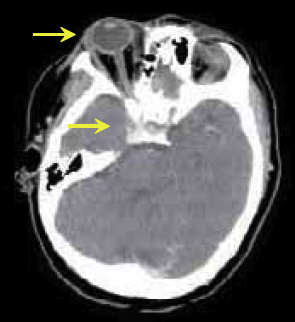
While hospitalized, the patient suffered progressive ascending weakness involving the upper extremities and the diaphragm, necessitating intubation. She was treated with high-dose steroids, IVIG, and plasmapheresis for the possibility of Guillain-Barre or transverse myelitis; there was no change in her symptoms. With no clear diagnosis, on hospital day 10, she complained of diplopia and was found to have right eye chemosis, proptosis, right abducens nerve palsy, and a loud bruit over the right eye. A CT scan revealed dilated right ophthalmic veins and an engorged cavernous sinus (Figure 1). A cerebral angiogram was performed and showed a distal right vertebral arteriovenous fistula (Figure 2), and an MRI showed increased signal in the entire cord secondary to venous hypertension.
What is the diagnosis?
Vertebral Arterio-Venous Fistula (AVF) with arterialized venous drainage to the cavernous sinus, ophthalmic veins, and the cervical epidural veins leading to her ocular symptoms and a cervical myelopathy.
She had no history of trauma and the AVF was thought to be spontaneous. She underwent successful transarterial embolization of the right vertebral artery (see Figure 3). Her ocular symptoms rapidly improved and she was transferred to a rehabilitation facility with improving motor and sensory function.
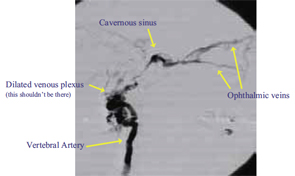
Discussion: Vertebral arteriovenous fistulas (AVFs) are rare vascular malformations characterized by abnormal shunting between the extracranial vertebral artery and a neighboring vein. Vertebral AVFs are most often secondary to trauma including penetrating gunshot or stab wounds to the neck. Fibromuscular dysplasia and neurofibromatosis are predisposing conditions but vertebral AVFs can be spontaneous as in this case. Patients with vertebral AVFs may present with tinnitus, but frequently they have no symptoms and their fistulas are discovered as cervical bruits on routine auscultation. Neurologic syndromes in the setting of a vertebral AVF are rare and typically secondary to arterialization of venous drainage leading to local ischemia and nerve damage. There are case reports of vertigo and vertebrobasilar insufficiency, cervical radiculopathy related to nerve-root compression from engorged vertebral veins, and cervical myelopathy from venous hypertension similar to this patient. As well, there is only one case report of a vertebral AVF leading to exophthalmos, chemosis, and a bruit, mimicking a carotid-cavernous fistula. This is the first reported case of a vertebral AVF leading to both cervical cord and ocular pathology.
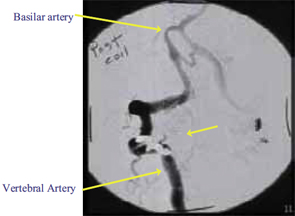
Vertebral AVFs can be suspected based on CT and MRI findings, but angiography is the gold standard for diagnosis. Transarterial embolization is the safest and most effective treatment, allowing for occlusion of the fistula while maintaining patency of the vertebral artery. If treated expediently, most patients experience total recovery.
Dr. Baudendistel can be contacted at BaudenT@sutterhealth.org.
References
- Ammirati M, Mirzai S, Samii M. Vertebral arteriovenous fistulae: report of two cases and review of the literature. Acta Neurochir. 1989;99:122-6.
- Gobin YP, Duckwiler GR, Vinuela F. Direct arteriovenous fistulas: diagnosis and intervention. Neuroimaging Clin North Am. 1998;8:425-43.
- Halbach VV, Higashida RT, Hieshima GB. Treatment of vertebral arteriovenous fistulas. AJR. 1988;150:405-12.
A 57-year-old woman with no previous medical history was admitted with weakness. The patient complained of 2 months of ascending bilateral lower extremity weakness followed by subjective “numbness” of both legs. She had a normal lumbosacral MRI as an outpatient and presented to the ED with progressive symptoms. She denied back pain, bowel or bladder problems, diplopia, ataxia, or confusion. As well, there were no fevers, chills, muscle pain, or weight loss. She had no risk factors for HIV and no toxic exposures.
On admission, her vital signs were normal and her general physical exam was unremarkable. Her neurologic exam was notable for diffuse symmetric 3/5 bilateral lower extremity weakness and symmetric bilateral sensory loss in a “stocking” distribution. She had bilateral lower extremity hyperreflexia and plantar reflexes were extensor bilaterally. She had normal upper extremities, cranial nerves, and mental status. Screening laboratories including fasting glucose, B12, RPR, TSH, HIV, SPEP, and UPEP were negative. A repeat lumbosacral MRI and a lumbar puncture were nondiagnostic.
While hospitalized, the patient suffered progressive ascending weakness involving the upper extremities and the diaphragm, necessitating intubation. She was treated with high-dose steroids, IVIG, and plasmapheresis for the possibility of Guillain-Barre or transverse myelitis; there was no change in her symptoms. With no clear diagnosis, on hospital day 10, she complained of diplopia and was found to have right eye chemosis, proptosis, right abducens nerve palsy, and a loud bruit over the right eye. A CT scan revealed dilated right ophthalmic veins and an engorged cavernous sinus (Figure 1). A cerebral angiogram was performed and showed a distal right vertebral arteriovenous fistula (Figure 2), and an MRI showed increased signal in the entire cord secondary to venous hypertension.
What is the diagnosis?
Vertebral Arterio-Venous Fistula (AVF) with arterialized venous drainage to the cavernous sinus, ophthalmic veins, and the cervical epidural veins leading to her ocular symptoms and a cervical myelopathy.
She had no history of trauma and the AVF was thought to be spontaneous. She underwent successful transarterial embolization of the right vertebral artery (see Figure 3). Her ocular symptoms rapidly improved and she was transferred to a rehabilitation facility with improving motor and sensory function.
Discussion: Vertebral arteriovenous fistulas (AVFs) are rare vascular malformations characterized by abnormal shunting between the extracranial vertebral artery and a neighboring vein. Vertebral AVFs are most often secondary to trauma including penetrating gunshot or stab wounds to the neck. Fibromuscular dysplasia and neurofibromatosis are predisposing conditions but vertebral AVFs can be spontaneous as in this case. Patients with vertebral AVFs may present with tinnitus, but frequently they have no symptoms and their fistulas are discovered as cervical bruits on routine auscultation. Neurologic syndromes in the setting of a vertebral AVF are rare and typically secondary to arterialization of venous drainage leading to local ischemia and nerve damage. There are case reports of vertigo and vertebrobasilar insufficiency, cervical radiculopathy related to nerve-root compression from engorged vertebral veins, and cervical myelopathy from venous hypertension similar to this patient. As well, there is only one case report of a vertebral AVF leading to exophthalmos, chemosis, and a bruit, mimicking a carotid-cavernous fistula. This is the first reported case of a vertebral AVF leading to both cervical cord and ocular pathology.
Vertebral AVFs can be suspected based on CT and MRI findings, but angiography is the gold standard for diagnosis. Transarterial embolization is the safest and most effective treatment, allowing for occlusion of the fistula while maintaining patency of the vertebral artery. If treated expediently, most patients experience total recovery.
Dr. Baudendistel can be contacted at BaudenT@sutterhealth.org.
References
- Ammirati M, Mirzai S, Samii M. Vertebral arteriovenous fistulae: report of two cases and review of the literature. Acta Neurochir. 1989;99:122-6.
- Gobin YP, Duckwiler GR, Vinuela F. Direct arteriovenous fistulas: diagnosis and intervention. Neuroimaging Clin North Am. 1998;8:425-43.
- Halbach VV, Higashida RT, Hieshima GB. Treatment of vertebral arteriovenous fistulas. AJR. 1988;150:405-12.
A 57-year-old woman with no previous medical history was admitted with weakness. The patient complained of 2 months of ascending bilateral lower extremity weakness followed by subjective “numbness” of both legs. She had a normal lumbosacral MRI as an outpatient and presented to the ED with progressive symptoms. She denied back pain, bowel or bladder problems, diplopia, ataxia, or confusion. As well, there were no fevers, chills, muscle pain, or weight loss. She had no risk factors for HIV and no toxic exposures.
On admission, her vital signs were normal and her general physical exam was unremarkable. Her neurologic exam was notable for diffuse symmetric 3/5 bilateral lower extremity weakness and symmetric bilateral sensory loss in a “stocking” distribution. She had bilateral lower extremity hyperreflexia and plantar reflexes were extensor bilaterally. She had normal upper extremities, cranial nerves, and mental status. Screening laboratories including fasting glucose, B12, RPR, TSH, HIV, SPEP, and UPEP were negative. A repeat lumbosacral MRI and a lumbar puncture were nondiagnostic.
While hospitalized, the patient suffered progressive ascending weakness involving the upper extremities and the diaphragm, necessitating intubation. She was treated with high-dose steroids, IVIG, and plasmapheresis for the possibility of Guillain-Barre or transverse myelitis; there was no change in her symptoms. With no clear diagnosis, on hospital day 10, she complained of diplopia and was found to have right eye chemosis, proptosis, right abducens nerve palsy, and a loud bruit over the right eye. A CT scan revealed dilated right ophthalmic veins and an engorged cavernous sinus (Figure 1). A cerebral angiogram was performed and showed a distal right vertebral arteriovenous fistula (Figure 2), and an MRI showed increased signal in the entire cord secondary to venous hypertension.
What is the diagnosis?
Vertebral Arterio-Venous Fistula (AVF) with arterialized venous drainage to the cavernous sinus, ophthalmic veins, and the cervical epidural veins leading to her ocular symptoms and a cervical myelopathy.
She had no history of trauma and the AVF was thought to be spontaneous. She underwent successful transarterial embolization of the right vertebral artery (see Figure 3). Her ocular symptoms rapidly improved and she was transferred to a rehabilitation facility with improving motor and sensory function.
Discussion: Vertebral arteriovenous fistulas (AVFs) are rare vascular malformations characterized by abnormal shunting between the extracranial vertebral artery and a neighboring vein. Vertebral AVFs are most often secondary to trauma including penetrating gunshot or stab wounds to the neck. Fibromuscular dysplasia and neurofibromatosis are predisposing conditions but vertebral AVFs can be spontaneous as in this case. Patients with vertebral AVFs may present with tinnitus, but frequently they have no symptoms and their fistulas are discovered as cervical bruits on routine auscultation. Neurologic syndromes in the setting of a vertebral AVF are rare and typically secondary to arterialization of venous drainage leading to local ischemia and nerve damage. There are case reports of vertigo and vertebrobasilar insufficiency, cervical radiculopathy related to nerve-root compression from engorged vertebral veins, and cervical myelopathy from venous hypertension similar to this patient. As well, there is only one case report of a vertebral AVF leading to exophthalmos, chemosis, and a bruit, mimicking a carotid-cavernous fistula. This is the first reported case of a vertebral AVF leading to both cervical cord and ocular pathology.
Vertebral AVFs can be suspected based on CT and MRI findings, but angiography is the gold standard for diagnosis. Transarterial embolization is the safest and most effective treatment, allowing for occlusion of the fistula while maintaining patency of the vertebral artery. If treated expediently, most patients experience total recovery.
Dr. Baudendistel can be contacted at BaudenT@sutterhealth.org.
References
- Ammirati M, Mirzai S, Samii M. Vertebral arteriovenous fistulae: report of two cases and review of the literature. Acta Neurochir. 1989;99:122-6.
- Gobin YP, Duckwiler GR, Vinuela F. Direct arteriovenous fistulas: diagnosis and intervention. Neuroimaging Clin North Am. 1998;8:425-43.
- Halbach VV, Higashida RT, Hieshima GB. Treatment of vertebral arteriovenous fistulas. AJR. 1988;150:405-12.
How to avoid ‘foreseeable’ harm
When a psychiatrist is sued for negligence, the legal system asks, “Did the doctor depart from the standard of care, and—if so—did that departure proximately cause the harm?” To determine proximate cause, the legal system then asks whether the harm was a “reasonably foreseeable” result of the negligent act.
Inadequate evaluation leads to patient’s suicide, plaintiff alleges
Dallas County (TX) District Court
In 1997, 1 year after suffering a stroke, a 56-year-old man was admitted to a rehabilitation center and seen by a psychiatrist for depression. In February 2000, the patient died after jumping from the center’s fifth-floor window.
The patient’s estate charged that the psychiatrist was negligent and did not adequately evaluate or treat the patient. The defense disputed the charge.
- The jury found for the defense.
Dr. Grant’s observations
In this case, the psychiatrist presumably assessed the patient, determined whether he was depressed, and made appropriate treatment interventions. Three years later, the patient killed himself.
Although 3 years passed between the consultation and the suicide, under the law an intervening act that is the reasonably foreseeable result of negligence does not break the causal chain. For example, if the psychiatrist told the patient he needed no treatment and did not need to follow-up with another clinician, the causal chain arguably would still exist. Thus, proper care, not time, will prevent such a suit.
To win a negligence case, the plaintiff must show that the psychiatrist’s actions proximately caused the harm. In order to defend your treatment decisions, document and discuss with the patient:
- the diagnosis and illness severity
- possible illness course based on patient history and the illness in question
- the need to monitor mood symptoms
- basis for treatment recommendations
- the possible need for continued treatment and to arrange follow-up care.
Plaintiff: Improper treatment caused fatal altercation
Cuyahoga County (OH) Court of Common Pleas
A man in his early 30s was admitted to the hospital’s psychiatric unit for depression, mood disorder, and adjustment disorder secondary to myasthenia gravis. He was estranged from his wife, who was dating another man. The treating psychiatrist discharged the patient after 5 days.
Approximately 40 hours after discharge, the patient went to the other man’s home and confronted him about his relationship with the patient’s wife. The two men then fought, and the other man fatally shot the patient. During the fight, the patient stabbed the other man in the neck with a knife; this man required care and subsequently developed a scar.
The other man and the patient’s estate charged that the psychiatrist did not appropriately evaluate and treat the patient. They claimed that a more thorough evaluation would have resulted in continued hospitalization and prevented the fight.
The defendant argued that the evaluation was thorough, that the discharge met the guidelines of appropriate care, and that the patient posed no risk to himself or others when he was discharged.
- The jury decided for the defense.
Dr. Grant’s observations
This case raises the clinically difficult issue of assessing a patient’s danger to self or others and whether this danger is reasonably foreseeable. Although Hughes reports that 17% of psychiatric emergency room patients are homicidal,1 the American Psychiatric Association notes that 2 of 3 predictions of patient violence are wrong.2
In Tarasoff v Regents of the University of California, the California Supreme Court ruled that clinicians must warn potential victims of, and protect them from, a patient’s intent to harm.3 You should become familiar with the Tarasoff-type legislations in your state. But even if the patient shows no violent intent, the possibility of future violence cannot be ruled out.
During admission, assess and document an inpatient’s risk of violence.4 Factors that may increase a depressed patient’s risk of becoming homicidal include:
- past violence
- current substance abuse
- psychopathy
- having suffered physical abuse as a child
- violent thoughts.4-6
Check the patient’s records for a history of recurrent violence. Culling this information from the chart is necessary because:
- past violent behavior may predict future violence
- patients rarely reveal homicidal thoughts or behavior spontaneously.6
A psychiatrist may be found negligent after a patient’s violent act if the violence was foreseeable. However, after having seen the patient for 5 days in an inpatient setting, the psychiatrist in this case apparently could clearly document that the patient was not dangerous to himself or others before discharge.
1. Hughes DH. Suicide and violence assessment in psychiatry. Gen Hosp Psychiatry 1996;18:416-21.
2. American Psychiatric Association fact sheet. Violence and mental illness. January 1998:1-5. Available at: http://www.psych.org/public_info/violence.pdf. Accessed Feb. 3, 2005.
3. Tarasoff v Regents of the University of California, 551 P2d 334 (Cal 1976)
4. Green B, Pedley R, Whittingham D. A structured clinical model for violence risk intervention. Int J Law Psychiatry 2004;27:349-59.
5. Appelbaum PS, Robbins PC, Monahan J. Violence and delusions: data from the MacArthur Violence Risk Assessment Study. Am J Psychiatry 2000;157:566-72.
6. Rosenbaum M, Bennett B. Homicide and depression. Am J Psychiatry 1986;143:367-70.
7. Appelbaum PS. Can a psychiatrist be held responsible when a patient commits murder? Psychiatr Serv 2002;53:27-9.
When a psychiatrist is sued for negligence, the legal system asks, “Did the doctor depart from the standard of care, and—if so—did that departure proximately cause the harm?” To determine proximate cause, the legal system then asks whether the harm was a “reasonably foreseeable” result of the negligent act.
Inadequate evaluation leads to patient’s suicide, plaintiff alleges
Dallas County (TX) District Court
In 1997, 1 year after suffering a stroke, a 56-year-old man was admitted to a rehabilitation center and seen by a psychiatrist for depression. In February 2000, the patient died after jumping from the center’s fifth-floor window.
The patient’s estate charged that the psychiatrist was negligent and did not adequately evaluate or treat the patient. The defense disputed the charge.
- The jury found for the defense.
Dr. Grant’s observations
In this case, the psychiatrist presumably assessed the patient, determined whether he was depressed, and made appropriate treatment interventions. Three years later, the patient killed himself.
Although 3 years passed between the consultation and the suicide, under the law an intervening act that is the reasonably foreseeable result of negligence does not break the causal chain. For example, if the psychiatrist told the patient he needed no treatment and did not need to follow-up with another clinician, the causal chain arguably would still exist. Thus, proper care, not time, will prevent such a suit.
To win a negligence case, the plaintiff must show that the psychiatrist’s actions proximately caused the harm. In order to defend your treatment decisions, document and discuss with the patient:
- the diagnosis and illness severity
- possible illness course based on patient history and the illness in question
- the need to monitor mood symptoms
- basis for treatment recommendations
- the possible need for continued treatment and to arrange follow-up care.
Plaintiff: Improper treatment caused fatal altercation
Cuyahoga County (OH) Court of Common Pleas
A man in his early 30s was admitted to the hospital’s psychiatric unit for depression, mood disorder, and adjustment disorder secondary to myasthenia gravis. He was estranged from his wife, who was dating another man. The treating psychiatrist discharged the patient after 5 days.
Approximately 40 hours after discharge, the patient went to the other man’s home and confronted him about his relationship with the patient’s wife. The two men then fought, and the other man fatally shot the patient. During the fight, the patient stabbed the other man in the neck with a knife; this man required care and subsequently developed a scar.
The other man and the patient’s estate charged that the psychiatrist did not appropriately evaluate and treat the patient. They claimed that a more thorough evaluation would have resulted in continued hospitalization and prevented the fight.
The defendant argued that the evaluation was thorough, that the discharge met the guidelines of appropriate care, and that the patient posed no risk to himself or others when he was discharged.
- The jury decided for the defense.
Dr. Grant’s observations
This case raises the clinically difficult issue of assessing a patient’s danger to self or others and whether this danger is reasonably foreseeable. Although Hughes reports that 17% of psychiatric emergency room patients are homicidal,1 the American Psychiatric Association notes that 2 of 3 predictions of patient violence are wrong.2
In Tarasoff v Regents of the University of California, the California Supreme Court ruled that clinicians must warn potential victims of, and protect them from, a patient’s intent to harm.3 You should become familiar with the Tarasoff-type legislations in your state. But even if the patient shows no violent intent, the possibility of future violence cannot be ruled out.
During admission, assess and document an inpatient’s risk of violence.4 Factors that may increase a depressed patient’s risk of becoming homicidal include:
- past violence
- current substance abuse
- psychopathy
- having suffered physical abuse as a child
- violent thoughts.4-6
Check the patient’s records for a history of recurrent violence. Culling this information from the chart is necessary because:
- past violent behavior may predict future violence
- patients rarely reveal homicidal thoughts or behavior spontaneously.6
A psychiatrist may be found negligent after a patient’s violent act if the violence was foreseeable. However, after having seen the patient for 5 days in an inpatient setting, the psychiatrist in this case apparently could clearly document that the patient was not dangerous to himself or others before discharge.
When a psychiatrist is sued for negligence, the legal system asks, “Did the doctor depart from the standard of care, and—if so—did that departure proximately cause the harm?” To determine proximate cause, the legal system then asks whether the harm was a “reasonably foreseeable” result of the negligent act.
Inadequate evaluation leads to patient’s suicide, plaintiff alleges
Dallas County (TX) District Court
In 1997, 1 year after suffering a stroke, a 56-year-old man was admitted to a rehabilitation center and seen by a psychiatrist for depression. In February 2000, the patient died after jumping from the center’s fifth-floor window.
The patient’s estate charged that the psychiatrist was negligent and did not adequately evaluate or treat the patient. The defense disputed the charge.
- The jury found for the defense.
Dr. Grant’s observations
In this case, the psychiatrist presumably assessed the patient, determined whether he was depressed, and made appropriate treatment interventions. Three years later, the patient killed himself.
Although 3 years passed between the consultation and the suicide, under the law an intervening act that is the reasonably foreseeable result of negligence does not break the causal chain. For example, if the psychiatrist told the patient he needed no treatment and did not need to follow-up with another clinician, the causal chain arguably would still exist. Thus, proper care, not time, will prevent such a suit.
To win a negligence case, the plaintiff must show that the psychiatrist’s actions proximately caused the harm. In order to defend your treatment decisions, document and discuss with the patient:
- the diagnosis and illness severity
- possible illness course based on patient history and the illness in question
- the need to monitor mood symptoms
- basis for treatment recommendations
- the possible need for continued treatment and to arrange follow-up care.
Plaintiff: Improper treatment caused fatal altercation
Cuyahoga County (OH) Court of Common Pleas
A man in his early 30s was admitted to the hospital’s psychiatric unit for depression, mood disorder, and adjustment disorder secondary to myasthenia gravis. He was estranged from his wife, who was dating another man. The treating psychiatrist discharged the patient after 5 days.
Approximately 40 hours after discharge, the patient went to the other man’s home and confronted him about his relationship with the patient’s wife. The two men then fought, and the other man fatally shot the patient. During the fight, the patient stabbed the other man in the neck with a knife; this man required care and subsequently developed a scar.
The other man and the patient’s estate charged that the psychiatrist did not appropriately evaluate and treat the patient. They claimed that a more thorough evaluation would have resulted in continued hospitalization and prevented the fight.
The defendant argued that the evaluation was thorough, that the discharge met the guidelines of appropriate care, and that the patient posed no risk to himself or others when he was discharged.
- The jury decided for the defense.
Dr. Grant’s observations
This case raises the clinically difficult issue of assessing a patient’s danger to self or others and whether this danger is reasonably foreseeable. Although Hughes reports that 17% of psychiatric emergency room patients are homicidal,1 the American Psychiatric Association notes that 2 of 3 predictions of patient violence are wrong.2
In Tarasoff v Regents of the University of California, the California Supreme Court ruled that clinicians must warn potential victims of, and protect them from, a patient’s intent to harm.3 You should become familiar with the Tarasoff-type legislations in your state. But even if the patient shows no violent intent, the possibility of future violence cannot be ruled out.
During admission, assess and document an inpatient’s risk of violence.4 Factors that may increase a depressed patient’s risk of becoming homicidal include:
- past violence
- current substance abuse
- psychopathy
- having suffered physical abuse as a child
- violent thoughts.4-6
Check the patient’s records for a history of recurrent violence. Culling this information from the chart is necessary because:
- past violent behavior may predict future violence
- patients rarely reveal homicidal thoughts or behavior spontaneously.6
A psychiatrist may be found negligent after a patient’s violent act if the violence was foreseeable. However, after having seen the patient for 5 days in an inpatient setting, the psychiatrist in this case apparently could clearly document that the patient was not dangerous to himself or others before discharge.
1. Hughes DH. Suicide and violence assessment in psychiatry. Gen Hosp Psychiatry 1996;18:416-21.
2. American Psychiatric Association fact sheet. Violence and mental illness. January 1998:1-5. Available at: http://www.psych.org/public_info/violence.pdf. Accessed Feb. 3, 2005.
3. Tarasoff v Regents of the University of California, 551 P2d 334 (Cal 1976)
4. Green B, Pedley R, Whittingham D. A structured clinical model for violence risk intervention. Int J Law Psychiatry 2004;27:349-59.
5. Appelbaum PS, Robbins PC, Monahan J. Violence and delusions: data from the MacArthur Violence Risk Assessment Study. Am J Psychiatry 2000;157:566-72.
6. Rosenbaum M, Bennett B. Homicide and depression. Am J Psychiatry 1986;143:367-70.
7. Appelbaum PS. Can a psychiatrist be held responsible when a patient commits murder? Psychiatr Serv 2002;53:27-9.
1. Hughes DH. Suicide and violence assessment in psychiatry. Gen Hosp Psychiatry 1996;18:416-21.
2. American Psychiatric Association fact sheet. Violence and mental illness. January 1998:1-5. Available at: http://www.psych.org/public_info/violence.pdf. Accessed Feb. 3, 2005.
3. Tarasoff v Regents of the University of California, 551 P2d 334 (Cal 1976)
4. Green B, Pedley R, Whittingham D. A structured clinical model for violence risk intervention. Int J Law Psychiatry 2004;27:349-59.
5. Appelbaum PS, Robbins PC, Monahan J. Violence and delusions: data from the MacArthur Violence Risk Assessment Study. Am J Psychiatry 2000;157:566-72.
6. Rosenbaum M, Bennett B. Homicide and depression. Am J Psychiatry 1986;143:367-70.
7. Appelbaum PS. Can a psychiatrist be held responsible when a patient commits murder? Psychiatr Serv 2002;53:27-9.
Other Literature of Interest
1. Annane D, Bellissant E, Briegel J, et al. Corticosteroids for severe sepsis and septic shock: a systematic review and metaanalysis. BMJ. 2004;329:480.
Severe sepsis is a common cause of ICU admissions and continues to have mortality rates as high as 30%. As research has evolved, the role of corticosteroids in sepsis has changed. Annane and colleagues systematically reviewed corticosteroid treatment for severe sepsis and septic shock. The authors found 15 randomized trials that evaluated their main outcome of all-cause mortality at 28 days. When these results were pooled there was no significant improvement in mortality (RR 0.98; 0.87 to 1.10). However, the analysis showed very significant heterogeneity, so the authors appropriately performed a sensitivity analysis based on an a priori hypothesis that low-dose, long-course steroids (≤ 300 mg hydrocortisone/day and ≥ 5 days) would provide greater benefit than short-course, high-dose corticosteroids. The sensitivity analysis of five studies with low-dose, long-course corticosteroids showed a clear reduction in 28-day mortality (RR 0.80; 0.67 to 0.95) with no heterogeneity. There was no statistically significant difference in GI bleeds, superinfections, and hyperglycemia.
This is a very well-done review, which included an exhaustive search for all available evidence. The authors conclude based on the findings of an individual study in the review that patients with septic shock should undergo adrenal insufficiency testing prior to starting empiric therapy with low-dose hydrocortisone (200-300 mg/day). Hydrocortisone should then be stopped if there is no evidence of adrenal insufficiency. However, none of the studies in this review were limited to patients with adrenal insufficiency. Also, although none of the studies individually showed a statistically significant improvement with corticosteroids, they all favored the steroid treatment group with RRs < 1. Although there is good evidence that septic shock patients with adrenal insufficiency should be treated with corticosteroids, it remains unclear if therapy should be generalized to all septic patients. The ongoing European CORTICUS trial should help answer some of these questions.
2. Baddour L.,Yu, V. and the International Pneumococcal Study Group. Combination antibiotic therapy lowers mortality among severely ill patients with pneumococcal bacteremia. Am J Resp Crit Care Med; 2004;170:440-444.
Three retrospective studies indicate that patients with pneumococcal bacteremia are less likely to die if treated with combination antibiotics. The combination of a beta-lactam and a macrolide appear to be especially protective. Based upon this soft data, multiple societies now recommend combination antibiotic therapy with a beta-lactam and a macrolide as first-line therapy for hospitalized patients with CAP. This large, multi-center, prospective observational study analyzed outcomes for all patients with pneumococcal bacteremia. Critically ill patients were eight times more likely to die than non-critically ill patients (mortality: 54.6% vs. 7.3%, p=0.0001). Combination therapy was defined as any two or more antibiotics used concurrently: multiple different regimens were used. The 14-day mortality difference between pneumococcal bacteremic patients receiving monotherapy vs. those receiving combination therapy was not significant (10.4 vs. 11.5%, p-value not disclosed) However, in critically ill patients, combination antibiotic therapy was associated with a marked decrease in mortality (23.4 vs. 55.3%, p=0.0015).
This study has significant limitations. It is not randomized, combination therapy was broadly defined as any two or more antibiotics, and 16% of critically ill patients received only one antibiotic, a major deviation from the standard of care. Nonetheless, this is the first prospective trial that attempts to ascertain which patients with pneumococcal bacteremia benefit from combination therapy. The marked mortality reduction in critically ill patients who received combination therapy reinforces the current recommendation that septic patients with pneumococcal bacteremia should receive combination therapy. However, these findings also underscore the fact that current guidelines for the treatment of an exceedingly common and serious disease are based upon weak retrospective data. Further randomized prospective trials are needed to determine which patients with pneumococcal pneumonia may actually benefit from combination antimicrobial therapy and what combination is most efficacious.
3. Fernandez-Avilles F, Alsonso J, Castro-Beivas A, et al, on behalf of the GRACIA (Grupo de Analisis de la Cardiopatio Isquemica Aguda) Group. Routine invasive strategy within 24 hours of thrombolysis versus ischemia-guided conservative approach for acute myocardial infarction with ST-segment elevation (GRACIA-1). Lancet;2004;364:045-1053
In the last ACC/AHA guidelines for acute myocardial infarction (1999), angioplasty soon after thrombolysis is strongly discouraged (class III) because studies to date showed no significant difference in outcomes and propensity for adverse events, i.e. bleeding. However, as stated in these last recommendations, the benefits of early post-thrombolysis percutaneous transluminal coronary angioplasty (PTCA) with stenting should be reassessed as interventional strategies mature. In the current era of stents and newer antiplatelet therapies, it looks as if now is the time to take another look.
The GRACIA-1 was a randomized, multi-centered trial to assess early intervention following thrombolysis in ST-elevation myocardial infarction (STEMI). Five hundred patients were enrolled and randomized to receive either fibrin-specific thrombolytics alone in the conservative group or thrombolysis combined with early PTCA. The primary endpoint was a combined rate of death, non-fatal reinfarction, or ischemia-induced revascularization at 1 year. Pre-discharge PTCA and stenting in those demonstrating recurrent ischemia in the conservative group (n=52) was analyzed as a secondary endpoint. One-year follow-up was completed in 98% of patients. Both groups had similar major cardiac events at 30 days, with the one-year endpoint demonstrating no difference in mortality. Significant differences were seen in the primary endpoint at one year [23 (9%) in the invasive group vs. 51 (21%) in the conservative group (RR-0.44, 95% CI 0.28-0.70 p=0.00008)].
A major limitation of this study was the low-risk profile of its patients, and the fact that it was not powered to differentiate between mortality and reinfarction. It will be interesting to see if these results are replicated in future studies (CARESS-2005) and their clinical impact on the management of acute myocardial infarction in centers without interventional support.
4. Hitcho EB, Krauss MJ, Birge S, et al. Characteristics and circumstances of falls in a hospital setting: a prospective analysis. J Gen Intern Med.2004;19:732-739.
Falls in hospital patients are common and persistent problems in hospitals across the country, with significant impact on patient safety, morbidity, and health care cost. Previous studies have reported up to 30% of inpatient falls result in injury, with 4-6% resulting in serious injury. Most studies on falls are retrospective reviews. This paper detailed a prospective observational study designed to identify and analyze the patient characteristics or the circumstances that contribute to falls. Using an online adverse event reporting system, patient falls were identified. Once identified, additional data sources, including the patients’ medical records, electronic nursing records, and interviews with patient or family members and nurses, were used to collect information. A total of 183 patients fell during the study period, with 85% of the falls occurring in the patient’s room.
Half of the falls involved bowel or bladder elimination and were more likely to occur in patients over 65 years in age (adjusted odds ratio 2.4; 95% confidence interval 1.1 to 5.3). Most of the falls (59%) occurred during the evening/overnight. 58% of the patients who fell had received agents with central nervous system activity in the 24 hours prior to a fall. 12% of the patients who fell received sedative-hypnotics. Repeat fallers were more likely to be men than women (11/86 [13%] vs 4/97 [4%]; p=0.03). 42% of the falls resulted in some type of injury, ranging from pain/swelling (34%) to cardiac arrest/death (0.5%). In multivariate analysis, only elimination-related falls remained a significant predictor of being injured from a fall (aOR , 2.4; 95% CI 1.1 to 5.3). Interestingly, patients who were confused or disoriented were less likely to be injured than alert and oriented patients (crude OR, 0.5; 95% CI, 0.3 to 0.98). When examined by services, medicine and neurology had the highest fall rate at 6.12 falls per 1000 patient days and had the highest patient-to-nurse ratio of 6.5 and 5.3, respectively.
While specific independent risk factors for prevention of falls could not be determined in this study due to a lack of a control group, their findings are consistent with previously identified risk factors for falling, including weakness, poor cognitive status including medication-related changes, and altered elimination. Potential interventions to prevent falls include toileting schedules for high-risk elderly patients and review of medication lists to minimize centrally acting, psychotropic, or sedating agents.
5. Kagansky N, Knobler H, Rimon E, Ozer Z, Levy S. Safety of anticoagulation therapy in well-informed older patients. Arch Intern Med; 2004;164:2044-2050
Elderly patients are increasingly likely to require long-term anticoagulation. Despite this, physicians often withhold long-term anticoagulation due to perceived risk factors for bleeding, including age, comorbidity, and cognitive or functional impairment.
This combination retrospective and prospective observational study evaluated the safety and quality of anticoagulation in elderly patients. Over a three-year span, 323 elderly patients were discharged on warfarin from a large Israeli hospital. These patients were frail and potentially “at risk”; 54% were older than age 80, 81% were uneducated, and 84% had low income. 47% were considered cognitively intact (according to MMSE) and only 34% were functionally independent. Using a multivariate analysis, the authors determined that only poor quality of anticoagulation education (OR: 8.83; 95% CI: 2.0-50.2), polypharmacy (OR: 6.14; 95% CI 1.2-42.4) and INR >3 (OR: 1.08; 95% CI 1.03-1.14) were associated with major bleeding.
This study of a “real world” population of frail, at-risk elderly patients provides important insights into risks for major bleeding resulting from warfarin therapy. Surprisingly, advanced age, cognitive impairment and markers for frailty did not confer elevated risk for major bleeding. Importantly, the study did not explicitly address patient fall risk, an often-cited reason for withholding anticoagulation therapy. Supratherapeutic anticoagulation is associated with a statistically but not clinically significant bleeding risk. Polypharmacy is increasingly unavoidable in elderly patients. However, appropriate anticoagulation therapy should be the standard of care. This study makes it clear that we need to focus our efforts on ensuring that elderly patients and their caregivers receive appropriate anticoagulation education prior to discharge from the hospital.
6. Prinssen M, Verhoeven E, Buth J, et al. A Randomized trial comparing conventional and endovascular repair of abdominal aortic aneurysms. NEJM. 2004;351:1607-18.
Endovascular repair of abdominal aortic aneurysm, which involves percutaneous introduction of a graft to bridge an aortic aneurysm, has been available since the early 1990s. This procedure was initially used in patients who were felt to be at high risk for the traditional open procedure. This selection bias may have affected the outcome of earlier studies. Therefore, the Dutch Randomized Endovascular Aneurysm Management (DREAM) trial was designed to assess outcomes in patients deemed fit to undergo either open or endovascular repair. The study was conducted at 24 centers in the Netherlands and four centers in Belgium. Three hundred and forty-five patients had abdominal aortic aneurysms of at least 5 cm and were considered eligible for either open or endovascular repair. Patients were then randomized to undergo one procedure or the other.
Surgeons experienced in both endovascular and open repair performed the procedures. Primary outcomes were 30-day mortality (defined as death during the primary hospital admission or within 30 days), severe complications, and the combination of the two. The operative mortality rate was 4.6% in the open-repair group and 1.2% in the endovascular repair group, with a risk ratio of 3.9 (95% CI, 0.9-32.9). The combined endpoint of mortality and severe complication was 9.8% in the open-repair group and 4.7% in the endovascular repair group, with a risk ratio of 2.1 (95% CI, 0.9 to 5.4). It should be noted that 90% of study patients were men. These findings indicate that endovascular repair of aortic aneurysm results in less short-term morbidity and mortality than open repair. Larger studies with longer follow up are indicated.
7. Spargias K, Alexopoulos E, Kyrzopoulos S. Ascorbic acid prevents contrast-mediated nephropathy in patients with renal dysfunction undergoing coronary angiography or intervention. Circulation.110(18)2837-42
In this study, a team of Greek researchers studied the use of vitamin C in patients with renal insufficiency (creatinine >1.2) undergoing coronary catheterization or intervention to determine if it prevented contrast-mediated nephropathy (CMN). Although the etiology of CMN is unknown, ischemic insults to the renal medulla and free radical release have been implicated. Since vitamin C has been shown in animal studies to attenuate nephropathy when administered with known renal toxins, a similar effect was postulated when administered with IV contrast.
Two hundred and twenty patients electively admitted for coronary catheterization or intervention were randomized to placebo or to receive 3 grams of vitamin C 2 hours prior to the dye load followed by 2 gm that night and the morning after. The two groups were balanced for presence of hypertension, diabetes, tobacco use, and use of commonly prescribed medications. Intravenous hydration was given to all at variable rates depending on left ventricular ejection fraction. The catheterization team chose the type of contrast agent. Creatinine was measured at baseline (up to 3 months prior to dye load) and 2-5 days afterwards. CMN was defined as a rise in total serum creatinine by 0.5 mg/dL or by 25%. Using these criteria, 9% of the vitamin C group developed CMN as opposed to 20% in the controls (NNT 9; 95% CI: 5-53). Logistical regression was performed to account for differences in age, initial serum creatinine, or both, and always yielded significant differences. The treatment group was slightly older, had higher rates of isoosmolar contrast administration (reno-protective), and had slightly higher baseline creatinines, so the true protective effect was thought even higher than reported.
This study is limited by small sample size, an overwhelmingly male patient base (90%), and the suspected presence of atherosclerotic heart disease in all patients. The amount and rate of delivery of contrast was not noted. The vitamin C preparation used was not described, implying that all preparations were bioequivalent. No mention was made of whether these results could be extrapolated to other procedures involving contrast. Given the low cost and high tolerability of vitamin C, however, further studies would certainly be welcome.
8. Yadav J, Wholey M, Kuntz R, et al. Protected carotid-artery stenting versus endarterectomy in high-risk patients. NEJM.2004;351:1493-1501.
Carotid angioplasty has been available for the past decade, but, due to possible complications such as plaque embolization and stent compression, the procedure had been limited to patients unsuitable for surgical endarterectomy. Recently, the introduction of crush-resistant nitinol stents and emboli protection devices has made the procedure safer. This study was designed to test the hypothesis that angioplasty and stenting is not inferior to endarterectomy. Three hundred and thirty-four patients at 29 centers had either a symptomatic carotid lesion greater than 50% or asymptomatic lesion greater than 80% and were deemed to be suitable candidates for either carotid endarterectomy or angioplasty. Patients were then randomized to one of the treatment groups. Surgeons, cardiologists, or interventional radiologists performed angioplasty. The primary endpoint was a composite of death, stroke, or MI within 30 days of the procedure, or death or stroke between 31 days and one year.
Secondary endpoints were the need for revascularization and cranial-nerve palsy at one year. During the first month after procedure, 4.8% of patients in the stent group and 9.8% of patients in the surgical group reached the primary endpoint. In the subsequent year, 12.2% of stent patients and 20.1% of surgical patients reached the primary endpoint (absolute risk reduction of 7.9, CI 0.7-16.4 and NNT 14). Cranial nerve palsy at one year was 0% vs. 4.9% in the stent vs. surgical group. Need for revascularization at one year was 0.6% vs. 4.3% for stent vs. surgical group. Although this study was designed to show the non-inferiority of angioplasty vs. carotid endarterectomy in patients deemed suitable for either procedure, it actually was statistically significant for superiority of stenting. It also implied a lower complication rate in terms of cranial nerve palsy and the need for revascularization at one year made the procedure safer. This study was designed to test the hypothesis that angioplasty and stenting is not inferior to endarterectomy. Three hundred and thirty-four patients at 29 centers had either a symptomatic carotid lesion greater than 50% or asymptomatic lesion greater than 80% and were deemed to be suitable candidates for either carotid endarterectomy or angioplasty. Patients were then randomized to one of the treatment groups. Surgeons, cardiologists, or interventional radiologists performed angioplasty. The primary endpoint was a composite of death, stroke, or MI within 30 days of the procedure, or death or stroke between 31 days and one year.
Secondary endpoints were the need for revascularization and cranial-nerve palsy at one year. During the first month after procedure, 4.8% of patients in the stent group and 9.8% of patients in the surgical group reached the primary endpoint. In the subsequent year, 12.2% of stent patients and 20.1% of surgical patients reached the primary endpoint (absolute risk reduction of 7.9, CI 0.7-16.4 and NNT 14). Cranial nerve palsy at one year was 0% vs. 4.9% in the stent vs. surgical group. Need for revascularization at one year was 0.6% vs. 4.3% for stent vs. surgical group. Although this study was designed to show the non-inferiority of angioplasty vs. carotid endarterectomy in patients deemed suitable for either procedure, it actually was statistically significant for superiority of stenting. It also implied a lower complication rate in terms of cranial nerve palsy and the need for revascularization at one year.
1. Annane D, Bellissant E, Briegel J, et al. Corticosteroids for severe sepsis and septic shock: a systematic review and metaanalysis. BMJ. 2004;329:480.
Severe sepsis is a common cause of ICU admissions and continues to have mortality rates as high as 30%. As research has evolved, the role of corticosteroids in sepsis has changed. Annane and colleagues systematically reviewed corticosteroid treatment for severe sepsis and septic shock. The authors found 15 randomized trials that evaluated their main outcome of all-cause mortality at 28 days. When these results were pooled there was no significant improvement in mortality (RR 0.98; 0.87 to 1.10). However, the analysis showed very significant heterogeneity, so the authors appropriately performed a sensitivity analysis based on an a priori hypothesis that low-dose, long-course steroids (≤ 300 mg hydrocortisone/day and ≥ 5 days) would provide greater benefit than short-course, high-dose corticosteroids. The sensitivity analysis of five studies with low-dose, long-course corticosteroids showed a clear reduction in 28-day mortality (RR 0.80; 0.67 to 0.95) with no heterogeneity. There was no statistically significant difference in GI bleeds, superinfections, and hyperglycemia.
This is a very well-done review, which included an exhaustive search for all available evidence. The authors conclude based on the findings of an individual study in the review that patients with septic shock should undergo adrenal insufficiency testing prior to starting empiric therapy with low-dose hydrocortisone (200-300 mg/day). Hydrocortisone should then be stopped if there is no evidence of adrenal insufficiency. However, none of the studies in this review were limited to patients with adrenal insufficiency. Also, although none of the studies individually showed a statistically significant improvement with corticosteroids, they all favored the steroid treatment group with RRs < 1. Although there is good evidence that septic shock patients with adrenal insufficiency should be treated with corticosteroids, it remains unclear if therapy should be generalized to all septic patients. The ongoing European CORTICUS trial should help answer some of these questions.
2. Baddour L.,Yu, V. and the International Pneumococcal Study Group. Combination antibiotic therapy lowers mortality among severely ill patients with pneumococcal bacteremia. Am J Resp Crit Care Med; 2004;170:440-444.
Three retrospective studies indicate that patients with pneumococcal bacteremia are less likely to die if treated with combination antibiotics. The combination of a beta-lactam and a macrolide appear to be especially protective. Based upon this soft data, multiple societies now recommend combination antibiotic therapy with a beta-lactam and a macrolide as first-line therapy for hospitalized patients with CAP. This large, multi-center, prospective observational study analyzed outcomes for all patients with pneumococcal bacteremia. Critically ill patients were eight times more likely to die than non-critically ill patients (mortality: 54.6% vs. 7.3%, p=0.0001). Combination therapy was defined as any two or more antibiotics used concurrently: multiple different regimens were used. The 14-day mortality difference between pneumococcal bacteremic patients receiving monotherapy vs. those receiving combination therapy was not significant (10.4 vs. 11.5%, p-value not disclosed) However, in critically ill patients, combination antibiotic therapy was associated with a marked decrease in mortality (23.4 vs. 55.3%, p=0.0015).
This study has significant limitations. It is not randomized, combination therapy was broadly defined as any two or more antibiotics, and 16% of critically ill patients received only one antibiotic, a major deviation from the standard of care. Nonetheless, this is the first prospective trial that attempts to ascertain which patients with pneumococcal bacteremia benefit from combination therapy. The marked mortality reduction in critically ill patients who received combination therapy reinforces the current recommendation that septic patients with pneumococcal bacteremia should receive combination therapy. However, these findings also underscore the fact that current guidelines for the treatment of an exceedingly common and serious disease are based upon weak retrospective data. Further randomized prospective trials are needed to determine which patients with pneumococcal pneumonia may actually benefit from combination antimicrobial therapy and what combination is most efficacious.
3. Fernandez-Avilles F, Alsonso J, Castro-Beivas A, et al, on behalf of the GRACIA (Grupo de Analisis de la Cardiopatio Isquemica Aguda) Group. Routine invasive strategy within 24 hours of thrombolysis versus ischemia-guided conservative approach for acute myocardial infarction with ST-segment elevation (GRACIA-1). Lancet;2004;364:045-1053
In the last ACC/AHA guidelines for acute myocardial infarction (1999), angioplasty soon after thrombolysis is strongly discouraged (class III) because studies to date showed no significant difference in outcomes and propensity for adverse events, i.e. bleeding. However, as stated in these last recommendations, the benefits of early post-thrombolysis percutaneous transluminal coronary angioplasty (PTCA) with stenting should be reassessed as interventional strategies mature. In the current era of stents and newer antiplatelet therapies, it looks as if now is the time to take another look.
The GRACIA-1 was a randomized, multi-centered trial to assess early intervention following thrombolysis in ST-elevation myocardial infarction (STEMI). Five hundred patients were enrolled and randomized to receive either fibrin-specific thrombolytics alone in the conservative group or thrombolysis combined with early PTCA. The primary endpoint was a combined rate of death, non-fatal reinfarction, or ischemia-induced revascularization at 1 year. Pre-discharge PTCA and stenting in those demonstrating recurrent ischemia in the conservative group (n=52) was analyzed as a secondary endpoint. One-year follow-up was completed in 98% of patients. Both groups had similar major cardiac events at 30 days, with the one-year endpoint demonstrating no difference in mortality. Significant differences were seen in the primary endpoint at one year [23 (9%) in the invasive group vs. 51 (21%) in the conservative group (RR-0.44, 95% CI 0.28-0.70 p=0.00008)].
A major limitation of this study was the low-risk profile of its patients, and the fact that it was not powered to differentiate between mortality and reinfarction. It will be interesting to see if these results are replicated in future studies (CARESS-2005) and their clinical impact on the management of acute myocardial infarction in centers without interventional support.
4. Hitcho EB, Krauss MJ, Birge S, et al. Characteristics and circumstances of falls in a hospital setting: a prospective analysis. J Gen Intern Med.2004;19:732-739.
Falls in hospital patients are common and persistent problems in hospitals across the country, with significant impact on patient safety, morbidity, and health care cost. Previous studies have reported up to 30% of inpatient falls result in injury, with 4-6% resulting in serious injury. Most studies on falls are retrospective reviews. This paper detailed a prospective observational study designed to identify and analyze the patient characteristics or the circumstances that contribute to falls. Using an online adverse event reporting system, patient falls were identified. Once identified, additional data sources, including the patients’ medical records, electronic nursing records, and interviews with patient or family members and nurses, were used to collect information. A total of 183 patients fell during the study period, with 85% of the falls occurring in the patient’s room.
Half of the falls involved bowel or bladder elimination and were more likely to occur in patients over 65 years in age (adjusted odds ratio 2.4; 95% confidence interval 1.1 to 5.3). Most of the falls (59%) occurred during the evening/overnight. 58% of the patients who fell had received agents with central nervous system activity in the 24 hours prior to a fall. 12% of the patients who fell received sedative-hypnotics. Repeat fallers were more likely to be men than women (11/86 [13%] vs 4/97 [4%]; p=0.03). 42% of the falls resulted in some type of injury, ranging from pain/swelling (34%) to cardiac arrest/death (0.5%). In multivariate analysis, only elimination-related falls remained a significant predictor of being injured from a fall (aOR , 2.4; 95% CI 1.1 to 5.3). Interestingly, patients who were confused or disoriented were less likely to be injured than alert and oriented patients (crude OR, 0.5; 95% CI, 0.3 to 0.98). When examined by services, medicine and neurology had the highest fall rate at 6.12 falls per 1000 patient days and had the highest patient-to-nurse ratio of 6.5 and 5.3, respectively.
While specific independent risk factors for prevention of falls could not be determined in this study due to a lack of a control group, their findings are consistent with previously identified risk factors for falling, including weakness, poor cognitive status including medication-related changes, and altered elimination. Potential interventions to prevent falls include toileting schedules for high-risk elderly patients and review of medication lists to minimize centrally acting, psychotropic, or sedating agents.
5. Kagansky N, Knobler H, Rimon E, Ozer Z, Levy S. Safety of anticoagulation therapy in well-informed older patients. Arch Intern Med; 2004;164:2044-2050
Elderly patients are increasingly likely to require long-term anticoagulation. Despite this, physicians often withhold long-term anticoagulation due to perceived risk factors for bleeding, including age, comorbidity, and cognitive or functional impairment.
This combination retrospective and prospective observational study evaluated the safety and quality of anticoagulation in elderly patients. Over a three-year span, 323 elderly patients were discharged on warfarin from a large Israeli hospital. These patients were frail and potentially “at risk”; 54% were older than age 80, 81% were uneducated, and 84% had low income. 47% were considered cognitively intact (according to MMSE) and only 34% were functionally independent. Using a multivariate analysis, the authors determined that only poor quality of anticoagulation education (OR: 8.83; 95% CI: 2.0-50.2), polypharmacy (OR: 6.14; 95% CI 1.2-42.4) and INR >3 (OR: 1.08; 95% CI 1.03-1.14) were associated with major bleeding.
This study of a “real world” population of frail, at-risk elderly patients provides important insights into risks for major bleeding resulting from warfarin therapy. Surprisingly, advanced age, cognitive impairment and markers for frailty did not confer elevated risk for major bleeding. Importantly, the study did not explicitly address patient fall risk, an often-cited reason for withholding anticoagulation therapy. Supratherapeutic anticoagulation is associated with a statistically but not clinically significant bleeding risk. Polypharmacy is increasingly unavoidable in elderly patients. However, appropriate anticoagulation therapy should be the standard of care. This study makes it clear that we need to focus our efforts on ensuring that elderly patients and their caregivers receive appropriate anticoagulation education prior to discharge from the hospital.
6. Prinssen M, Verhoeven E, Buth J, et al. A Randomized trial comparing conventional and endovascular repair of abdominal aortic aneurysms. NEJM. 2004;351:1607-18.
Endovascular repair of abdominal aortic aneurysm, which involves percutaneous introduction of a graft to bridge an aortic aneurysm, has been available since the early 1990s. This procedure was initially used in patients who were felt to be at high risk for the traditional open procedure. This selection bias may have affected the outcome of earlier studies. Therefore, the Dutch Randomized Endovascular Aneurysm Management (DREAM) trial was designed to assess outcomes in patients deemed fit to undergo either open or endovascular repair. The study was conducted at 24 centers in the Netherlands and four centers in Belgium. Three hundred and forty-five patients had abdominal aortic aneurysms of at least 5 cm and were considered eligible for either open or endovascular repair. Patients were then randomized to undergo one procedure or the other.
Surgeons experienced in both endovascular and open repair performed the procedures. Primary outcomes were 30-day mortality (defined as death during the primary hospital admission or within 30 days), severe complications, and the combination of the two. The operative mortality rate was 4.6% in the open-repair group and 1.2% in the endovascular repair group, with a risk ratio of 3.9 (95% CI, 0.9-32.9). The combined endpoint of mortality and severe complication was 9.8% in the open-repair group and 4.7% in the endovascular repair group, with a risk ratio of 2.1 (95% CI, 0.9 to 5.4). It should be noted that 90% of study patients were men. These findings indicate that endovascular repair of aortic aneurysm results in less short-term morbidity and mortality than open repair. Larger studies with longer follow up are indicated.
7. Spargias K, Alexopoulos E, Kyrzopoulos S. Ascorbic acid prevents contrast-mediated nephropathy in patients with renal dysfunction undergoing coronary angiography or intervention. Circulation.110(18)2837-42
In this study, a team of Greek researchers studied the use of vitamin C in patients with renal insufficiency (creatinine >1.2) undergoing coronary catheterization or intervention to determine if it prevented contrast-mediated nephropathy (CMN). Although the etiology of CMN is unknown, ischemic insults to the renal medulla and free radical release have been implicated. Since vitamin C has been shown in animal studies to attenuate nephropathy when administered with known renal toxins, a similar effect was postulated when administered with IV contrast.
Two hundred and twenty patients electively admitted for coronary catheterization or intervention were randomized to placebo or to receive 3 grams of vitamin C 2 hours prior to the dye load followed by 2 gm that night and the morning after. The two groups were balanced for presence of hypertension, diabetes, tobacco use, and use of commonly prescribed medications. Intravenous hydration was given to all at variable rates depending on left ventricular ejection fraction. The catheterization team chose the type of contrast agent. Creatinine was measured at baseline (up to 3 months prior to dye load) and 2-5 days afterwards. CMN was defined as a rise in total serum creatinine by 0.5 mg/dL or by 25%. Using these criteria, 9% of the vitamin C group developed CMN as opposed to 20% in the controls (NNT 9; 95% CI: 5-53). Logistical regression was performed to account for differences in age, initial serum creatinine, or both, and always yielded significant differences. The treatment group was slightly older, had higher rates of isoosmolar contrast administration (reno-protective), and had slightly higher baseline creatinines, so the true protective effect was thought even higher than reported.
This study is limited by small sample size, an overwhelmingly male patient base (90%), and the suspected presence of atherosclerotic heart disease in all patients. The amount and rate of delivery of contrast was not noted. The vitamin C preparation used was not described, implying that all preparations were bioequivalent. No mention was made of whether these results could be extrapolated to other procedures involving contrast. Given the low cost and high tolerability of vitamin C, however, further studies would certainly be welcome.
8. Yadav J, Wholey M, Kuntz R, et al. Protected carotid-artery stenting versus endarterectomy in high-risk patients. NEJM.2004;351:1493-1501.
Carotid angioplasty has been available for the past decade, but, due to possible complications such as plaque embolization and stent compression, the procedure had been limited to patients unsuitable for surgical endarterectomy. Recently, the introduction of crush-resistant nitinol stents and emboli protection devices has made the procedure safer. This study was designed to test the hypothesis that angioplasty and stenting is not inferior to endarterectomy. Three hundred and thirty-four patients at 29 centers had either a symptomatic carotid lesion greater than 50% or asymptomatic lesion greater than 80% and were deemed to be suitable candidates for either carotid endarterectomy or angioplasty. Patients were then randomized to one of the treatment groups. Surgeons, cardiologists, or interventional radiologists performed angioplasty. The primary endpoint was a composite of death, stroke, or MI within 30 days of the procedure, or death or stroke between 31 days and one year.
Secondary endpoints were the need for revascularization and cranial-nerve palsy at one year. During the first month after procedure, 4.8% of patients in the stent group and 9.8% of patients in the surgical group reached the primary endpoint. In the subsequent year, 12.2% of stent patients and 20.1% of surgical patients reached the primary endpoint (absolute risk reduction of 7.9, CI 0.7-16.4 and NNT 14). Cranial nerve palsy at one year was 0% vs. 4.9% in the stent vs. surgical group. Need for revascularization at one year was 0.6% vs. 4.3% for stent vs. surgical group. Although this study was designed to show the non-inferiority of angioplasty vs. carotid endarterectomy in patients deemed suitable for either procedure, it actually was statistically significant for superiority of stenting. It also implied a lower complication rate in terms of cranial nerve palsy and the need for revascularization at one year made the procedure safer. This study was designed to test the hypothesis that angioplasty and stenting is not inferior to endarterectomy. Three hundred and thirty-four patients at 29 centers had either a symptomatic carotid lesion greater than 50% or asymptomatic lesion greater than 80% and were deemed to be suitable candidates for either carotid endarterectomy or angioplasty. Patients were then randomized to one of the treatment groups. Surgeons, cardiologists, or interventional radiologists performed angioplasty. The primary endpoint was a composite of death, stroke, or MI within 30 days of the procedure, or death or stroke between 31 days and one year.
Secondary endpoints were the need for revascularization and cranial-nerve palsy at one year. During the first month after procedure, 4.8% of patients in the stent group and 9.8% of patients in the surgical group reached the primary endpoint. In the subsequent year, 12.2% of stent patients and 20.1% of surgical patients reached the primary endpoint (absolute risk reduction of 7.9, CI 0.7-16.4 and NNT 14). Cranial nerve palsy at one year was 0% vs. 4.9% in the stent vs. surgical group. Need for revascularization at one year was 0.6% vs. 4.3% for stent vs. surgical group. Although this study was designed to show the non-inferiority of angioplasty vs. carotid endarterectomy in patients deemed suitable for either procedure, it actually was statistically significant for superiority of stenting. It also implied a lower complication rate in terms of cranial nerve palsy and the need for revascularization at one year.
1. Annane D, Bellissant E, Briegel J, et al. Corticosteroids for severe sepsis and septic shock: a systematic review and metaanalysis. BMJ. 2004;329:480.
Severe sepsis is a common cause of ICU admissions and continues to have mortality rates as high as 30%. As research has evolved, the role of corticosteroids in sepsis has changed. Annane and colleagues systematically reviewed corticosteroid treatment for severe sepsis and septic shock. The authors found 15 randomized trials that evaluated their main outcome of all-cause mortality at 28 days. When these results were pooled there was no significant improvement in mortality (RR 0.98; 0.87 to 1.10). However, the analysis showed very significant heterogeneity, so the authors appropriately performed a sensitivity analysis based on an a priori hypothesis that low-dose, long-course steroids (≤ 300 mg hydrocortisone/day and ≥ 5 days) would provide greater benefit than short-course, high-dose corticosteroids. The sensitivity analysis of five studies with low-dose, long-course corticosteroids showed a clear reduction in 28-day mortality (RR 0.80; 0.67 to 0.95) with no heterogeneity. There was no statistically significant difference in GI bleeds, superinfections, and hyperglycemia.
This is a very well-done review, which included an exhaustive search for all available evidence. The authors conclude based on the findings of an individual study in the review that patients with septic shock should undergo adrenal insufficiency testing prior to starting empiric therapy with low-dose hydrocortisone (200-300 mg/day). Hydrocortisone should then be stopped if there is no evidence of adrenal insufficiency. However, none of the studies in this review were limited to patients with adrenal insufficiency. Also, although none of the studies individually showed a statistically significant improvement with corticosteroids, they all favored the steroid treatment group with RRs < 1. Although there is good evidence that septic shock patients with adrenal insufficiency should be treated with corticosteroids, it remains unclear if therapy should be generalized to all septic patients. The ongoing European CORTICUS trial should help answer some of these questions.
2. Baddour L.,Yu, V. and the International Pneumococcal Study Group. Combination antibiotic therapy lowers mortality among severely ill patients with pneumococcal bacteremia. Am J Resp Crit Care Med; 2004;170:440-444.
Three retrospective studies indicate that patients with pneumococcal bacteremia are less likely to die if treated with combination antibiotics. The combination of a beta-lactam and a macrolide appear to be especially protective. Based upon this soft data, multiple societies now recommend combination antibiotic therapy with a beta-lactam and a macrolide as first-line therapy for hospitalized patients with CAP. This large, multi-center, prospective observational study analyzed outcomes for all patients with pneumococcal bacteremia. Critically ill patients were eight times more likely to die than non-critically ill patients (mortality: 54.6% vs. 7.3%, p=0.0001). Combination therapy was defined as any two or more antibiotics used concurrently: multiple different regimens were used. The 14-day mortality difference between pneumococcal bacteremic patients receiving monotherapy vs. those receiving combination therapy was not significant (10.4 vs. 11.5%, p-value not disclosed) However, in critically ill patients, combination antibiotic therapy was associated with a marked decrease in mortality (23.4 vs. 55.3%, p=0.0015).
This study has significant limitations. It is not randomized, combination therapy was broadly defined as any two or more antibiotics, and 16% of critically ill patients received only one antibiotic, a major deviation from the standard of care. Nonetheless, this is the first prospective trial that attempts to ascertain which patients with pneumococcal bacteremia benefit from combination therapy. The marked mortality reduction in critically ill patients who received combination therapy reinforces the current recommendation that septic patients with pneumococcal bacteremia should receive combination therapy. However, these findings also underscore the fact that current guidelines for the treatment of an exceedingly common and serious disease are based upon weak retrospective data. Further randomized prospective trials are needed to determine which patients with pneumococcal pneumonia may actually benefit from combination antimicrobial therapy and what combination is most efficacious.
3. Fernandez-Avilles F, Alsonso J, Castro-Beivas A, et al, on behalf of the GRACIA (Grupo de Analisis de la Cardiopatio Isquemica Aguda) Group. Routine invasive strategy within 24 hours of thrombolysis versus ischemia-guided conservative approach for acute myocardial infarction with ST-segment elevation (GRACIA-1). Lancet;2004;364:045-1053
In the last ACC/AHA guidelines for acute myocardial infarction (1999), angioplasty soon after thrombolysis is strongly discouraged (class III) because studies to date showed no significant difference in outcomes and propensity for adverse events, i.e. bleeding. However, as stated in these last recommendations, the benefits of early post-thrombolysis percutaneous transluminal coronary angioplasty (PTCA) with stenting should be reassessed as interventional strategies mature. In the current era of stents and newer antiplatelet therapies, it looks as if now is the time to take another look.
The GRACIA-1 was a randomized, multi-centered trial to assess early intervention following thrombolysis in ST-elevation myocardial infarction (STEMI). Five hundred patients were enrolled and randomized to receive either fibrin-specific thrombolytics alone in the conservative group or thrombolysis combined with early PTCA. The primary endpoint was a combined rate of death, non-fatal reinfarction, or ischemia-induced revascularization at 1 year. Pre-discharge PTCA and stenting in those demonstrating recurrent ischemia in the conservative group (n=52) was analyzed as a secondary endpoint. One-year follow-up was completed in 98% of patients. Both groups had similar major cardiac events at 30 days, with the one-year endpoint demonstrating no difference in mortality. Significant differences were seen in the primary endpoint at one year [23 (9%) in the invasive group vs. 51 (21%) in the conservative group (RR-0.44, 95% CI 0.28-0.70 p=0.00008)].
A major limitation of this study was the low-risk profile of its patients, and the fact that it was not powered to differentiate between mortality and reinfarction. It will be interesting to see if these results are replicated in future studies (CARESS-2005) and their clinical impact on the management of acute myocardial infarction in centers without interventional support.
4. Hitcho EB, Krauss MJ, Birge S, et al. Characteristics and circumstances of falls in a hospital setting: a prospective analysis. J Gen Intern Med.2004;19:732-739.
Falls in hospital patients are common and persistent problems in hospitals across the country, with significant impact on patient safety, morbidity, and health care cost. Previous studies have reported up to 30% of inpatient falls result in injury, with 4-6% resulting in serious injury. Most studies on falls are retrospective reviews. This paper detailed a prospective observational study designed to identify and analyze the patient characteristics or the circumstances that contribute to falls. Using an online adverse event reporting system, patient falls were identified. Once identified, additional data sources, including the patients’ medical records, electronic nursing records, and interviews with patient or family members and nurses, were used to collect information. A total of 183 patients fell during the study period, with 85% of the falls occurring in the patient’s room.
Half of the falls involved bowel or bladder elimination and were more likely to occur in patients over 65 years in age (adjusted odds ratio 2.4; 95% confidence interval 1.1 to 5.3). Most of the falls (59%) occurred during the evening/overnight. 58% of the patients who fell had received agents with central nervous system activity in the 24 hours prior to a fall. 12% of the patients who fell received sedative-hypnotics. Repeat fallers were more likely to be men than women (11/86 [13%] vs 4/97 [4%]; p=0.03). 42% of the falls resulted in some type of injury, ranging from pain/swelling (34%) to cardiac arrest/death (0.5%). In multivariate analysis, only elimination-related falls remained a significant predictor of being injured from a fall (aOR , 2.4; 95% CI 1.1 to 5.3). Interestingly, patients who were confused or disoriented were less likely to be injured than alert and oriented patients (crude OR, 0.5; 95% CI, 0.3 to 0.98). When examined by services, medicine and neurology had the highest fall rate at 6.12 falls per 1000 patient days and had the highest patient-to-nurse ratio of 6.5 and 5.3, respectively.
While specific independent risk factors for prevention of falls could not be determined in this study due to a lack of a control group, their findings are consistent with previously identified risk factors for falling, including weakness, poor cognitive status including medication-related changes, and altered elimination. Potential interventions to prevent falls include toileting schedules for high-risk elderly patients and review of medication lists to minimize centrally acting, psychotropic, or sedating agents.
5. Kagansky N, Knobler H, Rimon E, Ozer Z, Levy S. Safety of anticoagulation therapy in well-informed older patients. Arch Intern Med; 2004;164:2044-2050
Elderly patients are increasingly likely to require long-term anticoagulation. Despite this, physicians often withhold long-term anticoagulation due to perceived risk factors for bleeding, including age, comorbidity, and cognitive or functional impairment.
This combination retrospective and prospective observational study evaluated the safety and quality of anticoagulation in elderly patients. Over a three-year span, 323 elderly patients were discharged on warfarin from a large Israeli hospital. These patients were frail and potentially “at risk”; 54% were older than age 80, 81% were uneducated, and 84% had low income. 47% were considered cognitively intact (according to MMSE) and only 34% were functionally independent. Using a multivariate analysis, the authors determined that only poor quality of anticoagulation education (OR: 8.83; 95% CI: 2.0-50.2), polypharmacy (OR: 6.14; 95% CI 1.2-42.4) and INR >3 (OR: 1.08; 95% CI 1.03-1.14) were associated with major bleeding.
This study of a “real world” population of frail, at-risk elderly patients provides important insights into risks for major bleeding resulting from warfarin therapy. Surprisingly, advanced age, cognitive impairment and markers for frailty did not confer elevated risk for major bleeding. Importantly, the study did not explicitly address patient fall risk, an often-cited reason for withholding anticoagulation therapy. Supratherapeutic anticoagulation is associated with a statistically but not clinically significant bleeding risk. Polypharmacy is increasingly unavoidable in elderly patients. However, appropriate anticoagulation therapy should be the standard of care. This study makes it clear that we need to focus our efforts on ensuring that elderly patients and their caregivers receive appropriate anticoagulation education prior to discharge from the hospital.
6. Prinssen M, Verhoeven E, Buth J, et al. A Randomized trial comparing conventional and endovascular repair of abdominal aortic aneurysms. NEJM. 2004;351:1607-18.
Endovascular repair of abdominal aortic aneurysm, which involves percutaneous introduction of a graft to bridge an aortic aneurysm, has been available since the early 1990s. This procedure was initially used in patients who were felt to be at high risk for the traditional open procedure. This selection bias may have affected the outcome of earlier studies. Therefore, the Dutch Randomized Endovascular Aneurysm Management (DREAM) trial was designed to assess outcomes in patients deemed fit to undergo either open or endovascular repair. The study was conducted at 24 centers in the Netherlands and four centers in Belgium. Three hundred and forty-five patients had abdominal aortic aneurysms of at least 5 cm and were considered eligible for either open or endovascular repair. Patients were then randomized to undergo one procedure or the other.
Surgeons experienced in both endovascular and open repair performed the procedures. Primary outcomes were 30-day mortality (defined as death during the primary hospital admission or within 30 days), severe complications, and the combination of the two. The operative mortality rate was 4.6% in the open-repair group and 1.2% in the endovascular repair group, with a risk ratio of 3.9 (95% CI, 0.9-32.9). The combined endpoint of mortality and severe complication was 9.8% in the open-repair group and 4.7% in the endovascular repair group, with a risk ratio of 2.1 (95% CI, 0.9 to 5.4). It should be noted that 90% of study patients were men. These findings indicate that endovascular repair of aortic aneurysm results in less short-term morbidity and mortality than open repair. Larger studies with longer follow up are indicated.
7. Spargias K, Alexopoulos E, Kyrzopoulos S. Ascorbic acid prevents contrast-mediated nephropathy in patients with renal dysfunction undergoing coronary angiography or intervention. Circulation.110(18)2837-42
In this study, a team of Greek researchers studied the use of vitamin C in patients with renal insufficiency (creatinine >1.2) undergoing coronary catheterization or intervention to determine if it prevented contrast-mediated nephropathy (CMN). Although the etiology of CMN is unknown, ischemic insults to the renal medulla and free radical release have been implicated. Since vitamin C has been shown in animal studies to attenuate nephropathy when administered with known renal toxins, a similar effect was postulated when administered with IV contrast.
Two hundred and twenty patients electively admitted for coronary catheterization or intervention were randomized to placebo or to receive 3 grams of vitamin C 2 hours prior to the dye load followed by 2 gm that night and the morning after. The two groups were balanced for presence of hypertension, diabetes, tobacco use, and use of commonly prescribed medications. Intravenous hydration was given to all at variable rates depending on left ventricular ejection fraction. The catheterization team chose the type of contrast agent. Creatinine was measured at baseline (up to 3 months prior to dye load) and 2-5 days afterwards. CMN was defined as a rise in total serum creatinine by 0.5 mg/dL or by 25%. Using these criteria, 9% of the vitamin C group developed CMN as opposed to 20% in the controls (NNT 9; 95% CI: 5-53). Logistical regression was performed to account for differences in age, initial serum creatinine, or both, and always yielded significant differences. The treatment group was slightly older, had higher rates of isoosmolar contrast administration (reno-protective), and had slightly higher baseline creatinines, so the true protective effect was thought even higher than reported.
This study is limited by small sample size, an overwhelmingly male patient base (90%), and the suspected presence of atherosclerotic heart disease in all patients. The amount and rate of delivery of contrast was not noted. The vitamin C preparation used was not described, implying that all preparations were bioequivalent. No mention was made of whether these results could be extrapolated to other procedures involving contrast. Given the low cost and high tolerability of vitamin C, however, further studies would certainly be welcome.
8. Yadav J, Wholey M, Kuntz R, et al. Protected carotid-artery stenting versus endarterectomy in high-risk patients. NEJM.2004;351:1493-1501.
Carotid angioplasty has been available for the past decade, but, due to possible complications such as plaque embolization and stent compression, the procedure had been limited to patients unsuitable for surgical endarterectomy. Recently, the introduction of crush-resistant nitinol stents and emboli protection devices has made the procedure safer. This study was designed to test the hypothesis that angioplasty and stenting is not inferior to endarterectomy. Three hundred and thirty-four patients at 29 centers had either a symptomatic carotid lesion greater than 50% or asymptomatic lesion greater than 80% and were deemed to be suitable candidates for either carotid endarterectomy or angioplasty. Patients were then randomized to one of the treatment groups. Surgeons, cardiologists, or interventional radiologists performed angioplasty. The primary endpoint was a composite of death, stroke, or MI within 30 days of the procedure, or death or stroke between 31 days and one year.
Secondary endpoints were the need for revascularization and cranial-nerve palsy at one year. During the first month after procedure, 4.8% of patients in the stent group and 9.8% of patients in the surgical group reached the primary endpoint. In the subsequent year, 12.2% of stent patients and 20.1% of surgical patients reached the primary endpoint (absolute risk reduction of 7.9, CI 0.7-16.4 and NNT 14). Cranial nerve palsy at one year was 0% vs. 4.9% in the stent vs. surgical group. Need for revascularization at one year was 0.6% vs. 4.3% for stent vs. surgical group. Although this study was designed to show the non-inferiority of angioplasty vs. carotid endarterectomy in patients deemed suitable for either procedure, it actually was statistically significant for superiority of stenting. It also implied a lower complication rate in terms of cranial nerve palsy and the need for revascularization at one year made the procedure safer. This study was designed to test the hypothesis that angioplasty and stenting is not inferior to endarterectomy. Three hundred and thirty-four patients at 29 centers had either a symptomatic carotid lesion greater than 50% or asymptomatic lesion greater than 80% and were deemed to be suitable candidates for either carotid endarterectomy or angioplasty. Patients were then randomized to one of the treatment groups. Surgeons, cardiologists, or interventional radiologists performed angioplasty. The primary endpoint was a composite of death, stroke, or MI within 30 days of the procedure, or death or stroke between 31 days and one year.
Secondary endpoints were the need for revascularization and cranial-nerve palsy at one year. During the first month after procedure, 4.8% of patients in the stent group and 9.8% of patients in the surgical group reached the primary endpoint. In the subsequent year, 12.2% of stent patients and 20.1% of surgical patients reached the primary endpoint (absolute risk reduction of 7.9, CI 0.7-16.4 and NNT 14). Cranial nerve palsy at one year was 0% vs. 4.9% in the stent vs. surgical group. Need for revascularization at one year was 0.6% vs. 4.3% for stent vs. surgical group. Although this study was designed to show the non-inferiority of angioplasty vs. carotid endarterectomy in patients deemed suitable for either procedure, it actually was statistically significant for superiority of stenting. It also implied a lower complication rate in terms of cranial nerve palsy and the need for revascularization at one year.
Practice Profile
Contact Information
Stacy Goldsholl, MD, BC IM (1/03-present)
Medical Director, Covenant Healthcare Hospital Medicine Program

Covenant Healthcare
1447 North Harrison
Saginaw, MI 48602
Holly Krenz
Hospitalist Support Associate
Phone: 989-583-4220
Fax: 989-583-4287
Start Up
May 2003
Hospitals Served
Covenant HealthCare, Saginaw, Michigan
Physician Staff
Abdo Alward, MD, BC IM (8/04)
Anu Gollapudi, MD, BC IM (5/03)
Noel Lucas, DO, BC IM (5/03)
Iris Mangulabnan, MD BC IM (8/03)
Hassan Nasser, MD, BC IM (5/03-5/04)
Sayed Naqvi, MD, BC IM (4/04)
Shelene Ruggio, MD, BC, IM (9/03)
Devanshu Thakore, MD, BC FP (7/03-8/04)
Support Staff
Holly Krenz, Hospitalist Support Associate
Mary Burr, Certified Coder
Physician Training
Eight of the physicians are board certified in internal medicine; one is board certified in family practice.
The Health System
Covenant HealthCare is a nonprofit regional tertiary health care system serving 18 counties throughout East Central Michigan, offering high-quality medical care with 20 inpatient and outpatient facilities, including two acute care hospitals with 643 licensed beds and 40 adult critical care beds, 20 short-term skilled nursing beds, and 41 inpatient rehabilitation beds. A 30-bed long-term acute care hospital also rents space on the hospital main campus. Covenant’s new state-of-the-science Emergency Care Center provides critical and trauma care with an annual volume in excess of 73,000 patient visits and offers a helicopter service that was added in January 2004. Additionally, Covenant provides comprehensive medical services in cardiovascular, neurosciences, surgery, orthopedics, obstetrics, and all ancillary services. Covenant HealthCare also features Michigan’s northernmost regional neonatal and pediatric/pediatric intensive care units to serve the needs of children.
As Michigan’s sixth largest hospital and most comprehensive health care facility north of Detroit, Covenant HealthCare has been nationally recognized for its superior service, having received such distinctions as a Solucient Top 100 Hospital for cardiac care and orthopedics from 1999 to 2003. Covenant is the recipient of the 2003 Governor’s Award of Excellence for Improving Care in the Hospital and Emergency Department for Heart Attack, Heart Failure, and Pneumonia, and is a five-time recipient of the National Research Corporation’s Consumer’s Choice Award. Covenant HealthCare ranks among the top 5% of hospitals its size nationwide for patient satisfaction.
Employment Arrangement
All of the physicians and staff are employed by Covenant HealthCare. Pediatric services for the pediatric patients of the family practice physicians utilizing the hospitalist program are provided by a contractual arrangement with Synergy Medical Alliance Family Practice residency program, an affiliate of Michigan State University.
Management and Operational Structure
An on-site Medical Director is responsible for all administrative aspects of the Hospital Medicine Program. Clinical responsibilities vary according to the service needs. The Medical Director reports to the Vice President of Medical Affairs. All team members report directly to the program’s Medical Director.
A full-time support associate (M-F) is responsible for all communications with primary care physicians, other hospital departments, and general office maintenance. A part-time certified coder is available twice weekly for charge capture reconciliation, billing, and documentation audit and physician education.
Multidisciplinary rounds are conducted daily (M-F) at 9 a.m. with all rounding physicians, the program director, case managers, and liaisons from skilled nursing, inpatient rehabilitation units, and home health/hospice. During this time, patient status is updated, and discharge planning is initiated. Case managers also bring non-hospitalist patient medical necessity reviews to the director/hospitalists who also serve as physician advisors to case management.
Staffing
The CHC Hospital Medicine Program is a 24-hour in-house service that operates in a shift-based (7a-7p) block model. There is one nocturnalist that covers 15 night shifts per month. Hospitalists are scheduled 15-18 12-hour shifts per month and are paid for additional shift coverage. Sign-in/out is face-to-face at 7 a.m. and 7 p.m. Day-time shifts are covered by two physicians 7 days per week, with an additional 0.5 FTE available M-F (medical director). Night shifts have single-physician coverage. Beginning in January 2005, day-time coverage will expand by one FTE.
Compensation/Benefits
All physicians are salaried. An annual bonus of up to 10% base salary is available at each physician’s anniversary date. The bonus is based heavily upon quality/FCCS certification (30%), team and referral physician satisfaction (20%), Press Ganey Patient-Physician Satisfaction scores (15%), and operational efficiency/organizational benefit (35%).
Standard benefits are provided, including malpractice coverage with tail, health, dental, vision, life insurance, 403b and 457b plans, short- and long-term disability. CME/Professional fee allowances of $3000 are provided. Initially, all physicians received 37 days of paid time off while contracting for 18 shifts/month. This has evolved into a 15-shifts/month schedule with no additional PTO.
Patient Census/Population
Patients are admitted to the Covenant HealthCare Hospital Medicine Service from three main avenues: unassigned emergency department admissions, private admitting relationships, and direct regional referrals. The hospitalists cover approximately 85% off all ED unassigned admissions. In addition, the service admits exclusively (all-or-none) for 35 local and regional primary care physicians. Covenant HealthCare serves as the tertiary referral for a number of small rural and critical access hospitals. These regional partners have ease of access with a “one pager” call number for the admitting hospitalist. Additionally, the hospitalists co-manage patients with various surgical specialties (orthopedics, neurosurgery, general surgery) and offer a medical consultation service. All of the Covenant Hospitalists have ACLS and Fundamentals of Critical Care Support certification, allowing them to serve as intensivist extenders (ICUs are open). As such, the service acts as Code Blue attending and the Medical Response Team for pre-code emergencies.
The average daily census is 30 with an average of 8-10 admissions per day. The Case Mix Index is 1.2617.
Communication Strategies
Communication was emphasized as a priority with the development of this new program. The position of a hospitalist support associate was created to serve as the point person for all external and internal communication. This is a full-time equivalent Monday through Friday. Hospitalist dictations are expedited via medical records transcription and faxed to the hospitalist office. All primary care physicians receive a notification of patient admission by fax on the morning following admission. This notification identifies the hospitalist attending, accompanies the dictated history and physical, and makes a request for pertinent outpatient information. Follow-up appointments are arranged by the hospitalist support associate prior to patient discharge. Discharge summaries are completed in real-time and faxed to the primary care office at the time of discharge.
Each hospitalist carries their own designated pager. A universal pager is passed between day and night physicians and is the “one call” direct contact for both the hospitalists’ private admitting relationships and regional referrals. Primary care physicians also have the opportunity to identify their preferred subspecialty consultants on enrollment to the hospitalist service. Laboratory and Radiology also utilize the universal pager for communication of critical values.
In conjunction with business development, primary care physician enrollment packets, patient brochures, hospitalist fliers, a regional referral manual, and DVD have all been compiled to assist in the education of patients, staff, and physicians.
Challenges
The greatest challenge to our program has been the facilitation of a culture of direct communication between the hospitalists and the medical staff consultants. Additionally, in our system the emergency department physicians routinely write admitting orders (“bridging orders”) for the private medical staff attending admissions. It has been a shift in culture to request the emergency physicians not to write bridging orders for the hospitalist admissions but to allow the hospitalist physician the opportunity to evaluate and admit hospitalist patients in real time in the emergency department.
First-Year Experience (fiscal 2004)
Admissions: 1747
Discharges: 1541
Observation: 289
Code Blue (CPR/critical care): 107
The Covenant Hospital Medicine Program was initiated with single-physician (four MDs) coverage 24 hours per day, 7 days per week in May 2003. The Medical Director was on-site for institutional and medical staff education, consensus building, physician and practice recruitment, and program planning for 4 months prior to program opening. Initially, the service admitted 90% of all unassigned emergency department medical admissions and enrolled two family practices as private admitting relationships. Over the course of the first year, the service grew to attend for 25% of all internal medicine admissions, and expanded the private admitting relationships to over 30 physician practices. Three additional FTE hospitalist physicians were added by September of 2003. Length of stay (2.94 CMI) and cost per case was reduced by 33% and 14%, respectively, versus the internal medicine physician admissions (nonhospitalist). Hospitalist inpatient mortality was 17.5% less than expected mortality as calculated by the Michigan Hospital Association database. The hospitalist readmission rate was 25% less than the internal medicine physician group (non-hospitalist). Profitability, as defined by net patient revenue minus total cost, was $707 for each hospitalist case compared to-$80 for each patient cared for by general internal medicine (non-hospitalist).
An intensive outreach program to our rural regional hospitals and critical access hospitals resulted in growth of regional referrals from 5% to 15% of the total hospital medicine program census over the course of the first year. Additionally, the medical consultation service, which was not offered at the initial start-up in order to control growth, now accounts for an additional 15% of the service volume.
Hospitalist Retention
The Covenant Hospital Medicine Program has a 78% retention rate for hospitalists in the first year. No physicians recruited to the program have had previous hospitalist experience. Two of the physicians left after one year; one to join a large hospitalist group in the West and the other to initiate a hospitalist program on the East coast.
Goals and Future Plans
Physician recruitment is the rate-limiting step for further growth and expansion. Two FTE hospitalists will be starting in January 2005 to accommodate the growth of the service to date. Two additional physicians will allow expansion to our off-site transitional care unit and inpatient rehabilitation unit to further provide for continuity and quality of care over the continuum. A fifth hospitalist is also sought to serve as an emergency department designated hospitalist in attempt to maximize daytime physician workflow.
Contact Information
Stacy Goldsholl, MD, BC IM (1/03-present)
Medical Director, Covenant Healthcare Hospital Medicine Program
Covenant Healthcare
1447 North Harrison
Saginaw, MI 48602
Holly Krenz
Hospitalist Support Associate
Phone: 989-583-4220
Fax: 989-583-4287
Start Up
May 2003
Hospitals Served
Covenant HealthCare, Saginaw, Michigan
Physician Staff
Abdo Alward, MD, BC IM (8/04)
Anu Gollapudi, MD, BC IM (5/03)
Noel Lucas, DO, BC IM (5/03)
Iris Mangulabnan, MD BC IM (8/03)
Hassan Nasser, MD, BC IM (5/03-5/04)
Sayed Naqvi, MD, BC IM (4/04)
Shelene Ruggio, MD, BC, IM (9/03)
Devanshu Thakore, MD, BC FP (7/03-8/04)
Support Staff
Holly Krenz, Hospitalist Support Associate
Mary Burr, Certified Coder
Physician Training
Eight of the physicians are board certified in internal medicine; one is board certified in family practice.
The Health System
Covenant HealthCare is a nonprofit regional tertiary health care system serving 18 counties throughout East Central Michigan, offering high-quality medical care with 20 inpatient and outpatient facilities, including two acute care hospitals with 643 licensed beds and 40 adult critical care beds, 20 short-term skilled nursing beds, and 41 inpatient rehabilitation beds. A 30-bed long-term acute care hospital also rents space on the hospital main campus. Covenant’s new state-of-the-science Emergency Care Center provides critical and trauma care with an annual volume in excess of 73,000 patient visits and offers a helicopter service that was added in January 2004. Additionally, Covenant provides comprehensive medical services in cardiovascular, neurosciences, surgery, orthopedics, obstetrics, and all ancillary services. Covenant HealthCare also features Michigan’s northernmost regional neonatal and pediatric/pediatric intensive care units to serve the needs of children.
As Michigan’s sixth largest hospital and most comprehensive health care facility north of Detroit, Covenant HealthCare has been nationally recognized for its superior service, having received such distinctions as a Solucient Top 100 Hospital for cardiac care and orthopedics from 1999 to 2003. Covenant is the recipient of the 2003 Governor’s Award of Excellence for Improving Care in the Hospital and Emergency Department for Heart Attack, Heart Failure, and Pneumonia, and is a five-time recipient of the National Research Corporation’s Consumer’s Choice Award. Covenant HealthCare ranks among the top 5% of hospitals its size nationwide for patient satisfaction.
Employment Arrangement
All of the physicians and staff are employed by Covenant HealthCare. Pediatric services for the pediatric patients of the family practice physicians utilizing the hospitalist program are provided by a contractual arrangement with Synergy Medical Alliance Family Practice residency program, an affiliate of Michigan State University.
Management and Operational Structure
An on-site Medical Director is responsible for all administrative aspects of the Hospital Medicine Program. Clinical responsibilities vary according to the service needs. The Medical Director reports to the Vice President of Medical Affairs. All team members report directly to the program’s Medical Director.
A full-time support associate (M-F) is responsible for all communications with primary care physicians, other hospital departments, and general office maintenance. A part-time certified coder is available twice weekly for charge capture reconciliation, billing, and documentation audit and physician education.
Multidisciplinary rounds are conducted daily (M-F) at 9 a.m. with all rounding physicians, the program director, case managers, and liaisons from skilled nursing, inpatient rehabilitation units, and home health/hospice. During this time, patient status is updated, and discharge planning is initiated. Case managers also bring non-hospitalist patient medical necessity reviews to the director/hospitalists who also serve as physician advisors to case management.
Staffing
The CHC Hospital Medicine Program is a 24-hour in-house service that operates in a shift-based (7a-7p) block model. There is one nocturnalist that covers 15 night shifts per month. Hospitalists are scheduled 15-18 12-hour shifts per month and are paid for additional shift coverage. Sign-in/out is face-to-face at 7 a.m. and 7 p.m. Day-time shifts are covered by two physicians 7 days per week, with an additional 0.5 FTE available M-F (medical director). Night shifts have single-physician coverage. Beginning in January 2005, day-time coverage will expand by one FTE.
Compensation/Benefits
All physicians are salaried. An annual bonus of up to 10% base salary is available at each physician’s anniversary date. The bonus is based heavily upon quality/FCCS certification (30%), team and referral physician satisfaction (20%), Press Ganey Patient-Physician Satisfaction scores (15%), and operational efficiency/organizational benefit (35%).
Standard benefits are provided, including malpractice coverage with tail, health, dental, vision, life insurance, 403b and 457b plans, short- and long-term disability. CME/Professional fee allowances of $3000 are provided. Initially, all physicians received 37 days of paid time off while contracting for 18 shifts/month. This has evolved into a 15-shifts/month schedule with no additional PTO.
Patient Census/Population
Patients are admitted to the Covenant HealthCare Hospital Medicine Service from three main avenues: unassigned emergency department admissions, private admitting relationships, and direct regional referrals. The hospitalists cover approximately 85% off all ED unassigned admissions. In addition, the service admits exclusively (all-or-none) for 35 local and regional primary care physicians. Covenant HealthCare serves as the tertiary referral for a number of small rural and critical access hospitals. These regional partners have ease of access with a “one pager” call number for the admitting hospitalist. Additionally, the hospitalists co-manage patients with various surgical specialties (orthopedics, neurosurgery, general surgery) and offer a medical consultation service. All of the Covenant Hospitalists have ACLS and Fundamentals of Critical Care Support certification, allowing them to serve as intensivist extenders (ICUs are open). As such, the service acts as Code Blue attending and the Medical Response Team for pre-code emergencies.
The average daily census is 30 with an average of 8-10 admissions per day. The Case Mix Index is 1.2617.
Communication Strategies
Communication was emphasized as a priority with the development of this new program. The position of a hospitalist support associate was created to serve as the point person for all external and internal communication. This is a full-time equivalent Monday through Friday. Hospitalist dictations are expedited via medical records transcription and faxed to the hospitalist office. All primary care physicians receive a notification of patient admission by fax on the morning following admission. This notification identifies the hospitalist attending, accompanies the dictated history and physical, and makes a request for pertinent outpatient information. Follow-up appointments are arranged by the hospitalist support associate prior to patient discharge. Discharge summaries are completed in real-time and faxed to the primary care office at the time of discharge.
Each hospitalist carries their own designated pager. A universal pager is passed between day and night physicians and is the “one call” direct contact for both the hospitalists’ private admitting relationships and regional referrals. Primary care physicians also have the opportunity to identify their preferred subspecialty consultants on enrollment to the hospitalist service. Laboratory and Radiology also utilize the universal pager for communication of critical values.
In conjunction with business development, primary care physician enrollment packets, patient brochures, hospitalist fliers, a regional referral manual, and DVD have all been compiled to assist in the education of patients, staff, and physicians.
Challenges
The greatest challenge to our program has been the facilitation of a culture of direct communication between the hospitalists and the medical staff consultants. Additionally, in our system the emergency department physicians routinely write admitting orders (“bridging orders”) for the private medical staff attending admissions. It has been a shift in culture to request the emergency physicians not to write bridging orders for the hospitalist admissions but to allow the hospitalist physician the opportunity to evaluate and admit hospitalist patients in real time in the emergency department.
First-Year Experience (fiscal 2004)
Admissions: 1747
Discharges: 1541
Observation: 289
Code Blue (CPR/critical care): 107
The Covenant Hospital Medicine Program was initiated with single-physician (four MDs) coverage 24 hours per day, 7 days per week in May 2003. The Medical Director was on-site for institutional and medical staff education, consensus building, physician and practice recruitment, and program planning for 4 months prior to program opening. Initially, the service admitted 90% of all unassigned emergency department medical admissions and enrolled two family practices as private admitting relationships. Over the course of the first year, the service grew to attend for 25% of all internal medicine admissions, and expanded the private admitting relationships to over 30 physician practices. Three additional FTE hospitalist physicians were added by September of 2003. Length of stay (2.94 CMI) and cost per case was reduced by 33% and 14%, respectively, versus the internal medicine physician admissions (nonhospitalist). Hospitalist inpatient mortality was 17.5% less than expected mortality as calculated by the Michigan Hospital Association database. The hospitalist readmission rate was 25% less than the internal medicine physician group (non-hospitalist). Profitability, as defined by net patient revenue minus total cost, was $707 for each hospitalist case compared to-$80 for each patient cared for by general internal medicine (non-hospitalist).
An intensive outreach program to our rural regional hospitals and critical access hospitals resulted in growth of regional referrals from 5% to 15% of the total hospital medicine program census over the course of the first year. Additionally, the medical consultation service, which was not offered at the initial start-up in order to control growth, now accounts for an additional 15% of the service volume.
Hospitalist Retention
The Covenant Hospital Medicine Program has a 78% retention rate for hospitalists in the first year. No physicians recruited to the program have had previous hospitalist experience. Two of the physicians left after one year; one to join a large hospitalist group in the West and the other to initiate a hospitalist program on the East coast.
Goals and Future Plans
Physician recruitment is the rate-limiting step for further growth and expansion. Two FTE hospitalists will be starting in January 2005 to accommodate the growth of the service to date. Two additional physicians will allow expansion to our off-site transitional care unit and inpatient rehabilitation unit to further provide for continuity and quality of care over the continuum. A fifth hospitalist is also sought to serve as an emergency department designated hospitalist in attempt to maximize daytime physician workflow.
Contact Information
Stacy Goldsholl, MD, BC IM (1/03-present)
Medical Director, Covenant Healthcare Hospital Medicine Program
Covenant Healthcare
1447 North Harrison
Saginaw, MI 48602
Holly Krenz
Hospitalist Support Associate
Phone: 989-583-4220
Fax: 989-583-4287
Start Up
May 2003
Hospitals Served
Covenant HealthCare, Saginaw, Michigan
Physician Staff
Abdo Alward, MD, BC IM (8/04)
Anu Gollapudi, MD, BC IM (5/03)
Noel Lucas, DO, BC IM (5/03)
Iris Mangulabnan, MD BC IM (8/03)
Hassan Nasser, MD, BC IM (5/03-5/04)
Sayed Naqvi, MD, BC IM (4/04)
Shelene Ruggio, MD, BC, IM (9/03)
Devanshu Thakore, MD, BC FP (7/03-8/04)
Support Staff
Holly Krenz, Hospitalist Support Associate
Mary Burr, Certified Coder
Physician Training
Eight of the physicians are board certified in internal medicine; one is board certified in family practice.
The Health System
Covenant HealthCare is a nonprofit regional tertiary health care system serving 18 counties throughout East Central Michigan, offering high-quality medical care with 20 inpatient and outpatient facilities, including two acute care hospitals with 643 licensed beds and 40 adult critical care beds, 20 short-term skilled nursing beds, and 41 inpatient rehabilitation beds. A 30-bed long-term acute care hospital also rents space on the hospital main campus. Covenant’s new state-of-the-science Emergency Care Center provides critical and trauma care with an annual volume in excess of 73,000 patient visits and offers a helicopter service that was added in January 2004. Additionally, Covenant provides comprehensive medical services in cardiovascular, neurosciences, surgery, orthopedics, obstetrics, and all ancillary services. Covenant HealthCare also features Michigan’s northernmost regional neonatal and pediatric/pediatric intensive care units to serve the needs of children.
As Michigan’s sixth largest hospital and most comprehensive health care facility north of Detroit, Covenant HealthCare has been nationally recognized for its superior service, having received such distinctions as a Solucient Top 100 Hospital for cardiac care and orthopedics from 1999 to 2003. Covenant is the recipient of the 2003 Governor’s Award of Excellence for Improving Care in the Hospital and Emergency Department for Heart Attack, Heart Failure, and Pneumonia, and is a five-time recipient of the National Research Corporation’s Consumer’s Choice Award. Covenant HealthCare ranks among the top 5% of hospitals its size nationwide for patient satisfaction.
Employment Arrangement
All of the physicians and staff are employed by Covenant HealthCare. Pediatric services for the pediatric patients of the family practice physicians utilizing the hospitalist program are provided by a contractual arrangement with Synergy Medical Alliance Family Practice residency program, an affiliate of Michigan State University.
Management and Operational Structure
An on-site Medical Director is responsible for all administrative aspects of the Hospital Medicine Program. Clinical responsibilities vary according to the service needs. The Medical Director reports to the Vice President of Medical Affairs. All team members report directly to the program’s Medical Director.
A full-time support associate (M-F) is responsible for all communications with primary care physicians, other hospital departments, and general office maintenance. A part-time certified coder is available twice weekly for charge capture reconciliation, billing, and documentation audit and physician education.
Multidisciplinary rounds are conducted daily (M-F) at 9 a.m. with all rounding physicians, the program director, case managers, and liaisons from skilled nursing, inpatient rehabilitation units, and home health/hospice. During this time, patient status is updated, and discharge planning is initiated. Case managers also bring non-hospitalist patient medical necessity reviews to the director/hospitalists who also serve as physician advisors to case management.
Staffing
The CHC Hospital Medicine Program is a 24-hour in-house service that operates in a shift-based (7a-7p) block model. There is one nocturnalist that covers 15 night shifts per month. Hospitalists are scheduled 15-18 12-hour shifts per month and are paid for additional shift coverage. Sign-in/out is face-to-face at 7 a.m. and 7 p.m. Day-time shifts are covered by two physicians 7 days per week, with an additional 0.5 FTE available M-F (medical director). Night shifts have single-physician coverage. Beginning in January 2005, day-time coverage will expand by one FTE.
Compensation/Benefits
All physicians are salaried. An annual bonus of up to 10% base salary is available at each physician’s anniversary date. The bonus is based heavily upon quality/FCCS certification (30%), team and referral physician satisfaction (20%), Press Ganey Patient-Physician Satisfaction scores (15%), and operational efficiency/organizational benefit (35%).
Standard benefits are provided, including malpractice coverage with tail, health, dental, vision, life insurance, 403b and 457b plans, short- and long-term disability. CME/Professional fee allowances of $3000 are provided. Initially, all physicians received 37 days of paid time off while contracting for 18 shifts/month. This has evolved into a 15-shifts/month schedule with no additional PTO.
Patient Census/Population
Patients are admitted to the Covenant HealthCare Hospital Medicine Service from three main avenues: unassigned emergency department admissions, private admitting relationships, and direct regional referrals. The hospitalists cover approximately 85% off all ED unassigned admissions. In addition, the service admits exclusively (all-or-none) for 35 local and regional primary care physicians. Covenant HealthCare serves as the tertiary referral for a number of small rural and critical access hospitals. These regional partners have ease of access with a “one pager” call number for the admitting hospitalist. Additionally, the hospitalists co-manage patients with various surgical specialties (orthopedics, neurosurgery, general surgery) and offer a medical consultation service. All of the Covenant Hospitalists have ACLS and Fundamentals of Critical Care Support certification, allowing them to serve as intensivist extenders (ICUs are open). As such, the service acts as Code Blue attending and the Medical Response Team for pre-code emergencies.
The average daily census is 30 with an average of 8-10 admissions per day. The Case Mix Index is 1.2617.
Communication Strategies
Communication was emphasized as a priority with the development of this new program. The position of a hospitalist support associate was created to serve as the point person for all external and internal communication. This is a full-time equivalent Monday through Friday. Hospitalist dictations are expedited via medical records transcription and faxed to the hospitalist office. All primary care physicians receive a notification of patient admission by fax on the morning following admission. This notification identifies the hospitalist attending, accompanies the dictated history and physical, and makes a request for pertinent outpatient information. Follow-up appointments are arranged by the hospitalist support associate prior to patient discharge. Discharge summaries are completed in real-time and faxed to the primary care office at the time of discharge.
Each hospitalist carries their own designated pager. A universal pager is passed between day and night physicians and is the “one call” direct contact for both the hospitalists’ private admitting relationships and regional referrals. Primary care physicians also have the opportunity to identify their preferred subspecialty consultants on enrollment to the hospitalist service. Laboratory and Radiology also utilize the universal pager for communication of critical values.
In conjunction with business development, primary care physician enrollment packets, patient brochures, hospitalist fliers, a regional referral manual, and DVD have all been compiled to assist in the education of patients, staff, and physicians.
Challenges
The greatest challenge to our program has been the facilitation of a culture of direct communication between the hospitalists and the medical staff consultants. Additionally, in our system the emergency department physicians routinely write admitting orders (“bridging orders”) for the private medical staff attending admissions. It has been a shift in culture to request the emergency physicians not to write bridging orders for the hospitalist admissions but to allow the hospitalist physician the opportunity to evaluate and admit hospitalist patients in real time in the emergency department.
First-Year Experience (fiscal 2004)
Admissions: 1747
Discharges: 1541
Observation: 289
Code Blue (CPR/critical care): 107
The Covenant Hospital Medicine Program was initiated with single-physician (four MDs) coverage 24 hours per day, 7 days per week in May 2003. The Medical Director was on-site for institutional and medical staff education, consensus building, physician and practice recruitment, and program planning for 4 months prior to program opening. Initially, the service admitted 90% of all unassigned emergency department medical admissions and enrolled two family practices as private admitting relationships. Over the course of the first year, the service grew to attend for 25% of all internal medicine admissions, and expanded the private admitting relationships to over 30 physician practices. Three additional FTE hospitalist physicians were added by September of 2003. Length of stay (2.94 CMI) and cost per case was reduced by 33% and 14%, respectively, versus the internal medicine physician admissions (nonhospitalist). Hospitalist inpatient mortality was 17.5% less than expected mortality as calculated by the Michigan Hospital Association database. The hospitalist readmission rate was 25% less than the internal medicine physician group (non-hospitalist). Profitability, as defined by net patient revenue minus total cost, was $707 for each hospitalist case compared to-$80 for each patient cared for by general internal medicine (non-hospitalist).
An intensive outreach program to our rural regional hospitals and critical access hospitals resulted in growth of regional referrals from 5% to 15% of the total hospital medicine program census over the course of the first year. Additionally, the medical consultation service, which was not offered at the initial start-up in order to control growth, now accounts for an additional 15% of the service volume.
Hospitalist Retention
The Covenant Hospital Medicine Program has a 78% retention rate for hospitalists in the first year. No physicians recruited to the program have had previous hospitalist experience. Two of the physicians left after one year; one to join a large hospitalist group in the West and the other to initiate a hospitalist program on the East coast.
Goals and Future Plans
Physician recruitment is the rate-limiting step for further growth and expansion. Two FTE hospitalists will be starting in January 2005 to accommodate the growth of the service to date. Two additional physicians will allow expansion to our off-site transitional care unit and inpatient rehabilitation unit to further provide for continuity and quality of care over the continuum. A fifth hospitalist is also sought to serve as an emergency department designated hospitalist in attempt to maximize daytime physician workflow.