User login
Oncologists face nightmares every day with prior authorization
Editor’s note: Prior authorization has been flagged as the biggest payer-related cause of stress for U.S. oncologists. In one survey, 75% said prior authorization was their biggest burden, followed by coverage denials and appeals (62%). Another survey found that practices spent on average 16.4 hours a week dealing with prior authorizations.
Around 5% of my emails every day are from insurance companies denying my patients the treatments I have recommended. A part of every day is spent worrying about how I’m going to cover my patients’ therapy and what I need to order to make sure it doesn’t get delayed.
Many doctors are retiring because they don’t want to deal with this anymore. There are many times that I have thought about quitting for this reason. A partner of mine had a heart attack last year. He’s a few years older than I am – in his mid-50s – and that scared me. I actually had a CT angiogram just to make sure. They told me my heart is fine, but I worry because of all these frustrations every day. And I’m not alone. For every doctor I work with, it’s the same story, and it’s just ridiculous.
For example, I had a patient with a huge breast mass. My nurse got me the prior authorization for an emergency biopsy. I got back the results for estrogen and progesterone receptor status, but not the HER2-neu results because that test required another authorization.
Authorization shouldn’t be required for every single step. I understand if maybe you need to get an authorization to do something outside the standard of care or something that is unique or unheard of, but HER2-neu biopsy is standard of care and should not require additional authorization.
And the sad part is, that patient turned out to be HER2-neu positive. She lost 4 weeks just waiting for an authorization of a test that should be a no-brainer.
We cannot even do a blood count in our office before getting authorization from some insurances. This is a very important test when we give chemotherapy, and it’s very cheap.
And then another nightmare is if you want to give a patient growth factors when you see their blood count is going down. Sometimes the insurance company will say, “When they get neutropenic fever, we’ll allow it with the next cycle.” Why do I have to wait until the patient develops such a problem to start with a treatment that could avoid it? They may end up in the hospital.
I think I’m one of the more conservative doctors; I try to do everything scientifically and only order a test or a treatment if it’s indicated. But sometimes this guidance costs more money. For example, an insurance company may say to order a CT scan first and if you don’t find your answer, then get a PET scan.
So I order a CT scan, knowing it’s not going to help, and then I tell them, “Now I need a PET scan.” That’s another week delay and an extra cost that I don’t want the system to incur.
I’ve even had some issues with lung screening scans for smokers. This screening has reduced mortality by 20%; it should be a no-brainer to encourage smokers to do it because many of them may not even need chemotherapy if you find early-stage lung cancer. And the screening is not expensive, you can do it for $90 to $100. So why do we have to get authorization for that?
Sometimes I push back and request a “peer-to-peer,” where you challenge the decision of the insurance company and speak to one of their doctors. Out of 10 doctors, maybe three or four will do the peer-to-peer. The rest will give up because it’s so frustrating.
In one case, I wanted to modify a standard regimen and give only two out of three drugs because I thought the third would be too toxic. But the insurance company wouldn’t approve the regimen because the guidelines say you have to give three drugs.
Guidelines are guidance, they should not dictate how you treat an individual patient – there should be some allowance in there for a doctor’s discretion. If not, why do we even need doctors? We could just follow treatment regimens dictated by computers. They have to allow me to personalize the care that my patient deserves and make changes so that the treatment can be tolerated.
But then, I get that one patient whom I feel I really helped and I realize, “Okay, I can help more people.”
I had this one patient, a young, 40-year-old nurse with breast cancer – also HER2-neu positive. She’d had her surgery and finished her adjuvant chemotherapy. One of the things that you do as standard of care, after a year of trastuzumab, is you start them on neratinib. There are studies that show it improves progression-free survival if you give them an extra year of this drug as an adjuvant.
I prescribed the neratinib, but the insurance company denied it because the patient “did not have positive lymph nodes and was not considered high risk.” I told them, “That’s BS, that’s not what the indication is for.” I asked for a peer-to-peer and they said the policy did not allow for peer-to-peer. So, I made a big fuss about it. We appealed, and I finally spoke to a pharmacist who worked for the insurance company. I told him, “Why did you guys deny this? It’s standard of care.” He said, “Oh, I agree with you, this will be approved. And actually, we’re going to change the policy now.”
When that pharmacist told me they were going to change the policy, it was like someone gave me 1 million dollars. Because, you know what? I didn’t just help my patient; now other patients will also get it. The hope is that if you keep fighting for something, they will change it.
I think every doctor wants to do the best for their patients. It’s not like they don’t want to, but really, I am fortunate that I have the means to do it. We’re a big practice and we have dedicated staff who can help.
If you’re a small practice, it’s almost impossible to deal with this. I have two nurse practitioners, and a lot of their work is filling out paperwork for insurance companies.
We had a colleague, a solo practitioner, who would send us his patients with complicated therapies, because he couldn’t afford the time or the effort or the risk of not getting reimbursed. His practice could have paid out $100,000 for drugs and not get a reimbursement for a few months.
Even when an insurance company does give the preauthorization, there’s always this disclaimer that it doesn’t guarantee payment. If they find in the future that your patient didn’t meet the criteria, they can still deny payment.
If the insurers refuse coverage, we really work hard at getting patients free drugs, and most of the time, we manage to do that. We either look to charitable organizations, like the Leukemia and Lymphoma Society, or we look for rare disease societies or we go to the pharmaceutical company.
For really expensive drugs, pharmaceutical companies have a program where you can enroll the patient and they can help copay or even cover the drug. For less expensive drugs, it might not be a big problem, but for a drug that can cost $18,000 to $20,000 a month, that’s a big risk to take.
It’s confusing for patients, too. They get angry and frustrated, and that’s not good for their treatment, because attitude and psychology are very important. Sometimes they yell at us because they think it’s our fault. I encourage them to call their insurance companies themselves, and some of them do.
I don’t do it with every patient, but there are some more educated patients who are advocates, and if their condition is stable, I do encourage them to call their senators or congressmen or congresswomen to complain.
I don’t mind treating complicated patients. I don’t want to say I enjoy it, but I like challenges. That’s my field, that’s medicine, that’s what I’m supposed to do. But it’s really sad and frustrating that, when you want to treat a patient, you first have to look at their insurance to see how much care you can actually give them.
Maen Hussein, MD, is physician director of finance at Florida Cancer Specialists and Research Institute, Fort Myers. He is a board member of the Florida Cancer Specialists Foundation and sits on the board of directors for the Florida Society of Clinical Oncology.
A version of this article first appeared on Medscape.com.
Editor’s note: Prior authorization has been flagged as the biggest payer-related cause of stress for U.S. oncologists. In one survey, 75% said prior authorization was their biggest burden, followed by coverage denials and appeals (62%). Another survey found that practices spent on average 16.4 hours a week dealing with prior authorizations.
Around 5% of my emails every day are from insurance companies denying my patients the treatments I have recommended. A part of every day is spent worrying about how I’m going to cover my patients’ therapy and what I need to order to make sure it doesn’t get delayed.
Many doctors are retiring because they don’t want to deal with this anymore. There are many times that I have thought about quitting for this reason. A partner of mine had a heart attack last year. He’s a few years older than I am – in his mid-50s – and that scared me. I actually had a CT angiogram just to make sure. They told me my heart is fine, but I worry because of all these frustrations every day. And I’m not alone. For every doctor I work with, it’s the same story, and it’s just ridiculous.
For example, I had a patient with a huge breast mass. My nurse got me the prior authorization for an emergency biopsy. I got back the results for estrogen and progesterone receptor status, but not the HER2-neu results because that test required another authorization.
Authorization shouldn’t be required for every single step. I understand if maybe you need to get an authorization to do something outside the standard of care or something that is unique or unheard of, but HER2-neu biopsy is standard of care and should not require additional authorization.
And the sad part is, that patient turned out to be HER2-neu positive. She lost 4 weeks just waiting for an authorization of a test that should be a no-brainer.
We cannot even do a blood count in our office before getting authorization from some insurances. This is a very important test when we give chemotherapy, and it’s very cheap.
And then another nightmare is if you want to give a patient growth factors when you see their blood count is going down. Sometimes the insurance company will say, “When they get neutropenic fever, we’ll allow it with the next cycle.” Why do I have to wait until the patient develops such a problem to start with a treatment that could avoid it? They may end up in the hospital.
I think I’m one of the more conservative doctors; I try to do everything scientifically and only order a test or a treatment if it’s indicated. But sometimes this guidance costs more money. For example, an insurance company may say to order a CT scan first and if you don’t find your answer, then get a PET scan.
So I order a CT scan, knowing it’s not going to help, and then I tell them, “Now I need a PET scan.” That’s another week delay and an extra cost that I don’t want the system to incur.
I’ve even had some issues with lung screening scans for smokers. This screening has reduced mortality by 20%; it should be a no-brainer to encourage smokers to do it because many of them may not even need chemotherapy if you find early-stage lung cancer. And the screening is not expensive, you can do it for $90 to $100. So why do we have to get authorization for that?
Sometimes I push back and request a “peer-to-peer,” where you challenge the decision of the insurance company and speak to one of their doctors. Out of 10 doctors, maybe three or four will do the peer-to-peer. The rest will give up because it’s so frustrating.
In one case, I wanted to modify a standard regimen and give only two out of three drugs because I thought the third would be too toxic. But the insurance company wouldn’t approve the regimen because the guidelines say you have to give three drugs.
Guidelines are guidance, they should not dictate how you treat an individual patient – there should be some allowance in there for a doctor’s discretion. If not, why do we even need doctors? We could just follow treatment regimens dictated by computers. They have to allow me to personalize the care that my patient deserves and make changes so that the treatment can be tolerated.
But then, I get that one patient whom I feel I really helped and I realize, “Okay, I can help more people.”
I had this one patient, a young, 40-year-old nurse with breast cancer – also HER2-neu positive. She’d had her surgery and finished her adjuvant chemotherapy. One of the things that you do as standard of care, after a year of trastuzumab, is you start them on neratinib. There are studies that show it improves progression-free survival if you give them an extra year of this drug as an adjuvant.
I prescribed the neratinib, but the insurance company denied it because the patient “did not have positive lymph nodes and was not considered high risk.” I told them, “That’s BS, that’s not what the indication is for.” I asked for a peer-to-peer and they said the policy did not allow for peer-to-peer. So, I made a big fuss about it. We appealed, and I finally spoke to a pharmacist who worked for the insurance company. I told him, “Why did you guys deny this? It’s standard of care.” He said, “Oh, I agree with you, this will be approved. And actually, we’re going to change the policy now.”
When that pharmacist told me they were going to change the policy, it was like someone gave me 1 million dollars. Because, you know what? I didn’t just help my patient; now other patients will also get it. The hope is that if you keep fighting for something, they will change it.
I think every doctor wants to do the best for their patients. It’s not like they don’t want to, but really, I am fortunate that I have the means to do it. We’re a big practice and we have dedicated staff who can help.
If you’re a small practice, it’s almost impossible to deal with this. I have two nurse practitioners, and a lot of their work is filling out paperwork for insurance companies.
We had a colleague, a solo practitioner, who would send us his patients with complicated therapies, because he couldn’t afford the time or the effort or the risk of not getting reimbursed. His practice could have paid out $100,000 for drugs and not get a reimbursement for a few months.
Even when an insurance company does give the preauthorization, there’s always this disclaimer that it doesn’t guarantee payment. If they find in the future that your patient didn’t meet the criteria, they can still deny payment.
If the insurers refuse coverage, we really work hard at getting patients free drugs, and most of the time, we manage to do that. We either look to charitable organizations, like the Leukemia and Lymphoma Society, or we look for rare disease societies or we go to the pharmaceutical company.
For really expensive drugs, pharmaceutical companies have a program where you can enroll the patient and they can help copay or even cover the drug. For less expensive drugs, it might not be a big problem, but for a drug that can cost $18,000 to $20,000 a month, that’s a big risk to take.
It’s confusing for patients, too. They get angry and frustrated, and that’s not good for their treatment, because attitude and psychology are very important. Sometimes they yell at us because they think it’s our fault. I encourage them to call their insurance companies themselves, and some of them do.
I don’t do it with every patient, but there are some more educated patients who are advocates, and if their condition is stable, I do encourage them to call their senators or congressmen or congresswomen to complain.
I don’t mind treating complicated patients. I don’t want to say I enjoy it, but I like challenges. That’s my field, that’s medicine, that’s what I’m supposed to do. But it’s really sad and frustrating that, when you want to treat a patient, you first have to look at their insurance to see how much care you can actually give them.
Maen Hussein, MD, is physician director of finance at Florida Cancer Specialists and Research Institute, Fort Myers. He is a board member of the Florida Cancer Specialists Foundation and sits on the board of directors for the Florida Society of Clinical Oncology.
A version of this article first appeared on Medscape.com.
Editor’s note: Prior authorization has been flagged as the biggest payer-related cause of stress for U.S. oncologists. In one survey, 75% said prior authorization was their biggest burden, followed by coverage denials and appeals (62%). Another survey found that practices spent on average 16.4 hours a week dealing with prior authorizations.
Around 5% of my emails every day are from insurance companies denying my patients the treatments I have recommended. A part of every day is spent worrying about how I’m going to cover my patients’ therapy and what I need to order to make sure it doesn’t get delayed.
Many doctors are retiring because they don’t want to deal with this anymore. There are many times that I have thought about quitting for this reason. A partner of mine had a heart attack last year. He’s a few years older than I am – in his mid-50s – and that scared me. I actually had a CT angiogram just to make sure. They told me my heart is fine, but I worry because of all these frustrations every day. And I’m not alone. For every doctor I work with, it’s the same story, and it’s just ridiculous.
For example, I had a patient with a huge breast mass. My nurse got me the prior authorization for an emergency biopsy. I got back the results for estrogen and progesterone receptor status, but not the HER2-neu results because that test required another authorization.
Authorization shouldn’t be required for every single step. I understand if maybe you need to get an authorization to do something outside the standard of care or something that is unique or unheard of, but HER2-neu biopsy is standard of care and should not require additional authorization.
And the sad part is, that patient turned out to be HER2-neu positive. She lost 4 weeks just waiting for an authorization of a test that should be a no-brainer.
We cannot even do a blood count in our office before getting authorization from some insurances. This is a very important test when we give chemotherapy, and it’s very cheap.
And then another nightmare is if you want to give a patient growth factors when you see their blood count is going down. Sometimes the insurance company will say, “When they get neutropenic fever, we’ll allow it with the next cycle.” Why do I have to wait until the patient develops such a problem to start with a treatment that could avoid it? They may end up in the hospital.
I think I’m one of the more conservative doctors; I try to do everything scientifically and only order a test or a treatment if it’s indicated. But sometimes this guidance costs more money. For example, an insurance company may say to order a CT scan first and if you don’t find your answer, then get a PET scan.
So I order a CT scan, knowing it’s not going to help, and then I tell them, “Now I need a PET scan.” That’s another week delay and an extra cost that I don’t want the system to incur.
I’ve even had some issues with lung screening scans for smokers. This screening has reduced mortality by 20%; it should be a no-brainer to encourage smokers to do it because many of them may not even need chemotherapy if you find early-stage lung cancer. And the screening is not expensive, you can do it for $90 to $100. So why do we have to get authorization for that?
Sometimes I push back and request a “peer-to-peer,” where you challenge the decision of the insurance company and speak to one of their doctors. Out of 10 doctors, maybe three or four will do the peer-to-peer. The rest will give up because it’s so frustrating.
In one case, I wanted to modify a standard regimen and give only two out of three drugs because I thought the third would be too toxic. But the insurance company wouldn’t approve the regimen because the guidelines say you have to give three drugs.
Guidelines are guidance, they should not dictate how you treat an individual patient – there should be some allowance in there for a doctor’s discretion. If not, why do we even need doctors? We could just follow treatment regimens dictated by computers. They have to allow me to personalize the care that my patient deserves and make changes so that the treatment can be tolerated.
But then, I get that one patient whom I feel I really helped and I realize, “Okay, I can help more people.”
I had this one patient, a young, 40-year-old nurse with breast cancer – also HER2-neu positive. She’d had her surgery and finished her adjuvant chemotherapy. One of the things that you do as standard of care, after a year of trastuzumab, is you start them on neratinib. There are studies that show it improves progression-free survival if you give them an extra year of this drug as an adjuvant.
I prescribed the neratinib, but the insurance company denied it because the patient “did not have positive lymph nodes and was not considered high risk.” I told them, “That’s BS, that’s not what the indication is for.” I asked for a peer-to-peer and they said the policy did not allow for peer-to-peer. So, I made a big fuss about it. We appealed, and I finally spoke to a pharmacist who worked for the insurance company. I told him, “Why did you guys deny this? It’s standard of care.” He said, “Oh, I agree with you, this will be approved. And actually, we’re going to change the policy now.”
When that pharmacist told me they were going to change the policy, it was like someone gave me 1 million dollars. Because, you know what? I didn’t just help my patient; now other patients will also get it. The hope is that if you keep fighting for something, they will change it.
I think every doctor wants to do the best for their patients. It’s not like they don’t want to, but really, I am fortunate that I have the means to do it. We’re a big practice and we have dedicated staff who can help.
If you’re a small practice, it’s almost impossible to deal with this. I have two nurse practitioners, and a lot of their work is filling out paperwork for insurance companies.
We had a colleague, a solo practitioner, who would send us his patients with complicated therapies, because he couldn’t afford the time or the effort or the risk of not getting reimbursed. His practice could have paid out $100,000 for drugs and not get a reimbursement for a few months.
Even when an insurance company does give the preauthorization, there’s always this disclaimer that it doesn’t guarantee payment. If they find in the future that your patient didn’t meet the criteria, they can still deny payment.
If the insurers refuse coverage, we really work hard at getting patients free drugs, and most of the time, we manage to do that. We either look to charitable organizations, like the Leukemia and Lymphoma Society, or we look for rare disease societies or we go to the pharmaceutical company.
For really expensive drugs, pharmaceutical companies have a program where you can enroll the patient and they can help copay or even cover the drug. For less expensive drugs, it might not be a big problem, but for a drug that can cost $18,000 to $20,000 a month, that’s a big risk to take.
It’s confusing for patients, too. They get angry and frustrated, and that’s not good for their treatment, because attitude and psychology are very important. Sometimes they yell at us because they think it’s our fault. I encourage them to call their insurance companies themselves, and some of them do.
I don’t do it with every patient, but there are some more educated patients who are advocates, and if their condition is stable, I do encourage them to call their senators or congressmen or congresswomen to complain.
I don’t mind treating complicated patients. I don’t want to say I enjoy it, but I like challenges. That’s my field, that’s medicine, that’s what I’m supposed to do. But it’s really sad and frustrating that, when you want to treat a patient, you first have to look at their insurance to see how much care you can actually give them.
Maen Hussein, MD, is physician director of finance at Florida Cancer Specialists and Research Institute, Fort Myers. He is a board member of the Florida Cancer Specialists Foundation and sits on the board of directors for the Florida Society of Clinical Oncology.
A version of this article first appeared on Medscape.com.
Reckoning with America’s alarming rise in anti-Asian hate
On March 16, the world was witness to a horrific act of violence when a gunman killed six Asian American women and two others at spas in the Atlanta, Georgia area. The attack prompted a national outcry and protests against the rising levels of hate and violence directed at Asian Americans and Pacific Islanders (AAPI), a community that has experienced a profound and disturbing legacy of racism in American history.
Despite this fact, my own understanding and awareness of the hate and racism experienced by the AAPI community, then and now, would be described as limited at best. Was I aware on some level? Perhaps. But if I’m being honest, I have not fully appreciated the unique experiences of AAPI colleagues, friends, and students.
That changed when I attended a White Coats Against Asian Hate & Racism rally, held by the George Washington University School of Medicine and Health Sciences 2 months after the Atlanta killings. Hearing my colleagues speak of their personal experiences, I quickly realized my lack of education on the subject of how systemic racism has long affected Asian Americans in this country.
Measuring the alarming rise in anti-Asian hate
The data supporting a rise in anti-Asian hate crimes have been staring us in the face for decades but have drawn increasing attention since the beginning of the COVID-19 pandemic, when these already distressingly high numbers experienced a steep rise.
Before looking at these figures, though, we must begin by defining what is considered a hate crime versus a hate incident. The National Asian Pacific American Bar Association and Asian & Pacific Islander American Health Forum have produced a beneficial summary document on precisely what separates these terms:
- A hate crime is a crime committed on the basis of the victim’s perceived or actual race, color, religion, national origin, sexual orientation, gender identity, or disability. It differs from “regular” crime in that its victims include the immediate crime target and others like them. Hate crimes affect families, communities, and, at times, an entire nation.
- A hate incident describes acts of prejudice that are not crimes and do not involve violence, threats, or property damage. The most common examples are isolated forms of speech, such as racial slurs.
Stop AAPI Hate (SAH) was founded in March 2020 as a coalition to track and analyze incidents of hate against this community. SAH’s 2020-2021 national report details 3,795 hate incidents that occurred from March 19, 2020, to Feb. 28, 2021. In a notable parallel to the Georgia killings, SAH found that Asian American women reported hate incidents 2.3 times more often than men and that businesses were the primary site of discrimination.
This rise in hate incidents has occurred in parallel with an increase in Asian American hate crimes. Recently, the Center for the Study of Hate and Extremism (CSUSB) released its Report to the Nation: Anti-Asian Prejudice & Hate Crime. I re-read that data point multiple times, thinking it must be in error. If you’re asking exactly why I was having difficulty accepting this data, you have to appreciate these two critical points:
- Per the CSUSB, anti-Asian hate crimes were already surging by 146% in 2020.
- This surge occurred while overall hate crimes dropped by 7%.
So, if 2020 was a surge, the first quarter of 2021 is a hurricane. What’s perhaps most concerning is that these data only capture reported cases and therefore are a fraction of the total.
Undoubtedly, we are living through an unprecedented rise in anti-Asian hate incidents and hate crimes since the start of the pandemic. This rise in hate-related events paralleled the many pandemic-related stressors (disease, isolation, economics, mental health, etc.). Should anyone have been surprised when this most recent deadly spike of anti-Asian hate occurred in the first quarter of 2021?
Hate’s toll on mental health
As a psychiatrist, I’ve spent my entire career working with dedicated teams to treat patients with mental health disorders. Currently, hate is not classified by the Diagnostic and Statistical Manual of Mental Disorders as a mental illness. However, I can’t think of another emotion that is a better candidate for further research and scientific instigation, if for no other reason than to better understand when prejudice and bias transform into hatred and crime.
Surprisingly, there has been relatively little research on the topic of hate in the fields of psychology and psychiatry. I’d be willing to wager that if you asked a typical graduating class of medical students to give you an actual working definition of the emotion of hate, most would be at a loss for words.
Dr. Fischer and Dr. Halperin published a helpful article that gives a functional perspective on hate. The authors cover a great deal of research on hate and offer the following four starting points valuable in considering it:
- “Hate is different from anger because an anger target is appraised as someone whose behavior can be influenced and changed.”
- “A hate target, on the contrary, implies appraisals of the other’s malevolent nature and malicious intent.”
- “Hate is characterized by appraisals that imply a stable perception of a person or group and thus the incapability to change the extremely negative characteristics attributed to the target of hate.”
- “Everyday observations also suggest that hate is so powerful that it does, not just temporarily but permanently, destroy relations between individuals or groups.”
When I view hate with these insights in mind, it completely changes how I choose to utilize the word or concept. Hate is an emotion whose goal/action tendency is to eliminate groups (not just people or obstacles) and destroy any current or future relationships. We can take this a step further in noting that hate spreads, not only to the intended targets but potentially my “own” group. Similar to secondhand smoke, there is no risk-free exposure to hate or racism.
In the past decade, a robust body of evidence has emerged that clearly illustrates the negative health impacts of racism. Dr. Paradies and colleagues performed a systematic meta-analysis explicitly focused on racism as a determinant of health, finding that it was associated with poorer mental health, including depression, anxiety, and psychological distress. Over the past two decades, researchers have increasingly looked at the effects of racial discrimination on the AAPI community. In their 2009 review article, Dr. Gee and colleagues identified 62 empirical articles assessing the relation between discrimination and health among Asian Americans. Most of the studies found that discrimination was associated with poorer health. Of the 40 studies focused on mental health, 37 reported that discrimination was associated with poorer outcomes.
SAH recently released its very illuminating Mental Health Report. Among several key findings, two in particular caught my attention. First, Asian Americans who have experienced racism are more stressed by anti-Asian hate than the pandemic itself. Second, one in five Asian Americans who have experienced racism display racial trauma, the psychological and emotional harm caused by racism. Given the rise in hate crimes, there must be concern regarding the level of trauma being inflicted upon the Asian American community.
A complete review of the health effects of racism is beyond this article’s scope. Still, the previously mentioned studies further support the need to treat racism in general, and specifically anti-Asian hate, as the urgent public health concern that it truly is. The U.S. government recently outlined an action plan to respond to anti-Asian violence, xenophobia, and bias. These are helpful first steps, but much more is required on a societal and individual level, given the mental health disparities faced by the AAPI community.
Determining the best ways to address this urgent public health concern can be overwhelming, exhausting, and outright demoralizing. The bottom line is that if we do nothing, communities and groups will continue to suffer the effects of racial hatred. These consequences are severe and transgenerational.
But we must start somewhere. For me, that begins by gaining a better understanding of the emotion of hate and my role in either facilitating or stopping it, and by listening, listening, and listening some more to AAPI colleagues, friends, and family about their lived experience with anti-Asian hate.
A version of this article first appeared on Medscape.com.
On March 16, the world was witness to a horrific act of violence when a gunman killed six Asian American women and two others at spas in the Atlanta, Georgia area. The attack prompted a national outcry and protests against the rising levels of hate and violence directed at Asian Americans and Pacific Islanders (AAPI), a community that has experienced a profound and disturbing legacy of racism in American history.
Despite this fact, my own understanding and awareness of the hate and racism experienced by the AAPI community, then and now, would be described as limited at best. Was I aware on some level? Perhaps. But if I’m being honest, I have not fully appreciated the unique experiences of AAPI colleagues, friends, and students.
That changed when I attended a White Coats Against Asian Hate & Racism rally, held by the George Washington University School of Medicine and Health Sciences 2 months after the Atlanta killings. Hearing my colleagues speak of their personal experiences, I quickly realized my lack of education on the subject of how systemic racism has long affected Asian Americans in this country.
Measuring the alarming rise in anti-Asian hate
The data supporting a rise in anti-Asian hate crimes have been staring us in the face for decades but have drawn increasing attention since the beginning of the COVID-19 pandemic, when these already distressingly high numbers experienced a steep rise.
Before looking at these figures, though, we must begin by defining what is considered a hate crime versus a hate incident. The National Asian Pacific American Bar Association and Asian & Pacific Islander American Health Forum have produced a beneficial summary document on precisely what separates these terms:
- A hate crime is a crime committed on the basis of the victim’s perceived or actual race, color, religion, national origin, sexual orientation, gender identity, or disability. It differs from “regular” crime in that its victims include the immediate crime target and others like them. Hate crimes affect families, communities, and, at times, an entire nation.
- A hate incident describes acts of prejudice that are not crimes and do not involve violence, threats, or property damage. The most common examples are isolated forms of speech, such as racial slurs.
Stop AAPI Hate (SAH) was founded in March 2020 as a coalition to track and analyze incidents of hate against this community. SAH’s 2020-2021 national report details 3,795 hate incidents that occurred from March 19, 2020, to Feb. 28, 2021. In a notable parallel to the Georgia killings, SAH found that Asian American women reported hate incidents 2.3 times more often than men and that businesses were the primary site of discrimination.
This rise in hate incidents has occurred in parallel with an increase in Asian American hate crimes. Recently, the Center for the Study of Hate and Extremism (CSUSB) released its Report to the Nation: Anti-Asian Prejudice & Hate Crime. I re-read that data point multiple times, thinking it must be in error. If you’re asking exactly why I was having difficulty accepting this data, you have to appreciate these two critical points:
- Per the CSUSB, anti-Asian hate crimes were already surging by 146% in 2020.
- This surge occurred while overall hate crimes dropped by 7%.
So, if 2020 was a surge, the first quarter of 2021 is a hurricane. What’s perhaps most concerning is that these data only capture reported cases and therefore are a fraction of the total.
Undoubtedly, we are living through an unprecedented rise in anti-Asian hate incidents and hate crimes since the start of the pandemic. This rise in hate-related events paralleled the many pandemic-related stressors (disease, isolation, economics, mental health, etc.). Should anyone have been surprised when this most recent deadly spike of anti-Asian hate occurred in the first quarter of 2021?
Hate’s toll on mental health
As a psychiatrist, I’ve spent my entire career working with dedicated teams to treat patients with mental health disorders. Currently, hate is not classified by the Diagnostic and Statistical Manual of Mental Disorders as a mental illness. However, I can’t think of another emotion that is a better candidate for further research and scientific instigation, if for no other reason than to better understand when prejudice and bias transform into hatred and crime.
Surprisingly, there has been relatively little research on the topic of hate in the fields of psychology and psychiatry. I’d be willing to wager that if you asked a typical graduating class of medical students to give you an actual working definition of the emotion of hate, most would be at a loss for words.
Dr. Fischer and Dr. Halperin published a helpful article that gives a functional perspective on hate. The authors cover a great deal of research on hate and offer the following four starting points valuable in considering it:
- “Hate is different from anger because an anger target is appraised as someone whose behavior can be influenced and changed.”
- “A hate target, on the contrary, implies appraisals of the other’s malevolent nature and malicious intent.”
- “Hate is characterized by appraisals that imply a stable perception of a person or group and thus the incapability to change the extremely negative characteristics attributed to the target of hate.”
- “Everyday observations also suggest that hate is so powerful that it does, not just temporarily but permanently, destroy relations between individuals or groups.”
When I view hate with these insights in mind, it completely changes how I choose to utilize the word or concept. Hate is an emotion whose goal/action tendency is to eliminate groups (not just people or obstacles) and destroy any current or future relationships. We can take this a step further in noting that hate spreads, not only to the intended targets but potentially my “own” group. Similar to secondhand smoke, there is no risk-free exposure to hate or racism.
In the past decade, a robust body of evidence has emerged that clearly illustrates the negative health impacts of racism. Dr. Paradies and colleagues performed a systematic meta-analysis explicitly focused on racism as a determinant of health, finding that it was associated with poorer mental health, including depression, anxiety, and psychological distress. Over the past two decades, researchers have increasingly looked at the effects of racial discrimination on the AAPI community. In their 2009 review article, Dr. Gee and colleagues identified 62 empirical articles assessing the relation between discrimination and health among Asian Americans. Most of the studies found that discrimination was associated with poorer health. Of the 40 studies focused on mental health, 37 reported that discrimination was associated with poorer outcomes.
SAH recently released its very illuminating Mental Health Report. Among several key findings, two in particular caught my attention. First, Asian Americans who have experienced racism are more stressed by anti-Asian hate than the pandemic itself. Second, one in five Asian Americans who have experienced racism display racial trauma, the psychological and emotional harm caused by racism. Given the rise in hate crimes, there must be concern regarding the level of trauma being inflicted upon the Asian American community.
A complete review of the health effects of racism is beyond this article’s scope. Still, the previously mentioned studies further support the need to treat racism in general, and specifically anti-Asian hate, as the urgent public health concern that it truly is. The U.S. government recently outlined an action plan to respond to anti-Asian violence, xenophobia, and bias. These are helpful first steps, but much more is required on a societal and individual level, given the mental health disparities faced by the AAPI community.
Determining the best ways to address this urgent public health concern can be overwhelming, exhausting, and outright demoralizing. The bottom line is that if we do nothing, communities and groups will continue to suffer the effects of racial hatred. These consequences are severe and transgenerational.
But we must start somewhere. For me, that begins by gaining a better understanding of the emotion of hate and my role in either facilitating or stopping it, and by listening, listening, and listening some more to AAPI colleagues, friends, and family about their lived experience with anti-Asian hate.
A version of this article first appeared on Medscape.com.
On March 16, the world was witness to a horrific act of violence when a gunman killed six Asian American women and two others at spas in the Atlanta, Georgia area. The attack prompted a national outcry and protests against the rising levels of hate and violence directed at Asian Americans and Pacific Islanders (AAPI), a community that has experienced a profound and disturbing legacy of racism in American history.
Despite this fact, my own understanding and awareness of the hate and racism experienced by the AAPI community, then and now, would be described as limited at best. Was I aware on some level? Perhaps. But if I’m being honest, I have not fully appreciated the unique experiences of AAPI colleagues, friends, and students.
That changed when I attended a White Coats Against Asian Hate & Racism rally, held by the George Washington University School of Medicine and Health Sciences 2 months after the Atlanta killings. Hearing my colleagues speak of their personal experiences, I quickly realized my lack of education on the subject of how systemic racism has long affected Asian Americans in this country.
Measuring the alarming rise in anti-Asian hate
The data supporting a rise in anti-Asian hate crimes have been staring us in the face for decades but have drawn increasing attention since the beginning of the COVID-19 pandemic, when these already distressingly high numbers experienced a steep rise.
Before looking at these figures, though, we must begin by defining what is considered a hate crime versus a hate incident. The National Asian Pacific American Bar Association and Asian & Pacific Islander American Health Forum have produced a beneficial summary document on precisely what separates these terms:
- A hate crime is a crime committed on the basis of the victim’s perceived or actual race, color, religion, national origin, sexual orientation, gender identity, or disability. It differs from “regular” crime in that its victims include the immediate crime target and others like them. Hate crimes affect families, communities, and, at times, an entire nation.
- A hate incident describes acts of prejudice that are not crimes and do not involve violence, threats, or property damage. The most common examples are isolated forms of speech, such as racial slurs.
Stop AAPI Hate (SAH) was founded in March 2020 as a coalition to track and analyze incidents of hate against this community. SAH’s 2020-2021 national report details 3,795 hate incidents that occurred from March 19, 2020, to Feb. 28, 2021. In a notable parallel to the Georgia killings, SAH found that Asian American women reported hate incidents 2.3 times more often than men and that businesses were the primary site of discrimination.
This rise in hate incidents has occurred in parallel with an increase in Asian American hate crimes. Recently, the Center for the Study of Hate and Extremism (CSUSB) released its Report to the Nation: Anti-Asian Prejudice & Hate Crime. I re-read that data point multiple times, thinking it must be in error. If you’re asking exactly why I was having difficulty accepting this data, you have to appreciate these two critical points:
- Per the CSUSB, anti-Asian hate crimes were already surging by 146% in 2020.
- This surge occurred while overall hate crimes dropped by 7%.
So, if 2020 was a surge, the first quarter of 2021 is a hurricane. What’s perhaps most concerning is that these data only capture reported cases and therefore are a fraction of the total.
Undoubtedly, we are living through an unprecedented rise in anti-Asian hate incidents and hate crimes since the start of the pandemic. This rise in hate-related events paralleled the many pandemic-related stressors (disease, isolation, economics, mental health, etc.). Should anyone have been surprised when this most recent deadly spike of anti-Asian hate occurred in the first quarter of 2021?
Hate’s toll on mental health
As a psychiatrist, I’ve spent my entire career working with dedicated teams to treat patients with mental health disorders. Currently, hate is not classified by the Diagnostic and Statistical Manual of Mental Disorders as a mental illness. However, I can’t think of another emotion that is a better candidate for further research and scientific instigation, if for no other reason than to better understand when prejudice and bias transform into hatred and crime.
Surprisingly, there has been relatively little research on the topic of hate in the fields of psychology and psychiatry. I’d be willing to wager that if you asked a typical graduating class of medical students to give you an actual working definition of the emotion of hate, most would be at a loss for words.
Dr. Fischer and Dr. Halperin published a helpful article that gives a functional perspective on hate. The authors cover a great deal of research on hate and offer the following four starting points valuable in considering it:
- “Hate is different from anger because an anger target is appraised as someone whose behavior can be influenced and changed.”
- “A hate target, on the contrary, implies appraisals of the other’s malevolent nature and malicious intent.”
- “Hate is characterized by appraisals that imply a stable perception of a person or group and thus the incapability to change the extremely negative characteristics attributed to the target of hate.”
- “Everyday observations also suggest that hate is so powerful that it does, not just temporarily but permanently, destroy relations between individuals or groups.”
When I view hate with these insights in mind, it completely changes how I choose to utilize the word or concept. Hate is an emotion whose goal/action tendency is to eliminate groups (not just people or obstacles) and destroy any current or future relationships. We can take this a step further in noting that hate spreads, not only to the intended targets but potentially my “own” group. Similar to secondhand smoke, there is no risk-free exposure to hate or racism.
In the past decade, a robust body of evidence has emerged that clearly illustrates the negative health impacts of racism. Dr. Paradies and colleagues performed a systematic meta-analysis explicitly focused on racism as a determinant of health, finding that it was associated with poorer mental health, including depression, anxiety, and psychological distress. Over the past two decades, researchers have increasingly looked at the effects of racial discrimination on the AAPI community. In their 2009 review article, Dr. Gee and colleagues identified 62 empirical articles assessing the relation between discrimination and health among Asian Americans. Most of the studies found that discrimination was associated with poorer health. Of the 40 studies focused on mental health, 37 reported that discrimination was associated with poorer outcomes.
SAH recently released its very illuminating Mental Health Report. Among several key findings, two in particular caught my attention. First, Asian Americans who have experienced racism are more stressed by anti-Asian hate than the pandemic itself. Second, one in five Asian Americans who have experienced racism display racial trauma, the psychological and emotional harm caused by racism. Given the rise in hate crimes, there must be concern regarding the level of trauma being inflicted upon the Asian American community.
A complete review of the health effects of racism is beyond this article’s scope. Still, the previously mentioned studies further support the need to treat racism in general, and specifically anti-Asian hate, as the urgent public health concern that it truly is. The U.S. government recently outlined an action plan to respond to anti-Asian violence, xenophobia, and bias. These are helpful first steps, but much more is required on a societal and individual level, given the mental health disparities faced by the AAPI community.
Determining the best ways to address this urgent public health concern can be overwhelming, exhausting, and outright demoralizing. The bottom line is that if we do nothing, communities and groups will continue to suffer the effects of racial hatred. These consequences are severe and transgenerational.
But we must start somewhere. For me, that begins by gaining a better understanding of the emotion of hate and my role in either facilitating or stopping it, and by listening, listening, and listening some more to AAPI colleagues, friends, and family about their lived experience with anti-Asian hate.
A version of this article first appeared on Medscape.com.
The Surfside tragedy: A call for healing the healers
The mental health toll from the Surfside, Fla., Champlain Tower collapse will be felt by our patients for years to come. As mental health professionals in Miami-Dade County, it has been difficult to deal with the catastrophe layered on the escalating COVID-19 crisis.
With each passing day after the June 24 incident, we all learned who the 98 victims were. In session after session, the enormous impact of this unfathomable tragedy unfolded. Some mental health care professionals were directly affected with the loss of family members; some lost patients, and a large number of our patients lost someone or knew someone who lost someone. It was reminiscent of our work during the COVID-19 crisis when we found that we were dealing with the same stressors as those of our patients. As it was said then, we were all in the same storm – just in very different boats.

It was heartening to see how many colleagues rushed to the site of the building where family waiting areas were established. So many professionals wanted to assist that some had to be turned away.
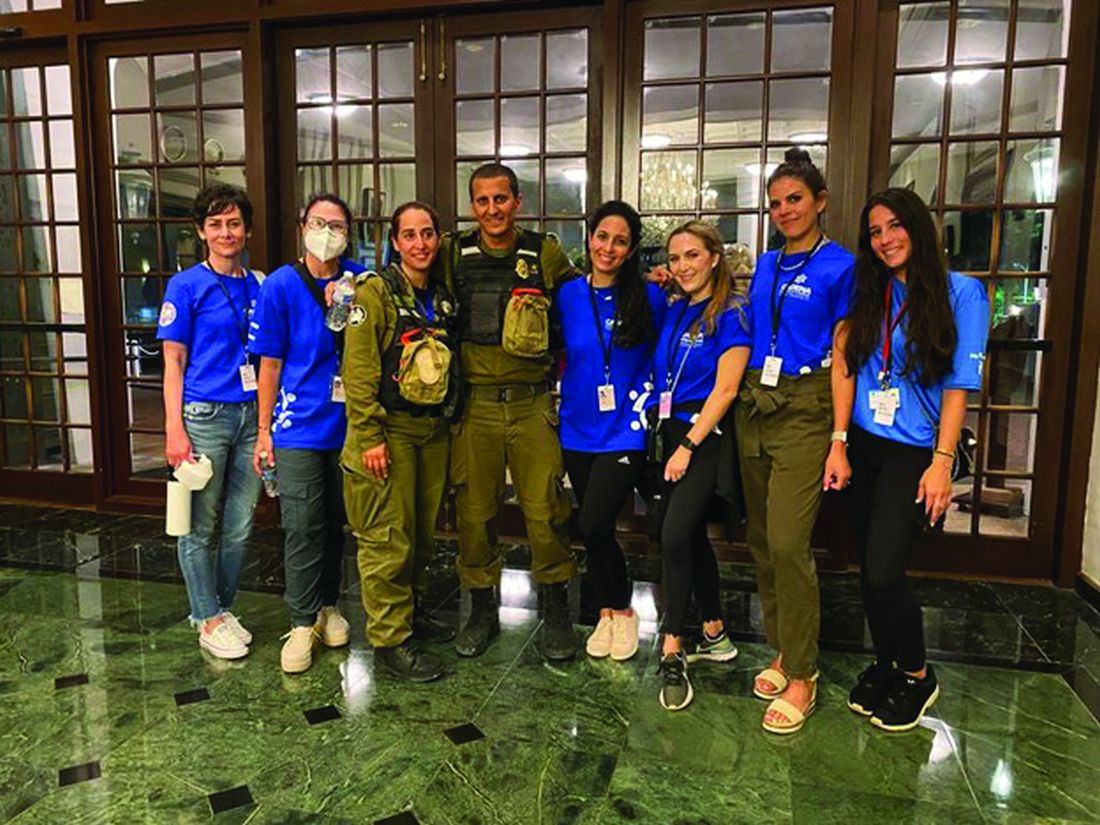
The days right after the collapse were agonizing for all as we waited and hoped for survivors to be found. Search teams from across the United States and from Mexico and Israel – specifically, Israeli Defense Forces personnel with experience conducting operations in the wake of earthquakes in both Haiti and Nepal, took on the dangerous work. When no one was recovered after the first day, hope faded, and after 10 days, the search and rescue efforts turned to search and recovery. We were indeed a county and community in mourning.
According to Lina Haji, PsyD, GIA Miami, in addition to the direct impact of loss, clinicians who engaged in crisis response and bereavement counseling with those affected by the Surfside tragedy were subjected to vicarious trauma. Mental health care providers in the Miami area not only experienced the direct effect of this tragedy but have been hearing details and harrowing stories about the unimaginable experiences their patients endured over those critical weeks. Vicarious trauma can result in our own symptoms, compassion fatigue, or burnout as clinicians. This resulted in a call for mental health providers to come to the aid of their fellow colleagues.
So, on the 1-month anniversary of the initial collapse, at the urging of Patricia Stauber, RN, LCSW, a clinician with more than 30 years’ experience in providing grief counseling in hospital and private practice settings; Antonello Bonci, MD, the founder of GIA Miami; Charlotte Tomic, director of public relations for the Institute for the Study of Global Antisemitism; and I cohosted what we hope will be several Mental Health Appreciation retreats. Our goal was to create a space to focus on healing the healers. We had hoped to hold an in-person event, but at the last moment we opted for a Zoom-based event because COVID-19 cases were rising rapidly again.
Working on the front lines
Cassie Feldman, PsyD, a licensed clinical psychologist with extensive experience working with grief, loss, end of life, and responding to trauma-related consults, reflected on her experience responding to the collapse in the earliest days – first independently at the request of community religious leaders and then as part of CADENA Foundation, a nonprofit organization dedicated to rescue, humanitarian aid, and disaster response and prevention worldwide.
Dr. Feldman worked alongside other mental health professionals, local Miami-Dade police and fire officials, and the domestic and international rescue teams (CADENA’s Go Team from Mexico and the Israeli Defense Force’s Search and Rescue Delegation), providing Psychological First Aid, crisis intervention, and disaster response to the victims’ families and survivors.
This initially was a 24-hour coverage effort, requiring Dr. Feldman and her colleagues to clear their schedules, and at times to work 18-hour shifts in the early days of the crisis to address the need for consistency and continuity. Their commitment was to show up for the victims’ families and survivors, fully embracing the chaos and the demands of the situation. She noted that the disaster brought out the best of her and her colleagues.
They divided and conquered the work, alongside clinicians from Jewish Community Services and Project Chai intervening acutely where possible, and coordinating long-term care plans for those survivors and members of the victims’ support networks in need of consistent care.
Dr. Feldman reflected on the notion that we have all been processing losses prior to this – loss of normalcy because of the pandemic, loss of people we loved as a result, other personal losses – and that this community tragedy is yet another loss to disentangle. It didn’t feel good or natural for her to passively absorb the news knowing she had both the skill set and capacity to take on an active supportive role. The first days at the community center were disorganized; it was hard to know who was who and what was what. She described parents crying out for their children and children longing for their parents. Individuals were so overcome with emotion that they grew faint. Friends and families flooded in but were unaware of how to be fully supportive. The level of trauma was so high that the only interventions that were absorbed were those that were nonverbal or that fully addressed practical needs. People were frightened and in a state of shock.
Day by day, more order ensued and the efforts became more coordinated, but it became apparent to her that the “family reunification center” was devoid of reunification. She and her colleagues’ primary role became aiding the police department in making death notifications to the families and being supportive of the victims’ families and their loved ones during and in between the formal briefings, where so many concerned family members and friends gathered and waited.
“As the days went on, things became more structured and predictable,” Dr. Feldman noted. “We continued to connect with the victims’ families and survivors, [listened to] their stories, shared meals with them, spent downtime with them, began to intimately know their loved ones, and all the barriers they were now facing. We became invested in them, their unique intricacies, and to care deeply for them like our own families and loved ones. Small talk and conversation morphed into silent embraces where spoken words weren’t necessary.”
Dr. Feldman said some of her earliest memories were visiting ICU patients alongside her father, a critical care and ICU physician. Her father taught her that nonverbal communication and connection can be offered to patients in the most poignant moments of suffering.
Her “nascent experiences in the ICU,” she said, taught her that “the most useful of interventions was just being with people in their pain and bearing witness at times when there were just no words.”
Dr. Feldman said that when many of her colleagues learned about the switch from rescue to recovery, the pull was to jump in their cars and drive to the hotel where the families were based to offer support.
The unity she witnessed – from the disparate clinicians who were virtual strangers before the incident but a team afterward, from the families and the community, and from the first responders and rescue teams – was inspiring, Dr. Feldman said.
“We were all forced to think beyond ourselves, push ourselves past our limits, and unify in a way that remedied this period in history of deep fragmentation,” she said.
Understanding the role of psychoneuroimmunology
In another presentation during the Zoom event, Ms. Stauber offered her insights about the importance of support among mental health clinicians.
She cited research on women with HIV showing that those who are part of a support group had a stronger immune response than those who were not.
Ms. Stauber said the impact of COVID-19 and its ramifications – including fear, grief over losing loved ones, isolation from friends and family, and interference/cessation of normal routines – has put an enormous strain on clinicians and clients. One of her clients had to take her mother to the emergency room – never to see her again. She continues to ask: “If I’d been there, could I have saved her?”
Another client whose husband died of COVID-19–related illness agonizes over not being able to be at her husband’s side, not being able to hold his hand, not being able to say goodbye.
She said other cultures are more accepting of suffering as a condition of life and the acknowledgment that our time on earth is limited.
The “quick fix for everything” society carries over to people’s grief, said Ms. Stauber. As a result, many find it difficult to appreciate how much time it takes to heal.
Normal uncomplicated grief can take approximately 2-3 years, she said. By then, the shock has been wearing off, the emotional roller coaster of loss is calming down, coping skills are strengthened, and life can once again be more fulfilling or meaningful. Complicated grief or grief with trauma takes much longer, said Ms. Stauber, who is a consultant with a national crisis and debriefing company providing trauma and bereavement support to Fortune 500 companies.
Trauma adds another complexity to loss. To begin to appreciate the rough road ahead, Ms. Stauber said, it is important to understand the basic challenges facing grieving people.
“This is where our profession may be needed; we are providing support for those suffering the immense pain of loss in a world that often has difficulty being present or patient with loss,” she said. “We are indeed providing an emotional life raft.”
Ultimately, self-care is critical, Ms. Stauber said. “Consider self-care a job requirement” to be successful. She also offered the following tips for self-care:
1. Share your own loss experience with a caring and nonjudgmental person.
2. Consider ongoing supervision and consultation with colleagues who understand the nature of your work.
3. Be willing to ask for help.
4. Be aware of risks and countertransference in our work.
5. Attend workshops.
6. Remember that you do not have to and cannot do it all by yourself – we absolutely need more grief and trauma trained therapists.
7. Involve yourself in activities outside of work that feed your soul and nourish your spirit.
8. Schedule play.
9. Develop a healthy self-care regimen to remain present doing this work.
10. Consider the benefits of exercise.
11. Enjoy the beauty and wonder of nature.
12. Consider yoga, meditation, spa retreats – such as Kripalu, Miraval, and Canyon Ranch.
13. Spend time with loving family and friends.
14. Adopt a pet.
15. Eat healthy foods; get plenty of rest.
16. Walk in the rain.
17. Listen to music.
18. Enjoy a relaxing bubble bath.
19. Sing, dance, and enjoy the blessings of this life.
20. Love yourself; you truly can be your own best friend.
To advocate on behalf of mental health for patients, we must do the same for mental health professionals. The retreat was well received, and we learned a lot from our speakers. After the program, we offered a 45-minute yoga class and then 30-minute sound bowl meditation. We plan to repeat the event in September to help our community deal with the ongoing stress of such overwhelming loss.
While our community will never be the same, we hope that, by coming together, we can all find a way to support one another and strive to help ourselves and others manage as we navigate yet another unprecedented crisis.
Dr. Ritvo, who has more than 30 years’ experience in psychiatry, practices telemedicine. She is author of “BeKindr – The Transformative Power of Kindness” (Hellertown, Pa.: Momosa Publishing, 2018). Dr. Ritvo has no disclosures.
The mental health toll from the Surfside, Fla., Champlain Tower collapse will be felt by our patients for years to come. As mental health professionals in Miami-Dade County, it has been difficult to deal with the catastrophe layered on the escalating COVID-19 crisis.
With each passing day after the June 24 incident, we all learned who the 98 victims were. In session after session, the enormous impact of this unfathomable tragedy unfolded. Some mental health care professionals were directly affected with the loss of family members; some lost patients, and a large number of our patients lost someone or knew someone who lost someone. It was reminiscent of our work during the COVID-19 crisis when we found that we were dealing with the same stressors as those of our patients. As it was said then, we were all in the same storm – just in very different boats.
It was heartening to see how many colleagues rushed to the site of the building where family waiting areas were established. So many professionals wanted to assist that some had to be turned away.
The days right after the collapse were agonizing for all as we waited and hoped for survivors to be found. Search teams from across the United States and from Mexico and Israel – specifically, Israeli Defense Forces personnel with experience conducting operations in the wake of earthquakes in both Haiti and Nepal, took on the dangerous work. When no one was recovered after the first day, hope faded, and after 10 days, the search and rescue efforts turned to search and recovery. We were indeed a county and community in mourning.
According to Lina Haji, PsyD, GIA Miami, in addition to the direct impact of loss, clinicians who engaged in crisis response and bereavement counseling with those affected by the Surfside tragedy were subjected to vicarious trauma. Mental health care providers in the Miami area not only experienced the direct effect of this tragedy but have been hearing details and harrowing stories about the unimaginable experiences their patients endured over those critical weeks. Vicarious trauma can result in our own symptoms, compassion fatigue, or burnout as clinicians. This resulted in a call for mental health providers to come to the aid of their fellow colleagues.
So, on the 1-month anniversary of the initial collapse, at the urging of Patricia Stauber, RN, LCSW, a clinician with more than 30 years’ experience in providing grief counseling in hospital and private practice settings; Antonello Bonci, MD, the founder of GIA Miami; Charlotte Tomic, director of public relations for the Institute for the Study of Global Antisemitism; and I cohosted what we hope will be several Mental Health Appreciation retreats. Our goal was to create a space to focus on healing the healers. We had hoped to hold an in-person event, but at the last moment we opted for a Zoom-based event because COVID-19 cases were rising rapidly again.
Working on the front lines
Cassie Feldman, PsyD, a licensed clinical psychologist with extensive experience working with grief, loss, end of life, and responding to trauma-related consults, reflected on her experience responding to the collapse in the earliest days – first independently at the request of community religious leaders and then as part of CADENA Foundation, a nonprofit organization dedicated to rescue, humanitarian aid, and disaster response and prevention worldwide.
Dr. Feldman worked alongside other mental health professionals, local Miami-Dade police and fire officials, and the domestic and international rescue teams (CADENA’s Go Team from Mexico and the Israeli Defense Force’s Search and Rescue Delegation), providing Psychological First Aid, crisis intervention, and disaster response to the victims’ families and survivors.
This initially was a 24-hour coverage effort, requiring Dr. Feldman and her colleagues to clear their schedules, and at times to work 18-hour shifts in the early days of the crisis to address the need for consistency and continuity. Their commitment was to show up for the victims’ families and survivors, fully embracing the chaos and the demands of the situation. She noted that the disaster brought out the best of her and her colleagues.
They divided and conquered the work, alongside clinicians from Jewish Community Services and Project Chai intervening acutely where possible, and coordinating long-term care plans for those survivors and members of the victims’ support networks in need of consistent care.
Dr. Feldman reflected on the notion that we have all been processing losses prior to this – loss of normalcy because of the pandemic, loss of people we loved as a result, other personal losses – and that this community tragedy is yet another loss to disentangle. It didn’t feel good or natural for her to passively absorb the news knowing she had both the skill set and capacity to take on an active supportive role. The first days at the community center were disorganized; it was hard to know who was who and what was what. She described parents crying out for their children and children longing for their parents. Individuals were so overcome with emotion that they grew faint. Friends and families flooded in but were unaware of how to be fully supportive. The level of trauma was so high that the only interventions that were absorbed were those that were nonverbal or that fully addressed practical needs. People were frightened and in a state of shock.
Day by day, more order ensued and the efforts became more coordinated, but it became apparent to her that the “family reunification center” was devoid of reunification. She and her colleagues’ primary role became aiding the police department in making death notifications to the families and being supportive of the victims’ families and their loved ones during and in between the formal briefings, where so many concerned family members and friends gathered and waited.
“As the days went on, things became more structured and predictable,” Dr. Feldman noted. “We continued to connect with the victims’ families and survivors, [listened to] their stories, shared meals with them, spent downtime with them, began to intimately know their loved ones, and all the barriers they were now facing. We became invested in them, their unique intricacies, and to care deeply for them like our own families and loved ones. Small talk and conversation morphed into silent embraces where spoken words weren’t necessary.”
Dr. Feldman said some of her earliest memories were visiting ICU patients alongside her father, a critical care and ICU physician. Her father taught her that nonverbal communication and connection can be offered to patients in the most poignant moments of suffering.
Her “nascent experiences in the ICU,” she said, taught her that “the most useful of interventions was just being with people in their pain and bearing witness at times when there were just no words.”
Dr. Feldman said that when many of her colleagues learned about the switch from rescue to recovery, the pull was to jump in their cars and drive to the hotel where the families were based to offer support.
The unity she witnessed – from the disparate clinicians who were virtual strangers before the incident but a team afterward, from the families and the community, and from the first responders and rescue teams – was inspiring, Dr. Feldman said.
“We were all forced to think beyond ourselves, push ourselves past our limits, and unify in a way that remedied this period in history of deep fragmentation,” she said.
Understanding the role of psychoneuroimmunology
In another presentation during the Zoom event, Ms. Stauber offered her insights about the importance of support among mental health clinicians.
She cited research on women with HIV showing that those who are part of a support group had a stronger immune response than those who were not.
Ms. Stauber said the impact of COVID-19 and its ramifications – including fear, grief over losing loved ones, isolation from friends and family, and interference/cessation of normal routines – has put an enormous strain on clinicians and clients. One of her clients had to take her mother to the emergency room – never to see her again. She continues to ask: “If I’d been there, could I have saved her?”
Another client whose husband died of COVID-19–related illness agonizes over not being able to be at her husband’s side, not being able to hold his hand, not being able to say goodbye.
She said other cultures are more accepting of suffering as a condition of life and the acknowledgment that our time on earth is limited.
The “quick fix for everything” society carries over to people’s grief, said Ms. Stauber. As a result, many find it difficult to appreciate how much time it takes to heal.
Normal uncomplicated grief can take approximately 2-3 years, she said. By then, the shock has been wearing off, the emotional roller coaster of loss is calming down, coping skills are strengthened, and life can once again be more fulfilling or meaningful. Complicated grief or grief with trauma takes much longer, said Ms. Stauber, who is a consultant with a national crisis and debriefing company providing trauma and bereavement support to Fortune 500 companies.
Trauma adds another complexity to loss. To begin to appreciate the rough road ahead, Ms. Stauber said, it is important to understand the basic challenges facing grieving people.
“This is where our profession may be needed; we are providing support for those suffering the immense pain of loss in a world that often has difficulty being present or patient with loss,” she said. “We are indeed providing an emotional life raft.”
Ultimately, self-care is critical, Ms. Stauber said. “Consider self-care a job requirement” to be successful. She also offered the following tips for self-care:
1. Share your own loss experience with a caring and nonjudgmental person.
2. Consider ongoing supervision and consultation with colleagues who understand the nature of your work.
3. Be willing to ask for help.
4. Be aware of risks and countertransference in our work.
5. Attend workshops.
6. Remember that you do not have to and cannot do it all by yourself – we absolutely need more grief and trauma trained therapists.
7. Involve yourself in activities outside of work that feed your soul and nourish your spirit.
8. Schedule play.
9. Develop a healthy self-care regimen to remain present doing this work.
10. Consider the benefits of exercise.
11. Enjoy the beauty and wonder of nature.
12. Consider yoga, meditation, spa retreats – such as Kripalu, Miraval, and Canyon Ranch.
13. Spend time with loving family and friends.
14. Adopt a pet.
15. Eat healthy foods; get plenty of rest.
16. Walk in the rain.
17. Listen to music.
18. Enjoy a relaxing bubble bath.
19. Sing, dance, and enjoy the blessings of this life.
20. Love yourself; you truly can be your own best friend.
To advocate on behalf of mental health for patients, we must do the same for mental health professionals. The retreat was well received, and we learned a lot from our speakers. After the program, we offered a 45-minute yoga class and then 30-minute sound bowl meditation. We plan to repeat the event in September to help our community deal with the ongoing stress of such overwhelming loss.
While our community will never be the same, we hope that, by coming together, we can all find a way to support one another and strive to help ourselves and others manage as we navigate yet another unprecedented crisis.
Dr. Ritvo, who has more than 30 years’ experience in psychiatry, practices telemedicine. She is author of “BeKindr – The Transformative Power of Kindness” (Hellertown, Pa.: Momosa Publishing, 2018). Dr. Ritvo has no disclosures.
The mental health toll from the Surfside, Fla., Champlain Tower collapse will be felt by our patients for years to come. As mental health professionals in Miami-Dade County, it has been difficult to deal with the catastrophe layered on the escalating COVID-19 crisis.
With each passing day after the June 24 incident, we all learned who the 98 victims were. In session after session, the enormous impact of this unfathomable tragedy unfolded. Some mental health care professionals were directly affected with the loss of family members; some lost patients, and a large number of our patients lost someone or knew someone who lost someone. It was reminiscent of our work during the COVID-19 crisis when we found that we were dealing with the same stressors as those of our patients. As it was said then, we were all in the same storm – just in very different boats.
It was heartening to see how many colleagues rushed to the site of the building where family waiting areas were established. So many professionals wanted to assist that some had to be turned away.
The days right after the collapse were agonizing for all as we waited and hoped for survivors to be found. Search teams from across the United States and from Mexico and Israel – specifically, Israeli Defense Forces personnel with experience conducting operations in the wake of earthquakes in both Haiti and Nepal, took on the dangerous work. When no one was recovered after the first day, hope faded, and after 10 days, the search and rescue efforts turned to search and recovery. We were indeed a county and community in mourning.
According to Lina Haji, PsyD, GIA Miami, in addition to the direct impact of loss, clinicians who engaged in crisis response and bereavement counseling with those affected by the Surfside tragedy were subjected to vicarious trauma. Mental health care providers in the Miami area not only experienced the direct effect of this tragedy but have been hearing details and harrowing stories about the unimaginable experiences their patients endured over those critical weeks. Vicarious trauma can result in our own symptoms, compassion fatigue, or burnout as clinicians. This resulted in a call for mental health providers to come to the aid of their fellow colleagues.
So, on the 1-month anniversary of the initial collapse, at the urging of Patricia Stauber, RN, LCSW, a clinician with more than 30 years’ experience in providing grief counseling in hospital and private practice settings; Antonello Bonci, MD, the founder of GIA Miami; Charlotte Tomic, director of public relations for the Institute for the Study of Global Antisemitism; and I cohosted what we hope will be several Mental Health Appreciation retreats. Our goal was to create a space to focus on healing the healers. We had hoped to hold an in-person event, but at the last moment we opted for a Zoom-based event because COVID-19 cases were rising rapidly again.
Working on the front lines
Cassie Feldman, PsyD, a licensed clinical psychologist with extensive experience working with grief, loss, end of life, and responding to trauma-related consults, reflected on her experience responding to the collapse in the earliest days – first independently at the request of community religious leaders and then as part of CADENA Foundation, a nonprofit organization dedicated to rescue, humanitarian aid, and disaster response and prevention worldwide.
Dr. Feldman worked alongside other mental health professionals, local Miami-Dade police and fire officials, and the domestic and international rescue teams (CADENA’s Go Team from Mexico and the Israeli Defense Force’s Search and Rescue Delegation), providing Psychological First Aid, crisis intervention, and disaster response to the victims’ families and survivors.
This initially was a 24-hour coverage effort, requiring Dr. Feldman and her colleagues to clear their schedules, and at times to work 18-hour shifts in the early days of the crisis to address the need for consistency and continuity. Their commitment was to show up for the victims’ families and survivors, fully embracing the chaos and the demands of the situation. She noted that the disaster brought out the best of her and her colleagues.
They divided and conquered the work, alongside clinicians from Jewish Community Services and Project Chai intervening acutely where possible, and coordinating long-term care plans for those survivors and members of the victims’ support networks in need of consistent care.
Dr. Feldman reflected on the notion that we have all been processing losses prior to this – loss of normalcy because of the pandemic, loss of people we loved as a result, other personal losses – and that this community tragedy is yet another loss to disentangle. It didn’t feel good or natural for her to passively absorb the news knowing she had both the skill set and capacity to take on an active supportive role. The first days at the community center were disorganized; it was hard to know who was who and what was what. She described parents crying out for their children and children longing for their parents. Individuals were so overcome with emotion that they grew faint. Friends and families flooded in but were unaware of how to be fully supportive. The level of trauma was so high that the only interventions that were absorbed were those that were nonverbal or that fully addressed practical needs. People were frightened and in a state of shock.
Day by day, more order ensued and the efforts became more coordinated, but it became apparent to her that the “family reunification center” was devoid of reunification. She and her colleagues’ primary role became aiding the police department in making death notifications to the families and being supportive of the victims’ families and their loved ones during and in between the formal briefings, where so many concerned family members and friends gathered and waited.
“As the days went on, things became more structured and predictable,” Dr. Feldman noted. “We continued to connect with the victims’ families and survivors, [listened to] their stories, shared meals with them, spent downtime with them, began to intimately know their loved ones, and all the barriers they were now facing. We became invested in them, their unique intricacies, and to care deeply for them like our own families and loved ones. Small talk and conversation morphed into silent embraces where spoken words weren’t necessary.”
Dr. Feldman said some of her earliest memories were visiting ICU patients alongside her father, a critical care and ICU physician. Her father taught her that nonverbal communication and connection can be offered to patients in the most poignant moments of suffering.
Her “nascent experiences in the ICU,” she said, taught her that “the most useful of interventions was just being with people in their pain and bearing witness at times when there were just no words.”
Dr. Feldman said that when many of her colleagues learned about the switch from rescue to recovery, the pull was to jump in their cars and drive to the hotel where the families were based to offer support.
The unity she witnessed – from the disparate clinicians who were virtual strangers before the incident but a team afterward, from the families and the community, and from the first responders and rescue teams – was inspiring, Dr. Feldman said.
“We were all forced to think beyond ourselves, push ourselves past our limits, and unify in a way that remedied this period in history of deep fragmentation,” she said.
Understanding the role of psychoneuroimmunology
In another presentation during the Zoom event, Ms. Stauber offered her insights about the importance of support among mental health clinicians.
She cited research on women with HIV showing that those who are part of a support group had a stronger immune response than those who were not.
Ms. Stauber said the impact of COVID-19 and its ramifications – including fear, grief over losing loved ones, isolation from friends and family, and interference/cessation of normal routines – has put an enormous strain on clinicians and clients. One of her clients had to take her mother to the emergency room – never to see her again. She continues to ask: “If I’d been there, could I have saved her?”
Another client whose husband died of COVID-19–related illness agonizes over not being able to be at her husband’s side, not being able to hold his hand, not being able to say goodbye.
She said other cultures are more accepting of suffering as a condition of life and the acknowledgment that our time on earth is limited.
The “quick fix for everything” society carries over to people’s grief, said Ms. Stauber. As a result, many find it difficult to appreciate how much time it takes to heal.
Normal uncomplicated grief can take approximately 2-3 years, she said. By then, the shock has been wearing off, the emotional roller coaster of loss is calming down, coping skills are strengthened, and life can once again be more fulfilling or meaningful. Complicated grief or grief with trauma takes much longer, said Ms. Stauber, who is a consultant with a national crisis and debriefing company providing trauma and bereavement support to Fortune 500 companies.
Trauma adds another complexity to loss. To begin to appreciate the rough road ahead, Ms. Stauber said, it is important to understand the basic challenges facing grieving people.
“This is where our profession may be needed; we are providing support for those suffering the immense pain of loss in a world that often has difficulty being present or patient with loss,” she said. “We are indeed providing an emotional life raft.”
Ultimately, self-care is critical, Ms. Stauber said. “Consider self-care a job requirement” to be successful. She also offered the following tips for self-care:
1. Share your own loss experience with a caring and nonjudgmental person.
2. Consider ongoing supervision and consultation with colleagues who understand the nature of your work.
3. Be willing to ask for help.
4. Be aware of risks and countertransference in our work.
5. Attend workshops.
6. Remember that you do not have to and cannot do it all by yourself – we absolutely need more grief and trauma trained therapists.
7. Involve yourself in activities outside of work that feed your soul and nourish your spirit.
8. Schedule play.
9. Develop a healthy self-care regimen to remain present doing this work.
10. Consider the benefits of exercise.
11. Enjoy the beauty and wonder of nature.
12. Consider yoga, meditation, spa retreats – such as Kripalu, Miraval, and Canyon Ranch.
13. Spend time with loving family and friends.
14. Adopt a pet.
15. Eat healthy foods; get plenty of rest.
16. Walk in the rain.
17. Listen to music.
18. Enjoy a relaxing bubble bath.
19. Sing, dance, and enjoy the blessings of this life.
20. Love yourself; you truly can be your own best friend.
To advocate on behalf of mental health for patients, we must do the same for mental health professionals. The retreat was well received, and we learned a lot from our speakers. After the program, we offered a 45-minute yoga class and then 30-minute sound bowl meditation. We plan to repeat the event in September to help our community deal with the ongoing stress of such overwhelming loss.
While our community will never be the same, we hope that, by coming together, we can all find a way to support one another and strive to help ourselves and others manage as we navigate yet another unprecedented crisis.
Dr. Ritvo, who has more than 30 years’ experience in psychiatry, practices telemedicine. She is author of “BeKindr – The Transformative Power of Kindness” (Hellertown, Pa.: Momosa Publishing, 2018). Dr. Ritvo has no disclosures.
COVID-19: Delta variant is raising the stakes
Empathetic conversations with unvaccinated people desperately needed
Like many colleagues, I have been working to change the minds and behaviors of acquaintances and patients who are opting to forgo a COVID vaccine. The large numbers of these unvaccinated Americans, combined with the surging Delta coronavirus variant, are endangering the health of us all.
When I spoke with the 22-year-old daughter of a family friend about what was holding her back, she told me that she would “never” get vaccinated. I shared my vaccination experience and told her that, except for a sore arm both times for a day, I felt no side effects. Likewise, I said, all of my adult family members are vaccinated, and everyone is fine. She was neither moved nor convinced.
Finally, I asked her whether she attended school (knowing that she was a college graduate), and she said “yes.” So I told her that all 50 states require children attending public schools to be vaccinated for diseases such as diphtheria, tetanus, polio, and the chickenpox – with certain religious, philosophical, and medical exemptions. Her response was simple: “I didn’t know that. Anyway, my parents were in charge.” Suddenly, her thinking shifted. “You’re right,” she said. She got a COVID shot the next day. Success for me.
When I asked another acquaintance whether he’d been vaccinated, he said he’d heard people were getting very sick from the vaccine – and was going to wait. Another gentleman I spoke with said that, at age 45, he was healthy. Besides, he added, he “doesn’t get sick.” When I asked another acquaintance about her vaccination status, her retort was that this was none of my business. So far, I’m batting about .300.
But as a physician, I believe that we – and other health care providers – must continue to encourage the people in our lives to care for themselves and others by getting vaccinated. One concrete step advised by the Centers for Disease Control and Prevention is to help people make an appointment for a shot. Some sites no longer require appointments, and New York City, for example, offers in-home vaccinations to all NYC residents.
Also, NYC Mayor Bill de Blasio announced Aug. 3 the “Key to NYC Pass,” which he called a “first-in-the-nation approach” to vaccination. Under this new policy, vaccine-eligible people aged 12 and older in New York City will need to prove with a vaccination card, an app, or an Excelsior Pass that they have received at least one dose of vaccine before participating in indoor venues such as restaurants, bars, gyms, and movie theaters within the city. Mayor de Blasio said the new initiative, which is still being finalized, will be phased in starting the week of Aug. 16. I see this as a major public health measure that will keep people healthy – and get them vaccinated.
The medical community should support this move by the city of New York and encourage people to follow CDC guidance on wearing face coverings in public settings, especially schools. New research shows that physicians continue to be among the most trusted sources of vaccine-related information.
Another strategy we might use is to point to the longtime practices of surgeons. We could ask: Why do surgeons wear face masks in the operating room? For years, these coverings have been used to protect patients from the nasal and oral bacteria generated by operating room staff. Likewise, we can tell those who remain on the fence that, by wearing face masks, we are protecting others from all variants, but specifically from Delta – which the CDC now says can be transmitted by people who are fully vaccinated.
Why did the CDC lift face mask guidance for fully vaccinated people in indoor spaces in May? It was clear to me and other colleagues back then that this was not a good idea. Despite that guidance, I continued to wear a mask in public places and advised anyone who would listen to do the same.
The development of vaccines in the 20th and 21st centuries has saved millions of lives. The World Health Organization reports that 4 million to 5 million lives a year are saved by immunizations. In addition, research shows that, before the emergence of SARS-CoV-2, vaccinations led to the eradication of smallpox and polio, and a 74% drop in measles-related deaths between 2004 and 2014.
Protecting the most vulnerable
With COVID cases surging, particularly in parts of the South and Midwest, I am concerned about children under age 12 who do not yet qualify for a vaccine. Certainly, unvaccinated parents could spread the virus to their young children, and unvaccinated children could transmit the illness to immediate and extended family. Now that the CDC has said that there is a risk of SARS-CoV-2 breakthrough infection among fully vaccinated people in areas with high community transmission, should we worry about unvaccinated young children with vaccinated parents? I recently spoke with James C. Fagin, MD, a board-certified pediatrician and immunologist, to get his views on this issue.
Dr. Fagin, who is retired, said he is in complete agreement with the Food and Drug Administration when it comes to approving medications for children. However, given the seriousness of the pandemic and the need to get our children back to in-person learning, he would like to see the approval process safely expedited. Large numbers of unvaccinated people increase the pool for the Delta variant and could increase the likelihood of a new variant that is more resistant to the vaccines, said Dr. Fagin, former chief of academic pediatrics at North Shore University Hospital and a former faculty member in the allergy/immunology division of Cohen Children’s Medical Center, both in New York.
Meanwhile, I agree with the American Academy of Pediatrics’ recommendations that children, teachers, and school staff and other adults in school settings should wear masks regardless of vaccination status. Kids adjust well to masks – as my grandchildren and their friends have.
The bottom line is that we need to get as many people as possible vaccinated as soon as possible, and while doing so, we must continue to wear face coverings in public spaces. As clinicians, we have a special responsibility to do all that we can to change minds – and behaviors.
Dr. London is a practicing psychiatrist who has been a newspaper columnist for 35 years, specializing in and writing about short-term therapy, including cognitive-behavioral therapy and guided imagery. He is author of “Find Freedom Fast” (New York: Kettlehole Publishing, 2019). He has no conflicts of interest.
Empathetic conversations with unvaccinated people desperately needed
Empathetic conversations with unvaccinated people desperately needed
Like many colleagues, I have been working to change the minds and behaviors of acquaintances and patients who are opting to forgo a COVID vaccine. The large numbers of these unvaccinated Americans, combined with the surging Delta coronavirus variant, are endangering the health of us all.
When I spoke with the 22-year-old daughter of a family friend about what was holding her back, she told me that she would “never” get vaccinated. I shared my vaccination experience and told her that, except for a sore arm both times for a day, I felt no side effects. Likewise, I said, all of my adult family members are vaccinated, and everyone is fine. She was neither moved nor convinced.
Finally, I asked her whether she attended school (knowing that she was a college graduate), and she said “yes.” So I told her that all 50 states require children attending public schools to be vaccinated for diseases such as diphtheria, tetanus, polio, and the chickenpox – with certain religious, philosophical, and medical exemptions. Her response was simple: “I didn’t know that. Anyway, my parents were in charge.” Suddenly, her thinking shifted. “You’re right,” she said. She got a COVID shot the next day. Success for me.
When I asked another acquaintance whether he’d been vaccinated, he said he’d heard people were getting very sick from the vaccine – and was going to wait. Another gentleman I spoke with said that, at age 45, he was healthy. Besides, he added, he “doesn’t get sick.” When I asked another acquaintance about her vaccination status, her retort was that this was none of my business. So far, I’m batting about .300.
But as a physician, I believe that we – and other health care providers – must continue to encourage the people in our lives to care for themselves and others by getting vaccinated. One concrete step advised by the Centers for Disease Control and Prevention is to help people make an appointment for a shot. Some sites no longer require appointments, and New York City, for example, offers in-home vaccinations to all NYC residents.
Also, NYC Mayor Bill de Blasio announced Aug. 3 the “Key to NYC Pass,” which he called a “first-in-the-nation approach” to vaccination. Under this new policy, vaccine-eligible people aged 12 and older in New York City will need to prove with a vaccination card, an app, or an Excelsior Pass that they have received at least one dose of vaccine before participating in indoor venues such as restaurants, bars, gyms, and movie theaters within the city. Mayor de Blasio said the new initiative, which is still being finalized, will be phased in starting the week of Aug. 16. I see this as a major public health measure that will keep people healthy – and get them vaccinated.
The medical community should support this move by the city of New York and encourage people to follow CDC guidance on wearing face coverings in public settings, especially schools. New research shows that physicians continue to be among the most trusted sources of vaccine-related information.
Another strategy we might use is to point to the longtime practices of surgeons. We could ask: Why do surgeons wear face masks in the operating room? For years, these coverings have been used to protect patients from the nasal and oral bacteria generated by operating room staff. Likewise, we can tell those who remain on the fence that, by wearing face masks, we are protecting others from all variants, but specifically from Delta – which the CDC now says can be transmitted by people who are fully vaccinated.
Why did the CDC lift face mask guidance for fully vaccinated people in indoor spaces in May? It was clear to me and other colleagues back then that this was not a good idea. Despite that guidance, I continued to wear a mask in public places and advised anyone who would listen to do the same.
The development of vaccines in the 20th and 21st centuries has saved millions of lives. The World Health Organization reports that 4 million to 5 million lives a year are saved by immunizations. In addition, research shows that, before the emergence of SARS-CoV-2, vaccinations led to the eradication of smallpox and polio, and a 74% drop in measles-related deaths between 2004 and 2014.
Protecting the most vulnerable
With COVID cases surging, particularly in parts of the South and Midwest, I am concerned about children under age 12 who do not yet qualify for a vaccine. Certainly, unvaccinated parents could spread the virus to their young children, and unvaccinated children could transmit the illness to immediate and extended family. Now that the CDC has said that there is a risk of SARS-CoV-2 breakthrough infection among fully vaccinated people in areas with high community transmission, should we worry about unvaccinated young children with vaccinated parents? I recently spoke with James C. Fagin, MD, a board-certified pediatrician and immunologist, to get his views on this issue.
Dr. Fagin, who is retired, said he is in complete agreement with the Food and Drug Administration when it comes to approving medications for children. However, given the seriousness of the pandemic and the need to get our children back to in-person learning, he would like to see the approval process safely expedited. Large numbers of unvaccinated people increase the pool for the Delta variant and could increase the likelihood of a new variant that is more resistant to the vaccines, said Dr. Fagin, former chief of academic pediatrics at North Shore University Hospital and a former faculty member in the allergy/immunology division of Cohen Children’s Medical Center, both in New York.
Meanwhile, I agree with the American Academy of Pediatrics’ recommendations that children, teachers, and school staff and other adults in school settings should wear masks regardless of vaccination status. Kids adjust well to masks – as my grandchildren and their friends have.
The bottom line is that we need to get as many people as possible vaccinated as soon as possible, and while doing so, we must continue to wear face coverings in public spaces. As clinicians, we have a special responsibility to do all that we can to change minds – and behaviors.
Dr. London is a practicing psychiatrist who has been a newspaper columnist for 35 years, specializing in and writing about short-term therapy, including cognitive-behavioral therapy and guided imagery. He is author of “Find Freedom Fast” (New York: Kettlehole Publishing, 2019). He has no conflicts of interest.
Like many colleagues, I have been working to change the minds and behaviors of acquaintances and patients who are opting to forgo a COVID vaccine. The large numbers of these unvaccinated Americans, combined with the surging Delta coronavirus variant, are endangering the health of us all.
When I spoke with the 22-year-old daughter of a family friend about what was holding her back, she told me that she would “never” get vaccinated. I shared my vaccination experience and told her that, except for a sore arm both times for a day, I felt no side effects. Likewise, I said, all of my adult family members are vaccinated, and everyone is fine. She was neither moved nor convinced.
Finally, I asked her whether she attended school (knowing that she was a college graduate), and she said “yes.” So I told her that all 50 states require children attending public schools to be vaccinated for diseases such as diphtheria, tetanus, polio, and the chickenpox – with certain religious, philosophical, and medical exemptions. Her response was simple: “I didn’t know that. Anyway, my parents were in charge.” Suddenly, her thinking shifted. “You’re right,” she said. She got a COVID shot the next day. Success for me.
When I asked another acquaintance whether he’d been vaccinated, he said he’d heard people were getting very sick from the vaccine – and was going to wait. Another gentleman I spoke with said that, at age 45, he was healthy. Besides, he added, he “doesn’t get sick.” When I asked another acquaintance about her vaccination status, her retort was that this was none of my business. So far, I’m batting about .300.
But as a physician, I believe that we – and other health care providers – must continue to encourage the people in our lives to care for themselves and others by getting vaccinated. One concrete step advised by the Centers for Disease Control and Prevention is to help people make an appointment for a shot. Some sites no longer require appointments, and New York City, for example, offers in-home vaccinations to all NYC residents.
Also, NYC Mayor Bill de Blasio announced Aug. 3 the “Key to NYC Pass,” which he called a “first-in-the-nation approach” to vaccination. Under this new policy, vaccine-eligible people aged 12 and older in New York City will need to prove with a vaccination card, an app, or an Excelsior Pass that they have received at least one dose of vaccine before participating in indoor venues such as restaurants, bars, gyms, and movie theaters within the city. Mayor de Blasio said the new initiative, which is still being finalized, will be phased in starting the week of Aug. 16. I see this as a major public health measure that will keep people healthy – and get them vaccinated.
The medical community should support this move by the city of New York and encourage people to follow CDC guidance on wearing face coverings in public settings, especially schools. New research shows that physicians continue to be among the most trusted sources of vaccine-related information.
Another strategy we might use is to point to the longtime practices of surgeons. We could ask: Why do surgeons wear face masks in the operating room? For years, these coverings have been used to protect patients from the nasal and oral bacteria generated by operating room staff. Likewise, we can tell those who remain on the fence that, by wearing face masks, we are protecting others from all variants, but specifically from Delta – which the CDC now says can be transmitted by people who are fully vaccinated.
Why did the CDC lift face mask guidance for fully vaccinated people in indoor spaces in May? It was clear to me and other colleagues back then that this was not a good idea. Despite that guidance, I continued to wear a mask in public places and advised anyone who would listen to do the same.
The development of vaccines in the 20th and 21st centuries has saved millions of lives. The World Health Organization reports that 4 million to 5 million lives a year are saved by immunizations. In addition, research shows that, before the emergence of SARS-CoV-2, vaccinations led to the eradication of smallpox and polio, and a 74% drop in measles-related deaths between 2004 and 2014.
Protecting the most vulnerable
With COVID cases surging, particularly in parts of the South and Midwest, I am concerned about children under age 12 who do not yet qualify for a vaccine. Certainly, unvaccinated parents could spread the virus to their young children, and unvaccinated children could transmit the illness to immediate and extended family. Now that the CDC has said that there is a risk of SARS-CoV-2 breakthrough infection among fully vaccinated people in areas with high community transmission, should we worry about unvaccinated young children with vaccinated parents? I recently spoke with James C. Fagin, MD, a board-certified pediatrician and immunologist, to get his views on this issue.
Dr. Fagin, who is retired, said he is in complete agreement with the Food and Drug Administration when it comes to approving medications for children. However, given the seriousness of the pandemic and the need to get our children back to in-person learning, he would like to see the approval process safely expedited. Large numbers of unvaccinated people increase the pool for the Delta variant and could increase the likelihood of a new variant that is more resistant to the vaccines, said Dr. Fagin, former chief of academic pediatrics at North Shore University Hospital and a former faculty member in the allergy/immunology division of Cohen Children’s Medical Center, both in New York.
Meanwhile, I agree with the American Academy of Pediatrics’ recommendations that children, teachers, and school staff and other adults in school settings should wear masks regardless of vaccination status. Kids adjust well to masks – as my grandchildren and their friends have.
The bottom line is that we need to get as many people as possible vaccinated as soon as possible, and while doing so, we must continue to wear face coverings in public spaces. As clinicians, we have a special responsibility to do all that we can to change minds – and behaviors.
Dr. London is a practicing psychiatrist who has been a newspaper columnist for 35 years, specializing in and writing about short-term therapy, including cognitive-behavioral therapy and guided imagery. He is author of “Find Freedom Fast” (New York: Kettlehole Publishing, 2019). He has no conflicts of interest.
Needed: More studies of CSF molecular biomarkers in psychiatric disorders
Psychiatry and neurology are the brain’s twin medical disciplines. Unlike neurologic brain disorders, where localizing the “lesion” is a primary objective, psychiatric brain disorders are much more subtle, with no “gross” lesions but numerous cellular and molecular pathologies within neural circuits.
Measuring the molecular components of the cerebrospinal fluid (CSF), the glorious “sewage system” of the brain, may help reveal granular clues to the neurobiology of psychiatric disorders.
Mental illnesses involve the disruption of brain structures and functions in a diffuse manner across the cortex. Abnormal neuroplasticity has been implicated in several major psychiatric disorders. Examples include hypoplasia of the hippocampus in major depressive disorder and cortical thinning/dysplasia in schizophrenia. Reductions of neurotropic factors such as nerve growth factor or brain-derived neurotropic factor have been reported in mood and psychotic disorders, and appear to correlate with neuroplasticity changes.
Recent advances in psychiatric neuroscience have provided many clues to the pathophysiology of psychopathological conditions, including neuroinflammation, oxidative stress, apoptosis, impaired energy metabolism, abnormal metabolomics and lipidomics, and hypo- and hyperfunction of various neurotransmitters systems (especially glutamate N-methyl-
Thus, psychiatric research should focus on exploring and detecting molecular signatures (ie, biomarkers) of psychiatric disorders, including biomarkers of axonal and synaptic damage, glial activation, and oxidative stress. This is especially critical given the extensive heterogeneity of schizophrenia and mood and anxiety disorders. The CSF is a vastly unexploited substrate for discovering molecular biomarkers that will pave the way to precision psychiatry, and possibly open the door for completely new therapeutic strategies to tackle the most challenging neuropsychiatric disorders.
A role for CSF analysis
It’s quite puzzling why acute psychiatric episodes of schizophrenia, bipolar disorder, major depressive disorder, or panic attacks are not routinely assessed with a spinal tap, in conjunction with other brain measures such as neuroimaging (morphology, spectroscopy, cerebral blood flow, and diffusion tensor imaging) as well as a comprehensive neurocognitive examination and neurophysiological tests such as pre-pulse inhibition, mismatch negativity, and P-50, N-10, and P-300 evoked potentials. Combining CSF analysis with all those measures may help us stratify the spectra of psychosis, depression, and anxiety, as well as posttraumatic stress disorder and obsessive-compulsive disorder, into unique biotypes with overlapping clinical phenotypes and specific treatment approaches.
There are relatively few published CSF studies in psychiatric patients (mostly schizophrenia and bipolar and depressive disorders). The Table1-9 shows some of those findings. More than 365 biomarkers have been reported in schizophrenia, most of them in serum and tissue.10 However, none of them can be used for diagnostic purposes because schizophrenia is a syndrome comprised of several hundred different diseases (biotypes) that have similar clinical symptoms. Many of the serum and tissue biomarkers have not been studied in CSF, and they must if advances in the neurobiology and treatment of the psychotic and mood spectra are to be achieved. And adapting the CSF biomarkers described in neurologic disorders such as multiple sclerosis11 to schizophrenia and bipolar disorder (which also have well-established myelin pathologies) may yield a trove of neurobiologic findings.
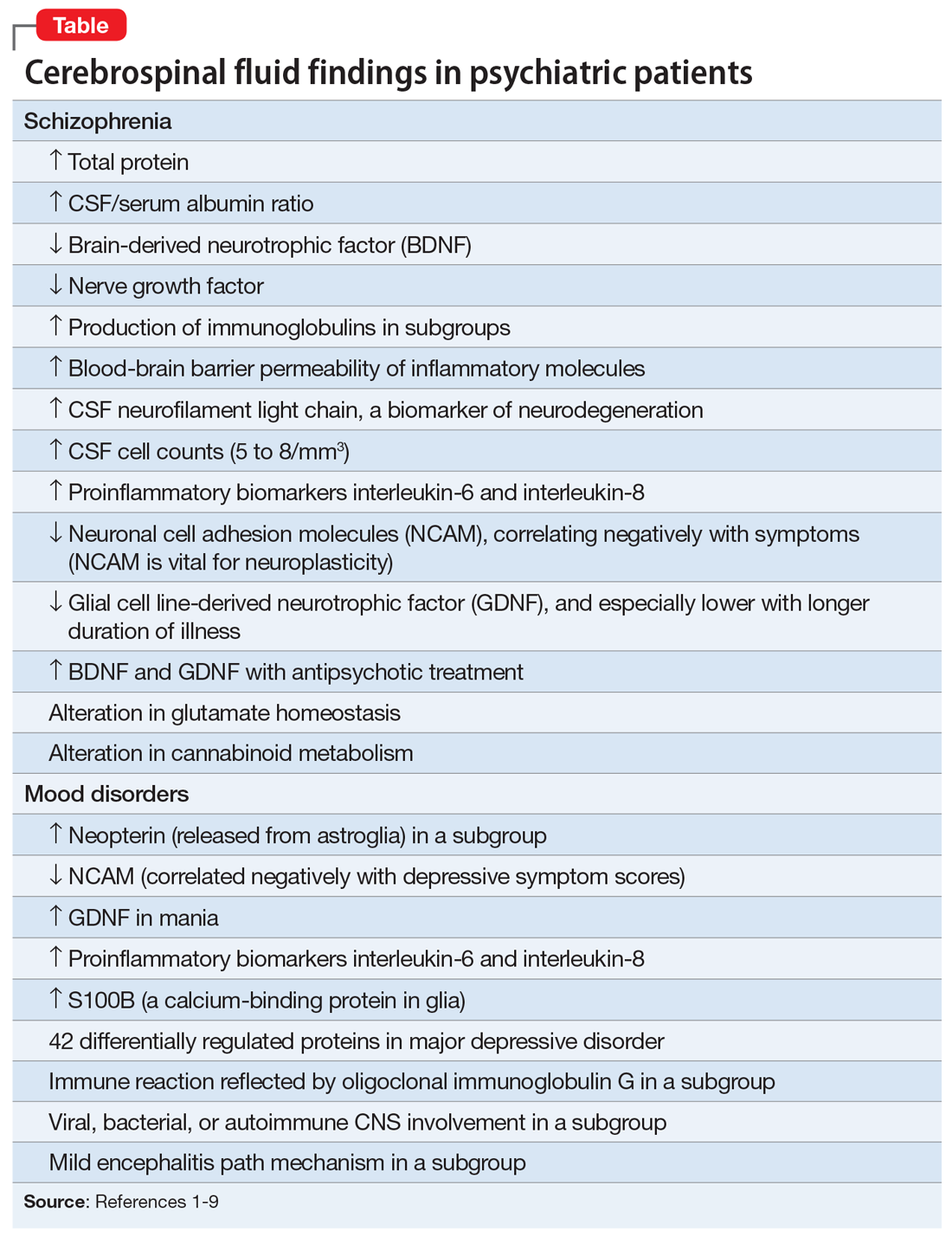
If CSF studies eventually prove to be very useful for identifying subtypes for diagnosis and treatment, psychiatrists do not have to do the lumbar puncture themselves, but may refer patients to a “spinal tap” laboratory, just as they refer patients to a phlebotomy laboratory for routine blood tests. The adoption of CSF assessment in psychiatry will solidify its status as a clinical neuroscience, like its sister, neurology.
1. Vasic N, Connemann BJ, Wolf RC, et al. Cerebrospinal fluid biomarker candidates of schizophrenia: where do we stand? Eur Arch Psychiatry Clin Neurosci. 2012;262(5):375-391.
2. Pollak TA, Drndarski S, Stone JM, et al. The blood-brain barrier in psychosis. Lancet Psychiatry. 2018;5(1):79-92.
3. Katisko K, Cajanus A, Jääskeläinen O, et al. Serum neurofilament light chain is a discriminative biomarker between frontotemporal lobar degeneration and primary psychiatric disorders. J Neurol. 2020;267(1):162-167.
4. Bechter K, Reiber H, Herzog S, et al. Cerebrospinal fluid analysis in affective and schizophrenic spectrum disorders: identification of subgroups with immune responses and blood-CSF barrier dysfunction. J Psychiatr Res. 2010;44(5):321-330.
5. Hidese S, Hattori K, Sasayama D, et al. Cerebrospinal fluid neural cell adhesion molecule levels and their correlation with clinical variables in patients with schizophrenia, bipolar disorder, and major depressive disorder. Prog Neuropsychopharmacol Biol Psychiatry. 2017;76:12-18.
6. Tunca Z, Kıvırcık Akdede B, Özerdem A, et al. Diverse glial cell line-derived neurotrophic factor (GDNF) support between mania and schizophrenia: a comparative study in four major psychiatric disorders. Eur Psychiatry. 2015;30(2):198-204.
7. Al Shweiki MR, Oeckl P, Steinacker P, et al. Major depressive disorder: insight into candidate cerebrospinal fluid protein biomarkers from proteomics studies. Expert Rev Proteomics. 2017;14(6):499-514.
8. Kroksmark H, Vinberg M. Does S100B have a potential role in affective disorders? A literature review. Nord J Psychiatry. 2018;72(7):462-470.
9. Orlovska-Waast S, Köhler-Forsberg O, Brix SW, et al. Cerebrospinal fluid markers of inflammation and infections in schizophrenia and affective disorders: a systematic review and meta-analysis. Mol Psychiatry. 2019;24(6):869-887.
10. Nasrallah HA. Lab tests for psychiatric disorders: few clinicians are aware of them. Current Psychiatry. 2013;12(2):5-7.
11. Porter L, Shoushtarizadeh A, Jelinek GA, et al. Metabolomic biomarkers of multiple sclerosis: a systematic review. Front Mol Biosci. 2020;7:574133. doi: 10.3389/fmolb.2020.574133
Psychiatry and neurology are the brain’s twin medical disciplines. Unlike neurologic brain disorders, where localizing the “lesion” is a primary objective, psychiatric brain disorders are much more subtle, with no “gross” lesions but numerous cellular and molecular pathologies within neural circuits.
Measuring the molecular components of the cerebrospinal fluid (CSF), the glorious “sewage system” of the brain, may help reveal granular clues to the neurobiology of psychiatric disorders.
Mental illnesses involve the disruption of brain structures and functions in a diffuse manner across the cortex. Abnormal neuroplasticity has been implicated in several major psychiatric disorders. Examples include hypoplasia of the hippocampus in major depressive disorder and cortical thinning/dysplasia in schizophrenia. Reductions of neurotropic factors such as nerve growth factor or brain-derived neurotropic factor have been reported in mood and psychotic disorders, and appear to correlate with neuroplasticity changes.
Recent advances in psychiatric neuroscience have provided many clues to the pathophysiology of psychopathological conditions, including neuroinflammation, oxidative stress, apoptosis, impaired energy metabolism, abnormal metabolomics and lipidomics, and hypo- and hyperfunction of various neurotransmitters systems (especially glutamate N-methyl-
Thus, psychiatric research should focus on exploring and detecting molecular signatures (ie, biomarkers) of psychiatric disorders, including biomarkers of axonal and synaptic damage, glial activation, and oxidative stress. This is especially critical given the extensive heterogeneity of schizophrenia and mood and anxiety disorders. The CSF is a vastly unexploited substrate for discovering molecular biomarkers that will pave the way to precision psychiatry, and possibly open the door for completely new therapeutic strategies to tackle the most challenging neuropsychiatric disorders.
A role for CSF analysis
It’s quite puzzling why acute psychiatric episodes of schizophrenia, bipolar disorder, major depressive disorder, or panic attacks are not routinely assessed with a spinal tap, in conjunction with other brain measures such as neuroimaging (morphology, spectroscopy, cerebral blood flow, and diffusion tensor imaging) as well as a comprehensive neurocognitive examination and neurophysiological tests such as pre-pulse inhibition, mismatch negativity, and P-50, N-10, and P-300 evoked potentials. Combining CSF analysis with all those measures may help us stratify the spectra of psychosis, depression, and anxiety, as well as posttraumatic stress disorder and obsessive-compulsive disorder, into unique biotypes with overlapping clinical phenotypes and specific treatment approaches.
There are relatively few published CSF studies in psychiatric patients (mostly schizophrenia and bipolar and depressive disorders). The Table1-9 shows some of those findings. More than 365 biomarkers have been reported in schizophrenia, most of them in serum and tissue.10 However, none of them can be used for diagnostic purposes because schizophrenia is a syndrome comprised of several hundred different diseases (biotypes) that have similar clinical symptoms. Many of the serum and tissue biomarkers have not been studied in CSF, and they must if advances in the neurobiology and treatment of the psychotic and mood spectra are to be achieved. And adapting the CSF biomarkers described in neurologic disorders such as multiple sclerosis11 to schizophrenia and bipolar disorder (which also have well-established myelin pathologies) may yield a trove of neurobiologic findings.
If CSF studies eventually prove to be very useful for identifying subtypes for diagnosis and treatment, psychiatrists do not have to do the lumbar puncture themselves, but may refer patients to a “spinal tap” laboratory, just as they refer patients to a phlebotomy laboratory for routine blood tests. The adoption of CSF assessment in psychiatry will solidify its status as a clinical neuroscience, like its sister, neurology.
Psychiatry and neurology are the brain’s twin medical disciplines. Unlike neurologic brain disorders, where localizing the “lesion” is a primary objective, psychiatric brain disorders are much more subtle, with no “gross” lesions but numerous cellular and molecular pathologies within neural circuits.
Measuring the molecular components of the cerebrospinal fluid (CSF), the glorious “sewage system” of the brain, may help reveal granular clues to the neurobiology of psychiatric disorders.
Mental illnesses involve the disruption of brain structures and functions in a diffuse manner across the cortex. Abnormal neuroplasticity has been implicated in several major psychiatric disorders. Examples include hypoplasia of the hippocampus in major depressive disorder and cortical thinning/dysplasia in schizophrenia. Reductions of neurotropic factors such as nerve growth factor or brain-derived neurotropic factor have been reported in mood and psychotic disorders, and appear to correlate with neuroplasticity changes.
Recent advances in psychiatric neuroscience have provided many clues to the pathophysiology of psychopathological conditions, including neuroinflammation, oxidative stress, apoptosis, impaired energy metabolism, abnormal metabolomics and lipidomics, and hypo- and hyperfunction of various neurotransmitters systems (especially glutamate N-methyl-
Thus, psychiatric research should focus on exploring and detecting molecular signatures (ie, biomarkers) of psychiatric disorders, including biomarkers of axonal and synaptic damage, glial activation, and oxidative stress. This is especially critical given the extensive heterogeneity of schizophrenia and mood and anxiety disorders. The CSF is a vastly unexploited substrate for discovering molecular biomarkers that will pave the way to precision psychiatry, and possibly open the door for completely new therapeutic strategies to tackle the most challenging neuropsychiatric disorders.
A role for CSF analysis
It’s quite puzzling why acute psychiatric episodes of schizophrenia, bipolar disorder, major depressive disorder, or panic attacks are not routinely assessed with a spinal tap, in conjunction with other brain measures such as neuroimaging (morphology, spectroscopy, cerebral blood flow, and diffusion tensor imaging) as well as a comprehensive neurocognitive examination and neurophysiological tests such as pre-pulse inhibition, mismatch negativity, and P-50, N-10, and P-300 evoked potentials. Combining CSF analysis with all those measures may help us stratify the spectra of psychosis, depression, and anxiety, as well as posttraumatic stress disorder and obsessive-compulsive disorder, into unique biotypes with overlapping clinical phenotypes and specific treatment approaches.
There are relatively few published CSF studies in psychiatric patients (mostly schizophrenia and bipolar and depressive disorders). The Table1-9 shows some of those findings. More than 365 biomarkers have been reported in schizophrenia, most of them in serum and tissue.10 However, none of them can be used for diagnostic purposes because schizophrenia is a syndrome comprised of several hundred different diseases (biotypes) that have similar clinical symptoms. Many of the serum and tissue biomarkers have not been studied in CSF, and they must if advances in the neurobiology and treatment of the psychotic and mood spectra are to be achieved. And adapting the CSF biomarkers described in neurologic disorders such as multiple sclerosis11 to schizophrenia and bipolar disorder (which also have well-established myelin pathologies) may yield a trove of neurobiologic findings.
If CSF studies eventually prove to be very useful for identifying subtypes for diagnosis and treatment, psychiatrists do not have to do the lumbar puncture themselves, but may refer patients to a “spinal tap” laboratory, just as they refer patients to a phlebotomy laboratory for routine blood tests. The adoption of CSF assessment in psychiatry will solidify its status as a clinical neuroscience, like its sister, neurology.
1. Vasic N, Connemann BJ, Wolf RC, et al. Cerebrospinal fluid biomarker candidates of schizophrenia: where do we stand? Eur Arch Psychiatry Clin Neurosci. 2012;262(5):375-391.
2. Pollak TA, Drndarski S, Stone JM, et al. The blood-brain barrier in psychosis. Lancet Psychiatry. 2018;5(1):79-92.
3. Katisko K, Cajanus A, Jääskeläinen O, et al. Serum neurofilament light chain is a discriminative biomarker between frontotemporal lobar degeneration and primary psychiatric disorders. J Neurol. 2020;267(1):162-167.
4. Bechter K, Reiber H, Herzog S, et al. Cerebrospinal fluid analysis in affective and schizophrenic spectrum disorders: identification of subgroups with immune responses and blood-CSF barrier dysfunction. J Psychiatr Res. 2010;44(5):321-330.
5. Hidese S, Hattori K, Sasayama D, et al. Cerebrospinal fluid neural cell adhesion molecule levels and their correlation with clinical variables in patients with schizophrenia, bipolar disorder, and major depressive disorder. Prog Neuropsychopharmacol Biol Psychiatry. 2017;76:12-18.
6. Tunca Z, Kıvırcık Akdede B, Özerdem A, et al. Diverse glial cell line-derived neurotrophic factor (GDNF) support between mania and schizophrenia: a comparative study in four major psychiatric disorders. Eur Psychiatry. 2015;30(2):198-204.
7. Al Shweiki MR, Oeckl P, Steinacker P, et al. Major depressive disorder: insight into candidate cerebrospinal fluid protein biomarkers from proteomics studies. Expert Rev Proteomics. 2017;14(6):499-514.
8. Kroksmark H, Vinberg M. Does S100B have a potential role in affective disorders? A literature review. Nord J Psychiatry. 2018;72(7):462-470.
9. Orlovska-Waast S, Köhler-Forsberg O, Brix SW, et al. Cerebrospinal fluid markers of inflammation and infections in schizophrenia and affective disorders: a systematic review and meta-analysis. Mol Psychiatry. 2019;24(6):869-887.
10. Nasrallah HA. Lab tests for psychiatric disorders: few clinicians are aware of them. Current Psychiatry. 2013;12(2):5-7.
11. Porter L, Shoushtarizadeh A, Jelinek GA, et al. Metabolomic biomarkers of multiple sclerosis: a systematic review. Front Mol Biosci. 2020;7:574133. doi: 10.3389/fmolb.2020.574133
1. Vasic N, Connemann BJ, Wolf RC, et al. Cerebrospinal fluid biomarker candidates of schizophrenia: where do we stand? Eur Arch Psychiatry Clin Neurosci. 2012;262(5):375-391.
2. Pollak TA, Drndarski S, Stone JM, et al. The blood-brain barrier in psychosis. Lancet Psychiatry. 2018;5(1):79-92.
3. Katisko K, Cajanus A, Jääskeläinen O, et al. Serum neurofilament light chain is a discriminative biomarker between frontotemporal lobar degeneration and primary psychiatric disorders. J Neurol. 2020;267(1):162-167.
4. Bechter K, Reiber H, Herzog S, et al. Cerebrospinal fluid analysis in affective and schizophrenic spectrum disorders: identification of subgroups with immune responses and blood-CSF barrier dysfunction. J Psychiatr Res. 2010;44(5):321-330.
5. Hidese S, Hattori K, Sasayama D, et al. Cerebrospinal fluid neural cell adhesion molecule levels and their correlation with clinical variables in patients with schizophrenia, bipolar disorder, and major depressive disorder. Prog Neuropsychopharmacol Biol Psychiatry. 2017;76:12-18.
6. Tunca Z, Kıvırcık Akdede B, Özerdem A, et al. Diverse glial cell line-derived neurotrophic factor (GDNF) support between mania and schizophrenia: a comparative study in four major psychiatric disorders. Eur Psychiatry. 2015;30(2):198-204.
7. Al Shweiki MR, Oeckl P, Steinacker P, et al. Major depressive disorder: insight into candidate cerebrospinal fluid protein biomarkers from proteomics studies. Expert Rev Proteomics. 2017;14(6):499-514.
8. Kroksmark H, Vinberg M. Does S100B have a potential role in affective disorders? A literature review. Nord J Psychiatry. 2018;72(7):462-470.
9. Orlovska-Waast S, Köhler-Forsberg O, Brix SW, et al. Cerebrospinal fluid markers of inflammation and infections in schizophrenia and affective disorders: a systematic review and meta-analysis. Mol Psychiatry. 2019;24(6):869-887.
10. Nasrallah HA. Lab tests for psychiatric disorders: few clinicians are aware of them. Current Psychiatry. 2013;12(2):5-7.
11. Porter L, Shoushtarizadeh A, Jelinek GA, et al. Metabolomic biomarkers of multiple sclerosis: a systematic review. Front Mol Biosci. 2020;7:574133. doi: 10.3389/fmolb.2020.574133
Medicine’s ‘Big Lie’
While today “The Big Lie” mainly refers to the actions of the prior President, an older and bigger lie that has a real effect on every American is one perpetrated by our very own health care conglomerate. Americans pay the highest rates for health care on the planet; health care consumes about 17% of our gross domestic product.1 If we got higher-quality care, faster services, longer lives, or even greater consumer happiness, paying those rates might be worth it. But we don’t.
Worse yet is the idea that “board certification” assures the public that the doctor from whom they receive/purchase care is of a higher quality than one who is not so credentialed. That is our “Big Lie!” For decades, the public has been told that they should seek out board-certified doctors. Doctors in training have been told they must get board-certified. Hospitals brag about employing only board-certified doctors, insurers sometimes mandate board certification for a doctor to get paid, and employers use board certification as a benchmark for hiring and as a factor in compensation.
The sacred secret is that board certification makes no difference. There is no substantial evidence in any branch of medicine that doctors who are board-certified are better. There is no evidence that board-certified doctors get their patients healthier with more frequency, faster, less expensively, or with fewer medical errors than other doctors. The reality is that board certification is a sham. It’s a certificate granted after taking a very expensive test, and it is now part of an industry that is misleading the public and harming the trust the medical profession had once earned. Board certification is the equivalent of a diploma mill or an online certificate in any other field.
Why has this been kept under wraps for so long? Follow the money. The American Board of Medical Specialties (ABMS) oversees 24 specialty boards and reported revenue of $22.2M and expenses of $19.3M on its 2019 IRS Form 990.2 They make profit every year. But, looking further, these “not-for-profit” educational entities are sitting on hundreds of millions of dollars in their “foundations.” Take the American Board of Psychiatry and Neurology, for instance. They had more than $140M in assets in 2019.3 How is this possible? Easy. They have misled the American public and been remarkably successful convincing other organizations, such as the Joint Commission, the Accreditation Council for Graduate Medical Education, and the National Committee for Quality Assurance, that board certification is an assurance of quality. They charge high fees to “candidates” for taking the computer-based test and have developed a system called maintenance of certification (MOC) that is onerous, expensive, and serves as an annuity that forces doctors to pay annually to keep their board certification.
Medicine is a science. In the practice of our discipline, we are expected to follow the science and to adhere to scientific principles. Yet there is neither scientific proof nor good evidence that board certification means anything in terms of competence, safety to the public, or quality of care. Doctors favor life-long learning, and continuing education has long been the standard and should remain so, not board certification or MOC. The mandatory continuing education required in every state to maintain a medical license is sufficient to prove doctors are current in their field of practice and to protect the public.
It is time for the medical community to admit that the emperor wears no clothes, and demand that the money grab of the ABMS and its affiliates be halted. This would result in greater access to care for patients and would reduce the cost of medical care, as the hundreds of millions being “stolen” from doctors today—costs that get passed on to patients—could be recouped and used for treating patients who clearly are in need and are being forgotten as the medical-industrial complex continues to flex its muscles and ensnare more of our national budget in its tentacles.
Neil S. Kaye, MD, DLFAPA
Hockessin, Delaware
1. The World Bank. Current health expenditure (% of GDP). Accessed July 12, 2021. https://data.worldbank.org/indicator/SH.XPD.CHEX.GD.ZS
2. American Board of Medical Specialties. 2019 Form 990. Return of Organization Exempt From Income Tax. Accessed July 12, 2021. https://www.abms.org/wp-content/uploads/2021/01/2019-american-board-of-medical-specialties-form-990.pdf
3. ProPublica. American Board of Psychiatry and Neurology. Accessed July 13, 2021. https://projects.propublica.org/nonprofits/organizations/410654864
While today “The Big Lie” mainly refers to the actions of the prior President, an older and bigger lie that has a real effect on every American is one perpetrated by our very own health care conglomerate. Americans pay the highest rates for health care on the planet; health care consumes about 17% of our gross domestic product.1 If we got higher-quality care, faster services, longer lives, or even greater consumer happiness, paying those rates might be worth it. But we don’t.
Worse yet is the idea that “board certification” assures the public that the doctor from whom they receive/purchase care is of a higher quality than one who is not so credentialed. That is our “Big Lie!” For decades, the public has been told that they should seek out board-certified doctors. Doctors in training have been told they must get board-certified. Hospitals brag about employing only board-certified doctors, insurers sometimes mandate board certification for a doctor to get paid, and employers use board certification as a benchmark for hiring and as a factor in compensation.
The sacred secret is that board certification makes no difference. There is no substantial evidence in any branch of medicine that doctors who are board-certified are better. There is no evidence that board-certified doctors get their patients healthier with more frequency, faster, less expensively, or with fewer medical errors than other doctors. The reality is that board certification is a sham. It’s a certificate granted after taking a very expensive test, and it is now part of an industry that is misleading the public and harming the trust the medical profession had once earned. Board certification is the equivalent of a diploma mill or an online certificate in any other field.
Why has this been kept under wraps for so long? Follow the money. The American Board of Medical Specialties (ABMS) oversees 24 specialty boards and reported revenue of $22.2M and expenses of $19.3M on its 2019 IRS Form 990.2 They make profit every year. But, looking further, these “not-for-profit” educational entities are sitting on hundreds of millions of dollars in their “foundations.” Take the American Board of Psychiatry and Neurology, for instance. They had more than $140M in assets in 2019.3 How is this possible? Easy. They have misled the American public and been remarkably successful convincing other organizations, such as the Joint Commission, the Accreditation Council for Graduate Medical Education, and the National Committee for Quality Assurance, that board certification is an assurance of quality. They charge high fees to “candidates” for taking the computer-based test and have developed a system called maintenance of certification (MOC) that is onerous, expensive, and serves as an annuity that forces doctors to pay annually to keep their board certification.
Medicine is a science. In the practice of our discipline, we are expected to follow the science and to adhere to scientific principles. Yet there is neither scientific proof nor good evidence that board certification means anything in terms of competence, safety to the public, or quality of care. Doctors favor life-long learning, and continuing education has long been the standard and should remain so, not board certification or MOC. The mandatory continuing education required in every state to maintain a medical license is sufficient to prove doctors are current in their field of practice and to protect the public.
It is time for the medical community to admit that the emperor wears no clothes, and demand that the money grab of the ABMS and its affiliates be halted. This would result in greater access to care for patients and would reduce the cost of medical care, as the hundreds of millions being “stolen” from doctors today—costs that get passed on to patients—could be recouped and used for treating patients who clearly are in need and are being forgotten as the medical-industrial complex continues to flex its muscles and ensnare more of our national budget in its tentacles.
Neil S. Kaye, MD, DLFAPA
Hockessin, Delaware
While today “The Big Lie” mainly refers to the actions of the prior President, an older and bigger lie that has a real effect on every American is one perpetrated by our very own health care conglomerate. Americans pay the highest rates for health care on the planet; health care consumes about 17% of our gross domestic product.1 If we got higher-quality care, faster services, longer lives, or even greater consumer happiness, paying those rates might be worth it. But we don’t.
Worse yet is the idea that “board certification” assures the public that the doctor from whom they receive/purchase care is of a higher quality than one who is not so credentialed. That is our “Big Lie!” For decades, the public has been told that they should seek out board-certified doctors. Doctors in training have been told they must get board-certified. Hospitals brag about employing only board-certified doctors, insurers sometimes mandate board certification for a doctor to get paid, and employers use board certification as a benchmark for hiring and as a factor in compensation.
The sacred secret is that board certification makes no difference. There is no substantial evidence in any branch of medicine that doctors who are board-certified are better. There is no evidence that board-certified doctors get their patients healthier with more frequency, faster, less expensively, or with fewer medical errors than other doctors. The reality is that board certification is a sham. It’s a certificate granted after taking a very expensive test, and it is now part of an industry that is misleading the public and harming the trust the medical profession had once earned. Board certification is the equivalent of a diploma mill or an online certificate in any other field.
Why has this been kept under wraps for so long? Follow the money. The American Board of Medical Specialties (ABMS) oversees 24 specialty boards and reported revenue of $22.2M and expenses of $19.3M on its 2019 IRS Form 990.2 They make profit every year. But, looking further, these “not-for-profit” educational entities are sitting on hundreds of millions of dollars in their “foundations.” Take the American Board of Psychiatry and Neurology, for instance. They had more than $140M in assets in 2019.3 How is this possible? Easy. They have misled the American public and been remarkably successful convincing other organizations, such as the Joint Commission, the Accreditation Council for Graduate Medical Education, and the National Committee for Quality Assurance, that board certification is an assurance of quality. They charge high fees to “candidates” for taking the computer-based test and have developed a system called maintenance of certification (MOC) that is onerous, expensive, and serves as an annuity that forces doctors to pay annually to keep their board certification.
Medicine is a science. In the practice of our discipline, we are expected to follow the science and to adhere to scientific principles. Yet there is neither scientific proof nor good evidence that board certification means anything in terms of competence, safety to the public, or quality of care. Doctors favor life-long learning, and continuing education has long been the standard and should remain so, not board certification or MOC. The mandatory continuing education required in every state to maintain a medical license is sufficient to prove doctors are current in their field of practice and to protect the public.
It is time for the medical community to admit that the emperor wears no clothes, and demand that the money grab of the ABMS and its affiliates be halted. This would result in greater access to care for patients and would reduce the cost of medical care, as the hundreds of millions being “stolen” from doctors today—costs that get passed on to patients—could be recouped and used for treating patients who clearly are in need and are being forgotten as the medical-industrial complex continues to flex its muscles and ensnare more of our national budget in its tentacles.
Neil S. Kaye, MD, DLFAPA
Hockessin, Delaware
1. The World Bank. Current health expenditure (% of GDP). Accessed July 12, 2021. https://data.worldbank.org/indicator/SH.XPD.CHEX.GD.ZS
2. American Board of Medical Specialties. 2019 Form 990. Return of Organization Exempt From Income Tax. Accessed July 12, 2021. https://www.abms.org/wp-content/uploads/2021/01/2019-american-board-of-medical-specialties-form-990.pdf
3. ProPublica. American Board of Psychiatry and Neurology. Accessed July 13, 2021. https://projects.propublica.org/nonprofits/organizations/410654864
1. The World Bank. Current health expenditure (% of GDP). Accessed July 12, 2021. https://data.worldbank.org/indicator/SH.XPD.CHEX.GD.ZS
2. American Board of Medical Specialties. 2019 Form 990. Return of Organization Exempt From Income Tax. Accessed July 12, 2021. https://www.abms.org/wp-content/uploads/2021/01/2019-american-board-of-medical-specialties-form-990.pdf
3. ProPublica. American Board of Psychiatry and Neurology. Accessed July 13, 2021. https://projects.propublica.org/nonprofits/organizations/410654864

My palliative care rotation: Lessons of gratitude, mindfulness, and kindness
As a psychiatry resident and as a part of consultation-liaison service, I have visited many palliative care patients to assist other physicians in managing psychiatric issues such as depression, anxiety, or delirium. But recently, as the first resident from our Department of Psychiatry who was sent to a palliative care rotation, I followed these patients as a part of a primary palliative care team. Doing so allowed me to see patients from the other side of the bridge.
Palliative care focuses on providing relief from the suffering and stress of a patient’s illness, with the primary goal of improving the quality of life of the patient and their families. The palliative care team works in collaboration with the patient’s other clinicians to provide an extra layer of support. They provide biopsychosociocultural interventions that are in harmony with the needs of the patient rather than the prognosis of the illness. To do so, they first must evaluate the needs of the patient and their family. This is a time-consuming, energy-consuming, emotionally draining job.
During my palliative care rotation, I attended table rounds, bedside rounds, family meetings, long counseling sessions, and disposition planning meetings. This rotation also gave me the opportunity to place my feet in the shoes of a palliative care team and to reflect on how it feels to be the physician of a patient who is dying, which as a psychiatric resident I had seldom experienced. I learned that although working with patients who are dying can cause stress, burnout, and compassion fatigue, it also helps physicians appreciate the little things in life. To appreciate all the blessings we have that we usually take for granted. To practice gratitude. To be kind.
Upon reflection, I learned that the rounds of palliative care are actually mindfulness-based discussions that provide cushions of supportive work, facilitate feelings of being in control, tend to alleviate physical as well as mental suffering, foster clear-sighted hope, and assist in establishing small, subjectively significant, realistic goals for the patient’s immediate future, and to help the patient achieve these goals.
A valuable lesson from a patient
I want to highlight a case of a 65-year-old woman I first visited while I was shadowing my attending, who had been providing palliative care to the patient and her family for several months. The patient was admitted to a tertiary care hospital because cancer had invaded her small bowel and caused mechanical obstruction, resulting in intractable vomiting, abdominal distension, and anorexia. She underwent open laparotomy and ileostomy for symptomatic relief. A nasogastric tube was placed, and she was put on total parenteral nutrition. The day I met her was her third postoperative day. She had been improving significantly, and she wanted to eat. She was missing food. Most of the discussion in the round among my attending, the patient, and her family was centered around how to get to the point where she would be able to eat again and appreciate the taste of biryani.
What my attending did was incredible. After assessing the patient’s needs, he instilled a realistic hope: the hope of tasting food again. The attending, while acknowledging the patient’s apprehensions, respectfully and supportively kept her from wandering into the future, made every possible attempt to bring her attention back to the present moment, and helped her establish goals for the present and her immediate future. My attending was not toxic-positive, forcing his patient to uselessly revisit her current trauma. Instead, he was kind, empathic, and considerate. His primary focus was to understand rather than to be understood, to help her find meaning, and to improve her quality of life—a quality she defined for herself, which was to taste the food of her choice.
That day, when I returned to my working station in the psychiatry ward and had lunch in the break room, I thought, “When I eat, how often do I think about eating?” Mostly I either think about work, tasks, and presentations, or I scroll on social media.
Our taste buds indeed get adapted to repetitive stimulation, but the experience of eating our favorite dish is the naked truth of being alive, and is something that I have been taking for granted for a long time. These are little things in life that I need to appreciate, and learn to cultivate their power.
As a psychiatry resident and as a part of consultation-liaison service, I have visited many palliative care patients to assist other physicians in managing psychiatric issues such as depression, anxiety, or delirium. But recently, as the first resident from our Department of Psychiatry who was sent to a palliative care rotation, I followed these patients as a part of a primary palliative care team. Doing so allowed me to see patients from the other side of the bridge.
Palliative care focuses on providing relief from the suffering and stress of a patient’s illness, with the primary goal of improving the quality of life of the patient and their families. The palliative care team works in collaboration with the patient’s other clinicians to provide an extra layer of support. They provide biopsychosociocultural interventions that are in harmony with the needs of the patient rather than the prognosis of the illness. To do so, they first must evaluate the needs of the patient and their family. This is a time-consuming, energy-consuming, emotionally draining job.
During my palliative care rotation, I attended table rounds, bedside rounds, family meetings, long counseling sessions, and disposition planning meetings. This rotation also gave me the opportunity to place my feet in the shoes of a palliative care team and to reflect on how it feels to be the physician of a patient who is dying, which as a psychiatric resident I had seldom experienced. I learned that although working with patients who are dying can cause stress, burnout, and compassion fatigue, it also helps physicians appreciate the little things in life. To appreciate all the blessings we have that we usually take for granted. To practice gratitude. To be kind.
Upon reflection, I learned that the rounds of palliative care are actually mindfulness-based discussions that provide cushions of supportive work, facilitate feelings of being in control, tend to alleviate physical as well as mental suffering, foster clear-sighted hope, and assist in establishing small, subjectively significant, realistic goals for the patient’s immediate future, and to help the patient achieve these goals.
A valuable lesson from a patient
I want to highlight a case of a 65-year-old woman I first visited while I was shadowing my attending, who had been providing palliative care to the patient and her family for several months. The patient was admitted to a tertiary care hospital because cancer had invaded her small bowel and caused mechanical obstruction, resulting in intractable vomiting, abdominal distension, and anorexia. She underwent open laparotomy and ileostomy for symptomatic relief. A nasogastric tube was placed, and she was put on total parenteral nutrition. The day I met her was her third postoperative day. She had been improving significantly, and she wanted to eat. She was missing food. Most of the discussion in the round among my attending, the patient, and her family was centered around how to get to the point where she would be able to eat again and appreciate the taste of biryani.
What my attending did was incredible. After assessing the patient’s needs, he instilled a realistic hope: the hope of tasting food again. The attending, while acknowledging the patient’s apprehensions, respectfully and supportively kept her from wandering into the future, made every possible attempt to bring her attention back to the present moment, and helped her establish goals for the present and her immediate future. My attending was not toxic-positive, forcing his patient to uselessly revisit her current trauma. Instead, he was kind, empathic, and considerate. His primary focus was to understand rather than to be understood, to help her find meaning, and to improve her quality of life—a quality she defined for herself, which was to taste the food of her choice.
That day, when I returned to my working station in the psychiatry ward and had lunch in the break room, I thought, “When I eat, how often do I think about eating?” Mostly I either think about work, tasks, and presentations, or I scroll on social media.
Our taste buds indeed get adapted to repetitive stimulation, but the experience of eating our favorite dish is the naked truth of being alive, and is something that I have been taking for granted for a long time. These are little things in life that I need to appreciate, and learn to cultivate their power.
As a psychiatry resident and as a part of consultation-liaison service, I have visited many palliative care patients to assist other physicians in managing psychiatric issues such as depression, anxiety, or delirium. But recently, as the first resident from our Department of Psychiatry who was sent to a palliative care rotation, I followed these patients as a part of a primary palliative care team. Doing so allowed me to see patients from the other side of the bridge.
Palliative care focuses on providing relief from the suffering and stress of a patient’s illness, with the primary goal of improving the quality of life of the patient and their families. The palliative care team works in collaboration with the patient’s other clinicians to provide an extra layer of support. They provide biopsychosociocultural interventions that are in harmony with the needs of the patient rather than the prognosis of the illness. To do so, they first must evaluate the needs of the patient and their family. This is a time-consuming, energy-consuming, emotionally draining job.
During my palliative care rotation, I attended table rounds, bedside rounds, family meetings, long counseling sessions, and disposition planning meetings. This rotation also gave me the opportunity to place my feet in the shoes of a palliative care team and to reflect on how it feels to be the physician of a patient who is dying, which as a psychiatric resident I had seldom experienced. I learned that although working with patients who are dying can cause stress, burnout, and compassion fatigue, it also helps physicians appreciate the little things in life. To appreciate all the blessings we have that we usually take for granted. To practice gratitude. To be kind.
Upon reflection, I learned that the rounds of palliative care are actually mindfulness-based discussions that provide cushions of supportive work, facilitate feelings of being in control, tend to alleviate physical as well as mental suffering, foster clear-sighted hope, and assist in establishing small, subjectively significant, realistic goals for the patient’s immediate future, and to help the patient achieve these goals.
A valuable lesson from a patient
I want to highlight a case of a 65-year-old woman I first visited while I was shadowing my attending, who had been providing palliative care to the patient and her family for several months. The patient was admitted to a tertiary care hospital because cancer had invaded her small bowel and caused mechanical obstruction, resulting in intractable vomiting, abdominal distension, and anorexia. She underwent open laparotomy and ileostomy for symptomatic relief. A nasogastric tube was placed, and she was put on total parenteral nutrition. The day I met her was her third postoperative day. She had been improving significantly, and she wanted to eat. She was missing food. Most of the discussion in the round among my attending, the patient, and her family was centered around how to get to the point where she would be able to eat again and appreciate the taste of biryani.
What my attending did was incredible. After assessing the patient’s needs, he instilled a realistic hope: the hope of tasting food again. The attending, while acknowledging the patient’s apprehensions, respectfully and supportively kept her from wandering into the future, made every possible attempt to bring her attention back to the present moment, and helped her establish goals for the present and her immediate future. My attending was not toxic-positive, forcing his patient to uselessly revisit her current trauma. Instead, he was kind, empathic, and considerate. His primary focus was to understand rather than to be understood, to help her find meaning, and to improve her quality of life—a quality she defined for herself, which was to taste the food of her choice.
That day, when I returned to my working station in the psychiatry ward and had lunch in the break room, I thought, “When I eat, how often do I think about eating?” Mostly I either think about work, tasks, and presentations, or I scroll on social media.
Our taste buds indeed get adapted to repetitive stimulation, but the experience of eating our favorite dish is the naked truth of being alive, and is something that I have been taking for granted for a long time. These are little things in life that I need to appreciate, and learn to cultivate their power.

Introduction: Precision Oncology Changes the Game for VA Health Care (FULL)
For US Army veteran Tam Huynh, the US Department of Veterans Affairs (VA) precision oncology program has been the proverbial game changer. Diagnosed in 2016 with stage IV lung cancer and physically depleted by chemotherapy, Huynh learned that treatment based on the precise molecular makeup of his tumors held the potential for improving quality of life. Through the VA National Precision Oncology Program (NPOP), Huynh was matched to a medication shown to help patients whose tumors had the same genetic mutation as Huynh’s tumors. Today, Huynh is not only free of chemotherapy’s debilitating adverse effects, but able to enjoy time with his family and return to work.
Huynh is one of 400,000 veterans treated for cancer annually at the VA. The life-changing treatment he received is due to the legacy of research, integrated care, and collaboration that is the hallmark of the VA health care system. The NPOP is a natural outgrowth of this legacy, and, as Executive-in-Charge Richard Stone, MD, notes in his Foreword, part of the Veterans Health Administration’s (VHA) evolution as a learning health care system. The articles in this special issue represent a snapshot of the work underway under VHA NPOP as well as the dedication of VHA staff nationwide to provide patient-centric care to every veteran.
Leading off this special issue, NPOP director Michael J. Kelley, MD, provides context for understanding the paradigm shift represented by precision oncology.2 He also discusses how, within 5 years, the program came together from its start as a regional effort to its use today by almost every VA oncology practice. Kelley also explains the complexity behind interpreting next-generation sequencing (NGS) gene panel test results and how VA medical centers can call upon NPOP for assistance with this interpretation. Further, he states the “obligation” for new medical technology to be accessible and notes how NPOP was “intentional” during implementation to ensure rural veterans would be offered testing.2
Following Kelley’s discussion is a series of articles focused on precision oncology for prostate cancer, which affects 15,000 veterans yearly. The first, an overview of the Prostate Cancer Foundation (PCF), provides a short history of the organization and how it came to partner with the VA.3 Written by several PCF staff, including President and CEO Jonathan Simons, MD, the paper notes how the commitment of early leaders like S. Ward Casscells, MD, and Larry Stupski led to PCF’s “no veteran left behind” philosophy; ie, ensuring veteran access to clinical trials and world class care regardless of location. As the first disease-specific national network for oncology trials serving veterans, PCF aims to provide a model for all of US health care in the delivery of precision oncology care.
A critical part of PCF is the Precision Oncology Program for Cancer of the Prostate (POPCaP), which focuses on genetics and genomic testing. Bruce Montgomery, MD, and Matthew Retting, MD—VHA’s leading experts in prostate cancer—shine the spotlight on VA’s research track record, specifically the genomics of metastatic prostate cancer.4 They also note the program’s focus on African American veteran patients who are disproportionately affected by the disease but well represented in the VA. In discussing future directions, the authors explain the importance of expanding genetic testing for those diagnosed with prostate cancer.
Prostate cancer Analysis for Therapy Choice (PATCH) is a clinical trials network that works hand-in-hand with POPCaP to use genetic data collected by POPCaP sites to find patients for trials. In their discussion, authors Julie N. Graff, MD, and Grant D. Huang, MD, who leads VA Research’s Cooperative Studies Program, focus on 3 key areas: (1) the challenges of precision oncology when working with relatively rare mutations; (2) 2 new drug trials at VA that will help clinicians know whether certain targeted therapies work for prostate cancer; and (3) how VA is emerging as a national partner in drug discovery and the approval of precision drugs.5
Turning to lung cancer–the second leading cause of cancer death among veterans–Drew Moghanaki, MD, MPH, and Michael Hagan, MD, discuss 3 multisite initiatives launched in 2016 and 2017.6 The first trial, VA Partnership to Increase Access to Lung Cancer Screening (VA-PALS), is a multisite project sponsored by the VA’s Office of Rural Health and Bristol-Myers Squibb Foundation. The trial’s goal is to reduce lung cancer mortality through a robust early detection program. The second trial, VA Lung Cancer Surgery OR Radiation therapy (VALOR) compares whether radiation or surgery is the best for early-stage lung cancer. Notably, VALOR may be one of the most difficult randomized trial ever attempted in lung cancer research (4 previous phase 3 trials outside the VA closed prematurely). By addressing the previous challenges associated with running such a trial, the VALOR study team already has enrolled more than all of the previous phase 3 efforts combined. The third trial is VA Radiation Oncology Quality Surveillance Program (VA-ROQS), which was created in 2016 to benchmark the treatment of veterans with lung cancer. VA-ROQS aims to create a national network of Lung Cancer Centers of Excellence that work with VISNs to ensure that treatment decisions for veterans with lung cancer are based on all available molecular information.
The final group of authors, led by Maren T. Scheuner, MD, discuss how the advent of germline testing as a standard-of-care practice for certain tumor types presents opportunities and challenges for precision oncology.7 One of the primary challenges they note is the shortage of genetics professionals, both within the VA system and health care generally. To help address this issue, they recommend leveraging VA’s longstanding partnership with its academic affiliates.
Precision oncology clearly demonstrates how applying knowledge regarding one of the smallest of living matter can make a tremendous difference in the matter of living. Tam Huynh’s story is proof positive. Speaking at last year’s AMSUS (Society for Federal Health Professionals) annual meeting about his experience, Huynh said that all veterans should have access to the same life-changing treatment he received. This is exactly where the VA NPOP is heading.
1. How the VA is using AI to target cancer, https://www.theatlantic.com/sponsored/ibm-2018/watson-va-cancer/1925. Accessed August 6, 2020.
2. Kelley MJ. VA National Precision Oncology Program. Fed Pract. 2020;37 (suppl 4):S22-S27. doi:10.12788/fp.0037
3. Levine RD, Ekanayake RN, Martin AC, et al. Prostate Cancer Foundation-Department of Veterans Affairs partnership: a model of public-private collaboration to advance treatment and care of invasive cancers. Fed Pract. 2020;37(suppl 4):S32-S37. doi: 10.12788/fp.0035
4. Montgomery B, Rettig M, Kasten J, Muralidhar S, Myrie K, Ramoni R. The Precision Oncology Program for Cancer of the Prostate (POPCaP) network: a Veterans Affairs/Prostate Cancer Foundation collaboration. Fed Pract. 2020;37(suppl 4):S48-S53. doi:10.12788/fp.0021
5. Graff JN, Huang GD. Leveraging Veterans Health Administration clinical and research resources to accelerate discovery and testing in precision oncology. Fed Pract. 2020;37(suppl 4):S62-S67. doi:10.12788/fp.0028
6. Moghanaki D, Hagan M. Strategic initiatives for veterans with lung cancer. Fed Pract. 2020;37(suppl 4):S76-S80. doi:10.12788/fp.0019
7. Scheuner MT, Myrie K, Peredo J, et al. Integrating germline genetics into precision oncology practice in the Veterans Health Administration: challenges and opportunities. Fed Pract. 2020;37(suppl 4):S82-S88. doi:10.12788/fp.0033
For US Army veteran Tam Huynh, the US Department of Veterans Affairs (VA) precision oncology program has been the proverbial game changer. Diagnosed in 2016 with stage IV lung cancer and physically depleted by chemotherapy, Huynh learned that treatment based on the precise molecular makeup of his tumors held the potential for improving quality of life. Through the VA National Precision Oncology Program (NPOP), Huynh was matched to a medication shown to help patients whose tumors had the same genetic mutation as Huynh’s tumors. Today, Huynh is not only free of chemotherapy’s debilitating adverse effects, but able to enjoy time with his family and return to work.
Huynh is one of 400,000 veterans treated for cancer annually at the VA. The life-changing treatment he received is due to the legacy of research, integrated care, and collaboration that is the hallmark of the VA health care system. The NPOP is a natural outgrowth of this legacy, and, as Executive-in-Charge Richard Stone, MD, notes in his Foreword, part of the Veterans Health Administration’s (VHA) evolution as a learning health care system. The articles in this special issue represent a snapshot of the work underway under VHA NPOP as well as the dedication of VHA staff nationwide to provide patient-centric care to every veteran.
Leading off this special issue, NPOP director Michael J. Kelley, MD, provides context for understanding the paradigm shift represented by precision oncology.2 He also discusses how, within 5 years, the program came together from its start as a regional effort to its use today by almost every VA oncology practice. Kelley also explains the complexity behind interpreting next-generation sequencing (NGS) gene panel test results and how VA medical centers can call upon NPOP for assistance with this interpretation. Further, he states the “obligation” for new medical technology to be accessible and notes how NPOP was “intentional” during implementation to ensure rural veterans would be offered testing.2
Following Kelley’s discussion is a series of articles focused on precision oncology for prostate cancer, which affects 15,000 veterans yearly. The first, an overview of the Prostate Cancer Foundation (PCF), provides a short history of the organization and how it came to partner with the VA.3 Written by several PCF staff, including President and CEO Jonathan Simons, MD, the paper notes how the commitment of early leaders like S. Ward Casscells, MD, and Larry Stupski led to PCF’s “no veteran left behind” philosophy; ie, ensuring veteran access to clinical trials and world class care regardless of location. As the first disease-specific national network for oncology trials serving veterans, PCF aims to provide a model for all of US health care in the delivery of precision oncology care.
A critical part of PCF is the Precision Oncology Program for Cancer of the Prostate (POPCaP), which focuses on genetics and genomic testing. Bruce Montgomery, MD, and Matthew Retting, MD—VHA’s leading experts in prostate cancer—shine the spotlight on VA’s research track record, specifically the genomics of metastatic prostate cancer.4 They also note the program’s focus on African American veteran patients who are disproportionately affected by the disease but well represented in the VA. In discussing future directions, the authors explain the importance of expanding genetic testing for those diagnosed with prostate cancer.
Prostate cancer Analysis for Therapy Choice (PATCH) is a clinical trials network that works hand-in-hand with POPCaP to use genetic data collected by POPCaP sites to find patients for trials. In their discussion, authors Julie N. Graff, MD, and Grant D. Huang, MD, who leads VA Research’s Cooperative Studies Program, focus on 3 key areas: (1) the challenges of precision oncology when working with relatively rare mutations; (2) 2 new drug trials at VA that will help clinicians know whether certain targeted therapies work for prostate cancer; and (3) how VA is emerging as a national partner in drug discovery and the approval of precision drugs.5
Turning to lung cancer–the second leading cause of cancer death among veterans–Drew Moghanaki, MD, MPH, and Michael Hagan, MD, discuss 3 multisite initiatives launched in 2016 and 2017.6 The first trial, VA Partnership to Increase Access to Lung Cancer Screening (VA-PALS), is a multisite project sponsored by the VA’s Office of Rural Health and Bristol-Myers Squibb Foundation. The trial’s goal is to reduce lung cancer mortality through a robust early detection program. The second trial, VA Lung Cancer Surgery OR Radiation therapy (VALOR) compares whether radiation or surgery is the best for early-stage lung cancer. Notably, VALOR may be one of the most difficult randomized trial ever attempted in lung cancer research (4 previous phase 3 trials outside the VA closed prematurely). By addressing the previous challenges associated with running such a trial, the VALOR study team already has enrolled more than all of the previous phase 3 efforts combined. The third trial is VA Radiation Oncology Quality Surveillance Program (VA-ROQS), which was created in 2016 to benchmark the treatment of veterans with lung cancer. VA-ROQS aims to create a national network of Lung Cancer Centers of Excellence that work with VISNs to ensure that treatment decisions for veterans with lung cancer are based on all available molecular information.
The final group of authors, led by Maren T. Scheuner, MD, discuss how the advent of germline testing as a standard-of-care practice for certain tumor types presents opportunities and challenges for precision oncology.7 One of the primary challenges they note is the shortage of genetics professionals, both within the VA system and health care generally. To help address this issue, they recommend leveraging VA’s longstanding partnership with its academic affiliates.
Precision oncology clearly demonstrates how applying knowledge regarding one of the smallest of living matter can make a tremendous difference in the matter of living. Tam Huynh’s story is proof positive. Speaking at last year’s AMSUS (Society for Federal Health Professionals) annual meeting about his experience, Huynh said that all veterans should have access to the same life-changing treatment he received. This is exactly where the VA NPOP is heading.
For US Army veteran Tam Huynh, the US Department of Veterans Affairs (VA) precision oncology program has been the proverbial game changer. Diagnosed in 2016 with stage IV lung cancer and physically depleted by chemotherapy, Huynh learned that treatment based on the precise molecular makeup of his tumors held the potential for improving quality of life. Through the VA National Precision Oncology Program (NPOP), Huynh was matched to a medication shown to help patients whose tumors had the same genetic mutation as Huynh’s tumors. Today, Huynh is not only free of chemotherapy’s debilitating adverse effects, but able to enjoy time with his family and return to work.
Huynh is one of 400,000 veterans treated for cancer annually at the VA. The life-changing treatment he received is due to the legacy of research, integrated care, and collaboration that is the hallmark of the VA health care system. The NPOP is a natural outgrowth of this legacy, and, as Executive-in-Charge Richard Stone, MD, notes in his Foreword, part of the Veterans Health Administration’s (VHA) evolution as a learning health care system. The articles in this special issue represent a snapshot of the work underway under VHA NPOP as well as the dedication of VHA staff nationwide to provide patient-centric care to every veteran.
Leading off this special issue, NPOP director Michael J. Kelley, MD, provides context for understanding the paradigm shift represented by precision oncology.2 He also discusses how, within 5 years, the program came together from its start as a regional effort to its use today by almost every VA oncology practice. Kelley also explains the complexity behind interpreting next-generation sequencing (NGS) gene panel test results and how VA medical centers can call upon NPOP for assistance with this interpretation. Further, he states the “obligation” for new medical technology to be accessible and notes how NPOP was “intentional” during implementation to ensure rural veterans would be offered testing.2
Following Kelley’s discussion is a series of articles focused on precision oncology for prostate cancer, which affects 15,000 veterans yearly. The first, an overview of the Prostate Cancer Foundation (PCF), provides a short history of the organization and how it came to partner with the VA.3 Written by several PCF staff, including President and CEO Jonathan Simons, MD, the paper notes how the commitment of early leaders like S. Ward Casscells, MD, and Larry Stupski led to PCF’s “no veteran left behind” philosophy; ie, ensuring veteran access to clinical trials and world class care regardless of location. As the first disease-specific national network for oncology trials serving veterans, PCF aims to provide a model for all of US health care in the delivery of precision oncology care.
A critical part of PCF is the Precision Oncology Program for Cancer of the Prostate (POPCaP), which focuses on genetics and genomic testing. Bruce Montgomery, MD, and Matthew Retting, MD—VHA’s leading experts in prostate cancer—shine the spotlight on VA’s research track record, specifically the genomics of metastatic prostate cancer.4 They also note the program’s focus on African American veteran patients who are disproportionately affected by the disease but well represented in the VA. In discussing future directions, the authors explain the importance of expanding genetic testing for those diagnosed with prostate cancer.
Prostate cancer Analysis for Therapy Choice (PATCH) is a clinical trials network that works hand-in-hand with POPCaP to use genetic data collected by POPCaP sites to find patients for trials. In their discussion, authors Julie N. Graff, MD, and Grant D. Huang, MD, who leads VA Research’s Cooperative Studies Program, focus on 3 key areas: (1) the challenges of precision oncology when working with relatively rare mutations; (2) 2 new drug trials at VA that will help clinicians know whether certain targeted therapies work for prostate cancer; and (3) how VA is emerging as a national partner in drug discovery and the approval of precision drugs.5
Turning to lung cancer–the second leading cause of cancer death among veterans–Drew Moghanaki, MD, MPH, and Michael Hagan, MD, discuss 3 multisite initiatives launched in 2016 and 2017.6 The first trial, VA Partnership to Increase Access to Lung Cancer Screening (VA-PALS), is a multisite project sponsored by the VA’s Office of Rural Health and Bristol-Myers Squibb Foundation. The trial’s goal is to reduce lung cancer mortality through a robust early detection program. The second trial, VA Lung Cancer Surgery OR Radiation therapy (VALOR) compares whether radiation or surgery is the best for early-stage lung cancer. Notably, VALOR may be one of the most difficult randomized trial ever attempted in lung cancer research (4 previous phase 3 trials outside the VA closed prematurely). By addressing the previous challenges associated with running such a trial, the VALOR study team already has enrolled more than all of the previous phase 3 efforts combined. The third trial is VA Radiation Oncology Quality Surveillance Program (VA-ROQS), which was created in 2016 to benchmark the treatment of veterans with lung cancer. VA-ROQS aims to create a national network of Lung Cancer Centers of Excellence that work with VISNs to ensure that treatment decisions for veterans with lung cancer are based on all available molecular information.
The final group of authors, led by Maren T. Scheuner, MD, discuss how the advent of germline testing as a standard-of-care practice for certain tumor types presents opportunities and challenges for precision oncology.7 One of the primary challenges they note is the shortage of genetics professionals, both within the VA system and health care generally. To help address this issue, they recommend leveraging VA’s longstanding partnership with its academic affiliates.
Precision oncology clearly demonstrates how applying knowledge regarding one of the smallest of living matter can make a tremendous difference in the matter of living. Tam Huynh’s story is proof positive. Speaking at last year’s AMSUS (Society for Federal Health Professionals) annual meeting about his experience, Huynh said that all veterans should have access to the same life-changing treatment he received. This is exactly where the VA NPOP is heading.
1. How the VA is using AI to target cancer, https://www.theatlantic.com/sponsored/ibm-2018/watson-va-cancer/1925. Accessed August 6, 2020.
2. Kelley MJ. VA National Precision Oncology Program. Fed Pract. 2020;37 (suppl 4):S22-S27. doi:10.12788/fp.0037
3. Levine RD, Ekanayake RN, Martin AC, et al. Prostate Cancer Foundation-Department of Veterans Affairs partnership: a model of public-private collaboration to advance treatment and care of invasive cancers. Fed Pract. 2020;37(suppl 4):S32-S37. doi: 10.12788/fp.0035
4. Montgomery B, Rettig M, Kasten J, Muralidhar S, Myrie K, Ramoni R. The Precision Oncology Program for Cancer of the Prostate (POPCaP) network: a Veterans Affairs/Prostate Cancer Foundation collaboration. Fed Pract. 2020;37(suppl 4):S48-S53. doi:10.12788/fp.0021
5. Graff JN, Huang GD. Leveraging Veterans Health Administration clinical and research resources to accelerate discovery and testing in precision oncology. Fed Pract. 2020;37(suppl 4):S62-S67. doi:10.12788/fp.0028
6. Moghanaki D, Hagan M. Strategic initiatives for veterans with lung cancer. Fed Pract. 2020;37(suppl 4):S76-S80. doi:10.12788/fp.0019
7. Scheuner MT, Myrie K, Peredo J, et al. Integrating germline genetics into precision oncology practice in the Veterans Health Administration: challenges and opportunities. Fed Pract. 2020;37(suppl 4):S82-S88. doi:10.12788/fp.0033
1. How the VA is using AI to target cancer, https://www.theatlantic.com/sponsored/ibm-2018/watson-va-cancer/1925. Accessed August 6, 2020.
2. Kelley MJ. VA National Precision Oncology Program. Fed Pract. 2020;37 (suppl 4):S22-S27. doi:10.12788/fp.0037
3. Levine RD, Ekanayake RN, Martin AC, et al. Prostate Cancer Foundation-Department of Veterans Affairs partnership: a model of public-private collaboration to advance treatment and care of invasive cancers. Fed Pract. 2020;37(suppl 4):S32-S37. doi: 10.12788/fp.0035
4. Montgomery B, Rettig M, Kasten J, Muralidhar S, Myrie K, Ramoni R. The Precision Oncology Program for Cancer of the Prostate (POPCaP) network: a Veterans Affairs/Prostate Cancer Foundation collaboration. Fed Pract. 2020;37(suppl 4):S48-S53. doi:10.12788/fp.0021
5. Graff JN, Huang GD. Leveraging Veterans Health Administration clinical and research resources to accelerate discovery and testing in precision oncology. Fed Pract. 2020;37(suppl 4):S62-S67. doi:10.12788/fp.0028
6. Moghanaki D, Hagan M. Strategic initiatives for veterans with lung cancer. Fed Pract. 2020;37(suppl 4):S76-S80. doi:10.12788/fp.0019
7. Scheuner MT, Myrie K, Peredo J, et al. Integrating germline genetics into precision oncology practice in the Veterans Health Administration: challenges and opportunities. Fed Pract. 2020;37(suppl 4):S82-S88. doi:10.12788/fp.0033
Advances in Precision Oncology: Foreword (FULL)
For > 90 years, the US Department of Veterans Affairs (VA) has been in the vanguard of cancer research and treatment—improving the lives of veterans and all Americans. In 1932, recognizing the intrinsic link between research and clinical care, the Edward Hines, Jr. VA Hospital in Chicago, Illinois, established a tumor research laboratory to complement the work of its cancer treatment center. As the first VA laboratory to receive funding specifically for research, the new facility symbolized a paradigm shift in thinking about cancer treatment.
Today, through its National Precision Oncology Program (NPOP), the Veterans Health Administration (VHA) has embarked upon another paradigm shift—one that also puts research front and center by leveraging VHA’s unique assets as a learning health care system. As noted by Montgomery and colleagues, “given its size, integration and capabilities, the VA is an ideal setting for rapid learning cycles of testing and implementing best practices at scale.”1 The articles in this special issue, which focus on the 2 cancers that affects the most veterans—prostate and lung—show the transformative work underway to develop a new model of collaboration in cancer care.
At VHA, research and practice are not just proximal; they are truly integrated in the service of enhancing veterans’ outcomes. For example, > 60% of VA researchers are clinicians who also provide direct patient care. As observed by Levine and colleagues, “meaningful advances in cancer care depend on both laboratory and clinical research. This combination, known as translational research, takes discoveries in the laboratory and applies them to patients and vice versa.”2
For example, it was physician-scientist Donald Gleason, MD, PhD, who in the 1960s pioneered the standardized system that helps doctors better assess and treat prostate cancer (the Gleason score). More recently, physician-scientists Matthew Rettig, MD, and Bruce Montgomery, MD, both leading experts in prostate cancer research, were instrumental to VA’s partnership with the Prostate Cancer Foundation (PCF) to establish a national network for oncology trials serving veterans.
Having an embedded research program within the nation’s largest integrated health care system also provides the VA with the ability to conduct large-scale, multisite clinical trials. Since the 1940s, the VA Cooperative Studies Program (CSP) has generated key research findings across a range of diseases, including cancer, and provided definitive evidence and learning. In 1994, CSP launched its Prostate Cancer Intervention vs Observation Trial (PIVOT) study to determine whether observation is as effective as surgery for early-stage prostate cancer. Today, through the CSP, VA researchers are conducting a randomized, phase 3 clinical trial called VA Lung cancer surgery Or stereotactic Radiotherapy trial (VALOR) that will assess which of the 2 modalities is better when treating veterans with operable early-stage non-small cell lung cancer.
Additionally, VA is privileged to serve a patient population so dedicated to their country that many volunteer to serve again as participants in VA research clinical trials. In fact, Levine and colleagues credit the patients willing to enter clinical trials for the collective call to action and “critical philanthropic investment” that led to the Precision Oncology Program for Cancer of the Prostate (POPCaP).2
As a learning health care system, we also have been mindful of lessons drawn from the ongoing COVID-19 public health crisis. Almost overnight, VHA shifted from in-person to virtual visits to minimize the risk for veterans and their families. At the same time, we limited in-person clinical research visits to those that were required for the Veterans’ health or well-being and conducted large numbers of virtual research visits. (Notably, the current crisis motivated accelerated study regarding virtual research trials, clarifying which touchpoints must be face-to-face and which have been face-to-face due mainly to convention.) In parallel, we also launched numerous clinical studies focused on the fight against COVID-19. Our capacity to transition both clinical care and research is due in no small part to our preexisting and strong foundation in telehealth.
With one-third of our patient population living in rural areas, these achievements are vital to our commitment of “no veteran left behind.” These efforts were recently boosted by VHA’s newest partnership with the Bristol Myers Squibb Foundation to establish a national teleoncology center that will enable all veterans to benefit from new research advances no matter where they live.
Precision oncology represents a new model of collaboration in cancer care among clinicians, operations leaders, researchers and veterans. By leveraging the many assets that have contributed to VA’s success as a learning health care system, we can fulfill the promise of providing leading edge cancer care to all veterans.
1. Montgomery B, Rettig M, Kasten J, Muralidhar S, Myrie K, Ramoni R. The Precision Oncology Program for Cancer of the Prostate (POPCaP) network: a Veterans Affairs/Prostate Cancer Foundation collaboration. Fed Pract. 2020;37(suppl 4):S48-S53. doi:10.12788/fp.0021
2. Levine RD, Ekanayake RN, Martin AC, et al. Prostate Cancer Foundation-Department of Veterans Affairs Partnership: a model of public-private collaboration to advance treatment and care of invasive cancers. Fed Pract. 2020;37(suppl 4):S32-S37. doi:10.12788/fp.0035
For > 90 years, the US Department of Veterans Affairs (VA) has been in the vanguard of cancer research and treatment—improving the lives of veterans and all Americans. In 1932, recognizing the intrinsic link between research and clinical care, the Edward Hines, Jr. VA Hospital in Chicago, Illinois, established a tumor research laboratory to complement the work of its cancer treatment center. As the first VA laboratory to receive funding specifically for research, the new facility symbolized a paradigm shift in thinking about cancer treatment.
Today, through its National Precision Oncology Program (NPOP), the Veterans Health Administration (VHA) has embarked upon another paradigm shift—one that also puts research front and center by leveraging VHA’s unique assets as a learning health care system. As noted by Montgomery and colleagues, “given its size, integration and capabilities, the VA is an ideal setting for rapid learning cycles of testing and implementing best practices at scale.”1 The articles in this special issue, which focus on the 2 cancers that affects the most veterans—prostate and lung—show the transformative work underway to develop a new model of collaboration in cancer care.
At VHA, research and practice are not just proximal; they are truly integrated in the service of enhancing veterans’ outcomes. For example, > 60% of VA researchers are clinicians who also provide direct patient care. As observed by Levine and colleagues, “meaningful advances in cancer care depend on both laboratory and clinical research. This combination, known as translational research, takes discoveries in the laboratory and applies them to patients and vice versa.”2
For example, it was physician-scientist Donald Gleason, MD, PhD, who in the 1960s pioneered the standardized system that helps doctors better assess and treat prostate cancer (the Gleason score). More recently, physician-scientists Matthew Rettig, MD, and Bruce Montgomery, MD, both leading experts in prostate cancer research, were instrumental to VA’s partnership with the Prostate Cancer Foundation (PCF) to establish a national network for oncology trials serving veterans.
Having an embedded research program within the nation’s largest integrated health care system also provides the VA with the ability to conduct large-scale, multisite clinical trials. Since the 1940s, the VA Cooperative Studies Program (CSP) has generated key research findings across a range of diseases, including cancer, and provided definitive evidence and learning. In 1994, CSP launched its Prostate Cancer Intervention vs Observation Trial (PIVOT) study to determine whether observation is as effective as surgery for early-stage prostate cancer. Today, through the CSP, VA researchers are conducting a randomized, phase 3 clinical trial called VA Lung cancer surgery Or stereotactic Radiotherapy trial (VALOR) that will assess which of the 2 modalities is better when treating veterans with operable early-stage non-small cell lung cancer.
Additionally, VA is privileged to serve a patient population so dedicated to their country that many volunteer to serve again as participants in VA research clinical trials. In fact, Levine and colleagues credit the patients willing to enter clinical trials for the collective call to action and “critical philanthropic investment” that led to the Precision Oncology Program for Cancer of the Prostate (POPCaP).2
As a learning health care system, we also have been mindful of lessons drawn from the ongoing COVID-19 public health crisis. Almost overnight, VHA shifted from in-person to virtual visits to minimize the risk for veterans and their families. At the same time, we limited in-person clinical research visits to those that were required for the Veterans’ health or well-being and conducted large numbers of virtual research visits. (Notably, the current crisis motivated accelerated study regarding virtual research trials, clarifying which touchpoints must be face-to-face and which have been face-to-face due mainly to convention.) In parallel, we also launched numerous clinical studies focused on the fight against COVID-19. Our capacity to transition both clinical care and research is due in no small part to our preexisting and strong foundation in telehealth.
With one-third of our patient population living in rural areas, these achievements are vital to our commitment of “no veteran left behind.” These efforts were recently boosted by VHA’s newest partnership with the Bristol Myers Squibb Foundation to establish a national teleoncology center that will enable all veterans to benefit from new research advances no matter where they live.
Precision oncology represents a new model of collaboration in cancer care among clinicians, operations leaders, researchers and veterans. By leveraging the many assets that have contributed to VA’s success as a learning health care system, we can fulfill the promise of providing leading edge cancer care to all veterans.
For > 90 years, the US Department of Veterans Affairs (VA) has been in the vanguard of cancer research and treatment—improving the lives of veterans and all Americans. In 1932, recognizing the intrinsic link between research and clinical care, the Edward Hines, Jr. VA Hospital in Chicago, Illinois, established a tumor research laboratory to complement the work of its cancer treatment center. As the first VA laboratory to receive funding specifically for research, the new facility symbolized a paradigm shift in thinking about cancer treatment.
Today, through its National Precision Oncology Program (NPOP), the Veterans Health Administration (VHA) has embarked upon another paradigm shift—one that also puts research front and center by leveraging VHA’s unique assets as a learning health care system. As noted by Montgomery and colleagues, “given its size, integration and capabilities, the VA is an ideal setting for rapid learning cycles of testing and implementing best practices at scale.”1 The articles in this special issue, which focus on the 2 cancers that affects the most veterans—prostate and lung—show the transformative work underway to develop a new model of collaboration in cancer care.
At VHA, research and practice are not just proximal; they are truly integrated in the service of enhancing veterans’ outcomes. For example, > 60% of VA researchers are clinicians who also provide direct patient care. As observed by Levine and colleagues, “meaningful advances in cancer care depend on both laboratory and clinical research. This combination, known as translational research, takes discoveries in the laboratory and applies them to patients and vice versa.”2
For example, it was physician-scientist Donald Gleason, MD, PhD, who in the 1960s pioneered the standardized system that helps doctors better assess and treat prostate cancer (the Gleason score). More recently, physician-scientists Matthew Rettig, MD, and Bruce Montgomery, MD, both leading experts in prostate cancer research, were instrumental to VA’s partnership with the Prostate Cancer Foundation (PCF) to establish a national network for oncology trials serving veterans.
Having an embedded research program within the nation’s largest integrated health care system also provides the VA with the ability to conduct large-scale, multisite clinical trials. Since the 1940s, the VA Cooperative Studies Program (CSP) has generated key research findings across a range of diseases, including cancer, and provided definitive evidence and learning. In 1994, CSP launched its Prostate Cancer Intervention vs Observation Trial (PIVOT) study to determine whether observation is as effective as surgery for early-stage prostate cancer. Today, through the CSP, VA researchers are conducting a randomized, phase 3 clinical trial called VA Lung cancer surgery Or stereotactic Radiotherapy trial (VALOR) that will assess which of the 2 modalities is better when treating veterans with operable early-stage non-small cell lung cancer.
Additionally, VA is privileged to serve a patient population so dedicated to their country that many volunteer to serve again as participants in VA research clinical trials. In fact, Levine and colleagues credit the patients willing to enter clinical trials for the collective call to action and “critical philanthropic investment” that led to the Precision Oncology Program for Cancer of the Prostate (POPCaP).2
As a learning health care system, we also have been mindful of lessons drawn from the ongoing COVID-19 public health crisis. Almost overnight, VHA shifted from in-person to virtual visits to minimize the risk for veterans and their families. At the same time, we limited in-person clinical research visits to those that were required for the Veterans’ health or well-being and conducted large numbers of virtual research visits. (Notably, the current crisis motivated accelerated study regarding virtual research trials, clarifying which touchpoints must be face-to-face and which have been face-to-face due mainly to convention.) In parallel, we also launched numerous clinical studies focused on the fight against COVID-19. Our capacity to transition both clinical care and research is due in no small part to our preexisting and strong foundation in telehealth.
With one-third of our patient population living in rural areas, these achievements are vital to our commitment of “no veteran left behind.” These efforts were recently boosted by VHA’s newest partnership with the Bristol Myers Squibb Foundation to establish a national teleoncology center that will enable all veterans to benefit from new research advances no matter where they live.
Precision oncology represents a new model of collaboration in cancer care among clinicians, operations leaders, researchers and veterans. By leveraging the many assets that have contributed to VA’s success as a learning health care system, we can fulfill the promise of providing leading edge cancer care to all veterans.
1. Montgomery B, Rettig M, Kasten J, Muralidhar S, Myrie K, Ramoni R. The Precision Oncology Program for Cancer of the Prostate (POPCaP) network: a Veterans Affairs/Prostate Cancer Foundation collaboration. Fed Pract. 2020;37(suppl 4):S48-S53. doi:10.12788/fp.0021
2. Levine RD, Ekanayake RN, Martin AC, et al. Prostate Cancer Foundation-Department of Veterans Affairs Partnership: a model of public-private collaboration to advance treatment and care of invasive cancers. Fed Pract. 2020;37(suppl 4):S32-S37. doi:10.12788/fp.0035
1. Montgomery B, Rettig M, Kasten J, Muralidhar S, Myrie K, Ramoni R. The Precision Oncology Program for Cancer of the Prostate (POPCaP) network: a Veterans Affairs/Prostate Cancer Foundation collaboration. Fed Pract. 2020;37(suppl 4):S48-S53. doi:10.12788/fp.0021
2. Levine RD, Ekanayake RN, Martin AC, et al. Prostate Cancer Foundation-Department of Veterans Affairs Partnership: a model of public-private collaboration to advance treatment and care of invasive cancers. Fed Pract. 2020;37(suppl 4):S32-S37. doi:10.12788/fp.0035
Catching up with ourselves
August is a month that we traditionally reserved for rest and recovery. But unfortunately, there seems to be little of either as we recover from COVID-19, deal with the care that has been delayed, try to understand issues of health inequity, and manage our hybrid reimbursement landscape. So let’s set those issues aside for a bit and get back to science.
In this month’s cover stories, we can read about some astounding accomplishments. A fantastic study comes from Dana-Farber Cancer Institute, Boston, where researchers found 900 colorectal cancers from nurses who had participated in the long-running Nurse’s Health Studies. The researchers completed a whole-exome sequence on both normal and tumor tissue and then linked findings to the nutritional information contained in the Health Studies. With this information, they connected a tumor-associated mutation to the ingestion of red meat, which may suggest a causal link for the known association between red meat and CRC.
AGA has published a detailed clinical practice update about endoscopic management of postsurgical complications after bariatric/metabolic surgery. Bariatric therapy is an area in which gastroenterologists should play an increasingly prominent role, in conjunction with our surgical and metabolic colleagues.
Finally, read about a novel oral therapy that may provide substantial relief for celiac patients. This randomized trial of a transglutaminase inhibitor was published in the New England Journal of Medicine and may provide new hope for this difficult condition.
October marks the end of my term as Editor-in-Chief. Megan Adams, MD, JD, MSc, will take over and provide insights and opinions beyond my past missives. I thank Christopher Palmer and the excellent Frontline staff who find topics and compose articles for us. Finally, the publication department at the American Gastroenterological Association is unparalleled, led by Erin Landis with Jillian Schweitzer managing the GI & Hepatology News area. I am fortunate to return to the AGA Governing Board as Secretary/Treasurer and work with our new president, John Inadomi, as well as Tom Serena, a great friend and AGA CEO.
John I Allen, MD, MBA, AGAF
Editor in Chief
August is a month that we traditionally reserved for rest and recovery. But unfortunately, there seems to be little of either as we recover from COVID-19, deal with the care that has been delayed, try to understand issues of health inequity, and manage our hybrid reimbursement landscape. So let’s set those issues aside for a bit and get back to science.
In this month’s cover stories, we can read about some astounding accomplishments. A fantastic study comes from Dana-Farber Cancer Institute, Boston, where researchers found 900 colorectal cancers from nurses who had participated in the long-running Nurse’s Health Studies. The researchers completed a whole-exome sequence on both normal and tumor tissue and then linked findings to the nutritional information contained in the Health Studies. With this information, they connected a tumor-associated mutation to the ingestion of red meat, which may suggest a causal link for the known association between red meat and CRC.
AGA has published a detailed clinical practice update about endoscopic management of postsurgical complications after bariatric/metabolic surgery. Bariatric therapy is an area in which gastroenterologists should play an increasingly prominent role, in conjunction with our surgical and metabolic colleagues.
Finally, read about a novel oral therapy that may provide substantial relief for celiac patients. This randomized trial of a transglutaminase inhibitor was published in the New England Journal of Medicine and may provide new hope for this difficult condition.
October marks the end of my term as Editor-in-Chief. Megan Adams, MD, JD, MSc, will take over and provide insights and opinions beyond my past missives. I thank Christopher Palmer and the excellent Frontline staff who find topics and compose articles for us. Finally, the publication department at the American Gastroenterological Association is unparalleled, led by Erin Landis with Jillian Schweitzer managing the GI & Hepatology News area. I am fortunate to return to the AGA Governing Board as Secretary/Treasurer and work with our new president, John Inadomi, as well as Tom Serena, a great friend and AGA CEO.
John I Allen, MD, MBA, AGAF
Editor in Chief
August is a month that we traditionally reserved for rest and recovery. But unfortunately, there seems to be little of either as we recover from COVID-19, deal with the care that has been delayed, try to understand issues of health inequity, and manage our hybrid reimbursement landscape. So let’s set those issues aside for a bit and get back to science.
In this month’s cover stories, we can read about some astounding accomplishments. A fantastic study comes from Dana-Farber Cancer Institute, Boston, where researchers found 900 colorectal cancers from nurses who had participated in the long-running Nurse’s Health Studies. The researchers completed a whole-exome sequence on both normal and tumor tissue and then linked findings to the nutritional information contained in the Health Studies. With this information, they connected a tumor-associated mutation to the ingestion of red meat, which may suggest a causal link for the known association between red meat and CRC.
AGA has published a detailed clinical practice update about endoscopic management of postsurgical complications after bariatric/metabolic surgery. Bariatric therapy is an area in which gastroenterologists should play an increasingly prominent role, in conjunction with our surgical and metabolic colleagues.
Finally, read about a novel oral therapy that may provide substantial relief for celiac patients. This randomized trial of a transglutaminase inhibitor was published in the New England Journal of Medicine and may provide new hope for this difficult condition.
October marks the end of my term as Editor-in-Chief. Megan Adams, MD, JD, MSc, will take over and provide insights and opinions beyond my past missives. I thank Christopher Palmer and the excellent Frontline staff who find topics and compose articles for us. Finally, the publication department at the American Gastroenterological Association is unparalleled, led by Erin Landis with Jillian Schweitzer managing the GI & Hepatology News area. I am fortunate to return to the AGA Governing Board as Secretary/Treasurer and work with our new president, John Inadomi, as well as Tom Serena, a great friend and AGA CEO.
John I Allen, MD, MBA, AGAF
Editor in Chief