User login
News and Views that Matter to Pediatricians
The leading independent newspaper covering news and commentary in pediatrics.
Adolescents with migraine need smooth handoff to adult care
, according to a headache specialist who treats adults and children and spoke at the 2023 Scottsdale Headache Symposium.
“I would start at about the age of 15 or 16,” said Hope L. O’Brien, MD, Headache Center of Hope, University of Cincinnati.
Describing the steps that she thinks should be included in an effective transition, Dr. O’Brien maintained, “you will have a greater chance of successful transition and lessen the likelihood of the chronicity and the poor outcomes that we see in adults.”
Dr. O’Brien, who developed a headache clinic that serves individuals between the ages of 15 and 27, has substantial experience with headache patients in this age range. She acknowledged that there are no guideline recommendations for how best to guide the transition from pediatric to adult care, but she has developed some strategies at her own institution, including a tool for determining when the transition should be considered.
“Transition readiness is something that you need to think about,” she said. “You don’t just do it [automatically] at the age of 18.”
TRAQ questionnaire is helpful
The Transition Readiness Assessment Questionnaire (TRAQ) is one tool that can be helpful, according to Dr. O’Brien, This tool, which can be used to evaluate whether young patients feel prepared to describe their own health status and needs and advocate on their own behalf, is not specific to headache, but the principle is particularly important in headache because of the importance of the patient’s history. Dr. O’Brien said that a fellow in her program, Allyson Bazarsky, MD, who is now affiliated with the University of Vermont Medical Center, Burlington, validated TRAQ for headache about 6 years ago.
“TRAQ is available online. It’s free. You can download it as a PDF,” Dr. O’Brien said. In fact, several age-specific versions can now be found readily on a web search for TRAQ questionnaire.
Ultimately, TRAQ helps the clinician to gauge what patients know about their disease, the medications they are taking, and the relevance of any comorbidities, such as mood disorders. It also provides insight about the ability to understand their health issues and to communicate well with caregivers.
Dr. O’Brien sees this as a process over time, rather than something to be implemented a few months before the transition.
“It is important to start making the shift during childhood and talking directly to the child,” Dr. O’Brien said. If education about the disease and its triggers are started relatively early in adolescence, the transition will not only be easier, but patients might have a chance to understand and control their disease at an earlier age.
With this kind of approach, most children are at least in the preparation stage by age 18 years. However, the age at which patients are suitable for transition varies substantially. Many patients 18 years of age or older are in the “action phase,” meaning it is time to take steps to transition.
Again, based on the interrelationship between headache and comorbidities, particularly mood disorders, such as depression and anxiety, the goal should not be limited to headache. Young adults should be educated about taking responsibility for their overall health.
In addition to educating the patient, Dr. O’Brien recommended preparing a transfer packet, such as the one described in an article published in Headache. Geared for communicating with the clinician who will take over care, the contents should include a detailed medical history along with the current treatment plan and list of medications that have been effective and those that have failed, according to Dr. O’Brien.
“An emergency plan in the form of an emergency department letter in case the patient needs to seek emergent care at an outside facility” is also appropriate, Dr. O’Brien said.
The patient should be aware of what is in the transfer pack in order to participate in an informed discussion of health care with the adult neurologist.
Poor transition linked to poor outcomes
A substantial proportion of adolescents with migraine continue to experience episodes as an adult, particularly those with a delayed diagnosis of migraine, those with a first degree relative who has migraine, and those with poor health habits, but this is not inevitable. Dr. O’Brien noted that “unsuccessful transition of care” into adulthood is a factor associated with poorer outcomes, making it an appropriate target for optimizing outcomes.
“Have that discussion on transfer of care with an action plan and do that early, especially in those with chronic or persistent disability headaches,” Dr. O’Brien emphasized.
This is pertinent advice, according to Amy A. Gelfand, MD, director of the child and adolescent headache program at Benioff Children’s Hospitals, University of California, San Francisco. Senior author of a comprehensive review article on pediatric migraine in Neurologic Clinics, Dr. Gelfand said the practical value of young adults learning what medications they are taking, and why, can place them in a better position to monitor their disease and to understand when a clinical visit is appropriate.
“I agree that it is important to help young adults (i.e., 18- or 19-year-olds) to prepare for the transition from the pediatric health care environment to the adult one,” said Dr. Gelfand, who has written frequently on this and related topics, such as the impact of comorbidities on outcome.
Dr. O’Brien reports financial relationships with AbbVie, Eli Lilly, Guidepoint, Pfizer, and Vector Psychometric Group. Dr. Gelfand reports financial relationships with Allergan, Eli Lilly, EMKinetics, eNeura, Teva and Zosano.
, according to a headache specialist who treats adults and children and spoke at the 2023 Scottsdale Headache Symposium.
“I would start at about the age of 15 or 16,” said Hope L. O’Brien, MD, Headache Center of Hope, University of Cincinnati.
Describing the steps that she thinks should be included in an effective transition, Dr. O’Brien maintained, “you will have a greater chance of successful transition and lessen the likelihood of the chronicity and the poor outcomes that we see in adults.”
Dr. O’Brien, who developed a headache clinic that serves individuals between the ages of 15 and 27, has substantial experience with headache patients in this age range. She acknowledged that there are no guideline recommendations for how best to guide the transition from pediatric to adult care, but she has developed some strategies at her own institution, including a tool for determining when the transition should be considered.
“Transition readiness is something that you need to think about,” she said. “You don’t just do it [automatically] at the age of 18.”
TRAQ questionnaire is helpful
The Transition Readiness Assessment Questionnaire (TRAQ) is one tool that can be helpful, according to Dr. O’Brien, This tool, which can be used to evaluate whether young patients feel prepared to describe their own health status and needs and advocate on their own behalf, is not specific to headache, but the principle is particularly important in headache because of the importance of the patient’s history. Dr. O’Brien said that a fellow in her program, Allyson Bazarsky, MD, who is now affiliated with the University of Vermont Medical Center, Burlington, validated TRAQ for headache about 6 years ago.
“TRAQ is available online. It’s free. You can download it as a PDF,” Dr. O’Brien said. In fact, several age-specific versions can now be found readily on a web search for TRAQ questionnaire.
Ultimately, TRAQ helps the clinician to gauge what patients know about their disease, the medications they are taking, and the relevance of any comorbidities, such as mood disorders. It also provides insight about the ability to understand their health issues and to communicate well with caregivers.
Dr. O’Brien sees this as a process over time, rather than something to be implemented a few months before the transition.
“It is important to start making the shift during childhood and talking directly to the child,” Dr. O’Brien said. If education about the disease and its triggers are started relatively early in adolescence, the transition will not only be easier, but patients might have a chance to understand and control their disease at an earlier age.
With this kind of approach, most children are at least in the preparation stage by age 18 years. However, the age at which patients are suitable for transition varies substantially. Many patients 18 years of age or older are in the “action phase,” meaning it is time to take steps to transition.
Again, based on the interrelationship between headache and comorbidities, particularly mood disorders, such as depression and anxiety, the goal should not be limited to headache. Young adults should be educated about taking responsibility for their overall health.
In addition to educating the patient, Dr. O’Brien recommended preparing a transfer packet, such as the one described in an article published in Headache. Geared for communicating with the clinician who will take over care, the contents should include a detailed medical history along with the current treatment plan and list of medications that have been effective and those that have failed, according to Dr. O’Brien.
“An emergency plan in the form of an emergency department letter in case the patient needs to seek emergent care at an outside facility” is also appropriate, Dr. O’Brien said.
The patient should be aware of what is in the transfer pack in order to participate in an informed discussion of health care with the adult neurologist.
Poor transition linked to poor outcomes
A substantial proportion of adolescents with migraine continue to experience episodes as an adult, particularly those with a delayed diagnosis of migraine, those with a first degree relative who has migraine, and those with poor health habits, but this is not inevitable. Dr. O’Brien noted that “unsuccessful transition of care” into adulthood is a factor associated with poorer outcomes, making it an appropriate target for optimizing outcomes.
“Have that discussion on transfer of care with an action plan and do that early, especially in those with chronic or persistent disability headaches,” Dr. O’Brien emphasized.
This is pertinent advice, according to Amy A. Gelfand, MD, director of the child and adolescent headache program at Benioff Children’s Hospitals, University of California, San Francisco. Senior author of a comprehensive review article on pediatric migraine in Neurologic Clinics, Dr. Gelfand said the practical value of young adults learning what medications they are taking, and why, can place them in a better position to monitor their disease and to understand when a clinical visit is appropriate.
“I agree that it is important to help young adults (i.e., 18- or 19-year-olds) to prepare for the transition from the pediatric health care environment to the adult one,” said Dr. Gelfand, who has written frequently on this and related topics, such as the impact of comorbidities on outcome.
Dr. O’Brien reports financial relationships with AbbVie, Eli Lilly, Guidepoint, Pfizer, and Vector Psychometric Group. Dr. Gelfand reports financial relationships with Allergan, Eli Lilly, EMKinetics, eNeura, Teva and Zosano.
, according to a headache specialist who treats adults and children and spoke at the 2023 Scottsdale Headache Symposium.
“I would start at about the age of 15 or 16,” said Hope L. O’Brien, MD, Headache Center of Hope, University of Cincinnati.
Describing the steps that she thinks should be included in an effective transition, Dr. O’Brien maintained, “you will have a greater chance of successful transition and lessen the likelihood of the chronicity and the poor outcomes that we see in adults.”
Dr. O’Brien, who developed a headache clinic that serves individuals between the ages of 15 and 27, has substantial experience with headache patients in this age range. She acknowledged that there are no guideline recommendations for how best to guide the transition from pediatric to adult care, but she has developed some strategies at her own institution, including a tool for determining when the transition should be considered.
“Transition readiness is something that you need to think about,” she said. “You don’t just do it [automatically] at the age of 18.”
TRAQ questionnaire is helpful
The Transition Readiness Assessment Questionnaire (TRAQ) is one tool that can be helpful, according to Dr. O’Brien, This tool, which can be used to evaluate whether young patients feel prepared to describe their own health status and needs and advocate on their own behalf, is not specific to headache, but the principle is particularly important in headache because of the importance of the patient’s history. Dr. O’Brien said that a fellow in her program, Allyson Bazarsky, MD, who is now affiliated with the University of Vermont Medical Center, Burlington, validated TRAQ for headache about 6 years ago.
“TRAQ is available online. It’s free. You can download it as a PDF,” Dr. O’Brien said. In fact, several age-specific versions can now be found readily on a web search for TRAQ questionnaire.
Ultimately, TRAQ helps the clinician to gauge what patients know about their disease, the medications they are taking, and the relevance of any comorbidities, such as mood disorders. It also provides insight about the ability to understand their health issues and to communicate well with caregivers.
Dr. O’Brien sees this as a process over time, rather than something to be implemented a few months before the transition.
“It is important to start making the shift during childhood and talking directly to the child,” Dr. O’Brien said. If education about the disease and its triggers are started relatively early in adolescence, the transition will not only be easier, but patients might have a chance to understand and control their disease at an earlier age.
With this kind of approach, most children are at least in the preparation stage by age 18 years. However, the age at which patients are suitable for transition varies substantially. Many patients 18 years of age or older are in the “action phase,” meaning it is time to take steps to transition.
Again, based on the interrelationship between headache and comorbidities, particularly mood disorders, such as depression and anxiety, the goal should not be limited to headache. Young adults should be educated about taking responsibility for their overall health.
In addition to educating the patient, Dr. O’Brien recommended preparing a transfer packet, such as the one described in an article published in Headache. Geared for communicating with the clinician who will take over care, the contents should include a detailed medical history along with the current treatment plan and list of medications that have been effective and those that have failed, according to Dr. O’Brien.
“An emergency plan in the form of an emergency department letter in case the patient needs to seek emergent care at an outside facility” is also appropriate, Dr. O’Brien said.
The patient should be aware of what is in the transfer pack in order to participate in an informed discussion of health care with the adult neurologist.
Poor transition linked to poor outcomes
A substantial proportion of adolescents with migraine continue to experience episodes as an adult, particularly those with a delayed diagnosis of migraine, those with a first degree relative who has migraine, and those with poor health habits, but this is not inevitable. Dr. O’Brien noted that “unsuccessful transition of care” into adulthood is a factor associated with poorer outcomes, making it an appropriate target for optimizing outcomes.
“Have that discussion on transfer of care with an action plan and do that early, especially in those with chronic or persistent disability headaches,” Dr. O’Brien emphasized.
This is pertinent advice, according to Amy A. Gelfand, MD, director of the child and adolescent headache program at Benioff Children’s Hospitals, University of California, San Francisco. Senior author of a comprehensive review article on pediatric migraine in Neurologic Clinics, Dr. Gelfand said the practical value of young adults learning what medications they are taking, and why, can place them in a better position to monitor their disease and to understand when a clinical visit is appropriate.
“I agree that it is important to help young adults (i.e., 18- or 19-year-olds) to prepare for the transition from the pediatric health care environment to the adult one,” said Dr. Gelfand, who has written frequently on this and related topics, such as the impact of comorbidities on outcome.
Dr. O’Brien reports financial relationships with AbbVie, Eli Lilly, Guidepoint, Pfizer, and Vector Psychometric Group. Dr. Gelfand reports financial relationships with Allergan, Eli Lilly, EMKinetics, eNeura, Teva and Zosano.
FROM THE 2023 SCOTTSDALE HEADACHE SYMPOSIUM
Already-available drug could help treat type 1 diabetes
“I think we have lots of potential to improve people’s quality of life who are living with type 1 diabetes if we can increase their endogenous insulin secretion. ... I think long-term combination therapy is going to be the answer,” study author Emily K. Sims, MD, a pediatric endocrinologist at Indiana University, Indianapolis, said in an interview.
DFMO inhibits the polyamine biosynthesis pathway, which plays a role in the inflammatory responses in autoimmune diseases, including type 1 diabetes. It’s sold under the name eflornithine as an intravenous treatment for African sleeping sickness (trypanosomiasis) and as a cream for unwanted hair growth in women. It also has orphan designations for treating various cancers, including neuroblastoma.
In type 1 diabetes, the immune system destroys insulin-producing pancreatic beta cells. Insulin treatment is required. Recently, the monoclonal antibody teplizumab (Tzield, Sanofi) was approved as a treatment for delaying the onset of type 1 diabetes in people with autoantibodies that signify a preclinical stage of the condition. As yet, no agent has been approved for preserving beta-cell function after the onset of type 1 diabetes, but many are under investigation.
The new safety study by Dr. Sims and colleagues, which was published in Cell Medicine Reports, enrolled 41 people with type 1 diabetes who had been diagnosed within the previous 8 months, including 31 children. Participants were randomly assigned to undergo oral treatment with DFMO at one of five doses or placebo for 3 months, with 3 additional months of follow-up.
Following a mixed-meal tolerance test at 6 months, the C-peptide area under the curve – a measure of beta-cell function – was significantly higher with the three highest DFMO doses compared to placebo (P = .02, .03, and .02 for 125 mg/m2, 750 mg/m2, and 1,000 mg/m2, respectively).
Two individuals dropped out, one because of anaphylaxis. There were no dose-limiting toxicities or serious adverse events, while mild gastrointestinal events, anemia, and headache were common. “Although there’s no [Food and Drug Administration] approval for the oral form right now, there’s a lot of safety data, including in kids from the neuroblastoma studies,” Dr. Sims explained.
There were no differences in C-peptide at 3 months or in hemoglobin A1c at any time point. Glucose areas under the curve were significantly lower for DFMO, compared with placebo in the 125-mg/m2 and 750-mg/m2 treatment groups at the 6-month time point (P = .03 and .04, respectively).
In their article, Dr. Sims and colleagues also reported confirmatory analyses in mice, as well as testing in the humans showing that there didn’t appear to be significant immune system modulation. “So, we can envision giving DFMO in addition to something that targets the immune system, as a combination therapy,” said Dr. Sims, who also worked on the pivotal study of teplizumab.
“I’m excited. The sample size is small, so I was kind of expecting no efficacy signals. ... It’s definitely worth following up,” she said.
However, she noted, “it wasn’t a slam-dunk huge effect. It was subtle. It seemed that things were kind of more stable compared to placebo over time versus ... a big increase in C-peptide over time.”
But, she added, “I believe that even teplizumab will need to be used in combination. It delays the onset of type 1 diabetes and improves C-peptide, but it didn’t get everyone off insulin. I don’t think we’ve seen any drug that won’t need to be used in combination.”
Dr. Sims pointed to other investigational agents, such as verapamil and various Janus kinase inhibitors, that may also serve in combination to forestall or reduce insulin dependency for people with either new-onset type 1 diabetes or those who have been identified via screening as having type 1 diabetes–related autoantibodies. “I think there are a lot of potential different interventions.”
Dr. Sims and colleagues are now conducting a larger six-center JDRF-funded study of DFMO in early-onset type 1 diabetes that will be fully powered and that will use the highest tolerated doses from the preliminary study.
She believes there will likely be benefit even if the agent doesn’t completely reverse the disease. “The people who are making more insulin are just easier to manage, with more time in range and less hypoglycemia.” Even if the drugs only delay but don’t prevent type 1 diabetes entirely in those at risk, “the improvement in quality of life of being able to delay insulin for a few years is really palpable. ... I’m really optimistic.”
Dr. Sims disclosed no relevant financial relationships. Three other authors are coauthors on a patent application for the use of DFMO for the treatment of beta-cell dysfunction in type 1 diabetes; one of those three authors is an employee of Cancer Prevention Pharmaceuticals.
A version of this article first appeared on Medscape.com.
“I think we have lots of potential to improve people’s quality of life who are living with type 1 diabetes if we can increase their endogenous insulin secretion. ... I think long-term combination therapy is going to be the answer,” study author Emily K. Sims, MD, a pediatric endocrinologist at Indiana University, Indianapolis, said in an interview.
DFMO inhibits the polyamine biosynthesis pathway, which plays a role in the inflammatory responses in autoimmune diseases, including type 1 diabetes. It’s sold under the name eflornithine as an intravenous treatment for African sleeping sickness (trypanosomiasis) and as a cream for unwanted hair growth in women. It also has orphan designations for treating various cancers, including neuroblastoma.
In type 1 diabetes, the immune system destroys insulin-producing pancreatic beta cells. Insulin treatment is required. Recently, the monoclonal antibody teplizumab (Tzield, Sanofi) was approved as a treatment for delaying the onset of type 1 diabetes in people with autoantibodies that signify a preclinical stage of the condition. As yet, no agent has been approved for preserving beta-cell function after the onset of type 1 diabetes, but many are under investigation.
The new safety study by Dr. Sims and colleagues, which was published in Cell Medicine Reports, enrolled 41 people with type 1 diabetes who had been diagnosed within the previous 8 months, including 31 children. Participants were randomly assigned to undergo oral treatment with DFMO at one of five doses or placebo for 3 months, with 3 additional months of follow-up.
Following a mixed-meal tolerance test at 6 months, the C-peptide area under the curve – a measure of beta-cell function – was significantly higher with the three highest DFMO doses compared to placebo (P = .02, .03, and .02 for 125 mg/m2, 750 mg/m2, and 1,000 mg/m2, respectively).
Two individuals dropped out, one because of anaphylaxis. There were no dose-limiting toxicities or serious adverse events, while mild gastrointestinal events, anemia, and headache were common. “Although there’s no [Food and Drug Administration] approval for the oral form right now, there’s a lot of safety data, including in kids from the neuroblastoma studies,” Dr. Sims explained.
There were no differences in C-peptide at 3 months or in hemoglobin A1c at any time point. Glucose areas under the curve were significantly lower for DFMO, compared with placebo in the 125-mg/m2 and 750-mg/m2 treatment groups at the 6-month time point (P = .03 and .04, respectively).
In their article, Dr. Sims and colleagues also reported confirmatory analyses in mice, as well as testing in the humans showing that there didn’t appear to be significant immune system modulation. “So, we can envision giving DFMO in addition to something that targets the immune system, as a combination therapy,” said Dr. Sims, who also worked on the pivotal study of teplizumab.
“I’m excited. The sample size is small, so I was kind of expecting no efficacy signals. ... It’s definitely worth following up,” she said.
However, she noted, “it wasn’t a slam-dunk huge effect. It was subtle. It seemed that things were kind of more stable compared to placebo over time versus ... a big increase in C-peptide over time.”
But, she added, “I believe that even teplizumab will need to be used in combination. It delays the onset of type 1 diabetes and improves C-peptide, but it didn’t get everyone off insulin. I don’t think we’ve seen any drug that won’t need to be used in combination.”
Dr. Sims pointed to other investigational agents, such as verapamil and various Janus kinase inhibitors, that may also serve in combination to forestall or reduce insulin dependency for people with either new-onset type 1 diabetes or those who have been identified via screening as having type 1 diabetes–related autoantibodies. “I think there are a lot of potential different interventions.”
Dr. Sims and colleagues are now conducting a larger six-center JDRF-funded study of DFMO in early-onset type 1 diabetes that will be fully powered and that will use the highest tolerated doses from the preliminary study.
She believes there will likely be benefit even if the agent doesn’t completely reverse the disease. “The people who are making more insulin are just easier to manage, with more time in range and less hypoglycemia.” Even if the drugs only delay but don’t prevent type 1 diabetes entirely in those at risk, “the improvement in quality of life of being able to delay insulin for a few years is really palpable. ... I’m really optimistic.”
Dr. Sims disclosed no relevant financial relationships. Three other authors are coauthors on a patent application for the use of DFMO for the treatment of beta-cell dysfunction in type 1 diabetes; one of those three authors is an employee of Cancer Prevention Pharmaceuticals.
A version of this article first appeared on Medscape.com.
“I think we have lots of potential to improve people’s quality of life who are living with type 1 diabetes if we can increase their endogenous insulin secretion. ... I think long-term combination therapy is going to be the answer,” study author Emily K. Sims, MD, a pediatric endocrinologist at Indiana University, Indianapolis, said in an interview.
DFMO inhibits the polyamine biosynthesis pathway, which plays a role in the inflammatory responses in autoimmune diseases, including type 1 diabetes. It’s sold under the name eflornithine as an intravenous treatment for African sleeping sickness (trypanosomiasis) and as a cream for unwanted hair growth in women. It also has orphan designations for treating various cancers, including neuroblastoma.
In type 1 diabetes, the immune system destroys insulin-producing pancreatic beta cells. Insulin treatment is required. Recently, the monoclonal antibody teplizumab (Tzield, Sanofi) was approved as a treatment for delaying the onset of type 1 diabetes in people with autoantibodies that signify a preclinical stage of the condition. As yet, no agent has been approved for preserving beta-cell function after the onset of type 1 diabetes, but many are under investigation.
The new safety study by Dr. Sims and colleagues, which was published in Cell Medicine Reports, enrolled 41 people with type 1 diabetes who had been diagnosed within the previous 8 months, including 31 children. Participants were randomly assigned to undergo oral treatment with DFMO at one of five doses or placebo for 3 months, with 3 additional months of follow-up.
Following a mixed-meal tolerance test at 6 months, the C-peptide area under the curve – a measure of beta-cell function – was significantly higher with the three highest DFMO doses compared to placebo (P = .02, .03, and .02 for 125 mg/m2, 750 mg/m2, and 1,000 mg/m2, respectively).
Two individuals dropped out, one because of anaphylaxis. There were no dose-limiting toxicities or serious adverse events, while mild gastrointestinal events, anemia, and headache were common. “Although there’s no [Food and Drug Administration] approval for the oral form right now, there’s a lot of safety data, including in kids from the neuroblastoma studies,” Dr. Sims explained.
There were no differences in C-peptide at 3 months or in hemoglobin A1c at any time point. Glucose areas under the curve were significantly lower for DFMO, compared with placebo in the 125-mg/m2 and 750-mg/m2 treatment groups at the 6-month time point (P = .03 and .04, respectively).
In their article, Dr. Sims and colleagues also reported confirmatory analyses in mice, as well as testing in the humans showing that there didn’t appear to be significant immune system modulation. “So, we can envision giving DFMO in addition to something that targets the immune system, as a combination therapy,” said Dr. Sims, who also worked on the pivotal study of teplizumab.
“I’m excited. The sample size is small, so I was kind of expecting no efficacy signals. ... It’s definitely worth following up,” she said.
However, she noted, “it wasn’t a slam-dunk huge effect. It was subtle. It seemed that things were kind of more stable compared to placebo over time versus ... a big increase in C-peptide over time.”
But, she added, “I believe that even teplizumab will need to be used in combination. It delays the onset of type 1 diabetes and improves C-peptide, but it didn’t get everyone off insulin. I don’t think we’ve seen any drug that won’t need to be used in combination.”
Dr. Sims pointed to other investigational agents, such as verapamil and various Janus kinase inhibitors, that may also serve in combination to forestall or reduce insulin dependency for people with either new-onset type 1 diabetes or those who have been identified via screening as having type 1 diabetes–related autoantibodies. “I think there are a lot of potential different interventions.”
Dr. Sims and colleagues are now conducting a larger six-center JDRF-funded study of DFMO in early-onset type 1 diabetes that will be fully powered and that will use the highest tolerated doses from the preliminary study.
She believes there will likely be benefit even if the agent doesn’t completely reverse the disease. “The people who are making more insulin are just easier to manage, with more time in range and less hypoglycemia.” Even if the drugs only delay but don’t prevent type 1 diabetes entirely in those at risk, “the improvement in quality of life of being able to delay insulin for a few years is really palpable. ... I’m really optimistic.”
Dr. Sims disclosed no relevant financial relationships. Three other authors are coauthors on a patent application for the use of DFMO for the treatment of beta-cell dysfunction in type 1 diabetes; one of those three authors is an employee of Cancer Prevention Pharmaceuticals.
A version of this article first appeared on Medscape.com.
FROM CELL MEDICINE REPORTS
Infographic: Careers that tempt doctors to leave medicine
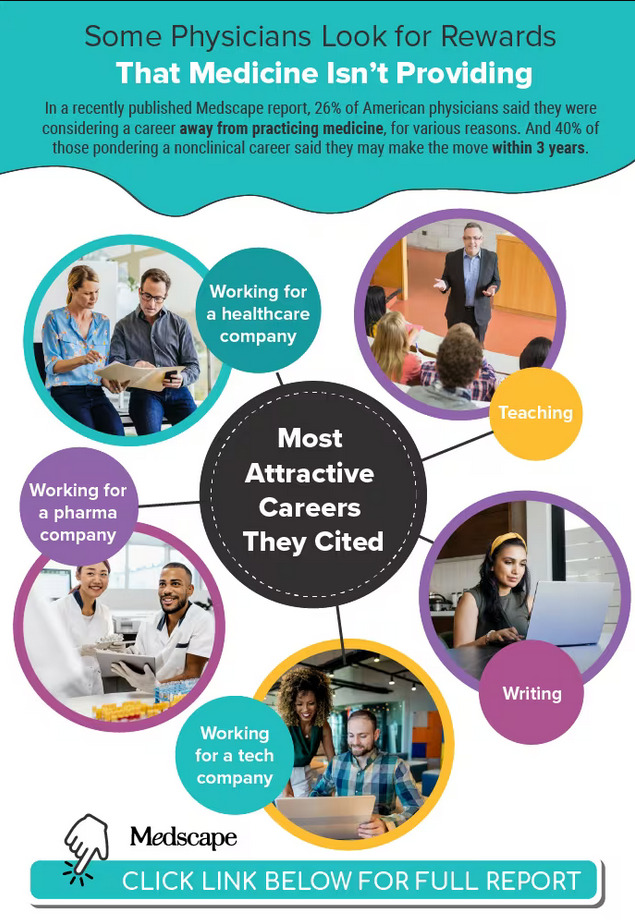
In a recently published Medscape report, 26% of American physicians said they were considering a career away from practicing medicine, for various reasons. Becoming a teacher was one of the nonclinical careers that most enthused them. What were the others?
For more details, check out the Medscape Physicians and Nonclinical Careers Report 2023.
A version of this article first appeared on Medscape.com.
In a recently published Medscape report, 26% of American physicians said they were considering a career away from practicing medicine, for various reasons. Becoming a teacher was one of the nonclinical careers that most enthused them. What were the others?
For more details, check out the Medscape Physicians and Nonclinical Careers Report 2023.
A version of this article first appeared on Medscape.com.
In a recently published Medscape report, 26% of American physicians said they were considering a career away from practicing medicine, for various reasons. Becoming a teacher was one of the nonclinical careers that most enthused them. What were the others?
For more details, check out the Medscape Physicians and Nonclinical Careers Report 2023.
A version of this article first appeared on Medscape.com.
Use the stool! Fecal microbiota transplants help kids with diarrheal infection
(AAP).
However, fecal microbiota transplants (FMTs) should not be used to treat other gastrointestinal ailments such as Crohn’s disease or ulcerative colitis, because scientific evidence falls short on effectiveness in treating these conditions, the group said.
C. difficile infections (CDIs) are major contributors to hospital-associated diarrhea and diarrhea caused by antibiotics. An FMT involves introducing the feces of a healthy person into the gastrointestinal tract, usually through a nasogastric tube but sometimes in capsules containing healthy stool. Serious adverse reactions associated with an FMT, such as hospitalization, are rare, occuring in roughly 2% of case, the AAP said.
An FMT “does have a place for treatment of recurrent CDIs in children,” said Maria Oliva-Hemker, MD, a pediatric gastroenterologist at Johns Hopkins University School of Medicine in Baltimore and the lead author of the report, which was online in Pediatrics.
The AAP strongly encourages people not to perform an FMT at home, although caregivers may be tempted due to a lack of medical facilities located nearby to deliver this care.
“People might see a video on YouTube and think they can do this themselves,” Dr. Oliva-Hemker said.
An FMT requires screening of donors for any infections, which involves administering questionnaires and analyzing donor blood and stool, which are tasks better suited for medical facilities than for a living room.
No controlled or prospective clinical trials on the efficacy of FMT for children exist, according to the AAP. But a retrospective study published in 2020 showed that one or two courses of FMT prevented CDI recurrence in children 87% of the time. Researchers defined the eradication of CDIs as no recurrence for at least 2 months after an FMT and noted the success rates in children were comaparable to those reported in adults.
Unlike pediatric data, adult data come from a randomized clinical trial.
“Sometimes, kids are the last people to be enrolled in these trials,” said Maribeth Nicholson, MD, MPH, a pediatric gastroenterologist at Vanderbilt University Medical Center in Nashville, Tenn., an author of the 2020 study.
Dr. Nicholson, who was not involved in the AAP report, said that the retrospective data are strong enough to justify using FMT to eradicate CDIs in children. But researchers are unclear about the biologic mechanisms that make FMTs work.
Dr. Nicholson said that many therapeutics meant to produce a healthier microbiome are being studied in clinical trials. Any clinical trials of such products should include children, Dr. Nicholson said. A child’s gastrointestinal microbiome is actively developing, Dr. Nicholson added, compared with the relatively stable microbiome of an adult.
“When we think about the microbiome it makes sense to target kids, because they’re more apt to respond to these therapies. I worry that somebody will say ‘this doesn’t work in adults,’ and it just stops there,” Dr. Nicholson said.
Though the AAP said that the benefits of FMT for treating CDIs are clear, the data available for treating other conditions such as ulcerative colitis or Crohn’s disease are less convincing. Any child receiving an FMT for these ailments should only do so as part of a clinical trial, the group said.
The AAP report endorses a joint position paper, published in 2019, about the benefits of FMTs for CDIs from North American and European pediatric gastroenterology societies. Dr. Nicholson was an author of this joint statement and hopes that the AAP report raises further awareness among pediatricians that FMTs are a safe and effective treatment for recurrent CDIs.
“This is something that maybe is not as discussed in pediatric circles. Kids need FMTs sometimes,” Dr. Nicholson said.
Dr. Oliva-Hemker and Dr. Nicholson report no relevant financial relationships.
A version of this article appeared on Medscape.com.
(AAP).
However, fecal microbiota transplants (FMTs) should not be used to treat other gastrointestinal ailments such as Crohn’s disease or ulcerative colitis, because scientific evidence falls short on effectiveness in treating these conditions, the group said.
C. difficile infections (CDIs) are major contributors to hospital-associated diarrhea and diarrhea caused by antibiotics. An FMT involves introducing the feces of a healthy person into the gastrointestinal tract, usually through a nasogastric tube but sometimes in capsules containing healthy stool. Serious adverse reactions associated with an FMT, such as hospitalization, are rare, occuring in roughly 2% of case, the AAP said.
An FMT “does have a place for treatment of recurrent CDIs in children,” said Maria Oliva-Hemker, MD, a pediatric gastroenterologist at Johns Hopkins University School of Medicine in Baltimore and the lead author of the report, which was online in Pediatrics.
The AAP strongly encourages people not to perform an FMT at home, although caregivers may be tempted due to a lack of medical facilities located nearby to deliver this care.
“People might see a video on YouTube and think they can do this themselves,” Dr. Oliva-Hemker said.
An FMT requires screening of donors for any infections, which involves administering questionnaires and analyzing donor blood and stool, which are tasks better suited for medical facilities than for a living room.
No controlled or prospective clinical trials on the efficacy of FMT for children exist, according to the AAP. But a retrospective study published in 2020 showed that one or two courses of FMT prevented CDI recurrence in children 87% of the time. Researchers defined the eradication of CDIs as no recurrence for at least 2 months after an FMT and noted the success rates in children were comaparable to those reported in adults.
Unlike pediatric data, adult data come from a randomized clinical trial.
“Sometimes, kids are the last people to be enrolled in these trials,” said Maribeth Nicholson, MD, MPH, a pediatric gastroenterologist at Vanderbilt University Medical Center in Nashville, Tenn., an author of the 2020 study.
Dr. Nicholson, who was not involved in the AAP report, said that the retrospective data are strong enough to justify using FMT to eradicate CDIs in children. But researchers are unclear about the biologic mechanisms that make FMTs work.
Dr. Nicholson said that many therapeutics meant to produce a healthier microbiome are being studied in clinical trials. Any clinical trials of such products should include children, Dr. Nicholson said. A child’s gastrointestinal microbiome is actively developing, Dr. Nicholson added, compared with the relatively stable microbiome of an adult.
“When we think about the microbiome it makes sense to target kids, because they’re more apt to respond to these therapies. I worry that somebody will say ‘this doesn’t work in adults,’ and it just stops there,” Dr. Nicholson said.
Though the AAP said that the benefits of FMT for treating CDIs are clear, the data available for treating other conditions such as ulcerative colitis or Crohn’s disease are less convincing. Any child receiving an FMT for these ailments should only do so as part of a clinical trial, the group said.
The AAP report endorses a joint position paper, published in 2019, about the benefits of FMTs for CDIs from North American and European pediatric gastroenterology societies. Dr. Nicholson was an author of this joint statement and hopes that the AAP report raises further awareness among pediatricians that FMTs are a safe and effective treatment for recurrent CDIs.
“This is something that maybe is not as discussed in pediatric circles. Kids need FMTs sometimes,” Dr. Nicholson said.
Dr. Oliva-Hemker and Dr. Nicholson report no relevant financial relationships.
A version of this article appeared on Medscape.com.
(AAP).
However, fecal microbiota transplants (FMTs) should not be used to treat other gastrointestinal ailments such as Crohn’s disease or ulcerative colitis, because scientific evidence falls short on effectiveness in treating these conditions, the group said.
C. difficile infections (CDIs) are major contributors to hospital-associated diarrhea and diarrhea caused by antibiotics. An FMT involves introducing the feces of a healthy person into the gastrointestinal tract, usually through a nasogastric tube but sometimes in capsules containing healthy stool. Serious adverse reactions associated with an FMT, such as hospitalization, are rare, occuring in roughly 2% of case, the AAP said.
An FMT “does have a place for treatment of recurrent CDIs in children,” said Maria Oliva-Hemker, MD, a pediatric gastroenterologist at Johns Hopkins University School of Medicine in Baltimore and the lead author of the report, which was online in Pediatrics.
The AAP strongly encourages people not to perform an FMT at home, although caregivers may be tempted due to a lack of medical facilities located nearby to deliver this care.
“People might see a video on YouTube and think they can do this themselves,” Dr. Oliva-Hemker said.
An FMT requires screening of donors for any infections, which involves administering questionnaires and analyzing donor blood and stool, which are tasks better suited for medical facilities than for a living room.
No controlled or prospective clinical trials on the efficacy of FMT for children exist, according to the AAP. But a retrospective study published in 2020 showed that one or two courses of FMT prevented CDI recurrence in children 87% of the time. Researchers defined the eradication of CDIs as no recurrence for at least 2 months after an FMT and noted the success rates in children were comaparable to those reported in adults.
Unlike pediatric data, adult data come from a randomized clinical trial.
“Sometimes, kids are the last people to be enrolled in these trials,” said Maribeth Nicholson, MD, MPH, a pediatric gastroenterologist at Vanderbilt University Medical Center in Nashville, Tenn., an author of the 2020 study.
Dr. Nicholson, who was not involved in the AAP report, said that the retrospective data are strong enough to justify using FMT to eradicate CDIs in children. But researchers are unclear about the biologic mechanisms that make FMTs work.
Dr. Nicholson said that many therapeutics meant to produce a healthier microbiome are being studied in clinical trials. Any clinical trials of such products should include children, Dr. Nicholson said. A child’s gastrointestinal microbiome is actively developing, Dr. Nicholson added, compared with the relatively stable microbiome of an adult.
“When we think about the microbiome it makes sense to target kids, because they’re more apt to respond to these therapies. I worry that somebody will say ‘this doesn’t work in adults,’ and it just stops there,” Dr. Nicholson said.
Though the AAP said that the benefits of FMT for treating CDIs are clear, the data available for treating other conditions such as ulcerative colitis or Crohn’s disease are less convincing. Any child receiving an FMT for these ailments should only do so as part of a clinical trial, the group said.
The AAP report endorses a joint position paper, published in 2019, about the benefits of FMTs for CDIs from North American and European pediatric gastroenterology societies. Dr. Nicholson was an author of this joint statement and hopes that the AAP report raises further awareness among pediatricians that FMTs are a safe and effective treatment for recurrent CDIs.
“This is something that maybe is not as discussed in pediatric circles. Kids need FMTs sometimes,” Dr. Nicholson said.
Dr. Oliva-Hemker and Dr. Nicholson report no relevant financial relationships.
A version of this article appeared on Medscape.com.
FROM PEDIATRICS
Lebrikizumab gets European nod for treating moderate-to-severe atopic dermatitis
The , according to a press release from the manufacturer.
Lebrikizumab, which selectively targets interleukin-13 and inhibits its signaling pathway, will first be available in Germany, with a rollout in other European countries expected through 2024, according to Almirall, the manufacturer.
The European approval of lebrikizumab (Ebglyss) was based on data from a trio of pivotal phase 3 studies including ADvocate1 and ADvocate2, which evaluated lebrikizumab as monotherapy, and ADhere, which evaluated lebrikizumab in combination with topical corticosteroids. All three trials included adult and adolescent patients aged 12 years and older with moderate-to-severe AD.
In the two ADvocate studies, published in the New England Journal of Medicine, participants were randomized to a 250-mg injection of lebrikizumab or placebo every 2 weeks. The primary outcome was a score of clear or almost clear skin based on the Investigator’s Global Assessment with at least a 2-point reduction from baseline to 16 weeks.
Compared with placebo, lebrikizumab showed significant clinical efficacy in both studies. In study 1, 43.1% of 283 patients treated with lebrikizumab versus 12.7% of 141 patients on placebo met the primary endpoint (P < .001), as did 33.2% of the 281 patients on lebrikizumab and 10.8% of 146 patients on placebo in study 2 (P < .001). In addition, 58.8% and 52.1% of patients on lebrikizumab in studies 1 and 2, respectively, met the secondary endpoint of a 75% reduction in the Eczema Area and Severity Index score (EASI-75), versus 16.2% and 18.1% of patients on placebo in study 1 and 2, respectively (P < .001 for both).
In the ADhere study, published in JAMA Dermatology, 41.2% of patients receiving a lebrikizumab/corticosteroid combination and 22.1% of those randomized to a placebo/corticosteroid combination met the primary endpoint of IGA scores of 0 or 1 at 16 weeks, and nearly 70% patients treated with a combination of lebrikizumab and topical corticosteroids achieved EASI-75, compared with 42% of those on the combination.
Nearly 80% of patients who responded at 16 weeks and continued treatment with lebrikizumab as monotherapy or combination therapy showed sustained results up to 52 weeks with maintenance monthly dosing, according to the Almirall press release.
Most adverse events across the studies were mild or moderate and were not associated with treatment discontinuation. The most common adverse reactions were conjunctivitis, injection site reactions, allergic conjunctivitis, and dry eye.
Further research has shown showed clinical efficacy and safety in patients who used lebrikizumab for up to 2 years, either as monotherapy or in combination with topical corticosteroids, according to the manufacturer.
Lebrikizumab remains under review in the United States after the Food and Drug Administration issued a complete response letter in October regarding findings made during an inspection of a third-party contract manufacturer that included the “monoclonal antibody drug substance” for lebrikizumab, although no concerns about clinical data or safety were raised, Eli Lilly announced in October. Eli Lilly has the rights to develop lebrikizumab in the United States and the rest of the world excluding Europe.
The , according to a press release from the manufacturer.
Lebrikizumab, which selectively targets interleukin-13 and inhibits its signaling pathway, will first be available in Germany, with a rollout in other European countries expected through 2024, according to Almirall, the manufacturer.
The European approval of lebrikizumab (Ebglyss) was based on data from a trio of pivotal phase 3 studies including ADvocate1 and ADvocate2, which evaluated lebrikizumab as monotherapy, and ADhere, which evaluated lebrikizumab in combination with topical corticosteroids. All three trials included adult and adolescent patients aged 12 years and older with moderate-to-severe AD.
In the two ADvocate studies, published in the New England Journal of Medicine, participants were randomized to a 250-mg injection of lebrikizumab or placebo every 2 weeks. The primary outcome was a score of clear or almost clear skin based on the Investigator’s Global Assessment with at least a 2-point reduction from baseline to 16 weeks.
Compared with placebo, lebrikizumab showed significant clinical efficacy in both studies. In study 1, 43.1% of 283 patients treated with lebrikizumab versus 12.7% of 141 patients on placebo met the primary endpoint (P < .001), as did 33.2% of the 281 patients on lebrikizumab and 10.8% of 146 patients on placebo in study 2 (P < .001). In addition, 58.8% and 52.1% of patients on lebrikizumab in studies 1 and 2, respectively, met the secondary endpoint of a 75% reduction in the Eczema Area and Severity Index score (EASI-75), versus 16.2% and 18.1% of patients on placebo in study 1 and 2, respectively (P < .001 for both).
In the ADhere study, published in JAMA Dermatology, 41.2% of patients receiving a lebrikizumab/corticosteroid combination and 22.1% of those randomized to a placebo/corticosteroid combination met the primary endpoint of IGA scores of 0 or 1 at 16 weeks, and nearly 70% patients treated with a combination of lebrikizumab and topical corticosteroids achieved EASI-75, compared with 42% of those on the combination.
Nearly 80% of patients who responded at 16 weeks and continued treatment with lebrikizumab as monotherapy or combination therapy showed sustained results up to 52 weeks with maintenance monthly dosing, according to the Almirall press release.
Most adverse events across the studies were mild or moderate and were not associated with treatment discontinuation. The most common adverse reactions were conjunctivitis, injection site reactions, allergic conjunctivitis, and dry eye.
Further research has shown showed clinical efficacy and safety in patients who used lebrikizumab for up to 2 years, either as monotherapy or in combination with topical corticosteroids, according to the manufacturer.
Lebrikizumab remains under review in the United States after the Food and Drug Administration issued a complete response letter in October regarding findings made during an inspection of a third-party contract manufacturer that included the “monoclonal antibody drug substance” for lebrikizumab, although no concerns about clinical data or safety were raised, Eli Lilly announced in October. Eli Lilly has the rights to develop lebrikizumab in the United States and the rest of the world excluding Europe.
The , according to a press release from the manufacturer.
Lebrikizumab, which selectively targets interleukin-13 and inhibits its signaling pathway, will first be available in Germany, with a rollout in other European countries expected through 2024, according to Almirall, the manufacturer.
The European approval of lebrikizumab (Ebglyss) was based on data from a trio of pivotal phase 3 studies including ADvocate1 and ADvocate2, which evaluated lebrikizumab as monotherapy, and ADhere, which evaluated lebrikizumab in combination with topical corticosteroids. All three trials included adult and adolescent patients aged 12 years and older with moderate-to-severe AD.
In the two ADvocate studies, published in the New England Journal of Medicine, participants were randomized to a 250-mg injection of lebrikizumab or placebo every 2 weeks. The primary outcome was a score of clear or almost clear skin based on the Investigator’s Global Assessment with at least a 2-point reduction from baseline to 16 weeks.
Compared with placebo, lebrikizumab showed significant clinical efficacy in both studies. In study 1, 43.1% of 283 patients treated with lebrikizumab versus 12.7% of 141 patients on placebo met the primary endpoint (P < .001), as did 33.2% of the 281 patients on lebrikizumab and 10.8% of 146 patients on placebo in study 2 (P < .001). In addition, 58.8% and 52.1% of patients on lebrikizumab in studies 1 and 2, respectively, met the secondary endpoint of a 75% reduction in the Eczema Area and Severity Index score (EASI-75), versus 16.2% and 18.1% of patients on placebo in study 1 and 2, respectively (P < .001 for both).
In the ADhere study, published in JAMA Dermatology, 41.2% of patients receiving a lebrikizumab/corticosteroid combination and 22.1% of those randomized to a placebo/corticosteroid combination met the primary endpoint of IGA scores of 0 or 1 at 16 weeks, and nearly 70% patients treated with a combination of lebrikizumab and topical corticosteroids achieved EASI-75, compared with 42% of those on the combination.
Nearly 80% of patients who responded at 16 weeks and continued treatment with lebrikizumab as monotherapy or combination therapy showed sustained results up to 52 weeks with maintenance monthly dosing, according to the Almirall press release.
Most adverse events across the studies were mild or moderate and were not associated with treatment discontinuation. The most common adverse reactions were conjunctivitis, injection site reactions, allergic conjunctivitis, and dry eye.
Further research has shown showed clinical efficacy and safety in patients who used lebrikizumab for up to 2 years, either as monotherapy or in combination with topical corticosteroids, according to the manufacturer.
Lebrikizumab remains under review in the United States after the Food and Drug Administration issued a complete response letter in October regarding findings made during an inspection of a third-party contract manufacturer that included the “monoclonal antibody drug substance” for lebrikizumab, although no concerns about clinical data or safety were raised, Eli Lilly announced in October. Eli Lilly has the rights to develop lebrikizumab in the United States and the rest of the world excluding Europe.
Compensation is key to fixing primary care shortage
Money talks.
The United States faces a serious shortage of primary care physicians for many reasons, but one, in particular, is inescapable: compensation.
Substantial disparities between what primary care physicians earn relative to specialists like orthopedists and cardiologists can weigh into medical students’ decisions about which field to choose. Plus, the system that Medicare and other health plans use to pay doctors generally places more value on doing procedures like replacing a knee or inserting a stent than on delivering the whole-person, long-term health care management that primary care physicians provide.
As a result of those pay disparities, and the punishing workload typically faced by primary care physicians, more new doctors are becoming specialists, often leaving patients with fewer choices for primary care.
“There is a public out there that is dissatisfied with the lack of access to a routine source of care,” said Christopher Koller, president of the Milbank Memorial Fund, a foundation that focuses on improving population health and health equity. “That’s not going to be addressed until we pay for it.”
Primary care is the foundation of our health care system, the only area in which providing more services – such as childhood vaccines and regular blood pressure screenings – is linked to better population health and more equitable outcomes, according to the National Academies of Sciences, Engineering, and Medicine, in a recently published report on how to rebuild primary care. Without it, the national academies wrote, “minor health problems can spiral into chronic disease,” with poor disease management, ED overuse, and unsustainable costs. Yet for decades, the United States has underinvested in primary care. It accounted for less than 5% of health care spending in 2020 – significantly less than the average spending by countries that are members of the Organization for Economic Cooperation and Development, according to the report.
A $26 billion piece of bipartisan legislation proposed last month by Sen. Bernie Sanders (I-Vt.), chair of the Senate Health, Education, Labor, and Pensions Committee, and Sen. Roger Marshall (R-Kan.) would bolster primary care by increasing training opportunities for doctors and nurses and expanding access to community health centers. Policy experts say the bill would provide important support, but it’s not enough. It doesn’t touch compensation.
“We need primary care to be paid differently and to be paid more, and that starts with Medicare,” Mr. Koller said.
How Medicare drives payment
Medicare, which covers 65 million people who are 65 and older or who have certain long-term disabilities, finances more than a fifth of all health care spending — giving it significant muscle in the health care market. Private health plans typically base their payment amounts on the Medicare system, so what Medicare pays is crucial.
Under the Medicare payment system, the amount the program pays for a medical service is determined by three geographically weighted components: a physician’s work, including time and intensity; the practice’s expense, such as overhead and equipment; and professional insurance. It tends to reward specialties that emphasize procedures, such as repairing a hernia or removing a tumor, more than primary care, where the focus is on talking with patients, answering questions, and educating them about managing their chronic conditions.
Medical students may not be familiar with the particulars of how the payment system works, but their clinical training exposes them to a punishing workload and burnout that is contributing to the shortage of primary care physicians, projected to reach up to 48,000 by 2034, according to estimates from the Association of American Medical Colleges.
The earnings differential between primary care and other specialists is also not lost on them. Average annual compensation for doctors who focus on primary care – family medicine, internists, and pediatricians – ranges from an average of about $250,000 to $275,000, according to Medscape’s annual physician compensation report. Many specialists make more than twice as much: Plastic surgeons top the compensation list at $619,000 annually, followed by orthopedists ($573,000) and cardiologists ($507,000).
“I think the major issues in terms of the primary care physician pipeline are the compensation and the work of primary care,” said Russ Phillips, MD, an internist and the director of the Harvard Medical School Center for Primary Care, Boston. “You have to really want to be a primary care physician when that student will make one-third of what students going into dermatology will make.”
According to statistics from the National Resident Matching Program, which tracks the number of residency slots available for graduating medical students and the number of slots filled, 89% of 5,088 family medicine residency slots were filled in 2023, compared with a 93% residency fill rate overall. Internists had a higher fill rate, 96%, but a significant proportion of internal medicine residents eventually practice in a specialty area rather than in primary care.
No one would claim that doctors are poorly paid, but with the average medical student graduating with just over $200,000 in medical school debt, making a good salary matters.
Not in it for the money
Still, it’s a misperception that student debt always drives the decision whether to go into primary care, said Len Marquez, senior director of government relations and legislative advocacy at the Association of American Medical Colleges.
For Anitza Quintero, 24, a second-year medical student at the Geisinger Commonwealth School of Medicine in rural Pennsylvania, primary care is a logical extension of her interest in helping children and immigrants. Ms. Quintero’s family came to the United States on a raft from Cuba before she was born. She plans to focus on internal medicine and pediatrics.
“I want to keep going to help my family and other families,” Ms. Quintero said. “There’s obviously something attractive about having a specialty and a high pay grade,” Still, she wants to work “where the whole body is involved,” she said, adding that long-term doctor-patient relationships are “also attractive.”
Ms. Quintero is part of the Abigail Geisinger Scholars Program, which aims to recruit primary care physicians and psychiatrists to the rural health system in part with a promise of medical school loan forgiveness. Health care shortages tend to be more acute in rural areas.
These students’ education costs are covered, and they receive a $2,000 monthly stipend. They can do their residency elsewhere, but upon completing it they return to Geisinger for a primary care job with the health care system. Every year of work there erases one year of the debt covered by their award. If they don’t take a job with the health care system, they must repay the amount they received.
Payment imbalances a source of tension
In recent years, the Centers for Medicare & Medicaid Services, which administers the Medicare program, has made changes to address some of the payment imbalances between primary care and specialist services. The agency has expanded the office visit services for which providers can bill to manage their patients, including adding nonprocedural billing codes for providing transitional care, chronic care management, and advance care planning.
In 2024’s final physician fee schedule, the agency plans to allow another new code to take effect, G2211. It would let physicians bill for complex patient evaluation and management services. Any physician could use the code, but it is expected that primary care physicians would use it more frequently than specialists. Congress has delayed implementation of the code since 2021.
The new code is a tiny piece of overall payment reform, “but it is critically important, and it is our top priority on the Hill right now,” said Shari Erickson, chief advocacy officer for the American College of Physicians.
It also triggered a tussle that highlights ongoing tension in Medicare physician payment rules.
The American College of Surgeons and 18 other specialty groups published a statement describing the new code as “unnecessary.” They oppose its implementation because it would primarily benefit primary care providers who, they say, already have the flexibility to bill more for more complex visits.
But the real issue is that, under federal law, changes to Medicare physician payments must preserve budget neutrality, a zero-sum arrangement in which payment increases for primary care providers mean payment decreases elsewhere.
“If they want to keep it, they need to pay for it,” said Christian Shalgian, director of the division of advocacy and health policy for the American College of Surgeons, noting that his organization will continue to oppose implementation otherwise.
Still, there’s general agreement that strengthening the primary care system through payment reform won’t be accomplished by tinkering with billing codes.
The current fee-for-service system doesn’t fully accommodate the time and effort primary care physicians put into “small-ticket” activities like emails and phone calls, reviews of lab results, and consultation reports. A better arrangement, they say, would be to pay primary care physicians a set monthly amount per patient to provide all their care, a system called capitation.
“We’re much better off paying on a per capita basis, get that monthly payment paid in advance plus some extra amount for other things,” said Paul Ginsburg, PhD, a senior fellow at the University of Southern California Schaeffer Center for Health Policy and Economics and former commissioner of the Medicare Payment Advisory Commission.
But if adding a single five-character code to Medicare’s payment rules has proved challenging, imagine the heavy lift involved in overhauling the program’s entire physician payment system. MedPAC and the national academies, both of which provide advice to Congress, have weighed in on the broad outlines of what such a transformation might look like. And there are targeted efforts in Congress: For instance, a bill that would add an annual inflation update to Medicare physician payments and a proposal to address budget neutrality. But it’s unclear whether lawmakers have strong interest in taking action.
“The fact that Medicare has been squeezing physician payment rates for 2 decades is making reforming their structure more difficult,” said Dr. Ginsburg. “The losers are more sensitive to reductions in the rates for the procedures they do.”
KFF Health News is a national newsroom that produces in-depth journalism about health issues and is one of the core operating programs at KFF—an independent source of health policy research, polling, and journalism. Learn more about KFF.
Money talks.
The United States faces a serious shortage of primary care physicians for many reasons, but one, in particular, is inescapable: compensation.
Substantial disparities between what primary care physicians earn relative to specialists like orthopedists and cardiologists can weigh into medical students’ decisions about which field to choose. Plus, the system that Medicare and other health plans use to pay doctors generally places more value on doing procedures like replacing a knee or inserting a stent than on delivering the whole-person, long-term health care management that primary care physicians provide.
As a result of those pay disparities, and the punishing workload typically faced by primary care physicians, more new doctors are becoming specialists, often leaving patients with fewer choices for primary care.
“There is a public out there that is dissatisfied with the lack of access to a routine source of care,” said Christopher Koller, president of the Milbank Memorial Fund, a foundation that focuses on improving population health and health equity. “That’s not going to be addressed until we pay for it.”
Primary care is the foundation of our health care system, the only area in which providing more services – such as childhood vaccines and regular blood pressure screenings – is linked to better population health and more equitable outcomes, according to the National Academies of Sciences, Engineering, and Medicine, in a recently published report on how to rebuild primary care. Without it, the national academies wrote, “minor health problems can spiral into chronic disease,” with poor disease management, ED overuse, and unsustainable costs. Yet for decades, the United States has underinvested in primary care. It accounted for less than 5% of health care spending in 2020 – significantly less than the average spending by countries that are members of the Organization for Economic Cooperation and Development, according to the report.
A $26 billion piece of bipartisan legislation proposed last month by Sen. Bernie Sanders (I-Vt.), chair of the Senate Health, Education, Labor, and Pensions Committee, and Sen. Roger Marshall (R-Kan.) would bolster primary care by increasing training opportunities for doctors and nurses and expanding access to community health centers. Policy experts say the bill would provide important support, but it’s not enough. It doesn’t touch compensation.
“We need primary care to be paid differently and to be paid more, and that starts with Medicare,” Mr. Koller said.
How Medicare drives payment
Medicare, which covers 65 million people who are 65 and older or who have certain long-term disabilities, finances more than a fifth of all health care spending — giving it significant muscle in the health care market. Private health plans typically base their payment amounts on the Medicare system, so what Medicare pays is crucial.
Under the Medicare payment system, the amount the program pays for a medical service is determined by three geographically weighted components: a physician’s work, including time and intensity; the practice’s expense, such as overhead and equipment; and professional insurance. It tends to reward specialties that emphasize procedures, such as repairing a hernia or removing a tumor, more than primary care, where the focus is on talking with patients, answering questions, and educating them about managing their chronic conditions.
Medical students may not be familiar with the particulars of how the payment system works, but their clinical training exposes them to a punishing workload and burnout that is contributing to the shortage of primary care physicians, projected to reach up to 48,000 by 2034, according to estimates from the Association of American Medical Colleges.
The earnings differential between primary care and other specialists is also not lost on them. Average annual compensation for doctors who focus on primary care – family medicine, internists, and pediatricians – ranges from an average of about $250,000 to $275,000, according to Medscape’s annual physician compensation report. Many specialists make more than twice as much: Plastic surgeons top the compensation list at $619,000 annually, followed by orthopedists ($573,000) and cardiologists ($507,000).
“I think the major issues in terms of the primary care physician pipeline are the compensation and the work of primary care,” said Russ Phillips, MD, an internist and the director of the Harvard Medical School Center for Primary Care, Boston. “You have to really want to be a primary care physician when that student will make one-third of what students going into dermatology will make.”
According to statistics from the National Resident Matching Program, which tracks the number of residency slots available for graduating medical students and the number of slots filled, 89% of 5,088 family medicine residency slots were filled in 2023, compared with a 93% residency fill rate overall. Internists had a higher fill rate, 96%, but a significant proportion of internal medicine residents eventually practice in a specialty area rather than in primary care.
No one would claim that doctors are poorly paid, but with the average medical student graduating with just over $200,000 in medical school debt, making a good salary matters.
Not in it for the money
Still, it’s a misperception that student debt always drives the decision whether to go into primary care, said Len Marquez, senior director of government relations and legislative advocacy at the Association of American Medical Colleges.
For Anitza Quintero, 24, a second-year medical student at the Geisinger Commonwealth School of Medicine in rural Pennsylvania, primary care is a logical extension of her interest in helping children and immigrants. Ms. Quintero’s family came to the United States on a raft from Cuba before she was born. She plans to focus on internal medicine and pediatrics.
“I want to keep going to help my family and other families,” Ms. Quintero said. “There’s obviously something attractive about having a specialty and a high pay grade,” Still, she wants to work “where the whole body is involved,” she said, adding that long-term doctor-patient relationships are “also attractive.”
Ms. Quintero is part of the Abigail Geisinger Scholars Program, which aims to recruit primary care physicians and psychiatrists to the rural health system in part with a promise of medical school loan forgiveness. Health care shortages tend to be more acute in rural areas.
These students’ education costs are covered, and they receive a $2,000 monthly stipend. They can do their residency elsewhere, but upon completing it they return to Geisinger for a primary care job with the health care system. Every year of work there erases one year of the debt covered by their award. If they don’t take a job with the health care system, they must repay the amount they received.
Payment imbalances a source of tension
In recent years, the Centers for Medicare & Medicaid Services, which administers the Medicare program, has made changes to address some of the payment imbalances between primary care and specialist services. The agency has expanded the office visit services for which providers can bill to manage their patients, including adding nonprocedural billing codes for providing transitional care, chronic care management, and advance care planning.
In 2024’s final physician fee schedule, the agency plans to allow another new code to take effect, G2211. It would let physicians bill for complex patient evaluation and management services. Any physician could use the code, but it is expected that primary care physicians would use it more frequently than specialists. Congress has delayed implementation of the code since 2021.
The new code is a tiny piece of overall payment reform, “but it is critically important, and it is our top priority on the Hill right now,” said Shari Erickson, chief advocacy officer for the American College of Physicians.
It also triggered a tussle that highlights ongoing tension in Medicare physician payment rules.
The American College of Surgeons and 18 other specialty groups published a statement describing the new code as “unnecessary.” They oppose its implementation because it would primarily benefit primary care providers who, they say, already have the flexibility to bill more for more complex visits.
But the real issue is that, under federal law, changes to Medicare physician payments must preserve budget neutrality, a zero-sum arrangement in which payment increases for primary care providers mean payment decreases elsewhere.
“If they want to keep it, they need to pay for it,” said Christian Shalgian, director of the division of advocacy and health policy for the American College of Surgeons, noting that his organization will continue to oppose implementation otherwise.
Still, there’s general agreement that strengthening the primary care system through payment reform won’t be accomplished by tinkering with billing codes.
The current fee-for-service system doesn’t fully accommodate the time and effort primary care physicians put into “small-ticket” activities like emails and phone calls, reviews of lab results, and consultation reports. A better arrangement, they say, would be to pay primary care physicians a set monthly amount per patient to provide all their care, a system called capitation.
“We’re much better off paying on a per capita basis, get that monthly payment paid in advance plus some extra amount for other things,” said Paul Ginsburg, PhD, a senior fellow at the University of Southern California Schaeffer Center for Health Policy and Economics and former commissioner of the Medicare Payment Advisory Commission.
But if adding a single five-character code to Medicare’s payment rules has proved challenging, imagine the heavy lift involved in overhauling the program’s entire physician payment system. MedPAC and the national academies, both of which provide advice to Congress, have weighed in on the broad outlines of what such a transformation might look like. And there are targeted efforts in Congress: For instance, a bill that would add an annual inflation update to Medicare physician payments and a proposal to address budget neutrality. But it’s unclear whether lawmakers have strong interest in taking action.
“The fact that Medicare has been squeezing physician payment rates for 2 decades is making reforming their structure more difficult,” said Dr. Ginsburg. “The losers are more sensitive to reductions in the rates for the procedures they do.”
KFF Health News is a national newsroom that produces in-depth journalism about health issues and is one of the core operating programs at KFF—an independent source of health policy research, polling, and journalism. Learn more about KFF.
Money talks.
The United States faces a serious shortage of primary care physicians for many reasons, but one, in particular, is inescapable: compensation.
Substantial disparities between what primary care physicians earn relative to specialists like orthopedists and cardiologists can weigh into medical students’ decisions about which field to choose. Plus, the system that Medicare and other health plans use to pay doctors generally places more value on doing procedures like replacing a knee or inserting a stent than on delivering the whole-person, long-term health care management that primary care physicians provide.
As a result of those pay disparities, and the punishing workload typically faced by primary care physicians, more new doctors are becoming specialists, often leaving patients with fewer choices for primary care.
“There is a public out there that is dissatisfied with the lack of access to a routine source of care,” said Christopher Koller, president of the Milbank Memorial Fund, a foundation that focuses on improving population health and health equity. “That’s not going to be addressed until we pay for it.”
Primary care is the foundation of our health care system, the only area in which providing more services – such as childhood vaccines and regular blood pressure screenings – is linked to better population health and more equitable outcomes, according to the National Academies of Sciences, Engineering, and Medicine, in a recently published report on how to rebuild primary care. Without it, the national academies wrote, “minor health problems can spiral into chronic disease,” with poor disease management, ED overuse, and unsustainable costs. Yet for decades, the United States has underinvested in primary care. It accounted for less than 5% of health care spending in 2020 – significantly less than the average spending by countries that are members of the Organization for Economic Cooperation and Development, according to the report.
A $26 billion piece of bipartisan legislation proposed last month by Sen. Bernie Sanders (I-Vt.), chair of the Senate Health, Education, Labor, and Pensions Committee, and Sen. Roger Marshall (R-Kan.) would bolster primary care by increasing training opportunities for doctors and nurses and expanding access to community health centers. Policy experts say the bill would provide important support, but it’s not enough. It doesn’t touch compensation.
“We need primary care to be paid differently and to be paid more, and that starts with Medicare,” Mr. Koller said.
How Medicare drives payment
Medicare, which covers 65 million people who are 65 and older or who have certain long-term disabilities, finances more than a fifth of all health care spending — giving it significant muscle in the health care market. Private health plans typically base their payment amounts on the Medicare system, so what Medicare pays is crucial.
Under the Medicare payment system, the amount the program pays for a medical service is determined by three geographically weighted components: a physician’s work, including time and intensity; the practice’s expense, such as overhead and equipment; and professional insurance. It tends to reward specialties that emphasize procedures, such as repairing a hernia or removing a tumor, more than primary care, where the focus is on talking with patients, answering questions, and educating them about managing their chronic conditions.
Medical students may not be familiar with the particulars of how the payment system works, but their clinical training exposes them to a punishing workload and burnout that is contributing to the shortage of primary care physicians, projected to reach up to 48,000 by 2034, according to estimates from the Association of American Medical Colleges.
The earnings differential between primary care and other specialists is also not lost on them. Average annual compensation for doctors who focus on primary care – family medicine, internists, and pediatricians – ranges from an average of about $250,000 to $275,000, according to Medscape’s annual physician compensation report. Many specialists make more than twice as much: Plastic surgeons top the compensation list at $619,000 annually, followed by orthopedists ($573,000) and cardiologists ($507,000).
“I think the major issues in terms of the primary care physician pipeline are the compensation and the work of primary care,” said Russ Phillips, MD, an internist and the director of the Harvard Medical School Center for Primary Care, Boston. “You have to really want to be a primary care physician when that student will make one-third of what students going into dermatology will make.”
According to statistics from the National Resident Matching Program, which tracks the number of residency slots available for graduating medical students and the number of slots filled, 89% of 5,088 family medicine residency slots were filled in 2023, compared with a 93% residency fill rate overall. Internists had a higher fill rate, 96%, but a significant proportion of internal medicine residents eventually practice in a specialty area rather than in primary care.
No one would claim that doctors are poorly paid, but with the average medical student graduating with just over $200,000 in medical school debt, making a good salary matters.
Not in it for the money
Still, it’s a misperception that student debt always drives the decision whether to go into primary care, said Len Marquez, senior director of government relations and legislative advocacy at the Association of American Medical Colleges.
For Anitza Quintero, 24, a second-year medical student at the Geisinger Commonwealth School of Medicine in rural Pennsylvania, primary care is a logical extension of her interest in helping children and immigrants. Ms. Quintero’s family came to the United States on a raft from Cuba before she was born. She plans to focus on internal medicine and pediatrics.
“I want to keep going to help my family and other families,” Ms. Quintero said. “There’s obviously something attractive about having a specialty and a high pay grade,” Still, she wants to work “where the whole body is involved,” she said, adding that long-term doctor-patient relationships are “also attractive.”
Ms. Quintero is part of the Abigail Geisinger Scholars Program, which aims to recruit primary care physicians and psychiatrists to the rural health system in part with a promise of medical school loan forgiveness. Health care shortages tend to be more acute in rural areas.
These students’ education costs are covered, and they receive a $2,000 monthly stipend. They can do their residency elsewhere, but upon completing it they return to Geisinger for a primary care job with the health care system. Every year of work there erases one year of the debt covered by their award. If they don’t take a job with the health care system, they must repay the amount they received.
Payment imbalances a source of tension
In recent years, the Centers for Medicare & Medicaid Services, which administers the Medicare program, has made changes to address some of the payment imbalances between primary care and specialist services. The agency has expanded the office visit services for which providers can bill to manage their patients, including adding nonprocedural billing codes for providing transitional care, chronic care management, and advance care planning.
In 2024’s final physician fee schedule, the agency plans to allow another new code to take effect, G2211. It would let physicians bill for complex patient evaluation and management services. Any physician could use the code, but it is expected that primary care physicians would use it more frequently than specialists. Congress has delayed implementation of the code since 2021.
The new code is a tiny piece of overall payment reform, “but it is critically important, and it is our top priority on the Hill right now,” said Shari Erickson, chief advocacy officer for the American College of Physicians.
It also triggered a tussle that highlights ongoing tension in Medicare physician payment rules.
The American College of Surgeons and 18 other specialty groups published a statement describing the new code as “unnecessary.” They oppose its implementation because it would primarily benefit primary care providers who, they say, already have the flexibility to bill more for more complex visits.
But the real issue is that, under federal law, changes to Medicare physician payments must preserve budget neutrality, a zero-sum arrangement in which payment increases for primary care providers mean payment decreases elsewhere.
“If they want to keep it, they need to pay for it,” said Christian Shalgian, director of the division of advocacy and health policy for the American College of Surgeons, noting that his organization will continue to oppose implementation otherwise.
Still, there’s general agreement that strengthening the primary care system through payment reform won’t be accomplished by tinkering with billing codes.
The current fee-for-service system doesn’t fully accommodate the time and effort primary care physicians put into “small-ticket” activities like emails and phone calls, reviews of lab results, and consultation reports. A better arrangement, they say, would be to pay primary care physicians a set monthly amount per patient to provide all their care, a system called capitation.
“We’re much better off paying on a per capita basis, get that monthly payment paid in advance plus some extra amount for other things,” said Paul Ginsburg, PhD, a senior fellow at the University of Southern California Schaeffer Center for Health Policy and Economics and former commissioner of the Medicare Payment Advisory Commission.
But if adding a single five-character code to Medicare’s payment rules has proved challenging, imagine the heavy lift involved in overhauling the program’s entire physician payment system. MedPAC and the national academies, both of which provide advice to Congress, have weighed in on the broad outlines of what such a transformation might look like. And there are targeted efforts in Congress: For instance, a bill that would add an annual inflation update to Medicare physician payments and a proposal to address budget neutrality. But it’s unclear whether lawmakers have strong interest in taking action.
“The fact that Medicare has been squeezing physician payment rates for 2 decades is making reforming their structure more difficult,” said Dr. Ginsburg. “The losers are more sensitive to reductions in the rates for the procedures they do.”
KFF Health News is a national newsroom that produces in-depth journalism about health issues and is one of the core operating programs at KFF—an independent source of health policy research, polling, and journalism. Learn more about KFF.
Sepsis mortality greater in Black than White children despite similar interventions
WASHINGTON – , according to research presented at the annual meeting of the American Academy of Pediatrics.
The only other difference between Black and White pediatric patients was the length of hospital stay and the length of time in the ICU among those who died. In both cases, Black children who died spent more time in the hospital and in the ICU, reported Michael H. Stroud, MD, a pediatric critical care physician at the University of Arkansas for Medical Sciences in Little Rock, and his colleagues.
“Further investigations are needed to identify biases, conscious and unconscious, potential socioeconomic factors, and genetic predispositions leading to racial disparities in outcomes of children with pediatric sepsis, severe sepsis, and septic shock,” Dr Stroud and his colleagues said.
Nathan T. Chomilo, MD, adjunct assistant professor of pediatrics at the University of Minnesota, Minneapolis, who was not involved in the study but reviewed it, said the research “builds upon existing evidence that our health care system has work to do to meet its goal of treating patients equitably and provide everyone the opportunity for health.” He found the racial disparity in death particularly striking in 2023. “In the U.S., with all our wealth, knowledge, and resources, very few children should die from this, let alone there be such a stark gap,” Dr. Chomilo wrote.
Racial disparities persist
Dr. Stroud noted that many institutions currently use “automated, real-time, algorithm-based detection of sepsis, severe sepsis, and septic shock incorporated into the electronic medical record,” which leads to earlier recognition and resuscitation and overall better outcomes. Yet racial disparities in sepsis mortality rates persist, and he and his colleagues wanted to explore whether they remained even with these EMR-incorporated systems.
The researchers analyzed data from all patients at Arkansas Children’s Hospital who had sepsis, severe sepsis, or septic shock between January 2018 and April 2022. The hospital uses a best practice advisory (BPA) in the EMR whose activation leads to a bedside huddle and clinical interventions. For this study, the researchers defined a sepsis episode as either a BPA activation or an EMR diagnosis of sepsis, severe sepsis, or septic shock.
Among the 3,514 patients who had a sepsis episode during the study, 60.5% were White (n = 2,126) and 20.9% were Black (n = 736). Overall mortality was 1.65%, but that included 3.13% of Black children versus 1.27% of White children (odds ratio [OR] 2.51, P = .001). No significant differences in mortality were seen in gender or age.
Clinical interventions in the two groups were also similar: Total IV antibiotic days were 23.8 days for Black children and 21.6 days for White children (P = .38); total vasoactive infusion days were 2.2 for Black children and 2.6 for White (P = .18); and extracorporeal membrane oxygenation was necessary for 26.1% of Black children and 18.5% of White children (P = .52).
Length of hospitalization stay, however, was an average 4 days longer for Black children (16.7 days) versus White children (12.7 days) who died (P = .03). ICU stay for Black children who died was also an average 1.9 days longer (7.57 vs. 5.7 days; P = .01). There were no significant differences in the EMR between Black and White patients, however, in the percent who were over the threshold for antibiotic administration and the percent who received an IV fluid bolus.
Contributing factors
Dr. Chomilo said that most BPA systems require staff – including rooming and triage staff, nurses. and physicians – to enter vital signs, order labs, enter the results into the system, and enter other data used by the algorithm. “So even though the time from when those BPA warnings flagged to when clinical interventions were documented didn’t show a significant difference, there are numerous other points along a child’s illness that may be contributing to these numbers,” Dr. Chomilo said.
For example, he pointed out that differences in health insurance coverage could have influenced whether their parent or caregiver was able to bring them in early enough to be diagnosed since studies have revealed disparate access to regular care due to structural racism in the health care system. Studies have also shown disparate rates of patients being triaged or having to wait longer in emergency departments, he added.
“When the child was brought in, how were they triaged? How long did they wait before they had vitals taken? How long until they were seen by a clinician?” Dr. Chomilo said. “Was their care on the inpatient ward the same or different? What was the source of sepsis? Was it all infectious or other issues [since] cancer and autoimmune illnesses can also trigger a sepsis evaluation, for example? Overall, I suspect answers to several of these questions would reveal a disparity due to structural racism that contributed to the ultimate disparity in deaths.”
Other social determinants of health that could have played a role in the outcome disparities here might include the family’s access to transportation options, parental employment or child care options, and nutrition access since baseline nutritional status can be a factor in the outcomes of severe illnesses like sepsis.
”I don’t think this study provided enough information about the potential causative factors to come to any strong conclusions,” Dr. Chomilo said. But it’s important for clinicians to be aware of how biases in the health care system put Black, Indigenous and other communities at higher risk for worse clinical outcomes.
“I would reiterate that clinicians in the hospital can help improve outcomes by being aware of structural racism and structural inequity and how that may contribute to their patient’s risk of severe illness as the decide how to approach their treatment and engaging the patient’s family,” Dr. Chomilo said. “We cannot rely solely on universal tools that don’t take this into account when we are looking to improve clinical outcomes for everyone. Otherwise we will see these gaps persist.”
No external funding sources were noted. Dr. Stroud and Dr. Chomilo had no disclosures.
WASHINGTON – , according to research presented at the annual meeting of the American Academy of Pediatrics.
The only other difference between Black and White pediatric patients was the length of hospital stay and the length of time in the ICU among those who died. In both cases, Black children who died spent more time in the hospital and in the ICU, reported Michael H. Stroud, MD, a pediatric critical care physician at the University of Arkansas for Medical Sciences in Little Rock, and his colleagues.
“Further investigations are needed to identify biases, conscious and unconscious, potential socioeconomic factors, and genetic predispositions leading to racial disparities in outcomes of children with pediatric sepsis, severe sepsis, and septic shock,” Dr Stroud and his colleagues said.
Nathan T. Chomilo, MD, adjunct assistant professor of pediatrics at the University of Minnesota, Minneapolis, who was not involved in the study but reviewed it, said the research “builds upon existing evidence that our health care system has work to do to meet its goal of treating patients equitably and provide everyone the opportunity for health.” He found the racial disparity in death particularly striking in 2023. “In the U.S., with all our wealth, knowledge, and resources, very few children should die from this, let alone there be such a stark gap,” Dr. Chomilo wrote.
Racial disparities persist
Dr. Stroud noted that many institutions currently use “automated, real-time, algorithm-based detection of sepsis, severe sepsis, and septic shock incorporated into the electronic medical record,” which leads to earlier recognition and resuscitation and overall better outcomes. Yet racial disparities in sepsis mortality rates persist, and he and his colleagues wanted to explore whether they remained even with these EMR-incorporated systems.
The researchers analyzed data from all patients at Arkansas Children’s Hospital who had sepsis, severe sepsis, or septic shock between January 2018 and April 2022. The hospital uses a best practice advisory (BPA) in the EMR whose activation leads to a bedside huddle and clinical interventions. For this study, the researchers defined a sepsis episode as either a BPA activation or an EMR diagnosis of sepsis, severe sepsis, or septic shock.
Among the 3,514 patients who had a sepsis episode during the study, 60.5% were White (n = 2,126) and 20.9% were Black (n = 736). Overall mortality was 1.65%, but that included 3.13% of Black children versus 1.27% of White children (odds ratio [OR] 2.51, P = .001). No significant differences in mortality were seen in gender or age.
Clinical interventions in the two groups were also similar: Total IV antibiotic days were 23.8 days for Black children and 21.6 days for White children (P = .38); total vasoactive infusion days were 2.2 for Black children and 2.6 for White (P = .18); and extracorporeal membrane oxygenation was necessary for 26.1% of Black children and 18.5% of White children (P = .52).
Length of hospitalization stay, however, was an average 4 days longer for Black children (16.7 days) versus White children (12.7 days) who died (P = .03). ICU stay for Black children who died was also an average 1.9 days longer (7.57 vs. 5.7 days; P = .01). There were no significant differences in the EMR between Black and White patients, however, in the percent who were over the threshold for antibiotic administration and the percent who received an IV fluid bolus.
Contributing factors
Dr. Chomilo said that most BPA systems require staff – including rooming and triage staff, nurses. and physicians – to enter vital signs, order labs, enter the results into the system, and enter other data used by the algorithm. “So even though the time from when those BPA warnings flagged to when clinical interventions were documented didn’t show a significant difference, there are numerous other points along a child’s illness that may be contributing to these numbers,” Dr. Chomilo said.
For example, he pointed out that differences in health insurance coverage could have influenced whether their parent or caregiver was able to bring them in early enough to be diagnosed since studies have revealed disparate access to regular care due to structural racism in the health care system. Studies have also shown disparate rates of patients being triaged or having to wait longer in emergency departments, he added.
“When the child was brought in, how were they triaged? How long did they wait before they had vitals taken? How long until they were seen by a clinician?” Dr. Chomilo said. “Was their care on the inpatient ward the same or different? What was the source of sepsis? Was it all infectious or other issues [since] cancer and autoimmune illnesses can also trigger a sepsis evaluation, for example? Overall, I suspect answers to several of these questions would reveal a disparity due to structural racism that contributed to the ultimate disparity in deaths.”
Other social determinants of health that could have played a role in the outcome disparities here might include the family’s access to transportation options, parental employment or child care options, and nutrition access since baseline nutritional status can be a factor in the outcomes of severe illnesses like sepsis.
”I don’t think this study provided enough information about the potential causative factors to come to any strong conclusions,” Dr. Chomilo said. But it’s important for clinicians to be aware of how biases in the health care system put Black, Indigenous and other communities at higher risk for worse clinical outcomes.
“I would reiterate that clinicians in the hospital can help improve outcomes by being aware of structural racism and structural inequity and how that may contribute to their patient’s risk of severe illness as the decide how to approach their treatment and engaging the patient’s family,” Dr. Chomilo said. “We cannot rely solely on universal tools that don’t take this into account when we are looking to improve clinical outcomes for everyone. Otherwise we will see these gaps persist.”
No external funding sources were noted. Dr. Stroud and Dr. Chomilo had no disclosures.
WASHINGTON – , according to research presented at the annual meeting of the American Academy of Pediatrics.
The only other difference between Black and White pediatric patients was the length of hospital stay and the length of time in the ICU among those who died. In both cases, Black children who died spent more time in the hospital and in the ICU, reported Michael H. Stroud, MD, a pediatric critical care physician at the University of Arkansas for Medical Sciences in Little Rock, and his colleagues.
“Further investigations are needed to identify biases, conscious and unconscious, potential socioeconomic factors, and genetic predispositions leading to racial disparities in outcomes of children with pediatric sepsis, severe sepsis, and septic shock,” Dr Stroud and his colleagues said.
Nathan T. Chomilo, MD, adjunct assistant professor of pediatrics at the University of Minnesota, Minneapolis, who was not involved in the study but reviewed it, said the research “builds upon existing evidence that our health care system has work to do to meet its goal of treating patients equitably and provide everyone the opportunity for health.” He found the racial disparity in death particularly striking in 2023. “In the U.S., with all our wealth, knowledge, and resources, very few children should die from this, let alone there be such a stark gap,” Dr. Chomilo wrote.
Racial disparities persist
Dr. Stroud noted that many institutions currently use “automated, real-time, algorithm-based detection of sepsis, severe sepsis, and septic shock incorporated into the electronic medical record,” which leads to earlier recognition and resuscitation and overall better outcomes. Yet racial disparities in sepsis mortality rates persist, and he and his colleagues wanted to explore whether they remained even with these EMR-incorporated systems.
The researchers analyzed data from all patients at Arkansas Children’s Hospital who had sepsis, severe sepsis, or septic shock between January 2018 and April 2022. The hospital uses a best practice advisory (BPA) in the EMR whose activation leads to a bedside huddle and clinical interventions. For this study, the researchers defined a sepsis episode as either a BPA activation or an EMR diagnosis of sepsis, severe sepsis, or septic shock.
Among the 3,514 patients who had a sepsis episode during the study, 60.5% were White (n = 2,126) and 20.9% were Black (n = 736). Overall mortality was 1.65%, but that included 3.13% of Black children versus 1.27% of White children (odds ratio [OR] 2.51, P = .001). No significant differences in mortality were seen in gender or age.
Clinical interventions in the two groups were also similar: Total IV antibiotic days were 23.8 days for Black children and 21.6 days for White children (P = .38); total vasoactive infusion days were 2.2 for Black children and 2.6 for White (P = .18); and extracorporeal membrane oxygenation was necessary for 26.1% of Black children and 18.5% of White children (P = .52).
Length of hospitalization stay, however, was an average 4 days longer for Black children (16.7 days) versus White children (12.7 days) who died (P = .03). ICU stay for Black children who died was also an average 1.9 days longer (7.57 vs. 5.7 days; P = .01). There were no significant differences in the EMR between Black and White patients, however, in the percent who were over the threshold for antibiotic administration and the percent who received an IV fluid bolus.
Contributing factors
Dr. Chomilo said that most BPA systems require staff – including rooming and triage staff, nurses. and physicians – to enter vital signs, order labs, enter the results into the system, and enter other data used by the algorithm. “So even though the time from when those BPA warnings flagged to when clinical interventions were documented didn’t show a significant difference, there are numerous other points along a child’s illness that may be contributing to these numbers,” Dr. Chomilo said.
For example, he pointed out that differences in health insurance coverage could have influenced whether their parent or caregiver was able to bring them in early enough to be diagnosed since studies have revealed disparate access to regular care due to structural racism in the health care system. Studies have also shown disparate rates of patients being triaged or having to wait longer in emergency departments, he added.
“When the child was brought in, how were they triaged? How long did they wait before they had vitals taken? How long until they were seen by a clinician?” Dr. Chomilo said. “Was their care on the inpatient ward the same or different? What was the source of sepsis? Was it all infectious or other issues [since] cancer and autoimmune illnesses can also trigger a sepsis evaluation, for example? Overall, I suspect answers to several of these questions would reveal a disparity due to structural racism that contributed to the ultimate disparity in deaths.”
Other social determinants of health that could have played a role in the outcome disparities here might include the family’s access to transportation options, parental employment or child care options, and nutrition access since baseline nutritional status can be a factor in the outcomes of severe illnesses like sepsis.
”I don’t think this study provided enough information about the potential causative factors to come to any strong conclusions,” Dr. Chomilo said. But it’s important for clinicians to be aware of how biases in the health care system put Black, Indigenous and other communities at higher risk for worse clinical outcomes.
“I would reiterate that clinicians in the hospital can help improve outcomes by being aware of structural racism and structural inequity and how that may contribute to their patient’s risk of severe illness as the decide how to approach their treatment and engaging the patient’s family,” Dr. Chomilo said. “We cannot rely solely on universal tools that don’t take this into account when we are looking to improve clinical outcomes for everyone. Otherwise we will see these gaps persist.”
No external funding sources were noted. Dr. Stroud and Dr. Chomilo had no disclosures.
AT AAP 2023
New at-home test approved for chlamydia and gonorrhea
Called Simple 2, it’s the first test approved by the Food and Drug Administration that uses a sample collected at home to test for an STD, other than tests for HIV. The test can be purchased over-the-counter in stores or ordered online and delivered in discreet packaging. A vaginal swab or urine sample is collected and then sent for laboratory testing using a prepaid shipping label.
The FDA issued the final needed approval on Nov. 15, and the product is already for sale on the website of the manufacturer, LetsGetChecked. The listed price is $99 with free shipping for a single test kit, and the site offers a discounted subscription to receive a kit every 3 months for $69.30 per kit.
Gonorrhea cases have surged 28% since 2017, reaching 700,000 cases during 2021, Centers for Disease Control and Prevention data show. Chlamydia has also been on the rise, up 4% from 2020 to 2021, with 1.6 million annual infections.
Previously, tests for the two STDs required that samples be taken at a health care location such as a doctor’s office. The Simple 2 test results can be retrieved online, and a health care provider will reach out to people whose tests are positive or invalid. Results are typically received in 2-5 days, according to a press release from LetsGetChecked, which also offers treatment services.
“This authorization marks an important public health milestone, giving patients more information about their health from the privacy of their own home,” said Jeff Shuren, MD, JD, director of the FDA’s Center for Devices and Radiological Health, in a statement. “We are eager to continue supporting greater consumer access to diagnostic tests, which helps further our goal of bringing more health care into the home.”
A version of this article first appeared on WebMD.com.
Called Simple 2, it’s the first test approved by the Food and Drug Administration that uses a sample collected at home to test for an STD, other than tests for HIV. The test can be purchased over-the-counter in stores or ordered online and delivered in discreet packaging. A vaginal swab or urine sample is collected and then sent for laboratory testing using a prepaid shipping label.
The FDA issued the final needed approval on Nov. 15, and the product is already for sale on the website of the manufacturer, LetsGetChecked. The listed price is $99 with free shipping for a single test kit, and the site offers a discounted subscription to receive a kit every 3 months for $69.30 per kit.
Gonorrhea cases have surged 28% since 2017, reaching 700,000 cases during 2021, Centers for Disease Control and Prevention data show. Chlamydia has also been on the rise, up 4% from 2020 to 2021, with 1.6 million annual infections.
Previously, tests for the two STDs required that samples be taken at a health care location such as a doctor’s office. The Simple 2 test results can be retrieved online, and a health care provider will reach out to people whose tests are positive or invalid. Results are typically received in 2-5 days, according to a press release from LetsGetChecked, which also offers treatment services.
“This authorization marks an important public health milestone, giving patients more information about their health from the privacy of their own home,” said Jeff Shuren, MD, JD, director of the FDA’s Center for Devices and Radiological Health, in a statement. “We are eager to continue supporting greater consumer access to diagnostic tests, which helps further our goal of bringing more health care into the home.”
A version of this article first appeared on WebMD.com.
Called Simple 2, it’s the first test approved by the Food and Drug Administration that uses a sample collected at home to test for an STD, other than tests for HIV. The test can be purchased over-the-counter in stores or ordered online and delivered in discreet packaging. A vaginal swab or urine sample is collected and then sent for laboratory testing using a prepaid shipping label.
The FDA issued the final needed approval on Nov. 15, and the product is already for sale on the website of the manufacturer, LetsGetChecked. The listed price is $99 with free shipping for a single test kit, and the site offers a discounted subscription to receive a kit every 3 months for $69.30 per kit.
Gonorrhea cases have surged 28% since 2017, reaching 700,000 cases during 2021, Centers for Disease Control and Prevention data show. Chlamydia has also been on the rise, up 4% from 2020 to 2021, with 1.6 million annual infections.
Previously, tests for the two STDs required that samples be taken at a health care location such as a doctor’s office. The Simple 2 test results can be retrieved online, and a health care provider will reach out to people whose tests are positive or invalid. Results are typically received in 2-5 days, according to a press release from LetsGetChecked, which also offers treatment services.
“This authorization marks an important public health milestone, giving patients more information about their health from the privacy of their own home,” said Jeff Shuren, MD, JD, director of the FDA’s Center for Devices and Radiological Health, in a statement. “We are eager to continue supporting greater consumer access to diagnostic tests, which helps further our goal of bringing more health care into the home.”
A version of this article first appeared on WebMD.com.
Children and preteen use of melatonin as sleep aid increased
More children and preteens are taking melatonin to help them sleep, a new study found, while experts cautioned parents may be unaware of some risks, particularly with long-term use.
The investigators noted not all melatonin supplements contain what they say they do – some tested in a separate study contained two to three times the amount of melatonin on the label, and one supplement contained none at all.
A matter of timing?
While not completely advising against the sleep supplement, the study researchers pointed out that short-term use is likely safer.
“We are not saying that melatonin is necessarily harmful to children. But much more research needs to be done before we can state with confidence that it is safe for kids to be taking long term,” lead study author Lauren Hartstein, PhD, a postdoctoral fellow in the Sleep and Development Lab at the University of Colorado in Boulder, said in a news release.
“If, after weighing potential risks and benefits, melatonin is recommended as the appropriate treatment, [a sleep medicine specialist] can recommend a dose and timing to treat the sleep issue,” said Raj Bhui, MD, a sleep medicine specialist and American Academy of Sleep Medicine spokesperson, who was not involved in the study.
An increasing trend
From 2017 to 2018, only about 1.3% of parents reported their children used melatonin in national data looking at supplement use in children and teenagers. In fact, usage more than doubled in this younger population from 2017 to 2020, another study revealed. “All of a sudden, in 2022, we started noticing a lot of parents telling us that their healthy child was regularly taking melatonin,” Dr. Hartstein said.
She and colleagues surveyed the parents of 993 children, aged 1 to less than 14, from January to April 2023. They found about 20% of these school-aged children and preteens took melatonin as a sleep aid. The findings, published in the journal JAMA Pediatrics, also suggest that some parents routinely give their preschool children melatonin.
They found nearly 6% of preschoolers aged 1-4, 18.5% of children aged 5-9, and 19.4% of kids aged 10-13 had taken melatonin in the previous month.
The researchers also discovered that many took melatonin for longer than a few nights. Preschool children took the supplement for a median of 1 year, grade school children for a median 18 months, and preteens for 21 months.
What’s in your supplement?
In a different study published April 25 (JAMA. 2023. doi: 10.1001/jama.2023.2296), researchers looked at 25 melatonin gummy products and found that 22 of them contained different amounts of melatonin than listed on the label. In fact, one called Sleep Plus Immune contained more than three times the amount, and with a supplement called Sleep Support, researchers could not detect any melatonin.
There is a general misconception that supplements are natural and therefore safe, Dr. Bhui said. “Multiple investigations of commercially available supplements have shown we cannot assume that what is on the label is in the pill or that what is in the pill is disclosed on the label. Formal laboratory testing has revealed some supplements to be adulterated with unapproved pharmaceutical ingredients, contaminated with microbes, or even tainted with toxins like arsenic, lead, and mercury.”
Choosing a product with the “USP Verified Mark” may give parents some comfort regarding melatonin content and consistency with labeling, Dr. Bhui said. Taking steps to safeguard the supply at home is also important in making sure children don’t take the supplements by accident. “With the increased use of melatonin, this has been a growing problem.”
A version of this article first appeared on WebMD.com.
More children and preteens are taking melatonin to help them sleep, a new study found, while experts cautioned parents may be unaware of some risks, particularly with long-term use.
The investigators noted not all melatonin supplements contain what they say they do – some tested in a separate study contained two to three times the amount of melatonin on the label, and one supplement contained none at all.
A matter of timing?
While not completely advising against the sleep supplement, the study researchers pointed out that short-term use is likely safer.
“We are not saying that melatonin is necessarily harmful to children. But much more research needs to be done before we can state with confidence that it is safe for kids to be taking long term,” lead study author Lauren Hartstein, PhD, a postdoctoral fellow in the Sleep and Development Lab at the University of Colorado in Boulder, said in a news release.
“If, after weighing potential risks and benefits, melatonin is recommended as the appropriate treatment, [a sleep medicine specialist] can recommend a dose and timing to treat the sleep issue,” said Raj Bhui, MD, a sleep medicine specialist and American Academy of Sleep Medicine spokesperson, who was not involved in the study.
An increasing trend
From 2017 to 2018, only about 1.3% of parents reported their children used melatonin in national data looking at supplement use in children and teenagers. In fact, usage more than doubled in this younger population from 2017 to 2020, another study revealed. “All of a sudden, in 2022, we started noticing a lot of parents telling us that their healthy child was regularly taking melatonin,” Dr. Hartstein said.
She and colleagues surveyed the parents of 993 children, aged 1 to less than 14, from January to April 2023. They found about 20% of these school-aged children and preteens took melatonin as a sleep aid. The findings, published in the journal JAMA Pediatrics, also suggest that some parents routinely give their preschool children melatonin.
They found nearly 6% of preschoolers aged 1-4, 18.5% of children aged 5-9, and 19.4% of kids aged 10-13 had taken melatonin in the previous month.
The researchers also discovered that many took melatonin for longer than a few nights. Preschool children took the supplement for a median of 1 year, grade school children for a median 18 months, and preteens for 21 months.
What’s in your supplement?
In a different study published April 25 (JAMA. 2023. doi: 10.1001/jama.2023.2296), researchers looked at 25 melatonin gummy products and found that 22 of them contained different amounts of melatonin than listed on the label. In fact, one called Sleep Plus Immune contained more than three times the amount, and with a supplement called Sleep Support, researchers could not detect any melatonin.
There is a general misconception that supplements are natural and therefore safe, Dr. Bhui said. “Multiple investigations of commercially available supplements have shown we cannot assume that what is on the label is in the pill or that what is in the pill is disclosed on the label. Formal laboratory testing has revealed some supplements to be adulterated with unapproved pharmaceutical ingredients, contaminated with microbes, or even tainted with toxins like arsenic, lead, and mercury.”
Choosing a product with the “USP Verified Mark” may give parents some comfort regarding melatonin content and consistency with labeling, Dr. Bhui said. Taking steps to safeguard the supply at home is also important in making sure children don’t take the supplements by accident. “With the increased use of melatonin, this has been a growing problem.”
A version of this article first appeared on WebMD.com.
More children and preteens are taking melatonin to help them sleep, a new study found, while experts cautioned parents may be unaware of some risks, particularly with long-term use.
The investigators noted not all melatonin supplements contain what they say they do – some tested in a separate study contained two to three times the amount of melatonin on the label, and one supplement contained none at all.
A matter of timing?
While not completely advising against the sleep supplement, the study researchers pointed out that short-term use is likely safer.
“We are not saying that melatonin is necessarily harmful to children. But much more research needs to be done before we can state with confidence that it is safe for kids to be taking long term,” lead study author Lauren Hartstein, PhD, a postdoctoral fellow in the Sleep and Development Lab at the University of Colorado in Boulder, said in a news release.
“If, after weighing potential risks and benefits, melatonin is recommended as the appropriate treatment, [a sleep medicine specialist] can recommend a dose and timing to treat the sleep issue,” said Raj Bhui, MD, a sleep medicine specialist and American Academy of Sleep Medicine spokesperson, who was not involved in the study.
An increasing trend
From 2017 to 2018, only about 1.3% of parents reported their children used melatonin in national data looking at supplement use in children and teenagers. In fact, usage more than doubled in this younger population from 2017 to 2020, another study revealed. “All of a sudden, in 2022, we started noticing a lot of parents telling us that their healthy child was regularly taking melatonin,” Dr. Hartstein said.
She and colleagues surveyed the parents of 993 children, aged 1 to less than 14, from January to April 2023. They found about 20% of these school-aged children and preteens took melatonin as a sleep aid. The findings, published in the journal JAMA Pediatrics, also suggest that some parents routinely give their preschool children melatonin.
They found nearly 6% of preschoolers aged 1-4, 18.5% of children aged 5-9, and 19.4% of kids aged 10-13 had taken melatonin in the previous month.
The researchers also discovered that many took melatonin for longer than a few nights. Preschool children took the supplement for a median of 1 year, grade school children for a median 18 months, and preteens for 21 months.
What’s in your supplement?
In a different study published April 25 (JAMA. 2023. doi: 10.1001/jama.2023.2296), researchers looked at 25 melatonin gummy products and found that 22 of them contained different amounts of melatonin than listed on the label. In fact, one called Sleep Plus Immune contained more than three times the amount, and with a supplement called Sleep Support, researchers could not detect any melatonin.
There is a general misconception that supplements are natural and therefore safe, Dr. Bhui said. “Multiple investigations of commercially available supplements have shown we cannot assume that what is on the label is in the pill or that what is in the pill is disclosed on the label. Formal laboratory testing has revealed some supplements to be adulterated with unapproved pharmaceutical ingredients, contaminated with microbes, or even tainted with toxins like arsenic, lead, and mercury.”
Choosing a product with the “USP Verified Mark” may give parents some comfort regarding melatonin content and consistency with labeling, Dr. Bhui said. Taking steps to safeguard the supply at home is also important in making sure children don’t take the supplements by accident. “With the increased use of melatonin, this has been a growing problem.”
A version of this article first appeared on WebMD.com.
FROM JAMA PEDIATRICS
Life in the woods
“I went to the woods because I wished to live deliberately, to front only the essential facts of life, and see if I could not learn what it had to teach.” – Henry David Thoreau
I have many patients like Maxine. Tall, with a shock of white hair. Old, but still in charge. When you try to make eye contact, she looks right through you. First with her left eye. Then her right. Her face is inscrutable. What’s she thinking? Unlike many of my patients, however, this Maxine was a llama. Every morning my daughter and I tried to coax her into moving as we leaned on the cold steel gate that kept her in her pasture. We were visiting family in October and chose to stay on a working New England farm. The kids will love the animals, we thought, and we’ll appreciate the extra bedrooms.

Airbnb helped us find this charming fiber-farm in Rhode Island where they raise Leicester Longwool sheep, a historic breed that once roamed George Washington’s pastures, along with a few goats, ducks, chickens, and Maxine. It’s situated deep in the woods, which were yellow, orange, and red that week. As it happens, we were just a short drive due south of Walden Pond where Henry David Thoreau spent 2 years, 2 months and 2 days escaping “overcivilization” nearly 175 years ago. Hoisting our overweight bags over the uneven granite stone steps when we arrived, I realized this was going to be more like the Thoreau experiment than I intended. The farmhouse dated to the 1790s. There were wide, creaky floorboards, low ceilings, one staircase to the bedrooms (which could have aptly been called a ladder) and loads of book-laden shelves. Instructions posted in the kitchen warned that the heat is tricky to regulate – a redundant admonition as we watched our 3-year-old putting on her socks and shoes as she got into bed.
Now, if you’ve ever been on vacation with little kids, you know that it’s basically just childcare in a novel location. After barricading the staircase with luggage and unplugging lamps from their dicey outlets we set out to feed the chickens and try to pet a sheep. Walking the perimeter of the farm we saw stone walls that needed mending and stumbled across two ancient cemeteries, one had been for family, the other for slaves. I wondered how many farmers and weavers and menders had walked this trail with their kids over the generations.
The next morning, we learned that roosters do not in fact crow at dawn, they crow before dawn (which could also aptly be called nighttime). There were no commutes or late patients here. But there was work to be done. Chickens don’t care that it’s Sunday. It downpoured. Watching the sheep from the kitchen as I sipped my coffee, they didn’t seem to mind. Nor did our farmer hosts who trudged past them in tall boots, just as they had every other day of their farmer lives.
By the fifth day, we had fallen into the rhythms of the homestead. We cracked the blue, green, and brown eggs that our hosts placed outside our door in the early hours and made omelets that were as orange as the foliage. We finally learned to adjust the heat so we neither got chilblains nor had to open the windows and strip naked to cool down. The sky was a brilliant blue that last morning and Sloan ran around trying to catch leaves as they blew off the trees. She had no objective. No counting. No contest. Just chasing leaves as they fell. It was the ultimate atelic activity, done just for doing it. I joined her and found I was no better at this than a 3-year-old.
We might all benefit from a little time in the woods.
Dr. Benabio is director of Healthcare Transformation and chief of dermatology at Kaiser Permanente San Diego. The opinions expressed in this column are his own and do not represent those of Kaiser Permanente. Dr. Benabio is @Dermdoc on Twitter. Write to him at dermnews@mdedge.com.
“I went to the woods because I wished to live deliberately, to front only the essential facts of life, and see if I could not learn what it had to teach.” – Henry David Thoreau
I have many patients like Maxine. Tall, with a shock of white hair. Old, but still in charge. When you try to make eye contact, she looks right through you. First with her left eye. Then her right. Her face is inscrutable. What’s she thinking? Unlike many of my patients, however, this Maxine was a llama. Every morning my daughter and I tried to coax her into moving as we leaned on the cold steel gate that kept her in her pasture. We were visiting family in October and chose to stay on a working New England farm. The kids will love the animals, we thought, and we’ll appreciate the extra bedrooms.
Airbnb helped us find this charming fiber-farm in Rhode Island where they raise Leicester Longwool sheep, a historic breed that once roamed George Washington’s pastures, along with a few goats, ducks, chickens, and Maxine. It’s situated deep in the woods, which were yellow, orange, and red that week. As it happens, we were just a short drive due south of Walden Pond where Henry David Thoreau spent 2 years, 2 months and 2 days escaping “overcivilization” nearly 175 years ago. Hoisting our overweight bags over the uneven granite stone steps when we arrived, I realized this was going to be more like the Thoreau experiment than I intended. The farmhouse dated to the 1790s. There were wide, creaky floorboards, low ceilings, one staircase to the bedrooms (which could have aptly been called a ladder) and loads of book-laden shelves. Instructions posted in the kitchen warned that the heat is tricky to regulate – a redundant admonition as we watched our 3-year-old putting on her socks and shoes as she got into bed.
Now, if you’ve ever been on vacation with little kids, you know that it’s basically just childcare in a novel location. After barricading the staircase with luggage and unplugging lamps from their dicey outlets we set out to feed the chickens and try to pet a sheep. Walking the perimeter of the farm we saw stone walls that needed mending and stumbled across two ancient cemeteries, one had been for family, the other for slaves. I wondered how many farmers and weavers and menders had walked this trail with their kids over the generations.
The next morning, we learned that roosters do not in fact crow at dawn, they crow before dawn (which could also aptly be called nighttime). There were no commutes or late patients here. But there was work to be done. Chickens don’t care that it’s Sunday. It downpoured. Watching the sheep from the kitchen as I sipped my coffee, they didn’t seem to mind. Nor did our farmer hosts who trudged past them in tall boots, just as they had every other day of their farmer lives.
By the fifth day, we had fallen into the rhythms of the homestead. We cracked the blue, green, and brown eggs that our hosts placed outside our door in the early hours and made omelets that were as orange as the foliage. We finally learned to adjust the heat so we neither got chilblains nor had to open the windows and strip naked to cool down. The sky was a brilliant blue that last morning and Sloan ran around trying to catch leaves as they blew off the trees. She had no objective. No counting. No contest. Just chasing leaves as they fell. It was the ultimate atelic activity, done just for doing it. I joined her and found I was no better at this than a 3-year-old.
We might all benefit from a little time in the woods.
Dr. Benabio is director of Healthcare Transformation and chief of dermatology at Kaiser Permanente San Diego. The opinions expressed in this column are his own and do not represent those of Kaiser Permanente. Dr. Benabio is @Dermdoc on Twitter. Write to him at dermnews@mdedge.com.
“I went to the woods because I wished to live deliberately, to front only the essential facts of life, and see if I could not learn what it had to teach.” – Henry David Thoreau
I have many patients like Maxine. Tall, with a shock of white hair. Old, but still in charge. When you try to make eye contact, she looks right through you. First with her left eye. Then her right. Her face is inscrutable. What’s she thinking? Unlike many of my patients, however, this Maxine was a llama. Every morning my daughter and I tried to coax her into moving as we leaned on the cold steel gate that kept her in her pasture. We were visiting family in October and chose to stay on a working New England farm. The kids will love the animals, we thought, and we’ll appreciate the extra bedrooms.
Airbnb helped us find this charming fiber-farm in Rhode Island where they raise Leicester Longwool sheep, a historic breed that once roamed George Washington’s pastures, along with a few goats, ducks, chickens, and Maxine. It’s situated deep in the woods, which were yellow, orange, and red that week. As it happens, we were just a short drive due south of Walden Pond where Henry David Thoreau spent 2 years, 2 months and 2 days escaping “overcivilization” nearly 175 years ago. Hoisting our overweight bags over the uneven granite stone steps when we arrived, I realized this was going to be more like the Thoreau experiment than I intended. The farmhouse dated to the 1790s. There were wide, creaky floorboards, low ceilings, one staircase to the bedrooms (which could have aptly been called a ladder) and loads of book-laden shelves. Instructions posted in the kitchen warned that the heat is tricky to regulate – a redundant admonition as we watched our 3-year-old putting on her socks and shoes as she got into bed.
Now, if you’ve ever been on vacation with little kids, you know that it’s basically just childcare in a novel location. After barricading the staircase with luggage and unplugging lamps from their dicey outlets we set out to feed the chickens and try to pet a sheep. Walking the perimeter of the farm we saw stone walls that needed mending and stumbled across two ancient cemeteries, one had been for family, the other for slaves. I wondered how many farmers and weavers and menders had walked this trail with their kids over the generations.
The next morning, we learned that roosters do not in fact crow at dawn, they crow before dawn (which could also aptly be called nighttime). There were no commutes or late patients here. But there was work to be done. Chickens don’t care that it’s Sunday. It downpoured. Watching the sheep from the kitchen as I sipped my coffee, they didn’t seem to mind. Nor did our farmer hosts who trudged past them in tall boots, just as they had every other day of their farmer lives.
By the fifth day, we had fallen into the rhythms of the homestead. We cracked the blue, green, and brown eggs that our hosts placed outside our door in the early hours and made omelets that were as orange as the foliage. We finally learned to adjust the heat so we neither got chilblains nor had to open the windows and strip naked to cool down. The sky was a brilliant blue that last morning and Sloan ran around trying to catch leaves as they blew off the trees. She had no objective. No counting. No contest. Just chasing leaves as they fell. It was the ultimate atelic activity, done just for doing it. I joined her and found I was no better at this than a 3-year-old.
We might all benefit from a little time in the woods.
Dr. Benabio is director of Healthcare Transformation and chief of dermatology at Kaiser Permanente San Diego. The opinions expressed in this column are his own and do not represent those of Kaiser Permanente. Dr. Benabio is @Dermdoc on Twitter. Write to him at dermnews@mdedge.com.