User login
News and Views that Matter to Pediatricians
The leading independent newspaper covering news and commentary in pediatrics.
Weekly COVID-19 cases in children dropped 22%
according to new data from the American Academy of Pediatrics and the Children’s Hospital Association.
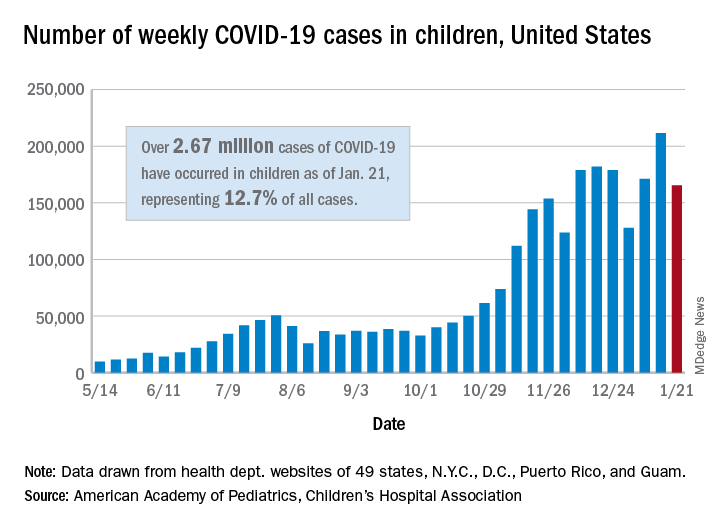
The 165,000 new cases reported during the week of Jan. 15-21 were down by almost 22% from the previous week’s 211,000, when the new-case count reached its highest point in the pandemic, the AAP and CHA said in their weekly COVID-19 report.
Cumulative cases in children now stand at just over 2.67 million, and children represent 12.7% of all COVID-19 cases reported by 49 states (excluding New York), the District of Columbia, New York City, Puerto Rico, and Guam. For the week of Jan. 15-21, children made up 14.8% of all new cases, the highest proportion since late September, the AAP/CHA data show.
The cumulative rate of infection among children is up to 3,556 per 100,000 nationally, with states ranging from 943 per 100,000 in Hawaii to 8,195 in North Dakota. California has the most reported cases at 383,000, while Vermont has the fewest at 1,820, the two organizations reported.
There were 14 more deaths among children in the last week, bringing the total to 205 in the 43 states (plus New York City and Guam) reporting such data. Children represent just 0.06% of all coronavirus-related deaths, and only 0.01% of all cases in children have resulted in death, the AAP and CHA said. There are still 10 states where no children have died from COVID-19.
Although severe illness appears to be rare in children, the AAP and CHA noted, “there is an urgent need to collect more data on longer-term impacts of the pandemic on children, including ways the virus may harm the long-term physical health of infected children, as well as its emotional and mental health effects.”
according to new data from the American Academy of Pediatrics and the Children’s Hospital Association.
The 165,000 new cases reported during the week of Jan. 15-21 were down by almost 22% from the previous week’s 211,000, when the new-case count reached its highest point in the pandemic, the AAP and CHA said in their weekly COVID-19 report.
Cumulative cases in children now stand at just over 2.67 million, and children represent 12.7% of all COVID-19 cases reported by 49 states (excluding New York), the District of Columbia, New York City, Puerto Rico, and Guam. For the week of Jan. 15-21, children made up 14.8% of all new cases, the highest proportion since late September, the AAP/CHA data show.
The cumulative rate of infection among children is up to 3,556 per 100,000 nationally, with states ranging from 943 per 100,000 in Hawaii to 8,195 in North Dakota. California has the most reported cases at 383,000, while Vermont has the fewest at 1,820, the two organizations reported.
There were 14 more deaths among children in the last week, bringing the total to 205 in the 43 states (plus New York City and Guam) reporting such data. Children represent just 0.06% of all coronavirus-related deaths, and only 0.01% of all cases in children have resulted in death, the AAP and CHA said. There are still 10 states where no children have died from COVID-19.
Although severe illness appears to be rare in children, the AAP and CHA noted, “there is an urgent need to collect more data on longer-term impacts of the pandemic on children, including ways the virus may harm the long-term physical health of infected children, as well as its emotional and mental health effects.”
according to new data from the American Academy of Pediatrics and the Children’s Hospital Association.
The 165,000 new cases reported during the week of Jan. 15-21 were down by almost 22% from the previous week’s 211,000, when the new-case count reached its highest point in the pandemic, the AAP and CHA said in their weekly COVID-19 report.
Cumulative cases in children now stand at just over 2.67 million, and children represent 12.7% of all COVID-19 cases reported by 49 states (excluding New York), the District of Columbia, New York City, Puerto Rico, and Guam. For the week of Jan. 15-21, children made up 14.8% of all new cases, the highest proportion since late September, the AAP/CHA data show.
The cumulative rate of infection among children is up to 3,556 per 100,000 nationally, with states ranging from 943 per 100,000 in Hawaii to 8,195 in North Dakota. California has the most reported cases at 383,000, while Vermont has the fewest at 1,820, the two organizations reported.
There were 14 more deaths among children in the last week, bringing the total to 205 in the 43 states (plus New York City and Guam) reporting such data. Children represent just 0.06% of all coronavirus-related deaths, and only 0.01% of all cases in children have resulted in death, the AAP and CHA said. There are still 10 states where no children have died from COVID-19.
Although severe illness appears to be rare in children, the AAP and CHA noted, “there is an urgent need to collect more data on longer-term impacts of the pandemic on children, including ways the virus may harm the long-term physical health of infected children, as well as its emotional and mental health effects.”
Bathing now more widely accepted as an eczema treatment strategy
According to Noreen Heer Nicol, PhD, RN, FNP, frustration still exists for patients, families, and health care providers regarding the lack of consensus that routine bathing is good for patients with atopic dermatitis.

During the Revolutionizing Atopic Dermatitis symposium, she said that conflicting and vague guidelines currently exist on the topic.
“This stems from the fact that we just don’t have good studies,” said Dr. Nicol, associate dean and associate professor of nursing at the University of Colorado at Denver, Aurora. “Particularly, we don’t have randomized, controlled trials on the effects of water and bathing. It’s not just parents that are frustrated, but health care providers are as well.”
In an observational analysis, researchers evaluated results from three online surveys of dermatologists, allergists, and immunologists, and primary care physicians regarding routine bathing frequency recommendations for children with AD. It found that PCPs recommended daily bathing less than 50% of the time, while specialists recommended daily bathing more than 50% of the time.
“It seems like the PCPs have embraced that old dermatology notion when bathing was avoided in patients with AD,” Dr. Nicol said. “This lack of consensus on the basic daily care steps in AD management causes a great deal of confusion amongst patients, families, and young health care providers, in particular,” she added.
She believes that this goes back to a century-long debate about the pros and cons of bathing in AD. “We used to say that bathing will dry the skin out if you take a bath or a shower without immediately applying something like a good moisturizer. That’s where the 3-minute rule came along from the National Eczema Association, meaning that bathing hydrates the stratum corneum if you take a bath or a shower and you immediately apply that good moisturizer within 3 minutes to retain that hydration and keep the barrier intact and flexible.”
Dr. Nicol presented a stepwise management model that she has published many times over the years (see Pediatr Nursing 2020;46[2]:92-8 and J Allergy Clin Immunol Pract 2019;7[1]:1-16).
Step 1 consists of basic care, including skin hydration/bathing, application of a daily moisturizer, avoiding irritants, and identifying and addressing specific triggers. “This is the foundation for every step as you go forward,” she explained. Soak and seal has been a mainstay of treatment at National Jewish Health, she noted. “By that, I mean taking a soaking 10-15 minute bath in warm water daily. Gently pat away excess water. Immediately apply skin medications or moisturizer within 3 minutes. Using a gentle fragrance-free, dye-free cleanser to clean skin is also important. Avoid scrubbing.”
A review article on bathing and associated treatments in AD was published in 2017 and includes 144 references to bathing studies. A separate recommendation known as the “AD Yardstick” published by Dr. Nicol’s colleague at National Jewish Health, Mark Boguniewicz, MD, and coauthors, elaborated on the definition of basic skin care for nonlesional AD. Besides recommending the liberal and frequent application of moisturizers, it suggests management with warm baths or showers using nonsoap cleansers, usually once per day, followed by application of a moisturizer, even on clear areas.
“This is now what people are thinking as the basis of skin care in patients with AD,” Dr. Nicol said. “Warm baths and showers don’t look so controversial anymore. This model nicely lays out what we want people to remember. In the past, many times we just skipped that important step of telling people about bathing.”
In a small 2009 study, researchers conducted a quantitative assessment of combination bathing and moisturizing regimens on skin hydration in AD. They found that bathing followed by application of a moisturizer provides modest hydration benefits, though less than that of simply applying moisturizer alone. “That has not been the case for most of us who are bathing advocates,” Dr. Nicol said. “We believe that there is an additional hydration that’s gained from bathing and moisturizers done properly.”
In an earlier retrospective study of 28 patients referred to a tertiary care center for refractory chronic pruritic eruptions, researchers found that a plain-water 20-minute soak followed by smearing of midstrength corticosteroid ointment led to clearing or dramatic improvement of the lesions (Arch Dermatol 2005;14:1556-9). The authors recommended prospective studies to confirm the findings.
In a separate review of medical literature, researchers explored the role of frequent bathing in the treatment of pediatric AD (Ann Allergy Asthma Immunol 2016;117[1]:9-13). They found that the weight of evidence suggests that the frequent soak and smear bathing is preferred to infrequent bathing in the management of AD. Frequent bathing was defined as bathing at least once a day, while infrequent bathing was defined as bathing less than once a day.
“Bleach baths have received much attention in recent years, and have been endorsed by multiple AD guidelines, though not to the same degree as regular bathing,” Dr. Nicol said. “Right now, you can find almost as much literature for this practice as against it. The populations that seem to value from beach baths the most, however, are those with frequent infections, particularly those who are methicillin resistant. Most people recommend a maximum of two to three times per week but only with an active infection. Care must be taken to avoid additional drying or irritation of the skin from bleach.”
Many bleach bath recipes call for adding one-eighth to one-half of a cup of bleach to a tub full or water.
Dr. Nicol disclosed that she has served as an advisory board member for Eli Lilly.
According to Noreen Heer Nicol, PhD, RN, FNP, frustration still exists for patients, families, and health care providers regarding the lack of consensus that routine bathing is good for patients with atopic dermatitis.
During the Revolutionizing Atopic Dermatitis symposium, she said that conflicting and vague guidelines currently exist on the topic.
“This stems from the fact that we just don’t have good studies,” said Dr. Nicol, associate dean and associate professor of nursing at the University of Colorado at Denver, Aurora. “Particularly, we don’t have randomized, controlled trials on the effects of water and bathing. It’s not just parents that are frustrated, but health care providers are as well.”
In an observational analysis, researchers evaluated results from three online surveys of dermatologists, allergists, and immunologists, and primary care physicians regarding routine bathing frequency recommendations for children with AD. It found that PCPs recommended daily bathing less than 50% of the time, while specialists recommended daily bathing more than 50% of the time.
“It seems like the PCPs have embraced that old dermatology notion when bathing was avoided in patients with AD,” Dr. Nicol said. “This lack of consensus on the basic daily care steps in AD management causes a great deal of confusion amongst patients, families, and young health care providers, in particular,” she added.
She believes that this goes back to a century-long debate about the pros and cons of bathing in AD. “We used to say that bathing will dry the skin out if you take a bath or a shower without immediately applying something like a good moisturizer. That’s where the 3-minute rule came along from the National Eczema Association, meaning that bathing hydrates the stratum corneum if you take a bath or a shower and you immediately apply that good moisturizer within 3 minutes to retain that hydration and keep the barrier intact and flexible.”
Dr. Nicol presented a stepwise management model that she has published many times over the years (see Pediatr Nursing 2020;46[2]:92-8 and J Allergy Clin Immunol Pract 2019;7[1]:1-16).
Step 1 consists of basic care, including skin hydration/bathing, application of a daily moisturizer, avoiding irritants, and identifying and addressing specific triggers. “This is the foundation for every step as you go forward,” she explained. Soak and seal has been a mainstay of treatment at National Jewish Health, she noted. “By that, I mean taking a soaking 10-15 minute bath in warm water daily. Gently pat away excess water. Immediately apply skin medications or moisturizer within 3 minutes. Using a gentle fragrance-free, dye-free cleanser to clean skin is also important. Avoid scrubbing.”
A review article on bathing and associated treatments in AD was published in 2017 and includes 144 references to bathing studies. A separate recommendation known as the “AD Yardstick” published by Dr. Nicol’s colleague at National Jewish Health, Mark Boguniewicz, MD, and coauthors, elaborated on the definition of basic skin care for nonlesional AD. Besides recommending the liberal and frequent application of moisturizers, it suggests management with warm baths or showers using nonsoap cleansers, usually once per day, followed by application of a moisturizer, even on clear areas.
“This is now what people are thinking as the basis of skin care in patients with AD,” Dr. Nicol said. “Warm baths and showers don’t look so controversial anymore. This model nicely lays out what we want people to remember. In the past, many times we just skipped that important step of telling people about bathing.”
In a small 2009 study, researchers conducted a quantitative assessment of combination bathing and moisturizing regimens on skin hydration in AD. They found that bathing followed by application of a moisturizer provides modest hydration benefits, though less than that of simply applying moisturizer alone. “That has not been the case for most of us who are bathing advocates,” Dr. Nicol said. “We believe that there is an additional hydration that’s gained from bathing and moisturizers done properly.”
In an earlier retrospective study of 28 patients referred to a tertiary care center for refractory chronic pruritic eruptions, researchers found that a plain-water 20-minute soak followed by smearing of midstrength corticosteroid ointment led to clearing or dramatic improvement of the lesions (Arch Dermatol 2005;14:1556-9). The authors recommended prospective studies to confirm the findings.
In a separate review of medical literature, researchers explored the role of frequent bathing in the treatment of pediatric AD (Ann Allergy Asthma Immunol 2016;117[1]:9-13). They found that the weight of evidence suggests that the frequent soak and smear bathing is preferred to infrequent bathing in the management of AD. Frequent bathing was defined as bathing at least once a day, while infrequent bathing was defined as bathing less than once a day.
“Bleach baths have received much attention in recent years, and have been endorsed by multiple AD guidelines, though not to the same degree as regular bathing,” Dr. Nicol said. “Right now, you can find almost as much literature for this practice as against it. The populations that seem to value from beach baths the most, however, are those with frequent infections, particularly those who are methicillin resistant. Most people recommend a maximum of two to three times per week but only with an active infection. Care must be taken to avoid additional drying or irritation of the skin from bleach.”
Many bleach bath recipes call for adding one-eighth to one-half of a cup of bleach to a tub full or water.
Dr. Nicol disclosed that she has served as an advisory board member for Eli Lilly.
According to Noreen Heer Nicol, PhD, RN, FNP, frustration still exists for patients, families, and health care providers regarding the lack of consensus that routine bathing is good for patients with atopic dermatitis.
During the Revolutionizing Atopic Dermatitis symposium, she said that conflicting and vague guidelines currently exist on the topic.
“This stems from the fact that we just don’t have good studies,” said Dr. Nicol, associate dean and associate professor of nursing at the University of Colorado at Denver, Aurora. “Particularly, we don’t have randomized, controlled trials on the effects of water and bathing. It’s not just parents that are frustrated, but health care providers are as well.”
In an observational analysis, researchers evaluated results from three online surveys of dermatologists, allergists, and immunologists, and primary care physicians regarding routine bathing frequency recommendations for children with AD. It found that PCPs recommended daily bathing less than 50% of the time, while specialists recommended daily bathing more than 50% of the time.
“It seems like the PCPs have embraced that old dermatology notion when bathing was avoided in patients with AD,” Dr. Nicol said. “This lack of consensus on the basic daily care steps in AD management causes a great deal of confusion amongst patients, families, and young health care providers, in particular,” she added.
She believes that this goes back to a century-long debate about the pros and cons of bathing in AD. “We used to say that bathing will dry the skin out if you take a bath or a shower without immediately applying something like a good moisturizer. That’s where the 3-minute rule came along from the National Eczema Association, meaning that bathing hydrates the stratum corneum if you take a bath or a shower and you immediately apply that good moisturizer within 3 minutes to retain that hydration and keep the barrier intact and flexible.”
Dr. Nicol presented a stepwise management model that she has published many times over the years (see Pediatr Nursing 2020;46[2]:92-8 and J Allergy Clin Immunol Pract 2019;7[1]:1-16).
Step 1 consists of basic care, including skin hydration/bathing, application of a daily moisturizer, avoiding irritants, and identifying and addressing specific triggers. “This is the foundation for every step as you go forward,” she explained. Soak and seal has been a mainstay of treatment at National Jewish Health, she noted. “By that, I mean taking a soaking 10-15 minute bath in warm water daily. Gently pat away excess water. Immediately apply skin medications or moisturizer within 3 minutes. Using a gentle fragrance-free, dye-free cleanser to clean skin is also important. Avoid scrubbing.”
A review article on bathing and associated treatments in AD was published in 2017 and includes 144 references to bathing studies. A separate recommendation known as the “AD Yardstick” published by Dr. Nicol’s colleague at National Jewish Health, Mark Boguniewicz, MD, and coauthors, elaborated on the definition of basic skin care for nonlesional AD. Besides recommending the liberal and frequent application of moisturizers, it suggests management with warm baths or showers using nonsoap cleansers, usually once per day, followed by application of a moisturizer, even on clear areas.
“This is now what people are thinking as the basis of skin care in patients with AD,” Dr. Nicol said. “Warm baths and showers don’t look so controversial anymore. This model nicely lays out what we want people to remember. In the past, many times we just skipped that important step of telling people about bathing.”
In a small 2009 study, researchers conducted a quantitative assessment of combination bathing and moisturizing regimens on skin hydration in AD. They found that bathing followed by application of a moisturizer provides modest hydration benefits, though less than that of simply applying moisturizer alone. “That has not been the case for most of us who are bathing advocates,” Dr. Nicol said. “We believe that there is an additional hydration that’s gained from bathing and moisturizers done properly.”
In an earlier retrospective study of 28 patients referred to a tertiary care center for refractory chronic pruritic eruptions, researchers found that a plain-water 20-minute soak followed by smearing of midstrength corticosteroid ointment led to clearing or dramatic improvement of the lesions (Arch Dermatol 2005;14:1556-9). The authors recommended prospective studies to confirm the findings.
In a separate review of medical literature, researchers explored the role of frequent bathing in the treatment of pediatric AD (Ann Allergy Asthma Immunol 2016;117[1]:9-13). They found that the weight of evidence suggests that the frequent soak and smear bathing is preferred to infrequent bathing in the management of AD. Frequent bathing was defined as bathing at least once a day, while infrequent bathing was defined as bathing less than once a day.
“Bleach baths have received much attention in recent years, and have been endorsed by multiple AD guidelines, though not to the same degree as regular bathing,” Dr. Nicol said. “Right now, you can find almost as much literature for this practice as against it. The populations that seem to value from beach baths the most, however, are those with frequent infections, particularly those who are methicillin resistant. Most people recommend a maximum of two to three times per week but only with an active infection. Care must be taken to avoid additional drying or irritation of the skin from bleach.”
Many bleach bath recipes call for adding one-eighth to one-half of a cup of bleach to a tub full or water.
Dr. Nicol disclosed that she has served as an advisory board member for Eli Lilly.
FROM REVOLUTIONIZING AD 2020
COVID-19 variants may prompt additional Moderna vaccine
As mutated strains of the coronavirus represent new threats in the pandemic, vaccine makers are racing to respond.
Moderna, whose two-dose vaccine has been authorized for use in the United States since Dec. 18, said on Jan. 25 that it is now investigating whether a third dose of the vaccine will better prevent the spread of a variant first seen in South Africa, while it also tests a new vaccine formula for the same purpose.
“Out of an abundance of caution and leveraging the flexibility of our mRNA platform, we are advancing an emerging variant booster candidate against the variant first identified in the Republic of South Africa into the clinic to determine if it will be more effective … against this and potentially future variants,” Moderna CEO Stéphane Bancel said in a statement. Pfizer and BioNTech, whose vaccine was also authorized in December, announced on Jan. 20 that their COVID-19 vaccine creates antibodies that could protect vaccine recipients from the U.K. variant B.1.1.7.
Moderna on Jan. 25 said laboratory tests have shown its COVID-19 vaccine could protect against the U.K. strain but that it is less effective – while still meeting efficacy benchmarks – against the strain identified in South Africa. Data from the study were submitted to a preprint server on Jan. 25 but have not yet been peer reviewed.
“This is not a problem yet,” Paul Offit, MD, director of the Vaccine Education Center at Children’s Hospital of Philadelphia, told CNBC.
“Prepare for it. Sequence these viruses,” he said. “Get ready just in case a variant emerges, which is resistant.”
There were at least 195 confirmed cases of patients infected with the U.K. variant, which is believed to be as much as 70% more transmissible, in the United States as of Jan. 22, according to the Centers for Disease Control and Prevention. No cases from the South African variant have been confirmed in the United States. To try to prevent the variant from entering the country, President Joe Biden plans to ban travel from South Africa, except for American citizens and permanent residents.
The U.S. has reported more than 25 million total COVID-19 cases, according to data from Johns Hopkins University, marking another major milestone during the pandemic.
That means about 1 in 13 people have contracted the virus, or about 7.6% of the U.S. population.
“Twenty-five million cases is an incredible scale of tragedy,” Caitlin Rivers, an epidemiologist at the Johns Hopkins Bloomberg School of Public Health, told The New York Times. She called the pandemic one of the worst public health crises in history.
After the first U.S. case was reported in January 2020, it took more than 9 months to reach 10 million cases in early November. Numbers rose during the holidays, and 10 million more cases were reported by the end of the year.
Following a major surge throughout January 2021, with a peak of more than 300,000 daily cases on some days, the U.S. reached 25 million in about 3 weeks.
Hospitalizations also peaked in early January, with more than 132,000 COVID-19 patients in hospitals across the country, according to the COVID Tracking Project. On Jan. 24, about 111,000 patients were hospitalized, which is the lowest since mid-December.
The U.S. has also reported nearly 420,000 deaths. As recently as the week starting Jan. 17, more than 4,400 deaths were reported in a single day, according to the COVID Tracking Project. Deaths are beginning to drop but still remain above 3,000 daily.
The University of Washington’s Institute for Health Metrics and Evaluation released a new projection Jan. 22 that said new cases would decline steadily in coming weeks. New COVID-19 cases had fallen about 21% in 2 weeks prior to Jan. 25, according to an analysis by The New York Times.
“We’ve been saying since summer that we thought we’d see a peak in January, and I think that, at the national level, we’re around the peak,” Christopher J.L. Murray, MD, director of the institute, told the newspaper.
At the same time, public health officials are concerned that new coronavirus variants could lead to an increase again. Dr. Murray said the variants could “totally change the story.” If the more transmissible strains spread quickly, cases and deaths will surge once more.
“We’re definitely on a downward slope, but I’m worried that the new variants will throw us a curveball in late February or March,” Ms. Rivers told the newspaper.
A version of this article first appeared on WebMD.com.
As mutated strains of the coronavirus represent new threats in the pandemic, vaccine makers are racing to respond.
Moderna, whose two-dose vaccine has been authorized for use in the United States since Dec. 18, said on Jan. 25 that it is now investigating whether a third dose of the vaccine will better prevent the spread of a variant first seen in South Africa, while it also tests a new vaccine formula for the same purpose.
“Out of an abundance of caution and leveraging the flexibility of our mRNA platform, we are advancing an emerging variant booster candidate against the variant first identified in the Republic of South Africa into the clinic to determine if it will be more effective … against this and potentially future variants,” Moderna CEO Stéphane Bancel said in a statement. Pfizer and BioNTech, whose vaccine was also authorized in December, announced on Jan. 20 that their COVID-19 vaccine creates antibodies that could protect vaccine recipients from the U.K. variant B.1.1.7.
Moderna on Jan. 25 said laboratory tests have shown its COVID-19 vaccine could protect against the U.K. strain but that it is less effective – while still meeting efficacy benchmarks – against the strain identified in South Africa. Data from the study were submitted to a preprint server on Jan. 25 but have not yet been peer reviewed.
“This is not a problem yet,” Paul Offit, MD, director of the Vaccine Education Center at Children’s Hospital of Philadelphia, told CNBC.
“Prepare for it. Sequence these viruses,” he said. “Get ready just in case a variant emerges, which is resistant.”
There were at least 195 confirmed cases of patients infected with the U.K. variant, which is believed to be as much as 70% more transmissible, in the United States as of Jan. 22, according to the Centers for Disease Control and Prevention. No cases from the South African variant have been confirmed in the United States. To try to prevent the variant from entering the country, President Joe Biden plans to ban travel from South Africa, except for American citizens and permanent residents.
The U.S. has reported more than 25 million total COVID-19 cases, according to data from Johns Hopkins University, marking another major milestone during the pandemic.
That means about 1 in 13 people have contracted the virus, or about 7.6% of the U.S. population.
“Twenty-five million cases is an incredible scale of tragedy,” Caitlin Rivers, an epidemiologist at the Johns Hopkins Bloomberg School of Public Health, told The New York Times. She called the pandemic one of the worst public health crises in history.
After the first U.S. case was reported in January 2020, it took more than 9 months to reach 10 million cases in early November. Numbers rose during the holidays, and 10 million more cases were reported by the end of the year.
Following a major surge throughout January 2021, with a peak of more than 300,000 daily cases on some days, the U.S. reached 25 million in about 3 weeks.
Hospitalizations also peaked in early January, with more than 132,000 COVID-19 patients in hospitals across the country, according to the COVID Tracking Project. On Jan. 24, about 111,000 patients were hospitalized, which is the lowest since mid-December.
The U.S. has also reported nearly 420,000 deaths. As recently as the week starting Jan. 17, more than 4,400 deaths were reported in a single day, according to the COVID Tracking Project. Deaths are beginning to drop but still remain above 3,000 daily.
The University of Washington’s Institute for Health Metrics and Evaluation released a new projection Jan. 22 that said new cases would decline steadily in coming weeks. New COVID-19 cases had fallen about 21% in 2 weeks prior to Jan. 25, according to an analysis by The New York Times.
“We’ve been saying since summer that we thought we’d see a peak in January, and I think that, at the national level, we’re around the peak,” Christopher J.L. Murray, MD, director of the institute, told the newspaper.
At the same time, public health officials are concerned that new coronavirus variants could lead to an increase again. Dr. Murray said the variants could “totally change the story.” If the more transmissible strains spread quickly, cases and deaths will surge once more.
“We’re definitely on a downward slope, but I’m worried that the new variants will throw us a curveball in late February or March,” Ms. Rivers told the newspaper.
A version of this article first appeared on WebMD.com.
As mutated strains of the coronavirus represent new threats in the pandemic, vaccine makers are racing to respond.
Moderna, whose two-dose vaccine has been authorized for use in the United States since Dec. 18, said on Jan. 25 that it is now investigating whether a third dose of the vaccine will better prevent the spread of a variant first seen in South Africa, while it also tests a new vaccine formula for the same purpose.
“Out of an abundance of caution and leveraging the flexibility of our mRNA platform, we are advancing an emerging variant booster candidate against the variant first identified in the Republic of South Africa into the clinic to determine if it will be more effective … against this and potentially future variants,” Moderna CEO Stéphane Bancel said in a statement. Pfizer and BioNTech, whose vaccine was also authorized in December, announced on Jan. 20 that their COVID-19 vaccine creates antibodies that could protect vaccine recipients from the U.K. variant B.1.1.7.
Moderna on Jan. 25 said laboratory tests have shown its COVID-19 vaccine could protect against the U.K. strain but that it is less effective – while still meeting efficacy benchmarks – against the strain identified in South Africa. Data from the study were submitted to a preprint server on Jan. 25 but have not yet been peer reviewed.
“This is not a problem yet,” Paul Offit, MD, director of the Vaccine Education Center at Children’s Hospital of Philadelphia, told CNBC.
“Prepare for it. Sequence these viruses,” he said. “Get ready just in case a variant emerges, which is resistant.”
There were at least 195 confirmed cases of patients infected with the U.K. variant, which is believed to be as much as 70% more transmissible, in the United States as of Jan. 22, according to the Centers for Disease Control and Prevention. No cases from the South African variant have been confirmed in the United States. To try to prevent the variant from entering the country, President Joe Biden plans to ban travel from South Africa, except for American citizens and permanent residents.
The U.S. has reported more than 25 million total COVID-19 cases, according to data from Johns Hopkins University, marking another major milestone during the pandemic.
That means about 1 in 13 people have contracted the virus, or about 7.6% of the U.S. population.
“Twenty-five million cases is an incredible scale of tragedy,” Caitlin Rivers, an epidemiologist at the Johns Hopkins Bloomberg School of Public Health, told The New York Times. She called the pandemic one of the worst public health crises in history.
After the first U.S. case was reported in January 2020, it took more than 9 months to reach 10 million cases in early November. Numbers rose during the holidays, and 10 million more cases were reported by the end of the year.
Following a major surge throughout January 2021, with a peak of more than 300,000 daily cases on some days, the U.S. reached 25 million in about 3 weeks.
Hospitalizations also peaked in early January, with more than 132,000 COVID-19 patients in hospitals across the country, according to the COVID Tracking Project. On Jan. 24, about 111,000 patients were hospitalized, which is the lowest since mid-December.
The U.S. has also reported nearly 420,000 deaths. As recently as the week starting Jan. 17, more than 4,400 deaths were reported in a single day, according to the COVID Tracking Project. Deaths are beginning to drop but still remain above 3,000 daily.
The University of Washington’s Institute for Health Metrics and Evaluation released a new projection Jan. 22 that said new cases would decline steadily in coming weeks. New COVID-19 cases had fallen about 21% in 2 weeks prior to Jan. 25, according to an analysis by The New York Times.
“We’ve been saying since summer that we thought we’d see a peak in January, and I think that, at the national level, we’re around the peak,” Christopher J.L. Murray, MD, director of the institute, told the newspaper.
At the same time, public health officials are concerned that new coronavirus variants could lead to an increase again. Dr. Murray said the variants could “totally change the story.” If the more transmissible strains spread quickly, cases and deaths will surge once more.
“We’re definitely on a downward slope, but I’m worried that the new variants will throw us a curveball in late February or March,” Ms. Rivers told the newspaper.
A version of this article first appeared on WebMD.com.
More than one-third of COVID-19 infections are asymptomatic: Review
A systematic review suggests at least one-third of SARS-CoV-2 infections occur in people who never develop symptoms, providing strong evidence for the prevalence of asymptomatic infections.
The finding that nearly one in three infected people remain symptom free suggests testing should be changed, the investigators noted.
“To reduce transmission from people who are presymptomatic or asymptomatic, we need to shift our testing focus to at-home screening,” lead author Daniel Oran, AM, said in an interview. “Inexpensive rapid antigen tests, provided to millions of people for frequent use, could help us significantly reduce the spread of the virus.”
The systematic review was published online Jan. 22 in Annals of Internal Medicine.
The findings come at a dire time when the official number of COVID-19 cases in the United States exceeds 25 million for the first time. Public health officials have raised concerns about more transmissible, and possibly more deadly, variants of SARS-CoV-2, while a new presidential administration tries to meet the challenge of improving vaccine distribution and acceptance rates.
The results also build on earlier findings from the same research team – Mr. Oran and senior author Eric Topol, MD – that published a review article looking at asymptomatic COVID-19 cases. Even though initial data were more limited, they likewise suggested a broader scope of testing is warranted, pointing out that asymptomatic individuals can transmit SARS-CoV-2 for up to 14 days. Dr. Topol is also editor in chief of Medscape.
In the current systematic review, the highest-quality evidence comes from large studies in England and Spain. The nationally representative evidence included serologic surveys from more than 365,000 people in England and more than 61,000 in Spain. When analyzed separately, about the same proportion of asymptomatic cases emerged: 32.4% in England and 33% in Spain.
“It was really remarkable to find that nationwide antibody testing studies in England and Spain – including hundreds of thousands of people – produced nearly identical results: About one-third of the SARS-CoV-2 infections were completely asymptomatic,” said Mr. Oran, a researcher at Scripps Research Translational Institute in La Jolla, Calif.
The systematic review included 43 studies with PCR testing for active SARS-CoV-2 infection and another 18 with antibody results that indicated present or previous infection. The studies were published up until Nov. 17, 2020.
An appreciation for asymptomatic transmission of SARS-CoV-2 infection has come a long way from initial dismissals about its importance, Dr. Topol noted via Twitter. “When Dr. @camilla_rothe reported an asymptomatic transmission a year ago, the @NEJM report was refuted and disparaged. She was later named a TIME 100 Person of the Year.”
Not symptomatic vs. never symptomatic
The term “asymptomatic” could be misleading because some people in this group do progress to develop signs of infection. This “presymptomatic” group of patients is likely a minority, the authors noted. Longitudinal studies indicate that about three-quarters of people who are asymptomatic with SARS-CoV-2 remain so.
Dr. Topol anticipated the one-third asymptomatic finding could draw some feedback about distinguishing asymptomatic from presymptomatic individuals. He tweeted, “Some will argue that there is admixture with presymptomatic cases, but review of all the data supports this estimate as being a conservative one.”
The heterogeneity of the settings, populations and other features of the studies prevented the authors from performing a meta-analysis of the findings.
Home is where the test is
Based on their findings, Mr. Oran and Dr. Topol believe “that COVID-19 control strategies must be altered, taking into account the prevalence and transmission risk of asymptomatic SARS-CoV-2 infection.” They suggested frequent use of inexpensive, rapid home tests to identify people who are asymptomatic or presymptomatic, along with programs and housing provided by the government to offer financial assistance and allow this group of people to isolate themselves.
Further research is warranted to determine if and how well vaccines for SARS-CoV-2 prevent asymptomatic infection.
Dr. Topol and Mr. Oran created a short video to highlight the findings from their systematic review.
The study was supported by a grant from the National Institutes of Health.
A version of this article first appeared on Medscape.com.
A systematic review suggests at least one-third of SARS-CoV-2 infections occur in people who never develop symptoms, providing strong evidence for the prevalence of asymptomatic infections.
The finding that nearly one in three infected people remain symptom free suggests testing should be changed, the investigators noted.
“To reduce transmission from people who are presymptomatic or asymptomatic, we need to shift our testing focus to at-home screening,” lead author Daniel Oran, AM, said in an interview. “Inexpensive rapid antigen tests, provided to millions of people for frequent use, could help us significantly reduce the spread of the virus.”
The systematic review was published online Jan. 22 in Annals of Internal Medicine.
The findings come at a dire time when the official number of COVID-19 cases in the United States exceeds 25 million for the first time. Public health officials have raised concerns about more transmissible, and possibly more deadly, variants of SARS-CoV-2, while a new presidential administration tries to meet the challenge of improving vaccine distribution and acceptance rates.
The results also build on earlier findings from the same research team – Mr. Oran and senior author Eric Topol, MD – that published a review article looking at asymptomatic COVID-19 cases. Even though initial data were more limited, they likewise suggested a broader scope of testing is warranted, pointing out that asymptomatic individuals can transmit SARS-CoV-2 for up to 14 days. Dr. Topol is also editor in chief of Medscape.
In the current systematic review, the highest-quality evidence comes from large studies in England and Spain. The nationally representative evidence included serologic surveys from more than 365,000 people in England and more than 61,000 in Spain. When analyzed separately, about the same proportion of asymptomatic cases emerged: 32.4% in England and 33% in Spain.
“It was really remarkable to find that nationwide antibody testing studies in England and Spain – including hundreds of thousands of people – produced nearly identical results: About one-third of the SARS-CoV-2 infections were completely asymptomatic,” said Mr. Oran, a researcher at Scripps Research Translational Institute in La Jolla, Calif.
The systematic review included 43 studies with PCR testing for active SARS-CoV-2 infection and another 18 with antibody results that indicated present or previous infection. The studies were published up until Nov. 17, 2020.
An appreciation for asymptomatic transmission of SARS-CoV-2 infection has come a long way from initial dismissals about its importance, Dr. Topol noted via Twitter. “When Dr. @camilla_rothe reported an asymptomatic transmission a year ago, the @NEJM report was refuted and disparaged. She was later named a TIME 100 Person of the Year.”
Not symptomatic vs. never symptomatic
The term “asymptomatic” could be misleading because some people in this group do progress to develop signs of infection. This “presymptomatic” group of patients is likely a minority, the authors noted. Longitudinal studies indicate that about three-quarters of people who are asymptomatic with SARS-CoV-2 remain so.
Dr. Topol anticipated the one-third asymptomatic finding could draw some feedback about distinguishing asymptomatic from presymptomatic individuals. He tweeted, “Some will argue that there is admixture with presymptomatic cases, but review of all the data supports this estimate as being a conservative one.”
The heterogeneity of the settings, populations and other features of the studies prevented the authors from performing a meta-analysis of the findings.
Home is where the test is
Based on their findings, Mr. Oran and Dr. Topol believe “that COVID-19 control strategies must be altered, taking into account the prevalence and transmission risk of asymptomatic SARS-CoV-2 infection.” They suggested frequent use of inexpensive, rapid home tests to identify people who are asymptomatic or presymptomatic, along with programs and housing provided by the government to offer financial assistance and allow this group of people to isolate themselves.
Further research is warranted to determine if and how well vaccines for SARS-CoV-2 prevent asymptomatic infection.
Dr. Topol and Mr. Oran created a short video to highlight the findings from their systematic review.
The study was supported by a grant from the National Institutes of Health.
A version of this article first appeared on Medscape.com.
A systematic review suggests at least one-third of SARS-CoV-2 infections occur in people who never develop symptoms, providing strong evidence for the prevalence of asymptomatic infections.
The finding that nearly one in three infected people remain symptom free suggests testing should be changed, the investigators noted.
“To reduce transmission from people who are presymptomatic or asymptomatic, we need to shift our testing focus to at-home screening,” lead author Daniel Oran, AM, said in an interview. “Inexpensive rapid antigen tests, provided to millions of people for frequent use, could help us significantly reduce the spread of the virus.”
The systematic review was published online Jan. 22 in Annals of Internal Medicine.
The findings come at a dire time when the official number of COVID-19 cases in the United States exceeds 25 million for the first time. Public health officials have raised concerns about more transmissible, and possibly more deadly, variants of SARS-CoV-2, while a new presidential administration tries to meet the challenge of improving vaccine distribution and acceptance rates.
The results also build on earlier findings from the same research team – Mr. Oran and senior author Eric Topol, MD – that published a review article looking at asymptomatic COVID-19 cases. Even though initial data were more limited, they likewise suggested a broader scope of testing is warranted, pointing out that asymptomatic individuals can transmit SARS-CoV-2 for up to 14 days. Dr. Topol is also editor in chief of Medscape.
In the current systematic review, the highest-quality evidence comes from large studies in England and Spain. The nationally representative evidence included serologic surveys from more than 365,000 people in England and more than 61,000 in Spain. When analyzed separately, about the same proportion of asymptomatic cases emerged: 32.4% in England and 33% in Spain.
“It was really remarkable to find that nationwide antibody testing studies in England and Spain – including hundreds of thousands of people – produced nearly identical results: About one-third of the SARS-CoV-2 infections were completely asymptomatic,” said Mr. Oran, a researcher at Scripps Research Translational Institute in La Jolla, Calif.
The systematic review included 43 studies with PCR testing for active SARS-CoV-2 infection and another 18 with antibody results that indicated present or previous infection. The studies were published up until Nov. 17, 2020.
An appreciation for asymptomatic transmission of SARS-CoV-2 infection has come a long way from initial dismissals about its importance, Dr. Topol noted via Twitter. “When Dr. @camilla_rothe reported an asymptomatic transmission a year ago, the @NEJM report was refuted and disparaged. She was later named a TIME 100 Person of the Year.”
Not symptomatic vs. never symptomatic
The term “asymptomatic” could be misleading because some people in this group do progress to develop signs of infection. This “presymptomatic” group of patients is likely a minority, the authors noted. Longitudinal studies indicate that about three-quarters of people who are asymptomatic with SARS-CoV-2 remain so.
Dr. Topol anticipated the one-third asymptomatic finding could draw some feedback about distinguishing asymptomatic from presymptomatic individuals. He tweeted, “Some will argue that there is admixture with presymptomatic cases, but review of all the data supports this estimate as being a conservative one.”
The heterogeneity of the settings, populations and other features of the studies prevented the authors from performing a meta-analysis of the findings.
Home is where the test is
Based on their findings, Mr. Oran and Dr. Topol believe “that COVID-19 control strategies must be altered, taking into account the prevalence and transmission risk of asymptomatic SARS-CoV-2 infection.” They suggested frequent use of inexpensive, rapid home tests to identify people who are asymptomatic or presymptomatic, along with programs and housing provided by the government to offer financial assistance and allow this group of people to isolate themselves.
Further research is warranted to determine if and how well vaccines for SARS-CoV-2 prevent asymptomatic infection.
Dr. Topol and Mr. Oran created a short video to highlight the findings from their systematic review.
The study was supported by a grant from the National Institutes of Health.
A version of this article first appeared on Medscape.com.
Patient contact with primary care physicians declines in study
––
The reasons for this less frequent contact and the ramifications for patients and doctors practicing primary care are unclear, according to various experts. But some offered possible explanations for the changes, with patients’ increased participation in high deductible plans and shortages in primary care physicians (PCPs) being among the most often cited.
The findings, which were published online Jan. 11 in Annals of Family Medicine, were derived from researchers using a repeated cross-sectional study of the 2002-2017 Medical Expenditure Panel Survey to characterize trends in primary care use. This survey, which collected information about medical care utilization from individuals and families, included 243,919 participants who were interviewed five times over 2 years. The authors defined primary care physician contact as “in-person visit or contact with a primary care physician (primarily telephone calls) with a reported specialty of family medicine, general internal medicine, geriatrics, general pediatrics, or general practice physician.” According to the paper, “the proportion of individuals with any primary care physician contact was determined for both the population and by age group using logistic regression models,” and negative binomial regression models were used to determine the number of contacts among people with visits during 2-year periods.
The study authors, Michael E. Johansen, MD, MS, and Joshua D. Niforatos, MD, MTS, said their study suggests that previously reported decreases in primary care contact was caused by fewer contacts per patient “as opposed to an absolute decrease in the number of patients in contact with primary care.”
Harold B. Betton, MD, PhD, who practices family medicine in Little Rock, Ark., questioned this claim.

“In my reading, the authors concluded that people are seeing their primary care physicians fewer times than in the past, which suggests something is happening,” Dr. Betton said in an interview. “The fact that fewer visits are occurring may be due to multiple things, i.e., urgent care visits, visits to physician extenders – physician assistants and advanced practice nurses – or emergency room visits.”
"The paper draws observational conclusions and I fail to see the merit in the observation without knowing what the respondents were asked and not asked," he added.
Other primary care physicians suggested patients’ participation in alternative pay models and high-deductible plans have played a factor in the declines.

“Most of us have gone from fee-for-service, volume-based care to more value-based care,” Ada D. Stewart, MD, president of the American Academy of Family Physicians, said in an interview. The data reflect that trend, “whereas we were rewarded more for the number of people we were seeing, now we are trying to get towards more of the value that we provide,” suggested Dr. Stewart, who also practices family medicine with Cooperative Health in Columbia, S.C.
“Given the rise of high-deductible plans and copays, it is not surprising that younger patients, a generally healthier population, might well decrease their visits to a primary care physician. I would suspect that data for patients over 50 might well be different,” William E. Golden, MD, who is medical director at the Arkansas Department of Health & Human Services, noted in an interview.
Eileen Barrett, MD, MPH, also cited greater participation in high-deductible plans as a possible factor that could be leading some patients to forgo visits, as well as increased financial insecurity, rendering it expensive to have the visit and also to take time from work for the visit.

“I would wonder if some of this is also due to how overloaded most primary care offices are so that instead of stopping accepting new patients or shedding patients, it is just harder for existing patients to be seen,” said Dr. Barrett, who is a general internist and associate professor in the division of hospital medicine, department of internal medicine, at the University of New Mexico, Albuquerque. “Some of this could be from administrative burden – 2 hours per hour of clinic – and consequently reducing clinical time,” continued Dr. Barrett, who also serves on the editorial advisory board of Internal Medicine News, which is affiliated with Family Practice News.
Other experts pointed to data showing an insufficient supply of PCPs as a potential explanation for the new study’s findings. The Health Resources and Services Organization, for example, reported that 83 million Americans live in primary care “health professional shortage areas,” as of Jan. 24, 2021, on their website.
New data
“The rate of any contact with a [PCP] for patients in the population over multiple 2-year periods decreased by 2.5% over the study period (adjusted odds ratio, 0.99 per panel; 95% [confidence interval], 0.98-0.99; P < .001),” wrote Dr. Johansen and Dr. Niforatos. The rate of contact for patients aged 18-39 years (aOR, 0.99 per panel; 95% CI, 0.98-0.99; P < .001) and patients aged 40-64 years (aOR, 0.99 per panel; 95% CI, 0.99-1.00; P = .002), specifically, also fell. These decreased contact rates correspond “to a predicted cumulative 5% absolute decrease for the younger group and a 2% absolute decrease for the older group,” the authors added.
“The number of contacts with a [PCP] decreased among individuals with any contact by 0.5 contacts over 2 years (P < .001). A decrease in the number of [PCP] contacts was observed across all age groups (P < .001 for all), with the largest absolute decrease among individuals with higher contact rates (aged less than 4 years and aged greater than 64 years),” according to the paper.
Outlook for PCPs
Physicians questioned about how concerning these data are for the future of PCPs and their ability to keep their practices running were hesitant to speculate, because of uncertainty about the causes of the study findings.
“A quote from the paper indicates that the respondents were interviewed five times over 2 years; however, without a copy of the questionnaire it is impossible to know what they were asked and not asked,” said Dr. Betton, who also serves on the editorial advisory board of Family Practice News and runs his own private practice. “In addition, it is impossible for the reader to know whether they understood what a primary care physician was to do.
“To draw a conclusion that PCP visits are falling off per patient per provider is only helpful if patients are opting out of the primary care model of practice and opting in for point-of-care [urgent] care,” Dr. Betton added.

Internist Alan Nelson, MD, said he was also undecided about whether the findings of the study are good or bad news for the physician specialty of primary care.
“Similar findings have been reported by the Medicare Payment Advisory Commission. They certainly merit further investigation,” noted Dr. Nelson, who is a member of the editorial advisory board of Internal Medicine News. “Is it because primary care physicians are too busy to see additional patients? Is it because nonphysician practitioners seem to be more caring? Should residency training be modified, and if so, how? In the meantime, I would not be surprised if the trend continues, at least in the short term.”

Ann Greiner, president and CEO of the Primary Care Collaborative, a nonprofit organization that advocates to strengthen primary care and make it more responsive to patient needs and preferences, on the other hand, reacted with a concerned outlook for primary care.
This study and others show that “the U.S. health care system is moving away from a primary care orientation, and that is concerning,” Ms. Greiner said in an interview. “Health systems that are more oriented toward primary care have better population health outcomes, do better on measures of equity across different population groups, and are less costly.”
Authors’ take
“Future research is needed to determine whether fewer contacts per patient resulted in clinically meaningful differences in outcomes across disease processes,” wrote Dr. Johansen, who is a family medicine doctor affiliated with OhioHealth Family Medicine Grant in Columbus and with the Heritage College of Osteopathic Medicine at Ohio University, Dublin, and Dr. Niforatos, who is affiliated with the department of emergency medicine at Johns Hopkins University, Baltimore.
The study’s limitations included reliance on self-reported categorization of PCP versus specialty care physician contact, insufficient accounting for nurse practitioner and physician assistant contact, and improved contact reporting having started in 2013, they said.
How to grow patient contact
For those PCPs looking to grow their visits and patient contact, Dr. Golden suggested they strengthen their medical home model in their practice.

“Medical home models help and transform practice operations. The Arkansas model is a multipayer model – private, Medicaid and CPC+ (Medicare),” said Dr. Golden, who also serves on the editorial advisory board of Internal Medicine News. It includes community-based doctors, not Federally Qualified Health Centers, and “requires 24/7 live voice access that promotes regular contact with patients and can reduce dependency on ER and urgent care center visits.”
“Greater use of patient portals and email communications facilitate access and patient engagement with their PCP,” Dr. Golden explained.
“Over the last 6 years, the Arkansas [patient-centered medical home] initiatives have altered culture and made our practice sites stronger to withstand COVID and other challenges. As our sites became more patient centered and incorporated behavioral health options, patients perceived greater value in the functionality of primary care” he said.
Dr. Barrett proposed PCPs participate in team-based care “for professional sustainability and also for patients to continue to experience high-quality, person-centered care.” She added that “telemedicine can also help practices maintain and increase patients, as it can lessen burden on patients and clinicians – if it is done right.”
“More flexible clinic hours is also key – after usual business hours and on weekends – but I would recommend in lieu of usual weekday hours and for those who can make it work with their family and other duties,” Dr. Barrett said. “Evening or Saturday morning clinic isn’t an option for everyone, but it is an option for many some of the time, and it would be great for access to care if it were available in more locations.”
Pandemic effect
The data examined by Dr. Johansen and Dr. Niforatos predates the pandemic, but PCPs interviewed by this news organization have seen declining patient contact occur in 2020 as well.
In fact, a survey of 1,485 mostly physician primary care practitioners that began after the pandemic onset found that 43% of participants have fewer in-person visits, motivated largely by patient preferences (66%) and safety concerns (74%). This ongoing survey, which was conducted by the Larry Green Center in partnership with the Primary Care Collaborative, also indicated that, while 25% of participants saw a total increase in patient volume, more than half of primary care practitioners reported that chronic and wellness visits are down, 53% and 55%, respectively.
“Sometimes we have to go looking for our patients when we have not seen them in a while,” Dr. Stewart noted. “We saw that with COVID because people were fearful of coming into our offices, and we had to have some outreach.”
The study authors had no conflicts of interest. Dr. Barrett, Dr. Betton, Dr. Golden, Dr. Nelson, and Dr. Stewart had no relevant disclosures.
Jake Remaly contributed to this article.
––
The reasons for this less frequent contact and the ramifications for patients and doctors practicing primary care are unclear, according to various experts. But some offered possible explanations for the changes, with patients’ increased participation in high deductible plans and shortages in primary care physicians (PCPs) being among the most often cited.
The findings, which were published online Jan. 11 in Annals of Family Medicine, were derived from researchers using a repeated cross-sectional study of the 2002-2017 Medical Expenditure Panel Survey to characterize trends in primary care use. This survey, which collected information about medical care utilization from individuals and families, included 243,919 participants who were interviewed five times over 2 years. The authors defined primary care physician contact as “in-person visit or contact with a primary care physician (primarily telephone calls) with a reported specialty of family medicine, general internal medicine, geriatrics, general pediatrics, or general practice physician.” According to the paper, “the proportion of individuals with any primary care physician contact was determined for both the population and by age group using logistic regression models,” and negative binomial regression models were used to determine the number of contacts among people with visits during 2-year periods.
The study authors, Michael E. Johansen, MD, MS, and Joshua D. Niforatos, MD, MTS, said their study suggests that previously reported decreases in primary care contact was caused by fewer contacts per patient “as opposed to an absolute decrease in the number of patients in contact with primary care.”
Harold B. Betton, MD, PhD, who practices family medicine in Little Rock, Ark., questioned this claim.
“In my reading, the authors concluded that people are seeing their primary care physicians fewer times than in the past, which suggests something is happening,” Dr. Betton said in an interview. “The fact that fewer visits are occurring may be due to multiple things, i.e., urgent care visits, visits to physician extenders – physician assistants and advanced practice nurses – or emergency room visits.”
"The paper draws observational conclusions and I fail to see the merit in the observation without knowing what the respondents were asked and not asked," he added.
Other primary care physicians suggested patients’ participation in alternative pay models and high-deductible plans have played a factor in the declines.
“Most of us have gone from fee-for-service, volume-based care to more value-based care,” Ada D. Stewart, MD, president of the American Academy of Family Physicians, said in an interview. The data reflect that trend, “whereas we were rewarded more for the number of people we were seeing, now we are trying to get towards more of the value that we provide,” suggested Dr. Stewart, who also practices family medicine with Cooperative Health in Columbia, S.C.
“Given the rise of high-deductible plans and copays, it is not surprising that younger patients, a generally healthier population, might well decrease their visits to a primary care physician. I would suspect that data for patients over 50 might well be different,” William E. Golden, MD, who is medical director at the Arkansas Department of Health & Human Services, noted in an interview.
Eileen Barrett, MD, MPH, also cited greater participation in high-deductible plans as a possible factor that could be leading some patients to forgo visits, as well as increased financial insecurity, rendering it expensive to have the visit and also to take time from work for the visit.
“I would wonder if some of this is also due to how overloaded most primary care offices are so that instead of stopping accepting new patients or shedding patients, it is just harder for existing patients to be seen,” said Dr. Barrett, who is a general internist and associate professor in the division of hospital medicine, department of internal medicine, at the University of New Mexico, Albuquerque. “Some of this could be from administrative burden – 2 hours per hour of clinic – and consequently reducing clinical time,” continued Dr. Barrett, who also serves on the editorial advisory board of Internal Medicine News, which is affiliated with Family Practice News.
Other experts pointed to data showing an insufficient supply of PCPs as a potential explanation for the new study’s findings. The Health Resources and Services Organization, for example, reported that 83 million Americans live in primary care “health professional shortage areas,” as of Jan. 24, 2021, on their website.
New data
“The rate of any contact with a [PCP] for patients in the population over multiple 2-year periods decreased by 2.5% over the study period (adjusted odds ratio, 0.99 per panel; 95% [confidence interval], 0.98-0.99; P < .001),” wrote Dr. Johansen and Dr. Niforatos. The rate of contact for patients aged 18-39 years (aOR, 0.99 per panel; 95% CI, 0.98-0.99; P < .001) and patients aged 40-64 years (aOR, 0.99 per panel; 95% CI, 0.99-1.00; P = .002), specifically, also fell. These decreased contact rates correspond “to a predicted cumulative 5% absolute decrease for the younger group and a 2% absolute decrease for the older group,” the authors added.
“The number of contacts with a [PCP] decreased among individuals with any contact by 0.5 contacts over 2 years (P < .001). A decrease in the number of [PCP] contacts was observed across all age groups (P < .001 for all), with the largest absolute decrease among individuals with higher contact rates (aged less than 4 years and aged greater than 64 years),” according to the paper.
Outlook for PCPs
Physicians questioned about how concerning these data are for the future of PCPs and their ability to keep their practices running were hesitant to speculate, because of uncertainty about the causes of the study findings.
“A quote from the paper indicates that the respondents were interviewed five times over 2 years; however, without a copy of the questionnaire it is impossible to know what they were asked and not asked,” said Dr. Betton, who also serves on the editorial advisory board of Family Practice News and runs his own private practice. “In addition, it is impossible for the reader to know whether they understood what a primary care physician was to do.
“To draw a conclusion that PCP visits are falling off per patient per provider is only helpful if patients are opting out of the primary care model of practice and opting in for point-of-care [urgent] care,” Dr. Betton added.
Internist Alan Nelson, MD, said he was also undecided about whether the findings of the study are good or bad news for the physician specialty of primary care.
“Similar findings have been reported by the Medicare Payment Advisory Commission. They certainly merit further investigation,” noted Dr. Nelson, who is a member of the editorial advisory board of Internal Medicine News. “Is it because primary care physicians are too busy to see additional patients? Is it because nonphysician practitioners seem to be more caring? Should residency training be modified, and if so, how? In the meantime, I would not be surprised if the trend continues, at least in the short term.”
Ann Greiner, president and CEO of the Primary Care Collaborative, a nonprofit organization that advocates to strengthen primary care and make it more responsive to patient needs and preferences, on the other hand, reacted with a concerned outlook for primary care.
This study and others show that “the U.S. health care system is moving away from a primary care orientation, and that is concerning,” Ms. Greiner said in an interview. “Health systems that are more oriented toward primary care have better population health outcomes, do better on measures of equity across different population groups, and are less costly.”
Authors’ take
“Future research is needed to determine whether fewer contacts per patient resulted in clinically meaningful differences in outcomes across disease processes,” wrote Dr. Johansen, who is a family medicine doctor affiliated with OhioHealth Family Medicine Grant in Columbus and with the Heritage College of Osteopathic Medicine at Ohio University, Dublin, and Dr. Niforatos, who is affiliated with the department of emergency medicine at Johns Hopkins University, Baltimore.
The study’s limitations included reliance on self-reported categorization of PCP versus specialty care physician contact, insufficient accounting for nurse practitioner and physician assistant contact, and improved contact reporting having started in 2013, they said.
How to grow patient contact
For those PCPs looking to grow their visits and patient contact, Dr. Golden suggested they strengthen their medical home model in their practice.
“Medical home models help and transform practice operations. The Arkansas model is a multipayer model – private, Medicaid and CPC+ (Medicare),” said Dr. Golden, who also serves on the editorial advisory board of Internal Medicine News. It includes community-based doctors, not Federally Qualified Health Centers, and “requires 24/7 live voice access that promotes regular contact with patients and can reduce dependency on ER and urgent care center visits.”
“Greater use of patient portals and email communications facilitate access and patient engagement with their PCP,” Dr. Golden explained.
“Over the last 6 years, the Arkansas [patient-centered medical home] initiatives have altered culture and made our practice sites stronger to withstand COVID and other challenges. As our sites became more patient centered and incorporated behavioral health options, patients perceived greater value in the functionality of primary care” he said.
Dr. Barrett proposed PCPs participate in team-based care “for professional sustainability and also for patients to continue to experience high-quality, person-centered care.” She added that “telemedicine can also help practices maintain and increase patients, as it can lessen burden on patients and clinicians – if it is done right.”
“More flexible clinic hours is also key – after usual business hours and on weekends – but I would recommend in lieu of usual weekday hours and for those who can make it work with their family and other duties,” Dr. Barrett said. “Evening or Saturday morning clinic isn’t an option for everyone, but it is an option for many some of the time, and it would be great for access to care if it were available in more locations.”
Pandemic effect
The data examined by Dr. Johansen and Dr. Niforatos predates the pandemic, but PCPs interviewed by this news organization have seen declining patient contact occur in 2020 as well.
In fact, a survey of 1,485 mostly physician primary care practitioners that began after the pandemic onset found that 43% of participants have fewer in-person visits, motivated largely by patient preferences (66%) and safety concerns (74%). This ongoing survey, which was conducted by the Larry Green Center in partnership with the Primary Care Collaborative, also indicated that, while 25% of participants saw a total increase in patient volume, more than half of primary care practitioners reported that chronic and wellness visits are down, 53% and 55%, respectively.
“Sometimes we have to go looking for our patients when we have not seen them in a while,” Dr. Stewart noted. “We saw that with COVID because people were fearful of coming into our offices, and we had to have some outreach.”
The study authors had no conflicts of interest. Dr. Barrett, Dr. Betton, Dr. Golden, Dr. Nelson, and Dr. Stewart had no relevant disclosures.
Jake Remaly contributed to this article.
––
The reasons for this less frequent contact and the ramifications for patients and doctors practicing primary care are unclear, according to various experts. But some offered possible explanations for the changes, with patients’ increased participation in high deductible plans and shortages in primary care physicians (PCPs) being among the most often cited.
The findings, which were published online Jan. 11 in Annals of Family Medicine, were derived from researchers using a repeated cross-sectional study of the 2002-2017 Medical Expenditure Panel Survey to characterize trends in primary care use. This survey, which collected information about medical care utilization from individuals and families, included 243,919 participants who were interviewed five times over 2 years. The authors defined primary care physician contact as “in-person visit or contact with a primary care physician (primarily telephone calls) with a reported specialty of family medicine, general internal medicine, geriatrics, general pediatrics, or general practice physician.” According to the paper, “the proportion of individuals with any primary care physician contact was determined for both the population and by age group using logistic regression models,” and negative binomial regression models were used to determine the number of contacts among people with visits during 2-year periods.
The study authors, Michael E. Johansen, MD, MS, and Joshua D. Niforatos, MD, MTS, said their study suggests that previously reported decreases in primary care contact was caused by fewer contacts per patient “as opposed to an absolute decrease in the number of patients in contact with primary care.”
Harold B. Betton, MD, PhD, who practices family medicine in Little Rock, Ark., questioned this claim.
“In my reading, the authors concluded that people are seeing their primary care physicians fewer times than in the past, which suggests something is happening,” Dr. Betton said in an interview. “The fact that fewer visits are occurring may be due to multiple things, i.e., urgent care visits, visits to physician extenders – physician assistants and advanced practice nurses – or emergency room visits.”
"The paper draws observational conclusions and I fail to see the merit in the observation without knowing what the respondents were asked and not asked," he added.
Other primary care physicians suggested patients’ participation in alternative pay models and high-deductible plans have played a factor in the declines.
“Most of us have gone from fee-for-service, volume-based care to more value-based care,” Ada D. Stewart, MD, president of the American Academy of Family Physicians, said in an interview. The data reflect that trend, “whereas we were rewarded more for the number of people we were seeing, now we are trying to get towards more of the value that we provide,” suggested Dr. Stewart, who also practices family medicine with Cooperative Health in Columbia, S.C.
“Given the rise of high-deductible plans and copays, it is not surprising that younger patients, a generally healthier population, might well decrease their visits to a primary care physician. I would suspect that data for patients over 50 might well be different,” William E. Golden, MD, who is medical director at the Arkansas Department of Health & Human Services, noted in an interview.
Eileen Barrett, MD, MPH, also cited greater participation in high-deductible plans as a possible factor that could be leading some patients to forgo visits, as well as increased financial insecurity, rendering it expensive to have the visit and also to take time from work for the visit.
“I would wonder if some of this is also due to how overloaded most primary care offices are so that instead of stopping accepting new patients or shedding patients, it is just harder for existing patients to be seen,” said Dr. Barrett, who is a general internist and associate professor in the division of hospital medicine, department of internal medicine, at the University of New Mexico, Albuquerque. “Some of this could be from administrative burden – 2 hours per hour of clinic – and consequently reducing clinical time,” continued Dr. Barrett, who also serves on the editorial advisory board of Internal Medicine News, which is affiliated with Family Practice News.
Other experts pointed to data showing an insufficient supply of PCPs as a potential explanation for the new study’s findings. The Health Resources and Services Organization, for example, reported that 83 million Americans live in primary care “health professional shortage areas,” as of Jan. 24, 2021, on their website.
New data
“The rate of any contact with a [PCP] for patients in the population over multiple 2-year periods decreased by 2.5% over the study period (adjusted odds ratio, 0.99 per panel; 95% [confidence interval], 0.98-0.99; P < .001),” wrote Dr. Johansen and Dr. Niforatos. The rate of contact for patients aged 18-39 years (aOR, 0.99 per panel; 95% CI, 0.98-0.99; P < .001) and patients aged 40-64 years (aOR, 0.99 per panel; 95% CI, 0.99-1.00; P = .002), specifically, also fell. These decreased contact rates correspond “to a predicted cumulative 5% absolute decrease for the younger group and a 2% absolute decrease for the older group,” the authors added.
“The number of contacts with a [PCP] decreased among individuals with any contact by 0.5 contacts over 2 years (P < .001). A decrease in the number of [PCP] contacts was observed across all age groups (P < .001 for all), with the largest absolute decrease among individuals with higher contact rates (aged less than 4 years and aged greater than 64 years),” according to the paper.
Outlook for PCPs
Physicians questioned about how concerning these data are for the future of PCPs and their ability to keep their practices running were hesitant to speculate, because of uncertainty about the causes of the study findings.
“A quote from the paper indicates that the respondents were interviewed five times over 2 years; however, without a copy of the questionnaire it is impossible to know what they were asked and not asked,” said Dr. Betton, who also serves on the editorial advisory board of Family Practice News and runs his own private practice. “In addition, it is impossible for the reader to know whether they understood what a primary care physician was to do.
“To draw a conclusion that PCP visits are falling off per patient per provider is only helpful if patients are opting out of the primary care model of practice and opting in for point-of-care [urgent] care,” Dr. Betton added.
Internist Alan Nelson, MD, said he was also undecided about whether the findings of the study are good or bad news for the physician specialty of primary care.
“Similar findings have been reported by the Medicare Payment Advisory Commission. They certainly merit further investigation,” noted Dr. Nelson, who is a member of the editorial advisory board of Internal Medicine News. “Is it because primary care physicians are too busy to see additional patients? Is it because nonphysician practitioners seem to be more caring? Should residency training be modified, and if so, how? In the meantime, I would not be surprised if the trend continues, at least in the short term.”
Ann Greiner, president and CEO of the Primary Care Collaborative, a nonprofit organization that advocates to strengthen primary care and make it more responsive to patient needs and preferences, on the other hand, reacted with a concerned outlook for primary care.
This study and others show that “the U.S. health care system is moving away from a primary care orientation, and that is concerning,” Ms. Greiner said in an interview. “Health systems that are more oriented toward primary care have better population health outcomes, do better on measures of equity across different population groups, and are less costly.”
Authors’ take
“Future research is needed to determine whether fewer contacts per patient resulted in clinically meaningful differences in outcomes across disease processes,” wrote Dr. Johansen, who is a family medicine doctor affiliated with OhioHealth Family Medicine Grant in Columbus and with the Heritage College of Osteopathic Medicine at Ohio University, Dublin, and Dr. Niforatos, who is affiliated with the department of emergency medicine at Johns Hopkins University, Baltimore.
The study’s limitations included reliance on self-reported categorization of PCP versus specialty care physician contact, insufficient accounting for nurse practitioner and physician assistant contact, and improved contact reporting having started in 2013, they said.
How to grow patient contact
For those PCPs looking to grow their visits and patient contact, Dr. Golden suggested they strengthen their medical home model in their practice.
“Medical home models help and transform practice operations. The Arkansas model is a multipayer model – private, Medicaid and CPC+ (Medicare),” said Dr. Golden, who also serves on the editorial advisory board of Internal Medicine News. It includes community-based doctors, not Federally Qualified Health Centers, and “requires 24/7 live voice access that promotes regular contact with patients and can reduce dependency on ER and urgent care center visits.”
“Greater use of patient portals and email communications facilitate access and patient engagement with their PCP,” Dr. Golden explained.
“Over the last 6 years, the Arkansas [patient-centered medical home] initiatives have altered culture and made our practice sites stronger to withstand COVID and other challenges. As our sites became more patient centered and incorporated behavioral health options, patients perceived greater value in the functionality of primary care” he said.
Dr. Barrett proposed PCPs participate in team-based care “for professional sustainability and also for patients to continue to experience high-quality, person-centered care.” She added that “telemedicine can also help practices maintain and increase patients, as it can lessen burden on patients and clinicians – if it is done right.”
“More flexible clinic hours is also key – after usual business hours and on weekends – but I would recommend in lieu of usual weekday hours and for those who can make it work with their family and other duties,” Dr. Barrett said. “Evening or Saturday morning clinic isn’t an option for everyone, but it is an option for many some of the time, and it would be great for access to care if it were available in more locations.”
Pandemic effect
The data examined by Dr. Johansen and Dr. Niforatos predates the pandemic, but PCPs interviewed by this news organization have seen declining patient contact occur in 2020 as well.
In fact, a survey of 1,485 mostly physician primary care practitioners that began after the pandemic onset found that 43% of participants have fewer in-person visits, motivated largely by patient preferences (66%) and safety concerns (74%). This ongoing survey, which was conducted by the Larry Green Center in partnership with the Primary Care Collaborative, also indicated that, while 25% of participants saw a total increase in patient volume, more than half of primary care practitioners reported that chronic and wellness visits are down, 53% and 55%, respectively.
“Sometimes we have to go looking for our patients when we have not seen them in a while,” Dr. Stewart noted. “We saw that with COVID because people were fearful of coming into our offices, and we had to have some outreach.”
The study authors had no conflicts of interest. Dr. Barrett, Dr. Betton, Dr. Golden, Dr. Nelson, and Dr. Stewart had no relevant disclosures.
Jake Remaly contributed to this article.
FROM ANNALS OF FAMILY MEDICINE
Which providers miss metabolic monitoring of children taking antipsychotics?
The number and types of providers involved in a child’s care are associated with the likelihood that the child will receive metabolic monitoring, according to the study, which was published in Pediatrics.
The results suggest that primary care providers and mental health providers should collaborate to monitor children taking antipsychotics, the researchers said.
“Shared care arrangements between primary care physicians and mental health specialists significantly increased the chances that metabolic monitoring would be done, compared with care delivered by one provider,” reported Elizabeth A. Shenkman, PhD, chair of the department of health outcomes and biomedical informatics at the University of Florida, Gainesville, and colleagues. “The results of our study point to the importance of state Medicaid agencies and Medicaid managed care plans in identifying all providers caring for the children taking antipsychotic medication and using this information to engage the providers in quality improvement efforts to improve metabolic monitoring rates.”
Comparing specialties
Children who take antipsychotic medication are at risk for obesity, impaired glucose metabolism, and hyperlipidemia, but less than 40% receive recommended metabolic monitoring with glucose and cholesterol tests.
To examine how health care provider specialty influences the receipt of metabolic monitoring, Dr. Shenkman and colleagues analyzed Medicaid enrollment and health care and pharmacy claims data from Florida and Texas.
They focused on 41,078 children who had an antipsychotic medication dispensed at least twice in 2017 and were eligible for inclusion in the Centers for Medicare & Medicaid Services metabolic monitoring measure. The Metabolic Monitoring for Children and Adolescents on Antipsychotics measure is a “priority nationally and is currently on the CMS Child Core Set, which is used to annually assess state-specific performance on pediatric quality measures,” the authors wrote.
About 65% were boys, and the children had an average age of 12 years. The researchers compared metabolic monitoring rates when children received outpatient care from a primary care provider, a mental health provider with prescribing privileges, or both.
Less than 40% of the children received metabolic monitoring, that is, at least one diabetes test and at least one cholesterol test, during the year.
Most of the children (61%) saw both primary care providers and mental health providers. Approximately one-third had a primary care provider prescribe antipsychotic medication the majority of the time, and 60% had a mental health provider prescribe antipsychotic medication the majority of the time.
Patients who saw both types of providers were significantly more likely to receive metabolic monitoring, relative to those who saw primary care providers only (adjusted odds ratio, 1.42). Those seeing a mental health provider alone had adjusted odds of metabolic monitoring that were 23% lower than those seeing a primary care provider alone.
Children who had a mental health provider prescribe the medication the majority of the time were 25% more likely to receive metabolic monitoring, compared with those who had a primary care provider prescribing the medication the majority of the time.
Slipping through the cracks
Child psychiatrist Fred Volkmar, MD, commented that the results are “sadly” unsurprising and reflect issues that pertain to other psychotropic drugs as well as antipsychotics and to adults as well as children.

The researchers “are quite right to point to it,” and “we really do need to develop better plans for improving” monitoring, said Dr. Volkmar, the Irving B. Harris Professor in the Child Study Center and professor of psychology at Yale University, New Haven, Conn.
“Increasingly we are asking primary care providers ... to take care of folks who have important either developmental or mental health problems,” Dr. Volkmar said. While they can do a good job, they increasingly are underpaid. Monitoring patients takes work, and they may be less familiar with the medications. “Either they prescribe these medications or they are asked to monitor them in place of the specialist provider who may have started them or suggested them,” he said. Metabolic monitoring may not be prioritized and can easily “slip through the cracks.” At the same time, doctors need to be aware of the risk of serious side effects of antipsychotic medications, such as malignant hyperthermia.
These medications can be overused and inappropriately used, which is a further complication. And when patients are taking multiple medications, there may be a need for additional monitoring and awareness of drug interactions.
“These medications are very complicated to use,” and there needs to be a way to connect primary care providers with child psychiatrists who are best trained in their use, said Dr. Volkmar.
A system with reminders can facilitate effective metabolic monitoring, he suggested. Dr. Volkmar has established a routine while providing care for a group home of adults with autism. Every 3 months, he reviews lab results. “You just have to force yourself to do it.”
Shared care arrangements may be another way to promote metabolic monitoring, Dr. Shenkman and colleagues said.
“Attributing care back to the multiple providers is important for care coordination and development of strategies to ensure that the evidence-based care is delivered and there is appropriate follow-up with the family and child to be sure care is received,” the study authors wrote. “Formalized shared care arrangements and adaptation of existing care delivery models to support integrated care, which can vary in degree from external coordination to on-site intervention and collaboration, are effective methods to promote partnership between primary and mental health providers.”
It is possible that clinicians in the study ordered metabolic monitoring but families did not take the children for testing, the investigators noted. In addition, it is not clear how much information providers have about other providers their patients are seeing.
The study authors and Dr. Volkmar had no disclosures.
The number and types of providers involved in a child’s care are associated with the likelihood that the child will receive metabolic monitoring, according to the study, which was published in Pediatrics.
The results suggest that primary care providers and mental health providers should collaborate to monitor children taking antipsychotics, the researchers said.
“Shared care arrangements between primary care physicians and mental health specialists significantly increased the chances that metabolic monitoring would be done, compared with care delivered by one provider,” reported Elizabeth A. Shenkman, PhD, chair of the department of health outcomes and biomedical informatics at the University of Florida, Gainesville, and colleagues. “The results of our study point to the importance of state Medicaid agencies and Medicaid managed care plans in identifying all providers caring for the children taking antipsychotic medication and using this information to engage the providers in quality improvement efforts to improve metabolic monitoring rates.”
Comparing specialties
Children who take antipsychotic medication are at risk for obesity, impaired glucose metabolism, and hyperlipidemia, but less than 40% receive recommended metabolic monitoring with glucose and cholesterol tests.
To examine how health care provider specialty influences the receipt of metabolic monitoring, Dr. Shenkman and colleagues analyzed Medicaid enrollment and health care and pharmacy claims data from Florida and Texas.
They focused on 41,078 children who had an antipsychotic medication dispensed at least twice in 2017 and were eligible for inclusion in the Centers for Medicare & Medicaid Services metabolic monitoring measure. The Metabolic Monitoring for Children and Adolescents on Antipsychotics measure is a “priority nationally and is currently on the CMS Child Core Set, which is used to annually assess state-specific performance on pediatric quality measures,” the authors wrote.
About 65% were boys, and the children had an average age of 12 years. The researchers compared metabolic monitoring rates when children received outpatient care from a primary care provider, a mental health provider with prescribing privileges, or both.
Less than 40% of the children received metabolic monitoring, that is, at least one diabetes test and at least one cholesterol test, during the year.
Most of the children (61%) saw both primary care providers and mental health providers. Approximately one-third had a primary care provider prescribe antipsychotic medication the majority of the time, and 60% had a mental health provider prescribe antipsychotic medication the majority of the time.
Patients who saw both types of providers were significantly more likely to receive metabolic monitoring, relative to those who saw primary care providers only (adjusted odds ratio, 1.42). Those seeing a mental health provider alone had adjusted odds of metabolic monitoring that were 23% lower than those seeing a primary care provider alone.
Children who had a mental health provider prescribe the medication the majority of the time were 25% more likely to receive metabolic monitoring, compared with those who had a primary care provider prescribing the medication the majority of the time.
Slipping through the cracks
Child psychiatrist Fred Volkmar, MD, commented that the results are “sadly” unsurprising and reflect issues that pertain to other psychotropic drugs as well as antipsychotics and to adults as well as children.
The researchers “are quite right to point to it,” and “we really do need to develop better plans for improving” monitoring, said Dr. Volkmar, the Irving B. Harris Professor in the Child Study Center and professor of psychology at Yale University, New Haven, Conn.
“Increasingly we are asking primary care providers ... to take care of folks who have important either developmental or mental health problems,” Dr. Volkmar said. While they can do a good job, they increasingly are underpaid. Monitoring patients takes work, and they may be less familiar with the medications. “Either they prescribe these medications or they are asked to monitor them in place of the specialist provider who may have started them or suggested them,” he said. Metabolic monitoring may not be prioritized and can easily “slip through the cracks.” At the same time, doctors need to be aware of the risk of serious side effects of antipsychotic medications, such as malignant hyperthermia.
These medications can be overused and inappropriately used, which is a further complication. And when patients are taking multiple medications, there may be a need for additional monitoring and awareness of drug interactions.
“These medications are very complicated to use,” and there needs to be a way to connect primary care providers with child psychiatrists who are best trained in their use, said Dr. Volkmar.
A system with reminders can facilitate effective metabolic monitoring, he suggested. Dr. Volkmar has established a routine while providing care for a group home of adults with autism. Every 3 months, he reviews lab results. “You just have to force yourself to do it.”
Shared care arrangements may be another way to promote metabolic monitoring, Dr. Shenkman and colleagues said.
“Attributing care back to the multiple providers is important for care coordination and development of strategies to ensure that the evidence-based care is delivered and there is appropriate follow-up with the family and child to be sure care is received,” the study authors wrote. “Formalized shared care arrangements and adaptation of existing care delivery models to support integrated care, which can vary in degree from external coordination to on-site intervention and collaboration, are effective methods to promote partnership between primary and mental health providers.”
It is possible that clinicians in the study ordered metabolic monitoring but families did not take the children for testing, the investigators noted. In addition, it is not clear how much information providers have about other providers their patients are seeing.
The study authors and Dr. Volkmar had no disclosures.
The number and types of providers involved in a child’s care are associated with the likelihood that the child will receive metabolic monitoring, according to the study, which was published in Pediatrics.
The results suggest that primary care providers and mental health providers should collaborate to monitor children taking antipsychotics, the researchers said.
“Shared care arrangements between primary care physicians and mental health specialists significantly increased the chances that metabolic monitoring would be done, compared with care delivered by one provider,” reported Elizabeth A. Shenkman, PhD, chair of the department of health outcomes and biomedical informatics at the University of Florida, Gainesville, and colleagues. “The results of our study point to the importance of state Medicaid agencies and Medicaid managed care plans in identifying all providers caring for the children taking antipsychotic medication and using this information to engage the providers in quality improvement efforts to improve metabolic monitoring rates.”
Comparing specialties
Children who take antipsychotic medication are at risk for obesity, impaired glucose metabolism, and hyperlipidemia, but less than 40% receive recommended metabolic monitoring with glucose and cholesterol tests.
To examine how health care provider specialty influences the receipt of metabolic monitoring, Dr. Shenkman and colleagues analyzed Medicaid enrollment and health care and pharmacy claims data from Florida and Texas.
They focused on 41,078 children who had an antipsychotic medication dispensed at least twice in 2017 and were eligible for inclusion in the Centers for Medicare & Medicaid Services metabolic monitoring measure. The Metabolic Monitoring for Children and Adolescents on Antipsychotics measure is a “priority nationally and is currently on the CMS Child Core Set, which is used to annually assess state-specific performance on pediatric quality measures,” the authors wrote.
About 65% were boys, and the children had an average age of 12 years. The researchers compared metabolic monitoring rates when children received outpatient care from a primary care provider, a mental health provider with prescribing privileges, or both.
Less than 40% of the children received metabolic monitoring, that is, at least one diabetes test and at least one cholesterol test, during the year.
Most of the children (61%) saw both primary care providers and mental health providers. Approximately one-third had a primary care provider prescribe antipsychotic medication the majority of the time, and 60% had a mental health provider prescribe antipsychotic medication the majority of the time.
Patients who saw both types of providers were significantly more likely to receive metabolic monitoring, relative to those who saw primary care providers only (adjusted odds ratio, 1.42). Those seeing a mental health provider alone had adjusted odds of metabolic monitoring that were 23% lower than those seeing a primary care provider alone.
Children who had a mental health provider prescribe the medication the majority of the time were 25% more likely to receive metabolic monitoring, compared with those who had a primary care provider prescribing the medication the majority of the time.
Slipping through the cracks
Child psychiatrist Fred Volkmar, MD, commented that the results are “sadly” unsurprising and reflect issues that pertain to other psychotropic drugs as well as antipsychotics and to adults as well as children.
The researchers “are quite right to point to it,” and “we really do need to develop better plans for improving” monitoring, said Dr. Volkmar, the Irving B. Harris Professor in the Child Study Center and professor of psychology at Yale University, New Haven, Conn.
“Increasingly we are asking primary care providers ... to take care of folks who have important either developmental or mental health problems,” Dr. Volkmar said. While they can do a good job, they increasingly are underpaid. Monitoring patients takes work, and they may be less familiar with the medications. “Either they prescribe these medications or they are asked to monitor them in place of the specialist provider who may have started them or suggested them,” he said. Metabolic monitoring may not be prioritized and can easily “slip through the cracks.” At the same time, doctors need to be aware of the risk of serious side effects of antipsychotic medications, such as malignant hyperthermia.
These medications can be overused and inappropriately used, which is a further complication. And when patients are taking multiple medications, there may be a need for additional monitoring and awareness of drug interactions.
“These medications are very complicated to use,” and there needs to be a way to connect primary care providers with child psychiatrists who are best trained in their use, said Dr. Volkmar.
A system with reminders can facilitate effective metabolic monitoring, he suggested. Dr. Volkmar has established a routine while providing care for a group home of adults with autism. Every 3 months, he reviews lab results. “You just have to force yourself to do it.”
Shared care arrangements may be another way to promote metabolic monitoring, Dr. Shenkman and colleagues said.
“Attributing care back to the multiple providers is important for care coordination and development of strategies to ensure that the evidence-based care is delivered and there is appropriate follow-up with the family and child to be sure care is received,” the study authors wrote. “Formalized shared care arrangements and adaptation of existing care delivery models to support integrated care, which can vary in degree from external coordination to on-site intervention and collaboration, are effective methods to promote partnership between primary and mental health providers.”
It is possible that clinicians in the study ordered metabolic monitoring but families did not take the children for testing, the investigators noted. In addition, it is not clear how much information providers have about other providers their patients are seeing.
The study authors and Dr. Volkmar had no disclosures.
FROM PEDIATRICS
Vaccines may not be as effective against variants
The current COVID-19 vaccines may not be as effective against new coronavirus variants, but they should be powerful enough to still be beneficial, Anthony Fauci, MD, director of the National Institute of Allergy and Infectious Diseases, said during a news briefing on Jan. 21.
Both vaccines from Pfizer-BioNTech and Moderna have such high efficacy rates that it creates a “cushion effect,” he said, meaning that new variants will likely only diminish vaccine efficacy slightly.
“Bottom line: We’re paying very close attention to it,” he said. “There are alternative plans if we ever have to modify the vaccine.”
The U.S. has reported 144 cases of the B.1.1.7 variant, which was first identified in the United Kingdom, according to the latest update from the CDC. So far, no cases of the variant strain identified in South Africa have been reported in the U.S., but Dr. Fauci said public health officials are looking for it.
“We’re following very carefully the one in South Africa, which is a little bit more concerning, but nonetheless not something that we don’t think we can handle,” he said.
Despite challenges with vaccine distribution and administration, the U.S. “can and should” vaccinate 70% to 85% of adults by the end of the summer, Dr. Fauci told CNN. If that happens, people could begin to return to some sense of normalcy by the fall, he added.
“When you put ... the pedal to the floor, you can get it done,” he said.
If the U.S. administered one million shots per day, it would take until the end of 2021 to fully vaccine 75% of adults, according to a CNN analysis. Dr. Fauci said he believes the U.S. can give more than one million shots per day. An updated tally from the CDC showed that 1.6 million shots were given in the past 24 hours, which was the largest single-day increase yet reported.
“I’d like it to be a lot more,” Dr. Fauci told CNN. “If we can do better than that, which I personally think we likely will, then great.”
A version of this article first appeared on WebMD.com.
The current COVID-19 vaccines may not be as effective against new coronavirus variants, but they should be powerful enough to still be beneficial, Anthony Fauci, MD, director of the National Institute of Allergy and Infectious Diseases, said during a news briefing on Jan. 21.
Both vaccines from Pfizer-BioNTech and Moderna have such high efficacy rates that it creates a “cushion effect,” he said, meaning that new variants will likely only diminish vaccine efficacy slightly.
“Bottom line: We’re paying very close attention to it,” he said. “There are alternative plans if we ever have to modify the vaccine.”
The U.S. has reported 144 cases of the B.1.1.7 variant, which was first identified in the United Kingdom, according to the latest update from the CDC. So far, no cases of the variant strain identified in South Africa have been reported in the U.S., but Dr. Fauci said public health officials are looking for it.
“We’re following very carefully the one in South Africa, which is a little bit more concerning, but nonetheless not something that we don’t think we can handle,” he said.
Despite challenges with vaccine distribution and administration, the U.S. “can and should” vaccinate 70% to 85% of adults by the end of the summer, Dr. Fauci told CNN. If that happens, people could begin to return to some sense of normalcy by the fall, he added.
“When you put ... the pedal to the floor, you can get it done,” he said.
If the U.S. administered one million shots per day, it would take until the end of 2021 to fully vaccine 75% of adults, according to a CNN analysis. Dr. Fauci said he believes the U.S. can give more than one million shots per day. An updated tally from the CDC showed that 1.6 million shots were given in the past 24 hours, which was the largest single-day increase yet reported.
“I’d like it to be a lot more,” Dr. Fauci told CNN. “If we can do better than that, which I personally think we likely will, then great.”
A version of this article first appeared on WebMD.com.
The current COVID-19 vaccines may not be as effective against new coronavirus variants, but they should be powerful enough to still be beneficial, Anthony Fauci, MD, director of the National Institute of Allergy and Infectious Diseases, said during a news briefing on Jan. 21.
Both vaccines from Pfizer-BioNTech and Moderna have such high efficacy rates that it creates a “cushion effect,” he said, meaning that new variants will likely only diminish vaccine efficacy slightly.
“Bottom line: We’re paying very close attention to it,” he said. “There are alternative plans if we ever have to modify the vaccine.”
The U.S. has reported 144 cases of the B.1.1.7 variant, which was first identified in the United Kingdom, according to the latest update from the CDC. So far, no cases of the variant strain identified in South Africa have been reported in the U.S., but Dr. Fauci said public health officials are looking for it.
“We’re following very carefully the one in South Africa, which is a little bit more concerning, but nonetheless not something that we don’t think we can handle,” he said.
Despite challenges with vaccine distribution and administration, the U.S. “can and should” vaccinate 70% to 85% of adults by the end of the summer, Dr. Fauci told CNN. If that happens, people could begin to return to some sense of normalcy by the fall, he added.
“When you put ... the pedal to the floor, you can get it done,” he said.
If the U.S. administered one million shots per day, it would take until the end of 2021 to fully vaccine 75% of adults, according to a CNN analysis. Dr. Fauci said he believes the U.S. can give more than one million shots per day. An updated tally from the CDC showed that 1.6 million shots were given in the past 24 hours, which was the largest single-day increase yet reported.
“I’d like it to be a lot more,” Dr. Fauci told CNN. “If we can do better than that, which I personally think we likely will, then great.”
A version of this article first appeared on WebMD.com.
ColCORONA: Colchicine reduces complications in outpatient COVID-19
The oral, anti-inflammatory drug colchicine can prevent complications and hospitalizations in nonhospitalized patients newly diagnosed with COVID-19, according to a press release from the ColCORONA trial investigators.
After 1 month of therapy, there was a 21% risk reduction in the primary composite endpoint of death or hospitalizations that missed statistical significance, compared with placebo among 4,488 outpatients enrolled in the global, phase 3 trial.
After excluding 329 patients without a confirmatory polymerase chain reaction test, however, the use of colchicine was reported to significantly reduce hospitalizations by 25%, the need for mechanical ventilation by 50%, and deaths by 44%.
“We believe that this is a medical breakthrough. There’s no approved therapy to prevent complications of COVID-19 in outpatients, to prevent them from reaching the hospital,” lead investigator Jean-Claude Tardif, MD, from the Montreal Heart Institute, said in an interview.
“I know that several countries will be reviewing the data very rapidly and that Greece approved it today,” he said. “So this is providing hope for patients.”
Having been burned by hydroxychloroquine and other treatments brought forth without peer review, the response to the announcement was tempered by a desire for more details.
Asked for comment, Steven E. Nissen, MD, of the Cleveland Clinic Foundation, was cautious. “The press release about the trial is vague and lacks details such as hazard ratios, confidence intervals, and P values,” he said in an interview.
“It is impossible to evaluate the results of this trial without these details. It is also uncertain how rigorously data were collected,” he added. “We’ll need to see the manuscript to adequately interpret the results.”
The evidence in the press release is hard to interpret, but early intervention with anti-inflammatory therapy has considerable biologic appeal in COVID, said Paul Ridker, MD, MPH, who led the pivotal CANTOS trial of the anti-inflammatory drug canakinumab in the post-MI setting, and is also chair of the ACTIV-4B trial currently investigating anticoagulants and antithrombotics in outpatient COVID-19.
“Colchicine is both inexpensive and generally well tolerated, and the apparent benefits so far reported are substantial,” Dr. Ridker, from Brigham and Women’s Hospital in Boston, said in an interview. “We are eager to see the full data as rapidly as possible.”
The commonly used gout and rheumatic disease agent costs about 26 cents in Canada and between $4 and $6 in the United States. As previously reported, it reduced the time to clinical deterioration and hospital stay but not mortality in the 105-patient Greek Study in the Effects of Colchicine in COVID-19 Complications Prevention (GRECCO-19) study.
Dr. Tardif said he’s looking forward to having the data in the public domain and that they acted swiftly because the evidence was “clinically persuasive” and “the health system is congested now.”
“We received the results Friday, Jan. 22 at 5 p.m., an hour later we were in meetings with our data safety monitoring board [DSMB], 2 hours later we issued a press release, and a day later we’re submitting a full manuscript to a major scientific journal, so I don’t know if anyone has done this at this speed,” he said. “So we are actually very proud of what we did.”
ColCORONA was designed to enroll 6,000 outpatients, at least 40 years of age, who were diagnosed with COVID-19 infection within the previous 24 hours, and had a least one high-risk criterion, including age at least 70 years, body mass index of at least 30 kg/m2, diabetes mellitus, uncontrolled hypertension, known respiratory disease, heart failure or coronary disease, fever of at least 38.4° C within the last 48 hours, dyspnea at presentation, bicytopenia, pancytopenia, or the combination of high neutrophil count and low lymphocyte count.
Participants were randomly assigned to receive either placebo or colchicine 0.5 mg twice daily for 3 days and then once daily for another 27 days.
The number needed to prevent one COVID-19 complication is about 60 patients, Dr. Tardif said.
Colchicine was well tolerated and resulted in fewer serious adverse events than with placebo, he said. Diarrhea occurred more often with colchicine, but there was no increase in pneumonia. Caution should be used, however, in treating patients with severe renal disease.
Dr. Tardif said he would not prescribe colchicine to an 18-year-old COVID outpatient who doesn’t have any concomitant diseases, but would for those meeting the study protocol.
“As long as a patient appears to me to be at risk of a complication, I would prescribe it, without a doubt,” he said. “I can tell you that when we held the meeting with the DSMB Friday evening, I actually put each member on the spot and asked them: ‘If it were you – not even treating a patient, but if you had COVID today, would you take it based on the data you’ve seen?’ and all of the DSMB members said they would.
“So we’ll have that debate in the public domain when the paper is out, but I believe most physicians will use it to treat their patients.”
The trial was coordinated by the Montreal Heart Institute and funded by the government of Quebec; the U.S. National Heart, Lung, and Blood Institute; Montreal philanthropist Sophie Desmarais; and the COVID-19 Therapeutics Accelerator launched by the Bill & Melinda Gates Foundation, Wellcome, and Mastercard. CGI, Dacima, and Pharmascience of Montreal were also collaborators.
A version of this article first appeared on Medscape.com.
The oral, anti-inflammatory drug colchicine can prevent complications and hospitalizations in nonhospitalized patients newly diagnosed with COVID-19, according to a press release from the ColCORONA trial investigators.
After 1 month of therapy, there was a 21% risk reduction in the primary composite endpoint of death or hospitalizations that missed statistical significance, compared with placebo among 4,488 outpatients enrolled in the global, phase 3 trial.
After excluding 329 patients without a confirmatory polymerase chain reaction test, however, the use of colchicine was reported to significantly reduce hospitalizations by 25%, the need for mechanical ventilation by 50%, and deaths by 44%.
“We believe that this is a medical breakthrough. There’s no approved therapy to prevent complications of COVID-19 in outpatients, to prevent them from reaching the hospital,” lead investigator Jean-Claude Tardif, MD, from the Montreal Heart Institute, said in an interview.
“I know that several countries will be reviewing the data very rapidly and that Greece approved it today,” he said. “So this is providing hope for patients.”
Having been burned by hydroxychloroquine and other treatments brought forth without peer review, the response to the announcement was tempered by a desire for more details.
Asked for comment, Steven E. Nissen, MD, of the Cleveland Clinic Foundation, was cautious. “The press release about the trial is vague and lacks details such as hazard ratios, confidence intervals, and P values,” he said in an interview.
“It is impossible to evaluate the results of this trial without these details. It is also uncertain how rigorously data were collected,” he added. “We’ll need to see the manuscript to adequately interpret the results.”
The evidence in the press release is hard to interpret, but early intervention with anti-inflammatory therapy has considerable biologic appeal in COVID, said Paul Ridker, MD, MPH, who led the pivotal CANTOS trial of the anti-inflammatory drug canakinumab in the post-MI setting, and is also chair of the ACTIV-4B trial currently investigating anticoagulants and antithrombotics in outpatient COVID-19.
“Colchicine is both inexpensive and generally well tolerated, and the apparent benefits so far reported are substantial,” Dr. Ridker, from Brigham and Women’s Hospital in Boston, said in an interview. “We are eager to see the full data as rapidly as possible.”
The commonly used gout and rheumatic disease agent costs about 26 cents in Canada and between $4 and $6 in the United States. As previously reported, it reduced the time to clinical deterioration and hospital stay but not mortality in the 105-patient Greek Study in the Effects of Colchicine in COVID-19 Complications Prevention (GRECCO-19) study.
Dr. Tardif said he’s looking forward to having the data in the public domain and that they acted swiftly because the evidence was “clinically persuasive” and “the health system is congested now.”
“We received the results Friday, Jan. 22 at 5 p.m., an hour later we were in meetings with our data safety monitoring board [DSMB], 2 hours later we issued a press release, and a day later we’re submitting a full manuscript to a major scientific journal, so I don’t know if anyone has done this at this speed,” he said. “So we are actually very proud of what we did.”
ColCORONA was designed to enroll 6,000 outpatients, at least 40 years of age, who were diagnosed with COVID-19 infection within the previous 24 hours, and had a least one high-risk criterion, including age at least 70 years, body mass index of at least 30 kg/m2, diabetes mellitus, uncontrolled hypertension, known respiratory disease, heart failure or coronary disease, fever of at least 38.4° C within the last 48 hours, dyspnea at presentation, bicytopenia, pancytopenia, or the combination of high neutrophil count and low lymphocyte count.
Participants were randomly assigned to receive either placebo or colchicine 0.5 mg twice daily for 3 days and then once daily for another 27 days.
The number needed to prevent one COVID-19 complication is about 60 patients, Dr. Tardif said.
Colchicine was well tolerated and resulted in fewer serious adverse events than with placebo, he said. Diarrhea occurred more often with colchicine, but there was no increase in pneumonia. Caution should be used, however, in treating patients with severe renal disease.
Dr. Tardif said he would not prescribe colchicine to an 18-year-old COVID outpatient who doesn’t have any concomitant diseases, but would for those meeting the study protocol.
“As long as a patient appears to me to be at risk of a complication, I would prescribe it, without a doubt,” he said. “I can tell you that when we held the meeting with the DSMB Friday evening, I actually put each member on the spot and asked them: ‘If it were you – not even treating a patient, but if you had COVID today, would you take it based on the data you’ve seen?’ and all of the DSMB members said they would.
“So we’ll have that debate in the public domain when the paper is out, but I believe most physicians will use it to treat their patients.”
The trial was coordinated by the Montreal Heart Institute and funded by the government of Quebec; the U.S. National Heart, Lung, and Blood Institute; Montreal philanthropist Sophie Desmarais; and the COVID-19 Therapeutics Accelerator launched by the Bill & Melinda Gates Foundation, Wellcome, and Mastercard. CGI, Dacima, and Pharmascience of Montreal were also collaborators.
A version of this article first appeared on Medscape.com.
The oral, anti-inflammatory drug colchicine can prevent complications and hospitalizations in nonhospitalized patients newly diagnosed with COVID-19, according to a press release from the ColCORONA trial investigators.
After 1 month of therapy, there was a 21% risk reduction in the primary composite endpoint of death or hospitalizations that missed statistical significance, compared with placebo among 4,488 outpatients enrolled in the global, phase 3 trial.
After excluding 329 patients without a confirmatory polymerase chain reaction test, however, the use of colchicine was reported to significantly reduce hospitalizations by 25%, the need for mechanical ventilation by 50%, and deaths by 44%.
“We believe that this is a medical breakthrough. There’s no approved therapy to prevent complications of COVID-19 in outpatients, to prevent them from reaching the hospital,” lead investigator Jean-Claude Tardif, MD, from the Montreal Heart Institute, said in an interview.
“I know that several countries will be reviewing the data very rapidly and that Greece approved it today,” he said. “So this is providing hope for patients.”
Having been burned by hydroxychloroquine and other treatments brought forth without peer review, the response to the announcement was tempered by a desire for more details.
Asked for comment, Steven E. Nissen, MD, of the Cleveland Clinic Foundation, was cautious. “The press release about the trial is vague and lacks details such as hazard ratios, confidence intervals, and P values,” he said in an interview.
“It is impossible to evaluate the results of this trial without these details. It is also uncertain how rigorously data were collected,” he added. “We’ll need to see the manuscript to adequately interpret the results.”
The evidence in the press release is hard to interpret, but early intervention with anti-inflammatory therapy has considerable biologic appeal in COVID, said Paul Ridker, MD, MPH, who led the pivotal CANTOS trial of the anti-inflammatory drug canakinumab in the post-MI setting, and is also chair of the ACTIV-4B trial currently investigating anticoagulants and antithrombotics in outpatient COVID-19.
“Colchicine is both inexpensive and generally well tolerated, and the apparent benefits so far reported are substantial,” Dr. Ridker, from Brigham and Women’s Hospital in Boston, said in an interview. “We are eager to see the full data as rapidly as possible.”
The commonly used gout and rheumatic disease agent costs about 26 cents in Canada and between $4 and $6 in the United States. As previously reported, it reduced the time to clinical deterioration and hospital stay but not mortality in the 105-patient Greek Study in the Effects of Colchicine in COVID-19 Complications Prevention (GRECCO-19) study.
Dr. Tardif said he’s looking forward to having the data in the public domain and that they acted swiftly because the evidence was “clinically persuasive” and “the health system is congested now.”
“We received the results Friday, Jan. 22 at 5 p.m., an hour later we were in meetings with our data safety monitoring board [DSMB], 2 hours later we issued a press release, and a day later we’re submitting a full manuscript to a major scientific journal, so I don’t know if anyone has done this at this speed,” he said. “So we are actually very proud of what we did.”
ColCORONA was designed to enroll 6,000 outpatients, at least 40 years of age, who were diagnosed with COVID-19 infection within the previous 24 hours, and had a least one high-risk criterion, including age at least 70 years, body mass index of at least 30 kg/m2, diabetes mellitus, uncontrolled hypertension, known respiratory disease, heart failure or coronary disease, fever of at least 38.4° C within the last 48 hours, dyspnea at presentation, bicytopenia, pancytopenia, or the combination of high neutrophil count and low lymphocyte count.
Participants were randomly assigned to receive either placebo or colchicine 0.5 mg twice daily for 3 days and then once daily for another 27 days.
The number needed to prevent one COVID-19 complication is about 60 patients, Dr. Tardif said.
Colchicine was well tolerated and resulted in fewer serious adverse events than with placebo, he said. Diarrhea occurred more often with colchicine, but there was no increase in pneumonia. Caution should be used, however, in treating patients with severe renal disease.
Dr. Tardif said he would not prescribe colchicine to an 18-year-old COVID outpatient who doesn’t have any concomitant diseases, but would for those meeting the study protocol.
“As long as a patient appears to me to be at risk of a complication, I would prescribe it, without a doubt,” he said. “I can tell you that when we held the meeting with the DSMB Friday evening, I actually put each member on the spot and asked them: ‘If it were you – not even treating a patient, but if you had COVID today, would you take it based on the data you’ve seen?’ and all of the DSMB members said they would.
“So we’ll have that debate in the public domain when the paper is out, but I believe most physicians will use it to treat their patients.”
The trial was coordinated by the Montreal Heart Institute and funded by the government of Quebec; the U.S. National Heart, Lung, and Blood Institute; Montreal philanthropist Sophie Desmarais; and the COVID-19 Therapeutics Accelerator launched by the Bill & Melinda Gates Foundation, Wellcome, and Mastercard. CGI, Dacima, and Pharmascience of Montreal were also collaborators.
A version of this article first appeared on Medscape.com.
Full-dose anticoagulation reduces need for life support in COVID-19
Full-dose anticoagulation was superior to low, prophylactic doses in reducing the need for vital organ support such as ventilation in moderately ill patients hospitalized for COVID-19, according to a report released Jan. 22 by the National Institutes of Health (NIH).
“This is a major advance for patients hospitalized with COVID. Full dose of anticoagulation in these non-ICU patients improved outcomes and there’s a trend toward a reduction in mortality,” Judith Hochman, MD, director of the Cardiovascular Clinical Research Center at NYU Langone Medical Center, New York, said in an interview.
“We have treatments that are improving outcomes but not as many that reduce mortality, so we’re hopeful when the full dataset comes in that will be confirmed,” she said.
The observation of increased rates of blood clots and inflammation among COVID-19 patients, which can lead to complications such as lung failure, heart attack, and stroke, has given rise to various anticoagulant treatment protocols and a need for randomized data on routinely administering increased doses of anticoagulation to hospitalized patients.
Today’s top-line findings come from three linked clinical trials – REMAP-CAP, ACTIV-4, and ATTACC – examining the safety and efficacy of full-dose anticoagulation to treat moderately ill or critically ill adults hospitalized with COVID-19 compared with a lower dose typically used to prevent blood clots in hospitalized patients.
In December 2020, all three trials paused enrollment of the critically ill subgroup after results showed that full-dose anticoagulation started in the intensive care unit (ICU) was not beneficial and may have been harmful in some patients.
Moderately ill patients with COVID-19, defined as those who did not require ICU care or organ support, made up 80% of participants at enrollment in the three trials, Dr. Hochman said.
Among more than 1,000 moderately ill patients reviewed as of the data cut with the data safety monitoring board, full doses of low molecular weight or unfractionated heparin were superior to low prophylactic doses for the primary endpoint of need for ventilation or other organ supportive interventions at 21 days after randomization.
This met the predefined threshold for 99% probability of superiority and recruitment was stopped, Dr. Hochman reported. “Obviously safety figured into this decision. The risk/benefit ratio was very clear.”
The results do not pertain to patients with a previous indication for anticoagulation, who were excluded from the trials.
Data from an additional 1,000 patients will be reviewed and the data published sometime in the next 2-3 months, she said.
With large numbers of COVID-19 patients requiring hospitalization, the outcomes could help reduce the overload on intensive care units around the world, the NIH noted.
The results also highlight the critical role of timing in the course of COVID-19.
“We believe that full anticoagulation is effective early in the disease course,” Dr. Hochman said. “Based on the results so far from these three platform trials, those that were very, very sick at the time of enrollment really didn’t benefit and we needed to have caught them at an earlier stage.
“It’s possible that the people in the ICU are just different and the minute they get sick they need the ICU; so we haven’t clearly demonstrated this time course and when to intervene, but that’s the implication of the findings.”
The question of even earlier treatment is being examined in the partner ACTIV-4B trial, which is enrolling patients with COVID-19 illness not requiring hospitalization and randomizing them to the direct oral anticoagulant apixaban or aspirin or placebo.
“It’s a very important trial and we really want to get the message out that patients should volunteer for it,” said Dr. Hochman, principal investigator of the ACTIV-4 trial.
In the United States, the ACTIV-4 trial is being led by a collaborative effort involving a number of universities, including the University of Pittsburgh and New York University.
The REMAP-CAP, ACTIV-4, and ATTACC study platforms span five continents in more than 300 hospitals and are supported by multiple international funding organizations including the National Institutes of Health, Canadian Institutes of Health Research, the National Institute for Health Research (United Kingdom), the National Health and Medical Research Council (Australia), and the PREPARE and RECOVER consortia (European Union).
A version of this article first appeared on Medscape.com.
Full-dose anticoagulation was superior to low, prophylactic doses in reducing the need for vital organ support such as ventilation in moderately ill patients hospitalized for COVID-19, according to a report released Jan. 22 by the National Institutes of Health (NIH).
“This is a major advance for patients hospitalized with COVID. Full dose of anticoagulation in these non-ICU patients improved outcomes and there’s a trend toward a reduction in mortality,” Judith Hochman, MD, director of the Cardiovascular Clinical Research Center at NYU Langone Medical Center, New York, said in an interview.
“We have treatments that are improving outcomes but not as many that reduce mortality, so we’re hopeful when the full dataset comes in that will be confirmed,” she said.
The observation of increased rates of blood clots and inflammation among COVID-19 patients, which can lead to complications such as lung failure, heart attack, and stroke, has given rise to various anticoagulant treatment protocols and a need for randomized data on routinely administering increased doses of anticoagulation to hospitalized patients.
Today’s top-line findings come from three linked clinical trials – REMAP-CAP, ACTIV-4, and ATTACC – examining the safety and efficacy of full-dose anticoagulation to treat moderately ill or critically ill adults hospitalized with COVID-19 compared with a lower dose typically used to prevent blood clots in hospitalized patients.
In December 2020, all three trials paused enrollment of the critically ill subgroup after results showed that full-dose anticoagulation started in the intensive care unit (ICU) was not beneficial and may have been harmful in some patients.
Moderately ill patients with COVID-19, defined as those who did not require ICU care or organ support, made up 80% of participants at enrollment in the three trials, Dr. Hochman said.
Among more than 1,000 moderately ill patients reviewed as of the data cut with the data safety monitoring board, full doses of low molecular weight or unfractionated heparin were superior to low prophylactic doses for the primary endpoint of need for ventilation or other organ supportive interventions at 21 days after randomization.
This met the predefined threshold for 99% probability of superiority and recruitment was stopped, Dr. Hochman reported. “Obviously safety figured into this decision. The risk/benefit ratio was very clear.”
The results do not pertain to patients with a previous indication for anticoagulation, who were excluded from the trials.
Data from an additional 1,000 patients will be reviewed and the data published sometime in the next 2-3 months, she said.
With large numbers of COVID-19 patients requiring hospitalization, the outcomes could help reduce the overload on intensive care units around the world, the NIH noted.
The results also highlight the critical role of timing in the course of COVID-19.
“We believe that full anticoagulation is effective early in the disease course,” Dr. Hochman said. “Based on the results so far from these three platform trials, those that were very, very sick at the time of enrollment really didn’t benefit and we needed to have caught them at an earlier stage.
“It’s possible that the people in the ICU are just different and the minute they get sick they need the ICU; so we haven’t clearly demonstrated this time course and when to intervene, but that’s the implication of the findings.”
The question of even earlier treatment is being examined in the partner ACTIV-4B trial, which is enrolling patients with COVID-19 illness not requiring hospitalization and randomizing them to the direct oral anticoagulant apixaban or aspirin or placebo.
“It’s a very important trial and we really want to get the message out that patients should volunteer for it,” said Dr. Hochman, principal investigator of the ACTIV-4 trial.
In the United States, the ACTIV-4 trial is being led by a collaborative effort involving a number of universities, including the University of Pittsburgh and New York University.
The REMAP-CAP, ACTIV-4, and ATTACC study platforms span five continents in more than 300 hospitals and are supported by multiple international funding organizations including the National Institutes of Health, Canadian Institutes of Health Research, the National Institute for Health Research (United Kingdom), the National Health and Medical Research Council (Australia), and the PREPARE and RECOVER consortia (European Union).
A version of this article first appeared on Medscape.com.
Full-dose anticoagulation was superior to low, prophylactic doses in reducing the need for vital organ support such as ventilation in moderately ill patients hospitalized for COVID-19, according to a report released Jan. 22 by the National Institutes of Health (NIH).
“This is a major advance for patients hospitalized with COVID. Full dose of anticoagulation in these non-ICU patients improved outcomes and there’s a trend toward a reduction in mortality,” Judith Hochman, MD, director of the Cardiovascular Clinical Research Center at NYU Langone Medical Center, New York, said in an interview.
“We have treatments that are improving outcomes but not as many that reduce mortality, so we’re hopeful when the full dataset comes in that will be confirmed,” she said.
The observation of increased rates of blood clots and inflammation among COVID-19 patients, which can lead to complications such as lung failure, heart attack, and stroke, has given rise to various anticoagulant treatment protocols and a need for randomized data on routinely administering increased doses of anticoagulation to hospitalized patients.
Today’s top-line findings come from three linked clinical trials – REMAP-CAP, ACTIV-4, and ATTACC – examining the safety and efficacy of full-dose anticoagulation to treat moderately ill or critically ill adults hospitalized with COVID-19 compared with a lower dose typically used to prevent blood clots in hospitalized patients.
In December 2020, all three trials paused enrollment of the critically ill subgroup after results showed that full-dose anticoagulation started in the intensive care unit (ICU) was not beneficial and may have been harmful in some patients.
Moderately ill patients with COVID-19, defined as those who did not require ICU care or organ support, made up 80% of participants at enrollment in the three trials, Dr. Hochman said.
Among more than 1,000 moderately ill patients reviewed as of the data cut with the data safety monitoring board, full doses of low molecular weight or unfractionated heparin were superior to low prophylactic doses for the primary endpoint of need for ventilation or other organ supportive interventions at 21 days after randomization.
This met the predefined threshold for 99% probability of superiority and recruitment was stopped, Dr. Hochman reported. “Obviously safety figured into this decision. The risk/benefit ratio was very clear.”
The results do not pertain to patients with a previous indication for anticoagulation, who were excluded from the trials.
Data from an additional 1,000 patients will be reviewed and the data published sometime in the next 2-3 months, she said.
With large numbers of COVID-19 patients requiring hospitalization, the outcomes could help reduce the overload on intensive care units around the world, the NIH noted.
The results also highlight the critical role of timing in the course of COVID-19.
“We believe that full anticoagulation is effective early in the disease course,” Dr. Hochman said. “Based on the results so far from these three platform trials, those that were very, very sick at the time of enrollment really didn’t benefit and we needed to have caught them at an earlier stage.
“It’s possible that the people in the ICU are just different and the minute they get sick they need the ICU; so we haven’t clearly demonstrated this time course and when to intervene, but that’s the implication of the findings.”
The question of even earlier treatment is being examined in the partner ACTIV-4B trial, which is enrolling patients with COVID-19 illness not requiring hospitalization and randomizing them to the direct oral anticoagulant apixaban or aspirin or placebo.
“It’s a very important trial and we really want to get the message out that patients should volunteer for it,” said Dr. Hochman, principal investigator of the ACTIV-4 trial.
In the United States, the ACTIV-4 trial is being led by a collaborative effort involving a number of universities, including the University of Pittsburgh and New York University.
The REMAP-CAP, ACTIV-4, and ATTACC study platforms span five continents in more than 300 hospitals and are supported by multiple international funding organizations including the National Institutes of Health, Canadian Institutes of Health Research, the National Institute for Health Research (United Kingdom), the National Health and Medical Research Council (Australia), and the PREPARE and RECOVER consortia (European Union).
A version of this article first appeared on Medscape.com.
COVID-19 drives physician burnout for some specialties
Physician burnout remains at a critical level, at 42% overall – the same percentage as last year – but COVID-19 has changed the specialties hit hardest, according to Medscape’s Death by 1,000 Cuts: Physician Burnout & Suicide Report.
Critical care physicians now top the list of those experiencing burnout, at 51%, up from 44% last year, followed by rheumatologists (50%, up from 46%) and infectious disease specialists (49%, up from 45%). Forty-nine percent of urologists reported burnout, but that was a reduction from 54% last year.
Last year, the specialties burdened most by burnout were urology, neurology, nephrology, endocrinology, and family medicine.
Women hit particularly hard
Women in medicine traditionally have experienced higher levels of burnout than men, and the pandemic seems to have widened that gap, with the divide now at 51% for women and 36% for men.
“Many women physicians are in families with children at home,” said Carol Bernstein, MD, psychiatrist at Montefiore Medical Center, New York. “It’s already known that women assume more responsibilities in the home than do men. The pressures have increased during COVID-19 – having to be their child’s teacher during home schooling, no child care, and the grandparents can’t babysit. In addition, all doctors and nurses are worried about bringing the virus home to their families.”
Data were collected from Aug. 30 through Nov. 5, 2020. More than 12,000 physicians from 29 specialties responded.
For many, (79%) burnout has been building over years, but for some (21%), it started with the pandemic. Factors cited include lack of adequate personal protective equipment, grief from losing patients, watching families suffer, long hours, and difficult working conditions.
More than 70% of those who responded feel that burnout has had at least a moderate impact on their lives.
“One-tenth consider it severe enough to consider leaving medicine,” survey authors wrote, “an unexpected outcome after having spent so many years in training to become a physician.”
Tragically, an estimated 300 physicians each year in the United States are consumed by the struggle and take their own lives.
One percent have attempted suicide
In this survey, 13% of physicians had thoughts of suicide, and 1% have attempted it; 81% said they had no thoughts of suicide; and 5% preferred not to answer.
By specialty, obstetricians/gynecologists were most likely to have thoughts of suicide (19%), followed by orthopedists (18%) and otolaryngologists and plastic surgeons (17%).
“I yell all the time, I am angry and frustrated all the time. I think about quitting all the time,” said an internist who admitted having suicidal thoughts. “No one in my organization cares about doing the right things for patients as much as I do.”
Yet, many with such thoughts tell no one. By age group, 32% of millennials, 40% of generation X physicians, and 41% of baby boomer physicians who had had thoughts of suicide said they had told no one about those thoughts.
Fear of being reported to the medical board, fear of colleagues finding out, and other factors perpetuate a cycle of burnout and depression, and most don’t seek help.
Top reasons physicians listed for not seeking help for burnout and depression include “symptoms are not severe enough” (52%); “I can deal with without help from a professional” (46%); and feeling “too busy” (40%).
Administrative tasks fuel burnout
The top driver of burnout continues to be “too many administrative tasks.” This year, 58% put it at the top. The next highest categories (named by 37%) were “spending too many hours at work” and “lack of respect from administrators/employers, colleagues or staff.” Others mentioned lack of control or insufficient compensation and government regulations.
Notably, only 8% said stress from treating COVID-19 patients was the top driver.
An internist said, “I’m working 6 days a week, nights, weekends, holidays!”
A general surgeon said, “Being forced to see four patients an hour when complicated patients and procedures are involved” was the biggest contributor to burnout.
One physician in the survey summarized it: “It’s all of these causes; it’s death by 1,000 cuts.”
Exercise tops coping list
Asked how they cope with stress and burnout, physicians put exercise at the top (48%). Next was talking with family and friends (43%), though 43% said they cope by isolating themselves.
Drinking alcohol and overeating junk food were up slightly in the past year: for alcohol, 26%, up from 24%; for junk food, 35%, up from 33%.
The action respondents said would help most to reduce burnout was “increased compensation to avoid financial stress,” chosen by 45%. Next, at 42%, was “more manageable work and schedule,” followed by greater respect from employers, colleagues, and staff (39%).
Asked whether their workplace offered programs to reduce stress and/or burnout, almost half (47%) of physicians said no; 35% said yes; and 18% didn’t know.
Participation in such programs has been low. Almost half (42%) of physicians in this survey said they would be unlikely to attend such a program. Thirty percent they would be likely to participate; 28% said they were neutral on the idea.
“Anti-stress/burnout programs focus on individual approaches to much larger problems,” Wendy K. Dean, MD, psychiatrist and president of Moral Injury of Healthcare, said in an interview. “The programs offer temporary symptomatic relief rather than lasting systemic change. Many physicians are frustrated by these approaches.”
A study last year by the Mayo Clinic found that “the most efficacious strategy to alleviate physician burnout will target organization-directed changes rather than the level of the individual.”
A version of this article first appeared on Medscape.com.
Physician burnout remains at a critical level, at 42% overall – the same percentage as last year – but COVID-19 has changed the specialties hit hardest, according to Medscape’s Death by 1,000 Cuts: Physician Burnout & Suicide Report.
Critical care physicians now top the list of those experiencing burnout, at 51%, up from 44% last year, followed by rheumatologists (50%, up from 46%) and infectious disease specialists (49%, up from 45%). Forty-nine percent of urologists reported burnout, but that was a reduction from 54% last year.
Last year, the specialties burdened most by burnout were urology, neurology, nephrology, endocrinology, and family medicine.
Women hit particularly hard
Women in medicine traditionally have experienced higher levels of burnout than men, and the pandemic seems to have widened that gap, with the divide now at 51% for women and 36% for men.
“Many women physicians are in families with children at home,” said Carol Bernstein, MD, psychiatrist at Montefiore Medical Center, New York. “It’s already known that women assume more responsibilities in the home than do men. The pressures have increased during COVID-19 – having to be their child’s teacher during home schooling, no child care, and the grandparents can’t babysit. In addition, all doctors and nurses are worried about bringing the virus home to their families.”
Data were collected from Aug. 30 through Nov. 5, 2020. More than 12,000 physicians from 29 specialties responded.
For many, (79%) burnout has been building over years, but for some (21%), it started with the pandemic. Factors cited include lack of adequate personal protective equipment, grief from losing patients, watching families suffer, long hours, and difficult working conditions.
More than 70% of those who responded feel that burnout has had at least a moderate impact on their lives.
“One-tenth consider it severe enough to consider leaving medicine,” survey authors wrote, “an unexpected outcome after having spent so many years in training to become a physician.”
Tragically, an estimated 300 physicians each year in the United States are consumed by the struggle and take their own lives.
One percent have attempted suicide
In this survey, 13% of physicians had thoughts of suicide, and 1% have attempted it; 81% said they had no thoughts of suicide; and 5% preferred not to answer.
By specialty, obstetricians/gynecologists were most likely to have thoughts of suicide (19%), followed by orthopedists (18%) and otolaryngologists and plastic surgeons (17%).
“I yell all the time, I am angry and frustrated all the time. I think about quitting all the time,” said an internist who admitted having suicidal thoughts. “No one in my organization cares about doing the right things for patients as much as I do.”
Yet, many with such thoughts tell no one. By age group, 32% of millennials, 40% of generation X physicians, and 41% of baby boomer physicians who had had thoughts of suicide said they had told no one about those thoughts.
Fear of being reported to the medical board, fear of colleagues finding out, and other factors perpetuate a cycle of burnout and depression, and most don’t seek help.
Top reasons physicians listed for not seeking help for burnout and depression include “symptoms are not severe enough” (52%); “I can deal with without help from a professional” (46%); and feeling “too busy” (40%).
Administrative tasks fuel burnout
The top driver of burnout continues to be “too many administrative tasks.” This year, 58% put it at the top. The next highest categories (named by 37%) were “spending too many hours at work” and “lack of respect from administrators/employers, colleagues or staff.” Others mentioned lack of control or insufficient compensation and government regulations.
Notably, only 8% said stress from treating COVID-19 patients was the top driver.
An internist said, “I’m working 6 days a week, nights, weekends, holidays!”
A general surgeon said, “Being forced to see four patients an hour when complicated patients and procedures are involved” was the biggest contributor to burnout.
One physician in the survey summarized it: “It’s all of these causes; it’s death by 1,000 cuts.”
Exercise tops coping list
Asked how they cope with stress and burnout, physicians put exercise at the top (48%). Next was talking with family and friends (43%), though 43% said they cope by isolating themselves.
Drinking alcohol and overeating junk food were up slightly in the past year: for alcohol, 26%, up from 24%; for junk food, 35%, up from 33%.
The action respondents said would help most to reduce burnout was “increased compensation to avoid financial stress,” chosen by 45%. Next, at 42%, was “more manageable work and schedule,” followed by greater respect from employers, colleagues, and staff (39%).
Asked whether their workplace offered programs to reduce stress and/or burnout, almost half (47%) of physicians said no; 35% said yes; and 18% didn’t know.
Participation in such programs has been low. Almost half (42%) of physicians in this survey said they would be unlikely to attend such a program. Thirty percent they would be likely to participate; 28% said they were neutral on the idea.
“Anti-stress/burnout programs focus on individual approaches to much larger problems,” Wendy K. Dean, MD, psychiatrist and president of Moral Injury of Healthcare, said in an interview. “The programs offer temporary symptomatic relief rather than lasting systemic change. Many physicians are frustrated by these approaches.”
A study last year by the Mayo Clinic found that “the most efficacious strategy to alleviate physician burnout will target organization-directed changes rather than the level of the individual.”
A version of this article first appeared on Medscape.com.
Physician burnout remains at a critical level, at 42% overall – the same percentage as last year – but COVID-19 has changed the specialties hit hardest, according to Medscape’s Death by 1,000 Cuts: Physician Burnout & Suicide Report.
Critical care physicians now top the list of those experiencing burnout, at 51%, up from 44% last year, followed by rheumatologists (50%, up from 46%) and infectious disease specialists (49%, up from 45%). Forty-nine percent of urologists reported burnout, but that was a reduction from 54% last year.
Last year, the specialties burdened most by burnout were urology, neurology, nephrology, endocrinology, and family medicine.
Women hit particularly hard
Women in medicine traditionally have experienced higher levels of burnout than men, and the pandemic seems to have widened that gap, with the divide now at 51% for women and 36% for men.
“Many women physicians are in families with children at home,” said Carol Bernstein, MD, psychiatrist at Montefiore Medical Center, New York. “It’s already known that women assume more responsibilities in the home than do men. The pressures have increased during COVID-19 – having to be their child’s teacher during home schooling, no child care, and the grandparents can’t babysit. In addition, all doctors and nurses are worried about bringing the virus home to their families.”
Data were collected from Aug. 30 through Nov. 5, 2020. More than 12,000 physicians from 29 specialties responded.
For many, (79%) burnout has been building over years, but for some (21%), it started with the pandemic. Factors cited include lack of adequate personal protective equipment, grief from losing patients, watching families suffer, long hours, and difficult working conditions.
More than 70% of those who responded feel that burnout has had at least a moderate impact on their lives.
“One-tenth consider it severe enough to consider leaving medicine,” survey authors wrote, “an unexpected outcome after having spent so many years in training to become a physician.”
Tragically, an estimated 300 physicians each year in the United States are consumed by the struggle and take their own lives.
One percent have attempted suicide
In this survey, 13% of physicians had thoughts of suicide, and 1% have attempted it; 81% said they had no thoughts of suicide; and 5% preferred not to answer.
By specialty, obstetricians/gynecologists were most likely to have thoughts of suicide (19%), followed by orthopedists (18%) and otolaryngologists and plastic surgeons (17%).
“I yell all the time, I am angry and frustrated all the time. I think about quitting all the time,” said an internist who admitted having suicidal thoughts. “No one in my organization cares about doing the right things for patients as much as I do.”
Yet, many with such thoughts tell no one. By age group, 32% of millennials, 40% of generation X physicians, and 41% of baby boomer physicians who had had thoughts of suicide said they had told no one about those thoughts.
Fear of being reported to the medical board, fear of colleagues finding out, and other factors perpetuate a cycle of burnout and depression, and most don’t seek help.
Top reasons physicians listed for not seeking help for burnout and depression include “symptoms are not severe enough” (52%); “I can deal with without help from a professional” (46%); and feeling “too busy” (40%).
Administrative tasks fuel burnout
The top driver of burnout continues to be “too many administrative tasks.” This year, 58% put it at the top. The next highest categories (named by 37%) were “spending too many hours at work” and “lack of respect from administrators/employers, colleagues or staff.” Others mentioned lack of control or insufficient compensation and government regulations.
Notably, only 8% said stress from treating COVID-19 patients was the top driver.
An internist said, “I’m working 6 days a week, nights, weekends, holidays!”
A general surgeon said, “Being forced to see four patients an hour when complicated patients and procedures are involved” was the biggest contributor to burnout.
One physician in the survey summarized it: “It’s all of these causes; it’s death by 1,000 cuts.”
Exercise tops coping list
Asked how they cope with stress and burnout, physicians put exercise at the top (48%). Next was talking with family and friends (43%), though 43% said they cope by isolating themselves.
Drinking alcohol and overeating junk food were up slightly in the past year: for alcohol, 26%, up from 24%; for junk food, 35%, up from 33%.
The action respondents said would help most to reduce burnout was “increased compensation to avoid financial stress,” chosen by 45%. Next, at 42%, was “more manageable work and schedule,” followed by greater respect from employers, colleagues, and staff (39%).
Asked whether their workplace offered programs to reduce stress and/or burnout, almost half (47%) of physicians said no; 35% said yes; and 18% didn’t know.
Participation in such programs has been low. Almost half (42%) of physicians in this survey said they would be unlikely to attend such a program. Thirty percent they would be likely to participate; 28% said they were neutral on the idea.
“Anti-stress/burnout programs focus on individual approaches to much larger problems,” Wendy K. Dean, MD, psychiatrist and president of Moral Injury of Healthcare, said in an interview. “The programs offer temporary symptomatic relief rather than lasting systemic change. Many physicians are frustrated by these approaches.”
A study last year by the Mayo Clinic found that “the most efficacious strategy to alleviate physician burnout will target organization-directed changes rather than the level of the individual.”
A version of this article first appeared on Medscape.com.