User login
ONLINE EXCLUSIVE: Listen to an ID specialist explains why de-escalation of antibiotics isn't a simple proposition
Click here to listen to Dr. Allen
Click here to listen to Dr. Allen
Click here to listen to Dr. Allen
Gout Prevalence Has Spiked
NEW YORK – The prevalence of gout has increased by 40% over almost 2 decades, judging from recent data discussed by Dr. Michael Pillinger at a rheumatology meeting sponsored by New York University. At the same time, other research has shown that there is greater recognition of its ill effects, including increased risk of osteoarthritis, heart failure, and death.
"Gout continues to be on the rise," according to Dr. Pillinger, citing the results of a recently published analysis of gout prevalence based on two large nationally representative samples (Arthritis Rheum. 2011;63:3136-41). By comparing data from 5,707 participants of the National Health and Nutrition Examination Survey (NHANES, 2007-2008) to 18,825 participants in NHANES-III (1988-1994), the researchers found that the prevalence of gout increased by 1.2%, from 2.7% to 3.9%. The rise was greater for men than women, with an increase of 2.1% for men and 0.4% for women. The most striking gain was found in those over the age of 80 years old (men and women), which saw an increase of 6.7% (from 5.9% to 12.6%).
"Something very significant is going on," says Dr. Pillinger, suggesting that factors such as longer life span, kidney disease, increased diuretic use, diet, and obesity may all be contributing to the findings.
While few patients die as a result of a gout attack, just having the disease shortens survival by 10% to 15%, says Dr. Pillinger, director of the rheumatology fellowship program at New York University and director of rheumatology at the Manhattan campus of the VA New York Harbor Healthcare System.
An examination of the National Death Registry of Taiwan of 6,631 people who were diagnosed with gout in 2000 and followed for 8 years (representing 53,048 person-years of follow-up) showed that crude mortality for men and women combined was 21.3 per 1,000 patient-years, which was significantly higher than that of the national population (Joint Bone Spine 2011;78:577-80). The all-cause standardized mortality ratio was 1.29 for men and 1.70 for women, with higher mortality ratios due to death from kidney diseases, endocrine and metabolic, and cardiovascular diseases in both sexes.
Gout is often accompanied by several serious comorbidities. Results from the New York Veterans Affairs Gout Cohort, a database analysis of 575 people with gout in the VA system, found that the average gout patient has four or five comorbidities. In their sample, nearly 90% were found to have hypertension, 60% hyperlipidemia, and 40-50% chronic kidney disease, diabetes, and coronary artery disease (Am. J. Med. 2011;124:155-63). The presence of comorbidities result in a high frequency of contraindications to approved gout medication, so these patients can be difficult to treat, says Dr. Pillinger, a coauthor of the study.
Now heart failure can be added to the list of gout-related comorbidities. In a post-hoc, longitudinal and cross-sectional analysis of 4,989 patients enrolled in the Framingham Offspring Study (BMJ Open 2012 Feb. 15 [doi: 10.1136/bmjopen-2011-000282]), the researchers found that those with gout (n = 228) had two to three times higher incidence of clinical heart failure compared with those without. Examining the cardiac characteristics of patients with and without gout (2,326 had echocardiograms), those with gout were four times more likely to have systolic dysfunction (P less than .001) and three times more likely to have low ejection fraction (P less than .001).
The study began in 1971 and patients were examined approximately every 4 years, with the last data collection in 2008. Longitudinal analysis showed that the risk of clinical heart failure did not become apparent until after the patients had gout for 10 or 12 years. These findings suggest that while clinical heart failure is not a problem when patients with gout are first seen when they are younger, the risk of clinical heart failure as patients age should be something to be cognizant of for possible early intervention, says Dr. Pillinger.
Participants with gout had greater mortality than those without (adjusted hazard ratio, 1.58; 95% confidence interval, 1.40 to 1.78). In those with heart failure, those with gout were more likely to die than those without the disease (adjusted HR, 1.50; 95% CI, 1.3 to 1.73). "This study adds to the growing body of evidence suggesting that gout has major consequences on the cardiovascular system," according to Dr. Krishnan.
Gout appears to also increase the prevalence and severity of osteoarthritis (OA). Using both ACR clinical and radiographic criteria, the prevalence of OA in both knees was significantly higher in those with gout compared to normal controls or those with asymptomatic hyperuricemia (68% vs. 28%, P less than or equal to .05), according to data presented at the 2011 annual meeting of the American College of Rheumatology. The severity of osteoarthritis was also higher in those with gout compared to normal controls using both Kellgren-Lawrence and Western Ontario and McMaster Universities Arthritis Index scores, but differences between groups did not reach statistical significance.
"If you have gout in an older person, you better look for OA," says Dr. Pillinger, a coauthor. He attributed the lack of statistical significance to the small size of the study (25 in each group of gout, normal controls, and those with asymptomatic hyperuricemia, age greater than 60 years).
Dr. Pillinger reported financial relationships with Takeda and URL Pharma.
NEW YORK – The prevalence of gout has increased by 40% over almost 2 decades, judging from recent data discussed by Dr. Michael Pillinger at a rheumatology meeting sponsored by New York University. At the same time, other research has shown that there is greater recognition of its ill effects, including increased risk of osteoarthritis, heart failure, and death.
"Gout continues to be on the rise," according to Dr. Pillinger, citing the results of a recently published analysis of gout prevalence based on two large nationally representative samples (Arthritis Rheum. 2011;63:3136-41). By comparing data from 5,707 participants of the National Health and Nutrition Examination Survey (NHANES, 2007-2008) to 18,825 participants in NHANES-III (1988-1994), the researchers found that the prevalence of gout increased by 1.2%, from 2.7% to 3.9%. The rise was greater for men than women, with an increase of 2.1% for men and 0.4% for women. The most striking gain was found in those over the age of 80 years old (men and women), which saw an increase of 6.7% (from 5.9% to 12.6%).
"Something very significant is going on," says Dr. Pillinger, suggesting that factors such as longer life span, kidney disease, increased diuretic use, diet, and obesity may all be contributing to the findings.
While few patients die as a result of a gout attack, just having the disease shortens survival by 10% to 15%, says Dr. Pillinger, director of the rheumatology fellowship program at New York University and director of rheumatology at the Manhattan campus of the VA New York Harbor Healthcare System.
An examination of the National Death Registry of Taiwan of 6,631 people who were diagnosed with gout in 2000 and followed for 8 years (representing 53,048 person-years of follow-up) showed that crude mortality for men and women combined was 21.3 per 1,000 patient-years, which was significantly higher than that of the national population (Joint Bone Spine 2011;78:577-80). The all-cause standardized mortality ratio was 1.29 for men and 1.70 for women, with higher mortality ratios due to death from kidney diseases, endocrine and metabolic, and cardiovascular diseases in both sexes.
Gout is often accompanied by several serious comorbidities. Results from the New York Veterans Affairs Gout Cohort, a database analysis of 575 people with gout in the VA system, found that the average gout patient has four or five comorbidities. In their sample, nearly 90% were found to have hypertension, 60% hyperlipidemia, and 40-50% chronic kidney disease, diabetes, and coronary artery disease (Am. J. Med. 2011;124:155-63). The presence of comorbidities result in a high frequency of contraindications to approved gout medication, so these patients can be difficult to treat, says Dr. Pillinger, a coauthor of the study.
Now heart failure can be added to the list of gout-related comorbidities. In a post-hoc, longitudinal and cross-sectional analysis of 4,989 patients enrolled in the Framingham Offspring Study (BMJ Open 2012 Feb. 15 [doi: 10.1136/bmjopen-2011-000282]), the researchers found that those with gout (n = 228) had two to three times higher incidence of clinical heart failure compared with those without. Examining the cardiac characteristics of patients with and without gout (2,326 had echocardiograms), those with gout were four times more likely to have systolic dysfunction (P less than .001) and three times more likely to have low ejection fraction (P less than .001).
The study began in 1971 and patients were examined approximately every 4 years, with the last data collection in 2008. Longitudinal analysis showed that the risk of clinical heart failure did not become apparent until after the patients had gout for 10 or 12 years. These findings suggest that while clinical heart failure is not a problem when patients with gout are first seen when they are younger, the risk of clinical heart failure as patients age should be something to be cognizant of for possible early intervention, says Dr. Pillinger.
Participants with gout had greater mortality than those without (adjusted hazard ratio, 1.58; 95% confidence interval, 1.40 to 1.78). In those with heart failure, those with gout were more likely to die than those without the disease (adjusted HR, 1.50; 95% CI, 1.3 to 1.73). "This study adds to the growing body of evidence suggesting that gout has major consequences on the cardiovascular system," according to Dr. Krishnan.
Gout appears to also increase the prevalence and severity of osteoarthritis (OA). Using both ACR clinical and radiographic criteria, the prevalence of OA in both knees was significantly higher in those with gout compared to normal controls or those with asymptomatic hyperuricemia (68% vs. 28%, P less than or equal to .05), according to data presented at the 2011 annual meeting of the American College of Rheumatology. The severity of osteoarthritis was also higher in those with gout compared to normal controls using both Kellgren-Lawrence and Western Ontario and McMaster Universities Arthritis Index scores, but differences between groups did not reach statistical significance.
"If you have gout in an older person, you better look for OA," says Dr. Pillinger, a coauthor. He attributed the lack of statistical significance to the small size of the study (25 in each group of gout, normal controls, and those with asymptomatic hyperuricemia, age greater than 60 years).
Dr. Pillinger reported financial relationships with Takeda and URL Pharma.
NEW YORK – The prevalence of gout has increased by 40% over almost 2 decades, judging from recent data discussed by Dr. Michael Pillinger at a rheumatology meeting sponsored by New York University. At the same time, other research has shown that there is greater recognition of its ill effects, including increased risk of osteoarthritis, heart failure, and death.
"Gout continues to be on the rise," according to Dr. Pillinger, citing the results of a recently published analysis of gout prevalence based on two large nationally representative samples (Arthritis Rheum. 2011;63:3136-41). By comparing data from 5,707 participants of the National Health and Nutrition Examination Survey (NHANES, 2007-2008) to 18,825 participants in NHANES-III (1988-1994), the researchers found that the prevalence of gout increased by 1.2%, from 2.7% to 3.9%. The rise was greater for men than women, with an increase of 2.1% for men and 0.4% for women. The most striking gain was found in those over the age of 80 years old (men and women), which saw an increase of 6.7% (from 5.9% to 12.6%).
"Something very significant is going on," says Dr. Pillinger, suggesting that factors such as longer life span, kidney disease, increased diuretic use, diet, and obesity may all be contributing to the findings.
While few patients die as a result of a gout attack, just having the disease shortens survival by 10% to 15%, says Dr. Pillinger, director of the rheumatology fellowship program at New York University and director of rheumatology at the Manhattan campus of the VA New York Harbor Healthcare System.
An examination of the National Death Registry of Taiwan of 6,631 people who were diagnosed with gout in 2000 and followed for 8 years (representing 53,048 person-years of follow-up) showed that crude mortality for men and women combined was 21.3 per 1,000 patient-years, which was significantly higher than that of the national population (Joint Bone Spine 2011;78:577-80). The all-cause standardized mortality ratio was 1.29 for men and 1.70 for women, with higher mortality ratios due to death from kidney diseases, endocrine and metabolic, and cardiovascular diseases in both sexes.
Gout is often accompanied by several serious comorbidities. Results from the New York Veterans Affairs Gout Cohort, a database analysis of 575 people with gout in the VA system, found that the average gout patient has four or five comorbidities. In their sample, nearly 90% were found to have hypertension, 60% hyperlipidemia, and 40-50% chronic kidney disease, diabetes, and coronary artery disease (Am. J. Med. 2011;124:155-63). The presence of comorbidities result in a high frequency of contraindications to approved gout medication, so these patients can be difficult to treat, says Dr. Pillinger, a coauthor of the study.
Now heart failure can be added to the list of gout-related comorbidities. In a post-hoc, longitudinal and cross-sectional analysis of 4,989 patients enrolled in the Framingham Offspring Study (BMJ Open 2012 Feb. 15 [doi: 10.1136/bmjopen-2011-000282]), the researchers found that those with gout (n = 228) had two to three times higher incidence of clinical heart failure compared with those without. Examining the cardiac characteristics of patients with and without gout (2,326 had echocardiograms), those with gout were four times more likely to have systolic dysfunction (P less than .001) and three times more likely to have low ejection fraction (P less than .001).
The study began in 1971 and patients were examined approximately every 4 years, with the last data collection in 2008. Longitudinal analysis showed that the risk of clinical heart failure did not become apparent until after the patients had gout for 10 or 12 years. These findings suggest that while clinical heart failure is not a problem when patients with gout are first seen when they are younger, the risk of clinical heart failure as patients age should be something to be cognizant of for possible early intervention, says Dr. Pillinger.
Participants with gout had greater mortality than those without (adjusted hazard ratio, 1.58; 95% confidence interval, 1.40 to 1.78). In those with heart failure, those with gout were more likely to die than those without the disease (adjusted HR, 1.50; 95% CI, 1.3 to 1.73). "This study adds to the growing body of evidence suggesting that gout has major consequences on the cardiovascular system," according to Dr. Krishnan.
Gout appears to also increase the prevalence and severity of osteoarthritis (OA). Using both ACR clinical and radiographic criteria, the prevalence of OA in both knees was significantly higher in those with gout compared to normal controls or those with asymptomatic hyperuricemia (68% vs. 28%, P less than or equal to .05), according to data presented at the 2011 annual meeting of the American College of Rheumatology. The severity of osteoarthritis was also higher in those with gout compared to normal controls using both Kellgren-Lawrence and Western Ontario and McMaster Universities Arthritis Index scores, but differences between groups did not reach statistical significance.
"If you have gout in an older person, you better look for OA," says Dr. Pillinger, a coauthor. He attributed the lack of statistical significance to the small size of the study (25 in each group of gout, normal controls, and those with asymptomatic hyperuricemia, age greater than 60 years).
Dr. Pillinger reported financial relationships with Takeda and URL Pharma.
EXPERT ANALYSIS FROM A RHEUMATOLOGY MEETING SPONSORED BY NEW YORK UNIVERSITY
New Crop of Hospital Medicine Fellows “Arrives” at HM12
A new class of 141 Fellows of Hospital Medicine (FHM), SHM’s designation for recognizing professional leadership by hospitalists, will be introduced Tuesday morning at HM12 in San Diego. This is the fourth class of fellows, a program that began in 2009 with more than 500 inductees. Also honored this year are 54 new Senior Fellows of Hospital Medicine (SFHM) and three Masters of Hospital Medicine (MHM).
“SHM’s Fellows, Senior Fellows, and Masters in Hospital Medicine embody the core ideals of hospital medicine: high-value care delivery, teamwork to integrate health systems, and effective leadership to guide our systems,” says Shaun Frost, MD, SFHM, FACP, who will be inaugurated as SHM’s president this week. “As the vanguard of HM, they challenge our healthcare community to think critically about how care is provided in the hospital.”
For new Fellow Gregory Misky, MD, FHM, a hospitalist at the University of Colorado Denver, the designation represents national recognition and validation for his years of hospitalist work, including work in nonclinical realms such as teaching and hospital committee assignments.
“It also conveys a kind of credibility, both within my institution and my hospital group and among peers elsewhere—like a badge of honor. It feels like arriving as a well-rounded hospitalist and belonging to something bigger,” Dr. Misky says.
Mangla Gulati, MD, FHM, academic hospitalist at the University of Maryland at Baltimore, says that being named a fellow acknowledges the work she has done in areas such as quality, patient satisfaction, and teaching. “Hospitalists all over the country are doing things to make a difference," she says. "This honor encourages us to continue.” Increasingly, says Dr. Gulati, all hospitalists will need to do more than just clinical work; they will need to show what they can do to improve quality of care, patient satisfaction, and efficiency.
The Fellow designation is for physicians who have devoted their careers to HM and whose personal and professional behavior embodies the mission and goals of SHM.
A new class of 141 Fellows of Hospital Medicine (FHM), SHM’s designation for recognizing professional leadership by hospitalists, will be introduced Tuesday morning at HM12 in San Diego. This is the fourth class of fellows, a program that began in 2009 with more than 500 inductees. Also honored this year are 54 new Senior Fellows of Hospital Medicine (SFHM) and three Masters of Hospital Medicine (MHM).
“SHM’s Fellows, Senior Fellows, and Masters in Hospital Medicine embody the core ideals of hospital medicine: high-value care delivery, teamwork to integrate health systems, and effective leadership to guide our systems,” says Shaun Frost, MD, SFHM, FACP, who will be inaugurated as SHM’s president this week. “As the vanguard of HM, they challenge our healthcare community to think critically about how care is provided in the hospital.”
For new Fellow Gregory Misky, MD, FHM, a hospitalist at the University of Colorado Denver, the designation represents national recognition and validation for his years of hospitalist work, including work in nonclinical realms such as teaching and hospital committee assignments.
“It also conveys a kind of credibility, both within my institution and my hospital group and among peers elsewhere—like a badge of honor. It feels like arriving as a well-rounded hospitalist and belonging to something bigger,” Dr. Misky says.
Mangla Gulati, MD, FHM, academic hospitalist at the University of Maryland at Baltimore, says that being named a fellow acknowledges the work she has done in areas such as quality, patient satisfaction, and teaching. “Hospitalists all over the country are doing things to make a difference," she says. "This honor encourages us to continue.” Increasingly, says Dr. Gulati, all hospitalists will need to do more than just clinical work; they will need to show what they can do to improve quality of care, patient satisfaction, and efficiency.
The Fellow designation is for physicians who have devoted their careers to HM and whose personal and professional behavior embodies the mission and goals of SHM.
A new class of 141 Fellows of Hospital Medicine (FHM), SHM’s designation for recognizing professional leadership by hospitalists, will be introduced Tuesday morning at HM12 in San Diego. This is the fourth class of fellows, a program that began in 2009 with more than 500 inductees. Also honored this year are 54 new Senior Fellows of Hospital Medicine (SFHM) and three Masters of Hospital Medicine (MHM).
“SHM’s Fellows, Senior Fellows, and Masters in Hospital Medicine embody the core ideals of hospital medicine: high-value care delivery, teamwork to integrate health systems, and effective leadership to guide our systems,” says Shaun Frost, MD, SFHM, FACP, who will be inaugurated as SHM’s president this week. “As the vanguard of HM, they challenge our healthcare community to think critically about how care is provided in the hospital.”
For new Fellow Gregory Misky, MD, FHM, a hospitalist at the University of Colorado Denver, the designation represents national recognition and validation for his years of hospitalist work, including work in nonclinical realms such as teaching and hospital committee assignments.
“It also conveys a kind of credibility, both within my institution and my hospital group and among peers elsewhere—like a badge of honor. It feels like arriving as a well-rounded hospitalist and belonging to something bigger,” Dr. Misky says.
Mangla Gulati, MD, FHM, academic hospitalist at the University of Maryland at Baltimore, says that being named a fellow acknowledges the work she has done in areas such as quality, patient satisfaction, and teaching. “Hospitalists all over the country are doing things to make a difference," she says. "This honor encourages us to continue.” Increasingly, says Dr. Gulati, all hospitalists will need to do more than just clinical work; they will need to show what they can do to improve quality of care, patient satisfaction, and efficiency.
The Fellow designation is for physicians who have devoted their careers to HM and whose personal and professional behavior embodies the mission and goals of SHM.
BEST PRACTICES IN: The Treatment of Heavy Menstrual Bleeding
A supplement to Ob.Gyn. News. This supplement was sponsored by Ferring Pharmaceuticals.
•Topics
•Faculty/Faculty Disclosure
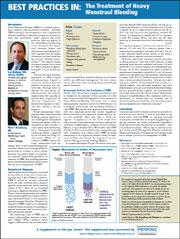
To view the supplement, click the image above.
Topics
• Introduction
• Definition & Diagnosis
• Tranexamic Acid for the Treatment of HMB
• Conclusion
Faculty/Faculty Disclosure
Lee Shulman, MD, FACOG, FACMG
The Anna Ross Lapham Professor in Obstetrics and Gynecology
Feinberg School of Medicine of Northwestern University
Chicago, Illinois
Dr Shulman is a consultant to Ferring Pharmaceuticals, Inc.
Matt T. Rosenberg, MD
Family Physician
Mid-Michigan Health Centers
Jackson, Michigan
Dr Rosenberg is a consultant to Ferring Pharmaceuticals, Inc.
Copyright © 2011 by Elsevier Inc.
A supplement to Ob.Gyn. News. This supplement was sponsored by Ferring Pharmaceuticals.
•Topics
•Faculty/Faculty Disclosure
To view the supplement, click the image above.
Topics
• Introduction
• Definition & Diagnosis
• Tranexamic Acid for the Treatment of HMB
• Conclusion
Faculty/Faculty Disclosure
Lee Shulman, MD, FACOG, FACMG
The Anna Ross Lapham Professor in Obstetrics and Gynecology
Feinberg School of Medicine of Northwestern University
Chicago, Illinois
Dr Shulman is a consultant to Ferring Pharmaceuticals, Inc.
Matt T. Rosenberg, MD
Family Physician
Mid-Michigan Health Centers
Jackson, Michigan
Dr Rosenberg is a consultant to Ferring Pharmaceuticals, Inc.
Copyright © 2011 by Elsevier Inc.
A supplement to Ob.Gyn. News. This supplement was sponsored by Ferring Pharmaceuticals.
•Topics
•Faculty/Faculty Disclosure
To view the supplement, click the image above.
Topics
• Introduction
• Definition & Diagnosis
• Tranexamic Acid for the Treatment of HMB
• Conclusion
Faculty/Faculty Disclosure
Lee Shulman, MD, FACOG, FACMG
The Anna Ross Lapham Professor in Obstetrics and Gynecology
Feinberg School of Medicine of Northwestern University
Chicago, Illinois
Dr Shulman is a consultant to Ferring Pharmaceuticals, Inc.
Matt T. Rosenberg, MD
Family Physician
Mid-Michigan Health Centers
Jackson, Michigan
Dr Rosenberg is a consultant to Ferring Pharmaceuticals, Inc.
Copyright © 2011 by Elsevier Inc.
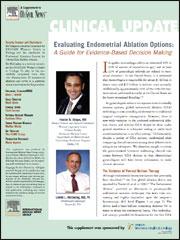
CLINICAL UPDATE:Evaluating Endometrial Ablation Options: A Guide for Evidence-Based Decision Making
Evaluating Endometrial Ablation Options: A Guide for Evidence-Based Decision Making
A supplement to Ob.Gyn. News.
This supplement was sponsored by ETHICON Women's Health & Urology.
To view the supplement, click the image above.
Topic Highlights
• The Evolution of Thermal Balloon Therapy
• Understanding the Mechanism of Action for Thermal Balloon Therapy
• Menorrhagia-Associated Dysmenorrhea
• Importance of endometrial Cavitary Coverage
• A Review of Research on Clinical Efficacy
• Thermal Balloon Ablation After Cesarean Section
• Should Thermal Balloon Therapy Be Performed in the Office?
Faculty/Faculty Disclosures
Hector O. Chapa, MD
Medical Director and Outreach Coordinator
Women's Specialty Center
Clinical Faculty
Methodist Medical Center
Department of Obstetrics and Gynecology Residency ProgramDallas, TX
Dr. Chapa is a medical consultant for ETHICON Women's Health & Urology and has coauthored its Professional Education Content for ThermaChoice Balloon Ablation.
Lowell L. McCauley, MD, PC
Obstetrician/Gynecologist
Knoxville, TN
Dr. McCauley is a medical consultant for ETHICON Women's Health & Urology. To date, he has successfully completed more than 400 Thermachoice III endometrial ablations and serves as a physician educator and trainer for the procedure.
A supplement to Ob.Gyn. News.
This supplement was sponsored by ETHICON Women's Health & Urology.
To view the supplement, click the image above.
Topic Highlights
• The Evolution of Thermal Balloon Therapy
• Understanding the Mechanism of Action for Thermal Balloon Therapy
• Menorrhagia-Associated Dysmenorrhea
• Importance of endometrial Cavitary Coverage
• A Review of Research on Clinical Efficacy
• Thermal Balloon Ablation After Cesarean Section
• Should Thermal Balloon Therapy Be Performed in the Office?
Faculty/Faculty Disclosures
Hector O. Chapa, MD
Medical Director and Outreach Coordinator
Women's Specialty Center
Clinical Faculty
Methodist Medical Center
Department of Obstetrics and Gynecology Residency ProgramDallas, TX
Dr. Chapa is a medical consultant for ETHICON Women's Health & Urology and has coauthored its Professional Education Content for ThermaChoice Balloon Ablation.
Lowell L. McCauley, MD, PC
Obstetrician/Gynecologist
Knoxville, TN
Dr. McCauley is a medical consultant for ETHICON Women's Health & Urology. To date, he has successfully completed more than 400 Thermachoice III endometrial ablations and serves as a physician educator and trainer for the procedure.
A supplement to Ob.Gyn. News.
This supplement was sponsored by ETHICON Women's Health & Urology.
To view the supplement, click the image above.
Topic Highlights
• The Evolution of Thermal Balloon Therapy
• Understanding the Mechanism of Action for Thermal Balloon Therapy
• Menorrhagia-Associated Dysmenorrhea
• Importance of endometrial Cavitary Coverage
• A Review of Research on Clinical Efficacy
• Thermal Balloon Ablation After Cesarean Section
• Should Thermal Balloon Therapy Be Performed in the Office?
Faculty/Faculty Disclosures
Hector O. Chapa, MD
Medical Director and Outreach Coordinator
Women's Specialty Center
Clinical Faculty
Methodist Medical Center
Department of Obstetrics and Gynecology Residency ProgramDallas, TX
Dr. Chapa is a medical consultant for ETHICON Women's Health & Urology and has coauthored its Professional Education Content for ThermaChoice Balloon Ablation.
Lowell L. McCauley, MD, PC
Obstetrician/Gynecologist
Knoxville, TN
Dr. McCauley is a medical consultant for ETHICON Women's Health & Urology. To date, he has successfully completed more than 400 Thermachoice III endometrial ablations and serves as a physician educator and trainer for the procedure.
Evaluating Endometrial Ablation Options: A Guide for Evidence-Based Decision Making
Evaluating Endometrial Ablation Options: A Guide for Evidence-Based Decision Making
CDC report on C. diff offers encouragement, motivation for hospitalists
A Centers for Disease Control report on Clostridium difficile infections offers encouragement for hospitalists that prevention is possible, but also offers further evidence that more work is needed to prevent the potentially deadly infections.
The report examines three sets of data on C. diff infections. According to an analysis of the CDC’s Emerging Infections Program, 94% of the more than 10,000 infections identified were related to the receipt of healthcare. Also, 75% of the infections had their onset in patients who were not hospitalized at the time.
An analysis of National Healthcare Safety Network data of present-at-admission and hospital-onset C. diff infections found that 52% of the cases involved patients already infected at admission, although they were largely healthcare-related.
—Ketino Kobaidze, MD, PhD, assistant professor, Emory University School of Medicine, Atlanta
And an analysis of data from three state-administered CDI-prevention projects in Illinois, Massachusetts, and New York found that, cumulatively, C. diff infections were reduced by 20%, showing that prevention efforts can pay off.
The heavy involvement of healthcare settings in infections shows that more should be done, says Clifford McDonald, MD, chief of prevention and response in CDC’s Division of Healthcare Quality and Promotion in Atlanta. He took aim specifically at careful use of antibiotics, as broad-spectrum antibiotics kill off bacteria that can help keep C. diff at bay.
“Certainly in the area of antibiotic stewardship, hospitals can do a lot more,” he told The Hospitalist. “A lot of the most potent antibiotics are being prescribed in the hospital. … If they’re necessary, that’s the way it is. It’s necessary and people are put at increased risk because they had to get those antibiotics. But if they weren’t necessary, it’s all the more critical that greater judiciousness be applied to the use of those antibiotics.”
Since many of the cases had their onset outside the hospital, hospitals must emphasize quick evaluation of admitted patients, including asking them an uncomfortable question: “Have you had diarrhea recently?” Three unformed stools in the previous 24 hours, along with antibiotic use in the previous 12 weeks—particularly the previous four to eight weeks—means a C. diff infection is a distinct possibility.
“We don’t think to ask, and patients may not bring it up because they are embarrassed by it,” Dr. McDonald says. Patients suspected of having C. diff infections must be isolated right away, he adds. (Click here to listen to more of Dr. McDonald's interview.)
The success in lowering the infection rate within the three state initiatives is encouraging, Dr. McDonald says, particularly because almost the entire emphasis in those programs was infection control; only the Massachusetts program included antibiotic stewardship, and only as a minor component.
“It does appear that prevention’s possible,” he notes. “Even more can be done if more tools are brought to bear and brought to bear across settings.”
Ketino Kobaidze, MD, PhD, assistant professor at the Emory University School of Medicine in Atlanta and a member of the antimicrobial stewardship and infectious-disease-control committees at Emory’s Hospital Midtown, says that while hospitalists have long been aware of C. diff infections in community settings, she was surprised to learn that 75% of cases were found in patients not currently in the hospital.
“This information will make all hospital-based doctors be more alert when a patient comes with diarrhea—and include CDI in their differential,” she says. “We need to change our approach and make appropriate recommendations on how to screen and prevent further spread.
“What this data tells us is that we need to educate our doctors to prescribe antibiotics more carefully; ask patients about diarrhea even if they are coming in for another disease; and order diagnostic tests if [they report it].”
SHM presid
He also says that while it’s widely accepted that antibiotics are overprescribed, the use of antibiotics in agriculture─in the poultry and cattle industries, for example─is an area that should be explored.
“One of the things to think about is the amount of antibiotics that are used for non- healthcare reasons,” he says, “and that also is a very large contributor to the problem.”
Thomas R. Collins is a freelance medical writer in South Florida.
A Centers for Disease Control report on Clostridium difficile infections offers encouragement for hospitalists that prevention is possible, but also offers further evidence that more work is needed to prevent the potentially deadly infections.
The report examines three sets of data on C. diff infections. According to an analysis of the CDC’s Emerging Infections Program, 94% of the more than 10,000 infections identified were related to the receipt of healthcare. Also, 75% of the infections had their onset in patients who were not hospitalized at the time.
An analysis of National Healthcare Safety Network data of present-at-admission and hospital-onset C. diff infections found that 52% of the cases involved patients already infected at admission, although they were largely healthcare-related.
—Ketino Kobaidze, MD, PhD, assistant professor, Emory University School of Medicine, Atlanta
And an analysis of data from three state-administered CDI-prevention projects in Illinois, Massachusetts, and New York found that, cumulatively, C. diff infections were reduced by 20%, showing that prevention efforts can pay off.
The heavy involvement of healthcare settings in infections shows that more should be done, says Clifford McDonald, MD, chief of prevention and response in CDC’s Division of Healthcare Quality and Promotion in Atlanta. He took aim specifically at careful use of antibiotics, as broad-spectrum antibiotics kill off bacteria that can help keep C. diff at bay.
“Certainly in the area of antibiotic stewardship, hospitals can do a lot more,” he told The Hospitalist. “A lot of the most potent antibiotics are being prescribed in the hospital. … If they’re necessary, that’s the way it is. It’s necessary and people are put at increased risk because they had to get those antibiotics. But if they weren’t necessary, it’s all the more critical that greater judiciousness be applied to the use of those antibiotics.”
Since many of the cases had their onset outside the hospital, hospitals must emphasize quick evaluation of admitted patients, including asking them an uncomfortable question: “Have you had diarrhea recently?” Three unformed stools in the previous 24 hours, along with antibiotic use in the previous 12 weeks—particularly the previous four to eight weeks—means a C. diff infection is a distinct possibility.
“We don’t think to ask, and patients may not bring it up because they are embarrassed by it,” Dr. McDonald says. Patients suspected of having C. diff infections must be isolated right away, he adds. (Click here to listen to more of Dr. McDonald's interview.)
The success in lowering the infection rate within the three state initiatives is encouraging, Dr. McDonald says, particularly because almost the entire emphasis in those programs was infection control; only the Massachusetts program included antibiotic stewardship, and only as a minor component.
“It does appear that prevention’s possible,” he notes. “Even more can be done if more tools are brought to bear and brought to bear across settings.”
Ketino Kobaidze, MD, PhD, assistant professor at the Emory University School of Medicine in Atlanta and a member of the antimicrobial stewardship and infectious-disease-control committees at Emory’s Hospital Midtown, says that while hospitalists have long been aware of C. diff infections in community settings, she was surprised to learn that 75% of cases were found in patients not currently in the hospital.
“This information will make all hospital-based doctors be more alert when a patient comes with diarrhea—and include CDI in their differential,” she says. “We need to change our approach and make appropriate recommendations on how to screen and prevent further spread.
“What this data tells us is that we need to educate our doctors to prescribe antibiotics more carefully; ask patients about diarrhea even if they are coming in for another disease; and order diagnostic tests if [they report it].”
SHM presid
He also says that while it’s widely accepted that antibiotics are overprescribed, the use of antibiotics in agriculture─in the poultry and cattle industries, for example─is an area that should be explored.
“One of the things to think about is the amount of antibiotics that are used for non- healthcare reasons,” he says, “and that also is a very large contributor to the problem.”
Thomas R. Collins is a freelance medical writer in South Florida.
A Centers for Disease Control report on Clostridium difficile infections offers encouragement for hospitalists that prevention is possible, but also offers further evidence that more work is needed to prevent the potentially deadly infections.
The report examines three sets of data on C. diff infections. According to an analysis of the CDC’s Emerging Infections Program, 94% of the more than 10,000 infections identified were related to the receipt of healthcare. Also, 75% of the infections had their onset in patients who were not hospitalized at the time.
An analysis of National Healthcare Safety Network data of present-at-admission and hospital-onset C. diff infections found that 52% of the cases involved patients already infected at admission, although they were largely healthcare-related.
—Ketino Kobaidze, MD, PhD, assistant professor, Emory University School of Medicine, Atlanta
And an analysis of data from three state-administered CDI-prevention projects in Illinois, Massachusetts, and New York found that, cumulatively, C. diff infections were reduced by 20%, showing that prevention efforts can pay off.
The heavy involvement of healthcare settings in infections shows that more should be done, says Clifford McDonald, MD, chief of prevention and response in CDC’s Division of Healthcare Quality and Promotion in Atlanta. He took aim specifically at careful use of antibiotics, as broad-spectrum antibiotics kill off bacteria that can help keep C. diff at bay.
“Certainly in the area of antibiotic stewardship, hospitals can do a lot more,” he told The Hospitalist. “A lot of the most potent antibiotics are being prescribed in the hospital. … If they’re necessary, that’s the way it is. It’s necessary and people are put at increased risk because they had to get those antibiotics. But if they weren’t necessary, it’s all the more critical that greater judiciousness be applied to the use of those antibiotics.”
Since many of the cases had their onset outside the hospital, hospitals must emphasize quick evaluation of admitted patients, including asking them an uncomfortable question: “Have you had diarrhea recently?” Three unformed stools in the previous 24 hours, along with antibiotic use in the previous 12 weeks—particularly the previous four to eight weeks—means a C. diff infection is a distinct possibility.
“We don’t think to ask, and patients may not bring it up because they are embarrassed by it,” Dr. McDonald says. Patients suspected of having C. diff infections must be isolated right away, he adds. (Click here to listen to more of Dr. McDonald's interview.)
The success in lowering the infection rate within the three state initiatives is encouraging, Dr. McDonald says, particularly because almost the entire emphasis in those programs was infection control; only the Massachusetts program included antibiotic stewardship, and only as a minor component.
“It does appear that prevention’s possible,” he notes. “Even more can be done if more tools are brought to bear and brought to bear across settings.”
Ketino Kobaidze, MD, PhD, assistant professor at the Emory University School of Medicine in Atlanta and a member of the antimicrobial stewardship and infectious-disease-control committees at Emory’s Hospital Midtown, says that while hospitalists have long been aware of C. diff infections in community settings, she was surprised to learn that 75% of cases were found in patients not currently in the hospital.
“This information will make all hospital-based doctors be more alert when a patient comes with diarrhea—and include CDI in their differential,” she says. “We need to change our approach and make appropriate recommendations on how to screen and prevent further spread.
“What this data tells us is that we need to educate our doctors to prescribe antibiotics more carefully; ask patients about diarrhea even if they are coming in for another disease; and order diagnostic tests if [they report it].”
SHM presid
He also says that while it’s widely accepted that antibiotics are overprescribed, the use of antibiotics in agriculture─in the poultry and cattle industries, for example─is an area that should be explored.
“One of the things to think about is the amount of antibiotics that are used for non- healthcare reasons,” he says, “and that also is a very large contributor to the problem.”
Thomas R. Collins is a freelance medical writer in South Florida.
Canadian Report Finds Higher-Spending Hospitals See Drops in Death Rate, Readmission
U.S. hospitalists could learn a lesson from a new report that shows patients treated at higher-spending hospitals in Ontario, Canada, had associated drops in death rates and readmissions, says one of the study's authors.
Theresa Stukel, PhD, of the Institute for Clinical Evaluative Sciences in Toronto says that while direct comparisons between Canadian and U.S. healthcare delivery systems can be misleading because the U.S. spends more on healthcare, and this study deals with the universal healthcare system in Canada, "one of the important policy lessons is that it's very important to manage one's resources—to think about the fact that more resources may not lead to better care and to think about where to put the next healthcare dollar."
The report, "Association of Hospital Spending Intensity With Mortality and Readmission Rates in Ontario Hospitals," found that in the highest- versus lowest-spending hospitals, respectively, the age- and sex-adjusted relative 30-day mortality rate was 12.7% vs. 12.8% for acute myocardial infarction patients; 10.2% vs. 12.4% for congestive heart failure patients; 7.7% vs. 9.7% for hip fracture cases; and 3.3% vs. 3.9% for colon cancer patients.
And while higher-spending hospitals showed better outcomes, Dr. Stukel says, more money does not correlate directly to better care. She suggests U.S. physicians look for guidance from domestic health systems, such as Kaiser Permanente, Geisenger Health System, and Intermountain Healthcare, which she says outperform the U.S. averages for quality while spending less than the average costs.
The lesson to hospitalists: be careful what you ask for, Dr. Stukel explains. Physicians always want the latest "testing equipment and therapies," she says. "I think there's a point where having access to these resources means you have to use them; otherwise, you can't amortize them. There's a point where physicians think that if they are not doing a service to the patients, they’re not providing better care."
U.S. hospitalists could learn a lesson from a new report that shows patients treated at higher-spending hospitals in Ontario, Canada, had associated drops in death rates and readmissions, says one of the study's authors.
Theresa Stukel, PhD, of the Institute for Clinical Evaluative Sciences in Toronto says that while direct comparisons between Canadian and U.S. healthcare delivery systems can be misleading because the U.S. spends more on healthcare, and this study deals with the universal healthcare system in Canada, "one of the important policy lessons is that it's very important to manage one's resources—to think about the fact that more resources may not lead to better care and to think about where to put the next healthcare dollar."
The report, "Association of Hospital Spending Intensity With Mortality and Readmission Rates in Ontario Hospitals," found that in the highest- versus lowest-spending hospitals, respectively, the age- and sex-adjusted relative 30-day mortality rate was 12.7% vs. 12.8% for acute myocardial infarction patients; 10.2% vs. 12.4% for congestive heart failure patients; 7.7% vs. 9.7% for hip fracture cases; and 3.3% vs. 3.9% for colon cancer patients.
And while higher-spending hospitals showed better outcomes, Dr. Stukel says, more money does not correlate directly to better care. She suggests U.S. physicians look for guidance from domestic health systems, such as Kaiser Permanente, Geisenger Health System, and Intermountain Healthcare, which she says outperform the U.S. averages for quality while spending less than the average costs.
The lesson to hospitalists: be careful what you ask for, Dr. Stukel explains. Physicians always want the latest "testing equipment and therapies," she says. "I think there's a point where having access to these resources means you have to use them; otherwise, you can't amortize them. There's a point where physicians think that if they are not doing a service to the patients, they’re not providing better care."
U.S. hospitalists could learn a lesson from a new report that shows patients treated at higher-spending hospitals in Ontario, Canada, had associated drops in death rates and readmissions, says one of the study's authors.
Theresa Stukel, PhD, of the Institute for Clinical Evaluative Sciences in Toronto says that while direct comparisons between Canadian and U.S. healthcare delivery systems can be misleading because the U.S. spends more on healthcare, and this study deals with the universal healthcare system in Canada, "one of the important policy lessons is that it's very important to manage one's resources—to think about the fact that more resources may not lead to better care and to think about where to put the next healthcare dollar."
The report, "Association of Hospital Spending Intensity With Mortality and Readmission Rates in Ontario Hospitals," found that in the highest- versus lowest-spending hospitals, respectively, the age- and sex-adjusted relative 30-day mortality rate was 12.7% vs. 12.8% for acute myocardial infarction patients; 10.2% vs. 12.4% for congestive heart failure patients; 7.7% vs. 9.7% for hip fracture cases; and 3.3% vs. 3.9% for colon cancer patients.
And while higher-spending hospitals showed better outcomes, Dr. Stukel says, more money does not correlate directly to better care. She suggests U.S. physicians look for guidance from domestic health systems, such as Kaiser Permanente, Geisenger Health System, and Intermountain Healthcare, which she says outperform the U.S. averages for quality while spending less than the average costs.
The lesson to hospitalists: be careful what you ask for, Dr. Stukel explains. Physicians always want the latest "testing equipment and therapies," she says. "I think there's a point where having access to these resources means you have to use them; otherwise, you can't amortize them. There's a point where physicians think that if they are not doing a service to the patients, they’re not providing better care."
ITL: Physician Reviews of HM-Relevant Research
Clinical question: Is the risk of recurrence of Clostridium difficile infection (CDI) increased by the use of "non-CDI" antimicrobial agents (inactive against C. diff) during or after CDI therapy?
Background: Recurrence of CDI is expected to increase with use of non-CDI antimicrobials. Previous studies have not distinguished between the timing of non-CDI agents during and after CDI treatment, nor examined the effect of frequency, duration, or type of non-CDI antibiotic therapy.
Study design: Retrospective cohort.
Setting: Academic Veterans Affairs medical center.
Synopsis: All patients with CDI over a three-year period were evaluated to determine the association between non-CDI antimicrobial during or within 30 days following CDI therapy and 90-day CDI recurrence. Of 246 patients, 57% received concurrent or subsequent non-CDI antimicrobials. CDI recurred in 40% of patients who received non-CDI antimicrobials and in 16% of those who did not (OR: 3.5, 95% CI: 1.9 to 6.5).
After multivariable adjustment (including age, duration of CDI treatment, comorbidity, hospital and ICU admission, and gastric acid suppression), those who received non-CDI antimicrobials during CDI therapy had no increased risk of recurrence. However, those who received any non-CDI antimicrobials after initial CDI treatment had an absolute recurrence rate of 48% with an adjusted OR of 3.02 (95% CI: 1.65 to 5.52). This increased risk of recurrence was unaffected by the number or duration of non-CDI antimicrobial prescriptions. Subgroup analysis by antimicrobial class revealed statistically significant associations only with beta-lactams and fluoroquinolones.
Bottom line: The risk of recurrence of CDI is tripled by exposure to non-CDI antimicrobials within 30 days after CDI treatment, irrespective of the number or duration of such exposures.
Citation: Drekonja DM, Amundson WH, DeCarolis DD, Kuskowski MA, Lederle FA, Johnson JR. Antimicrobial use and risk for recurrent Clostridium difficile infection. Am J Med. 2011;124:1081.e1-1081.e7.
Clinical question: Is the risk of recurrence of Clostridium difficile infection (CDI) increased by the use of "non-CDI" antimicrobial agents (inactive against C. diff) during or after CDI therapy?
Background: Recurrence of CDI is expected to increase with use of non-CDI antimicrobials. Previous studies have not distinguished between the timing of non-CDI agents during and after CDI treatment, nor examined the effect of frequency, duration, or type of non-CDI antibiotic therapy.
Study design: Retrospective cohort.
Setting: Academic Veterans Affairs medical center.
Synopsis: All patients with CDI over a three-year period were evaluated to determine the association between non-CDI antimicrobial during or within 30 days following CDI therapy and 90-day CDI recurrence. Of 246 patients, 57% received concurrent or subsequent non-CDI antimicrobials. CDI recurred in 40% of patients who received non-CDI antimicrobials and in 16% of those who did not (OR: 3.5, 95% CI: 1.9 to 6.5).
After multivariable adjustment (including age, duration of CDI treatment, comorbidity, hospital and ICU admission, and gastric acid suppression), those who received non-CDI antimicrobials during CDI therapy had no increased risk of recurrence. However, those who received any non-CDI antimicrobials after initial CDI treatment had an absolute recurrence rate of 48% with an adjusted OR of 3.02 (95% CI: 1.65 to 5.52). This increased risk of recurrence was unaffected by the number or duration of non-CDI antimicrobial prescriptions. Subgroup analysis by antimicrobial class revealed statistically significant associations only with beta-lactams and fluoroquinolones.
Bottom line: The risk of recurrence of CDI is tripled by exposure to non-CDI antimicrobials within 30 days after CDI treatment, irrespective of the number or duration of such exposures.
Citation: Drekonja DM, Amundson WH, DeCarolis DD, Kuskowski MA, Lederle FA, Johnson JR. Antimicrobial use and risk for recurrent Clostridium difficile infection. Am J Med. 2011;124:1081.e1-1081.e7.
Clinical question: Is the risk of recurrence of Clostridium difficile infection (CDI) increased by the use of "non-CDI" antimicrobial agents (inactive against C. diff) during or after CDI therapy?
Background: Recurrence of CDI is expected to increase with use of non-CDI antimicrobials. Previous studies have not distinguished between the timing of non-CDI agents during and after CDI treatment, nor examined the effect of frequency, duration, or type of non-CDI antibiotic therapy.
Study design: Retrospective cohort.
Setting: Academic Veterans Affairs medical center.
Synopsis: All patients with CDI over a three-year period were evaluated to determine the association between non-CDI antimicrobial during or within 30 days following CDI therapy and 90-day CDI recurrence. Of 246 patients, 57% received concurrent or subsequent non-CDI antimicrobials. CDI recurred in 40% of patients who received non-CDI antimicrobials and in 16% of those who did not (OR: 3.5, 95% CI: 1.9 to 6.5).
After multivariable adjustment (including age, duration of CDI treatment, comorbidity, hospital and ICU admission, and gastric acid suppression), those who received non-CDI antimicrobials during CDI therapy had no increased risk of recurrence. However, those who received any non-CDI antimicrobials after initial CDI treatment had an absolute recurrence rate of 48% with an adjusted OR of 3.02 (95% CI: 1.65 to 5.52). This increased risk of recurrence was unaffected by the number or duration of non-CDI antimicrobial prescriptions. Subgroup analysis by antimicrobial class revealed statistically significant associations only with beta-lactams and fluoroquinolones.
Bottom line: The risk of recurrence of CDI is tripled by exposure to non-CDI antimicrobials within 30 days after CDI treatment, irrespective of the number or duration of such exposures.
Citation: Drekonja DM, Amundson WH, DeCarolis DD, Kuskowski MA, Lederle FA, Johnson JR. Antimicrobial use and risk for recurrent Clostridium difficile infection. Am J Med. 2011;124:1081.e1-1081.e7.
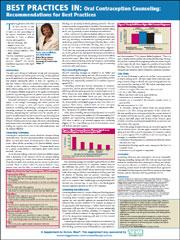
BEST PRACTICES IN: Oral Contraception Counseling: Recommendations for Best Practices
A supplement to Ob.Gyn. News. This supplement was sponsored by TEVA Women's Health.
•Topics
•Faculty/Faculty Disclosure
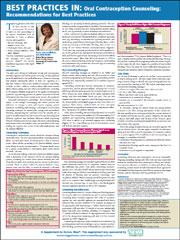
To view the supplement, click the image above.
Topics
• Counseling Techniques
• Key Counseling Messages
• Counseling and Adherence
• Case Study
Faculty/Faculty Disclosure
Versie Johnson-Mallard, PhD, MSN, MSMS
Nurse Faculty Scholar
Robert Wood Johnson
University of South Florida
Tampa, FL
Dr Johnson-Mallard has nothing to disclose.
Copyright © 2011 by Elsevier Inc.
A supplement to Ob.Gyn. News. This supplement was sponsored by TEVA Women's Health.
•Topics
•Faculty/Faculty Disclosure
To view the supplement, click the image above.
Topics
• Counseling Techniques
• Key Counseling Messages
• Counseling and Adherence
• Case Study
Faculty/Faculty Disclosure
Versie Johnson-Mallard, PhD, MSN, MSMS
Nurse Faculty Scholar
Robert Wood Johnson
University of South Florida
Tampa, FL
Dr Johnson-Mallard has nothing to disclose.
Copyright © 2011 by Elsevier Inc.
A supplement to Ob.Gyn. News. This supplement was sponsored by TEVA Women's Health.
•Topics
•Faculty/Faculty Disclosure
To view the supplement, click the image above.
Topics
• Counseling Techniques
• Key Counseling Messages
• Counseling and Adherence
• Case Study
Faculty/Faculty Disclosure
Versie Johnson-Mallard, PhD, MSN, MSMS
Nurse Faculty Scholar
Robert Wood Johnson
University of South Florida
Tampa, FL
Dr Johnson-Mallard has nothing to disclose.
Copyright © 2011 by Elsevier Inc.
Clinical UpdateThe Latest Techniques for Preventing Adhesions in Cesarean Delivery
The Latest Techniques for Preventing Adhesions in Cesarean Delivery
A supplement to Ob.Gyn. News. This supplement was sponsored by Ethicon Women's Health & Urology.
•Topics
•Faculty/Faculty Disclosure
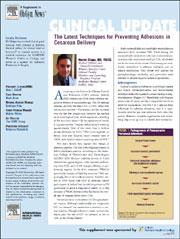
To view the supplement, click the image above.
Topics
• Introduction
• Adhesiogenesis
• Adhesion Frequency in Cesarean Deliveries
• General and Obstetric Sequelae of Adhesions
• Where Are Adhesions Most Likely to Develop?
• Should We Do Peritoneal Closure?
• Adhesion Prevention
• Data on Clinical Effectiveness
• Using ORC at Cesarean Delivery
Faculty/Faculty Disclosure
Hector Chapa, MD, FACOG
Medical Director and Outreach Coordinator
Women's Specialty Center
Clinical Faculty
Obstetrics and Gynecology
Residency Program
Methodist Medical Center
Dallas, Texas
Dr Chapa has received clinical grant funding from Johnson & Johnson Medical Affairs for clinical trials of Interceed
A supplement to Ob.Gyn. News. This supplement was sponsored by Ethicon Women's Health & Urology.
•Topics
•Faculty/Faculty Disclosure
To view the supplement, click the image above.
Topics
• Introduction
• Adhesiogenesis
• Adhesion Frequency in Cesarean Deliveries
• General and Obstetric Sequelae of Adhesions
• Where Are Adhesions Most Likely to Develop?
• Should We Do Peritoneal Closure?
• Adhesion Prevention
• Data on Clinical Effectiveness
• Using ORC at Cesarean Delivery
Faculty/Faculty Disclosure
Hector Chapa, MD, FACOG
Medical Director and Outreach Coordinator
Women's Specialty Center
Clinical Faculty
Obstetrics and Gynecology
Residency Program
Methodist Medical Center
Dallas, Texas
Dr Chapa has received clinical grant funding from Johnson & Johnson Medical Affairs for clinical trials of Interceed
A supplement to Ob.Gyn. News. This supplement was sponsored by Ethicon Women's Health & Urology.
•Topics
•Faculty/Faculty Disclosure
To view the supplement, click the image above.
Topics
• Introduction
• Adhesiogenesis
• Adhesion Frequency in Cesarean Deliveries
• General and Obstetric Sequelae of Adhesions
• Where Are Adhesions Most Likely to Develop?
• Should We Do Peritoneal Closure?
• Adhesion Prevention
• Data on Clinical Effectiveness
• Using ORC at Cesarean Delivery
Faculty/Faculty Disclosure
Hector Chapa, MD, FACOG
Medical Director and Outreach Coordinator
Women's Specialty Center
Clinical Faculty
Obstetrics and Gynecology
Residency Program
Methodist Medical Center
Dallas, Texas
Dr Chapa has received clinical grant funding from Johnson & Johnson Medical Affairs for clinical trials of Interceed
The Latest Techniques for Preventing Adhesions in Cesarean Delivery
The Latest Techniques for Preventing Adhesions in Cesarean Delivery