User login
Almost a third of children aged 8-15 years misperceive their weight, with the majority of overweight children having incorrect perceptions of their weight, the National Center for Health Statistics reported.
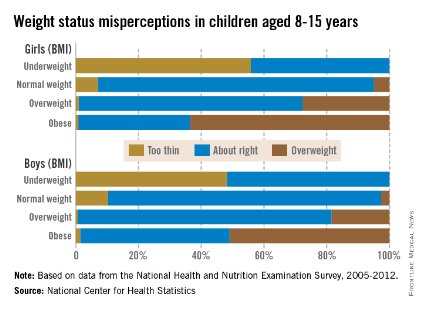
Weight misperception is very high in all overweight and obese children, with 81% of overweight boys and 48% of obese boys viewing themselves as being of normal weight. For girls aged 8-15 years, 71% of those who are overweight and 36% of those who are obese believe they are the correct weight, according to the NCHS report.
About 30% of all children surveyed from 2005 to 2012 misperceived their weight status, with misperception being higher in boys than in girls. Weight-status misperception was also more common in children than in adolescents, with 33% of children aged 8-11 years and 27% of adolescents aged 12-15 years misperceiving their weight, the NCHS investigators noted.
The common misconception of weight status makes combating childhood obesity difficult, as "accurate self-perception of weight status has been linked to appropriate weight control behaviors in youth. Understanding the prevalence of weight status misconception among U.S children and adolescents may help inform public health interventions," they said.
The NCHS study used data from the National Health and Nutrition Examination Survey, 2005-20012 (NHANES).
Almost a third of children aged 8-15 years misperceive their weight, with the majority of overweight children having incorrect perceptions of their weight, the National Center for Health Statistics reported.
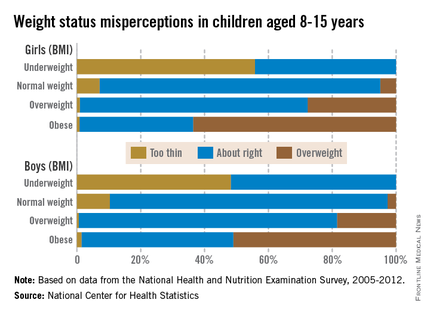
Weight misperception is very high in all overweight and obese children, with 81% of overweight boys and 48% of obese boys viewing themselves as being of normal weight. For girls aged 8-15 years, 71% of those who are overweight and 36% of those who are obese believe they are the correct weight, according to the NCHS report.
About 30% of all children surveyed from 2005 to 2012 misperceived their weight status, with misperception being higher in boys than in girls. Weight-status misperception was also more common in children than in adolescents, with 33% of children aged 8-11 years and 27% of adolescents aged 12-15 years misperceiving their weight, the NCHS investigators noted.
The common misconception of weight status makes combating childhood obesity difficult, as "accurate self-perception of weight status has been linked to appropriate weight control behaviors in youth. Understanding the prevalence of weight status misconception among U.S children and adolescents may help inform public health interventions," they said.
The NCHS study used data from the National Health and Nutrition Examination Survey, 2005-20012 (NHANES).
Almost a third of children aged 8-15 years misperceive their weight, with the majority of overweight children having incorrect perceptions of their weight, the National Center for Health Statistics reported.
Weight misperception is very high in all overweight and obese children, with 81% of overweight boys and 48% of obese boys viewing themselves as being of normal weight. For girls aged 8-15 years, 71% of those who are overweight and 36% of those who are obese believe they are the correct weight, according to the NCHS report.
About 30% of all children surveyed from 2005 to 2012 misperceived their weight status, with misperception being higher in boys than in girls. Weight-status misperception was also more common in children than in adolescents, with 33% of children aged 8-11 years and 27% of adolescents aged 12-15 years misperceiving their weight, the NCHS investigators noted.
The common misconception of weight status makes combating childhood obesity difficult, as "accurate self-perception of weight status has been linked to appropriate weight control behaviors in youth. Understanding the prevalence of weight status misconception among U.S children and adolescents may help inform public health interventions," they said.
The NCHS study used data from the National Health and Nutrition Examination Survey, 2005-20012 (NHANES).