User login
Respiratory disorders presenting in troops deployed to Iraq and Afghanistan require a standardized diagnostic approach and centers of excellence with specific expertise.
Those recommendations are part of forthcoming white paper to be released by National Jewish Health in Denver designed to better define and manage deployment-related lung diseases, a controversial diagnosis that has stirred debate over its cause and potential for long-term disability and costly government compensation.
"I think there’s confusion within the Department of Medical Affairs about how to assess whether people have suffered some deployment-related lung condition," says Dr. Cecile Rose, a member of the white paper working group and director of the occupational and environmental medicine clinic at National Jewish Health.
In the community setting, "I think it’s just starting to hit the radar screen of physicians, if it’s even there," she adds.
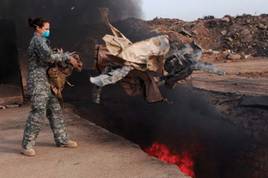
Researchers point to inhalational exposure to a complex mixture of high ambient dust levels, combustion products, extremes of temperature and humidity, and open-air burn pits used to burn garbage on military bases. Military officials contend that development of respiratory diseases will depend not only on the type and extent of exposure, but on comorbidities such as preexisting asthma, tobacco use, and genetic predisposition. A consensus report released in October 2011 by the Institute of Medicine and sponsored by the U.S. Department of Defense (DOD) concluded there was insufficient data to link burn pit exposure in Iraq to chronic respiratory diseases.
Part of the challenge in truly understanding the risk is that the exposures are problematic to characterize, Dr. Rose says. Some troops may have had particular job duties that placed them in much closer proximity to burn pit combustion products, while others have had multiple deployments that could suggest a dose-dependent effect.
In terms of a hallmark diagnostic clue, there isn’t one, she says. Many veterans complain of dyspnea upon exertion and say they used to be able to run 2 miles in 14 minutes, but now can’t even get close to passing the military’s physical fitness requirements. A handful will have abnormal pulmonary function testing either at rest or with exercise, but there are also a substantial number with normal pulmonary tests and normal high-resolution computed tomography.
"Then the physician is in the challenging position of having to decide whether to send someone for a surgical lung biopsy to evaluate the possibility of constrictive bronchiolitis because you can’t make that diagnosis without a biopsy," Dr. Rose says. The working group is attempting to create a standardized approach to diagnosis and a model for clinical centers of excellence where patients could be sent to undergo testing and assessment that would include consideration of surgical lung biopsy.
Physicians at Vanderbilt University in Nashville, Tenn., and Fort Campbell, Ky., had created just such a collaborative diagnostic protocol, but the referrals stopped after the working group convened in February 2010, says Dr. Robert F. Miller, a pulmonologist at the Vanderbilt-Ingram Cancer Center in Nashville. Instead of traveling the 30 or so miles from Fort Campbell to Vanderbilt, soldiers are now sent several hundred miles away to Fort Hood in Texas, "where you can pretty much be assured they are not going to get an invasive workup and are going to leave without a diagnosis or disability benefit," he adds.
Together with colleague Dr. Matthew King, Dr. Miller published the largest case series to date in which open lung biopsy was used to diagnose 38 cases of constrictive bronchiolitis and 11 other lung ailments in 49 Fort Campbell soldiers with unexplained exertional dyspnea and normal pulmonary-function and cardiopulmonary-exercise testing (N. Engl. J. Med. 2011;365: 222-30).
The findings have largely been embraced by the academic and wider medical community, but there was some criticism for the unorthodox use of the invasive test and the potential for bias because of the high diagnostic yield and use of two unblinded pathologists (N. Engl. J. Med. 2011;365:1743-45). Dr. Miller agrees that a lung biopsy is not the standard of care in this setting, but says they opted to use it "after seeing too many soldiers with the exact same story." To date, he’s biopsied 66 soldiers, with 62 showing small airways disease, 3 sarcoid, and 1 normal.
Over the next 6 months, Dr. Rose and her associates will send 50 of the biopsies, along with both positive and negative control samples, to a panel of pathologists to develop a small airway scoring system. Dr. Miller doesn’t expect 100% concordance with his results, but believes the DOD-funded research will validate Vanderbilt’s findings of small airways disease.
"I talk to people every week just to validate what we’ve done and there have been biopsies done all over the country that are finding the same thing in Nevada, Kansas, Colorado, Seattle, Chicago," he says. "So everybody is finding this, if they’re looking for it."
Still, the biopsies are beginning to look a bit different. They still contain the same features of small airway narrowing, associated arteriopathy and pigment deposits, but are more likely to have changes of inflammation and hypersensitivity than scarring, Dr. Miller says. One explanation is that part of his population may have been skewed up front because a lot of the soldiers seen early on were exposed to the Mishraq sulfur mine fires in 2003 – an argument raised by military officials who argued that this type of exposure is unique to the study cohort.
Interestingly, a recent case report by Dr. Anthony Szema, with The State University of New York at Stony Brook, identified titanium, iron, and copper in the lung biopsy of a soldier with nonspecific interstitial pneumonitis and bronchiolitis (J. Occup. Environ. Med. 2012;54:1-2).
Lessons Learned From 9/11
Two other key recommendations from the working group are to institute predeployment respiratory testing, including spirometry, and to follow the troops longitudinally. Annual pulmonary function test data from World Trade Center firefighters has proven invaluable in assessing the impact of exposure, revealing a very acute and substantial decline in forced expiratory volume in 1 second (FEV1) averaging 600 cc within the first 6 months after 911, typically followed by a return to the normal age-related decline in FEV1, Dr. Rose says.
"We’re really just starting to follow our patients now, so whether this is an acute decline that then stabilizes or whether this is a persistent accelerated decline in lung function, we just don’t know," she admits.
So far, pulmonary function testing has been relatively stable, although patients will typically say they are more short of breath, Dr. Miller says. When they’ve been able to check it, their exercise tests are getting worse, a change he suggests is probably better explained by deconditioning and weight gain than by progression and disease.
Dr. Miller says the best way to assess predeployment lung function is for each soldier to serve as his or her own control, but that it may not be practical to test everyone who’s deployed. Still, if enough cardiopulmonary testing is performed, it may help determine how a soldier at a particular age, height, and weight with a specific 2-mile run time would correlate with a cardiopulmonary test. At the very least, the 2-mile run times should be put in the medical record, and that is not the case now, he says.
For their part, military officials have said they do not believe long-term respiratory problems will be an issue for the majority of troops deployed to Iraq and Afghanistan, and that predeployment spirometry is not warranted.
Although troops typically express relief at a diagnosis, the prognosis for constrictive bronchiolitis is grim. None of the patients have responded well to oral corticosteroids or in a few cases, to second-line immunosuppressive drugs, Dr. Rose says.
Recent news reports are being used by veterans to push for better care, with one group, DisabledVeterans.org, recently launching a breathing survey to document soldiers’ health and experience with the Department of Veterans Affairs.
The exact scope of the problem is unknown, but the financial ramifications for the government are potentially staggering given the roughly two million troops deployed since 2001. The prospective DOD Millennium Cohort study reported respiratory problems in 14% of troops deployed to Iraq/Afghanistan and 10% of troops not deployed (Am. J. Epidemiol. 2009;170:1433-42), while a retrospective study by Dr. Szema reported respiratory symptoms requiring spirometry in 14.5% of Iraq/Afghanistan troops vs. just 2% of troops deployed elsewhere (J. Occup. Environ. Med. 2011;53:961-5).
For Dr. Miller, it has become a matter of advocacy.
"What these guys sacrifice is incredible, even when they’re not injured, and they deserve better than what they’re getting when they’re injured, whether it’s loss of limb, PTSD or a lung injury," he argues. "I hope we can prevail in what we’re doing."
Respiratory disorders presenting in troops deployed to Iraq and Afghanistan require a standardized diagnostic approach and centers of excellence with specific expertise.
Those recommendations are part of forthcoming white paper to be released by National Jewish Health in Denver designed to better define and manage deployment-related lung diseases, a controversial diagnosis that has stirred debate over its cause and potential for long-term disability and costly government compensation.
"I think there’s confusion within the Department of Medical Affairs about how to assess whether people have suffered some deployment-related lung condition," says Dr. Cecile Rose, a member of the white paper working group and director of the occupational and environmental medicine clinic at National Jewish Health.
In the community setting, "I think it’s just starting to hit the radar screen of physicians, if it’s even there," she adds.
Researchers point to inhalational exposure to a complex mixture of high ambient dust levels, combustion products, extremes of temperature and humidity, and open-air burn pits used to burn garbage on military bases. Military officials contend that development of respiratory diseases will depend not only on the type and extent of exposure, but on comorbidities such as preexisting asthma, tobacco use, and genetic predisposition. A consensus report released in October 2011 by the Institute of Medicine and sponsored by the U.S. Department of Defense (DOD) concluded there was insufficient data to link burn pit exposure in Iraq to chronic respiratory diseases.
Part of the challenge in truly understanding the risk is that the exposures are problematic to characterize, Dr. Rose says. Some troops may have had particular job duties that placed them in much closer proximity to burn pit combustion products, while others have had multiple deployments that could suggest a dose-dependent effect.
In terms of a hallmark diagnostic clue, there isn’t one, she says. Many veterans complain of dyspnea upon exertion and say they used to be able to run 2 miles in 14 minutes, but now can’t even get close to passing the military’s physical fitness requirements. A handful will have abnormal pulmonary function testing either at rest or with exercise, but there are also a substantial number with normal pulmonary tests and normal high-resolution computed tomography.
"Then the physician is in the challenging position of having to decide whether to send someone for a surgical lung biopsy to evaluate the possibility of constrictive bronchiolitis because you can’t make that diagnosis without a biopsy," Dr. Rose says. The working group is attempting to create a standardized approach to diagnosis and a model for clinical centers of excellence where patients could be sent to undergo testing and assessment that would include consideration of surgical lung biopsy.
Physicians at Vanderbilt University in Nashville, Tenn., and Fort Campbell, Ky., had created just such a collaborative diagnostic protocol, but the referrals stopped after the working group convened in February 2010, says Dr. Robert F. Miller, a pulmonologist at the Vanderbilt-Ingram Cancer Center in Nashville. Instead of traveling the 30 or so miles from Fort Campbell to Vanderbilt, soldiers are now sent several hundred miles away to Fort Hood in Texas, "where you can pretty much be assured they are not going to get an invasive workup and are going to leave without a diagnosis or disability benefit," he adds.
Together with colleague Dr. Matthew King, Dr. Miller published the largest case series to date in which open lung biopsy was used to diagnose 38 cases of constrictive bronchiolitis and 11 other lung ailments in 49 Fort Campbell soldiers with unexplained exertional dyspnea and normal pulmonary-function and cardiopulmonary-exercise testing (N. Engl. J. Med. 2011;365: 222-30).
The findings have largely been embraced by the academic and wider medical community, but there was some criticism for the unorthodox use of the invasive test and the potential for bias because of the high diagnostic yield and use of two unblinded pathologists (N. Engl. J. Med. 2011;365:1743-45). Dr. Miller agrees that a lung biopsy is not the standard of care in this setting, but says they opted to use it "after seeing too many soldiers with the exact same story." To date, he’s biopsied 66 soldiers, with 62 showing small airways disease, 3 sarcoid, and 1 normal.
Over the next 6 months, Dr. Rose and her associates will send 50 of the biopsies, along with both positive and negative control samples, to a panel of pathologists to develop a small airway scoring system. Dr. Miller doesn’t expect 100% concordance with his results, but believes the DOD-funded research will validate Vanderbilt’s findings of small airways disease.
"I talk to people every week just to validate what we’ve done and there have been biopsies done all over the country that are finding the same thing in Nevada, Kansas, Colorado, Seattle, Chicago," he says. "So everybody is finding this, if they’re looking for it."
Still, the biopsies are beginning to look a bit different. They still contain the same features of small airway narrowing, associated arteriopathy and pigment deposits, but are more likely to have changes of inflammation and hypersensitivity than scarring, Dr. Miller says. One explanation is that part of his population may have been skewed up front because a lot of the soldiers seen early on were exposed to the Mishraq sulfur mine fires in 2003 – an argument raised by military officials who argued that this type of exposure is unique to the study cohort.
Interestingly, a recent case report by Dr. Anthony Szema, with The State University of New York at Stony Brook, identified titanium, iron, and copper in the lung biopsy of a soldier with nonspecific interstitial pneumonitis and bronchiolitis (J. Occup. Environ. Med. 2012;54:1-2).
Lessons Learned From 9/11
Two other key recommendations from the working group are to institute predeployment respiratory testing, including spirometry, and to follow the troops longitudinally. Annual pulmonary function test data from World Trade Center firefighters has proven invaluable in assessing the impact of exposure, revealing a very acute and substantial decline in forced expiratory volume in 1 second (FEV1) averaging 600 cc within the first 6 months after 911, typically followed by a return to the normal age-related decline in FEV1, Dr. Rose says.
"We’re really just starting to follow our patients now, so whether this is an acute decline that then stabilizes or whether this is a persistent accelerated decline in lung function, we just don’t know," she admits.
So far, pulmonary function testing has been relatively stable, although patients will typically say they are more short of breath, Dr. Miller says. When they’ve been able to check it, their exercise tests are getting worse, a change he suggests is probably better explained by deconditioning and weight gain than by progression and disease.
Dr. Miller says the best way to assess predeployment lung function is for each soldier to serve as his or her own control, but that it may not be practical to test everyone who’s deployed. Still, if enough cardiopulmonary testing is performed, it may help determine how a soldier at a particular age, height, and weight with a specific 2-mile run time would correlate with a cardiopulmonary test. At the very least, the 2-mile run times should be put in the medical record, and that is not the case now, he says.
For their part, military officials have said they do not believe long-term respiratory problems will be an issue for the majority of troops deployed to Iraq and Afghanistan, and that predeployment spirometry is not warranted.
Although troops typically express relief at a diagnosis, the prognosis for constrictive bronchiolitis is grim. None of the patients have responded well to oral corticosteroids or in a few cases, to second-line immunosuppressive drugs, Dr. Rose says.
Recent news reports are being used by veterans to push for better care, with one group, DisabledVeterans.org, recently launching a breathing survey to document soldiers’ health and experience with the Department of Veterans Affairs.
The exact scope of the problem is unknown, but the financial ramifications for the government are potentially staggering given the roughly two million troops deployed since 2001. The prospective DOD Millennium Cohort study reported respiratory problems in 14% of troops deployed to Iraq/Afghanistan and 10% of troops not deployed (Am. J. Epidemiol. 2009;170:1433-42), while a retrospective study by Dr. Szema reported respiratory symptoms requiring spirometry in 14.5% of Iraq/Afghanistan troops vs. just 2% of troops deployed elsewhere (J. Occup. Environ. Med. 2011;53:961-5).
For Dr. Miller, it has become a matter of advocacy.
"What these guys sacrifice is incredible, even when they’re not injured, and they deserve better than what they’re getting when they’re injured, whether it’s loss of limb, PTSD or a lung injury," he argues. "I hope we can prevail in what we’re doing."
Respiratory disorders presenting in troops deployed to Iraq and Afghanistan require a standardized diagnostic approach and centers of excellence with specific expertise.
Those recommendations are part of forthcoming white paper to be released by National Jewish Health in Denver designed to better define and manage deployment-related lung diseases, a controversial diagnosis that has stirred debate over its cause and potential for long-term disability and costly government compensation.
"I think there’s confusion within the Department of Medical Affairs about how to assess whether people have suffered some deployment-related lung condition," says Dr. Cecile Rose, a member of the white paper working group and director of the occupational and environmental medicine clinic at National Jewish Health.
In the community setting, "I think it’s just starting to hit the radar screen of physicians, if it’s even there," she adds.
Researchers point to inhalational exposure to a complex mixture of high ambient dust levels, combustion products, extremes of temperature and humidity, and open-air burn pits used to burn garbage on military bases. Military officials contend that development of respiratory diseases will depend not only on the type and extent of exposure, but on comorbidities such as preexisting asthma, tobacco use, and genetic predisposition. A consensus report released in October 2011 by the Institute of Medicine and sponsored by the U.S. Department of Defense (DOD) concluded there was insufficient data to link burn pit exposure in Iraq to chronic respiratory diseases.
Part of the challenge in truly understanding the risk is that the exposures are problematic to characterize, Dr. Rose says. Some troops may have had particular job duties that placed them in much closer proximity to burn pit combustion products, while others have had multiple deployments that could suggest a dose-dependent effect.
In terms of a hallmark diagnostic clue, there isn’t one, she says. Many veterans complain of dyspnea upon exertion and say they used to be able to run 2 miles in 14 minutes, but now can’t even get close to passing the military’s physical fitness requirements. A handful will have abnormal pulmonary function testing either at rest or with exercise, but there are also a substantial number with normal pulmonary tests and normal high-resolution computed tomography.
"Then the physician is in the challenging position of having to decide whether to send someone for a surgical lung biopsy to evaluate the possibility of constrictive bronchiolitis because you can’t make that diagnosis without a biopsy," Dr. Rose says. The working group is attempting to create a standardized approach to diagnosis and a model for clinical centers of excellence where patients could be sent to undergo testing and assessment that would include consideration of surgical lung biopsy.
Physicians at Vanderbilt University in Nashville, Tenn., and Fort Campbell, Ky., had created just such a collaborative diagnostic protocol, but the referrals stopped after the working group convened in February 2010, says Dr. Robert F. Miller, a pulmonologist at the Vanderbilt-Ingram Cancer Center in Nashville. Instead of traveling the 30 or so miles from Fort Campbell to Vanderbilt, soldiers are now sent several hundred miles away to Fort Hood in Texas, "where you can pretty much be assured they are not going to get an invasive workup and are going to leave without a diagnosis or disability benefit," he adds.
Together with colleague Dr. Matthew King, Dr. Miller published the largest case series to date in which open lung biopsy was used to diagnose 38 cases of constrictive bronchiolitis and 11 other lung ailments in 49 Fort Campbell soldiers with unexplained exertional dyspnea and normal pulmonary-function and cardiopulmonary-exercise testing (N. Engl. J. Med. 2011;365: 222-30).
The findings have largely been embraced by the academic and wider medical community, but there was some criticism for the unorthodox use of the invasive test and the potential for bias because of the high diagnostic yield and use of two unblinded pathologists (N. Engl. J. Med. 2011;365:1743-45). Dr. Miller agrees that a lung biopsy is not the standard of care in this setting, but says they opted to use it "after seeing too many soldiers with the exact same story." To date, he’s biopsied 66 soldiers, with 62 showing small airways disease, 3 sarcoid, and 1 normal.
Over the next 6 months, Dr. Rose and her associates will send 50 of the biopsies, along with both positive and negative control samples, to a panel of pathologists to develop a small airway scoring system. Dr. Miller doesn’t expect 100% concordance with his results, but believes the DOD-funded research will validate Vanderbilt’s findings of small airways disease.
"I talk to people every week just to validate what we’ve done and there have been biopsies done all over the country that are finding the same thing in Nevada, Kansas, Colorado, Seattle, Chicago," he says. "So everybody is finding this, if they’re looking for it."
Still, the biopsies are beginning to look a bit different. They still contain the same features of small airway narrowing, associated arteriopathy and pigment deposits, but are more likely to have changes of inflammation and hypersensitivity than scarring, Dr. Miller says. One explanation is that part of his population may have been skewed up front because a lot of the soldiers seen early on were exposed to the Mishraq sulfur mine fires in 2003 – an argument raised by military officials who argued that this type of exposure is unique to the study cohort.
Interestingly, a recent case report by Dr. Anthony Szema, with The State University of New York at Stony Brook, identified titanium, iron, and copper in the lung biopsy of a soldier with nonspecific interstitial pneumonitis and bronchiolitis (J. Occup. Environ. Med. 2012;54:1-2).
Lessons Learned From 9/11
Two other key recommendations from the working group are to institute predeployment respiratory testing, including spirometry, and to follow the troops longitudinally. Annual pulmonary function test data from World Trade Center firefighters has proven invaluable in assessing the impact of exposure, revealing a very acute and substantial decline in forced expiratory volume in 1 second (FEV1) averaging 600 cc within the first 6 months after 911, typically followed by a return to the normal age-related decline in FEV1, Dr. Rose says.
"We’re really just starting to follow our patients now, so whether this is an acute decline that then stabilizes or whether this is a persistent accelerated decline in lung function, we just don’t know," she admits.
So far, pulmonary function testing has been relatively stable, although patients will typically say they are more short of breath, Dr. Miller says. When they’ve been able to check it, their exercise tests are getting worse, a change he suggests is probably better explained by deconditioning and weight gain than by progression and disease.
Dr. Miller says the best way to assess predeployment lung function is for each soldier to serve as his or her own control, but that it may not be practical to test everyone who’s deployed. Still, if enough cardiopulmonary testing is performed, it may help determine how a soldier at a particular age, height, and weight with a specific 2-mile run time would correlate with a cardiopulmonary test. At the very least, the 2-mile run times should be put in the medical record, and that is not the case now, he says.
For their part, military officials have said they do not believe long-term respiratory problems will be an issue for the majority of troops deployed to Iraq and Afghanistan, and that predeployment spirometry is not warranted.
Although troops typically express relief at a diagnosis, the prognosis for constrictive bronchiolitis is grim. None of the patients have responded well to oral corticosteroids or in a few cases, to second-line immunosuppressive drugs, Dr. Rose says.
Recent news reports are being used by veterans to push for better care, with one group, DisabledVeterans.org, recently launching a breathing survey to document soldiers’ health and experience with the Department of Veterans Affairs.
The exact scope of the problem is unknown, but the financial ramifications for the government are potentially staggering given the roughly two million troops deployed since 2001. The prospective DOD Millennium Cohort study reported respiratory problems in 14% of troops deployed to Iraq/Afghanistan and 10% of troops not deployed (Am. J. Epidemiol. 2009;170:1433-42), while a retrospective study by Dr. Szema reported respiratory symptoms requiring spirometry in 14.5% of Iraq/Afghanistan troops vs. just 2% of troops deployed elsewhere (J. Occup. Environ. Med. 2011;53:961-5).
For Dr. Miller, it has become a matter of advocacy.
"What these guys sacrifice is incredible, even when they’re not injured, and they deserve better than what they’re getting when they’re injured, whether it’s loss of limb, PTSD or a lung injury," he argues. "I hope we can prevail in what we’re doing."