User login
Multiparametric cardiovascular MRI was found superior to single-photon emission computed tomography for evaluating stable angina in "the largest prospective, real-world assessment" of the newer technology done to date, published online Dec. 23 in the Lancet.
Both imaging techniques were compared against x-ray coronary angiography, the reference standard, in 752 men and women with suspected angina pectoris that required assessment to identify significant coronary heart disease.
The study findings "support the wider adoption of [multiparametric cardiovascular magnetic resonance imaging] for the diagnosis and management of stable coronary heart disease patients, in view of the growing concern of the cancer risk associated with medical-source ionizing radiation," said John P. Greenwood, Ph.D., of the Multidisciplinary Cardiovascular Research Centre and Leeds (U.K.) Institute of Genetics, Health, and Therapeutics, and his associates.
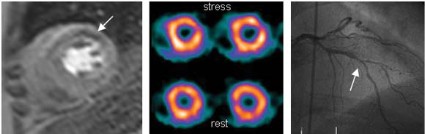
Multiparametric cardiovascular MRI allows the assessment of several possible pathologies in a single examination, including ventricular dysfunction, impaired myocardial perfusion, and abnormalities in the coronary artery anatomy. Dr. Greenwood and his colleagues performed the Clinical Evaluation of Magnetic Resonance Imaging in Coronary Heart Disease (CE-MARC) study "to establish the diagnostic accuracy [of the technique] in a large real-world population."
The study subjects were evaluated using cardiovascular MRI, single-photon emission computed tomography (SPECT), and x-ray angiography. The overall prevalence of significant coronary heart disease on x-ray angiography was 39%, which is typical in an outpatient population.
The sensitivity of cardiovascular MRI at detecting coronary heart disease (CHD) was 86.5%, which was significantly greater than the 66.5% sensitivity for SPECT. The specificity of cardiovascular MRI was 83.4%, compared with 82.6% for SPECT, a nonsignificant difference.

The positive predictive value of cardiovascular MRI was 77.2%, compared with 71.4% with SPECT, a nonsignificant difference. And the negative predictive value of cardiovascular MRI was 90.5%, which was significantly greater than the 79.1% negative predictive value for SPECT.
Thus, cardiovascular MRI was as accurate as SPECT in specificity and positive predictive value, but was superior in sensitivity and negative predictive value. "These findings support the wider adoption of cardiovascular MRI for coronary heart disease diagnosis and its inclusion in evidence-based clinical management guidelines," the investigators said (Lancet 2011 Dec. 23 [doi:10.1016/S0140-6736(11)61335-4]).
"Although we have not specifically sought to address why cardiovascular MRI has superior accuracy to SPECT, it might relate partly to its higher spatial resolution (2.2-3.2 mm, vs. approximately 10 mm in-plane for SPECT)," they added.
This study was limited in that the subjects were predominantly white and of northern European ancestry; results might be different in populations of other ethnicities. In addition, CE-MARC was conducted at a single center with a high volume of coronary imaging procedures, the researchers wrote. "Extrapolation to low-volume centers should be made with caution," they said.
This study was supported by the British Heart Foundation. No conflicts of interest were reported.
It is still uncertain whether cardiovascular MRI will replace SPECT or other established tests such as stress echocardiography, said Dr. Robert O. Bonow.
The technique’s superior diagnostic accuracy must be balanced against its limited availability and high cost. Moreover, there is no evidence yet that use of cardiovascular MRI measurably improves patient outcomes.
"Comparative effectiveness trials, such as those underway comparing standard stress imaging methods with noninvasive CT coronary angiography, must show whether cardiovascular MRI provides an incremental increase in value compared with SPECT and echocardiography in clinical practice," he said.
Dr. Bonow is at the Center for Cardiovascular Innovation at Northwestern University Feinberg School of Medicine, Chicago. He reported no financial conflicts of interest. These remarks were taken from his commentary accompanying the report of Dr. Greenwood and colleagues (Lancet 2011 [doi:10.1016/S0140-6736(11)61671-1]).
It is still uncertain whether cardiovascular MRI will replace SPECT or other established tests such as stress echocardiography, said Dr. Robert O. Bonow.
The technique’s superior diagnostic accuracy must be balanced against its limited availability and high cost. Moreover, there is no evidence yet that use of cardiovascular MRI measurably improves patient outcomes.
"Comparative effectiveness trials, such as those underway comparing standard stress imaging methods with noninvasive CT coronary angiography, must show whether cardiovascular MRI provides an incremental increase in value compared with SPECT and echocardiography in clinical practice," he said.
Dr. Bonow is at the Center for Cardiovascular Innovation at Northwestern University Feinberg School of Medicine, Chicago. He reported no financial conflicts of interest. These remarks were taken from his commentary accompanying the report of Dr. Greenwood and colleagues (Lancet 2011 [doi:10.1016/S0140-6736(11)61671-1]).
It is still uncertain whether cardiovascular MRI will replace SPECT or other established tests such as stress echocardiography, said Dr. Robert O. Bonow.
The technique’s superior diagnostic accuracy must be balanced against its limited availability and high cost. Moreover, there is no evidence yet that use of cardiovascular MRI measurably improves patient outcomes.
"Comparative effectiveness trials, such as those underway comparing standard stress imaging methods with noninvasive CT coronary angiography, must show whether cardiovascular MRI provides an incremental increase in value compared with SPECT and echocardiography in clinical practice," he said.
Dr. Bonow is at the Center for Cardiovascular Innovation at Northwestern University Feinberg School of Medicine, Chicago. He reported no financial conflicts of interest. These remarks were taken from his commentary accompanying the report of Dr. Greenwood and colleagues (Lancet 2011 [doi:10.1016/S0140-6736(11)61671-1]).
Multiparametric cardiovascular MRI was found superior to single-photon emission computed tomography for evaluating stable angina in "the largest prospective, real-world assessment" of the newer technology done to date, published online Dec. 23 in the Lancet.
Both imaging techniques were compared against x-ray coronary angiography, the reference standard, in 752 men and women with suspected angina pectoris that required assessment to identify significant coronary heart disease.
The study findings "support the wider adoption of [multiparametric cardiovascular magnetic resonance imaging] for the diagnosis and management of stable coronary heart disease patients, in view of the growing concern of the cancer risk associated with medical-source ionizing radiation," said John P. Greenwood, Ph.D., of the Multidisciplinary Cardiovascular Research Centre and Leeds (U.K.) Institute of Genetics, Health, and Therapeutics, and his associates.
Multiparametric cardiovascular MRI allows the assessment of several possible pathologies in a single examination, including ventricular dysfunction, impaired myocardial perfusion, and abnormalities in the coronary artery anatomy. Dr. Greenwood and his colleagues performed the Clinical Evaluation of Magnetic Resonance Imaging in Coronary Heart Disease (CE-MARC) study "to establish the diagnostic accuracy [of the technique] in a large real-world population."
The study subjects were evaluated using cardiovascular MRI, single-photon emission computed tomography (SPECT), and x-ray angiography. The overall prevalence of significant coronary heart disease on x-ray angiography was 39%, which is typical in an outpatient population.
The sensitivity of cardiovascular MRI at detecting coronary heart disease (CHD) was 86.5%, which was significantly greater than the 66.5% sensitivity for SPECT. The specificity of cardiovascular MRI was 83.4%, compared with 82.6% for SPECT, a nonsignificant difference.
The positive predictive value of cardiovascular MRI was 77.2%, compared with 71.4% with SPECT, a nonsignificant difference. And the negative predictive value of cardiovascular MRI was 90.5%, which was significantly greater than the 79.1% negative predictive value for SPECT.
Thus, cardiovascular MRI was as accurate as SPECT in specificity and positive predictive value, but was superior in sensitivity and negative predictive value. "These findings support the wider adoption of cardiovascular MRI for coronary heart disease diagnosis and its inclusion in evidence-based clinical management guidelines," the investigators said (Lancet 2011 Dec. 23 [doi:10.1016/S0140-6736(11)61335-4]).
"Although we have not specifically sought to address why cardiovascular MRI has superior accuracy to SPECT, it might relate partly to its higher spatial resolution (2.2-3.2 mm, vs. approximately 10 mm in-plane for SPECT)," they added.
This study was limited in that the subjects were predominantly white and of northern European ancestry; results might be different in populations of other ethnicities. In addition, CE-MARC was conducted at a single center with a high volume of coronary imaging procedures, the researchers wrote. "Extrapolation to low-volume centers should be made with caution," they said.
This study was supported by the British Heart Foundation. No conflicts of interest were reported.
Multiparametric cardiovascular MRI was found superior to single-photon emission computed tomography for evaluating stable angina in "the largest prospective, real-world assessment" of the newer technology done to date, published online Dec. 23 in the Lancet.
Both imaging techniques were compared against x-ray coronary angiography, the reference standard, in 752 men and women with suspected angina pectoris that required assessment to identify significant coronary heart disease.
The study findings "support the wider adoption of [multiparametric cardiovascular magnetic resonance imaging] for the diagnosis and management of stable coronary heart disease patients, in view of the growing concern of the cancer risk associated with medical-source ionizing radiation," said John P. Greenwood, Ph.D., of the Multidisciplinary Cardiovascular Research Centre and Leeds (U.K.) Institute of Genetics, Health, and Therapeutics, and his associates.
Multiparametric cardiovascular MRI allows the assessment of several possible pathologies in a single examination, including ventricular dysfunction, impaired myocardial perfusion, and abnormalities in the coronary artery anatomy. Dr. Greenwood and his colleagues performed the Clinical Evaluation of Magnetic Resonance Imaging in Coronary Heart Disease (CE-MARC) study "to establish the diagnostic accuracy [of the technique] in a large real-world population."
The study subjects were evaluated using cardiovascular MRI, single-photon emission computed tomography (SPECT), and x-ray angiography. The overall prevalence of significant coronary heart disease on x-ray angiography was 39%, which is typical in an outpatient population.
The sensitivity of cardiovascular MRI at detecting coronary heart disease (CHD) was 86.5%, which was significantly greater than the 66.5% sensitivity for SPECT. The specificity of cardiovascular MRI was 83.4%, compared with 82.6% for SPECT, a nonsignificant difference.
The positive predictive value of cardiovascular MRI was 77.2%, compared with 71.4% with SPECT, a nonsignificant difference. And the negative predictive value of cardiovascular MRI was 90.5%, which was significantly greater than the 79.1% negative predictive value for SPECT.
Thus, cardiovascular MRI was as accurate as SPECT in specificity and positive predictive value, but was superior in sensitivity and negative predictive value. "These findings support the wider adoption of cardiovascular MRI for coronary heart disease diagnosis and its inclusion in evidence-based clinical management guidelines," the investigators said (Lancet 2011 Dec. 23 [doi:10.1016/S0140-6736(11)61335-4]).
"Although we have not specifically sought to address why cardiovascular MRI has superior accuracy to SPECT, it might relate partly to its higher spatial resolution (2.2-3.2 mm, vs. approximately 10 mm in-plane for SPECT)," they added.
This study was limited in that the subjects were predominantly white and of northern European ancestry; results might be different in populations of other ethnicities. In addition, CE-MARC was conducted at a single center with a high volume of coronary imaging procedures, the researchers wrote. "Extrapolation to low-volume centers should be made with caution," they said.
This study was supported by the British Heart Foundation. No conflicts of interest were reported.
FROM THE LANCET
Major Finding: Cardiovascular MRI had superior sensitivity (86.5% vs 66.5%) and negative predictive value (90.5% vs 79.1%), compared with SPECT, and had comparable specificity (83.4% vs 82.6%) and positive predictive value (77.2% vs 71.4%).
Data Source: Prospective trial comparing cardiovascular MRI and SPECT against x-ray coronary angiography in assessing stable angina in 752 patients.
Disclosures: This study was supported by the British Heart Foundation. No conflicts of interest were reported.