User login
New antihemophilic factors last longer than standard treatments
WARSAW—Recombinant Fc fusion proteins can provide long-lasting protection from bleeding in patients with hemophilia A or B, according to data presented at the 6th Annual Congress of the European Association for Haemophilia and Allied Disorders.
Data from the phase 3 A-LONG study indicated that patients with hemophilia A could maintain low bleeding rates with once- to twice-weekly prophylactic injections of a recombinant factor VIII Fc fusion protein (rFVIIIFc, efmoroctocog alfa/Elocta, Eloctate).
Similarly, results of the phase 3 B-LONG study showed that patients with hemophilia B had low bleeding rates when they received prophylactic injections of a recombinant factor IX Fc fusion protein (rFIXFc, eftrenonacog alfa/Alprolix) every 1 to 2 weeks.
Both studies were sponsored by the companies developing these factors, Biogen Idec and Swedish Orphan Biovitrum (Sobi).
A-LONG data
In the A-LONG study, researchers evaluated the efficacy, safety, and pharmacokinetics of intravenous rFVIIIFc in 165 male patients aged 12 years and older. The team found that 98% of bleeding episodes were controlled by 1 or 2 injections of rFVIIIFc.
The factor was generally well-tolerated, and no inhibitors were detected. The most common adverse events (with an incidence of 5% or higher) were nasopharyngitis, arthralgia, headache, and upper respiratory tract infection.
The study also showed that rFVIIIFc stays in the body for 50% longer than Advate [antihemophilic factor (recombinant), plasma/albumin-free method], the most frequently used factor VIII therapy. The terminal half-life for rFVIIIFc was 19 hours, compared to 12 hours for Advate.
Additionally, the mean time for maintaining a clotting factor activity level associated with less bleeding (time to 1%) was approximately 5 days for rFVIIIFc, compared to 3.5 days for Advate. And the average rate at which rFVIIIFc was cleared from the body was 2.0 mL/hr/kg, compared with 3.0 mL/hr/kg for Advate.
In the study’s individualized prophylaxis arm, patients received rFVIIIFc at a median dosing interval of 3.5 days and a median weekly dose of 78 IU/kg to prevent bleeding, which compares favorably to the recommended dose for the standard of care. Nearly one-third of patients were able to achieve every-5-days dosing in this arm.
The A-LONG data were presented in the late-breaking oral abstract session and in poster 104, “Phase 3 clinical study of recombinant FC fusion factor FVIII (rFVIIIFc) demonstrated safety, efficacy, and improved pharmacokinetics (A-LONG).”
B-LONG data
In the B-LONG study, researchers evaluated the efficacy, safety, and pharmacokinetics of intravenous rFIXFc in 123 male patients aged 12 years and older. The team found that more than 90% of bleeding episodes were controlled by a single injection of rFIXFc.
rFIXFc was generally well-tolerated, and no inhibitors were detected. The most common adverse events (with an incidence of 5% or more) were nasopharyngitis, influenza, arthralgia, upper respiratory infection, hypertension, and headache.
One serious adverse event, obstructive uropathy in the setting of hematuria, may have been related to rFIXFc treatment. However, the patient continued to receive rFIXFc, and the event resolved with medical management.
The study also showed that rFIXFc stays in the body more than twice as long as BeneFIX [Coagulation Factor IX (Recombinant)], the only recombinant factor IX therapy currently approved for prophylactic use. The terminal half-life for rFIXFc was 82 hours, compared to 34 hours for BeneFIX.
In addition, the mean time for maintaining a normal clotting factor activity level (time to 1%) was 11 days for rFIXFc, compared to 5 days for BeneFIX. And the average rate at which rFIXFc was cleared from the body was 3.2 mL/hr/kg, compared with 6.3 mL/hr/kg for BeneFIX.
All patients in the individualized interval prophylaxis arm of the study were able to go at least 1 week between rFIXFc injections, and 50% could go 14 days or longer before needing another dose to prevent bleeding. The median weekly dose was 45 IU/kg, which is comparable to the recommended dose for the current standard of care.
The B-LONG data were presented in poster 115, “Safety, efficacy, and improved pharmacokinetics (PK) demonstrated in a phase 3 clinical trial of extended half-life recombinant FC fusion factor IX (B-LONG).” 
WARSAW—Recombinant Fc fusion proteins can provide long-lasting protection from bleeding in patients with hemophilia A or B, according to data presented at the 6th Annual Congress of the European Association for Haemophilia and Allied Disorders.
Data from the phase 3 A-LONG study indicated that patients with hemophilia A could maintain low bleeding rates with once- to twice-weekly prophylactic injections of a recombinant factor VIII Fc fusion protein (rFVIIIFc, efmoroctocog alfa/Elocta, Eloctate).
Similarly, results of the phase 3 B-LONG study showed that patients with hemophilia B had low bleeding rates when they received prophylactic injections of a recombinant factor IX Fc fusion protein (rFIXFc, eftrenonacog alfa/Alprolix) every 1 to 2 weeks.
Both studies were sponsored by the companies developing these factors, Biogen Idec and Swedish Orphan Biovitrum (Sobi).
A-LONG data
In the A-LONG study, researchers evaluated the efficacy, safety, and pharmacokinetics of intravenous rFVIIIFc in 165 male patients aged 12 years and older. The team found that 98% of bleeding episodes were controlled by 1 or 2 injections of rFVIIIFc.
The factor was generally well-tolerated, and no inhibitors were detected. The most common adverse events (with an incidence of 5% or higher) were nasopharyngitis, arthralgia, headache, and upper respiratory tract infection.
The study also showed that rFVIIIFc stays in the body for 50% longer than Advate [antihemophilic factor (recombinant), plasma/albumin-free method], the most frequently used factor VIII therapy. The terminal half-life for rFVIIIFc was 19 hours, compared to 12 hours for Advate.
Additionally, the mean time for maintaining a clotting factor activity level associated with less bleeding (time to 1%) was approximately 5 days for rFVIIIFc, compared to 3.5 days for Advate. And the average rate at which rFVIIIFc was cleared from the body was 2.0 mL/hr/kg, compared with 3.0 mL/hr/kg for Advate.
In the study’s individualized prophylaxis arm, patients received rFVIIIFc at a median dosing interval of 3.5 days and a median weekly dose of 78 IU/kg to prevent bleeding, which compares favorably to the recommended dose for the standard of care. Nearly one-third of patients were able to achieve every-5-days dosing in this arm.
The A-LONG data were presented in the late-breaking oral abstract session and in poster 104, “Phase 3 clinical study of recombinant FC fusion factor FVIII (rFVIIIFc) demonstrated safety, efficacy, and improved pharmacokinetics (A-LONG).”
B-LONG data
In the B-LONG study, researchers evaluated the efficacy, safety, and pharmacokinetics of intravenous rFIXFc in 123 male patients aged 12 years and older. The team found that more than 90% of bleeding episodes were controlled by a single injection of rFIXFc.
rFIXFc was generally well-tolerated, and no inhibitors were detected. The most common adverse events (with an incidence of 5% or more) were nasopharyngitis, influenza, arthralgia, upper respiratory infection, hypertension, and headache.
One serious adverse event, obstructive uropathy in the setting of hematuria, may have been related to rFIXFc treatment. However, the patient continued to receive rFIXFc, and the event resolved with medical management.
The study also showed that rFIXFc stays in the body more than twice as long as BeneFIX [Coagulation Factor IX (Recombinant)], the only recombinant factor IX therapy currently approved for prophylactic use. The terminal half-life for rFIXFc was 82 hours, compared to 34 hours for BeneFIX.
In addition, the mean time for maintaining a normal clotting factor activity level (time to 1%) was 11 days for rFIXFc, compared to 5 days for BeneFIX. And the average rate at which rFIXFc was cleared from the body was 3.2 mL/hr/kg, compared with 6.3 mL/hr/kg for BeneFIX.
All patients in the individualized interval prophylaxis arm of the study were able to go at least 1 week between rFIXFc injections, and 50% could go 14 days or longer before needing another dose to prevent bleeding. The median weekly dose was 45 IU/kg, which is comparable to the recommended dose for the current standard of care.
The B-LONG data were presented in poster 115, “Safety, efficacy, and improved pharmacokinetics (PK) demonstrated in a phase 3 clinical trial of extended half-life recombinant FC fusion factor IX (B-LONG).”
WARSAW—Recombinant Fc fusion proteins can provide long-lasting protection from bleeding in patients with hemophilia A or B, according to data presented at the 6th Annual Congress of the European Association for Haemophilia and Allied Disorders.
Data from the phase 3 A-LONG study indicated that patients with hemophilia A could maintain low bleeding rates with once- to twice-weekly prophylactic injections of a recombinant factor VIII Fc fusion protein (rFVIIIFc, efmoroctocog alfa/Elocta, Eloctate).
Similarly, results of the phase 3 B-LONG study showed that patients with hemophilia B had low bleeding rates when they received prophylactic injections of a recombinant factor IX Fc fusion protein (rFIXFc, eftrenonacog alfa/Alprolix) every 1 to 2 weeks.
Both studies were sponsored by the companies developing these factors, Biogen Idec and Swedish Orphan Biovitrum (Sobi).
A-LONG data
In the A-LONG study, researchers evaluated the efficacy, safety, and pharmacokinetics of intravenous rFVIIIFc in 165 male patients aged 12 years and older. The team found that 98% of bleeding episodes were controlled by 1 or 2 injections of rFVIIIFc.
The factor was generally well-tolerated, and no inhibitors were detected. The most common adverse events (with an incidence of 5% or higher) were nasopharyngitis, arthralgia, headache, and upper respiratory tract infection.
The study also showed that rFVIIIFc stays in the body for 50% longer than Advate [antihemophilic factor (recombinant), plasma/albumin-free method], the most frequently used factor VIII therapy. The terminal half-life for rFVIIIFc was 19 hours, compared to 12 hours for Advate.
Additionally, the mean time for maintaining a clotting factor activity level associated with less bleeding (time to 1%) was approximately 5 days for rFVIIIFc, compared to 3.5 days for Advate. And the average rate at which rFVIIIFc was cleared from the body was 2.0 mL/hr/kg, compared with 3.0 mL/hr/kg for Advate.
In the study’s individualized prophylaxis arm, patients received rFVIIIFc at a median dosing interval of 3.5 days and a median weekly dose of 78 IU/kg to prevent bleeding, which compares favorably to the recommended dose for the standard of care. Nearly one-third of patients were able to achieve every-5-days dosing in this arm.
The A-LONG data were presented in the late-breaking oral abstract session and in poster 104, “Phase 3 clinical study of recombinant FC fusion factor FVIII (rFVIIIFc) demonstrated safety, efficacy, and improved pharmacokinetics (A-LONG).”
B-LONG data
In the B-LONG study, researchers evaluated the efficacy, safety, and pharmacokinetics of intravenous rFIXFc in 123 male patients aged 12 years and older. The team found that more than 90% of bleeding episodes were controlled by a single injection of rFIXFc.
rFIXFc was generally well-tolerated, and no inhibitors were detected. The most common adverse events (with an incidence of 5% or more) were nasopharyngitis, influenza, arthralgia, upper respiratory infection, hypertension, and headache.
One serious adverse event, obstructive uropathy in the setting of hematuria, may have been related to rFIXFc treatment. However, the patient continued to receive rFIXFc, and the event resolved with medical management.
The study also showed that rFIXFc stays in the body more than twice as long as BeneFIX [Coagulation Factor IX (Recombinant)], the only recombinant factor IX therapy currently approved for prophylactic use. The terminal half-life for rFIXFc was 82 hours, compared to 34 hours for BeneFIX.
In addition, the mean time for maintaining a normal clotting factor activity level (time to 1%) was 11 days for rFIXFc, compared to 5 days for BeneFIX. And the average rate at which rFIXFc was cleared from the body was 3.2 mL/hr/kg, compared with 6.3 mL/hr/kg for BeneFIX.
All patients in the individualized interval prophylaxis arm of the study were able to go at least 1 week between rFIXFc injections, and 50% could go 14 days or longer before needing another dose to prevent bleeding. The median weekly dose was 45 IU/kg, which is comparable to the recommended dose for the current standard of care.
The B-LONG data were presented in poster 115, “Safety, efficacy, and improved pharmacokinetics (PK) demonstrated in a phase 3 clinical trial of extended half-life recombinant FC fusion factor IX (B-LONG).”
FDA approves plasma product
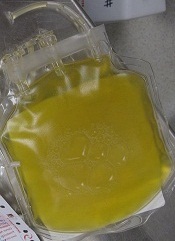
The FDA has approved a pooled plasma blood product (Octaplas) that can be used to replace coagulation factors in patients with certain medical conditions.
The product is a sterile, frozen solution of human plasma from several donors that has been treated with a solvent detergent process to minimize the risk of serious virus transmission.
The plasma used to manufacture Octaplas is collected from US donors who have been screened and tested for diseases transmitted by blood.
“For patients suffering with clotting disorders, this product provides a viable alternative to single-donor fresh-frozen plasma [FFP] and provides a reduced risk of certain viral transmissions,” said Karen Midthun, MD, director of the FDA’s Center for Biologics Evaluation and Research.
Indications and administration
Octaplas is indicated for the replacement of multiple coagulation factors in patients with acquired deficiencies due to liver disease or undergoing cardiac surgery or liver transplant. Octaplas can also be
used for plasma exchange in patients with thrombotic thrombocytopenic purpura (TTP).
Like FFP, Octaplas should be matched to the recipient’s blood group to help avoid transfusion reactions. Each lot of Octaplas is tested for composition of key clotting factors and is only released if the levels are within acceptable ranges.
The product is administered by intravenous infusion after thawing, using an infusion set with a filter. An aseptic technique must be used throughout the infusion.
The dosage depends upon the clinical situation and the underlying disorder. But 12-15 mL/kg of body weight is a generally accepted starting dose, and it should increase the patient’s plasma coagulation factor levels by about 25%.
It is important to monitor patient response, both clinically and with measurement of prothrombin time, partial thromboplastin time, and/or specific coagulation factor assays.
Prior experience with Octaplas
The FDA’s approval of Octaplas was primarily based on studies conducted in patients with liver disease, liver transplant, heart surgery, and TTP. The most common adverse reactions observed in these trials were shortness of breath, dizziness, chest discomfort, pruritis/rash, headache, and paresthesia.
Additional data supporting the safe use of Octaplas for the US market came from prior use of the product in Europe and other approved markets, where it has been used extensively.
A previous generation of Octaplas was first marketed in 1992, and the current version has been marketed since 2006. In total, more than 2 million patients outside the US have been treated with more than 7 million doses of Octaplas.
The product is manufactured by Octapharma, located in Vienna, Austria. For more information on Octaplas, visit the Octapharma website.
The FDA has approved a pooled plasma blood product (Octaplas) that can be used to replace coagulation factors in patients with certain medical conditions.
The product is a sterile, frozen solution of human plasma from several donors that has been treated with a solvent detergent process to minimize the risk of serious virus transmission.
The plasma used to manufacture Octaplas is collected from US donors who have been screened and tested for diseases transmitted by blood.
“For patients suffering with clotting disorders, this product provides a viable alternative to single-donor fresh-frozen plasma [FFP] and provides a reduced risk of certain viral transmissions,” said Karen Midthun, MD, director of the FDA’s Center for Biologics Evaluation and Research.
Indications and administration
Octaplas is indicated for the replacement of multiple coagulation factors in patients with acquired deficiencies due to liver disease or undergoing cardiac surgery or liver transplant. Octaplas can also be
used for plasma exchange in patients with thrombotic thrombocytopenic purpura (TTP).
Like FFP, Octaplas should be matched to the recipient’s blood group to help avoid transfusion reactions. Each lot of Octaplas is tested for composition of key clotting factors and is only released if the levels are within acceptable ranges.
The product is administered by intravenous infusion after thawing, using an infusion set with a filter. An aseptic technique must be used throughout the infusion.
The dosage depends upon the clinical situation and the underlying disorder. But 12-15 mL/kg of body weight is a generally accepted starting dose, and it should increase the patient’s plasma coagulation factor levels by about 25%.
It is important to monitor patient response, both clinically and with measurement of prothrombin time, partial thromboplastin time, and/or specific coagulation factor assays.
Prior experience with Octaplas
The FDA’s approval of Octaplas was primarily based on studies conducted in patients with liver disease, liver transplant, heart surgery, and TTP. The most common adverse reactions observed in these trials were shortness of breath, dizziness, chest discomfort, pruritis/rash, headache, and paresthesia.
Additional data supporting the safe use of Octaplas for the US market came from prior use of the product in Europe and other approved markets, where it has been used extensively.
A previous generation of Octaplas was first marketed in 1992, and the current version has been marketed since 2006. In total, more than 2 million patients outside the US have been treated with more than 7 million doses of Octaplas.
The product is manufactured by Octapharma, located in Vienna, Austria. For more information on Octaplas, visit the Octapharma website.
The FDA has approved a pooled plasma blood product (Octaplas) that can be used to replace coagulation factors in patients with certain medical conditions.
The product is a sterile, frozen solution of human plasma from several donors that has been treated with a solvent detergent process to minimize the risk of serious virus transmission.
The plasma used to manufacture Octaplas is collected from US donors who have been screened and tested for diseases transmitted by blood.
“For patients suffering with clotting disorders, this product provides a viable alternative to single-donor fresh-frozen plasma [FFP] and provides a reduced risk of certain viral transmissions,” said Karen Midthun, MD, director of the FDA’s Center for Biologics Evaluation and Research.
Indications and administration
Octaplas is indicated for the replacement of multiple coagulation factors in patients with acquired deficiencies due to liver disease or undergoing cardiac surgery or liver transplant. Octaplas can also be
used for plasma exchange in patients with thrombotic thrombocytopenic purpura (TTP).
Like FFP, Octaplas should be matched to the recipient’s blood group to help avoid transfusion reactions. Each lot of Octaplas is tested for composition of key clotting factors and is only released if the levels are within acceptable ranges.
The product is administered by intravenous infusion after thawing, using an infusion set with a filter. An aseptic technique must be used throughout the infusion.
The dosage depends upon the clinical situation and the underlying disorder. But 12-15 mL/kg of body weight is a generally accepted starting dose, and it should increase the patient’s plasma coagulation factor levels by about 25%.
It is important to monitor patient response, both clinically and with measurement of prothrombin time, partial thromboplastin time, and/or specific coagulation factor assays.
Prior experience with Octaplas
The FDA’s approval of Octaplas was primarily based on studies conducted in patients with liver disease, liver transplant, heart surgery, and TTP. The most common adverse reactions observed in these trials were shortness of breath, dizziness, chest discomfort, pruritis/rash, headache, and paresthesia.
Additional data supporting the safe use of Octaplas for the US market came from prior use of the product in Europe and other approved markets, where it has been used extensively.
A previous generation of Octaplas was first marketed in 1992, and the current version has been marketed since 2006. In total, more than 2 million patients outside the US have been treated with more than 7 million doses of Octaplas.
The product is manufactured by Octapharma, located in Vienna, Austria. For more information on Octaplas, visit the Octapharma website.
FDA approves apixaban for patients with NVAF
The FDA has approved the anticoagulant apixaban (Eliquis) as prophylaxis for stroke and systemic embolism in patients with nonvalvular atrial fibrillation (NVAF).
The agency’s decision is based on results of the ARISTOTLE trial, in which NVAF patients taking apixaban experienced fewer strokes than those on warfarin.
Apixaban use also resulted in lower rates of major bleeding and treatment discontinuation than warfarin.
The FDA had previously put off making a decision about apixaban, first last March and then in June, pending the receipt of additional data from the ARISTOTLE trial.
Though initial results of that study were promising, in other trials, apixaban produced mixed results.
In the APPRAISE-2 study, apixaban increased major bleeding in patients with acute coronary syndrome, without reducing recurrent ischemic events.
And although results of the ADVANCE-2 study suggested apixaban was superior to enoxaparin for the prevention of venous thromboembolism (VTE), the earlier ADVANCE study indicated the drugs were comparable in efficacy.
In the more recent AMPLIFY-EXTENSION study, apixaban reduced the incidence of VTE, VTE-related events, and death, when compared to placebo.
And in the AVERROES trial, apixaban proved superior to aspirin at preventing stroke in patients with atrial fibrillation who could not use vitamin K agonists.
Now, apixaban is approved for use in NVAF patients to reduce the risk of stroke and systemic embolism. The recommended dose for most patients is 5 mg orally twice daily.
But patients with at least 2 of the following characteristics—age of 80 years or older, weight of 60 kg or less, or serum creatinine of 1.5 mg/dL or greater—should receive 2.5 mg orally twice daily.
Patients with prosthetic heart valves should not take apixaban, nor should patients with atrial fibrillation caused by a heart valve problem. These patients have not been studied in clinical trials.
Bleeding, including life-threatening and fatal bleeding, is the most serious risk with apixaban. Additionally, the drug’s anticoagulant effects are irreversible.
Apixaban has also been approved in Japan, Canada, and the European Union. The drug is manufactured by Bristol-Myers Squibb Company of Princeton, New Jersey, and marketed by BMS and Pfizer Inc., of New York.
For additional information on apixaban, see the package insert.
The FDA has approved the anticoagulant apixaban (Eliquis) as prophylaxis for stroke and systemic embolism in patients with nonvalvular atrial fibrillation (NVAF).
The agency’s decision is based on results of the ARISTOTLE trial, in which NVAF patients taking apixaban experienced fewer strokes than those on warfarin.
Apixaban use also resulted in lower rates of major bleeding and treatment discontinuation than warfarin.
The FDA had previously put off making a decision about apixaban, first last March and then in June, pending the receipt of additional data from the ARISTOTLE trial.
Though initial results of that study were promising, in other trials, apixaban produced mixed results.
In the APPRAISE-2 study, apixaban increased major bleeding in patients with acute coronary syndrome, without reducing recurrent ischemic events.
And although results of the ADVANCE-2 study suggested apixaban was superior to enoxaparin for the prevention of venous thromboembolism (VTE), the earlier ADVANCE study indicated the drugs were comparable in efficacy.
In the more recent AMPLIFY-EXTENSION study, apixaban reduced the incidence of VTE, VTE-related events, and death, when compared to placebo.
And in the AVERROES trial, apixaban proved superior to aspirin at preventing stroke in patients with atrial fibrillation who could not use vitamin K agonists.
Now, apixaban is approved for use in NVAF patients to reduce the risk of stroke and systemic embolism. The recommended dose for most patients is 5 mg orally twice daily.
But patients with at least 2 of the following characteristics—age of 80 years or older, weight of 60 kg or less, or serum creatinine of 1.5 mg/dL or greater—should receive 2.5 mg orally twice daily.
Patients with prosthetic heart valves should not take apixaban, nor should patients with atrial fibrillation caused by a heart valve problem. These patients have not been studied in clinical trials.
Bleeding, including life-threatening and fatal bleeding, is the most serious risk with apixaban. Additionally, the drug’s anticoagulant effects are irreversible.
Apixaban has also been approved in Japan, Canada, and the European Union. The drug is manufactured by Bristol-Myers Squibb Company of Princeton, New Jersey, and marketed by BMS and Pfizer Inc., of New York.
For additional information on apixaban, see the package insert.
The FDA has approved the anticoagulant apixaban (Eliquis) as prophylaxis for stroke and systemic embolism in patients with nonvalvular atrial fibrillation (NVAF).
The agency’s decision is based on results of the ARISTOTLE trial, in which NVAF patients taking apixaban experienced fewer strokes than those on warfarin.
Apixaban use also resulted in lower rates of major bleeding and treatment discontinuation than warfarin.
The FDA had previously put off making a decision about apixaban, first last March and then in June, pending the receipt of additional data from the ARISTOTLE trial.
Though initial results of that study were promising, in other trials, apixaban produced mixed results.
In the APPRAISE-2 study, apixaban increased major bleeding in patients with acute coronary syndrome, without reducing recurrent ischemic events.
And although results of the ADVANCE-2 study suggested apixaban was superior to enoxaparin for the prevention of venous thromboembolism (VTE), the earlier ADVANCE study indicated the drugs were comparable in efficacy.
In the more recent AMPLIFY-EXTENSION study, apixaban reduced the incidence of VTE, VTE-related events, and death, when compared to placebo.
And in the AVERROES trial, apixaban proved superior to aspirin at preventing stroke in patients with atrial fibrillation who could not use vitamin K agonists.
Now, apixaban is approved for use in NVAF patients to reduce the risk of stroke and systemic embolism. The recommended dose for most patients is 5 mg orally twice daily.
But patients with at least 2 of the following characteristics—age of 80 years or older, weight of 60 kg or less, or serum creatinine of 1.5 mg/dL or greater—should receive 2.5 mg orally twice daily.
Patients with prosthetic heart valves should not take apixaban, nor should patients with atrial fibrillation caused by a heart valve problem. These patients have not been studied in clinical trials.
Bleeding, including life-threatening and fatal bleeding, is the most serious risk with apixaban. Additionally, the drug’s anticoagulant effects are irreversible.
Apixaban has also been approved in Japan, Canada, and the European Union. The drug is manufactured by Bristol-Myers Squibb Company of Princeton, New Jersey, and marketed by BMS and Pfizer Inc., of New York.
For additional information on apixaban, see the package insert.
Study supports extended apixaban use

Credit: Kevin MacKenzie
ATLANTA—Due to results of the AMPLIFY-EXTENSION study, researchers are recommending a new indication for apixaban: long-term use to prevent recurrent venous thromboembolism (VTE).
Study investigators compared 12 months of treatment with apixaban at 2 doses—2.5 mg and 5 mg—to placebo in patients who had previously received anticoagulant therapy for 6 to 12 months to treat a prior VTE.
The team found that both doses of apixaban effectively prevented VTE, VTE-related events, and death. And the incidence of bleeding events was low in all treatment arms.
“We believe that the study, given the results we achieved, should support the use of apixaban for the extended treatment of VTE,” said Giancarlo Agnelli, MD, of the University of Perugia in Italy.
Dr Agnelli presented these results in the late-breaking abstract session (LBA-1) of the 54th ASH Annual Meeting, which took place here December 8-11.
More detailed results of the study—which was funded by Bristol-Myers Squibb and Pfizer, joint developers of apixaban—have been published in NEJM.
Dr Agnelli noted that apixaban has proven effective as VTE prophylaxis when given at 2.5 mg after hip or knee replacement surgery. And the drug has been administered at 5 mg as stroke prevention in patients with atrial fibrillation.
So he and his colleagues wanted to determine if apixaban might be effective as long-term VTE prophylaxis in patients with a previous thrombotic event, as well as which dose might be optimal for these patients.
To find out, the researchers enrolled 2482 patients with a prior VTE who had completed 6 to 12 months of oral anticoagulant treatment without VTE recurrence or bleeding.
The team randomized 840 patients to receive apixaban at 2.5 mg BID, 813 patients to receive the drug at 5 mg BID, and 829 patients to receive placebo.
The patients were well-matched according age, gender, weight, initial diagnosis, and VTE clinical presentation. They received treatment for 12 months, after which they were followed for 30 days.
Efficacy data
The study’s primary efficacy endpoint was recurrent VTE or all-cause death. During the 12-month active study period, these events occurred in 32 patients (3.8%) in the 2.5-mg arm, 34 patients (4.2%) in the 5-mg arm, and 96 patients (11.6%) in the placebo arm. Both apixaban doses were significantly superior to placebo (P<0.001).
The researchers also calculated the incidence of recurrent VTE or VTE-related death. And these events occurred in 14 patients (1.7%) in the 2.5-mg arm, 14 patients (1.7%) in the 5-mg arm, and 73 patients (8.8%) in the placebo arm. Both apixaban doses were significantly superior to placebo (P<0.001).
A third composite endpoint consisted of recurrent VTE, VTE-related death, myocardial infarction, stroke, or cardiovascular-related death. This endpoint was met by 18 patients (2.1%) in the 2.5-mg arm, 19 patients (2.3%) in the 5-mg arm, and 83 patients (10.0%) in the placebo arm.
Overall, both doses of apixaban reduced the risk of fatal and non-fatal recurrent venous thromboembolism by 80%, Dr Agnelli said.
Events during follow-up
During the 30-day follow-up period, symptomatic, recurrent VTE occurred in 2 patients (0.2%) who had received placebo, 3 patients (0.4%) who had received apixaban at 2.5 mg, and 5 patients (0.6%) who had received apixaban at 5 mg.
The composite outcome of myocardial infarction, stroke, or death related to cardiovascular disease occurred in 2 patients: 1 who had received the lower dose of apixaban and 1 who received the higher dose.
Safety data
The study’s primary safety endpoint was major bleeding. In the 2.5-mg arm, 2 patients (0.2%) experienced major bleeding events, both of which were intraocular bleeds.
One patient (0.1%) in the 5-mg arm experienced a major gastrointestinal bleed. And 4 patients (0.5%) in the placebo arm experienced major bleeding events, including 1 intraocular bleed, 1 stroke, 1 urogenital bleed, and 1 gastrointestinal bleed.
A secondary endpoint was clinically relevant, non-major bleeding. This occurred in 25 patients (3.0%) in the 2.5-mg arm, 34 patients (4.2%) in the 5-mg arm, and 19 patients (2.3%) in the placebo arm.
Dr Agnelli and his colleagues also combined the major bleeding data and the clinically relevant, non-major bleeding data. So 27 patients (3.2%) in the 2.5-mg arm had a bleeding event of either kind, as did 35 patients (4.3%) in the 5-mg arm and 22 patients (2.7%) in the placebo arm.
Clinical interpretation
Finally, the researchers tried to put this data into a clinical context. They calculated the number of patients needed to treat 1 recurrent VTE in each of the apixaban arms. And they found that number was 14 patients per year with both doses of the drug.
The team also calculated the number of patients needed to inflict harm, in the form of 1 major or clinically relevant, non-major bleeding event. And they found that number was 200 patients per year in the 2.5-mg arm and 63 patients per year in the 5-mg arm.
In closing, Dr Agnelli said these results support the use of apixaban as long-term thromboprophylaxis in patients with a prior VTE.
“And, as a matter of speculation, we do believe that, given the similar efficacy and the possibility of less clinically relevant non-major bleeding, the dose of 2.5 mg of apixaban would be preferred by the clinician,” he added. 
Credit: Kevin MacKenzie
ATLANTA—Due to results of the AMPLIFY-EXTENSION study, researchers are recommending a new indication for apixaban: long-term use to prevent recurrent venous thromboembolism (VTE).
Study investigators compared 12 months of treatment with apixaban at 2 doses—2.5 mg and 5 mg—to placebo in patients who had previously received anticoagulant therapy for 6 to 12 months to treat a prior VTE.
The team found that both doses of apixaban effectively prevented VTE, VTE-related events, and death. And the incidence of bleeding events was low in all treatment arms.
“We believe that the study, given the results we achieved, should support the use of apixaban for the extended treatment of VTE,” said Giancarlo Agnelli, MD, of the University of Perugia in Italy.
Dr Agnelli presented these results in the late-breaking abstract session (LBA-1) of the 54th ASH Annual Meeting, which took place here December 8-11.
More detailed results of the study—which was funded by Bristol-Myers Squibb and Pfizer, joint developers of apixaban—have been published in NEJM.
Dr Agnelli noted that apixaban has proven effective as VTE prophylaxis when given at 2.5 mg after hip or knee replacement surgery. And the drug has been administered at 5 mg as stroke prevention in patients with atrial fibrillation.
So he and his colleagues wanted to determine if apixaban might be effective as long-term VTE prophylaxis in patients with a previous thrombotic event, as well as which dose might be optimal for these patients.
To find out, the researchers enrolled 2482 patients with a prior VTE who had completed 6 to 12 months of oral anticoagulant treatment without VTE recurrence or bleeding.
The team randomized 840 patients to receive apixaban at 2.5 mg BID, 813 patients to receive the drug at 5 mg BID, and 829 patients to receive placebo.
The patients were well-matched according age, gender, weight, initial diagnosis, and VTE clinical presentation. They received treatment for 12 months, after which they were followed for 30 days.
Efficacy data
The study’s primary efficacy endpoint was recurrent VTE or all-cause death. During the 12-month active study period, these events occurred in 32 patients (3.8%) in the 2.5-mg arm, 34 patients (4.2%) in the 5-mg arm, and 96 patients (11.6%) in the placebo arm. Both apixaban doses were significantly superior to placebo (P<0.001).
The researchers also calculated the incidence of recurrent VTE or VTE-related death. And these events occurred in 14 patients (1.7%) in the 2.5-mg arm, 14 patients (1.7%) in the 5-mg arm, and 73 patients (8.8%) in the placebo arm. Both apixaban doses were significantly superior to placebo (P<0.001).
A third composite endpoint consisted of recurrent VTE, VTE-related death, myocardial infarction, stroke, or cardiovascular-related death. This endpoint was met by 18 patients (2.1%) in the 2.5-mg arm, 19 patients (2.3%) in the 5-mg arm, and 83 patients (10.0%) in the placebo arm.
Overall, both doses of apixaban reduced the risk of fatal and non-fatal recurrent venous thromboembolism by 80%, Dr Agnelli said.
Events during follow-up
During the 30-day follow-up period, symptomatic, recurrent VTE occurred in 2 patients (0.2%) who had received placebo, 3 patients (0.4%) who had received apixaban at 2.5 mg, and 5 patients (0.6%) who had received apixaban at 5 mg.
The composite outcome of myocardial infarction, stroke, or death related to cardiovascular disease occurred in 2 patients: 1 who had received the lower dose of apixaban and 1 who received the higher dose.
Safety data
The study’s primary safety endpoint was major bleeding. In the 2.5-mg arm, 2 patients (0.2%) experienced major bleeding events, both of which were intraocular bleeds.
One patient (0.1%) in the 5-mg arm experienced a major gastrointestinal bleed. And 4 patients (0.5%) in the placebo arm experienced major bleeding events, including 1 intraocular bleed, 1 stroke, 1 urogenital bleed, and 1 gastrointestinal bleed.
A secondary endpoint was clinically relevant, non-major bleeding. This occurred in 25 patients (3.0%) in the 2.5-mg arm, 34 patients (4.2%) in the 5-mg arm, and 19 patients (2.3%) in the placebo arm.
Dr Agnelli and his colleagues also combined the major bleeding data and the clinically relevant, non-major bleeding data. So 27 patients (3.2%) in the 2.5-mg arm had a bleeding event of either kind, as did 35 patients (4.3%) in the 5-mg arm and 22 patients (2.7%) in the placebo arm.
Clinical interpretation
Finally, the researchers tried to put this data into a clinical context. They calculated the number of patients needed to treat 1 recurrent VTE in each of the apixaban arms. And they found that number was 14 patients per year with both doses of the drug.
The team also calculated the number of patients needed to inflict harm, in the form of 1 major or clinically relevant, non-major bleeding event. And they found that number was 200 patients per year in the 2.5-mg arm and 63 patients per year in the 5-mg arm.
In closing, Dr Agnelli said these results support the use of apixaban as long-term thromboprophylaxis in patients with a prior VTE.
“And, as a matter of speculation, we do believe that, given the similar efficacy and the possibility of less clinically relevant non-major bleeding, the dose of 2.5 mg of apixaban would be preferred by the clinician,” he added.
Credit: Kevin MacKenzie
ATLANTA—Due to results of the AMPLIFY-EXTENSION study, researchers are recommending a new indication for apixaban: long-term use to prevent recurrent venous thromboembolism (VTE).
Study investigators compared 12 months of treatment with apixaban at 2 doses—2.5 mg and 5 mg—to placebo in patients who had previously received anticoagulant therapy for 6 to 12 months to treat a prior VTE.
The team found that both doses of apixaban effectively prevented VTE, VTE-related events, and death. And the incidence of bleeding events was low in all treatment arms.
“We believe that the study, given the results we achieved, should support the use of apixaban for the extended treatment of VTE,” said Giancarlo Agnelli, MD, of the University of Perugia in Italy.
Dr Agnelli presented these results in the late-breaking abstract session (LBA-1) of the 54th ASH Annual Meeting, which took place here December 8-11.
More detailed results of the study—which was funded by Bristol-Myers Squibb and Pfizer, joint developers of apixaban—have been published in NEJM.
Dr Agnelli noted that apixaban has proven effective as VTE prophylaxis when given at 2.5 mg after hip or knee replacement surgery. And the drug has been administered at 5 mg as stroke prevention in patients with atrial fibrillation.
So he and his colleagues wanted to determine if apixaban might be effective as long-term VTE prophylaxis in patients with a previous thrombotic event, as well as which dose might be optimal for these patients.
To find out, the researchers enrolled 2482 patients with a prior VTE who had completed 6 to 12 months of oral anticoagulant treatment without VTE recurrence or bleeding.
The team randomized 840 patients to receive apixaban at 2.5 mg BID, 813 patients to receive the drug at 5 mg BID, and 829 patients to receive placebo.
The patients were well-matched according age, gender, weight, initial diagnosis, and VTE clinical presentation. They received treatment for 12 months, after which they were followed for 30 days.
Efficacy data
The study’s primary efficacy endpoint was recurrent VTE or all-cause death. During the 12-month active study period, these events occurred in 32 patients (3.8%) in the 2.5-mg arm, 34 patients (4.2%) in the 5-mg arm, and 96 patients (11.6%) in the placebo arm. Both apixaban doses were significantly superior to placebo (P<0.001).
The researchers also calculated the incidence of recurrent VTE or VTE-related death. And these events occurred in 14 patients (1.7%) in the 2.5-mg arm, 14 patients (1.7%) in the 5-mg arm, and 73 patients (8.8%) in the placebo arm. Both apixaban doses were significantly superior to placebo (P<0.001).
A third composite endpoint consisted of recurrent VTE, VTE-related death, myocardial infarction, stroke, or cardiovascular-related death. This endpoint was met by 18 patients (2.1%) in the 2.5-mg arm, 19 patients (2.3%) in the 5-mg arm, and 83 patients (10.0%) in the placebo arm.
Overall, both doses of apixaban reduced the risk of fatal and non-fatal recurrent venous thromboembolism by 80%, Dr Agnelli said.
Events during follow-up
During the 30-day follow-up period, symptomatic, recurrent VTE occurred in 2 patients (0.2%) who had received placebo, 3 patients (0.4%) who had received apixaban at 2.5 mg, and 5 patients (0.6%) who had received apixaban at 5 mg.
The composite outcome of myocardial infarction, stroke, or death related to cardiovascular disease occurred in 2 patients: 1 who had received the lower dose of apixaban and 1 who received the higher dose.
Safety data
The study’s primary safety endpoint was major bleeding. In the 2.5-mg arm, 2 patients (0.2%) experienced major bleeding events, both of which were intraocular bleeds.
One patient (0.1%) in the 5-mg arm experienced a major gastrointestinal bleed. And 4 patients (0.5%) in the placebo arm experienced major bleeding events, including 1 intraocular bleed, 1 stroke, 1 urogenital bleed, and 1 gastrointestinal bleed.
A secondary endpoint was clinically relevant, non-major bleeding. This occurred in 25 patients (3.0%) in the 2.5-mg arm, 34 patients (4.2%) in the 5-mg arm, and 19 patients (2.3%) in the placebo arm.
Dr Agnelli and his colleagues also combined the major bleeding data and the clinically relevant, non-major bleeding data. So 27 patients (3.2%) in the 2.5-mg arm had a bleeding event of either kind, as did 35 patients (4.3%) in the 5-mg arm and 22 patients (2.7%) in the placebo arm.
Clinical interpretation
Finally, the researchers tried to put this data into a clinical context. They calculated the number of patients needed to treat 1 recurrent VTE in each of the apixaban arms. And they found that number was 14 patients per year with both doses of the drug.
The team also calculated the number of patients needed to inflict harm, in the form of 1 major or clinically relevant, non-major bleeding event. And they found that number was 200 patients per year in the 2.5-mg arm and 63 patients per year in the 5-mg arm.
In closing, Dr Agnelli said these results support the use of apixaban as long-term thromboprophylaxis in patients with a prior VTE.
“And, as a matter of speculation, we do believe that, given the similar efficacy and the possibility of less clinically relevant non-major bleeding, the dose of 2.5 mg of apixaban would be preferred by the clinician,” he added.
Findings could revolutionize malaria drug testing
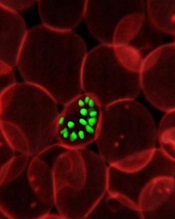
a red blood cell; Credit: St Jude
Children’s Research Hospital
Scientists have reported that injecting cryopreserved malaria sporozoites in human subjects can result in controlled infection.
This indicates that direct injection of sporozoites can be used in lieu of mosquito bites to test the efficacy of malaria drugs or vaccines in human volunteers.
The findings from this study were reported at the annual meeting of the American Society of Tropical Medicine and Hygiene and published online in the American Journal of Tropical Medicine and Hygiene.
“Our study shows it’s possible to manufacture and then administer controlled doses of malaria parasites using a needle and syringe to deliver a formulation that can meet regulatory standards for purity and dose consistency,” said study author Meta Roestenberg, MD, of the Radboud University Nijmegen Medical Center in The Netherlands.
She and her colleagues noted that the current method of testing malaria drugs and vaccines by exposing subjects to mosquito bites is technically complex and costly. And there are only a few places in the world today where such work is being done.
In addition, when using mosquitoes to deliver malaria parasites, it can be difficult to ensure that all subjects receive the same level of infection. And that can influence the outcome of the treatment.
So Dr Roestenberg and her colleagues set out to find a better way. They tested cryopreserved Plasmodium falciparum sporozoites that were harvested from the salivary glands of infected mosquitoes and had been frozen for more than 2 years. The sporozoites were manufactured by the Maryland-based biotechnology company Sanaria Inc.
The researchers enrolled 18 healthy volunteers and divided them into 3 groups. The first group received 2500 sporozoites, the second received 10,000 sporozoites, and the third received 25,000 sporozoites.
The team found that 84% of participants—5 of the 6 volunteers in each group—were safely and successfully infected with malaria. And there were no differences among the groups in the time it took for the infection to develop or the presentation of symptoms. The volunteers who developed infections subsequently received treatment and quickly recovered without incident.
“We have demonstrated the potential to develop what you might call ‘the human challenge trial in a bottle’ that could be available to scientists anywhere who need to know how a new drug or vaccine would fare against a real but carefully controlled and calibrated malaria infection,” said study author Stephen L. Hoffman, MD, of Sanaria Inc.
The researchers also said these results could aid the development of whole parasite vaccines.
“A major challenge to realizing the potential of whole parasite vaccines is the development of a stable, consistent formulation of sporozoites that can be manufactured, preserved, and used like any other vaccine,” said study author Robert W. Sauerwein, MD, PhD, also of Radboud University Nijmegen Medical Center.
Sanaria is currently pursuing clinical trials to test 2 different approaches to whole parasite vaccination: irradiated sporozoites and inducing controlled infections in tandem with the administration of antimalarial drugs.
Researchers are also planning additional trials to ensure the infection produced with the cryopreserved sporozoites mirrors what one would experience through bites from infected mosquitoes.
a red blood cell; Credit: St Jude
Children’s Research Hospital
Scientists have reported that injecting cryopreserved malaria sporozoites in human subjects can result in controlled infection.
This indicates that direct injection of sporozoites can be used in lieu of mosquito bites to test the efficacy of malaria drugs or vaccines in human volunteers.
The findings from this study were reported at the annual meeting of the American Society of Tropical Medicine and Hygiene and published online in the American Journal of Tropical Medicine and Hygiene.
“Our study shows it’s possible to manufacture and then administer controlled doses of malaria parasites using a needle and syringe to deliver a formulation that can meet regulatory standards for purity and dose consistency,” said study author Meta Roestenberg, MD, of the Radboud University Nijmegen Medical Center in The Netherlands.
She and her colleagues noted that the current method of testing malaria drugs and vaccines by exposing subjects to mosquito bites is technically complex and costly. And there are only a few places in the world today where such work is being done.
In addition, when using mosquitoes to deliver malaria parasites, it can be difficult to ensure that all subjects receive the same level of infection. And that can influence the outcome of the treatment.
So Dr Roestenberg and her colleagues set out to find a better way. They tested cryopreserved Plasmodium falciparum sporozoites that were harvested from the salivary glands of infected mosquitoes and had been frozen for more than 2 years. The sporozoites were manufactured by the Maryland-based biotechnology company Sanaria Inc.
The researchers enrolled 18 healthy volunteers and divided them into 3 groups. The first group received 2500 sporozoites, the second received 10,000 sporozoites, and the third received 25,000 sporozoites.
The team found that 84% of participants—5 of the 6 volunteers in each group—were safely and successfully infected with malaria. And there were no differences among the groups in the time it took for the infection to develop or the presentation of symptoms. The volunteers who developed infections subsequently received treatment and quickly recovered without incident.
“We have demonstrated the potential to develop what you might call ‘the human challenge trial in a bottle’ that could be available to scientists anywhere who need to know how a new drug or vaccine would fare against a real but carefully controlled and calibrated malaria infection,” said study author Stephen L. Hoffman, MD, of Sanaria Inc.
The researchers also said these results could aid the development of whole parasite vaccines.
“A major challenge to realizing the potential of whole parasite vaccines is the development of a stable, consistent formulation of sporozoites that can be manufactured, preserved, and used like any other vaccine,” said study author Robert W. Sauerwein, MD, PhD, also of Radboud University Nijmegen Medical Center.
Sanaria is currently pursuing clinical trials to test 2 different approaches to whole parasite vaccination: irradiated sporozoites and inducing controlled infections in tandem with the administration of antimalarial drugs.
Researchers are also planning additional trials to ensure the infection produced with the cryopreserved sporozoites mirrors what one would experience through bites from infected mosquitoes.
a red blood cell; Credit: St Jude
Children’s Research Hospital
Scientists have reported that injecting cryopreserved malaria sporozoites in human subjects can result in controlled infection.
This indicates that direct injection of sporozoites can be used in lieu of mosquito bites to test the efficacy of malaria drugs or vaccines in human volunteers.
The findings from this study were reported at the annual meeting of the American Society of Tropical Medicine and Hygiene and published online in the American Journal of Tropical Medicine and Hygiene.
“Our study shows it’s possible to manufacture and then administer controlled doses of malaria parasites using a needle and syringe to deliver a formulation that can meet regulatory standards for purity and dose consistency,” said study author Meta Roestenberg, MD, of the Radboud University Nijmegen Medical Center in The Netherlands.
She and her colleagues noted that the current method of testing malaria drugs and vaccines by exposing subjects to mosquito bites is technically complex and costly. And there are only a few places in the world today where such work is being done.
In addition, when using mosquitoes to deliver malaria parasites, it can be difficult to ensure that all subjects receive the same level of infection. And that can influence the outcome of the treatment.
So Dr Roestenberg and her colleagues set out to find a better way. They tested cryopreserved Plasmodium falciparum sporozoites that were harvested from the salivary glands of infected mosquitoes and had been frozen for more than 2 years. The sporozoites were manufactured by the Maryland-based biotechnology company Sanaria Inc.
The researchers enrolled 18 healthy volunteers and divided them into 3 groups. The first group received 2500 sporozoites, the second received 10,000 sporozoites, and the third received 25,000 sporozoites.
The team found that 84% of participants—5 of the 6 volunteers in each group—were safely and successfully infected with malaria. And there were no differences among the groups in the time it took for the infection to develop or the presentation of symptoms. The volunteers who developed infections subsequently received treatment and quickly recovered without incident.
“We have demonstrated the potential to develop what you might call ‘the human challenge trial in a bottle’ that could be available to scientists anywhere who need to know how a new drug or vaccine would fare against a real but carefully controlled and calibrated malaria infection,” said study author Stephen L. Hoffman, MD, of Sanaria Inc.
The researchers also said these results could aid the development of whole parasite vaccines.
“A major challenge to realizing the potential of whole parasite vaccines is the development of a stable, consistent formulation of sporozoites that can be manufactured, preserved, and used like any other vaccine,” said study author Robert W. Sauerwein, MD, PhD, also of Radboud University Nijmegen Medical Center.
Sanaria is currently pursuing clinical trials to test 2 different approaches to whole parasite vaccination: irradiated sporozoites and inducing controlled infections in tandem with the administration of antimalarial drugs.
Researchers are also planning additional trials to ensure the infection produced with the cryopreserved sporozoites mirrors what one would experience through bites from infected mosquitoes.
Factor appears safe, effective in hemophilia B
A novel therapy can prevent bleeding episodes in patients with hemophilia B, results of an industry-funded study suggest.
The goal of the phase 3 study, called B-LONG, was to evaluate the safety and efficacy of a long-lasting recombinant factor IX Fc fusion protein (rFIXFc, also known as eftrenonacog alfa and Alprolix).
Researchers found that a single injection of rFIXFc was sufficient to control more than 90% of bleeding episodes in males with hemophilia B.
In addition, none of the patients developed inhibitors, and the factor was generally well-tolerated.
The companies developing rFIXFc, Biogen Idec and Sobi, announced these results on September 26.
“Our companies are pioneering the application of Fc fusion technology to extend the half-life of clotting factors,” said Geoffrey McDonough, MD, Chief Executive Officer of Sobi, a biopharmaceutical company based in Stockholm, Sweden.
“Fc fusion technology utilizes a naturally occurring recycling pathway that has been successfully employed in other therapeutic areas. This approach holds promise for combining more consistent protection with fewer injections.”
Study design
To determine if rFIXFc does, in fact, provide bleeding protection with fewer injections, researchers administered the factor to 123 male patients with hemophilia B.
Patients were 12 years of age and older and had a history of at least 100 prior days during which they received 1 or more injections with any currently marketed factor IX product.
The investigators divided patients into 4 treatment arms. In Arm 1, 63 patients received weekly prophylaxis with rFIXFc. The starting dose was 50 IU/kg, and it was adjusted to maintain trough factor levels sufficient to prevent bleeding.
In Arm 2, 29 patients received individualized interval prophylaxis with rFIXFc. The factor was administered at 100 IU/kg at an initial interval of 10 days. It was subsequently individualized to maintain trough factor levels sufficient to prevent bleeding.
In Arm 3, 27 patients received episodic rFIXFc as needed to control bleeding. And in Arm 4, 12 patients who required major surgery received perioperative management with rFIXFc. Eight patients in this arm were also enrolled in other treatment arms.
Efficacy data
Overall, 93.5% of patients completed the study. Researchers assessed control of bleeding in all patients who experienced a bleeding episode while on study. In total, 90.4% of bleeding episodes were controlled by a single injection of rFIXFc.
The overall median annualized bleeding rates—including spontaneous and traumatic bleeds—were 2.95 in the weekly prophylaxis arm, 1.38 in the individualized interval prophylaxis arm, and 17.69 in the episodic treatment arm.
The perioperative management arm consisted of 12 patients undergoing 14 major surgical procedures. The treating physicians rated the hemostatic efficacy of rFIXFc as excellent or good in 100% of these surgeries.
The researchers also analyzed the pharmacokinetics of rFIXFc. The approximate terminal half-life of rFIXFc was 82 hours, compared to 34 hours for another recombinant factor IX product called BeneFIX.
This suggests that rFIXFc offers longer-lasting protection from bleeding in patients with hemophilia B, said Glenn Pierce, MD, PhD, Chief Medical Officer of Biogen Idec’s hemophilia therapeutic area.
“Currently, prophylactic treatment of hemophilia B requires intravenous injections up to 3 times a week,” he said, “which makes the prospect of a longer-lasting factor IX therapy very exciting.”
Safety data
The researchers found that rFIXFc was generally well-tolerated. None of the patients developed inhibitors, and none reported anaphylaxis.
The most common adverse events—with an incidence of 5% or greater—occurring outside of the perioperative management arm were nasopharyngitis, influenza, arthralgia, upper respiratory infection, hypertension, and headache.
One serious adverse event may have been drug-related. The patient experienced obstructive uropathy in the setting of hematuria. However, he continued to receive rFIXFc, and the event resolved with medical management.
Next steps
Based on the overall favorable outcomes of this study, Biogen Idec and Sobi are planning to submit a Biologics License Application for rFIXFc to the FDA in the first half of 2013. They also plan to submit an application to the EMA following results of a similar study in children, called Kids B-LONG.
Kids B-LONG is a phase 3, open-label study in previously treated children who are younger than 12 years of age and have been diagnosed with hemophilia B. The study is actively recruiting patients.
Researchers are also evaluating rFIXFc in the B-YOND study, which is a long-term, open-label extension study for patients who completed the B-LONG study or who will complete the Kids B-LONG study.
A novel therapy can prevent bleeding episodes in patients with hemophilia B, results of an industry-funded study suggest.
The goal of the phase 3 study, called B-LONG, was to evaluate the safety and efficacy of a long-lasting recombinant factor IX Fc fusion protein (rFIXFc, also known as eftrenonacog alfa and Alprolix).
Researchers found that a single injection of rFIXFc was sufficient to control more than 90% of bleeding episodes in males with hemophilia B.
In addition, none of the patients developed inhibitors, and the factor was generally well-tolerated.
The companies developing rFIXFc, Biogen Idec and Sobi, announced these results on September 26.
“Our companies are pioneering the application of Fc fusion technology to extend the half-life of clotting factors,” said Geoffrey McDonough, MD, Chief Executive Officer of Sobi, a biopharmaceutical company based in Stockholm, Sweden.
“Fc fusion technology utilizes a naturally occurring recycling pathway that has been successfully employed in other therapeutic areas. This approach holds promise for combining more consistent protection with fewer injections.”
Study design
To determine if rFIXFc does, in fact, provide bleeding protection with fewer injections, researchers administered the factor to 123 male patients with hemophilia B.
Patients were 12 years of age and older and had a history of at least 100 prior days during which they received 1 or more injections with any currently marketed factor IX product.
The investigators divided patients into 4 treatment arms. In Arm 1, 63 patients received weekly prophylaxis with rFIXFc. The starting dose was 50 IU/kg, and it was adjusted to maintain trough factor levels sufficient to prevent bleeding.
In Arm 2, 29 patients received individualized interval prophylaxis with rFIXFc. The factor was administered at 100 IU/kg at an initial interval of 10 days. It was subsequently individualized to maintain trough factor levels sufficient to prevent bleeding.
In Arm 3, 27 patients received episodic rFIXFc as needed to control bleeding. And in Arm 4, 12 patients who required major surgery received perioperative management with rFIXFc. Eight patients in this arm were also enrolled in other treatment arms.
Efficacy data
Overall, 93.5% of patients completed the study. Researchers assessed control of bleeding in all patients who experienced a bleeding episode while on study. In total, 90.4% of bleeding episodes were controlled by a single injection of rFIXFc.
The overall median annualized bleeding rates—including spontaneous and traumatic bleeds—were 2.95 in the weekly prophylaxis arm, 1.38 in the individualized interval prophylaxis arm, and 17.69 in the episodic treatment arm.
The perioperative management arm consisted of 12 patients undergoing 14 major surgical procedures. The treating physicians rated the hemostatic efficacy of rFIXFc as excellent or good in 100% of these surgeries.
The researchers also analyzed the pharmacokinetics of rFIXFc. The approximate terminal half-life of rFIXFc was 82 hours, compared to 34 hours for another recombinant factor IX product called BeneFIX.
This suggests that rFIXFc offers longer-lasting protection from bleeding in patients with hemophilia B, said Glenn Pierce, MD, PhD, Chief Medical Officer of Biogen Idec’s hemophilia therapeutic area.
“Currently, prophylactic treatment of hemophilia B requires intravenous injections up to 3 times a week,” he said, “which makes the prospect of a longer-lasting factor IX therapy very exciting.”
Safety data
The researchers found that rFIXFc was generally well-tolerated. None of the patients developed inhibitors, and none reported anaphylaxis.
The most common adverse events—with an incidence of 5% or greater—occurring outside of the perioperative management arm were nasopharyngitis, influenza, arthralgia, upper respiratory infection, hypertension, and headache.
One serious adverse event may have been drug-related. The patient experienced obstructive uropathy in the setting of hematuria. However, he continued to receive rFIXFc, and the event resolved with medical management.
Next steps
Based on the overall favorable outcomes of this study, Biogen Idec and Sobi are planning to submit a Biologics License Application for rFIXFc to the FDA in the first half of 2013. They also plan to submit an application to the EMA following results of a similar study in children, called Kids B-LONG.
Kids B-LONG is a phase 3, open-label study in previously treated children who are younger than 12 years of age and have been diagnosed with hemophilia B. The study is actively recruiting patients.
Researchers are also evaluating rFIXFc in the B-YOND study, which is a long-term, open-label extension study for patients who completed the B-LONG study or who will complete the Kids B-LONG study.
A novel therapy can prevent bleeding episodes in patients with hemophilia B, results of an industry-funded study suggest.
The goal of the phase 3 study, called B-LONG, was to evaluate the safety and efficacy of a long-lasting recombinant factor IX Fc fusion protein (rFIXFc, also known as eftrenonacog alfa and Alprolix).
Researchers found that a single injection of rFIXFc was sufficient to control more than 90% of bleeding episodes in males with hemophilia B.
In addition, none of the patients developed inhibitors, and the factor was generally well-tolerated.
The companies developing rFIXFc, Biogen Idec and Sobi, announced these results on September 26.
“Our companies are pioneering the application of Fc fusion technology to extend the half-life of clotting factors,” said Geoffrey McDonough, MD, Chief Executive Officer of Sobi, a biopharmaceutical company based in Stockholm, Sweden.
“Fc fusion technology utilizes a naturally occurring recycling pathway that has been successfully employed in other therapeutic areas. This approach holds promise for combining more consistent protection with fewer injections.”
Study design
To determine if rFIXFc does, in fact, provide bleeding protection with fewer injections, researchers administered the factor to 123 male patients with hemophilia B.
Patients were 12 years of age and older and had a history of at least 100 prior days during which they received 1 or more injections with any currently marketed factor IX product.
The investigators divided patients into 4 treatment arms. In Arm 1, 63 patients received weekly prophylaxis with rFIXFc. The starting dose was 50 IU/kg, and it was adjusted to maintain trough factor levels sufficient to prevent bleeding.
In Arm 2, 29 patients received individualized interval prophylaxis with rFIXFc. The factor was administered at 100 IU/kg at an initial interval of 10 days. It was subsequently individualized to maintain trough factor levels sufficient to prevent bleeding.
In Arm 3, 27 patients received episodic rFIXFc as needed to control bleeding. And in Arm 4, 12 patients who required major surgery received perioperative management with rFIXFc. Eight patients in this arm were also enrolled in other treatment arms.
Efficacy data
Overall, 93.5% of patients completed the study. Researchers assessed control of bleeding in all patients who experienced a bleeding episode while on study. In total, 90.4% of bleeding episodes were controlled by a single injection of rFIXFc.
The overall median annualized bleeding rates—including spontaneous and traumatic bleeds—were 2.95 in the weekly prophylaxis arm, 1.38 in the individualized interval prophylaxis arm, and 17.69 in the episodic treatment arm.
The perioperative management arm consisted of 12 patients undergoing 14 major surgical procedures. The treating physicians rated the hemostatic efficacy of rFIXFc as excellent or good in 100% of these surgeries.
The researchers also analyzed the pharmacokinetics of rFIXFc. The approximate terminal half-life of rFIXFc was 82 hours, compared to 34 hours for another recombinant factor IX product called BeneFIX.
This suggests that rFIXFc offers longer-lasting protection from bleeding in patients with hemophilia B, said Glenn Pierce, MD, PhD, Chief Medical Officer of Biogen Idec’s hemophilia therapeutic area.
“Currently, prophylactic treatment of hemophilia B requires intravenous injections up to 3 times a week,” he said, “which makes the prospect of a longer-lasting factor IX therapy very exciting.”
Safety data
The researchers found that rFIXFc was generally well-tolerated. None of the patients developed inhibitors, and none reported anaphylaxis.
The most common adverse events—with an incidence of 5% or greater—occurring outside of the perioperative management arm were nasopharyngitis, influenza, arthralgia, upper respiratory infection, hypertension, and headache.
One serious adverse event may have been drug-related. The patient experienced obstructive uropathy in the setting of hematuria. However, he continued to receive rFIXFc, and the event resolved with medical management.
Next steps
Based on the overall favorable outcomes of this study, Biogen Idec and Sobi are planning to submit a Biologics License Application for rFIXFc to the FDA in the first half of 2013. They also plan to submit an application to the EMA following results of a similar study in children, called Kids B-LONG.
Kids B-LONG is a phase 3, open-label study in previously treated children who are younger than 12 years of age and have been diagnosed with hemophilia B. The study is actively recruiting patients.
Researchers are also evaluating rFIXFc in the B-YOND study, which is a long-term, open-label extension study for patients who completed the B-LONG study or who will complete the Kids B-LONG study.
FDA approves 3rd-generation TKI for CML
The FDA has approved bosutinib (Bosulif), an Abl and Src kinase inhibitor, to treat patients with relapsed or refractory chronic myelogenous leukemia (CML).
Bosutinib is intended for use in patients with chronic, accelerated, or blast phase Philadelphia chromosome-positive CML who have failed therapy with first-generation and second-generation tyrosine kinase inhibitors (TKIs).
The recommended dose of bosutinib is 500 mg, taken once daily with food.
“[Bosutinib] is an important new addition to the CML treatment landscape,” said Jorge E. Cortes, MD, of MD Anderson Cancer Center in Houston.
“Despite recent advances, an unmet need remains for many CML patients who are refractory to one or more tyrosine kinase inhibitors.”
Dr Cortes was a lead investigator of the industry-sponsored study that led to bosutinib’s approval. The phase 1/2 trial included 546 adult patients who had chronic, accelerated, or blast phase CML.
Efficacy data
Patients were evaluable for efficacy if they had received at least one bosutinib dose and had a valid baseline efficacy assessment. Of the 546 patients enrolled, 503 were evaluable for efficacy.
Among the patients in chronic phase, 266 received prior treatment with imatinib only, and 108 received prior treatment with imatinib followed by dasatinib and/or nilotinib. There were 129 evaluable patients with advanced phase CML who were previously treated with at least one TKI.
The efficacy endpoints for patients with chronic phase CML were the rate of major cytogenetic response (MCyR) at week 24 and the duration of MCyR. The efficacy endpoints for patients with accelerated phase or blast phase CML were the rates of complete hematologic response (CHR) and overall hematologic response (OHR) by week 48.
In patients with chronic phase CML who received prior therapy with one TKI, 90 patients (33.8%) achieved an MCyR at week 24. Among the chronic phase CML patients who received prior therapy with more than one TKI, 29 (26.9%) achieved an MCyR by week 24.
Of the patients with chronic phase CML who had been treated with one prior TKI, 53.4% achieved an MCyR at any time during the trial. And 52.8% had a response lasting at least 18 months.
For the 32.4% of patients with chronic phase CML treated with more than one TKI who achieved an MCyR at any time, 51.4% had a response lasting at least 9 months.
In patients with accelerated phase CML who received at least one prior TKI, 21 (30.4%) achieved a CHR by week 48. And 38 patients (55.1%) achieved an OHR.
In the blast phase population, 9 patients (15%) achieved a CHR by week 48. And 17 patients (28.3%) achieved an OHR.
Safety data
The researchers evaluated bosutinib’s safety in all 546 patients. Of these patients, 287 had chronic phase CML, were previously treated with a single TKI, and had a median bosutinib treatment duration of 24 months.
There were 119 patients who had chronic phase CML, were previously treated with more than one TKI, and had a median bosutinib treatment duration of 9 months.
There were also 76 patients with accelerated phase CML and 64 patients with blast phase CML. In these patients, the median treatment duration was 10 months and 3 months, respectively.
The most common adverse events observed in more than 20% of all patients were diarrhea, nausea, thrombocytopenia, vomiting, abdominal pain, rash, anemia, pyrexia, and fatigue.
The most common grade 3 to 4 adverse events observed in more than 10% of patients were thrombocytopenia, anemia, and neutropenia. Other serious adverse events included anaphylactic shock, myelosuppression, gastrointestinal toxicity, fluid retention, hepatoxicity, and rash.
Bosutinib is marketed as Bosulif by Pfizer. For more information on bosutinib, see the package insert.
The FDA has approved bosutinib (Bosulif), an Abl and Src kinase inhibitor, to treat patients with relapsed or refractory chronic myelogenous leukemia (CML).
Bosutinib is intended for use in patients with chronic, accelerated, or blast phase Philadelphia chromosome-positive CML who have failed therapy with first-generation and second-generation tyrosine kinase inhibitors (TKIs).
The recommended dose of bosutinib is 500 mg, taken once daily with food.
“[Bosutinib] is an important new addition to the CML treatment landscape,” said Jorge E. Cortes, MD, of MD Anderson Cancer Center in Houston.
“Despite recent advances, an unmet need remains for many CML patients who are refractory to one or more tyrosine kinase inhibitors.”
Dr Cortes was a lead investigator of the industry-sponsored study that led to bosutinib’s approval. The phase 1/2 trial included 546 adult patients who had chronic, accelerated, or blast phase CML.
Efficacy data
Patients were evaluable for efficacy if they had received at least one bosutinib dose and had a valid baseline efficacy assessment. Of the 546 patients enrolled, 503 were evaluable for efficacy.
Among the patients in chronic phase, 266 received prior treatment with imatinib only, and 108 received prior treatment with imatinib followed by dasatinib and/or nilotinib. There were 129 evaluable patients with advanced phase CML who were previously treated with at least one TKI.
The efficacy endpoints for patients with chronic phase CML were the rate of major cytogenetic response (MCyR) at week 24 and the duration of MCyR. The efficacy endpoints for patients with accelerated phase or blast phase CML were the rates of complete hematologic response (CHR) and overall hematologic response (OHR) by week 48.
In patients with chronic phase CML who received prior therapy with one TKI, 90 patients (33.8%) achieved an MCyR at week 24. Among the chronic phase CML patients who received prior therapy with more than one TKI, 29 (26.9%) achieved an MCyR by week 24.
Of the patients with chronic phase CML who had been treated with one prior TKI, 53.4% achieved an MCyR at any time during the trial. And 52.8% had a response lasting at least 18 months.
For the 32.4% of patients with chronic phase CML treated with more than one TKI who achieved an MCyR at any time, 51.4% had a response lasting at least 9 months.
In patients with accelerated phase CML who received at least one prior TKI, 21 (30.4%) achieved a CHR by week 48. And 38 patients (55.1%) achieved an OHR.
In the blast phase population, 9 patients (15%) achieved a CHR by week 48. And 17 patients (28.3%) achieved an OHR.
Safety data
The researchers evaluated bosutinib’s safety in all 546 patients. Of these patients, 287 had chronic phase CML, were previously treated with a single TKI, and had a median bosutinib treatment duration of 24 months.
There were 119 patients who had chronic phase CML, were previously treated with more than one TKI, and had a median bosutinib treatment duration of 9 months.
There were also 76 patients with accelerated phase CML and 64 patients with blast phase CML. In these patients, the median treatment duration was 10 months and 3 months, respectively.
The most common adverse events observed in more than 20% of all patients were diarrhea, nausea, thrombocytopenia, vomiting, abdominal pain, rash, anemia, pyrexia, and fatigue.
The most common grade 3 to 4 adverse events observed in more than 10% of patients were thrombocytopenia, anemia, and neutropenia. Other serious adverse events included anaphylactic shock, myelosuppression, gastrointestinal toxicity, fluid retention, hepatoxicity, and rash.
Bosutinib is marketed as Bosulif by Pfizer. For more information on bosutinib, see the package insert.
The FDA has approved bosutinib (Bosulif), an Abl and Src kinase inhibitor, to treat patients with relapsed or refractory chronic myelogenous leukemia (CML).
Bosutinib is intended for use in patients with chronic, accelerated, or blast phase Philadelphia chromosome-positive CML who have failed therapy with first-generation and second-generation tyrosine kinase inhibitors (TKIs).
The recommended dose of bosutinib is 500 mg, taken once daily with food.
“[Bosutinib] is an important new addition to the CML treatment landscape,” said Jorge E. Cortes, MD, of MD Anderson Cancer Center in Houston.
“Despite recent advances, an unmet need remains for many CML patients who are refractory to one or more tyrosine kinase inhibitors.”
Dr Cortes was a lead investigator of the industry-sponsored study that led to bosutinib’s approval. The phase 1/2 trial included 546 adult patients who had chronic, accelerated, or blast phase CML.
Efficacy data
Patients were evaluable for efficacy if they had received at least one bosutinib dose and had a valid baseline efficacy assessment. Of the 546 patients enrolled, 503 were evaluable for efficacy.
Among the patients in chronic phase, 266 received prior treatment with imatinib only, and 108 received prior treatment with imatinib followed by dasatinib and/or nilotinib. There were 129 evaluable patients with advanced phase CML who were previously treated with at least one TKI.
The efficacy endpoints for patients with chronic phase CML were the rate of major cytogenetic response (MCyR) at week 24 and the duration of MCyR. The efficacy endpoints for patients with accelerated phase or blast phase CML were the rates of complete hematologic response (CHR) and overall hematologic response (OHR) by week 48.
In patients with chronic phase CML who received prior therapy with one TKI, 90 patients (33.8%) achieved an MCyR at week 24. Among the chronic phase CML patients who received prior therapy with more than one TKI, 29 (26.9%) achieved an MCyR by week 24.
Of the patients with chronic phase CML who had been treated with one prior TKI, 53.4% achieved an MCyR at any time during the trial. And 52.8% had a response lasting at least 18 months.
For the 32.4% of patients with chronic phase CML treated with more than one TKI who achieved an MCyR at any time, 51.4% had a response lasting at least 9 months.
In patients with accelerated phase CML who received at least one prior TKI, 21 (30.4%) achieved a CHR by week 48. And 38 patients (55.1%) achieved an OHR.
In the blast phase population, 9 patients (15%) achieved a CHR by week 48. And 17 patients (28.3%) achieved an OHR.
Safety data
The researchers evaluated bosutinib’s safety in all 546 patients. Of these patients, 287 had chronic phase CML, were previously treated with a single TKI, and had a median bosutinib treatment duration of 24 months.
There were 119 patients who had chronic phase CML, were previously treated with more than one TKI, and had a median bosutinib treatment duration of 9 months.
There were also 76 patients with accelerated phase CML and 64 patients with blast phase CML. In these patients, the median treatment duration was 10 months and 3 months, respectively.
The most common adverse events observed in more than 20% of all patients were diarrhea, nausea, thrombocytopenia, vomiting, abdominal pain, rash, anemia, pyrexia, and fatigue.
The most common grade 3 to 4 adverse events observed in more than 10% of patients were thrombocytopenia, anemia, and neutropenia. Other serious adverse events included anaphylactic shock, myelosuppression, gastrointestinal toxicity, fluid retention, hepatoxicity, and rash.
Bosutinib is marketed as Bosulif by Pfizer. For more information on bosutinib, see the package insert.
FDA grants drug accelerated approval for relapsed/refractory MM

The FDA has announced accelerated approval of carfilzomib (Kyprolis) as treatment for relapsed or refractory multiple myeloma (MM).
The drug is indicated for MM patients who have received at least 2 prior therapies, including bortezomib and an immunomodulatory agent, and have demonstrated disease progression on or within 60 days of completing their last treatment.
Carfilzomib was approved under the FDA’s accelerated approval program, which allows the agency to approve a drug based on data suggesting a clinical benefit. The drug’s maker is required to submit additional information after the approval to confirm that benefit.
Carfilzomib’s approval was based on efficacy data from a trial of 266 patients and safety data from 526 patients who received the drug.
The 266 patients had relapsed MM and had received at least 2 prior therapies, including bortezomib and an immunomodulatory agent (either thalidomide or lenalidomide). Patients received carfilzomib intravenously over a period of 2 to 10 minutes on 2 consecutive days a week for 3 weeks, followed by a 12-day rest period.
Patients received 20 mg/m2 at each dose in cycle 1 and 27 mg/m2 in subsequent cycles. They continued to receive treatment until their disease progressed, they developed unacceptable toxicity, or they completed 12 cycles.
Following treatment, the overall response rate was 22.9%. One patient achieved a complete response, 13 had very good partial responses, and 47 achieved partial responses. The median response duration was 7.8 months.
Researchers also evaluated carfilzomib’s safety in 526 patients with relapsed MM. Patients received a median of 4 treatment cycles and a median cumulative carfilzomib dose of 993.4 mg.
The most common adverse reactions—with an incidence of 30% or greater—were fatigue, anemia, nausea, thrombocytopenia, dyspnea, diarrhea, and pyrexia.
In addition, 45% of patients experienced serious adverse reactions. The most common were pneumonia, acute renal failure, pyrexia, and congestive heart failure.
Seven percent of patients (n=37) died on study. The most common causes of death, other than underlying disease, were cardiac (n=5), end-organ failure (n=4), and infection (n=4).
Carfilzomib will be marketed as Kyprolis by Onyx Pharmaceuticals. As a condition of the drug’s accelerated approval, Onyx is required to submit the complete analysis of an ongoing phase 3 trial comparing lenalidomide plus low-dose dexamethasone to lenalidomide, low-dose dexamethasone, and carfilzomib.
For more information on carfilzomib, consult the FDA website.
The FDA has announced accelerated approval of carfilzomib (Kyprolis) as treatment for relapsed or refractory multiple myeloma (MM).
The drug is indicated for MM patients who have received at least 2 prior therapies, including bortezomib and an immunomodulatory agent, and have demonstrated disease progression on or within 60 days of completing their last treatment.
Carfilzomib was approved under the FDA’s accelerated approval program, which allows the agency to approve a drug based on data suggesting a clinical benefit. The drug’s maker is required to submit additional information after the approval to confirm that benefit.
Carfilzomib’s approval was based on efficacy data from a trial of 266 patients and safety data from 526 patients who received the drug.
The 266 patients had relapsed MM and had received at least 2 prior therapies, including bortezomib and an immunomodulatory agent (either thalidomide or lenalidomide). Patients received carfilzomib intravenously over a period of 2 to 10 minutes on 2 consecutive days a week for 3 weeks, followed by a 12-day rest period.
Patients received 20 mg/m2 at each dose in cycle 1 and 27 mg/m2 in subsequent cycles. They continued to receive treatment until their disease progressed, they developed unacceptable toxicity, or they completed 12 cycles.
Following treatment, the overall response rate was 22.9%. One patient achieved a complete response, 13 had very good partial responses, and 47 achieved partial responses. The median response duration was 7.8 months.
Researchers also evaluated carfilzomib’s safety in 526 patients with relapsed MM. Patients received a median of 4 treatment cycles and a median cumulative carfilzomib dose of 993.4 mg.
The most common adverse reactions—with an incidence of 30% or greater—were fatigue, anemia, nausea, thrombocytopenia, dyspnea, diarrhea, and pyrexia.
In addition, 45% of patients experienced serious adverse reactions. The most common were pneumonia, acute renal failure, pyrexia, and congestive heart failure.
Seven percent of patients (n=37) died on study. The most common causes of death, other than underlying disease, were cardiac (n=5), end-organ failure (n=4), and infection (n=4).
Carfilzomib will be marketed as Kyprolis by Onyx Pharmaceuticals. As a condition of the drug’s accelerated approval, Onyx is required to submit the complete analysis of an ongoing phase 3 trial comparing lenalidomide plus low-dose dexamethasone to lenalidomide, low-dose dexamethasone, and carfilzomib.
For more information on carfilzomib, consult the FDA website.
The FDA has announced accelerated approval of carfilzomib (Kyprolis) as treatment for relapsed or refractory multiple myeloma (MM).
The drug is indicated for MM patients who have received at least 2 prior therapies, including bortezomib and an immunomodulatory agent, and have demonstrated disease progression on or within 60 days of completing their last treatment.
Carfilzomib was approved under the FDA’s accelerated approval program, which allows the agency to approve a drug based on data suggesting a clinical benefit. The drug’s maker is required to submit additional information after the approval to confirm that benefit.
Carfilzomib’s approval was based on efficacy data from a trial of 266 patients and safety data from 526 patients who received the drug.
The 266 patients had relapsed MM and had received at least 2 prior therapies, including bortezomib and an immunomodulatory agent (either thalidomide or lenalidomide). Patients received carfilzomib intravenously over a period of 2 to 10 minutes on 2 consecutive days a week for 3 weeks, followed by a 12-day rest period.
Patients received 20 mg/m2 at each dose in cycle 1 and 27 mg/m2 in subsequent cycles. They continued to receive treatment until their disease progressed, they developed unacceptable toxicity, or they completed 12 cycles.
Following treatment, the overall response rate was 22.9%. One patient achieved a complete response, 13 had very good partial responses, and 47 achieved partial responses. The median response duration was 7.8 months.
Researchers also evaluated carfilzomib’s safety in 526 patients with relapsed MM. Patients received a median of 4 treatment cycles and a median cumulative carfilzomib dose of 993.4 mg.
The most common adverse reactions—with an incidence of 30% or greater—were fatigue, anemia, nausea, thrombocytopenia, dyspnea, diarrhea, and pyrexia.
In addition, 45% of patients experienced serious adverse reactions. The most common were pneumonia, acute renal failure, pyrexia, and congestive heart failure.
Seven percent of patients (n=37) died on study. The most common causes of death, other than underlying disease, were cardiac (n=5), end-organ failure (n=4), and infection (n=4).
Carfilzomib will be marketed as Kyprolis by Onyx Pharmaceuticals. As a condition of the drug’s accelerated approval, Onyx is required to submit the complete analysis of an ongoing phase 3 trial comparing lenalidomide plus low-dose dexamethasone to lenalidomide, low-dose dexamethasone, and carfilzomib.
For more information on carfilzomib, consult the FDA website.
Secondary prophylaxis reduces bleeding in hemophilia

PARIS—Results of a phase 3 study indicate that the recombinant antihemophilic factor octocog alfa is effective as secondary bleeding prophylaxis in patients with severe hemophilia A.
The product appeared to be well-tolerated, and it reduced bleeding frequency as secondary prophylaxis (ie, treatment after multiple bleeding episodes have occurred), when compared to on-demand treatment.
These results were presented as a late-breaking abstract at the World Federation of Hemophilia 2012 World Congress, which took place July 8-12. The study—called SPINART—was sponsored by Bayer Healthcare, the makers of octocog alfa (marketed as Kogenate).
“Patients on the prophylactic regimen experienced significantly fewer bleeds than those using on-demand treatment,” said the study’s principal investigator, Marilyn Manco-Johnson, MD, of the University of Colorado at Denver.
“Those bleeds that did occur on the prophylactic regimen were predominantly mild-to-moderate.”
Dr Manco-Johnson and her colleagues had randomized 84 patients with hemophilia A to receive either on-demand treatment or secondary prophylaxis at 25 IU/kg 3 times per week. The total follow-up was 3 years.
After a median follow-up of 1.7 years, the researchers observed significantly fewer total bleeding events per year with prophylaxis vs on-demand treatment. The median number of bleeding events were 0 and 27.9, respectively. However, 48% of patients in the prophylaxis arm did experience at least 1 bleeding event.
There were significantly fewer joint bleeds with prophylaxis than with on-demand treatment. The median number of joint bleeds were 0 and 21.2, respectively. But 38% of patients in the prophylaxis arm did experience joint bleeds.
In patients on prophylaxis who did experience bleeding, 20% of the episodes were severe, 44% were mild, and 36% were moderate. In patients receiving on-demand treatment, 19% of bleeding episodes were severe, 23% were mild, and 58% were moderate.
The researchers did not observe inhibitor formation in any of the patients. And adverse events were consistent with those observed in previous studies, including skin-associated hypersensitivity reactions, infusion site reactions, and central venous access device line-associated infections.
PARIS—Results of a phase 3 study indicate that the recombinant antihemophilic factor octocog alfa is effective as secondary bleeding prophylaxis in patients with severe hemophilia A.
The product appeared to be well-tolerated, and it reduced bleeding frequency as secondary prophylaxis (ie, treatment after multiple bleeding episodes have occurred), when compared to on-demand treatment.
These results were presented as a late-breaking abstract at the World Federation of Hemophilia 2012 World Congress, which took place July 8-12. The study—called SPINART—was sponsored by Bayer Healthcare, the makers of octocog alfa (marketed as Kogenate).
“Patients on the prophylactic regimen experienced significantly fewer bleeds than those using on-demand treatment,” said the study’s principal investigator, Marilyn Manco-Johnson, MD, of the University of Colorado at Denver.
“Those bleeds that did occur on the prophylactic regimen were predominantly mild-to-moderate.”
Dr Manco-Johnson and her colleagues had randomized 84 patients with hemophilia A to receive either on-demand treatment or secondary prophylaxis at 25 IU/kg 3 times per week. The total follow-up was 3 years.
After a median follow-up of 1.7 years, the researchers observed significantly fewer total bleeding events per year with prophylaxis vs on-demand treatment. The median number of bleeding events were 0 and 27.9, respectively. However, 48% of patients in the prophylaxis arm did experience at least 1 bleeding event.
There were significantly fewer joint bleeds with prophylaxis than with on-demand treatment. The median number of joint bleeds were 0 and 21.2, respectively. But 38% of patients in the prophylaxis arm did experience joint bleeds.
In patients on prophylaxis who did experience bleeding, 20% of the episodes were severe, 44% were mild, and 36% were moderate. In patients receiving on-demand treatment, 19% of bleeding episodes were severe, 23% were mild, and 58% were moderate.
The researchers did not observe inhibitor formation in any of the patients. And adverse events were consistent with those observed in previous studies, including skin-associated hypersensitivity reactions, infusion site reactions, and central venous access device line-associated infections.
PARIS—Results of a phase 3 study indicate that the recombinant antihemophilic factor octocog alfa is effective as secondary bleeding prophylaxis in patients with severe hemophilia A.
The product appeared to be well-tolerated, and it reduced bleeding frequency as secondary prophylaxis (ie, treatment after multiple bleeding episodes have occurred), when compared to on-demand treatment.
These results were presented as a late-breaking abstract at the World Federation of Hemophilia 2012 World Congress, which took place July 8-12. The study—called SPINART—was sponsored by Bayer Healthcare, the makers of octocog alfa (marketed as Kogenate).
“Patients on the prophylactic regimen experienced significantly fewer bleeds than those using on-demand treatment,” said the study’s principal investigator, Marilyn Manco-Johnson, MD, of the University of Colorado at Denver.
“Those bleeds that did occur on the prophylactic regimen were predominantly mild-to-moderate.”
Dr Manco-Johnson and her colleagues had randomized 84 patients with hemophilia A to receive either on-demand treatment or secondary prophylaxis at 25 IU/kg 3 times per week. The total follow-up was 3 years.
After a median follow-up of 1.7 years, the researchers observed significantly fewer total bleeding events per year with prophylaxis vs on-demand treatment. The median number of bleeding events were 0 and 27.9, respectively. However, 48% of patients in the prophylaxis arm did experience at least 1 bleeding event.
There were significantly fewer joint bleeds with prophylaxis than with on-demand treatment. The median number of joint bleeds were 0 and 21.2, respectively. But 38% of patients in the prophylaxis arm did experience joint bleeds.
In patients on prophylaxis who did experience bleeding, 20% of the episodes were severe, 44% were mild, and 36% were moderate. In patients receiving on-demand treatment, 19% of bleeding episodes were severe, 23% were mild, and 58% were moderate.
The researchers did not observe inhibitor formation in any of the patients. And adverse events were consistent with those observed in previous studies, including skin-associated hypersensitivity reactions, infusion site reactions, and central venous access device line-associated infections.
Hemophilia patients plagued by professional challenges
PARIS—Results of a large study suggest that 8 in 10 hemophilia patients feel
their disorder has had a negative impact on their career.
In fact, 1 in 5
patients said they have lost a job because of their condition. However, only 8% said they were unable to find employment because of it.
These findings were presented at the World Federation of Hemophilia 2012 World Congress. The data are part of the HERO study, which
evaluated the psychosocial aspects of living with hemophilia. The study
was sponsored by Novo Nordisk.
“Treatment of hemophilia has advanced greatly over the past decades, but psychosocial issues can still be a challenge for people with hemophilia . . . ,” said Alfonso Iorio, MD, PhD, a member of the HERO International Advisory Board and a professor at McMaster University in Canada.
With this in mind, HERO researchers examined hemophilia’s effects on relationships, sexual health, and quality of life. The investigators also assessed treatment and management of the disorder, patients’ knowledge and education levels, and how hemophilia has impacted their professional life.
For the career analysis, researchers interviewed 605 patients with hemophilia. Forty percent of patients said their hemophilia played a major role in their choice of profession or job training, but 21% of patients said their disorder had no impact on their job choice.
Thirty percent of patients said their current treatment allows them to work in most situations. But 21% of patients said they have to restrict their hours due to their hemophilia, and 17% said they must work flexible hours.
Twenty-four percent of patients said they have voluntarily left a job because of their hemophilia, and 22% thought they lost a job because of their disorder.
Twenty-two percent of patients believed they were not hired for a job because of their hemophilia, and 14% felt they had not received a promotion because of it. But 10% of patients said their disorder actually helped them land a job.
These results were presented at the World Federation of Hemophilia 2012 World Congress on Monday as poster 199. Other results from the HERO study will also be presented at the meeting, which is taking place July 8-12.
“The insights from the HERO study will provide much-needed evidence to support advocating for better comprehensive hemophilia care,” Dr Iorio said.
PARIS—Results of a large study suggest that 8 in 10 hemophilia patients feel
their disorder has had a negative impact on their career.
In fact, 1 in 5
patients said they have lost a job because of their condition. However, only 8% said they were unable to find employment because of it.
These findings were presented at the World Federation of Hemophilia 2012 World Congress. The data are part of the HERO study, which
evaluated the psychosocial aspects of living with hemophilia. The study
was sponsored by Novo Nordisk.
“Treatment of hemophilia has advanced greatly over the past decades, but psychosocial issues can still be a challenge for people with hemophilia . . . ,” said Alfonso Iorio, MD, PhD, a member of the HERO International Advisory Board and a professor at McMaster University in Canada.
With this in mind, HERO researchers examined hemophilia’s effects on relationships, sexual health, and quality of life. The investigators also assessed treatment and management of the disorder, patients’ knowledge and education levels, and how hemophilia has impacted their professional life.
For the career analysis, researchers interviewed 605 patients with hemophilia. Forty percent of patients said their hemophilia played a major role in their choice of profession or job training, but 21% of patients said their disorder had no impact on their job choice.
Thirty percent of patients said their current treatment allows them to work in most situations. But 21% of patients said they have to restrict their hours due to their hemophilia, and 17% said they must work flexible hours.
Twenty-four percent of patients said they have voluntarily left a job because of their hemophilia, and 22% thought they lost a job because of their disorder.
Twenty-two percent of patients believed they were not hired for a job because of their hemophilia, and 14% felt they had not received a promotion because of it. But 10% of patients said their disorder actually helped them land a job.
These results were presented at the World Federation of Hemophilia 2012 World Congress on Monday as poster 199. Other results from the HERO study will also be presented at the meeting, which is taking place July 8-12.
“The insights from the HERO study will provide much-needed evidence to support advocating for better comprehensive hemophilia care,” Dr Iorio said.
PARIS—Results of a large study suggest that 8 in 10 hemophilia patients feel
their disorder has had a negative impact on their career.
In fact, 1 in 5
patients said they have lost a job because of their condition. However, only 8% said they were unable to find employment because of it.
These findings were presented at the World Federation of Hemophilia 2012 World Congress. The data are part of the HERO study, which
evaluated the psychosocial aspects of living with hemophilia. The study
was sponsored by Novo Nordisk.
“Treatment of hemophilia has advanced greatly over the past decades, but psychosocial issues can still be a challenge for people with hemophilia . . . ,” said Alfonso Iorio, MD, PhD, a member of the HERO International Advisory Board and a professor at McMaster University in Canada.
With this in mind, HERO researchers examined hemophilia’s effects on relationships, sexual health, and quality of life. The investigators also assessed treatment and management of the disorder, patients’ knowledge and education levels, and how hemophilia has impacted their professional life.
For the career analysis, researchers interviewed 605 patients with hemophilia. Forty percent of patients said their hemophilia played a major role in their choice of profession or job training, but 21% of patients said their disorder had no impact on their job choice.
Thirty percent of patients said their current treatment allows them to work in most situations. But 21% of patients said they have to restrict their hours due to their hemophilia, and 17% said they must work flexible hours.
Twenty-four percent of patients said they have voluntarily left a job because of their hemophilia, and 22% thought they lost a job because of their disorder.
Twenty-two percent of patients believed they were not hired for a job because of their hemophilia, and 14% felt they had not received a promotion because of it. But 10% of patients said their disorder actually helped them land a job.
These results were presented at the World Federation of Hemophilia 2012 World Congress on Monday as poster 199. Other results from the HERO study will also be presented at the meeting, which is taking place July 8-12.
“The insights from the HERO study will provide much-needed evidence to support advocating for better comprehensive hemophilia care,” Dr Iorio said.