User login
Atrial fibrillation is not a single disease, and specialists already have ways to distinguish one type from another and guide management. But new methods are emerging to better distinguish various causes and types of atrial fibrillation, further refine management, and offer new intervention approaches.
This new way of looking at AF has been called personalized management, and while some cardiologists may quibble that a fully personalized approach to managing each AF patient is still likely a decade or more away, there seems to be wide agreement that AF patients are heterogeneous and the more that can be learned about the etiology and character of AF in each patient, the better care will be.
A manifesto on personalized AF management appeared last November from a panel of 72 cardiologists organized by the German AF Competence Network (AFNET) and the European Heart Rhythm Association (EP Europace 2013;15:1540-56).
"Atrial fibrillation is not a disease, it is a syndrome" in which different patients "present with similar ECG patterns and complications, but with completely different causes," said Dr. Paulus Kirchhof, an organizer of the AFNET/EHRA consensus group, during a session on personalized AF at the American Heart Association’s scientific sessions last November. "We are still in the process of trying to understand the individual mechanisms [causing AF], and then we try to translate that into parameters that can be measured. Once we get there, we can probably reclassify AF as a disease with different causes in different people. But we still need more work to better classify AF based on causal mechanisms," said Dr. Kirchhof, professor of cardiovascular medicine at the University of Birmingham, England.
AF classification evolves
More than 2 decades ago, atrial fibrillation was classified as either acute or chronic. Starting about 20 years ago, classification by duration became a little more subdivided, into categories of paroxysmal, persistent, long-term persistent, and permanent. This rough taxonomy, focused on episode duration, guides some facets of management today and has "served a reasonable function, but has done as much as it could. So, we’re searching for a new taxonomy that will help us progress further, a taxonomy based on mechanisms," said Dr. A. John Camm, professor of clinical cardiology at St. George’s, University of London, and another organizer of the AFNET/EHRA group.
"The electrophysiology community and the physician community are starting to get comfortable with the current AF taxonomy of paroxysmal, persistent, and long-standing persistent. But those who spend a lot of time thinking about AF recognize that this scheme is overly simplistic and that other parameters are important," said Dr. Hugh Calkins, professor and director of the cardiac arrhythmia service at Johns Hopkins Medical Center in Baltimore. "I do not believe it is time to make a dramatic shift to a new AF taxonomy now, especially for day-to-day care, but it is likely that over time new parameters will be included when describing AF patients. The proposed new classification scheme may provide a useful framework as this research moves forward," Dr. Calkins said in an interview. Dr. Calkins, president of the U.S.-based Heart Rhythm Society, was one of the 72 coauthors of the AFNET/EHRA consensus statement and one of the few participants not based in Europe.

"Given the complexities of AF, a personalized approach is and will continue to be essential. This is widely accepted and not controversial," said Dr. Peter R. Kowey, chief of cardiovascular diseases at Main Line Health in Wynnewood, Pa. "But each new parameter used to categorize AF will require careful validation before its adoption," he said in an interview. "Subclassification of AF would be helpful, but it will need to be data driven and carefully vetted before it will be accepted," said Dr. Kowey, who was not a member of the AFNET/EHRA group.
"The concept of personalized AF management is not new and not controversial. It is at the core of optimal patient care," Dr. Calkins concurred.
"Our hope is that molecular, genomic, and novel ECG and structural-imaging modalities will guide AF treatment in the future," said Dr. Anne M. Gillis, professor of medicine at the University of Calgary (Alta.), speaking during the AHA session last November. "At present, we start with rate control and move on to rhythm control when dictated by symptoms, with ablation continuing to emerge as the primary option. In the future we think there will be a focus on prevention and a personalized approach, with a greater emphasis on rhythm control that may involve mechanism-directed ablation against foci and rotors."
Dr. Gillis, immediate past president of the Heart Rhythm Society, and some of her colleagues endorsed the concept of a personalized approach to AF management and increasing reliance on new methods to further distinguish various types of AF patients in a commentary last year (Can. J. Cardiol. 2013;29:1141-6).
Preliminary draft of a new AF taxonomy

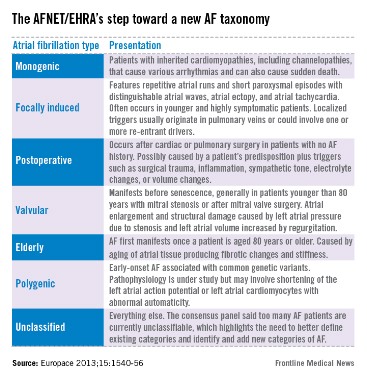
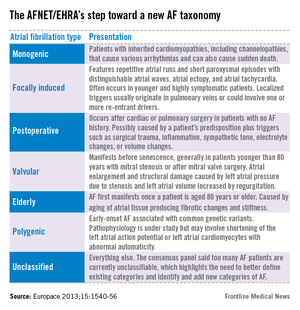
The consensus statement from the AFNET/EHRA group includes a draft of a new way to classify and think about AF. They divided AF into seven types: monogenic, focally induced, postoperative, valvular, AF in the elderly, polygenic, and unclassified (see table). But the coauthors of the statement cautioned that their proposed classifications were "preliminary," just a "step towards" a new AF taxonomy.
The proposed classification "is useful because it identifies patients with specific causes of AF, but it is preliminary because it is not able to classify many patients. We need better markers for the common mechanisms of AF," said Dr. Kirchhof in an interview. Progress in AF classification and taxonomy and progress in AF management will be "closely intertwined," he said. "We have a relatively decent understanding of several major mechanisms that cause AF, but we need clinically applicable markers that need to be validated. I expect that blood-based markers, and, to some extent, ECG-based markers will become helpful in the near future provided that they are validated."
Factors already accepted as valid tools for discriminating among AF patients include myocardial ischemia, hemodynamic instability, blood cell count, electrolytes, thyroid stimulating hormone level, ECG, and the presence or absence of AF-related symptoms, while decisions about anticoagulation are driven by a patient’s CHA2DS2-VASc score.
According to the consensus statement, factors currently under development and seen as good candidates for additional ways to discriminate among AF patients include:
• More ECG-derived information including evidence of left ventricular hypertrophy, heart failure, QT interval, atrioventricular block, and cardiomyopathy, as well as analysis of the electrical complexity of AF episodes.
• Silent AF episodes detected by prolonged ECG monitoring with a miniaturized device; also using prolonged ECG monitoring to further refine and personalize rhythm-control therapy.
• Brain imaging, particularly magnetic resonance imaging (MRI), to identify silent brain infarctions, white matter hyperintensities, and cerebral microbleeds to further refine anticoagulant treatment.
• Structural heart disease including valve disease, left ventricular hypertrophy, and left ventricular dysfunction detected by MRI or three-dimensional echocardiography.
• Atrial activation time monitored by tissue Doppler to better guide rhythm-control treatment.
• Blood levels of D-dimer, high-sensitive troponin T, and forms of brain natriuretic peptide, biomarkers that might refine stroke-risk assessment and anticoagulation.
• Chronic kidney disease, which might especially affect stroke risk.
• Blood and urine biomarkers of inflammation, cardiac load, cardiac damage, or kidney function that may predict the risk of recurrent AF, including various forms of brain natriuretic peptide, C-reactive protein, and creatinine.
• Genes linked to familial forms of AF, such as genes close to the PITX2 locus on chromosome 4q25 and genes close to the ZFHX3 locus on chromosome 16q22.
What comes next?
Dr. Camm cited two methods in particular as among the closest to becoming the next new ways to assess and discriminate AF patients. One is evaluating atrial remodeling by MRI, which also identifies regions of atrial fibrosis. This is especially promising because several drug classes may stop or perhaps reverse fibrotic changes in atria: angiotensin-converting enzyme inhibitors, angiotensin-receptor blockers, and galectin 3 inhibitor drugs.
Another way to assess AF and personalize management nearing routine use is measuring ECG patterns on the atrial surface with noninvasive sensors placed on a patient’s chest, patterns that may pinpoint conduction lesions or circuits amenable to focused ablation.
It’s also very possible that some new, validated markers of AF will flag some of the earliest pathologic changes that start down the road to AF, markers that could identify potential targets for early intervention, "allowing us to interrupt the AF process before it becomes an end-stage disease and while it can still be more directly managed," Dr. Camm said.
The AFNET/EHRA group plans to reconvene early next year and every 2 years after that to update its assessment of AF personalization, he added.
"Even AF patients treated with the best available treatment today have unacceptably high mortality. Treatments targeting individual mechanisms that cause AF could improve this," Dr. Kirchhof said.
Dr. Kirchhof said he has received consulting fees and honoraria from more than a dozen drug and device companies. Dr. Camm said he has received consulting fees and honoraria from more than 20 drug and device companies. Dr. Gillis said she has received honoraria from Medtronic. Dr. Calkins and Dr. Kowey had no relevant disclosures.
mzoler@frontlinemedcom.com
On Twitter @mitchelzoler
Atrial fibrillation is not a single disease, and specialists already have ways to distinguish one type from another and guide management. But new methods are emerging to better distinguish various causes and types of atrial fibrillation, further refine management, and offer new intervention approaches.
This new way of looking at AF has been called personalized management, and while some cardiologists may quibble that a fully personalized approach to managing each AF patient is still likely a decade or more away, there seems to be wide agreement that AF patients are heterogeneous and the more that can be learned about the etiology and character of AF in each patient, the better care will be.
A manifesto on personalized AF management appeared last November from a panel of 72 cardiologists organized by the German AF Competence Network (AFNET) and the European Heart Rhythm Association (EP Europace 2013;15:1540-56).
"Atrial fibrillation is not a disease, it is a syndrome" in which different patients "present with similar ECG patterns and complications, but with completely different causes," said Dr. Paulus Kirchhof, an organizer of the AFNET/EHRA consensus group, during a session on personalized AF at the American Heart Association’s scientific sessions last November. "We are still in the process of trying to understand the individual mechanisms [causing AF], and then we try to translate that into parameters that can be measured. Once we get there, we can probably reclassify AF as a disease with different causes in different people. But we still need more work to better classify AF based on causal mechanisms," said Dr. Kirchhof, professor of cardiovascular medicine at the University of Birmingham, England.
AF classification evolves
More than 2 decades ago, atrial fibrillation was classified as either acute or chronic. Starting about 20 years ago, classification by duration became a little more subdivided, into categories of paroxysmal, persistent, long-term persistent, and permanent. This rough taxonomy, focused on episode duration, guides some facets of management today and has "served a reasonable function, but has done as much as it could. So, we’re searching for a new taxonomy that will help us progress further, a taxonomy based on mechanisms," said Dr. A. John Camm, professor of clinical cardiology at St. George’s, University of London, and another organizer of the AFNET/EHRA group.
"The electrophysiology community and the physician community are starting to get comfortable with the current AF taxonomy of paroxysmal, persistent, and long-standing persistent. But those who spend a lot of time thinking about AF recognize that this scheme is overly simplistic and that other parameters are important," said Dr. Hugh Calkins, professor and director of the cardiac arrhythmia service at Johns Hopkins Medical Center in Baltimore. "I do not believe it is time to make a dramatic shift to a new AF taxonomy now, especially for day-to-day care, but it is likely that over time new parameters will be included when describing AF patients. The proposed new classification scheme may provide a useful framework as this research moves forward," Dr. Calkins said in an interview. Dr. Calkins, president of the U.S.-based Heart Rhythm Society, was one of the 72 coauthors of the AFNET/EHRA consensus statement and one of the few participants not based in Europe.
"Given the complexities of AF, a personalized approach is and will continue to be essential. This is widely accepted and not controversial," said Dr. Peter R. Kowey, chief of cardiovascular diseases at Main Line Health in Wynnewood, Pa. "But each new parameter used to categorize AF will require careful validation before its adoption," he said in an interview. "Subclassification of AF would be helpful, but it will need to be data driven and carefully vetted before it will be accepted," said Dr. Kowey, who was not a member of the AFNET/EHRA group.
"The concept of personalized AF management is not new and not controversial. It is at the core of optimal patient care," Dr. Calkins concurred.
"Our hope is that molecular, genomic, and novel ECG and structural-imaging modalities will guide AF treatment in the future," said Dr. Anne M. Gillis, professor of medicine at the University of Calgary (Alta.), speaking during the AHA session last November. "At present, we start with rate control and move on to rhythm control when dictated by symptoms, with ablation continuing to emerge as the primary option. In the future we think there will be a focus on prevention and a personalized approach, with a greater emphasis on rhythm control that may involve mechanism-directed ablation against foci and rotors."
Dr. Gillis, immediate past president of the Heart Rhythm Society, and some of her colleagues endorsed the concept of a personalized approach to AF management and increasing reliance on new methods to further distinguish various types of AF patients in a commentary last year (Can. J. Cardiol. 2013;29:1141-6).
Preliminary draft of a new AF taxonomy
The consensus statement from the AFNET/EHRA group includes a draft of a new way to classify and think about AF. They divided AF into seven types: monogenic, focally induced, postoperative, valvular, AF in the elderly, polygenic, and unclassified (see table). But the coauthors of the statement cautioned that their proposed classifications were "preliminary," just a "step towards" a new AF taxonomy.
The proposed classification "is useful because it identifies patients with specific causes of AF, but it is preliminary because it is not able to classify many patients. We need better markers for the common mechanisms of AF," said Dr. Kirchhof in an interview. Progress in AF classification and taxonomy and progress in AF management will be "closely intertwined," he said. "We have a relatively decent understanding of several major mechanisms that cause AF, but we need clinically applicable markers that need to be validated. I expect that blood-based markers, and, to some extent, ECG-based markers will become helpful in the near future provided that they are validated."
Factors already accepted as valid tools for discriminating among AF patients include myocardial ischemia, hemodynamic instability, blood cell count, electrolytes, thyroid stimulating hormone level, ECG, and the presence or absence of AF-related symptoms, while decisions about anticoagulation are driven by a patient’s CHA2DS2-VASc score.
According to the consensus statement, factors currently under development and seen as good candidates for additional ways to discriminate among AF patients include:
• More ECG-derived information including evidence of left ventricular hypertrophy, heart failure, QT interval, atrioventricular block, and cardiomyopathy, as well as analysis of the electrical complexity of AF episodes.
• Silent AF episodes detected by prolonged ECG monitoring with a miniaturized device; also using prolonged ECG monitoring to further refine and personalize rhythm-control therapy.
• Brain imaging, particularly magnetic resonance imaging (MRI), to identify silent brain infarctions, white matter hyperintensities, and cerebral microbleeds to further refine anticoagulant treatment.
• Structural heart disease including valve disease, left ventricular hypertrophy, and left ventricular dysfunction detected by MRI or three-dimensional echocardiography.
• Atrial activation time monitored by tissue Doppler to better guide rhythm-control treatment.
• Blood levels of D-dimer, high-sensitive troponin T, and forms of brain natriuretic peptide, biomarkers that might refine stroke-risk assessment and anticoagulation.
• Chronic kidney disease, which might especially affect stroke risk.
• Blood and urine biomarkers of inflammation, cardiac load, cardiac damage, or kidney function that may predict the risk of recurrent AF, including various forms of brain natriuretic peptide, C-reactive protein, and creatinine.
• Genes linked to familial forms of AF, such as genes close to the PITX2 locus on chromosome 4q25 and genes close to the ZFHX3 locus on chromosome 16q22.
What comes next?
Dr. Camm cited two methods in particular as among the closest to becoming the next new ways to assess and discriminate AF patients. One is evaluating atrial remodeling by MRI, which also identifies regions of atrial fibrosis. This is especially promising because several drug classes may stop or perhaps reverse fibrotic changes in atria: angiotensin-converting enzyme inhibitors, angiotensin-receptor blockers, and galectin 3 inhibitor drugs.
Another way to assess AF and personalize management nearing routine use is measuring ECG patterns on the atrial surface with noninvasive sensors placed on a patient’s chest, patterns that may pinpoint conduction lesions or circuits amenable to focused ablation.
It’s also very possible that some new, validated markers of AF will flag some of the earliest pathologic changes that start down the road to AF, markers that could identify potential targets for early intervention, "allowing us to interrupt the AF process before it becomes an end-stage disease and while it can still be more directly managed," Dr. Camm said.
The AFNET/EHRA group plans to reconvene early next year and every 2 years after that to update its assessment of AF personalization, he added.
"Even AF patients treated with the best available treatment today have unacceptably high mortality. Treatments targeting individual mechanisms that cause AF could improve this," Dr. Kirchhof said.
Dr. Kirchhof said he has received consulting fees and honoraria from more than a dozen drug and device companies. Dr. Camm said he has received consulting fees and honoraria from more than 20 drug and device companies. Dr. Gillis said she has received honoraria from Medtronic. Dr. Calkins and Dr. Kowey had no relevant disclosures.
mzoler@frontlinemedcom.com
On Twitter @mitchelzoler
Atrial fibrillation is not a single disease, and specialists already have ways to distinguish one type from another and guide management. But new methods are emerging to better distinguish various causes and types of atrial fibrillation, further refine management, and offer new intervention approaches.
This new way of looking at AF has been called personalized management, and while some cardiologists may quibble that a fully personalized approach to managing each AF patient is still likely a decade or more away, there seems to be wide agreement that AF patients are heterogeneous and the more that can be learned about the etiology and character of AF in each patient, the better care will be.
A manifesto on personalized AF management appeared last November from a panel of 72 cardiologists organized by the German AF Competence Network (AFNET) and the European Heart Rhythm Association (EP Europace 2013;15:1540-56).
"Atrial fibrillation is not a disease, it is a syndrome" in which different patients "present with similar ECG patterns and complications, but with completely different causes," said Dr. Paulus Kirchhof, an organizer of the AFNET/EHRA consensus group, during a session on personalized AF at the American Heart Association’s scientific sessions last November. "We are still in the process of trying to understand the individual mechanisms [causing AF], and then we try to translate that into parameters that can be measured. Once we get there, we can probably reclassify AF as a disease with different causes in different people. But we still need more work to better classify AF based on causal mechanisms," said Dr. Kirchhof, professor of cardiovascular medicine at the University of Birmingham, England.
AF classification evolves
More than 2 decades ago, atrial fibrillation was classified as either acute or chronic. Starting about 20 years ago, classification by duration became a little more subdivided, into categories of paroxysmal, persistent, long-term persistent, and permanent. This rough taxonomy, focused on episode duration, guides some facets of management today and has "served a reasonable function, but has done as much as it could. So, we’re searching for a new taxonomy that will help us progress further, a taxonomy based on mechanisms," said Dr. A. John Camm, professor of clinical cardiology at St. George’s, University of London, and another organizer of the AFNET/EHRA group.
"The electrophysiology community and the physician community are starting to get comfortable with the current AF taxonomy of paroxysmal, persistent, and long-standing persistent. But those who spend a lot of time thinking about AF recognize that this scheme is overly simplistic and that other parameters are important," said Dr. Hugh Calkins, professor and director of the cardiac arrhythmia service at Johns Hopkins Medical Center in Baltimore. "I do not believe it is time to make a dramatic shift to a new AF taxonomy now, especially for day-to-day care, but it is likely that over time new parameters will be included when describing AF patients. The proposed new classification scheme may provide a useful framework as this research moves forward," Dr. Calkins said in an interview. Dr. Calkins, president of the U.S.-based Heart Rhythm Society, was one of the 72 coauthors of the AFNET/EHRA consensus statement and one of the few participants not based in Europe.
"Given the complexities of AF, a personalized approach is and will continue to be essential. This is widely accepted and not controversial," said Dr. Peter R. Kowey, chief of cardiovascular diseases at Main Line Health in Wynnewood, Pa. "But each new parameter used to categorize AF will require careful validation before its adoption," he said in an interview. "Subclassification of AF would be helpful, but it will need to be data driven and carefully vetted before it will be accepted," said Dr. Kowey, who was not a member of the AFNET/EHRA group.
"The concept of personalized AF management is not new and not controversial. It is at the core of optimal patient care," Dr. Calkins concurred.
"Our hope is that molecular, genomic, and novel ECG and structural-imaging modalities will guide AF treatment in the future," said Dr. Anne M. Gillis, professor of medicine at the University of Calgary (Alta.), speaking during the AHA session last November. "At present, we start with rate control and move on to rhythm control when dictated by symptoms, with ablation continuing to emerge as the primary option. In the future we think there will be a focus on prevention and a personalized approach, with a greater emphasis on rhythm control that may involve mechanism-directed ablation against foci and rotors."
Dr. Gillis, immediate past president of the Heart Rhythm Society, and some of her colleagues endorsed the concept of a personalized approach to AF management and increasing reliance on new methods to further distinguish various types of AF patients in a commentary last year (Can. J. Cardiol. 2013;29:1141-6).
Preliminary draft of a new AF taxonomy
The consensus statement from the AFNET/EHRA group includes a draft of a new way to classify and think about AF. They divided AF into seven types: monogenic, focally induced, postoperative, valvular, AF in the elderly, polygenic, and unclassified (see table). But the coauthors of the statement cautioned that their proposed classifications were "preliminary," just a "step towards" a new AF taxonomy.
The proposed classification "is useful because it identifies patients with specific causes of AF, but it is preliminary because it is not able to classify many patients. We need better markers for the common mechanisms of AF," said Dr. Kirchhof in an interview. Progress in AF classification and taxonomy and progress in AF management will be "closely intertwined," he said. "We have a relatively decent understanding of several major mechanisms that cause AF, but we need clinically applicable markers that need to be validated. I expect that blood-based markers, and, to some extent, ECG-based markers will become helpful in the near future provided that they are validated."
Factors already accepted as valid tools for discriminating among AF patients include myocardial ischemia, hemodynamic instability, blood cell count, electrolytes, thyroid stimulating hormone level, ECG, and the presence or absence of AF-related symptoms, while decisions about anticoagulation are driven by a patient’s CHA2DS2-VASc score.
According to the consensus statement, factors currently under development and seen as good candidates for additional ways to discriminate among AF patients include:
• More ECG-derived information including evidence of left ventricular hypertrophy, heart failure, QT interval, atrioventricular block, and cardiomyopathy, as well as analysis of the electrical complexity of AF episodes.
• Silent AF episodes detected by prolonged ECG monitoring with a miniaturized device; also using prolonged ECG monitoring to further refine and personalize rhythm-control therapy.
• Brain imaging, particularly magnetic resonance imaging (MRI), to identify silent brain infarctions, white matter hyperintensities, and cerebral microbleeds to further refine anticoagulant treatment.
• Structural heart disease including valve disease, left ventricular hypertrophy, and left ventricular dysfunction detected by MRI or three-dimensional echocardiography.
• Atrial activation time monitored by tissue Doppler to better guide rhythm-control treatment.
• Blood levels of D-dimer, high-sensitive troponin T, and forms of brain natriuretic peptide, biomarkers that might refine stroke-risk assessment and anticoagulation.
• Chronic kidney disease, which might especially affect stroke risk.
• Blood and urine biomarkers of inflammation, cardiac load, cardiac damage, or kidney function that may predict the risk of recurrent AF, including various forms of brain natriuretic peptide, C-reactive protein, and creatinine.
• Genes linked to familial forms of AF, such as genes close to the PITX2 locus on chromosome 4q25 and genes close to the ZFHX3 locus on chromosome 16q22.
What comes next?
Dr. Camm cited two methods in particular as among the closest to becoming the next new ways to assess and discriminate AF patients. One is evaluating atrial remodeling by MRI, which also identifies regions of atrial fibrosis. This is especially promising because several drug classes may stop or perhaps reverse fibrotic changes in atria: angiotensin-converting enzyme inhibitors, angiotensin-receptor blockers, and galectin 3 inhibitor drugs.
Another way to assess AF and personalize management nearing routine use is measuring ECG patterns on the atrial surface with noninvasive sensors placed on a patient’s chest, patterns that may pinpoint conduction lesions or circuits amenable to focused ablation.
It’s also very possible that some new, validated markers of AF will flag some of the earliest pathologic changes that start down the road to AF, markers that could identify potential targets for early intervention, "allowing us to interrupt the AF process before it becomes an end-stage disease and while it can still be more directly managed," Dr. Camm said.
The AFNET/EHRA group plans to reconvene early next year and every 2 years after that to update its assessment of AF personalization, he added.
"Even AF patients treated with the best available treatment today have unacceptably high mortality. Treatments targeting individual mechanisms that cause AF could improve this," Dr. Kirchhof said.
Dr. Kirchhof said he has received consulting fees and honoraria from more than a dozen drug and device companies. Dr. Camm said he has received consulting fees and honoraria from more than 20 drug and device companies. Dr. Gillis said she has received honoraria from Medtronic. Dr. Calkins and Dr. Kowey had no relevant disclosures.
mzoler@frontlinemedcom.com
On Twitter @mitchelzoler