User login
Sharon Worcester is an award-winning medical journalist for MDedge News. She has been with the company since 1996, first as the Southeast Bureau Chief (1996-2009) when the company was known as International Medical News Group, then as a freelance writer (2010-2015) before returning as a reporter in 2015. She previously worked as a daily newspaper reporter covering health and local government. Sharon currently reports primarily on oncology and hematology. She has a BA from Eckerd College and an MA in Mass Communication/Print Journalism from the University of Florida. Connect with her via LinkedIn and follow her on twitter @SW_MedReporter.
Laparoscopic hysterectomy safest even for markedly enlarged uteri
ORLANDO – according to findings from a nationwide cohort of more than 27,000 women.
After adjusting for numerous potential confounding factors, including medical risk factors, procedure-related variables, and patient demographics, increasing uterine weight was significantly associated with increasing odds of complications – particularly after hysterectomy for uteri over 500 g, Michelle Louie, MD, reported during an oral poster session at the annual scientific meeting of the Society of Gynecologic Surgeons.
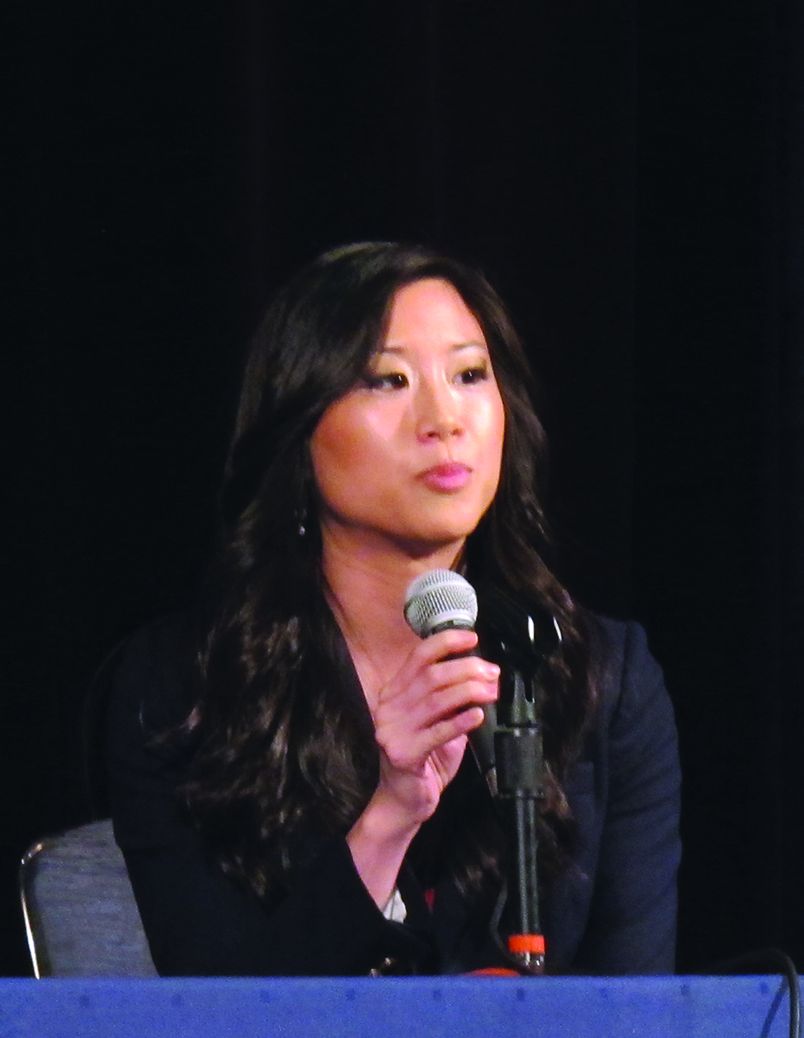
The same was true for uteri of 250-500 g (adjusted OR, 0.99, 1.73, and 1.06, respectively), she noted, adding that “abdominal hysterectomy always has the highest rate of a complication, except at above 850 g, when a vaginal hysterectomy is associated with a greater odds of complications.”
This secondary analysis was performed using prospectively collected quality improvement data abstracted from the American College of Surgeons National Surgical Quality Improvement Program database, which includes patient information and 30-day outcomes from more than 500 U.S. hospitals. Patients included in the analysis were 27,167 women who underwent a hysterectomy for benign conditions during 2014-2015 for whom uterine size was reported. Complications assessed included infection, vascular complications, reoperation, and readmission.
“Our study suggests that uterine weight is not an appropriate indication for abdominal hysterectomy – that we can, and should, offer a laparoscopic approach even for a markedly enlarged uterus,” she said. “We believe, therefore, that patients may benefit from referral to specialty surgeons who are able to offer a laparoscopic approach, even for a very large uterus.”
In response to a question from the audience about the role of physician experience in the findings, Dr. Louie said that it was not a covariate for which information was available, thus it was not included in the analysis.
“However, I think all of us realize that surgeon volume and surgeon experience is an important factor for patient safety,” she said.
Dr. Louie has received consulting fees from Teleflex.
sworcester@frontlinemedcom.com
SOURCE: Louie M et al. SGS 2018, Oral Poster 06.
ORLANDO – according to findings from a nationwide cohort of more than 27,000 women.
After adjusting for numerous potential confounding factors, including medical risk factors, procedure-related variables, and patient demographics, increasing uterine weight was significantly associated with increasing odds of complications – particularly after hysterectomy for uteri over 500 g, Michelle Louie, MD, reported during an oral poster session at the annual scientific meeting of the Society of Gynecologic Surgeons.
The same was true for uteri of 250-500 g (adjusted OR, 0.99, 1.73, and 1.06, respectively), she noted, adding that “abdominal hysterectomy always has the highest rate of a complication, except at above 850 g, when a vaginal hysterectomy is associated with a greater odds of complications.”
This secondary analysis was performed using prospectively collected quality improvement data abstracted from the American College of Surgeons National Surgical Quality Improvement Program database, which includes patient information and 30-day outcomes from more than 500 U.S. hospitals. Patients included in the analysis were 27,167 women who underwent a hysterectomy for benign conditions during 2014-2015 for whom uterine size was reported. Complications assessed included infection, vascular complications, reoperation, and readmission.
“Our study suggests that uterine weight is not an appropriate indication for abdominal hysterectomy – that we can, and should, offer a laparoscopic approach even for a markedly enlarged uterus,” she said. “We believe, therefore, that patients may benefit from referral to specialty surgeons who are able to offer a laparoscopic approach, even for a very large uterus.”
In response to a question from the audience about the role of physician experience in the findings, Dr. Louie said that it was not a covariate for which information was available, thus it was not included in the analysis.
“However, I think all of us realize that surgeon volume and surgeon experience is an important factor for patient safety,” she said.
Dr. Louie has received consulting fees from Teleflex.
sworcester@frontlinemedcom.com
SOURCE: Louie M et al. SGS 2018, Oral Poster 06.
ORLANDO – according to findings from a nationwide cohort of more than 27,000 women.
After adjusting for numerous potential confounding factors, including medical risk factors, procedure-related variables, and patient demographics, increasing uterine weight was significantly associated with increasing odds of complications – particularly after hysterectomy for uteri over 500 g, Michelle Louie, MD, reported during an oral poster session at the annual scientific meeting of the Society of Gynecologic Surgeons.
The same was true for uteri of 250-500 g (adjusted OR, 0.99, 1.73, and 1.06, respectively), she noted, adding that “abdominal hysterectomy always has the highest rate of a complication, except at above 850 g, when a vaginal hysterectomy is associated with a greater odds of complications.”
This secondary analysis was performed using prospectively collected quality improvement data abstracted from the American College of Surgeons National Surgical Quality Improvement Program database, which includes patient information and 30-day outcomes from more than 500 U.S. hospitals. Patients included in the analysis were 27,167 women who underwent a hysterectomy for benign conditions during 2014-2015 for whom uterine size was reported. Complications assessed included infection, vascular complications, reoperation, and readmission.
“Our study suggests that uterine weight is not an appropriate indication for abdominal hysterectomy – that we can, and should, offer a laparoscopic approach even for a markedly enlarged uterus,” she said. “We believe, therefore, that patients may benefit from referral to specialty surgeons who are able to offer a laparoscopic approach, even for a very large uterus.”
In response to a question from the audience about the role of physician experience in the findings, Dr. Louie said that it was not a covariate for which information was available, thus it was not included in the analysis.
“However, I think all of us realize that surgeon volume and surgeon experience is an important factor for patient safety,” she said.
Dr. Louie has received consulting fees from Teleflex.
sworcester@frontlinemedcom.com
SOURCE: Louie M et al. SGS 2018, Oral Poster 06.
REPORTING FROM SGS 2018
Key clinical point: Laparoscopic hysterectomy can and should be offered to women with uteri over 500 g.
Major finding: The odds ratios for complications after laparoscopic, abdominal, and vaginal hysterectomy for uteri over 500 g were 1.61, 2.16, and 2.57, respectively.
Study details: A secondary analysis of a nationwide cohort of 27,167 women.
Disclosures: Dr. Louie has received consulting fees from Teleflex.
Source: Louie M et al. SGS 2018, Oral Poster 06.
KD025 shows promise for steroid-dependent cGVHD
SALT LAKE CITY – KD025, an orally available Rho-associated coiled-coil kinase 2–selective inhibitor, is demonstrating encouraging activity and safety in patients with steroid-dependent or refractory chronic graft-versus-host disease (cGVHD) in a phase 2a clinical trial.
Initial results from the ongoing open-label trial known as KD025-208 showed that 11 of 17 patients (65%) and 11 of 16 patients (69%) enrolled in 200-mg daily and 200-mg twice-daily dose cohorts, respectively, had a clinical response with no reported treatment-related serious adverse events at any evaluation time point, Aleksandr Lazaryan, MD, PhD, reported at the combined annual meetings of the Center for International Blood & Marrow Transplant Research and the American Society for Blood and Marrow Transplantation.
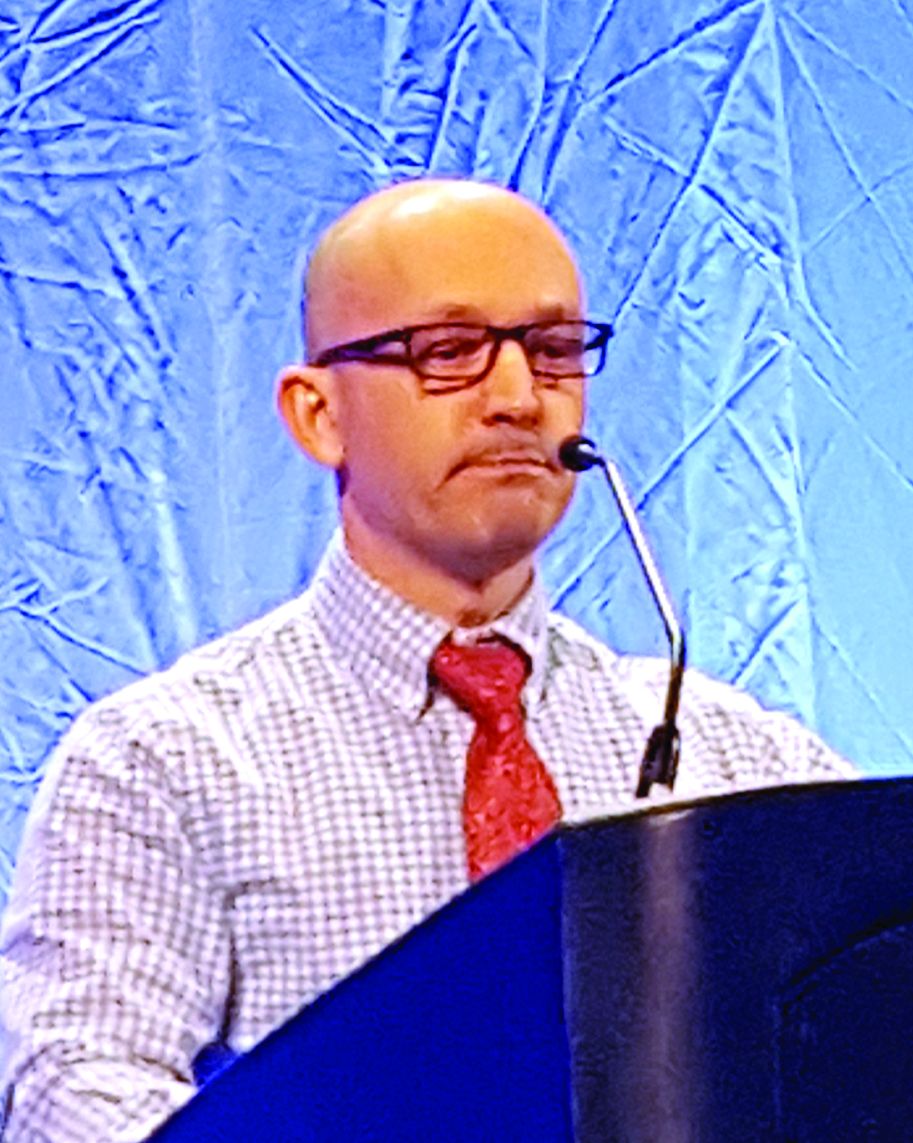
The median duration of treatment in the 200-mg daily group (cohort 1) was 37 weeks, and in the 200-mg twice-daily group (cohort 2) was 28 weeks. At last follow-up, eight patients remained active in each cohort, and these patients had a median treatment duration of 53 and 38 weeks, respectively, he said.
In cohort 1, four patients went off the study because of cGVHD progression, and five withdrew, including two who experienced recurrence of their underlying hematologic malignancy. In cohort 2, 7 of the 16 patients experienced progression of cGVHD, he noted.
Patients in cohorts 1 and 2 had a median age of 52 years and had received at least 2 months of steroid treatment and no more than 3 prior lines of therapy. They were comparable with respect to baseline characteristics, including median time to and duration of GVHD, time from diagnosis to enrollment, median prednisone dose, and median number of prior therapies. They had involvement of various – and often multiple – organ systems: 58% had four or more systems affected at the time of enrollment, and 21% had five or more systems affected.
“This, in a way, reflects a real-life mix of the cGVHD population of patients, with some of those patients having advanced cGVHD,” said Dr. Lazaryan.
Responses were observed across all affected organ systems, with complete responses documented in the upper and lower gastrointestinal tracts. About 75% of patients in cohort 1 who had multiple organ systems involved at enrollment demonstrated responses in at least four organ systems.
Furthermore, the responses were rapid: 68% of responses occurred in the first 8 weeks of treatment and appeared durable, Dr. Lazaryan said, noting that 7 of the 17 patients in cohort 1 had sustained responses for more than 20 weeks, and 3 patients had sustained responses for more than 32 weeks.
“The durability data continue to mature in this trial,” he added.
The adverse events that occurred were consistent with what would be expected for the cGVHD patient population treated with steroids, he said, reporting that no patients discontinued treatment because of infection, no opportunistic or fungal infections have been reported to date, and no treatment-related serious adverse events were reported.
Steroid dose reductions were experienced by 40% and 26% of patients in cohorts 1 and 2, respectively. The dose reductions were achieved in both KD025 responders and nonresponders, he noted.
Overall, four patients (12%) were able to discontinue steroids, and 80% in both cohorts experienced reductions in background tacrolimus.
In addition, up to 65% of patients in cohort 1 achieved a greater than seven point reduction on the Lee cGVHD Symptom Scale, with both responders and nonresponders experiencing improvement on this endpoint.
Chronic GVHD remains a leading cause of post-transplant morbidity and mortality. KD025, which is currently in phase 2 development for inflammatory fibrotic disease, has been shown in preclinical models to down-regulate T helper 17 cells and T follicular helper cells while up-regulating anti-inflammatory regulatory T cells, thereby potentially correcting the immunological imbalance seen in cGVHD, Dr. Lazaryan said.
Analysis is ongoing in this study, including in a third cohort of patients treated with 200 mg of KD025 four times daily, which recently completed accrual. An expansion cohort, at a dose yet to be determined, will include approximately 40 patients, he noted.
The trial is sponsored by Kadmon. Dr. Lazaryan reported advisory board membership and consultancy for GLyPharma Therapeutic.
sworcester@frontlinemedcom.com
SOURCE: Lazaryan A et al. 2018 BMT Tandem Meetings, Abstract 38.
SALT LAKE CITY – KD025, an orally available Rho-associated coiled-coil kinase 2–selective inhibitor, is demonstrating encouraging activity and safety in patients with steroid-dependent or refractory chronic graft-versus-host disease (cGVHD) in a phase 2a clinical trial.
Initial results from the ongoing open-label trial known as KD025-208 showed that 11 of 17 patients (65%) and 11 of 16 patients (69%) enrolled in 200-mg daily and 200-mg twice-daily dose cohorts, respectively, had a clinical response with no reported treatment-related serious adverse events at any evaluation time point, Aleksandr Lazaryan, MD, PhD, reported at the combined annual meetings of the Center for International Blood & Marrow Transplant Research and the American Society for Blood and Marrow Transplantation.
The median duration of treatment in the 200-mg daily group (cohort 1) was 37 weeks, and in the 200-mg twice-daily group (cohort 2) was 28 weeks. At last follow-up, eight patients remained active in each cohort, and these patients had a median treatment duration of 53 and 38 weeks, respectively, he said.
In cohort 1, four patients went off the study because of cGVHD progression, and five withdrew, including two who experienced recurrence of their underlying hematologic malignancy. In cohort 2, 7 of the 16 patients experienced progression of cGVHD, he noted.
Patients in cohorts 1 and 2 had a median age of 52 years and had received at least 2 months of steroid treatment and no more than 3 prior lines of therapy. They were comparable with respect to baseline characteristics, including median time to and duration of GVHD, time from diagnosis to enrollment, median prednisone dose, and median number of prior therapies. They had involvement of various – and often multiple – organ systems: 58% had four or more systems affected at the time of enrollment, and 21% had five or more systems affected.
“This, in a way, reflects a real-life mix of the cGVHD population of patients, with some of those patients having advanced cGVHD,” said Dr. Lazaryan.
Responses were observed across all affected organ systems, with complete responses documented in the upper and lower gastrointestinal tracts. About 75% of patients in cohort 1 who had multiple organ systems involved at enrollment demonstrated responses in at least four organ systems.
Furthermore, the responses were rapid: 68% of responses occurred in the first 8 weeks of treatment and appeared durable, Dr. Lazaryan said, noting that 7 of the 17 patients in cohort 1 had sustained responses for more than 20 weeks, and 3 patients had sustained responses for more than 32 weeks.
“The durability data continue to mature in this trial,” he added.
The adverse events that occurred were consistent with what would be expected for the cGVHD patient population treated with steroids, he said, reporting that no patients discontinued treatment because of infection, no opportunistic or fungal infections have been reported to date, and no treatment-related serious adverse events were reported.
Steroid dose reductions were experienced by 40% and 26% of patients in cohorts 1 and 2, respectively. The dose reductions were achieved in both KD025 responders and nonresponders, he noted.
Overall, four patients (12%) were able to discontinue steroids, and 80% in both cohorts experienced reductions in background tacrolimus.
In addition, up to 65% of patients in cohort 1 achieved a greater than seven point reduction on the Lee cGVHD Symptom Scale, with both responders and nonresponders experiencing improvement on this endpoint.
Chronic GVHD remains a leading cause of post-transplant morbidity and mortality. KD025, which is currently in phase 2 development for inflammatory fibrotic disease, has been shown in preclinical models to down-regulate T helper 17 cells and T follicular helper cells while up-regulating anti-inflammatory regulatory T cells, thereby potentially correcting the immunological imbalance seen in cGVHD, Dr. Lazaryan said.
Analysis is ongoing in this study, including in a third cohort of patients treated with 200 mg of KD025 four times daily, which recently completed accrual. An expansion cohort, at a dose yet to be determined, will include approximately 40 patients, he noted.
The trial is sponsored by Kadmon. Dr. Lazaryan reported advisory board membership and consultancy for GLyPharma Therapeutic.
sworcester@frontlinemedcom.com
SOURCE: Lazaryan A et al. 2018 BMT Tandem Meetings, Abstract 38.
SALT LAKE CITY – KD025, an orally available Rho-associated coiled-coil kinase 2–selective inhibitor, is demonstrating encouraging activity and safety in patients with steroid-dependent or refractory chronic graft-versus-host disease (cGVHD) in a phase 2a clinical trial.
Initial results from the ongoing open-label trial known as KD025-208 showed that 11 of 17 patients (65%) and 11 of 16 patients (69%) enrolled in 200-mg daily and 200-mg twice-daily dose cohorts, respectively, had a clinical response with no reported treatment-related serious adverse events at any evaluation time point, Aleksandr Lazaryan, MD, PhD, reported at the combined annual meetings of the Center for International Blood & Marrow Transplant Research and the American Society for Blood and Marrow Transplantation.
The median duration of treatment in the 200-mg daily group (cohort 1) was 37 weeks, and in the 200-mg twice-daily group (cohort 2) was 28 weeks. At last follow-up, eight patients remained active in each cohort, and these patients had a median treatment duration of 53 and 38 weeks, respectively, he said.
In cohort 1, four patients went off the study because of cGVHD progression, and five withdrew, including two who experienced recurrence of their underlying hematologic malignancy. In cohort 2, 7 of the 16 patients experienced progression of cGVHD, he noted.
Patients in cohorts 1 and 2 had a median age of 52 years and had received at least 2 months of steroid treatment and no more than 3 prior lines of therapy. They were comparable with respect to baseline characteristics, including median time to and duration of GVHD, time from diagnosis to enrollment, median prednisone dose, and median number of prior therapies. They had involvement of various – and often multiple – organ systems: 58% had four or more systems affected at the time of enrollment, and 21% had five or more systems affected.
“This, in a way, reflects a real-life mix of the cGVHD population of patients, with some of those patients having advanced cGVHD,” said Dr. Lazaryan.
Responses were observed across all affected organ systems, with complete responses documented in the upper and lower gastrointestinal tracts. About 75% of patients in cohort 1 who had multiple organ systems involved at enrollment demonstrated responses in at least four organ systems.
Furthermore, the responses were rapid: 68% of responses occurred in the first 8 weeks of treatment and appeared durable, Dr. Lazaryan said, noting that 7 of the 17 patients in cohort 1 had sustained responses for more than 20 weeks, and 3 patients had sustained responses for more than 32 weeks.
“The durability data continue to mature in this trial,” he added.
The adverse events that occurred were consistent with what would be expected for the cGVHD patient population treated with steroids, he said, reporting that no patients discontinued treatment because of infection, no opportunistic or fungal infections have been reported to date, and no treatment-related serious adverse events were reported.
Steroid dose reductions were experienced by 40% and 26% of patients in cohorts 1 and 2, respectively. The dose reductions were achieved in both KD025 responders and nonresponders, he noted.
Overall, four patients (12%) were able to discontinue steroids, and 80% in both cohorts experienced reductions in background tacrolimus.
In addition, up to 65% of patients in cohort 1 achieved a greater than seven point reduction on the Lee cGVHD Symptom Scale, with both responders and nonresponders experiencing improvement on this endpoint.
Chronic GVHD remains a leading cause of post-transplant morbidity and mortality. KD025, which is currently in phase 2 development for inflammatory fibrotic disease, has been shown in preclinical models to down-regulate T helper 17 cells and T follicular helper cells while up-regulating anti-inflammatory regulatory T cells, thereby potentially correcting the immunological imbalance seen in cGVHD, Dr. Lazaryan said.
Analysis is ongoing in this study, including in a third cohort of patients treated with 200 mg of KD025 four times daily, which recently completed accrual. An expansion cohort, at a dose yet to be determined, will include approximately 40 patients, he noted.
The trial is sponsored by Kadmon. Dr. Lazaryan reported advisory board membership and consultancy for GLyPharma Therapeutic.
sworcester@frontlinemedcom.com
SOURCE: Lazaryan A et al. 2018 BMT Tandem Meetings, Abstract 38.
REPORTING FROM THE 2018 BMT TANDEM MEETINGS
Key clinical point:
Major finding: Clinical response rates in cohorts 1 and 2 were 65% and 69%, respectively.
Study details: Preliminary findings in 33 patients from a phase 2a trial.
Disclosures: The trial is sponsored by Kadmon. Dr. Lazaryan reported advisory board membership and consultancy for GLyPharma Therapeutic.
Source: Lazaryan A et al. 2018 BMT Tandem Meetings, Abstract 38.
MEC plus ixazomib looks promising in relapsed/refractory AML
ATLANTA – Mitoxantrone, etoposide, and cytarabine (MEC) in combination with the second-generation proteasome inhibitor ixazomib was well tolerated and effective in a phase 1 expansion study of patients with relapsed or refractory acute myeloid leukemia.
The overall response rate in 30 patients enrolled in the study and treated with the novel combination was 53%; 11 patients had a complete response (CR), and 5 had a complete response with incomplete blood count recovery (CRi). The median overall survival was 4.9 months, Anjali S. Advani, MD, reported at the annual meeting of the American Society of Hematology.
Thirteen patients proceeded to allogeneic hematopoietic cell transplant (AHCT), and one received a donor lymphocyte infusion. Seven of these 14 patients are alive with a median follow-up of 14.5 months, said Dr. Advani of Taussig Cancer Institute, Cleveland Clinic.
The patients, who had a median age of 58 years (range of 18-70 years), were eligible for the study if they had relapsed/refractory acute myeloid leukemia (AML), adequate organ function, and cardiac ejection fraction of at least 45%. The median time from initial diagnosis to enrollment was 7.6 months.
Eight patients had a history of an antecedent hematologic disorder; 14 were in their first relapse; and 13 had disease that was refractory to their last treatment. Two had received a prior AHCT; seven had FLT3 internal tandem duplication (ITD) mutations indicative of particularly poor prognosis; and seven had adverse cytogenetics, she said.
They received one cycle of the therapy, which included 8mg/m2 of mitoxantrone, 80 mg/m2 of etoposide, and 1,000 mg/m2 of cytarabine given intravenously on days 1-6, plus ixazomib at doses of 1 mg (27 patients) or 2 mg (3 patients) given orally on days 1, 4, 8, and 11. An additional 18 patients were treated at the maximum tolerated dose (1 mg, as determined in phase 1 of the trial), Dr. Advani said.
The treatment was well tolerated in most patients. Grade 3-5 nonhematologic toxicities occurred in at least 15% of patients and included infection in 74%, febrile neutropenia in 85%, hypotension in 18%, hypoxia in 19%, mucositis in 15%, hypokalemia in 33%, and hypoalbuminemia in 30%, she said. The early mortality rate was 10%.
Of note, prior studies have demonstrated that the number of mutations in DNMT3A, TP53, ASXL1, and NRAS is associated with a worse response to salvage therapy. Of 21 patients in the current study who had available data, 10 patients had at least one of these mutations, and 8 of those 10 patients achieved CR or CRi, Dr. Advani said.
“To identify a signature predictive of response to treatment, we performed RNA sequencing on pretreatment samples from 17 patients, and on posttreatment samples from 11 patients,” she said. “We found that genes were differentially expressed between resistant and responding patients in 314 genes in the pretreatment samples, in 217 genes in the posttreatment samples, and in 72 genes at both time points.”
Gene set enrichment analysis identified significantly differentially expressed genes clustering in heme-metabolism and erythroblast differentiation, inflammatory response, cytokine/STAT signaling, nuclear factor-kappa beta (NF-kappaB), and hypoxia. Two genes – gamma-interferon–inducible lysosomal thiol reductase (IFI30) and retinoic acid–related orphan receptor A (ROR-alpha) – were found to be significantly different between responding and resistant patients, and could potentially classify response, she noted.
“IFI30, which may increase the levels of antioxidants and lead to a decreased ER [endoplasmic reticulum] stress response to therapy, was more highly expressed in resistant patients, and ROR-alpha, a tumor-suppressor gene, was down regulated in resistant patients,” she said.
Ixazomib was combined with the AML salvage regimen MEC in this study because proteasome inhibitors like ixazomib induce cell death in AML cells through inhibition of NF-kappaB, and also increase chemosensitivity to anthracyclines and cytarabines, Dr. Advani explained.
The findings are encouraging and suggest that results from gene expression profiling may help identify resistant patients and provide further therapeutic targets, she said, noting that in vitro studies are planned to clarify whether the use of ROR-alpha agonists may help sensitize resistant cells to treatment.
Dr. Advani reported receiving research funding from Takeda/Millenium, and serving as a consultant for Pfizer.
ATLANTA – Mitoxantrone, etoposide, and cytarabine (MEC) in combination with the second-generation proteasome inhibitor ixazomib was well tolerated and effective in a phase 1 expansion study of patients with relapsed or refractory acute myeloid leukemia.
The overall response rate in 30 patients enrolled in the study and treated with the novel combination was 53%; 11 patients had a complete response (CR), and 5 had a complete response with incomplete blood count recovery (CRi). The median overall survival was 4.9 months, Anjali S. Advani, MD, reported at the annual meeting of the American Society of Hematology.
Thirteen patients proceeded to allogeneic hematopoietic cell transplant (AHCT), and one received a donor lymphocyte infusion. Seven of these 14 patients are alive with a median follow-up of 14.5 months, said Dr. Advani of Taussig Cancer Institute, Cleveland Clinic.
The patients, who had a median age of 58 years (range of 18-70 years), were eligible for the study if they had relapsed/refractory acute myeloid leukemia (AML), adequate organ function, and cardiac ejection fraction of at least 45%. The median time from initial diagnosis to enrollment was 7.6 months.
Eight patients had a history of an antecedent hematologic disorder; 14 were in their first relapse; and 13 had disease that was refractory to their last treatment. Two had received a prior AHCT; seven had FLT3 internal tandem duplication (ITD) mutations indicative of particularly poor prognosis; and seven had adverse cytogenetics, she said.
They received one cycle of the therapy, which included 8mg/m2 of mitoxantrone, 80 mg/m2 of etoposide, and 1,000 mg/m2 of cytarabine given intravenously on days 1-6, plus ixazomib at doses of 1 mg (27 patients) or 2 mg (3 patients) given orally on days 1, 4, 8, and 11. An additional 18 patients were treated at the maximum tolerated dose (1 mg, as determined in phase 1 of the trial), Dr. Advani said.
The treatment was well tolerated in most patients. Grade 3-5 nonhematologic toxicities occurred in at least 15% of patients and included infection in 74%, febrile neutropenia in 85%, hypotension in 18%, hypoxia in 19%, mucositis in 15%, hypokalemia in 33%, and hypoalbuminemia in 30%, she said. The early mortality rate was 10%.
Of note, prior studies have demonstrated that the number of mutations in DNMT3A, TP53, ASXL1, and NRAS is associated with a worse response to salvage therapy. Of 21 patients in the current study who had available data, 10 patients had at least one of these mutations, and 8 of those 10 patients achieved CR or CRi, Dr. Advani said.
“To identify a signature predictive of response to treatment, we performed RNA sequencing on pretreatment samples from 17 patients, and on posttreatment samples from 11 patients,” she said. “We found that genes were differentially expressed between resistant and responding patients in 314 genes in the pretreatment samples, in 217 genes in the posttreatment samples, and in 72 genes at both time points.”
Gene set enrichment analysis identified significantly differentially expressed genes clustering in heme-metabolism and erythroblast differentiation, inflammatory response, cytokine/STAT signaling, nuclear factor-kappa beta (NF-kappaB), and hypoxia. Two genes – gamma-interferon–inducible lysosomal thiol reductase (IFI30) and retinoic acid–related orphan receptor A (ROR-alpha) – were found to be significantly different between responding and resistant patients, and could potentially classify response, she noted.
“IFI30, which may increase the levels of antioxidants and lead to a decreased ER [endoplasmic reticulum] stress response to therapy, was more highly expressed in resistant patients, and ROR-alpha, a tumor-suppressor gene, was down regulated in resistant patients,” she said.
Ixazomib was combined with the AML salvage regimen MEC in this study because proteasome inhibitors like ixazomib induce cell death in AML cells through inhibition of NF-kappaB, and also increase chemosensitivity to anthracyclines and cytarabines, Dr. Advani explained.
The findings are encouraging and suggest that results from gene expression profiling may help identify resistant patients and provide further therapeutic targets, she said, noting that in vitro studies are planned to clarify whether the use of ROR-alpha agonists may help sensitize resistant cells to treatment.
Dr. Advani reported receiving research funding from Takeda/Millenium, and serving as a consultant for Pfizer.
ATLANTA – Mitoxantrone, etoposide, and cytarabine (MEC) in combination with the second-generation proteasome inhibitor ixazomib was well tolerated and effective in a phase 1 expansion study of patients with relapsed or refractory acute myeloid leukemia.
The overall response rate in 30 patients enrolled in the study and treated with the novel combination was 53%; 11 patients had a complete response (CR), and 5 had a complete response with incomplete blood count recovery (CRi). The median overall survival was 4.9 months, Anjali S. Advani, MD, reported at the annual meeting of the American Society of Hematology.
Thirteen patients proceeded to allogeneic hematopoietic cell transplant (AHCT), and one received a donor lymphocyte infusion. Seven of these 14 patients are alive with a median follow-up of 14.5 months, said Dr. Advani of Taussig Cancer Institute, Cleveland Clinic.
The patients, who had a median age of 58 years (range of 18-70 years), were eligible for the study if they had relapsed/refractory acute myeloid leukemia (AML), adequate organ function, and cardiac ejection fraction of at least 45%. The median time from initial diagnosis to enrollment was 7.6 months.
Eight patients had a history of an antecedent hematologic disorder; 14 were in their first relapse; and 13 had disease that was refractory to their last treatment. Two had received a prior AHCT; seven had FLT3 internal tandem duplication (ITD) mutations indicative of particularly poor prognosis; and seven had adverse cytogenetics, she said.
They received one cycle of the therapy, which included 8mg/m2 of mitoxantrone, 80 mg/m2 of etoposide, and 1,000 mg/m2 of cytarabine given intravenously on days 1-6, plus ixazomib at doses of 1 mg (27 patients) or 2 mg (3 patients) given orally on days 1, 4, 8, and 11. An additional 18 patients were treated at the maximum tolerated dose (1 mg, as determined in phase 1 of the trial), Dr. Advani said.
The treatment was well tolerated in most patients. Grade 3-5 nonhematologic toxicities occurred in at least 15% of patients and included infection in 74%, febrile neutropenia in 85%, hypotension in 18%, hypoxia in 19%, mucositis in 15%, hypokalemia in 33%, and hypoalbuminemia in 30%, she said. The early mortality rate was 10%.
Of note, prior studies have demonstrated that the number of mutations in DNMT3A, TP53, ASXL1, and NRAS is associated with a worse response to salvage therapy. Of 21 patients in the current study who had available data, 10 patients had at least one of these mutations, and 8 of those 10 patients achieved CR or CRi, Dr. Advani said.
“To identify a signature predictive of response to treatment, we performed RNA sequencing on pretreatment samples from 17 patients, and on posttreatment samples from 11 patients,” she said. “We found that genes were differentially expressed between resistant and responding patients in 314 genes in the pretreatment samples, in 217 genes in the posttreatment samples, and in 72 genes at both time points.”
Gene set enrichment analysis identified significantly differentially expressed genes clustering in heme-metabolism and erythroblast differentiation, inflammatory response, cytokine/STAT signaling, nuclear factor-kappa beta (NF-kappaB), and hypoxia. Two genes – gamma-interferon–inducible lysosomal thiol reductase (IFI30) and retinoic acid–related orphan receptor A (ROR-alpha) – were found to be significantly different between responding and resistant patients, and could potentially classify response, she noted.
“IFI30, which may increase the levels of antioxidants and lead to a decreased ER [endoplasmic reticulum] stress response to therapy, was more highly expressed in resistant patients, and ROR-alpha, a tumor-suppressor gene, was down regulated in resistant patients,” she said.
Ixazomib was combined with the AML salvage regimen MEC in this study because proteasome inhibitors like ixazomib induce cell death in AML cells through inhibition of NF-kappaB, and also increase chemosensitivity to anthracyclines and cytarabines, Dr. Advani explained.
The findings are encouraging and suggest that results from gene expression profiling may help identify resistant patients and provide further therapeutic targets, she said, noting that in vitro studies are planned to clarify whether the use of ROR-alpha agonists may help sensitize resistant cells to treatment.
Dr. Advani reported receiving research funding from Takeda/Millenium, and serving as a consultant for Pfizer.
REPORTING FROM ASH 2017
Key clinical point: Major finding: The overall response rate was 53%.
Study details: A phase 1 trial involving 30 patients.
Disclosures: Dr. Advani reported receiving research funding from Takeda/Millenium, and serving as a consultant for Pfizer.
Source: Advani A et al. ASH 2017, Abstract 150.
HCT-CI score may predict mortality for nonmalignant disease
SALT LAKE CITY – Scores of 3 or higher on the Hematopoietic Cell Transplantation Comorbidity Index (HCT-CI) are associated with an increased risk of posttransplant mortality in certain patients undergoing allogeneic HCT for nonmalignant disease, according to findings from a review of more than 4,000 patients.
The exception was in patients undergoing HCT for hemoglobinopathies, Larisa Broglie, MD, reported at the combined annual meetings of the Center for International Blood & Marrow Transplant Research and the American Society for Blood and Marrow Transplantation.
The findings of the study, which is the largest to date to validate the usefulness of the HCT-CI for risk assessment in HCT patients with nonmalignant disease, have important implications for patient counseling and decision making, said Dr. Broglie of the Medical College of Wisconsin, Milwaukee.
Of 4,083 children and adults who underwent a first allogeneic HCT for a nonmalignant disease between 2007 and 2014 and who had sufficient follow-up (median, 39 months), 61% had an HCT-CI score of 0, 20% had a score of 1-2, and 19% had a score of 3 or higher.
After adjustment for age, disease, donor, graft source, recipient cytomegalovirus status, and performance status, scores of 3 or greater were associated with an overall increased hazard ratio for poor survival (HRs of 1.33 for scores of 3-4 and 2.31 for scores of 5 or greater, vs. 1.0 and 1.127 for scores of 0 or 1-2, respectively), she said.
Patients with an HCT-CI score of 0 had estimated 2-year overall survival of 82.7%, compared with 80.3% for scores 1-2, 74.0% for scores 3-4, and 55.8% for scores of 5 or greater.
Patients included in this study were identified from the Center for International Blood & Marrow Transplant Research database. They ranged in age from under 1 year to 77 years but most were young; the median age was 9 years and 78% of patients were under age 20.
HCT was performed for acquired aplastic anemia in 33% of patients, immune deficiencies in 19%, hemoglobinopathies in 16%, bone marrow failure in 12%, histiocytic disorders in 11%, metabolic disease in 9%, or autoimmune disease in less than 1%, she said, noting that the most frequent comorbidities seen within the entire cohort were moderate pulmonary disease, hepatic disease, and infection requiring ongoing treatment.
The effect of HCT-CI score on survival was present regardless of conditioning intensity and graft-versus-host disease prophylaxis, but scores predicted mortality risk differently based on underlying disease, and different comorbidities predominated in each disease category, she said, explaining that this was apparent when patients were stratified by the seven represented nonmalignant disease categories to account for disease heterogeneity.
For example, HCT-CI score predicted mortality risk in patients with aplastic anemia (HRs of 1.00, 1.19, and 2.06 for scores of 0, 1-2, and 3 or greater, respectively), and in patients with immune deficiency (HRs of 1.00, 1.37, and 1.87 for scores of 0, 1-2, and 3 or greater, respectively), and the distribution of comorbidities in patients in these two disease categories was similar to that of the overall cohort.
However, HCT-CI score did not predict mortality risk in those undergoing HCT for hemoglobinopathies (HRs of 1.00, 0.46, and 0.59 for scores of 0, 1-2, and 3 or greater, respectively), Dr. Broglie said, noting that these patients had overall high survival rates regardless of HCT-CI scores, and they had comorbidities that differed from the overall cohort.
HCT is a curative treatment strategy for many patients with nonmalignant diseases but transplant-related mortality remains a concern, she said. While HCT-CI has been shown to be useful for discriminating the risks of nonrelapse and overall survival among patients with hematologic malignancies who undergo allogeneic HCT, its usefulness in patients undergoing HCT for nonmalignant diseases has been less clear.
The distinction is important, as patients with nonmalignant diseases have different pretransplant exposures and may have comorbidities specific to their underlying disease. Furthermore, transplantation approaches – including conditioning regimens and intensities – differ, she said.
“And the HCT-CI was developed to predict risk of nonrelapse mortality, but relapse in nonmalignant diseases can often be difficult to define,” she added.
The current findings demonstrate the value of the HCT-CI in nonmalignant diseases, and “offer the potential to intervene with transplantation prior to the onset of comorbidities, or with efforts to prevent comorbidities prior to transplantation,” she said, concluding that “future efforts could focus on further refining pretransplant risk assessment for patients with nonmalignant diseases, especially for patients with hemoglobinopathies and HCT-CI scores of less than 3.”
Dr. Broglie reported having no financial disclosures.
sworcester@frontlinemedcom.com
SOURCE: Broglie L et al. Abstract 16.
SALT LAKE CITY – Scores of 3 or higher on the Hematopoietic Cell Transplantation Comorbidity Index (HCT-CI) are associated with an increased risk of posttransplant mortality in certain patients undergoing allogeneic HCT for nonmalignant disease, according to findings from a review of more than 4,000 patients.
The exception was in patients undergoing HCT for hemoglobinopathies, Larisa Broglie, MD, reported at the combined annual meetings of the Center for International Blood & Marrow Transplant Research and the American Society for Blood and Marrow Transplantation.
The findings of the study, which is the largest to date to validate the usefulness of the HCT-CI for risk assessment in HCT patients with nonmalignant disease, have important implications for patient counseling and decision making, said Dr. Broglie of the Medical College of Wisconsin, Milwaukee.
Of 4,083 children and adults who underwent a first allogeneic HCT for a nonmalignant disease between 2007 and 2014 and who had sufficient follow-up (median, 39 months), 61% had an HCT-CI score of 0, 20% had a score of 1-2, and 19% had a score of 3 or higher.
After adjustment for age, disease, donor, graft source, recipient cytomegalovirus status, and performance status, scores of 3 or greater were associated with an overall increased hazard ratio for poor survival (HRs of 1.33 for scores of 3-4 and 2.31 for scores of 5 or greater, vs. 1.0 and 1.127 for scores of 0 or 1-2, respectively), she said.
Patients with an HCT-CI score of 0 had estimated 2-year overall survival of 82.7%, compared with 80.3% for scores 1-2, 74.0% for scores 3-4, and 55.8% for scores of 5 or greater.
Patients included in this study were identified from the Center for International Blood & Marrow Transplant Research database. They ranged in age from under 1 year to 77 years but most were young; the median age was 9 years and 78% of patients were under age 20.
HCT was performed for acquired aplastic anemia in 33% of patients, immune deficiencies in 19%, hemoglobinopathies in 16%, bone marrow failure in 12%, histiocytic disorders in 11%, metabolic disease in 9%, or autoimmune disease in less than 1%, she said, noting that the most frequent comorbidities seen within the entire cohort were moderate pulmonary disease, hepatic disease, and infection requiring ongoing treatment.
The effect of HCT-CI score on survival was present regardless of conditioning intensity and graft-versus-host disease prophylaxis, but scores predicted mortality risk differently based on underlying disease, and different comorbidities predominated in each disease category, she said, explaining that this was apparent when patients were stratified by the seven represented nonmalignant disease categories to account for disease heterogeneity.
For example, HCT-CI score predicted mortality risk in patients with aplastic anemia (HRs of 1.00, 1.19, and 2.06 for scores of 0, 1-2, and 3 or greater, respectively), and in patients with immune deficiency (HRs of 1.00, 1.37, and 1.87 for scores of 0, 1-2, and 3 or greater, respectively), and the distribution of comorbidities in patients in these two disease categories was similar to that of the overall cohort.
However, HCT-CI score did not predict mortality risk in those undergoing HCT for hemoglobinopathies (HRs of 1.00, 0.46, and 0.59 for scores of 0, 1-2, and 3 or greater, respectively), Dr. Broglie said, noting that these patients had overall high survival rates regardless of HCT-CI scores, and they had comorbidities that differed from the overall cohort.
HCT is a curative treatment strategy for many patients with nonmalignant diseases but transplant-related mortality remains a concern, she said. While HCT-CI has been shown to be useful for discriminating the risks of nonrelapse and overall survival among patients with hematologic malignancies who undergo allogeneic HCT, its usefulness in patients undergoing HCT for nonmalignant diseases has been less clear.
The distinction is important, as patients with nonmalignant diseases have different pretransplant exposures and may have comorbidities specific to their underlying disease. Furthermore, transplantation approaches – including conditioning regimens and intensities – differ, she said.
“And the HCT-CI was developed to predict risk of nonrelapse mortality, but relapse in nonmalignant diseases can often be difficult to define,” she added.
The current findings demonstrate the value of the HCT-CI in nonmalignant diseases, and “offer the potential to intervene with transplantation prior to the onset of comorbidities, or with efforts to prevent comorbidities prior to transplantation,” she said, concluding that “future efforts could focus on further refining pretransplant risk assessment for patients with nonmalignant diseases, especially for patients with hemoglobinopathies and HCT-CI scores of less than 3.”
Dr. Broglie reported having no financial disclosures.
sworcester@frontlinemedcom.com
SOURCE: Broglie L et al. Abstract 16.
SALT LAKE CITY – Scores of 3 or higher on the Hematopoietic Cell Transplantation Comorbidity Index (HCT-CI) are associated with an increased risk of posttransplant mortality in certain patients undergoing allogeneic HCT for nonmalignant disease, according to findings from a review of more than 4,000 patients.
The exception was in patients undergoing HCT for hemoglobinopathies, Larisa Broglie, MD, reported at the combined annual meetings of the Center for International Blood & Marrow Transplant Research and the American Society for Blood and Marrow Transplantation.
The findings of the study, which is the largest to date to validate the usefulness of the HCT-CI for risk assessment in HCT patients with nonmalignant disease, have important implications for patient counseling and decision making, said Dr. Broglie of the Medical College of Wisconsin, Milwaukee.
Of 4,083 children and adults who underwent a first allogeneic HCT for a nonmalignant disease between 2007 and 2014 and who had sufficient follow-up (median, 39 months), 61% had an HCT-CI score of 0, 20% had a score of 1-2, and 19% had a score of 3 or higher.
After adjustment for age, disease, donor, graft source, recipient cytomegalovirus status, and performance status, scores of 3 or greater were associated with an overall increased hazard ratio for poor survival (HRs of 1.33 for scores of 3-4 and 2.31 for scores of 5 or greater, vs. 1.0 and 1.127 for scores of 0 or 1-2, respectively), she said.
Patients with an HCT-CI score of 0 had estimated 2-year overall survival of 82.7%, compared with 80.3% for scores 1-2, 74.0% for scores 3-4, and 55.8% for scores of 5 or greater.
Patients included in this study were identified from the Center for International Blood & Marrow Transplant Research database. They ranged in age from under 1 year to 77 years but most were young; the median age was 9 years and 78% of patients were under age 20.
HCT was performed for acquired aplastic anemia in 33% of patients, immune deficiencies in 19%, hemoglobinopathies in 16%, bone marrow failure in 12%, histiocytic disorders in 11%, metabolic disease in 9%, or autoimmune disease in less than 1%, she said, noting that the most frequent comorbidities seen within the entire cohort were moderate pulmonary disease, hepatic disease, and infection requiring ongoing treatment.
The effect of HCT-CI score on survival was present regardless of conditioning intensity and graft-versus-host disease prophylaxis, but scores predicted mortality risk differently based on underlying disease, and different comorbidities predominated in each disease category, she said, explaining that this was apparent when patients were stratified by the seven represented nonmalignant disease categories to account for disease heterogeneity.
For example, HCT-CI score predicted mortality risk in patients with aplastic anemia (HRs of 1.00, 1.19, and 2.06 for scores of 0, 1-2, and 3 or greater, respectively), and in patients with immune deficiency (HRs of 1.00, 1.37, and 1.87 for scores of 0, 1-2, and 3 or greater, respectively), and the distribution of comorbidities in patients in these two disease categories was similar to that of the overall cohort.
However, HCT-CI score did not predict mortality risk in those undergoing HCT for hemoglobinopathies (HRs of 1.00, 0.46, and 0.59 for scores of 0, 1-2, and 3 or greater, respectively), Dr. Broglie said, noting that these patients had overall high survival rates regardless of HCT-CI scores, and they had comorbidities that differed from the overall cohort.
HCT is a curative treatment strategy for many patients with nonmalignant diseases but transplant-related mortality remains a concern, she said. While HCT-CI has been shown to be useful for discriminating the risks of nonrelapse and overall survival among patients with hematologic malignancies who undergo allogeneic HCT, its usefulness in patients undergoing HCT for nonmalignant diseases has been less clear.
The distinction is important, as patients with nonmalignant diseases have different pretransplant exposures and may have comorbidities specific to their underlying disease. Furthermore, transplantation approaches – including conditioning regimens and intensities – differ, she said.
“And the HCT-CI was developed to predict risk of nonrelapse mortality, but relapse in nonmalignant diseases can often be difficult to define,” she added.
The current findings demonstrate the value of the HCT-CI in nonmalignant diseases, and “offer the potential to intervene with transplantation prior to the onset of comorbidities, or with efforts to prevent comorbidities prior to transplantation,” she said, concluding that “future efforts could focus on further refining pretransplant risk assessment for patients with nonmalignant diseases, especially for patients with hemoglobinopathies and HCT-CI scores of less than 3.”
Dr. Broglie reported having no financial disclosures.
sworcester@frontlinemedcom.com
SOURCE: Broglie L et al. Abstract 16.
REPORTING FROM THE 2018 BMT TANDEM MEETINGS
Key clinical point:
Major finding: Hazard ratios for poor survival were 1.33 for scores of 3-4 and 2.31 for scores of 5 or greater, compared with 1.0 and 1.127 for scores of 0 or 1-2, respectively.
Study details: A review of 4,083 patients from the CIBMTR database.
Disclosures: Dr. Broglie reported having no financial disclosures.
Source: Broglie L et al. Abstract 16.
GCLAM therapy shows promise for relapsed/refractory AML
ATLANTA – GCLAM – the combined use of granulocyte colony-stimulating factor (G-CSF), cladribine, high-dose cytarabine, and mitoxantrone – was well tolerated and had potent antileukemia activity in a phase 1/2 trial of adults with relapsed/refractory acute myeloid leukemia or high-grade myeloid neoplasms.
Of 40 patients who were treated with GCLAM (with mitoxantrone at the maximum tolerated dose of 16 mg/m2 per day as established in phase 1 of the trial), 11 achieved a complete response (CR), and 13 achieved a complete response with incomplete blood count recovery (CRi), for an overall response rate of 60%, Anna B. Halpern, MD, reported at the annual meeting of the American Society of Hematology.
“Nine of the 11 CR patients and 11 of 13 with CRis were negative for minimal residual disease, for an overall MRD-negative CR rate of 23%,” said Dr. Halpern of the University of Washington and the Fred Hutchinson Cancer Research Center, both in Seattle.
Resistant disease occurred in 11 patients, she noted.
Median overall survival was 11.5 months, and the treatment-related mortality (TRM) rate was 5%.
Overall, 21 of 40 patients went to transplant, with a 49% 1-year survival rate, she said.
The patients had a median age of 63 years. Thirty-four had acute myeloid leukemia (AML), and 6 had high-grade myelodysplastic syndrome; 28 had secondary disease. Nineteen had primary refractory disease, 21 had relapsed disease after a median initial CR duration of 12 months, and 7 had prior allogeneic transplant. The median TRM score for all patients was 2.0, indicating a low risk for treatment-related mortality.
“Cytogenetics distribution, based on Medical Research Council criteria, was as expected,” she added.
At the mitoxantrone maximum tolerated dose of 16 mg/m2 per day – which was established during phase 1 in 26 patients in whom higher dose levels (18 mg/m2 per day) led to dose-limiting encephalopathy and cardiogenic shock – the most common grade 3 or greater adverse events included neutropenic fever, infectious complications, and hypoxia during therapy. This was largely attributed to volume overload and infection, Dr. Halpern said.
“Although three patients did have decreased ejection fraction in cycle 2, this was largely in the setting of sepsis, making the etiology difficult to ascribe to the anthracycline versus sepsis physiology,” she noted.
The median times to an absolute neutrophil count of 500/mcL or greater and platelet count of 50,000/mcL or greater were 29 days each, she noted.
A multivariable analysis controlling for baseline prognostic features showed that the mitoxantrone dose of 16 mg/m2 per day was associated with significantly better overall survival, compared with a dose of 10 mg/m2 per day used in a historical cohort according to standard GCLAM dosing (hazard ratio for death, 0.45). Additionally, more of those receiving a dose of 16 mg/m2 per day went on to transplant (52% vs. 37%), she said. The overall response rate was also higher with the 16-mg/m2 dose, but the difference was not statistically significant (odds ratio, 1.87).
“Further, the outcomes appear to be as good or better with GCLAM with mitoxantrone at 16 mg/m2 compared to other salvage regimens used at our institution, including decitabine priming plus mitoxantrone, etoposide, and cytarabine [d/MEC] and G-CSF with clofarabine and high-dose cytarabine [GCLAC],” she said, noting that the examination is currently ongoing in a larger sample.
The initial analysis, however, showed that, after controlling for age, cytogenetic risk, first CR duration, and prior hematopoietic cell transplant, overall response and overall survival rates were better with GCLAM than with d/MEC (OR, 3.23; HR for death, 0.64) and that the overall response rate was similar between GCLAM and GCLAC (OR, 1.75), she said.
The findings are encouraging because outcomes with standard chemotherapies for relapsed/refractory myeloid neoplasms are poor, with complete remission rates rarely exceeding 15%-20%, Dr. Halpern said.
The current study was undertaken based on promising results from a previous phase 2 study in poor-risk relapsed/refractory AML, which also showed encouraging activity with GCLAM and based on data suggesting benefit with escalated doses of anthracyclines in AML, she explained.
Patients 18 years and older were eligible if they had adequate organ function and a TRM score of 6.9 or lower, which corresponds to a predicted 28-day mortality of no more than 6.9% with standard induction chemotherapy. Those with uncontrolled infection or concomitant illness with expected survival of less than 1 year were excluded.
The phase 1 dose escalation involved cohorts of 6-12 patients who were assigned to receive mitoxantrone dose levels of 12, 14, 16, or 18 mg/m2 per day on days 1-3. The doses of the remaining drugs in the combination were fixed at 300 mcg or 480 mcg of G-CSF on days 0-5, 5 mg/m2 of cladribine on days 1-5, and 2 mg/m2 of cytarabine on days 1-5.
“All patients received GCLAM induction at their assigned mitoxantrone dose level. If CR wasn’t achieved with cycle 1, a second identical course of GCLAM was given,” Dr. Halpern explained, noting that patients with resistant disease after 2 cycles were taken off the study.
If CR or CRi was achieved within 1-2 cycles of induction, up to 4 cycles of consolidation with G-CLA (mitoxantrone omitted) were allowed, and responders could proceed with transplant at any time.
In phase 2, patients received the maximum tolerated dose of mitoxantrone (16mg/m2 per day), as defined in phase 1.
“Relapsed and refractory AML and high grade myeloid neoplasms are a challenging disease to treat. With an overall response rate of 60%, this regimen showed efficacy in a heavily pretreated patient population,” Dr. Halpern said. “And many of the responders were able to go on to receive a stem cell transplant, the only known curative option in this situation.”
A follow-up study is currently exploring the relative value of decitabine priming followed by GCLAM in this setting, she said.
Dr. Halpern reported having no relevant financial disclosures.
sworcester@frontlinemedcom.com
SOURCE: Halpern AB et al. ASH 2017, Abstract 149
ATLANTA – GCLAM – the combined use of granulocyte colony-stimulating factor (G-CSF), cladribine, high-dose cytarabine, and mitoxantrone – was well tolerated and had potent antileukemia activity in a phase 1/2 trial of adults with relapsed/refractory acute myeloid leukemia or high-grade myeloid neoplasms.
Of 40 patients who were treated with GCLAM (with mitoxantrone at the maximum tolerated dose of 16 mg/m2 per day as established in phase 1 of the trial), 11 achieved a complete response (CR), and 13 achieved a complete response with incomplete blood count recovery (CRi), for an overall response rate of 60%, Anna B. Halpern, MD, reported at the annual meeting of the American Society of Hematology.
“Nine of the 11 CR patients and 11 of 13 with CRis were negative for minimal residual disease, for an overall MRD-negative CR rate of 23%,” said Dr. Halpern of the University of Washington and the Fred Hutchinson Cancer Research Center, both in Seattle.
Resistant disease occurred in 11 patients, she noted.
Median overall survival was 11.5 months, and the treatment-related mortality (TRM) rate was 5%.
Overall, 21 of 40 patients went to transplant, with a 49% 1-year survival rate, she said.
The patients had a median age of 63 years. Thirty-four had acute myeloid leukemia (AML), and 6 had high-grade myelodysplastic syndrome; 28 had secondary disease. Nineteen had primary refractory disease, 21 had relapsed disease after a median initial CR duration of 12 months, and 7 had prior allogeneic transplant. The median TRM score for all patients was 2.0, indicating a low risk for treatment-related mortality.
“Cytogenetics distribution, based on Medical Research Council criteria, was as expected,” she added.
At the mitoxantrone maximum tolerated dose of 16 mg/m2 per day – which was established during phase 1 in 26 patients in whom higher dose levels (18 mg/m2 per day) led to dose-limiting encephalopathy and cardiogenic shock – the most common grade 3 or greater adverse events included neutropenic fever, infectious complications, and hypoxia during therapy. This was largely attributed to volume overload and infection, Dr. Halpern said.
“Although three patients did have decreased ejection fraction in cycle 2, this was largely in the setting of sepsis, making the etiology difficult to ascribe to the anthracycline versus sepsis physiology,” she noted.
The median times to an absolute neutrophil count of 500/mcL or greater and platelet count of 50,000/mcL or greater were 29 days each, she noted.
A multivariable analysis controlling for baseline prognostic features showed that the mitoxantrone dose of 16 mg/m2 per day was associated with significantly better overall survival, compared with a dose of 10 mg/m2 per day used in a historical cohort according to standard GCLAM dosing (hazard ratio for death, 0.45). Additionally, more of those receiving a dose of 16 mg/m2 per day went on to transplant (52% vs. 37%), she said. The overall response rate was also higher with the 16-mg/m2 dose, but the difference was not statistically significant (odds ratio, 1.87).
“Further, the outcomes appear to be as good or better with GCLAM with mitoxantrone at 16 mg/m2 compared to other salvage regimens used at our institution, including decitabine priming plus mitoxantrone, etoposide, and cytarabine [d/MEC] and G-CSF with clofarabine and high-dose cytarabine [GCLAC],” she said, noting that the examination is currently ongoing in a larger sample.
The initial analysis, however, showed that, after controlling for age, cytogenetic risk, first CR duration, and prior hematopoietic cell transplant, overall response and overall survival rates were better with GCLAM than with d/MEC (OR, 3.23; HR for death, 0.64) and that the overall response rate was similar between GCLAM and GCLAC (OR, 1.75), she said.
The findings are encouraging because outcomes with standard chemotherapies for relapsed/refractory myeloid neoplasms are poor, with complete remission rates rarely exceeding 15%-20%, Dr. Halpern said.
The current study was undertaken based on promising results from a previous phase 2 study in poor-risk relapsed/refractory AML, which also showed encouraging activity with GCLAM and based on data suggesting benefit with escalated doses of anthracyclines in AML, she explained.
Patients 18 years and older were eligible if they had adequate organ function and a TRM score of 6.9 or lower, which corresponds to a predicted 28-day mortality of no more than 6.9% with standard induction chemotherapy. Those with uncontrolled infection or concomitant illness with expected survival of less than 1 year were excluded.
The phase 1 dose escalation involved cohorts of 6-12 patients who were assigned to receive mitoxantrone dose levels of 12, 14, 16, or 18 mg/m2 per day on days 1-3. The doses of the remaining drugs in the combination were fixed at 300 mcg or 480 mcg of G-CSF on days 0-5, 5 mg/m2 of cladribine on days 1-5, and 2 mg/m2 of cytarabine on days 1-5.
“All patients received GCLAM induction at their assigned mitoxantrone dose level. If CR wasn’t achieved with cycle 1, a second identical course of GCLAM was given,” Dr. Halpern explained, noting that patients with resistant disease after 2 cycles were taken off the study.
If CR or CRi was achieved within 1-2 cycles of induction, up to 4 cycles of consolidation with G-CLA (mitoxantrone omitted) were allowed, and responders could proceed with transplant at any time.
In phase 2, patients received the maximum tolerated dose of mitoxantrone (16mg/m2 per day), as defined in phase 1.
“Relapsed and refractory AML and high grade myeloid neoplasms are a challenging disease to treat. With an overall response rate of 60%, this regimen showed efficacy in a heavily pretreated patient population,” Dr. Halpern said. “And many of the responders were able to go on to receive a stem cell transplant, the only known curative option in this situation.”
A follow-up study is currently exploring the relative value of decitabine priming followed by GCLAM in this setting, she said.
Dr. Halpern reported having no relevant financial disclosures.
sworcester@frontlinemedcom.com
SOURCE: Halpern AB et al. ASH 2017, Abstract 149
ATLANTA – GCLAM – the combined use of granulocyte colony-stimulating factor (G-CSF), cladribine, high-dose cytarabine, and mitoxantrone – was well tolerated and had potent antileukemia activity in a phase 1/2 trial of adults with relapsed/refractory acute myeloid leukemia or high-grade myeloid neoplasms.
Of 40 patients who were treated with GCLAM (with mitoxantrone at the maximum tolerated dose of 16 mg/m2 per day as established in phase 1 of the trial), 11 achieved a complete response (CR), and 13 achieved a complete response with incomplete blood count recovery (CRi), for an overall response rate of 60%, Anna B. Halpern, MD, reported at the annual meeting of the American Society of Hematology.
“Nine of the 11 CR patients and 11 of 13 with CRis were negative for minimal residual disease, for an overall MRD-negative CR rate of 23%,” said Dr. Halpern of the University of Washington and the Fred Hutchinson Cancer Research Center, both in Seattle.
Resistant disease occurred in 11 patients, she noted.
Median overall survival was 11.5 months, and the treatment-related mortality (TRM) rate was 5%.
Overall, 21 of 40 patients went to transplant, with a 49% 1-year survival rate, she said.
The patients had a median age of 63 years. Thirty-four had acute myeloid leukemia (AML), and 6 had high-grade myelodysplastic syndrome; 28 had secondary disease. Nineteen had primary refractory disease, 21 had relapsed disease after a median initial CR duration of 12 months, and 7 had prior allogeneic transplant. The median TRM score for all patients was 2.0, indicating a low risk for treatment-related mortality.
“Cytogenetics distribution, based on Medical Research Council criteria, was as expected,” she added.
At the mitoxantrone maximum tolerated dose of 16 mg/m2 per day – which was established during phase 1 in 26 patients in whom higher dose levels (18 mg/m2 per day) led to dose-limiting encephalopathy and cardiogenic shock – the most common grade 3 or greater adverse events included neutropenic fever, infectious complications, and hypoxia during therapy. This was largely attributed to volume overload and infection, Dr. Halpern said.
“Although three patients did have decreased ejection fraction in cycle 2, this was largely in the setting of sepsis, making the etiology difficult to ascribe to the anthracycline versus sepsis physiology,” she noted.
The median times to an absolute neutrophil count of 500/mcL or greater and platelet count of 50,000/mcL or greater were 29 days each, she noted.
A multivariable analysis controlling for baseline prognostic features showed that the mitoxantrone dose of 16 mg/m2 per day was associated with significantly better overall survival, compared with a dose of 10 mg/m2 per day used in a historical cohort according to standard GCLAM dosing (hazard ratio for death, 0.45). Additionally, more of those receiving a dose of 16 mg/m2 per day went on to transplant (52% vs. 37%), she said. The overall response rate was also higher with the 16-mg/m2 dose, but the difference was not statistically significant (odds ratio, 1.87).
“Further, the outcomes appear to be as good or better with GCLAM with mitoxantrone at 16 mg/m2 compared to other salvage regimens used at our institution, including decitabine priming plus mitoxantrone, etoposide, and cytarabine [d/MEC] and G-CSF with clofarabine and high-dose cytarabine [GCLAC],” she said, noting that the examination is currently ongoing in a larger sample.
The initial analysis, however, showed that, after controlling for age, cytogenetic risk, first CR duration, and prior hematopoietic cell transplant, overall response and overall survival rates were better with GCLAM than with d/MEC (OR, 3.23; HR for death, 0.64) and that the overall response rate was similar between GCLAM and GCLAC (OR, 1.75), she said.
The findings are encouraging because outcomes with standard chemotherapies for relapsed/refractory myeloid neoplasms are poor, with complete remission rates rarely exceeding 15%-20%, Dr. Halpern said.
The current study was undertaken based on promising results from a previous phase 2 study in poor-risk relapsed/refractory AML, which also showed encouraging activity with GCLAM and based on data suggesting benefit with escalated doses of anthracyclines in AML, she explained.
Patients 18 years and older were eligible if they had adequate organ function and a TRM score of 6.9 or lower, which corresponds to a predicted 28-day mortality of no more than 6.9% with standard induction chemotherapy. Those with uncontrolled infection or concomitant illness with expected survival of less than 1 year were excluded.
The phase 1 dose escalation involved cohorts of 6-12 patients who were assigned to receive mitoxantrone dose levels of 12, 14, 16, or 18 mg/m2 per day on days 1-3. The doses of the remaining drugs in the combination were fixed at 300 mcg or 480 mcg of G-CSF on days 0-5, 5 mg/m2 of cladribine on days 1-5, and 2 mg/m2 of cytarabine on days 1-5.
“All patients received GCLAM induction at their assigned mitoxantrone dose level. If CR wasn’t achieved with cycle 1, a second identical course of GCLAM was given,” Dr. Halpern explained, noting that patients with resistant disease after 2 cycles were taken off the study.
If CR or CRi was achieved within 1-2 cycles of induction, up to 4 cycles of consolidation with G-CLA (mitoxantrone omitted) were allowed, and responders could proceed with transplant at any time.
In phase 2, patients received the maximum tolerated dose of mitoxantrone (16mg/m2 per day), as defined in phase 1.
“Relapsed and refractory AML and high grade myeloid neoplasms are a challenging disease to treat. With an overall response rate of 60%, this regimen showed efficacy in a heavily pretreated patient population,” Dr. Halpern said. “And many of the responders were able to go on to receive a stem cell transplant, the only known curative option in this situation.”
A follow-up study is currently exploring the relative value of decitabine priming followed by GCLAM in this setting, she said.
Dr. Halpern reported having no relevant financial disclosures.
sworcester@frontlinemedcom.com
SOURCE: Halpern AB et al. ASH 2017, Abstract 149
REPORTING FROM ASH 2017
Key clinical point: GCLAM was well tolerated and had potent antileukemia activity in a phase 1/2 trial.
Major finding: The overall response rate was 60%.
Study details: A phase 1/2 study of 40 patients.
Disclosures: Dr. Halpern reported having no financial disclosures.
Source: Halpern AB et al. ASH 2017, Abstract 149.
Team engagement and motivation critical to QI success
Thomas McIlraith, MD, SFHM, CLHM, never imagined he would be leading hospitalists and launching quality improvement (QI) initiatives, but only one year out of residency, he was doing just that.
In 2000, Dr. McIlraith had spent a year working as a hospitalist at South Sacramento (Calif.) Kaiser Permanente when he was tapped for the QI program director role.

“Obviously I didn’t have a lot of preparation,” he said of that first job as director. “All of a sudden I found myself in charge of 15 hospitalists, … and I really didn’t know what I was getting myself into.”
But a passion for quality improvement – for striving to always find ways to do better – put Dr. McIlraith on that path and kept him on it through two terms as chair of the hospital medicine department of Mercy Medical Group in Sacramento, where he was hired in 2004. He completed his second term in June 2016 (the department quintupled in size during his tenure), and then chose to return to the ranks as a hospitalist focusing on patient care – and on spending time with his kids before they finished high school.
But quality improvement is in his blood, and he can see himself returning to it someday, Dr. McIlraith said.
“For me it was never about rising up in the ranks of leadership. It was really about making the world I exist in better,” he said.
In recounting some of the lessons he learned over the last 17 years, Dr. McIlraith recalled his first and all-time favorite quality initiative: Central Coordination. It was a concept he implemented around 2002 at Kaiser Permanante that fundamentally changed the way patients were admitted from the emergency department.
The previous system had separate admitting and rounding physicians, which lead to too many patient hand-offs, increased risk of mistakes, poor efficiency, and low patient satisfaction, he said.
“We actually took the job of distributing patients out of physicians’ hands altogether,” Dr. McIlraith explained.
Under Central Coordination, patient assignments were coordinated by a clerical staffer who distributed them evenly among a team of six doctors.
“The most amazing thing was that after this was implemented we went back and looked at ER responsiveness, and our ability to respond to the needs of the ER improved dramatically,” he said. “That wasn’t even an outcome I intended to impact, or look at, but the data were unequivocal. It ended up being really enduring and substantial on many fronts.”
Mercy Medical Group still uses Central Coordination systemwide, and the results of Dr. McIlraith’s initiative were eventually published.
“At the same time, due to my lack of experience in 2002, I definitely made some mistakes,” he said of the undertaking. Among them was failing to recognize just how resistant people can be to change. “I thought [the plan] was so brilliant that everyone would see that and get in line behind me,” he said. “Then I had a rude awakening that not everyone sees things the same way I do. I was completely taken aback by the resistance.”
Even though the existing system left a lot to be desired, the doctors were comfortable with it, Dr. McIlraith explained, stressing that implementing change requires the buy-in of team members.
If he could do it over again, he would follow the eight-step “Road Map for Change” as outlined by Jeffrey Glasheen, MD, SFHM, during the Society of Hospital Medicine’s Leadership Academy, Dr. McIlraith said.
Dr. Glasheen’s road map emphasizes team engagement and motivation, as well as the importance of creating a “burning platform” (the imperative for change).
“You need to be systematic about it to get people to change behaviors,” Dr. McIlraith said, noting that behavioral change is one of the greatest challenges and one of the leading causes of failure to attain the “holy grail” of quality improvement: sustained results.
In fact, the main reason for the enduring success of Central Coordination was that it took the focus off of behavioral change and put it on the process. “We took the behavior aspect out of the equation and put form over function,” Dr. McIlraith said.
One recent quality improvement initiative involved increasing the percentage of discharge orders delivered before 11 a.m. Dr. McIlraith put the lessons he learned to work by creating an “excellence team” that met regularly to identify key problems and to create “SMART (Specific, Measurable, Attainable, Relevant, and Timely) goals,” which are necessary for success.
Because the team not only bought into the plan to meet the target but also helped create the plan, it wasn’t necessary to force behavioral change, Dr. McIlraith said. Instead the team lead the initiative, set the targets and goals, and ended up surpassing the initial goal of reaching 30% of discharge orders in by 11 a.m. (in fact, they hit 40%).
Dr. McIlraith’s advice for QI success is to know the problem you are trying to solve so that you can tell if the solution you implement is having the desired impact and also to measure the impact of that solution using the SMART goals.
For those who hope to follow a quality improvement career path to leadership, he strongly recommends the Society of Hospital Medicine’s Leadership Academies, which are excellent resources for mentorship, networking, and leadership training through SHM.
Ultimately, Dr. McIlraith stressed the importance of mentoring team members for development as future QI leaders. If mentoring relationships are successful, then when the time comes for a QI veteran to “step back” to focus more on family or take a different career path, there will be others who can step in and keep the quality momentum going.
Thomas McIlraith, MD, SFHM, CLHM, never imagined he would be leading hospitalists and launching quality improvement (QI) initiatives, but only one year out of residency, he was doing just that.
In 2000, Dr. McIlraith had spent a year working as a hospitalist at South Sacramento (Calif.) Kaiser Permanente when he was tapped for the QI program director role.
“Obviously I didn’t have a lot of preparation,” he said of that first job as director. “All of a sudden I found myself in charge of 15 hospitalists, … and I really didn’t know what I was getting myself into.”
But a passion for quality improvement – for striving to always find ways to do better – put Dr. McIlraith on that path and kept him on it through two terms as chair of the hospital medicine department of Mercy Medical Group in Sacramento, where he was hired in 2004. He completed his second term in June 2016 (the department quintupled in size during his tenure), and then chose to return to the ranks as a hospitalist focusing on patient care – and on spending time with his kids before they finished high school.
But quality improvement is in his blood, and he can see himself returning to it someday, Dr. McIlraith said.
“For me it was never about rising up in the ranks of leadership. It was really about making the world I exist in better,” he said.
In recounting some of the lessons he learned over the last 17 years, Dr. McIlraith recalled his first and all-time favorite quality initiative: Central Coordination. It was a concept he implemented around 2002 at Kaiser Permanante that fundamentally changed the way patients were admitted from the emergency department.
The previous system had separate admitting and rounding physicians, which lead to too many patient hand-offs, increased risk of mistakes, poor efficiency, and low patient satisfaction, he said.
“We actually took the job of distributing patients out of physicians’ hands altogether,” Dr. McIlraith explained.
Under Central Coordination, patient assignments were coordinated by a clerical staffer who distributed them evenly among a team of six doctors.
“The most amazing thing was that after this was implemented we went back and looked at ER responsiveness, and our ability to respond to the needs of the ER improved dramatically,” he said. “That wasn’t even an outcome I intended to impact, or look at, but the data were unequivocal. It ended up being really enduring and substantial on many fronts.”
Mercy Medical Group still uses Central Coordination systemwide, and the results of Dr. McIlraith’s initiative were eventually published.
“At the same time, due to my lack of experience in 2002, I definitely made some mistakes,” he said of the undertaking. Among them was failing to recognize just how resistant people can be to change. “I thought [the plan] was so brilliant that everyone would see that and get in line behind me,” he said. “Then I had a rude awakening that not everyone sees things the same way I do. I was completely taken aback by the resistance.”
Even though the existing system left a lot to be desired, the doctors were comfortable with it, Dr. McIlraith explained, stressing that implementing change requires the buy-in of team members.
If he could do it over again, he would follow the eight-step “Road Map for Change” as outlined by Jeffrey Glasheen, MD, SFHM, during the Society of Hospital Medicine’s Leadership Academy, Dr. McIlraith said.
Dr. Glasheen’s road map emphasizes team engagement and motivation, as well as the importance of creating a “burning platform” (the imperative for change).
“You need to be systematic about it to get people to change behaviors,” Dr. McIlraith said, noting that behavioral change is one of the greatest challenges and one of the leading causes of failure to attain the “holy grail” of quality improvement: sustained results.
In fact, the main reason for the enduring success of Central Coordination was that it took the focus off of behavioral change and put it on the process. “We took the behavior aspect out of the equation and put form over function,” Dr. McIlraith said.
One recent quality improvement initiative involved increasing the percentage of discharge orders delivered before 11 a.m. Dr. McIlraith put the lessons he learned to work by creating an “excellence team” that met regularly to identify key problems and to create “SMART (Specific, Measurable, Attainable, Relevant, and Timely) goals,” which are necessary for success.
Because the team not only bought into the plan to meet the target but also helped create the plan, it wasn’t necessary to force behavioral change, Dr. McIlraith said. Instead the team lead the initiative, set the targets and goals, and ended up surpassing the initial goal of reaching 30% of discharge orders in by 11 a.m. (in fact, they hit 40%).
Dr. McIlraith’s advice for QI success is to know the problem you are trying to solve so that you can tell if the solution you implement is having the desired impact and also to measure the impact of that solution using the SMART goals.
For those who hope to follow a quality improvement career path to leadership, he strongly recommends the Society of Hospital Medicine’s Leadership Academies, which are excellent resources for mentorship, networking, and leadership training through SHM.
Ultimately, Dr. McIlraith stressed the importance of mentoring team members for development as future QI leaders. If mentoring relationships are successful, then when the time comes for a QI veteran to “step back” to focus more on family or take a different career path, there will be others who can step in and keep the quality momentum going.
Thomas McIlraith, MD, SFHM, CLHM, never imagined he would be leading hospitalists and launching quality improvement (QI) initiatives, but only one year out of residency, he was doing just that.
In 2000, Dr. McIlraith had spent a year working as a hospitalist at South Sacramento (Calif.) Kaiser Permanente when he was tapped for the QI program director role.
“Obviously I didn’t have a lot of preparation,” he said of that first job as director. “All of a sudden I found myself in charge of 15 hospitalists, … and I really didn’t know what I was getting myself into.”
But a passion for quality improvement – for striving to always find ways to do better – put Dr. McIlraith on that path and kept him on it through two terms as chair of the hospital medicine department of Mercy Medical Group in Sacramento, where he was hired in 2004. He completed his second term in June 2016 (the department quintupled in size during his tenure), and then chose to return to the ranks as a hospitalist focusing on patient care – and on spending time with his kids before they finished high school.
But quality improvement is in his blood, and he can see himself returning to it someday, Dr. McIlraith said.
“For me it was never about rising up in the ranks of leadership. It was really about making the world I exist in better,” he said.
In recounting some of the lessons he learned over the last 17 years, Dr. McIlraith recalled his first and all-time favorite quality initiative: Central Coordination. It was a concept he implemented around 2002 at Kaiser Permanante that fundamentally changed the way patients were admitted from the emergency department.
The previous system had separate admitting and rounding physicians, which lead to too many patient hand-offs, increased risk of mistakes, poor efficiency, and low patient satisfaction, he said.
“We actually took the job of distributing patients out of physicians’ hands altogether,” Dr. McIlraith explained.
Under Central Coordination, patient assignments were coordinated by a clerical staffer who distributed them evenly among a team of six doctors.
“The most amazing thing was that after this was implemented we went back and looked at ER responsiveness, and our ability to respond to the needs of the ER improved dramatically,” he said. “That wasn’t even an outcome I intended to impact, or look at, but the data were unequivocal. It ended up being really enduring and substantial on many fronts.”
Mercy Medical Group still uses Central Coordination systemwide, and the results of Dr. McIlraith’s initiative were eventually published.
“At the same time, due to my lack of experience in 2002, I definitely made some mistakes,” he said of the undertaking. Among them was failing to recognize just how resistant people can be to change. “I thought [the plan] was so brilliant that everyone would see that and get in line behind me,” he said. “Then I had a rude awakening that not everyone sees things the same way I do. I was completely taken aback by the resistance.”
Even though the existing system left a lot to be desired, the doctors were comfortable with it, Dr. McIlraith explained, stressing that implementing change requires the buy-in of team members.
If he could do it over again, he would follow the eight-step “Road Map for Change” as outlined by Jeffrey Glasheen, MD, SFHM, during the Society of Hospital Medicine’s Leadership Academy, Dr. McIlraith said.
Dr. Glasheen’s road map emphasizes team engagement and motivation, as well as the importance of creating a “burning platform” (the imperative for change).
“You need to be systematic about it to get people to change behaviors,” Dr. McIlraith said, noting that behavioral change is one of the greatest challenges and one of the leading causes of failure to attain the “holy grail” of quality improvement: sustained results.
In fact, the main reason for the enduring success of Central Coordination was that it took the focus off of behavioral change and put it on the process. “We took the behavior aspect out of the equation and put form over function,” Dr. McIlraith said.
One recent quality improvement initiative involved increasing the percentage of discharge orders delivered before 11 a.m. Dr. McIlraith put the lessons he learned to work by creating an “excellence team” that met regularly to identify key problems and to create “SMART (Specific, Measurable, Attainable, Relevant, and Timely) goals,” which are necessary for success.
Because the team not only bought into the plan to meet the target but also helped create the plan, it wasn’t necessary to force behavioral change, Dr. McIlraith said. Instead the team lead the initiative, set the targets and goals, and ended up surpassing the initial goal of reaching 30% of discharge orders in by 11 a.m. (in fact, they hit 40%).
Dr. McIlraith’s advice for QI success is to know the problem you are trying to solve so that you can tell if the solution you implement is having the desired impact and also to measure the impact of that solution using the SMART goals.
For those who hope to follow a quality improvement career path to leadership, he strongly recommends the Society of Hospital Medicine’s Leadership Academies, which are excellent resources for mentorship, networking, and leadership training through SHM.
Ultimately, Dr. McIlraith stressed the importance of mentoring team members for development as future QI leaders. If mentoring relationships are successful, then when the time comes for a QI veteran to “step back” to focus more on family or take a different career path, there will be others who can step in and keep the quality momentum going.
High objective response rate, OS seen with ATA129 in PTLD
SALT LAKE CITY, UTAH – An allogeneic off-the-shelf Epstein-Barr virus–targeted cytotoxic T lymphocyte–cell product known as ATA129 (tabelecleucel), is associated with a high response rate and a low rate of serious adverse events in patients with posttransplant lymphoproliferative disorder (PTLD), according to interim findings from an ongoing multicenter study.
The objective response rate at a median of 3.3 months among patients who were treated with ATA129 and who had sufficient follow-up to assess response was 80% in six patients treated following hematopoietic cell transplantation (HCT), and 83% in six who were treated after solid organ transplant (SOT), Susan E. Prockop, MD, reported at the combined annual meetings of the Center for International Blood & Marrow Transplant Research and the American Society for Blood and Marrow Transplantation.
Study participants included those with or without underlying immune deficiency with Epstein-Barr virus (EBV)–positive PTLD, EBV-positive lymphoma, EBV-positive hemophagocytic lymphohistiocytosis, or EBV viremia, and they had to have measurable disease. All had adequate organ function and performance status. The overall median age of the cohort was 41 years, and among the transplant recipients the median age was 24.5 years. They received a median of 5 weeks of therapy (2.1 months among post-HCT patients and 12.9 months among post-SOT patients), she said.
Patients in the trial underwent the adoptive T cell therapy with partially human leukocyte antigen (HLA)–matched ATA129 that shared at least 2 of 10 HLA alleles at high resolution, including at least 1 through which ATA129 exerted cytotoxicity, or “HLA restriction,” Dr. Prockop said, noting that the product was licensed and obtained breakthrough designation in February 2015.
The ATA129 dose was 1.6-2 million T cells/kg infused on days 1, 8, and 15 of every 35-day cycle. Those without toxicity were eligible to receive additional cycles, and patients with progressive disease after one cycle were allowed to switch to an ATA129 product with a different HLA restriction, she noted.
Treatment-emergent adverse events occurred in 21 patients, including 17 who experienced grade 3 or greater adverse events or serious adverse events. Six were treatment related; one of those was grade 3 or greater, and five were considered serious adverse events. One patient had a grade 5 treatment-emergent adverse event (disease progression); two in the post-HCT group experienced graft-versus-host disease (GVHD), including one with grade 3 skin GVHD after sun exposure, which resolved with topical therapy; and one had grade 4 GVHD of the gastrointestinal tract and liver. One patient had a tumor flare that resolved, Dr. Prockop said.
“The most common safety events were GI disorders in seven patients, infections and infestations in five patients, and general disorders and administration site conditions in four,” she said. “No events have been categorized as drug reactions.”
PTLD, an EBV-driven lymphoproliferative disorder, is a life-threatening condition typically involving aggressive, clonal, diffuse large B cell lymphomas. Survival without therapy is a median of 31 days, she explained. Patients at high risk have a mortality rate of 72%, and these included those over age 30 years, those with GVHD at the time of diagnosis, and those with extranodal disease, three or more sites of disease involved, or central nervous system disease.
Although some patients respond to single-agent rituximab (Rituxan) therapy, those with rituximab-refractory disease have a median overall survival of 16-56 days, she said.
SOT recipients who develop indolent PTLD may respond to reduction of immunosuppression. Two-year risk-based survival in these patients is 88% with zero or one risk factors, and 0% with three or more risk factors, which include older age, poor performance status at diagnosis, high lactate dehydrogenase, CNS involvement, and short time from transplant to development of PTLD.
Rituximab monotherapy response rates are 76% in those with early lesions, and 47% in those with high-grade lesions, she said.
“Two-year overall survival in this patient population is 33%, reflecting their eligibility for multiagent chemotherapy, although this approach comes with significant morbidity,” she added, noting that patients failing rituximab experience increased chemotherapy-induced treatment-related mortality, compared with other lymphoma patients.
The benefit-risk profile observed in this multicenter trial is favorable with maximum response rates being reached after two cycles of therapy, and the findings confirm those from prior single-center studies, she said, noting that based on those earlier findings in patients treated with both primary and third-party donor EBV-cytotoxic T lymphocytes, the therapy is now an established National Comprehensive Cancer Network guideline therapeutic alternative for PTLD.
“Further evaluation in rituximab-refractory PTLD is ongoing in phase 3 registration trials,” she said.
Atara Biotherapeutics sponsored the trial. Dr. Prockop reported having no disclosures.
sworcester@frontlinemedcom.com
SOURCE: Prockop S et al. BMT Tandem Meetings Abstract 21.
SALT LAKE CITY, UTAH – An allogeneic off-the-shelf Epstein-Barr virus–targeted cytotoxic T lymphocyte–cell product known as ATA129 (tabelecleucel), is associated with a high response rate and a low rate of serious adverse events in patients with posttransplant lymphoproliferative disorder (PTLD), according to interim findings from an ongoing multicenter study.
The objective response rate at a median of 3.3 months among patients who were treated with ATA129 and who had sufficient follow-up to assess response was 80% in six patients treated following hematopoietic cell transplantation (HCT), and 83% in six who were treated after solid organ transplant (SOT), Susan E. Prockop, MD, reported at the combined annual meetings of the Center for International Blood & Marrow Transplant Research and the American Society for Blood and Marrow Transplantation.
Study participants included those with or without underlying immune deficiency with Epstein-Barr virus (EBV)–positive PTLD, EBV-positive lymphoma, EBV-positive hemophagocytic lymphohistiocytosis, or EBV viremia, and they had to have measurable disease. All had adequate organ function and performance status. The overall median age of the cohort was 41 years, and among the transplant recipients the median age was 24.5 years. They received a median of 5 weeks of therapy (2.1 months among post-HCT patients and 12.9 months among post-SOT patients), she said.
Patients in the trial underwent the adoptive T cell therapy with partially human leukocyte antigen (HLA)–matched ATA129 that shared at least 2 of 10 HLA alleles at high resolution, including at least 1 through which ATA129 exerted cytotoxicity, or “HLA restriction,” Dr. Prockop said, noting that the product was licensed and obtained breakthrough designation in February 2015.
The ATA129 dose was 1.6-2 million T cells/kg infused on days 1, 8, and 15 of every 35-day cycle. Those without toxicity were eligible to receive additional cycles, and patients with progressive disease after one cycle were allowed to switch to an ATA129 product with a different HLA restriction, she noted.
Treatment-emergent adverse events occurred in 21 patients, including 17 who experienced grade 3 or greater adverse events or serious adverse events. Six were treatment related; one of those was grade 3 or greater, and five were considered serious adverse events. One patient had a grade 5 treatment-emergent adverse event (disease progression); two in the post-HCT group experienced graft-versus-host disease (GVHD), including one with grade 3 skin GVHD after sun exposure, which resolved with topical therapy; and one had grade 4 GVHD of the gastrointestinal tract and liver. One patient had a tumor flare that resolved, Dr. Prockop said.
“The most common safety events were GI disorders in seven patients, infections and infestations in five patients, and general disorders and administration site conditions in four,” she said. “No events have been categorized as drug reactions.”
PTLD, an EBV-driven lymphoproliferative disorder, is a life-threatening condition typically involving aggressive, clonal, diffuse large B cell lymphomas. Survival without therapy is a median of 31 days, she explained. Patients at high risk have a mortality rate of 72%, and these included those over age 30 years, those with GVHD at the time of diagnosis, and those with extranodal disease, three or more sites of disease involved, or central nervous system disease.
Although some patients respond to single-agent rituximab (Rituxan) therapy, those with rituximab-refractory disease have a median overall survival of 16-56 days, she said.
SOT recipients who develop indolent PTLD may respond to reduction of immunosuppression. Two-year risk-based survival in these patients is 88% with zero or one risk factors, and 0% with three or more risk factors, which include older age, poor performance status at diagnosis, high lactate dehydrogenase, CNS involvement, and short time from transplant to development of PTLD.
Rituximab monotherapy response rates are 76% in those with early lesions, and 47% in those with high-grade lesions, she said.
“Two-year overall survival in this patient population is 33%, reflecting their eligibility for multiagent chemotherapy, although this approach comes with significant morbidity,” she added, noting that patients failing rituximab experience increased chemotherapy-induced treatment-related mortality, compared with other lymphoma patients.
The benefit-risk profile observed in this multicenter trial is favorable with maximum response rates being reached after two cycles of therapy, and the findings confirm those from prior single-center studies, she said, noting that based on those earlier findings in patients treated with both primary and third-party donor EBV-cytotoxic T lymphocytes, the therapy is now an established National Comprehensive Cancer Network guideline therapeutic alternative for PTLD.
“Further evaluation in rituximab-refractory PTLD is ongoing in phase 3 registration trials,” she said.
Atara Biotherapeutics sponsored the trial. Dr. Prockop reported having no disclosures.
sworcester@frontlinemedcom.com
SOURCE: Prockop S et al. BMT Tandem Meetings Abstract 21.
SALT LAKE CITY, UTAH – An allogeneic off-the-shelf Epstein-Barr virus–targeted cytotoxic T lymphocyte–cell product known as ATA129 (tabelecleucel), is associated with a high response rate and a low rate of serious adverse events in patients with posttransplant lymphoproliferative disorder (PTLD), according to interim findings from an ongoing multicenter study.
The objective response rate at a median of 3.3 months among patients who were treated with ATA129 and who had sufficient follow-up to assess response was 80% in six patients treated following hematopoietic cell transplantation (HCT), and 83% in six who were treated after solid organ transplant (SOT), Susan E. Prockop, MD, reported at the combined annual meetings of the Center for International Blood & Marrow Transplant Research and the American Society for Blood and Marrow Transplantation.
Study participants included those with or without underlying immune deficiency with Epstein-Barr virus (EBV)–positive PTLD, EBV-positive lymphoma, EBV-positive hemophagocytic lymphohistiocytosis, or EBV viremia, and they had to have measurable disease. All had adequate organ function and performance status. The overall median age of the cohort was 41 years, and among the transplant recipients the median age was 24.5 years. They received a median of 5 weeks of therapy (2.1 months among post-HCT patients and 12.9 months among post-SOT patients), she said.
Patients in the trial underwent the adoptive T cell therapy with partially human leukocyte antigen (HLA)–matched ATA129 that shared at least 2 of 10 HLA alleles at high resolution, including at least 1 through which ATA129 exerted cytotoxicity, or “HLA restriction,” Dr. Prockop said, noting that the product was licensed and obtained breakthrough designation in February 2015.
The ATA129 dose was 1.6-2 million T cells/kg infused on days 1, 8, and 15 of every 35-day cycle. Those without toxicity were eligible to receive additional cycles, and patients with progressive disease after one cycle were allowed to switch to an ATA129 product with a different HLA restriction, she noted.
Treatment-emergent adverse events occurred in 21 patients, including 17 who experienced grade 3 or greater adverse events or serious adverse events. Six were treatment related; one of those was grade 3 or greater, and five were considered serious adverse events. One patient had a grade 5 treatment-emergent adverse event (disease progression); two in the post-HCT group experienced graft-versus-host disease (GVHD), including one with grade 3 skin GVHD after sun exposure, which resolved with topical therapy; and one had grade 4 GVHD of the gastrointestinal tract and liver. One patient had a tumor flare that resolved, Dr. Prockop said.
“The most common safety events were GI disorders in seven patients, infections and infestations in five patients, and general disorders and administration site conditions in four,” she said. “No events have been categorized as drug reactions.”
PTLD, an EBV-driven lymphoproliferative disorder, is a life-threatening condition typically involving aggressive, clonal, diffuse large B cell lymphomas. Survival without therapy is a median of 31 days, she explained. Patients at high risk have a mortality rate of 72%, and these included those over age 30 years, those with GVHD at the time of diagnosis, and those with extranodal disease, three or more sites of disease involved, or central nervous system disease.
Although some patients respond to single-agent rituximab (Rituxan) therapy, those with rituximab-refractory disease have a median overall survival of 16-56 days, she said.
SOT recipients who develop indolent PTLD may respond to reduction of immunosuppression. Two-year risk-based survival in these patients is 88% with zero or one risk factors, and 0% with three or more risk factors, which include older age, poor performance status at diagnosis, high lactate dehydrogenase, CNS involvement, and short time from transplant to development of PTLD.
Rituximab monotherapy response rates are 76% in those with early lesions, and 47% in those with high-grade lesions, she said.
“Two-year overall survival in this patient population is 33%, reflecting their eligibility for multiagent chemotherapy, although this approach comes with significant morbidity,” she added, noting that patients failing rituximab experience increased chemotherapy-induced treatment-related mortality, compared with other lymphoma patients.
The benefit-risk profile observed in this multicenter trial is favorable with maximum response rates being reached after two cycles of therapy, and the findings confirm those from prior single-center studies, she said, noting that based on those earlier findings in patients treated with both primary and third-party donor EBV-cytotoxic T lymphocytes, the therapy is now an established National Comprehensive Cancer Network guideline therapeutic alternative for PTLD.
“Further evaluation in rituximab-refractory PTLD is ongoing in phase 3 registration trials,” she said.
Atara Biotherapeutics sponsored the trial. Dr. Prockop reported having no disclosures.
sworcester@frontlinemedcom.com
SOURCE: Prockop S et al. BMT Tandem Meetings Abstract 21.
REPORTING FROM THE 2018 BMT TANDEM MEETINGS
Key clinical point:
Major finding: Overall 1-year survival was 90.3%.
Study details: Interim results in 23 patients from a multicenter study.
Disclosures: Atara Biotherapeutics sponsored the trial. Dr. Prockop reported having no disclosures.
Source: Prockop S et al. BMT Tandem Meetings Abstract 21.
‘Remarkable’ survival seen with pretransplant JAK inhibitor
SALT LAKE CITY – The use of Janus kinase (JAK) inhibitor therapy prior to hematopoietic stem cell transplantation is safe and may improve posttransplant survival in patients with myelofibrosis, according to findings from an ongoing prospective phase 2 study.
The 1-year overall survival rate among the 28 initial patients in the single-center study of JAK inhibitor therapy followed by myeloablative or reduced-intensity hematopoietic cell transplantation (HCT) was 93%. The 2-year survival rate was 89%, compared with 54% in a closely matched historical cohort of intermediate-2–risk patients who did not receive pre-HCT JAK inhibitor therapy, Rachel B. Salit, MD, reported at the combined annual meetings of the Center for International Blood & Marrow Transplant Research and the American Society for Blood and Marrow Transplantation.
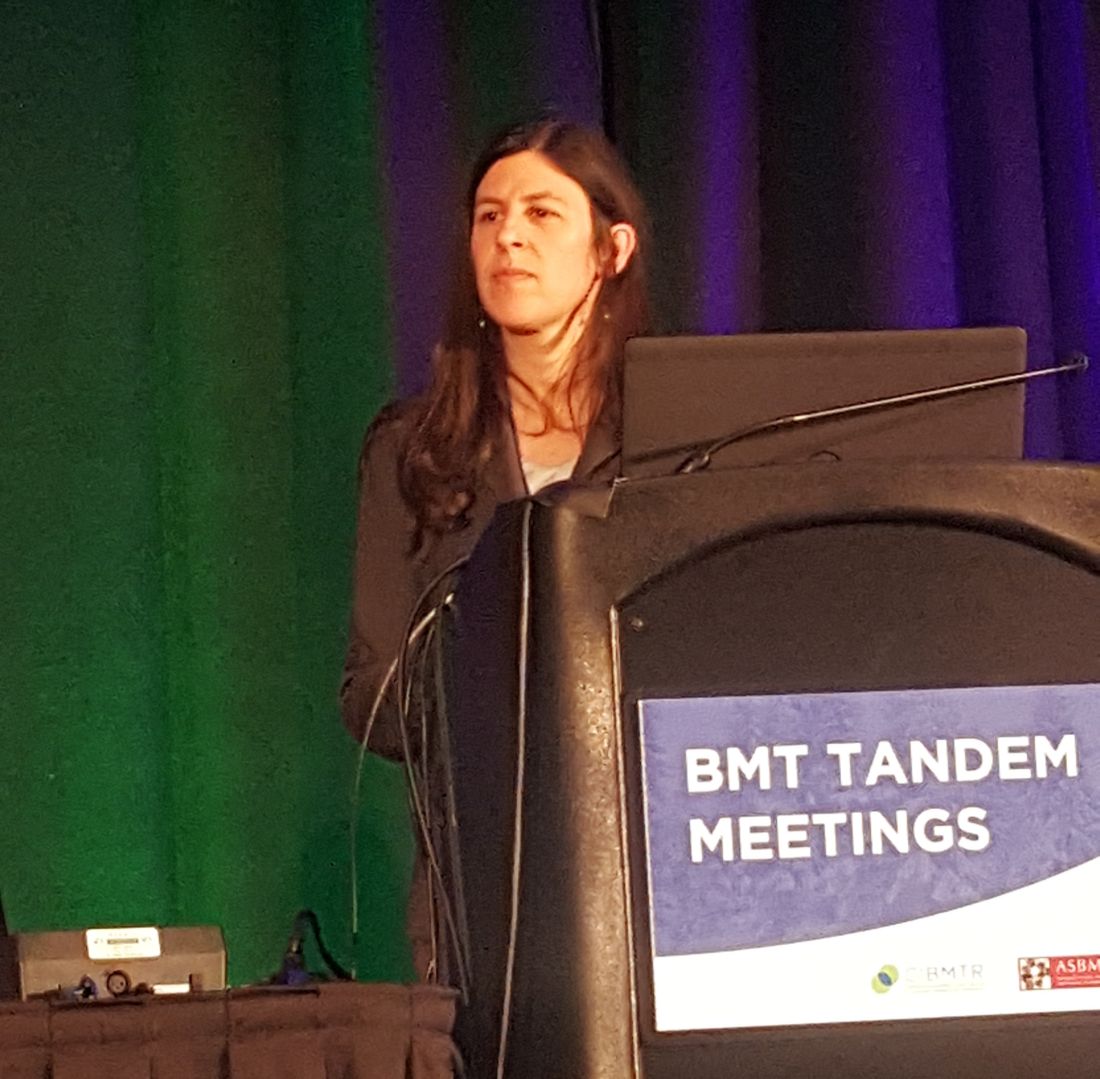
“So this is pretty exciting for us,” she added, explaining that allogeneic HCT, which is currently indicated only for patients with intermediate-2– or high-risk disease on the Dynamic International Prognostic Scoring System (DIPSS), remains the only curative treatment option for patients with myelofibrosis.
“Transplant outcomes have been associated with DIPSS and DIPSS+ risk scores,” she said, adding that a study demonstrating that association showed a 54% survival rate at 3 years in patients with intermediate-2–risk disease. “Then JAK-2 inhibitors came down the pipe, and they are also indicated for patients with DIPSS intermediate-2– and high-risk disease. They’ve been shown to decrease spleen size, increase quality of life scores, decrease cytokine levels, and improve constitutional symptoms.”
Posttransplant benefits of pre-HCT JAK inhibitor therapy could include improved graft function because of decreased spleen size and cytokines, potentially decreased severe graft-versus-host disease (GVHD), and decreased nonrelapse mortality.
“Our hypothesis was that the use of JAK inhibitors before transplant in patients with myelofibrosis – by decreasing inflammation, improving constitutional symptoms, and reducing splenomegaly – would result in a decreased DIPSS score” and improved posttransplant survival, Dr. Salit said.
Study participants were patients aged 18 years and older (median of 53 years) with primary or secondary myelofibrosis (14 each). About two-thirds of the study participants were men. Prior to JAK inhibitor therapy, 2 patients were low risk, 10 patients were intermediate-1 risk, and 16 patients were intermediate-2 risk according to the DIPSS.
They were given ruxolitinib (Jakafi) for at least 8 weeks prior to HCT (median of 7 months, but up to 3 years), and the treatment was tapered over 1-2 weeks through day 2 or 3 of conditioning chemotherapy, depending on the conditioning regimen. Conditioning regimens were determined by the physician based on donor type.
“After the ruxolitinib, we had 6 patients who were intermediate-1 and 21 who were intermediate-2, so in that way they failed to meet that hypothesis,” Dr. Salit said. This happened because the patients became anemic, so they gained points on their DIPSS scores for declining constitutional symptoms.
Of the 28 participants, 23 received myeloablative HCT, and 5 received reduced-intensity HCT.
“We had a mixture of related, unrelated, and cord blood recipients,” she noted.
At a median follow-up of just over 1 year, and at up to 3 years in some patients, no cases of cytokine release syndrome have occurred with the overlap of ruxolitinib and conditioning chemotherapy, and there have been no graft failures. All patients, including cord blood recipients, engrafted. The median time to engraftment was 19 days, but the range went as high as 35 days. “The 35 was one of our cord blood recipients,” she noted.
Median time to platelet engraftment was 20 days, and median CD3 and CD33 chimerism at day 80 were 88% and 100%, respectively.
Acute grades II-IV GVHD occurred in 70% of patients, but just 15% of these cases were grades III or IV, she said.
Chronic GVHD occurred in 35% of patients, including two severe cases. Two patients relapsed, including one at 6 months with marrow blast and one at 2 years with myeloid sarcoma. Two treatment-related deaths occurred, including one each at days 54 and 81.
The strategy of overlapping a JAK inhibitor with conditioning chemotherapy was safe, and “better in that we haven’t seen any cytokine release syndrome,” she concluded, adding that no graft failures occurred and grades III-IV acute and severe chronic GVHD were encouragingly infrequent.
Future studies should look at the optimal amount of time for JAK inhibitor therapy prior to transplant and whether it’s safe to continue JAK inhibitors through transplant, she said.
“Some of the work in Germany has shown that JAK inhibitors are safe to include up to day 28 through transplant, and that’s something that we’re looking to explore,” she noted.
Dr. Salit reported having no financial disclosures. This study was sponsored by the Fred Hutchinson Cancer Research Center.
sworcester@frontlinemedcom.com
SOURCE: Salit R et al. BMT Tandem Meetings, Abstract 17.
SALT LAKE CITY – The use of Janus kinase (JAK) inhibitor therapy prior to hematopoietic stem cell transplantation is safe and may improve posttransplant survival in patients with myelofibrosis, according to findings from an ongoing prospective phase 2 study.
The 1-year overall survival rate among the 28 initial patients in the single-center study of JAK inhibitor therapy followed by myeloablative or reduced-intensity hematopoietic cell transplantation (HCT) was 93%. The 2-year survival rate was 89%, compared with 54% in a closely matched historical cohort of intermediate-2–risk patients who did not receive pre-HCT JAK inhibitor therapy, Rachel B. Salit, MD, reported at the combined annual meetings of the Center for International Blood & Marrow Transplant Research and the American Society for Blood and Marrow Transplantation.
“So this is pretty exciting for us,” she added, explaining that allogeneic HCT, which is currently indicated only for patients with intermediate-2– or high-risk disease on the Dynamic International Prognostic Scoring System (DIPSS), remains the only curative treatment option for patients with myelofibrosis.
“Transplant outcomes have been associated with DIPSS and DIPSS+ risk scores,” she said, adding that a study demonstrating that association showed a 54% survival rate at 3 years in patients with intermediate-2–risk disease. “Then JAK-2 inhibitors came down the pipe, and they are also indicated for patients with DIPSS intermediate-2– and high-risk disease. They’ve been shown to decrease spleen size, increase quality of life scores, decrease cytokine levels, and improve constitutional symptoms.”
Posttransplant benefits of pre-HCT JAK inhibitor therapy could include improved graft function because of decreased spleen size and cytokines, potentially decreased severe graft-versus-host disease (GVHD), and decreased nonrelapse mortality.
“Our hypothesis was that the use of JAK inhibitors before transplant in patients with myelofibrosis – by decreasing inflammation, improving constitutional symptoms, and reducing splenomegaly – would result in a decreased DIPSS score” and improved posttransplant survival, Dr. Salit said.
Study participants were patients aged 18 years and older (median of 53 years) with primary or secondary myelofibrosis (14 each). About two-thirds of the study participants were men. Prior to JAK inhibitor therapy, 2 patients were low risk, 10 patients were intermediate-1 risk, and 16 patients were intermediate-2 risk according to the DIPSS.
They were given ruxolitinib (Jakafi) for at least 8 weeks prior to HCT (median of 7 months, but up to 3 years), and the treatment was tapered over 1-2 weeks through day 2 or 3 of conditioning chemotherapy, depending on the conditioning regimen. Conditioning regimens were determined by the physician based on donor type.
“After the ruxolitinib, we had 6 patients who were intermediate-1 and 21 who were intermediate-2, so in that way they failed to meet that hypothesis,” Dr. Salit said. This happened because the patients became anemic, so they gained points on their DIPSS scores for declining constitutional symptoms.
Of the 28 participants, 23 received myeloablative HCT, and 5 received reduced-intensity HCT.
“We had a mixture of related, unrelated, and cord blood recipients,” she noted.
At a median follow-up of just over 1 year, and at up to 3 years in some patients, no cases of cytokine release syndrome have occurred with the overlap of ruxolitinib and conditioning chemotherapy, and there have been no graft failures. All patients, including cord blood recipients, engrafted. The median time to engraftment was 19 days, but the range went as high as 35 days. “The 35 was one of our cord blood recipients,” she noted.
Median time to platelet engraftment was 20 days, and median CD3 and CD33 chimerism at day 80 were 88% and 100%, respectively.
Acute grades II-IV GVHD occurred in 70% of patients, but just 15% of these cases were grades III or IV, she said.
Chronic GVHD occurred in 35% of patients, including two severe cases. Two patients relapsed, including one at 6 months with marrow blast and one at 2 years with myeloid sarcoma. Two treatment-related deaths occurred, including one each at days 54 and 81.
The strategy of overlapping a JAK inhibitor with conditioning chemotherapy was safe, and “better in that we haven’t seen any cytokine release syndrome,” she concluded, adding that no graft failures occurred and grades III-IV acute and severe chronic GVHD were encouragingly infrequent.
Future studies should look at the optimal amount of time for JAK inhibitor therapy prior to transplant and whether it’s safe to continue JAK inhibitors through transplant, she said.
“Some of the work in Germany has shown that JAK inhibitors are safe to include up to day 28 through transplant, and that’s something that we’re looking to explore,” she noted.
Dr. Salit reported having no financial disclosures. This study was sponsored by the Fred Hutchinson Cancer Research Center.
sworcester@frontlinemedcom.com
SOURCE: Salit R et al. BMT Tandem Meetings, Abstract 17.
SALT LAKE CITY – The use of Janus kinase (JAK) inhibitor therapy prior to hematopoietic stem cell transplantation is safe and may improve posttransplant survival in patients with myelofibrosis, according to findings from an ongoing prospective phase 2 study.
The 1-year overall survival rate among the 28 initial patients in the single-center study of JAK inhibitor therapy followed by myeloablative or reduced-intensity hematopoietic cell transplantation (HCT) was 93%. The 2-year survival rate was 89%, compared with 54% in a closely matched historical cohort of intermediate-2–risk patients who did not receive pre-HCT JAK inhibitor therapy, Rachel B. Salit, MD, reported at the combined annual meetings of the Center for International Blood & Marrow Transplant Research and the American Society for Blood and Marrow Transplantation.
“So this is pretty exciting for us,” she added, explaining that allogeneic HCT, which is currently indicated only for patients with intermediate-2– or high-risk disease on the Dynamic International Prognostic Scoring System (DIPSS), remains the only curative treatment option for patients with myelofibrosis.
“Transplant outcomes have been associated with DIPSS and DIPSS+ risk scores,” she said, adding that a study demonstrating that association showed a 54% survival rate at 3 years in patients with intermediate-2–risk disease. “Then JAK-2 inhibitors came down the pipe, and they are also indicated for patients with DIPSS intermediate-2– and high-risk disease. They’ve been shown to decrease spleen size, increase quality of life scores, decrease cytokine levels, and improve constitutional symptoms.”
Posttransplant benefits of pre-HCT JAK inhibitor therapy could include improved graft function because of decreased spleen size and cytokines, potentially decreased severe graft-versus-host disease (GVHD), and decreased nonrelapse mortality.
“Our hypothesis was that the use of JAK inhibitors before transplant in patients with myelofibrosis – by decreasing inflammation, improving constitutional symptoms, and reducing splenomegaly – would result in a decreased DIPSS score” and improved posttransplant survival, Dr. Salit said.
Study participants were patients aged 18 years and older (median of 53 years) with primary or secondary myelofibrosis (14 each). About two-thirds of the study participants were men. Prior to JAK inhibitor therapy, 2 patients were low risk, 10 patients were intermediate-1 risk, and 16 patients were intermediate-2 risk according to the DIPSS.
They were given ruxolitinib (Jakafi) for at least 8 weeks prior to HCT (median of 7 months, but up to 3 years), and the treatment was tapered over 1-2 weeks through day 2 or 3 of conditioning chemotherapy, depending on the conditioning regimen. Conditioning regimens were determined by the physician based on donor type.
“After the ruxolitinib, we had 6 patients who were intermediate-1 and 21 who were intermediate-2, so in that way they failed to meet that hypothesis,” Dr. Salit said. This happened because the patients became anemic, so they gained points on their DIPSS scores for declining constitutional symptoms.
Of the 28 participants, 23 received myeloablative HCT, and 5 received reduced-intensity HCT.
“We had a mixture of related, unrelated, and cord blood recipients,” she noted.
At a median follow-up of just over 1 year, and at up to 3 years in some patients, no cases of cytokine release syndrome have occurred with the overlap of ruxolitinib and conditioning chemotherapy, and there have been no graft failures. All patients, including cord blood recipients, engrafted. The median time to engraftment was 19 days, but the range went as high as 35 days. “The 35 was one of our cord blood recipients,” she noted.
Median time to platelet engraftment was 20 days, and median CD3 and CD33 chimerism at day 80 were 88% and 100%, respectively.
Acute grades II-IV GVHD occurred in 70% of patients, but just 15% of these cases were grades III or IV, she said.
Chronic GVHD occurred in 35% of patients, including two severe cases. Two patients relapsed, including one at 6 months with marrow blast and one at 2 years with myeloid sarcoma. Two treatment-related deaths occurred, including one each at days 54 and 81.
The strategy of overlapping a JAK inhibitor with conditioning chemotherapy was safe, and “better in that we haven’t seen any cytokine release syndrome,” she concluded, adding that no graft failures occurred and grades III-IV acute and severe chronic GVHD were encouragingly infrequent.
Future studies should look at the optimal amount of time for JAK inhibitor therapy prior to transplant and whether it’s safe to continue JAK inhibitors through transplant, she said.
“Some of the work in Germany has shown that JAK inhibitors are safe to include up to day 28 through transplant, and that’s something that we’re looking to explore,” she noted.
Dr. Salit reported having no financial disclosures. This study was sponsored by the Fred Hutchinson Cancer Research Center.
sworcester@frontlinemedcom.com
SOURCE: Salit R et al. BMT Tandem Meetings, Abstract 17.
REPORTING FROM THE 2018 BMT TANDEM MEETINGS
Key clinical point:
Major finding: The 2-year overall survival rate was 89%.
Study details: Findings in 28 patients from an ongoing prospective phase 2 study.
Disclosures: Dr. Salit reported having no financial disclosures. The study was sponsored by the Fred Hutchinson Cancer Research Center in Seattle.
Source: Salit R et al. BMT Tandem Meetings, Abstract 17.
Tamibarotene shows strong results in high-risk APL patients
ATLANTA – Maintenance therapy with the synthetic retinoid tamibarotene is more effective than all-trans retinoic acid (ATRA), for decreasing the relapse rate in patients with acute promyelocytic leukemia (APL) – a subtype of acute myeloid leukemia, according to 7-year findings from the JALSG-APL204 randomized controlled trial.
The relapse-free survival findings were particularly pronounced among high-risk patients with leukocyte counts of at least 10,000 per microliter, Akihiro Takeshita, MD, PhD, reported at the annual meeting of the American Society of Hematology.
“These results could lead to a new strategy for the treatment of high-risk patients, which is one of the recent priority issues in the treatment of APL,” said Dr. Takeshita of Hamamatsu (Japan) University.
Of 344 eligible patients aged 15-70 years with newly diagnosed APL and documented cytogenetic and/or molecular evidence of chromosomal translocation t(15;17) or PML/RAR-alpha gene expression, 269 entered the maintenance phase of the study after completing three courses of consolidation therapy and were assigned to receive ATRA or tamibarotene. At a mean follow-up of 7 years, the relapse-free survival rate was 84% in the 135 patients in the ATRA arm, compared with 93% among the 134 patients in the tamibarotene arm.
The difference between the groups was statistically significant, but an even greater difference was seen when the analysis was restricted to 52 high-risk patients with an initial leukocyte count of at least 10,000 per microliter (62% vs. 89%).
Both treatments were generally well tolerated, Dr. Takeshita reported.
Study subjects received ATRA at a daily dose of 45 mg/m2 for remission induction. Once complete remission was achieved, they received chemotherapy based on their initial leukocyte and blast count in the peripheral blood. Those who achieved molecular remission after consolidation chemotherapy were included in the current maintenance phase of the study. During this phase, ATRA was given at a daily dose of 45 mg/m2 divided into 3 doses for 14 days, and tamibarotene was given at a daily dose of 6 mg/m2 divided into 2 doses for 14 days. Each cycle of treatment was repeated every 3 months for 2 years.
Adverse events included secondary hematopoietic disorders in 12 cases, malignancies in 9 cases, and late cardiac complications of grade 3 or higher in 5 cases, but no significant difference in the rates of these events was seen between the two treatment groups, Dr. Takeshita noted.
Tamibarotene was studied in this trial because, compared with ATRA, it has been shown to have about a 10-fold increase in potency for inducing in vitro differentiation of NB-4 cells, enhanced chemical stability, and low affinity for cellular RA-binding protein.
“The clinical efficacy of tamibarotene for the treatment of APL has also been reported,” Dr. Takeshita added.
In the initial phases of the trial, no difference was seen between ATRA and tamibarotene with respect to 4-year relapse-free survival, but there did appear to be improved efficacy with tamibarotene in high-risk patients, which warranted further investigation, he said.
The current findings demonstrate the efficacy of tamibarotene vs. ATRA for decreasing the relapse rate at the 7-year observation point, and confirm the benefit in high-risk patients that was seen in earlier analyses, he concluded.
Dr. Takeshita reported receiving research funding from Chugai Pharmaceutical, Astellas Pharma, Pfizer Japan, and Takeda Pharmaceutical.
sworcester@frontlinemedcom.com
SOURCE: Takeshita A et al., ASH 2017, abstract 642.
ATLANTA – Maintenance therapy with the synthetic retinoid tamibarotene is more effective than all-trans retinoic acid (ATRA), for decreasing the relapse rate in patients with acute promyelocytic leukemia (APL) – a subtype of acute myeloid leukemia, according to 7-year findings from the JALSG-APL204 randomized controlled trial.
The relapse-free survival findings were particularly pronounced among high-risk patients with leukocyte counts of at least 10,000 per microliter, Akihiro Takeshita, MD, PhD, reported at the annual meeting of the American Society of Hematology.
“These results could lead to a new strategy for the treatment of high-risk patients, which is one of the recent priority issues in the treatment of APL,” said Dr. Takeshita of Hamamatsu (Japan) University.
Of 344 eligible patients aged 15-70 years with newly diagnosed APL and documented cytogenetic and/or molecular evidence of chromosomal translocation t(15;17) or PML/RAR-alpha gene expression, 269 entered the maintenance phase of the study after completing three courses of consolidation therapy and were assigned to receive ATRA or tamibarotene. At a mean follow-up of 7 years, the relapse-free survival rate was 84% in the 135 patients in the ATRA arm, compared with 93% among the 134 patients in the tamibarotene arm.
The difference between the groups was statistically significant, but an even greater difference was seen when the analysis was restricted to 52 high-risk patients with an initial leukocyte count of at least 10,000 per microliter (62% vs. 89%).
Both treatments were generally well tolerated, Dr. Takeshita reported.
Study subjects received ATRA at a daily dose of 45 mg/m2 for remission induction. Once complete remission was achieved, they received chemotherapy based on their initial leukocyte and blast count in the peripheral blood. Those who achieved molecular remission after consolidation chemotherapy were included in the current maintenance phase of the study. During this phase, ATRA was given at a daily dose of 45 mg/m2 divided into 3 doses for 14 days, and tamibarotene was given at a daily dose of 6 mg/m2 divided into 2 doses for 14 days. Each cycle of treatment was repeated every 3 months for 2 years.
Adverse events included secondary hematopoietic disorders in 12 cases, malignancies in 9 cases, and late cardiac complications of grade 3 or higher in 5 cases, but no significant difference in the rates of these events was seen between the two treatment groups, Dr. Takeshita noted.
Tamibarotene was studied in this trial because, compared with ATRA, it has been shown to have about a 10-fold increase in potency for inducing in vitro differentiation of NB-4 cells, enhanced chemical stability, and low affinity for cellular RA-binding protein.
“The clinical efficacy of tamibarotene for the treatment of APL has also been reported,” Dr. Takeshita added.
In the initial phases of the trial, no difference was seen between ATRA and tamibarotene with respect to 4-year relapse-free survival, but there did appear to be improved efficacy with tamibarotene in high-risk patients, which warranted further investigation, he said.
The current findings demonstrate the efficacy of tamibarotene vs. ATRA for decreasing the relapse rate at the 7-year observation point, and confirm the benefit in high-risk patients that was seen in earlier analyses, he concluded.
Dr. Takeshita reported receiving research funding from Chugai Pharmaceutical, Astellas Pharma, Pfizer Japan, and Takeda Pharmaceutical.
sworcester@frontlinemedcom.com
SOURCE: Takeshita A et al., ASH 2017, abstract 642.
ATLANTA – Maintenance therapy with the synthetic retinoid tamibarotene is more effective than all-trans retinoic acid (ATRA), for decreasing the relapse rate in patients with acute promyelocytic leukemia (APL) – a subtype of acute myeloid leukemia, according to 7-year findings from the JALSG-APL204 randomized controlled trial.
The relapse-free survival findings were particularly pronounced among high-risk patients with leukocyte counts of at least 10,000 per microliter, Akihiro Takeshita, MD, PhD, reported at the annual meeting of the American Society of Hematology.
“These results could lead to a new strategy for the treatment of high-risk patients, which is one of the recent priority issues in the treatment of APL,” said Dr. Takeshita of Hamamatsu (Japan) University.
Of 344 eligible patients aged 15-70 years with newly diagnosed APL and documented cytogenetic and/or molecular evidence of chromosomal translocation t(15;17) or PML/RAR-alpha gene expression, 269 entered the maintenance phase of the study after completing three courses of consolidation therapy and were assigned to receive ATRA or tamibarotene. At a mean follow-up of 7 years, the relapse-free survival rate was 84% in the 135 patients in the ATRA arm, compared with 93% among the 134 patients in the tamibarotene arm.
The difference between the groups was statistically significant, but an even greater difference was seen when the analysis was restricted to 52 high-risk patients with an initial leukocyte count of at least 10,000 per microliter (62% vs. 89%).
Both treatments were generally well tolerated, Dr. Takeshita reported.
Study subjects received ATRA at a daily dose of 45 mg/m2 for remission induction. Once complete remission was achieved, they received chemotherapy based on their initial leukocyte and blast count in the peripheral blood. Those who achieved molecular remission after consolidation chemotherapy were included in the current maintenance phase of the study. During this phase, ATRA was given at a daily dose of 45 mg/m2 divided into 3 doses for 14 days, and tamibarotene was given at a daily dose of 6 mg/m2 divided into 2 doses for 14 days. Each cycle of treatment was repeated every 3 months for 2 years.
Adverse events included secondary hematopoietic disorders in 12 cases, malignancies in 9 cases, and late cardiac complications of grade 3 or higher in 5 cases, but no significant difference in the rates of these events was seen between the two treatment groups, Dr. Takeshita noted.
Tamibarotene was studied in this trial because, compared with ATRA, it has been shown to have about a 10-fold increase in potency for inducing in vitro differentiation of NB-4 cells, enhanced chemical stability, and low affinity for cellular RA-binding protein.
“The clinical efficacy of tamibarotene for the treatment of APL has also been reported,” Dr. Takeshita added.
In the initial phases of the trial, no difference was seen between ATRA and tamibarotene with respect to 4-year relapse-free survival, but there did appear to be improved efficacy with tamibarotene in high-risk patients, which warranted further investigation, he said.
The current findings demonstrate the efficacy of tamibarotene vs. ATRA for decreasing the relapse rate at the 7-year observation point, and confirm the benefit in high-risk patients that was seen in earlier analyses, he concluded.
Dr. Takeshita reported receiving research funding from Chugai Pharmaceutical, Astellas Pharma, Pfizer Japan, and Takeda Pharmaceutical.
sworcester@frontlinemedcom.com
SOURCE: Takeshita A et al., ASH 2017, abstract 642.
REPORTING FROM ASH 2017
Key clinical point:
Major finding: The 7-year relapse-free survival was 62% vs. 89% with ATRA vs. tamibarotene in high-risk patients.
Study details: Long-term maintenance results in 344 patients from a randomized controlled trial.
Disclosures: Dr. Takeshita reported receiving research funding from Chugai Pharmaceutical, Astellas Pharma, Pfizer Japan, and Takeda Pharmaceutical.
Source: Takeshita A et al. ASH 2017, abstract 642.
Cyclophosphamide extends PFS in elderly HER2+ breast cancer patients
by 7 months – with acceptable toxicity – vs. dual HER2 blockade alone in a randomized, open-label, phase 2 trial.
After a median follow-up of 20.7 months, the median progression-free survival (PFS) among 41 women who received trastuzumab and pertuzumab plus metronomic oral cyclophosphamide was 12.7 months, compared with 5.6 months among 39 women who received only trastuzumab and pertuzumab. Estimated PFS at 6 months was 73.4% and 46.2% in the groups, respectively (hazard ratio, 0.65), Hans Wildiers, MD, PhD, of University Hospitals Leuven, Belgium, and his colleagues reported in Lancet Oncology.
The most frequent grade 3-4 adverse events occurring in each group, respectively, were hypertension (12% and 15%), diarrhea (12% and 10%), dyspnea (10% and 5%), fatigue (5% and 8%), and pain (5% in each group). Thromboembolic events occurred in four patients (10%) receiving cyclophosphamide, while none occurred in the dual HER2 blockade-only group. Severe cardiac toxicities were occasionally observed in both groups.
Study subjects were women aged at least 70 years, or at least 60 years with confirmed functional restrictions. All had confirmed HER2-positive metastatic breast cancer and no prior chemotherapy for metastatic disease. They received either intravenous trastuzumab at a loading dose of 8 mg/kg, followed by 6 mg/kg every 3 weeks, and intravenous pertuzumab at a loading dose of 840 mg followed by 420 mg every 3 weeks (median of 6 cycles), or those same doses of trastuzumab and pertuzumab plus metronomic oral cyclophosphamide at a dose of 50 mg daily (median of 13 cycles). Subsequent treatment with trastuzumab emtansine in 29 patients who progressed during the study was active and well tolerated; the overall PFS at 6 months in this group of patients was 49.5% and median PFS was 5 months after starting trastuzumab emtansine.
“The results of this study indicate that the benefit of avoiding the side effects of chemotherapy with the use of dual anti–HER2 blockade only does not compensate for an important loss of activity in the metastatic setting,” the investigators wrote, concluding that “trastuzumab and pertuzumab plus metronomic oral cyclophosphamide, potentially followed by trastuzumab emtansine after progression, might delay the need for, or supersede, the use of taxane-based chemotherapy in this population.”
Further evaluation of this combination in a randomized phase 3 study is warranted, as the phase 2 findings do not provide “robust justification for a change in practice.” They do, however, provide a scientific framework for supporting more specific trials in older patients, who compromise nearly a third of breast cancer patients worldwide, and up to 50% in high-income countries, they said.
This study was funded by F Hoffmann-La Roche. Dr. Wildiers has received research grants from Roche, and personal fees to his institute from Roche, Amgen, Novartis, Pfizer, Puma, and Celldex. Other authors also reported receiving research or other support from Roche Products, Eisai, Novartis Pharmaceuticals UK, Astellas/Medivation, Astra Zeneca, Celgene, Daiichi-Sankyo, GE Oncology, Genentech, GlaxoSmithKline, Macrogenics, Merck Sharp & Dohme, Merus BV, Mylan, Novartis, Pfizer, Pierre Fabre, Sanofi, and Teva.
sworcester@frontlinemedcom.com
SOURCE: Wildiers H et al. Lancet Oncol. 2018 Feb 9. doi: 10.1016/S1470-2045(18)30083-4.
The findings by Wildiers et al. regarding the benefits of adding oral cyclophosphamide to dual HER2 blockade should be evaluated further, according to Charles E. Geyer Jr., MD, who applauded the investigators’ demonstration of a framework for much-needed clinical trials in frail elderly patients with breast cancer.
In an editorial, Dr. Geyer wrote that the trial results provide sufficient evidence for consideration of trastuzumab and pertuzumab plus oral cyclophosphamide in frail elderly patients at increased risk of adverse events from taxane-based therapies, but he also encouraged additional study (Lancet Oncol. 2018 Feb 9. doi: 10.1016/S1470-2045(18)30084-6).
An important consideration in future studies will be the choice of a comparator group; he suggested a version of the CLEOPATRA study to look at trastuzumab plus metronomic oral cyclophosphamide with and without pertuzumab. A prior small study suggested that the problematic risk of diarrhea seen in patients in the current study did not occur in patients pretreated with trastuzumab who showed activity with trastuzumab and metronomic oral cyclophosphamide chemotherapy, he noted.
Dr. Geyer is with the Massey Cancer Center at Virginia Commonwealth University, Richmond. He reported receiving personal fees from Myriad and Heron Therapeutics for advisory board participation, and travel support from AstraZeneca, Genentech, and Macrogenics, outside the submitted work.
The findings by Wildiers et al. regarding the benefits of adding oral cyclophosphamide to dual HER2 blockade should be evaluated further, according to Charles E. Geyer Jr., MD, who applauded the investigators’ demonstration of a framework for much-needed clinical trials in frail elderly patients with breast cancer.
In an editorial, Dr. Geyer wrote that the trial results provide sufficient evidence for consideration of trastuzumab and pertuzumab plus oral cyclophosphamide in frail elderly patients at increased risk of adverse events from taxane-based therapies, but he also encouraged additional study (Lancet Oncol. 2018 Feb 9. doi: 10.1016/S1470-2045(18)30084-6).
An important consideration in future studies will be the choice of a comparator group; he suggested a version of the CLEOPATRA study to look at trastuzumab plus metronomic oral cyclophosphamide with and without pertuzumab. A prior small study suggested that the problematic risk of diarrhea seen in patients in the current study did not occur in patients pretreated with trastuzumab who showed activity with trastuzumab and metronomic oral cyclophosphamide chemotherapy, he noted.
Dr. Geyer is with the Massey Cancer Center at Virginia Commonwealth University, Richmond. He reported receiving personal fees from Myriad and Heron Therapeutics for advisory board participation, and travel support from AstraZeneca, Genentech, and Macrogenics, outside the submitted work.
The findings by Wildiers et al. regarding the benefits of adding oral cyclophosphamide to dual HER2 blockade should be evaluated further, according to Charles E. Geyer Jr., MD, who applauded the investigators’ demonstration of a framework for much-needed clinical trials in frail elderly patients with breast cancer.
In an editorial, Dr. Geyer wrote that the trial results provide sufficient evidence for consideration of trastuzumab and pertuzumab plus oral cyclophosphamide in frail elderly patients at increased risk of adverse events from taxane-based therapies, but he also encouraged additional study (Lancet Oncol. 2018 Feb 9. doi: 10.1016/S1470-2045(18)30084-6).
An important consideration in future studies will be the choice of a comparator group; he suggested a version of the CLEOPATRA study to look at trastuzumab plus metronomic oral cyclophosphamide with and without pertuzumab. A prior small study suggested that the problematic risk of diarrhea seen in patients in the current study did not occur in patients pretreated with trastuzumab who showed activity with trastuzumab and metronomic oral cyclophosphamide chemotherapy, he noted.
Dr. Geyer is with the Massey Cancer Center at Virginia Commonwealth University, Richmond. He reported receiving personal fees from Myriad and Heron Therapeutics for advisory board participation, and travel support from AstraZeneca, Genentech, and Macrogenics, outside the submitted work.
by 7 months – with acceptable toxicity – vs. dual HER2 blockade alone in a randomized, open-label, phase 2 trial.
After a median follow-up of 20.7 months, the median progression-free survival (PFS) among 41 women who received trastuzumab and pertuzumab plus metronomic oral cyclophosphamide was 12.7 months, compared with 5.6 months among 39 women who received only trastuzumab and pertuzumab. Estimated PFS at 6 months was 73.4% and 46.2% in the groups, respectively (hazard ratio, 0.65), Hans Wildiers, MD, PhD, of University Hospitals Leuven, Belgium, and his colleagues reported in Lancet Oncology.
The most frequent grade 3-4 adverse events occurring in each group, respectively, were hypertension (12% and 15%), diarrhea (12% and 10%), dyspnea (10% and 5%), fatigue (5% and 8%), and pain (5% in each group). Thromboembolic events occurred in four patients (10%) receiving cyclophosphamide, while none occurred in the dual HER2 blockade-only group. Severe cardiac toxicities were occasionally observed in both groups.
Study subjects were women aged at least 70 years, or at least 60 years with confirmed functional restrictions. All had confirmed HER2-positive metastatic breast cancer and no prior chemotherapy for metastatic disease. They received either intravenous trastuzumab at a loading dose of 8 mg/kg, followed by 6 mg/kg every 3 weeks, and intravenous pertuzumab at a loading dose of 840 mg followed by 420 mg every 3 weeks (median of 6 cycles), or those same doses of trastuzumab and pertuzumab plus metronomic oral cyclophosphamide at a dose of 50 mg daily (median of 13 cycles). Subsequent treatment with trastuzumab emtansine in 29 patients who progressed during the study was active and well tolerated; the overall PFS at 6 months in this group of patients was 49.5% and median PFS was 5 months after starting trastuzumab emtansine.
“The results of this study indicate that the benefit of avoiding the side effects of chemotherapy with the use of dual anti–HER2 blockade only does not compensate for an important loss of activity in the metastatic setting,” the investigators wrote, concluding that “trastuzumab and pertuzumab plus metronomic oral cyclophosphamide, potentially followed by trastuzumab emtansine after progression, might delay the need for, or supersede, the use of taxane-based chemotherapy in this population.”
Further evaluation of this combination in a randomized phase 3 study is warranted, as the phase 2 findings do not provide “robust justification for a change in practice.” They do, however, provide a scientific framework for supporting more specific trials in older patients, who compromise nearly a third of breast cancer patients worldwide, and up to 50% in high-income countries, they said.
This study was funded by F Hoffmann-La Roche. Dr. Wildiers has received research grants from Roche, and personal fees to his institute from Roche, Amgen, Novartis, Pfizer, Puma, and Celldex. Other authors also reported receiving research or other support from Roche Products, Eisai, Novartis Pharmaceuticals UK, Astellas/Medivation, Astra Zeneca, Celgene, Daiichi-Sankyo, GE Oncology, Genentech, GlaxoSmithKline, Macrogenics, Merck Sharp & Dohme, Merus BV, Mylan, Novartis, Pfizer, Pierre Fabre, Sanofi, and Teva.
sworcester@frontlinemedcom.com
SOURCE: Wildiers H et al. Lancet Oncol. 2018 Feb 9. doi: 10.1016/S1470-2045(18)30083-4.
by 7 months – with acceptable toxicity – vs. dual HER2 blockade alone in a randomized, open-label, phase 2 trial.
After a median follow-up of 20.7 months, the median progression-free survival (PFS) among 41 women who received trastuzumab and pertuzumab plus metronomic oral cyclophosphamide was 12.7 months, compared with 5.6 months among 39 women who received only trastuzumab and pertuzumab. Estimated PFS at 6 months was 73.4% and 46.2% in the groups, respectively (hazard ratio, 0.65), Hans Wildiers, MD, PhD, of University Hospitals Leuven, Belgium, and his colleagues reported in Lancet Oncology.
The most frequent grade 3-4 adverse events occurring in each group, respectively, were hypertension (12% and 15%), diarrhea (12% and 10%), dyspnea (10% and 5%), fatigue (5% and 8%), and pain (5% in each group). Thromboembolic events occurred in four patients (10%) receiving cyclophosphamide, while none occurred in the dual HER2 blockade-only group. Severe cardiac toxicities were occasionally observed in both groups.
Study subjects were women aged at least 70 years, or at least 60 years with confirmed functional restrictions. All had confirmed HER2-positive metastatic breast cancer and no prior chemotherapy for metastatic disease. They received either intravenous trastuzumab at a loading dose of 8 mg/kg, followed by 6 mg/kg every 3 weeks, and intravenous pertuzumab at a loading dose of 840 mg followed by 420 mg every 3 weeks (median of 6 cycles), or those same doses of trastuzumab and pertuzumab plus metronomic oral cyclophosphamide at a dose of 50 mg daily (median of 13 cycles). Subsequent treatment with trastuzumab emtansine in 29 patients who progressed during the study was active and well tolerated; the overall PFS at 6 months in this group of patients was 49.5% and median PFS was 5 months after starting trastuzumab emtansine.
“The results of this study indicate that the benefit of avoiding the side effects of chemotherapy with the use of dual anti–HER2 blockade only does not compensate for an important loss of activity in the metastatic setting,” the investigators wrote, concluding that “trastuzumab and pertuzumab plus metronomic oral cyclophosphamide, potentially followed by trastuzumab emtansine after progression, might delay the need for, or supersede, the use of taxane-based chemotherapy in this population.”
Further evaluation of this combination in a randomized phase 3 study is warranted, as the phase 2 findings do not provide “robust justification for a change in practice.” They do, however, provide a scientific framework for supporting more specific trials in older patients, who compromise nearly a third of breast cancer patients worldwide, and up to 50% in high-income countries, they said.
This study was funded by F Hoffmann-La Roche. Dr. Wildiers has received research grants from Roche, and personal fees to his institute from Roche, Amgen, Novartis, Pfizer, Puma, and Celldex. Other authors also reported receiving research or other support from Roche Products, Eisai, Novartis Pharmaceuticals UK, Astellas/Medivation, Astra Zeneca, Celgene, Daiichi-Sankyo, GE Oncology, Genentech, GlaxoSmithKline, Macrogenics, Merck Sharp & Dohme, Merus BV, Mylan, Novartis, Pfizer, Pierre Fabre, Sanofi, and Teva.
sworcester@frontlinemedcom.com
SOURCE: Wildiers H et al. Lancet Oncol. 2018 Feb 9. doi: 10.1016/S1470-2045(18)30083-4.
FROM THE LANCET ONCOLOGY
Key clinical point: Adding oral cyclophosphamide to trastuzumab and pertuzumab benefits frail elderly breast cancer patients.
Major finding: PFS was 12.7 months vs. 5.6 months with trastuzumab and pertuzumab plus metronomic oral cyclophosphamide vs. trastuzumab and pertuzumab alone.
Study details: A randomized phase 2 trial in 80 patients.
Disclosures: This study was funded by F Hoffmann-La Roche. Dr. Wildiers has received research grants from Roche, and personal fees to his institute from Roche, Amgen, Novartis, Pfizer, Puma, and Celldex. Other authors also reported receiving research or other support from Roche Products, Eisai, Novartis Pharmaceuticals UK, Astellas/Medivation, AstraZeneca, Celgene, Daiichi-Sankyo, GE Oncology, Genentech, GlaxoSmithKline, MacroGenics, Merck Sharp & Dohme, Merus BV, Mylan, Novartis, Pfizer, Pierre Fabre, Sanofi, and Teva.
Source: Wildiers Hans et al. Lancet Oncol. 2018 Feb 9. doi: 10.1016/S1470-2045(18)30083-4.