User login
Revisions coming to McDonald Criteria for MS
NEW ORLEANS – Changes are coming to the current McDonald Criteria for diagnosing multiple sclerosis, primarily because of advances in the understanding of MS since the criteria were last updated in 2010.
Such advances include the availability of new data regarding the relationship between MS and other spectrum disorders and data concerning the performance of the 2010 McDonald Criteria in several patient populations, according to Jeffrey A. Cohen, MD, who cochaired the effort known as the International Panel on Diagnosis of Multiple Sclerosis. “There also were new data concerning the utility of cerebrospinal fluid evaluation and increasing recognition that the role of cerebrospinal fluid (CSF) examination perhaps needs increased emphasis,” Dr. Cohen said at the annual meeting of the Consortium of Multiple Sclerosis Centers. “It’s been somewhat de-emphasized in previous versions of the criteria. Then, there was identification of subsets of patients that were felt to have a high likelihood of MS but in whom the diagnosis could not be made by the current criteria – patients who fell through the cracks. There was also increasing recognition of the frequency and important consequences of misdiagnosis.”

The panel emphasized that evidence supporting the McDonald criteria is predominately based on patients with a typical clinically isolated syndrome (CIS) at onset. It also acknowledged the difficulty of confirming a diagnosis of MS, the importance of addressing alternative diagnoses and absence of atypical features and red flags, and the rigor necessary for interpreting clinical, imaging, and laboratory studies. “Misdiagnosis is common,” Dr. Cohen told meeting attendees. “In some series, upwards of 50%-60% of patients referred to a specialized MS center turn out to have some other diagnosis. Our panel had discussions related to the tradeoff between sensitivity of the criteria and trying to make the diagnosis earlier and in a broader range of patients but counterbalancing that against the risk of a misdiagnosis. Our conclusion was that, although some of that might be created by the criteria, it’s mostly a problem of misapplying the criteria. One needs to remember that to make the diagnosis of MS does not merely require demonstrating that the patient has a disease process that involves potentially multiple places in the CNS and as recurrent events over time, but one has to apply the diagnostic data with rigor.”
Another emphasis expected to be included in updated McDonald criteria is the use of CSF and spinal cord imaging, as well as the notion that a history, examination, and synthesis of a patient’s overall clinical picture “needs to be made by a clinician with MS-related expertise,” Dr. Cohen said. “One cannot merely use the criteria as a checklist.”
The panelists also discussed modifying the term “possible MS,” which is already in the McDonald criteria, to include patients with CIS who do not (yet) fulfill the diagnostic criteria for MS; radiologically isolated syndrome (RIS); solitary sclerosis; and patients with clinical manifestations, imaging, and other features that are compatible with MS but not typical for those who may or may not be determined to have MS or in the future.
Dr. Cohen noted that additional data concerning the applicability of the McDonald criteria to Asian and Latin populations have been published since 2010 but are modest. “There is no indication the McDonald criteria cannot be used in these populations,” he said. “Care is needed to address alternative diagnoses, particularly neuromyelitis optica spectrum disorder (NMOSD) in both and also infectious diseases in Latin America.” Several studies also support the applicability of the McDonald criteria in children, with certain caveats. “One needs to be careful in diagnosing MS in people younger than 11 years of age,” Dr. Cohen said. “If the initial event is [acute disseminated encephalomyelitis], they also need to have a typical clinically isolated syndrome.”
Panelists also agreed that the McDonald criteria apply to older patients, with caveats that a new diagnosis of MS is rarely considered in older adults. “They are more likely to have a progressive course, either progressive from onset or following previous unrecognized relapses,” Dr. Cohen said. “There needs to be careful consideration of alternative diagnoses and, particularly, comorbidities. This represents an example of a diagnostic scenario for which CSF examination is advised.”
Panel members found that the recognized range of potential clinical manifestations of NMOSD is becoming wider and is still being defined. “Emerging data suggests a substantial proportion of AQP-4 seronegative patients with NMOSD features (about 20%) have anti–myelin oligodendrocyte glycoprotein antibodies,” he said. “Although some features of MS and NMOSD overlap, they are now understood to be distinct disorders.”
Other points under consideration for the 2017 revision of the McDonald Criteria included incorporating the revised phenotype categories (relapse-remitting, secondary progressive, primary progressive, and progressive relapsing), expanding the role of CSF to allow diagnosis of MS with CIS plus DIS plus oligoclonal bands, determining whether to accept 2016 Revised Magnetic Resonance Imaging in Multiple Sclerosis MRI criteria in aggregate or in part, and incorporating optic nerve involvement.
Dr. Cohen disclosed that he has received compensation as a consultant for Adamas, Celgene, Merck, Mallinckrodt, and Novartis.
NEW ORLEANS – Changes are coming to the current McDonald Criteria for diagnosing multiple sclerosis, primarily because of advances in the understanding of MS since the criteria were last updated in 2010.
Such advances include the availability of new data regarding the relationship between MS and other spectrum disorders and data concerning the performance of the 2010 McDonald Criteria in several patient populations, according to Jeffrey A. Cohen, MD, who cochaired the effort known as the International Panel on Diagnosis of Multiple Sclerosis. “There also were new data concerning the utility of cerebrospinal fluid evaluation and increasing recognition that the role of cerebrospinal fluid (CSF) examination perhaps needs increased emphasis,” Dr. Cohen said at the annual meeting of the Consortium of Multiple Sclerosis Centers. “It’s been somewhat de-emphasized in previous versions of the criteria. Then, there was identification of subsets of patients that were felt to have a high likelihood of MS but in whom the diagnosis could not be made by the current criteria – patients who fell through the cracks. There was also increasing recognition of the frequency and important consequences of misdiagnosis.”
The panel emphasized that evidence supporting the McDonald criteria is predominately based on patients with a typical clinically isolated syndrome (CIS) at onset. It also acknowledged the difficulty of confirming a diagnosis of MS, the importance of addressing alternative diagnoses and absence of atypical features and red flags, and the rigor necessary for interpreting clinical, imaging, and laboratory studies. “Misdiagnosis is common,” Dr. Cohen told meeting attendees. “In some series, upwards of 50%-60% of patients referred to a specialized MS center turn out to have some other diagnosis. Our panel had discussions related to the tradeoff between sensitivity of the criteria and trying to make the diagnosis earlier and in a broader range of patients but counterbalancing that against the risk of a misdiagnosis. Our conclusion was that, although some of that might be created by the criteria, it’s mostly a problem of misapplying the criteria. One needs to remember that to make the diagnosis of MS does not merely require demonstrating that the patient has a disease process that involves potentially multiple places in the CNS and as recurrent events over time, but one has to apply the diagnostic data with rigor.”
Another emphasis expected to be included in updated McDonald criteria is the use of CSF and spinal cord imaging, as well as the notion that a history, examination, and synthesis of a patient’s overall clinical picture “needs to be made by a clinician with MS-related expertise,” Dr. Cohen said. “One cannot merely use the criteria as a checklist.”
The panelists also discussed modifying the term “possible MS,” which is already in the McDonald criteria, to include patients with CIS who do not (yet) fulfill the diagnostic criteria for MS; radiologically isolated syndrome (RIS); solitary sclerosis; and patients with clinical manifestations, imaging, and other features that are compatible with MS but not typical for those who may or may not be determined to have MS or in the future.
Dr. Cohen noted that additional data concerning the applicability of the McDonald criteria to Asian and Latin populations have been published since 2010 but are modest. “There is no indication the McDonald criteria cannot be used in these populations,” he said. “Care is needed to address alternative diagnoses, particularly neuromyelitis optica spectrum disorder (NMOSD) in both and also infectious diseases in Latin America.” Several studies also support the applicability of the McDonald criteria in children, with certain caveats. “One needs to be careful in diagnosing MS in people younger than 11 years of age,” Dr. Cohen said. “If the initial event is [acute disseminated encephalomyelitis], they also need to have a typical clinically isolated syndrome.”
Panelists also agreed that the McDonald criteria apply to older patients, with caveats that a new diagnosis of MS is rarely considered in older adults. “They are more likely to have a progressive course, either progressive from onset or following previous unrecognized relapses,” Dr. Cohen said. “There needs to be careful consideration of alternative diagnoses and, particularly, comorbidities. This represents an example of a diagnostic scenario for which CSF examination is advised.”
Panel members found that the recognized range of potential clinical manifestations of NMOSD is becoming wider and is still being defined. “Emerging data suggests a substantial proportion of AQP-4 seronegative patients with NMOSD features (about 20%) have anti–myelin oligodendrocyte glycoprotein antibodies,” he said. “Although some features of MS and NMOSD overlap, they are now understood to be distinct disorders.”
Other points under consideration for the 2017 revision of the McDonald Criteria included incorporating the revised phenotype categories (relapse-remitting, secondary progressive, primary progressive, and progressive relapsing), expanding the role of CSF to allow diagnosis of MS with CIS plus DIS plus oligoclonal bands, determining whether to accept 2016 Revised Magnetic Resonance Imaging in Multiple Sclerosis MRI criteria in aggregate or in part, and incorporating optic nerve involvement.
Dr. Cohen disclosed that he has received compensation as a consultant for Adamas, Celgene, Merck, Mallinckrodt, and Novartis.
NEW ORLEANS – Changes are coming to the current McDonald Criteria for diagnosing multiple sclerosis, primarily because of advances in the understanding of MS since the criteria were last updated in 2010.
Such advances include the availability of new data regarding the relationship between MS and other spectrum disorders and data concerning the performance of the 2010 McDonald Criteria in several patient populations, according to Jeffrey A. Cohen, MD, who cochaired the effort known as the International Panel on Diagnosis of Multiple Sclerosis. “There also were new data concerning the utility of cerebrospinal fluid evaluation and increasing recognition that the role of cerebrospinal fluid (CSF) examination perhaps needs increased emphasis,” Dr. Cohen said at the annual meeting of the Consortium of Multiple Sclerosis Centers. “It’s been somewhat de-emphasized in previous versions of the criteria. Then, there was identification of subsets of patients that were felt to have a high likelihood of MS but in whom the diagnosis could not be made by the current criteria – patients who fell through the cracks. There was also increasing recognition of the frequency and important consequences of misdiagnosis.”
The panel emphasized that evidence supporting the McDonald criteria is predominately based on patients with a typical clinically isolated syndrome (CIS) at onset. It also acknowledged the difficulty of confirming a diagnosis of MS, the importance of addressing alternative diagnoses and absence of atypical features and red flags, and the rigor necessary for interpreting clinical, imaging, and laboratory studies. “Misdiagnosis is common,” Dr. Cohen told meeting attendees. “In some series, upwards of 50%-60% of patients referred to a specialized MS center turn out to have some other diagnosis. Our panel had discussions related to the tradeoff between sensitivity of the criteria and trying to make the diagnosis earlier and in a broader range of patients but counterbalancing that against the risk of a misdiagnosis. Our conclusion was that, although some of that might be created by the criteria, it’s mostly a problem of misapplying the criteria. One needs to remember that to make the diagnosis of MS does not merely require demonstrating that the patient has a disease process that involves potentially multiple places in the CNS and as recurrent events over time, but one has to apply the diagnostic data with rigor.”
Another emphasis expected to be included in updated McDonald criteria is the use of CSF and spinal cord imaging, as well as the notion that a history, examination, and synthesis of a patient’s overall clinical picture “needs to be made by a clinician with MS-related expertise,” Dr. Cohen said. “One cannot merely use the criteria as a checklist.”
The panelists also discussed modifying the term “possible MS,” which is already in the McDonald criteria, to include patients with CIS who do not (yet) fulfill the diagnostic criteria for MS; radiologically isolated syndrome (RIS); solitary sclerosis; and patients with clinical manifestations, imaging, and other features that are compatible with MS but not typical for those who may or may not be determined to have MS or in the future.
Dr. Cohen noted that additional data concerning the applicability of the McDonald criteria to Asian and Latin populations have been published since 2010 but are modest. “There is no indication the McDonald criteria cannot be used in these populations,” he said. “Care is needed to address alternative diagnoses, particularly neuromyelitis optica spectrum disorder (NMOSD) in both and also infectious diseases in Latin America.” Several studies also support the applicability of the McDonald criteria in children, with certain caveats. “One needs to be careful in diagnosing MS in people younger than 11 years of age,” Dr. Cohen said. “If the initial event is [acute disseminated encephalomyelitis], they also need to have a typical clinically isolated syndrome.”
Panelists also agreed that the McDonald criteria apply to older patients, with caveats that a new diagnosis of MS is rarely considered in older adults. “They are more likely to have a progressive course, either progressive from onset or following previous unrecognized relapses,” Dr. Cohen said. “There needs to be careful consideration of alternative diagnoses and, particularly, comorbidities. This represents an example of a diagnostic scenario for which CSF examination is advised.”
Panel members found that the recognized range of potential clinical manifestations of NMOSD is becoming wider and is still being defined. “Emerging data suggests a substantial proportion of AQP-4 seronegative patients with NMOSD features (about 20%) have anti–myelin oligodendrocyte glycoprotein antibodies,” he said. “Although some features of MS and NMOSD overlap, they are now understood to be distinct disorders.”
Other points under consideration for the 2017 revision of the McDonald Criteria included incorporating the revised phenotype categories (relapse-remitting, secondary progressive, primary progressive, and progressive relapsing), expanding the role of CSF to allow diagnosis of MS with CIS plus DIS plus oligoclonal bands, determining whether to accept 2016 Revised Magnetic Resonance Imaging in Multiple Sclerosis MRI criteria in aggregate or in part, and incorporating optic nerve involvement.
Dr. Cohen disclosed that he has received compensation as a consultant for Adamas, Celgene, Merck, Mallinckrodt, and Novartis.
EXPERT ANALYSIS AT THE CMSC ANNUAL MEETING
Disease-Modifying Drug Treatment Before, During, and After Pregnancy in Women With MS

Treatment Before, During, and After Pregnancy
To evaluate treatment patterns before, during, and after pregnancy in women with MS and a live birth, Dr. Houtchens and colleagues used a US administrative claims database to conduct a retrospective analysis of women ages 18 to 65 with MS, a claim indicative of a live birth, and one-year continuous eligibility before and after pregnancy in the IMS Health Real World Data Adjudicated Claims US database from January 1, 2006, to June 30, 2015. Disease-modifying drug treatment was evaluated during the year prior to pregnancy (at three-month intervals), the three trimesters of pregnancy, puerperium (six weeks post-pregnancy), and one year post pregnancy (seven to 12 weeks post pregnancy and three to six, six to nine, and nine to 12 months post pregnancy). The researchers evaluated the proportion of women exposed to disease-modifying drug treatment during the 12 time periods. Results were also stratified by the number of relapses women experienced in the year prior to pregnancy.
Of 190,475 women with MS, 2,158 met eligibility criteria. Mean age was 30.26. Most women had commercial health insurance (98%) and were from the Midwest (32%), South (30%), or Northeast (29%) regions of the US.
The proportion of women with MS and a live birth treated with any disease-modifying drug was 20.48% at nine to 12 months pre-pregnancy, 21.46% at six to nine months pre-pregnancy, 20.62% at three to six months pre-pregnancy, and 17.75% at three months pre-pregnancy. During pregnancy, the proportion of women treated with a disease-modifying drug decreased to 12.05% during the first trimester and 1.90% during the second trimester, and then increased slightly to 2.97% during the third trimester. The proportion of women treated with disease-modifying drugs increased to 8.34% during puerperium, 12.93% during seven to 12 weeks post partum, 21.97% during three to six months post partum, 24.47% during six to nine months post partum, and 25.49% during nine to 12 months post partum. The majority of women (81.9%) had received disease-modifying drug treatment by six to nine months post partum. The proportion of women with disease-modifying drug treatment before and after pregnancy increased numerically with the number of relapses experienced before pregnancy.
Treatment After a Live Birth
In a separate analysis using the same cohort, Dr. Houtchens and colleagues looked closer at the time to initiation of disease-modifying drug treatment after a live birth in women with MS. Of the 2,094 women included in this analysis, the proportion with a live birth initiating a disease-modifying drug treatment within one year was 28.46%, and the proportion with no disease-modifying treatment within one year was 71.54%.
For those initiating a disease-modifying treatment within one year, mean time from live birth to first treatment was 118.98 days, and median time to first treatment was 93.50 days. A total of 16.11% received a disease-modifying drug less than 30 days after live birth, approximately half initiated a treatment within 90 days (47.82%), and three-quarters initiated a disease-modifying drug within six months (75.5%). The proportion of patients initiating treatment within one year after live birth increased with higher numbers of pre-pregnancy relapses (zero relapses, n = 441, 24.53%; one relapse, n = 108, 50.94%; two relapses, n = 33, 54.10%; three or more relapses, n = 14, 60.87%). The mean number of days until disease-modifying drug initiation for those receiving treatment within one year who had zero pre-pregnancy relapses was 123.57 (median, 99); one relapse, 107.95 (median, 80); two relapses, 120.76 (median, 98); and three or more relapses, 55.57 (median, 49.5). Patients who received disease-modifying drug treatment one year pre-pregnancy were more likely to receive treatment within one year after delivery, compared with patients without exposure to treatment in the year before pregnancy (72.58% vs 12.44%).
This study was supported by EMD Serono.
Treatment Before, During, and After Pregnancy
To evaluate treatment patterns before, during, and after pregnancy in women with MS and a live birth, Dr. Houtchens and colleagues used a US administrative claims database to conduct a retrospective analysis of women ages 18 to 65 with MS, a claim indicative of a live birth, and one-year continuous eligibility before and after pregnancy in the IMS Health Real World Data Adjudicated Claims US database from January 1, 2006, to June 30, 2015. Disease-modifying drug treatment was evaluated during the year prior to pregnancy (at three-month intervals), the three trimesters of pregnancy, puerperium (six weeks post-pregnancy), and one year post pregnancy (seven to 12 weeks post pregnancy and three to six, six to nine, and nine to 12 months post pregnancy). The researchers evaluated the proportion of women exposed to disease-modifying drug treatment during the 12 time periods. Results were also stratified by the number of relapses women experienced in the year prior to pregnancy.
Of 190,475 women with MS, 2,158 met eligibility criteria. Mean age was 30.26. Most women had commercial health insurance (98%) and were from the Midwest (32%), South (30%), or Northeast (29%) regions of the US.
The proportion of women with MS and a live birth treated with any disease-modifying drug was 20.48% at nine to 12 months pre-pregnancy, 21.46% at six to nine months pre-pregnancy, 20.62% at three to six months pre-pregnancy, and 17.75% at three months pre-pregnancy. During pregnancy, the proportion of women treated with a disease-modifying drug decreased to 12.05% during the first trimester and 1.90% during the second trimester, and then increased slightly to 2.97% during the third trimester. The proportion of women treated with disease-modifying drugs increased to 8.34% during puerperium, 12.93% during seven to 12 weeks post partum, 21.97% during three to six months post partum, 24.47% during six to nine months post partum, and 25.49% during nine to 12 months post partum. The majority of women (81.9%) had received disease-modifying drug treatment by six to nine months post partum. The proportion of women with disease-modifying drug treatment before and after pregnancy increased numerically with the number of relapses experienced before pregnancy.
Treatment After a Live Birth
In a separate analysis using the same cohort, Dr. Houtchens and colleagues looked closer at the time to initiation of disease-modifying drug treatment after a live birth in women with MS. Of the 2,094 women included in this analysis, the proportion with a live birth initiating a disease-modifying drug treatment within one year was 28.46%, and the proportion with no disease-modifying treatment within one year was 71.54%.
For those initiating a disease-modifying treatment within one year, mean time from live birth to first treatment was 118.98 days, and median time to first treatment was 93.50 days. A total of 16.11% received a disease-modifying drug less than 30 days after live birth, approximately half initiated a treatment within 90 days (47.82%), and three-quarters initiated a disease-modifying drug within six months (75.5%). The proportion of patients initiating treatment within one year after live birth increased with higher numbers of pre-pregnancy relapses (zero relapses, n = 441, 24.53%; one relapse, n = 108, 50.94%; two relapses, n = 33, 54.10%; three or more relapses, n = 14, 60.87%). The mean number of days until disease-modifying drug initiation for those receiving treatment within one year who had zero pre-pregnancy relapses was 123.57 (median, 99); one relapse, 107.95 (median, 80); two relapses, 120.76 (median, 98); and three or more relapses, 55.57 (median, 49.5). Patients who received disease-modifying drug treatment one year pre-pregnancy were more likely to receive treatment within one year after delivery, compared with patients without exposure to treatment in the year before pregnancy (72.58% vs 12.44%).
This study was supported by EMD Serono.
Treatment Before, During, and After Pregnancy
To evaluate treatment patterns before, during, and after pregnancy in women with MS and a live birth, Dr. Houtchens and colleagues used a US administrative claims database to conduct a retrospective analysis of women ages 18 to 65 with MS, a claim indicative of a live birth, and one-year continuous eligibility before and after pregnancy in the IMS Health Real World Data Adjudicated Claims US database from January 1, 2006, to June 30, 2015. Disease-modifying drug treatment was evaluated during the year prior to pregnancy (at three-month intervals), the three trimesters of pregnancy, puerperium (six weeks post-pregnancy), and one year post pregnancy (seven to 12 weeks post pregnancy and three to six, six to nine, and nine to 12 months post pregnancy). The researchers evaluated the proportion of women exposed to disease-modifying drug treatment during the 12 time periods. Results were also stratified by the number of relapses women experienced in the year prior to pregnancy.
Of 190,475 women with MS, 2,158 met eligibility criteria. Mean age was 30.26. Most women had commercial health insurance (98%) and were from the Midwest (32%), South (30%), or Northeast (29%) regions of the US.
The proportion of women with MS and a live birth treated with any disease-modifying drug was 20.48% at nine to 12 months pre-pregnancy, 21.46% at six to nine months pre-pregnancy, 20.62% at three to six months pre-pregnancy, and 17.75% at three months pre-pregnancy. During pregnancy, the proportion of women treated with a disease-modifying drug decreased to 12.05% during the first trimester and 1.90% during the second trimester, and then increased slightly to 2.97% during the third trimester. The proportion of women treated with disease-modifying drugs increased to 8.34% during puerperium, 12.93% during seven to 12 weeks post partum, 21.97% during three to six months post partum, 24.47% during six to nine months post partum, and 25.49% during nine to 12 months post partum. The majority of women (81.9%) had received disease-modifying drug treatment by six to nine months post partum. The proportion of women with disease-modifying drug treatment before and after pregnancy increased numerically with the number of relapses experienced before pregnancy.
Treatment After a Live Birth
In a separate analysis using the same cohort, Dr. Houtchens and colleagues looked closer at the time to initiation of disease-modifying drug treatment after a live birth in women with MS. Of the 2,094 women included in this analysis, the proportion with a live birth initiating a disease-modifying drug treatment within one year was 28.46%, and the proportion with no disease-modifying treatment within one year was 71.54%.
For those initiating a disease-modifying treatment within one year, mean time from live birth to first treatment was 118.98 days, and median time to first treatment was 93.50 days. A total of 16.11% received a disease-modifying drug less than 30 days after live birth, approximately half initiated a treatment within 90 days (47.82%), and three-quarters initiated a disease-modifying drug within six months (75.5%). The proportion of patients initiating treatment within one year after live birth increased with higher numbers of pre-pregnancy relapses (zero relapses, n = 441, 24.53%; one relapse, n = 108, 50.94%; two relapses, n = 33, 54.10%; three or more relapses, n = 14, 60.87%). The mean number of days until disease-modifying drug initiation for those receiving treatment within one year who had zero pre-pregnancy relapses was 123.57 (median, 99); one relapse, 107.95 (median, 80); two relapses, 120.76 (median, 98); and three or more relapses, 55.57 (median, 49.5). Patients who received disease-modifying drug treatment one year pre-pregnancy were more likely to receive treatment within one year after delivery, compared with patients without exposure to treatment in the year before pregnancy (72.58% vs 12.44%).
This study was supported by EMD Serono.
Study offers snapshot of common MS comorbidities
NEW ORLEANS – Comorbidities such as hyperlipidemia, hypertension, gastrointestinal disorders, and depression are significantly more common among patients with multiple sclerosis, compared with patients who do not have the condition.
The findings, based on a large analysis of national claims data that was presented at the annual meeting of the Consortium of Multiple Sclerosis Centers, may better inform physicians and patients about potential comorbidities in patients with MS, lead study author Kiren Kresa-Reahl, MD, said in an interview. “The challenge is, what is the underlying problem?” she asked. “Is it the chicken or the egg? It may be that MS lesions on the brain and microvascular disease look similar, so it’s hard to know. There are also conditions that are caused by MS, such as depression. Is it caused by MS the disease or is it a comorbidity with MS? That’s hard to know.”
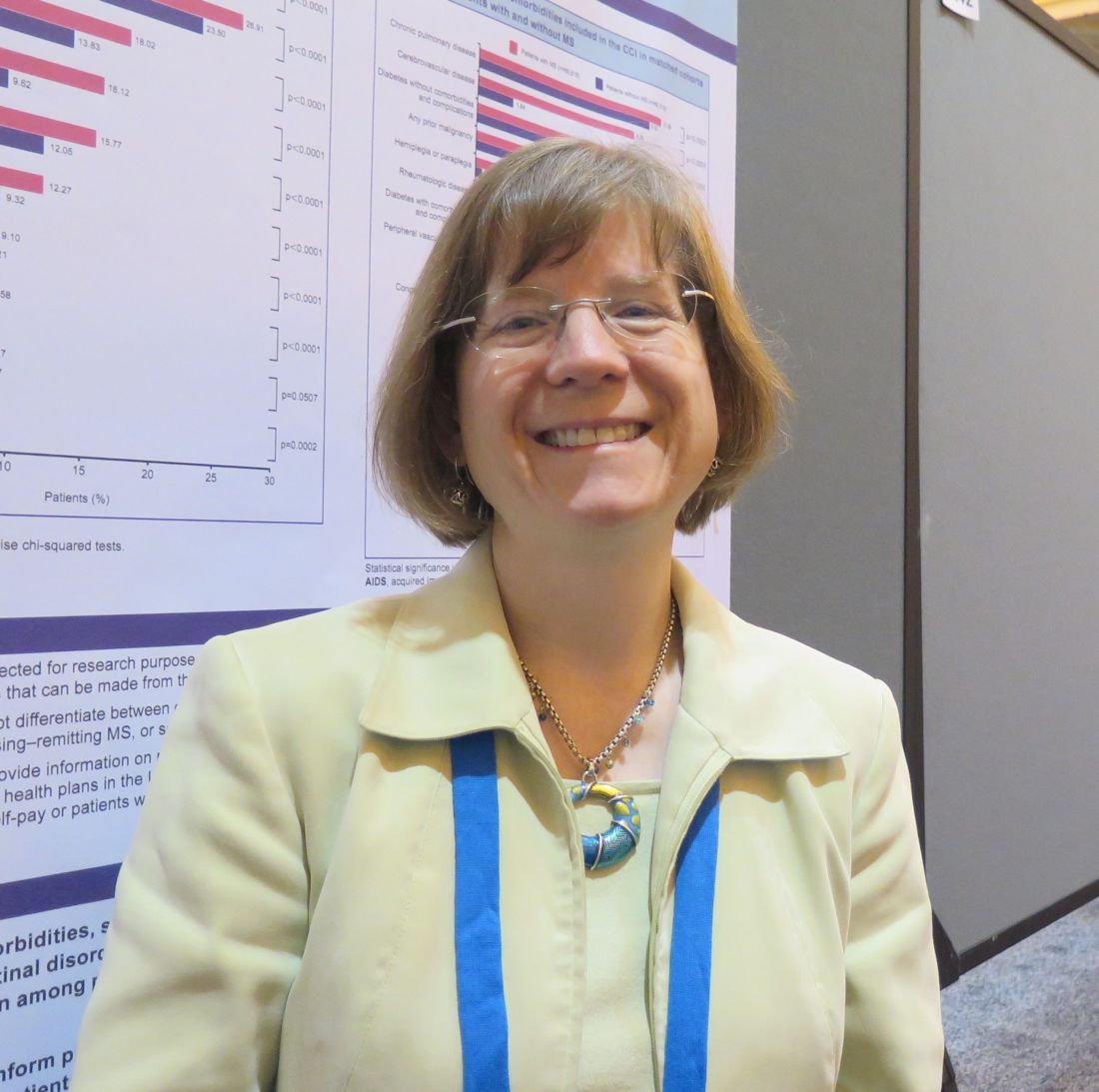
In an effort to compare the prevalence of comorbidities in patients with and without MS, Dr. Kresa-Reahl and her associates retrospectively evaluated IMS Health Real World Data Adjudicated Claims-U.S. data between Jan. 1, 2011, and Sept. 30, 2015. The database includes about 150 million patients with a medical benefit and a subset of 95 million patients with both medical and pharmacy benefits. MS patients were required to have at least two claims with an ICD-9 diagnosis of MS 30 days apart and to be between the ages of 18 and 65.
The researchers drew from a systematic review of the 10 most common comorbidities in MS (Mult Scler. 2015;21[3]:263-81) and then matched 69,550 MS patients to a pool of 3,129,573 patients without MS by age group, gender, geographic region, and index quarter year. This left 66,616 patients in each cohort. Their mean age was 46 years, 76% were female, and the majority had commercial health insurance (97% of MS patients and 95% of those without the condition).
Of the 10 common comorbidities, eight occurred significantly more frequently among MS patients, compared with those without the condition (P less than .0001 for all). These included hyperlipidemia (27.76% vs. 24.57%, respectively), hypertension (26.91% vs. 23.50%), GI disorders (18.02% vs. 13.84%), depression (16.12% vs. 9.62%), thyroid disease (15.77% vs. 12.05%), anxiety (12.27% vs. 9.32%), and chronic obstructive pulmonary disease (10.39% vs. 9.52%).
Dr. Kresa-Reahl, a neurologist at the Providence Multiple Sclerosis Center in Portland, Ore., and her associates also found that patients with MS had a significantly lower prevalence of alcohol abuse, AIDS, mild liver disease, and moderate liver disease than did patients without MS (P less than .05 for all). There were no differences between groups in the prevalence of diabetes without complications or in metastatic tumor (P greater than .05).
She acknowledged certain limitations of the study, including the potential for missing information and the inability of the researchers to determine which form of MS the patients had. “It might be that if we looked at just Medicare and Medicaid patients, these diagnoses would be a little bit different,” Dr. Kresa-Reahl added. “Maybe they would have more disability or more depression or more limited mobility. It’s hard to know, but this is a snapshot of people who have commercial insurance, so maybe they would be more likely to be employed.”
The study was sponsored by EMD Serono. Dr. Kresa-Reahl disclosed that she has received consulting fees from Biogen and EMD Serono; speakers fees and honoraria from Biogen, EMD Serono, Genzyme, Mallinckrodt, Novartis, and Teva; and grant/research support from Biogen, Genentech, Genzyme, Mallinckrodt, and Novartis.
NEW ORLEANS – Comorbidities such as hyperlipidemia, hypertension, gastrointestinal disorders, and depression are significantly more common among patients with multiple sclerosis, compared with patients who do not have the condition.
The findings, based on a large analysis of national claims data that was presented at the annual meeting of the Consortium of Multiple Sclerosis Centers, may better inform physicians and patients about potential comorbidities in patients with MS, lead study author Kiren Kresa-Reahl, MD, said in an interview. “The challenge is, what is the underlying problem?” she asked. “Is it the chicken or the egg? It may be that MS lesions on the brain and microvascular disease look similar, so it’s hard to know. There are also conditions that are caused by MS, such as depression. Is it caused by MS the disease or is it a comorbidity with MS? That’s hard to know.”
In an effort to compare the prevalence of comorbidities in patients with and without MS, Dr. Kresa-Reahl and her associates retrospectively evaluated IMS Health Real World Data Adjudicated Claims-U.S. data between Jan. 1, 2011, and Sept. 30, 2015. The database includes about 150 million patients with a medical benefit and a subset of 95 million patients with both medical and pharmacy benefits. MS patients were required to have at least two claims with an ICD-9 diagnosis of MS 30 days apart and to be between the ages of 18 and 65.
The researchers drew from a systematic review of the 10 most common comorbidities in MS (Mult Scler. 2015;21[3]:263-81) and then matched 69,550 MS patients to a pool of 3,129,573 patients without MS by age group, gender, geographic region, and index quarter year. This left 66,616 patients in each cohort. Their mean age was 46 years, 76% were female, and the majority had commercial health insurance (97% of MS patients and 95% of those without the condition).
Of the 10 common comorbidities, eight occurred significantly more frequently among MS patients, compared with those without the condition (P less than .0001 for all). These included hyperlipidemia (27.76% vs. 24.57%, respectively), hypertension (26.91% vs. 23.50%), GI disorders (18.02% vs. 13.84%), depression (16.12% vs. 9.62%), thyroid disease (15.77% vs. 12.05%), anxiety (12.27% vs. 9.32%), and chronic obstructive pulmonary disease (10.39% vs. 9.52%).
Dr. Kresa-Reahl, a neurologist at the Providence Multiple Sclerosis Center in Portland, Ore., and her associates also found that patients with MS had a significantly lower prevalence of alcohol abuse, AIDS, mild liver disease, and moderate liver disease than did patients without MS (P less than .05 for all). There were no differences between groups in the prevalence of diabetes without complications or in metastatic tumor (P greater than .05).
She acknowledged certain limitations of the study, including the potential for missing information and the inability of the researchers to determine which form of MS the patients had. “It might be that if we looked at just Medicare and Medicaid patients, these diagnoses would be a little bit different,” Dr. Kresa-Reahl added. “Maybe they would have more disability or more depression or more limited mobility. It’s hard to know, but this is a snapshot of people who have commercial insurance, so maybe they would be more likely to be employed.”
The study was sponsored by EMD Serono. Dr. Kresa-Reahl disclosed that she has received consulting fees from Biogen and EMD Serono; speakers fees and honoraria from Biogen, EMD Serono, Genzyme, Mallinckrodt, Novartis, and Teva; and grant/research support from Biogen, Genentech, Genzyme, Mallinckrodt, and Novartis.
NEW ORLEANS – Comorbidities such as hyperlipidemia, hypertension, gastrointestinal disorders, and depression are significantly more common among patients with multiple sclerosis, compared with patients who do not have the condition.
The findings, based on a large analysis of national claims data that was presented at the annual meeting of the Consortium of Multiple Sclerosis Centers, may better inform physicians and patients about potential comorbidities in patients with MS, lead study author Kiren Kresa-Reahl, MD, said in an interview. “The challenge is, what is the underlying problem?” she asked. “Is it the chicken or the egg? It may be that MS lesions on the brain and microvascular disease look similar, so it’s hard to know. There are also conditions that are caused by MS, such as depression. Is it caused by MS the disease or is it a comorbidity with MS? That’s hard to know.”
In an effort to compare the prevalence of comorbidities in patients with and without MS, Dr. Kresa-Reahl and her associates retrospectively evaluated IMS Health Real World Data Adjudicated Claims-U.S. data between Jan. 1, 2011, and Sept. 30, 2015. The database includes about 150 million patients with a medical benefit and a subset of 95 million patients with both medical and pharmacy benefits. MS patients were required to have at least two claims with an ICD-9 diagnosis of MS 30 days apart and to be between the ages of 18 and 65.
The researchers drew from a systematic review of the 10 most common comorbidities in MS (Mult Scler. 2015;21[3]:263-81) and then matched 69,550 MS patients to a pool of 3,129,573 patients without MS by age group, gender, geographic region, and index quarter year. This left 66,616 patients in each cohort. Their mean age was 46 years, 76% were female, and the majority had commercial health insurance (97% of MS patients and 95% of those without the condition).
Of the 10 common comorbidities, eight occurred significantly more frequently among MS patients, compared with those without the condition (P less than .0001 for all). These included hyperlipidemia (27.76% vs. 24.57%, respectively), hypertension (26.91% vs. 23.50%), GI disorders (18.02% vs. 13.84%), depression (16.12% vs. 9.62%), thyroid disease (15.77% vs. 12.05%), anxiety (12.27% vs. 9.32%), and chronic obstructive pulmonary disease (10.39% vs. 9.52%).
Dr. Kresa-Reahl, a neurologist at the Providence Multiple Sclerosis Center in Portland, Ore., and her associates also found that patients with MS had a significantly lower prevalence of alcohol abuse, AIDS, mild liver disease, and moderate liver disease than did patients without MS (P less than .05 for all). There were no differences between groups in the prevalence of diabetes without complications or in metastatic tumor (P greater than .05).
She acknowledged certain limitations of the study, including the potential for missing information and the inability of the researchers to determine which form of MS the patients had. “It might be that if we looked at just Medicare and Medicaid patients, these diagnoses would be a little bit different,” Dr. Kresa-Reahl added. “Maybe they would have more disability or more depression or more limited mobility. It’s hard to know, but this is a snapshot of people who have commercial insurance, so maybe they would be more likely to be employed.”
The study was sponsored by EMD Serono. Dr. Kresa-Reahl disclosed that she has received consulting fees from Biogen and EMD Serono; speakers fees and honoraria from Biogen, EMD Serono, Genzyme, Mallinckrodt, Novartis, and Teva; and grant/research support from Biogen, Genentech, Genzyme, Mallinckrodt, and Novartis.
AT THE CMSC ANNUAL MEETING
Key clinical point:
Major finding: Of 10 common comorbidities, eight occurred significantly more frequently among MS patients, compared with those without the condition (P less than .0001 for all).
Data source: A retrospective analysis of claims data from 66,616 MS patients and 66,616 patients without the condition.
Disclosures: The study was sponsored by EMD Serono. Dr. Kresa-Reahl disclosed that she has received consulting fees from Biogen and EMD Serono; speakers fees and honoraria from Biogen, EMD Serono, Genzyme, Mallinckrodt, Novartis, and Teva; and grant/research support from Biogen, Genentech, Genzyme, Mallinckrodt, and Novartis.
Effective monitoring of DMTs for multiple sclerosis can be tricky
NEW ORLEANS – Safety and efficacy laboratory monitoring of adherence to disease-modifying therapies for multiple sclerosis remains challenging, results from a small pilot study showed.
In an effort to determine if select patients on specific DMTs are receiving appropriate and adequate monitoring as outlined by each DMT’s internal guidance document, Felecia Hart, PharmD, and her associates retrospectively reviewed existing patients treated for MS at the Rocky Mountain Multiple Sclerosis Center at the University of Colorado, Denver, between June 1, 2013, and June 1, 2016.
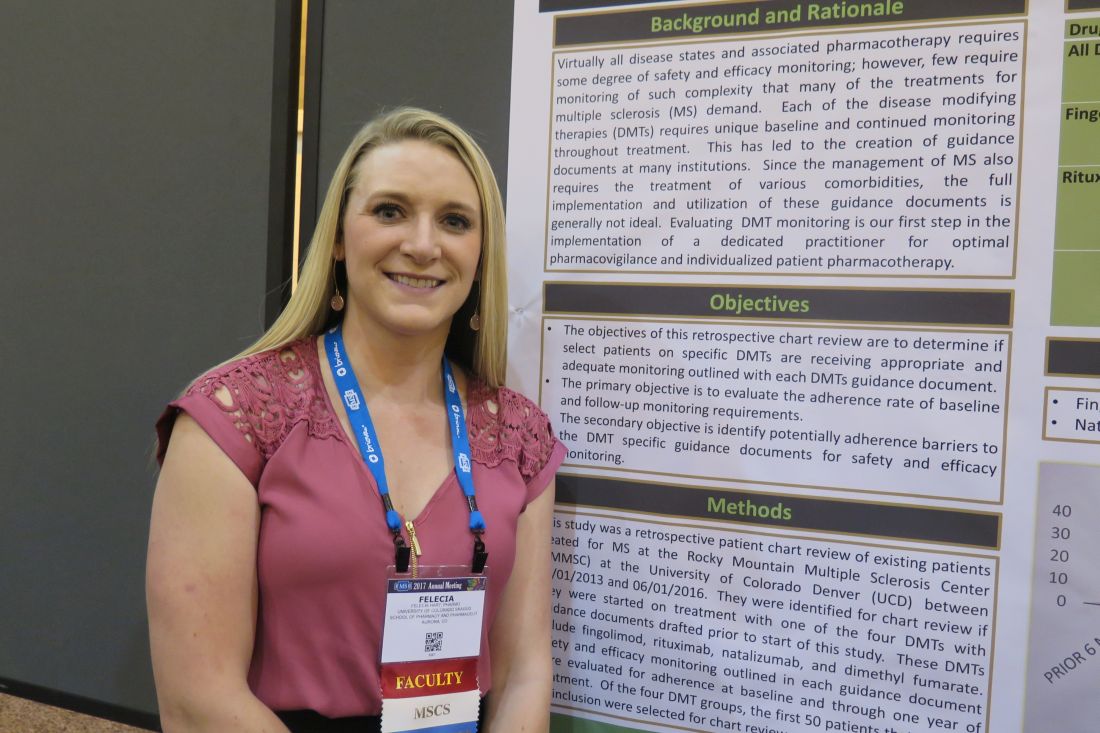
“What we wanted to know was, if patients are getting their infusions or lab work done elsewhere, are we properly documenting it and keeping track of it?” Dr. Hart said in an interview at the meeting. “We’re not looking for core outcomes yet.”
Dr. Hart, a clinical pharmacy neurology fellow at the Skaggs School of Pharmacy and Pharmaceutical Sciences on the University of Colorado Anschutz Medical Campus, reported preliminary results from 50 patients treated with natalizumab and 50 treated with fingolimod. Among those treated with natalizumab, 49 had vitamin D measured within 6 months of drug initiation, 49 had a complete blood count measured within 1 year of drug initiation, and 49 had a comprehensive metabolic panel (CMP) measured within 1 year of drug initiation. “Interestingly, the absent CBC and CMP were from different patients,” she said.
Among patients treated with fingolimod, all had CBC/CMP measured within 1 year of drug initiation, 48 had vitamin D measured within 6 months of drug initiation, and 47 had documented macular optical coherence tomography at baseline, but the proportion of patients who had adequate documentation for other recommended assessments declined significantly. For example, only 19 of 50 had a documented repeat echocardiography within 3 months of drug initiation. Also, several baseline measurements required prior to drug initiation were documented poorly or in an untimely manner. Four patients had their HIV-1 and -2 antibody measured after drug initiation, three had hepatitis B virus surface antigen measured after drug initiation, and three had varicella measured after drug initiation.
Even though the MS center has an electronic medical record system, Dr. Hart and her associates found it difficult to obtain and monitor the parameters of interest. “I’ve been working with our EMR for 6 years, so I know how to navigate it well,” she said. “But I found it difficult to do a simple chart review and find what I wanted to. We have a labs tab in our chart, but the difficulty became including patients who were coming from outside of our center. The lab and the order were referenced in a note but there was never any documentation after that. There are too many holes in getting it documented correctly.”
The findings suggest that having a dedicated clinician such as a clinical pharmacist to oversee pharmacovigilance may improve patient outcomes and ensure that safety and efficacy monitoring doesn’t inadvertently get overlooked because of difficulties with adequate documentation. “That would be ideal,” Dr. Hart said.
She reported having no financial disclosures.
NEW ORLEANS – Safety and efficacy laboratory monitoring of adherence to disease-modifying therapies for multiple sclerosis remains challenging, results from a small pilot study showed.
In an effort to determine if select patients on specific DMTs are receiving appropriate and adequate monitoring as outlined by each DMT’s internal guidance document, Felecia Hart, PharmD, and her associates retrospectively reviewed existing patients treated for MS at the Rocky Mountain Multiple Sclerosis Center at the University of Colorado, Denver, between June 1, 2013, and June 1, 2016.
“What we wanted to know was, if patients are getting their infusions or lab work done elsewhere, are we properly documenting it and keeping track of it?” Dr. Hart said in an interview at the meeting. “We’re not looking for core outcomes yet.”
Dr. Hart, a clinical pharmacy neurology fellow at the Skaggs School of Pharmacy and Pharmaceutical Sciences on the University of Colorado Anschutz Medical Campus, reported preliminary results from 50 patients treated with natalizumab and 50 treated with fingolimod. Among those treated with natalizumab, 49 had vitamin D measured within 6 months of drug initiation, 49 had a complete blood count measured within 1 year of drug initiation, and 49 had a comprehensive metabolic panel (CMP) measured within 1 year of drug initiation. “Interestingly, the absent CBC and CMP were from different patients,” she said.
Among patients treated with fingolimod, all had CBC/CMP measured within 1 year of drug initiation, 48 had vitamin D measured within 6 months of drug initiation, and 47 had documented macular optical coherence tomography at baseline, but the proportion of patients who had adequate documentation for other recommended assessments declined significantly. For example, only 19 of 50 had a documented repeat echocardiography within 3 months of drug initiation. Also, several baseline measurements required prior to drug initiation were documented poorly or in an untimely manner. Four patients had their HIV-1 and -2 antibody measured after drug initiation, three had hepatitis B virus surface antigen measured after drug initiation, and three had varicella measured after drug initiation.
Even though the MS center has an electronic medical record system, Dr. Hart and her associates found it difficult to obtain and monitor the parameters of interest. “I’ve been working with our EMR for 6 years, so I know how to navigate it well,” she said. “But I found it difficult to do a simple chart review and find what I wanted to. We have a labs tab in our chart, but the difficulty became including patients who were coming from outside of our center. The lab and the order were referenced in a note but there was never any documentation after that. There are too many holes in getting it documented correctly.”
The findings suggest that having a dedicated clinician such as a clinical pharmacist to oversee pharmacovigilance may improve patient outcomes and ensure that safety and efficacy monitoring doesn’t inadvertently get overlooked because of difficulties with adequate documentation. “That would be ideal,” Dr. Hart said.
She reported having no financial disclosures.
NEW ORLEANS – Safety and efficacy laboratory monitoring of adherence to disease-modifying therapies for multiple sclerosis remains challenging, results from a small pilot study showed.
In an effort to determine if select patients on specific DMTs are receiving appropriate and adequate monitoring as outlined by each DMT’s internal guidance document, Felecia Hart, PharmD, and her associates retrospectively reviewed existing patients treated for MS at the Rocky Mountain Multiple Sclerosis Center at the University of Colorado, Denver, between June 1, 2013, and June 1, 2016.
“What we wanted to know was, if patients are getting their infusions or lab work done elsewhere, are we properly documenting it and keeping track of it?” Dr. Hart said in an interview at the meeting. “We’re not looking for core outcomes yet.”
Dr. Hart, a clinical pharmacy neurology fellow at the Skaggs School of Pharmacy and Pharmaceutical Sciences on the University of Colorado Anschutz Medical Campus, reported preliminary results from 50 patients treated with natalizumab and 50 treated with fingolimod. Among those treated with natalizumab, 49 had vitamin D measured within 6 months of drug initiation, 49 had a complete blood count measured within 1 year of drug initiation, and 49 had a comprehensive metabolic panel (CMP) measured within 1 year of drug initiation. “Interestingly, the absent CBC and CMP were from different patients,” she said.
Among patients treated with fingolimod, all had CBC/CMP measured within 1 year of drug initiation, 48 had vitamin D measured within 6 months of drug initiation, and 47 had documented macular optical coherence tomography at baseline, but the proportion of patients who had adequate documentation for other recommended assessments declined significantly. For example, only 19 of 50 had a documented repeat echocardiography within 3 months of drug initiation. Also, several baseline measurements required prior to drug initiation were documented poorly or in an untimely manner. Four patients had their HIV-1 and -2 antibody measured after drug initiation, three had hepatitis B virus surface antigen measured after drug initiation, and three had varicella measured after drug initiation.
Even though the MS center has an electronic medical record system, Dr. Hart and her associates found it difficult to obtain and monitor the parameters of interest. “I’ve been working with our EMR for 6 years, so I know how to navigate it well,” she said. “But I found it difficult to do a simple chart review and find what I wanted to. We have a labs tab in our chart, but the difficulty became including patients who were coming from outside of our center. The lab and the order were referenced in a note but there was never any documentation after that. There are too many holes in getting it documented correctly.”
The findings suggest that having a dedicated clinician such as a clinical pharmacist to oversee pharmacovigilance may improve patient outcomes and ensure that safety and efficacy monitoring doesn’t inadvertently get overlooked because of difficulties with adequate documentation. “That would be ideal,” Dr. Hart said.
She reported having no financial disclosures.
AT THE CMSC ANNUAL MEETING
Key clinical point:
Major finding: Among patients treated with fingolimod, only 19 of 50 had a documented repeat ECG within 3 months of drug initiation. Also, several baseline measurements required prior to drug initiation were documented poorly or in an untimely manner.
Data source: Preliminary results from a retrospective review of 50 patients treated with natalizumab and 50 treated with fingolimod.
Disclosures: Dr. Hart reported having no financial disclosures.
Coexisting Autoimmune Disorders May Influence Clinical Outcomes in MS
NEW ORLEANS—Patients with multiple sclerosis (MS) had increased rates of in-hospital mortality and discharge to nursing facilities, compared with patients with MS plus a coexisting autoimmune disorder, according to research presented at the 31st Annual Meeting of the Consortium of MS Centers.

“The findings in this study suggest that a coexisting autoimmune disorder may in fact lessen the severity of the immune dysregulation of MS, which leads to improved health outcomes,” said Malik M. Adil, MD, a neurology resident at the Ochsner Clinic Foundation in New Orleans, and colleagues.
Studies have suggested an association between MS and autoimmune disorders, but research concerning clinical outcomes is limited. To determine whether coexisting autoimmune disorders affect outcomes in patients with MS, Dr. Adil and colleagues analyzed Nationwide Inpatient Survey data files from 2006 to 2010. The researchers classified patients with MS into two groups: an MS group (without coexisting autoimmune disorders) and an MS Plus group (with coexisting autoimmune disorders).
The investigators then compared the rate of clinical outcomes (ie, in-hospital mortality, discharge to home, discharge to nursing facilities, length of stay, and total charges) between the MS and MS Plus groups. Dr. Adil and colleagues used multivariate analysis to adjust for potential confounders when assessing in-hospital outcomes.
Of 115,120 patients with MS, 18,796 were in the MS Plus group. The adjusted odds of in-hospital mortality and of discharge to nursing facilities were significantly higher in the MS group, compared with the MS Plus group (odds ratios, 4.67 and 1.16, respectively). Length of stay and mean hospital charges were significantly higher in the MS Plus group, compared with the MS group.
A possible explanation for the findings is that coexisting autoimmune diseases involve different effector T cells that may regulate the effect of other effector T cells, said the authors. “Other possible explanations of better outcome in the MS Plus group might be the use of chronic immune suppressive agents in addition to MS immunotherapy, and multidisciplinary management,” they added.
NEW ORLEANS—Patients with multiple sclerosis (MS) had increased rates of in-hospital mortality and discharge to nursing facilities, compared with patients with MS plus a coexisting autoimmune disorder, according to research presented at the 31st Annual Meeting of the Consortium of MS Centers.
“The findings in this study suggest that a coexisting autoimmune disorder may in fact lessen the severity of the immune dysregulation of MS, which leads to improved health outcomes,” said Malik M. Adil, MD, a neurology resident at the Ochsner Clinic Foundation in New Orleans, and colleagues.
Studies have suggested an association between MS and autoimmune disorders, but research concerning clinical outcomes is limited. To determine whether coexisting autoimmune disorders affect outcomes in patients with MS, Dr. Adil and colleagues analyzed Nationwide Inpatient Survey data files from 2006 to 2010. The researchers classified patients with MS into two groups: an MS group (without coexisting autoimmune disorders) and an MS Plus group (with coexisting autoimmune disorders).
The investigators then compared the rate of clinical outcomes (ie, in-hospital mortality, discharge to home, discharge to nursing facilities, length of stay, and total charges) between the MS and MS Plus groups. Dr. Adil and colleagues used multivariate analysis to adjust for potential confounders when assessing in-hospital outcomes.
Of 115,120 patients with MS, 18,796 were in the MS Plus group. The adjusted odds of in-hospital mortality and of discharge to nursing facilities were significantly higher in the MS group, compared with the MS Plus group (odds ratios, 4.67 and 1.16, respectively). Length of stay and mean hospital charges were significantly higher in the MS Plus group, compared with the MS group.
A possible explanation for the findings is that coexisting autoimmune diseases involve different effector T cells that may regulate the effect of other effector T cells, said the authors. “Other possible explanations of better outcome in the MS Plus group might be the use of chronic immune suppressive agents in addition to MS immunotherapy, and multidisciplinary management,” they added.
NEW ORLEANS—Patients with multiple sclerosis (MS) had increased rates of in-hospital mortality and discharge to nursing facilities, compared with patients with MS plus a coexisting autoimmune disorder, according to research presented at the 31st Annual Meeting of the Consortium of MS Centers.
“The findings in this study suggest that a coexisting autoimmune disorder may in fact lessen the severity of the immune dysregulation of MS, which leads to improved health outcomes,” said Malik M. Adil, MD, a neurology resident at the Ochsner Clinic Foundation in New Orleans, and colleagues.
Studies have suggested an association between MS and autoimmune disorders, but research concerning clinical outcomes is limited. To determine whether coexisting autoimmune disorders affect outcomes in patients with MS, Dr. Adil and colleagues analyzed Nationwide Inpatient Survey data files from 2006 to 2010. The researchers classified patients with MS into two groups: an MS group (without coexisting autoimmune disorders) and an MS Plus group (with coexisting autoimmune disorders).
The investigators then compared the rate of clinical outcomes (ie, in-hospital mortality, discharge to home, discharge to nursing facilities, length of stay, and total charges) between the MS and MS Plus groups. Dr. Adil and colleagues used multivariate analysis to adjust for potential confounders when assessing in-hospital outcomes.
Of 115,120 patients with MS, 18,796 were in the MS Plus group. The adjusted odds of in-hospital mortality and of discharge to nursing facilities were significantly higher in the MS group, compared with the MS Plus group (odds ratios, 4.67 and 1.16, respectively). Length of stay and mean hospital charges were significantly higher in the MS Plus group, compared with the MS group.
A possible explanation for the findings is that coexisting autoimmune diseases involve different effector T cells that may regulate the effect of other effector T cells, said the authors. “Other possible explanations of better outcome in the MS Plus group might be the use of chronic immune suppressive agents in addition to MS immunotherapy, and multidisciplinary management,” they added.
Phase II Data Show Safety and Efficacy of Ozanimod for Relapsing MS
NEW ORLEANS—Ozanimod demonstrated durable efficacy with a favorable safety profile in patients continuing ozanimod for 120 weeks or switching from placebo to ozanimod for 96 weeks, according to results of a phase II study presented at the 31st Annual Meeting of the Consortium of Multiple Sclerosis Centers. “These data support the ongoing RADIANCE and SUNBEAM phase III studies,” said Brett E. Skolnick, PhD, on behalf of his study collaborators. Dr. Skolnick is an employee of Receptos, a wholly owned subsidiary of Celgene, in San Diego.

Ozanimod, an oral, once-daily immunomodulator selectively targeting sphingosine 1-phosphate (S1P) receptor-1 and -5 , is in development for relapsing multiple sclerosis (MS). “The increased receptor selectivity of ozanimod and additional pharmaceutical properties may result in a more favorable safety profile versus other nonselective and selective S1P receptor modulators,” said Dr. Skolnick.
In the completed RADIANCE Part A phase II trial, patients with relapsing MS were randomized (1:1:1) to once-daily ozanimod 0.5 mg or 1.0 mg or to placebo for 24 weeks. At week 24, patients could enter a 96-week, blinded extension phase. Patients randomized to ozanimod continued their assigned dose; 85 patients received 0.5 mg, and 81 patients received 1.0 mg. Patients administered placebo were re-randomized (1:1) to ozanimod 0.5 mg (n = 41) or 1.0 mg (n = 42). Ozanimod was dose-escalated over seven days to attenuate first-dose effects.
A total of 89% of patients taking the 0.5 mg dose and 90% of patients taking the 1.0 mg dose completed the extension study. At week 120, 89% to 91% of patients were free of gadolinium-enhancing lesions. Unadjusted annualized relapse rates were 0.31 in the 0.5 mg group and 0.18 in the 1.0 mg group. One or more treatment-emergent adverse events were seen in 79% of patients taking the 0.5 mg dose and in 76% of those taking the 1.0 mg dose. The most common adverse events were increased alanine aminotransferases, nasopharyngitis, and upper respiratory tract infection. Serious treatment-emergent adverse events were seen in 12 patients in the 0.5 mg group and in nine patients in the 1.0 mg group. Mild blunting of the normal diurnal heart rate was observed. The largest mean decrease in heart rate relative to pre-dose was 3.5 bpm at hour 6 on day 1, with no associated symptoms. No type II or 2:1 atrioventricular block was reported.
At week 120, alanine aminotransferase (ALT) levels were three or more times upper limit of normal in 6% of the 0.5 mg group and in 7% of the 1.0 mg group. In the 0.5 mg group, 2% of patients discontinued ozanimod due to increased liver transaminases. Less than 1% of patients in the 1.0 mg group discontinued ozanimod for the same reason. Between baseline and week 120, three patients in the 1.0 mg group had absolute lymphocyte counts below 200 cells/μL; none was associated with severe or serious infection. There were no notable cases of pulmonary adverse events and no cases of macular edema, malignancy-related adverse events, or serious opportunistic infections.
This study was supported by Celgene.
Suggested Reading
Cohen JA, Arnold DL, Comi G, et al. Safety and efficacy of the selective sphingosine 1-phosphate receptor modulator ozanimod in relapsing multiple sclerosis (RADIANCE): a randomised, placebo-controlled, phase 2 trial. Lancet Neurol. 2016;15(4):373-381.
NEW ORLEANS—Ozanimod demonstrated durable efficacy with a favorable safety profile in patients continuing ozanimod for 120 weeks or switching from placebo to ozanimod for 96 weeks, according to results of a phase II study presented at the 31st Annual Meeting of the Consortium of Multiple Sclerosis Centers. “These data support the ongoing RADIANCE and SUNBEAM phase III studies,” said Brett E. Skolnick, PhD, on behalf of his study collaborators. Dr. Skolnick is an employee of Receptos, a wholly owned subsidiary of Celgene, in San Diego.
Ozanimod, an oral, once-daily immunomodulator selectively targeting sphingosine 1-phosphate (S1P) receptor-1 and -5 , is in development for relapsing multiple sclerosis (MS). “The increased receptor selectivity of ozanimod and additional pharmaceutical properties may result in a more favorable safety profile versus other nonselective and selective S1P receptor modulators,” said Dr. Skolnick.
In the completed RADIANCE Part A phase II trial, patients with relapsing MS were randomized (1:1:1) to once-daily ozanimod 0.5 mg or 1.0 mg or to placebo for 24 weeks. At week 24, patients could enter a 96-week, blinded extension phase. Patients randomized to ozanimod continued their assigned dose; 85 patients received 0.5 mg, and 81 patients received 1.0 mg. Patients administered placebo were re-randomized (1:1) to ozanimod 0.5 mg (n = 41) or 1.0 mg (n = 42). Ozanimod was dose-escalated over seven days to attenuate first-dose effects.
A total of 89% of patients taking the 0.5 mg dose and 90% of patients taking the 1.0 mg dose completed the extension study. At week 120, 89% to 91% of patients were free of gadolinium-enhancing lesions. Unadjusted annualized relapse rates were 0.31 in the 0.5 mg group and 0.18 in the 1.0 mg group. One or more treatment-emergent adverse events were seen in 79% of patients taking the 0.5 mg dose and in 76% of those taking the 1.0 mg dose. The most common adverse events were increased alanine aminotransferases, nasopharyngitis, and upper respiratory tract infection. Serious treatment-emergent adverse events were seen in 12 patients in the 0.5 mg group and in nine patients in the 1.0 mg group. Mild blunting of the normal diurnal heart rate was observed. The largest mean decrease in heart rate relative to pre-dose was 3.5 bpm at hour 6 on day 1, with no associated symptoms. No type II or 2:1 atrioventricular block was reported.
At week 120, alanine aminotransferase (ALT) levels were three or more times upper limit of normal in 6% of the 0.5 mg group and in 7% of the 1.0 mg group. In the 0.5 mg group, 2% of patients discontinued ozanimod due to increased liver transaminases. Less than 1% of patients in the 1.0 mg group discontinued ozanimod for the same reason. Between baseline and week 120, three patients in the 1.0 mg group had absolute lymphocyte counts below 200 cells/μL; none was associated with severe or serious infection. There were no notable cases of pulmonary adverse events and no cases of macular edema, malignancy-related adverse events, or serious opportunistic infections.
This study was supported by Celgene.
Suggested Reading
Cohen JA, Arnold DL, Comi G, et al. Safety and efficacy of the selective sphingosine 1-phosphate receptor modulator ozanimod in relapsing multiple sclerosis (RADIANCE): a randomised, placebo-controlled, phase 2 trial. Lancet Neurol. 2016;15(4):373-381.
NEW ORLEANS—Ozanimod demonstrated durable efficacy with a favorable safety profile in patients continuing ozanimod for 120 weeks or switching from placebo to ozanimod for 96 weeks, according to results of a phase II study presented at the 31st Annual Meeting of the Consortium of Multiple Sclerosis Centers. “These data support the ongoing RADIANCE and SUNBEAM phase III studies,” said Brett E. Skolnick, PhD, on behalf of his study collaborators. Dr. Skolnick is an employee of Receptos, a wholly owned subsidiary of Celgene, in San Diego.
Ozanimod, an oral, once-daily immunomodulator selectively targeting sphingosine 1-phosphate (S1P) receptor-1 and -5 , is in development for relapsing multiple sclerosis (MS). “The increased receptor selectivity of ozanimod and additional pharmaceutical properties may result in a more favorable safety profile versus other nonselective and selective S1P receptor modulators,” said Dr. Skolnick.
In the completed RADIANCE Part A phase II trial, patients with relapsing MS were randomized (1:1:1) to once-daily ozanimod 0.5 mg or 1.0 mg or to placebo for 24 weeks. At week 24, patients could enter a 96-week, blinded extension phase. Patients randomized to ozanimod continued their assigned dose; 85 patients received 0.5 mg, and 81 patients received 1.0 mg. Patients administered placebo were re-randomized (1:1) to ozanimod 0.5 mg (n = 41) or 1.0 mg (n = 42). Ozanimod was dose-escalated over seven days to attenuate first-dose effects.
A total of 89% of patients taking the 0.5 mg dose and 90% of patients taking the 1.0 mg dose completed the extension study. At week 120, 89% to 91% of patients were free of gadolinium-enhancing lesions. Unadjusted annualized relapse rates were 0.31 in the 0.5 mg group and 0.18 in the 1.0 mg group. One or more treatment-emergent adverse events were seen in 79% of patients taking the 0.5 mg dose and in 76% of those taking the 1.0 mg dose. The most common adverse events were increased alanine aminotransferases, nasopharyngitis, and upper respiratory tract infection. Serious treatment-emergent adverse events were seen in 12 patients in the 0.5 mg group and in nine patients in the 1.0 mg group. Mild blunting of the normal diurnal heart rate was observed. The largest mean decrease in heart rate relative to pre-dose was 3.5 bpm at hour 6 on day 1, with no associated symptoms. No type II or 2:1 atrioventricular block was reported.
At week 120, alanine aminotransferase (ALT) levels were three or more times upper limit of normal in 6% of the 0.5 mg group and in 7% of the 1.0 mg group. In the 0.5 mg group, 2% of patients discontinued ozanimod due to increased liver transaminases. Less than 1% of patients in the 1.0 mg group discontinued ozanimod for the same reason. Between baseline and week 120, three patients in the 1.0 mg group had absolute lymphocyte counts below 200 cells/μL; none was associated with severe or serious infection. There were no notable cases of pulmonary adverse events and no cases of macular edema, malignancy-related adverse events, or serious opportunistic infections.
This study was supported by Celgene.
Suggested Reading
Cohen JA, Arnold DL, Comi G, et al. Safety and efficacy of the selective sphingosine 1-phosphate receptor modulator ozanimod in relapsing multiple sclerosis (RADIANCE): a randomised, placebo-controlled, phase 2 trial. Lancet Neurol. 2016;15(4):373-381.
Risk tolerance to MS therapies varies widely
NEW ORLEANS – Risk tolerance to current disease modifying therapies by patients with multiple sclerosis varies widely, results from a large national survey demonstrated.
“We have therapies available with a wide range of risks,” study author Sneha Natarajan, PhD, said in an interview at the annual meeting of the Consortium of Multiple Sclerosis Centers. “Some of the risks are relatively minor like injection site reactions or flu-like symptoms and some are as bad as PML [progressive multifocal leukoencephalopathy], which can be fatal. We don’t know what kind of risks people tolerate.”

Dr. Natarajan, research coordinator at the Mellen Center for Multiple Sclerosis at the Cleveland Clinic, reported results from 3,371 survey respondents. Their mean age was 55 years, 93% were white, 61% had the relapsing-remitting form of MS, and 53% were currently taking a DMT. Overall, respondents reported the highest risk tolerance for infection or thyroid risks (1:1,000 for both) and lowest risk tolerance for PML and kidney injury risks (1:1,000,000 for both). Males reported a higher risk tolerance to all six risks (P less than .0001 for all). Females reported a risk tolerance to skin rash that was similar to kidney injury and PML.
“There is a pattern to the risks that our patients accept,” Dr. Natarajan said. “I don’t think a doctor would not recommend a therapy benefit because of a skin rash [risk], but he may need to address the concerns of the patient upfront and have a talk with the patient.”
The researchers also found that current DMT users expressed increased risk tolerance for all outcomes, compared with those not using any DMT (P less than .001). Higher risk tolerance was also expressed by respondents who were older, more disabled, and by those taking infusion therapies.
The National Multiple Sclerosis Society funded the study. Dr. Natarajan reported having no financial disclosures.
NEW ORLEANS – Risk tolerance to current disease modifying therapies by patients with multiple sclerosis varies widely, results from a large national survey demonstrated.
“We have therapies available with a wide range of risks,” study author Sneha Natarajan, PhD, said in an interview at the annual meeting of the Consortium of Multiple Sclerosis Centers. “Some of the risks are relatively minor like injection site reactions or flu-like symptoms and some are as bad as PML [progressive multifocal leukoencephalopathy], which can be fatal. We don’t know what kind of risks people tolerate.”
Dr. Natarajan, research coordinator at the Mellen Center for Multiple Sclerosis at the Cleveland Clinic, reported results from 3,371 survey respondents. Their mean age was 55 years, 93% were white, 61% had the relapsing-remitting form of MS, and 53% were currently taking a DMT. Overall, respondents reported the highest risk tolerance for infection or thyroid risks (1:1,000 for both) and lowest risk tolerance for PML and kidney injury risks (1:1,000,000 for both). Males reported a higher risk tolerance to all six risks (P less than .0001 for all). Females reported a risk tolerance to skin rash that was similar to kidney injury and PML.
“There is a pattern to the risks that our patients accept,” Dr. Natarajan said. “I don’t think a doctor would not recommend a therapy benefit because of a skin rash [risk], but he may need to address the concerns of the patient upfront and have a talk with the patient.”
The researchers also found that current DMT users expressed increased risk tolerance for all outcomes, compared with those not using any DMT (P less than .001). Higher risk tolerance was also expressed by respondents who were older, more disabled, and by those taking infusion therapies.
The National Multiple Sclerosis Society funded the study. Dr. Natarajan reported having no financial disclosures.
NEW ORLEANS – Risk tolerance to current disease modifying therapies by patients with multiple sclerosis varies widely, results from a large national survey demonstrated.
“We have therapies available with a wide range of risks,” study author Sneha Natarajan, PhD, said in an interview at the annual meeting of the Consortium of Multiple Sclerosis Centers. “Some of the risks are relatively minor like injection site reactions or flu-like symptoms and some are as bad as PML [progressive multifocal leukoencephalopathy], which can be fatal. We don’t know what kind of risks people tolerate.”
Dr. Natarajan, research coordinator at the Mellen Center for Multiple Sclerosis at the Cleveland Clinic, reported results from 3,371 survey respondents. Their mean age was 55 years, 93% were white, 61% had the relapsing-remitting form of MS, and 53% were currently taking a DMT. Overall, respondents reported the highest risk tolerance for infection or thyroid risks (1:1,000 for both) and lowest risk tolerance for PML and kidney injury risks (1:1,000,000 for both). Males reported a higher risk tolerance to all six risks (P less than .0001 for all). Females reported a risk tolerance to skin rash that was similar to kidney injury and PML.
“There is a pattern to the risks that our patients accept,” Dr. Natarajan said. “I don’t think a doctor would not recommend a therapy benefit because of a skin rash [risk], but he may need to address the concerns of the patient upfront and have a talk with the patient.”
The researchers also found that current DMT users expressed increased risk tolerance for all outcomes, compared with those not using any DMT (P less than .001). Higher risk tolerance was also expressed by respondents who were older, more disabled, and by those taking infusion therapies.
The National Multiple Sclerosis Society funded the study. Dr. Natarajan reported having no financial disclosures.
AT THE CMSC ANNUAL MEETING
Key clinical point:
Major finding: Survey respondents reported the highest risk tolerance for infection or thyroid risks (1:1,000 for both) and lowest risk tolerance for PML and kidney injury risks (1:1,000,000 for both).
Data source: A survey of 3,371 people who reported having MS.
Disclosures: The National Multiple Sclerosis Society funded the study. Dr. Natarajan reported having no financial disclosures.
Minocycline may delay conversion to MS
Minocycline, an antibiotic that has immune-modulating properties and crosses the blood-brain barrier, appears to delay conversion to multiple sclerosis in patients who have an initial focal demyelinating event, according to a report published online June 1 in the New England Journal of Medicine.
Two small clinical trials involving patients with relapsing-remitting multiple sclerosis (MS) recently showed that minocycline reduces the number of lesions detected on MRI with gadolinium enhancement. So researchers led by Luanne M. Metz, MD, of the Cumming School of Medicine and the Hotchkiss Brain Institute, Calgary, Alta., conducted a randomized, double-blind, placebo-controlled trial at 12 Canadian MS clinics to determine whether the drug might delay conversion to MS after a first, clinically isolated demyelinating event, such as optic neuritis or a brainstem, cerebral, cerebellar, or myelopathy syndrome.
The primary outcome of conversion to MS within 6 months of randomization occurred in 23 (32%) patients taking minocycline, compared with 41 (59%) taking placebo – a difference that exceeded the prespecified clinically meaningful difference between the two groups. After the data were adjusted to account for the number of brain lesions at baseline, the difference in risk at 6 months was 18.5 percentage points, a magnitude of effect that is similar to what has been reported for other therapies such as interferon beta-1b, interferon beta-1a, teriflunomide, and oral cladribine.
The findings were similar in every sensitivity and subgroup analysis. All secondary outcomes, such as the decrease in mean lesion volume and the mean number of new lesions after 6 months of treatment, also favored minocycline over placebo, the investigators said (N Engl J Med. 2017 June 1. doi: 10.1056/NEJMoa1608889).
Minocycline’s neuroprotective effect persisted through 12 months of follow-up, according to a post hoc analysis, but was no longer sustained at 24 months of follow-up, they noted. In addition, post hoc analyses showed that minocycline held no significant benefit over placebo with respect to relapse or disability outcomes at either 6 months or 24 months.
This study was supported by the Multiple Sclerosis Society of Canada. Dr. Metz reported receiving grant support from Hoffmann–La Roche outside of this work; her associates reported ties to numerous industry sources.
The intriguing findings of Metz et al., together with the established safety profile and low cost of minocycline, make a compelling case for more research into the drug’s use in early MS.
However, it would be premature to begin using minocycline for MS until its benefits can be confirmed in larger and longer-term clinical trials.
Zongqi Xia, MD, PhD, is in the Program in Translational Neurology and Neuroinflammation at the Pittsburgh Institute of Neurodegenerative Diseases and at the Institute of Multiple Sclerosis Care and Research at the University of Pittsburgh. Robert M. Friedlander, MD, is in the Neuroapoptosis Laboratory and the department of neurosurgery at the University of Pittsburgh. They reported having no relevant financial disclosures. Dr. Xia and Dr. Friedlander made these remarks in an editorial accompanying Dr. Metz and colleagues’ report (N Engl J Med. 2017 June 1. doi: 10.1056/NEJMe1703230).
The intriguing findings of Metz et al., together with the established safety profile and low cost of minocycline, make a compelling case for more research into the drug’s use in early MS.
However, it would be premature to begin using minocycline for MS until its benefits can be confirmed in larger and longer-term clinical trials.
Zongqi Xia, MD, PhD, is in the Program in Translational Neurology and Neuroinflammation at the Pittsburgh Institute of Neurodegenerative Diseases and at the Institute of Multiple Sclerosis Care and Research at the University of Pittsburgh. Robert M. Friedlander, MD, is in the Neuroapoptosis Laboratory and the department of neurosurgery at the University of Pittsburgh. They reported having no relevant financial disclosures. Dr. Xia and Dr. Friedlander made these remarks in an editorial accompanying Dr. Metz and colleagues’ report (N Engl J Med. 2017 June 1. doi: 10.1056/NEJMe1703230).
The intriguing findings of Metz et al., together with the established safety profile and low cost of minocycline, make a compelling case for more research into the drug’s use in early MS.
However, it would be premature to begin using minocycline for MS until its benefits can be confirmed in larger and longer-term clinical trials.
Zongqi Xia, MD, PhD, is in the Program in Translational Neurology and Neuroinflammation at the Pittsburgh Institute of Neurodegenerative Diseases and at the Institute of Multiple Sclerosis Care and Research at the University of Pittsburgh. Robert M. Friedlander, MD, is in the Neuroapoptosis Laboratory and the department of neurosurgery at the University of Pittsburgh. They reported having no relevant financial disclosures. Dr. Xia and Dr. Friedlander made these remarks in an editorial accompanying Dr. Metz and colleagues’ report (N Engl J Med. 2017 June 1. doi: 10.1056/NEJMe1703230).
Minocycline, an antibiotic that has immune-modulating properties and crosses the blood-brain barrier, appears to delay conversion to multiple sclerosis in patients who have an initial focal demyelinating event, according to a report published online June 1 in the New England Journal of Medicine.
Two small clinical trials involving patients with relapsing-remitting multiple sclerosis (MS) recently showed that minocycline reduces the number of lesions detected on MRI with gadolinium enhancement. So researchers led by Luanne M. Metz, MD, of the Cumming School of Medicine and the Hotchkiss Brain Institute, Calgary, Alta., conducted a randomized, double-blind, placebo-controlled trial at 12 Canadian MS clinics to determine whether the drug might delay conversion to MS after a first, clinically isolated demyelinating event, such as optic neuritis or a brainstem, cerebral, cerebellar, or myelopathy syndrome.
The primary outcome of conversion to MS within 6 months of randomization occurred in 23 (32%) patients taking minocycline, compared with 41 (59%) taking placebo – a difference that exceeded the prespecified clinically meaningful difference between the two groups. After the data were adjusted to account for the number of brain lesions at baseline, the difference in risk at 6 months was 18.5 percentage points, a magnitude of effect that is similar to what has been reported for other therapies such as interferon beta-1b, interferon beta-1a, teriflunomide, and oral cladribine.
The findings were similar in every sensitivity and subgroup analysis. All secondary outcomes, such as the decrease in mean lesion volume and the mean number of new lesions after 6 months of treatment, also favored minocycline over placebo, the investigators said (N Engl J Med. 2017 June 1. doi: 10.1056/NEJMoa1608889).
Minocycline’s neuroprotective effect persisted through 12 months of follow-up, according to a post hoc analysis, but was no longer sustained at 24 months of follow-up, they noted. In addition, post hoc analyses showed that minocycline held no significant benefit over placebo with respect to relapse or disability outcomes at either 6 months or 24 months.
This study was supported by the Multiple Sclerosis Society of Canada. Dr. Metz reported receiving grant support from Hoffmann–La Roche outside of this work; her associates reported ties to numerous industry sources.
Minocycline, an antibiotic that has immune-modulating properties and crosses the blood-brain barrier, appears to delay conversion to multiple sclerosis in patients who have an initial focal demyelinating event, according to a report published online June 1 in the New England Journal of Medicine.
Two small clinical trials involving patients with relapsing-remitting multiple sclerosis (MS) recently showed that minocycline reduces the number of lesions detected on MRI with gadolinium enhancement. So researchers led by Luanne M. Metz, MD, of the Cumming School of Medicine and the Hotchkiss Brain Institute, Calgary, Alta., conducted a randomized, double-blind, placebo-controlled trial at 12 Canadian MS clinics to determine whether the drug might delay conversion to MS after a first, clinically isolated demyelinating event, such as optic neuritis or a brainstem, cerebral, cerebellar, or myelopathy syndrome.
The primary outcome of conversion to MS within 6 months of randomization occurred in 23 (32%) patients taking minocycline, compared with 41 (59%) taking placebo – a difference that exceeded the prespecified clinically meaningful difference between the two groups. After the data were adjusted to account for the number of brain lesions at baseline, the difference in risk at 6 months was 18.5 percentage points, a magnitude of effect that is similar to what has been reported for other therapies such as interferon beta-1b, interferon beta-1a, teriflunomide, and oral cladribine.
The findings were similar in every sensitivity and subgroup analysis. All secondary outcomes, such as the decrease in mean lesion volume and the mean number of new lesions after 6 months of treatment, also favored minocycline over placebo, the investigators said (N Engl J Med. 2017 June 1. doi: 10.1056/NEJMoa1608889).
Minocycline’s neuroprotective effect persisted through 12 months of follow-up, according to a post hoc analysis, but was no longer sustained at 24 months of follow-up, they noted. In addition, post hoc analyses showed that minocycline held no significant benefit over placebo with respect to relapse or disability outcomes at either 6 months or 24 months.
This study was supported by the Multiple Sclerosis Society of Canada. Dr. Metz reported receiving grant support from Hoffmann–La Roche outside of this work; her associates reported ties to numerous industry sources.
FROM THE NEW ENGLAND JOURNAL OF MEDICINE
Key clinical point:
Major finding: The primary outcome, conversion to MS within 6 months of randomization, occurred in 23 (32%) patients taking minocycline, compared with 41 (59%) taking placebo.
Data source: A multicenter, randomized, double-blind, placebo-controlled trial involving 142 adults treated for up to 24 months.
Disclosures: This study was supported by the Multiple Sclerosis Society of Canada. Dr. Metz reported receiving grant support from Hoffmann–La Roche outside of this work; her associates reported ties to numerous industry sources.
Alemtuzumab May Prevent MRI Lesions for Six Years in Patients With Highly Active Disease
NEW ORLEANS—Most patients with relapsing-remitting multiple sclerosis (MS) with highly active disease remain free of new MRI activity for six years after receiving alemtuzumab, according to research presented at the 31st Annual Meeting of the Consortium of MS Centers. The durable effects may result from the distinct pattern of lymphocyte repopulation following treatment with alemtuzumab, which may lead to a rebalancing of the immune system, said Anthony Traboulsee, MD, Associate Professor of Neurology at the University of British Columbia in Vancouver. Additional mechanistic studies are needed to establish this hypothesis, the authors said.

To evaluate six-year MRI and brain volume loss outcomes in a subset of patient with highly active disease at baseline who were treated with alemtuzumab, Dr. Traboulsee and colleagues analyzed data from the CARE-MS I trial. In that trial, researchers randomized patients with active relapsing-remitting MS who were drug-naïve at baseline to alemtuzumab or interferon beta-1a. After two years, patients who received alemtuzumab had improved clinical and MRI outcomes, including brain loss volume, compared with patients who received interferon beta-1a. In addition, significantly more of these patients had no evidence of disease activity, compared with patients treated with interferon beta1-a.
In an extension study, patients could receive additional treatment with alemtuzumab (12 mg/day on three consecutive days one year or more after the most recent course) as needed for relapse or radiologic activity. During the extension, patients also could receive treatment with other licensed disease-modifying therapies at an investigator’s discretion. Retreatment criteria included one or more relapse, two or more new or enlarging T2 hyperintense lesions, or new gadolinium-enhancing T1 brain or spinal cord lesions on MRI. Researchers defined highly active disease as two or more relapses a year prior to randomization and one or more gadolinium-enhancing T1 lesion at core study baseline.
The researchers obtained MRI scans at baseline and yearly thereafter. Experts masked to patients’ original treatment group assignment analyzed the MRI scans. Investigators assessed the proportion of patients free of MRI disease activity (ie, no new or enlarging T2 hyperintense lesions or new gadolinium-enhancing T1 lesions) and the proportion of patients free of new non-enhancing T1 lesions. Brain volume loss was derived by brain parenchymal fraction change.
Of 376 patients who received alemtuzumab in the CARE-MS I trial, 105 met the criteria for highly active disease at core study baseline. Of these 105 patients, 99 remained in the study through Year 6. Through six years, 63% of patients did not receive additional treatment with alemtuzumab or another disease-modifying therapy. In each year through Year 6, a majority of patients were free of MRI disease activity (61 % at Year 6), free of new gadolinium-enhancing T1 lesions (83% at Year 6), and free of new or enlarging T2 hyperintense lesions (62% at Year 6). The investigators also observed that annually in Years 2 through 6, high proportions of patients had no new non-enhancing T1 hypointense lesions.
“These findings, along with long-term clinical efficacy, suggest that alemtuzumab may provide a unique treatment approach for relapsing-remitting MS patients with highly active disease, offering durable efficacy in the absence of continuous treatment,” said Dr. Traboulsee and colleagues.
NEW ORLEANS—Most patients with relapsing-remitting multiple sclerosis (MS) with highly active disease remain free of new MRI activity for six years after receiving alemtuzumab, according to research presented at the 31st Annual Meeting of the Consortium of MS Centers. The durable effects may result from the distinct pattern of lymphocyte repopulation following treatment with alemtuzumab, which may lead to a rebalancing of the immune system, said Anthony Traboulsee, MD, Associate Professor of Neurology at the University of British Columbia in Vancouver. Additional mechanistic studies are needed to establish this hypothesis, the authors said.
To evaluate six-year MRI and brain volume loss outcomes in a subset of patient with highly active disease at baseline who were treated with alemtuzumab, Dr. Traboulsee and colleagues analyzed data from the CARE-MS I trial. In that trial, researchers randomized patients with active relapsing-remitting MS who were drug-naïve at baseline to alemtuzumab or interferon beta-1a. After two years, patients who received alemtuzumab had improved clinical and MRI outcomes, including brain loss volume, compared with patients who received interferon beta-1a. In addition, significantly more of these patients had no evidence of disease activity, compared with patients treated with interferon beta1-a.
In an extension study, patients could receive additional treatment with alemtuzumab (12 mg/day on three consecutive days one year or more after the most recent course) as needed for relapse or radiologic activity. During the extension, patients also could receive treatment with other licensed disease-modifying therapies at an investigator’s discretion. Retreatment criteria included one or more relapse, two or more new or enlarging T2 hyperintense lesions, or new gadolinium-enhancing T1 brain or spinal cord lesions on MRI. Researchers defined highly active disease as two or more relapses a year prior to randomization and one or more gadolinium-enhancing T1 lesion at core study baseline.
The researchers obtained MRI scans at baseline and yearly thereafter. Experts masked to patients’ original treatment group assignment analyzed the MRI scans. Investigators assessed the proportion of patients free of MRI disease activity (ie, no new or enlarging T2 hyperintense lesions or new gadolinium-enhancing T1 lesions) and the proportion of patients free of new non-enhancing T1 lesions. Brain volume loss was derived by brain parenchymal fraction change.
Of 376 patients who received alemtuzumab in the CARE-MS I trial, 105 met the criteria for highly active disease at core study baseline. Of these 105 patients, 99 remained in the study through Year 6. Through six years, 63% of patients did not receive additional treatment with alemtuzumab or another disease-modifying therapy. In each year through Year 6, a majority of patients were free of MRI disease activity (61 % at Year 6), free of new gadolinium-enhancing T1 lesions (83% at Year 6), and free of new or enlarging T2 hyperintense lesions (62% at Year 6). The investigators also observed that annually in Years 2 through 6, high proportions of patients had no new non-enhancing T1 hypointense lesions.
“These findings, along with long-term clinical efficacy, suggest that alemtuzumab may provide a unique treatment approach for relapsing-remitting MS patients with highly active disease, offering durable efficacy in the absence of continuous treatment,” said Dr. Traboulsee and colleagues.
NEW ORLEANS—Most patients with relapsing-remitting multiple sclerosis (MS) with highly active disease remain free of new MRI activity for six years after receiving alemtuzumab, according to research presented at the 31st Annual Meeting of the Consortium of MS Centers. The durable effects may result from the distinct pattern of lymphocyte repopulation following treatment with alemtuzumab, which may lead to a rebalancing of the immune system, said Anthony Traboulsee, MD, Associate Professor of Neurology at the University of British Columbia in Vancouver. Additional mechanistic studies are needed to establish this hypothesis, the authors said.
To evaluate six-year MRI and brain volume loss outcomes in a subset of patient with highly active disease at baseline who were treated with alemtuzumab, Dr. Traboulsee and colleagues analyzed data from the CARE-MS I trial. In that trial, researchers randomized patients with active relapsing-remitting MS who were drug-naïve at baseline to alemtuzumab or interferon beta-1a. After two years, patients who received alemtuzumab had improved clinical and MRI outcomes, including brain loss volume, compared with patients who received interferon beta-1a. In addition, significantly more of these patients had no evidence of disease activity, compared with patients treated with interferon beta1-a.
In an extension study, patients could receive additional treatment with alemtuzumab (12 mg/day on three consecutive days one year or more after the most recent course) as needed for relapse or radiologic activity. During the extension, patients also could receive treatment with other licensed disease-modifying therapies at an investigator’s discretion. Retreatment criteria included one or more relapse, two or more new or enlarging T2 hyperintense lesions, or new gadolinium-enhancing T1 brain or spinal cord lesions on MRI. Researchers defined highly active disease as two or more relapses a year prior to randomization and one or more gadolinium-enhancing T1 lesion at core study baseline.
The researchers obtained MRI scans at baseline and yearly thereafter. Experts masked to patients’ original treatment group assignment analyzed the MRI scans. Investigators assessed the proportion of patients free of MRI disease activity (ie, no new or enlarging T2 hyperintense lesions or new gadolinium-enhancing T1 lesions) and the proportion of patients free of new non-enhancing T1 lesions. Brain volume loss was derived by brain parenchymal fraction change.
Of 376 patients who received alemtuzumab in the CARE-MS I trial, 105 met the criteria for highly active disease at core study baseline. Of these 105 patients, 99 remained in the study through Year 6. Through six years, 63% of patients did not receive additional treatment with alemtuzumab or another disease-modifying therapy. In each year through Year 6, a majority of patients were free of MRI disease activity (61 % at Year 6), free of new gadolinium-enhancing T1 lesions (83% at Year 6), and free of new or enlarging T2 hyperintense lesions (62% at Year 6). The investigators also observed that annually in Years 2 through 6, high proportions of patients had no new non-enhancing T1 hypointense lesions.
“These findings, along with long-term clinical efficacy, suggest that alemtuzumab may provide a unique treatment approach for relapsing-remitting MS patients with highly active disease, offering durable efficacy in the absence of continuous treatment,” said Dr. Traboulsee and colleagues.
What Are Patients With MS Saying About Day-to-Day Life and Treatment?
NEW ORLEANS—Two studies presented at the 31st Annual Meeting of the Consortium of Multiple Sclerosis (MS) Centers examined the impact of MS and treatment among patients who are members of an online social network. Researchers found that, among patients who were taking oral disease-modifying treatments (DMTs), how the drug was taken was the most important factor in selecting the therapy (36% of patients) almost as often as the doctor’s recommendation (40% of patients), according to the results of a patient survey. In a separate study that analyzed comments made on the social network, researchers found that adverse events were the most commonly stated reason for stopping a treatment (56%).

In one study, Terrie Livingston, PharmD, an employee of Biogen in Weston, Massachusetts, and colleagues conducted a patient survey to assess the impact of MS on day-to-day life, self-reported symptoms, patient descriptions of disability progression, trade-offs when deciding which DMT to take, and what health care providers should know to better manage MS.
In November 2014, researchers sent an email invitation to the entire MyMSTeam community, a social network of approximately 25,000 people (currently more than 75,000 people) diagnosed with MS. In all, 1,107 members responded to the survey.
Overall, the most commonly reported symptoms were fatigue (82% of patients), problems with mobility (64%), and poor balance (64%). In addition, weakness, cognitive issues, and depression were common. The respondents defined disability progression as increased limitations on their ability to get around, having to sacrifice normal daily activities, and losing their ability to be independent. Patients measured the efficacy of DMTs by evaluating the treatments’ ability to slow progression, prevent further physical disability, prevent new lesions, and improve quality of life.
In a separate study, Dr. Livingston and colleagues conducted an analysis of organic discussions within MyMSTeam from January 2015 to April 2016. Researchers anonymized, coded, categorized, and analyzed 3,300 verbatim comments by key themes. The analysis focused on 12 DMTs. Discussions were overlaid with patient self-reported data on gender, age, date of diagnosis, MS type, current DMT, and effectiveness ratings.
Common discussion topics included side effects experienced; reasons for stopping treatment; perceived efficacy; questions, hopes, and concerns about starting a new DMT; rituals to mitigate side effects; and insurance or financial hurdles to getting on or staying on treatment.
Discussions about infusion therapies tended to focus on receiving treatment and issues related to progressive multifocal leukoencephalopathy.
When discussing Tysabri (natalizumab), patients most commonly discussed elevated energy levels post infusion around day 14. Patients also reported increased fatigue in the days prior to the next infusion and extreme fatigue on the day of treatment. In addition, patients shared their experiences with managing tolerability issues, most commonly flu-like symptoms with interferons and gastrointestinal effects with Tecfidera (dimethyl fumarate).
Dr. Livingston and colleagues said that their research “will better allow medical professionals to treat the individual holistically, and not just the disease itself. Additionally, helping patients understand MS progression will allow specialists to set realistic expectations for treating the disease and to help their patients better prepare for the future.”
NEW ORLEANS—Two studies presented at the 31st Annual Meeting of the Consortium of Multiple Sclerosis (MS) Centers examined the impact of MS and treatment among patients who are members of an online social network. Researchers found that, among patients who were taking oral disease-modifying treatments (DMTs), how the drug was taken was the most important factor in selecting the therapy (36% of patients) almost as often as the doctor’s recommendation (40% of patients), according to the results of a patient survey. In a separate study that analyzed comments made on the social network, researchers found that adverse events were the most commonly stated reason for stopping a treatment (56%).
In one study, Terrie Livingston, PharmD, an employee of Biogen in Weston, Massachusetts, and colleagues conducted a patient survey to assess the impact of MS on day-to-day life, self-reported symptoms, patient descriptions of disability progression, trade-offs when deciding which DMT to take, and what health care providers should know to better manage MS.
In November 2014, researchers sent an email invitation to the entire MyMSTeam community, a social network of approximately 25,000 people (currently more than 75,000 people) diagnosed with MS. In all, 1,107 members responded to the survey.
Overall, the most commonly reported symptoms were fatigue (82% of patients), problems with mobility (64%), and poor balance (64%). In addition, weakness, cognitive issues, and depression were common. The respondents defined disability progression as increased limitations on their ability to get around, having to sacrifice normal daily activities, and losing their ability to be independent. Patients measured the efficacy of DMTs by evaluating the treatments’ ability to slow progression, prevent further physical disability, prevent new lesions, and improve quality of life.
In a separate study, Dr. Livingston and colleagues conducted an analysis of organic discussions within MyMSTeam from January 2015 to April 2016. Researchers anonymized, coded, categorized, and analyzed 3,300 verbatim comments by key themes. The analysis focused on 12 DMTs. Discussions were overlaid with patient self-reported data on gender, age, date of diagnosis, MS type, current DMT, and effectiveness ratings.
Common discussion topics included side effects experienced; reasons for stopping treatment; perceived efficacy; questions, hopes, and concerns about starting a new DMT; rituals to mitigate side effects; and insurance or financial hurdles to getting on or staying on treatment.
Discussions about infusion therapies tended to focus on receiving treatment and issues related to progressive multifocal leukoencephalopathy.
When discussing Tysabri (natalizumab), patients most commonly discussed elevated energy levels post infusion around day 14. Patients also reported increased fatigue in the days prior to the next infusion and extreme fatigue on the day of treatment. In addition, patients shared their experiences with managing tolerability issues, most commonly flu-like symptoms with interferons and gastrointestinal effects with Tecfidera (dimethyl fumarate).
Dr. Livingston and colleagues said that their research “will better allow medical professionals to treat the individual holistically, and not just the disease itself. Additionally, helping patients understand MS progression will allow specialists to set realistic expectations for treating the disease and to help their patients better prepare for the future.”
NEW ORLEANS—Two studies presented at the 31st Annual Meeting of the Consortium of Multiple Sclerosis (MS) Centers examined the impact of MS and treatment among patients who are members of an online social network. Researchers found that, among patients who were taking oral disease-modifying treatments (DMTs), how the drug was taken was the most important factor in selecting the therapy (36% of patients) almost as often as the doctor’s recommendation (40% of patients), according to the results of a patient survey. In a separate study that analyzed comments made on the social network, researchers found that adverse events were the most commonly stated reason for stopping a treatment (56%).
In one study, Terrie Livingston, PharmD, an employee of Biogen in Weston, Massachusetts, and colleagues conducted a patient survey to assess the impact of MS on day-to-day life, self-reported symptoms, patient descriptions of disability progression, trade-offs when deciding which DMT to take, and what health care providers should know to better manage MS.
In November 2014, researchers sent an email invitation to the entire MyMSTeam community, a social network of approximately 25,000 people (currently more than 75,000 people) diagnosed with MS. In all, 1,107 members responded to the survey.
Overall, the most commonly reported symptoms were fatigue (82% of patients), problems with mobility (64%), and poor balance (64%). In addition, weakness, cognitive issues, and depression were common. The respondents defined disability progression as increased limitations on their ability to get around, having to sacrifice normal daily activities, and losing their ability to be independent. Patients measured the efficacy of DMTs by evaluating the treatments’ ability to slow progression, prevent further physical disability, prevent new lesions, and improve quality of life.
In a separate study, Dr. Livingston and colleagues conducted an analysis of organic discussions within MyMSTeam from January 2015 to April 2016. Researchers anonymized, coded, categorized, and analyzed 3,300 verbatim comments by key themes. The analysis focused on 12 DMTs. Discussions were overlaid with patient self-reported data on gender, age, date of diagnosis, MS type, current DMT, and effectiveness ratings.
Common discussion topics included side effects experienced; reasons for stopping treatment; perceived efficacy; questions, hopes, and concerns about starting a new DMT; rituals to mitigate side effects; and insurance or financial hurdles to getting on or staying on treatment.
Discussions about infusion therapies tended to focus on receiving treatment and issues related to progressive multifocal leukoencephalopathy.
When discussing Tysabri (natalizumab), patients most commonly discussed elevated energy levels post infusion around day 14. Patients also reported increased fatigue in the days prior to the next infusion and extreme fatigue on the day of treatment. In addition, patients shared their experiences with managing tolerability issues, most commonly flu-like symptoms with interferons and gastrointestinal effects with Tecfidera (dimethyl fumarate).
Dr. Livingston and colleagues said that their research “will better allow medical professionals to treat the individual holistically, and not just the disease itself. Additionally, helping patients understand MS progression will allow specialists to set realistic expectations for treating the disease and to help their patients better prepare for the future.”