User login
Nf-L levels predictive of brain atrophy, disability in progressive MS
BERLIN – Neurofilament light chain (Nf-L) levels are higher in the plasma of patients with secondary progressive multiple sclerosis (SPMS) than primary progressive multiple sclerosis (PPMS) irrespective of age, according to an analysis of blood samples from two large phase 3 trials.

“Our data suggest that Nf-L should be considered as an informative endpoint for phase 2 studies in SPMS,” said the presenting study author Ludwig Kappos, MD, at the annual congress of the European Committee for Treatment and Research in Multiple Sclerosis.
Much of the research on using Nf-L as a biomarker in MS to date has looked at patients with relapsing-remitting MS and the researchers wanted to see if Nf-L might be a useful biomarker in progressive MS because drug development in this area needs long-term and large trials to show an effect of a drug on disability. Conventional magnetic resonance imaging measures show only a modest association with disease evolution in SPMS and PPMS, and, as Nf-L is specific to neuronal damage, it should reflect damage to the brain and spinal cord, Dr. Kappos explained.
The aim of the study was to compare Nf-L levels in the two progressive subtypes of MS – SPMS and PPMS – and to see if it had any predictive value in determining the degree of brain atrophy or disability. Other objectives were to measure the sensitivity for Nf-L to detect treatment effects, and to estimate how big a sample size would be needed in a phase 2 study if it was used as a primary endpoint.
Blood samples from 1,830 patients who had participated in one of two phase 3 studies of siponimod in SPMS (EXPAND) and fingolimod (Gilyena) in PPMS (INFORMS). Nf-L levels were measured retrospectively in plasma using the SIMOA Nf-L immunoassay and categorized as being low (less than 30 pg/mL), medium (30-60 pg/mL), or high (greater than 60 pg/mL). Brain volume change on MRI was calculated using the SIENA (Structural Image Evaluation, using Normalization, of Atrophy) method, and disability changes assessed were evaluated by the Expanded Disability Status Scale (EDSS) score
“One of the confounders of measuring Nf-L is age,” Dr. Kappos acknowledged, “but we see a difference between SPMS and PPMS that is robust along the spectrum of ages.” The geometric mean of Nf-L at baseline was 32.1 pg/mL in patients with SPMS (n = 1,452) and 22.0 pg/mL in those with PPMS (n = 378).
Multiple regression analysis showed that, in both SPMS and PPMS patients, higher Nf-L levels were associated with older age and higher disease activity (increased EDSS score, more gadolinium-enhancing (Gd+) lesions and higher T2 lesion load).
Greater brain loss was seen at both 12 and 24 months in patients with high versus low Nf-L levels at baseline in both the SPMS and PPMS groups. For example, comparing high versus low Nf-L in SPMS, the mean brain volume change from baseline was –0.8% vs. –0.2% (P less than .0001) at 12 months and –1.5% vs. –0.5% at 24 months (P less than .0001). Corresponding values for PPMS were –0.8% vs. –0.4% (P = .0044) and –1.9% vs. –0.8% (P less than .0001).
Nf-L levels of 30 pg/mL were associated with a 32% increased risk of disability progression in patients with SPMS (P = .0055) and a 49% increased risk of disability progression in patients with PPMS (P = .0268).
In both groups of progressive MS patients, Nf-L levels were reduced in response to treatment at both 12 and 24 months, which remained significant.
“So, what about sample size calculation for a 1-year, phase 2 study with Nf-L as a primary endpoint?” Dr. Kappos queried. Assuming a reduction in Nf-L of 20% with a test drug, such a study would be likely to need to include 188 patients, or 94 patients per single arm to have 80% statistical power. To see a 30% reduction in Nf-L, fewer total and single-arm numbers would be needed, at 74 and 37 participants, respectively.
The study was funded by Novartis Pharma AG, Basel, Switzerland. Dr. Kappos disclosed that his institution (University Hospital Basel) had received steering committee, advisory board, and consultancy fees in the last 3 years that had been used exclusively for research support at the department from Novartis and a number of other pharmaceutical manufacturers. The Research of the MS Centre in Basel has been supported by grants from Bayer, Biogen, Novartis, the Swiss MS Society, the Swiss National Research Foundation, the European Union, and Roche Research Foundations.
SOURCE: Kuhle J et al. ECTRIMS 2018. Mult Scler. 2018;24(Suppl 2):111, Abstract 286.
BERLIN – Neurofilament light chain (Nf-L) levels are higher in the plasma of patients with secondary progressive multiple sclerosis (SPMS) than primary progressive multiple sclerosis (PPMS) irrespective of age, according to an analysis of blood samples from two large phase 3 trials.
“Our data suggest that Nf-L should be considered as an informative endpoint for phase 2 studies in SPMS,” said the presenting study author Ludwig Kappos, MD, at the annual congress of the European Committee for Treatment and Research in Multiple Sclerosis.
Much of the research on using Nf-L as a biomarker in MS to date has looked at patients with relapsing-remitting MS and the researchers wanted to see if Nf-L might be a useful biomarker in progressive MS because drug development in this area needs long-term and large trials to show an effect of a drug on disability. Conventional magnetic resonance imaging measures show only a modest association with disease evolution in SPMS and PPMS, and, as Nf-L is specific to neuronal damage, it should reflect damage to the brain and spinal cord, Dr. Kappos explained.
The aim of the study was to compare Nf-L levels in the two progressive subtypes of MS – SPMS and PPMS – and to see if it had any predictive value in determining the degree of brain atrophy or disability. Other objectives were to measure the sensitivity for Nf-L to detect treatment effects, and to estimate how big a sample size would be needed in a phase 2 study if it was used as a primary endpoint.
Blood samples from 1,830 patients who had participated in one of two phase 3 studies of siponimod in SPMS (EXPAND) and fingolimod (Gilyena) in PPMS (INFORMS). Nf-L levels were measured retrospectively in plasma using the SIMOA Nf-L immunoassay and categorized as being low (less than 30 pg/mL), medium (30-60 pg/mL), or high (greater than 60 pg/mL). Brain volume change on MRI was calculated using the SIENA (Structural Image Evaluation, using Normalization, of Atrophy) method, and disability changes assessed were evaluated by the Expanded Disability Status Scale (EDSS) score
“One of the confounders of measuring Nf-L is age,” Dr. Kappos acknowledged, “but we see a difference between SPMS and PPMS that is robust along the spectrum of ages.” The geometric mean of Nf-L at baseline was 32.1 pg/mL in patients with SPMS (n = 1,452) and 22.0 pg/mL in those with PPMS (n = 378).
Multiple regression analysis showed that, in both SPMS and PPMS patients, higher Nf-L levels were associated with older age and higher disease activity (increased EDSS score, more gadolinium-enhancing (Gd+) lesions and higher T2 lesion load).
Greater brain loss was seen at both 12 and 24 months in patients with high versus low Nf-L levels at baseline in both the SPMS and PPMS groups. For example, comparing high versus low Nf-L in SPMS, the mean brain volume change from baseline was –0.8% vs. –0.2% (P less than .0001) at 12 months and –1.5% vs. –0.5% at 24 months (P less than .0001). Corresponding values for PPMS were –0.8% vs. –0.4% (P = .0044) and –1.9% vs. –0.8% (P less than .0001).
Nf-L levels of 30 pg/mL were associated with a 32% increased risk of disability progression in patients with SPMS (P = .0055) and a 49% increased risk of disability progression in patients with PPMS (P = .0268).
In both groups of progressive MS patients, Nf-L levels were reduced in response to treatment at both 12 and 24 months, which remained significant.
“So, what about sample size calculation for a 1-year, phase 2 study with Nf-L as a primary endpoint?” Dr. Kappos queried. Assuming a reduction in Nf-L of 20% with a test drug, such a study would be likely to need to include 188 patients, or 94 patients per single arm to have 80% statistical power. To see a 30% reduction in Nf-L, fewer total and single-arm numbers would be needed, at 74 and 37 participants, respectively.
The study was funded by Novartis Pharma AG, Basel, Switzerland. Dr. Kappos disclosed that his institution (University Hospital Basel) had received steering committee, advisory board, and consultancy fees in the last 3 years that had been used exclusively for research support at the department from Novartis and a number of other pharmaceutical manufacturers. The Research of the MS Centre in Basel has been supported by grants from Bayer, Biogen, Novartis, the Swiss MS Society, the Swiss National Research Foundation, the European Union, and Roche Research Foundations.
SOURCE: Kuhle J et al. ECTRIMS 2018. Mult Scler. 2018;24(Suppl 2):111, Abstract 286.
BERLIN – Neurofilament light chain (Nf-L) levels are higher in the plasma of patients with secondary progressive multiple sclerosis (SPMS) than primary progressive multiple sclerosis (PPMS) irrespective of age, according to an analysis of blood samples from two large phase 3 trials.
“Our data suggest that Nf-L should be considered as an informative endpoint for phase 2 studies in SPMS,” said the presenting study author Ludwig Kappos, MD, at the annual congress of the European Committee for Treatment and Research in Multiple Sclerosis.
Much of the research on using Nf-L as a biomarker in MS to date has looked at patients with relapsing-remitting MS and the researchers wanted to see if Nf-L might be a useful biomarker in progressive MS because drug development in this area needs long-term and large trials to show an effect of a drug on disability. Conventional magnetic resonance imaging measures show only a modest association with disease evolution in SPMS and PPMS, and, as Nf-L is specific to neuronal damage, it should reflect damage to the brain and spinal cord, Dr. Kappos explained.
The aim of the study was to compare Nf-L levels in the two progressive subtypes of MS – SPMS and PPMS – and to see if it had any predictive value in determining the degree of brain atrophy or disability. Other objectives were to measure the sensitivity for Nf-L to detect treatment effects, and to estimate how big a sample size would be needed in a phase 2 study if it was used as a primary endpoint.
Blood samples from 1,830 patients who had participated in one of two phase 3 studies of siponimod in SPMS (EXPAND) and fingolimod (Gilyena) in PPMS (INFORMS). Nf-L levels were measured retrospectively in plasma using the SIMOA Nf-L immunoassay and categorized as being low (less than 30 pg/mL), medium (30-60 pg/mL), or high (greater than 60 pg/mL). Brain volume change on MRI was calculated using the SIENA (Structural Image Evaluation, using Normalization, of Atrophy) method, and disability changes assessed were evaluated by the Expanded Disability Status Scale (EDSS) score
“One of the confounders of measuring Nf-L is age,” Dr. Kappos acknowledged, “but we see a difference between SPMS and PPMS that is robust along the spectrum of ages.” The geometric mean of Nf-L at baseline was 32.1 pg/mL in patients with SPMS (n = 1,452) and 22.0 pg/mL in those with PPMS (n = 378).
Multiple regression analysis showed that, in both SPMS and PPMS patients, higher Nf-L levels were associated with older age and higher disease activity (increased EDSS score, more gadolinium-enhancing (Gd+) lesions and higher T2 lesion load).
Greater brain loss was seen at both 12 and 24 months in patients with high versus low Nf-L levels at baseline in both the SPMS and PPMS groups. For example, comparing high versus low Nf-L in SPMS, the mean brain volume change from baseline was –0.8% vs. –0.2% (P less than .0001) at 12 months and –1.5% vs. –0.5% at 24 months (P less than .0001). Corresponding values for PPMS were –0.8% vs. –0.4% (P = .0044) and –1.9% vs. –0.8% (P less than .0001).
Nf-L levels of 30 pg/mL were associated with a 32% increased risk of disability progression in patients with SPMS (P = .0055) and a 49% increased risk of disability progression in patients with PPMS (P = .0268).
In both groups of progressive MS patients, Nf-L levels were reduced in response to treatment at both 12 and 24 months, which remained significant.
“So, what about sample size calculation for a 1-year, phase 2 study with Nf-L as a primary endpoint?” Dr. Kappos queried. Assuming a reduction in Nf-L of 20% with a test drug, such a study would be likely to need to include 188 patients, or 94 patients per single arm to have 80% statistical power. To see a 30% reduction in Nf-L, fewer total and single-arm numbers would be needed, at 74 and 37 participants, respectively.
The study was funded by Novartis Pharma AG, Basel, Switzerland. Dr. Kappos disclosed that his institution (University Hospital Basel) had received steering committee, advisory board, and consultancy fees in the last 3 years that had been used exclusively for research support at the department from Novartis and a number of other pharmaceutical manufacturers. The Research of the MS Centre in Basel has been supported by grants from Bayer, Biogen, Novartis, the Swiss MS Society, the Swiss National Research Foundation, the European Union, and Roche Research Foundations.
SOURCE: Kuhle J et al. ECTRIMS 2018. Mult Scler. 2018;24(Suppl 2):111, Abstract 286.
REPORTING FROM ECTRIMS 2018
Key clinical point: Neurofilament light chain level was predictive of changes in brain atrophy, disability and sensitive to treatment effect in secondary progressive multiple sclerosis.
Major finding: Comparing high versus low baseline Nf-L in SPMS, the mean brain volume change from baseline was –0.8% vs. –0.2% (P less than .0001) at 12 months. Elevated Nf-L was associated with a 32% increase risk of disability progression.
Study details: Include study type and number of subjects.
Disclosures: The study was funded by Novartis Pharma AG, Basel, Switzerland. Dr. Kappos disclosed that his institution (University Hospital Basel) had received steering committee, advisory board, and consultancy fees in the last 3 years that had been used exclusively for research support at the department from Novartis and many other pharmaceutical manufacturers.
Source: Kuhle J et al. ECTRIMS 2018. Mult Scler. 2018;24(Suppl 2):111, Abstract 286.
Low spinal cord volume linked to higher MS disability
BERLIN – Spinal cord volume deficits in patients with multiple sclerosis may contribute to clinical disability that appears out of proportion to lesion load on brain imaging, according to new research.
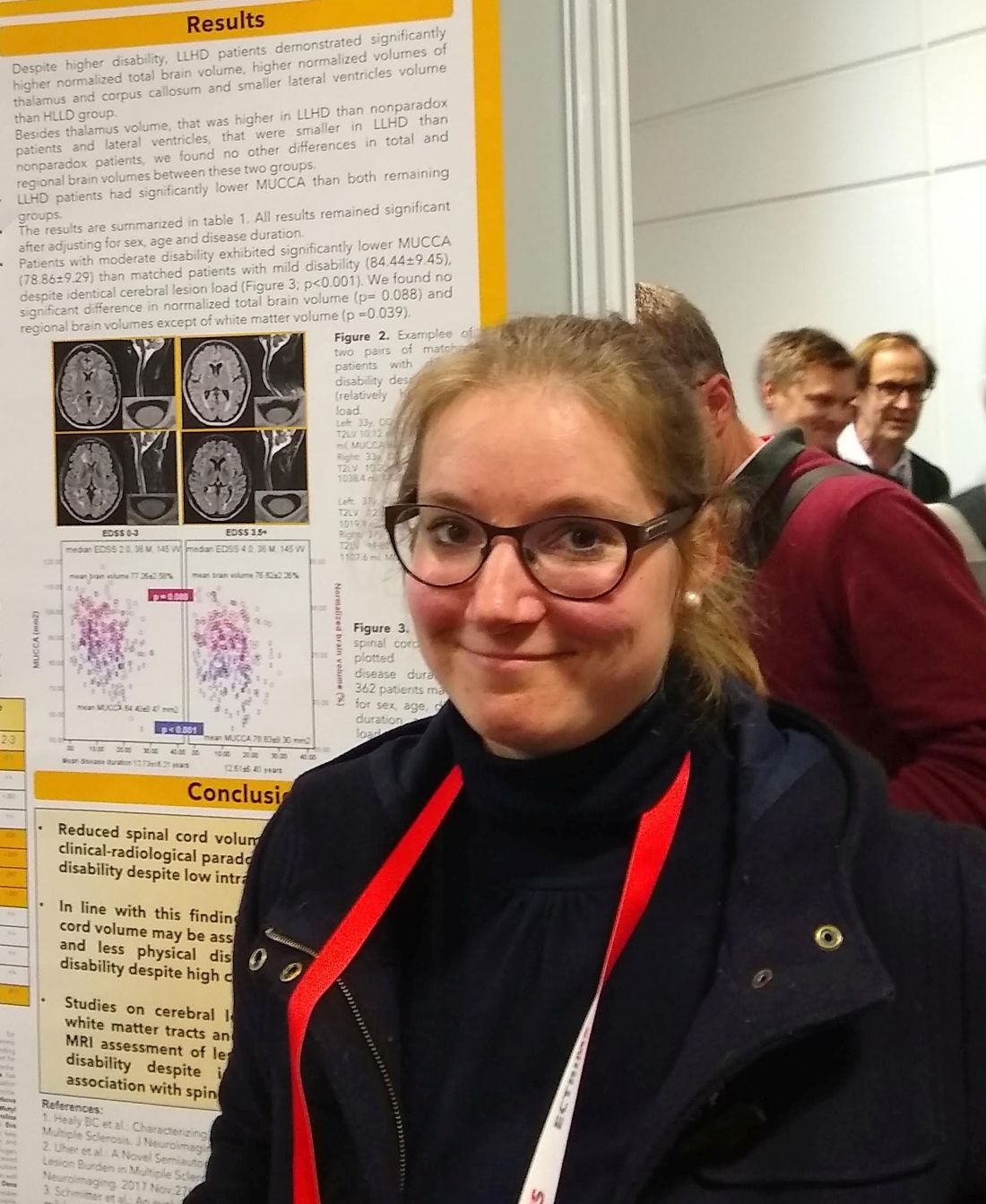
In a pool of 362 patients with mild to moderate MS-related disability but identical white matter lesion load identified by MRI, those with higher disability had significantly lower spinal cord volumes when compared against those with disability scores in the mild range (P less than .001).
Though brain MRI is a key tool used to track disease severity and progression in MS, some patients have relatively high disability but a low burden of white matter intracerebral lesions on MRI. Little is known about spinal cord volume in MS patients with pronounced dissociation between intracerebral lesion load and disability, Michaela Andelova, MD, said in an interview during a poster session at the annual congress of the European Committee for Treatment and Research in Multiple Sclerosis.
Dr. Andelova, of Charles University, Prague, said that she and her colleagues hypothesized that spinal cord volume would differ between patients who had varying levels of disability, despite identical white matter lesion load.
To test this, she and her colleagues looked at records of 1,245 patients with relapsing-remitting MS. They divided them into three groups by severity of clinical disability, and also by extent of cerebral T2 hyperintense lesion load. The investigators identified a group of patients (n = 53) whose total volume of T2-weighted hyperintense lesions was less than 3 mL, but whose Expanded Disability Status Scale (EDSS) scores were at least 3.5; this was the low lesion load/high disability (LLHD) group.
Dr. Andelova and her colleagues then identified another group of patients (n = 71) who had a volume of T2-weighted hyperintensities that was greater than 9 mL, but whose EDSS score was less than 1.5. This was the high lesion load/low disability (HLLD) group.
The remaining patients (n = 1,121), who did not have these paradoxical associations, were analyzed separately.
For all patients, mean upper cervical cord area (MUCCA) was also measured. Using images acquired by a 3 T MRI scanner, MUCCA was calculated as the mean sum of spinal cord area in 21 slices centered at the C3/4 intervertebral disk, using an in-house, semiautomated method.
“Despite higher disability, LLHD patients demonstrated significantly higher normalized total brain volume, higher normalized volumes of thalamus and callosum, and smaller lateral ventricles than [the] HLLD group,” wrote Dr. Andelova and her collaborators.
However, the LLHD patients had MUCCA values that were significantly lower than the other groups: The nonparadoxical group’s mean MUCCA was 84.02 mm2, while the HLLD group had a mean MUCCA of 85.75 mm2. This difference was not statistically significant. By contrast, the LLHD group’s mean MUCCA was significantly smaller, at 80.40 mm2 (P = .023 versus nonparadoxical patients, and P = .007 versus HLLD patients).
Looking at the data another way, Dr. Andelova and her colleagues compared 362 evenly divided patients with moderate disability (EDSS 3.5-6.5) with matched patients who had mild MS-related disability (EDSS less than 3) and identical cerebral lesion loads. They found that MUCCA was significantly smaller in the moderate disability group (78.86 versus 84.44 mm2; P less than .001).
In addition to having identical lesions loads, the mild and moderate disability groups didn’t differ significantly in normalized total brain volume or regional brain volumes. The group with moderate disability did have slightly less white matter volume (P = .039), Dr. Andelova pointed out.
All differences found between groups retained statistical significance even after adjustment for such potential confounders as age, sex, and duration of disease, Dr. Andelova said.
“Reduced spinal cord volume may explain part of the clinical-radiological paradox in patients who have high disability despite low intracranial lesion load,” Dr. Andelova and her collaborators wrote. “In line with this finding, relatively preserved spinal cord volume may be associated with functional reserve and less physical disability in patients with low disability despite high cerebral lesion load.”
Further work looking more precisely at cerebral lesion distribution and quantitative MRI investigation of lesion distribution is in the works for Dr. Andelova and her collaborators. They are hoping to see some association between various distribution patterns and accelerated spinal atrophy.
The research was supported by the Czech government. Dr. Andelova and several of her collaborators reported financial relationships with pharmaceutical companies.
SOURCE: Andelova M et al. Mult Scler. 2018;24(Suppl 2):211, Abstract P477.
BERLIN – Spinal cord volume deficits in patients with multiple sclerosis may contribute to clinical disability that appears out of proportion to lesion load on brain imaging, according to new research.
In a pool of 362 patients with mild to moderate MS-related disability but identical white matter lesion load identified by MRI, those with higher disability had significantly lower spinal cord volumes when compared against those with disability scores in the mild range (P less than .001).
Though brain MRI is a key tool used to track disease severity and progression in MS, some patients have relatively high disability but a low burden of white matter intracerebral lesions on MRI. Little is known about spinal cord volume in MS patients with pronounced dissociation between intracerebral lesion load and disability, Michaela Andelova, MD, said in an interview during a poster session at the annual congress of the European Committee for Treatment and Research in Multiple Sclerosis.
Dr. Andelova, of Charles University, Prague, said that she and her colleagues hypothesized that spinal cord volume would differ between patients who had varying levels of disability, despite identical white matter lesion load.
To test this, she and her colleagues looked at records of 1,245 patients with relapsing-remitting MS. They divided them into three groups by severity of clinical disability, and also by extent of cerebral T2 hyperintense lesion load. The investigators identified a group of patients (n = 53) whose total volume of T2-weighted hyperintense lesions was less than 3 mL, but whose Expanded Disability Status Scale (EDSS) scores were at least 3.5; this was the low lesion load/high disability (LLHD) group.
Dr. Andelova and her colleagues then identified another group of patients (n = 71) who had a volume of T2-weighted hyperintensities that was greater than 9 mL, but whose EDSS score was less than 1.5. This was the high lesion load/low disability (HLLD) group.
The remaining patients (n = 1,121), who did not have these paradoxical associations, were analyzed separately.
For all patients, mean upper cervical cord area (MUCCA) was also measured. Using images acquired by a 3 T MRI scanner, MUCCA was calculated as the mean sum of spinal cord area in 21 slices centered at the C3/4 intervertebral disk, using an in-house, semiautomated method.
“Despite higher disability, LLHD patients demonstrated significantly higher normalized total brain volume, higher normalized volumes of thalamus and callosum, and smaller lateral ventricles than [the] HLLD group,” wrote Dr. Andelova and her collaborators.
However, the LLHD patients had MUCCA values that were significantly lower than the other groups: The nonparadoxical group’s mean MUCCA was 84.02 mm2, while the HLLD group had a mean MUCCA of 85.75 mm2. This difference was not statistically significant. By contrast, the LLHD group’s mean MUCCA was significantly smaller, at 80.40 mm2 (P = .023 versus nonparadoxical patients, and P = .007 versus HLLD patients).
Looking at the data another way, Dr. Andelova and her colleagues compared 362 evenly divided patients with moderate disability (EDSS 3.5-6.5) with matched patients who had mild MS-related disability (EDSS less than 3) and identical cerebral lesion loads. They found that MUCCA was significantly smaller in the moderate disability group (78.86 versus 84.44 mm2; P less than .001).
In addition to having identical lesions loads, the mild and moderate disability groups didn’t differ significantly in normalized total brain volume or regional brain volumes. The group with moderate disability did have slightly less white matter volume (P = .039), Dr. Andelova pointed out.
All differences found between groups retained statistical significance even after adjustment for such potential confounders as age, sex, and duration of disease, Dr. Andelova said.
“Reduced spinal cord volume may explain part of the clinical-radiological paradox in patients who have high disability despite low intracranial lesion load,” Dr. Andelova and her collaborators wrote. “In line with this finding, relatively preserved spinal cord volume may be associated with functional reserve and less physical disability in patients with low disability despite high cerebral lesion load.”
Further work looking more precisely at cerebral lesion distribution and quantitative MRI investigation of lesion distribution is in the works for Dr. Andelova and her collaborators. They are hoping to see some association between various distribution patterns and accelerated spinal atrophy.
The research was supported by the Czech government. Dr. Andelova and several of her collaborators reported financial relationships with pharmaceutical companies.
SOURCE: Andelova M et al. Mult Scler. 2018;24(Suppl 2):211, Abstract P477.
BERLIN – Spinal cord volume deficits in patients with multiple sclerosis may contribute to clinical disability that appears out of proportion to lesion load on brain imaging, according to new research.
In a pool of 362 patients with mild to moderate MS-related disability but identical white matter lesion load identified by MRI, those with higher disability had significantly lower spinal cord volumes when compared against those with disability scores in the mild range (P less than .001).
Though brain MRI is a key tool used to track disease severity and progression in MS, some patients have relatively high disability but a low burden of white matter intracerebral lesions on MRI. Little is known about spinal cord volume in MS patients with pronounced dissociation between intracerebral lesion load and disability, Michaela Andelova, MD, said in an interview during a poster session at the annual congress of the European Committee for Treatment and Research in Multiple Sclerosis.
Dr. Andelova, of Charles University, Prague, said that she and her colleagues hypothesized that spinal cord volume would differ between patients who had varying levels of disability, despite identical white matter lesion load.
To test this, she and her colleagues looked at records of 1,245 patients with relapsing-remitting MS. They divided them into three groups by severity of clinical disability, and also by extent of cerebral T2 hyperintense lesion load. The investigators identified a group of patients (n = 53) whose total volume of T2-weighted hyperintense lesions was less than 3 mL, but whose Expanded Disability Status Scale (EDSS) scores were at least 3.5; this was the low lesion load/high disability (LLHD) group.
Dr. Andelova and her colleagues then identified another group of patients (n = 71) who had a volume of T2-weighted hyperintensities that was greater than 9 mL, but whose EDSS score was less than 1.5. This was the high lesion load/low disability (HLLD) group.
The remaining patients (n = 1,121), who did not have these paradoxical associations, were analyzed separately.
For all patients, mean upper cervical cord area (MUCCA) was also measured. Using images acquired by a 3 T MRI scanner, MUCCA was calculated as the mean sum of spinal cord area in 21 slices centered at the C3/4 intervertebral disk, using an in-house, semiautomated method.
“Despite higher disability, LLHD patients demonstrated significantly higher normalized total brain volume, higher normalized volumes of thalamus and callosum, and smaller lateral ventricles than [the] HLLD group,” wrote Dr. Andelova and her collaborators.
However, the LLHD patients had MUCCA values that were significantly lower than the other groups: The nonparadoxical group’s mean MUCCA was 84.02 mm2, while the HLLD group had a mean MUCCA of 85.75 mm2. This difference was not statistically significant. By contrast, the LLHD group’s mean MUCCA was significantly smaller, at 80.40 mm2 (P = .023 versus nonparadoxical patients, and P = .007 versus HLLD patients).
Looking at the data another way, Dr. Andelova and her colleagues compared 362 evenly divided patients with moderate disability (EDSS 3.5-6.5) with matched patients who had mild MS-related disability (EDSS less than 3) and identical cerebral lesion loads. They found that MUCCA was significantly smaller in the moderate disability group (78.86 versus 84.44 mm2; P less than .001).
In addition to having identical lesions loads, the mild and moderate disability groups didn’t differ significantly in normalized total brain volume or regional brain volumes. The group with moderate disability did have slightly less white matter volume (P = .039), Dr. Andelova pointed out.
All differences found between groups retained statistical significance even after adjustment for such potential confounders as age, sex, and duration of disease, Dr. Andelova said.
“Reduced spinal cord volume may explain part of the clinical-radiological paradox in patients who have high disability despite low intracranial lesion load,” Dr. Andelova and her collaborators wrote. “In line with this finding, relatively preserved spinal cord volume may be associated with functional reserve and less physical disability in patients with low disability despite high cerebral lesion load.”
Further work looking more precisely at cerebral lesion distribution and quantitative MRI investigation of lesion distribution is in the works for Dr. Andelova and her collaborators. They are hoping to see some association between various distribution patterns and accelerated spinal atrophy.
The research was supported by the Czech government. Dr. Andelova and several of her collaborators reported financial relationships with pharmaceutical companies.
SOURCE: Andelova M et al. Mult Scler. 2018;24(Suppl 2):211, Abstract P477.
REPORTING FROM ECTRIMS 2018
Key clinical point:
Major finding: Moderate disability patients had lower spinal cord volumes than did those with mild disability but a similar intracerebral lesion load.
Study details: Retrospective study of 1,245 patients with relapsing-remitting MS.
Disclosures: The study was sponsored by a grant from the Czech government. Several authors, including Dr. Andelova, reported multiple financial relationships with pharmaceutical companies.
Source: Andelova M et al. Mult Scler. 2018;24(Suppl 2):211, Abstract P477.
Oligoclonal bands, initial seizures increase risk of post-ADEM epilepsy in children
BERLIN – Children with acute disseminated encephalomyelitis have a significantly increased risk of subsequent epilepsy when it occurs with oligoclonal bands in cerebrospinal fluid and seizures at presentation, Thomas Rossor, MD, reported at the annual congress of the European Committee for Treatment and Research in Multiple Sclerosis.

But fortunately, the seizures of postacute disseminated encephalomyelitis (post-ADEM) epilepsy are relatively easy to control and not clinically devastating, said Dr. Rossor of Great Ormond Street Hospital, London.
Of the 12 who developed epilepsy in Dr. Rossor’s retrospective, multicenter review of 74 children with ADEM, 11 were well controlled on one drug and 1 on two drugs.
Pediatric ADEM is usually monophasic with good clinical outcome, he said. But a benign course is not set in stone: Up to 40% of children experience seizures during the acute presentation. “In contrast,” Dr. Rossor said, “adult patients with relapsing-remitting multiple sclerosis have the same risk of developing epilepsy as the general population.” Among adults with cortical encephalitis, antibodies against myelin oligodendrocyte glycoprotein (MOG) have been associated with seizures and the need for antiepileptic medications, he added.
That finding was part of what spurred Dr. Rossor’s study, which aimed to identify predictors of relapse and post-ADEM epilepsy in children. The patients in the review had a median age of 4.5 years. All were tested for anti-MOG antibodies, and most (about 68%) were positive. Oligoclonal bands in cerebrospinal fluid (CSF) occurred in 22%. The median follow-up period was 5 years.
A total of 41% (n = 31) relapsed after the initial acute phase. Among these, the final diagnosis included multiphasic disseminated encephalomyelitis (n = 19); ADEM-optic neuritis (n = 3); and neuromyelitis optica spectrum disorder (n = 6).
Of the 74 patients, 16 (22%) had seizures during the acute phase, and 12 (16%) developed post-ADEM epilepsy at a median of 3 months. The most common clinical characteristics with post-ADEM epilepsy included oligoclonal bands (57% vs. 13%), anti-MOG antibodies (92% vs. 16%), and seizures at presentation (50% vs. 16%). When these were entered into a regression model, oligoclonal bands and initial seizures significantly predicted epilepsy, increasing the risk by 20.7 and 13.5 times, respectively.
Since relapse is known to be associated with post-ADEM epilepsy, Dr. Rossor first looked at relapse risk. He conducted a multivariate analysis that included several clinical characteristics: age, prodrome, increased CSF white cells and protein, oligoclonal bands, anti-MOG antibodies, and seizures both at presentation and after the acute phase.
Anti-MOG antibodies were significantly more common among the relapsed patients than among the monophasic patients (87% vs. 53%). Seizures at presentation also were more common among the relapsed patients (32% vs. 14%). These two factors were entered into a binary regression analysis; only anti-MOG antibodies remained significantly associated with relapse, increasing the risk fivefold (odds ratio = 5.4; P = .007).
Anti-MOG antibodies also were associated with both earlier and more relapses. Overall, 40% of anti–MOG-antibody–positive patients relapsed by 24 months. In contrast, only 20% of anti–MOG-antibody–negative patients had relapsed by 24 months, and this number remained steady throughout the follow-up period.
By 96 months, almost all the anti–MOG-antibody–positive patients had relapsed, and some experienced many relapses. “In the antibody-negative group, four patients did relapse, but they had relatively few relapses. In the antibody-positive group, some had relatively few relapses, but several had 15, 20, or 25 clinical relapses in the follow-up period,” he said.
Dr. Rossor and his coauthors had no financial disclosures.
SOURCE: Rossor T et al. Mult Scler. 2018;24(Suppl 2):27. Abstract 62.
BERLIN – Children with acute disseminated encephalomyelitis have a significantly increased risk of subsequent epilepsy when it occurs with oligoclonal bands in cerebrospinal fluid and seizures at presentation, Thomas Rossor, MD, reported at the annual congress of the European Committee for Treatment and Research in Multiple Sclerosis.
But fortunately, the seizures of postacute disseminated encephalomyelitis (post-ADEM) epilepsy are relatively easy to control and not clinically devastating, said Dr. Rossor of Great Ormond Street Hospital, London.
Of the 12 who developed epilepsy in Dr. Rossor’s retrospective, multicenter review of 74 children with ADEM, 11 were well controlled on one drug and 1 on two drugs.
Pediatric ADEM is usually monophasic with good clinical outcome, he said. But a benign course is not set in stone: Up to 40% of children experience seizures during the acute presentation. “In contrast,” Dr. Rossor said, “adult patients with relapsing-remitting multiple sclerosis have the same risk of developing epilepsy as the general population.” Among adults with cortical encephalitis, antibodies against myelin oligodendrocyte glycoprotein (MOG) have been associated with seizures and the need for antiepileptic medications, he added.
That finding was part of what spurred Dr. Rossor’s study, which aimed to identify predictors of relapse and post-ADEM epilepsy in children. The patients in the review had a median age of 4.5 years. All were tested for anti-MOG antibodies, and most (about 68%) were positive. Oligoclonal bands in cerebrospinal fluid (CSF) occurred in 22%. The median follow-up period was 5 years.
A total of 41% (n = 31) relapsed after the initial acute phase. Among these, the final diagnosis included multiphasic disseminated encephalomyelitis (n = 19); ADEM-optic neuritis (n = 3); and neuromyelitis optica spectrum disorder (n = 6).
Of the 74 patients, 16 (22%) had seizures during the acute phase, and 12 (16%) developed post-ADEM epilepsy at a median of 3 months. The most common clinical characteristics with post-ADEM epilepsy included oligoclonal bands (57% vs. 13%), anti-MOG antibodies (92% vs. 16%), and seizures at presentation (50% vs. 16%). When these were entered into a regression model, oligoclonal bands and initial seizures significantly predicted epilepsy, increasing the risk by 20.7 and 13.5 times, respectively.
Since relapse is known to be associated with post-ADEM epilepsy, Dr. Rossor first looked at relapse risk. He conducted a multivariate analysis that included several clinical characteristics: age, prodrome, increased CSF white cells and protein, oligoclonal bands, anti-MOG antibodies, and seizures both at presentation and after the acute phase.
Anti-MOG antibodies were significantly more common among the relapsed patients than among the monophasic patients (87% vs. 53%). Seizures at presentation also were more common among the relapsed patients (32% vs. 14%). These two factors were entered into a binary regression analysis; only anti-MOG antibodies remained significantly associated with relapse, increasing the risk fivefold (odds ratio = 5.4; P = .007).
Anti-MOG antibodies also were associated with both earlier and more relapses. Overall, 40% of anti–MOG-antibody–positive patients relapsed by 24 months. In contrast, only 20% of anti–MOG-antibody–negative patients had relapsed by 24 months, and this number remained steady throughout the follow-up period.
By 96 months, almost all the anti–MOG-antibody–positive patients had relapsed, and some experienced many relapses. “In the antibody-negative group, four patients did relapse, but they had relatively few relapses. In the antibody-positive group, some had relatively few relapses, but several had 15, 20, or 25 clinical relapses in the follow-up period,” he said.
Dr. Rossor and his coauthors had no financial disclosures.
SOURCE: Rossor T et al. Mult Scler. 2018;24(Suppl 2):27. Abstract 62.
BERLIN – Children with acute disseminated encephalomyelitis have a significantly increased risk of subsequent epilepsy when it occurs with oligoclonal bands in cerebrospinal fluid and seizures at presentation, Thomas Rossor, MD, reported at the annual congress of the European Committee for Treatment and Research in Multiple Sclerosis.
But fortunately, the seizures of postacute disseminated encephalomyelitis (post-ADEM) epilepsy are relatively easy to control and not clinically devastating, said Dr. Rossor of Great Ormond Street Hospital, London.
Of the 12 who developed epilepsy in Dr. Rossor’s retrospective, multicenter review of 74 children with ADEM, 11 were well controlled on one drug and 1 on two drugs.
Pediatric ADEM is usually monophasic with good clinical outcome, he said. But a benign course is not set in stone: Up to 40% of children experience seizures during the acute presentation. “In contrast,” Dr. Rossor said, “adult patients with relapsing-remitting multiple sclerosis have the same risk of developing epilepsy as the general population.” Among adults with cortical encephalitis, antibodies against myelin oligodendrocyte glycoprotein (MOG) have been associated with seizures and the need for antiepileptic medications, he added.
That finding was part of what spurred Dr. Rossor’s study, which aimed to identify predictors of relapse and post-ADEM epilepsy in children. The patients in the review had a median age of 4.5 years. All were tested for anti-MOG antibodies, and most (about 68%) were positive. Oligoclonal bands in cerebrospinal fluid (CSF) occurred in 22%. The median follow-up period was 5 years.
A total of 41% (n = 31) relapsed after the initial acute phase. Among these, the final diagnosis included multiphasic disseminated encephalomyelitis (n = 19); ADEM-optic neuritis (n = 3); and neuromyelitis optica spectrum disorder (n = 6).
Of the 74 patients, 16 (22%) had seizures during the acute phase, and 12 (16%) developed post-ADEM epilepsy at a median of 3 months. The most common clinical characteristics with post-ADEM epilepsy included oligoclonal bands (57% vs. 13%), anti-MOG antibodies (92% vs. 16%), and seizures at presentation (50% vs. 16%). When these were entered into a regression model, oligoclonal bands and initial seizures significantly predicted epilepsy, increasing the risk by 20.7 and 13.5 times, respectively.
Since relapse is known to be associated with post-ADEM epilepsy, Dr. Rossor first looked at relapse risk. He conducted a multivariate analysis that included several clinical characteristics: age, prodrome, increased CSF white cells and protein, oligoclonal bands, anti-MOG antibodies, and seizures both at presentation and after the acute phase.
Anti-MOG antibodies were significantly more common among the relapsed patients than among the monophasic patients (87% vs. 53%). Seizures at presentation also were more common among the relapsed patients (32% vs. 14%). These two factors were entered into a binary regression analysis; only anti-MOG antibodies remained significantly associated with relapse, increasing the risk fivefold (odds ratio = 5.4; P = .007).
Anti-MOG antibodies also were associated with both earlier and more relapses. Overall, 40% of anti–MOG-antibody–positive patients relapsed by 24 months. In contrast, only 20% of anti–MOG-antibody–negative patients had relapsed by 24 months, and this number remained steady throughout the follow-up period.
By 96 months, almost all the anti–MOG-antibody–positive patients had relapsed, and some experienced many relapses. “In the antibody-negative group, four patients did relapse, but they had relatively few relapses. In the antibody-positive group, some had relatively few relapses, but several had 15, 20, or 25 clinical relapses in the follow-up period,” he said.
Dr. Rossor and his coauthors had no financial disclosures.
SOURCE: Rossor T et al. Mult Scler. 2018;24(Suppl 2):27. Abstract 62.
REPORTING FROM ECTRIMS 2018
Key clinical point: .
Major finding: Oligoclonal bands in CSF increased the risk of post-ADEM epilepsy by more than 20 times.
Study details: The retrospective cohort review comprised 74 children.
Disclosures: Dr. Rossor and his coauthors had no financial disclosures.
Source: Rossor T et al. Mult Scler. 2018;24(Suppl 2):27. Abstract 62.
Do Dimethyl Fumarate and Teriflunomide Have Equivalent Efficacy?
New T2 lesions are more likely on teriflunomide, which may contribute to its higher rate of discontinuation.
BERLIN—Dimethyl fumarate and teriflunomide have similar efficacy in terms of risk of relapse and worsening of Expanded Disability Status Scale (EDSS) score after one and two years of treatment, according to data presented at ECTRIMS 2018. Significantly more patients have new T2 lesions after two years of teriflunomide, however, compared with dimethyl fumarate, and this outcome may explain an increased treatment withdrawal for lack of efficacy among patients receiving teriflunomide.
Teriflunomide and dimethyl fumarate have been approved as first-line treatments for patients with relapsing-remitting multiple sclerosis (MS). To date, no randomized controlled nor observational studies have compared their relative efficacies. David A. Laplaud, MD, PhD, a team leader at the Center of Research in Transplantation and Immunology in Nantes, France, and colleagues conducted a study to compare the effects of teriflunomide and dimethyl fumarate on clinical and MRI outcomes in patients with relapsing-remitting MS from 34 MS centers participating in the French prospective national cohort of MS patients.
The investigators included 1,770 patients with relapsing-remitting MS in the study. In all, 713 participants received teriflunomide, and 1,057 received dimethyl fumarate. Participants were aged 18 to 65 and had an EDSS score of 0 to 5.5 and an available brain MRI performed within six months before treatment initiation. The outcomes under investigation were the proportion of patients with at least one relapse in the year and the two years following teriflunomide or dimethyl fumarate initiation, the proportion of patients with at least one new T2 lesion at one and two years, the number of patients with an increased EDSS score at one and two years, and reasons for treatment cessation at one and two years. For statistical analyses, the outcomes were modeled with propensity scores and logistic regressions by using weighted likelihood maximization and a robust variance estimator.
The confounder-adjusted proportion of patients with at least one relapse at one and two years of treatment was similar in the teriflunomide group and the dimethyl fumarate group (21.6% vs 20.2% for the first year, 30.4% vs 29.5% at two years). Likewise, a similar percentage of patients had an increase of EDSS score at one and two years in the teriflunomide group (27.4% and 41.6%, respectively) and the dimethyl fumarate group (27.1% and 40.6%, respectively). MRI comparisons, however, revealed that the confounder-adjusted proportion of patients with at least one new T2 lesion at two years was significantly lower in patients treated with dimethyl fumarate, compared with teriflunomide (60.8% vs 72.2%; odds ratio [OR], 0.6). The reason for treatment withdrawal at two years was lack of efficacy in 8.5% of patients who received dimethyl fumarate versus 14.5% of patients who received teriflunomide (OR, 0.54).
New T2 lesions are more likely on teriflunomide, which may contribute to its higher rate of discontinuation.
New T2 lesions are more likely on teriflunomide, which may contribute to its higher rate of discontinuation.
BERLIN—Dimethyl fumarate and teriflunomide have similar efficacy in terms of risk of relapse and worsening of Expanded Disability Status Scale (EDSS) score after one and two years of treatment, according to data presented at ECTRIMS 2018. Significantly more patients have new T2 lesions after two years of teriflunomide, however, compared with dimethyl fumarate, and this outcome may explain an increased treatment withdrawal for lack of efficacy among patients receiving teriflunomide.
Teriflunomide and dimethyl fumarate have been approved as first-line treatments for patients with relapsing-remitting multiple sclerosis (MS). To date, no randomized controlled nor observational studies have compared their relative efficacies. David A. Laplaud, MD, PhD, a team leader at the Center of Research in Transplantation and Immunology in Nantes, France, and colleagues conducted a study to compare the effects of teriflunomide and dimethyl fumarate on clinical and MRI outcomes in patients with relapsing-remitting MS from 34 MS centers participating in the French prospective national cohort of MS patients.
The investigators included 1,770 patients with relapsing-remitting MS in the study. In all, 713 participants received teriflunomide, and 1,057 received dimethyl fumarate. Participants were aged 18 to 65 and had an EDSS score of 0 to 5.5 and an available brain MRI performed within six months before treatment initiation. The outcomes under investigation were the proportion of patients with at least one relapse in the year and the two years following teriflunomide or dimethyl fumarate initiation, the proportion of patients with at least one new T2 lesion at one and two years, the number of patients with an increased EDSS score at one and two years, and reasons for treatment cessation at one and two years. For statistical analyses, the outcomes were modeled with propensity scores and logistic regressions by using weighted likelihood maximization and a robust variance estimator.
The confounder-adjusted proportion of patients with at least one relapse at one and two years of treatment was similar in the teriflunomide group and the dimethyl fumarate group (21.6% vs 20.2% for the first year, 30.4% vs 29.5% at two years). Likewise, a similar percentage of patients had an increase of EDSS score at one and two years in the teriflunomide group (27.4% and 41.6%, respectively) and the dimethyl fumarate group (27.1% and 40.6%, respectively). MRI comparisons, however, revealed that the confounder-adjusted proportion of patients with at least one new T2 lesion at two years was significantly lower in patients treated with dimethyl fumarate, compared with teriflunomide (60.8% vs 72.2%; odds ratio [OR], 0.6). The reason for treatment withdrawal at two years was lack of efficacy in 8.5% of patients who received dimethyl fumarate versus 14.5% of patients who received teriflunomide (OR, 0.54).
BERLIN—Dimethyl fumarate and teriflunomide have similar efficacy in terms of risk of relapse and worsening of Expanded Disability Status Scale (EDSS) score after one and two years of treatment, according to data presented at ECTRIMS 2018. Significantly more patients have new T2 lesions after two years of teriflunomide, however, compared with dimethyl fumarate, and this outcome may explain an increased treatment withdrawal for lack of efficacy among patients receiving teriflunomide.
Teriflunomide and dimethyl fumarate have been approved as first-line treatments for patients with relapsing-remitting multiple sclerosis (MS). To date, no randomized controlled nor observational studies have compared their relative efficacies. David A. Laplaud, MD, PhD, a team leader at the Center of Research in Transplantation and Immunology in Nantes, France, and colleagues conducted a study to compare the effects of teriflunomide and dimethyl fumarate on clinical and MRI outcomes in patients with relapsing-remitting MS from 34 MS centers participating in the French prospective national cohort of MS patients.
The investigators included 1,770 patients with relapsing-remitting MS in the study. In all, 713 participants received teriflunomide, and 1,057 received dimethyl fumarate. Participants were aged 18 to 65 and had an EDSS score of 0 to 5.5 and an available brain MRI performed within six months before treatment initiation. The outcomes under investigation were the proportion of patients with at least one relapse in the year and the two years following teriflunomide or dimethyl fumarate initiation, the proportion of patients with at least one new T2 lesion at one and two years, the number of patients with an increased EDSS score at one and two years, and reasons for treatment cessation at one and two years. For statistical analyses, the outcomes were modeled with propensity scores and logistic regressions by using weighted likelihood maximization and a robust variance estimator.
The confounder-adjusted proportion of patients with at least one relapse at one and two years of treatment was similar in the teriflunomide group and the dimethyl fumarate group (21.6% vs 20.2% for the first year, 30.4% vs 29.5% at two years). Likewise, a similar percentage of patients had an increase of EDSS score at one and two years in the teriflunomide group (27.4% and 41.6%, respectively) and the dimethyl fumarate group (27.1% and 40.6%, respectively). MRI comparisons, however, revealed that the confounder-adjusted proportion of patients with at least one new T2 lesion at two years was significantly lower in patients treated with dimethyl fumarate, compared with teriflunomide (60.8% vs 72.2%; odds ratio [OR], 0.6). The reason for treatment withdrawal at two years was lack of efficacy in 8.5% of patients who received dimethyl fumarate versus 14.5% of patients who received teriflunomide (OR, 0.54).
Cortical Damage at Onset May Indicate Risk of Secondary Progressive MS
This observation may aid patient stratification and guide the choice of appropriate therapy.
BERLIN—Widespread focal cortical damage at multiple sclerosis (MS) onset identifies patients likely to have frequent early relapses and a rapid development of progressive disease, which results from worsening global cortical pathology over time, according to a study presented at ECTRIMS 2018. The results provide a basis for patient stratification with the goal of therapeutic optimization. In addition, the data “highlight the importance of elucidating mechanisms involved in early cortical pathology,” according to the investigators.
Following Patients With Relapsing-Remitting MS
Among patients with relapsing-remitting MS, a high frequency of early relapses is associated with increased risk of developing severe disability, which suggests that early biologic mechanisms influence long-term disease evolution. Antonio Scalfari, MD, PhD, a consultant neurologist at Imperial College Healthcare in London, and colleagues sought to investigate the relationship between early cortical pathology, early relapses, and the risk of converting to secondary progressive MS.

Dr. Scalfari and colleagues examined 219 patients with relapsing-remitting MS. Participants had one (n = 116), two (n = 53), or three or more (n = 50) relapses during the first two years. Follow-up lasted for a mean of 7.9 years. The researchers assessed the number of cortical lesions and white matter lesions and the rate of cortical thinning using 3D double inversion recovery, 3D T1-weighted imaging, and Freesurfer analysis.
Cortical Lesions Predicted Cortical Thinning
During the observation period, 59 (27%) patients converted to secondary progressive MS in a mean of 6.1 years. At disease onset, the investigators detected 674 cortical lesions in 166 (76%) patients. A larger number of cortical lesions was associated with a significantly higher risk of secondary progressive MS. The hazard ratios (HR) for secondary progressive MS were 2.16 for patients with two lesions, 4.79 for patients with five lesions, and 12.3 for patients with seven lesions. A large number of cortical lesions also was associated with shorter latency to secondary progressive MS and a faster rate of global cortical thinning. The mean loss per year was 0.93% for patients with no lesions, 0.99% for patients with one to three lesions, 1.13% for patients with four to six lesions, and 1.33% for patients with seven or more lesions. In the group with no cortical lesions (n = 53), no patients entered the secondary progressive phase, and four reached an Expanded Disability Status Scale score of 4.
Patients with a high number of early relapses, compared with those with low and moderate numbers, had a larger volume of white matter lesions and cortical lesions at onset. The mean volumes of cortical lesions were 181.6 mm3, 386.8 mm3, and 544.0 mm3 for patients with one, two, and three or more early relapses, respectively. Patients with a high number of early relapses also accrued more cortical lesions (mean cortical lesion volumes were 118.8 mm3, 138.8 mm3, and 790.5 mm3 for patients with one, two, and three or more early relapses, respectively), had a faster rate of cortical atrophy (mean loss/year was 0.47%, 0.79%, and 0.94% for patients with one, two, and three or more early relapses, respectively), and entered the secondary progressive phase more rapidly.
In the multivariate model, older age at onset (HR, 1.97), a larger baseline cortical lesion (HR, 2.21) and white matter lesion (HR, 1.32) volume, early changes of global cortical thickness (HR, 1.36), and three or more early relapses (HR, 6.08) independently predicted a higher probability of secondary progressive MS.
This observation may aid patient stratification and guide the choice of appropriate therapy.
This observation may aid patient stratification and guide the choice of appropriate therapy.
BERLIN—Widespread focal cortical damage at multiple sclerosis (MS) onset identifies patients likely to have frequent early relapses and a rapid development of progressive disease, which results from worsening global cortical pathology over time, according to a study presented at ECTRIMS 2018. The results provide a basis for patient stratification with the goal of therapeutic optimization. In addition, the data “highlight the importance of elucidating mechanisms involved in early cortical pathology,” according to the investigators.
Following Patients With Relapsing-Remitting MS
Among patients with relapsing-remitting MS, a high frequency of early relapses is associated with increased risk of developing severe disability, which suggests that early biologic mechanisms influence long-term disease evolution. Antonio Scalfari, MD, PhD, a consultant neurologist at Imperial College Healthcare in London, and colleagues sought to investigate the relationship between early cortical pathology, early relapses, and the risk of converting to secondary progressive MS.
Dr. Scalfari and colleagues examined 219 patients with relapsing-remitting MS. Participants had one (n = 116), two (n = 53), or three or more (n = 50) relapses during the first two years. Follow-up lasted for a mean of 7.9 years. The researchers assessed the number of cortical lesions and white matter lesions and the rate of cortical thinning using 3D double inversion recovery, 3D T1-weighted imaging, and Freesurfer analysis.
Cortical Lesions Predicted Cortical Thinning
During the observation period, 59 (27%) patients converted to secondary progressive MS in a mean of 6.1 years. At disease onset, the investigators detected 674 cortical lesions in 166 (76%) patients. A larger number of cortical lesions was associated with a significantly higher risk of secondary progressive MS. The hazard ratios (HR) for secondary progressive MS were 2.16 for patients with two lesions, 4.79 for patients with five lesions, and 12.3 for patients with seven lesions. A large number of cortical lesions also was associated with shorter latency to secondary progressive MS and a faster rate of global cortical thinning. The mean loss per year was 0.93% for patients with no lesions, 0.99% for patients with one to three lesions, 1.13% for patients with four to six lesions, and 1.33% for patients with seven or more lesions. In the group with no cortical lesions (n = 53), no patients entered the secondary progressive phase, and four reached an Expanded Disability Status Scale score of 4.
Patients with a high number of early relapses, compared with those with low and moderate numbers, had a larger volume of white matter lesions and cortical lesions at onset. The mean volumes of cortical lesions were 181.6 mm3, 386.8 mm3, and 544.0 mm3 for patients with one, two, and three or more early relapses, respectively. Patients with a high number of early relapses also accrued more cortical lesions (mean cortical lesion volumes were 118.8 mm3, 138.8 mm3, and 790.5 mm3 for patients with one, two, and three or more early relapses, respectively), had a faster rate of cortical atrophy (mean loss/year was 0.47%, 0.79%, and 0.94% for patients with one, two, and three or more early relapses, respectively), and entered the secondary progressive phase more rapidly.
In the multivariate model, older age at onset (HR, 1.97), a larger baseline cortical lesion (HR, 2.21) and white matter lesion (HR, 1.32) volume, early changes of global cortical thickness (HR, 1.36), and three or more early relapses (HR, 6.08) independently predicted a higher probability of secondary progressive MS.
BERLIN—Widespread focal cortical damage at multiple sclerosis (MS) onset identifies patients likely to have frequent early relapses and a rapid development of progressive disease, which results from worsening global cortical pathology over time, according to a study presented at ECTRIMS 2018. The results provide a basis for patient stratification with the goal of therapeutic optimization. In addition, the data “highlight the importance of elucidating mechanisms involved in early cortical pathology,” according to the investigators.
Following Patients With Relapsing-Remitting MS
Among patients with relapsing-remitting MS, a high frequency of early relapses is associated with increased risk of developing severe disability, which suggests that early biologic mechanisms influence long-term disease evolution. Antonio Scalfari, MD, PhD, a consultant neurologist at Imperial College Healthcare in London, and colleagues sought to investigate the relationship between early cortical pathology, early relapses, and the risk of converting to secondary progressive MS.
Dr. Scalfari and colleagues examined 219 patients with relapsing-remitting MS. Participants had one (n = 116), two (n = 53), or three or more (n = 50) relapses during the first two years. Follow-up lasted for a mean of 7.9 years. The researchers assessed the number of cortical lesions and white matter lesions and the rate of cortical thinning using 3D double inversion recovery, 3D T1-weighted imaging, and Freesurfer analysis.
Cortical Lesions Predicted Cortical Thinning
During the observation period, 59 (27%) patients converted to secondary progressive MS in a mean of 6.1 years. At disease onset, the investigators detected 674 cortical lesions in 166 (76%) patients. A larger number of cortical lesions was associated with a significantly higher risk of secondary progressive MS. The hazard ratios (HR) for secondary progressive MS were 2.16 for patients with two lesions, 4.79 for patients with five lesions, and 12.3 for patients with seven lesions. A large number of cortical lesions also was associated with shorter latency to secondary progressive MS and a faster rate of global cortical thinning. The mean loss per year was 0.93% for patients with no lesions, 0.99% for patients with one to three lesions, 1.13% for patients with four to six lesions, and 1.33% for patients with seven or more lesions. In the group with no cortical lesions (n = 53), no patients entered the secondary progressive phase, and four reached an Expanded Disability Status Scale score of 4.
Patients with a high number of early relapses, compared with those with low and moderate numbers, had a larger volume of white matter lesions and cortical lesions at onset. The mean volumes of cortical lesions were 181.6 mm3, 386.8 mm3, and 544.0 mm3 for patients with one, two, and three or more early relapses, respectively. Patients with a high number of early relapses also accrued more cortical lesions (mean cortical lesion volumes were 118.8 mm3, 138.8 mm3, and 790.5 mm3 for patients with one, two, and three or more early relapses, respectively), had a faster rate of cortical atrophy (mean loss/year was 0.47%, 0.79%, and 0.94% for patients with one, two, and three or more early relapses, respectively), and entered the secondary progressive phase more rapidly.
In the multivariate model, older age at onset (HR, 1.97), a larger baseline cortical lesion (HR, 2.21) and white matter lesion (HR, 1.32) volume, early changes of global cortical thickness (HR, 1.36), and three or more early relapses (HR, 6.08) independently predicted a higher probability of secondary progressive MS.
When Is the Optimal Time to Start Treatment in Patients With Relapsing-Remitting MS?
Real-world data identify when therapy initiation has the best chance of reducing long-term disability.
BERLIN—Data from the Big Multiple Sclerosis Data (BMSD) Network indicate that the optimal time to start disease-modifying therapy in patients with multiple sclerosis (MS) to prevent the long-term accumulation of disability is within six months of disease onset. This finding was presented by Pietro Iaffaldano, MD, and colleagues at ECTRIMS 2018. Dr. Iaffaldano is Assistant Professor of Neurology at the University of Bari, Italy.

Many randomized clinical trials support the early start of disease-modifying therapies in MS. However, there is still an ongoing discussion on the optimal timing of treatment. For insight into this and other questions, the Danish, Italian, and Swedish national MS registries, MSBase, and the OFSEP of France pooled data for specific research projects in the BMSD Network. One question they sought to answer with this large, real-world data set was the optimal time to start disease-modifying therapy to prevent long-term disability accumulation in MS.
A cohort of patients with relapsing-remitting MS who had 10 or more years of follow-up, three or more years of cumulative disease-modifying therapy exposure, and three or more Expanded Disability Status Scale (EDSS) score evaluations was selected from the pooled cohort of the BMSD Network. The researchers conducted a set of pairwise (1:1) propensity score matching analyses with 10 different cut-offs for early versus delayed treatment (> 0.5 year up to > 5.0 years, using 0.5-year intervals) to allow an unbiased comparison between groups. The logistic model to predict propensity score included the following covariates: age at onset of the disease, sex, baseline EDSS, number of relapses in the two years before disease-modifying therapy start, number of EDSS evaluations, decade of birth, and registry source. To estimate the risk of reaching 12 months-confirmed EDSS progression (EDSSpr), a set of Cox models, adjusted for disease duration and relapses after disease-modifying therapy start as time-dependent covariates, was calculated.
A cohort of 11,871 patients with relapsing-remitting MS (71.0% female) was retrieved from the pooled BMSD Network database. The median (interquartile range) age at onset was 27.7 (22.3–34.6), median follow-up was 13.2 (11.4–15.4) years, and median time to the first disease-modifying therapy start was 3.8 (1.5–8.5) years. During the follow-up, an EDSSpr was reached by 4,138 (34.9%) patients. The lowest hazard ratio (HR) with relative 95% confidence interval (CI) for the propensity score matched models was obtained by a cutoff of treatment start within six months from disease onset (n = 873 per group). Early treatment significantly reduced the risk of reaching an EDSSpr (HR, 0.72 ). All subsequent comparisons between early and delayed treatment were not statistically significant.
This project was supported by Biogen International (Zug, Switzerland) on the basis of a sponsored research agreement with the BMSD Network.
Real-world data identify when therapy initiation has the best chance of reducing long-term disability.
Real-world data identify when therapy initiation has the best chance of reducing long-term disability.
BERLIN—Data from the Big Multiple Sclerosis Data (BMSD) Network indicate that the optimal time to start disease-modifying therapy in patients with multiple sclerosis (MS) to prevent the long-term accumulation of disability is within six months of disease onset. This finding was presented by Pietro Iaffaldano, MD, and colleagues at ECTRIMS 2018. Dr. Iaffaldano is Assistant Professor of Neurology at the University of Bari, Italy.
Many randomized clinical trials support the early start of disease-modifying therapies in MS. However, there is still an ongoing discussion on the optimal timing of treatment. For insight into this and other questions, the Danish, Italian, and Swedish national MS registries, MSBase, and the OFSEP of France pooled data for specific research projects in the BMSD Network. One question they sought to answer with this large, real-world data set was the optimal time to start disease-modifying therapy to prevent long-term disability accumulation in MS.
A cohort of patients with relapsing-remitting MS who had 10 or more years of follow-up, three or more years of cumulative disease-modifying therapy exposure, and three or more Expanded Disability Status Scale (EDSS) score evaluations was selected from the pooled cohort of the BMSD Network. The researchers conducted a set of pairwise (1:1) propensity score matching analyses with 10 different cut-offs for early versus delayed treatment (> 0.5 year up to > 5.0 years, using 0.5-year intervals) to allow an unbiased comparison between groups. The logistic model to predict propensity score included the following covariates: age at onset of the disease, sex, baseline EDSS, number of relapses in the two years before disease-modifying therapy start, number of EDSS evaluations, decade of birth, and registry source. To estimate the risk of reaching 12 months-confirmed EDSS progression (EDSSpr), a set of Cox models, adjusted for disease duration and relapses after disease-modifying therapy start as time-dependent covariates, was calculated.
A cohort of 11,871 patients with relapsing-remitting MS (71.0% female) was retrieved from the pooled BMSD Network database. The median (interquartile range) age at onset was 27.7 (22.3–34.6), median follow-up was 13.2 (11.4–15.4) years, and median time to the first disease-modifying therapy start was 3.8 (1.5–8.5) years. During the follow-up, an EDSSpr was reached by 4,138 (34.9%) patients. The lowest hazard ratio (HR) with relative 95% confidence interval (CI) for the propensity score matched models was obtained by a cutoff of treatment start within six months from disease onset (n = 873 per group). Early treatment significantly reduced the risk of reaching an EDSSpr (HR, 0.72 ). All subsequent comparisons between early and delayed treatment were not statistically significant.
This project was supported by Biogen International (Zug, Switzerland) on the basis of a sponsored research agreement with the BMSD Network.
BERLIN—Data from the Big Multiple Sclerosis Data (BMSD) Network indicate that the optimal time to start disease-modifying therapy in patients with multiple sclerosis (MS) to prevent the long-term accumulation of disability is within six months of disease onset. This finding was presented by Pietro Iaffaldano, MD, and colleagues at ECTRIMS 2018. Dr. Iaffaldano is Assistant Professor of Neurology at the University of Bari, Italy.
Many randomized clinical trials support the early start of disease-modifying therapies in MS. However, there is still an ongoing discussion on the optimal timing of treatment. For insight into this and other questions, the Danish, Italian, and Swedish national MS registries, MSBase, and the OFSEP of France pooled data for specific research projects in the BMSD Network. One question they sought to answer with this large, real-world data set was the optimal time to start disease-modifying therapy to prevent long-term disability accumulation in MS.
A cohort of patients with relapsing-remitting MS who had 10 or more years of follow-up, three or more years of cumulative disease-modifying therapy exposure, and three or more Expanded Disability Status Scale (EDSS) score evaluations was selected from the pooled cohort of the BMSD Network. The researchers conducted a set of pairwise (1:1) propensity score matching analyses with 10 different cut-offs for early versus delayed treatment (> 0.5 year up to > 5.0 years, using 0.5-year intervals) to allow an unbiased comparison between groups. The logistic model to predict propensity score included the following covariates: age at onset of the disease, sex, baseline EDSS, number of relapses in the two years before disease-modifying therapy start, number of EDSS evaluations, decade of birth, and registry source. To estimate the risk of reaching 12 months-confirmed EDSS progression (EDSSpr), a set of Cox models, adjusted for disease duration and relapses after disease-modifying therapy start as time-dependent covariates, was calculated.
A cohort of 11,871 patients with relapsing-remitting MS (71.0% female) was retrieved from the pooled BMSD Network database. The median (interquartile range) age at onset was 27.7 (22.3–34.6), median follow-up was 13.2 (11.4–15.4) years, and median time to the first disease-modifying therapy start was 3.8 (1.5–8.5) years. During the follow-up, an EDSSpr was reached by 4,138 (34.9%) patients. The lowest hazard ratio (HR) with relative 95% confidence interval (CI) for the propensity score matched models was obtained by a cutoff of treatment start within six months from disease onset (n = 873 per group). Early treatment significantly reduced the risk of reaching an EDSSpr (HR, 0.72 ). All subsequent comparisons between early and delayed treatment were not statistically significant.
This project was supported by Biogen International (Zug, Switzerland) on the basis of a sponsored research agreement with the BMSD Network.
Relapsing-remitting MS best treated within 6 months of onset
BERLIN – according to real-world data from the Big Multiple Sclerosis Data Network.

Receiving disease-modifying treatments (DMTs) within 6 months of diagnosis was associated with a 28% reduction in the risk of reaching an Expanded Disability Status Scale score of 3.0 or more for the first time at 12 months versus receiving treatment after 6 months (hazard ratio, 0.72; 95% confidence interval, 0.59-0.90; P = .003).
Results were not significant, looking at all the other periods tested at 6-month intervals from 1 year up to 5 years after diagnosis. HRs (95% CIs) comparing a first DMT given at 1 year, 1.5 years, 2 years, 2.5 years, 3 years, 3.5 years, 4 years, 4.5 years, and 5 years were a respective 0.90 (0.78-1.03), 0.89 (0.79-1.01), 0.99 (0.88-1.11), 0.95 (0.85-1.06), 1.01 (0.90-1.12), 0.97 (0.86-1.09), 1.09 (0.96-1.22), 1.11 (0.98-1.25), and 1.06 (0.93-1.20).
“To date, these data represent the largest RRMS cohort with the longest follow-up ever analyzed to determine the long-term effectiveness of the early start of DMTs,” said Pietro Iaffaldano, MD, at the annual congress of the European Committee for Treatment and Research in Multiple Sclerosis.
“This study also provides evidence that data sharing from MS registries and databases is feasible,” noted Dr. Iaffaldano, who is assistant professor of neurology at the University of Bari (Italy). Such an approach can provide enough statistical power to detect the impact of treatment on disability outcomes in the long term, he suggested.
For the study, a cohort of 11,934 patients was obtained by screening more than 149,636 patients from five large registries and databases of MS patients – the Italian MS Registry, the Swedish MS Registry, the Danish MS Registry, OFSEP (Observatoire Français de al Sclérose en Plaques), and MSBase. Patients were included in the current analysis if they had at least 10 years of follow-up, had at least three EDSS evaluations, and at least one DMT prescription.
“It is well known that randomized, controlled trials support the early start of treatment in MS, but open-label extensions of the same trials reported inconsistent results about the long-term benefit on disability accumulation,” Dr. Iaffaldano explained. Further, recent observational studies have suggested that initiating DMTs early might not only delay the accumulation of disability but perhaps also death.
The aim of the research was thus to look at what effect the time interval from disease onset to the first administration of a DMT might have on long-term disability accumulation, as measured by the EDSS, in patients with RRMS.
The population of patients studied was mostly (71%) female, with a median age of 27 years at disease onset. The number of relapses prior to starting a DMT was two and the baseline EDSS was 2.0. In almost all (98.9%) cases, DMT was used as first-line treatment (second line in 1.1% of cases). The median follow-up was 13.2 years and cumulative DMT exposure was 10.5 years.
The work was supported by Biogen International on the basis of a sponsored research agreement with the Big Multiple Sclerosis Data Network. Dr. Iaffaldano has served on scientific advisory boards for and received funding for travel and/or speaker honoraria from Biogen and other companies that market DMTs for MS. Several study authors are employees of Biogen, and other study authors also reported financial ties to Biogen and other pharmaceutical companies.
SOURCE: Iaffaldano P et al. Mult Scler. 2018;24(Suppl 2):71-2, Abstract 204.
BERLIN – according to real-world data from the Big Multiple Sclerosis Data Network.
Receiving disease-modifying treatments (DMTs) within 6 months of diagnosis was associated with a 28% reduction in the risk of reaching an Expanded Disability Status Scale score of 3.0 or more for the first time at 12 months versus receiving treatment after 6 months (hazard ratio, 0.72; 95% confidence interval, 0.59-0.90; P = .003).
Results were not significant, looking at all the other periods tested at 6-month intervals from 1 year up to 5 years after diagnosis. HRs (95% CIs) comparing a first DMT given at 1 year, 1.5 years, 2 years, 2.5 years, 3 years, 3.5 years, 4 years, 4.5 years, and 5 years were a respective 0.90 (0.78-1.03), 0.89 (0.79-1.01), 0.99 (0.88-1.11), 0.95 (0.85-1.06), 1.01 (0.90-1.12), 0.97 (0.86-1.09), 1.09 (0.96-1.22), 1.11 (0.98-1.25), and 1.06 (0.93-1.20).
“To date, these data represent the largest RRMS cohort with the longest follow-up ever analyzed to determine the long-term effectiveness of the early start of DMTs,” said Pietro Iaffaldano, MD, at the annual congress of the European Committee for Treatment and Research in Multiple Sclerosis.
“This study also provides evidence that data sharing from MS registries and databases is feasible,” noted Dr. Iaffaldano, who is assistant professor of neurology at the University of Bari (Italy). Such an approach can provide enough statistical power to detect the impact of treatment on disability outcomes in the long term, he suggested.
For the study, a cohort of 11,934 patients was obtained by screening more than 149,636 patients from five large registries and databases of MS patients – the Italian MS Registry, the Swedish MS Registry, the Danish MS Registry, OFSEP (Observatoire Français de al Sclérose en Plaques), and MSBase. Patients were included in the current analysis if they had at least 10 years of follow-up, had at least three EDSS evaluations, and at least one DMT prescription.
“It is well known that randomized, controlled trials support the early start of treatment in MS, but open-label extensions of the same trials reported inconsistent results about the long-term benefit on disability accumulation,” Dr. Iaffaldano explained. Further, recent observational studies have suggested that initiating DMTs early might not only delay the accumulation of disability but perhaps also death.
The aim of the research was thus to look at what effect the time interval from disease onset to the first administration of a DMT might have on long-term disability accumulation, as measured by the EDSS, in patients with RRMS.
The population of patients studied was mostly (71%) female, with a median age of 27 years at disease onset. The number of relapses prior to starting a DMT was two and the baseline EDSS was 2.0. In almost all (98.9%) cases, DMT was used as first-line treatment (second line in 1.1% of cases). The median follow-up was 13.2 years and cumulative DMT exposure was 10.5 years.
The work was supported by Biogen International on the basis of a sponsored research agreement with the Big Multiple Sclerosis Data Network. Dr. Iaffaldano has served on scientific advisory boards for and received funding for travel and/or speaker honoraria from Biogen and other companies that market DMTs for MS. Several study authors are employees of Biogen, and other study authors also reported financial ties to Biogen and other pharmaceutical companies.
SOURCE: Iaffaldano P et al. Mult Scler. 2018;24(Suppl 2):71-2, Abstract 204.
BERLIN – according to real-world data from the Big Multiple Sclerosis Data Network.
Receiving disease-modifying treatments (DMTs) within 6 months of diagnosis was associated with a 28% reduction in the risk of reaching an Expanded Disability Status Scale score of 3.0 or more for the first time at 12 months versus receiving treatment after 6 months (hazard ratio, 0.72; 95% confidence interval, 0.59-0.90; P = .003).
Results were not significant, looking at all the other periods tested at 6-month intervals from 1 year up to 5 years after diagnosis. HRs (95% CIs) comparing a first DMT given at 1 year, 1.5 years, 2 years, 2.5 years, 3 years, 3.5 years, 4 years, 4.5 years, and 5 years were a respective 0.90 (0.78-1.03), 0.89 (0.79-1.01), 0.99 (0.88-1.11), 0.95 (0.85-1.06), 1.01 (0.90-1.12), 0.97 (0.86-1.09), 1.09 (0.96-1.22), 1.11 (0.98-1.25), and 1.06 (0.93-1.20).
“To date, these data represent the largest RRMS cohort with the longest follow-up ever analyzed to determine the long-term effectiveness of the early start of DMTs,” said Pietro Iaffaldano, MD, at the annual congress of the European Committee for Treatment and Research in Multiple Sclerosis.
“This study also provides evidence that data sharing from MS registries and databases is feasible,” noted Dr. Iaffaldano, who is assistant professor of neurology at the University of Bari (Italy). Such an approach can provide enough statistical power to detect the impact of treatment on disability outcomes in the long term, he suggested.
For the study, a cohort of 11,934 patients was obtained by screening more than 149,636 patients from five large registries and databases of MS patients – the Italian MS Registry, the Swedish MS Registry, the Danish MS Registry, OFSEP (Observatoire Français de al Sclérose en Plaques), and MSBase. Patients were included in the current analysis if they had at least 10 years of follow-up, had at least three EDSS evaluations, and at least one DMT prescription.
“It is well known that randomized, controlled trials support the early start of treatment in MS, but open-label extensions of the same trials reported inconsistent results about the long-term benefit on disability accumulation,” Dr. Iaffaldano explained. Further, recent observational studies have suggested that initiating DMTs early might not only delay the accumulation of disability but perhaps also death.
The aim of the research was thus to look at what effect the time interval from disease onset to the first administration of a DMT might have on long-term disability accumulation, as measured by the EDSS, in patients with RRMS.
The population of patients studied was mostly (71%) female, with a median age of 27 years at disease onset. The number of relapses prior to starting a DMT was two and the baseline EDSS was 2.0. In almost all (98.9%) cases, DMT was used as first-line treatment (second line in 1.1% of cases). The median follow-up was 13.2 years and cumulative DMT exposure was 10.5 years.
The work was supported by Biogen International on the basis of a sponsored research agreement with the Big Multiple Sclerosis Data Network. Dr. Iaffaldano has served on scientific advisory boards for and received funding for travel and/or speaker honoraria from Biogen and other companies that market DMTs for MS. Several study authors are employees of Biogen, and other study authors also reported financial ties to Biogen and other pharmaceutical companies.
SOURCE: Iaffaldano P et al. Mult Scler. 2018;24(Suppl 2):71-2, Abstract 204.
REPORTING FROM ECTRIMS 2018
Key clinical point: Less disease progression occurs if disease-modifying treatments (DMTs) are given early in relapsing-remitting multiple sclerosis (RRMS).
Major finding: DMTs within 6 months vs. later decreased the risk of confirmed first disability progression at 12 months by 28% (P = .003).
Study details: 11,934 patients with RRMS with at least 10 years’ follow-up, three or more Expanded Disability Status Scale evaluations, and at least one DMT prescription.
Disclosures: The work was supported by Biogen International on the basis of a sponsored research agreement with the Big Multiple Sclerosis Data Network. Dr. Iaffaldano has served on scientific advisory boards for and received funding for travel and/or speaker honoraria from Biogen and other companies that market DMTs for MS. Several study authors are employees of Biogen, and other study authors also reported financial ties to Biogen and other pharmaceutical companies.
Source: Iaffaldano P et al. Mult Scler. 2018;24(Suppl 2):71-2, Abstract 204.
Level of Serum Neurofilament Light Enables Treatment Monitoring
The biomarker indicates disease severity and predicts clinical and imaging outcomes.
BERLIN—Serum neurofilament light chain (sNfL) levels are clinically relevant, and data suggest cut points to enable disease severity stratification and treatment monitoring in patients with relapsing-remitting multiple sclerosis (MS), according to research described at ECTRIMS 2018.
Various investigations have indicated that sNfL is associated with disease activity and predicts long-term clinical and imaging outcomes in patients with relapsing-remitting MS. Disease-modifying treatments (DMTs) reduce sNfL levels in these patients. “The integration of sNfL into clinical practice will require a standardized, validated assay and defined, clinically meaningful cut points validated with real-world data,” said Peter Calabresi, MD, Director of the Division of Neuroimmunology at Johns Hopkins Medicine in Baltimore, and colleagues.
Dr. Calabresi and colleagues conducted a study to define the sNfL levels relevant to disease severity stratification and treatment monitoring in patients with relapsing-remitting MS using samples and data from phase III clinical studies supported by Biogen. They measured sNfL with a single-molecule array Advantage kit or laboratory method in serial samples from more than 1,000 patients enrolled in four studies.
In the ADVANCE trial (which examined peginterferon beta-1a in 594 patients with relapsing-remitting MS), sNfL was measured at baseline, every three months until Year 2, and then every six months until Year 4. In the CHAMPS trial (which analyzed interferon beta 1a in 319 patients with clinically isolated syndrome), sNfL was measured at baseline and Week 48. In the MSCRG study (which examined interferon beta 1a in 164 patients with relapsing-remitting MS), sNfL was measured at Years 3 and 4. In SENTINEL (which examined natalizumab in 122 patients with relapsing-remitting MS), sNfL was measured at baseline and Week 96. Statistical analyses included Spearman correlation, analysis of variance, chi-squared test, Kaplan-Meier analysis, and multivariate logistic regression.
Baseline sNfL levels were associated with the number of enhancing lesions and accumulation of new T2 lesions over time. Patients with no evident disease activity had consistently low sNfL levels, but those with active disease, especially with high brain atrophy rates, had elevated sNfL levels. Dr. Calabresi’s group found that an sNfL level greater than 16 pg/mL indicated a high probability of disease activity over the following year (positive predictive values of 92% and 95% in test and verification cohorts, respectively). Using the average of sNfL levels at baseline and Months 3 and 6 further improved the positive predictive value. Similarly, an sNfL level greater than 16 pg/mL was associated long-term with worse clinical and imaging outcomes, including progression of Expanded Disability Status Scale score (12 years), increase in T2 lesion volume (10 years), and brain atrophy (five years). DMTs lowered sNfL levels. Natalizumab reduced sNfL below 16 pg/mL in 96% of patients.
The study was sponsored by Biogen.
The biomarker indicates disease severity and predicts clinical and imaging outcomes.
The biomarker indicates disease severity and predicts clinical and imaging outcomes.
BERLIN—Serum neurofilament light chain (sNfL) levels are clinically relevant, and data suggest cut points to enable disease severity stratification and treatment monitoring in patients with relapsing-remitting multiple sclerosis (MS), according to research described at ECTRIMS 2018.
Various investigations have indicated that sNfL is associated with disease activity and predicts long-term clinical and imaging outcomes in patients with relapsing-remitting MS. Disease-modifying treatments (DMTs) reduce sNfL levels in these patients. “The integration of sNfL into clinical practice will require a standardized, validated assay and defined, clinically meaningful cut points validated with real-world data,” said Peter Calabresi, MD, Director of the Division of Neuroimmunology at Johns Hopkins Medicine in Baltimore, and colleagues.
Dr. Calabresi and colleagues conducted a study to define the sNfL levels relevant to disease severity stratification and treatment monitoring in patients with relapsing-remitting MS using samples and data from phase III clinical studies supported by Biogen. They measured sNfL with a single-molecule array Advantage kit or laboratory method in serial samples from more than 1,000 patients enrolled in four studies.
In the ADVANCE trial (which examined peginterferon beta-1a in 594 patients with relapsing-remitting MS), sNfL was measured at baseline, every three months until Year 2, and then every six months until Year 4. In the CHAMPS trial (which analyzed interferon beta 1a in 319 patients with clinically isolated syndrome), sNfL was measured at baseline and Week 48. In the MSCRG study (which examined interferon beta 1a in 164 patients with relapsing-remitting MS), sNfL was measured at Years 3 and 4. In SENTINEL (which examined natalizumab in 122 patients with relapsing-remitting MS), sNfL was measured at baseline and Week 96. Statistical analyses included Spearman correlation, analysis of variance, chi-squared test, Kaplan-Meier analysis, and multivariate logistic regression.
Baseline sNfL levels were associated with the number of enhancing lesions and accumulation of new T2 lesions over time. Patients with no evident disease activity had consistently low sNfL levels, but those with active disease, especially with high brain atrophy rates, had elevated sNfL levels. Dr. Calabresi’s group found that an sNfL level greater than 16 pg/mL indicated a high probability of disease activity over the following year (positive predictive values of 92% and 95% in test and verification cohorts, respectively). Using the average of sNfL levels at baseline and Months 3 and 6 further improved the positive predictive value. Similarly, an sNfL level greater than 16 pg/mL was associated long-term with worse clinical and imaging outcomes, including progression of Expanded Disability Status Scale score (12 years), increase in T2 lesion volume (10 years), and brain atrophy (five years). DMTs lowered sNfL levels. Natalizumab reduced sNfL below 16 pg/mL in 96% of patients.
The study was sponsored by Biogen.
BERLIN—Serum neurofilament light chain (sNfL) levels are clinically relevant, and data suggest cut points to enable disease severity stratification and treatment monitoring in patients with relapsing-remitting multiple sclerosis (MS), according to research described at ECTRIMS 2018.
Various investigations have indicated that sNfL is associated with disease activity and predicts long-term clinical and imaging outcomes in patients with relapsing-remitting MS. Disease-modifying treatments (DMTs) reduce sNfL levels in these patients. “The integration of sNfL into clinical practice will require a standardized, validated assay and defined, clinically meaningful cut points validated with real-world data,” said Peter Calabresi, MD, Director of the Division of Neuroimmunology at Johns Hopkins Medicine in Baltimore, and colleagues.
Dr. Calabresi and colleagues conducted a study to define the sNfL levels relevant to disease severity stratification and treatment monitoring in patients with relapsing-remitting MS using samples and data from phase III clinical studies supported by Biogen. They measured sNfL with a single-molecule array Advantage kit or laboratory method in serial samples from more than 1,000 patients enrolled in four studies.
In the ADVANCE trial (which examined peginterferon beta-1a in 594 patients with relapsing-remitting MS), sNfL was measured at baseline, every three months until Year 2, and then every six months until Year 4. In the CHAMPS trial (which analyzed interferon beta 1a in 319 patients with clinically isolated syndrome), sNfL was measured at baseline and Week 48. In the MSCRG study (which examined interferon beta 1a in 164 patients with relapsing-remitting MS), sNfL was measured at Years 3 and 4. In SENTINEL (which examined natalizumab in 122 patients with relapsing-remitting MS), sNfL was measured at baseline and Week 96. Statistical analyses included Spearman correlation, analysis of variance, chi-squared test, Kaplan-Meier analysis, and multivariate logistic regression.
Baseline sNfL levels were associated with the number of enhancing lesions and accumulation of new T2 lesions over time. Patients with no evident disease activity had consistently low sNfL levels, but those with active disease, especially with high brain atrophy rates, had elevated sNfL levels. Dr. Calabresi’s group found that an sNfL level greater than 16 pg/mL indicated a high probability of disease activity over the following year (positive predictive values of 92% and 95% in test and verification cohorts, respectively). Using the average of sNfL levels at baseline and Months 3 and 6 further improved the positive predictive value. Similarly, an sNfL level greater than 16 pg/mL was associated long-term with worse clinical and imaging outcomes, including progression of Expanded Disability Status Scale score (12 years), increase in T2 lesion volume (10 years), and brain atrophy (five years). DMTs lowered sNfL levels. Natalizumab reduced sNfL below 16 pg/mL in 96% of patients.
The study was sponsored by Biogen.
Mood disorders worsen multiple sclerosis disability
BERLIN – Depression and bipolar disorder are major risk factors for worsening disability in people with multiple sclerosis, according to the results of a large Swedish registry-based study.

The presence of depression increased the risk of having a sustained Expanded Disability Status Scale (EDSS) score of 3.0 by 54% and 4.0 by 87%, and it doubled the risk of an EDSS of 6.0.
Selective serotonin reuptake inhibitor treatment also upped the risk of greater disability, with patients exposed to SSRIs having a 40% increased risk of a sustained EDSS of 3.0, a 97% chance of having a sustained EDSS of 4.0, and 2.2-fold increased risk of a sustained EDSS of 6.0.
“We know that mood disorders are highly prevalent in people with multiple sclerosis,” Stefanie Binzer, MD, said at the annual congress of the European Committee for Treatment and Research in Multiple Sclerosis. She gave her presentation at the meeting on Oct. 10, which was World Mental Health Day.
The presence of mood disorders is associated with reduced quality of life, said Dr. Binzer of the department of clinical neuroscience at the Karolinska Institute in Stockholm. Furthermore, depression is the major risk factor for suicidality in patients with MS. However, before this study the effect of having a comorbid mood disorder on MS patients’ disability levels had not been established.
The investigators analyzed data from 5,875 patients in the Swedish MS registry between 2001 and 2014. By matching these patients to records in the Swedish National Patient Registry and the Swedish National Prescribed Drug Registry, they found that 8.5% (n = 502) had an International Classification of Diseases, 10th revision (ICD-10), code for depression. Of these, 261 had received a diagnosis of depression before their diagnosis of MS.
Of 3,817 patients with MS onset between 2005 and 2014, 27.4% (n = 1,048) had collected at least one prescription for an SSRI.
“What we found was that MS patients with either an ICD code for depression or having been exposed to SSRIs had a significantly increased risk of reaching EDSS 3.0,” Dr. Binzer reported. The age at which patients reached these milestones were younger in both groups when compared with MS patients without depression, she observed.
“The difference between the groups [MS with and MS without depression] seemed to increased with EDSS,” Dr. Binzer said.
Although not statistically significant, there was a trend for patients with depression to be more likely to convert to secondary progressive MS, with a hazard ratio of 1.38 (95% confidence interval, 0.91-2.1).
“For a sensitivity analysis, we found that those who had depression prior to their first MS symptom, the median age when they reached EDSS 3.0 and 4.0 was reduced by 3 and 7 years, respectively,” Dr. Binzer said, adding that, unfortunately, there wasn’t enough power to look at the other endpoints.
In regard to bipolar disorder, 1.5% (n = 200) of 13,125 MS patients diagnosed between 1973 and 2014 were identified with this mood disorder. Its presence significantly increased the risk of MS patients reaching an EDSS score of 4.0 by 58% (95% CI, 1.1-2.28), but not EDSS 3.0 (HR = 1.34; 95% CI, 0.94-1.92) or 6.0 (HR = 1.16; 95% CI, 0.79-1.69). The latter could be due to smaller sample size, Dr. Binzer suggested.
The investigators’ analysis of the results stratified by sex, conducted because men tend to fare worse than women with MS and progress faster, showed that for both depression and bipolar disorder, men were at significantly higher risk of reaching sustained disability milestones. Indeed, compared with women, men with depression had a 61% increased risk and those with bipolar disorder a 31% increased risk of reaching an EDSS score of 6.0. They also had 51% and 32% increased risks of conversion to secondary progressive MS.
“We don’t know the mechanisms that underlie these associations,” Dr. Binzer noted. “Irrespective of the underlying mechanisms, [the study] clearly shows that it’s imperative that we recognize, early, mood disorders in MS patients, and manage them effectively in order to provide better care and hopefully reduce MS disability worsening.”
The research was funded by the Swedish Research Council and the Swedish Brain Foundation. Dr. Binzer has received speaker fees and travel grants from Biogen.
SOURCE: Binzer S et al. Mult Scler. 2018;24(Suppl 2):41. Abstract 99.
BERLIN – Depression and bipolar disorder are major risk factors for worsening disability in people with multiple sclerosis, according to the results of a large Swedish registry-based study.
The presence of depression increased the risk of having a sustained Expanded Disability Status Scale (EDSS) score of 3.0 by 54% and 4.0 by 87%, and it doubled the risk of an EDSS of 6.0.
Selective serotonin reuptake inhibitor treatment also upped the risk of greater disability, with patients exposed to SSRIs having a 40% increased risk of a sustained EDSS of 3.0, a 97% chance of having a sustained EDSS of 4.0, and 2.2-fold increased risk of a sustained EDSS of 6.0.
“We know that mood disorders are highly prevalent in people with multiple sclerosis,” Stefanie Binzer, MD, said at the annual congress of the European Committee for Treatment and Research in Multiple Sclerosis. She gave her presentation at the meeting on Oct. 10, which was World Mental Health Day.
The presence of mood disorders is associated with reduced quality of life, said Dr. Binzer of the department of clinical neuroscience at the Karolinska Institute in Stockholm. Furthermore, depression is the major risk factor for suicidality in patients with MS. However, before this study the effect of having a comorbid mood disorder on MS patients’ disability levels had not been established.
The investigators analyzed data from 5,875 patients in the Swedish MS registry between 2001 and 2014. By matching these patients to records in the Swedish National Patient Registry and the Swedish National Prescribed Drug Registry, they found that 8.5% (n = 502) had an International Classification of Diseases, 10th revision (ICD-10), code for depression. Of these, 261 had received a diagnosis of depression before their diagnosis of MS.
Of 3,817 patients with MS onset between 2005 and 2014, 27.4% (n = 1,048) had collected at least one prescription for an SSRI.
“What we found was that MS patients with either an ICD code for depression or having been exposed to SSRIs had a significantly increased risk of reaching EDSS 3.0,” Dr. Binzer reported. The age at which patients reached these milestones were younger in both groups when compared with MS patients without depression, she observed.
“The difference between the groups [MS with and MS without depression] seemed to increased with EDSS,” Dr. Binzer said.
Although not statistically significant, there was a trend for patients with depression to be more likely to convert to secondary progressive MS, with a hazard ratio of 1.38 (95% confidence interval, 0.91-2.1).
“For a sensitivity analysis, we found that those who had depression prior to their first MS symptom, the median age when they reached EDSS 3.0 and 4.0 was reduced by 3 and 7 years, respectively,” Dr. Binzer said, adding that, unfortunately, there wasn’t enough power to look at the other endpoints.
In regard to bipolar disorder, 1.5% (n = 200) of 13,125 MS patients diagnosed between 1973 and 2014 were identified with this mood disorder. Its presence significantly increased the risk of MS patients reaching an EDSS score of 4.0 by 58% (95% CI, 1.1-2.28), but not EDSS 3.0 (HR = 1.34; 95% CI, 0.94-1.92) or 6.0 (HR = 1.16; 95% CI, 0.79-1.69). The latter could be due to smaller sample size, Dr. Binzer suggested.
The investigators’ analysis of the results stratified by sex, conducted because men tend to fare worse than women with MS and progress faster, showed that for both depression and bipolar disorder, men were at significantly higher risk of reaching sustained disability milestones. Indeed, compared with women, men with depression had a 61% increased risk and those with bipolar disorder a 31% increased risk of reaching an EDSS score of 6.0. They also had 51% and 32% increased risks of conversion to secondary progressive MS.
“We don’t know the mechanisms that underlie these associations,” Dr. Binzer noted. “Irrespective of the underlying mechanisms, [the study] clearly shows that it’s imperative that we recognize, early, mood disorders in MS patients, and manage them effectively in order to provide better care and hopefully reduce MS disability worsening.”
The research was funded by the Swedish Research Council and the Swedish Brain Foundation. Dr. Binzer has received speaker fees and travel grants from Biogen.
SOURCE: Binzer S et al. Mult Scler. 2018;24(Suppl 2):41. Abstract 99.
BERLIN – Depression and bipolar disorder are major risk factors for worsening disability in people with multiple sclerosis, according to the results of a large Swedish registry-based study.
The presence of depression increased the risk of having a sustained Expanded Disability Status Scale (EDSS) score of 3.0 by 54% and 4.0 by 87%, and it doubled the risk of an EDSS of 6.0.
Selective serotonin reuptake inhibitor treatment also upped the risk of greater disability, with patients exposed to SSRIs having a 40% increased risk of a sustained EDSS of 3.0, a 97% chance of having a sustained EDSS of 4.0, and 2.2-fold increased risk of a sustained EDSS of 6.0.
“We know that mood disorders are highly prevalent in people with multiple sclerosis,” Stefanie Binzer, MD, said at the annual congress of the European Committee for Treatment and Research in Multiple Sclerosis. She gave her presentation at the meeting on Oct. 10, which was World Mental Health Day.
The presence of mood disorders is associated with reduced quality of life, said Dr. Binzer of the department of clinical neuroscience at the Karolinska Institute in Stockholm. Furthermore, depression is the major risk factor for suicidality in patients with MS. However, before this study the effect of having a comorbid mood disorder on MS patients’ disability levels had not been established.
The investigators analyzed data from 5,875 patients in the Swedish MS registry between 2001 and 2014. By matching these patients to records in the Swedish National Patient Registry and the Swedish National Prescribed Drug Registry, they found that 8.5% (n = 502) had an International Classification of Diseases, 10th revision (ICD-10), code for depression. Of these, 261 had received a diagnosis of depression before their diagnosis of MS.
Of 3,817 patients with MS onset between 2005 and 2014, 27.4% (n = 1,048) had collected at least one prescription for an SSRI.
“What we found was that MS patients with either an ICD code for depression or having been exposed to SSRIs had a significantly increased risk of reaching EDSS 3.0,” Dr. Binzer reported. The age at which patients reached these milestones were younger in both groups when compared with MS patients without depression, she observed.
“The difference between the groups [MS with and MS without depression] seemed to increased with EDSS,” Dr. Binzer said.
Although not statistically significant, there was a trend for patients with depression to be more likely to convert to secondary progressive MS, with a hazard ratio of 1.38 (95% confidence interval, 0.91-2.1).
“For a sensitivity analysis, we found that those who had depression prior to their first MS symptom, the median age when they reached EDSS 3.0 and 4.0 was reduced by 3 and 7 years, respectively,” Dr. Binzer said, adding that, unfortunately, there wasn’t enough power to look at the other endpoints.
In regard to bipolar disorder, 1.5% (n = 200) of 13,125 MS patients diagnosed between 1973 and 2014 were identified with this mood disorder. Its presence significantly increased the risk of MS patients reaching an EDSS score of 4.0 by 58% (95% CI, 1.1-2.28), but not EDSS 3.0 (HR = 1.34; 95% CI, 0.94-1.92) or 6.0 (HR = 1.16; 95% CI, 0.79-1.69). The latter could be due to smaller sample size, Dr. Binzer suggested.
The investigators’ analysis of the results stratified by sex, conducted because men tend to fare worse than women with MS and progress faster, showed that for both depression and bipolar disorder, men were at significantly higher risk of reaching sustained disability milestones. Indeed, compared with women, men with depression had a 61% increased risk and those with bipolar disorder a 31% increased risk of reaching an EDSS score of 6.0. They also had 51% and 32% increased risks of conversion to secondary progressive MS.
“We don’t know the mechanisms that underlie these associations,” Dr. Binzer noted. “Irrespective of the underlying mechanisms, [the study] clearly shows that it’s imperative that we recognize, early, mood disorders in MS patients, and manage them effectively in order to provide better care and hopefully reduce MS disability worsening.”
The research was funded by the Swedish Research Council and the Swedish Brain Foundation. Dr. Binzer has received speaker fees and travel grants from Biogen.
SOURCE: Binzer S et al. Mult Scler. 2018;24(Suppl 2):41. Abstract 99.
REPORTING FROM ECTRIMS 2018
Key clinical point:
Major finding: Depression and bipolar disorder increased the risk of reaching Expanded Disability Status Scale scores of 3.0, 4.0, and 6.0, particularly in men with MS.
Study details: Swedish registry study of nearly 6,000 individuals with confirmed MS, 8.5% of whom had depression and 1.5% of whom had bipolar disorder.
Disclosures: The research was funded by the Swedish Research Council and the Swedish Brain Foundation. Dr. Binzer has received speaker fees and travel grants from Biogen.
Source: Binzer S et al. Mult Scler. 2018;24(Suppl 2):41. Abstract 99.
Revamped MS criteria boost pediatric diagnoses
BERLIN –

The increased accuracy largely hinged on a positive finding of oligoclonal bands in cerebrospinal fluid – a diagnostic hallmark that was not included in the earlier criteria, Georgina Arrambide, MD, said at the annual congress of the European Committee for Treatment and Research in Multiple Sclerosis.
“Application to children of the new diagnostic criteria is limited,” said Dr. Arrambide, of the University Hospital Vall d’Hebron Multiple Sclerosis Centre of Catalonia, Barcelona. “And there are still some uncertainties with regard to fluid biomarkers and how they predict or confirm a diagnosis of MS in children, and also their relationship to the disease evolution.”
The updated McDonald criteria are intended to boost early, definitive MS diagnosis, leading to earlier initiation of therapy. They are intended primarily for patients aged 11 years and older who present with a typical clinically isolated syndrome and high probability of MS (Lancet Neurol. 2018;17[2]:162-73).
Dr. Arrambide and her colleagues used the revamped criteria to reassess MS diagnoses in a prospective Spanish cohort of children who experienced an acute first demyelinating event and were diagnosed with the 2010 criteria. The Kids-METOMS-MOGBCN Study enrolls children aged younger than 18 years within 1 year of a first acute demyelinating episode. It includes demographic, clinical, and imaging data, as well as data on oligoclonal bands and antibodies against aquaporin-4 and myelin oligodendrocyte glycoprotein (MoG). Of these fluid biomarkers, only oligoclonal bands are included in the new McDonald criteria.
The 55 children in Dr. Arrambide’s analysis were followed for a mean of 16 months. They included 25 (45%) girls with an overall median age of 6 years at the first acute event. Oligoclonal bands were present in 56%, and both anti-MoG and anti–aquaporin-4 antibodies in 82%.
All children had abnormal brain MRI at baseline, with about 33% having gadolinium-enhancing brain lesions. Spinal cord MRI was abnormal in 50%, with 39% having gadolinium-enhancing lesions. According to the 2010 criteria, only three had a definitive MS diagnosis at baseline. The diagnosis was acute disseminated encephalomyelitis in 51%, clinically isolated syndrome in 31%, radiologically isolated syndrome in 2%, and nonencephalopathic disseminated encephalomyelitis in the remainder.
At baseline, three of those had a definitive MS diagnosis, displaying dissemination in both space and time as required by both the 2010 and 2017 criteria. The addition of oligoclonal band positivity added one more patient over the 2010 criteria, and assessing the cohort with the complete 2017 criteria added three more definitive diagnoses. This was a significant increase in definitive MS diagnoses when compared against the earlier criteria (70% vs. 30%).
Diagnoses changed in 10 other patients during follow-up. The single patient with radiologically isolated syndrome was definitively diagnosed with MS. Of the seven with clinically isolated syndrome, six were diagnosed with MS and one with a relapsing optic neuritis. Of the 28 with a nonencephalopathic encephalitis, 2 were diagnosed with optic neuritis.
The study also confirmed the benefit of adding oligoclonal bands as a diagnostic marker in children. Of those with an MS diagnosis at last follow-up, 71% were positive for the cerebrospinal fluid finding, compared with just 4% of those with a non-MS diagnosis. However, none of those children had anti-MoG antibodies, compared with 58% of those with a non-MS diagnosis. None of the patients were positive for anti–aquaporin-4, regardless of diagnosis.
That finding does not necessarily mean that the absence of anti-MoG antibodies can rule out an MS diagnosis in children, Dr. Arrambide cautioned. Nevertheless, the finding is a useful clinical marker during a diagnostic work-up.
“The presence of oligoclonal bands and the absence of MOG-IgG are both useful biomarkers when evaluating the risk of MS in children with a first demyelinating event,” she said.
She disclosed financial relationships with several pharmaceutical companies.
SOURCE: Arrambide G et al. ECTRIMS 2018, Abstract 64
BERLIN –
The increased accuracy largely hinged on a positive finding of oligoclonal bands in cerebrospinal fluid – a diagnostic hallmark that was not included in the earlier criteria, Georgina Arrambide, MD, said at the annual congress of the European Committee for Treatment and Research in Multiple Sclerosis.
“Application to children of the new diagnostic criteria is limited,” said Dr. Arrambide, of the University Hospital Vall d’Hebron Multiple Sclerosis Centre of Catalonia, Barcelona. “And there are still some uncertainties with regard to fluid biomarkers and how they predict or confirm a diagnosis of MS in children, and also their relationship to the disease evolution.”
The updated McDonald criteria are intended to boost early, definitive MS diagnosis, leading to earlier initiation of therapy. They are intended primarily for patients aged 11 years and older who present with a typical clinically isolated syndrome and high probability of MS (Lancet Neurol. 2018;17[2]:162-73).
Dr. Arrambide and her colleagues used the revamped criteria to reassess MS diagnoses in a prospective Spanish cohort of children who experienced an acute first demyelinating event and were diagnosed with the 2010 criteria. The Kids-METOMS-MOGBCN Study enrolls children aged younger than 18 years within 1 year of a first acute demyelinating episode. It includes demographic, clinical, and imaging data, as well as data on oligoclonal bands and antibodies against aquaporin-4 and myelin oligodendrocyte glycoprotein (MoG). Of these fluid biomarkers, only oligoclonal bands are included in the new McDonald criteria.
The 55 children in Dr. Arrambide’s analysis were followed for a mean of 16 months. They included 25 (45%) girls with an overall median age of 6 years at the first acute event. Oligoclonal bands were present in 56%, and both anti-MoG and anti–aquaporin-4 antibodies in 82%.
All children had abnormal brain MRI at baseline, with about 33% having gadolinium-enhancing brain lesions. Spinal cord MRI was abnormal in 50%, with 39% having gadolinium-enhancing lesions. According to the 2010 criteria, only three had a definitive MS diagnosis at baseline. The diagnosis was acute disseminated encephalomyelitis in 51%, clinically isolated syndrome in 31%, radiologically isolated syndrome in 2%, and nonencephalopathic disseminated encephalomyelitis in the remainder.
At baseline, three of those had a definitive MS diagnosis, displaying dissemination in both space and time as required by both the 2010 and 2017 criteria. The addition of oligoclonal band positivity added one more patient over the 2010 criteria, and assessing the cohort with the complete 2017 criteria added three more definitive diagnoses. This was a significant increase in definitive MS diagnoses when compared against the earlier criteria (70% vs. 30%).
Diagnoses changed in 10 other patients during follow-up. The single patient with radiologically isolated syndrome was definitively diagnosed with MS. Of the seven with clinically isolated syndrome, six were diagnosed with MS and one with a relapsing optic neuritis. Of the 28 with a nonencephalopathic encephalitis, 2 were diagnosed with optic neuritis.
The study also confirmed the benefit of adding oligoclonal bands as a diagnostic marker in children. Of those with an MS diagnosis at last follow-up, 71% were positive for the cerebrospinal fluid finding, compared with just 4% of those with a non-MS diagnosis. However, none of those children had anti-MoG antibodies, compared with 58% of those with a non-MS diagnosis. None of the patients were positive for anti–aquaporin-4, regardless of diagnosis.
That finding does not necessarily mean that the absence of anti-MoG antibodies can rule out an MS diagnosis in children, Dr. Arrambide cautioned. Nevertheless, the finding is a useful clinical marker during a diagnostic work-up.
“The presence of oligoclonal bands and the absence of MOG-IgG are both useful biomarkers when evaluating the risk of MS in children with a first demyelinating event,” she said.
She disclosed financial relationships with several pharmaceutical companies.
SOURCE: Arrambide G et al. ECTRIMS 2018, Abstract 64
BERLIN –
The increased accuracy largely hinged on a positive finding of oligoclonal bands in cerebrospinal fluid – a diagnostic hallmark that was not included in the earlier criteria, Georgina Arrambide, MD, said at the annual congress of the European Committee for Treatment and Research in Multiple Sclerosis.
“Application to children of the new diagnostic criteria is limited,” said Dr. Arrambide, of the University Hospital Vall d’Hebron Multiple Sclerosis Centre of Catalonia, Barcelona. “And there are still some uncertainties with regard to fluid biomarkers and how they predict or confirm a diagnosis of MS in children, and also their relationship to the disease evolution.”
The updated McDonald criteria are intended to boost early, definitive MS diagnosis, leading to earlier initiation of therapy. They are intended primarily for patients aged 11 years and older who present with a typical clinically isolated syndrome and high probability of MS (Lancet Neurol. 2018;17[2]:162-73).
Dr. Arrambide and her colleagues used the revamped criteria to reassess MS diagnoses in a prospective Spanish cohort of children who experienced an acute first demyelinating event and were diagnosed with the 2010 criteria. The Kids-METOMS-MOGBCN Study enrolls children aged younger than 18 years within 1 year of a first acute demyelinating episode. It includes demographic, clinical, and imaging data, as well as data on oligoclonal bands and antibodies against aquaporin-4 and myelin oligodendrocyte glycoprotein (MoG). Of these fluid biomarkers, only oligoclonal bands are included in the new McDonald criteria.
The 55 children in Dr. Arrambide’s analysis were followed for a mean of 16 months. They included 25 (45%) girls with an overall median age of 6 years at the first acute event. Oligoclonal bands were present in 56%, and both anti-MoG and anti–aquaporin-4 antibodies in 82%.
All children had abnormal brain MRI at baseline, with about 33% having gadolinium-enhancing brain lesions. Spinal cord MRI was abnormal in 50%, with 39% having gadolinium-enhancing lesions. According to the 2010 criteria, only three had a definitive MS diagnosis at baseline. The diagnosis was acute disseminated encephalomyelitis in 51%, clinically isolated syndrome in 31%, radiologically isolated syndrome in 2%, and nonencephalopathic disseminated encephalomyelitis in the remainder.
At baseline, three of those had a definitive MS diagnosis, displaying dissemination in both space and time as required by both the 2010 and 2017 criteria. The addition of oligoclonal band positivity added one more patient over the 2010 criteria, and assessing the cohort with the complete 2017 criteria added three more definitive diagnoses. This was a significant increase in definitive MS diagnoses when compared against the earlier criteria (70% vs. 30%).
Diagnoses changed in 10 other patients during follow-up. The single patient with radiologically isolated syndrome was definitively diagnosed with MS. Of the seven with clinically isolated syndrome, six were diagnosed with MS and one with a relapsing optic neuritis. Of the 28 with a nonencephalopathic encephalitis, 2 were diagnosed with optic neuritis.
The study also confirmed the benefit of adding oligoclonal bands as a diagnostic marker in children. Of those with an MS diagnosis at last follow-up, 71% were positive for the cerebrospinal fluid finding, compared with just 4% of those with a non-MS diagnosis. However, none of those children had anti-MoG antibodies, compared with 58% of those with a non-MS diagnosis. None of the patients were positive for anti–aquaporin-4, regardless of diagnosis.
That finding does not necessarily mean that the absence of anti-MoG antibodies can rule out an MS diagnosis in children, Dr. Arrambide cautioned. Nevertheless, the finding is a useful clinical marker during a diagnostic work-up.
“The presence of oligoclonal bands and the absence of MOG-IgG are both useful biomarkers when evaluating the risk of MS in children with a first demyelinating event,” she said.
She disclosed financial relationships with several pharmaceutical companies.
SOURCE: Arrambide G et al. ECTRIMS 2018, Abstract 64
REPORTING FROM ECTRIMS 2018
Key clinical point: The revised McDonald criteria increased definitive multiple sclerosis diagnoses in children.
Major finding: The 2017 criteria boosted pediatric diagnostic accuracy by 40%.
Study details: The prospective cohort study comprised 55 patients.
Disclosures: Dr. Arrambide disclosed relationships with several pharmaceutical companies.
Source: Arrambide G et al. ECTRIMS 2018, Abstract 64.