User login
Interventions can ease insomnia in cancer patients

Credit: RelaxingMusic
A new study suggests cancer patients struggling with insomnia can choose between 2 behavioral interventions to obtain relief: cognitive behavioral therapy for insomnia (CBT-I) and mindfulness-based stress reduction (MBSR).
CBT-I is the gold standard of care, but the research showed that MBSR can also help improve sleep for cancer patients.
CBT-I involves stimulus control, sleep restriction, cognitive therapy, and relaxation training. When combined, these strategies target and reduce sleep-related physiologic and cognitive arousal to re-establish restorative sleep.
MBSR provides patients with psychoeducation on the relationship between stress and health. It also employs meditation techniques and gentle yoga to support mindful awareness and help patients respond better to stress.
Previous research has shown that MBSR can reduce distress and improve psychological well-being in patients with cancer. But this is the first study to directly compare MBSR to CBT-I in cancer patients.
The results are published in the Journal of Clinical Oncology.
“Insomnia and disturbed sleep are significant problems that can affect approximately half of all cancer patients,” said lead study author Sheila Garland, PhD, of Abramson Cancer Center at the University of Pennsylvania in Philadelphia.
“If not properly addressed, sleep disturbances can negatively influence therapeutic and supportive care measures for these patients, so it’s critical that clinicians can offer patients reliable, effective, and tailored interventions.”
With this in mind, Dr Garland and her colleagues tested behavioral interventions for insomnia in 111 patients recruited from a cancer center in Calgary, Alberta, Canada. Patients were randomized to either a CBT-I program (n=47) or an MBSR program (n=64) for 8 weeks.
Thirty-two patients completed the CBT-I program, and 40 completed the MBSR program. The researchers assessed patients immediately after program completion (at 2 months) and at 5 months from baseline.
Immediately after completion, MBSR was less effective than CBT-I at improving insomnia severity (P=0.35). But at the 5-month follow-up point, MBSR proved noninferior to CBT-I (P=0.02).
Patients in the CBT-I group showed greater overall improvement in subjectively measured sleep onset latency, sleep efficiency, sleep quality, and dysfunctional sleep beliefs than patients in the MBSR group.
But both groups showed progressive improvement over time when it came to subjectively measured total sleep time, wake after sleep onset, stress, and mood disturbance.
“That MBSR can produce similar improvements to CBT-I and that both [interventions] can effectively reduce stress and mood disturbance expands the available treatment options for insomnia in cancer patients,” Dr Garland said.
“This study suggests that we should not apply a ‘one-size-fits-all model’ to the treatment of insomnia and emphasizes the need to individualize treatment based on patient characteristics and preferences.” 
Credit: RelaxingMusic
A new study suggests cancer patients struggling with insomnia can choose between 2 behavioral interventions to obtain relief: cognitive behavioral therapy for insomnia (CBT-I) and mindfulness-based stress reduction (MBSR).
CBT-I is the gold standard of care, but the research showed that MBSR can also help improve sleep for cancer patients.
CBT-I involves stimulus control, sleep restriction, cognitive therapy, and relaxation training. When combined, these strategies target and reduce sleep-related physiologic and cognitive arousal to re-establish restorative sleep.
MBSR provides patients with psychoeducation on the relationship between stress and health. It also employs meditation techniques and gentle yoga to support mindful awareness and help patients respond better to stress.
Previous research has shown that MBSR can reduce distress and improve psychological well-being in patients with cancer. But this is the first study to directly compare MBSR to CBT-I in cancer patients.
The results are published in the Journal of Clinical Oncology.
“Insomnia and disturbed sleep are significant problems that can affect approximately half of all cancer patients,” said lead study author Sheila Garland, PhD, of Abramson Cancer Center at the University of Pennsylvania in Philadelphia.
“If not properly addressed, sleep disturbances can negatively influence therapeutic and supportive care measures for these patients, so it’s critical that clinicians can offer patients reliable, effective, and tailored interventions.”
With this in mind, Dr Garland and her colleagues tested behavioral interventions for insomnia in 111 patients recruited from a cancer center in Calgary, Alberta, Canada. Patients were randomized to either a CBT-I program (n=47) or an MBSR program (n=64) for 8 weeks.
Thirty-two patients completed the CBT-I program, and 40 completed the MBSR program. The researchers assessed patients immediately after program completion (at 2 months) and at 5 months from baseline.
Immediately after completion, MBSR was less effective than CBT-I at improving insomnia severity (P=0.35). But at the 5-month follow-up point, MBSR proved noninferior to CBT-I (P=0.02).
Patients in the CBT-I group showed greater overall improvement in subjectively measured sleep onset latency, sleep efficiency, sleep quality, and dysfunctional sleep beliefs than patients in the MBSR group.
But both groups showed progressive improvement over time when it came to subjectively measured total sleep time, wake after sleep onset, stress, and mood disturbance.
“That MBSR can produce similar improvements to CBT-I and that both [interventions] can effectively reduce stress and mood disturbance expands the available treatment options for insomnia in cancer patients,” Dr Garland said.
“This study suggests that we should not apply a ‘one-size-fits-all model’ to the treatment of insomnia and emphasizes the need to individualize treatment based on patient characteristics and preferences.”
Credit: RelaxingMusic
A new study suggests cancer patients struggling with insomnia can choose between 2 behavioral interventions to obtain relief: cognitive behavioral therapy for insomnia (CBT-I) and mindfulness-based stress reduction (MBSR).
CBT-I is the gold standard of care, but the research showed that MBSR can also help improve sleep for cancer patients.
CBT-I involves stimulus control, sleep restriction, cognitive therapy, and relaxation training. When combined, these strategies target and reduce sleep-related physiologic and cognitive arousal to re-establish restorative sleep.
MBSR provides patients with psychoeducation on the relationship between stress and health. It also employs meditation techniques and gentle yoga to support mindful awareness and help patients respond better to stress.
Previous research has shown that MBSR can reduce distress and improve psychological well-being in patients with cancer. But this is the first study to directly compare MBSR to CBT-I in cancer patients.
The results are published in the Journal of Clinical Oncology.
“Insomnia and disturbed sleep are significant problems that can affect approximately half of all cancer patients,” said lead study author Sheila Garland, PhD, of Abramson Cancer Center at the University of Pennsylvania in Philadelphia.
“If not properly addressed, sleep disturbances can negatively influence therapeutic and supportive care measures for these patients, so it’s critical that clinicians can offer patients reliable, effective, and tailored interventions.”
With this in mind, Dr Garland and her colleagues tested behavioral interventions for insomnia in 111 patients recruited from a cancer center in Calgary, Alberta, Canada. Patients were randomized to either a CBT-I program (n=47) or an MBSR program (n=64) for 8 weeks.
Thirty-two patients completed the CBT-I program, and 40 completed the MBSR program. The researchers assessed patients immediately after program completion (at 2 months) and at 5 months from baseline.
Immediately after completion, MBSR was less effective than CBT-I at improving insomnia severity (P=0.35). But at the 5-month follow-up point, MBSR proved noninferior to CBT-I (P=0.02).
Patients in the CBT-I group showed greater overall improvement in subjectively measured sleep onset latency, sleep efficiency, sleep quality, and dysfunctional sleep beliefs than patients in the MBSR group.
But both groups showed progressive improvement over time when it came to subjectively measured total sleep time, wake after sleep onset, stress, and mood disturbance.
“That MBSR can produce similar improvements to CBT-I and that both [interventions] can effectively reduce stress and mood disturbance expands the available treatment options for insomnia in cancer patients,” Dr Garland said.
“This study suggests that we should not apply a ‘one-size-fits-all model’ to the treatment of insomnia and emphasizes the need to individualize treatment based on patient characteristics and preferences.”
Genetic events drive ALL subtype

a patient with ALL
Investigators have identified the genetic events leading to leukemic transformation in ETV6-RUNX1 acute lymphoblastic leukemia (ALL), according to a paper published in Nature Genetics.
Previous studies have shown that, for 1 in 4 ALL patients, a key factor driving the disease is a chromosomal translocation that creates the ETV6-RUNX1 fusion gene.
However, the gene cannot cause overt leukemia on its own. Additional mutations are required for ALL to develop.
In this study, researchers found that RAG proteins—which rearrange the genome in normal immune cells to generate antibody diversity—can also rearrange the DNA of genes involved in cancer.
And this leads to ALL in individuals with the ETV6-RUNX1 fusion gene.
“For the first time, we see the combined events that are driving this treatable but highly devastating disease,” said lead study author Elli Papaemmanuil, PhD, of the Wellcome Trust Sanger Institute in Hinxton, UK.
“We now have a better understanding of the natural history of this disease and the critical events—from the initial acquisition of the fusion ETV6-RUNX1 to the sequential acquisition of RAG-mediated genome alterations—that ultimately result in this childhood leukemia.”
To unearth this discovery, the investigators sequenced the genomes of 57 ALL patients with the fusion gene. The team found that genomic rearrangements, and deletions in particular, were the predominant drivers of leukemia.
All samples showed evidence of events involving the RAG proteins. The proteins use a unique sequence of DNA letters as a signpost to direct them to antibody regions.
The researchers discovered that remnants of this sequence lay close to more than 50% of the cancer-driving genetic rearrangements. And this process often prompted the loss of the very genes required for normal immune cell development.
It is the deletion of these genes that, in combination with the fusion gene, leads to ALL, the investigators said. And the genetic signature linking the RAG proteins to genomic instability is not found in other types of leukemia or other common cancers.
“In this childhood leukemia, we see that the very process required to make normal antibodies is co-opted by the leukemia cells to knock out other genes with unprecedented specificity,” said Peter Campbell, PhD, also of the Wellcome Trust Sanger Institute.
To better understand the events that led to ALL development, the researchers used single-cell genomics to analyze samples from 2 patients. The team found that the cancer-causing process they identified occurs many times and results in continuous diversification of the leukemia.
“It may seem surprising that evolution should have provided a mechanism for diversifying antibodies that can collaterally damage genes that then contribute to cancer,” said Mel Greaves, PhD, of The Institute of Cancer Research in London, UK.
“But this only happens because the fusion gene that initiates the disease ‘traps’ cells in a normally very transient window of cell development where the RAG enzymes are active, teasing out their imperfect specificity.”
The researchers are now planning to investigate how the RAG-mediated genomic instability accrues in cells with the ETV6-RUNX1 fusion gene and what role this process plays in patients who relapse.
a patient with ALL
Investigators have identified the genetic events leading to leukemic transformation in ETV6-RUNX1 acute lymphoblastic leukemia (ALL), according to a paper published in Nature Genetics.
Previous studies have shown that, for 1 in 4 ALL patients, a key factor driving the disease is a chromosomal translocation that creates the ETV6-RUNX1 fusion gene.
However, the gene cannot cause overt leukemia on its own. Additional mutations are required for ALL to develop.
In this study, researchers found that RAG proteins—which rearrange the genome in normal immune cells to generate antibody diversity—can also rearrange the DNA of genes involved in cancer.
And this leads to ALL in individuals with the ETV6-RUNX1 fusion gene.
“For the first time, we see the combined events that are driving this treatable but highly devastating disease,” said lead study author Elli Papaemmanuil, PhD, of the Wellcome Trust Sanger Institute in Hinxton, UK.
“We now have a better understanding of the natural history of this disease and the critical events—from the initial acquisition of the fusion ETV6-RUNX1 to the sequential acquisition of RAG-mediated genome alterations—that ultimately result in this childhood leukemia.”
To unearth this discovery, the investigators sequenced the genomes of 57 ALL patients with the fusion gene. The team found that genomic rearrangements, and deletions in particular, were the predominant drivers of leukemia.
All samples showed evidence of events involving the RAG proteins. The proteins use a unique sequence of DNA letters as a signpost to direct them to antibody regions.
The researchers discovered that remnants of this sequence lay close to more than 50% of the cancer-driving genetic rearrangements. And this process often prompted the loss of the very genes required for normal immune cell development.
It is the deletion of these genes that, in combination with the fusion gene, leads to ALL, the investigators said. And the genetic signature linking the RAG proteins to genomic instability is not found in other types of leukemia or other common cancers.
“In this childhood leukemia, we see that the very process required to make normal antibodies is co-opted by the leukemia cells to knock out other genes with unprecedented specificity,” said Peter Campbell, PhD, also of the Wellcome Trust Sanger Institute.
To better understand the events that led to ALL development, the researchers used single-cell genomics to analyze samples from 2 patients. The team found that the cancer-causing process they identified occurs many times and results in continuous diversification of the leukemia.
“It may seem surprising that evolution should have provided a mechanism for diversifying antibodies that can collaterally damage genes that then contribute to cancer,” said Mel Greaves, PhD, of The Institute of Cancer Research in London, UK.
“But this only happens because the fusion gene that initiates the disease ‘traps’ cells in a normally very transient window of cell development where the RAG enzymes are active, teasing out their imperfect specificity.”
The researchers are now planning to investigate how the RAG-mediated genomic instability accrues in cells with the ETV6-RUNX1 fusion gene and what role this process plays in patients who relapse.
a patient with ALL
Investigators have identified the genetic events leading to leukemic transformation in ETV6-RUNX1 acute lymphoblastic leukemia (ALL), according to a paper published in Nature Genetics.
Previous studies have shown that, for 1 in 4 ALL patients, a key factor driving the disease is a chromosomal translocation that creates the ETV6-RUNX1 fusion gene.
However, the gene cannot cause overt leukemia on its own. Additional mutations are required for ALL to develop.
In this study, researchers found that RAG proteins—which rearrange the genome in normal immune cells to generate antibody diversity—can also rearrange the DNA of genes involved in cancer.
And this leads to ALL in individuals with the ETV6-RUNX1 fusion gene.
“For the first time, we see the combined events that are driving this treatable but highly devastating disease,” said lead study author Elli Papaemmanuil, PhD, of the Wellcome Trust Sanger Institute in Hinxton, UK.
“We now have a better understanding of the natural history of this disease and the critical events—from the initial acquisition of the fusion ETV6-RUNX1 to the sequential acquisition of RAG-mediated genome alterations—that ultimately result in this childhood leukemia.”
To unearth this discovery, the investigators sequenced the genomes of 57 ALL patients with the fusion gene. The team found that genomic rearrangements, and deletions in particular, were the predominant drivers of leukemia.
All samples showed evidence of events involving the RAG proteins. The proteins use a unique sequence of DNA letters as a signpost to direct them to antibody regions.
The researchers discovered that remnants of this sequence lay close to more than 50% of the cancer-driving genetic rearrangements. And this process often prompted the loss of the very genes required for normal immune cell development.
It is the deletion of these genes that, in combination with the fusion gene, leads to ALL, the investigators said. And the genetic signature linking the RAG proteins to genomic instability is not found in other types of leukemia or other common cancers.
“In this childhood leukemia, we see that the very process required to make normal antibodies is co-opted by the leukemia cells to knock out other genes with unprecedented specificity,” said Peter Campbell, PhD, also of the Wellcome Trust Sanger Institute.
To better understand the events that led to ALL development, the researchers used single-cell genomics to analyze samples from 2 patients. The team found that the cancer-causing process they identified occurs many times and results in continuous diversification of the leukemia.
“It may seem surprising that evolution should have provided a mechanism for diversifying antibodies that can collaterally damage genes that then contribute to cancer,” said Mel Greaves, PhD, of The Institute of Cancer Research in London, UK.
“But this only happens because the fusion gene that initiates the disease ‘traps’ cells in a normally very transient window of cell development where the RAG enzymes are active, teasing out their imperfect specificity.”
The researchers are now planning to investigate how the RAG-mediated genomic instability accrues in cells with the ETV6-RUNX1 fusion gene and what role this process plays in patients who relapse.
Antipsychotic drug is active against T-ALL

Experiments in zebrafish have shown that a 50-year-old antipsychotic medication called perphenazine can actively combat T-cell acute lymphoblastic leukemia (T-ALL).
The drug works by turning on a cancer-suppressing enzyme called PP2A and causing malignant tumor cells to self-destruct.
The findings suggest that developing medications that activate PP2A, while avoiding perphenazine’s psychotropic effects, could help clinicians make much-needed headway against T-ALL and perhaps other tumors as well.
Alejandro Gutierrez, MD, of the Dana-Farber Cancer Institute in Boston, and his colleagues detailed this research in The Journal of Clinical Investigation.
The researchers screened a library of 4880 compounds—including FDA-approved drugs whose patents had expired, small molecules, and natural products—in a model of T-ALL engineered using zebrafish.
One of the strongest hits in the zebrafish screen was perphenazine. The drug is a member of the phenothiazines family of antipsychotic medications, which can block dopamine receptors.
The investigators verified perphenazine’s anti-leukemic potential in vitro in several mouse and human T-ALL cell lines. Biochemical studies indicated that perphenazine’s anti-tumor activity is independent of its psychotropic activity and that it attacks T-ALL cells by turning on PP2A.
The fact that perphenazine works by reactivating a protein shut down in cancer cells is novel in the drug development field.
“We rarely find potential drug molecules that activate an enzyme,” Dr Gutierrez explained. “Most new drugs deactivate some protein or signal that the cancer cell requires to survive. But, here, perphenazine is restoring the activity of PP2A in the T-ALL cell.”
The researchers are now working to better understand the interactions between PP2A and perphenazine. They also want to search for or develop molecules that bind to and activate the enzyme more tightly and specifically to avoid perphenazine’s psychiatric effects.
“The challenge is to use medicinal chemistry to develop new PP2A inhibitors similar to perphenazine and the other phenothiazines, but to dial down dopamine interactions and accentuate those with PP2A,” said study author A. Thomas Look, MD, also of Dana-Farber.
He added that future PP2A inhibitors could be important additions to the oncologist’s arsenal. When used in combination with other drugs, the inhibitors might “make a real difference” for patients with T-ALL.
The investigators also believe the benefits of PP2A-activating drugs could extend beyond T-ALL.
“The proteins that PP2A suppresses, such as Myc and Akt, are involved in many tumors,” Dr Look noted. “We are optimistic that PP2A activators will have quite broad activity against different kinds of cancer, and we’re anxious to study the pathway in other malignancies as well.”
Experiments in zebrafish have shown that a 50-year-old antipsychotic medication called perphenazine can actively combat T-cell acute lymphoblastic leukemia (T-ALL).
The drug works by turning on a cancer-suppressing enzyme called PP2A and causing malignant tumor cells to self-destruct.
The findings suggest that developing medications that activate PP2A, while avoiding perphenazine’s psychotropic effects, could help clinicians make much-needed headway against T-ALL and perhaps other tumors as well.
Alejandro Gutierrez, MD, of the Dana-Farber Cancer Institute in Boston, and his colleagues detailed this research in The Journal of Clinical Investigation.
The researchers screened a library of 4880 compounds—including FDA-approved drugs whose patents had expired, small molecules, and natural products—in a model of T-ALL engineered using zebrafish.
One of the strongest hits in the zebrafish screen was perphenazine. The drug is a member of the phenothiazines family of antipsychotic medications, which can block dopamine receptors.
The investigators verified perphenazine’s anti-leukemic potential in vitro in several mouse and human T-ALL cell lines. Biochemical studies indicated that perphenazine’s anti-tumor activity is independent of its psychotropic activity and that it attacks T-ALL cells by turning on PP2A.
The fact that perphenazine works by reactivating a protein shut down in cancer cells is novel in the drug development field.
“We rarely find potential drug molecules that activate an enzyme,” Dr Gutierrez explained. “Most new drugs deactivate some protein or signal that the cancer cell requires to survive. But, here, perphenazine is restoring the activity of PP2A in the T-ALL cell.”
The researchers are now working to better understand the interactions between PP2A and perphenazine. They also want to search for or develop molecules that bind to and activate the enzyme more tightly and specifically to avoid perphenazine’s psychiatric effects.
“The challenge is to use medicinal chemistry to develop new PP2A inhibitors similar to perphenazine and the other phenothiazines, but to dial down dopamine interactions and accentuate those with PP2A,” said study author A. Thomas Look, MD, also of Dana-Farber.
He added that future PP2A inhibitors could be important additions to the oncologist’s arsenal. When used in combination with other drugs, the inhibitors might “make a real difference” for patients with T-ALL.
The investigators also believe the benefits of PP2A-activating drugs could extend beyond T-ALL.
“The proteins that PP2A suppresses, such as Myc and Akt, are involved in many tumors,” Dr Look noted. “We are optimistic that PP2A activators will have quite broad activity against different kinds of cancer, and we’re anxious to study the pathway in other malignancies as well.”
Experiments in zebrafish have shown that a 50-year-old antipsychotic medication called perphenazine can actively combat T-cell acute lymphoblastic leukemia (T-ALL).
The drug works by turning on a cancer-suppressing enzyme called PP2A and causing malignant tumor cells to self-destruct.
The findings suggest that developing medications that activate PP2A, while avoiding perphenazine’s psychotropic effects, could help clinicians make much-needed headway against T-ALL and perhaps other tumors as well.
Alejandro Gutierrez, MD, of the Dana-Farber Cancer Institute in Boston, and his colleagues detailed this research in The Journal of Clinical Investigation.
The researchers screened a library of 4880 compounds—including FDA-approved drugs whose patents had expired, small molecules, and natural products—in a model of T-ALL engineered using zebrafish.
One of the strongest hits in the zebrafish screen was perphenazine. The drug is a member of the phenothiazines family of antipsychotic medications, which can block dopamine receptors.
The investigators verified perphenazine’s anti-leukemic potential in vitro in several mouse and human T-ALL cell lines. Biochemical studies indicated that perphenazine’s anti-tumor activity is independent of its psychotropic activity and that it attacks T-ALL cells by turning on PP2A.
The fact that perphenazine works by reactivating a protein shut down in cancer cells is novel in the drug development field.
“We rarely find potential drug molecules that activate an enzyme,” Dr Gutierrez explained. “Most new drugs deactivate some protein or signal that the cancer cell requires to survive. But, here, perphenazine is restoring the activity of PP2A in the T-ALL cell.”
The researchers are now working to better understand the interactions between PP2A and perphenazine. They also want to search for or develop molecules that bind to and activate the enzyme more tightly and specifically to avoid perphenazine’s psychiatric effects.
“The challenge is to use medicinal chemistry to develop new PP2A inhibitors similar to perphenazine and the other phenothiazines, but to dial down dopamine interactions and accentuate those with PP2A,” said study author A. Thomas Look, MD, also of Dana-Farber.
He added that future PP2A inhibitors could be important additions to the oncologist’s arsenal. When used in combination with other drugs, the inhibitors might “make a real difference” for patients with T-ALL.
The investigators also believe the benefits of PP2A-activating drugs could extend beyond T-ALL.
“The proteins that PP2A suppresses, such as Myc and Akt, are involved in many tumors,” Dr Look noted. “We are optimistic that PP2A activators will have quite broad activity against different kinds of cancer, and we’re anxious to study the pathway in other malignancies as well.”
Deaths from leukemia, NHL declining in the UK

Credit: National Cancer
Institute-Mathews Media Group
Deaths from leukemia and non-Hodgkin lymphoma (NHL) are on the decline in the UK, but these malignancies are still among the leading causes of cancer death, a new analysis suggests.
Leukemia and NHL are among the 10 most common causes of cancer death for men and women in the UK, according to data from 2011.
But deaths from these malignancies have decreased from the number of deaths seen in the early 2000s.
These findings, published on the Cancer Research UK website, are similar to the results of a recent report on cancer deaths in the US.
The Cancer Research UK analysis showed that the death rate from cancer has dropped by more than a fifth since the 1990s.
In 1990, 220 in every 100,000 people died of cancer. But by 2011, the death rate had fallen 22%—to 170 per 100,000 people. The cancer mortality rate fell by 20% for women and 26% for men.
“Today, cancer is not the death sentence people once believed it to be,” said Harpal Kumar, Cancer Research UK chief executive.
“As these new figures show, mortality rates from this much-feared disease are dropping significantly . . . . But while we’re heading in the right direction, too many lives are still being lost to the disease, highlighting how much more work there is to do.”
NHL and leukemia stats
The analysis showed that, in men, the 3-year mortality rate for NHL decreased by 16% from 2000-2002 to 2009-2012. And the 3-year mortality rate for leukemia decreased by 6%.
In women, the 3-year mortality rate for NHL decreased by 18% from 2000-2002 to 2009-2012. And the 3-year mortality rate for leukemia decreased by 9%.
But the 2011 data showed that both types of cancer are among the 10 most common causes of cancer death in both men and women.
Among women, 2156 patients died of NHL (7th leading cause of cancer death), and 1994 patients died of leukemia (8th leading cause).
Among men, 2609 patients died of leukemia (8th leading cause of cancer death), and 2490 died of NHL (10th leading cause).
For more details on cancer mortality, including projections up to the year 2030, visit the Cancer Research UK website.
Credit: National Cancer
Institute-Mathews Media Group
Deaths from leukemia and non-Hodgkin lymphoma (NHL) are on the decline in the UK, but these malignancies are still among the leading causes of cancer death, a new analysis suggests.
Leukemia and NHL are among the 10 most common causes of cancer death for men and women in the UK, according to data from 2011.
But deaths from these malignancies have decreased from the number of deaths seen in the early 2000s.
These findings, published on the Cancer Research UK website, are similar to the results of a recent report on cancer deaths in the US.
The Cancer Research UK analysis showed that the death rate from cancer has dropped by more than a fifth since the 1990s.
In 1990, 220 in every 100,000 people died of cancer. But by 2011, the death rate had fallen 22%—to 170 per 100,000 people. The cancer mortality rate fell by 20% for women and 26% for men.
“Today, cancer is not the death sentence people once believed it to be,” said Harpal Kumar, Cancer Research UK chief executive.
“As these new figures show, mortality rates from this much-feared disease are dropping significantly . . . . But while we’re heading in the right direction, too many lives are still being lost to the disease, highlighting how much more work there is to do.”
NHL and leukemia stats
The analysis showed that, in men, the 3-year mortality rate for NHL decreased by 16% from 2000-2002 to 2009-2012. And the 3-year mortality rate for leukemia decreased by 6%.
In women, the 3-year mortality rate for NHL decreased by 18% from 2000-2002 to 2009-2012. And the 3-year mortality rate for leukemia decreased by 9%.
But the 2011 data showed that both types of cancer are among the 10 most common causes of cancer death in both men and women.
Among women, 2156 patients died of NHL (7th leading cause of cancer death), and 1994 patients died of leukemia (8th leading cause).
Among men, 2609 patients died of leukemia (8th leading cause of cancer death), and 2490 died of NHL (10th leading cause).
For more details on cancer mortality, including projections up to the year 2030, visit the Cancer Research UK website.
Credit: National Cancer
Institute-Mathews Media Group
Deaths from leukemia and non-Hodgkin lymphoma (NHL) are on the decline in the UK, but these malignancies are still among the leading causes of cancer death, a new analysis suggests.
Leukemia and NHL are among the 10 most common causes of cancer death for men and women in the UK, according to data from 2011.
But deaths from these malignancies have decreased from the number of deaths seen in the early 2000s.
These findings, published on the Cancer Research UK website, are similar to the results of a recent report on cancer deaths in the US.
The Cancer Research UK analysis showed that the death rate from cancer has dropped by more than a fifth since the 1990s.
In 1990, 220 in every 100,000 people died of cancer. But by 2011, the death rate had fallen 22%—to 170 per 100,000 people. The cancer mortality rate fell by 20% for women and 26% for men.
“Today, cancer is not the death sentence people once believed it to be,” said Harpal Kumar, Cancer Research UK chief executive.
“As these new figures show, mortality rates from this much-feared disease are dropping significantly . . . . But while we’re heading in the right direction, too many lives are still being lost to the disease, highlighting how much more work there is to do.”
NHL and leukemia stats
The analysis showed that, in men, the 3-year mortality rate for NHL decreased by 16% from 2000-2002 to 2009-2012. And the 3-year mortality rate for leukemia decreased by 6%.
In women, the 3-year mortality rate for NHL decreased by 18% from 2000-2002 to 2009-2012. And the 3-year mortality rate for leukemia decreased by 9%.
But the 2011 data showed that both types of cancer are among the 10 most common causes of cancer death in both men and women.
Among women, 2156 patients died of NHL (7th leading cause of cancer death), and 1994 patients died of leukemia (8th leading cause).
Among men, 2609 patients died of leukemia (8th leading cause of cancer death), and 2490 died of NHL (10th leading cause).
For more details on cancer mortality, including projections up to the year 2030, visit the Cancer Research UK website.
AML scoring system could optimize treatment

Credit: NIGMS
A scoring system that combines genetic and epigenetic changes could help guide therapy for acute myeloid leukemia (AML), according to a study published in the Journal of Clinical Oncology.
The score is based on the presence of 7 mutated genes and DNA methylation.
For each of these genes, lower expression and higher DNA methylation were associated with better patient outcomes.
The investigators therefore believe this scoring system could guide treatment by identifying novel subsets of patients.
“To date, disease classification and prognostication for AML patients have been based largely on chromosomal and genetic markers,” said principal investigator Clara D. Bloomfield, MD, of The Ohio State University in Columbus.
“Epigenetic changes that affect gene expression have not been considered. Here, we show that epigenetic changes in previously recognized and prognostically important mutated genes can identify novel patient subgroups, which might better help guide therapy.”
Creating the score
Dr Bloomfield and her colleagues identified the 7-gene panel in 134 patients who were 60 and older, had cytogenetically normal AML (CN-AML), and had been treated on Cancer and Leukemia Group B/Alliance clinical trials.
The investigators used next-generation sequencing to analyze regions of methylated DNA associated with prognostically important genetic mutations. The 7 genes they identified are CD34, RHOC, SCRN1, F2RL1, FAM92A1, MIR155HG, and VWA8.
The team then developed a summary score based on the number of genes in the panel showing high expression.
And they applied the unweighted score to 126 of the aforementioned patients. Individuals with 1 or no highly expressed genes had a 96% complete remission (CR) rate, a 3-year disease-free survival (DFS) rate of 32%, and a 3-year overall survival (OS) rate of 39%.
Patients with 6 to 7 highly expressed genes, on the other hand, had a 25% CR rate, a 3-year DFS of 0%, and a 3-year OS of 4%.
Validating the system
The investigators also tested the score in 4 validation cohorts: older patients (age 60 and up) with primary AML (n=72), younger patients (59 and under) with primary AML (n=134), older patients with CN-AML (n=65), and younger patients with CN-AML (n=84).
“In both younger and older patients, those who had no highly expressed genes, or had one highly expressed gene, had the best outcomes,” said study author Guido Marcucci, MD, of The Ohio State University Comprehensive Cancer Center.
For the younger patients (with primary or CN-AML), individuals with 1 or no highly expressed genes had a 91% to 100% CR rate, a 3-year DFS of 60% to 65%, and a 3-year OS of 76% to 82%.
But younger patients with 6 to 7 highly expressed genes had a 53% to 71% CR rate, a 3-year DFS of 13% to 17%, and a 3-year OS of 7% to 24%.
For the older patients, individuals with 1 or no highly expressed genes had a 69% to 89% CR rate, a 3-year DFS of 42% (CN-AML only), and a 3-year OS of 44% to 46%.
Older patients with 6 to 7 highly expressed genes had a 50% CR rate (both types of AML), a 3-year DFS of 0% (CN-AML only), and a 3-year OS of 10% to 12%. DFS data were not evaluable for the older patients with primary AML due to the small sample size.
“Overall, our findings suggest that the unweighted summary score is a better model compared with all other prognostic markers and previously reported gene-expression profiles,” Dr Bloomfield concluded.
Credit: NIGMS
A scoring system that combines genetic and epigenetic changes could help guide therapy for acute myeloid leukemia (AML), according to a study published in the Journal of Clinical Oncology.
The score is based on the presence of 7 mutated genes and DNA methylation.
For each of these genes, lower expression and higher DNA methylation were associated with better patient outcomes.
The investigators therefore believe this scoring system could guide treatment by identifying novel subsets of patients.
“To date, disease classification and prognostication for AML patients have been based largely on chromosomal and genetic markers,” said principal investigator Clara D. Bloomfield, MD, of The Ohio State University in Columbus.
“Epigenetic changes that affect gene expression have not been considered. Here, we show that epigenetic changes in previously recognized and prognostically important mutated genes can identify novel patient subgroups, which might better help guide therapy.”
Creating the score
Dr Bloomfield and her colleagues identified the 7-gene panel in 134 patients who were 60 and older, had cytogenetically normal AML (CN-AML), and had been treated on Cancer and Leukemia Group B/Alliance clinical trials.
The investigators used next-generation sequencing to analyze regions of methylated DNA associated with prognostically important genetic mutations. The 7 genes they identified are CD34, RHOC, SCRN1, F2RL1, FAM92A1, MIR155HG, and VWA8.
The team then developed a summary score based on the number of genes in the panel showing high expression.
And they applied the unweighted score to 126 of the aforementioned patients. Individuals with 1 or no highly expressed genes had a 96% complete remission (CR) rate, a 3-year disease-free survival (DFS) rate of 32%, and a 3-year overall survival (OS) rate of 39%.
Patients with 6 to 7 highly expressed genes, on the other hand, had a 25% CR rate, a 3-year DFS of 0%, and a 3-year OS of 4%.
Validating the system
The investigators also tested the score in 4 validation cohorts: older patients (age 60 and up) with primary AML (n=72), younger patients (59 and under) with primary AML (n=134), older patients with CN-AML (n=65), and younger patients with CN-AML (n=84).
“In both younger and older patients, those who had no highly expressed genes, or had one highly expressed gene, had the best outcomes,” said study author Guido Marcucci, MD, of The Ohio State University Comprehensive Cancer Center.
For the younger patients (with primary or CN-AML), individuals with 1 or no highly expressed genes had a 91% to 100% CR rate, a 3-year DFS of 60% to 65%, and a 3-year OS of 76% to 82%.
But younger patients with 6 to 7 highly expressed genes had a 53% to 71% CR rate, a 3-year DFS of 13% to 17%, and a 3-year OS of 7% to 24%.
For the older patients, individuals with 1 or no highly expressed genes had a 69% to 89% CR rate, a 3-year DFS of 42% (CN-AML only), and a 3-year OS of 44% to 46%.
Older patients with 6 to 7 highly expressed genes had a 50% CR rate (both types of AML), a 3-year DFS of 0% (CN-AML only), and a 3-year OS of 10% to 12%. DFS data were not evaluable for the older patients with primary AML due to the small sample size.
“Overall, our findings suggest that the unweighted summary score is a better model compared with all other prognostic markers and previously reported gene-expression profiles,” Dr Bloomfield concluded.
Credit: NIGMS
A scoring system that combines genetic and epigenetic changes could help guide therapy for acute myeloid leukemia (AML), according to a study published in the Journal of Clinical Oncology.
The score is based on the presence of 7 mutated genes and DNA methylation.
For each of these genes, lower expression and higher DNA methylation were associated with better patient outcomes.
The investigators therefore believe this scoring system could guide treatment by identifying novel subsets of patients.
“To date, disease classification and prognostication for AML patients have been based largely on chromosomal and genetic markers,” said principal investigator Clara D. Bloomfield, MD, of The Ohio State University in Columbus.
“Epigenetic changes that affect gene expression have not been considered. Here, we show that epigenetic changes in previously recognized and prognostically important mutated genes can identify novel patient subgroups, which might better help guide therapy.”
Creating the score
Dr Bloomfield and her colleagues identified the 7-gene panel in 134 patients who were 60 and older, had cytogenetically normal AML (CN-AML), and had been treated on Cancer and Leukemia Group B/Alliance clinical trials.
The investigators used next-generation sequencing to analyze regions of methylated DNA associated with prognostically important genetic mutations. The 7 genes they identified are CD34, RHOC, SCRN1, F2RL1, FAM92A1, MIR155HG, and VWA8.
The team then developed a summary score based on the number of genes in the panel showing high expression.
And they applied the unweighted score to 126 of the aforementioned patients. Individuals with 1 or no highly expressed genes had a 96% complete remission (CR) rate, a 3-year disease-free survival (DFS) rate of 32%, and a 3-year overall survival (OS) rate of 39%.
Patients with 6 to 7 highly expressed genes, on the other hand, had a 25% CR rate, a 3-year DFS of 0%, and a 3-year OS of 4%.
Validating the system
The investigators also tested the score in 4 validation cohorts: older patients (age 60 and up) with primary AML (n=72), younger patients (59 and under) with primary AML (n=134), older patients with CN-AML (n=65), and younger patients with CN-AML (n=84).
“In both younger and older patients, those who had no highly expressed genes, or had one highly expressed gene, had the best outcomes,” said study author Guido Marcucci, MD, of The Ohio State University Comprehensive Cancer Center.
For the younger patients (with primary or CN-AML), individuals with 1 or no highly expressed genes had a 91% to 100% CR rate, a 3-year DFS of 60% to 65%, and a 3-year OS of 76% to 82%.
But younger patients with 6 to 7 highly expressed genes had a 53% to 71% CR rate, a 3-year DFS of 13% to 17%, and a 3-year OS of 7% to 24%.
For the older patients, individuals with 1 or no highly expressed genes had a 69% to 89% CR rate, a 3-year DFS of 42% (CN-AML only), and a 3-year OS of 44% to 46%.
Older patients with 6 to 7 highly expressed genes had a 50% CR rate (both types of AML), a 3-year DFS of 0% (CN-AML only), and a 3-year OS of 10% to 12%. DFS data were not evaluable for the older patients with primary AML due to the small sample size.
“Overall, our findings suggest that the unweighted summary score is a better model compared with all other prognostic markers and previously reported gene-expression profiles,” Dr Bloomfield concluded.
Leukemia is leading cause of cancer death among young Americans
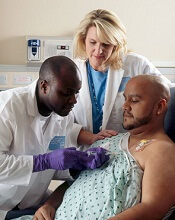
receiving chemotherapy
Credit: Rhoda Baer
Leukemia is the leading cause of cancer death in the US for men under 40 and women aged 20 and younger, according to a report by the American Cancer Society.
Non-Hodgkin lymphoma (NHL) is also among the 5 leading causes of cancer death for men under 40 and for women age 80 and older.
These data appear in “Cancer Statistics, 2014,” a report published in CA: A Cancer Journal for Clinicians.
The report includes statistics on cancer incidence and death from 1975 to 2010, as well as projections for 2014.
In the latest data (from 2010), NHL was the fifth leading cause of cancer death for men under 20 and for women over 79. It was the fourth leading cause of cancer death for men ages 20 to 39.
And leukemia was the third leading cause of cancer death for women ages 20 to 39, in addition to being the leading cause of cancer death for women under 21 and men under 40.
However, of all cancer types, leukemia and NHL have seen the largest improvements in survival, according to data comparing 5-year survival rates between 1975-1977 and 2003-2009.
Five-year survival rates for leukemia were 34% for 1975-1977 and 59% for 2003-2009 (P<0.05). For NHL, 5-year survival rates were 47% for 1975-1977 and 71% for 2003-2009 (P<0.05).
Projections for 2014
The report authors took past data into account to make estimates on cancer incidence and death for 2014. They projected that 1,665,540 patients will be diagnosed with cancer this year, and 585,720 patients will die of cancer.
Roughly 79,990 patients will be diagnosed with lymphoma—9190 with Hodgkin lymphoma and 70,800 with NHL. Approximately 18,990 patients will die of NHL, and 1180 will die of Hodgkin lymphoma.
There will be 24,050 new cases of myeloma in 2014 and 11,090 myeloma deaths, the authors said.
This year will see 52,380 patients diagnosed with leukemias—6020 with acute lymphocytic leukemia (ALL), 15,720 with chronic lymphocytic leukemia (CLL), 18,860 with acute myeloid leukemia (AML), 5980 with chronic myeloid leukemia (CML), and 5800 with other types of leukemia.
And there will be 24,090 leukemia deaths—1440 from ALL, 4600 from CLL, 10,460 from AML, 810 from CML, and 6780 from other leukemias.
For more information, see the complete report.
receiving chemotherapy
Credit: Rhoda Baer
Leukemia is the leading cause of cancer death in the US for men under 40 and women aged 20 and younger, according to a report by the American Cancer Society.
Non-Hodgkin lymphoma (NHL) is also among the 5 leading causes of cancer death for men under 40 and for women age 80 and older.
These data appear in “Cancer Statistics, 2014,” a report published in CA: A Cancer Journal for Clinicians.
The report includes statistics on cancer incidence and death from 1975 to 2010, as well as projections for 2014.
In the latest data (from 2010), NHL was the fifth leading cause of cancer death for men under 20 and for women over 79. It was the fourth leading cause of cancer death for men ages 20 to 39.
And leukemia was the third leading cause of cancer death for women ages 20 to 39, in addition to being the leading cause of cancer death for women under 21 and men under 40.
However, of all cancer types, leukemia and NHL have seen the largest improvements in survival, according to data comparing 5-year survival rates between 1975-1977 and 2003-2009.
Five-year survival rates for leukemia were 34% for 1975-1977 and 59% for 2003-2009 (P<0.05). For NHL, 5-year survival rates were 47% for 1975-1977 and 71% for 2003-2009 (P<0.05).
Projections for 2014
The report authors took past data into account to make estimates on cancer incidence and death for 2014. They projected that 1,665,540 patients will be diagnosed with cancer this year, and 585,720 patients will die of cancer.
Roughly 79,990 patients will be diagnosed with lymphoma—9190 with Hodgkin lymphoma and 70,800 with NHL. Approximately 18,990 patients will die of NHL, and 1180 will die of Hodgkin lymphoma.
There will be 24,050 new cases of myeloma in 2014 and 11,090 myeloma deaths, the authors said.
This year will see 52,380 patients diagnosed with leukemias—6020 with acute lymphocytic leukemia (ALL), 15,720 with chronic lymphocytic leukemia (CLL), 18,860 with acute myeloid leukemia (AML), 5980 with chronic myeloid leukemia (CML), and 5800 with other types of leukemia.
And there will be 24,090 leukemia deaths—1440 from ALL, 4600 from CLL, 10,460 from AML, 810 from CML, and 6780 from other leukemias.
For more information, see the complete report.
receiving chemotherapy
Credit: Rhoda Baer
Leukemia is the leading cause of cancer death in the US for men under 40 and women aged 20 and younger, according to a report by the American Cancer Society.
Non-Hodgkin lymphoma (NHL) is also among the 5 leading causes of cancer death for men under 40 and for women age 80 and older.
These data appear in “Cancer Statistics, 2014,” a report published in CA: A Cancer Journal for Clinicians.
The report includes statistics on cancer incidence and death from 1975 to 2010, as well as projections for 2014.
In the latest data (from 2010), NHL was the fifth leading cause of cancer death for men under 20 and for women over 79. It was the fourth leading cause of cancer death for men ages 20 to 39.
And leukemia was the third leading cause of cancer death for women ages 20 to 39, in addition to being the leading cause of cancer death for women under 21 and men under 40.
However, of all cancer types, leukemia and NHL have seen the largest improvements in survival, according to data comparing 5-year survival rates between 1975-1977 and 2003-2009.
Five-year survival rates for leukemia were 34% for 1975-1977 and 59% for 2003-2009 (P<0.05). For NHL, 5-year survival rates were 47% for 1975-1977 and 71% for 2003-2009 (P<0.05).
Projections for 2014
The report authors took past data into account to make estimates on cancer incidence and death for 2014. They projected that 1,665,540 patients will be diagnosed with cancer this year, and 585,720 patients will die of cancer.
Roughly 79,990 patients will be diagnosed with lymphoma—9190 with Hodgkin lymphoma and 70,800 with NHL. Approximately 18,990 patients will die of NHL, and 1180 will die of Hodgkin lymphoma.
There will be 24,050 new cases of myeloma in 2014 and 11,090 myeloma deaths, the authors said.
This year will see 52,380 patients diagnosed with leukemias—6020 with acute lymphocytic leukemia (ALL), 15,720 with chronic lymphocytic leukemia (CLL), 18,860 with acute myeloid leukemia (AML), 5980 with chronic myeloid leukemia (CML), and 5800 with other types of leukemia.
And there will be 24,090 leukemia deaths—1440 from ALL, 4600 from CLL, 10,460 from AML, 810 from CML, and 6780 from other leukemias.
For more information, see the complete report.
Internists may be ill-equipped to care for childhood cancer survivors

Credit: CDC
A survey of general internists suggests a few obstacles may prevent these physicians from providing optimal care for childhood cancer survivors.
Most of the internists surveyed were unfamiliar with surveillance guidelines, felt “somewhat uncomfortable” caring for childhood cancer survivors, and would prefer to follow patients in collaboration with a cancer center.
Nevertheless, about half of the survey respondents had recently cared for at least 1 childhood cancer survivor.
And a majority of these physicians said they never received a summary of their patients’ cancer treatment.
Eugene Suh, MD, of Loyola University Medical Center in Maywood, Illinois, and his colleagues reported these findings in Annals of Internal Medicine.
The researchers surveyed 1110 general internists, gauging their care preferences, comfort levels with caring for childhood cancer survivors, and knowledge of surveillance guidelines.
Only 36.9% of respondents said they were “somewhat comfortable” or “comfortable” caring for survivors of Hodgkin lymphoma. Twenty-seven percent felt the same about survivors of acute lymphoblastic leukemia. And 25% felt that way about osteosarcoma survivors.
In all, 51.1% of respondents had cared for at least 1 childhood cancer survivor in the 5 years preceding the survey. But 72% of these physicians had never received treatment summaries for these patients.
Eighty-four percent of respondents said they would prefer to treat childhood cancer survivors in collaboration with a physician based at a cancer center or a long-term follow-up clinic. And 10.5% said they would refer survivors to a cancer center-based physician, long-term follow-up clinic, or another primary care physician.
Only 12% of respondents said they felt at least “somewhat familiar” with surveillance guidelines. And the internists’ responses to a vignette case supported this answer.
The survey included questions about surveillance for a hypothetical 16-year-old Hodgkin lymphoma survivor who had received mantle radiation and anthracycline chemotherapy.
Ninety-one percent of respondents failed to recommend appropriate breast cancer surveillance for this patient, 85% did not recommend appropriate cardiac surveillance, and 24% failed to recommend appropriate thyroid surveillance.
Dr Suh and his colleagues said these results suggest a need for improved education among general internists but also the need for better collaboration between oncologists and primary care physicians.
A related editorial includes suggestions for educational initiatives.
Credit: CDC
A survey of general internists suggests a few obstacles may prevent these physicians from providing optimal care for childhood cancer survivors.
Most of the internists surveyed were unfamiliar with surveillance guidelines, felt “somewhat uncomfortable” caring for childhood cancer survivors, and would prefer to follow patients in collaboration with a cancer center.
Nevertheless, about half of the survey respondents had recently cared for at least 1 childhood cancer survivor.
And a majority of these physicians said they never received a summary of their patients’ cancer treatment.
Eugene Suh, MD, of Loyola University Medical Center in Maywood, Illinois, and his colleagues reported these findings in Annals of Internal Medicine.
The researchers surveyed 1110 general internists, gauging their care preferences, comfort levels with caring for childhood cancer survivors, and knowledge of surveillance guidelines.
Only 36.9% of respondents said they were “somewhat comfortable” or “comfortable” caring for survivors of Hodgkin lymphoma. Twenty-seven percent felt the same about survivors of acute lymphoblastic leukemia. And 25% felt that way about osteosarcoma survivors.
In all, 51.1% of respondents had cared for at least 1 childhood cancer survivor in the 5 years preceding the survey. But 72% of these physicians had never received treatment summaries for these patients.
Eighty-four percent of respondents said they would prefer to treat childhood cancer survivors in collaboration with a physician based at a cancer center or a long-term follow-up clinic. And 10.5% said they would refer survivors to a cancer center-based physician, long-term follow-up clinic, or another primary care physician.
Only 12% of respondents said they felt at least “somewhat familiar” with surveillance guidelines. And the internists’ responses to a vignette case supported this answer.
The survey included questions about surveillance for a hypothetical 16-year-old Hodgkin lymphoma survivor who had received mantle radiation and anthracycline chemotherapy.
Ninety-one percent of respondents failed to recommend appropriate breast cancer surveillance for this patient, 85% did not recommend appropriate cardiac surveillance, and 24% failed to recommend appropriate thyroid surveillance.
Dr Suh and his colleagues said these results suggest a need for improved education among general internists but also the need for better collaboration between oncologists and primary care physicians.
A related editorial includes suggestions for educational initiatives.
Credit: CDC
A survey of general internists suggests a few obstacles may prevent these physicians from providing optimal care for childhood cancer survivors.
Most of the internists surveyed were unfamiliar with surveillance guidelines, felt “somewhat uncomfortable” caring for childhood cancer survivors, and would prefer to follow patients in collaboration with a cancer center.
Nevertheless, about half of the survey respondents had recently cared for at least 1 childhood cancer survivor.
And a majority of these physicians said they never received a summary of their patients’ cancer treatment.
Eugene Suh, MD, of Loyola University Medical Center in Maywood, Illinois, and his colleagues reported these findings in Annals of Internal Medicine.
The researchers surveyed 1110 general internists, gauging their care preferences, comfort levels with caring for childhood cancer survivors, and knowledge of surveillance guidelines.
Only 36.9% of respondents said they were “somewhat comfortable” or “comfortable” caring for survivors of Hodgkin lymphoma. Twenty-seven percent felt the same about survivors of acute lymphoblastic leukemia. And 25% felt that way about osteosarcoma survivors.
In all, 51.1% of respondents had cared for at least 1 childhood cancer survivor in the 5 years preceding the survey. But 72% of these physicians had never received treatment summaries for these patients.
Eighty-four percent of respondents said they would prefer to treat childhood cancer survivors in collaboration with a physician based at a cancer center or a long-term follow-up clinic. And 10.5% said they would refer survivors to a cancer center-based physician, long-term follow-up clinic, or another primary care physician.
Only 12% of respondents said they felt at least “somewhat familiar” with surveillance guidelines. And the internists’ responses to a vignette case supported this answer.
The survey included questions about surveillance for a hypothetical 16-year-old Hodgkin lymphoma survivor who had received mantle radiation and anthracycline chemotherapy.
Ninety-one percent of respondents failed to recommend appropriate breast cancer surveillance for this patient, 85% did not recommend appropriate cardiac surveillance, and 24% failed to recommend appropriate thyroid surveillance.
Dr Suh and his colleagues said these results suggest a need for improved education among general internists but also the need for better collaboration between oncologists and primary care physicians.
A related editorial includes suggestions for educational initiatives.
Out-of-pocket costs hinder adherence to imatinib

Credit: CDC
When their share of prescription costs becomes too high, many patients with chronic myeloid leukemia (CML) will skip doses of imatinib or stop taking the drug entirely, new research suggests.
In a study of about 1500 patients, the median co-payment for an imatinib prescription was about $30 per fill, but the range was $0 to $4792.
Patients with higher co-payments were 70% more likely than their peers to stop taking imatinib and 42% more likely to skip doses of the drug.
Stacie B. Dusetzina, PhD, of the University of North Carolina at Chapel Hill, and her colleagues conducted this research and described the results in the Journal of Clinical Oncology.
Co-payment requirements vary
The researchers analyzed health plan claims from privately insured adults (ages 18 to 64) from 2002 to 2011. The data included 1541 CML patients beginning treatment with imatinib.
For the whole study period, the mean co-payment was $108 for a 30-day supply of imatinib. Patients in the lowest 25th percentile paid a mean of $17, and patients in the upper 75th percentile paid a mean of $53.
As expected, monthly co-payments increased over time. They averaged $55 in 2002 and $145 in 2011, with 6.4% of patients paying more than $500 a month.
Dr Dusetzina noted that the data only included patients on employer-based insurance plans, and most individuals had low out-of-pocket costs.
“We studied people who are part of large employer groups, so their insurance is probably more generous than someone who is buying insurance on a private market that does not have a lot of negotiating power,” she said.
Costs correlate with adherence
In the first 180 days of treatment, 30% of patients with higher co-payments were non-adherent to imatinib treatment, compared to 21% of patients with lower co-payments. Non-adherence was defined as having less than 80% of days with imatinib available.
Seventeen percent of patients with higher co-payments discontinued taking imatinib, compared to 10% of patients with lower co-payments. Discontinuation was defined as having a gap of more than 60 days after the exhaustion of imatinib therapy.
These data did not include patients who could not begin taking imatinib due to costs. Therefore, Dr Dusetzina said this study likely underestimates the effects of drug costs on treatment adherence.
“If you went to the pharmacy to obtain your prescription, and they said it was $5000, and you walked away because you couldn’t afford to pay, you’re not in the data,” she said. “We could only study individuals who filled at least one prescription.”
Dr Dusetzina also said these findings have implications beyond imatinib and CML. Many new treatments for rare conditions can cost insurers and patients more than $100,000 year.
“Our results are particularly relevant for specialty pharmaceutical products—those that cost over $10,000 a month,” she said.
“However, the lessons learned likely relate to any pharmaceutical product that has high out-of-pocket costs. It is important that we identify strategies to make effective but expensive medications more affordable to patients.”
Credit: CDC
When their share of prescription costs becomes too high, many patients with chronic myeloid leukemia (CML) will skip doses of imatinib or stop taking the drug entirely, new research suggests.
In a study of about 1500 patients, the median co-payment for an imatinib prescription was about $30 per fill, but the range was $0 to $4792.
Patients with higher co-payments were 70% more likely than their peers to stop taking imatinib and 42% more likely to skip doses of the drug.
Stacie B. Dusetzina, PhD, of the University of North Carolina at Chapel Hill, and her colleagues conducted this research and described the results in the Journal of Clinical Oncology.
Co-payment requirements vary
The researchers analyzed health plan claims from privately insured adults (ages 18 to 64) from 2002 to 2011. The data included 1541 CML patients beginning treatment with imatinib.
For the whole study period, the mean co-payment was $108 for a 30-day supply of imatinib. Patients in the lowest 25th percentile paid a mean of $17, and patients in the upper 75th percentile paid a mean of $53.
As expected, monthly co-payments increased over time. They averaged $55 in 2002 and $145 in 2011, with 6.4% of patients paying more than $500 a month.
Dr Dusetzina noted that the data only included patients on employer-based insurance plans, and most individuals had low out-of-pocket costs.
“We studied people who are part of large employer groups, so their insurance is probably more generous than someone who is buying insurance on a private market that does not have a lot of negotiating power,” she said.
Costs correlate with adherence
In the first 180 days of treatment, 30% of patients with higher co-payments were non-adherent to imatinib treatment, compared to 21% of patients with lower co-payments. Non-adherence was defined as having less than 80% of days with imatinib available.
Seventeen percent of patients with higher co-payments discontinued taking imatinib, compared to 10% of patients with lower co-payments. Discontinuation was defined as having a gap of more than 60 days after the exhaustion of imatinib therapy.
These data did not include patients who could not begin taking imatinib due to costs. Therefore, Dr Dusetzina said this study likely underestimates the effects of drug costs on treatment adherence.
“If you went to the pharmacy to obtain your prescription, and they said it was $5000, and you walked away because you couldn’t afford to pay, you’re not in the data,” she said. “We could only study individuals who filled at least one prescription.”
Dr Dusetzina also said these findings have implications beyond imatinib and CML. Many new treatments for rare conditions can cost insurers and patients more than $100,000 year.
“Our results are particularly relevant for specialty pharmaceutical products—those that cost over $10,000 a month,” she said.
“However, the lessons learned likely relate to any pharmaceutical product that has high out-of-pocket costs. It is important that we identify strategies to make effective but expensive medications more affordable to patients.”
Credit: CDC
When their share of prescription costs becomes too high, many patients with chronic myeloid leukemia (CML) will skip doses of imatinib or stop taking the drug entirely, new research suggests.
In a study of about 1500 patients, the median co-payment for an imatinib prescription was about $30 per fill, but the range was $0 to $4792.
Patients with higher co-payments were 70% more likely than their peers to stop taking imatinib and 42% more likely to skip doses of the drug.
Stacie B. Dusetzina, PhD, of the University of North Carolina at Chapel Hill, and her colleagues conducted this research and described the results in the Journal of Clinical Oncology.
Co-payment requirements vary
The researchers analyzed health plan claims from privately insured adults (ages 18 to 64) from 2002 to 2011. The data included 1541 CML patients beginning treatment with imatinib.
For the whole study period, the mean co-payment was $108 for a 30-day supply of imatinib. Patients in the lowest 25th percentile paid a mean of $17, and patients in the upper 75th percentile paid a mean of $53.
As expected, monthly co-payments increased over time. They averaged $55 in 2002 and $145 in 2011, with 6.4% of patients paying more than $500 a month.
Dr Dusetzina noted that the data only included patients on employer-based insurance plans, and most individuals had low out-of-pocket costs.
“We studied people who are part of large employer groups, so their insurance is probably more generous than someone who is buying insurance on a private market that does not have a lot of negotiating power,” she said.
Costs correlate with adherence
In the first 180 days of treatment, 30% of patients with higher co-payments were non-adherent to imatinib treatment, compared to 21% of patients with lower co-payments. Non-adherence was defined as having less than 80% of days with imatinib available.
Seventeen percent of patients with higher co-payments discontinued taking imatinib, compared to 10% of patients with lower co-payments. Discontinuation was defined as having a gap of more than 60 days after the exhaustion of imatinib therapy.
These data did not include patients who could not begin taking imatinib due to costs. Therefore, Dr Dusetzina said this study likely underestimates the effects of drug costs on treatment adherence.
“If you went to the pharmacy to obtain your prescription, and they said it was $5000, and you walked away because you couldn’t afford to pay, you’re not in the data,” she said. “We could only study individuals who filled at least one prescription.”
Dr Dusetzina also said these findings have implications beyond imatinib and CML. Many new treatments for rare conditions can cost insurers and patients more than $100,000 year.
“Our results are particularly relevant for specialty pharmaceutical products—those that cost over $10,000 a month,” she said.
“However, the lessons learned likely relate to any pharmaceutical product that has high out-of-pocket costs. It is important that we identify strategies to make effective but expensive medications more affordable to patients.”
Survey: Internists lack tools to care for survivors of childhood cancer
Most general internists are willing to care for adult survivors of childhood cancer, but many are uncomfortable doing so, according to the results of a nationally representative survey.
In fact, on average, the 1,110 survey respondents reported being "somewhat uncomfortable" caring for survivors, and being "somewhat unfamiliar" with available surveillance guidelines for long-term follow-up care of survivors, reported Dr. Eugene Suh of Loyola University Medical Center, Maywood, Ill., and his colleagues.
Only 37%, 27%, and 25% of respondents reported being "somewhat comfortable or "comfortable" caring for survivors of Hodgkin lymphoma, acute lymphoblastic leukemia, and osteosarcoma, respectively. After adjustment for a number of factors, higher levels of comfort in treating childhood cancer survivors were seen in physicians with larger patient volumes, those who had cared for at least 1 survivor during the preceding 5 years, and men.
Furthermore, only 12% of respondents reported being generally familiar with available surveillance guidelines for childhood cancer survivors, and this was borne out in responses to a clinical vignette about a young female survivor of Hodgkin lymphoma. Only 9%, 15%, and 76% of respondents recommend breast cancer surveillance, cardiac surveillance, and thyroid surveillance, respectively, in accordance with guidelines, and only 5% answered all three surveillance questions in accordance with guidelines, the investigators reported. The study was published in the Jan. 7 issue of Annals of Internal Medicine.
The findings are concerning given that more than 80% of adult childhood cancer survivors – a "growing and clinically challenging population" – receive health care from a primary care physician in their community, the researchers noted (Ann. Intern. Med. 2014;160:11-7 [doi:10.7326/M13-1941]).
Chemotherapy and radiation used to treat childhood cancer survivors are associated with significant risk for second malignant neoplasms and a number of other health concerns, including damage to vital organs, which can result in chronic illness and premature death, they added.
The survey was conducted between September 2011 and August 2012 in a random sample of 2,000 U.S. general internists; 62% responded. Questions regarding care preferences and comfort level with caring for adult childhood cancer survivors were answered using a 7-point Likert scale (with responses ranging from very uncomfortable to very comfortable, for example), and adherence to Children’s Oncology Group Long-Term Follow-Up Guidelines was assessed based on responses to clinical vignette. For the purposes of this study, a childhood cancer survivor was defined as a patient diagnosed with cancer at or before age 21 years, at least 5 years from cancer therapy completion, and cancer free.
More than half of the respondents (52%) reported caring for at least one survivor. Only 61 (5.5%) said they preferred to care for childhood cancer survivors independently, while 84% preferred to work in collaboration with a cancer center–based physician or long-term follow-up clinic, and 11% said they would refer survivors to a cancer center–based physician or clinic or to another primary care physician.
Although access to treatment summaries and surveillance guidelines were listed as particularly useful resources, 72% of those respondents said they never received a patient treatment summary.
The findings highlight a critical gap in some physicians’ knowledge of available guidelines as well as the need for improved attention to survivorship care plans (SCPs), which are a cornerstone of recommendations for long-term follow-up care of childhood cancer survivors, the investigators said.
These plans created by the oncology team provide survivors and physicians with a road map for care. Such plans include a cancer treatment summary as well as information about potential late treatment effects, guidelines for surveillance, and contact information for the oncology team.
"Concentrated efforts to improve these gaps should include enhanced education of [primary care physicians] through webinars, education sessions at national meetings, and guidelines linked to internal medicine websites. Focused efforts should also be made to improve comanagement by oncologists and [primary care physicians] throughout the cancer care trajectory," they concluded, noting that electronic medical records, web-based tools, and smartphone/tablet apps could allow for streamlining of SCP creation and dissemination.
The study was funded by the National Cancer Institute. The authors reported no relevant conflicts of interest.
The findings by Dr. Suh and his colleagues highlight a need for educational initiatives to improve the knowledge of general internists with respect to caring for adult survivors of childhood cancer, but internists don’t shoulder all of the responsibility for that care, Dr. Dava Szalda and Dr. Jill P. Ginsberg wrote in an accompanying editorial.
While it is clear that educational policies on treating childhood cancer survivors (CCSs) should be integrated into medical school programs, residency training, and continuing education, pediatric oncology teams and patients also share the responsibility for improved long-term follow-up care, they said (Ann Intern Med. 2014;160:66-7 [doi:10.7326/M13-2718]).
"It would be shortsighted to assert that the internist is solely responsible for long-term follow-up care of CCSs," they said, explaining that pediatric oncology teams should prepare patients for the transition to the adult health care setting by promoting self-management skills and providing information about the diagnosis, treatment exposures, and risk for late effects, and should ensure that patients can advocate for their own care needs throughout their lifetime.
Targeted readiness assessment and tools, standard policies and practices around the transition process, and creation and dissemination of a personalized care plan for survivor and primary care providers can help in accomplishing this, they said.
"Integration of innovative educational approaches for internists in the established medical school curriculum and beyond and the implementation of thoughtful, patient-focused transition practices will help to eliminate current disparities in the care of the CCSs," they concluded.
Dr. Szalda and Dr. Ginsberg are with The Children’s Hospital of Philadelphia. They reported no relevant conflicts of interest.
The findings by Dr. Suh and his colleagues highlight a need for educational initiatives to improve the knowledge of general internists with respect to caring for adult survivors of childhood cancer, but internists don’t shoulder all of the responsibility for that care, Dr. Dava Szalda and Dr. Jill P. Ginsberg wrote in an accompanying editorial.
While it is clear that educational policies on treating childhood cancer survivors (CCSs) should be integrated into medical school programs, residency training, and continuing education, pediatric oncology teams and patients also share the responsibility for improved long-term follow-up care, they said (Ann Intern Med. 2014;160:66-7 [doi:10.7326/M13-2718]).
"It would be shortsighted to assert that the internist is solely responsible for long-term follow-up care of CCSs," they said, explaining that pediatric oncology teams should prepare patients for the transition to the adult health care setting by promoting self-management skills and providing information about the diagnosis, treatment exposures, and risk for late effects, and should ensure that patients can advocate for their own care needs throughout their lifetime.
Targeted readiness assessment and tools, standard policies and practices around the transition process, and creation and dissemination of a personalized care plan for survivor and primary care providers can help in accomplishing this, they said.
"Integration of innovative educational approaches for internists in the established medical school curriculum and beyond and the implementation of thoughtful, patient-focused transition practices will help to eliminate current disparities in the care of the CCSs," they concluded.
Dr. Szalda and Dr. Ginsberg are with The Children’s Hospital of Philadelphia. They reported no relevant conflicts of interest.
The findings by Dr. Suh and his colleagues highlight a need for educational initiatives to improve the knowledge of general internists with respect to caring for adult survivors of childhood cancer, but internists don’t shoulder all of the responsibility for that care, Dr. Dava Szalda and Dr. Jill P. Ginsberg wrote in an accompanying editorial.
While it is clear that educational policies on treating childhood cancer survivors (CCSs) should be integrated into medical school programs, residency training, and continuing education, pediatric oncology teams and patients also share the responsibility for improved long-term follow-up care, they said (Ann Intern Med. 2014;160:66-7 [doi:10.7326/M13-2718]).
"It would be shortsighted to assert that the internist is solely responsible for long-term follow-up care of CCSs," they said, explaining that pediatric oncology teams should prepare patients for the transition to the adult health care setting by promoting self-management skills and providing information about the diagnosis, treatment exposures, and risk for late effects, and should ensure that patients can advocate for their own care needs throughout their lifetime.
Targeted readiness assessment and tools, standard policies and practices around the transition process, and creation and dissemination of a personalized care plan for survivor and primary care providers can help in accomplishing this, they said.
"Integration of innovative educational approaches for internists in the established medical school curriculum and beyond and the implementation of thoughtful, patient-focused transition practices will help to eliminate current disparities in the care of the CCSs," they concluded.
Dr. Szalda and Dr. Ginsberg are with The Children’s Hospital of Philadelphia. They reported no relevant conflicts of interest.
Most general internists are willing to care for adult survivors of childhood cancer, but many are uncomfortable doing so, according to the results of a nationally representative survey.
In fact, on average, the 1,110 survey respondents reported being "somewhat uncomfortable" caring for survivors, and being "somewhat unfamiliar" with available surveillance guidelines for long-term follow-up care of survivors, reported Dr. Eugene Suh of Loyola University Medical Center, Maywood, Ill., and his colleagues.
Only 37%, 27%, and 25% of respondents reported being "somewhat comfortable or "comfortable" caring for survivors of Hodgkin lymphoma, acute lymphoblastic leukemia, and osteosarcoma, respectively. After adjustment for a number of factors, higher levels of comfort in treating childhood cancer survivors were seen in physicians with larger patient volumes, those who had cared for at least 1 survivor during the preceding 5 years, and men.
Furthermore, only 12% of respondents reported being generally familiar with available surveillance guidelines for childhood cancer survivors, and this was borne out in responses to a clinical vignette about a young female survivor of Hodgkin lymphoma. Only 9%, 15%, and 76% of respondents recommend breast cancer surveillance, cardiac surveillance, and thyroid surveillance, respectively, in accordance with guidelines, and only 5% answered all three surveillance questions in accordance with guidelines, the investigators reported. The study was published in the Jan. 7 issue of Annals of Internal Medicine.
The findings are concerning given that more than 80% of adult childhood cancer survivors – a "growing and clinically challenging population" – receive health care from a primary care physician in their community, the researchers noted (Ann. Intern. Med. 2014;160:11-7 [doi:10.7326/M13-1941]).
Chemotherapy and radiation used to treat childhood cancer survivors are associated with significant risk for second malignant neoplasms and a number of other health concerns, including damage to vital organs, which can result in chronic illness and premature death, they added.
The survey was conducted between September 2011 and August 2012 in a random sample of 2,000 U.S. general internists; 62% responded. Questions regarding care preferences and comfort level with caring for adult childhood cancer survivors were answered using a 7-point Likert scale (with responses ranging from very uncomfortable to very comfortable, for example), and adherence to Children’s Oncology Group Long-Term Follow-Up Guidelines was assessed based on responses to clinical vignette. For the purposes of this study, a childhood cancer survivor was defined as a patient diagnosed with cancer at or before age 21 years, at least 5 years from cancer therapy completion, and cancer free.
More than half of the respondents (52%) reported caring for at least one survivor. Only 61 (5.5%) said they preferred to care for childhood cancer survivors independently, while 84% preferred to work in collaboration with a cancer center–based physician or long-term follow-up clinic, and 11% said they would refer survivors to a cancer center–based physician or clinic or to another primary care physician.
Although access to treatment summaries and surveillance guidelines were listed as particularly useful resources, 72% of those respondents said they never received a patient treatment summary.
The findings highlight a critical gap in some physicians’ knowledge of available guidelines as well as the need for improved attention to survivorship care plans (SCPs), which are a cornerstone of recommendations for long-term follow-up care of childhood cancer survivors, the investigators said.
These plans created by the oncology team provide survivors and physicians with a road map for care. Such plans include a cancer treatment summary as well as information about potential late treatment effects, guidelines for surveillance, and contact information for the oncology team.
"Concentrated efforts to improve these gaps should include enhanced education of [primary care physicians] through webinars, education sessions at national meetings, and guidelines linked to internal medicine websites. Focused efforts should also be made to improve comanagement by oncologists and [primary care physicians] throughout the cancer care trajectory," they concluded, noting that electronic medical records, web-based tools, and smartphone/tablet apps could allow for streamlining of SCP creation and dissemination.
The study was funded by the National Cancer Institute. The authors reported no relevant conflicts of interest.
Most general internists are willing to care for adult survivors of childhood cancer, but many are uncomfortable doing so, according to the results of a nationally representative survey.
In fact, on average, the 1,110 survey respondents reported being "somewhat uncomfortable" caring for survivors, and being "somewhat unfamiliar" with available surveillance guidelines for long-term follow-up care of survivors, reported Dr. Eugene Suh of Loyola University Medical Center, Maywood, Ill., and his colleagues.
Only 37%, 27%, and 25% of respondents reported being "somewhat comfortable or "comfortable" caring for survivors of Hodgkin lymphoma, acute lymphoblastic leukemia, and osteosarcoma, respectively. After adjustment for a number of factors, higher levels of comfort in treating childhood cancer survivors were seen in physicians with larger patient volumes, those who had cared for at least 1 survivor during the preceding 5 years, and men.
Furthermore, only 12% of respondents reported being generally familiar with available surveillance guidelines for childhood cancer survivors, and this was borne out in responses to a clinical vignette about a young female survivor of Hodgkin lymphoma. Only 9%, 15%, and 76% of respondents recommend breast cancer surveillance, cardiac surveillance, and thyroid surveillance, respectively, in accordance with guidelines, and only 5% answered all three surveillance questions in accordance with guidelines, the investigators reported. The study was published in the Jan. 7 issue of Annals of Internal Medicine.
The findings are concerning given that more than 80% of adult childhood cancer survivors – a "growing and clinically challenging population" – receive health care from a primary care physician in their community, the researchers noted (Ann. Intern. Med. 2014;160:11-7 [doi:10.7326/M13-1941]).
Chemotherapy and radiation used to treat childhood cancer survivors are associated with significant risk for second malignant neoplasms and a number of other health concerns, including damage to vital organs, which can result in chronic illness and premature death, they added.
The survey was conducted between September 2011 and August 2012 in a random sample of 2,000 U.S. general internists; 62% responded. Questions regarding care preferences and comfort level with caring for adult childhood cancer survivors were answered using a 7-point Likert scale (with responses ranging from very uncomfortable to very comfortable, for example), and adherence to Children’s Oncology Group Long-Term Follow-Up Guidelines was assessed based on responses to clinical vignette. For the purposes of this study, a childhood cancer survivor was defined as a patient diagnosed with cancer at or before age 21 years, at least 5 years from cancer therapy completion, and cancer free.
More than half of the respondents (52%) reported caring for at least one survivor. Only 61 (5.5%) said they preferred to care for childhood cancer survivors independently, while 84% preferred to work in collaboration with a cancer center–based physician or long-term follow-up clinic, and 11% said they would refer survivors to a cancer center–based physician or clinic or to another primary care physician.
Although access to treatment summaries and surveillance guidelines were listed as particularly useful resources, 72% of those respondents said they never received a patient treatment summary.
The findings highlight a critical gap in some physicians’ knowledge of available guidelines as well as the need for improved attention to survivorship care plans (SCPs), which are a cornerstone of recommendations for long-term follow-up care of childhood cancer survivors, the investigators said.
These plans created by the oncology team provide survivors and physicians with a road map for care. Such plans include a cancer treatment summary as well as information about potential late treatment effects, guidelines for surveillance, and contact information for the oncology team.
"Concentrated efforts to improve these gaps should include enhanced education of [primary care physicians] through webinars, education sessions at national meetings, and guidelines linked to internal medicine websites. Focused efforts should also be made to improve comanagement by oncologists and [primary care physicians] throughout the cancer care trajectory," they concluded, noting that electronic medical records, web-based tools, and smartphone/tablet apps could allow for streamlining of SCP creation and dissemination.
The study was funded by the National Cancer Institute. The authors reported no relevant conflicts of interest.
FROM ANNALS OF INTERNAL MEDICINE
Major finding: Only 37%, 27%, and 25% of respondents reported being "somewhat comfortable" or "comfortable" caring for survivors of Hodgkin Lymphoma, acute lymphoblastic leukemia, and osteosarcoma, respectively; only 12% of respondents reported being generally familiar with surveillance guidelines for childhood cancer survivors.
Data source: A cross-sectional survey of 1,110 internists.
Disclosures: This study was funded by the National Cancer Institute. The authors reported no relevant conflicts of interest.
Anticoagulation reaped survival benefit in leukemia patients with DVT
NEW ORLEANS – Continued anticoagulation proved surprisingly beneficial in acute leukemia patients with catheter-related deep vein thrombosis, based on a small retrospective study.
Significantly more patients on anticoagulation had DVT improvement than did those without anticoagulation (17/20 vs. 5/15; P = .03), but they also had significantly better survival (4/20 vs. 4/15).
Median survival has not been reached in the anticoagulation group and was 9 months in controls after a median follow-up of 6 months (P = .02), coauthors Dr. Briana Short and Dr. Nora Oliver reported at the annual meeting of the American Society of Hematology.
The study is one of few to tackle the risks and benefits of anticoagulation in leukemia patients who develop catheter-related DVTs.
There are no currently available guidelines, and the issue remains controversial because catheters increase the risk of DVT and pulmonary embolism, but anticoagulation raises the risk of bleeding in leukemia patients, particularly those with thrombocytopenia, the investigators noted. At many hospitals, the catheter is temporarily removed until the DVT resolves, but this can delay treatment and carries added risks with reinsertion of a central venous catheter.
Nonfatal bleeding events were more common with anticoagulation than without it, but the difference did not reach significance (5 patients vs. 1 patient; P = .21), according to Dr. Short and Dr. Oliver, chief residents at the University of Maryland, Baltimore.
The mechanism behind the increased survival is unknown, but it may be that leukemia patients who experience a DVT have microthrombi or inflammation after chemotherapy, said senior author and colleague Dr. Ashkan Emadi, who developed the novel strategy and also is at the university. A more favorable risk profile among anticoagulated patients was also a very real possibility, prompting the researchers to perform a slew of sensitivity analyses.
"We excluded people with APL [acute promyelocytic leukemia], and the data were still the same. We excluded people with bad cytogenetics, and the data still showed an overall survival benefit," he said in an interview. "We did a lot of rigorous, stingy sensitivity analyses, but wherever we looked, the survival advantage was still there."
The study, which attracted a crowd during the poster session, included 37 patients with acute leukemia who developed a DVT associated with a PICC (peripherally inserted central catheter) line. Half of these occurred within 18 days of catheter placement.
During hospitalization, 21 of the 22 patients in the anticoagulation group were started on unfractionated heparin or low-molecular-weight heparin (LMWH), with the remaining patient started on anticoagulation upon discharge. Two patients were anticoagulated with fondaparinux (Arixtra) and excluded from the analysis.
Two of the 15 controls were initially started on anticoagulation, but the therapies were discontinued during their hospital stay.
At discharge, 7 patients received enoxaparin (Lovenox) LMWH 0.5-0.75 mg/kg per day, and 13 received enoxaparin 1.0-1.5 mg/kg per day, both for 3 months. Patients were maintained at a platelet count of 50 x 103/mcL, and received platelet transfusions to decrease the risk of bleeding, if counts fell below this level. Controls were monitored post discharge by the treating physician without receiving any anticoagulation.
At baseline, the anticoagulated patients and controls were similar with respect to age (median, 56 vs. 51 years); presence of acute myeloid leukemia (12 each), acute promyelocytic leukemia (6 vs. 2 patients), or acute lymphoblastic leukemia (2 vs. 1 patient); poor-risk karyotype (5 vs. 4 patients); initial median white cell count (8.7 x 10³/mcL vs. 7.6 x 10³/mcL); and initial median platelet count (59 x 103/mcL vs. 45 x 103/mcL).
Though provocative, the findings need to be replicated in a prospective study, currently under discussion with researchers from Johns Hopkins Hospital, Baltimore, and Massachusetts General Hospital, Boston, Dr. Emadi said.
The authors reported having no financial disclosures.
NEW ORLEANS – Continued anticoagulation proved surprisingly beneficial in acute leukemia patients with catheter-related deep vein thrombosis, based on a small retrospective study.
Significantly more patients on anticoagulation had DVT improvement than did those without anticoagulation (17/20 vs. 5/15; P = .03), but they also had significantly better survival (4/20 vs. 4/15).
Median survival has not been reached in the anticoagulation group and was 9 months in controls after a median follow-up of 6 months (P = .02), coauthors Dr. Briana Short and Dr. Nora Oliver reported at the annual meeting of the American Society of Hematology.
The study is one of few to tackle the risks and benefits of anticoagulation in leukemia patients who develop catheter-related DVTs.
There are no currently available guidelines, and the issue remains controversial because catheters increase the risk of DVT and pulmonary embolism, but anticoagulation raises the risk of bleeding in leukemia patients, particularly those with thrombocytopenia, the investigators noted. At many hospitals, the catheter is temporarily removed until the DVT resolves, but this can delay treatment and carries added risks with reinsertion of a central venous catheter.
Nonfatal bleeding events were more common with anticoagulation than without it, but the difference did not reach significance (5 patients vs. 1 patient; P = .21), according to Dr. Short and Dr. Oliver, chief residents at the University of Maryland, Baltimore.
The mechanism behind the increased survival is unknown, but it may be that leukemia patients who experience a DVT have microthrombi or inflammation after chemotherapy, said senior author and colleague Dr. Ashkan Emadi, who developed the novel strategy and also is at the university. A more favorable risk profile among anticoagulated patients was also a very real possibility, prompting the researchers to perform a slew of sensitivity analyses.
"We excluded people with APL [acute promyelocytic leukemia], and the data were still the same. We excluded people with bad cytogenetics, and the data still showed an overall survival benefit," he said in an interview. "We did a lot of rigorous, stingy sensitivity analyses, but wherever we looked, the survival advantage was still there."
The study, which attracted a crowd during the poster session, included 37 patients with acute leukemia who developed a DVT associated with a PICC (peripherally inserted central catheter) line. Half of these occurred within 18 days of catheter placement.
During hospitalization, 21 of the 22 patients in the anticoagulation group were started on unfractionated heparin or low-molecular-weight heparin (LMWH), with the remaining patient started on anticoagulation upon discharge. Two patients were anticoagulated with fondaparinux (Arixtra) and excluded from the analysis.
Two of the 15 controls were initially started on anticoagulation, but the therapies were discontinued during their hospital stay.
At discharge, 7 patients received enoxaparin (Lovenox) LMWH 0.5-0.75 mg/kg per day, and 13 received enoxaparin 1.0-1.5 mg/kg per day, both for 3 months. Patients were maintained at a platelet count of 50 x 103/mcL, and received platelet transfusions to decrease the risk of bleeding, if counts fell below this level. Controls were monitored post discharge by the treating physician without receiving any anticoagulation.
At baseline, the anticoagulated patients and controls were similar with respect to age (median, 56 vs. 51 years); presence of acute myeloid leukemia (12 each), acute promyelocytic leukemia (6 vs. 2 patients), or acute lymphoblastic leukemia (2 vs. 1 patient); poor-risk karyotype (5 vs. 4 patients); initial median white cell count (8.7 x 10³/mcL vs. 7.6 x 10³/mcL); and initial median platelet count (59 x 103/mcL vs. 45 x 103/mcL).
Though provocative, the findings need to be replicated in a prospective study, currently under discussion with researchers from Johns Hopkins Hospital, Baltimore, and Massachusetts General Hospital, Boston, Dr. Emadi said.
The authors reported having no financial disclosures.
NEW ORLEANS – Continued anticoagulation proved surprisingly beneficial in acute leukemia patients with catheter-related deep vein thrombosis, based on a small retrospective study.
Significantly more patients on anticoagulation had DVT improvement than did those without anticoagulation (17/20 vs. 5/15; P = .03), but they also had significantly better survival (4/20 vs. 4/15).
Median survival has not been reached in the anticoagulation group and was 9 months in controls after a median follow-up of 6 months (P = .02), coauthors Dr. Briana Short and Dr. Nora Oliver reported at the annual meeting of the American Society of Hematology.
The study is one of few to tackle the risks and benefits of anticoagulation in leukemia patients who develop catheter-related DVTs.
There are no currently available guidelines, and the issue remains controversial because catheters increase the risk of DVT and pulmonary embolism, but anticoagulation raises the risk of bleeding in leukemia patients, particularly those with thrombocytopenia, the investigators noted. At many hospitals, the catheter is temporarily removed until the DVT resolves, but this can delay treatment and carries added risks with reinsertion of a central venous catheter.
Nonfatal bleeding events were more common with anticoagulation than without it, but the difference did not reach significance (5 patients vs. 1 patient; P = .21), according to Dr. Short and Dr. Oliver, chief residents at the University of Maryland, Baltimore.
The mechanism behind the increased survival is unknown, but it may be that leukemia patients who experience a DVT have microthrombi or inflammation after chemotherapy, said senior author and colleague Dr. Ashkan Emadi, who developed the novel strategy and also is at the university. A more favorable risk profile among anticoagulated patients was also a very real possibility, prompting the researchers to perform a slew of sensitivity analyses.
"We excluded people with APL [acute promyelocytic leukemia], and the data were still the same. We excluded people with bad cytogenetics, and the data still showed an overall survival benefit," he said in an interview. "We did a lot of rigorous, stingy sensitivity analyses, but wherever we looked, the survival advantage was still there."
The study, which attracted a crowd during the poster session, included 37 patients with acute leukemia who developed a DVT associated with a PICC (peripherally inserted central catheter) line. Half of these occurred within 18 days of catheter placement.
During hospitalization, 21 of the 22 patients in the anticoagulation group were started on unfractionated heparin or low-molecular-weight heparin (LMWH), with the remaining patient started on anticoagulation upon discharge. Two patients were anticoagulated with fondaparinux (Arixtra) and excluded from the analysis.
Two of the 15 controls were initially started on anticoagulation, but the therapies were discontinued during their hospital stay.
At discharge, 7 patients received enoxaparin (Lovenox) LMWH 0.5-0.75 mg/kg per day, and 13 received enoxaparin 1.0-1.5 mg/kg per day, both for 3 months. Patients were maintained at a platelet count of 50 x 103/mcL, and received platelet transfusions to decrease the risk of bleeding, if counts fell below this level. Controls were monitored post discharge by the treating physician without receiving any anticoagulation.
At baseline, the anticoagulated patients and controls were similar with respect to age (median, 56 vs. 51 years); presence of acute myeloid leukemia (12 each), acute promyelocytic leukemia (6 vs. 2 patients), or acute lymphoblastic leukemia (2 vs. 1 patient); poor-risk karyotype (5 vs. 4 patients); initial median white cell count (8.7 x 10³/mcL vs. 7.6 x 10³/mcL); and initial median platelet count (59 x 103/mcL vs. 45 x 103/mcL).
Though provocative, the findings need to be replicated in a prospective study, currently under discussion with researchers from Johns Hopkins Hospital, Baltimore, and Massachusetts General Hospital, Boston, Dr. Emadi said.
The authors reported having no financial disclosures.
AT ASH 2013
Major finding: Median survival has not been reached in the anticoagulation group and was 9 months in controls (P = .02).
Data source: A retrospective study of 37 patients with acute leukemia and catheter-related DVT.
Disclosures: The authors reported having no financial disclosures.