User login
Updated Analysis of Ocrelizumab’s Safety
NEW ORLEANS—The safety profile of ocrelizumab in ongoing open-label extension studies in relapsing multiple sclerosis (MS) and primary progressive MS is generally consistent with that observed in controlled clinical trials, according to a report presented at the 31st Annual Meeting of the Consortium of Multiple Sclerosis Centers (CMSC). “A slight increase in the rate of serious infections was observed in patients with relapsing MS beyond two years, but the rates remained low,” reported Ludwig Kappos, MD, Chair of Neurology at University Hospital Basel in Switzerland, and colleagues. “This was not observed in patients with primary progressive MS, and additional exposure data are needed to determine if the risk increases with further dosing,” the researchers said. “Incidence rates of malignancies and breast cancer observed with ocrelizumab treatment in MS remain within the range of epidemiologic background data.”

The safety and efficacy of ocrelizumab previously have been characterized in a phase II study in patients with relapsing-remitting MS and in phase III studies in patients with relapsing MS (OPERA I and OPERA II) and in patients with primary progressive MS (ORATORIO). Results from these trials showed that ocrelizumab reduced clinical and MRI evidence of disease activity, compared with placebo and interferon beta-1a. The most common adverse events associated with ocrelizumab during the double-blind periods of the phase III trials included infusion-related reactions, nasopharyngitis, upper respiratory tract infections, headache, and urinary tract infections. During the double-blind treatment period in the phase III trials in relapsing MS, serious adverse events, serious infections, and malignancies were reported in 6.9%, 1.3%, and 0.5% of ocrelizumab-treated patients, respectively (vs 8.7%, 2.9%, and 0.2% of patients treated with interferon beta-1a). In the phase III trial in primary progressive MS, these events were reported in 20.4%, 6.2%, and 2.3% of ocrelizumab-treated patients (vs 22.2%, 5.9%, and 0.8% of patients who received placebo). Across studies, few patients who received ocrelizumab (in the range of 2% to 4%) had adverse event–related treatment withdrawals.
At the CMSC annual meeting, data from controlled and open-label extension periods of the clinical trials of ocrelizumab in relapsing MS and primary progressive MS were presented.
Upon completion of a double-blind treatment period, patients from all studies were eligible to enter a long-term open-label extension in which they received ocrelizumab treatment. Safety analyses were based on integrated data from the phase II and phase III studies. The primary analysis was based on the clinical cutoff dates of the individual studies (phase II, January 22, 2015; OPERA I, April 2, 2015; OPERA II, May 12, 2015; ORATORIO, July 24, 2015). The present updated analysis includes all patients who received one or more dose of ocrelizumab during the controlled or open-label periods of the phase II and phase III studies (ie, the ocrelizumab all-exposure population) as of January 20, 2016. Additional data cutoffs of June 30, 2016, and September 15, 2016, were presented for malignancies to demonstrate changes with increasing ocrelizumab exposure.
The ocrelizumab all-exposure group included 2,279 patients. Patients’ mean age was 40.1, and 61.3% were female. Time since MS symptom onset was 6.67 years, and time since MS diagnosis was 3.66 years.
Overall Adverse Events
As of January 20, 2016, the majority (81%) of patients who received ocrelizumab experienced at least one adverse event, corresponding to a rate of 242 events per 100 patient-years. The most common adverse events included nasopharyngitis, upper respiratory tract infection, urinary tract infection, infusion-related reactions, and headache. Serious adverse events were reported in 12% of patients, corresponding to 6.97 events per 100 patient-years, and most commonly included infections. Treatment withdrawal because of an adverse event occurred in 3.3% of patients (rate, 1.40 per 100 patient-years) and primarily included infusion-related reactions (0.9%) and events coded as neoplasms (0.6%) or infections (0.4%).
Infections
As of January 20, 2016, 56.9% of the ocrelizumab all-exposure population reported one or more infection with ocrelizumab, corresponding to a rate of 73.6 per 100 patient-years. “These findings are consistent with the 75.6 rate observed at the primary analysis cutoff date,” the researchers reported. Infections were reported at the highest rate following the first dose and declined with subsequent dosing. Infections reported in 5% or more of patients included nasopharyngitis, upper respiratory tract infection, urinary tract infection, bronchitis, and influenza. In the ocrelizumab all-exposure population, the rate per 100 patient-years of serious infections (1.80) as of January 20, 2016, was comparable with the rate at the primary analysis cutoff date (1.74). Data for the pooled relapsing MS population showed a slight increase in the rate per 100 patient-years of serious infections (1.45) as of January 20, 2016, compared with the rate at the primary analysis cutoff date (1.08); “however, rates remained low, and further exposure is needed to make any interpretation,” the researchers said.
Among patients with primary progressive MS, the rate per 100 patient-years of serious infections remained stable (2.74) as of January 20, 2016, compared with the rate at the primary analysis cutoff date (2.97). The most common serious infection reported was pneumonia. No infections were identified as opportunistic in nature.
Malignancies
In the MS clinical trial program, an imbalance in the crude incidence of malignancies was observed between the ocrelizumab- and comparator-treated patients, which was associated with a cluster of breast cancer events in the ocrelizumab group. Over time, the crude incidence rate of malignancy per 100 patient-years in the ocrelizumab all-exposure population fluctuated but remained within the epidemiologic range of patients with MS. An observed change in the crude incidence rate of malignancy from June to September is attributed to the crude incidence rate of non-melanoma skin cancer, which increased from 0.090 at the primary analysis cutoff date to 0.145 at the September 15, 2016, data cutoff, due to six new cases of basal cell carcinoma. The crude incidence rate of breast cancer remained stable through the September 15, 2016, data cutoff.
More Recent Developments
In late May 2017, Genentech, the maker of ocrelizumab, notified physicians of
—Glenn S. Williams
NEW ORLEANS—The safety profile of ocrelizumab in ongoing open-label extension studies in relapsing multiple sclerosis (MS) and primary progressive MS is generally consistent with that observed in controlled clinical trials, according to a report presented at the 31st Annual Meeting of the Consortium of Multiple Sclerosis Centers (CMSC). “A slight increase in the rate of serious infections was observed in patients with relapsing MS beyond two years, but the rates remained low,” reported Ludwig Kappos, MD, Chair of Neurology at University Hospital Basel in Switzerland, and colleagues. “This was not observed in patients with primary progressive MS, and additional exposure data are needed to determine if the risk increases with further dosing,” the researchers said. “Incidence rates of malignancies and breast cancer observed with ocrelizumab treatment in MS remain within the range of epidemiologic background data.”
The safety and efficacy of ocrelizumab previously have been characterized in a phase II study in patients with relapsing-remitting MS and in phase III studies in patients with relapsing MS (OPERA I and OPERA II) and in patients with primary progressive MS (ORATORIO). Results from these trials showed that ocrelizumab reduced clinical and MRI evidence of disease activity, compared with placebo and interferon beta-1a. The most common adverse events associated with ocrelizumab during the double-blind periods of the phase III trials included infusion-related reactions, nasopharyngitis, upper respiratory tract infections, headache, and urinary tract infections. During the double-blind treatment period in the phase III trials in relapsing MS, serious adverse events, serious infections, and malignancies were reported in 6.9%, 1.3%, and 0.5% of ocrelizumab-treated patients, respectively (vs 8.7%, 2.9%, and 0.2% of patients treated with interferon beta-1a). In the phase III trial in primary progressive MS, these events were reported in 20.4%, 6.2%, and 2.3% of ocrelizumab-treated patients (vs 22.2%, 5.9%, and 0.8% of patients who received placebo). Across studies, few patients who received ocrelizumab (in the range of 2% to 4%) had adverse event–related treatment withdrawals.
At the CMSC annual meeting, data from controlled and open-label extension periods of the clinical trials of ocrelizumab in relapsing MS and primary progressive MS were presented.
Upon completion of a double-blind treatment period, patients from all studies were eligible to enter a long-term open-label extension in which they received ocrelizumab treatment. Safety analyses were based on integrated data from the phase II and phase III studies. The primary analysis was based on the clinical cutoff dates of the individual studies (phase II, January 22, 2015; OPERA I, April 2, 2015; OPERA II, May 12, 2015; ORATORIO, July 24, 2015). The present updated analysis includes all patients who received one or more dose of ocrelizumab during the controlled or open-label periods of the phase II and phase III studies (ie, the ocrelizumab all-exposure population) as of January 20, 2016. Additional data cutoffs of June 30, 2016, and September 15, 2016, were presented for malignancies to demonstrate changes with increasing ocrelizumab exposure.
The ocrelizumab all-exposure group included 2,279 patients. Patients’ mean age was 40.1, and 61.3% were female. Time since MS symptom onset was 6.67 years, and time since MS diagnosis was 3.66 years.
Overall Adverse Events
As of January 20, 2016, the majority (81%) of patients who received ocrelizumab experienced at least one adverse event, corresponding to a rate of 242 events per 100 patient-years. The most common adverse events included nasopharyngitis, upper respiratory tract infection, urinary tract infection, infusion-related reactions, and headache. Serious adverse events were reported in 12% of patients, corresponding to 6.97 events per 100 patient-years, and most commonly included infections. Treatment withdrawal because of an adverse event occurred in 3.3% of patients (rate, 1.40 per 100 patient-years) and primarily included infusion-related reactions (0.9%) and events coded as neoplasms (0.6%) or infections (0.4%).
Infections
As of January 20, 2016, 56.9% of the ocrelizumab all-exposure population reported one or more infection with ocrelizumab, corresponding to a rate of 73.6 per 100 patient-years. “These findings are consistent with the 75.6 rate observed at the primary analysis cutoff date,” the researchers reported. Infections were reported at the highest rate following the first dose and declined with subsequent dosing. Infections reported in 5% or more of patients included nasopharyngitis, upper respiratory tract infection, urinary tract infection, bronchitis, and influenza. In the ocrelizumab all-exposure population, the rate per 100 patient-years of serious infections (1.80) as of January 20, 2016, was comparable with the rate at the primary analysis cutoff date (1.74). Data for the pooled relapsing MS population showed a slight increase in the rate per 100 patient-years of serious infections (1.45) as of January 20, 2016, compared with the rate at the primary analysis cutoff date (1.08); “however, rates remained low, and further exposure is needed to make any interpretation,” the researchers said.
Among patients with primary progressive MS, the rate per 100 patient-years of serious infections remained stable (2.74) as of January 20, 2016, compared with the rate at the primary analysis cutoff date (2.97). The most common serious infection reported was pneumonia. No infections were identified as opportunistic in nature.
Malignancies
In the MS clinical trial program, an imbalance in the crude incidence of malignancies was observed between the ocrelizumab- and comparator-treated patients, which was associated with a cluster of breast cancer events in the ocrelizumab group. Over time, the crude incidence rate of malignancy per 100 patient-years in the ocrelizumab all-exposure population fluctuated but remained within the epidemiologic range of patients with MS. An observed change in the crude incidence rate of malignancy from June to September is attributed to the crude incidence rate of non-melanoma skin cancer, which increased from 0.090 at the primary analysis cutoff date to 0.145 at the September 15, 2016, data cutoff, due to six new cases of basal cell carcinoma. The crude incidence rate of breast cancer remained stable through the September 15, 2016, data cutoff.
More Recent Developments
In late May 2017, Genentech, the maker of ocrelizumab, notified physicians of
—Glenn S. Williams
NEW ORLEANS—The safety profile of ocrelizumab in ongoing open-label extension studies in relapsing multiple sclerosis (MS) and primary progressive MS is generally consistent with that observed in controlled clinical trials, according to a report presented at the 31st Annual Meeting of the Consortium of Multiple Sclerosis Centers (CMSC). “A slight increase in the rate of serious infections was observed in patients with relapsing MS beyond two years, but the rates remained low,” reported Ludwig Kappos, MD, Chair of Neurology at University Hospital Basel in Switzerland, and colleagues. “This was not observed in patients with primary progressive MS, and additional exposure data are needed to determine if the risk increases with further dosing,” the researchers said. “Incidence rates of malignancies and breast cancer observed with ocrelizumab treatment in MS remain within the range of epidemiologic background data.”
The safety and efficacy of ocrelizumab previously have been characterized in a phase II study in patients with relapsing-remitting MS and in phase III studies in patients with relapsing MS (OPERA I and OPERA II) and in patients with primary progressive MS (ORATORIO). Results from these trials showed that ocrelizumab reduced clinical and MRI evidence of disease activity, compared with placebo and interferon beta-1a. The most common adverse events associated with ocrelizumab during the double-blind periods of the phase III trials included infusion-related reactions, nasopharyngitis, upper respiratory tract infections, headache, and urinary tract infections. During the double-blind treatment period in the phase III trials in relapsing MS, serious adverse events, serious infections, and malignancies were reported in 6.9%, 1.3%, and 0.5% of ocrelizumab-treated patients, respectively (vs 8.7%, 2.9%, and 0.2% of patients treated with interferon beta-1a). In the phase III trial in primary progressive MS, these events were reported in 20.4%, 6.2%, and 2.3% of ocrelizumab-treated patients (vs 22.2%, 5.9%, and 0.8% of patients who received placebo). Across studies, few patients who received ocrelizumab (in the range of 2% to 4%) had adverse event–related treatment withdrawals.
At the CMSC annual meeting, data from controlled and open-label extension periods of the clinical trials of ocrelizumab in relapsing MS and primary progressive MS were presented.
Upon completion of a double-blind treatment period, patients from all studies were eligible to enter a long-term open-label extension in which they received ocrelizumab treatment. Safety analyses were based on integrated data from the phase II and phase III studies. The primary analysis was based on the clinical cutoff dates of the individual studies (phase II, January 22, 2015; OPERA I, April 2, 2015; OPERA II, May 12, 2015; ORATORIO, July 24, 2015). The present updated analysis includes all patients who received one or more dose of ocrelizumab during the controlled or open-label periods of the phase II and phase III studies (ie, the ocrelizumab all-exposure population) as of January 20, 2016. Additional data cutoffs of June 30, 2016, and September 15, 2016, were presented for malignancies to demonstrate changes with increasing ocrelizumab exposure.
The ocrelizumab all-exposure group included 2,279 patients. Patients’ mean age was 40.1, and 61.3% were female. Time since MS symptom onset was 6.67 years, and time since MS diagnosis was 3.66 years.
Overall Adverse Events
As of January 20, 2016, the majority (81%) of patients who received ocrelizumab experienced at least one adverse event, corresponding to a rate of 242 events per 100 patient-years. The most common adverse events included nasopharyngitis, upper respiratory tract infection, urinary tract infection, infusion-related reactions, and headache. Serious adverse events were reported in 12% of patients, corresponding to 6.97 events per 100 patient-years, and most commonly included infections. Treatment withdrawal because of an adverse event occurred in 3.3% of patients (rate, 1.40 per 100 patient-years) and primarily included infusion-related reactions (0.9%) and events coded as neoplasms (0.6%) or infections (0.4%).
Infections
As of January 20, 2016, 56.9% of the ocrelizumab all-exposure population reported one or more infection with ocrelizumab, corresponding to a rate of 73.6 per 100 patient-years. “These findings are consistent with the 75.6 rate observed at the primary analysis cutoff date,” the researchers reported. Infections were reported at the highest rate following the first dose and declined with subsequent dosing. Infections reported in 5% or more of patients included nasopharyngitis, upper respiratory tract infection, urinary tract infection, bronchitis, and influenza. In the ocrelizumab all-exposure population, the rate per 100 patient-years of serious infections (1.80) as of January 20, 2016, was comparable with the rate at the primary analysis cutoff date (1.74). Data for the pooled relapsing MS population showed a slight increase in the rate per 100 patient-years of serious infections (1.45) as of January 20, 2016, compared with the rate at the primary analysis cutoff date (1.08); “however, rates remained low, and further exposure is needed to make any interpretation,” the researchers said.
Among patients with primary progressive MS, the rate per 100 patient-years of serious infections remained stable (2.74) as of January 20, 2016, compared with the rate at the primary analysis cutoff date (2.97). The most common serious infection reported was pneumonia. No infections were identified as opportunistic in nature.
Malignancies
In the MS clinical trial program, an imbalance in the crude incidence of malignancies was observed between the ocrelizumab- and comparator-treated patients, which was associated with a cluster of breast cancer events in the ocrelizumab group. Over time, the crude incidence rate of malignancy per 100 patient-years in the ocrelizumab all-exposure population fluctuated but remained within the epidemiologic range of patients with MS. An observed change in the crude incidence rate of malignancy from June to September is attributed to the crude incidence rate of non-melanoma skin cancer, which increased from 0.090 at the primary analysis cutoff date to 0.145 at the September 15, 2016, data cutoff, due to six new cases of basal cell carcinoma. The crude incidence rate of breast cancer remained stable through the September 15, 2016, data cutoff.
More Recent Developments
In late May 2017, Genentech, the maker of ocrelizumab, notified physicians of
—Glenn S. Williams
Can Exercise Boost Cognitive Performance in Patients With MS?
NEW ORLEANS—A single bout of treadmill walking might affect cognitive processing to a greater degree than stationary cycling, particularly among those with multiple sclerosis (MS) who demonstrate low aerobic fitness, according to a report presented at the 31st Annual Meeting of the Consortium of MS Centers. "This [finding] highlights the importance of targeting those with low aerobic fitness in treadmill walking exercise training interventions for improving cognition in persons with MS, as improving aerobic fitness may be beneficial for reducing MS-related cognitive-motor interference," said Brian M. Sandroff, PhD, of the Kessler Foundation in West Orange, New Jersey, and colleagues.

The mechanisms by which treadmill walking improves cognition in patients with MS are not well understood. Researchers have hypothesized that treadmill walking is essentially a complex cognitive task that requires more attentional resources than other modalities of aerobic exercise (eg, cycle ergometry), and that repeated exposure trains the person in cognitive-motor processing. If this hypothesis is true, then patients with MS should demonstrate worse cognitive performance during treadmill walking than during cycle ergometry, as more attentional resources would presumably be devoted to walking on a treadmill than to cycling on a stationary bicycle. Furthermore, it is unknown whether better aerobic fitness attenuates such cognitive-motor interference in patients with MS.
Dr. Sandroff and colleagues conducted a pilot study to examine cognitive performance before and during acute bouts of treadmill walking, stationary cycling, and seated quiet rest in 12 fully ambulatory patients with MS with high or low aerobic fitness using a within-subjects, repeated-measures design.
Participants underwent a baseline incremental exercise test to exhaustion for measurement of aerobic fitness (ie, VO2peak). Participants further completed three experimental conditions that consisted of 20 minutes of moderate- to vigorous-intensity treadmill walking exercise, moderate- to vigorous-intensity cycle ergometer exercise, and seated quiet rest in a randomized, counterbalanced order. Participants underwent the three-second Paced Auditory Serial Addition Test (PASAT) as a measure of cognitive performance prior to and during each condition.
Overall, decreases in PASAT performance during treadmill walking were not larger than those during cycle ergometry, relative to quiet rest. However, decreases in PASAT performance were larger for those with lower aerobic fitness during treadmill walking than during cycle ergometry, compared with quiet rest.
NEW ORLEANS—A single bout of treadmill walking might affect cognitive processing to a greater degree than stationary cycling, particularly among those with multiple sclerosis (MS) who demonstrate low aerobic fitness, according to a report presented at the 31st Annual Meeting of the Consortium of MS Centers. "This [finding] highlights the importance of targeting those with low aerobic fitness in treadmill walking exercise training interventions for improving cognition in persons with MS, as improving aerobic fitness may be beneficial for reducing MS-related cognitive-motor interference," said Brian M. Sandroff, PhD, of the Kessler Foundation in West Orange, New Jersey, and colleagues.
The mechanisms by which treadmill walking improves cognition in patients with MS are not well understood. Researchers have hypothesized that treadmill walking is essentially a complex cognitive task that requires more attentional resources than other modalities of aerobic exercise (eg, cycle ergometry), and that repeated exposure trains the person in cognitive-motor processing. If this hypothesis is true, then patients with MS should demonstrate worse cognitive performance during treadmill walking than during cycle ergometry, as more attentional resources would presumably be devoted to walking on a treadmill than to cycling on a stationary bicycle. Furthermore, it is unknown whether better aerobic fitness attenuates such cognitive-motor interference in patients with MS.
Dr. Sandroff and colleagues conducted a pilot study to examine cognitive performance before and during acute bouts of treadmill walking, stationary cycling, and seated quiet rest in 12 fully ambulatory patients with MS with high or low aerobic fitness using a within-subjects, repeated-measures design.
Participants underwent a baseline incremental exercise test to exhaustion for measurement of aerobic fitness (ie, VO2peak). Participants further completed three experimental conditions that consisted of 20 minutes of moderate- to vigorous-intensity treadmill walking exercise, moderate- to vigorous-intensity cycle ergometer exercise, and seated quiet rest in a randomized, counterbalanced order. Participants underwent the three-second Paced Auditory Serial Addition Test (PASAT) as a measure of cognitive performance prior to and during each condition.
Overall, decreases in PASAT performance during treadmill walking were not larger than those during cycle ergometry, relative to quiet rest. However, decreases in PASAT performance were larger for those with lower aerobic fitness during treadmill walking than during cycle ergometry, compared with quiet rest.
NEW ORLEANS—A single bout of treadmill walking might affect cognitive processing to a greater degree than stationary cycling, particularly among those with multiple sclerosis (MS) who demonstrate low aerobic fitness, according to a report presented at the 31st Annual Meeting of the Consortium of MS Centers. "This [finding] highlights the importance of targeting those with low aerobic fitness in treadmill walking exercise training interventions for improving cognition in persons with MS, as improving aerobic fitness may be beneficial for reducing MS-related cognitive-motor interference," said Brian M. Sandroff, PhD, of the Kessler Foundation in West Orange, New Jersey, and colleagues.
The mechanisms by which treadmill walking improves cognition in patients with MS are not well understood. Researchers have hypothesized that treadmill walking is essentially a complex cognitive task that requires more attentional resources than other modalities of aerobic exercise (eg, cycle ergometry), and that repeated exposure trains the person in cognitive-motor processing. If this hypothesis is true, then patients with MS should demonstrate worse cognitive performance during treadmill walking than during cycle ergometry, as more attentional resources would presumably be devoted to walking on a treadmill than to cycling on a stationary bicycle. Furthermore, it is unknown whether better aerobic fitness attenuates such cognitive-motor interference in patients with MS.
Dr. Sandroff and colleagues conducted a pilot study to examine cognitive performance before and during acute bouts of treadmill walking, stationary cycling, and seated quiet rest in 12 fully ambulatory patients with MS with high or low aerobic fitness using a within-subjects, repeated-measures design.
Participants underwent a baseline incremental exercise test to exhaustion for measurement of aerobic fitness (ie, VO2peak). Participants further completed three experimental conditions that consisted of 20 minutes of moderate- to vigorous-intensity treadmill walking exercise, moderate- to vigorous-intensity cycle ergometer exercise, and seated quiet rest in a randomized, counterbalanced order. Participants underwent the three-second Paced Auditory Serial Addition Test (PASAT) as a measure of cognitive performance prior to and during each condition.
Overall, decreases in PASAT performance during treadmill walking were not larger than those during cycle ergometry, relative to quiet rest. However, decreases in PASAT performance were larger for those with lower aerobic fitness during treadmill walking than during cycle ergometry, compared with quiet rest.
Researchers Compare Three Escalation Therapies for MS

A Retrospective Chart Review
Ms. Vollmer and colleagues conducted a retrospective study to compare the discontinuation rates and efficacy of fingolimod and dimethyl fumarate to those of natalizumab. In a retrospective chart review, they identified patients with multiple sclerosis (MS) who presented to the Rocky Mountain MS Center in Aurora, Colorado. Eligible participants initiated drug therapy between January 2010 and October 2013. Patients who initiated natalizumab had to be negative for the John Cunningham virus (JCV) at baseline. Ms. Vollmer and colleagues retrospectively collected clinician-recorded data.
The study’s primary outcome was discontinuation at 24 months. Secondary outcomes included reasons for discontinuation, relapse activity, MRI activity, and a composite disease activity measure that comprised clinical relapse, contrast enhancement, and new T2 lesions on follow-up MRI. Ms. Vollmer and colleagues identified 1,302 patients who initiated insurance paperwork for natalizumab. To reduce the size of this sample, they randomly selected 800 patients, of whom 270 met the inclusion criteria. In all, 440 participants initiated paperwork for fingolimod, of whom 271 met the inclusion criteria. For dimethyl fumarate, the researchers found 592 participants who initiated the paperwork, and 342 met the inclusion criteria.
Patients receiving natalizumab were significantly younger (mean age, 39.8) than patients receiving fingolimod (42.5) or dimethyl fumarate (45.8). Furthermore, patients treated with natalizumab were more likely to be female (77.8%) than patients treated with fingolimod (72.0%) or dimethyl fumarate (69.6%). Patients receiving natalizumab also were more likely to have contrast enhancement on baseline MRI (31.2%) than were participants receiving fingolimod (24.6%) or dimethyl fumarate (14.6%). Mean disease duration was approximately 12 years for all groups.
Discontinuation and Disease Activity
The rate of discontinuation was similar for natalizumab (33.3%) and fingolimod (34.3%), but the researchers observed a significant difference between natalizumab and dimethyl fumarate (47.1%). Disease activity and adverse events were the most common reasons for discontinuation of fingolimod and dimethyl fumarate, and JCV positivity was the most common reason for discontinuation of natalizumab. Of the seven participants who discontinued natalizumab because of disease activity, five had neutralizing antibodies. Of the 20 patients who discontinued natalizumab because of adverse events, nine had rashes during infusion, eight of whom tested positive for neutralizing antibodies.
Ms. Vollmer and colleagues found no significant difference between natalizumab and fingolimod in the rate of patients with a clinical relapse (5.6% and 8.9%, respectively), but they observed a significant difference between dimethyl fumarate (12.9%) and natalizumab for this outcome. Contrast enhancement was less common among patients receiving natalizumab (6.6%), compared with fingolimod (13.1%), but there was no significant difference between natalizumab and dimethyl fumarate (10.0%).
The rate of new T2 lesions was lower with natalizumab (21.4%), compared with fingolimod (35.0%) and dimethyl fumarate (31.5%). Similarly, the composite disease activity measure was less common with natalizumab (20.7%), compared with fingolimod (34.7%) and dimethyl fumarate (33.6%). Data adjustments indicated that discontinuation was equally likely among patients receiving fingolimod and those receiving natalizumab. Patients receiving dimethyl fumarate, however, were approximately twice as likely to discontinue treatment, compared with patients receiving natalizumab.
Furthermore, patients receiving fingolimod were approximately twice as likely to discontinue treatment because of adverse events, compared with patients receiving natalizumab. Patients treated with dimethyl fumarate were approximately four times as likely to discontinue because of adverse events, compared with patients treated with natalizumab. In addition, patients were approximately twice as likely to have disease activity on fingolimod or dimethyl fumarate, compared with natalizumab.
—Erik Greb
Suggested Reading
Barbin L, Rousseau C, Jousset N, et al. Comparative efficacy of fingolimod vs natalizumab: A French multicenter observational study. Neurology. 2016;86(8):771-778.
A Retrospective Chart Review
Ms. Vollmer and colleagues conducted a retrospective study to compare the discontinuation rates and efficacy of fingolimod and dimethyl fumarate to those of natalizumab. In a retrospective chart review, they identified patients with multiple sclerosis (MS) who presented to the Rocky Mountain MS Center in Aurora, Colorado. Eligible participants initiated drug therapy between January 2010 and October 2013. Patients who initiated natalizumab had to be negative for the John Cunningham virus (JCV) at baseline. Ms. Vollmer and colleagues retrospectively collected clinician-recorded data.
The study’s primary outcome was discontinuation at 24 months. Secondary outcomes included reasons for discontinuation, relapse activity, MRI activity, and a composite disease activity measure that comprised clinical relapse, contrast enhancement, and new T2 lesions on follow-up MRI. Ms. Vollmer and colleagues identified 1,302 patients who initiated insurance paperwork for natalizumab. To reduce the size of this sample, they randomly selected 800 patients, of whom 270 met the inclusion criteria. In all, 440 participants initiated paperwork for fingolimod, of whom 271 met the inclusion criteria. For dimethyl fumarate, the researchers found 592 participants who initiated the paperwork, and 342 met the inclusion criteria.
Patients receiving natalizumab were significantly younger (mean age, 39.8) than patients receiving fingolimod (42.5) or dimethyl fumarate (45.8). Furthermore, patients treated with natalizumab were more likely to be female (77.8%) than patients treated with fingolimod (72.0%) or dimethyl fumarate (69.6%). Patients receiving natalizumab also were more likely to have contrast enhancement on baseline MRI (31.2%) than were participants receiving fingolimod (24.6%) or dimethyl fumarate (14.6%). Mean disease duration was approximately 12 years for all groups.
Discontinuation and Disease Activity
The rate of discontinuation was similar for natalizumab (33.3%) and fingolimod (34.3%), but the researchers observed a significant difference between natalizumab and dimethyl fumarate (47.1%). Disease activity and adverse events were the most common reasons for discontinuation of fingolimod and dimethyl fumarate, and JCV positivity was the most common reason for discontinuation of natalizumab. Of the seven participants who discontinued natalizumab because of disease activity, five had neutralizing antibodies. Of the 20 patients who discontinued natalizumab because of adverse events, nine had rashes during infusion, eight of whom tested positive for neutralizing antibodies.
Ms. Vollmer and colleagues found no significant difference between natalizumab and fingolimod in the rate of patients with a clinical relapse (5.6% and 8.9%, respectively), but they observed a significant difference between dimethyl fumarate (12.9%) and natalizumab for this outcome. Contrast enhancement was less common among patients receiving natalizumab (6.6%), compared with fingolimod (13.1%), but there was no significant difference between natalizumab and dimethyl fumarate (10.0%).
The rate of new T2 lesions was lower with natalizumab (21.4%), compared with fingolimod (35.0%) and dimethyl fumarate (31.5%). Similarly, the composite disease activity measure was less common with natalizumab (20.7%), compared with fingolimod (34.7%) and dimethyl fumarate (33.6%). Data adjustments indicated that discontinuation was equally likely among patients receiving fingolimod and those receiving natalizumab. Patients receiving dimethyl fumarate, however, were approximately twice as likely to discontinue treatment, compared with patients receiving natalizumab.
Furthermore, patients receiving fingolimod were approximately twice as likely to discontinue treatment because of adverse events, compared with patients receiving natalizumab. Patients treated with dimethyl fumarate were approximately four times as likely to discontinue because of adverse events, compared with patients treated with natalizumab. In addition, patients were approximately twice as likely to have disease activity on fingolimod or dimethyl fumarate, compared with natalizumab.
—Erik Greb
Suggested Reading
Barbin L, Rousseau C, Jousset N, et al. Comparative efficacy of fingolimod vs natalizumab: A French multicenter observational study. Neurology. 2016;86(8):771-778.
A Retrospective Chart Review
Ms. Vollmer and colleagues conducted a retrospective study to compare the discontinuation rates and efficacy of fingolimod and dimethyl fumarate to those of natalizumab. In a retrospective chart review, they identified patients with multiple sclerosis (MS) who presented to the Rocky Mountain MS Center in Aurora, Colorado. Eligible participants initiated drug therapy between January 2010 and October 2013. Patients who initiated natalizumab had to be negative for the John Cunningham virus (JCV) at baseline. Ms. Vollmer and colleagues retrospectively collected clinician-recorded data.
The study’s primary outcome was discontinuation at 24 months. Secondary outcomes included reasons for discontinuation, relapse activity, MRI activity, and a composite disease activity measure that comprised clinical relapse, contrast enhancement, and new T2 lesions on follow-up MRI. Ms. Vollmer and colleagues identified 1,302 patients who initiated insurance paperwork for natalizumab. To reduce the size of this sample, they randomly selected 800 patients, of whom 270 met the inclusion criteria. In all, 440 participants initiated paperwork for fingolimod, of whom 271 met the inclusion criteria. For dimethyl fumarate, the researchers found 592 participants who initiated the paperwork, and 342 met the inclusion criteria.
Patients receiving natalizumab were significantly younger (mean age, 39.8) than patients receiving fingolimod (42.5) or dimethyl fumarate (45.8). Furthermore, patients treated with natalizumab were more likely to be female (77.8%) than patients treated with fingolimod (72.0%) or dimethyl fumarate (69.6%). Patients receiving natalizumab also were more likely to have contrast enhancement on baseline MRI (31.2%) than were participants receiving fingolimod (24.6%) or dimethyl fumarate (14.6%). Mean disease duration was approximately 12 years for all groups.
Discontinuation and Disease Activity
The rate of discontinuation was similar for natalizumab (33.3%) and fingolimod (34.3%), but the researchers observed a significant difference between natalizumab and dimethyl fumarate (47.1%). Disease activity and adverse events were the most common reasons for discontinuation of fingolimod and dimethyl fumarate, and JCV positivity was the most common reason for discontinuation of natalizumab. Of the seven participants who discontinued natalizumab because of disease activity, five had neutralizing antibodies. Of the 20 patients who discontinued natalizumab because of adverse events, nine had rashes during infusion, eight of whom tested positive for neutralizing antibodies.
Ms. Vollmer and colleagues found no significant difference between natalizumab and fingolimod in the rate of patients with a clinical relapse (5.6% and 8.9%, respectively), but they observed a significant difference between dimethyl fumarate (12.9%) and natalizumab for this outcome. Contrast enhancement was less common among patients receiving natalizumab (6.6%), compared with fingolimod (13.1%), but there was no significant difference between natalizumab and dimethyl fumarate (10.0%).
The rate of new T2 lesions was lower with natalizumab (21.4%), compared with fingolimod (35.0%) and dimethyl fumarate (31.5%). Similarly, the composite disease activity measure was less common with natalizumab (20.7%), compared with fingolimod (34.7%) and dimethyl fumarate (33.6%). Data adjustments indicated that discontinuation was equally likely among patients receiving fingolimod and those receiving natalizumab. Patients receiving dimethyl fumarate, however, were approximately twice as likely to discontinue treatment, compared with patients receiving natalizumab.
Furthermore, patients receiving fingolimod were approximately twice as likely to discontinue treatment because of adverse events, compared with patients receiving natalizumab. Patients treated with dimethyl fumarate were approximately four times as likely to discontinue because of adverse events, compared with patients treated with natalizumab. In addition, patients were approximately twice as likely to have disease activity on fingolimod or dimethyl fumarate, compared with natalizumab.
—Erik Greb
Suggested Reading
Barbin L, Rousseau C, Jousset N, et al. Comparative efficacy of fingolimod vs natalizumab: A French multicenter observational study. Neurology. 2016;86(8):771-778.
When Should Neurologists Discontinue Disease-Modifying Treatments in Patients With MS?
NEW ORLEANS—Discontinuation of disease-modifying treatments (DMTs) may be considered for patients with secondary progressive multiple sclerosis (SPMS) age 55 or older with ongoing progression and no clinical relapses or new MRI lesions consistent with MS in the previous five years, according to research presented at the 31st Annual Meeting of the Consortium of MS Centers. Data from the study also suggest that it is reasonable to consider discontinuing DMTs for patients in the same age range with stable relapsing remitting (RR) MS who have had no clinical relapses or new MRI lesions consistent with MS in the previous five years.
Although DMTs can reduce relapse rates and progression of disability early in the course of RRMS, it remains unknown whether these treatments maintain efficacy late in the course of RRMS, in SPMS, or in older patients. Considerations for discontinuing treatment include potential inefficacy of DMTs and adverse effects in this cohort, said the authors.
Devyn Parsons, a medical student at the University of British Columbia in Vancouver, Canada, working with Anthony Traboulsee, MD, and colleagues, conducted a systematic search to examine literature relevant to the discontinuation of DMTs and to provide guidance about when DMTs may be discontinued. The investigators used the keywords “multiple sclerosis,” “disease modifying treatments,” “treatment withdrawal,” “stopping medication,” and “medication withdrawal” to search PubMed, Embase, and the Cochrane Database of Systematic Reviews. The search included articles up to June 2016 and was limited to English-language publications.
The review yielded what Ms. Parsons described as a “paucity of information.” The investigators found evidence that disease activity in RRMS declined with increasing age and longer disease duration. Some observational studies suggested that older patients who continuously receive DMT and are free of disease activity for several years might be good candidates for discontinuation of DMTs. Since DMTs are associated with adverse events that may affect quality of life or pose serious safety risks, it is important to consider patient preference, said the authors.
Safety monitoring following discontinuation of DMTs should include annual clinical assessment and annual brain MRIs for two to five years, with consideration of reinitiation of DMTs if evidence of new clinical relapse emerges or more than two new MRI lesions consistent with MS appear, said the researchers.
This study was supported by Sanofi Genzyme.
NEW ORLEANS—Discontinuation of disease-modifying treatments (DMTs) may be considered for patients with secondary progressive multiple sclerosis (SPMS) age 55 or older with ongoing progression and no clinical relapses or new MRI lesions consistent with MS in the previous five years, according to research presented at the 31st Annual Meeting of the Consortium of MS Centers. Data from the study also suggest that it is reasonable to consider discontinuing DMTs for patients in the same age range with stable relapsing remitting (RR) MS who have had no clinical relapses or new MRI lesions consistent with MS in the previous five years.
Although DMTs can reduce relapse rates and progression of disability early in the course of RRMS, it remains unknown whether these treatments maintain efficacy late in the course of RRMS, in SPMS, or in older patients. Considerations for discontinuing treatment include potential inefficacy of DMTs and adverse effects in this cohort, said the authors.
Devyn Parsons, a medical student at the University of British Columbia in Vancouver, Canada, working with Anthony Traboulsee, MD, and colleagues, conducted a systematic search to examine literature relevant to the discontinuation of DMTs and to provide guidance about when DMTs may be discontinued. The investigators used the keywords “multiple sclerosis,” “disease modifying treatments,” “treatment withdrawal,” “stopping medication,” and “medication withdrawal” to search PubMed, Embase, and the Cochrane Database of Systematic Reviews. The search included articles up to June 2016 and was limited to English-language publications.
The review yielded what Ms. Parsons described as a “paucity of information.” The investigators found evidence that disease activity in RRMS declined with increasing age and longer disease duration. Some observational studies suggested that older patients who continuously receive DMT and are free of disease activity for several years might be good candidates for discontinuation of DMTs. Since DMTs are associated with adverse events that may affect quality of life or pose serious safety risks, it is important to consider patient preference, said the authors.
Safety monitoring following discontinuation of DMTs should include annual clinical assessment and annual brain MRIs for two to five years, with consideration of reinitiation of DMTs if evidence of new clinical relapse emerges or more than two new MRI lesions consistent with MS appear, said the researchers.
This study was supported by Sanofi Genzyme.
NEW ORLEANS—Discontinuation of disease-modifying treatments (DMTs) may be considered for patients with secondary progressive multiple sclerosis (SPMS) age 55 or older with ongoing progression and no clinical relapses or new MRI lesions consistent with MS in the previous five years, according to research presented at the 31st Annual Meeting of the Consortium of MS Centers. Data from the study also suggest that it is reasonable to consider discontinuing DMTs for patients in the same age range with stable relapsing remitting (RR) MS who have had no clinical relapses or new MRI lesions consistent with MS in the previous five years.
Although DMTs can reduce relapse rates and progression of disability early in the course of RRMS, it remains unknown whether these treatments maintain efficacy late in the course of RRMS, in SPMS, or in older patients. Considerations for discontinuing treatment include potential inefficacy of DMTs and adverse effects in this cohort, said the authors.
Devyn Parsons, a medical student at the University of British Columbia in Vancouver, Canada, working with Anthony Traboulsee, MD, and colleagues, conducted a systematic search to examine literature relevant to the discontinuation of DMTs and to provide guidance about when DMTs may be discontinued. The investigators used the keywords “multiple sclerosis,” “disease modifying treatments,” “treatment withdrawal,” “stopping medication,” and “medication withdrawal” to search PubMed, Embase, and the Cochrane Database of Systematic Reviews. The search included articles up to June 2016 and was limited to English-language publications.
The review yielded what Ms. Parsons described as a “paucity of information.” The investigators found evidence that disease activity in RRMS declined with increasing age and longer disease duration. Some observational studies suggested that older patients who continuously receive DMT and are free of disease activity for several years might be good candidates for discontinuation of DMTs. Since DMTs are associated with adverse events that may affect quality of life or pose serious safety risks, it is important to consider patient preference, said the authors.
Safety monitoring following discontinuation of DMTs should include annual clinical assessment and annual brain MRIs for two to five years, with consideration of reinitiation of DMTs if evidence of new clinical relapse emerges or more than two new MRI lesions consistent with MS appear, said the researchers.
This study was supported by Sanofi Genzyme.
Pregnancy and MS: How do they affect each other?
NEW ORLEANS – Multiple sclerosis has little to no impact on the ability to conceive, on pregnancy, or on fetal status, according to Patricia K. Coyle, MD.
“That’s very reassuring,” Dr. Coyle said at the annual meeting of the Consortium of Multiple Sclerosis Centers. “We don’t see an increase in birth defects just because the mother has MS. There is no consistent increase in abortions, ectopic pregnancies, or assisted vaginal/cesarean deliveries.”
Dr. Coyle, director of the MS Comprehensive Care Center at Stony Brook (N.Y.) University Medical Center, said that the most dramatic changes for pregnant patients with MS occur in the final trimester and mainly involve rising levels of multiple hormones: estrogens, cortisol, progesterone, norepinephrine, and 1,25-dihydroxyvitamin D, which increase late in pregnancy, then rapidly drop off postpartum. This has led to the evaluation of sex hormone therapy for MS.
The impact of other pregnancy factors on MS disease activity remains unknown. One is microchimerism, a maternal-fetal exchange of cells and DNA. “These cells can last for a long time; you can find them in the blood, as well as in the [central nervous system],” Dr. Coyle said. “It’s been reported that fetal microchimerism may be increased in immune-mediated diseases like MS, but we really don’t have a lot of good data.”

Researchers also are studying the impact of changes in the gut microbiota that occur during pregnancy. “Could this be a potential target for MS therapy?” Dr. Coyle asked. “This is in its infancy.”
Counseling tips
She went on to share counseling tips for MS patients of childbearing age, including the fact that some studies report slightly smaller babies born to mothers with MS, while others have not found that association. “This is a question mark, but it doesn’t seem to be a major issue,” she said. One thing you can tell patients for certain is that MS is not inherited. “There are well over 230 genes linked to MS, so there’s a genetic enrichment that can make somebody vulnerable to MS, but there’s no gene that passes on MS,” Dr. Coyle said. “The risk is slightly higher for a first-degree relative, so when a parent has MS, the risk for the child is in the range of 2% to 2.5%, compared with the expected 0.13% in the general population. But there’s a slightly higher risk when you’re a sibling than when you’re a parent – 2.7% – which is speaking to environmental factors having an important impact on genes.”
Controversial data exist as to whether a maternal deficiency in vitamin D poses a risk of MS in the offspring. Dr. Coyle makes it a point to “normalize” vitamin D levels in pregnant MS patients, particularly in white patients. “You’d want to have them on prenatal vitamins and folic acid and tell them not to smoke, to limit their alcohol use, and advise them to have good sleep hygiene.”
Dr. Coyle, vice chair of clinical affairs at Stony Brook University Medical Center, said that up until the 1950s, physicians advised women with MS against having children. “They were told not to get pregnant or to have an abortion, because it was thought to make MS worse,” she said. “It turns out that was fiction. That was completely wrong. Pregnancy has no negative effect on long-term MS prognosis. It may have long-term benefits for relapsing MS, but there are not enough data to comment on its impact on progressive MS. Pregnancy makes it less likely that someone will develop a clinically isolated syndrome, but it may increase the radiologically isolated syndrome risk for clinical attack. That’s based on 7 pregnant patients out of a cohort of 60, so we need further data to explain that.”
Disease-modifying therapies
When it comes to washouts of disease-modifying therapies (DMTs), no one-size-fits-all approach exists. Interferon betas and glatiramer acetate have more than 1,000 pregnancy exposures that yield no evidence for teratogenicity or negative fetal impact. No washout is needed prior to pregnancy. “These agents can be used during pregnancy and breastfeeding,” she said.
The other DMTs paint a somewhat different picture. “There is insufficient pregnancy exposure to the three available oral DMTs to comment definitively on their safety, but there is no clear human teratogenicity to date,” Dr. Coyle said. The conventional washout for fingolimod is 8 weeks. In Dr. Coyle’s opinion, no washout is required with dimethyl fumarate. “The half-life is 40 minutes. There are no good signs of issues. For teriflunomide, it can hang around in individuals for 18-24 months. You should go through an accelerated elimination procedure with oral cholestyramine 8 mg three times a day for 11 days until blood level of the agent is less than 0.02 mcg/mL. Avoid all the orals with breastfeeding.”
Monoclonal antibodies – another form of DMTs – lack sufficient pregnancy exposures to merit comment on safety, but they should not be used during breastfeeding. Natalizumab is a humanized IgG4 antibody that crosses the placenta. “This has been used in several dozen pregnancies because the patients got so bad when they were taken off that it required reinstituting natalizumab even though they were pregnant,” Dr. Coyle said. “Human pregnancy exposures have been associated with transient hematologic issues in the newborn, including anemia, thrombocytopenia, and pancytopenia.” Data indicate that the rate of spontaneous abortion among pregnant women treated with natalizumab was 9%, the rate of major birth defects was 5.05%, and no malformation pattern was observed. The drug is detected in human breast milk and has a half-life of 11 days.
Alemtuzumab is a humanized IgG1 monoclonal antibody that crosses the placenta. The half-life elimination is about 14 days. In transgenic mice, giving alemtuzumab during organogenesis was found to be embryolethal. In human pregnancy, hypothyroidism is a concern. “The recommendation has been to wait 4 months after the last treatment before you try to become pregnant. Alemtuzumab is considered a two-cycle treatment. You don’t get the maximum benefit after the first cycle of 5 days. The complete treatment is the second cycle 3 days.”
Daclizumab, another humanized IgG1 monoclonal antibody, also crosses the placenta. Monkey exposure during gestation led to embryofetal death and decreased fetal growth, “but this was at greater than 30 times the human dose,” she said. “It was found to be excreted in monkey breast milk and the half-life is 21 days.” In humans, there have been 36 exposed women who had 38 pregnancies and 20 live births. The rate of spontaneous abortions/miscarriages was 11%, there were eight elective terminations, two ectopic pregnancies, and one congenital heart defect. “This is very limited data, but nothing that would raise the level of concern,” Dr. Coyle said.
Ocrelizumab, another humanized IgG1 monoclonal antibody, was approved by the Food and Drug Administration in March 2017. Prior studies of anti-CD20 antibodies in human pregnancy noted transient lymphocytopenia and peripheral B cell depletion in the newborns. In studies of pregnant monkeys that used 2 and 10 times human doses during organogenesis, it was associated with B cell depletion in spleen/lymph nodes, Dr. Coyle said. “During organogenesis and throughout the neonatal period, treatment could be associated with perinatal death, some associated with bacterial infection; glomerulonephropathy with inflammation; a decrease in circulating B cells, a decrease in testicular weight, and bone marrow lymphoid follicle formation.” Ocrelizumab is excreted in monkey breast milk and the prescription label suggests a 6-month delay in pregnancy. The drug’s half-life is 26 days.
Dr. Coyle reported that she has served as a consultant for Accordant, Acorda, Bayer, Biogen, Celgene, Genentech/Roche, Genzyme/Sanofi, Novartis, Serono, and Teva. She has also received research support from Actelion, Alkermes, Genentech/Roche, MedDay, the National Institute of Neurological Disorders and Stroke, and Novartis.
NEW ORLEANS – Multiple sclerosis has little to no impact on the ability to conceive, on pregnancy, or on fetal status, according to Patricia K. Coyle, MD.
“That’s very reassuring,” Dr. Coyle said at the annual meeting of the Consortium of Multiple Sclerosis Centers. “We don’t see an increase in birth defects just because the mother has MS. There is no consistent increase in abortions, ectopic pregnancies, or assisted vaginal/cesarean deliveries.”
Dr. Coyle, director of the MS Comprehensive Care Center at Stony Brook (N.Y.) University Medical Center, said that the most dramatic changes for pregnant patients with MS occur in the final trimester and mainly involve rising levels of multiple hormones: estrogens, cortisol, progesterone, norepinephrine, and 1,25-dihydroxyvitamin D, which increase late in pregnancy, then rapidly drop off postpartum. This has led to the evaluation of sex hormone therapy for MS.
The impact of other pregnancy factors on MS disease activity remains unknown. One is microchimerism, a maternal-fetal exchange of cells and DNA. “These cells can last for a long time; you can find them in the blood, as well as in the [central nervous system],” Dr. Coyle said. “It’s been reported that fetal microchimerism may be increased in immune-mediated diseases like MS, but we really don’t have a lot of good data.”
Researchers also are studying the impact of changes in the gut microbiota that occur during pregnancy. “Could this be a potential target for MS therapy?” Dr. Coyle asked. “This is in its infancy.”
Counseling tips
She went on to share counseling tips for MS patients of childbearing age, including the fact that some studies report slightly smaller babies born to mothers with MS, while others have not found that association. “This is a question mark, but it doesn’t seem to be a major issue,” she said. One thing you can tell patients for certain is that MS is not inherited. “There are well over 230 genes linked to MS, so there’s a genetic enrichment that can make somebody vulnerable to MS, but there’s no gene that passes on MS,” Dr. Coyle said. “The risk is slightly higher for a first-degree relative, so when a parent has MS, the risk for the child is in the range of 2% to 2.5%, compared with the expected 0.13% in the general population. But there’s a slightly higher risk when you’re a sibling than when you’re a parent – 2.7% – which is speaking to environmental factors having an important impact on genes.”
Controversial data exist as to whether a maternal deficiency in vitamin D poses a risk of MS in the offspring. Dr. Coyle makes it a point to “normalize” vitamin D levels in pregnant MS patients, particularly in white patients. “You’d want to have them on prenatal vitamins and folic acid and tell them not to smoke, to limit their alcohol use, and advise them to have good sleep hygiene.”
Dr. Coyle, vice chair of clinical affairs at Stony Brook University Medical Center, said that up until the 1950s, physicians advised women with MS against having children. “They were told not to get pregnant or to have an abortion, because it was thought to make MS worse,” she said. “It turns out that was fiction. That was completely wrong. Pregnancy has no negative effect on long-term MS prognosis. It may have long-term benefits for relapsing MS, but there are not enough data to comment on its impact on progressive MS. Pregnancy makes it less likely that someone will develop a clinically isolated syndrome, but it may increase the radiologically isolated syndrome risk for clinical attack. That’s based on 7 pregnant patients out of a cohort of 60, so we need further data to explain that.”
Disease-modifying therapies
When it comes to washouts of disease-modifying therapies (DMTs), no one-size-fits-all approach exists. Interferon betas and glatiramer acetate have more than 1,000 pregnancy exposures that yield no evidence for teratogenicity or negative fetal impact. No washout is needed prior to pregnancy. “These agents can be used during pregnancy and breastfeeding,” she said.
The other DMTs paint a somewhat different picture. “There is insufficient pregnancy exposure to the three available oral DMTs to comment definitively on their safety, but there is no clear human teratogenicity to date,” Dr. Coyle said. The conventional washout for fingolimod is 8 weeks. In Dr. Coyle’s opinion, no washout is required with dimethyl fumarate. “The half-life is 40 minutes. There are no good signs of issues. For teriflunomide, it can hang around in individuals for 18-24 months. You should go through an accelerated elimination procedure with oral cholestyramine 8 mg three times a day for 11 days until blood level of the agent is less than 0.02 mcg/mL. Avoid all the orals with breastfeeding.”
Monoclonal antibodies – another form of DMTs – lack sufficient pregnancy exposures to merit comment on safety, but they should not be used during breastfeeding. Natalizumab is a humanized IgG4 antibody that crosses the placenta. “This has been used in several dozen pregnancies because the patients got so bad when they were taken off that it required reinstituting natalizumab even though they were pregnant,” Dr. Coyle said. “Human pregnancy exposures have been associated with transient hematologic issues in the newborn, including anemia, thrombocytopenia, and pancytopenia.” Data indicate that the rate of spontaneous abortion among pregnant women treated with natalizumab was 9%, the rate of major birth defects was 5.05%, and no malformation pattern was observed. The drug is detected in human breast milk and has a half-life of 11 days.
Alemtuzumab is a humanized IgG1 monoclonal antibody that crosses the placenta. The half-life elimination is about 14 days. In transgenic mice, giving alemtuzumab during organogenesis was found to be embryolethal. In human pregnancy, hypothyroidism is a concern. “The recommendation has been to wait 4 months after the last treatment before you try to become pregnant. Alemtuzumab is considered a two-cycle treatment. You don’t get the maximum benefit after the first cycle of 5 days. The complete treatment is the second cycle 3 days.”
Daclizumab, another humanized IgG1 monoclonal antibody, also crosses the placenta. Monkey exposure during gestation led to embryofetal death and decreased fetal growth, “but this was at greater than 30 times the human dose,” she said. “It was found to be excreted in monkey breast milk and the half-life is 21 days.” In humans, there have been 36 exposed women who had 38 pregnancies and 20 live births. The rate of spontaneous abortions/miscarriages was 11%, there were eight elective terminations, two ectopic pregnancies, and one congenital heart defect. “This is very limited data, but nothing that would raise the level of concern,” Dr. Coyle said.
Ocrelizumab, another humanized IgG1 monoclonal antibody, was approved by the Food and Drug Administration in March 2017. Prior studies of anti-CD20 antibodies in human pregnancy noted transient lymphocytopenia and peripheral B cell depletion in the newborns. In studies of pregnant monkeys that used 2 and 10 times human doses during organogenesis, it was associated with B cell depletion in spleen/lymph nodes, Dr. Coyle said. “During organogenesis and throughout the neonatal period, treatment could be associated with perinatal death, some associated with bacterial infection; glomerulonephropathy with inflammation; a decrease in circulating B cells, a decrease in testicular weight, and bone marrow lymphoid follicle formation.” Ocrelizumab is excreted in monkey breast milk and the prescription label suggests a 6-month delay in pregnancy. The drug’s half-life is 26 days.
Dr. Coyle reported that she has served as a consultant for Accordant, Acorda, Bayer, Biogen, Celgene, Genentech/Roche, Genzyme/Sanofi, Novartis, Serono, and Teva. She has also received research support from Actelion, Alkermes, Genentech/Roche, MedDay, the National Institute of Neurological Disorders and Stroke, and Novartis.
NEW ORLEANS – Multiple sclerosis has little to no impact on the ability to conceive, on pregnancy, or on fetal status, according to Patricia K. Coyle, MD.
“That’s very reassuring,” Dr. Coyle said at the annual meeting of the Consortium of Multiple Sclerosis Centers. “We don’t see an increase in birth defects just because the mother has MS. There is no consistent increase in abortions, ectopic pregnancies, or assisted vaginal/cesarean deliveries.”
Dr. Coyle, director of the MS Comprehensive Care Center at Stony Brook (N.Y.) University Medical Center, said that the most dramatic changes for pregnant patients with MS occur in the final trimester and mainly involve rising levels of multiple hormones: estrogens, cortisol, progesterone, norepinephrine, and 1,25-dihydroxyvitamin D, which increase late in pregnancy, then rapidly drop off postpartum. This has led to the evaluation of sex hormone therapy for MS.
The impact of other pregnancy factors on MS disease activity remains unknown. One is microchimerism, a maternal-fetal exchange of cells and DNA. “These cells can last for a long time; you can find them in the blood, as well as in the [central nervous system],” Dr. Coyle said. “It’s been reported that fetal microchimerism may be increased in immune-mediated diseases like MS, but we really don’t have a lot of good data.”
Researchers also are studying the impact of changes in the gut microbiota that occur during pregnancy. “Could this be a potential target for MS therapy?” Dr. Coyle asked. “This is in its infancy.”
Counseling tips
She went on to share counseling tips for MS patients of childbearing age, including the fact that some studies report slightly smaller babies born to mothers with MS, while others have not found that association. “This is a question mark, but it doesn’t seem to be a major issue,” she said. One thing you can tell patients for certain is that MS is not inherited. “There are well over 230 genes linked to MS, so there’s a genetic enrichment that can make somebody vulnerable to MS, but there’s no gene that passes on MS,” Dr. Coyle said. “The risk is slightly higher for a first-degree relative, so when a parent has MS, the risk for the child is in the range of 2% to 2.5%, compared with the expected 0.13% in the general population. But there’s a slightly higher risk when you’re a sibling than when you’re a parent – 2.7% – which is speaking to environmental factors having an important impact on genes.”
Controversial data exist as to whether a maternal deficiency in vitamin D poses a risk of MS in the offspring. Dr. Coyle makes it a point to “normalize” vitamin D levels in pregnant MS patients, particularly in white patients. “You’d want to have them on prenatal vitamins and folic acid and tell them not to smoke, to limit their alcohol use, and advise them to have good sleep hygiene.”
Dr. Coyle, vice chair of clinical affairs at Stony Brook University Medical Center, said that up until the 1950s, physicians advised women with MS against having children. “They were told not to get pregnant or to have an abortion, because it was thought to make MS worse,” she said. “It turns out that was fiction. That was completely wrong. Pregnancy has no negative effect on long-term MS prognosis. It may have long-term benefits for relapsing MS, but there are not enough data to comment on its impact on progressive MS. Pregnancy makes it less likely that someone will develop a clinically isolated syndrome, but it may increase the radiologically isolated syndrome risk for clinical attack. That’s based on 7 pregnant patients out of a cohort of 60, so we need further data to explain that.”
Disease-modifying therapies
When it comes to washouts of disease-modifying therapies (DMTs), no one-size-fits-all approach exists. Interferon betas and glatiramer acetate have more than 1,000 pregnancy exposures that yield no evidence for teratogenicity or negative fetal impact. No washout is needed prior to pregnancy. “These agents can be used during pregnancy and breastfeeding,” she said.
The other DMTs paint a somewhat different picture. “There is insufficient pregnancy exposure to the three available oral DMTs to comment definitively on their safety, but there is no clear human teratogenicity to date,” Dr. Coyle said. The conventional washout for fingolimod is 8 weeks. In Dr. Coyle’s opinion, no washout is required with dimethyl fumarate. “The half-life is 40 minutes. There are no good signs of issues. For teriflunomide, it can hang around in individuals for 18-24 months. You should go through an accelerated elimination procedure with oral cholestyramine 8 mg three times a day for 11 days until blood level of the agent is less than 0.02 mcg/mL. Avoid all the orals with breastfeeding.”
Monoclonal antibodies – another form of DMTs – lack sufficient pregnancy exposures to merit comment on safety, but they should not be used during breastfeeding. Natalizumab is a humanized IgG4 antibody that crosses the placenta. “This has been used in several dozen pregnancies because the patients got so bad when they were taken off that it required reinstituting natalizumab even though they were pregnant,” Dr. Coyle said. “Human pregnancy exposures have been associated with transient hematologic issues in the newborn, including anemia, thrombocytopenia, and pancytopenia.” Data indicate that the rate of spontaneous abortion among pregnant women treated with natalizumab was 9%, the rate of major birth defects was 5.05%, and no malformation pattern was observed. The drug is detected in human breast milk and has a half-life of 11 days.
Alemtuzumab is a humanized IgG1 monoclonal antibody that crosses the placenta. The half-life elimination is about 14 days. In transgenic mice, giving alemtuzumab during organogenesis was found to be embryolethal. In human pregnancy, hypothyroidism is a concern. “The recommendation has been to wait 4 months after the last treatment before you try to become pregnant. Alemtuzumab is considered a two-cycle treatment. You don’t get the maximum benefit after the first cycle of 5 days. The complete treatment is the second cycle 3 days.”
Daclizumab, another humanized IgG1 monoclonal antibody, also crosses the placenta. Monkey exposure during gestation led to embryofetal death and decreased fetal growth, “but this was at greater than 30 times the human dose,” she said. “It was found to be excreted in monkey breast milk and the half-life is 21 days.” In humans, there have been 36 exposed women who had 38 pregnancies and 20 live births. The rate of spontaneous abortions/miscarriages was 11%, there were eight elective terminations, two ectopic pregnancies, and one congenital heart defect. “This is very limited data, but nothing that would raise the level of concern,” Dr. Coyle said.
Ocrelizumab, another humanized IgG1 monoclonal antibody, was approved by the Food and Drug Administration in March 2017. Prior studies of anti-CD20 antibodies in human pregnancy noted transient lymphocytopenia and peripheral B cell depletion in the newborns. In studies of pregnant monkeys that used 2 and 10 times human doses during organogenesis, it was associated with B cell depletion in spleen/lymph nodes, Dr. Coyle said. “During organogenesis and throughout the neonatal period, treatment could be associated with perinatal death, some associated with bacterial infection; glomerulonephropathy with inflammation; a decrease in circulating B cells, a decrease in testicular weight, and bone marrow lymphoid follicle formation.” Ocrelizumab is excreted in monkey breast milk and the prescription label suggests a 6-month delay in pregnancy. The drug’s half-life is 26 days.
Dr. Coyle reported that she has served as a consultant for Accordant, Acorda, Bayer, Biogen, Celgene, Genentech/Roche, Genzyme/Sanofi, Novartis, Serono, and Teva. She has also received research support from Actelion, Alkermes, Genentech/Roche, MedDay, the National Institute of Neurological Disorders and Stroke, and Novartis.
EXPERT ANALYSIS AT THE CMSC ANNUAL MEETING
Study sheds light on pregnancy outcomes following ocrelizumab treatment
NEW ORLEANS – Data from the ocrelizumab clinical development program gives clinicians a first look at pregnancy outcomes after exposure to the drug, but the small size limits the ability to draw firm conclusions.
In the United States, prescribing information for ocrelizumab states that women of childbearing potential should use contraception while receiving ocrelizumab and for 6 months after the last infusion. At the annual meeting of the Consortium of Multiple Sclerosis Centers, researchers led by Sibyl Wray, MD, set out to assess the pregnancy, fetal, neonatal and infant outcomes in patients who became pregnant during ocrelizumab trials in MS, rheumatoid arthritis (RA), and systemic lupus erythematosus (SLE) through Sept. 15, 2015.

The analysis included ocrelizumab-exposed women in primarily European-based clinical trials in patients with MS, RA, or SLE, in whom doses ranged from 20 mg to 2,000 mg. These included three randomized trials of its use in MS, totaling 1,876 patients with a mean age of 40 years; four trials of its use in RA, totaling 2,759 patients with a mean age of 53 years; and one trial of its use in SLE, totaling 381 patients with a mean age of 31 years. Between 2008 and Sept. 14, 2015, a total of 48 women who were enrolled in the trials reported pregnancies.
MS data
Of the 15 pregnancies in the MS trials, three involved the delivery of full term, healthy newborns. In one case, the last ocrelizumab infusion was given 28 months before conception. In the second case, an infusion was given 20 weeks before conception, and a further infusion was given 17 days after conception. In the third case, the last ocrelizumab infusion was given 26.5 weeks before conception.
One live term birth occurred with an abnormal finding. In this case, the last infusion of ocrelizumab was 23 weeks prior to the last menstrual period or about 6 months prior to conception. The embryo/fetus was not exposed to the drug in utero. The researchers also found that seven elective terminations occurred among MS patients and that four pregnancies were ongoing at the time of this report.
“We have to be cautious because we don’t have enough data yet to know, but it’s encouraging to see that, if you follow the guidelines, the patient population and the newborns seem to be healthy in these exposed individuals,” Dr. Wray said.
RA data
Data from the RA clinical trials revealed 22 pregnancies in 21 patients exposed to ocrelizumab. Of these, eight pregnancies resulted in healthy term babies; four resulted in live births with abnormal findings (structural malformation, growth abnormality) or preterm birth; and eight pregnancies in seven women resulted in spontaneous abortion (one patient experienced a spontaneous abortion on two occasions), missed abortion, or an embryonic pregnancy. One pregnancy was lost to follow-up and another resulted in elective termination.
SLE data
During the SLE trials, 11 pregnancies occurred in 10 patients. Three pregnancies in two women resulted in healthy term babies. Three other pregnancies resulted in live births with an abnormal finding (structural malformation, functional deficit, growth abnormality) and/or preterm birth. Two pregnancies resulted in spontaneous/missed abortion. One pregnancy resulted in fetal death at 7.5 months’ gestation secondary to fatal pulmonary embolism in the mother; one pregnancy resulted in elective termination; and one pregnancy resulted in a healthy baby born at an unknown gestational week.
Dr. Wray emphasized that the small numbers of patients studied make it difficult to draw conclusions about pregnancy outcomes following ocrelizumab in patients with MS and other autoimmune diseases. “We need to pay attention to the half-life of this drug, the time it takes to clear, and how to plan pregnancies around that,” she said. She noted that pregnancy outcomes in ongoing ocrelizumab studies and postmarketing experiences will continue to be collected and assessed.
The study was funded by Roche, Basel, Switzerland. Dr. Wray reported that she has received honoraria and/or research funding from Actelion, Alkermes, Biogen, Celgene, EMD Serono, Genentech/Roche, Genzyme/Sanofi, Novartis, and TG Therapeutics.
NEW ORLEANS – Data from the ocrelizumab clinical development program gives clinicians a first look at pregnancy outcomes after exposure to the drug, but the small size limits the ability to draw firm conclusions.
In the United States, prescribing information for ocrelizumab states that women of childbearing potential should use contraception while receiving ocrelizumab and for 6 months after the last infusion. At the annual meeting of the Consortium of Multiple Sclerosis Centers, researchers led by Sibyl Wray, MD, set out to assess the pregnancy, fetal, neonatal and infant outcomes in patients who became pregnant during ocrelizumab trials in MS, rheumatoid arthritis (RA), and systemic lupus erythematosus (SLE) through Sept. 15, 2015.
The analysis included ocrelizumab-exposed women in primarily European-based clinical trials in patients with MS, RA, or SLE, in whom doses ranged from 20 mg to 2,000 mg. These included three randomized trials of its use in MS, totaling 1,876 patients with a mean age of 40 years; four trials of its use in RA, totaling 2,759 patients with a mean age of 53 years; and one trial of its use in SLE, totaling 381 patients with a mean age of 31 years. Between 2008 and Sept. 14, 2015, a total of 48 women who were enrolled in the trials reported pregnancies.
MS data
Of the 15 pregnancies in the MS trials, three involved the delivery of full term, healthy newborns. In one case, the last ocrelizumab infusion was given 28 months before conception. In the second case, an infusion was given 20 weeks before conception, and a further infusion was given 17 days after conception. In the third case, the last ocrelizumab infusion was given 26.5 weeks before conception.
One live term birth occurred with an abnormal finding. In this case, the last infusion of ocrelizumab was 23 weeks prior to the last menstrual period or about 6 months prior to conception. The embryo/fetus was not exposed to the drug in utero. The researchers also found that seven elective terminations occurred among MS patients and that four pregnancies were ongoing at the time of this report.
“We have to be cautious because we don’t have enough data yet to know, but it’s encouraging to see that, if you follow the guidelines, the patient population and the newborns seem to be healthy in these exposed individuals,” Dr. Wray said.
RA data
Data from the RA clinical trials revealed 22 pregnancies in 21 patients exposed to ocrelizumab. Of these, eight pregnancies resulted in healthy term babies; four resulted in live births with abnormal findings (structural malformation, growth abnormality) or preterm birth; and eight pregnancies in seven women resulted in spontaneous abortion (one patient experienced a spontaneous abortion on two occasions), missed abortion, or an embryonic pregnancy. One pregnancy was lost to follow-up and another resulted in elective termination.
SLE data
During the SLE trials, 11 pregnancies occurred in 10 patients. Three pregnancies in two women resulted in healthy term babies. Three other pregnancies resulted in live births with an abnormal finding (structural malformation, functional deficit, growth abnormality) and/or preterm birth. Two pregnancies resulted in spontaneous/missed abortion. One pregnancy resulted in fetal death at 7.5 months’ gestation secondary to fatal pulmonary embolism in the mother; one pregnancy resulted in elective termination; and one pregnancy resulted in a healthy baby born at an unknown gestational week.
Dr. Wray emphasized that the small numbers of patients studied make it difficult to draw conclusions about pregnancy outcomes following ocrelizumab in patients with MS and other autoimmune diseases. “We need to pay attention to the half-life of this drug, the time it takes to clear, and how to plan pregnancies around that,” she said. She noted that pregnancy outcomes in ongoing ocrelizumab studies and postmarketing experiences will continue to be collected and assessed.
The study was funded by Roche, Basel, Switzerland. Dr. Wray reported that she has received honoraria and/or research funding from Actelion, Alkermes, Biogen, Celgene, EMD Serono, Genentech/Roche, Genzyme/Sanofi, Novartis, and TG Therapeutics.
NEW ORLEANS – Data from the ocrelizumab clinical development program gives clinicians a first look at pregnancy outcomes after exposure to the drug, but the small size limits the ability to draw firm conclusions.
In the United States, prescribing information for ocrelizumab states that women of childbearing potential should use contraception while receiving ocrelizumab and for 6 months after the last infusion. At the annual meeting of the Consortium of Multiple Sclerosis Centers, researchers led by Sibyl Wray, MD, set out to assess the pregnancy, fetal, neonatal and infant outcomes in patients who became pregnant during ocrelizumab trials in MS, rheumatoid arthritis (RA), and systemic lupus erythematosus (SLE) through Sept. 15, 2015.
The analysis included ocrelizumab-exposed women in primarily European-based clinical trials in patients with MS, RA, or SLE, in whom doses ranged from 20 mg to 2,000 mg. These included three randomized trials of its use in MS, totaling 1,876 patients with a mean age of 40 years; four trials of its use in RA, totaling 2,759 patients with a mean age of 53 years; and one trial of its use in SLE, totaling 381 patients with a mean age of 31 years. Between 2008 and Sept. 14, 2015, a total of 48 women who were enrolled in the trials reported pregnancies.
MS data
Of the 15 pregnancies in the MS trials, three involved the delivery of full term, healthy newborns. In one case, the last ocrelizumab infusion was given 28 months before conception. In the second case, an infusion was given 20 weeks before conception, and a further infusion was given 17 days after conception. In the third case, the last ocrelizumab infusion was given 26.5 weeks before conception.
One live term birth occurred with an abnormal finding. In this case, the last infusion of ocrelizumab was 23 weeks prior to the last menstrual period or about 6 months prior to conception. The embryo/fetus was not exposed to the drug in utero. The researchers also found that seven elective terminations occurred among MS patients and that four pregnancies were ongoing at the time of this report.
“We have to be cautious because we don’t have enough data yet to know, but it’s encouraging to see that, if you follow the guidelines, the patient population and the newborns seem to be healthy in these exposed individuals,” Dr. Wray said.
RA data
Data from the RA clinical trials revealed 22 pregnancies in 21 patients exposed to ocrelizumab. Of these, eight pregnancies resulted in healthy term babies; four resulted in live births with abnormal findings (structural malformation, growth abnormality) or preterm birth; and eight pregnancies in seven women resulted in spontaneous abortion (one patient experienced a spontaneous abortion on two occasions), missed abortion, or an embryonic pregnancy. One pregnancy was lost to follow-up and another resulted in elective termination.
SLE data
During the SLE trials, 11 pregnancies occurred in 10 patients. Three pregnancies in two women resulted in healthy term babies. Three other pregnancies resulted in live births with an abnormal finding (structural malformation, functional deficit, growth abnormality) and/or preterm birth. Two pregnancies resulted in spontaneous/missed abortion. One pregnancy resulted in fetal death at 7.5 months’ gestation secondary to fatal pulmonary embolism in the mother; one pregnancy resulted in elective termination; and one pregnancy resulted in a healthy baby born at an unknown gestational week.
Dr. Wray emphasized that the small numbers of patients studied make it difficult to draw conclusions about pregnancy outcomes following ocrelizumab in patients with MS and other autoimmune diseases. “We need to pay attention to the half-life of this drug, the time it takes to clear, and how to plan pregnancies around that,” she said. She noted that pregnancy outcomes in ongoing ocrelizumab studies and postmarketing experiences will continue to be collected and assessed.
The study was funded by Roche, Basel, Switzerland. Dr. Wray reported that she has received honoraria and/or research funding from Actelion, Alkermes, Biogen, Celgene, EMD Serono, Genentech/Roche, Genzyme/Sanofi, Novartis, and TG Therapeutics.
AT THE CMSC ANNUAL MEETING
Key clinical point:
Major finding: Of 15 pregnancies in the MS trials, three involved the delivery of three full term, healthy newborns; one live term birth occurred with an abnormal finding; seven elective terminations occurred; and four pregnancies were ongoing.
Data source: A review of 48 pregnancies among women enrolled in clinical trials for ocrelizumab in MS, rheumatoid arthritis, and systemic lupus erythematosus.
Disclosures: The study was funded by Roche, Basel, Switzerland. Dr. Wray reported that she has received honoraria and/or research funding from Actelion, Alkermes, Biogen, Celgene, EMD Serono, Genentech/Roche, Genzyme/Sanofi, Novartis, and TG Therapeutics.
Revisions coming to McDonald Criteria for MS
NEW ORLEANS – Changes are coming to the current McDonald Criteria for diagnosing multiple sclerosis, primarily because of advances in the understanding of MS since the criteria were last updated in 2010.
Such advances include the availability of new data regarding the relationship between MS and other spectrum disorders and data concerning the performance of the 2010 McDonald Criteria in several patient populations, according to Jeffrey A. Cohen, MD, who cochaired the effort known as the International Panel on Diagnosis of Multiple Sclerosis. “There also were new data concerning the utility of cerebrospinal fluid evaluation and increasing recognition that the role of cerebrospinal fluid (CSF) examination perhaps needs increased emphasis,” Dr. Cohen said at the annual meeting of the Consortium of Multiple Sclerosis Centers. “It’s been somewhat de-emphasized in previous versions of the criteria. Then, there was identification of subsets of patients that were felt to have a high likelihood of MS but in whom the diagnosis could not be made by the current criteria – patients who fell through the cracks. There was also increasing recognition of the frequency and important consequences of misdiagnosis.”

The panel emphasized that evidence supporting the McDonald criteria is predominately based on patients with a typical clinically isolated syndrome (CIS) at onset. It also acknowledged the difficulty of confirming a diagnosis of MS, the importance of addressing alternative diagnoses and absence of atypical features and red flags, and the rigor necessary for interpreting clinical, imaging, and laboratory studies. “Misdiagnosis is common,” Dr. Cohen told meeting attendees. “In some series, upwards of 50%-60% of patients referred to a specialized MS center turn out to have some other diagnosis. Our panel had discussions related to the tradeoff between sensitivity of the criteria and trying to make the diagnosis earlier and in a broader range of patients but counterbalancing that against the risk of a misdiagnosis. Our conclusion was that, although some of that might be created by the criteria, it’s mostly a problem of misapplying the criteria. One needs to remember that to make the diagnosis of MS does not merely require demonstrating that the patient has a disease process that involves potentially multiple places in the CNS and as recurrent events over time, but one has to apply the diagnostic data with rigor.”
Another emphasis expected to be included in updated McDonald criteria is the use of CSF and spinal cord imaging, as well as the notion that a history, examination, and synthesis of a patient’s overall clinical picture “needs to be made by a clinician with MS-related expertise,” Dr. Cohen said. “One cannot merely use the criteria as a checklist.”
The panelists also discussed modifying the term “possible MS,” which is already in the McDonald criteria, to include patients with CIS who do not (yet) fulfill the diagnostic criteria for MS; radiologically isolated syndrome (RIS); solitary sclerosis; and patients with clinical manifestations, imaging, and other features that are compatible with MS but not typical for those who may or may not be determined to have MS or in the future.
Dr. Cohen noted that additional data concerning the applicability of the McDonald criteria to Asian and Latin populations have been published since 2010 but are modest. “There is no indication the McDonald criteria cannot be used in these populations,” he said. “Care is needed to address alternative diagnoses, particularly neuromyelitis optica spectrum disorder (NMOSD) in both and also infectious diseases in Latin America.” Several studies also support the applicability of the McDonald criteria in children, with certain caveats. “One needs to be careful in diagnosing MS in people younger than 11 years of age,” Dr. Cohen said. “If the initial event is [acute disseminated encephalomyelitis], they also need to have a typical clinically isolated syndrome.”
Panelists also agreed that the McDonald criteria apply to older patients, with caveats that a new diagnosis of MS is rarely considered in older adults. “They are more likely to have a progressive course, either progressive from onset or following previous unrecognized relapses,” Dr. Cohen said. “There needs to be careful consideration of alternative diagnoses and, particularly, comorbidities. This represents an example of a diagnostic scenario for which CSF examination is advised.”
Panel members found that the recognized range of potential clinical manifestations of NMOSD is becoming wider and is still being defined. “Emerging data suggests a substantial proportion of AQP-4 seronegative patients with NMOSD features (about 20%) have anti–myelin oligodendrocyte glycoprotein antibodies,” he said. “Although some features of MS and NMOSD overlap, they are now understood to be distinct disorders.”
Other points under consideration for the 2017 revision of the McDonald Criteria included incorporating the revised phenotype categories (relapse-remitting, secondary progressive, primary progressive, and progressive relapsing), expanding the role of CSF to allow diagnosis of MS with CIS plus DIS plus oligoclonal bands, determining whether to accept 2016 Revised Magnetic Resonance Imaging in Multiple Sclerosis MRI criteria in aggregate or in part, and incorporating optic nerve involvement.
Dr. Cohen disclosed that he has received compensation as a consultant for Adamas, Celgene, Merck, Mallinckrodt, and Novartis.
NEW ORLEANS – Changes are coming to the current McDonald Criteria for diagnosing multiple sclerosis, primarily because of advances in the understanding of MS since the criteria were last updated in 2010.
Such advances include the availability of new data regarding the relationship between MS and other spectrum disorders and data concerning the performance of the 2010 McDonald Criteria in several patient populations, according to Jeffrey A. Cohen, MD, who cochaired the effort known as the International Panel on Diagnosis of Multiple Sclerosis. “There also were new data concerning the utility of cerebrospinal fluid evaluation and increasing recognition that the role of cerebrospinal fluid (CSF) examination perhaps needs increased emphasis,” Dr. Cohen said at the annual meeting of the Consortium of Multiple Sclerosis Centers. “It’s been somewhat de-emphasized in previous versions of the criteria. Then, there was identification of subsets of patients that were felt to have a high likelihood of MS but in whom the diagnosis could not be made by the current criteria – patients who fell through the cracks. There was also increasing recognition of the frequency and important consequences of misdiagnosis.”
The panel emphasized that evidence supporting the McDonald criteria is predominately based on patients with a typical clinically isolated syndrome (CIS) at onset. It also acknowledged the difficulty of confirming a diagnosis of MS, the importance of addressing alternative diagnoses and absence of atypical features and red flags, and the rigor necessary for interpreting clinical, imaging, and laboratory studies. “Misdiagnosis is common,” Dr. Cohen told meeting attendees. “In some series, upwards of 50%-60% of patients referred to a specialized MS center turn out to have some other diagnosis. Our panel had discussions related to the tradeoff between sensitivity of the criteria and trying to make the diagnosis earlier and in a broader range of patients but counterbalancing that against the risk of a misdiagnosis. Our conclusion was that, although some of that might be created by the criteria, it’s mostly a problem of misapplying the criteria. One needs to remember that to make the diagnosis of MS does not merely require demonstrating that the patient has a disease process that involves potentially multiple places in the CNS and as recurrent events over time, but one has to apply the diagnostic data with rigor.”
Another emphasis expected to be included in updated McDonald criteria is the use of CSF and spinal cord imaging, as well as the notion that a history, examination, and synthesis of a patient’s overall clinical picture “needs to be made by a clinician with MS-related expertise,” Dr. Cohen said. “One cannot merely use the criteria as a checklist.”
The panelists also discussed modifying the term “possible MS,” which is already in the McDonald criteria, to include patients with CIS who do not (yet) fulfill the diagnostic criteria for MS; radiologically isolated syndrome (RIS); solitary sclerosis; and patients with clinical manifestations, imaging, and other features that are compatible with MS but not typical for those who may or may not be determined to have MS or in the future.
Dr. Cohen noted that additional data concerning the applicability of the McDonald criteria to Asian and Latin populations have been published since 2010 but are modest. “There is no indication the McDonald criteria cannot be used in these populations,” he said. “Care is needed to address alternative diagnoses, particularly neuromyelitis optica spectrum disorder (NMOSD) in both and also infectious diseases in Latin America.” Several studies also support the applicability of the McDonald criteria in children, with certain caveats. “One needs to be careful in diagnosing MS in people younger than 11 years of age,” Dr. Cohen said. “If the initial event is [acute disseminated encephalomyelitis], they also need to have a typical clinically isolated syndrome.”
Panelists also agreed that the McDonald criteria apply to older patients, with caveats that a new diagnosis of MS is rarely considered in older adults. “They are more likely to have a progressive course, either progressive from onset or following previous unrecognized relapses,” Dr. Cohen said. “There needs to be careful consideration of alternative diagnoses and, particularly, comorbidities. This represents an example of a diagnostic scenario for which CSF examination is advised.”
Panel members found that the recognized range of potential clinical manifestations of NMOSD is becoming wider and is still being defined. “Emerging data suggests a substantial proportion of AQP-4 seronegative patients with NMOSD features (about 20%) have anti–myelin oligodendrocyte glycoprotein antibodies,” he said. “Although some features of MS and NMOSD overlap, they are now understood to be distinct disorders.”
Other points under consideration for the 2017 revision of the McDonald Criteria included incorporating the revised phenotype categories (relapse-remitting, secondary progressive, primary progressive, and progressive relapsing), expanding the role of CSF to allow diagnosis of MS with CIS plus DIS plus oligoclonal bands, determining whether to accept 2016 Revised Magnetic Resonance Imaging in Multiple Sclerosis MRI criteria in aggregate or in part, and incorporating optic nerve involvement.
Dr. Cohen disclosed that he has received compensation as a consultant for Adamas, Celgene, Merck, Mallinckrodt, and Novartis.
NEW ORLEANS – Changes are coming to the current McDonald Criteria for diagnosing multiple sclerosis, primarily because of advances in the understanding of MS since the criteria were last updated in 2010.
Such advances include the availability of new data regarding the relationship between MS and other spectrum disorders and data concerning the performance of the 2010 McDonald Criteria in several patient populations, according to Jeffrey A. Cohen, MD, who cochaired the effort known as the International Panel on Diagnosis of Multiple Sclerosis. “There also were new data concerning the utility of cerebrospinal fluid evaluation and increasing recognition that the role of cerebrospinal fluid (CSF) examination perhaps needs increased emphasis,” Dr. Cohen said at the annual meeting of the Consortium of Multiple Sclerosis Centers. “It’s been somewhat de-emphasized in previous versions of the criteria. Then, there was identification of subsets of patients that were felt to have a high likelihood of MS but in whom the diagnosis could not be made by the current criteria – patients who fell through the cracks. There was also increasing recognition of the frequency and important consequences of misdiagnosis.”
The panel emphasized that evidence supporting the McDonald criteria is predominately based on patients with a typical clinically isolated syndrome (CIS) at onset. It also acknowledged the difficulty of confirming a diagnosis of MS, the importance of addressing alternative diagnoses and absence of atypical features and red flags, and the rigor necessary for interpreting clinical, imaging, and laboratory studies. “Misdiagnosis is common,” Dr. Cohen told meeting attendees. “In some series, upwards of 50%-60% of patients referred to a specialized MS center turn out to have some other diagnosis. Our panel had discussions related to the tradeoff between sensitivity of the criteria and trying to make the diagnosis earlier and in a broader range of patients but counterbalancing that against the risk of a misdiagnosis. Our conclusion was that, although some of that might be created by the criteria, it’s mostly a problem of misapplying the criteria. One needs to remember that to make the diagnosis of MS does not merely require demonstrating that the patient has a disease process that involves potentially multiple places in the CNS and as recurrent events over time, but one has to apply the diagnostic data with rigor.”
Another emphasis expected to be included in updated McDonald criteria is the use of CSF and spinal cord imaging, as well as the notion that a history, examination, and synthesis of a patient’s overall clinical picture “needs to be made by a clinician with MS-related expertise,” Dr. Cohen said. “One cannot merely use the criteria as a checklist.”
The panelists also discussed modifying the term “possible MS,” which is already in the McDonald criteria, to include patients with CIS who do not (yet) fulfill the diagnostic criteria for MS; radiologically isolated syndrome (RIS); solitary sclerosis; and patients with clinical manifestations, imaging, and other features that are compatible with MS but not typical for those who may or may not be determined to have MS or in the future.
Dr. Cohen noted that additional data concerning the applicability of the McDonald criteria to Asian and Latin populations have been published since 2010 but are modest. “There is no indication the McDonald criteria cannot be used in these populations,” he said. “Care is needed to address alternative diagnoses, particularly neuromyelitis optica spectrum disorder (NMOSD) in both and also infectious diseases in Latin America.” Several studies also support the applicability of the McDonald criteria in children, with certain caveats. “One needs to be careful in diagnosing MS in people younger than 11 years of age,” Dr. Cohen said. “If the initial event is [acute disseminated encephalomyelitis], they also need to have a typical clinically isolated syndrome.”
Panelists also agreed that the McDonald criteria apply to older patients, with caveats that a new diagnosis of MS is rarely considered in older adults. “They are more likely to have a progressive course, either progressive from onset or following previous unrecognized relapses,” Dr. Cohen said. “There needs to be careful consideration of alternative diagnoses and, particularly, comorbidities. This represents an example of a diagnostic scenario for which CSF examination is advised.”
Panel members found that the recognized range of potential clinical manifestations of NMOSD is becoming wider and is still being defined. “Emerging data suggests a substantial proportion of AQP-4 seronegative patients with NMOSD features (about 20%) have anti–myelin oligodendrocyte glycoprotein antibodies,” he said. “Although some features of MS and NMOSD overlap, they are now understood to be distinct disorders.”
Other points under consideration for the 2017 revision of the McDonald Criteria included incorporating the revised phenotype categories (relapse-remitting, secondary progressive, primary progressive, and progressive relapsing), expanding the role of CSF to allow diagnosis of MS with CIS plus DIS plus oligoclonal bands, determining whether to accept 2016 Revised Magnetic Resonance Imaging in Multiple Sclerosis MRI criteria in aggregate or in part, and incorporating optic nerve involvement.
Dr. Cohen disclosed that he has received compensation as a consultant for Adamas, Celgene, Merck, Mallinckrodt, and Novartis.
EXPERT ANALYSIS AT THE CMSC ANNUAL MEETING
Effective monitoring of DMTs for multiple sclerosis can be tricky
NEW ORLEANS – Safety and efficacy laboratory monitoring of adherence to disease-modifying therapies for multiple sclerosis remains challenging, results from a small pilot study showed.
In an effort to determine if select patients on specific DMTs are receiving appropriate and adequate monitoring as outlined by each DMT’s internal guidance document, Felecia Hart, PharmD, and her associates retrospectively reviewed existing patients treated for MS at the Rocky Mountain Multiple Sclerosis Center at the University of Colorado, Denver, between June 1, 2013, and June 1, 2016.
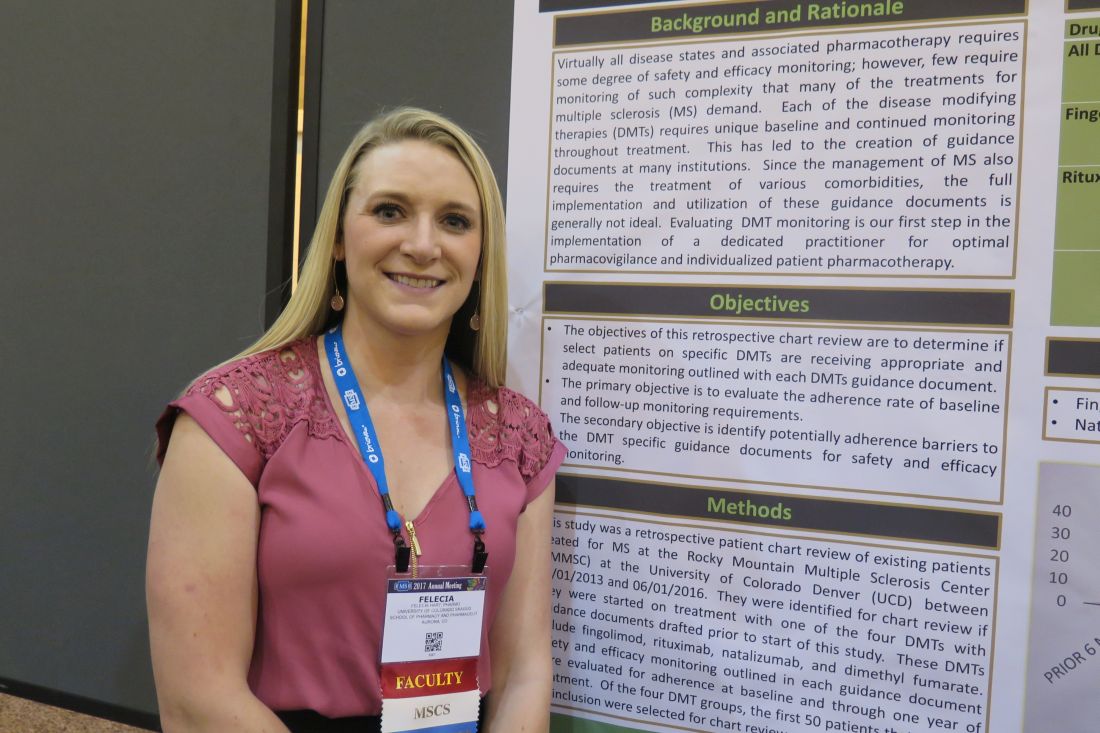
“What we wanted to know was, if patients are getting their infusions or lab work done elsewhere, are we properly documenting it and keeping track of it?” Dr. Hart said in an interview at the meeting. “We’re not looking for core outcomes yet.”
Dr. Hart, a clinical pharmacy neurology fellow at the Skaggs School of Pharmacy and Pharmaceutical Sciences on the University of Colorado Anschutz Medical Campus, reported preliminary results from 50 patients treated with natalizumab and 50 treated with fingolimod. Among those treated with natalizumab, 49 had vitamin D measured within 6 months of drug initiation, 49 had a complete blood count measured within 1 year of drug initiation, and 49 had a comprehensive metabolic panel (CMP) measured within 1 year of drug initiation. “Interestingly, the absent CBC and CMP were from different patients,” she said.
Among patients treated with fingolimod, all had CBC/CMP measured within 1 year of drug initiation, 48 had vitamin D measured within 6 months of drug initiation, and 47 had documented macular optical coherence tomography at baseline, but the proportion of patients who had adequate documentation for other recommended assessments declined significantly. For example, only 19 of 50 had a documented repeat echocardiography within 3 months of drug initiation. Also, several baseline measurements required prior to drug initiation were documented poorly or in an untimely manner. Four patients had their HIV-1 and -2 antibody measured after drug initiation, three had hepatitis B virus surface antigen measured after drug initiation, and three had varicella measured after drug initiation.
Even though the MS center has an electronic medical record system, Dr. Hart and her associates found it difficult to obtain and monitor the parameters of interest. “I’ve been working with our EMR for 6 years, so I know how to navigate it well,” she said. “But I found it difficult to do a simple chart review and find what I wanted to. We have a labs tab in our chart, but the difficulty became including patients who were coming from outside of our center. The lab and the order were referenced in a note but there was never any documentation after that. There are too many holes in getting it documented correctly.”
The findings suggest that having a dedicated clinician such as a clinical pharmacist to oversee pharmacovigilance may improve patient outcomes and ensure that safety and efficacy monitoring doesn’t inadvertently get overlooked because of difficulties with adequate documentation. “That would be ideal,” Dr. Hart said.
She reported having no financial disclosures.
NEW ORLEANS – Safety and efficacy laboratory monitoring of adherence to disease-modifying therapies for multiple sclerosis remains challenging, results from a small pilot study showed.
In an effort to determine if select patients on specific DMTs are receiving appropriate and adequate monitoring as outlined by each DMT’s internal guidance document, Felecia Hart, PharmD, and her associates retrospectively reviewed existing patients treated for MS at the Rocky Mountain Multiple Sclerosis Center at the University of Colorado, Denver, between June 1, 2013, and June 1, 2016.
“What we wanted to know was, if patients are getting their infusions or lab work done elsewhere, are we properly documenting it and keeping track of it?” Dr. Hart said in an interview at the meeting. “We’re not looking for core outcomes yet.”
Dr. Hart, a clinical pharmacy neurology fellow at the Skaggs School of Pharmacy and Pharmaceutical Sciences on the University of Colorado Anschutz Medical Campus, reported preliminary results from 50 patients treated with natalizumab and 50 treated with fingolimod. Among those treated with natalizumab, 49 had vitamin D measured within 6 months of drug initiation, 49 had a complete blood count measured within 1 year of drug initiation, and 49 had a comprehensive metabolic panel (CMP) measured within 1 year of drug initiation. “Interestingly, the absent CBC and CMP were from different patients,” she said.
Among patients treated with fingolimod, all had CBC/CMP measured within 1 year of drug initiation, 48 had vitamin D measured within 6 months of drug initiation, and 47 had documented macular optical coherence tomography at baseline, but the proportion of patients who had adequate documentation for other recommended assessments declined significantly. For example, only 19 of 50 had a documented repeat echocardiography within 3 months of drug initiation. Also, several baseline measurements required prior to drug initiation were documented poorly or in an untimely manner. Four patients had their HIV-1 and -2 antibody measured after drug initiation, three had hepatitis B virus surface antigen measured after drug initiation, and three had varicella measured after drug initiation.
Even though the MS center has an electronic medical record system, Dr. Hart and her associates found it difficult to obtain and monitor the parameters of interest. “I’ve been working with our EMR for 6 years, so I know how to navigate it well,” she said. “But I found it difficult to do a simple chart review and find what I wanted to. We have a labs tab in our chart, but the difficulty became including patients who were coming from outside of our center. The lab and the order were referenced in a note but there was never any documentation after that. There are too many holes in getting it documented correctly.”
The findings suggest that having a dedicated clinician such as a clinical pharmacist to oversee pharmacovigilance may improve patient outcomes and ensure that safety and efficacy monitoring doesn’t inadvertently get overlooked because of difficulties with adequate documentation. “That would be ideal,” Dr. Hart said.
She reported having no financial disclosures.
NEW ORLEANS – Safety and efficacy laboratory monitoring of adherence to disease-modifying therapies for multiple sclerosis remains challenging, results from a small pilot study showed.
In an effort to determine if select patients on specific DMTs are receiving appropriate and adequate monitoring as outlined by each DMT’s internal guidance document, Felecia Hart, PharmD, and her associates retrospectively reviewed existing patients treated for MS at the Rocky Mountain Multiple Sclerosis Center at the University of Colorado, Denver, between June 1, 2013, and June 1, 2016.
“What we wanted to know was, if patients are getting their infusions or lab work done elsewhere, are we properly documenting it and keeping track of it?” Dr. Hart said in an interview at the meeting. “We’re not looking for core outcomes yet.”
Dr. Hart, a clinical pharmacy neurology fellow at the Skaggs School of Pharmacy and Pharmaceutical Sciences on the University of Colorado Anschutz Medical Campus, reported preliminary results from 50 patients treated with natalizumab and 50 treated with fingolimod. Among those treated with natalizumab, 49 had vitamin D measured within 6 months of drug initiation, 49 had a complete blood count measured within 1 year of drug initiation, and 49 had a comprehensive metabolic panel (CMP) measured within 1 year of drug initiation. “Interestingly, the absent CBC and CMP were from different patients,” she said.
Among patients treated with fingolimod, all had CBC/CMP measured within 1 year of drug initiation, 48 had vitamin D measured within 6 months of drug initiation, and 47 had documented macular optical coherence tomography at baseline, but the proportion of patients who had adequate documentation for other recommended assessments declined significantly. For example, only 19 of 50 had a documented repeat echocardiography within 3 months of drug initiation. Also, several baseline measurements required prior to drug initiation were documented poorly or in an untimely manner. Four patients had their HIV-1 and -2 antibody measured after drug initiation, three had hepatitis B virus surface antigen measured after drug initiation, and three had varicella measured after drug initiation.
Even though the MS center has an electronic medical record system, Dr. Hart and her associates found it difficult to obtain and monitor the parameters of interest. “I’ve been working with our EMR for 6 years, so I know how to navigate it well,” she said. “But I found it difficult to do a simple chart review and find what I wanted to. We have a labs tab in our chart, but the difficulty became including patients who were coming from outside of our center. The lab and the order were referenced in a note but there was never any documentation after that. There are too many holes in getting it documented correctly.”
The findings suggest that having a dedicated clinician such as a clinical pharmacist to oversee pharmacovigilance may improve patient outcomes and ensure that safety and efficacy monitoring doesn’t inadvertently get overlooked because of difficulties with adequate documentation. “That would be ideal,” Dr. Hart said.
She reported having no financial disclosures.
AT THE CMSC ANNUAL MEETING
Key clinical point:
Major finding: Among patients treated with fingolimod, only 19 of 50 had a documented repeat ECG within 3 months of drug initiation. Also, several baseline measurements required prior to drug initiation were documented poorly or in an untimely manner.
Data source: Preliminary results from a retrospective review of 50 patients treated with natalizumab and 50 treated with fingolimod.
Disclosures: Dr. Hart reported having no financial disclosures.
Risk tolerance to MS therapies varies widely
NEW ORLEANS – Risk tolerance to current disease modifying therapies by patients with multiple sclerosis varies widely, results from a large national survey demonstrated.
“We have therapies available with a wide range of risks,” study author Sneha Natarajan, PhD, said in an interview at the annual meeting of the Consortium of Multiple Sclerosis Centers. “Some of the risks are relatively minor like injection site reactions or flu-like symptoms and some are as bad as PML [progressive multifocal leukoencephalopathy], which can be fatal. We don’t know what kind of risks people tolerate.”

Dr. Natarajan, research coordinator at the Mellen Center for Multiple Sclerosis at the Cleveland Clinic, reported results from 3,371 survey respondents. Their mean age was 55 years, 93% were white, 61% had the relapsing-remitting form of MS, and 53% were currently taking a DMT. Overall, respondents reported the highest risk tolerance for infection or thyroid risks (1:1,000 for both) and lowest risk tolerance for PML and kidney injury risks (1:1,000,000 for both). Males reported a higher risk tolerance to all six risks (P less than .0001 for all). Females reported a risk tolerance to skin rash that was similar to kidney injury and PML.
“There is a pattern to the risks that our patients accept,” Dr. Natarajan said. “I don’t think a doctor would not recommend a therapy benefit because of a skin rash [risk], but he may need to address the concerns of the patient upfront and have a talk with the patient.”
The researchers also found that current DMT users expressed increased risk tolerance for all outcomes, compared with those not using any DMT (P less than .001). Higher risk tolerance was also expressed by respondents who were older, more disabled, and by those taking infusion therapies.
The National Multiple Sclerosis Society funded the study. Dr. Natarajan reported having no financial disclosures.
NEW ORLEANS – Risk tolerance to current disease modifying therapies by patients with multiple sclerosis varies widely, results from a large national survey demonstrated.
“We have therapies available with a wide range of risks,” study author Sneha Natarajan, PhD, said in an interview at the annual meeting of the Consortium of Multiple Sclerosis Centers. “Some of the risks are relatively minor like injection site reactions or flu-like symptoms and some are as bad as PML [progressive multifocal leukoencephalopathy], which can be fatal. We don’t know what kind of risks people tolerate.”
Dr. Natarajan, research coordinator at the Mellen Center for Multiple Sclerosis at the Cleveland Clinic, reported results from 3,371 survey respondents. Their mean age was 55 years, 93% were white, 61% had the relapsing-remitting form of MS, and 53% were currently taking a DMT. Overall, respondents reported the highest risk tolerance for infection or thyroid risks (1:1,000 for both) and lowest risk tolerance for PML and kidney injury risks (1:1,000,000 for both). Males reported a higher risk tolerance to all six risks (P less than .0001 for all). Females reported a risk tolerance to skin rash that was similar to kidney injury and PML.
“There is a pattern to the risks that our patients accept,” Dr. Natarajan said. “I don’t think a doctor would not recommend a therapy benefit because of a skin rash [risk], but he may need to address the concerns of the patient upfront and have a talk with the patient.”
The researchers also found that current DMT users expressed increased risk tolerance for all outcomes, compared with those not using any DMT (P less than .001). Higher risk tolerance was also expressed by respondents who were older, more disabled, and by those taking infusion therapies.
The National Multiple Sclerosis Society funded the study. Dr. Natarajan reported having no financial disclosures.
NEW ORLEANS – Risk tolerance to current disease modifying therapies by patients with multiple sclerosis varies widely, results from a large national survey demonstrated.
“We have therapies available with a wide range of risks,” study author Sneha Natarajan, PhD, said in an interview at the annual meeting of the Consortium of Multiple Sclerosis Centers. “Some of the risks are relatively minor like injection site reactions or flu-like symptoms and some are as bad as PML [progressive multifocal leukoencephalopathy], which can be fatal. We don’t know what kind of risks people tolerate.”
Dr. Natarajan, research coordinator at the Mellen Center for Multiple Sclerosis at the Cleveland Clinic, reported results from 3,371 survey respondents. Their mean age was 55 years, 93% were white, 61% had the relapsing-remitting form of MS, and 53% were currently taking a DMT. Overall, respondents reported the highest risk tolerance for infection or thyroid risks (1:1,000 for both) and lowest risk tolerance for PML and kidney injury risks (1:1,000,000 for both). Males reported a higher risk tolerance to all six risks (P less than .0001 for all). Females reported a risk tolerance to skin rash that was similar to kidney injury and PML.
“There is a pattern to the risks that our patients accept,” Dr. Natarajan said. “I don’t think a doctor would not recommend a therapy benefit because of a skin rash [risk], but he may need to address the concerns of the patient upfront and have a talk with the patient.”
The researchers also found that current DMT users expressed increased risk tolerance for all outcomes, compared with those not using any DMT (P less than .001). Higher risk tolerance was also expressed by respondents who were older, more disabled, and by those taking infusion therapies.
The National Multiple Sclerosis Society funded the study. Dr. Natarajan reported having no financial disclosures.
AT THE CMSC ANNUAL MEETING
Key clinical point:
Major finding: Survey respondents reported the highest risk tolerance for infection or thyroid risks (1:1,000 for both) and lowest risk tolerance for PML and kidney injury risks (1:1,000,000 for both).
Data source: A survey of 3,371 people who reported having MS.
Disclosures: The National Multiple Sclerosis Society funded the study. Dr. Natarajan reported having no financial disclosures.
Minocycline may delay conversion to MS
Minocycline, an antibiotic that has immune-modulating properties and crosses the blood-brain barrier, appears to delay conversion to multiple sclerosis in patients who have an initial focal demyelinating event, according to a report published online June 1 in the New England Journal of Medicine.
Two small clinical trials involving patients with relapsing-remitting multiple sclerosis (MS) recently showed that minocycline reduces the number of lesions detected on MRI with gadolinium enhancement. So researchers led by Luanne M. Metz, MD, of the Cumming School of Medicine and the Hotchkiss Brain Institute, Calgary, Alta., conducted a randomized, double-blind, placebo-controlled trial at 12 Canadian MS clinics to determine whether the drug might delay conversion to MS after a first, clinically isolated demyelinating event, such as optic neuritis or a brainstem, cerebral, cerebellar, or myelopathy syndrome.
The primary outcome of conversion to MS within 6 months of randomization occurred in 23 (32%) patients taking minocycline, compared with 41 (59%) taking placebo – a difference that exceeded the prespecified clinically meaningful difference between the two groups. After the data were adjusted to account for the number of brain lesions at baseline, the difference in risk at 6 months was 18.5 percentage points, a magnitude of effect that is similar to what has been reported for other therapies such as interferon beta-1b, interferon beta-1a, teriflunomide, and oral cladribine.
The findings were similar in every sensitivity and subgroup analysis. All secondary outcomes, such as the decrease in mean lesion volume and the mean number of new lesions after 6 months of treatment, also favored minocycline over placebo, the investigators said (N Engl J Med. 2017 June 1. doi: 10.1056/NEJMoa1608889).
Minocycline’s neuroprotective effect persisted through 12 months of follow-up, according to a post hoc analysis, but was no longer sustained at 24 months of follow-up, they noted. In addition, post hoc analyses showed that minocycline held no significant benefit over placebo with respect to relapse or disability outcomes at either 6 months or 24 months.
This study was supported by the Multiple Sclerosis Society of Canada. Dr. Metz reported receiving grant support from Hoffmann–La Roche outside of this work; her associates reported ties to numerous industry sources.
The intriguing findings of Metz et al., together with the established safety profile and low cost of minocycline, make a compelling case for more research into the drug’s use in early MS.
However, it would be premature to begin using minocycline for MS until its benefits can be confirmed in larger and longer-term clinical trials.
Zongqi Xia, MD, PhD, is in the Program in Translational Neurology and Neuroinflammation at the Pittsburgh Institute of Neurodegenerative Diseases and at the Institute of Multiple Sclerosis Care and Research at the University of Pittsburgh. Robert M. Friedlander, MD, is in the Neuroapoptosis Laboratory and the department of neurosurgery at the University of Pittsburgh. They reported having no relevant financial disclosures. Dr. Xia and Dr. Friedlander made these remarks in an editorial accompanying Dr. Metz and colleagues’ report (N Engl J Med. 2017 June 1. doi: 10.1056/NEJMe1703230).
The intriguing findings of Metz et al., together with the established safety profile and low cost of minocycline, make a compelling case for more research into the drug’s use in early MS.
However, it would be premature to begin using minocycline for MS until its benefits can be confirmed in larger and longer-term clinical trials.
Zongqi Xia, MD, PhD, is in the Program in Translational Neurology and Neuroinflammation at the Pittsburgh Institute of Neurodegenerative Diseases and at the Institute of Multiple Sclerosis Care and Research at the University of Pittsburgh. Robert M. Friedlander, MD, is in the Neuroapoptosis Laboratory and the department of neurosurgery at the University of Pittsburgh. They reported having no relevant financial disclosures. Dr. Xia and Dr. Friedlander made these remarks in an editorial accompanying Dr. Metz and colleagues’ report (N Engl J Med. 2017 June 1. doi: 10.1056/NEJMe1703230).
The intriguing findings of Metz et al., together with the established safety profile and low cost of minocycline, make a compelling case for more research into the drug’s use in early MS.
However, it would be premature to begin using minocycline for MS until its benefits can be confirmed in larger and longer-term clinical trials.
Zongqi Xia, MD, PhD, is in the Program in Translational Neurology and Neuroinflammation at the Pittsburgh Institute of Neurodegenerative Diseases and at the Institute of Multiple Sclerosis Care and Research at the University of Pittsburgh. Robert M. Friedlander, MD, is in the Neuroapoptosis Laboratory and the department of neurosurgery at the University of Pittsburgh. They reported having no relevant financial disclosures. Dr. Xia and Dr. Friedlander made these remarks in an editorial accompanying Dr. Metz and colleagues’ report (N Engl J Med. 2017 June 1. doi: 10.1056/NEJMe1703230).
Minocycline, an antibiotic that has immune-modulating properties and crosses the blood-brain barrier, appears to delay conversion to multiple sclerosis in patients who have an initial focal demyelinating event, according to a report published online June 1 in the New England Journal of Medicine.
Two small clinical trials involving patients with relapsing-remitting multiple sclerosis (MS) recently showed that minocycline reduces the number of lesions detected on MRI with gadolinium enhancement. So researchers led by Luanne M. Metz, MD, of the Cumming School of Medicine and the Hotchkiss Brain Institute, Calgary, Alta., conducted a randomized, double-blind, placebo-controlled trial at 12 Canadian MS clinics to determine whether the drug might delay conversion to MS after a first, clinically isolated demyelinating event, such as optic neuritis or a brainstem, cerebral, cerebellar, or myelopathy syndrome.
The primary outcome of conversion to MS within 6 months of randomization occurred in 23 (32%) patients taking minocycline, compared with 41 (59%) taking placebo – a difference that exceeded the prespecified clinically meaningful difference between the two groups. After the data were adjusted to account for the number of brain lesions at baseline, the difference in risk at 6 months was 18.5 percentage points, a magnitude of effect that is similar to what has been reported for other therapies such as interferon beta-1b, interferon beta-1a, teriflunomide, and oral cladribine.
The findings were similar in every sensitivity and subgroup analysis. All secondary outcomes, such as the decrease in mean lesion volume and the mean number of new lesions after 6 months of treatment, also favored minocycline over placebo, the investigators said (N Engl J Med. 2017 June 1. doi: 10.1056/NEJMoa1608889).
Minocycline’s neuroprotective effect persisted through 12 months of follow-up, according to a post hoc analysis, but was no longer sustained at 24 months of follow-up, they noted. In addition, post hoc analyses showed that minocycline held no significant benefit over placebo with respect to relapse or disability outcomes at either 6 months or 24 months.
This study was supported by the Multiple Sclerosis Society of Canada. Dr. Metz reported receiving grant support from Hoffmann–La Roche outside of this work; her associates reported ties to numerous industry sources.
Minocycline, an antibiotic that has immune-modulating properties and crosses the blood-brain barrier, appears to delay conversion to multiple sclerosis in patients who have an initial focal demyelinating event, according to a report published online June 1 in the New England Journal of Medicine.
Two small clinical trials involving patients with relapsing-remitting multiple sclerosis (MS) recently showed that minocycline reduces the number of lesions detected on MRI with gadolinium enhancement. So researchers led by Luanne M. Metz, MD, of the Cumming School of Medicine and the Hotchkiss Brain Institute, Calgary, Alta., conducted a randomized, double-blind, placebo-controlled trial at 12 Canadian MS clinics to determine whether the drug might delay conversion to MS after a first, clinically isolated demyelinating event, such as optic neuritis or a brainstem, cerebral, cerebellar, or myelopathy syndrome.
The primary outcome of conversion to MS within 6 months of randomization occurred in 23 (32%) patients taking minocycline, compared with 41 (59%) taking placebo – a difference that exceeded the prespecified clinically meaningful difference between the two groups. After the data were adjusted to account for the number of brain lesions at baseline, the difference in risk at 6 months was 18.5 percentage points, a magnitude of effect that is similar to what has been reported for other therapies such as interferon beta-1b, interferon beta-1a, teriflunomide, and oral cladribine.
The findings were similar in every sensitivity and subgroup analysis. All secondary outcomes, such as the decrease in mean lesion volume and the mean number of new lesions after 6 months of treatment, also favored minocycline over placebo, the investigators said (N Engl J Med. 2017 June 1. doi: 10.1056/NEJMoa1608889).
Minocycline’s neuroprotective effect persisted through 12 months of follow-up, according to a post hoc analysis, but was no longer sustained at 24 months of follow-up, they noted. In addition, post hoc analyses showed that minocycline held no significant benefit over placebo with respect to relapse or disability outcomes at either 6 months or 24 months.
This study was supported by the Multiple Sclerosis Society of Canada. Dr. Metz reported receiving grant support from Hoffmann–La Roche outside of this work; her associates reported ties to numerous industry sources.
FROM THE NEW ENGLAND JOURNAL OF MEDICINE
Key clinical point:
Major finding: The primary outcome, conversion to MS within 6 months of randomization, occurred in 23 (32%) patients taking minocycline, compared with 41 (59%) taking placebo.
Data source: A multicenter, randomized, double-blind, placebo-controlled trial involving 142 adults treated for up to 24 months.
Disclosures: This study was supported by the Multiple Sclerosis Society of Canada. Dr. Metz reported receiving grant support from Hoffmann–La Roche outside of this work; her associates reported ties to numerous industry sources.